Rice Parade

In my mind, few foods are as simply clean and perfect as a pot of perfectly cooked rice. If foods were chosen to embody colors, rice would be the perfect candidate for whiteness. Think about it. Freshly made, just off the heat, the first time you fluff it to break up some of the clumps, it’s like little pillows. It smells comforting and grainy and nutty and warm, it’s stuffed in heating pads and pillows, it’s thrown at weddings, it’s an amazing little miracle all on its own – tiny individual grains, hard and pointed, but after 20 minutes in bubbling water they magically become this beautiful, warm, sticky heap of comfort. You can do anything with them, but why would you? How can you possibly improve upon the perfection of a fresh, hot, sticky/chewy/creamy/nutty pot of white rice?

By turning it into pudding.

I’ve never liked the look of those stovetop rice puddings that are soupy and goopy – almost like the consistency of hot cereal. No, when I think pudding, I want something that sets up firm and has to be broken through with a spoon, not just scooped up. I want a custard. Given our crazy weather today, my mom’s amended rice pudding recipe is perfect.

Cook two cups of raw rice in a pot on the stovetop until done, then take the pot off the heat, remove the lid, and let the rice cool.

In a large casserole dish combine:

3 eggs, beaten

3 cups milk

¾ cups sugar

1 ½ tsp. vanilla

¾ cups raisins

1 generous tsp. cinnamon

Cooled, cooked rice

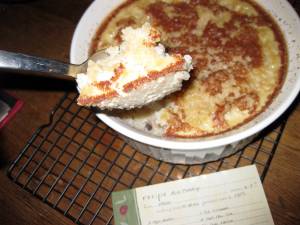
Place casserole dish in another larger, shallow dish (I use a glass pie plate) and fill the shallow dish about halfway with hot water. Cook, uncovered, in a preheated 350 degree oven for 45-60 minutes, or until custard is just set. Remove from oven. Cool. Consume.
img_0311

Soy love story

During my first year off from college, I lived in a house full of girls. There were five of us. Even if I wasn’t now happily married, I would never do that again. Too many showers, too many door slams, too much food in the fridge. Have you ever tried to contain all of your perishable food in one fifth of the refrigerator? There’s no division by product, there’s no organization, just a crowded heap of undifferentiated ingredients.

While living in this harem, however, my closest friend in the house was vegetarian, and made great use of that one product so often labeled as simply a vegetarian food item and shoved by the rest of us omnivores into a back, ignored corner of the fridge of life: tofu. I had never dealt with the stuff before, and was slightly mystified by its enigmatic properties. My friend, over the course of several “housemate date nights” that inevitably incorporated deliciously good food and deliciously bad TV, showed me the way.

img_0304

Step one: cut extra-firm tofu into squares (I use a 14 oz. block and usually cut 4x6x2, or whatever looks like a nice bite-size piece). Marinate tofu squares in soy sauce for ten or fifteen minutes (again, rough estimate, but I’d say these guys are sharing about ½ cup of tamari).

Step two: strain tofu squares and toss them in a light coating of brewers’ or nutritional yeast. Small flake is preferable, but large flake works fine too in a pinch. Nutritional yeast is usually available in grocery stores that have a bulk bin section.

Step three: sauté tofu in several tablespoons of very hot oil in a wok or frying pan. Don’t scramble it around too much because the coating of yeast will fall off and a major part of the flavor will be lost to the bottom of the pan. This sautéing (or stir-frying, if you prefer) process always takes longer than I expect it to. Be patient. Allow the squares to develop a dark golden color and a firm crust around the outside. When they are done, they will look like little croutons, but the taste is infinitely more complex and interesting and, of course, different given the soft tofu center of these squares of delight.

img_0309

I’ve enjoyed these in Pad Thai, stir fries, on baked potatoes, and inevitably plain and scorchingly hot right out of the frying pan. They add a deep, earthy, salty flavor. There is something very pleasurable about eating them, because the outside takes on a texture somewhere between crunchy and chewy for your teeth to play with, and the inside just melts away. N. claims they are delicious with beer, which makes sense, considering that they are crusted in yeast. Tonight’s application? I’m thinking fried rice.

The interesting thing about this recipe was that my housemate never had to find room to store any leftovers in our fridge. We always ate them all.