The Buttercream Problem

Folks, I have a problem.  It’s called buttercream.

I’ve been offered the great privilege of making a wedding cake for some dear friends who are tying the knot this summer.  I’ve never made a wedding cake before.  I’ve made a lot of cakes, most of them chocolate (in truth, most of them this one), but this is the big time.

I know the cake itself is going to be champagne.

I know the filling is going to be a lovely light whipped mascarpone cream, possibly dotted with fresh raspberries.

I suspect the frosting needs to be buttercream, because the bride wants to cover the cake in fondant (it’s going to be hot, it’s a cleaner look, it can be painted on with beautiful blue coloring).  But just in case I get good enough at smoothing out the buttercream, maybe we can just leave it at that.

I’ve done one practice run, for a small New Year’s Eve party we hosted (the wedding is in July, so there’s some time here).  The cake was delicious.  The filling was amazing.  The frosting was…

a disaster.

It was a simple American buttercream containing butter, powdered sugar, vanilla, and a splash of champagne to go with the cake flavor.  I think the butter was too cold.  I think the powdered sugar wasn’t well sifted.  I think proportions were off.  The resulting frosting was gloppy and grainy and oozing, and when I spread it on the cake it clumped and ran and blubbered down the sides. You know how jeans that are too long for you puddle around your feet at the bottom?  Now imagine that in white, and made out of frosting, and on my cake.  That’s what it looked like.

When I was too frustrated to look at it anymore, I stuck it in the fridge for a while, hoping it would harden up a bit so I could spread it with more success.  While that happened, I mixed some blue gel food coloring into the remaining bowl of frosting and whipped that up, in hopes that a few rosettes on top of the cake would save it a little.

An hour later, I took on the icing again.  I scraped off some of the worst slumps and filled up my piping bag with the beautiful blue I’d created.  With a star tip, I piped on a rosette.  It dissolved into a blob and blurbed toward the edge of the cake.  I somehow lost touch with reality and instead of trying to scrape it off, I made four more around the cake.  They all slumped over the edge.  I tried to pipe a pretty pattern around the bottom edge.  It looked like a long ribbon of blue poo.  I shoved the cake back into the fridge and drank a couple of glasses of champagne before serving it. It was New Year’s Eve.  It was clearly the right thing to do.

So here’s the issue: I have to make a better buttercream.  I’ve done some research and found some killer looking recipes.  I’m planning to use champagne extract instead of actual champagne to avoid any issues with acidity or carbonation.  I’m planning to use fully softened butter.  I’m contemplating blending in some mascarpone to add body and lessen the overwhelming sweetness buttercream can have.

But I’ve also seen conflicting theories about how much milk to add during the whipping process and how long to whip and whether or not to add shortening so the color is a little whiter.  I’ve seen seen creamy dreamy looking recipes for Italian and Swiss buttercreams.  I’m in a buttercream frosting float.  Or, rather, I’m floating in ideas about buttercream frosting.

So I’m looking to you, tiny multiverse of readers.  Have you made buttercream?  How did it turn out?  What recipe did you use?  Was it American, Italian, or Swiss?  Did it spread smoothly?  Was it overly sweet?

Help!

Revisions

At this point in the dissertation process, I am nearing the point where the researching will be finished, the drafting will be done, and the most hated part will begin: revision. Sometimes things don’t seem to need to change – to have a new vision, a “re” vision, is a strange and uncomfortable thing. It’s a painful process to re-imagine arguments, to rephrase key passages, whether they are written eloquently or clumsily. Cutting out words, sentences, whole paragraphs deemed “unnecessary” or “wordy” is as painful as amputation at the worst, and stings like picking a scab at best. Adding in new material and knitting new transitions is almost as bad. And at the end, you give it away to be read by others, who tell you what else needs to be done with it. There isn’t, at this stage, much savoring.

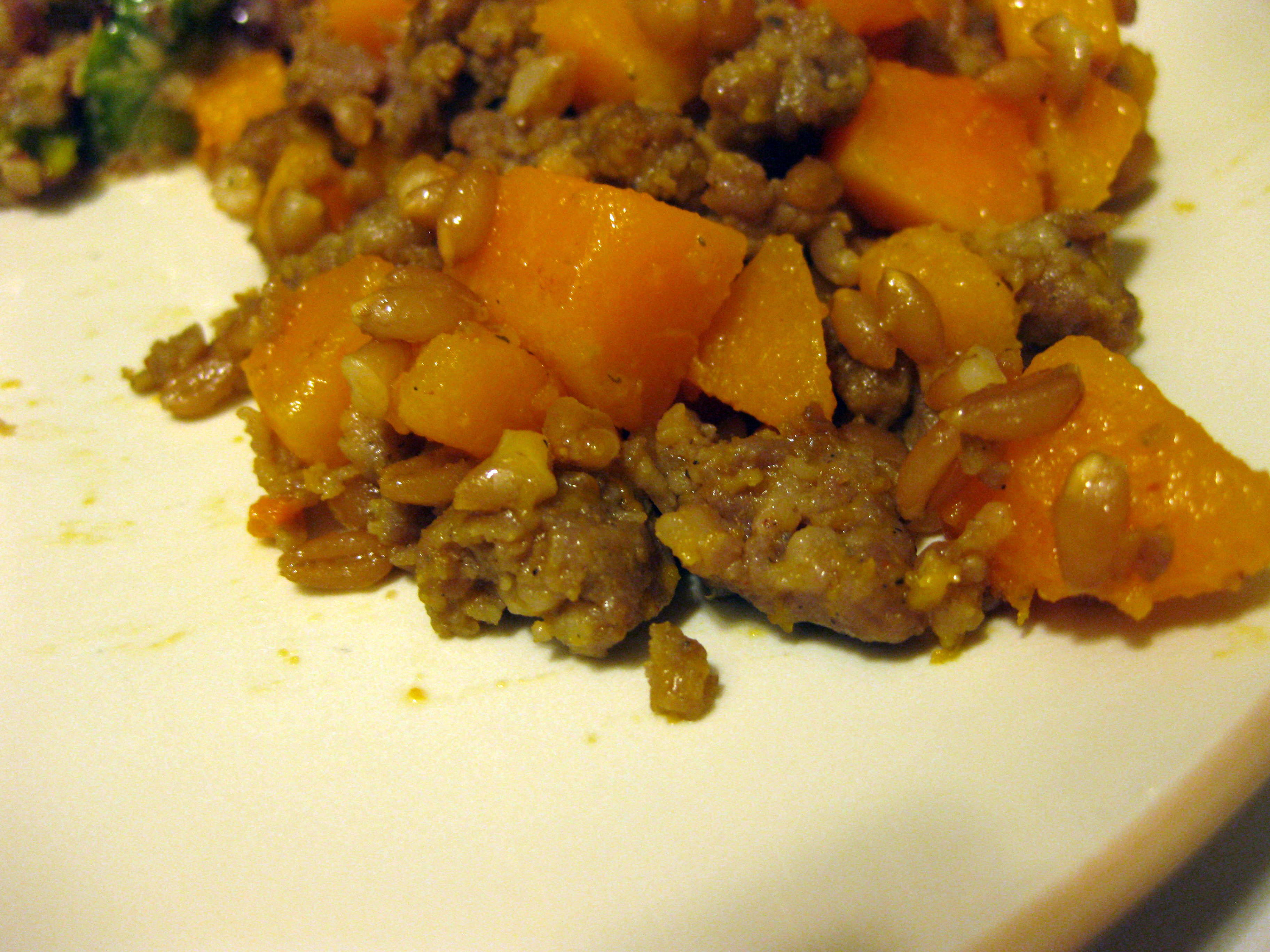
Thank goodness cooking isn’t like that. I love revising what I’ve done in the kitchen. So here, instead of telling you what I did (which involved undercooked ingredients and a side of roasted brussels sprouts in gorgonzola sauce), I’m going to tell you what I should have done. I’m going to tell you how to make this Bittman dish into a fantastic breakfast-for-dinner hash.

37. Sauté crumbled sweet Italian sausage with cubes of butternut squash in a bit of oil. Toss in cooked farro and dress with more oil and lemon juice. Serve as a salad or toss with grated Parmesan and use as a stuffing.

Here’s how it should have gone down:

1 cup emmer farro

2 cups water

4 cups chicken or vegetable broth

1 small butternut squash, peeled, seeded, and cut into 1-inch chunks

16 oz. pork sausage

4 eggs, or as many people as you intend to serve

2 cups baby spinach or chopped kale leaves, hard stems removed

Juice from ½ a lemon

Salt and pepper to taste

The night before you want to eat this, put the farro in a pot with the water and leave it overnight. This starts to break down the grains.

After the farro has soaked overnight (and most of the next day probably won’t hurt), add it to boiling broth and simmer for two hours, or until the grains have bloomed and softened. In the last few minutes, add the spinach or kale and cook just until wilted. The farro will still be a bit crunchy, and may or may not have absorbed all the broth. If not, drain the pot and set aside.

While the farro cooks, preheat the oven to 400F. Toss the butternut squash chunks with olive oil, salt and pepper, and roast until the squash is tender.

In a large skillet over medium heat, crumble and brown the sausage. When it is fully cooked, drain off some of the grease, then add the farro, greens, and squash to the skillet and toss together, just to let the grains and vegetables soak up some of the sausage fat and flavor. Squeeze in the lemon juice and season to taste with salt and pepper.

In another, smaller skillet, heat the reserved sausage grease and fry your eggs sunny side up, until the yolks are barely runny and the whites’ edges are frizzled and beautifully brown.

Serve your hash with a fried egg on top.  With a side of sourdough toast rubbed with garlic, if you like.  Let the yolk mix with the squash and sausage and hearty grain.  It won’t take much; you’ll quickly be full. Full of warmth and goodness. It’s the right kind of meal for winter.

Sick soup

Clearly the past week did not go as planned. No Bittman posts appeared here, and no new recipes were made. Until today at lunch.

I don’t get sick very often. When I do, it’s usually a head cold that lasts mayyyyybe three or four days until I get frustrated with it and flood myself with so much liquid that the cold just gets flushed right out of me. This week was different. I don’t know whether this thing that hit me was cold or flu, but it knocked me over, dragged me around for a while, and then pummeled me almost senseless.

My wonderful husband has been nursing me on simple, nutritious dinners and generally keeping me out of the kitchen, which has been a strange experience. But as this morning wound to a close, with husband and dog-daughter out on a walk, I was suddenly struck with a craving for – of all things – Cup’o’noodle soup. You know, the kind in the styrofoam cup with the peel-back paper top, packed with noodles and freeze-dried vegetables and crusty little shrimp? Yeah, I wanted that for the first time in probably ten years. Maybe more.

Of course we don’t have Cup’o’noodle in the house. But we did have frozen turkey broth, made from the carcass of our Thanksgiving turkey. And I had the memory of my friend M.’s suggestion for “garlic tea” as a cold remedy. I went to work in slow, hobbling steps.

In a pot, I put:

3 cups turkey broth (shlooped out of a freezer container in one icy cylinder)

6-10 cloves of garlic, well smashed

2-inch knob of ginger

½ tsp red chili flakes

I turned the heat up and let this come to a boil, where I left it rolling for about 10 minutes to let the garlic and ginger flavors really permeate the broth.*  Then I added:

1 cup loosely packed torn kale leaves

1-2 TB soy sauce

¼ lemon (I squeezed out the juice and then added the wedge of lemon as well)

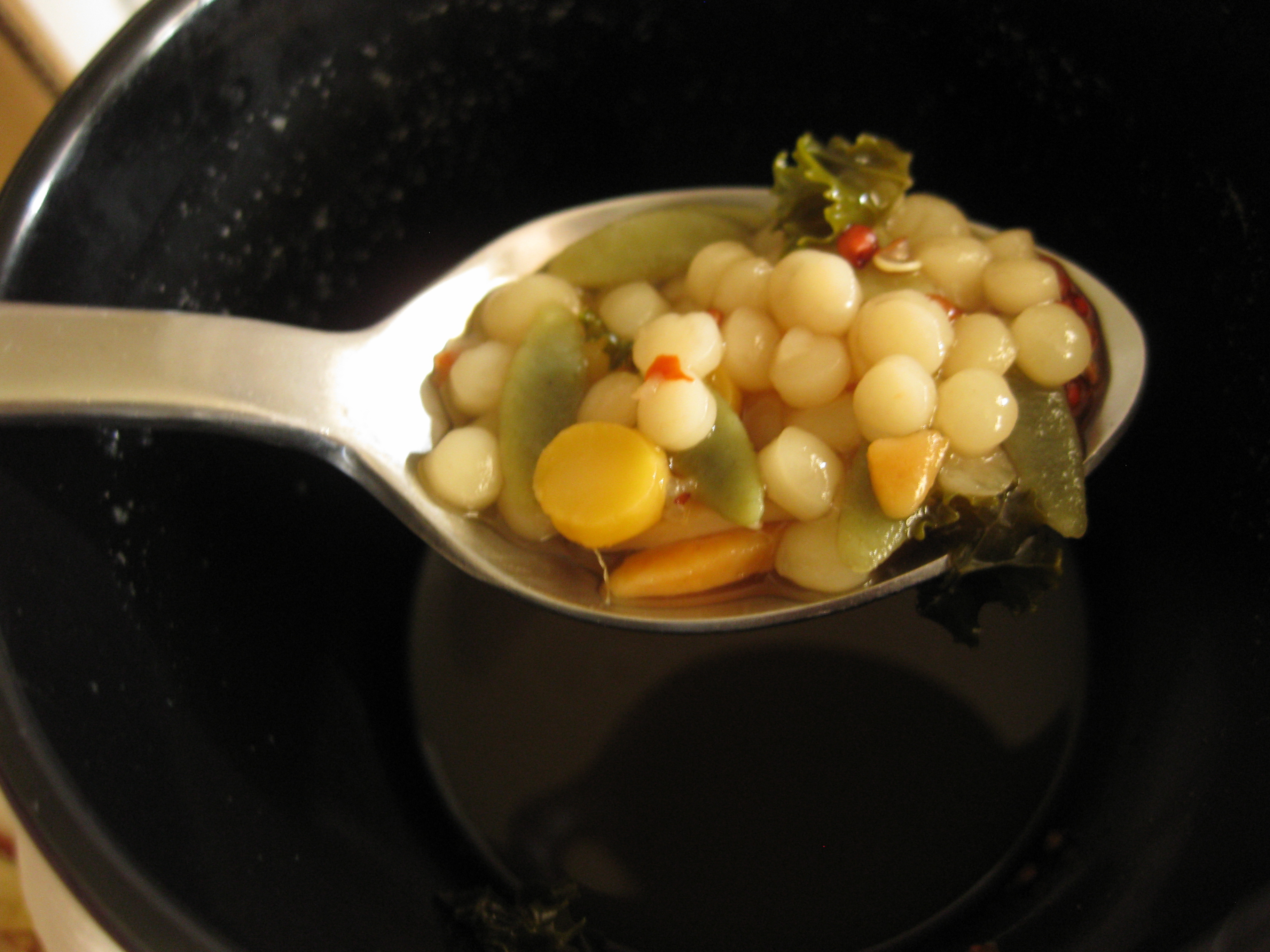
½ cup Trader Joe’s harvest blend (Israeli couscous, split peas, red quinoa, and orzo)

I let this simmer away for 10-15 minutes, until the kale was wilted and the grains were cooked.

Then I ate the whole pot. 

It was delicious. It wasn’t the over-salted, noodle-y guilty-awesome of Cup’o’noodle, but it was comforting and satisfying and spicy and rich and felt healthy. The lemon juice added a necessary brightness, and the grains blend made it filling enough for lunch. The garlic, the ginger and the chili flakes all have their own kind of spiciness, and all were welcome and throat-soothing and tummy-warming.

If you’re not feeling well (or even if you are!), make yourself a pot of this. To bulk it up, add more grains, or sub that out for noodles, or add some pre-cooked shredded chicken or squares of tofu. If you don’t like kale, add some spinach in the last five minutes instead. Using vegetable broth would easily make this vegetarian and vegan, and using tofu or rice noodles instead of the grains blend would easily make this gluten-free.


* At this point, you could strain out the garlic and ginger, and add the vegetables and grains to a clear broth. I didn’t, but then again, I’m the sicko.

With firm resolve?

Last night, at a New Year’s Eve party for which the unintentional theme appeared to  be cheese (brie en crout!  Hot artichoke parmesan dip!  Goat cheese with fig butter!), S. asked each guest if he or she had New Year’s resolutions.  When it was my turn, I was filled with bleary uncertainty.  The fact that I’m an academic always makes the new year an odd event, because regardless of what the calendar says, my new year starts in September.  That’s when I go back to school and to teaching.  January 1st happens in the middle of the term break, and though I have a new class of students when I return, it’s still the same school year.  So school-related resolutions don’t seem appropriate.  I’m not going to resolve to complete my dissertation, though that will get done.  It’s not really a resolution because it’s not a decision I’m changing.  It’s a set-in-stone-requirement for me, at this point.  I’m not going to resolve to get a job, because I’ve done what I can to help that happen, and now it’s out of my hands.

And then the Bittman project drifted into my mind.  With the dissertation winding down (amazing what a few afternoons of post-Christmas reading at the in-laws’ will do for brainstorming!) and my on campus schedule quite manageable this term, I feel a slow and only slightly unsteady confidence that I can inject enough regularity into my weeks this term for blogging to take place.  That and getting my year end report from WordPress yesterday made me feel a certain hunger to get back to my regular schedule here.

So that’s my resolution: I will finish the Bittman project.  The original list of sides was 101 items.  Eliminating those I knew N. and I would never eat, we began with 82.  Last year I made 39 of those, including one about which I hope to post sometime this week.  I know, pitiful.  So that leaves 43.  Doable, right?  Less than one a week, especially if I get my act together and double up occasionally.

It feels a little sad to be resolving to complete my unfinished resolution from last year, but I guess that’s what a lot of people do with these things: lose weight, get in shape, year in and year out.  Here I have exact numbers, exact quantities of what must be done.  Exact numbers of soups, chutneys, relishes, salads, desserts and breads and sides.  And so we’ll plow on!

Happy 2012, everyone.  May your resolutions bear fruit.