The Week of Magical Eating: Day One

With my exam over, and firm commands from my adviser to give myself a break for a week or two (she said a month, but she and I are both too dedicated and both such workhorses that I doubt that will happen), I can concentrate on the important things: food, and husband.  Fortunately, since he needs to be fed, these important things can work in tandem.  So I send my apologies to Joan Didion, and promise to report to you a Week of Magical Eating.  Some dishes will be fancy, fresh, and well prepared.  Some will probably be valiant attempts to use up leftovers.  Either way, I will try to check in with my results.

Day one, yesterday, also happened to be Valentine’s Day.  Neither N. nor I particularly support this Hallmark holiday, likely as a result of residual bitterness before meeting one another and deciding that no one but each other should ever be subjected to either of us again.  However, thanks to my rapidly ebbing stress and rising ability to enjoy normal activities like shopping and cooking without feeling guilt about not studying, I was able to secure ingredients for dinner on the special side.  Not for VDay, but for each other.

As a congratulatory gesture for passing my exam, one of my officemates gave me the ingredients for Kir Royale: champagne and crème de cassis.  This blackcurrant liquor smells sweet with the promise of a bite.  Mixed with champagne, it was much less sweet than I had imagined; my taste buds were prepared for something dessert-like, but the mix was delicious and fresh, and the color was appetizing too.

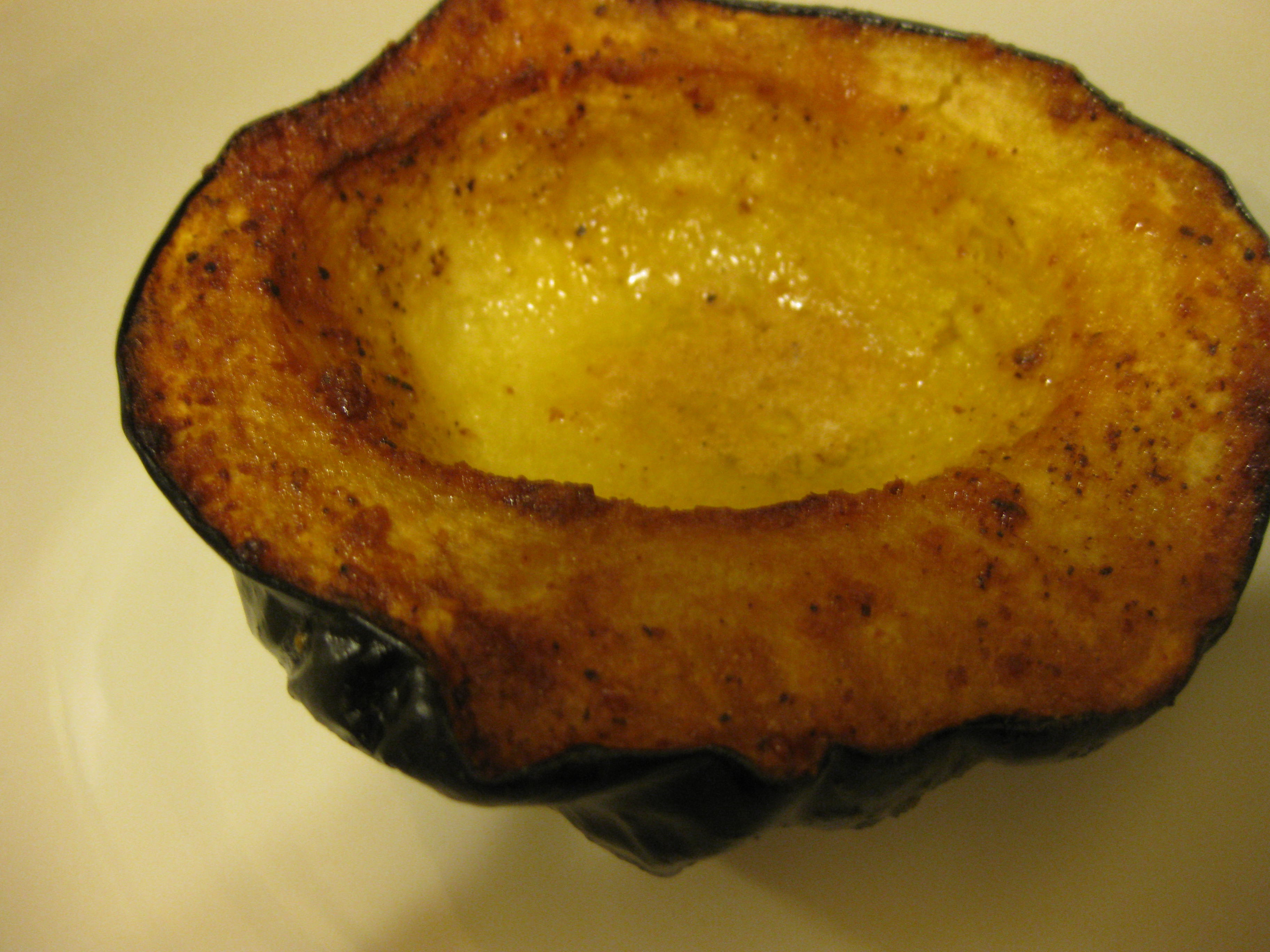
With our aperitifs poured, and an acorn squash halved, liberally basted with butter, honey, mustard, and shoved unceremoniously into the oven, I embarked on Jaime Oliver’s spinach and goat cheese risotto.  I’ve made this dish before, and was craving its fresh green notes and rich tanginess.  To make things extra special, and since between the two of us on a Sunday night we deemed it unwise to drink an entire bottle-o’-bubbly, I used champagne instead of white wine to deglaze my risotto pan after lightly toasting the rice and onions.  In the end result I couldn’t taste a difference, but I like to think the champagne contributed to the light tang of the final dish.

Piled high on a plate, it was creamy, it was luscious, with pockets of goat cheese slowly melting in amidst the kernels of rice that never lose their bite completely.  The acorn squash as a vegetable side, though it has a completely different flavor profile, works nicely with this risotto, I think, in part because the color contrast is so striking.  After an hour in the oven, the rind gets thin, flexible and yet crackling at the same time, and if you don’t mind burning the tips of your fingers, you can hold the caramelized edges with one hand while you scrape the flesh out with a spoon held in the other.

Nothing bitter here.  Honey, crème de cassis, goat cheese, sweetness layered on sweetness, but not enough to be cloying.  Exactly, perhaps, how Valentine’s Day ought to be.

Focaccia for the win

I have mentioned before, on this very blog, that I am afraid of yeast.  However, as it has surely become clear by now, I love baking.  It was only a matter of time before these two truths collided and a new truth was constructed.  As I told my students only a few days ago, it was not always a “truth” that our solar system was heliocentric.  They grudgingly accepted this, but I now elatedly announce that I am no longer afraid of yeast!  Perhaps a bit timid, a bit guarded still, but not afraid.  What has changed, you ask?

This is a rosemary olive oil focaccia-style loaf from a cookbook put out by Food and Wine Magazine that I finally got up the guts to try out.  I learned three things by making it: 1.) yeast is not as easy to screw up as I thought; 2.) following directions is smart; and 3.) the way to a man’s heart may really be through his stomach.  At least if he shares a last name with my husband.

While this bread was not difficult to make, I think it would have been better if I had read the recipe more carefully.  After assuming I had killed my yeast when it all sank in the warm water I sprinkled it over, I didn’t bother to knead the dough before setting it aside to rise.  Then I baked it at the wrong temperature and despaired when it didn’t seem done before realizing my mistake.  And after all that, it was still delicious.

The bottom half inch or so was denser than the rest of the loaf, and I don’t know why that happened, unless it was related to my inability to read the directions the first time through.  But it was really, very good.  The olive oil made the texture pleasant – moist and chewy, and the rosemary contributed a nice, herby, woodsy flavor that contrasted well against the brisk brightness of the sea salt that also flavored the bread.  It is amazing how something with so few ingredients (flour, yeast, oil, water, salt, rosemary, and cornmeal) can have so much flavor.  And excitingly, as the recipe itself declares, this bread has endless flavor combination possibilities.  Next time I think I will add chopped kalamata olives.  N. agrees.

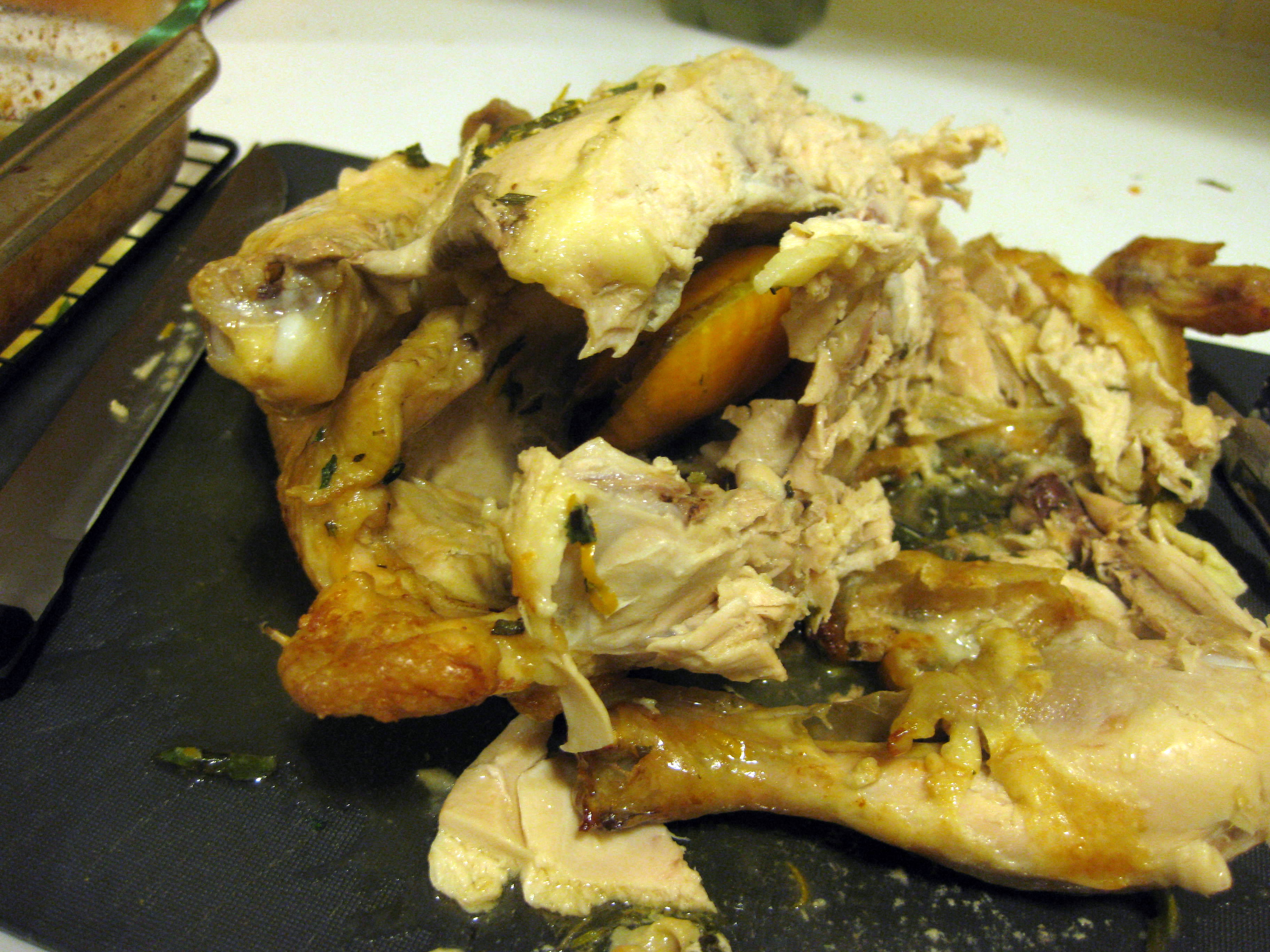
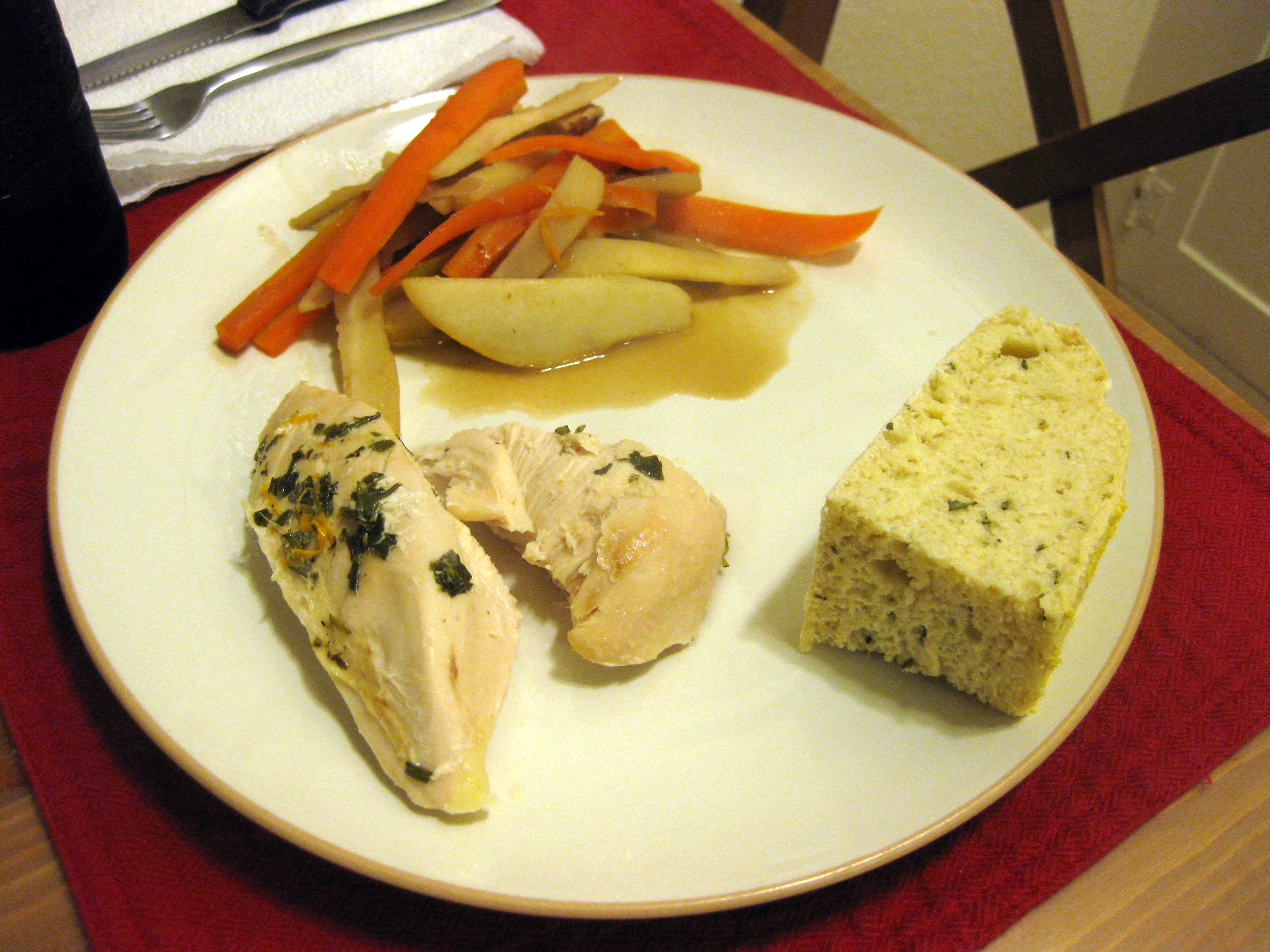
What was really glorious about this bread was how well I managed to combine and link flavors in the dinner that went with it.  We had a roast chicken and a vegetable side to go along with my yeasty triumph, and in the choices of aromatics I was able to clearly connect each dish.  The bread contained rosemary, and so when I made an herbed butter rub to massage under the chicken’s skin, I included plenty of fresh rosemary.

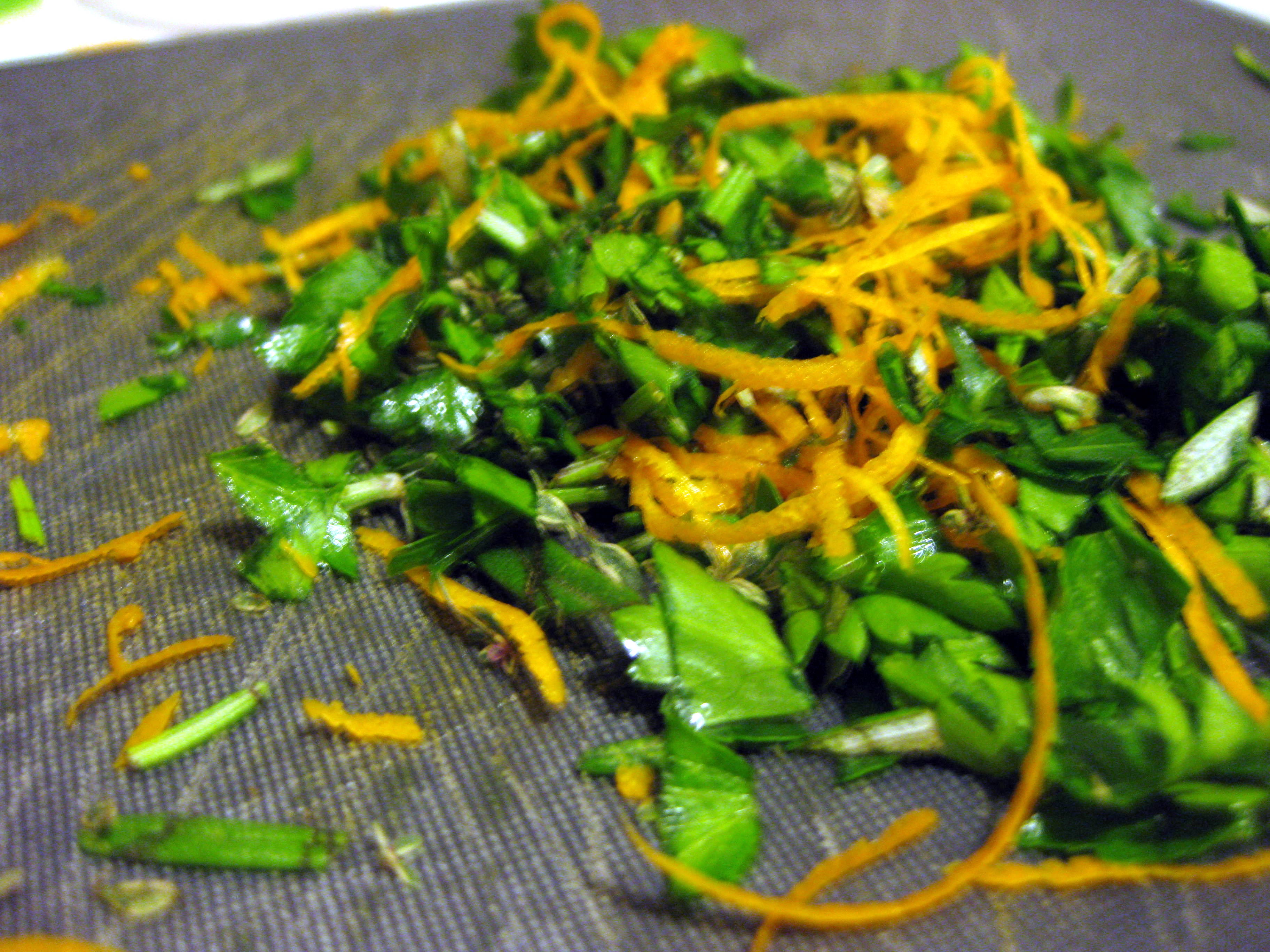
Our vegetable side consisted of glazed carrots, parsnips and pears with craisins and pecans.  Since the glaze was mostly orange juice, I added orange zest to my chicken herb rub and stuck a few orange slices inside the cavity of the chicken before it went in to roast.  If I had remembered in time, I would have added orange zest to the bread dough as well, to really link all three elements together.

The orange did, I think, add a delicate sweetness to the chicken, though I’m not sure it was recognizably citrus.  I think lemon would be more identifiable.  But the butter made even the white meat of the chicken tremendously succulent, and the herbs and garlic definitely added a punch and depth to the flavor.

The veggies were rich with autumnal flavors, and while I enjoyed them, I think they would match better with a pork or turkey main rather than chicken.  In fact, they might be delicious as a vegetable dish for Thanksgiving; the craisins make that an easy link-up.  Since carrots and pears are already sweet, the craisins and pecans were a natural pairing.  I always think pecans have a kind of caramel or molasses-like smokiness to them, which seemed to work very well with the herby, spicy notes of the parsnips.

Given that somewhat wild flavor the parsnips impart, a strongly spiced root beer or sarsaparilla might make a fitting non-alcoholic beverage pairing to this meal, or maybe even a ginger ale like Blue Sky that prides itself on natural flavors.

So let’s take a moment here and reflect: Roast chicken, glazed vegetables, and homemade bread.  Two of these three dishes required advanced planning and multiple stages, and then (as per usual, these days) I made broth from the chicken carcass after it was picked clean, with plans already in mind for the leftovers.  Long cooking times, “complex” procedures, and making use of every part of the meal.  If that doesn’t say Sally Homemaker to you, I don’t know what does.  All I can say is: I promise that I did not wear pearls while I cooked this meal.

Christmas 2009: Gluttony

Medieval theology and philosophy usually cites Gluttony as the least series of the seven deadly sins.  In the division of types, it is one of the sins of the flesh (along with lust), and it is easily conquered through abstinence.  You know, the kind so many people embark on after the New Year.  Call it a resolution.

Medieval theologians and philosophers never saw these:

These individual bittersweet chocolate soufflés provided the dessert course to our hors d’oeuvre dinner.  Our dear family friend L. brought them, and baked them in our oven just prior to serving so we would have as fluffy and elevated a puff as possible.  She was wise to do so.  Just look at that gorgeous height!  The cracked tops provided a lot of textual diversity, which was lovely because the insides were so luscious and creamy and rich.

We served these miniature masterpieces with a generous dollop of whipped cream and a sprig of spearmint, which I happened to have in the kitchen leftover from spring roll production.

They were a really nice, sophisticated blend of flavors.  Because the chocolate was bitter- to semi-sweet, the richness of the soufflé wasn’t overwhelming.  In fact, the whipped cream leant a very pleasant sweetness to the dish itself.  L. added orange zest to the batter for that classic combination, which emerged only as a subtle undertone, very complementary to the relative bitterness of the chocolate.  It was like a grown-up throwback to those chocolate oranges that you smack on a table and then unwrap to reveal perfectly molded segments.  There were nine of us.  There were nine soufflés.  We only managed to eat about six of them because they were so decadent, so rich while curiously so airy, and so sinful feeling only moments after that last loving lick of the spoon.

I fell asleep dreaming about the leftovers.  The next morning after a triumphant gift-exchanging ceremony, the Husband and I jetted off to spend the big day with his family, while my sister and her boyfriend did the same.

N.’s family does a very traditional style Christmas dinner after the fashion of a traditional Thanksgiving dinner: an enormous turkey, dressing, mashed potatoes, the works.  It kept our dog’s nose, and desires, busy all day.

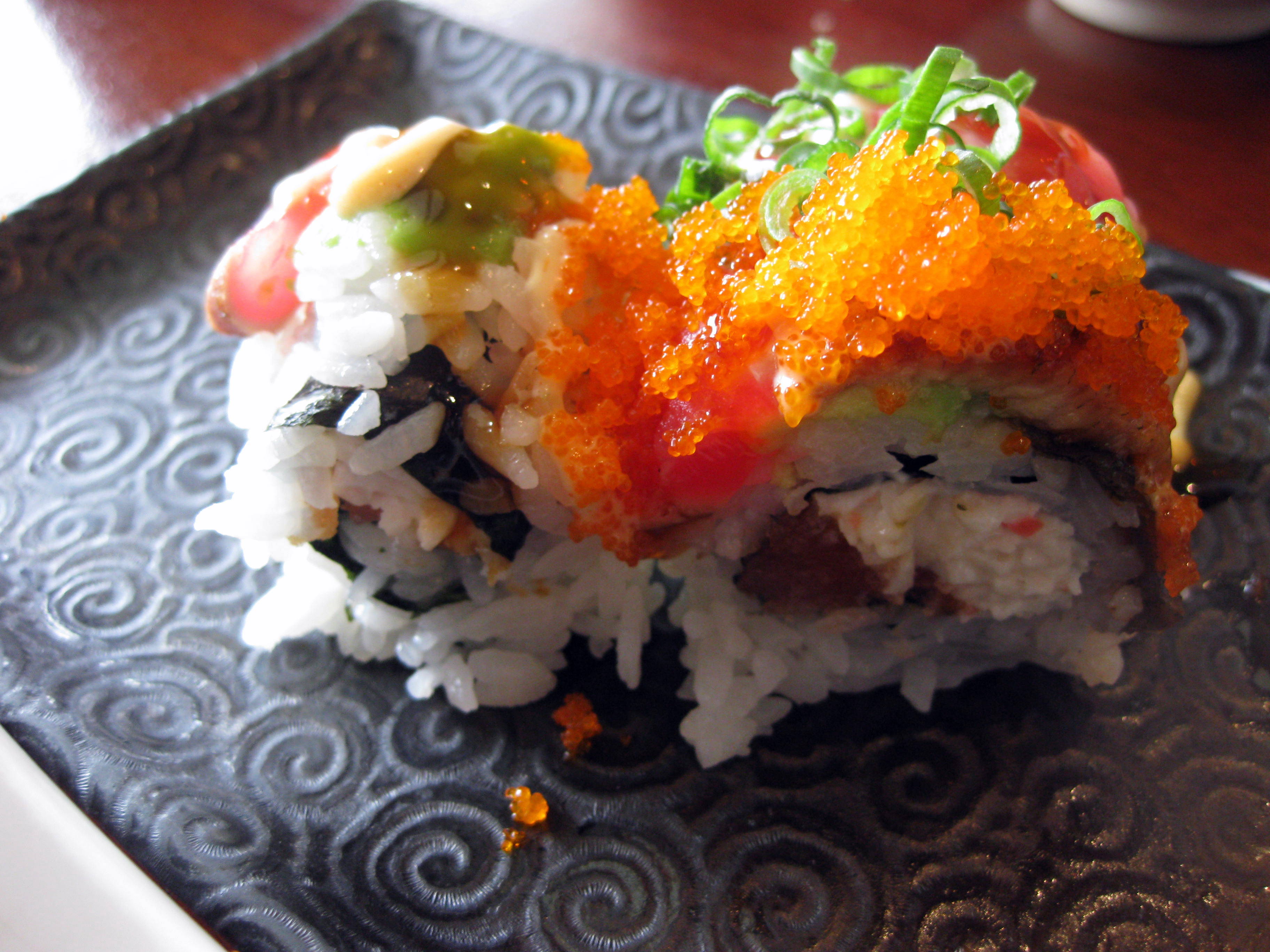
The next day, feeling repentant, we set off to share lunch with my sister and her boyfriend, whose parents live only a few miles from N.’s old homestead.  After a few days of richness, what could be more penitent and healthy than rice and fish?  Perhaps many things, if that rice and fish looks like this:

This jewel-encrusted carbuncle of sushi beauty is courtesy of Mikuni Japanese Restaurant and Sushi Bar , my favorite sushi establishment, and perhaps even my favorite restaurant in California.  The rice is chewy and nutty and sticky, the fish is extremely fresh and expertly handled, and as you can see, the combinations and toppings are imaginative and beautiful.  N. and I shared three rolls which, as you can see, I forgot to document until it was almost too late.  Such are the consequences of gluttony.

Turkey Pot Pie

I have discovered that, much as I enjoy baking, I am not and may never be a master of the finicky, temperamental beast that is homemade pie crust.  Fortunately, this did not hinder me when I embarked on my major repurposing-Thanksgiving-leftovers meal last week.  No, I shamelessly bought a package of pre-made pie crusts to lovingly enclose a turkey pot pie.

We had a big turkey this year, and after stripping off the meat and making stock from the bones, I decided both could be put to good use in a pie.  Since the weather has been so chilly, baking is a good way of warming up the house and therefore a good way of choosing dinners.  Never having attempted pot pie before, I surveyed a few likely looking sources for potential recipes before scrapping them all and making it up myself.  Here’s how it went down:

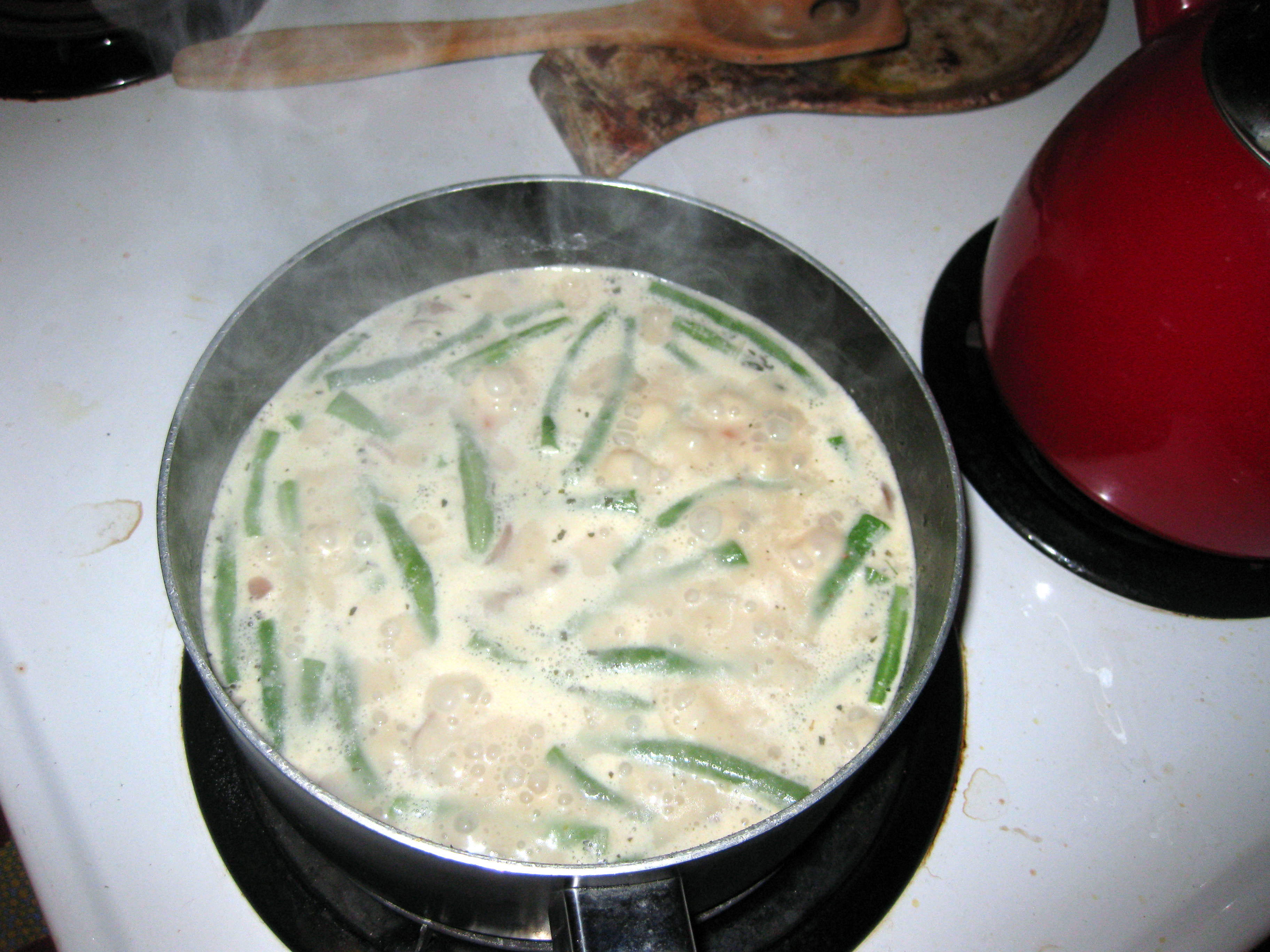
I chopped up three or four cloves of garlic, about ¼ cup of onion, and five or six cremini mushrooms, which I sweated down in olive oil until they were soft.  While this was happening, I chopped up a couple of carrots and a handful of fingerling potatoes into small pieces.  I tossed these into the pot with the aromatics along with some poultry seasoning and a splash of white wine, and then added about 2 cups of turkey stock and heavy cream stirred briefly together.  In a flash of genius, I realized this was an opportunity to use up the mushroom gravy my mom had made for the big Thanksgiving meal.  Everyone seems to stress about gravy – avoiding lumps, getting the right consistency, producing a good flavor without drowning the sauce in salt, and then it doesn’t get used up.  It coagulates into a strange, meaty jelly in the refrigerator and just doesn’t microwave right.  Most years we throw the leftovers away.  But mixed into my pot pie filling, it melted back into a slightly thickened liquid, bringing all its flavor with it.  I added some extra poultry seasoning and slapped the lid of my pot on to let the vegetables cook.

In the mean time, I assessed the crust situation.  Thanks to one of my cookbooks, I had decided to do a lattice top crust.  I’ve never made a lattice top crust before.  It looked daunting.  Helpfully, I found a diagram of how to do it, so while the potatoes and carrots slowly softened I cut my top crust into about twelve strips of semi-even thickness with the tip of one of my sharper knives.

When the potatoes and carrots were almost done, I added a handful of green beans to the filling, probably around a cup of frozen peas, and about two tablespoons of cornstarch mixed with water.  That way the filling could thicken while the green beans cooked.  When things were thickened up nicely, I carefully slopped the steaming filling into the bottom pie crust, which I had carefully laid into my pie plate.

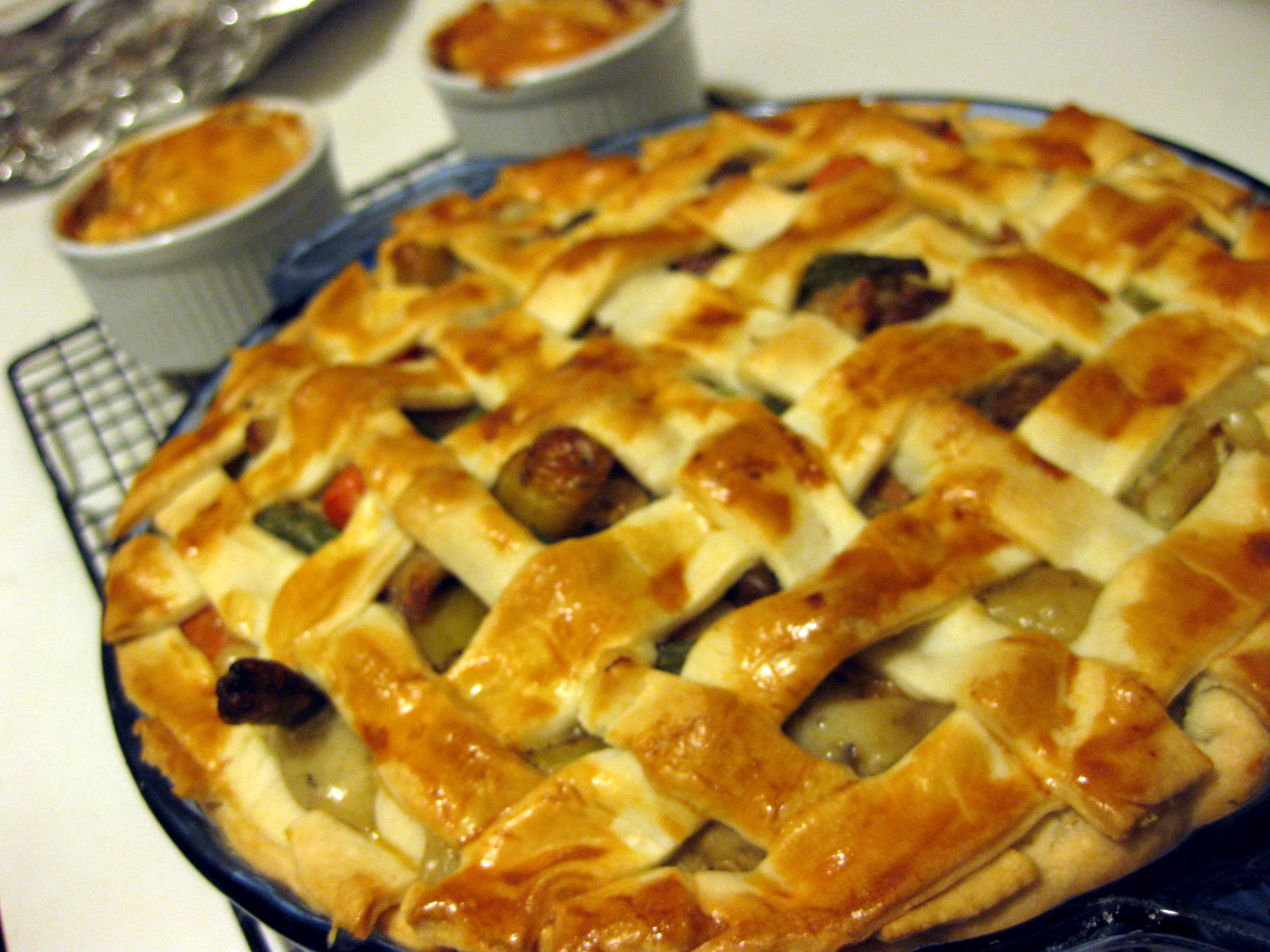
I carefully completed the lattice-work top (I don’t think I can explain without step-by-step pictures, which I unfortunately neglected to take, but it’s not quite as complicated as it looks) and then brushed it with an egg wash.  There was a little bit of filling and a few strips of crust left, so I made two mini-pot pies in tiny corningware dishes to use up the remainders before putting everything into the oven.

After 40 minutes or so at 425F, the pot pie was done.

The crust was golden and crunchy, the insides smelled delicious, and even though the whole first piece I cut fell completely apart, it was glorious.  Though N. enjoys my cooking, he is usually demure about his compliments, but not this time.  He proclaimed “I think I love this,” after only a bite or two, which I interpreted as ultimate triumph.  The veggies were tender but not mushy, the sauce had bubbled up on the sides and had a rich, meaty flavor, and the turkey itself was as delicious as it had been fresh off the bird.  I used only dark meat, which I think kept things moist and extra flavorful.  We glutted ourselves on turkey pot pie, and life was good.

Homage to Stratigraphy: Lasagna #2

After both taking and making suggestions for improvement about the lasagna I made here, I decided to take advantage of the last few weeks of outdoor Farmers’ Markets and take a second stab.  I believe I have now created the ultimate: Wild Mushroom and Spinach Lasagna with Arugula Pesto and Sundried Tomato Cream Sauce.  Since I have had several requests, I am willing to share the recipe with y’all.  Here goes, and keep in mind that most of my measurements are approximations.

Preheat oven to 350F and make sure you have a 9×9 square glass baking dish.

Ingredients:
1/2 lb (?) mixed wild mushrooms (I used reconstituted dried shiitakes and golden chanterelles from the Saturday Market)
1-2 bags baby spinach leaves
2 bunches arugula
(your own mix for pesto, or my cheat: 3-4 TB premade pesto, to blend with arugula)
Olive oil
4 TB butter
3 cloves garlic, finely chopped
1/4 cup flour
2 cups milk or cream (or a mixture)
Splash of white wine (if desired)
salt and pepper
2-4 TB sundried tomatoes, finely chopped
1 16oz. container ricotta cheese
1/2 cup grated mozzarella cheese
1/4-1/2 cup grated Parmesan
no boil lasagna noodles

Procedure:
1. Roughly chop the mushrooms and fry them in a medium saucepan in olive oil or butter to your liking.  Don’t rush them.  Keep them on about medium heat and wait, patiently or impatiently, until they have sucked up all the butter, expelled their own liquids, and then regained those liquids to become browned but still tender.
2. Add the spinach and cook just until it has wilted but still retains its bright green color, then set the mushroom and spinach mixture aside.
3. Meanwhile, whir together arugula, premade pesto, and a little extra olive oil in a blender or food processor (or just make your own arugula pesto).
4. In a medium saucepan, melt butter. Add garlic and cook just until fragrant. Add flour and combine well to make a roux. When flour is well incorporated and has cooked for a minute or two, add milk or cream slowly, stirring or whisking well until clumps are incorporated. Season with salt, pepper and white wine to taste.  A little grating of fresh nutmeg might also not be amiss.  Add sundried tomatoes and stir gently until thickened to your liking.
5. Combine all three cheeses
6. Assembly: spread a layer of sauce in the bottom of your pan and add a layer of no-boil lasagna noodles. Then, add layers in your preferred order. I stacked cheese, arugula pesto, mushroom and spinach mixture, then sauce in that order before adding another layer of noodles and repeating the process. Repeat until you run out of filling ingredients (should be about half a box of noodles, if you are using Barilla and a square pan). After adding the final layer of pasta, top with any remaining sauce, cheese, and/or pesto, and then add a generous layer of grated Parmesan. (If you don’t have sauce to add to the top, the final layer of noodles will not soften as nicely as they should.  I discovered this as I made my first cut.)
7. Bake for 45 minutes or until the cheese on top is browned and looks a little crunchy, and the fillings are bubbling up on the sides. If possible, wait for five minutes before cutting in, because the slices will hold together better this way.

IMG_1962

Enjoy.  Gorge.  Disintegrate.  Burn your mouth on the cheese and decide you don’t care, eat chilled slices you cut out of hand straight from the fridge at midnight, or have your neighbors over and just decimate the whole thing in one sitting, for I declare this the ultimate spinach and mushroom lasagna.

My First Lasagna

Since I’ve been in California for roughly the past two weeks, I haven’t shared any foodie experiments or revelations.  Yes, I cooked and ate delicious food on my trip, and yes, I brought my camera with me.  However, I neglected to bring the correct cable to plug the camera into a computer and upload the photos.  I’m home now, and certainly have things to share, but for the moment I’m much more excited about tonight’s dinner, which is currently just starting to emit cheesy delicious aromas from the oven.

I have never made lasagna before.  I’ve heard a lot of complaints about how it’s labor intensive and time consuming, and since two of the major ingredients are ground beef and tomato sauce, I’ve steered clear.  I like ground beef in hamburgers, and occasionally in burritos or meatloaf, but I’d prefer that it stay away from my pasta.  As for the tomato sauce, since I’ve entered adulthood cooked tomatoes in almost any form upset my stomach.  Therefore I have found a large number of alternative pizza and pasta toppings so I can still enjoy Italian cuisine.  But lasagna… that was always a roadblock that I wasn’t overly inspired to circumvent.

Then N. and I went to Ashland for our two year wedding anniversary.  In addition to the delicious food that we ordered from Pasta Piatti on Main Street (a must-visit, in my opinion), I salivated over most of the options on the menu, including, to my surprise, their take on the perennial classic: lasagna.  Here’s their description, and tell me this doesn’t sound amazingly delicious: roasted wild mushrooms, layered pasta, spinach, ricotta, parmesan, arugula pesto, white sauce.  I mean, I guess if you’re not a mushroom fan then it wouldn’t sound amazingly delicious, but I suspect substitutions could be made.  I scribbled down this description on the back of a receipt that I’d jammed in my wallet, and it traveled through the state (and into the next!) with me for the next few weeks.  Then we saw a dip into what might be the beginning of the fall season.  The temperature dropped.  The rain returned for the morning.  It was conveniently Saturday so that I could go and pick up a few things from the Saturday Market.  It was cool enough to turn on the oven, and so I decided to brave the lasagna.

It was a little bit time consuming, if only because there were multiple steps, but I wouldn’t call it particularly labor intensive.  Here’s what I did:

  • Reconstituted a package of shiitake mushrooms in a mixture of warm water and white wine for half an hour (tip: never buy dried shiitakes in the produce section; they cost about twice as much for about half as many mushrooms as they do in the Asian foods aisle!)
  • Chopped and blanched a bunch of Italian kale and about ½ lb. of baby spinach, drained and cooled in a colander.
  • Sliced and fried a generous handful of crimini mushrooms in butter, adding some pepper and the drained, squeezed, sliced shiitakes when the criminis were about half done.  When both kinds were done to my liking, I deglazed the pan with some white wine (I had about a ¼ of a bottle I was trying to finally evict from my refrigerator) and then continued to cook the mushrooms just until the liquid had evaporated.  Then I set them aside in a bowl to cool.
  • While the mushrooms were cooking, I made the arugula pesto.  I must confess, I love the idea but hate the practice of making my own pesto.  I can never seem to get the ratios right.  But for this dish, I had what I must call an ingenious fix.  I had a container of store-bought pesto in the fridge, and I combined four or five TB. of this with probably 2 cups of arugula in my food processor and pulsed them together.  Flawless, and so much easier than making it from scratch.
  • Using the same pan as I cooked the mushrooms in (I’m big on reducing the number of dishes needed for a meal), I made a roux with about 3 TB. each of butter and flour, then added between 1 and 2 cups of milk to create a white sauce.  When it was thickened, I added some pepper, freshly grated nutmeg, and the last few tablespoons of that pesky bottle of wine.
  • Then it was time to assemble.  Since I’ve never made this before, I actually found deciding which order to add ingredients to be the most challenging part.  I put down some sauce first, then a layer of no-boil pasta, then a mixture of ricotta cheese and arugula pesto, topped by the veggies and sauce.  Then I repeated, confining myself to three layers of pasta so our dinner would be heavy on the vegetables.  On the top layer of pasta, I spread the last little bit of sauce, a little bit more ricotta and pesto, and then a generous layer of grated parmesan cheese.  When I stuck it in the oven, it looked like this*:

IMG_1717

When it came out 45 minutes later, it looked like this:

IMG_1723

The cheese was browned and crusty, the sauce was bubbling up around the corners, and miraculously, my worst fears did not come to fruition, as the no-boil lasagna noodles were soft and chewy.  I was secretly afraid they would be crunchy, because I’m not familiar enough with the product to know how they work.  Here’s my review: the mixture of both greens and mushrooms was great, and made the dish taste satisfyingly healthy (well, as healthy as cheese-laden pasta gets, I suppose).  The arugula pesto added a satisfying bitterness, which I’m sure was helped along by the kale.  And of course, it was creamy and cheesy and actually came out of the baking dish in servable pieces, rather than collapsing all over itself in messy piles.  Actually, if I may toot my own horn for a moment, the whole thing was rather beautiful.  Somehow, despite not really knowing what I was doing, I got the proportions of fillings to cheese to pasta to sauce pretty much right.  A nice crisp white wine would go nicely with a large square of lasagna, which is convenient as you could simply drink the wine you were also soaking and deglazing the mushrooms with.
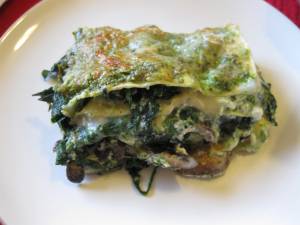
IMG_1726

All in all, it was a good, tasty dinner, but it’s definitely a work in progress.  N. and I both decided that, lacking the usual piquant, acidic bite of the tomatoes in a red sauce, the dish was actually missing something.  The flavors of the cheese, the pesto, and vegetables were good, but they were a little muddy without that sweet tangy top note of tomato.  For next time, I will be making a few additions.  To attempt to compensate for the missing acidity of the tomatoes, I’ll add extra lemon juice to the pesto mixture.  We both agreed that maybe adding a sprinkle of parmesan cheese along with the ricotta in each layer would add a nice touch; I don’t use much salt when I cook, and sometimes the deep greens like spinach and kale need some to enhance their flavors.  Extra parmesan mingling with the vegetables while they bake might accomplish this without actually having to add salt.  I might also add some of my beloved Penzey’s Black and Red pepper blend the next time to the white sauce, just to spice it up a little bit.  It was creamy and thick and good, but really, milk, butter and flour cooked together have only so much flavor on their own.

Other additions, or accompaniments, that have occurred to me since dinner include mixing finely chopped sundried tomatoes into either the white sauce or the mushrooms.  They would add that intense tomato flavor without the heavy sauce that upsets my stomach.  Thinly sliced fresh tomatoes in between each layer, or maybe only on the top layer underneath the parmesan cheese, might accomplish the same thing.  Finally, an old friend from high school T. just told me about a sauce she makes of roasted tomatoes and red peppers that might do the trick, and I wonder whether a plain old roasted red pepper sauce would have the same zippy tang as tomatoes?  Certainly it would be pretty, even if it was drizzled over the top or added plate-side.  Lasagna #1: down.  Lasagna #2 awaits…

* Nota bene: as a geologist’s daughter, I am all but obligated to understand and appreciate cross-sections as a method of conveying information.  Conveniently enough, this seems like a perfect strategy for photographing lasagna!