Sweet.

I’ve complained before about the sometimes-too-sweet-sweetness of sweet potatoes, and of the potential dangers of the salty-sweet combo (and at the same time, too!), but sometimes they do work.  And when they work, and work well?  Incredible.  If you have any love for sweet potatoes at all, you MUST try this dish.

“41. Toss chunks of sweet potato and 2-inch lengths of scallion with neutral or peanut oil. (Again, a little sesame oil helps). Roast, turning as necessary, until nicely caramelized; drizzle with soy.”

This sounded like it had potential, and didn’t require a lot from the store.  Double bonus points already.  Here’s what I used:

2 medium sweet potatoes (mine had orange flesh, so I guess that means they may have been yams)
1 bunch green onions, roots trimmed off

2 TB vegetable oil

1 TB sesame oil

2-3 TB soy sauce

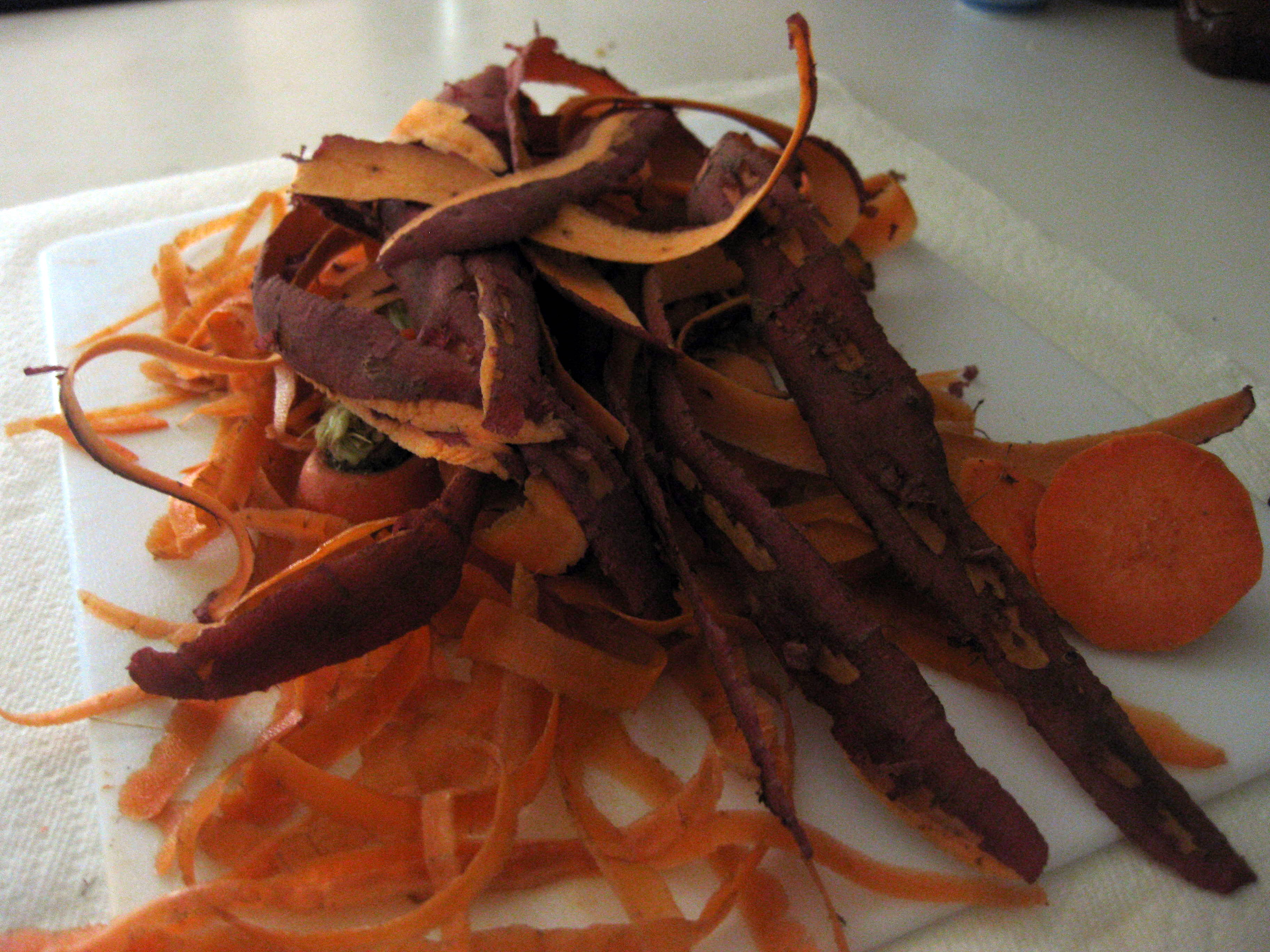
Since I don’t know what Bittman’s preferred roasting temperature is, I guessed that 400F would likely be fine, and cranked on the oven to preheat.  I peeled and then chunked up my sweet potatoes, trying to keep the cubes about 1-inch in size, so the outsides wouldn’t burn before the insides were cooked through.  I cut my green onions into approximately 2-inch lengths, then tossed them together with the sweet potatoes and both kinds of oil on a cookie sheet.  The amount of oil you use will depend on how big your sweet potatoes are – you want them to glisten and smell strongly of sesame, but not be drowning in a puddle on the bottom of the sheet tray.  We’re roasting, not frying.

I slipped the tray into the oven and let it roast for almost an hour, checking every 15 minutes or so for doneness, browning, and to turn things over.  At 45 minutes in, the chunks of sweet potato were meltingly tender, but they weren’t really getting brown on the outside.  I shimmied the oven temperature up to 450F and tossed everyone around again.

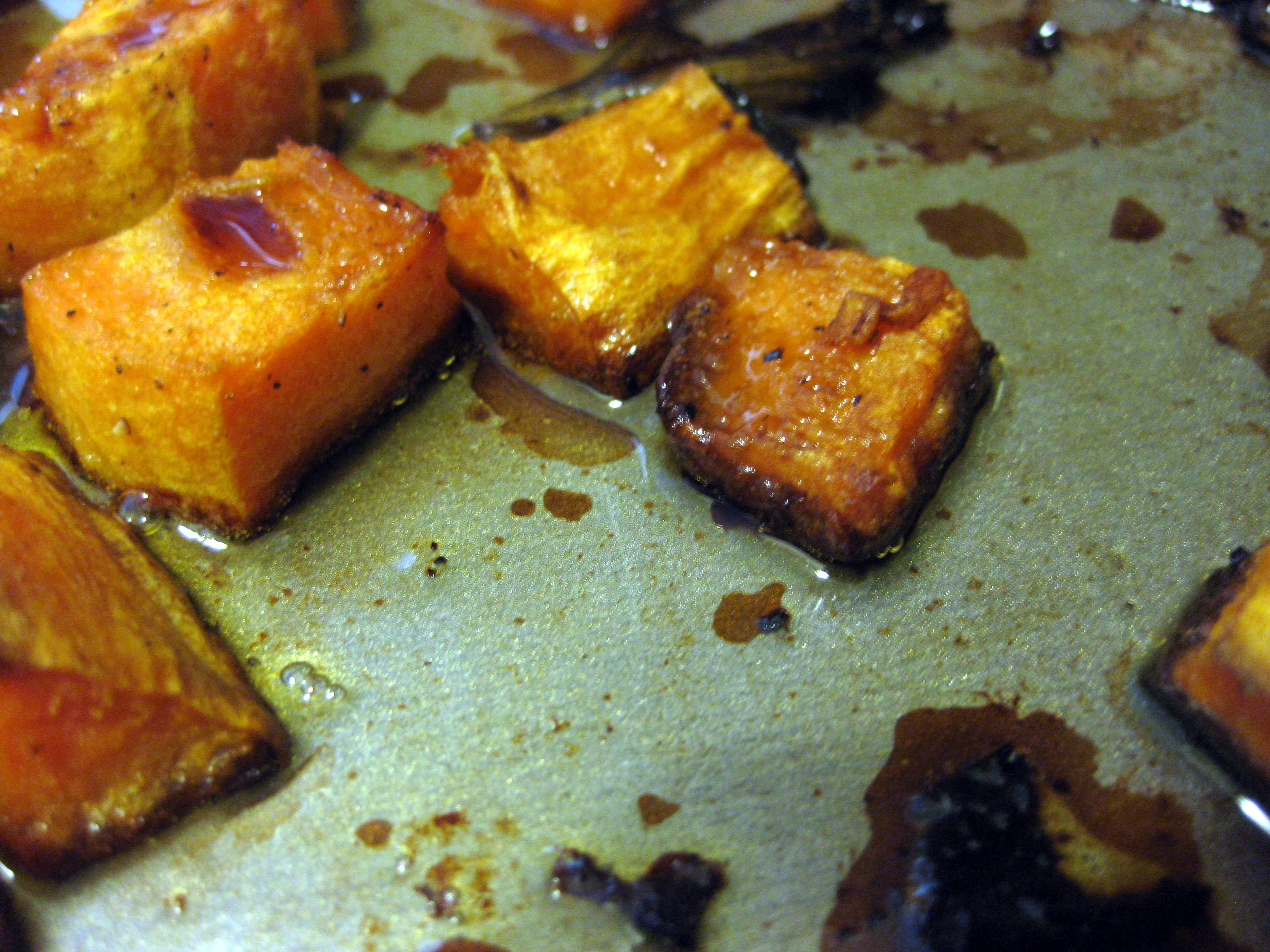
A quick 15 minutes later, I rescued the tray from the oven to see perfection.  The sweet potatoes had crisp crusty edges, the green onions were wilted and faded (this sounds bad but it was a very, very good thing), and when I drizzled the soy sauce over the whole thing the sizzling smell was delightful: salty and earthy and deep.
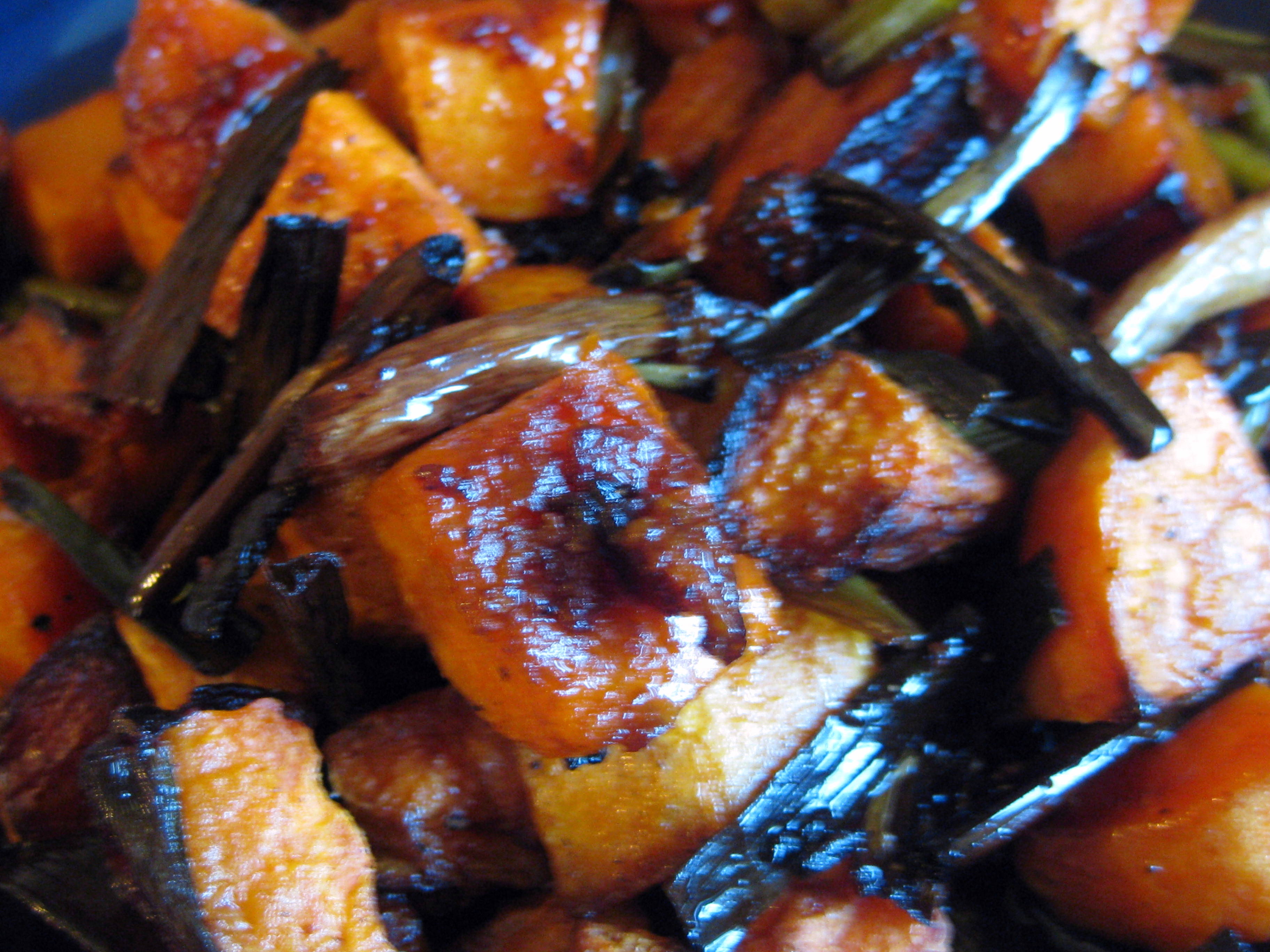
We tasted, and then we inhaled like ravenous, sweet-potato-deprived beasts.  This was SO GOOD.  The sweet potato flesh was as tender as a puree, but the caramelized sides offered a captivating chewiness.  True caramel, I think, has to stick to your teeth, and these clung to our teeth just like candy.  But they weren’t overly sweet.  The combination of green onion, sesame oil, and soy sauce gave a decidedly savory swing to the dish, and possessed that magical saliva inducing quality.  In fact, though we had two other components to our meal aside from the sweet potatoes, nothing made it into the fridge to store for another day.  N. and I kept finding ourselves back in front of the platter, even as we went about the remainder of our evening.  Passing through the kitchen to get a glass of water, and another chunk of potato, glistening with oil, gone.  Loading a plate into the dishwasher, and a straw of onion, wrapped around itself with just-burnt edges, sliding across my tongue.  Bedtime found the plate empty, with only the residue of soy sauce and sesame pooling in the middle.  N.’s assessment: “You can make this anytime.  Whenever you want.  Win.”

True, but I would make two changes.  First, I would start the oven out at 450F rather than 400F.  The potato chunks were cooked through well before I liberated them from the heat, and a higher temperature would brown them faster.  For the same reason, however, I would also add the onions in partway through the cooking process.  Instead of roasting them for the full hour, I’d throw them in at the half hour mark so they wouldn’t burn.

At this higher temperature, it could be that a full hour isn’t necessary – maybe only 45 minutes.  Or 35.  Or 55.  Check often and toss well, and when they are cooked through and the beautiful orange and bronze of autumn in the Northeast?  It’s time to scarf them. 
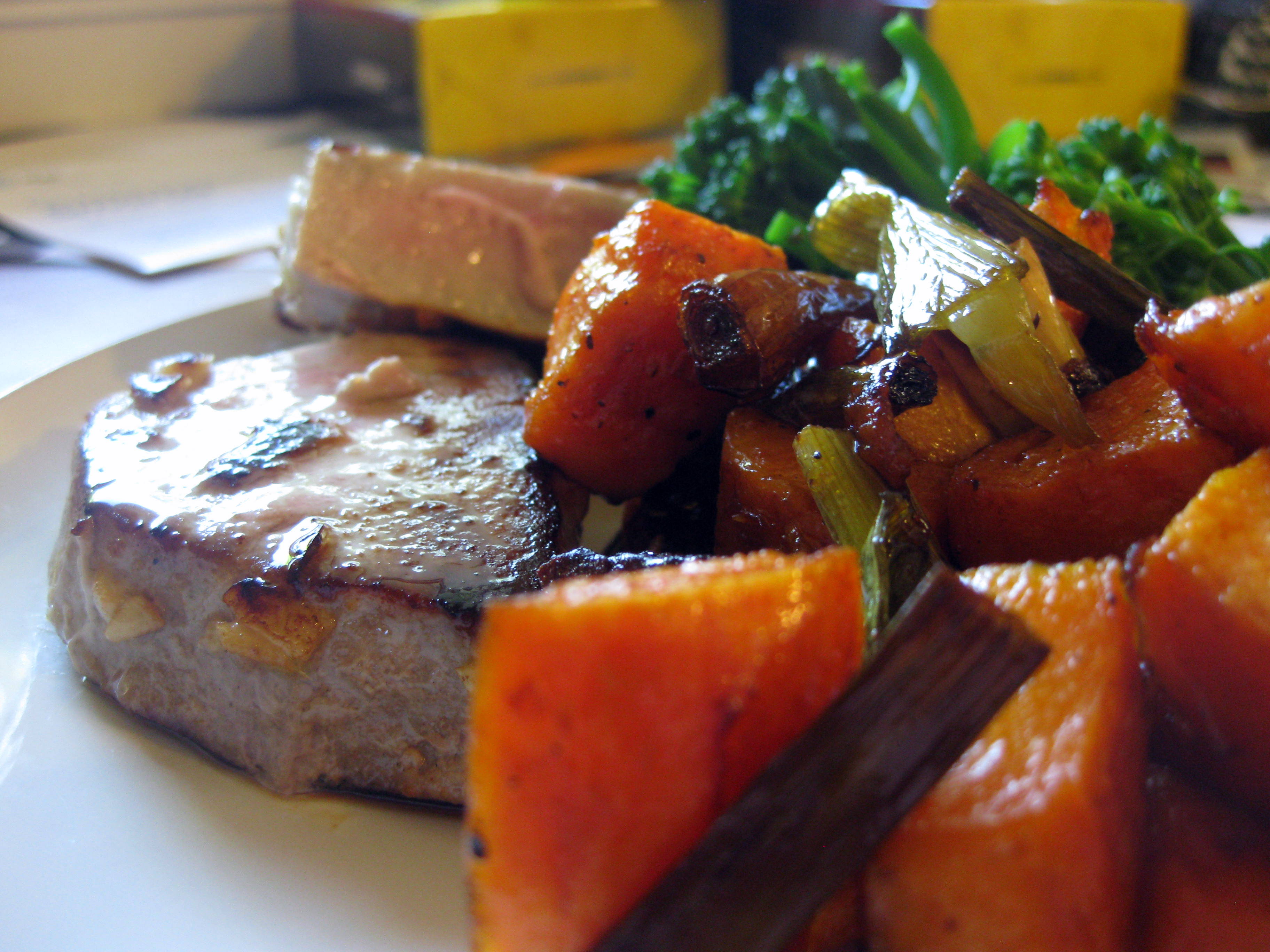
The sweet potatoes were really the stars of our meal, but we had them with broccolini and some pan-fried yellowfin tuna that I’d marinated for ½ an hour in garlic, ginger, lime juice, olive oil, and a tiny splash of soy sauce.  Successful, if a bit overcooked (I like my fish rare, N. likes his almost well done), but nothing compared to the caramel crusted stars of the show.

Out of Stock

This week’s Bittman exploration became, I must admit, something of an experiment thanks to what can only be termed “first world problems.”  Here’s what he suggests:

“31. Combine cooked wild rice with caramelized onions (nearly burnt onions are almost as good, and faster), chopped figs and fresh rosemary. Bake in an oiled dish or use as stuffing.” 

I knew this sounded good – an intriguing mix of sweet and savory ingredients – and I knew how I was going to quickly acquire the correct items: Trader Joe’s.  My local TJ’s has reorganized lately, so while I had no trouble finding some half dried black mission figs, I couldn’t locate either rosemary or wild rice.  I have bought, in the past, a vacuum sealed bag of already cooked wild rice, which I was planning the dinner around, and despite having a pair of very earnest and very determined young gentlemen scour the shelves, nothing turned up.

I went home.

With two key ingredients missing, I grudgingly went out to the garden and stripped a branch of my own slowly, reluctantly growing rosemary, all the while whispering to it what a good cause it was donating to, while my heartstrings cried piteously for the poor tiny plant.  What I finally came up with was as follows:

1 cup raw brown rice, cooked according to package directions

½ of the biggest red onion I’ve ever seen, diced

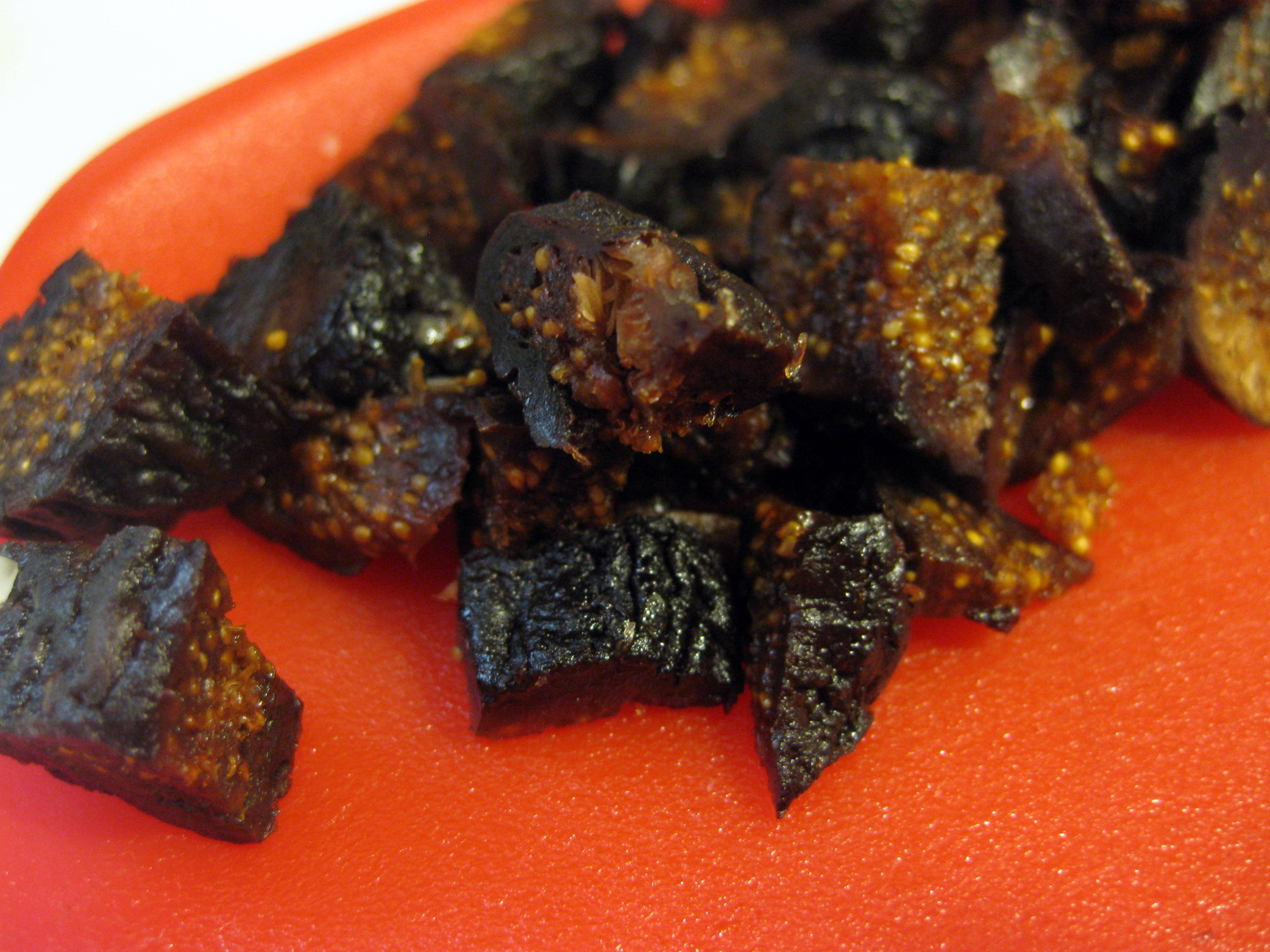
12 figs, chopped (choose fresh or dried according to your preference)

1 teaspoon rosemary (only because I was stingy.  Use more, by all means)

A few grinds each salt and pepper

2 TB olive oil

While the rice steamed away in my rice cooker, I heated olive oil in my largest skillet and cooked the onions gently over medium for 15-20 minutes, monitoring them carefully so they would just caramelize, not burn.

When the rice was done and the onions were nicely browned with deep, bronzed edges, I looked at the kitchen clock and realized two things.  1.) I was hungry, and it was already past the time we usually eat dinner, and 2.) it was already quite warm in the kitchen, and turning on the oven to bake this off did not sound like fun.  It would take too long, and it would produce too much sweat.  Instead, I decided to sizzle the rice briefly in the skillet with the other ingredients. 

I dumped in the rice and added the figs – alien wonder fruit that they are – the rosemary and the seasoning.  I let them all mingle for a few minutes while I finalized our side dishes: Italian sausages and green beans cooked in red wine.  Then, service!

Each individual part of our dinner was good.  The sausages were well spiced, the beans were zesty and crisp and salty, and the rice was delightful.  It definitely read sweet, since the onions were mellow and tender and the figs were chewy and fragrant.  I love the texture of brown rice, since it maintains an al dente toothsome quality even after its lengthy cooking time, and in this dish the slight chewiness was nicely comparable to the figs.

I can imagine there would be a nice woodsiness to the original version of this dish, both in flavor and appearance.  Rosemary is such an earthy herb, and if you left the leaves unchopped they would look like little pine needles.  Further, the dark, somewhat anise-musty flavor of wild rice and its similar piney appearance would make this a dish akin to a shady day on the forest floor.  Pleasant but complex, with earthy spice and the surprising sweet crunch of the fig seeds.

Here’s the thing, though, and as with numerous moments this week this goes back to the “first world problems” thing: these individual dinner components didn’t go together very well.  Here’s what I recommend instead to pair with this rice dish.  Pound out a turkey or chicken cutlet.  Spread a piece of prosciutto across the flattened surface.  On top of the meat, crumble some gorgonzola or goat cheese and, if you’re feeling adventurous, maybe a handful of baby arugula leaves.  Roll the poultry cutlet up around the meat and cheese and, if necessary, tie off with some kitchen twine to keep it closed.  Bake or pan fry until the poultry is fully cooked.  The salty, creamy richness will pair nicely with the sweet figs and onions in the rice, and the pepperiness of the arugula will provide a cleansing bite for your tongue.

Incidentally, if you’re wondering about this combination of ingredients, I’ll give you a quick run-down of my favorite pizza topping combination, and you’ll see the connection: on top of plenty of grated mozzarella cheese, distribute caramelized onions, sliced figs, prosciutto, and crumbled gorgonzola cheese.  When the pizza comes out of the oven, sprinkle fresh arugula leaves across the top.  It sounds discordant, but it’s outrageously good.

Go forth and experiment!  And tell me how it tastes!

Sunburst

Orange is a hot color. It’s flame and earthy warmth and friendly heat. But it’s also freshness and citrus-bright and spicy. It’s a fall color and a summer color. This is convenient, considering Oregon’s spastic and reluctant attempts to approach spring/summer. Interestingly too, the particular orange combination Bittman offered us this past week was a salad made from winter root vegetables, with a peppery summery acidic dressing. Juxtaposition of seasons. Juxtaposition of flavors.

68. Peel sweet potatoes and boil until tender, drain and cool; dice. Treat carrots the same way. Make sauce of Dijon mustard, olive oil, cider vinegar and chopped scallions. Toss all together.”

Here’s what I used:

1 big Beauregard yam, peeled

3 large carrots, peeled

4 green onions, thinly sliced

2 TB dijon mustard

2 TB cider vinegar

2-3 TB olive oil

salt and pepper to taste

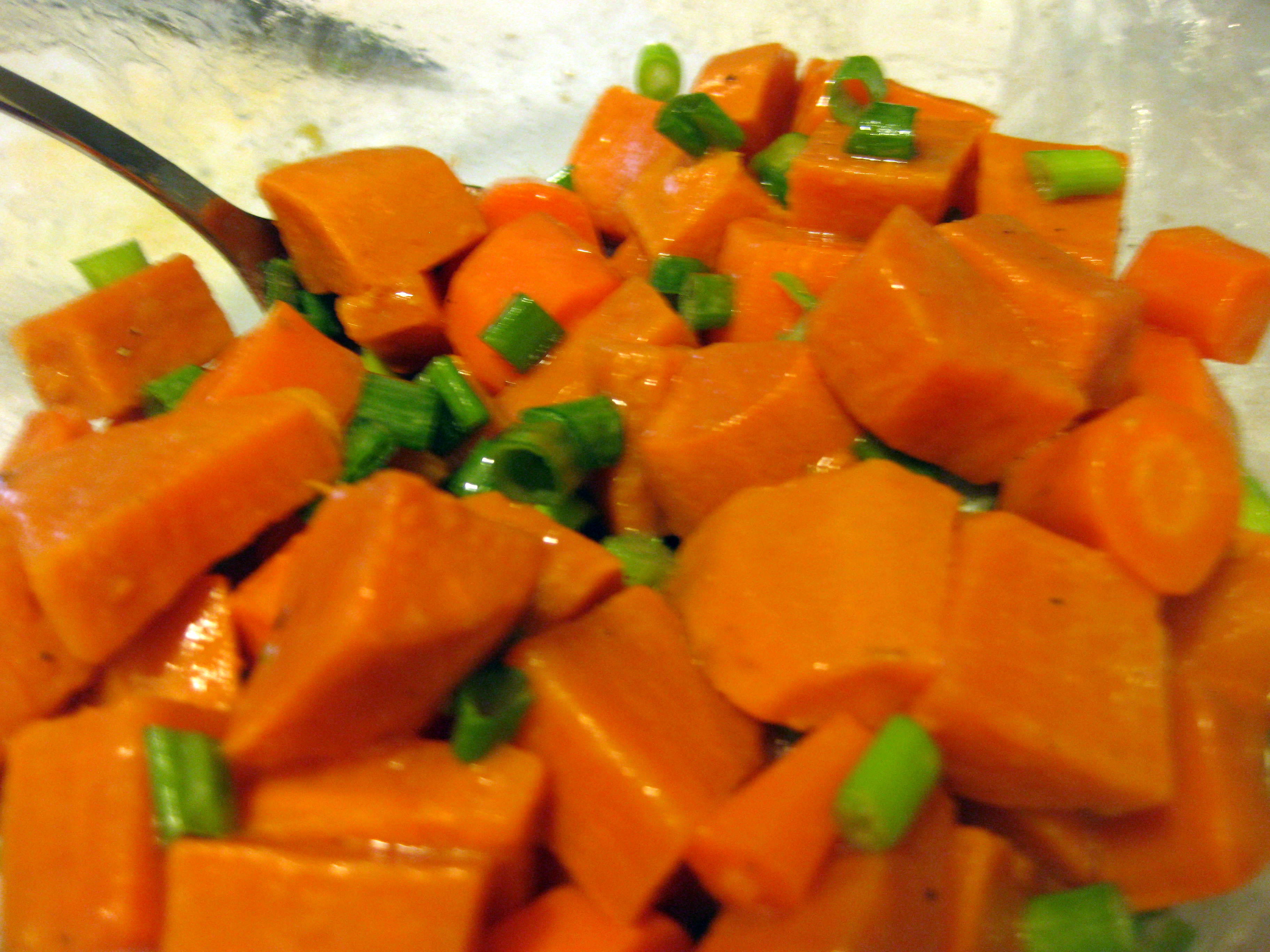
Bittman’s recipe seemed to advocate boiling the carrots and sweet potato whole. I decided to shorten the cooking time and cut the vegetables into chunks first. I boiled them in lightly salted water for fifteen or twenty minutes, or until the sweet potato chunks were tender and the carrots still had a touch of texture. Drained, they were startlingly bright against my white colander and I had to sample one. And then another. And then another of each.

They tasted like sweetness and familiarity. I set them aside to let them cool for an hour.

When they were well cooled, I tossed in the green onions, ground on some black pepper, and mixed up the dressing. I combined the mustard, the vinegar, and some salt and pepper in a measuring cup, then blended them with a fork into a homogenized mixture. Then, still whisking constantly, I added the olive oil in a slow stream, whisking persistently until the mixture emulsified. Then, of course, all that remained was to pour it over the vegetables and toss them gently together for full immersion.

While this sat, I prepped its accompaniment. I brought some chicken stock to a boil, then tossed in a bagful of frozen peas. When the liquid resumed its boil, I stirred in a box of couscous and clapped the lid on to let the absorption process commence. I wasn’t sure it was going to work, because I feared the peas might have soaked up too much of the liquid and the tiny beads of semolina wouldn’t cook properly. I feared in vain. When I fluffed the couscous five minutes later, it was cooked and tender, the peas were steaming, and I stirred in some chopped fresh parsley for kicks.

Now, instead of a steaming vegetable dish and a cold pasta salad, we had hot, vegetable-laced pasta and a cold vegetable salad. It was a delicious juxtaposition, with the wintry roots flavored in bright, commanding acidity and the couscous dressed with springiness. I loved what the mustard and vinegar did for the carrots and the sweet potatoes, playing against their inherent sweetness to add complexity and interest. Cleaning up after dinner, N. and I couldn’t stop grabbing chunks of their sour-sweet tastiness with our fingers out of the bowl. I will certainly make this one again.

The nice thing about this dish was how, even in its odd mixture of summery flavors and autumnal base, it mirrored my own summer thus far. Eugene has been mostly dreary, offering pockets and blotches of sunlight and teasing us with predictions of 70F degree weather, then delivering a sky socked in fog and breezes of misty drizzle. This isn’t June gloom. This is June despair.

But this past weekend, as the bright chunks of winter took on summer flavors, I left Eugene for warmth, for sun, and for vacation. This week and next week, I cannot promise another post. But I can promise that my pale shoulders will toast, my hair will bleach out, and my brain will slow down its frantic pace. I’ll keep track of what I eat, and I’ll photograph the triumphs and surprises to share upon my return to internet-land. And I hope, fervently, your last weeks of June will be as orange as I know mine will be.

Changing tastes

I was not a picky eater when I was a child.  I liked almost everything, and I was willing to try probably 99% of what I was offered.  I liked vegetables, I liked fish, I liked salsa, I liked avocados… I liked food.

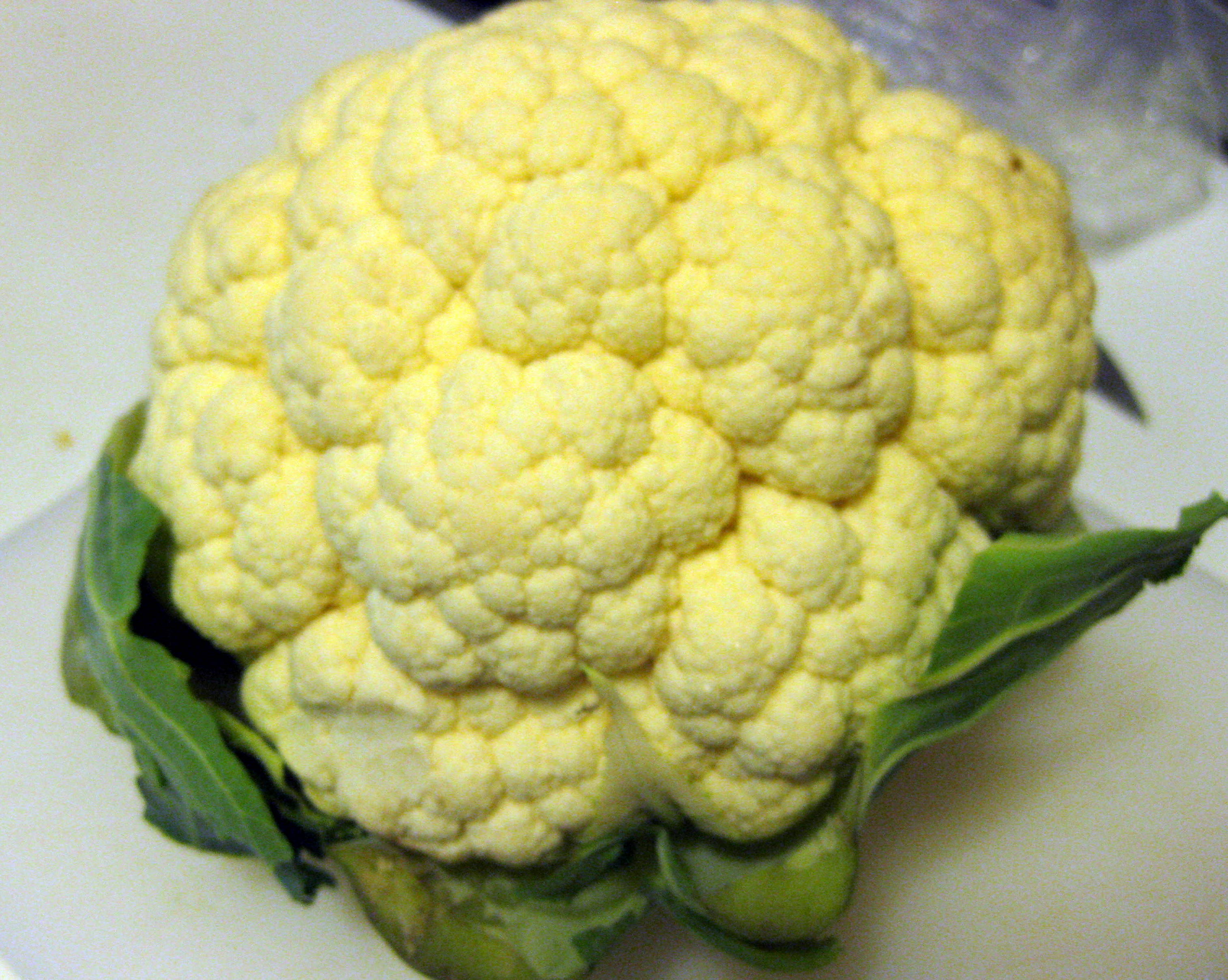
One of the few items that did not please my palate was cauliflower.  My mom always steamed it, and even smothered in a cheese sauce it had this musty, boiled cabbage flavor I couldn’t stand.  It felt mealy in my mouth and it looked pale and unappetizing: horrible vegetable brains I wasn’t supposed to gag over.

Recently, however, I’ve discovered roasted vegetables.  Well, I knew that if you cut root vegetables into chunks, doused them in olive oil, salt and rosemary and roasted them for almost an hour the result would be tender starchy delight, but I hadn’t done much with other victims.  Potatoes?  Yes.  Carrots and onions wedged in next to a leg of lamb?  Sure thing.  Asparagus with some lemon juice and delicate, bursting cherry tomatoes?  Definitely.  Cauliflower?  I was doubtful.  Until a few months ago.  I found a recipe for slow cooked “tandoori” chicken with a side of roasted cauliflower, and my husband’s pleading eyes convinced me to try it.  Liberally soused with olive oil, coriander and paprika, trapped in the oven at 450F for the better part of an hour, cauliflower became amazing.  Its cut surfaces deepened to mahogany and took on the appearance of that burnt sugar crust atop crème brulee.  Its florets got rough and crispy and, as I described to my slightly incredulous sister, became like cauliflower popcorn.  And I liked it.  With sea salt on top it was outrageously good.  N. and I plowed through a whole head of it by ourselves that night.

So I was okay with this week’s Bittman.  In fact, I was pretty excited.

“51. Steam cauliflower florets and toss with olive oil. Roast with peeled whole garlic cloves and chopped bacon at 400 degrees for 20 minutes.  Chopped parsley is a worthwhile addition.”

Not only was this – according to my new, cauliflower-appreciating minset – a delectable-sounding collection of ingredients, it was really easy.  I readied:

1 large head of cauliflower, cut into florets

¼ cup olive oil (approximate)

6-8 whole garlic cloves, peeled

5 slices bacon, chopped

Black pepper to taste

¼ cup chopped parsley

Ordinarily, I tell you what I did and then comment on it.  Here, I’d like to do the opposite.  I followed Bittman’s directions and, whether it was because I cut too large of pieces or because I overcrowded my baking tray, at the end of 20 minutes at 400F, my cauliflower was overcooked and my bacon was barely past raw.  I hiked up the heat and left it in for another 15 minutes, anxiously checking while we scarfed our side dish to hold back our hunger, which the smell of slowly-rendering bacon does nothing to assuage.

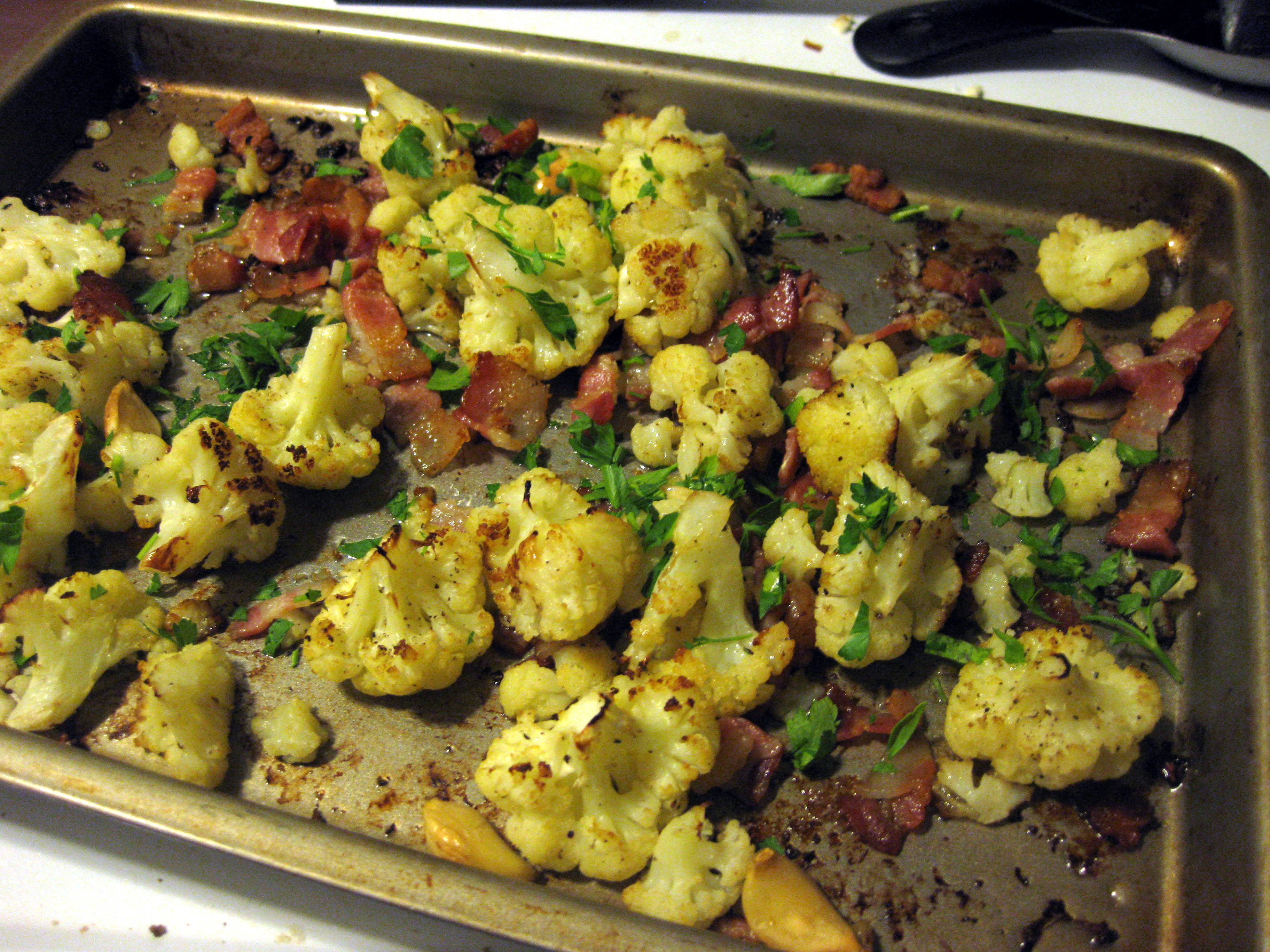
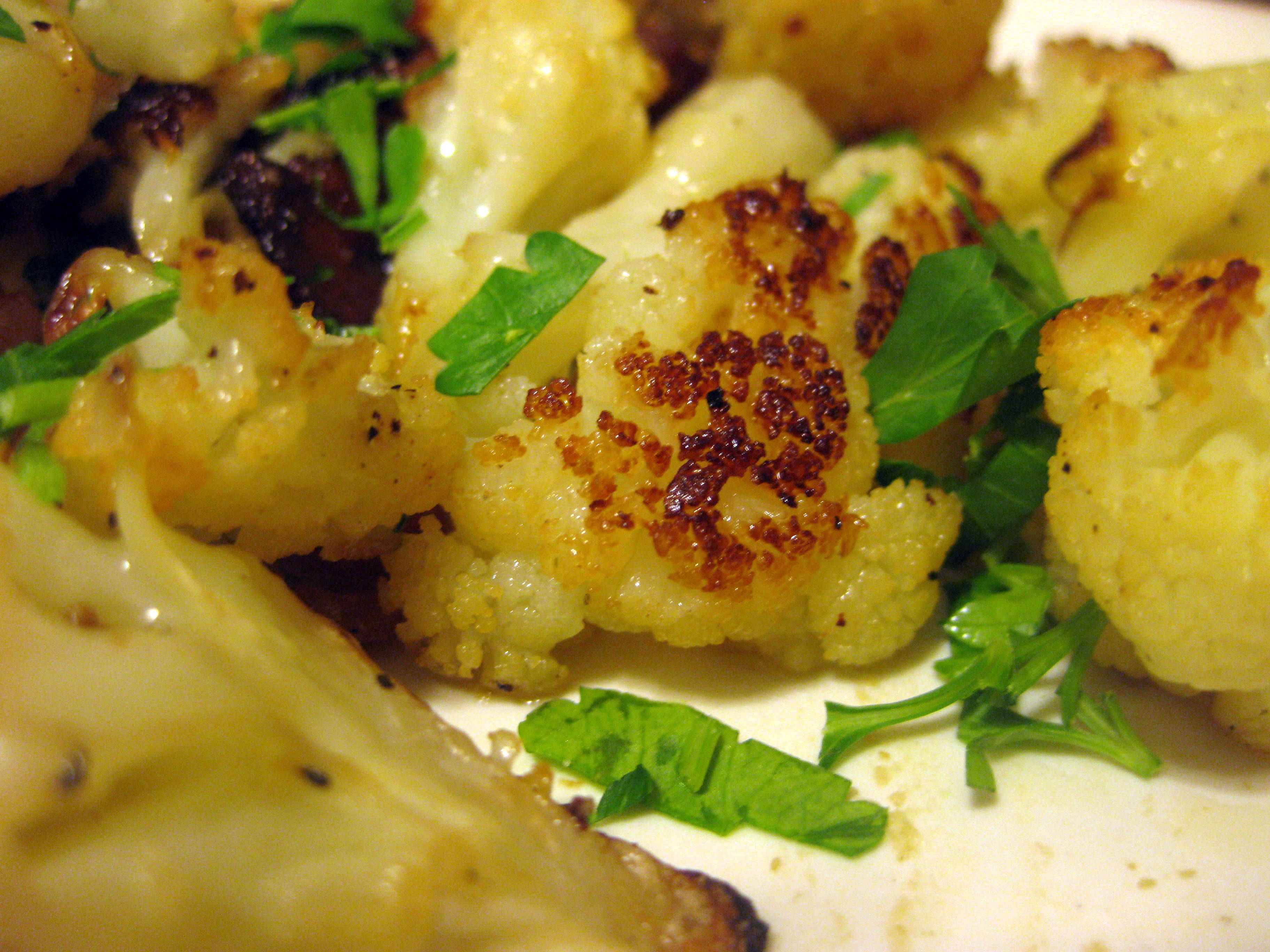
When it was finally done, with deep crinkly bits on the cauliflower and glistening bacon fat making the pan slick, I tossed on some parsley, scooped huge helpings onto our plates, and we collapsed into it.  It was good.  The blend of flavors was really wonderful.  The mild cauliflower, made almost sweet by its roasting treatment, was helped along by the smoky saltiness of the bacon, and when you got a garlic clove in there as well, it was magic against the taste buds.  The problem was in the texture and execution.  Because it had already been steamed, and because I had to add extra cooking time, the cauliflower was essentially the texture of mashed potatoes.  This might be acceptable in some cases – in fact, I’ve read recipes that call for pureed cauliflower as an addition or flat out replacement for mashed potatoes – but that wasn’t what this was supposed to be about.  I wanted some vegetal resistance against my teeth.  I wanted tenderness and give inside a golden shroud, but something still lingering to slice through.  This was all softness.  So here’s my procedure suggestion:

Preheat the oven to 450F.

Toss the raw cauliflower florets and the garlic cloves in olive oil and arrange in a single layer on a baking tray or cookie sheet.  Pepper them well.  Add the bacon, still trying to keep everything in a single layer and evenly distributed across the pan.

Roast for 20-30 minutes, checking frequently after 20 minutes, or until bacon is cooked through and cauliflower is dotted with crisp with golden-brown edges.  When desired doneness is achieved, sprinkle with fresh parsley and serve. 

This might be a delicious side with some grilled salmon and a green salad, or as an alternative to french fries alongside a burger.  We had ours, I must admit with slight shame, paired with Stouffer’s boxed stuffing.  I did cook it with homemade chicken broth, but the packaged cubes of something-that-once-resembled-bread and dried, barely reconstituted onion bits remained the same.  Sometimes you need some shameful comfort, and these red boxed Thanksgiving classics are what does it for me.

With cauliflower in my “might be love” file, at least when it’s roasted till its whole constitution seems altered, my list of foods I don’t care for – short to begin with – is becoming almost nonexistent.  There are some processed foods I don’t like, but I’m not going to feel bad about that or try to develop a taste for them.  “I’ll eat anything” doesn’t need to include mushy canned green beans or frozen pasta with pellets of sauce.  When it comes to food – whole, natural food – I can now safely say, with very few exceptions, just to be safe, I like everything.

Humble Fare

Writing a dissertation is a humbling experience.  The quantities of research required, the demands on time and mental health, and finding out how much you don’t know about what is supposed to be your area of expertise are all staggering.  Most recently for me, comments from my adviser and a recollection of how comparatively little time I have to research, draft, write, and polish the thing have kept me all but scraping the earth with my forehead.

This week’s Bittman played into this humility topos:

“71. Add chopped scallions and chopped kalamata or other good black olives to cooked and drained white beans.  Dress with white wine vinegar, olive oil and fresh thyme, marjoram or oregano.” 

Not only did this sound refreshing, filling, and ridiculously easy, but it allowed me to work on another area of life in which I feel humbled: the garden.  With another reluctant spring almost over and me still questioning whether it ever arrived in the first place, I haven’t had as much time to devote to the brave little sprouts forcing their way through the cold chunks of clay and silently suffering slug attack as I would like.  One variety, however, needs no assistance from me.  Two years ago I planted some oregano in a square planter and set it next to the herb bed.  It thrived.  One year ago, we put in a sprinkler system and forgot to connect a dripper to the oregano’s box.  It died.  This year when I ventured out for the first time in March to see how things were looking, there was oregano everywhere except that box where it was originally planted.  This salad, then, seemed like the ideal way to start getting things back under control.  A few stalks uprooted is doubly productive: dinner for us, a more orderly space for the garden.  If only the dissertation were that easy!  I used:

1 16 oz. can white kidney beans, rinsed and drained

½ cup kalamata olives, roughly chopped

4 green onion stalks, chopped (I saved the white bulbs for another use)

2 TB chopped fresh oregano

2 TB white wine vinegar

2 TB olive oil

salt and pepper to taste

(¼ cup grated parmesan cheese)

While our smoked chicken sausages sizzled in a pan, I literally dumped all the ingredients into a bowl, tossed it lightly, and gave it a taste.  When using only Bittman’s suggested collection it seemed to be missing something, so I added a shower of cheese.  Sun dried tomatoes, or capers, or fresh tomatoes, or torn arugula, or even crisp crumbles of bacon, would also make nice additions.

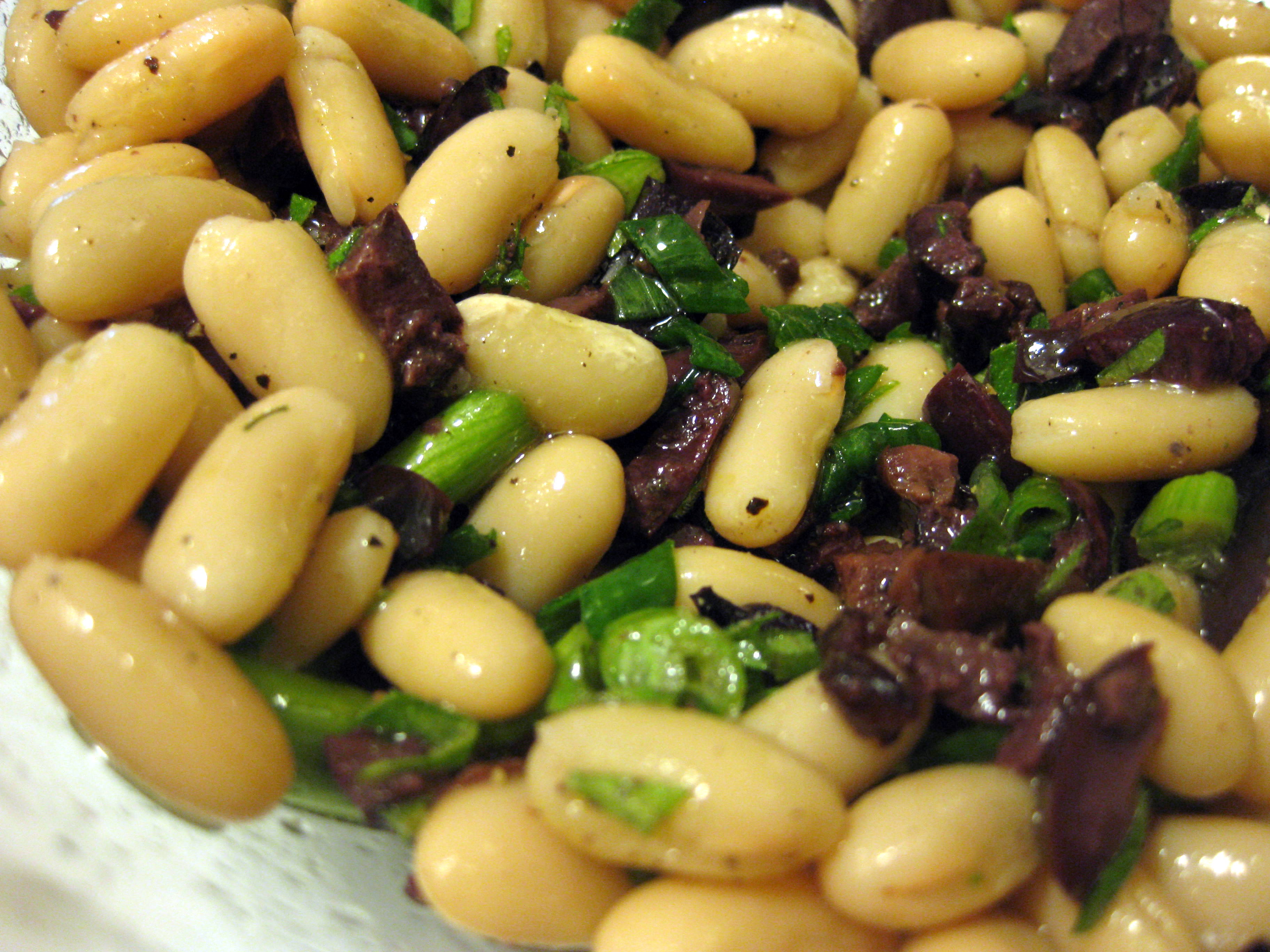
The finished salad was simple and satisfying, and had all the right tastes and textures.  The beans were creamy and soft beneath their slightly taut skins, the olives were a blast of brine, the onions had just the right astringency, and the oregano lent a spicy, earthy warmth.  The parmesan was just that final sprinkle of richness and somehow bound things together.  Pushing outside of the suggested ingredients and adding one of my own took this from a decent side dish to a salad I want to make over and over, adjusting the seasonings and the aromatics and the herbs every time, so it is fresh and exciting with each new taste.

It’s funny that even humble fare, when you give it due consideration, has flashes of zesty tangy brightness: a bite of olive, a splash of vinegar, a crumble of parmesan.  It makes me feel warmer about the dissertation experience.  If this simple salad – creamy and earthy and nourishing and salty – can have glimpses of piquancy, perhaps my project can as well.  I just have to keep experimenting with my ingredients.

Leafing through

Writing is slow.  And it’s difficult.  I learned this when I was first considering authorship (I wanted to write young adult novels, and then I wanted to write fantasy novels, and then I wanted to write The Great American Novel.  And then I decided to go to graduate school).  Yet I forget this with dependable, routine frequency, and then when I sit down to write something, I’m astounded and dismayed when it turns out to be challenging.

But cooking is often fast.  And it’s not all that difficult, if you’re paying attention.  So it’s funny that I seem compelled to combine the two.  Something that is over so quickly – created in half an hour, consumed in another – takes me a week to contemplate and fit words to.  And this surprises me, for some reason.  It’s synesthetic, really.  Taking the products of senses and forcing them into words is neither easy nor accurate.  And yet if we’re going to write about food, that’s what must be done…

“Poach broccoli rabe or stemmed greens like collard leaves, then drain and chop. Combine with chopped water chestnuts and diced mushrooms in a skillet with sesame or peanut oil, minced garlic and hot pepper flakes. Cook until vegetables soften and dry a bit.”

I permitted myself a few shortcuts this week, purchasing already-sliced water chestnuts and a big sack of greens from Trader Joe’s.

Approximations:

1 16 oz. bag mixed cooking greens

1 small can sliced water chestnuts

2 cups chopped mushrooms

¼ cup vegetable oil

2 TB sesame oil

4-6 cloves garlic, finely minced

½ tsp red pepper flakes, or to taste

2 TB soy sauce, or to taste

I heated up a pot full of salted water and dumped in the greens when the water came to a boil.  They only took a few minutes to cook, and when the thickest stems were just crisp tender, I declared them done and drained the pot, leaving the leaves in a colander so they could drip as dry as possible.

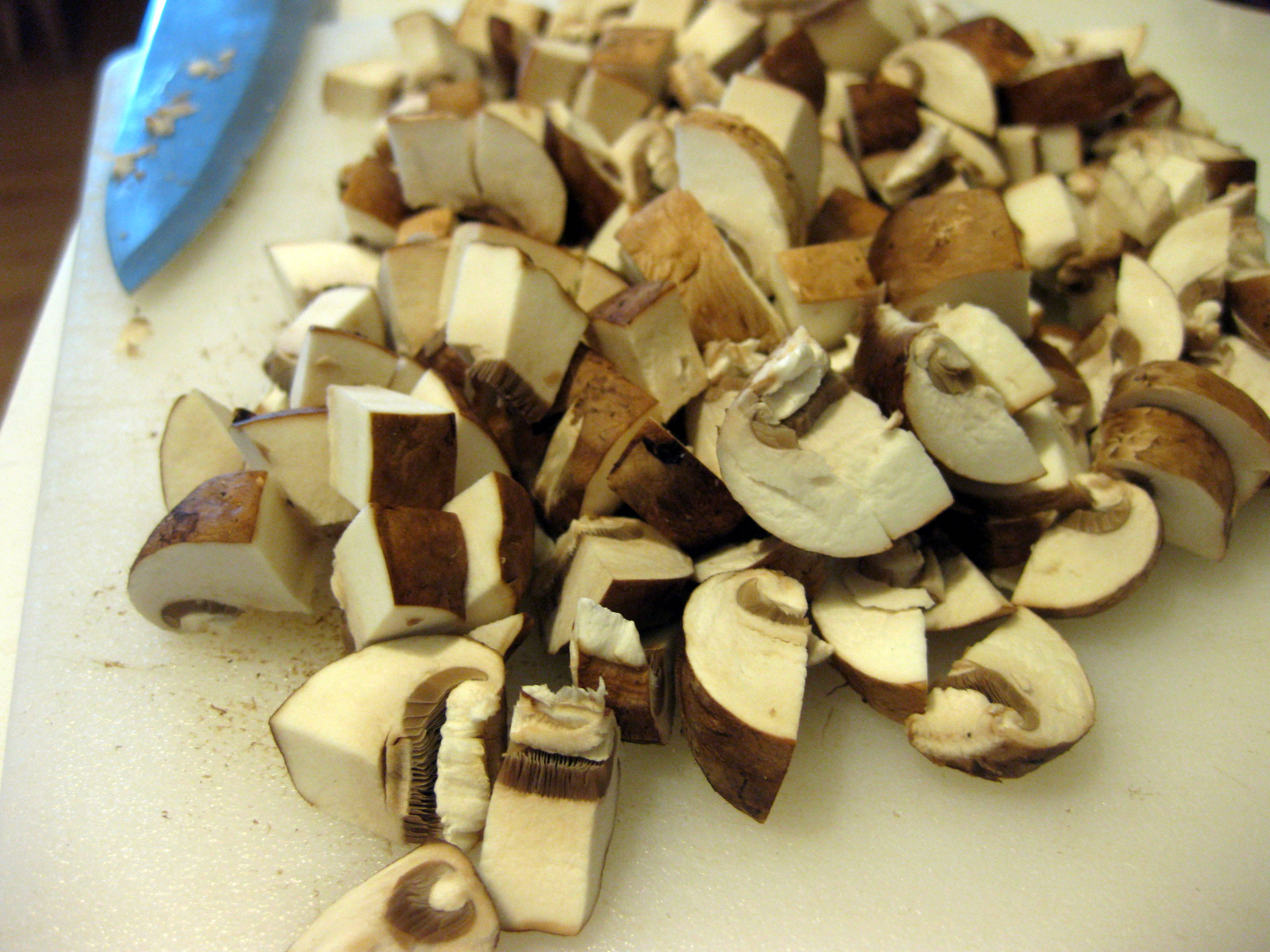
In a large skillet, I heated up the oil while I chopped mushrooms.  I think sesame oil has a very strong flavor and it sometimes burns, and since mushrooms tend to absorb quite a bit, I thought I’d give them a mixture to sizzle in.  When their color had darkened and they had given up their moisture, I tossed in the sliced water chestnuts and the garlic.

I’ve gotten into a bad habit of turning away from the stove lately, assuming things will take longer than they do (perhaps misapplying to the kitchen what I’ve learned so grudgingly about writing?) and returning to the smell of char, so I was careful to add my cooked, drained greens only moments after tossing the garlic around the pan.  Then I tossed on some red pepper flakes and gave the skillet a vigorous stir.

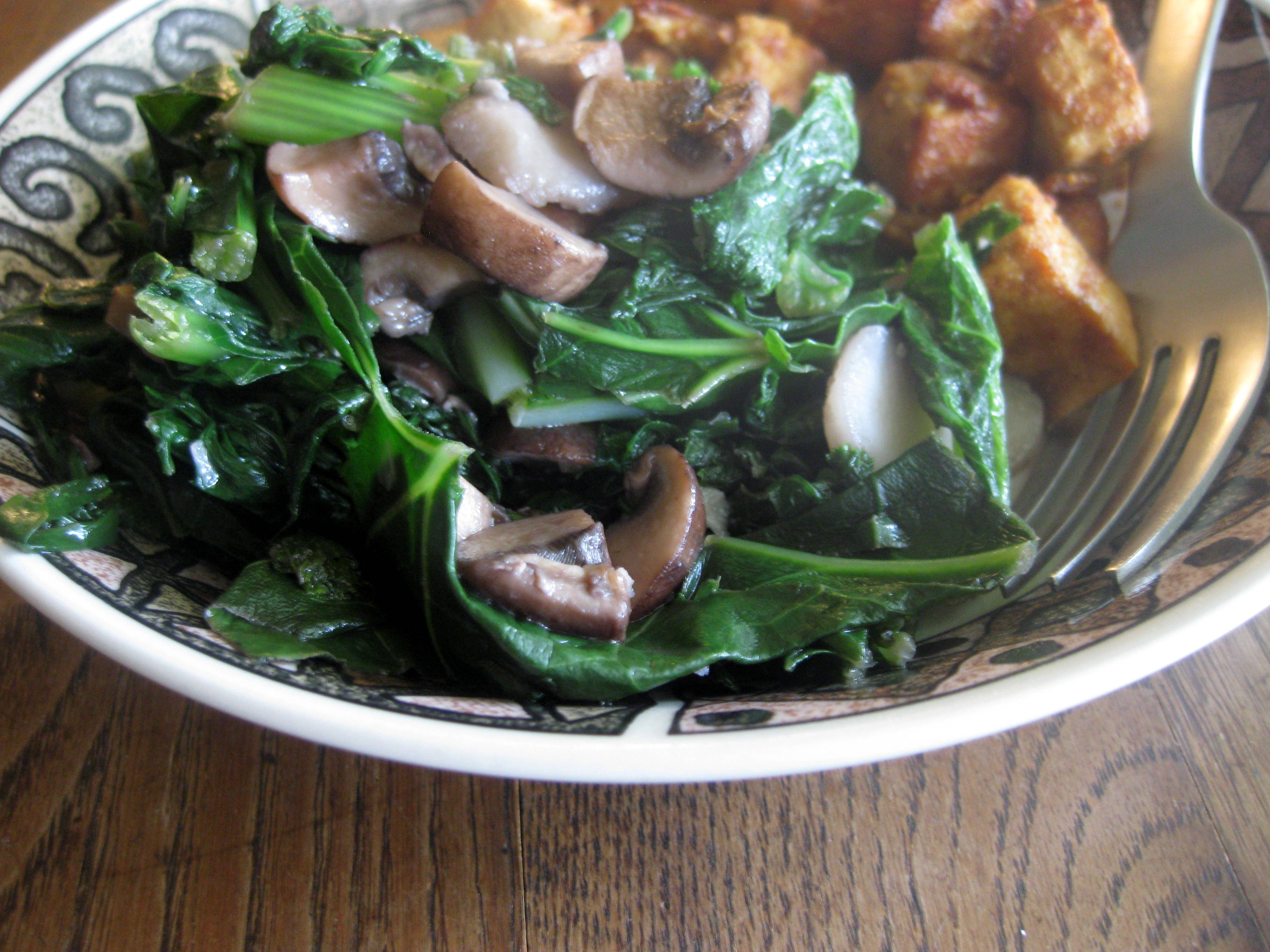
Because I served this with my favorite tofu recipe, I didn’t expect the greens to need any extra salt, but when N. and I tasted we realized it was missing something.  The simple addition of a few splashes of soy sauce rounded things out perfectly.  The greens had a tender crunch that is becoming one of my favorite textures; it’s the barest resistance against the teeth and then a soft chewiness that fills your mouth – I don’t know how to properly describe it.  The water chestnuts, on the other hand, scream with texture and crispness, though they don’t taste like much.  The mushrooms offer up such rich deep flavor that I almost didn’t need to textural contrast of the water chestnuts.  If I made this again I might leave them out.  The soft tender slipperiness of the cooked vegetables made this a dish with such comfort and familiarity that I could have eaten the whole pot on my own.   Easily.  Quickly.  Nothing like writing.

If writing is slow, for me, eating is like reading.  Both are acts of consumption: the words leap into your brain from the page and you must digest them to find their meaning.  The food slips into your mouth and lends flavor, nutrition, sustenance.

I’ve always done both more quickly than I should.  But when it tastes so good, what else can you do?