Indulgence

This week my shopping list was a bit wonky.  I was buying food for a party, and the idea that we might have to, you know, eat this week went to the wayside.  I never once looked at my Bittman options.  I bought nothing to make one of his meals.
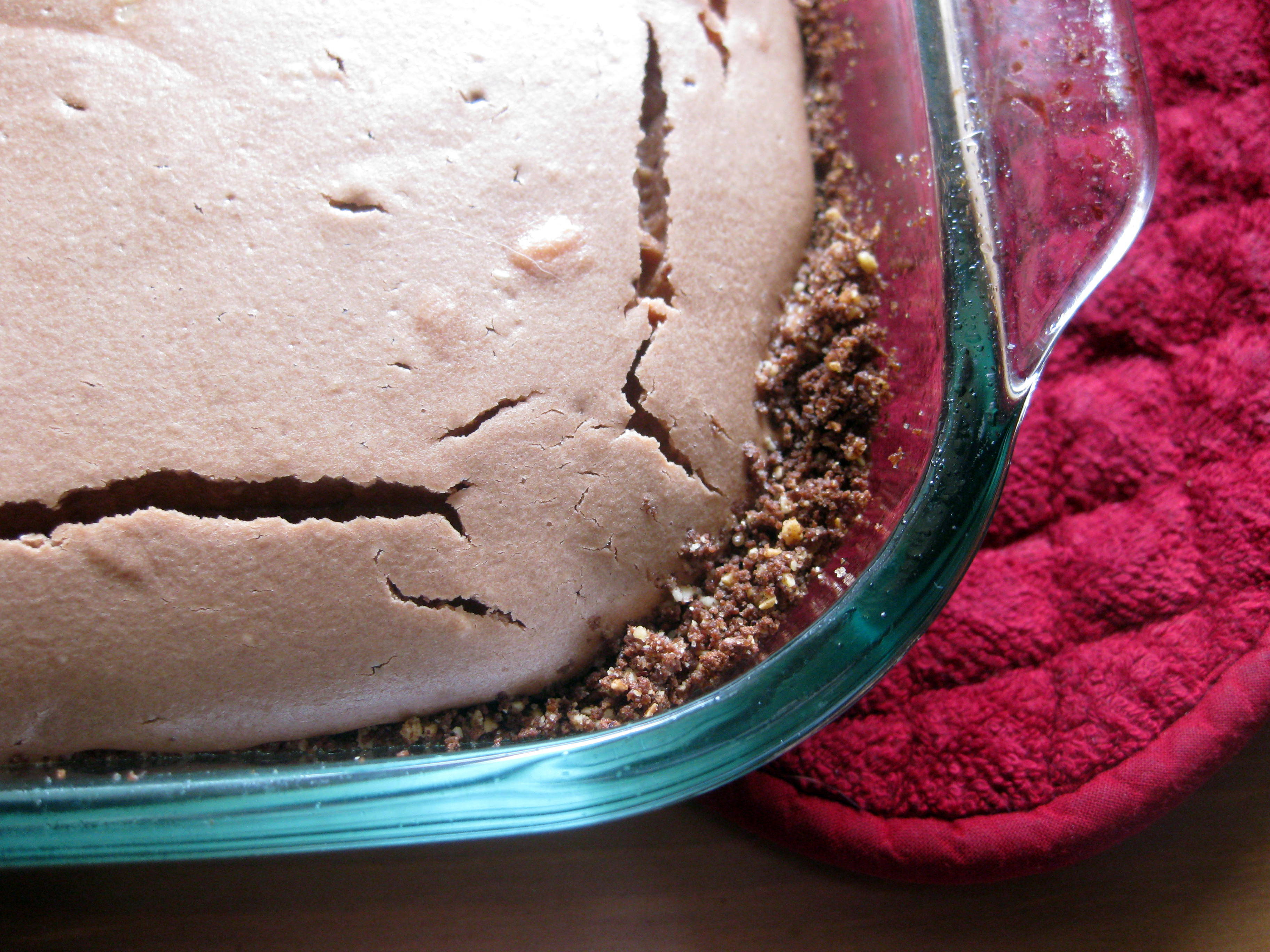
So I beg you to indulge me, as I present something a little different.  Indulge me my favorite indulgence: cheesecake.

For this recipe, I’d love to get some feedback.  I’ve never made a cheesecake before, let alone one impregnated with Nutella.  I don’t usually like “stuff” added to my cheesecake, but inspired by the frosting on Tartelette’s Nutella cupcakes crafted for World Nutella Day, I thought this one might just be okay.  If you make this, please let me know if you change anything and how those changes work out.

Nutella Cheesecake
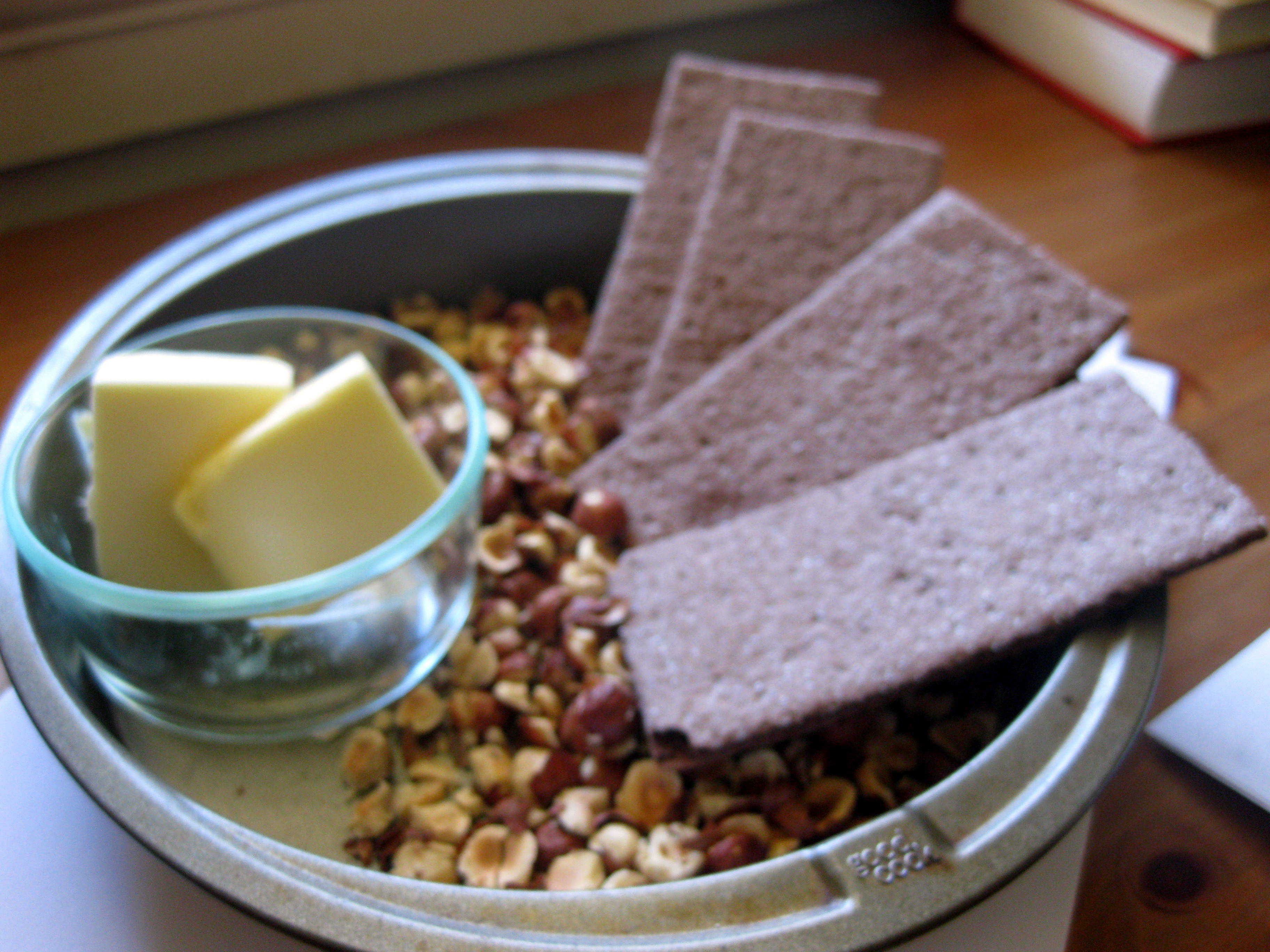
(some measurements are approximate)

Crust:

1 cup toasted, coarsely chopped hazelnuts

8-10 chocolate graham crackers, broken in big pieces

6 TB melted butter

1/8 tsp salt

1/3-1/2 cup sugar, or to taste

In a food processor, pulverize the hazelnuts until very fine – almost a meal.  Add graham crackers, salt, and sugar and grind until everything is homogenous and very fine.  With food processor running, dribble in melted butter and pulse until crumbs are moistened and clumping together.  Dump out into the baking vessel of your choice (I don’t have a springform pan, so I used a 9X13” glass baking dish.  I don’t know how these amounts would correspond to a springform pan).  Using your fingers or the curved bottom of a measuring cup, tamp down the crumbs into a crust of uniform thickness over the bottom and partway up the sides of the vessel you have chosen.

I did not pre-bake the crust, and because it ended up a little crumbly I suspect one of two things could be improved: either it needed more butter to hold it together, or it needed to be pre-baked.  If you do one of these things and have desirable results, please let me know so I can amend the recipe!

Set crust aside while you whip up the filling.

Filling:

all ingredients should be at room temperature

3 bricks full-fat cream cheese

1 cup Nutella

4 eggs

1-2 tsp vanilla extract

½ – 1 cup sugar, or to taste

In the bowl of a stand mixer (or in a large bowl with an electric mixer), beat up the cream cheese until very fluffy and well combined.  This may take a few minutes – don’t skimp on this part because it will ultimately result in less uniform filling.  Scraping down the sides several times during the process is helpful to catch any unblended cream cheese hiding out on the edges of the bowl.

When cream cheese is very light and all has the same consistency, scrape down the sides and add the Nutella.  Beat again, and again be sure it gets fully incorporated so there are no pockets of plain, unblended cream cheese.

Add vanilla and sugar to taste, and blend again until very well incorporated.  Because the Nutella is already sweet and the crust is sweet, start with ½ cup of sugar and give the filling a taste before adding more.  It may be sweet enough for you with only ½ cup.  If not, add more, blend again, and taste again until you are satisfied with the sweetness.

With the mixer running, add the eggs one at a time and wait until each is fully incorporated before adding the next.  Again, be sure to scrape down the sides of the bowl to be sure the filling is of homogeneous texture.  By the time the last egg is incorporated, the mixture should be pourable and slightly soupy.

Pour into the room temperature crust.  If you pre-baked the crust, let it cool (or pop it into the refrigerator for a few minutes) before adding the filling so you don’t start cooking the filling before putting it in the oven.  This would result in an unevenly baked product, which is not what we want.

With all the filling on top of the crust, spread it out a little with a spatula to be sure it forms an even layer.  You may want to lift and tap the whole baking vessel on the counter a few times to help the filling evenly distribute, settle, and release air bubbles (this is good to do with cake batter as well).

Stow your precious vessel in an oven preheated to 350F for about 45 minutes, or until the center is just barely set (you should be able to touch it very lightly and come away with a clean finger, but it should still look the tiniest bit wobbly when you gently shake the pan).  Don’t be afraid to take it out at this point – I left mine in the oven with the heat off and the door open for an extra ten minutes because I was afraid it wasn’t done, but this resulted in big cracks around the edges of the filling, which means I overcooked it.  Still, though, photographic evidence doesn’t lie:
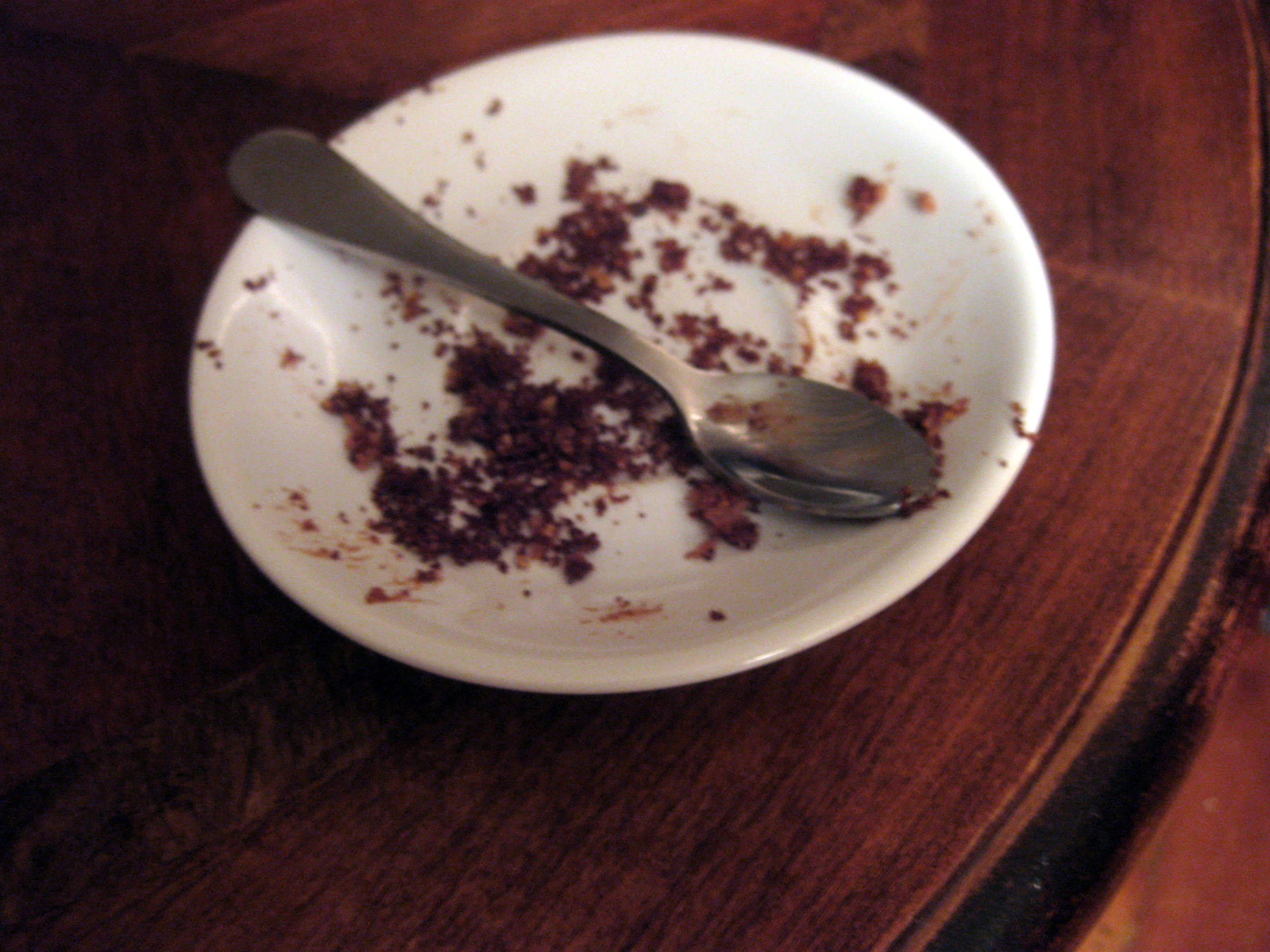
Let the cheesecake cool completely on a rack on your counter-top (away from the heat of the cooling oven), then cover it, put it in the refrigerator, and chill for a few hours to help it set up.  Remove, slice, and serve, and don’t expect the leftovers to last very long.  It’s very rich, it’s very chocolaty, and it’s very, very good.

Getting back into it…

I tell my students that it’s important to be specific when they write.  I tell them to be careful with pronouns – to be sure the subject they refer to is clear – and to add description and make their vocabularies work for them.

And yet, as a self-proclaimed word nerd, I do enjoy a little ambiguity when it comes to titles, lines of text, phrases, something to, shall we say, chew over.  Maybe this means I like poetry after all.  So let’s take on this title together.  It could mean “getting back into being in Oregon for the summer.”  This could certainly be true.  My vacation was phenomenal and I didn’t want it to be over, and even though summery weather has finally come to the Northwest, returning home means certain other, less welcome truths.  My title here could also mean “getting back into my dissertation.”  Yet again, a necessary activity I’m not quite wholly invested in yet.  I need to be.  We’re almost a week into July and I’ve only read one short scholarly book and one chapter of another, and though I’ve thought a bit about my work, I don’t have much to show for it yet.

Finally, and perhaps most applicable, my title could refer to this blog, Bittman, and cooking in general.  I didn’t take my laptop with me on vacation, and I hoped to sustain you on those limited – but admittedly lip-smacking – shots from my week at the beach, but now I’m well back and well behind.  Going out to eat and sampling masterworks from my various relatives made me at once anxious to return to my kitchen and, strangely, resistant to actually going in there and producing anything.  To top it off, because this week’s Bittman was not my favorite, I’ve been having trouble mustering the inspiration to write about it.

Because my cooking urge has been beaten back a bit, perhaps by the heat, or perhaps because all I want to eat is grilled food (hear that, N.?), I thought a raw salad would be a good choice for us.  Then, trying to be ambitious, I thought I’d throw in a bread-y accompaniment, and check two recipes off at once.

“66. In a blender, whip olive oil, lime juice, a little red onion and a stemmed and seeded jalapeno.  Toss with lots of shredded raw sweet potato, diced red bell pepper and chopped cilantro.” 

In theory, this sounded fresh and healthful and good.  Zesty.  I collected

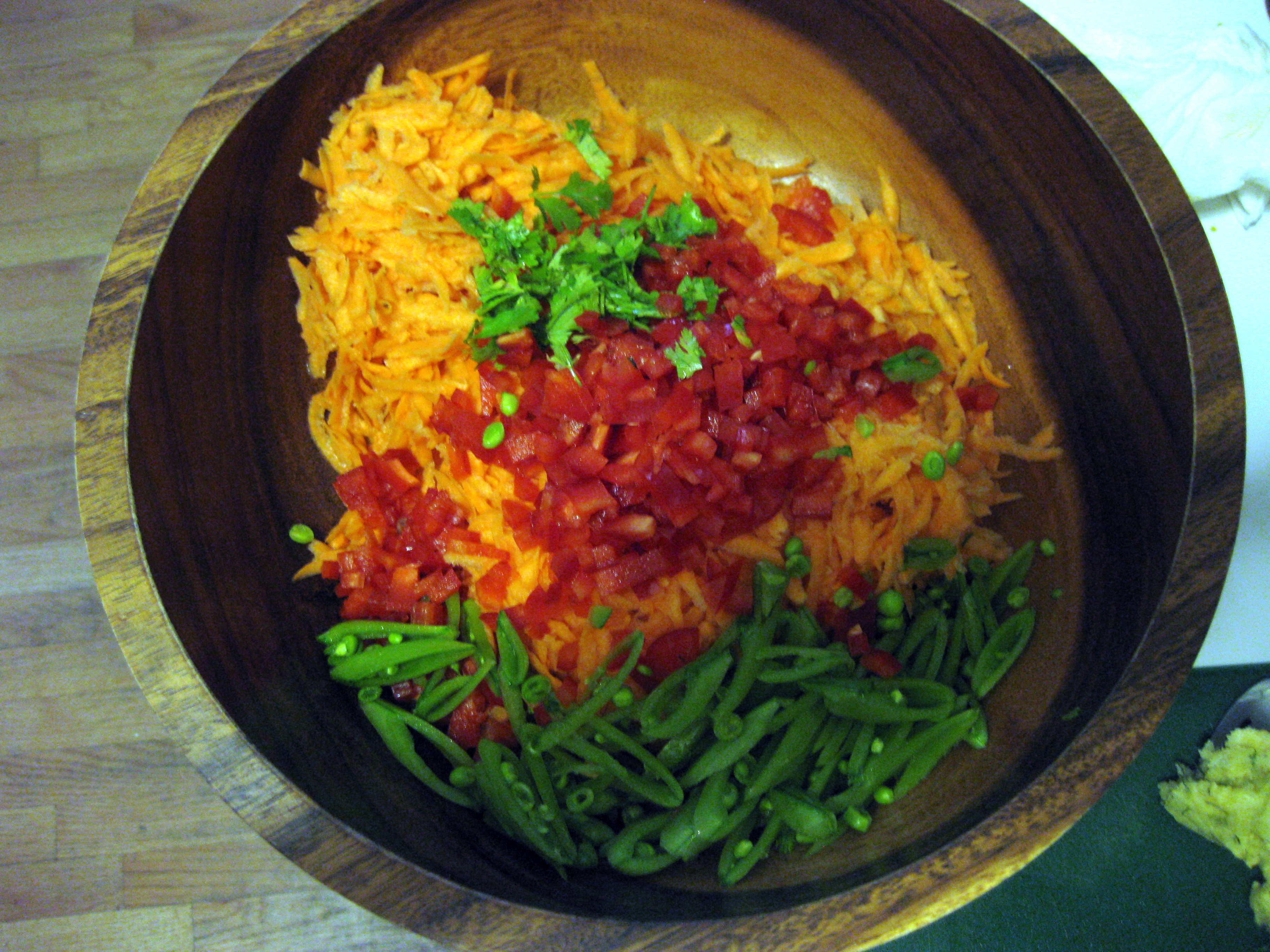
2 medium sweet potatoes (actually, I used the orange ones called Beauregard yams)

1 large red bell pepper, diced

2 TB chopped fresh cilantro

juice of one lime

¼ – ½ cup olive oil, depending on how much lime juice you have

¼ cup red onion, roughly chopped

1 jalapeno, or to taste (I used half a large, green jalapeno and the dressing was only mildly spicy)

I also added a handful of thinly, diagonally sliced sugar snap peapods, because they were swelling almost out of their skins in my garden.

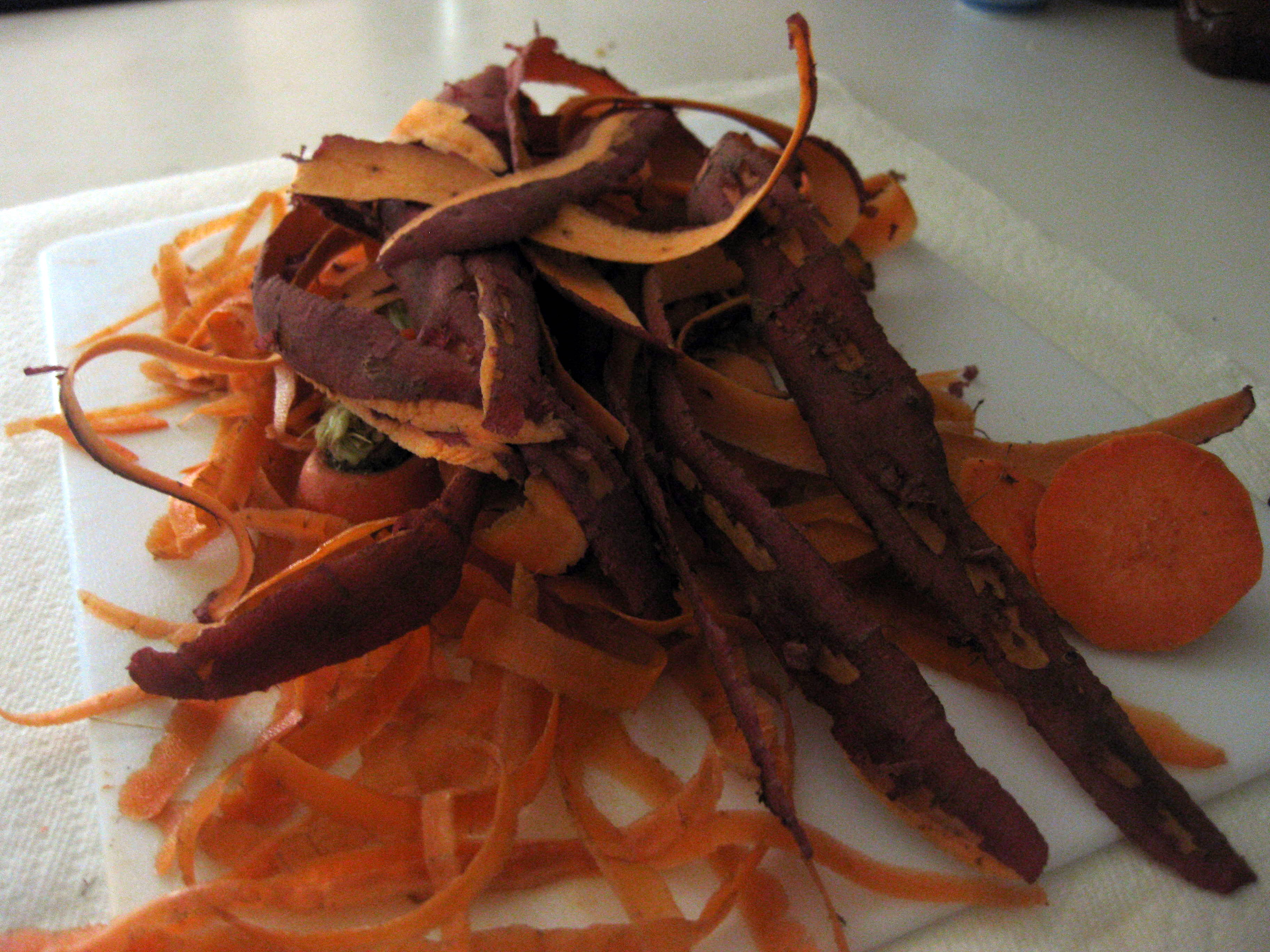
Before making the dressing, I shredded my sweet potatoes and submerged them in cold water in an effort to lift free some of their starchiness and make for a more pleasing mouthfeel.  I left them alone for almost an hour while I made the dill-Cheddar puffs (see below).  When I finally lifted and drained the tatters of potato, I squeezed as much water as I could out of them, and they looked and tasted almost exactly like a pile of carrots.

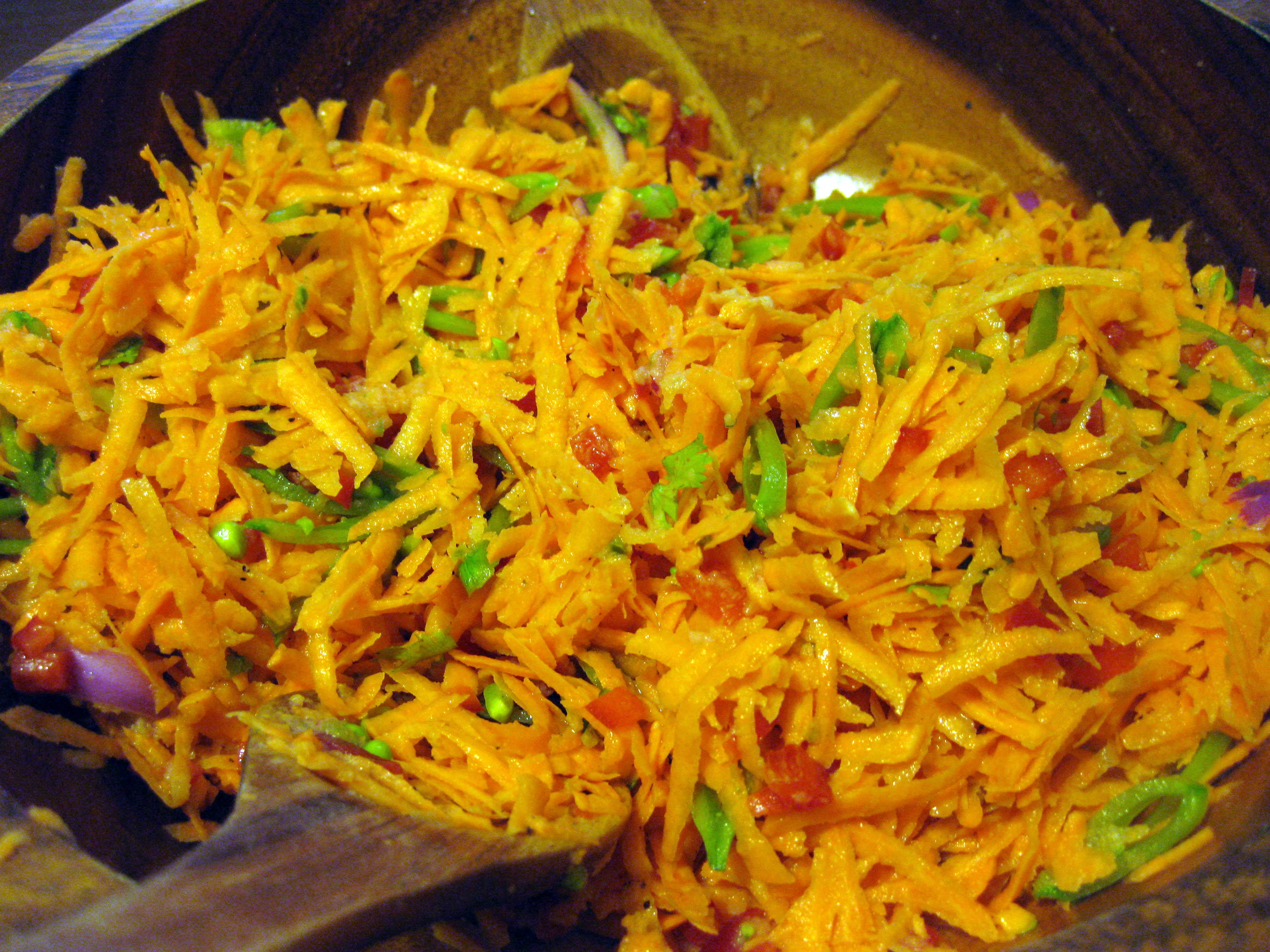
As Bittman directs, I whirred the dressing ingredients in my blender before tossing it with the vegetables, and that was that.  Easy!  I knew we were in trouble, however, when N. turned to me and asked “so what do you think?”  He never asks this!  In fact, as I’ve mentioned before, he rarely opines positively about food.  I knew he didn’t like it.  His assessment was of dissonance: he said he kept expecting either the flavor of carrots, or something that had been cooked.  What we were eating instead was a mildly flavored, slightly starchy crunch with bright, zesty-green-spicy notes. 

I thought the flavors were nice, but thought it wasn’t sufficient as a main dish salad.  This was a dish to be consumed in small heaps, not a giant, plate-filling mound.  My new challenge, then, consists of repurposing the leftovers, since N. is not interested.  I’m thinking a take on latkes, or a stuffing for a pita alongside some falafel or spiced ground lamb, or maybe even players in a spinach salad.  What this tells me, in all cases except the third, is that apparently I wanted some fat in this dish.  Good thing, then, that this wasn’t the only thing we ate that night.

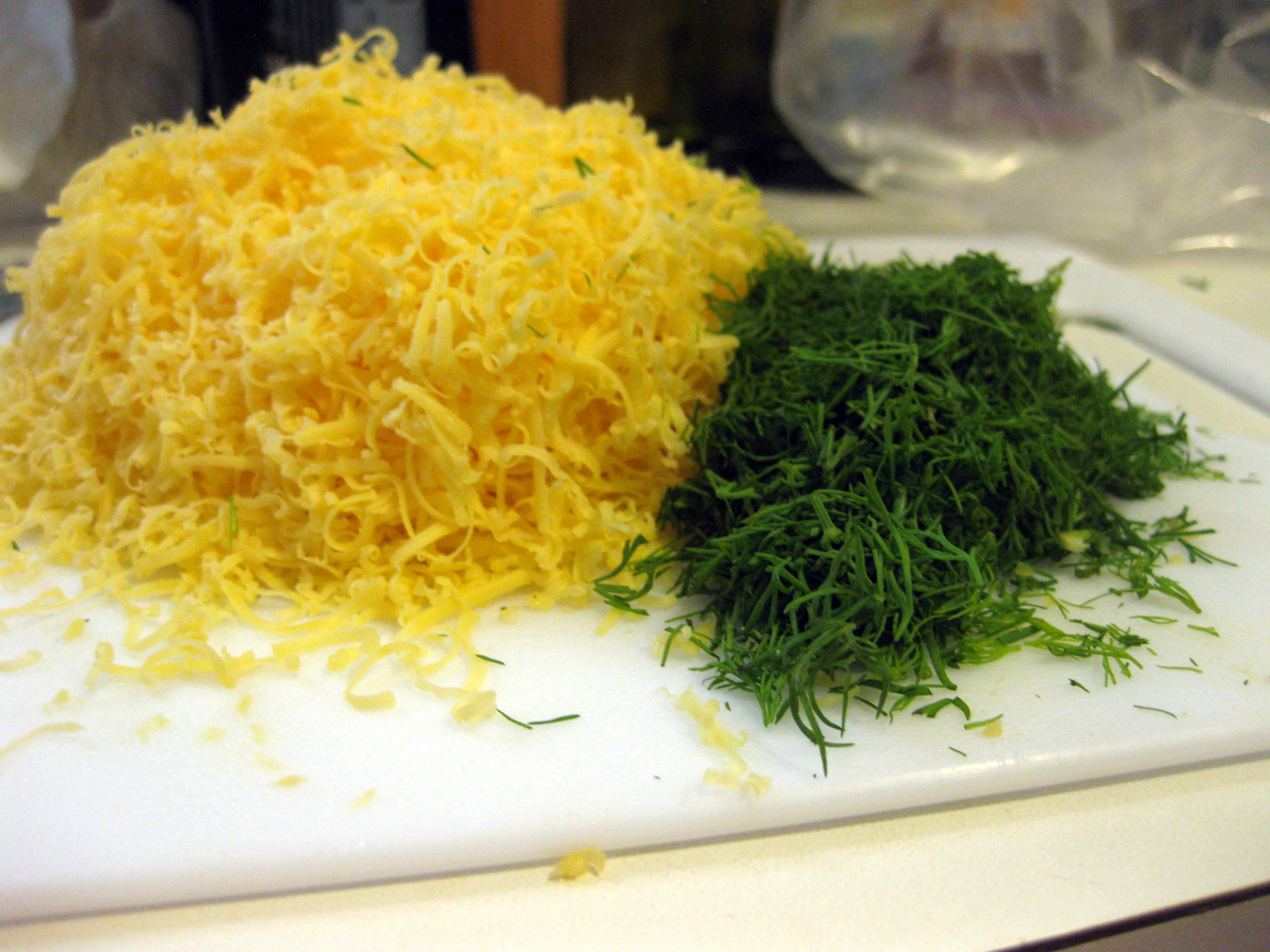
“Dill-Cheddar Puffs: Combine 1 cup water with ½ stick of butter and ½ teaspoon of salt in a saucepan over medium heat and bring to a boil.  When the butter melts add 1 ½ cups flour and cook, stirring, until the dough forms a ball, about 5 minutes.  Turn off the heat, then add 3 eggs, one at a time, beating well until the mixture is glossy.  Stir in 2 cups grated Cheddar and 2 tablespoons freshly chopped dill.  Drop teaspoons of the batter on greased baking sheets and bake at 425 degrees until lightly browned, about 10 to 15 minutes.”

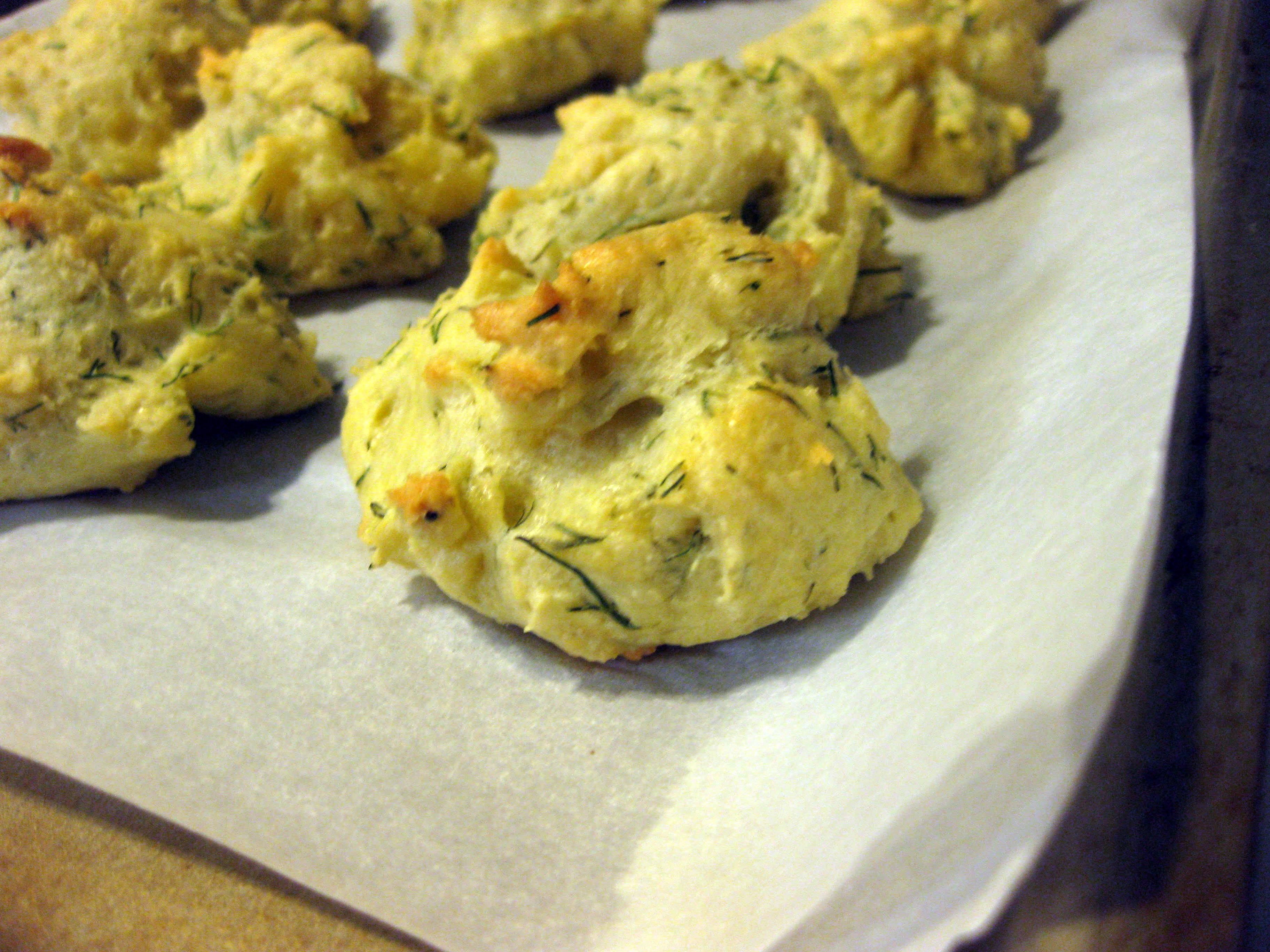
This doesn’t need much comment, either in terms of ingredients or procedure, since Bittman spells it out pretty specifically.  Basically these are savory, filling-less cream puffs.  My mistake, sadly, was ignoring the meaning of “teaspoons” when it came to the size of the batter droplets.  I did more like tablespoons-on-steroids, and as a result they were undercooked at the end of 15 minutes, and overcooked after I’d plunged them back in for another 10.

I ate them both ways, and both ways the flavor was excellent, but at 15 minutes the insides of each puff were still quite sticky.  Even overcooked, while the puffs were still warm they were tasty – crisp, dry, craggy exteriors with an eggy, cheesy middle, and the strong, pleasant grassiness of dill keeping them feeling much lighter than they were.  Either way, N. went back for a refill of puffs even after he’d replaced the salad on his plate with some leftovers.

With slightly better size management, these would have been a monumental success.  They’d make lovely canapes at a party, either whole as little pop-in-your-mouth bites, or split and filled.  If you did want to fill these, cream cheese or smoked salmon might hit the right tone.  Or, if you were feeling adventurous, perhaps both! 

And so with this, I will try to put myself back on schedule.  Back to gardening, back to reading, back to cooking.  Back to feeling excited about it all!  I hereby banish the summer slump of boredom-because-I-don’t-feel-like-doing-what-needs-to-get-done, and the let’s-go-out-again-because-none-of-my-recipes-are-exciting-tonight, and the too-lazy-to-snap-pictures-while-I’m-stirring blues.  I’m back, friends.  I’m back and back into it.

Sunburst

Orange is a hot color. It’s flame and earthy warmth and friendly heat. But it’s also freshness and citrus-bright and spicy. It’s a fall color and a summer color. This is convenient, considering Oregon’s spastic and reluctant attempts to approach spring/summer. Interestingly too, the particular orange combination Bittman offered us this past week was a salad made from winter root vegetables, with a peppery summery acidic dressing. Juxtaposition of seasons. Juxtaposition of flavors.

68. Peel sweet potatoes and boil until tender, drain and cool; dice. Treat carrots the same way. Make sauce of Dijon mustard, olive oil, cider vinegar and chopped scallions. Toss all together.”

Here’s what I used:

1 big Beauregard yam, peeled

3 large carrots, peeled

4 green onions, thinly sliced

2 TB dijon mustard

2 TB cider vinegar

2-3 TB olive oil

salt and pepper to taste

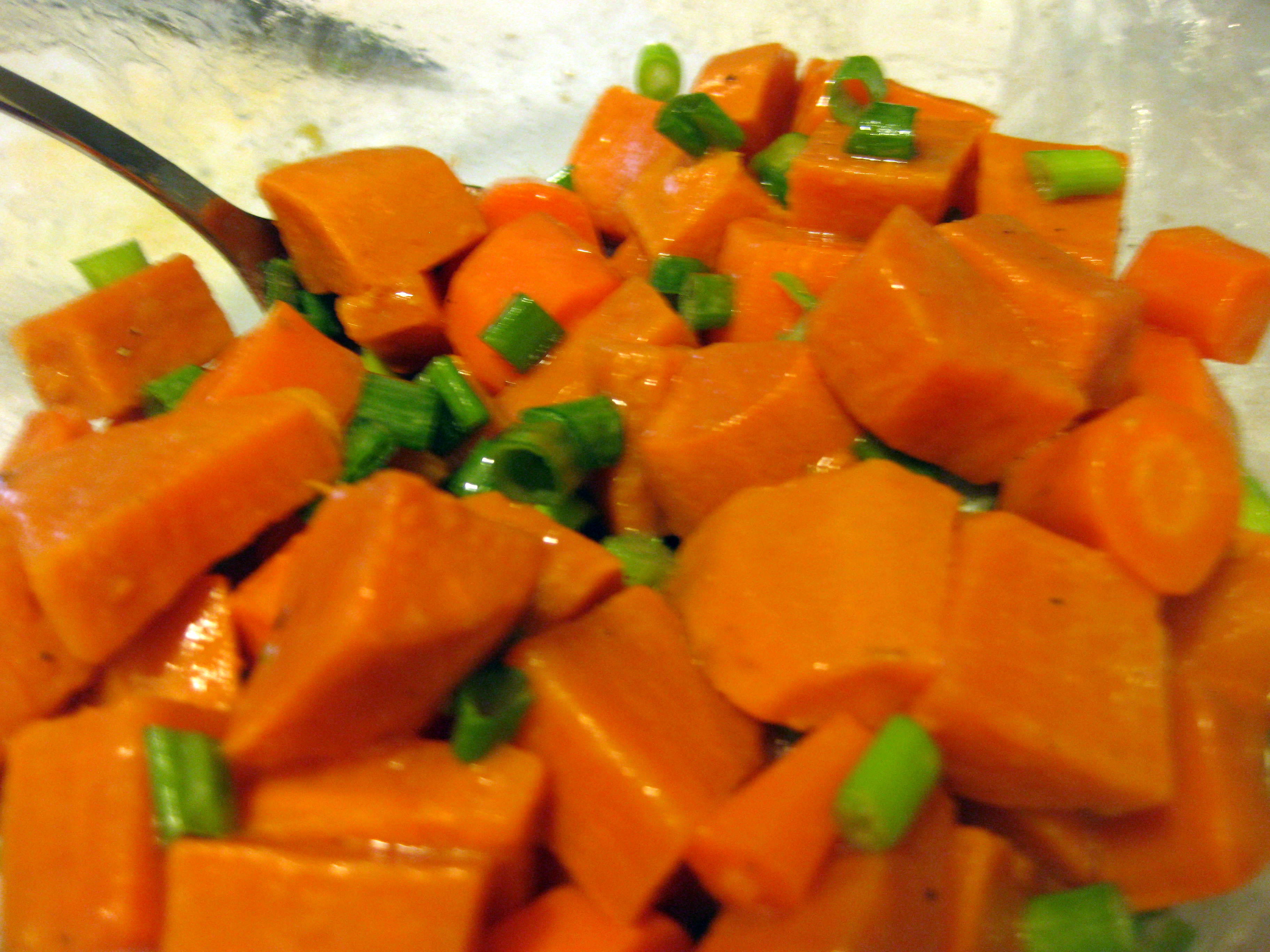
Bittman’s recipe seemed to advocate boiling the carrots and sweet potato whole. I decided to shorten the cooking time and cut the vegetables into chunks first. I boiled them in lightly salted water for fifteen or twenty minutes, or until the sweet potato chunks were tender and the carrots still had a touch of texture. Drained, they were startlingly bright against my white colander and I had to sample one. And then another. And then another of each.

They tasted like sweetness and familiarity. I set them aside to let them cool for an hour.

When they were well cooled, I tossed in the green onions, ground on some black pepper, and mixed up the dressing. I combined the mustard, the vinegar, and some salt and pepper in a measuring cup, then blended them with a fork into a homogenized mixture. Then, still whisking constantly, I added the olive oil in a slow stream, whisking persistently until the mixture emulsified. Then, of course, all that remained was to pour it over the vegetables and toss them gently together for full immersion.

While this sat, I prepped its accompaniment. I brought some chicken stock to a boil, then tossed in a bagful of frozen peas. When the liquid resumed its boil, I stirred in a box of couscous and clapped the lid on to let the absorption process commence. I wasn’t sure it was going to work, because I feared the peas might have soaked up too much of the liquid and the tiny beads of semolina wouldn’t cook properly. I feared in vain. When I fluffed the couscous five minutes later, it was cooked and tender, the peas were steaming, and I stirred in some chopped fresh parsley for kicks.

Now, instead of a steaming vegetable dish and a cold pasta salad, we had hot, vegetable-laced pasta and a cold vegetable salad. It was a delicious juxtaposition, with the wintry roots flavored in bright, commanding acidity and the couscous dressed with springiness. I loved what the mustard and vinegar did for the carrots and the sweet potatoes, playing against their inherent sweetness to add complexity and interest. Cleaning up after dinner, N. and I couldn’t stop grabbing chunks of their sour-sweet tastiness with our fingers out of the bowl. I will certainly make this one again.

The nice thing about this dish was how, even in its odd mixture of summery flavors and autumnal base, it mirrored my own summer thus far. Eugene has been mostly dreary, offering pockets and blotches of sunlight and teasing us with predictions of 70F degree weather, then delivering a sky socked in fog and breezes of misty drizzle. This isn’t June gloom. This is June despair.

But this past weekend, as the bright chunks of winter took on summer flavors, I left Eugene for warmth, for sun, and for vacation. This week and next week, I cannot promise another post. But I can promise that my pale shoulders will toast, my hair will bleach out, and my brain will slow down its frantic pace. I’ll keep track of what I eat, and I’ll photograph the triumphs and surprises to share upon my return to internet-land. And I hope, fervently, your last weeks of June will be as orange as I know mine will be.

Humble Fare

Writing a dissertation is a humbling experience.  The quantities of research required, the demands on time and mental health, and finding out how much you don’t know about what is supposed to be your area of expertise are all staggering.  Most recently for me, comments from my adviser and a recollection of how comparatively little time I have to research, draft, write, and polish the thing have kept me all but scraping the earth with my forehead.

This week’s Bittman played into this humility topos:

“71. Add chopped scallions and chopped kalamata or other good black olives to cooked and drained white beans.  Dress with white wine vinegar, olive oil and fresh thyme, marjoram or oregano.” 

Not only did this sound refreshing, filling, and ridiculously easy, but it allowed me to work on another area of life in which I feel humbled: the garden.  With another reluctant spring almost over and me still questioning whether it ever arrived in the first place, I haven’t had as much time to devote to the brave little sprouts forcing their way through the cold chunks of clay and silently suffering slug attack as I would like.  One variety, however, needs no assistance from me.  Two years ago I planted some oregano in a square planter and set it next to the herb bed.  It thrived.  One year ago, we put in a sprinkler system and forgot to connect a dripper to the oregano’s box.  It died.  This year when I ventured out for the first time in March to see how things were looking, there was oregano everywhere except that box where it was originally planted.  This salad, then, seemed like the ideal way to start getting things back under control.  A few stalks uprooted is doubly productive: dinner for us, a more orderly space for the garden.  If only the dissertation were that easy!  I used:

1 16 oz. can white kidney beans, rinsed and drained

½ cup kalamata olives, roughly chopped

4 green onion stalks, chopped (I saved the white bulbs for another use)

2 TB chopped fresh oregano

2 TB white wine vinegar

2 TB olive oil

salt and pepper to taste

(¼ cup grated parmesan cheese)

While our smoked chicken sausages sizzled in a pan, I literally dumped all the ingredients into a bowl, tossed it lightly, and gave it a taste.  When using only Bittman’s suggested collection it seemed to be missing something, so I added a shower of cheese.  Sun dried tomatoes, or capers, or fresh tomatoes, or torn arugula, or even crisp crumbles of bacon, would also make nice additions.

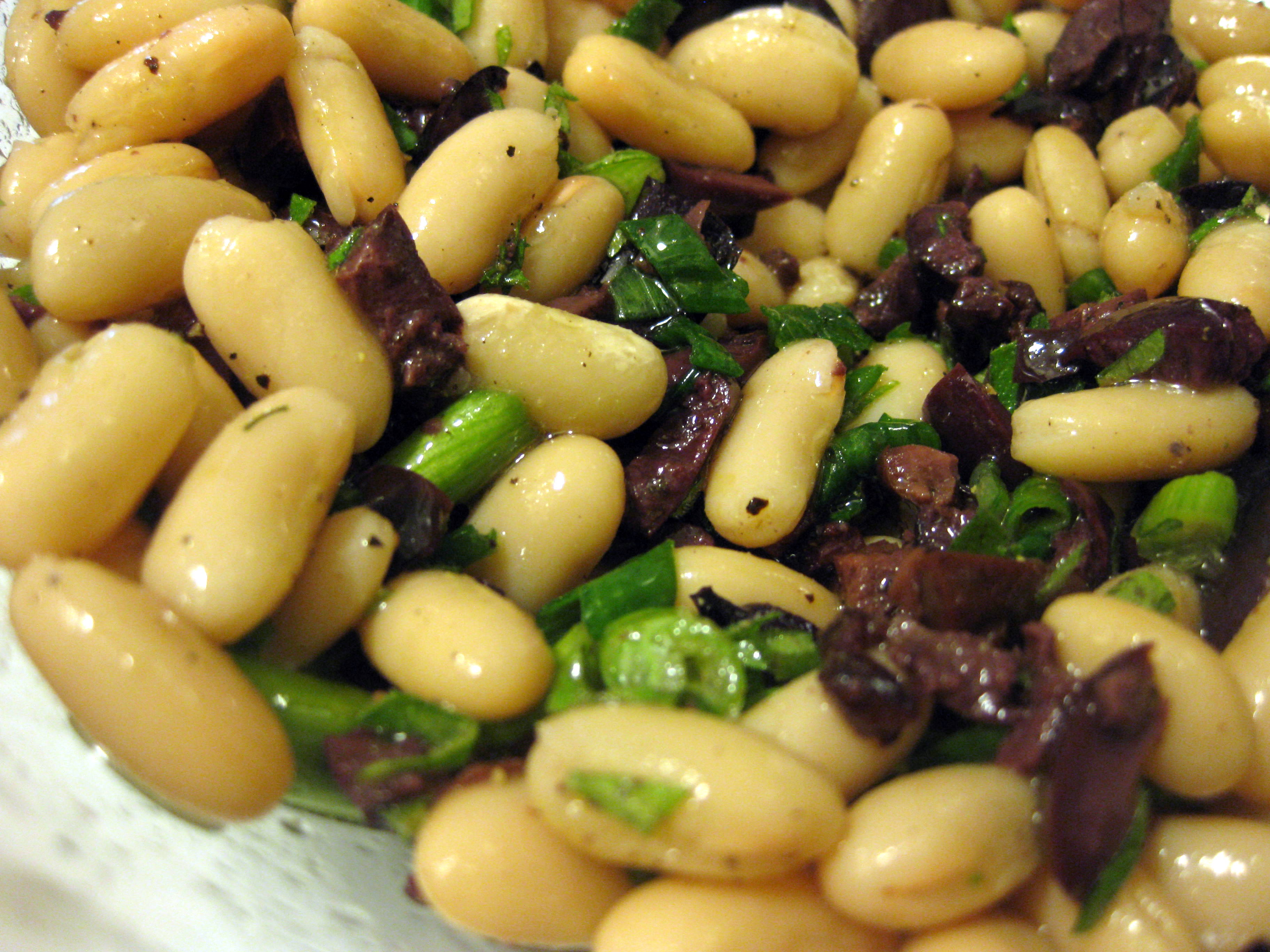
The finished salad was simple and satisfying, and had all the right tastes and textures.  The beans were creamy and soft beneath their slightly taut skins, the olives were a blast of brine, the onions had just the right astringency, and the oregano lent a spicy, earthy warmth.  The parmesan was just that final sprinkle of richness and somehow bound things together.  Pushing outside of the suggested ingredients and adding one of my own took this from a decent side dish to a salad I want to make over and over, adjusting the seasonings and the aromatics and the herbs every time, so it is fresh and exciting with each new taste.

It’s funny that even humble fare, when you give it due consideration, has flashes of zesty tangy brightness: a bite of olive, a splash of vinegar, a crumble of parmesan.  It makes me feel warmer about the dissertation experience.  If this simple salad – creamy and earthy and nourishing and salty – can have glimpses of piquancy, perhaps my project can as well.  I just have to keep experimenting with my ingredients.

Leafing through

Writing is slow.  And it’s difficult.  I learned this when I was first considering authorship (I wanted to write young adult novels, and then I wanted to write fantasy novels, and then I wanted to write The Great American Novel.  And then I decided to go to graduate school).  Yet I forget this with dependable, routine frequency, and then when I sit down to write something, I’m astounded and dismayed when it turns out to be challenging.

But cooking is often fast.  And it’s not all that difficult, if you’re paying attention.  So it’s funny that I seem compelled to combine the two.  Something that is over so quickly – created in half an hour, consumed in another – takes me a week to contemplate and fit words to.  And this surprises me, for some reason.  It’s synesthetic, really.  Taking the products of senses and forcing them into words is neither easy nor accurate.  And yet if we’re going to write about food, that’s what must be done…

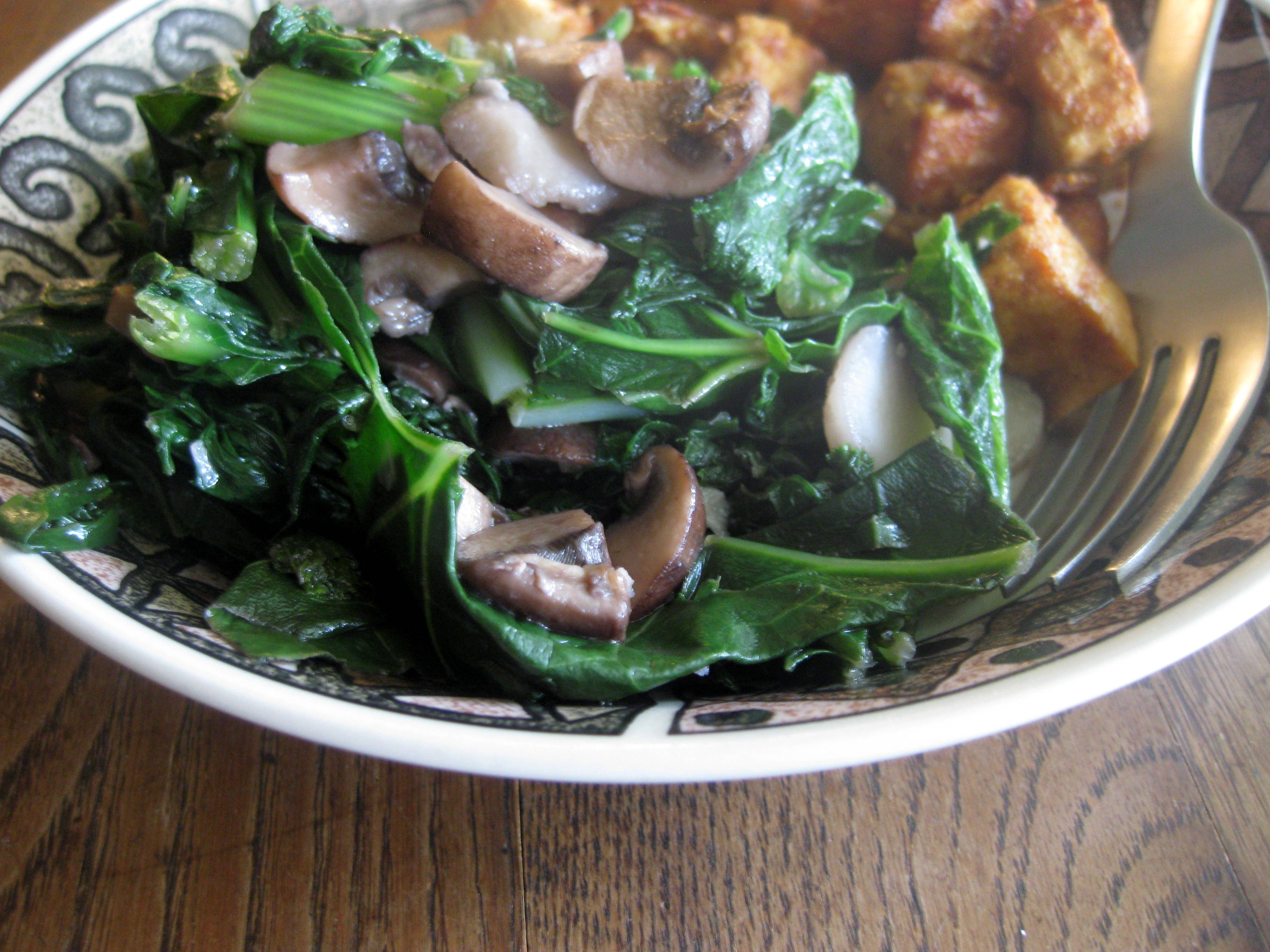
“Poach broccoli rabe or stemmed greens like collard leaves, then drain and chop. Combine with chopped water chestnuts and diced mushrooms in a skillet with sesame or peanut oil, minced garlic and hot pepper flakes. Cook until vegetables soften and dry a bit.”

I permitted myself a few shortcuts this week, purchasing already-sliced water chestnuts and a big sack of greens from Trader Joe’s.

Approximations:

1 16 oz. bag mixed cooking greens

1 small can sliced water chestnuts

2 cups chopped mushrooms

¼ cup vegetable oil

2 TB sesame oil

4-6 cloves garlic, finely minced

½ tsp red pepper flakes, or to taste

2 TB soy sauce, or to taste

I heated up a pot full of salted water and dumped in the greens when the water came to a boil.  They only took a few minutes to cook, and when the thickest stems were just crisp tender, I declared them done and drained the pot, leaving the leaves in a colander so they could drip as dry as possible.

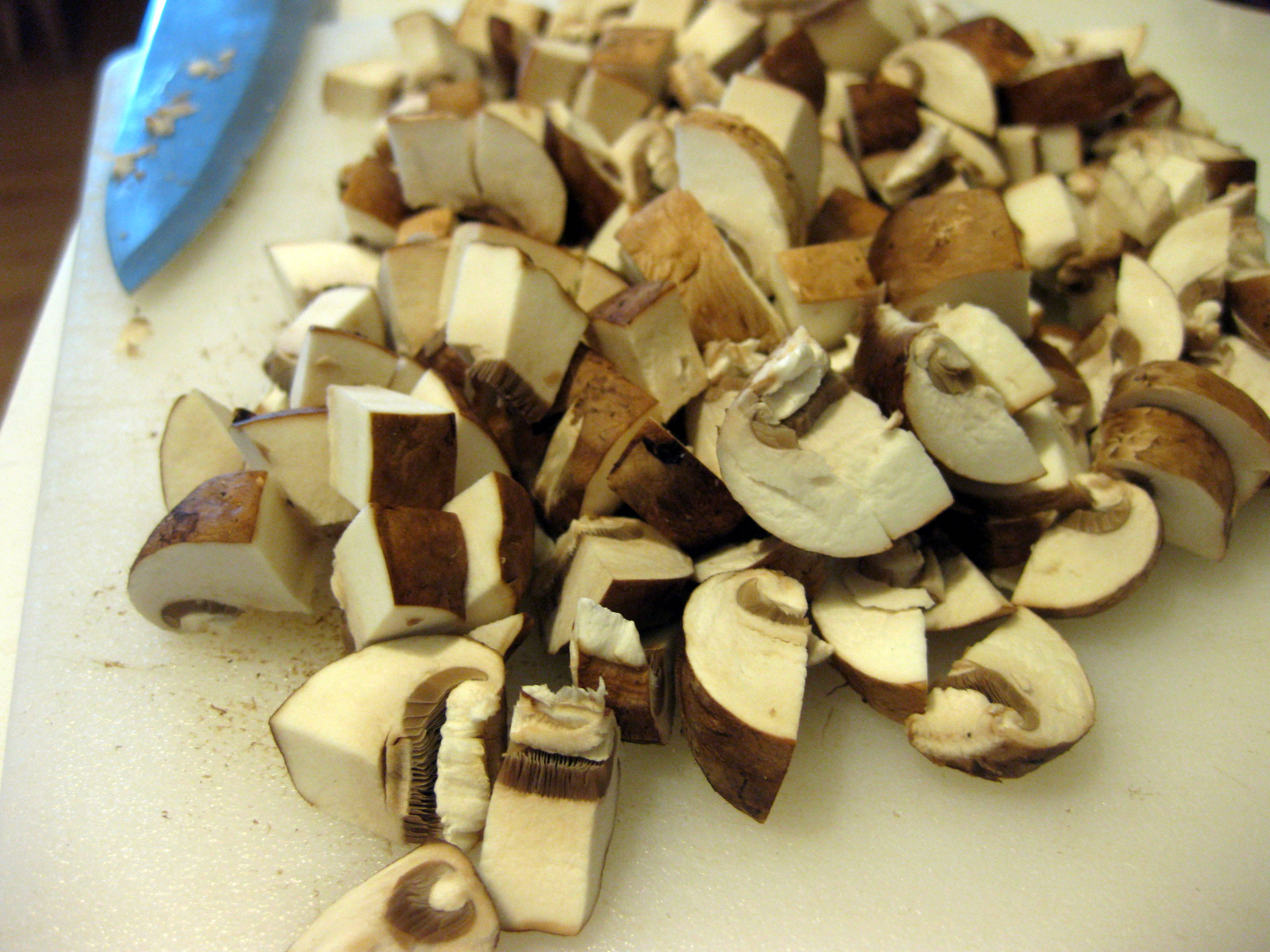
In a large skillet, I heated up the oil while I chopped mushrooms.  I think sesame oil has a very strong flavor and it sometimes burns, and since mushrooms tend to absorb quite a bit, I thought I’d give them a mixture to sizzle in.  When their color had darkened and they had given up their moisture, I tossed in the sliced water chestnuts and the garlic.

I’ve gotten into a bad habit of turning away from the stove lately, assuming things will take longer than they do (perhaps misapplying to the kitchen what I’ve learned so grudgingly about writing?) and returning to the smell of char, so I was careful to add my cooked, drained greens only moments after tossing the garlic around the pan.  Then I tossed on some red pepper flakes and gave the skillet a vigorous stir.

Because I served this with my favorite tofu recipe, I didn’t expect the greens to need any extra salt, but when N. and I tasted we realized it was missing something.  The simple addition of a few splashes of soy sauce rounded things out perfectly.  The greens had a tender crunch that is becoming one of my favorite textures; it’s the barest resistance against the teeth and then a soft chewiness that fills your mouth – I don’t know how to properly describe it.  The water chestnuts, on the other hand, scream with texture and crispness, though they don’t taste like much.  The mushrooms offer up such rich deep flavor that I almost didn’t need to textural contrast of the water chestnuts.  If I made this again I might leave them out.  The soft tender slipperiness of the cooked vegetables made this a dish with such comfort and familiarity that I could have eaten the whole pot on my own.   Easily.  Quickly.  Nothing like writing.

If writing is slow, for me, eating is like reading.  Both are acts of consumption: the words leap into your brain from the page and you must digest them to find their meaning.  The food slips into your mouth and lends flavor, nutrition, sustenance.

I’ve always done both more quickly than I should.  But when it tastes so good, what else can you do?

Kale and coconut

Kale is a recent love for me, at least relatively speaking.  I had seen the curly leaves used as edging – a kind of metaphorical hedge between dishes in fancy hotel breakfast buffets or salad bars; a hefty big brother to curls of parsley left quasi-artistically on the side of a plate – but I had never eaten it.  Sometimes it didn’t even look edible, but more like a plastic plant trapped somewhere in the realm of land kelp.

Last year I began experimenting with kale, mostly thanks to bloggers like Shauna at Gluten-Free Girl and Elana at Elana’s Pantry.  N. and I have chomped our way through kale in lasagna, pesto, braised with soy sauce and mushrooms, and of course coated in olive oil, sprinkled with salt and paprika and roasted into chips.  Its robust, almost waxen toughness seemed to require aggressive cooking techniques.  I never believed the recipes I read suggesting raw consumption could be tasty.  And yet Bittman advocated for this as well!

“74. Trim and chop kale; salt and squeeze and knead until wilted and reduced in volume, about 5 minutes.  Rinse, dry and toss with olive oil, lemon juice, chopped dried apples and toasted pine nuts.”

With my yen for freshness and greenery escalating, I decided it was worth a try.  The cast of characters consisted of:

1 large bunch Italian or lacinato kale

1 tsp. salt, plus more to taste, if desired

2 TB olive oil, or to coat

Juice of half a lemon

½ chopped dried apples

¼ cup toasted pine nuts

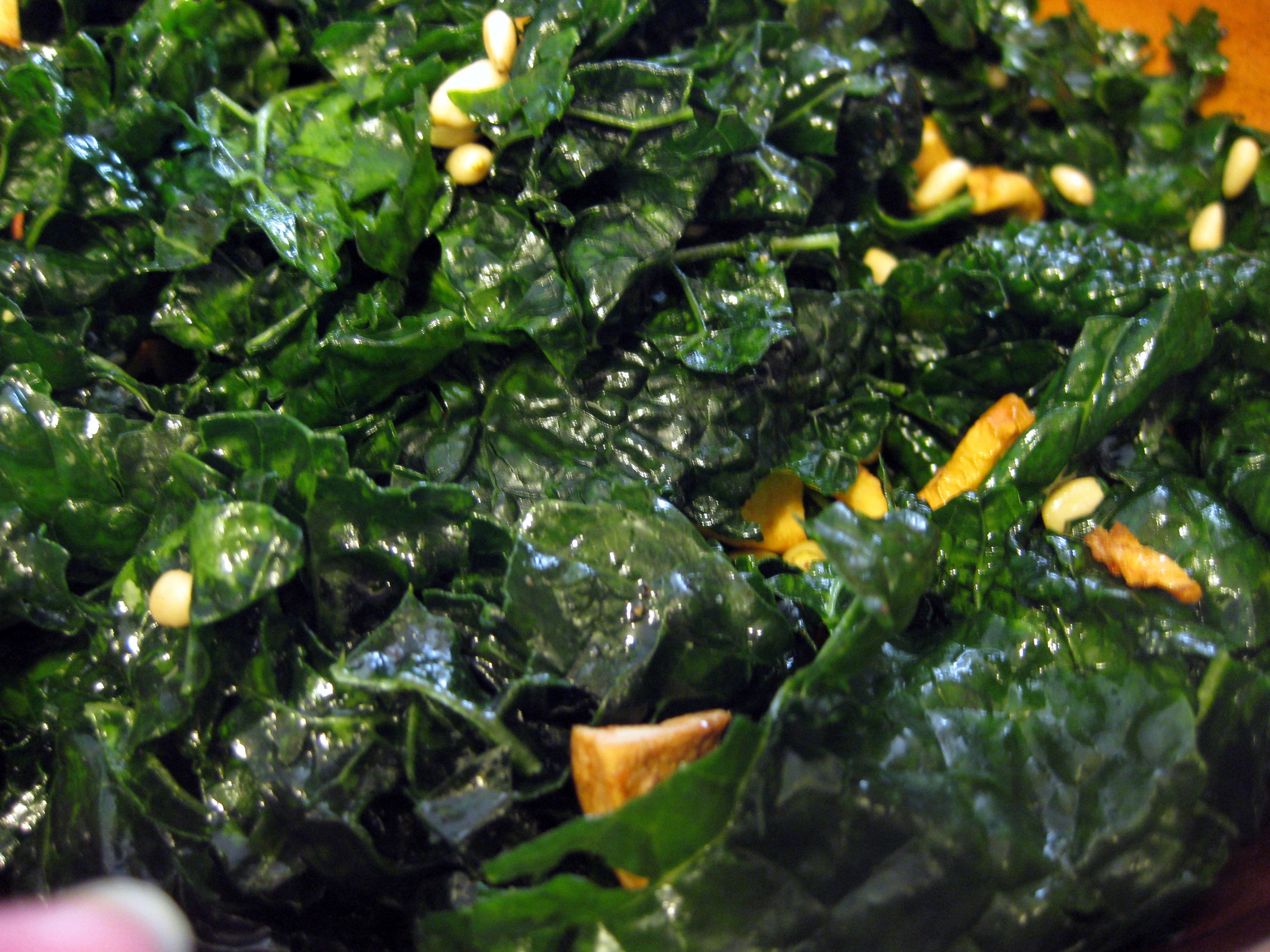
Doubtful, I tore the beautiful emerald lobed leaves from the tough central stalks, then roughly chopped the huge pile of leafy scraps into smaller pieces.  I sprinkled salt over my heap of salad and began to knead.  To my utter amazement, in under a minute the leaves had started to change in texture and consistency.  They became more like spinach, then more like cooked greens, and I decided to knead only for two or three minutes, fearing from the drastic reduction in volume already that I would end up with less than two servings.  When I stopped kneading, I flopped the wilted clumps into a salad spinner to rinse, de-salt, and spin dry.

I tossed the kale with olive oil and lemon juice in a large salad bowl, then added the pine nuts and apples.  A quick taste led me to add a miniscule sprinkle of salt, and then it was ready to serve!

We enjoyed the salad with chicken apple sausages – I wanted to capture the special flavor of the apples and highlight their sweetness against the tart lemon and bitter kale.  It was a very successful salad, and would be particularly good at the height of summer when you cannot bear to encounter the heat cooking requires.  Just pre-toast the pine nuts on a cooler occasion and this salad flies together.

The contrast of flavors is lovely.  It manages to hit all four of the major taste bud groups: the kale is bitter, the hint of salt gives it nice salinity, the apples are sweet, and the lemon is tartly sour.  Similarly, it satisfies a variety of textures: the kale is tender but still has some body for your tongue to play with, while the apples are chewy and the pine nuts provide a satisfying crunch.

Using kale as a salad base provides so many possibilities.  I already know I’d like to try toasting the apple rings to try and achieve a more chip-like texture and add extra crispness: apple croutons, if you will.  A more savory salad might entail replacing the apples with a good grating of sharp cheddar or Parmesan cheese.  Hard boiled eggs, walnuts, and maybe a scattering of bacon would make a more substantial salad.  The options are endless.

But the title of this post isn’t about endless kale.  It also mentions coconut, so I’d better move along.

With half a bag of sweetened, flaked coconut in my pantry and a small bevy of beauties descending on my house for a ladies’ TV night, I decided to over-achieve this week and make another Bittman selection to share with my friends.

“100. Spiced Macaroons: Mix 3 cups shredded unsweetened coconut, 1 cup sugar, ½ teaspoon ground cardamom and a pinch of salt in a bowl.  Stir in 3 lightly beaten egg whites and a teaspoon almond extract.  Drop in small spoonfuls on baking sheet and bake at 350 degrees for about 15 minutes, or until golden on the edges.”

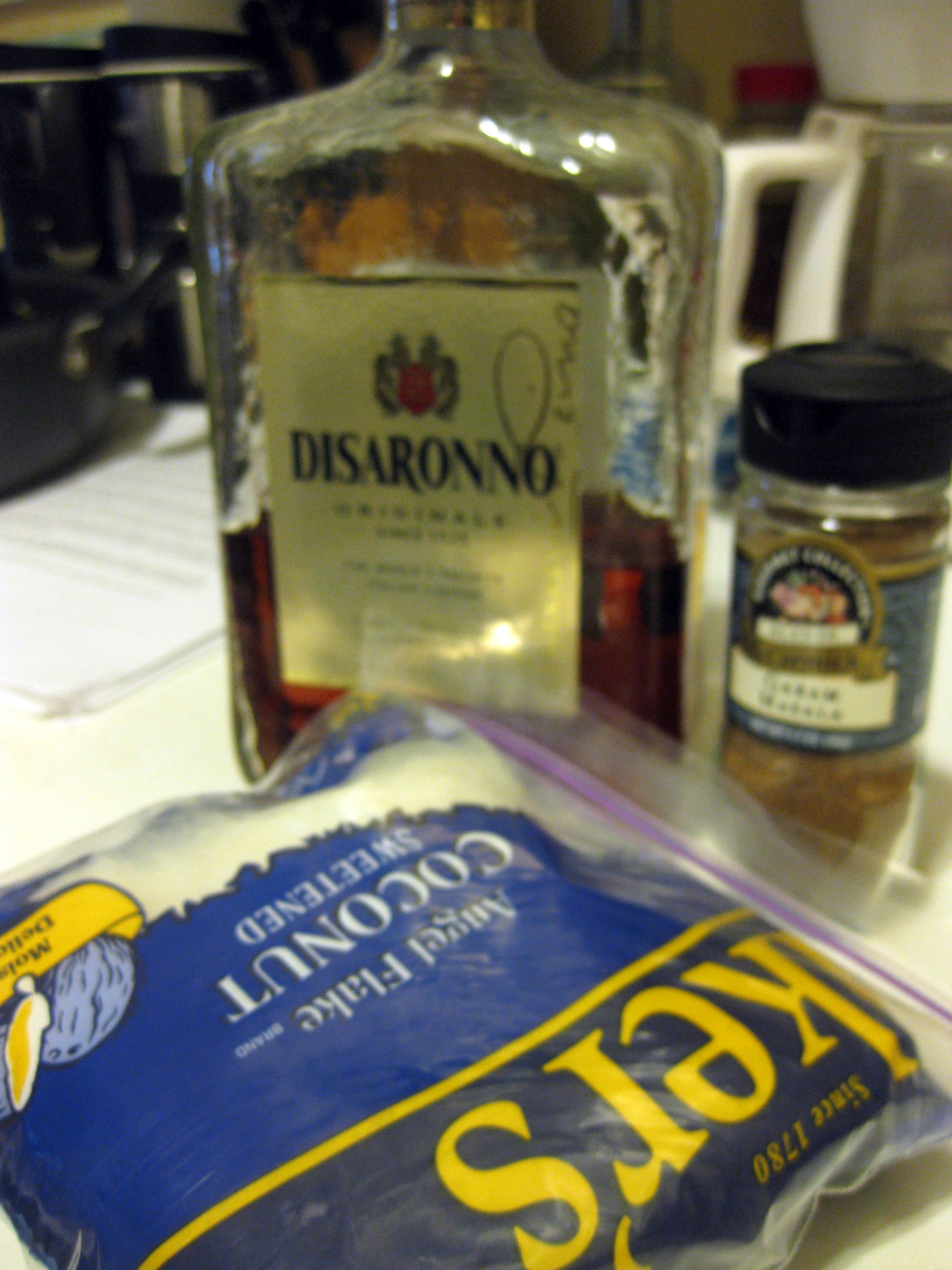
I must admit from the outset that my process was a considerable adaptation, spurred by a shortage or downright lack of both ingredients and time to obtain more.  I used the following:

2 cups sweetened shredded coconut

¼ tsp garam masala

Pinch of salt

2 lightly beaten egg whites

1 tsp amaretto liqueur

From there, I followed Bittman’s directions exactly.  At the point the house began to smell like a vacation, I pulled the cookies from the oven and, unable to resist, stuffed one that collapsed from its fragile form into my mouth.  Oh heaven.  It was incredible.  The coconut was still chewy, and I’m pretty good with words, but the mixture of spice and salt did something I can’t describe.  Cooks are always saying salt enhances the other flavors of the dish, and that’s what happened here.  The coconut and egg whites suggested lightness and airy tropical sweetness, while the garam masala was incense and thick dark spice, but just the barest touch: a perfumed, candle-lit temple down the road from an endless white sand beach.  Fanciful, you say?  What can I tell you… coconut is one of my favorite flavors, and when it is elevated to such heights a certain mystical religiosity is perfectly appropriate.

The cookies were quite tender, and some declined to hold together at all.  This made them easier to eat, in a way, because they were already breaking themselves for us – all but insisting upon their own sacrifice – but the next time I attempt them I want them to hold together better.  I may cook them a little longer, or perhaps beat the egg whites more vigorously.  You wouldn’t want stiff, or even soft, peaks, but perhaps an approach to peaks would help the coconut cling together.  Nevertheless, three girls in the space of an hour decimated a plate of macaroons, leaving behind only three stragglers who were so lonely that I found them a happier home the following afternoon as a reward to myself for accomplishing some much-needed reading.  I must say, the lift from an analysis of 14th century poetic aesthetics into all-but-mystical flavor vacation is about the best an afternoon snack can do.