Homecoming

I know I’m going about this a bit backwards, but I just wanted to show off what was weighing down our plants in the back garden when we returned from our California trip:

IMG_1711Just look at that!  I love how the cherry tomatoes are still clinging to their stems, though less than five minutes later I was thrilled to liberate them.  Our friend K., who was just one of the delightful people who helped us produce this harvest by watering the garden in our absence, told me that the sungolds are like tiny little jewels of crack.  I concurred.

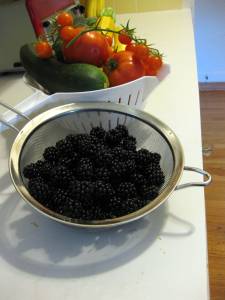
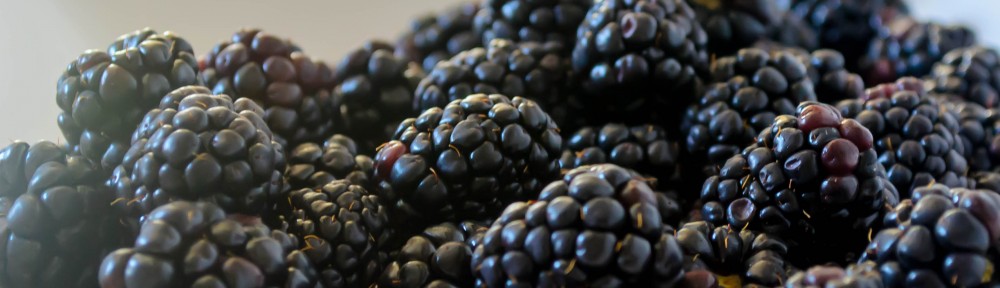
Oh, and don’t forget the blackberries, my inspiration for this blog in the first place:

IMG_1713They are already chilling in the freezer, waiting to be made into blackberry mojitos.  There are honestly enough of them to experiment with other concoctions, but really, why mess with a good recipe?

My First Lasagna

Since I’ve been in California for roughly the past two weeks, I haven’t shared any foodie experiments or revelations.  Yes, I cooked and ate delicious food on my trip, and yes, I brought my camera with me.  However, I neglected to bring the correct cable to plug the camera into a computer and upload the photos.  I’m home now, and certainly have things to share, but for the moment I’m much more excited about tonight’s dinner, which is currently just starting to emit cheesy delicious aromas from the oven.

I have never made lasagna before.  I’ve heard a lot of complaints about how it’s labor intensive and time consuming, and since two of the major ingredients are ground beef and tomato sauce, I’ve steered clear.  I like ground beef in hamburgers, and occasionally in burritos or meatloaf, but I’d prefer that it stay away from my pasta.  As for the tomato sauce, since I’ve entered adulthood cooked tomatoes in almost any form upset my stomach.  Therefore I have found a large number of alternative pizza and pasta toppings so I can still enjoy Italian cuisine.  But lasagna… that was always a roadblock that I wasn’t overly inspired to circumvent.

Then N. and I went to Ashland for our two year wedding anniversary.  In addition to the delicious food that we ordered from Pasta Piatti on Main Street (a must-visit, in my opinion), I salivated over most of the options on the menu, including, to my surprise, their take on the perennial classic: lasagna.  Here’s their description, and tell me this doesn’t sound amazingly delicious: roasted wild mushrooms, layered pasta, spinach, ricotta, parmesan, arugula pesto, white sauce.  I mean, I guess if you’re not a mushroom fan then it wouldn’t sound amazingly delicious, but I suspect substitutions could be made.  I scribbled down this description on the back of a receipt that I’d jammed in my wallet, and it traveled through the state (and into the next!) with me for the next few weeks.  Then we saw a dip into what might be the beginning of the fall season.  The temperature dropped.  The rain returned for the morning.  It was conveniently Saturday so that I could go and pick up a few things from the Saturday Market.  It was cool enough to turn on the oven, and so I decided to brave the lasagna.

It was a little bit time consuming, if only because there were multiple steps, but I wouldn’t call it particularly labor intensive.  Here’s what I did:

  • Reconstituted a package of shiitake mushrooms in a mixture of warm water and white wine for half an hour (tip: never buy dried shiitakes in the produce section; they cost about twice as much for about half as many mushrooms as they do in the Asian foods aisle!)
  • Chopped and blanched a bunch of Italian kale and about ½ lb. of baby spinach, drained and cooled in a colander.
  • Sliced and fried a generous handful of crimini mushrooms in butter, adding some pepper and the drained, squeezed, sliced shiitakes when the criminis were about half done.  When both kinds were done to my liking, I deglazed the pan with some white wine (I had about a ¼ of a bottle I was trying to finally evict from my refrigerator) and then continued to cook the mushrooms just until the liquid had evaporated.  Then I set them aside in a bowl to cool.
  • While the mushrooms were cooking, I made the arugula pesto.  I must confess, I love the idea but hate the practice of making my own pesto.  I can never seem to get the ratios right.  But for this dish, I had what I must call an ingenious fix.  I had a container of store-bought pesto in the fridge, and I combined four or five TB. of this with probably 2 cups of arugula in my food processor and pulsed them together.  Flawless, and so much easier than making it from scratch.
  • Using the same pan as I cooked the mushrooms in (I’m big on reducing the number of dishes needed for a meal), I made a roux with about 3 TB. each of butter and flour, then added between 1 and 2 cups of milk to create a white sauce.  When it was thickened, I added some pepper, freshly grated nutmeg, and the last few tablespoons of that pesky bottle of wine.
  • Then it was time to assemble.  Since I’ve never made this before, I actually found deciding which order to add ingredients to be the most challenging part.  I put down some sauce first, then a layer of no-boil pasta, then a mixture of ricotta cheese and arugula pesto, topped by the veggies and sauce.  Then I repeated, confining myself to three layers of pasta so our dinner would be heavy on the vegetables.  On the top layer of pasta, I spread the last little bit of sauce, a little bit more ricotta and pesto, and then a generous layer of grated parmesan cheese.  When I stuck it in the oven, it looked like this*:

IMG_1717

When it came out 45 minutes later, it looked like this:

IMG_1723

The cheese was browned and crusty, the sauce was bubbling up around the corners, and miraculously, my worst fears did not come to fruition, as the no-boil lasagna noodles were soft and chewy.  I was secretly afraid they would be crunchy, because I’m not familiar enough with the product to know how they work.  Here’s my review: the mixture of both greens and mushrooms was great, and made the dish taste satisfyingly healthy (well, as healthy as cheese-laden pasta gets, I suppose).  The arugula pesto added a satisfying bitterness, which I’m sure was helped along by the kale.  And of course, it was creamy and cheesy and actually came out of the baking dish in servable pieces, rather than collapsing all over itself in messy piles.  Actually, if I may toot my own horn for a moment, the whole thing was rather beautiful.  Somehow, despite not really knowing what I was doing, I got the proportions of fillings to cheese to pasta to sauce pretty much right.  A nice crisp white wine would go nicely with a large square of lasagna, which is convenient as you could simply drink the wine you were also soaking and deglazing the mushrooms with.
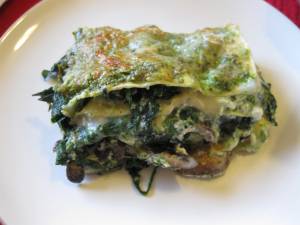
IMG_1726

All in all, it was a good, tasty dinner, but it’s definitely a work in progress.  N. and I both decided that, lacking the usual piquant, acidic bite of the tomatoes in a red sauce, the dish was actually missing something.  The flavors of the cheese, the pesto, and vegetables were good, but they were a little muddy without that sweet tangy top note of tomato.  For next time, I will be making a few additions.  To attempt to compensate for the missing acidity of the tomatoes, I’ll add extra lemon juice to the pesto mixture.  We both agreed that maybe adding a sprinkle of parmesan cheese along with the ricotta in each layer would add a nice touch; I don’t use much salt when I cook, and sometimes the deep greens like spinach and kale need some to enhance their flavors.  Extra parmesan mingling with the vegetables while they bake might accomplish this without actually having to add salt.  I might also add some of my beloved Penzey’s Black and Red pepper blend the next time to the white sauce, just to spice it up a little bit.  It was creamy and thick and good, but really, milk, butter and flour cooked together have only so much flavor on their own.

Other additions, or accompaniments, that have occurred to me since dinner include mixing finely chopped sundried tomatoes into either the white sauce or the mushrooms.  They would add that intense tomato flavor without the heavy sauce that upsets my stomach.  Thinly sliced fresh tomatoes in between each layer, or maybe only on the top layer underneath the parmesan cheese, might accomplish the same thing.  Finally, an old friend from high school T. just told me about a sauce she makes of roasted tomatoes and red peppers that might do the trick, and I wonder whether a plain old roasted red pepper sauce would have the same zippy tang as tomatoes?  Certainly it would be pretty, even if it was drizzled over the top or added plate-side.  Lasagna #1: down.  Lasagna #2 awaits…

* Nota bene: as a geologist’s daughter, I am all but obligated to understand and appreciate cross-sections as a method of conveying information.  Conveniently enough, this seems like a perfect strategy for photographing lasagna!
Food words

The words we use when we talk about food, and the attitudes they invoke, positive or negative, intrigue me.  For example, “buttery” is a good word.  It connotes flaky pastries, dense nut-filled cakes, rich bready desserts or breakfasts.  However, “oily” is a bad word, and “greasy” is even worse.  Why is that?

(This will seem like something of a non-sequitur, but I promise you’ll see where I’m going here in a paragraph or two.)

I recently saw the Meryl Streep/Amy Adams movie Julie&Julia.  While I will leave the review to my friend S., who is good at that sort of thing, I will comment that the food cinematography in the movie is marvelous.  I don’t know whether it is always real food they are using or not, but the colors were deep, the textures were luscious, and the sounds (mixing, slicing, carving) were pretty realistic.  At one particular point in the movie, as Julie Powell and her husband are sitting down to a dinner of bright red and yellow rustic-looking bruschetta, all six of the women I saw the movie with (including me) said something between “ohhhhh,” “mmmmmmm,” and “yum.”  Or maybe all three.  So a few nights later, inspired by the bursts of orange from the sungold cherry tomato plant in my backyard, I decided to try out Julie and Eric Powell’s dinner.

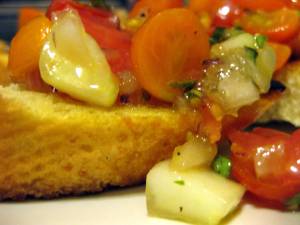
Starting with my favorite basic bruschetta recipe, I chopped up one red early girl tomato, a few dozen cherry tomatoes, a peeled and seeded cucumber from the back garden, and a handful of red onion.  Then I added julienned basil (backyard again!), salt, pepper, olive oil, and a tiny splash of red wine vinegar.  Then I let it sit in the fridge for a few hours while we went about our business. IMG_1522

After watching a dear colleague successfully defend her dissertation and then celebrate accordingly, we picked up a loaf of sourdough bread on the way home and the magic really began.  Generally when I make bruschetta, I toast the bread slices in the broiler.  However, in her rendition in the movie, Julie Powell (or Amy Adams; I don’t know whether Julie Powell ever actually made this) fried her bread in olive oil.  Wanting to stay as true to the beautiful food in the movie as I could, I opted to do the same.

Though some of my bread got a little dark, most of it turned out just fine.

IMG_1526

We stacked up the vegetables on the bread, covering every square millimeter possible before biting in and, of course, losing half the tomatoes to the plates below.  They squirted down our chins and slicked up our hands, but it was worth it, and here we return to my initial question.  The tomatoes were good and juicy, the cucumber was crisp, the basil added the right zing, but the bread was really what made the dish excellent.  It absorbed enough olive oil to be a beautiful golden brown color, and the crumbs of each slice became crisp; the perfect surface to stand up to the weight of the tomatoes, but still soak up a little of the juice the vegetables had created.  Biting into a slice was a textural experience, because the inside of the bread was still soft, but the crust was crunchy and the outer surfaces were crispy, and the whole thing was deliciously… oily?  Oiled?  In our low/no-fat culture, obsessed with cleanliness and thinness and sleekness, the idea of oil seems objectively negative.  But this was wonderful and delicious and silky and superb.  What can I call it?  Can we bring back, can we reclaim “oily” to mean what it should mean?  That crispness with buttery rich moisture I experienced with our weeknight dinner?  I think we should.

IMG_1527

Zucchini Days of Summer, Part 2

Anticipating a bumper crop of zucchini from the moment we planted our starts, I spent the late spring / early summer evenings scouring cookbooks for likely recipes.  I marked so many that now it’s just a project of choosing between them.  For Part 2 of this continuing series, I chose zucchini fritters.

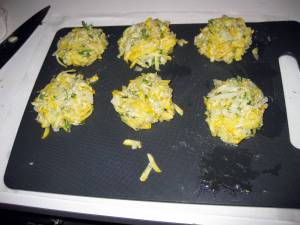
IMG_1496

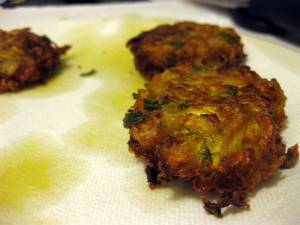
These were sticky, but pretty easy to assemble, being simply a mix of shredded zucchini, onion, some herbs, and flour.  The fritters in this photo look remarkably like cheddar cheese, but that is actually yellow zucchini, which is part of the reason for this sequence of posts.  We thought we were purchasing one zucchini plant (green) and one crookneck summer squash plant.  However, the yellow squashes ended up looking suspiciously like… guess what… zucchini!  And indeed, that is what they are.  Two zucchini plants = more creative zucchini recipes for me.

IMG_1500

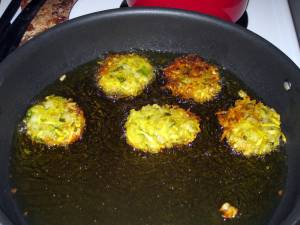
With the fritters delicately molded, I scooped them gently into a big pan of shimmering olive oil to fry (not to toot my own photography-skills horn, but I love how you can see the texture of the olive oil in the pan in this photograph.  When recipes elusively call for adding the food when the oil is “shimmering,” I’m pretty sure this is a textbook example of what they mean).  With the oil only about ¼ inch deep and nice and hot before adding the victims, they didn’t absorb too much.

IMG_1503

After a brief drain on paper towels, I stacked them all up on a plate, added crumbled feta cheese and finely grated parmesan cheese to the top, and served hot.  The hotter the better, I think.

IMG_1505

You can see the texture here: the onion and flour made these fritters reminiscent of latkes, although the flavor was definitely zucchini, with the sharp greenness of the chopped herbs and the salty tang of the feta and parmesan.  They were crispy but still moist, and despite it being our third zucchini dish in two weeks, there were no leftovers.

Zucchini Days of Summer, Part I

It’s that time.  The days are warm (mostly), the skies are blue (except when they’re cloudy, this is Oregon, after all), and the zucchini are swelling and ripening and filling up the garden with all the grace and timeliness of an animated stubbed toe.

Alright, I confess, that’s not quite fair.  I do like zucchini.  I’m just discovering, as a first time gardener, how right everyone is about how creative you have to be, and how strong the potential is to get sick of it.  So in case you find yourself in similar straits, I’ll share some of my zucchini ambitions with you in what will most certainly be a multi-part series.

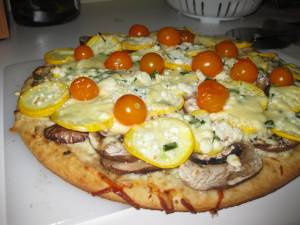
Part I is pretty simple: zucchini and mushroom pizza.  I like a simple “sauce” on my Boboli crust; just olive oil, garlic (or garlic powder, depending on how tired I’m feeling), dried Italian seasoning, and salt and pepper.  I topped this with a layer of Monterey jack cheese, and then stacked up thin slices of yellow zucchini and thick slices of crimini mushroom until you could barely see the cheese underneath anymore.  Then I added another thin layer of cheese, some leftover crumbles of feta, and a collection of cherry tomatoes, carefully inserted between vegetables to hold them securely in place.  Then, just for an added flourish, I sprinkled the whole thing with chopped chives.  Eleven or twelve minutes in the oven, and the veggies are cooked, the cheese is melted and bubbly, the cherry tomatoes are just starting to burst their skins, and dinner is served.

IMG_1492

Homegrown Feast

Michael Pollan, author of “The Omnivore’s Dilemma” and “In Defense of Food” (the latter of which is on my wish list, if anyone is so inclined…) has written a New York Times article about the upcoming movie “Julie & Julia,” the show “The Next Food Network Star” and the network from which it springs, and about food and the American mentality for it in general.  He considers why food, and cooking, have become spectator sports instead of daily endeavors, and concludes that a combination of increasing work hours, ever advancing kitchen technologies, and endlessly multiplying availability of quick and easy processed foods, are leading us out of the kitchen.  However, speculating that the instinctive, reptilian parts of our minds that are always subconsciously searching for sustenance are attracted by the appearance of food being made, we like the Food Network with its fancy presentations, competitive cooking shows, and analyses of restaurants.  Though this does not surprise me about American society in general, I am trying to set myself apart from this norm.  Hence the blog, the backyard garden, the subscriptions to cooking magazines… I try to pick up techniques and inspirations from Food Network shows, though I do admit to sometimes just enjoying watching someone else do the cooking.  However, today was something of a proud moment, considering Pollan’s article, which I read shortly after lunchtime.  Today each one of my meals included something homemade or homegrown.

For breakfast I feasted on toast topped by pluot-raspberry jam, lovingly preserved by a friend and colleague.  It was glossy and thick and sweet-tart with lumps of fruit inside, my favorite way.  I like my jams and preserves to still resemble the fruits they once came from, so they feel a little more real.

Lunch was one of my favorite summertime meals.  In celebration of our first full size ripe tomato (we’ve had great luck with the sungold cherries so far, but the big tomatoes are blushing only grudgingly), I picked it, carved it into thick slices, and had myself a juicy, creamy, yummy tomato sandwich.  I like my bread toasted, with mayonnaise on both sides to hold in the seeds and tender flesh of the tomato.  That’s all.  Ungarnished.  Unfancy.  Fresh and delectable.

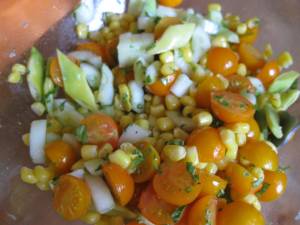
Dinner was a big triumph.  At my best estimate, about 70% of our dinner came from either my garden, or our neighbor’s.  Armed with cherry tomatoes, a few yellow pole beans, green onions, basil, and oregano from my yard, and a cucumber accompanied by a zucchini practically the size of a T-ball bat from our neighbor’s garden, I went to work.  I blanched the beans since a few of them were quite long and I was afraid they would be tough, before combining them with the halved sungolds, sliced cucumber, and a cup or two of defrosted frozen corn.

IMG_1379

I tossed these with a really simple vinaigrette of just red wine vinegar, some sugar, and a touch of olive oil.  Salt, pepper, and a small handful of julienned basil, and the salad was done.  I set it aside to marinate while I fixed the main event.

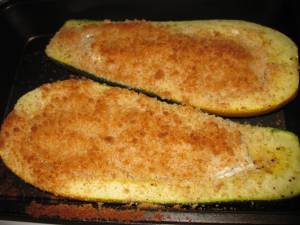
The zucchini was so big that I knew the seeds would be fully developed, so I sliced the monster in half lengthwise and scooped out the seeds, leaving the flesh behind.  I added salt, black pepper, and a little olive oil to the flesh before placing the halves in a roasting pan.  Per a distantly related recipe I found in a vegetarian cookbook, I added a little water to the roasting pan and slapped some aluminum foil over the top before letting them cook for about fifteen minutes, just to start softening up the flesh.  Meanwhile I mixed up the filling.  After finely chopping the green onions and oregano from the garden, I mixed them into some goat cheese along with garlic powder and Penzey’s Black and Red pepper mix that I particularly like.  When the zucchini halves finished their steam, I took them out, filled them with the cheese mixture, and topped them with considerable mounds of fresh white bread crumbs.  Then it was back into the oven for another 25 minutes, when the bread crumbs were suitably golden for my taste.

IMG_1383

When they came out, we cut off thick slices and ate them with the salad as a side.  The zucchini flesh was tender but still had some texture to it, and I was surprised to find that the skin was not a bit bitter.  The goat cheese lent a tangy flavor that was, surprisingly, not so strong that it overpowered the vegetable.  The bread crumbs were a nice touch, adding a crunchy texture and toasty flavor to the dish.  I think when I make this again (our own zucchini promise that I will), I may add some lemon juice or another acidic flavor to the cheese mixture.  I generally like my vegetables with lemon, and the goat cheese has a unique tartness that leads me to believe it would pair well with a squeeze of citrus.

IMG_1388

Feeling like a ecologically, environmentally, locally responsible citizen of the world, I can’t help but feel a twinge of longing for ice cream… packaged, processed, hermetically sealed… but maybe I’ll settle for a homebaked blueberry struesel bar instead.