Redemption!

Last week’s experiment left us, as you may recall, a bit underwhelmed.  Or perhaps just whelmed, in my case.  I didn’t love it, I certainly didn’t hate it.  This week we needed a real comeback kid to reinvigorate and inspire us.

We found it.

“39. Trim crimini or Portobello mushrooms and chop stems.  Cook crumbled sausage in olive oil until it begins to brown, then add stems and chopped onion and garlic.  Mix with cooked rice, an egg for every 2 cups of mushrooms and enough bread crumbs and Parmesan to bind slightly.  Spoon the stuffing into the mushroom caps and bake until tender.” 

Since the temperature was relatively cool going into Saturday afternoon, I thought I’d give it a try.  The players were all there, from the old three-coursers of my childhood: meat, starch, and veg.  Here, though, they were nicely tangled together and collected in their very own serving vessel.  It sounded enticing.

I assembled:

4 medium Portobello mushrooms

3 cups cooked rice (1 cup brown, 2 cups white)

1 lb. pork sausage

4 garlic cloves, finely minced

¼ cup red onion, diced

1 egg, lightly beaten

½ cup bread crumbs (I used Italian seasoned crumbs)

¼ cup finely grated Parmesan cheese

I put my sausage in a skillet with a tablespoon or so of olive oil, broke it up a little with a wooden spatula, and took on the mushroom caps while it started to sizzle.  I scraped out the gills and then dug my spoon down into the spongy “meat,” excavating great lumps of mushroom while being careful not to break through the bottom of the cap.  I probably left a good ¼ – ½ inch shell.  Along with the stems, I chopped up these pieces fairly finely.

Because I didn’t want all the grease the sausage had exuded, I drained it, reserving no more than a few tablespoons, and put the fully cooked sausage crumbles into a bowl along with the cooked rice.  Then I spilled the mushrooms into the flavorful skillet and let them brown.  I chopped up the onion and garlic and added them in a few minutes after I’d started the mushrooms.  The smell was perfect.  I read once that the smell of sautéing garlic and onions is a great way to impress a man.  This is one of those half truths.  In reality, I think, it’s a great way to impress anyone.  If I had to choose my top ten favorite scents, that would be one of them.  It might even crest into top five.

When the onions were tender and translucent, I killed the heat and poured the vegetation into my mixing bowl with the rice and sausage.  Because I had WAY more than would fit into four mushroom caps, I reserved all but about two cups for later use before adding the egg.

I mixed the egg into the mixture with a fork, then dumped on some bread crumbs and Parmesan.  The quantities of these last two components, as Bittman says, will depend largely on the composition of your bowl.  You may need (or want) more of one or both, you may need less.  When I was satisfied, the filling clumped together only slightly, and only when pressed.  I would wager a guess that you don’t want it too clumpy or too solidly packed, or it will take too long to heat all the way through in the oven.

I lumped, and piled, and stacked the filling into the mushroom caps, which I’d positioned on a baking sheet.  Then I plunged the whole thing into the oven, which was preheated to a temperature that, embarrassingly, escapes me.  It was one of three temps: 350, 375, or 400F.  Though a higher temperature will of course produce a crunchier, browner top, I don’t think this variance of 50 degrees will make an amazing amount of difference to your results.

Whatever the case, I gave the mushrooms half an hour to become magical, and was far from disappointed.  The Portobello caps themselves darkened in color, turning from musty dusty brown to rich and deep.  They softened, going tender but not watery, and retaining enough textural integrity that we needed knives to slice through neatly.
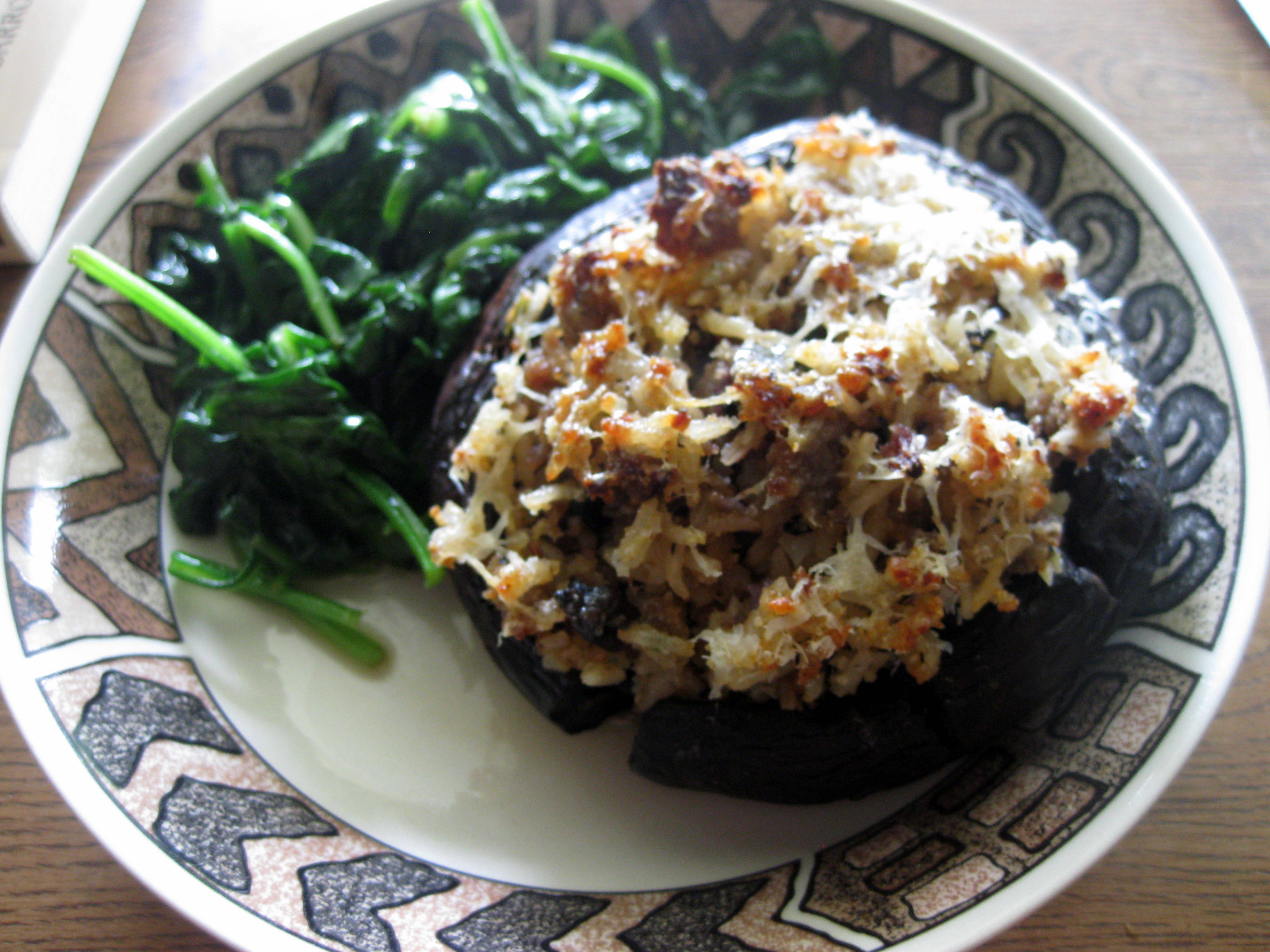
As for the filling, can you say umami?  The mystical, MSG-esque “fifth taste” was well in evidence here.  Not only did we have the rich beefiness of the mushrooms themselves, as vessels and interspersed throughout, but we had the sausage, herby-spicy-rich, and the brown rice, which added not only appealing texture but also an earthy taste.  Next time I would use solely brown rice for this dish, because its taste and lingering toothsome quality were so nice.  I suspect some of the flavor punch was a result of cooking the rice in a garlicky homemade chicken broth, which I would certainly recommend, if you have some on hand.  We rounded out the meal with kale chips and beer and both were, I feel, wise choices.*  Kale has a deep, slightly bitter flavor, but it mellows when you roast it, and the paprika and sea salt I sprinkled on top made it a smoky, salty delight.  The beer, of course, added to the earthy quality of the meal, with its lingering yeast flavors.

As we dug our way through the hidden treasures these mushrooms held, N. turned to me and said “Redemption.”  I think that says it all.


* This photo, however, does not show kale chips.  It shows steamed spinach, which was the accompaniment for lunch the following day.

Getting back into it…

I tell my students that it’s important to be specific when they write.  I tell them to be careful with pronouns – to be sure the subject they refer to is clear – and to add description and make their vocabularies work for them.

And yet, as a self-proclaimed word nerd, I do enjoy a little ambiguity when it comes to titles, lines of text, phrases, something to, shall we say, chew over.  Maybe this means I like poetry after all.  So let’s take on this title together.  It could mean “getting back into being in Oregon for the summer.”  This could certainly be true.  My vacation was phenomenal and I didn’t want it to be over, and even though summery weather has finally come to the Northwest, returning home means certain other, less welcome truths.  My title here could also mean “getting back into my dissertation.”  Yet again, a necessary activity I’m not quite wholly invested in yet.  I need to be.  We’re almost a week into July and I’ve only read one short scholarly book and one chapter of another, and though I’ve thought a bit about my work, I don’t have much to show for it yet.

Finally, and perhaps most applicable, my title could refer to this blog, Bittman, and cooking in general.  I didn’t take my laptop with me on vacation, and I hoped to sustain you on those limited – but admittedly lip-smacking – shots from my week at the beach, but now I’m well back and well behind.  Going out to eat and sampling masterworks from my various relatives made me at once anxious to return to my kitchen and, strangely, resistant to actually going in there and producing anything.  To top it off, because this week’s Bittman was not my favorite, I’ve been having trouble mustering the inspiration to write about it.

Because my cooking urge has been beaten back a bit, perhaps by the heat, or perhaps because all I want to eat is grilled food (hear that, N.?), I thought a raw salad would be a good choice for us.  Then, trying to be ambitious, I thought I’d throw in a bread-y accompaniment, and check two recipes off at once.

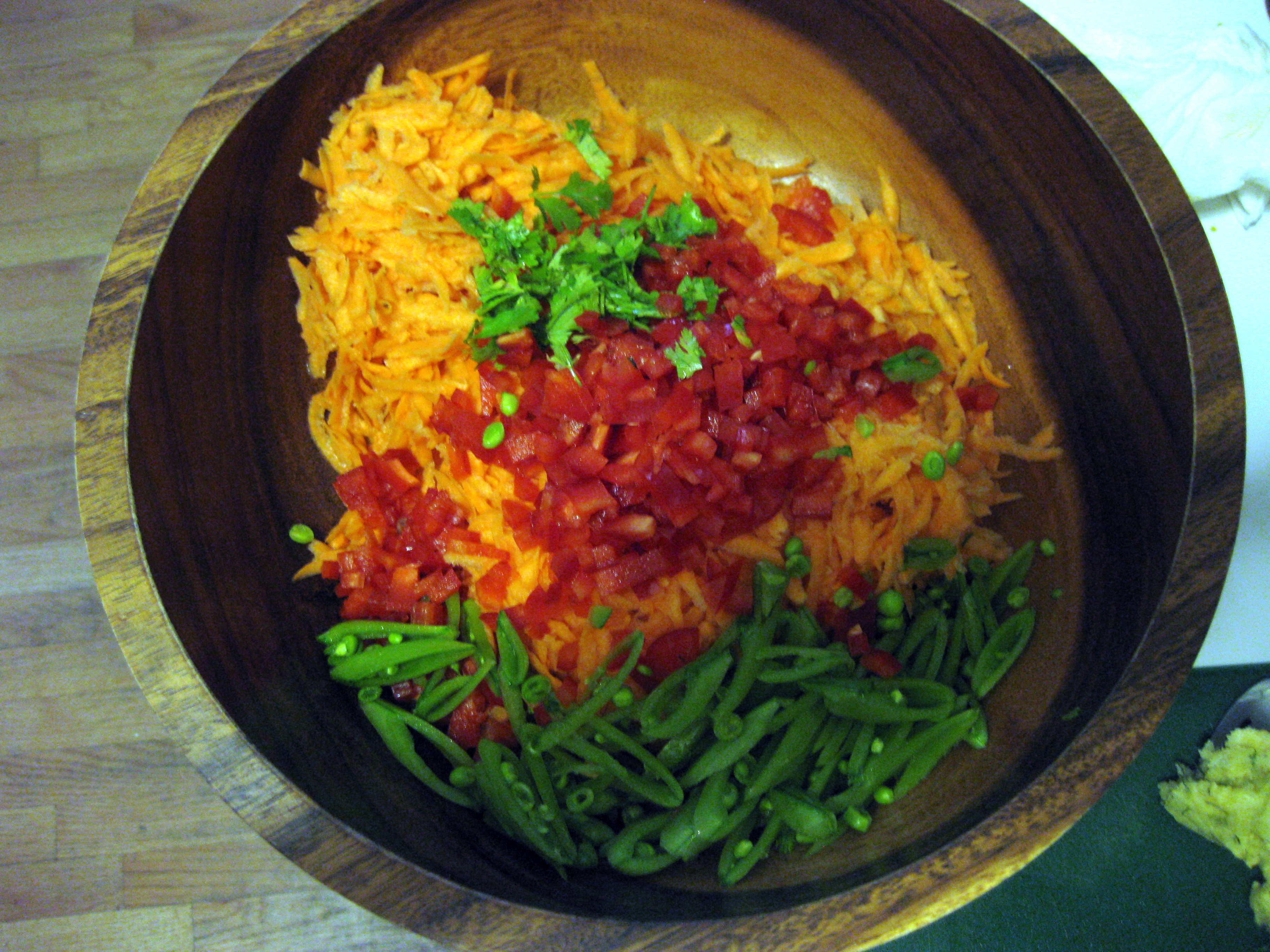
“66. In a blender, whip olive oil, lime juice, a little red onion and a stemmed and seeded jalapeno.  Toss with lots of shredded raw sweet potato, diced red bell pepper and chopped cilantro.” 

In theory, this sounded fresh and healthful and good.  Zesty.  I collected

2 medium sweet potatoes (actually, I used the orange ones called Beauregard yams)

1 large red bell pepper, diced

2 TB chopped fresh cilantro

juice of one lime

¼ – ½ cup olive oil, depending on how much lime juice you have

¼ cup red onion, roughly chopped

1 jalapeno, or to taste (I used half a large, green jalapeno and the dressing was only mildly spicy)

I also added a handful of thinly, diagonally sliced sugar snap peapods, because they were swelling almost out of their skins in my garden.

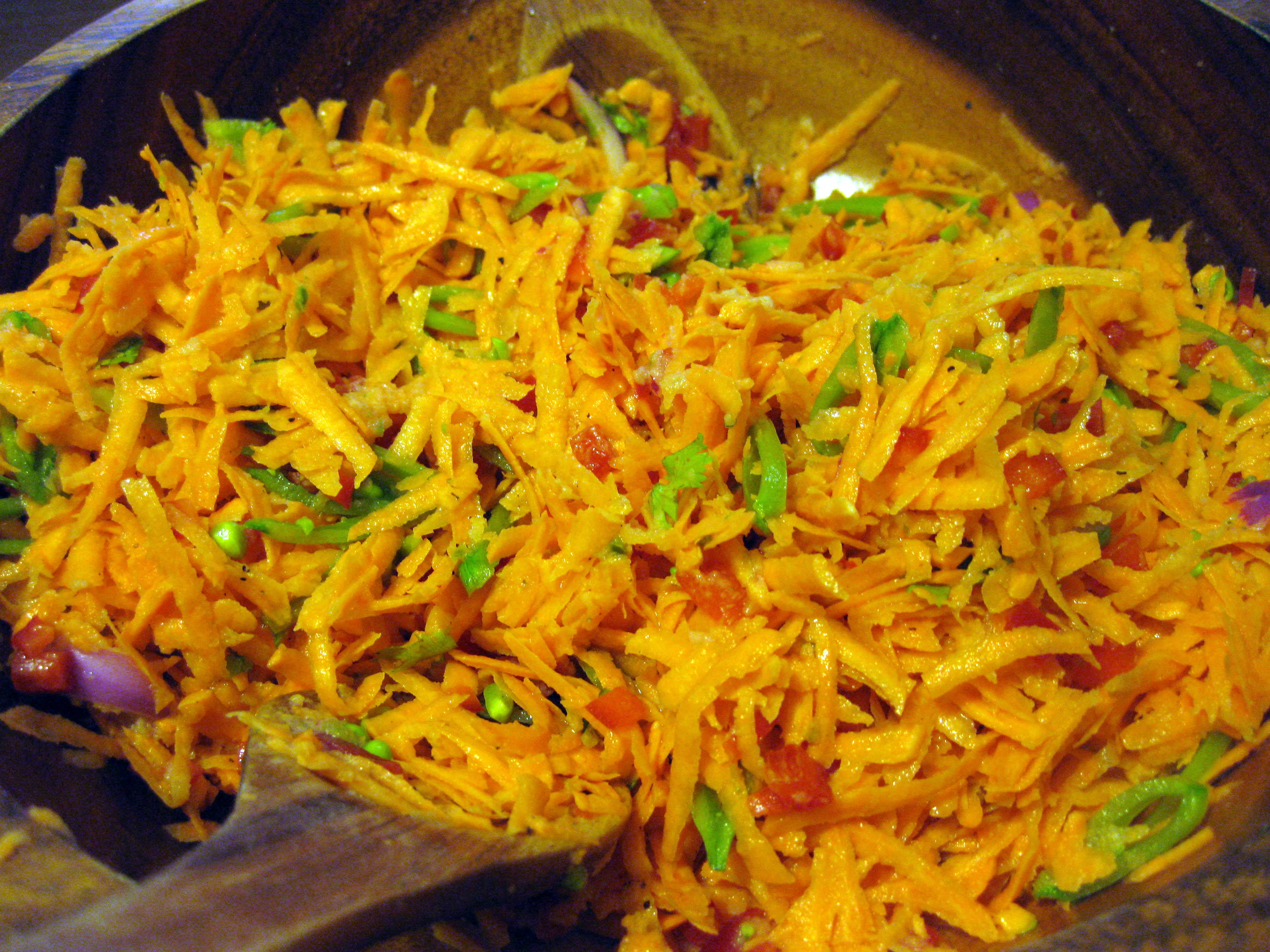
Before making the dressing, I shredded my sweet potatoes and submerged them in cold water in an effort to lift free some of their starchiness and make for a more pleasing mouthfeel.  I left them alone for almost an hour while I made the dill-Cheddar puffs (see below).  When I finally lifted and drained the tatters of potato, I squeezed as much water as I could out of them, and they looked and tasted almost exactly like a pile of carrots.

As Bittman directs, I whirred the dressing ingredients in my blender before tossing it with the vegetables, and that was that.  Easy!  I knew we were in trouble, however, when N. turned to me and asked “so what do you think?”  He never asks this!  In fact, as I’ve mentioned before, he rarely opines positively about food.  I knew he didn’t like it.  His assessment was of dissonance: he said he kept expecting either the flavor of carrots, or something that had been cooked.  What we were eating instead was a mildly flavored, slightly starchy crunch with bright, zesty-green-spicy notes. 

I thought the flavors were nice, but thought it wasn’t sufficient as a main dish salad.  This was a dish to be consumed in small heaps, not a giant, plate-filling mound.  My new challenge, then, consists of repurposing the leftovers, since N. is not interested.  I’m thinking a take on latkes, or a stuffing for a pita alongside some falafel or spiced ground lamb, or maybe even players in a spinach salad.  What this tells me, in all cases except the third, is that apparently I wanted some fat in this dish.  Good thing, then, that this wasn’t the only thing we ate that night.

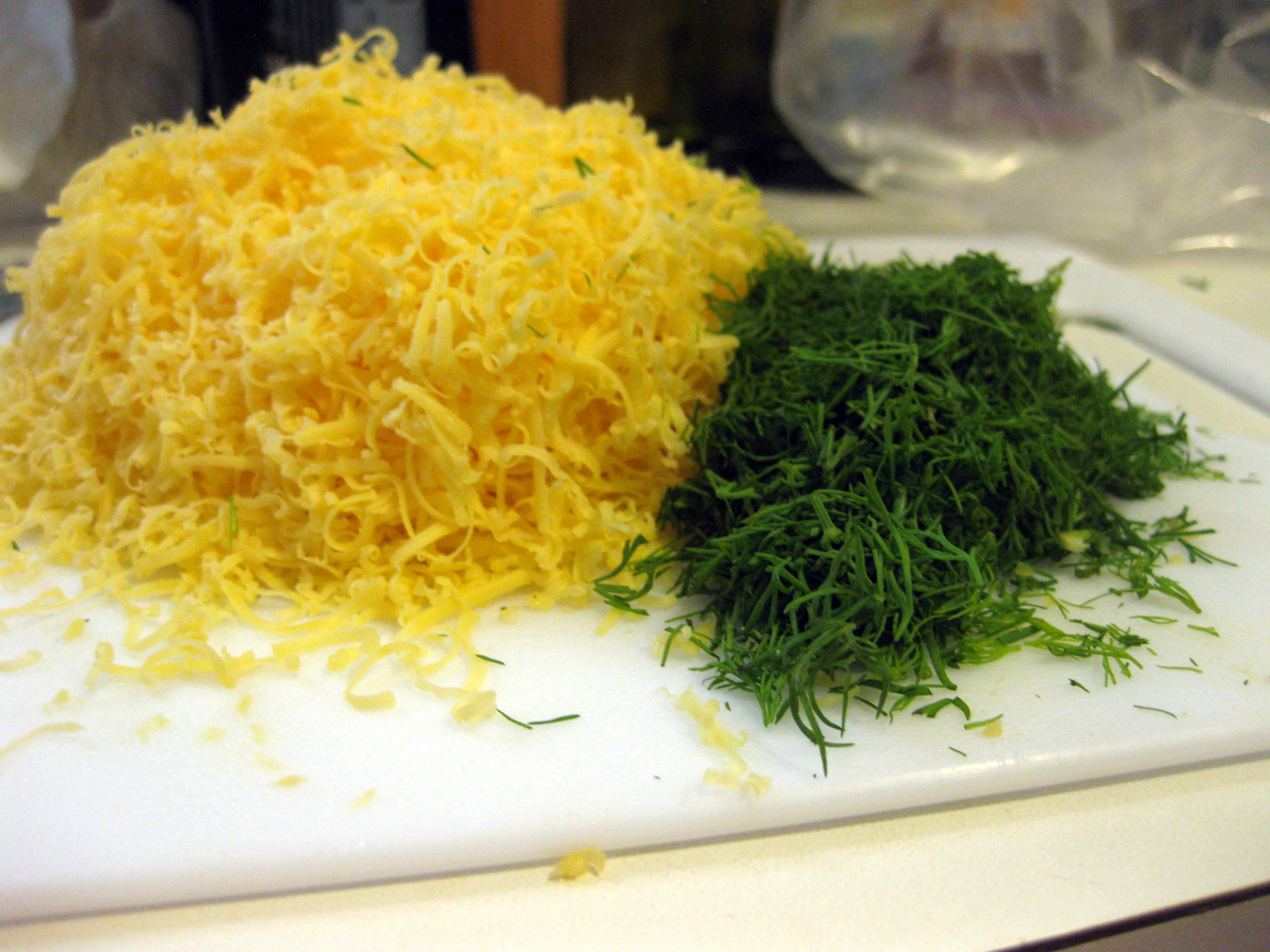
“Dill-Cheddar Puffs: Combine 1 cup water with ½ stick of butter and ½ teaspoon of salt in a saucepan over medium heat and bring to a boil.  When the butter melts add 1 ½ cups flour and cook, stirring, until the dough forms a ball, about 5 minutes.  Turn off the heat, then add 3 eggs, one at a time, beating well until the mixture is glossy.  Stir in 2 cups grated Cheddar and 2 tablespoons freshly chopped dill.  Drop teaspoons of the batter on greased baking sheets and bake at 425 degrees until lightly browned, about 10 to 15 minutes.”

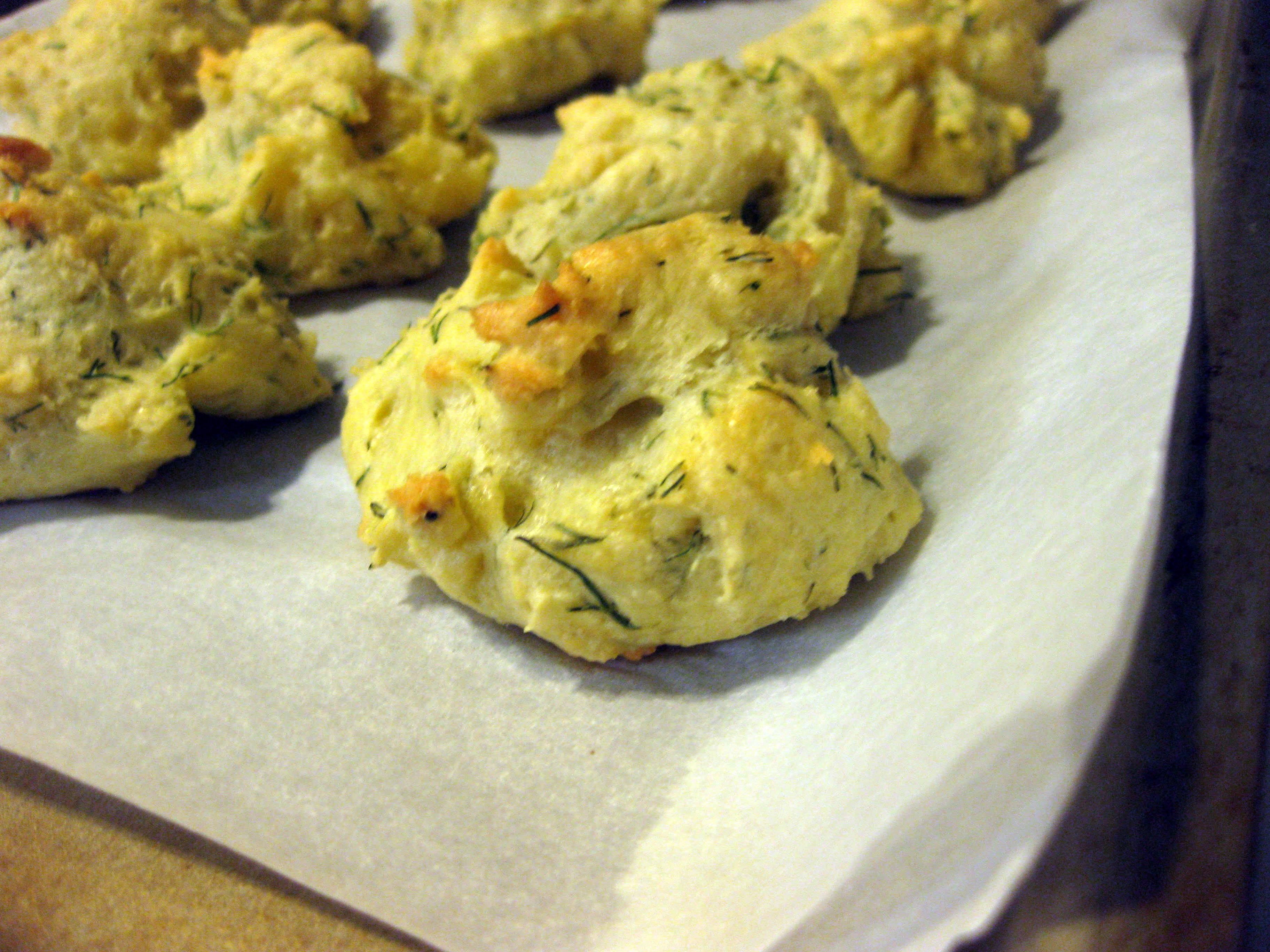
This doesn’t need much comment, either in terms of ingredients or procedure, since Bittman spells it out pretty specifically.  Basically these are savory, filling-less cream puffs.  My mistake, sadly, was ignoring the meaning of “teaspoons” when it came to the size of the batter droplets.  I did more like tablespoons-on-steroids, and as a result they were undercooked at the end of 15 minutes, and overcooked after I’d plunged them back in for another 10.

I ate them both ways, and both ways the flavor was excellent, but at 15 minutes the insides of each puff were still quite sticky.  Even overcooked, while the puffs were still warm they were tasty – crisp, dry, craggy exteriors with an eggy, cheesy middle, and the strong, pleasant grassiness of dill keeping them feeling much lighter than they were.  Either way, N. went back for a refill of puffs even after he’d replaced the salad on his plate with some leftovers.

With slightly better size management, these would have been a monumental success.  They’d make lovely canapes at a party, either whole as little pop-in-your-mouth bites, or split and filled.  If you did want to fill these, cream cheese or smoked salmon might hit the right tone.  Or, if you were feeling adventurous, perhaps both! 

And so with this, I will try to put myself back on schedule.  Back to gardening, back to reading, back to cooking.  Back to feeling excited about it all!  I hereby banish the summer slump of boredom-because-I-don’t-feel-like-doing-what-needs-to-get-done, and the let’s-go-out-again-because-none-of-my-recipes-are-exciting-tonight, and the too-lazy-to-snap-pictures-while-I’m-stirring blues.  I’m back, friends.  I’m back and back into it.

Bliss

This is what vacation looks like:

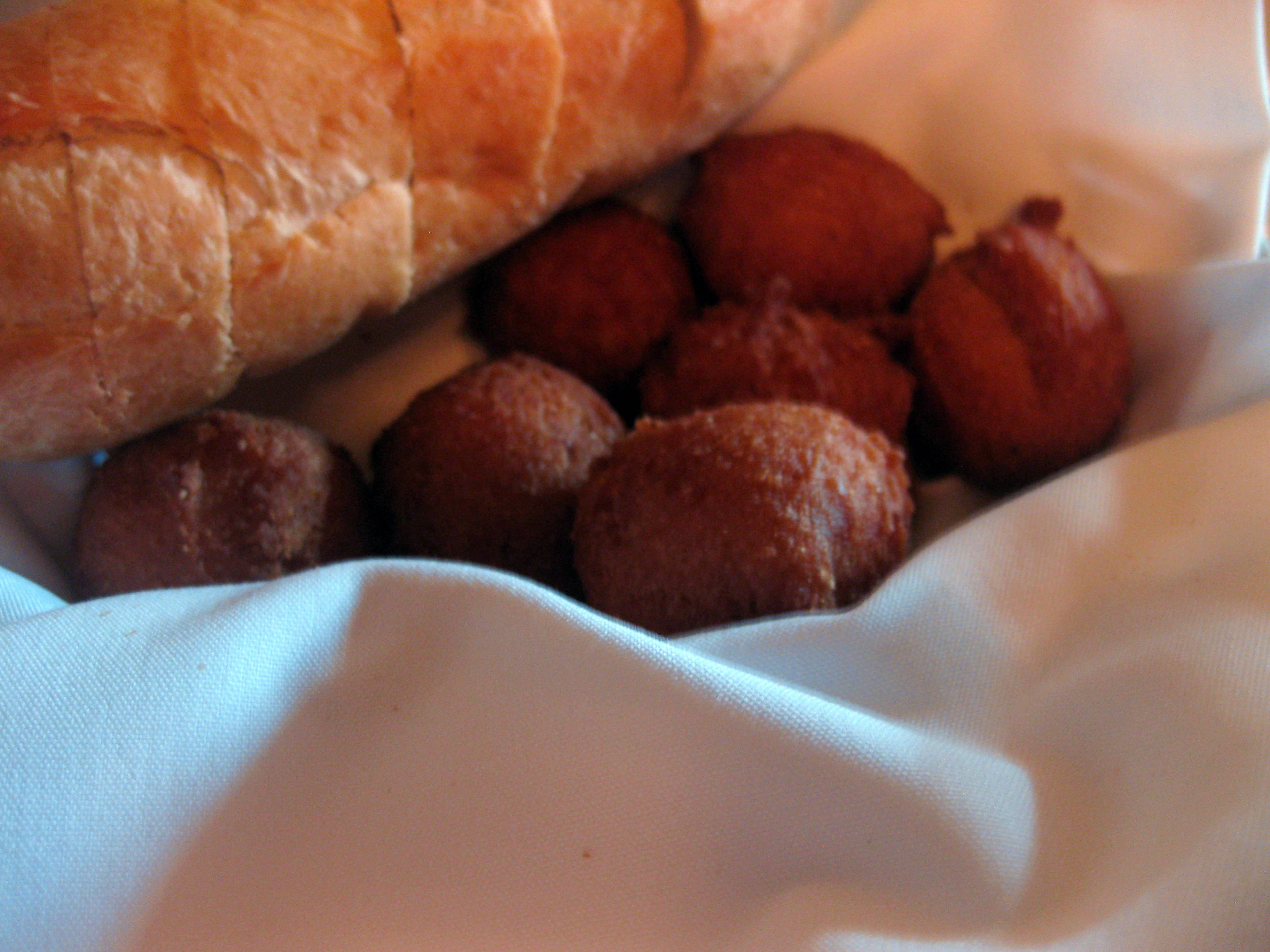
Shrimp scampi and coconut shrimp

Hush puppies nestled under freshly baked bread

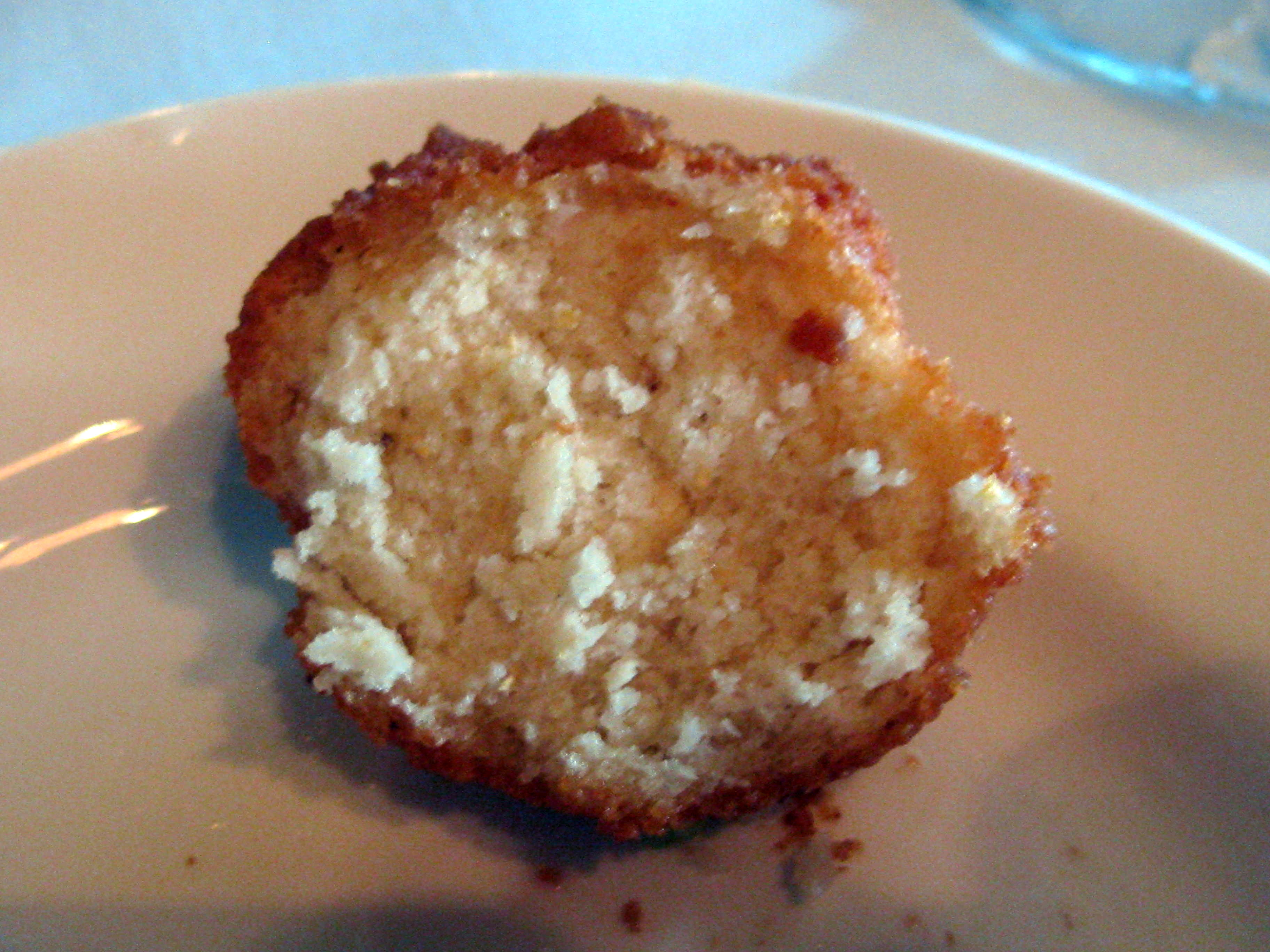
dense with a moist crumb, like a fine cornmeal cake donut

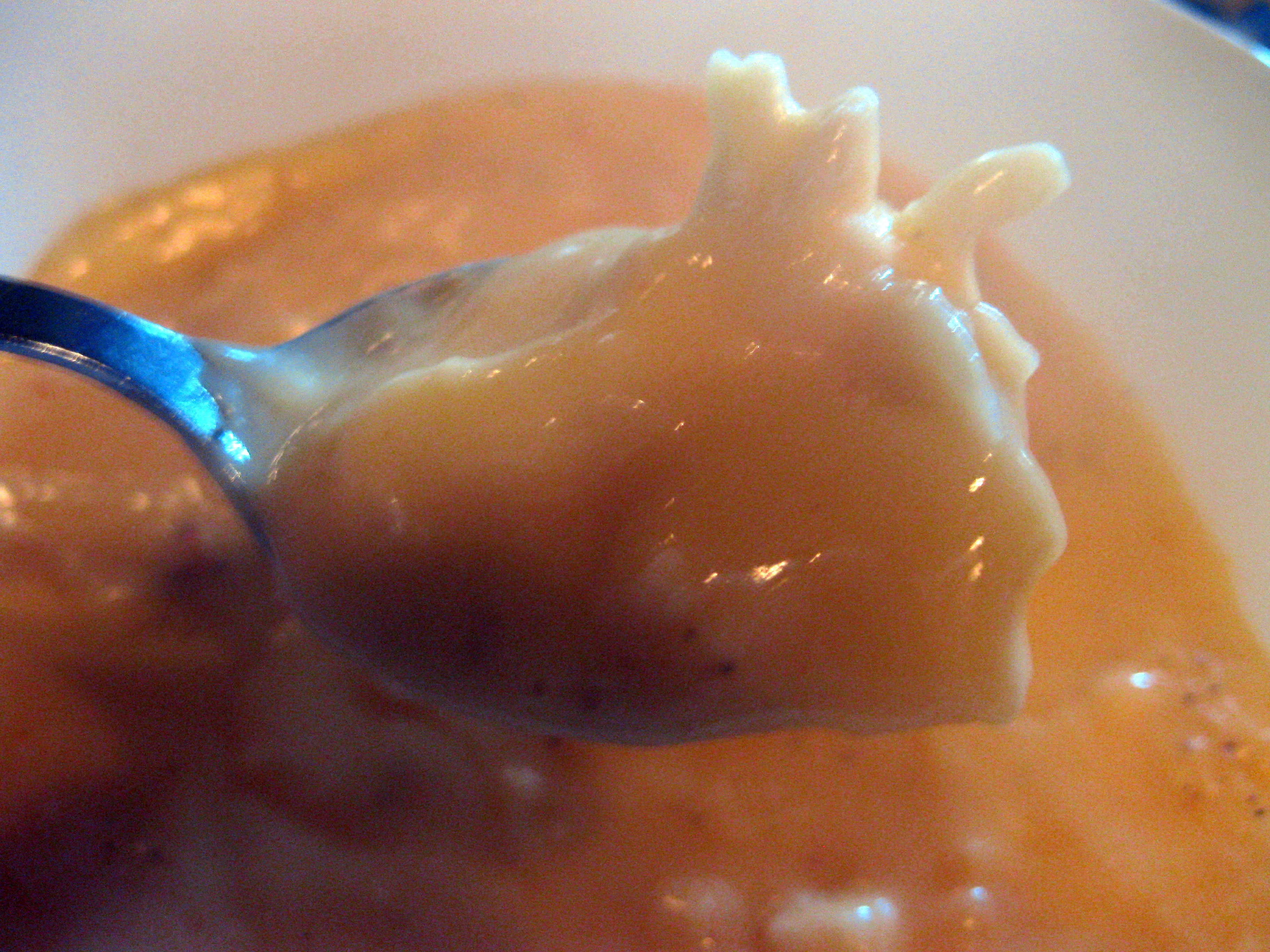
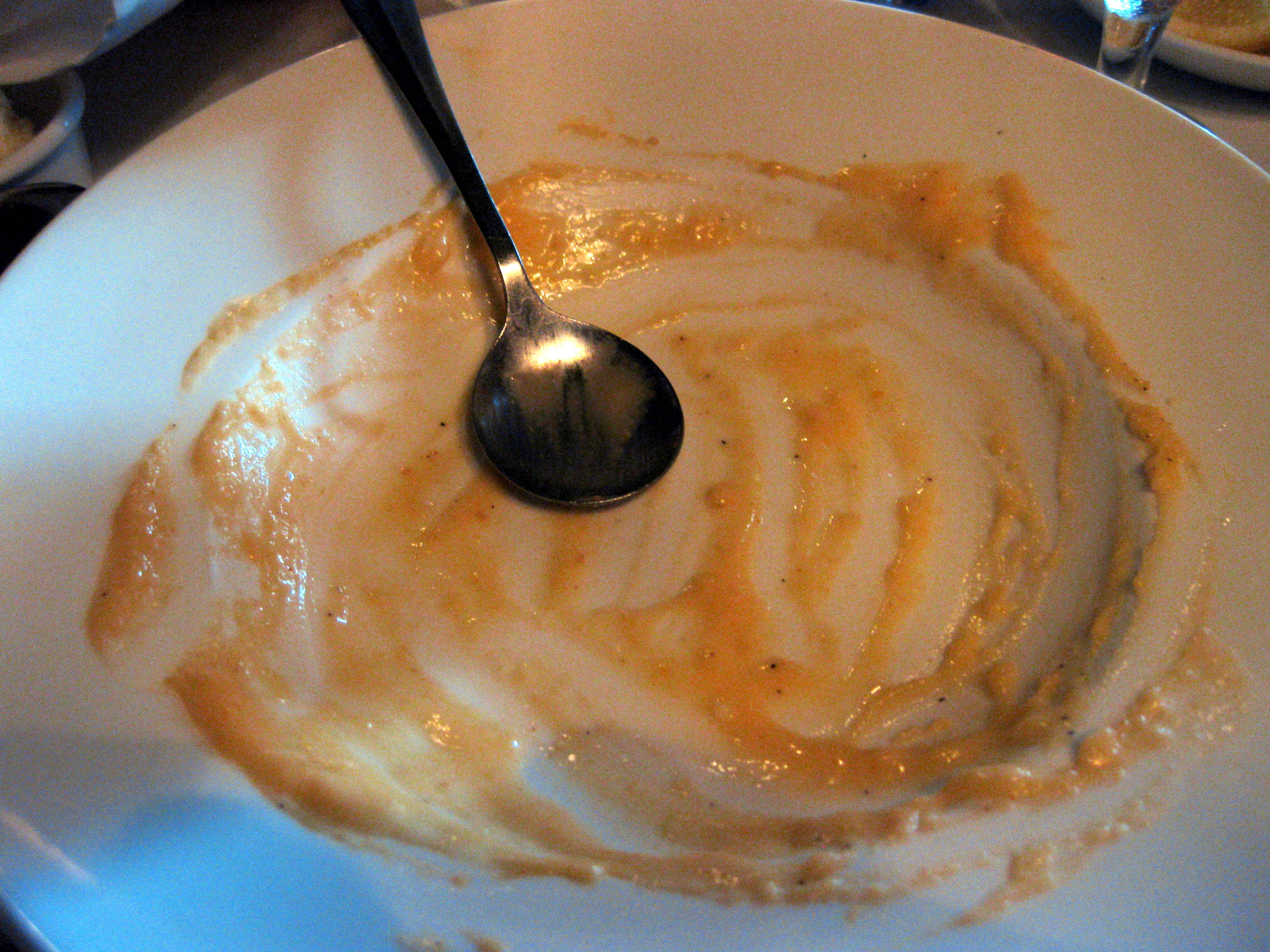
Lobster bisque, supremely creamy and rich, studded throughout with half-dollar sized lumps of lobster

… and as with so many good things, all too soon over.

Sunburst

Orange is a hot color. It’s flame and earthy warmth and friendly heat. But it’s also freshness and citrus-bright and spicy. It’s a fall color and a summer color. This is convenient, considering Oregon’s spastic and reluctant attempts to approach spring/summer. Interestingly too, the particular orange combination Bittman offered us this past week was a salad made from winter root vegetables, with a peppery summery acidic dressing. Juxtaposition of seasons. Juxtaposition of flavors.

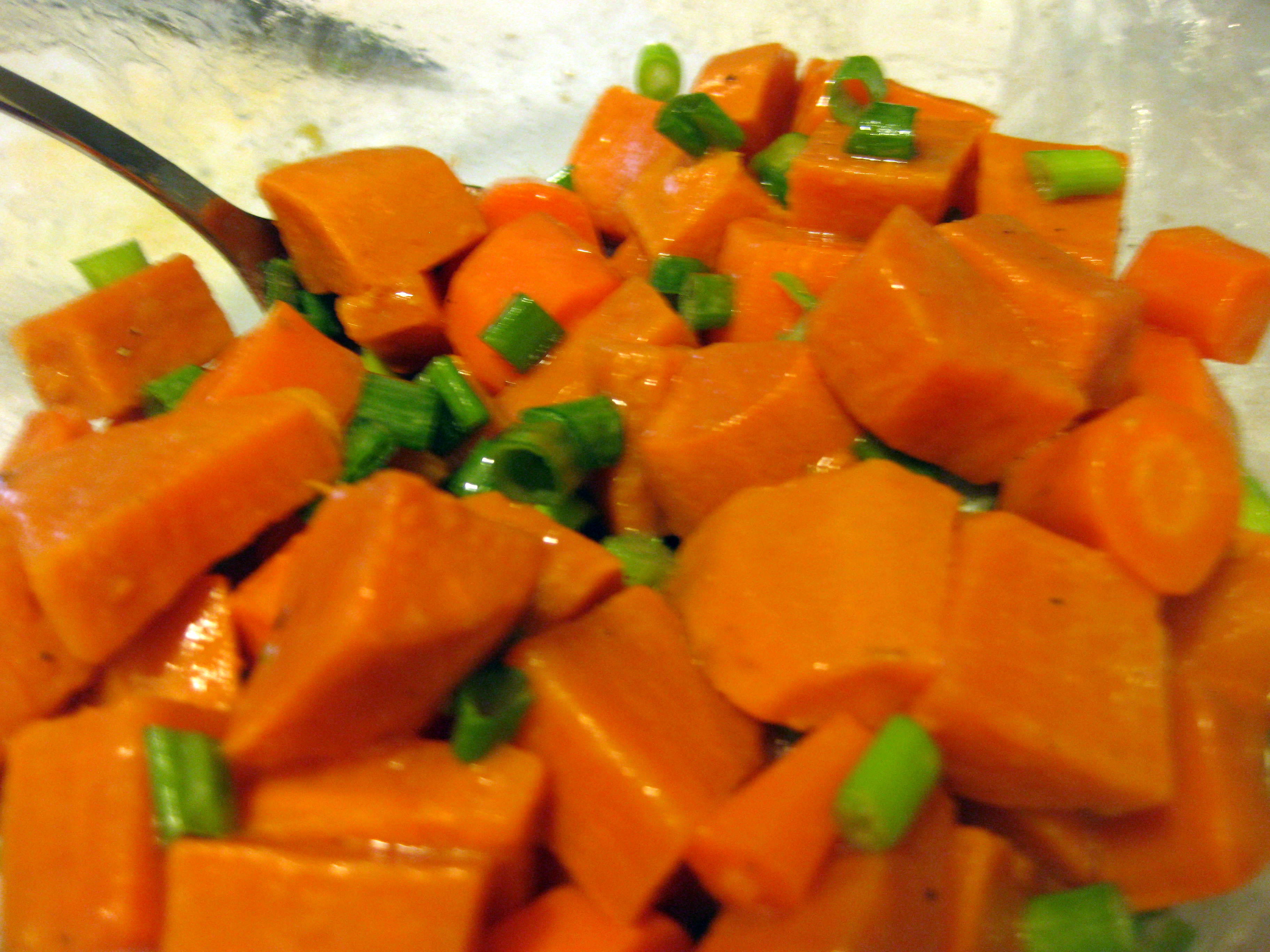
68. Peel sweet potatoes and boil until tender, drain and cool; dice. Treat carrots the same way. Make sauce of Dijon mustard, olive oil, cider vinegar and chopped scallions. Toss all together.”

Here’s what I used:

1 big Beauregard yam, peeled

3 large carrots, peeled

4 green onions, thinly sliced

2 TB dijon mustard

2 TB cider vinegar

2-3 TB olive oil

salt and pepper to taste

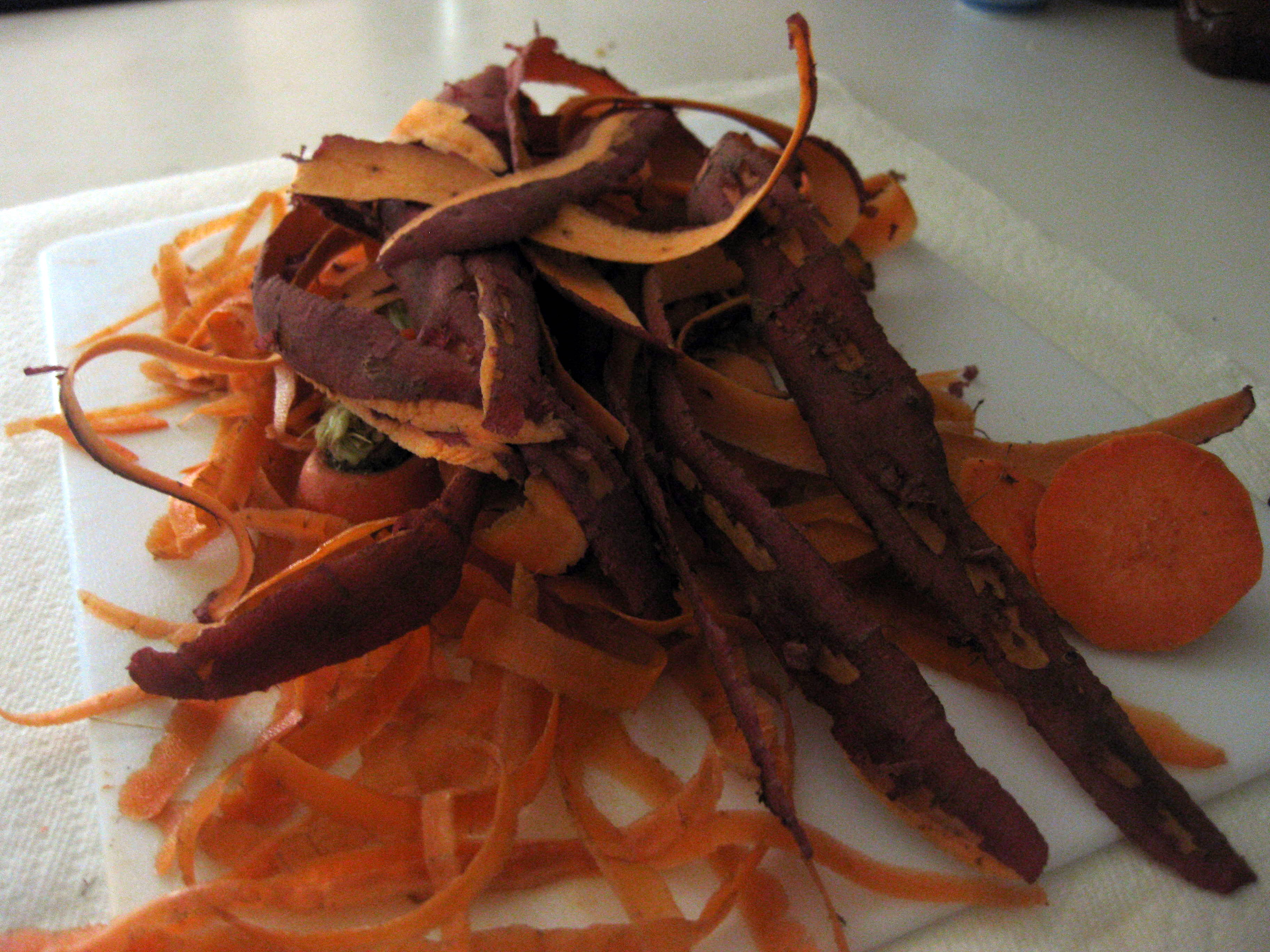
Bittman’s recipe seemed to advocate boiling the carrots and sweet potato whole. I decided to shorten the cooking time and cut the vegetables into chunks first. I boiled them in lightly salted water for fifteen or twenty minutes, or until the sweet potato chunks were tender and the carrots still had a touch of texture. Drained, they were startlingly bright against my white colander and I had to sample one. And then another. And then another of each.

They tasted like sweetness and familiarity. I set them aside to let them cool for an hour.

When they were well cooled, I tossed in the green onions, ground on some black pepper, and mixed up the dressing. I combined the mustard, the vinegar, and some salt and pepper in a measuring cup, then blended them with a fork into a homogenized mixture. Then, still whisking constantly, I added the olive oil in a slow stream, whisking persistently until the mixture emulsified. Then, of course, all that remained was to pour it over the vegetables and toss them gently together for full immersion.

While this sat, I prepped its accompaniment. I brought some chicken stock to a boil, then tossed in a bagful of frozen peas. When the liquid resumed its boil, I stirred in a box of couscous and clapped the lid on to let the absorption process commence. I wasn’t sure it was going to work, because I feared the peas might have soaked up too much of the liquid and the tiny beads of semolina wouldn’t cook properly. I feared in vain. When I fluffed the couscous five minutes later, it was cooked and tender, the peas were steaming, and I stirred in some chopped fresh parsley for kicks.

Now, instead of a steaming vegetable dish and a cold pasta salad, we had hot, vegetable-laced pasta and a cold vegetable salad. It was a delicious juxtaposition, with the wintry roots flavored in bright, commanding acidity and the couscous dressed with springiness. I loved what the mustard and vinegar did for the carrots and the sweet potatoes, playing against their inherent sweetness to add complexity and interest. Cleaning up after dinner, N. and I couldn’t stop grabbing chunks of their sour-sweet tastiness with our fingers out of the bowl. I will certainly make this one again.

The nice thing about this dish was how, even in its odd mixture of summery flavors and autumnal base, it mirrored my own summer thus far. Eugene has been mostly dreary, offering pockets and blotches of sunlight and teasing us with predictions of 70F degree weather, then delivering a sky socked in fog and breezes of misty drizzle. This isn’t June gloom. This is June despair.

But this past weekend, as the bright chunks of winter took on summer flavors, I left Eugene for warmth, for sun, and for vacation. This week and next week, I cannot promise another post. But I can promise that my pale shoulders will toast, my hair will bleach out, and my brain will slow down its frantic pace. I’ll keep track of what I eat, and I’ll photograph the triumphs and surprises to share upon my return to internet-land. And I hope, fervently, your last weeks of June will be as orange as I know mine will be.

Changing tastes

I was not a picky eater when I was a child.  I liked almost everything, and I was willing to try probably 99% of what I was offered.  I liked vegetables, I liked fish, I liked salsa, I liked avocados… I liked food.

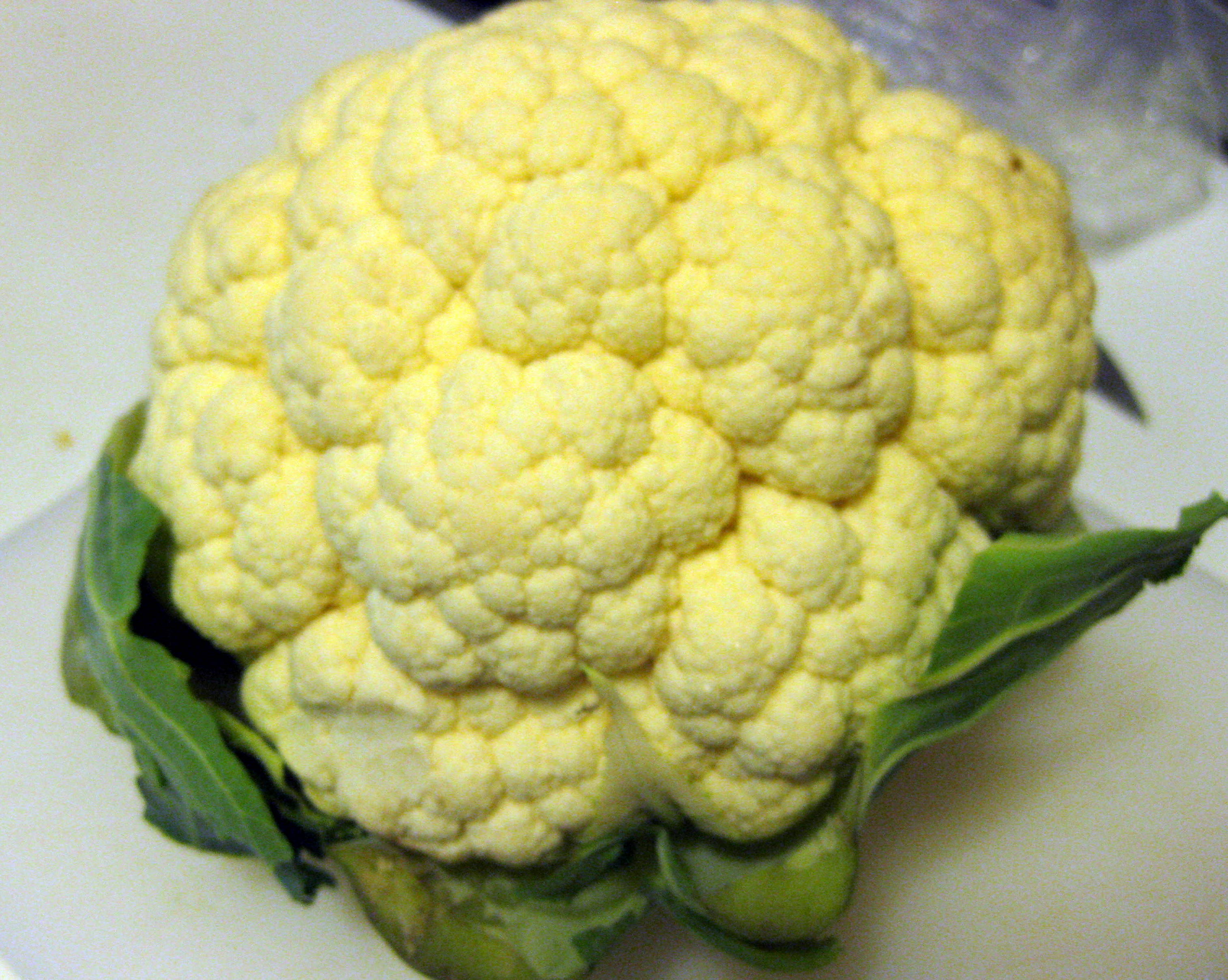
One of the few items that did not please my palate was cauliflower.  My mom always steamed it, and even smothered in a cheese sauce it had this musty, boiled cabbage flavor I couldn’t stand.  It felt mealy in my mouth and it looked pale and unappetizing: horrible vegetable brains I wasn’t supposed to gag over.

Recently, however, I’ve discovered roasted vegetables.  Well, I knew that if you cut root vegetables into chunks, doused them in olive oil, salt and rosemary and roasted them for almost an hour the result would be tender starchy delight, but I hadn’t done much with other victims.  Potatoes?  Yes.  Carrots and onions wedged in next to a leg of lamb?  Sure thing.  Asparagus with some lemon juice and delicate, bursting cherry tomatoes?  Definitely.  Cauliflower?  I was doubtful.  Until a few months ago.  I found a recipe for slow cooked “tandoori” chicken with a side of roasted cauliflower, and my husband’s pleading eyes convinced me to try it.  Liberally soused with olive oil, coriander and paprika, trapped in the oven at 450F for the better part of an hour, cauliflower became amazing.  Its cut surfaces deepened to mahogany and took on the appearance of that burnt sugar crust atop crème brulee.  Its florets got rough and crispy and, as I described to my slightly incredulous sister, became like cauliflower popcorn.  And I liked it.  With sea salt on top it was outrageously good.  N. and I plowed through a whole head of it by ourselves that night.

So I was okay with this week’s Bittman.  In fact, I was pretty excited.

“51. Steam cauliflower florets and toss with olive oil. Roast with peeled whole garlic cloves and chopped bacon at 400 degrees for 20 minutes.  Chopped parsley is a worthwhile addition.”

Not only was this – according to my new, cauliflower-appreciating minset – a delectable-sounding collection of ingredients, it was really easy.  I readied:

1 large head of cauliflower, cut into florets

¼ cup olive oil (approximate)

6-8 whole garlic cloves, peeled

5 slices bacon, chopped

Black pepper to taste

¼ cup chopped parsley

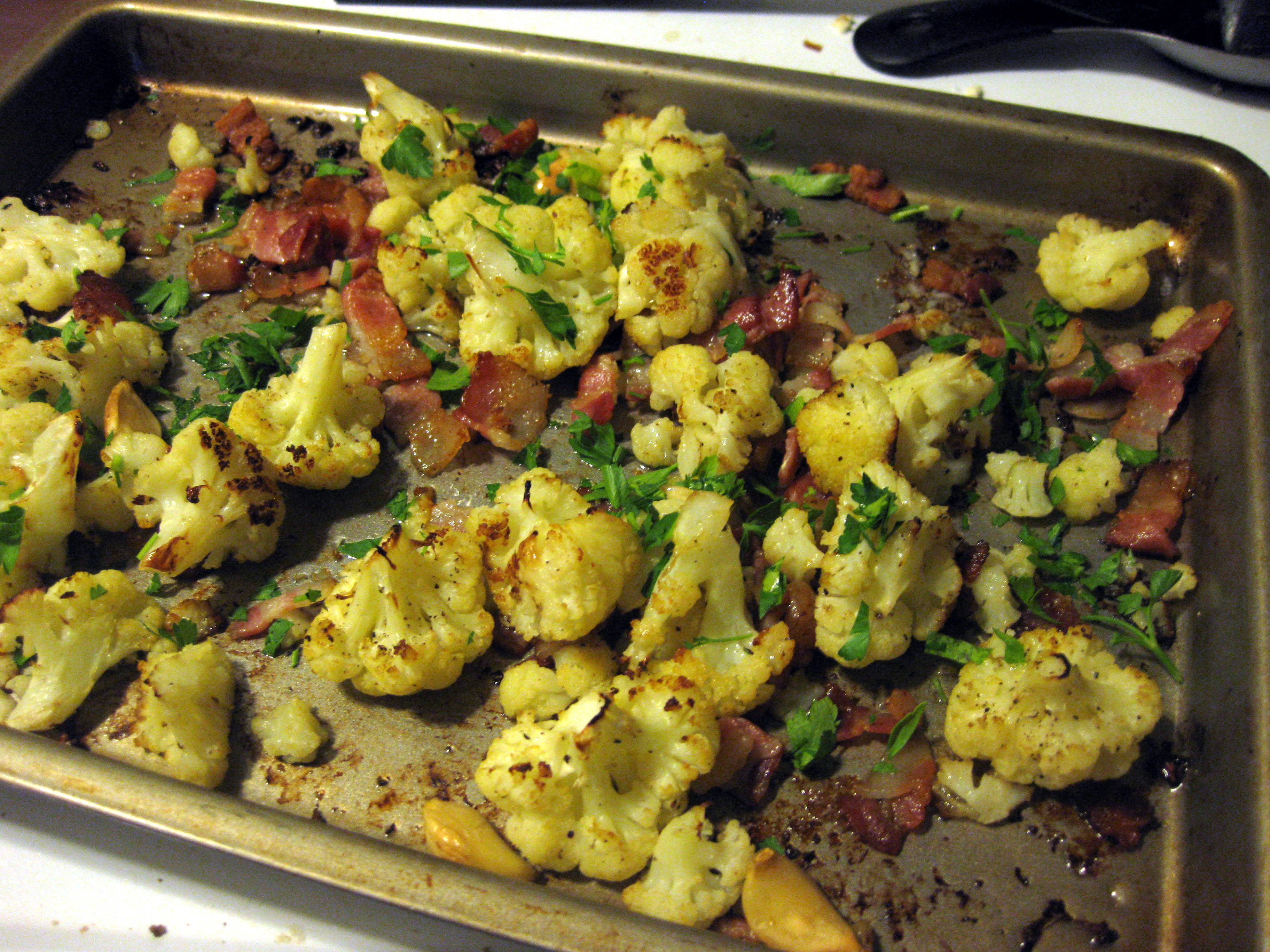
Ordinarily, I tell you what I did and then comment on it.  Here, I’d like to do the opposite.  I followed Bittman’s directions and, whether it was because I cut too large of pieces or because I overcrowded my baking tray, at the end of 20 minutes at 400F, my cauliflower was overcooked and my bacon was barely past raw.  I hiked up the heat and left it in for another 15 minutes, anxiously checking while we scarfed our side dish to hold back our hunger, which the smell of slowly-rendering bacon does nothing to assuage.

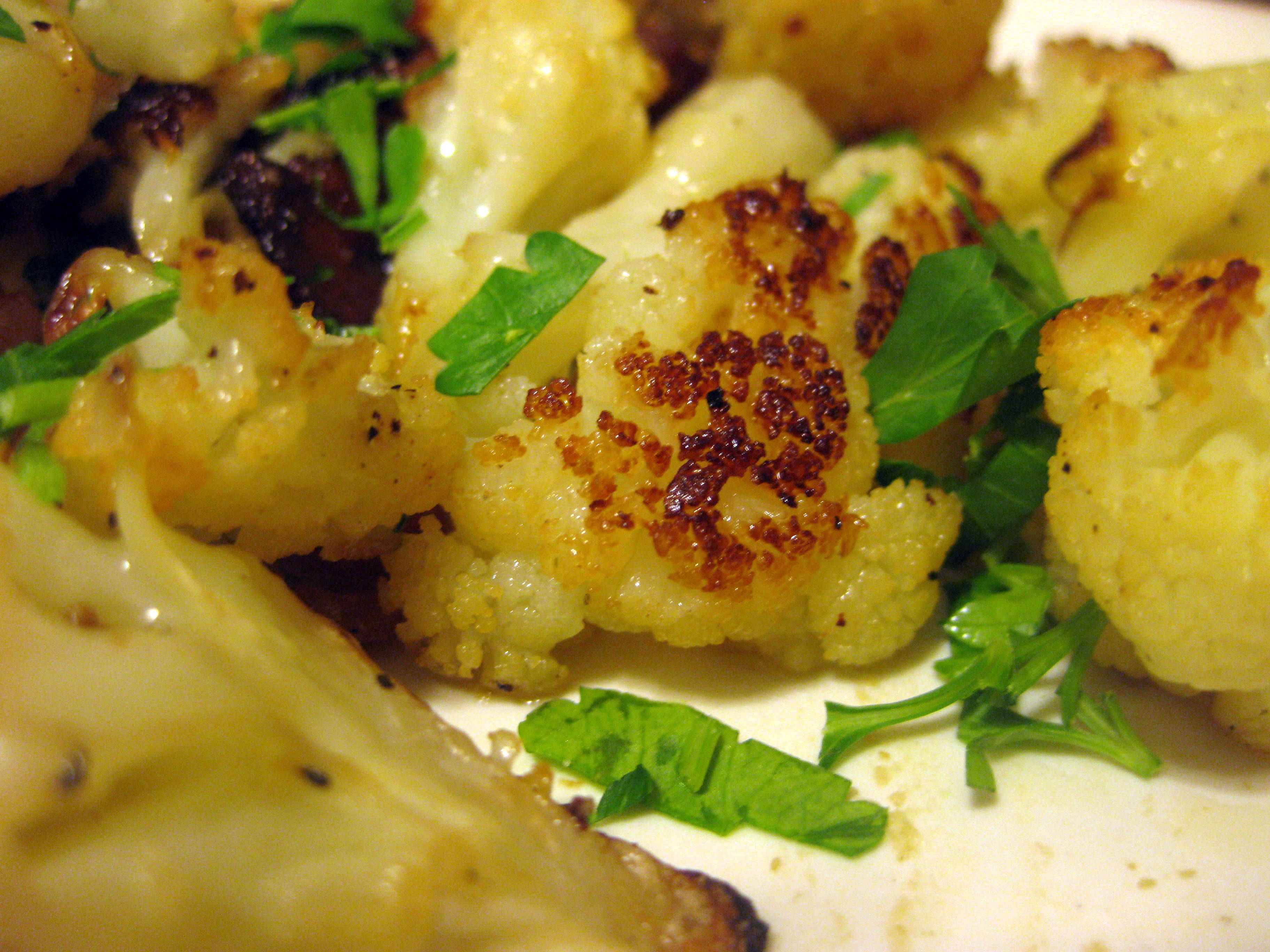
When it was finally done, with deep crinkly bits on the cauliflower and glistening bacon fat making the pan slick, I tossed on some parsley, scooped huge helpings onto our plates, and we collapsed into it.  It was good.  The blend of flavors was really wonderful.  The mild cauliflower, made almost sweet by its roasting treatment, was helped along by the smoky saltiness of the bacon, and when you got a garlic clove in there as well, it was magic against the taste buds.  The problem was in the texture and execution.  Because it had already been steamed, and because I had to add extra cooking time, the cauliflower was essentially the texture of mashed potatoes.  This might be acceptable in some cases – in fact, I’ve read recipes that call for pureed cauliflower as an addition or flat out replacement for mashed potatoes – but that wasn’t what this was supposed to be about.  I wanted some vegetal resistance against my teeth.  I wanted tenderness and give inside a golden shroud, but something still lingering to slice through.  This was all softness.  So here’s my procedure suggestion:

Preheat the oven to 450F.

Toss the raw cauliflower florets and the garlic cloves in olive oil and arrange in a single layer on a baking tray or cookie sheet.  Pepper them well.  Add the bacon, still trying to keep everything in a single layer and evenly distributed across the pan.

Roast for 20-30 minutes, checking frequently after 20 minutes, or until bacon is cooked through and cauliflower is dotted with crisp with golden-brown edges.  When desired doneness is achieved, sprinkle with fresh parsley and serve. 

This might be a delicious side with some grilled salmon and a green salad, or as an alternative to french fries alongside a burger.  We had ours, I must admit with slight shame, paired with Stouffer’s boxed stuffing.  I did cook it with homemade chicken broth, but the packaged cubes of something-that-once-resembled-bread and dried, barely reconstituted onion bits remained the same.  Sometimes you need some shameful comfort, and these red boxed Thanksgiving classics are what does it for me.

With cauliflower in my “might be love” file, at least when it’s roasted till its whole constitution seems altered, my list of foods I don’t care for – short to begin with – is becoming almost nonexistent.  There are some processed foods I don’t like, but I’m not going to feel bad about that or try to develop a taste for them.  “I’ll eat anything” doesn’t need to include mushy canned green beans or frozen pasta with pellets of sauce.  When it comes to food – whole, natural food – I can now safely say, with very few exceptions, just to be safe, I like everything.

Humble Fare

Writing a dissertation is a humbling experience.  The quantities of research required, the demands on time and mental health, and finding out how much you don’t know about what is supposed to be your area of expertise are all staggering.  Most recently for me, comments from my adviser and a recollection of how comparatively little time I have to research, draft, write, and polish the thing have kept me all but scraping the earth with my forehead.

This week’s Bittman played into this humility topos:

“71. Add chopped scallions and chopped kalamata or other good black olives to cooked and drained white beans.  Dress with white wine vinegar, olive oil and fresh thyme, marjoram or oregano.” 

Not only did this sound refreshing, filling, and ridiculously easy, but it allowed me to work on another area of life in which I feel humbled: the garden.  With another reluctant spring almost over and me still questioning whether it ever arrived in the first place, I haven’t had as much time to devote to the brave little sprouts forcing their way through the cold chunks of clay and silently suffering slug attack as I would like.  One variety, however, needs no assistance from me.  Two years ago I planted some oregano in a square planter and set it next to the herb bed.  It thrived.  One year ago, we put in a sprinkler system and forgot to connect a dripper to the oregano’s box.  It died.  This year when I ventured out for the first time in March to see how things were looking, there was oregano everywhere except that box where it was originally planted.  This salad, then, seemed like the ideal way to start getting things back under control.  A few stalks uprooted is doubly productive: dinner for us, a more orderly space for the garden.  If only the dissertation were that easy!  I used:

1 16 oz. can white kidney beans, rinsed and drained

½ cup kalamata olives, roughly chopped

4 green onion stalks, chopped (I saved the white bulbs for another use)

2 TB chopped fresh oregano

2 TB white wine vinegar

2 TB olive oil

salt and pepper to taste

(¼ cup grated parmesan cheese)

While our smoked chicken sausages sizzled in a pan, I literally dumped all the ingredients into a bowl, tossed it lightly, and gave it a taste.  When using only Bittman’s suggested collection it seemed to be missing something, so I added a shower of cheese.  Sun dried tomatoes, or capers, or fresh tomatoes, or torn arugula, or even crisp crumbles of bacon, would also make nice additions.

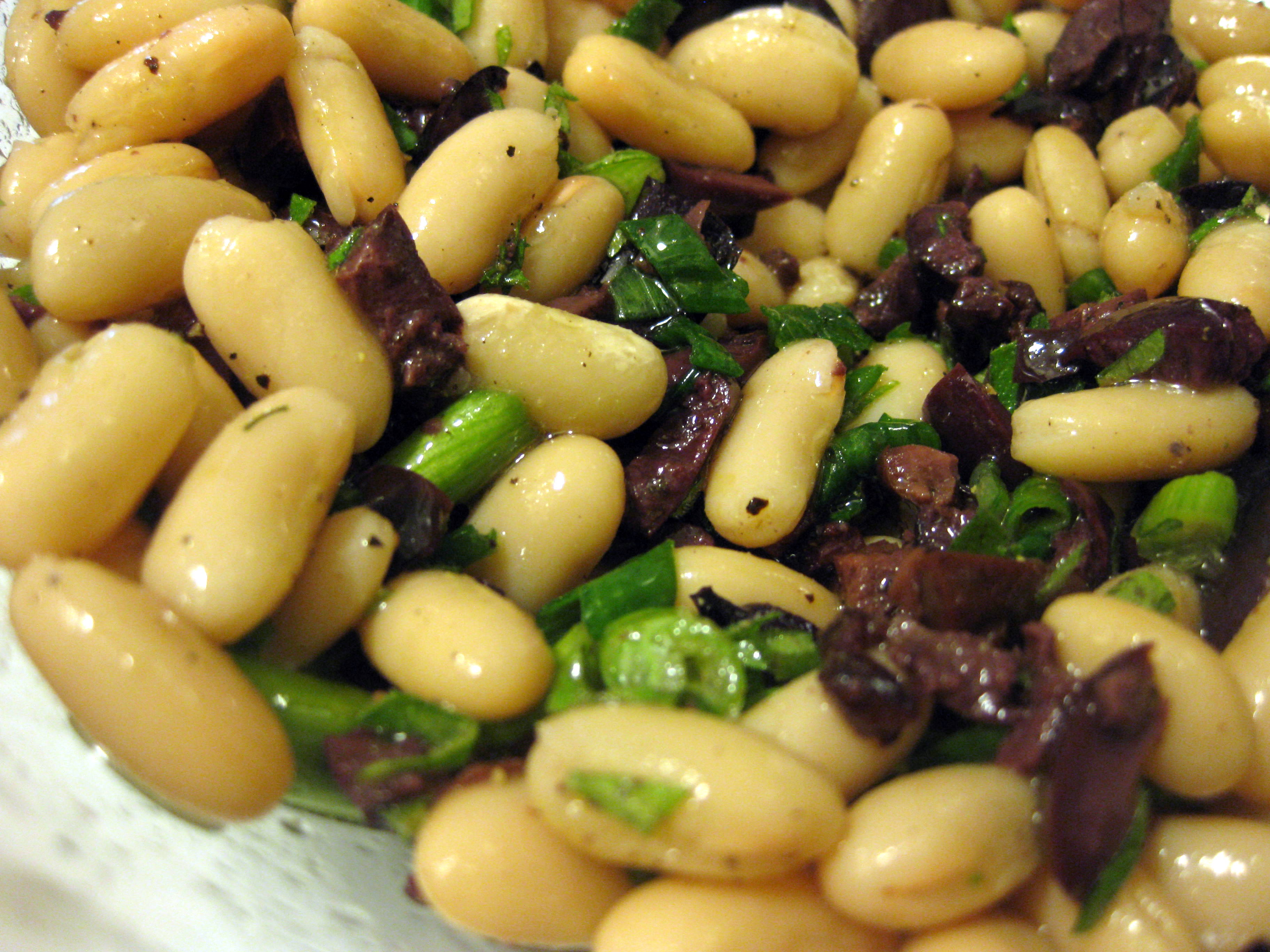
The finished salad was simple and satisfying, and had all the right tastes and textures.  The beans were creamy and soft beneath their slightly taut skins, the olives were a blast of brine, the onions had just the right astringency, and the oregano lent a spicy, earthy warmth.  The parmesan was just that final sprinkle of richness and somehow bound things together.  Pushing outside of the suggested ingredients and adding one of my own took this from a decent side dish to a salad I want to make over and over, adjusting the seasonings and the aromatics and the herbs every time, so it is fresh and exciting with each new taste.

It’s funny that even humble fare, when you give it due consideration, has flashes of zesty tangy brightness: a bite of olive, a splash of vinegar, a crumble of parmesan.  It makes me feel warmer about the dissertation experience.  If this simple salad – creamy and earthy and nourishing and salty – can have glimpses of piquancy, perhaps my project can as well.  I just have to keep experimenting with my ingredients.