Apple Cheddar Waffles

2015 Blog September-0463Although I object to the idea of swapping all of your usual décor with pumpkins and corncobs the moment calendars proclaim it’s the first day of fall, by the time mid-October rolls around I’m both cool with the harvest theme and starting to crave richer, belly-warming food. I have such ideas about bread, and stews, and short-ribs, and roasted everything…
2015 Blog September-04502015 Blog September-04522015 Blog September-0455Los Angeles is making this hard lately. With temperatures in the 90s during two of the past three weekends, it’s difficult to convince myself to cook anything, much less wax poetic about its warming spices and satisfying heartiness. My bedroom feels like the inside of a dryer. I might have fleeting dreams about fluffy, toasty, steaming biscuits mounded with chili, but all I can truly imagine consuming is a series of popsicles and frozen grapes.
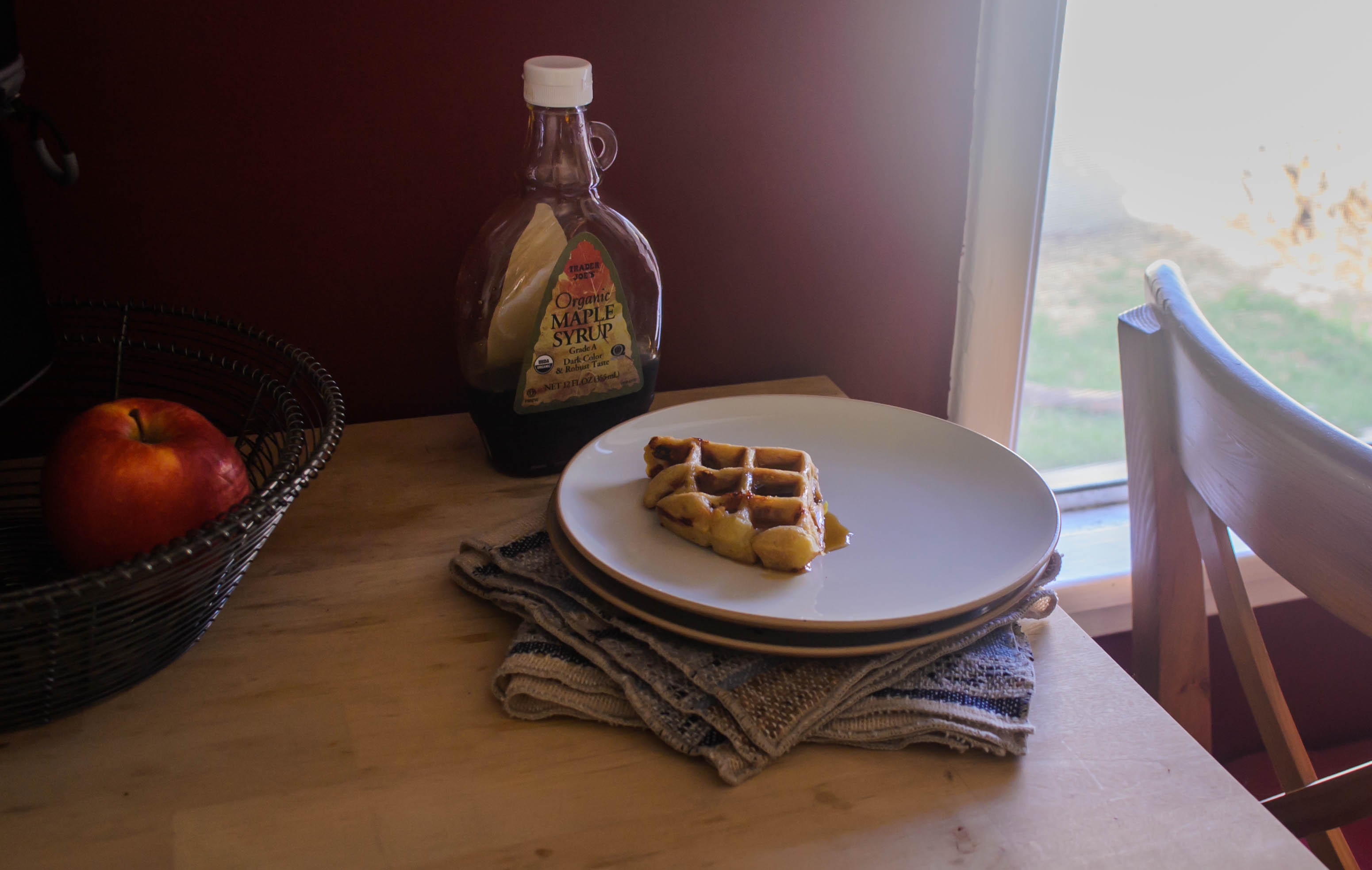
2015 Blog September-04562015 Blog September-0457But I will say, if it’s cool enough where you are that the thought of using heating implements in your kitchen doesn’t throw you into depression, you should make these waffles immediately. I first made them a month or so ago when it didn’t feel like Dante might mistake our kitchen for one of the circles of Hell. They were so good – fluffy and light from their yeasted batter, crisp and burnished with crackling edges of melted cheese – that it was only a week or two before we had to make them again. Like the grilled cheese sandwiches I pushed on you last year, they pull from the classic combination of cheddar cheese and apple pie. A wedge of salivation-inducing cheese against the sweet tartness of apple desserts is a worthy experiment in many cases, and here, soft, tender apple bits and pockets of melted cheese folded into a crisp waffle drowning in maple syrup is a combination you’re going to want to make all season, if the seasons would ever straighten themselves out. And if you simply aren’t enthused by a recipe that advertises itself with a pile of apples and sharp-as-you-can-get cheddar cheese, I’m not sure we can stay friends.

2015 Blog September-0467These start from my basic yeasted beer batter waffles recipe, which is adapted from King Arthur Flour. You can use milk instead of beer if you must, but between the yeast and the heat most of the alcohol is processed out, and the slightly bitter flavor of dark beer is such a welcome addition, balancing the rich cheese and tart apples. The first time I made these I was concerned about the apple pieces cooking all the way through in the short time they are enfolded in the waffle iron, but I needn’t have worried. They are in small enough pieces that they will cook. I like to leave the skins on for extra tartness, but you can peel them first if you prefer. Apples and cheese play well in both sweet and savory directions, so while I think a glug of maple syrup – we like to warm it up with a pinch of red pepper flakes for a little kick – makes these a complete meal, I could also see them providing a perfect raft for a moist thigh of roasted or fried chicken, or even piled with a fresh kale salad studded with walnuts and dried cherries. 2015 Blog September-0464
Apple Cheddar Waffles
Loosely adapted from King Arthur Flour
Makes about six 7-inch waffles
2-2½ hours (45 minutes active time)
1½ cups (12 ounces) lukewarm dark beer, such as a stout or a porter
1½ teaspoons active dry yeast
3 tablespoons maple syrup
6 tablespoons (3 ounces) melted butter, cooled
1 teaspoon salt
2 large eggs
2 cups all-purpose flour
1 green apple, diced into ¼ inch-½ inch chunks (1⅓ – 1½ cups, approximately)
1 generous cup grated sharp or extra sharp cheddar cheese


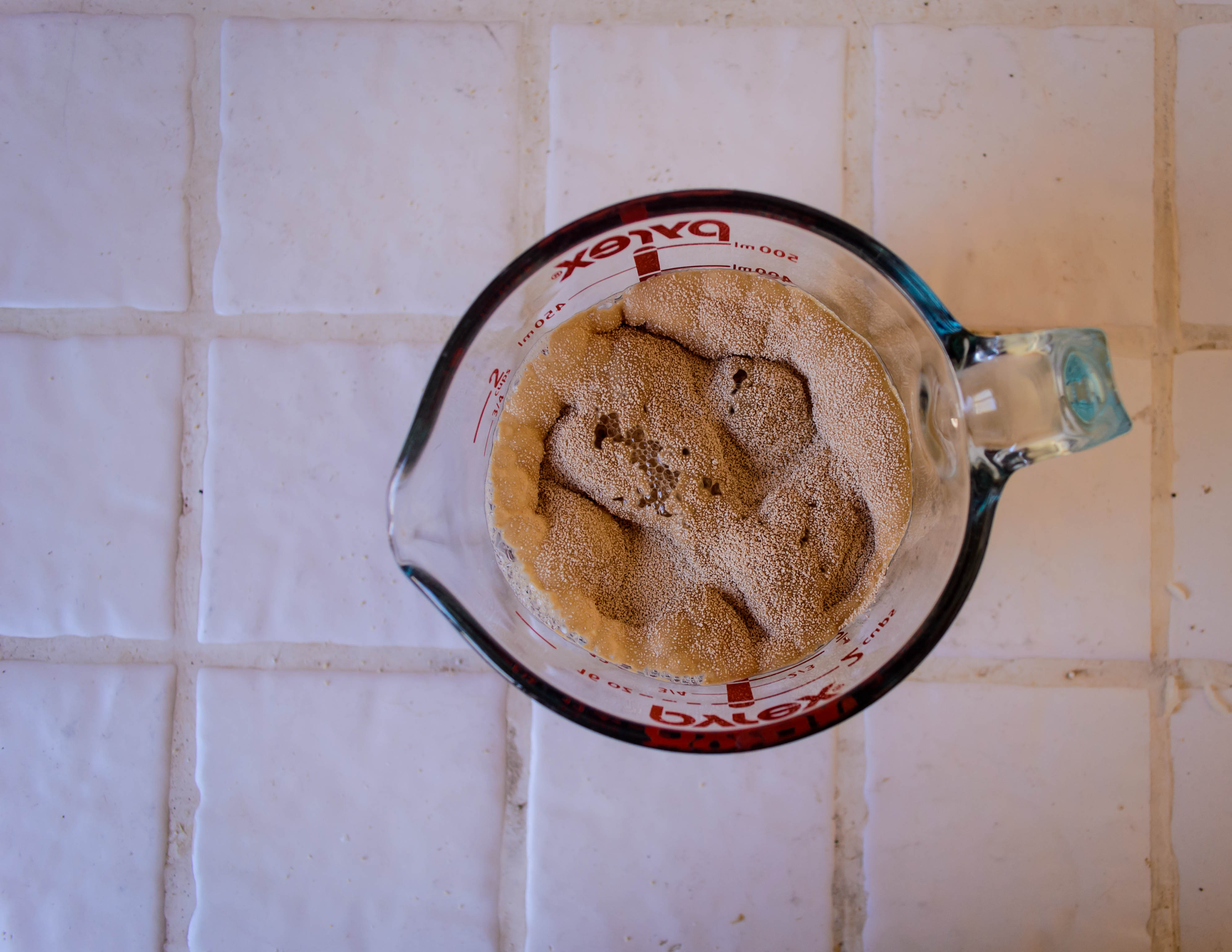
  • In a 2-cup glass measuring cup, or a small microwave safe bowl, heat the beer until just warm to the touch. Add yeast and let them mingle for 5-10 minutes. The yeast will foam up considerably, thanks to the extra sugars and yeast already in the beer.
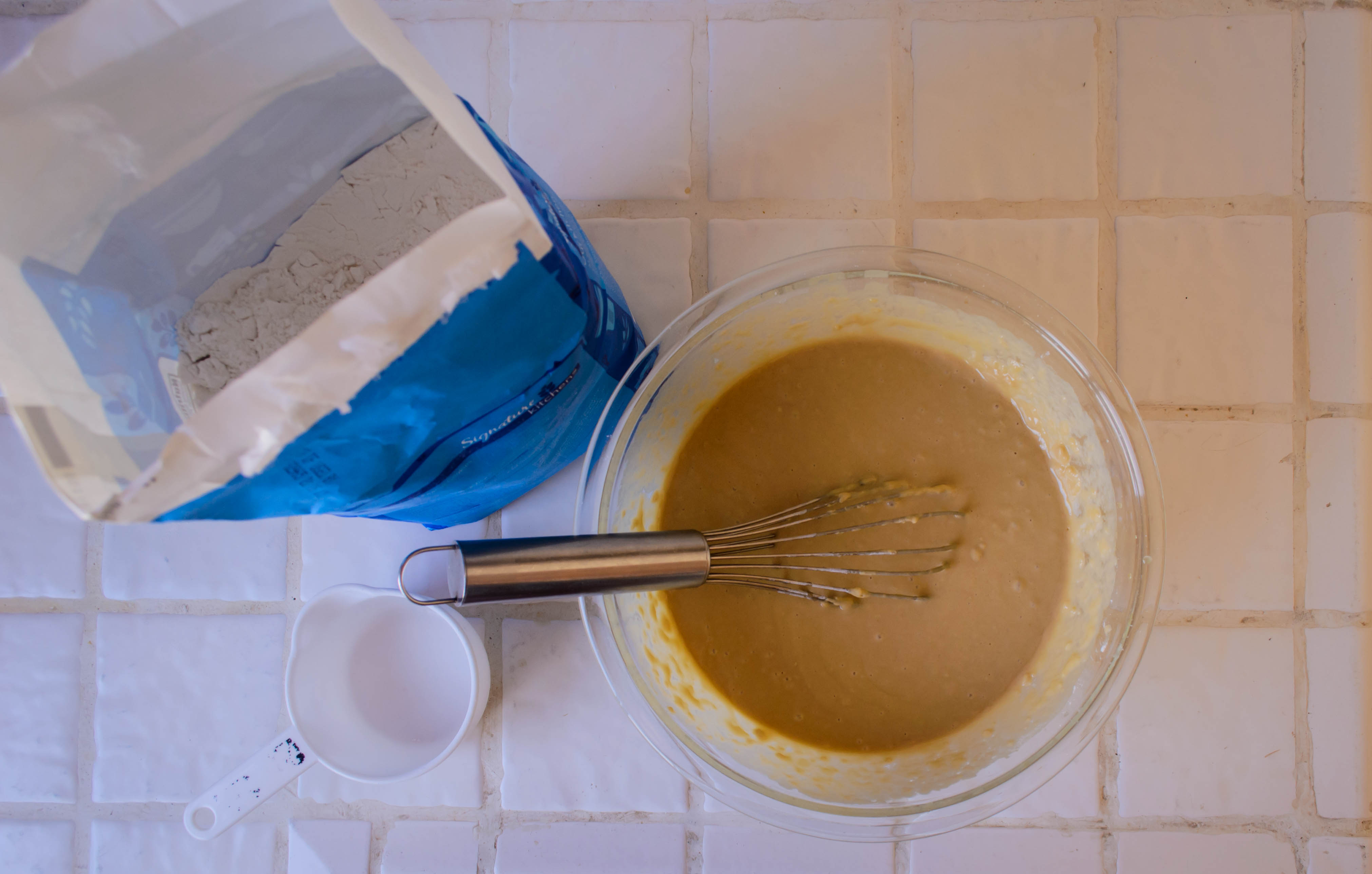
  • While the yeast proofs, whisk together the cooled melted butter, the maple syrup, the salt, and the eggs in a large bowl. Be sure there’s room for the batter to expand.
  • Add the beer and yeast mixture and whisk to combine, then add the flour 1 cup at a time, whisking to combine thoroughly. Switch to a rubber spatula and fold in the apple chunks and the cheese. Stir well, as the cheese may want to stick together; we want it evenly incorporated.
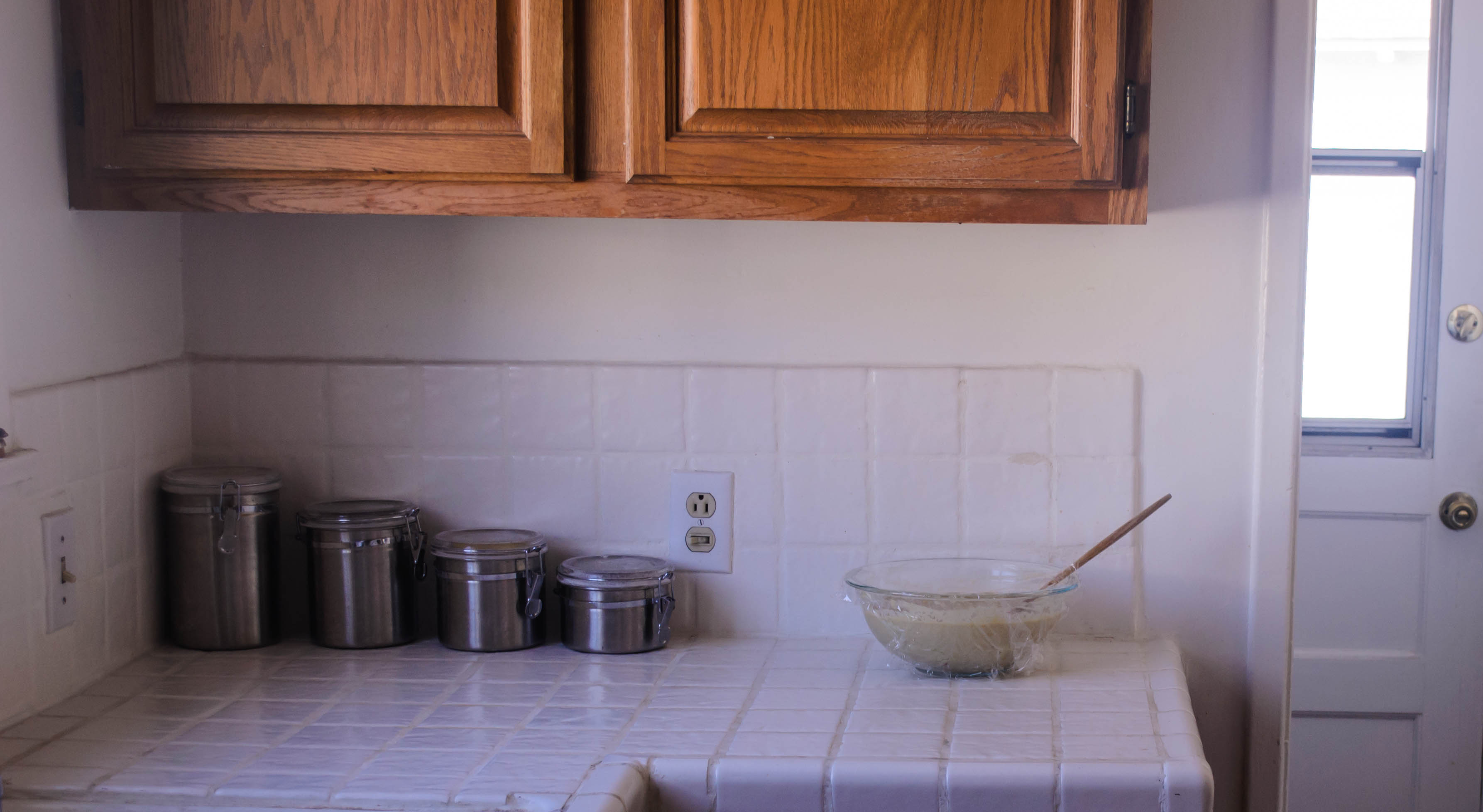
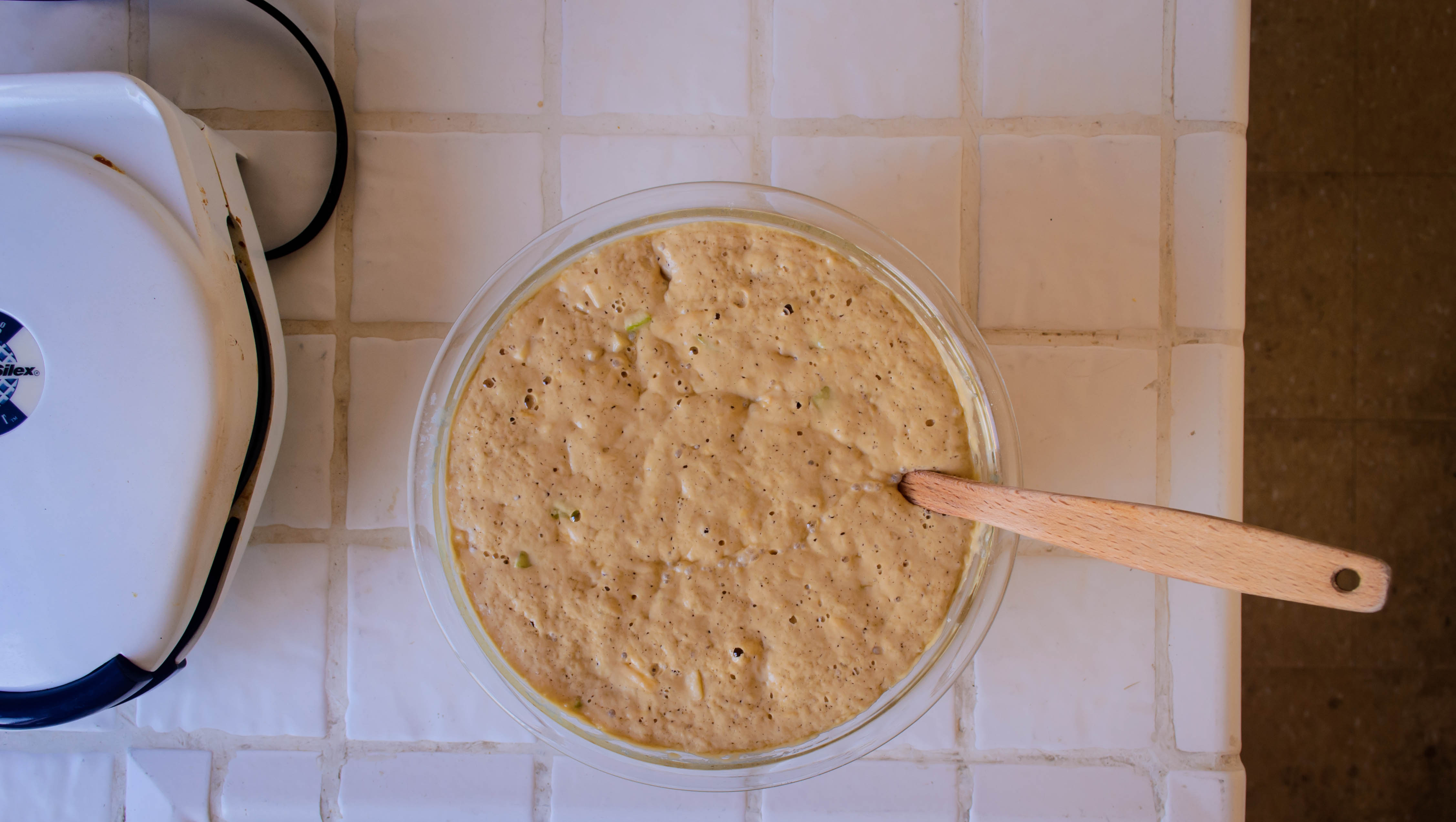
  • Cover the bowl with plastic wrap and set it on the counter for 1½-2 hours (how fast it rises and bubbles will depend on how warm your kitchen is, but longer rise = deeper flavor).  The mixture will develop lethargic and then more energetic bubbles, and begin to smell quite bready.
  • Once it has had a chance to rise and is covered with a near-consistent layer of bubbles, either stow in the refrigerator overnight, or preheat your waffle iron!
  • Drop the batter in generous ⅔ cup batches onto a preheated, greased waffle iron (or whatever capacity your iron can handle). Close the lid and cook for the recommended amount of time, or until the waffle is crisp on the outside and deeply golden, with dark crisp cheese lace protruding. Ours took about 7 minutes per waffle. (If you refrigerated your batter for a few hours or overnight, be sure to bring it back up to room temperature before cooking)
  • Serve hot with your choice of sweet pourable topping. We like maple syrup warmed with a pinch of red chili flakes in it, for a little kick. If you need to keep the waffles warm, stow them on a wire rack over a baking sheet in a 250F oven until you are ready to eat.


Thyme and Black Pepper Crackers

2015 Blog September-0498Over the past few years, N. and I have made it our business to conclude the week with a happy hour – we load some cheeses and crackers on a plate, sometimes some sliced cured meat, sometimes a few dried figs – and pour something cold and alcoholic into a frosty glass. Through this process, I’ve learned that N. loves black pepper. We bought a wedge of cheese crusted in black pepper once as an experiment, and I think since then it has been on every shopping list, every week, for about the last two years. More recently, we started picking up variety packs of crackers – the crushed wheat rounds, the chalky water crackers, the rectangles spiked with vegetable bits – and in one variety-pack, a black pepper water cracker. This sleeve always, always disappears first. N. doubles up on the pepper – peppered cheese on peppered cracker. And should there be peppered salami? The kid is in paradise.

2015 Blog September-04712015 Blog September-0475Because we always run out of the black pepper cracker first, I knew when I saw this month’s Twelve Loaves theme of crackers, crisps, or flatbreads that I wanted to recreate them. I poked around and considered, decided to add some fresh thyme for a little more interest, and ended up with these. At first I called them water crackers, but decided to amend for the sake of accuracy. A real water cracker, traditionally speaking, contains only flour and water (and sometimes some salt or leavening agent). No fat. Yet fat is what, so often, imparts flavor. Here, a few glugs of oil result in a cracker that crackles in thin, flaked layers, almost like a very crisp pastry crust.

2015 Blog September-04762015 Blog September-04782015 Blog September-04792015 Blog September-0482A few notes: first, these are not for the weak-of-tongue. The black pepper flavor is quite aggressive, and though a smear of creamy cheese will certainly cool things down, it can’t disguise the sharp spice of the bits of cracked pepper. Second, as with most crackers, the greatest trick here is getting them thin enough. I’ve recommended ⅛ inch at the thickest, but even thinner than that is better. They swell up only slightly as they bake, and a thick cracker is, alas, a decidedly not-crisp cracker. Those that I didn’t get quite thin enough tasted stale already barely cooled from the oven, simply because they didn’t snap and crumble adequately between the teeth. For us, the thinnest, most golden specimens stayed crisp and fresh tasting for a mere two days afterward, even stored in a firmly flattened zip-top bag. That means, unless you have a pepper fiend around your house, you are best served by making these for a gathering (the spice suggests a Halloween party might be a good venue), or throwing together a half recipe, or maybe even freezing half the dough until you need another batch. I haven’t tried that with this particular cracker, but I have done so with great success with Joy the Baker’s Sharp Cheddar Cheese Crackers, so I have every confidence these will be equally suited for the deep freeze.

2015 Blog September-0488Serving recommendations: topped with any sort of cheese, of course. But they would be equally good with cured meat of some sort, or a scoop of egg salad, or maybe even some hummus. While they were hot, I found myself compulsively snatching one and then another from the cooling rack, suggesting they are even acceptable bare. I do think, though, that a glass of something sparkling to wash them down is not to be discounted.

2015 Blog September-0497

Thyme and Black Pepper Crackers
Adapted from Chowhound
Makes 4-5 dozen 2½ inch crackers
Time needed: about an hour
2 cups all-purpose flour
1 teaspoon baking powder
½ teaspoon salt
1 tablespoon black peppercorns
1 tablespoon fresh thyme leaves
⅔ cup warm water
⅓ cup olive oil


  • Preheat the oven to 400F and line two cookie sheets with parchment paper.
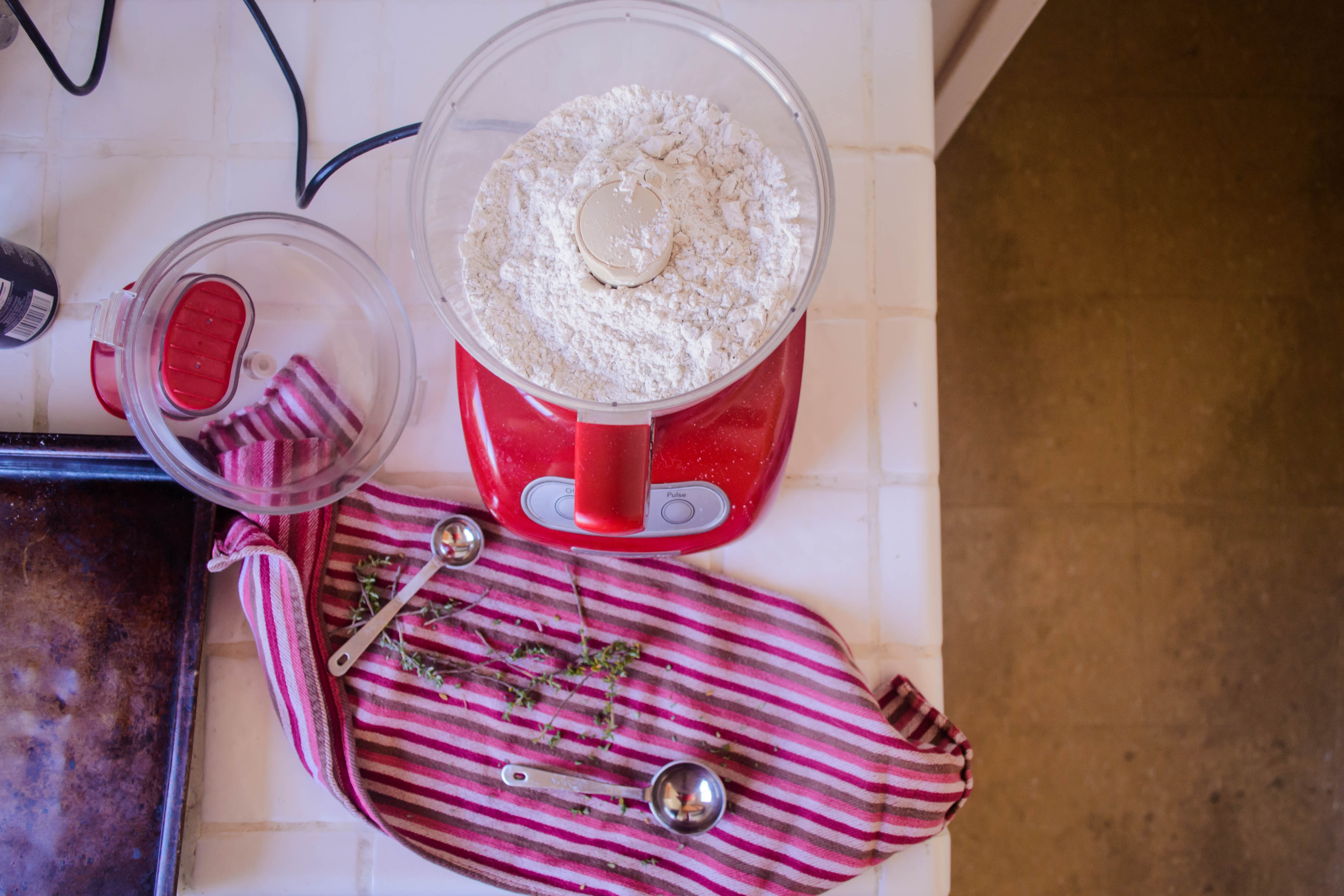
  • In a food processor, pulse the flour, baking powder, salt, and thyme until combined. Use a spice grinder or similar small bladed tool to crush up the peppercorns until some are coarsely chopped and some are a fine powder. Add this pebbly pepper dust into the food processor and run until the pepper is evenly distributed through the flour mixture.
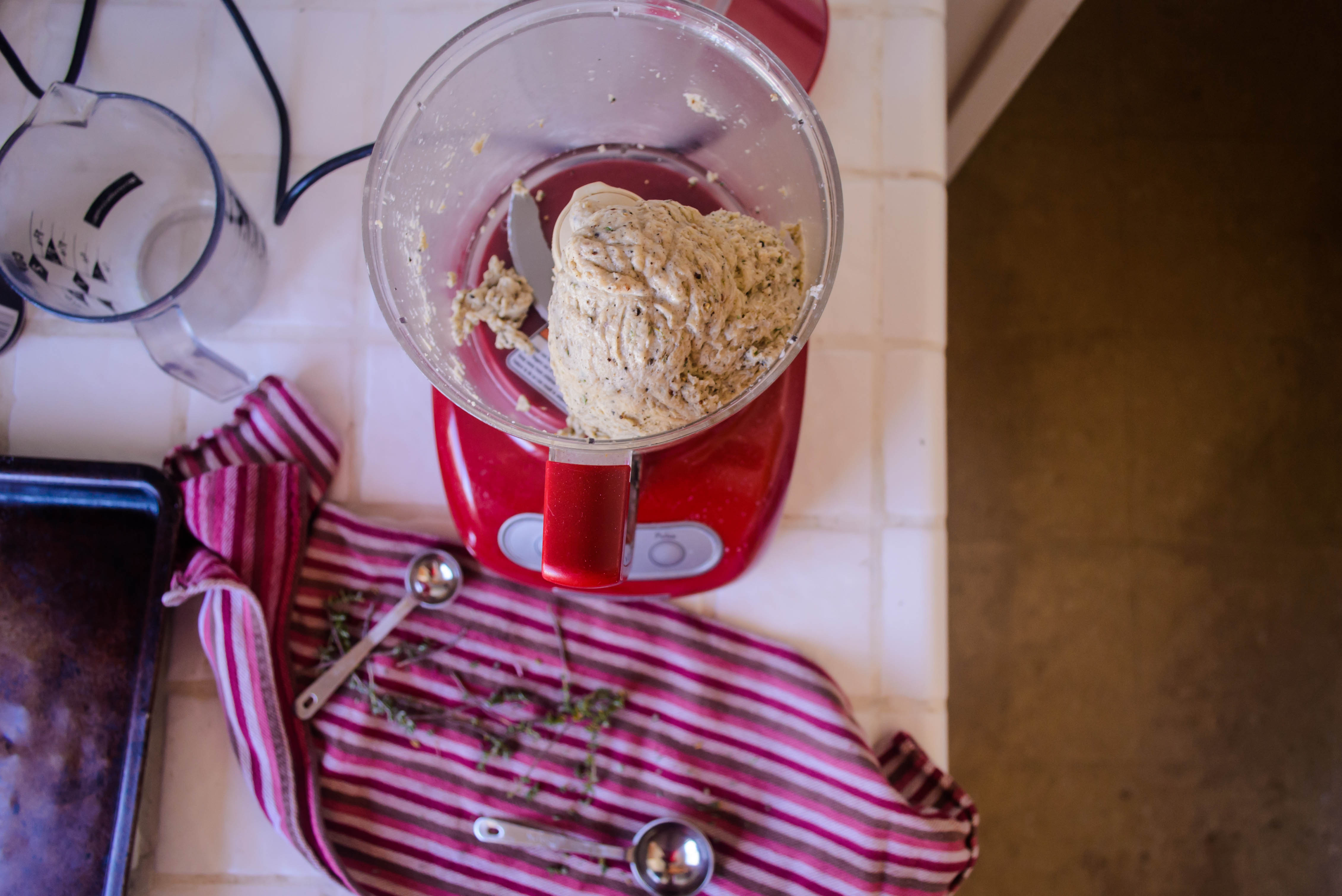
  • Measure out the warm water and the oil into the same vessel. With the food processor still on, drizzle in the water and oil and let the machine run until the ingredients form a smooth, slightly sticky dough. First small hunks will clump together, then quite suddenly a mass will form and run in circles around the belly of the processor.
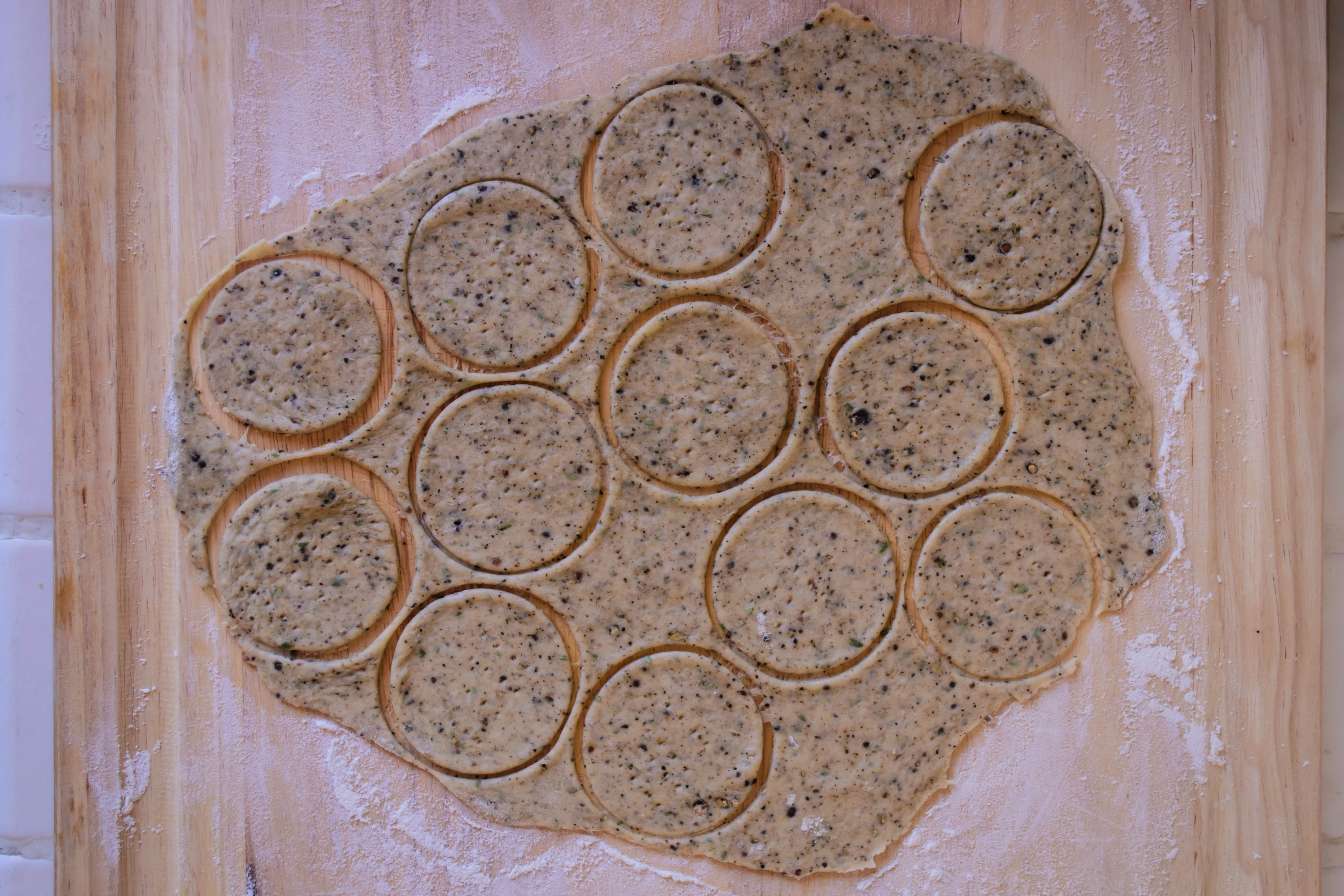
  • Lightly flour a board and a rolling pin, and turn out half the dough. Sprinkle a little flour atop the dough as well. Roll out until very thin – at maximum ⅛ inch, but 1/16 inch is better for crisp crackers. Be sure to get the edges as thin as the middle. If you fear the dough is getting sticky, flip it over and turn it 180 degrees, then sprinkle with a little flour and roll again.
  • Cut the thin, even layer of dough into shapes of your choosing. We like rounds, and I used a glass with a diameter of 2½ inches. Prick rounds with a fork three or four times, then transport dough rounds to the prepared cookie sheets. Place them in a single layer, but they can sit very close together because they will not spread out. I easily fit 2 dozen on a single cookie sheet. Repeat for the remaining half of the dough.
  • Bake 12-14 minutes, until golden on top and quite dry. Cool completely before topping with cheese, salami, hummus, or whatever’s your favorite.
  • These can be stored in an airtight container or zip-top bag for a few days, but because they are freshly made and contain no preservatives, they will get stale faster than the average boxed cracker.


#TwelveLoaves is a monthly bread baking party created by Lora from Cake Duchess and runs smoothly with the help of Heather of All Roads Lead to the Kitchen, and the rest of our fabulous bakers.

Our host this month is Camilla from Culinary Aventures with Camilla, and our theme is Crackers, Crisps, and Flatbreads. For more bread recipes, visit the #TwelveLoaves Pinterest board, or check out last month’s mouthwatering selection of #TwelveLoaves enter last month’s #TwelveLoaves Seeded Breads!

If you’d like to bake along with us this month, share your Crackers, Crisps, and Flatbreads using hashtag #TwelveLoaves!

Lamb meatballs with basmati pilaf and pomegranate drizzle

2015 Blog September-0440I don’t remember the first time I had lamb. I suspect it was a special occasion – probably Easter – and I suspect I had it in the company of a generous scoop of that emerald green mint jelly that still, in my memory, is the perfect accompaniment for the slight gaminess of a well-seared chop or slim carved slice.

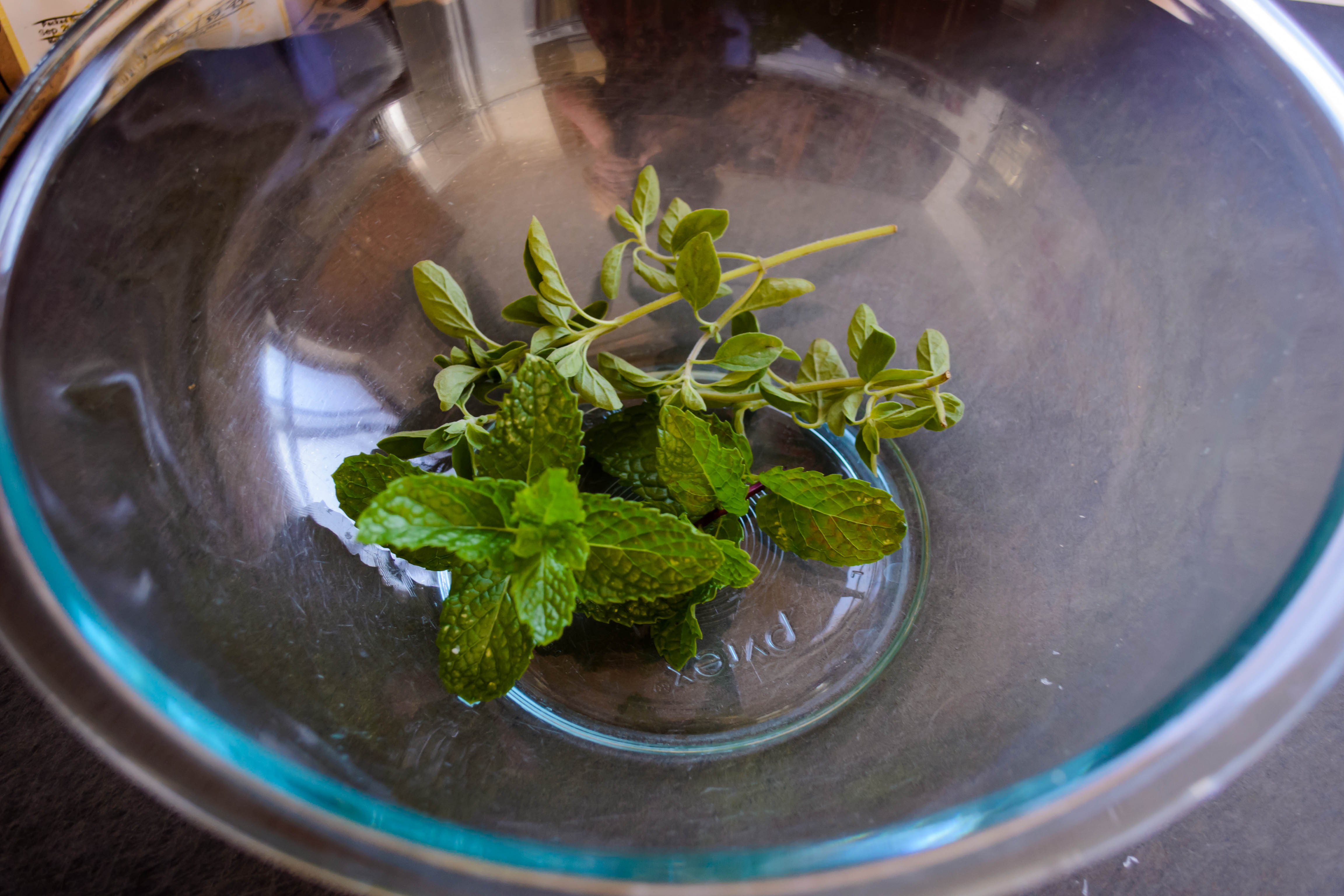
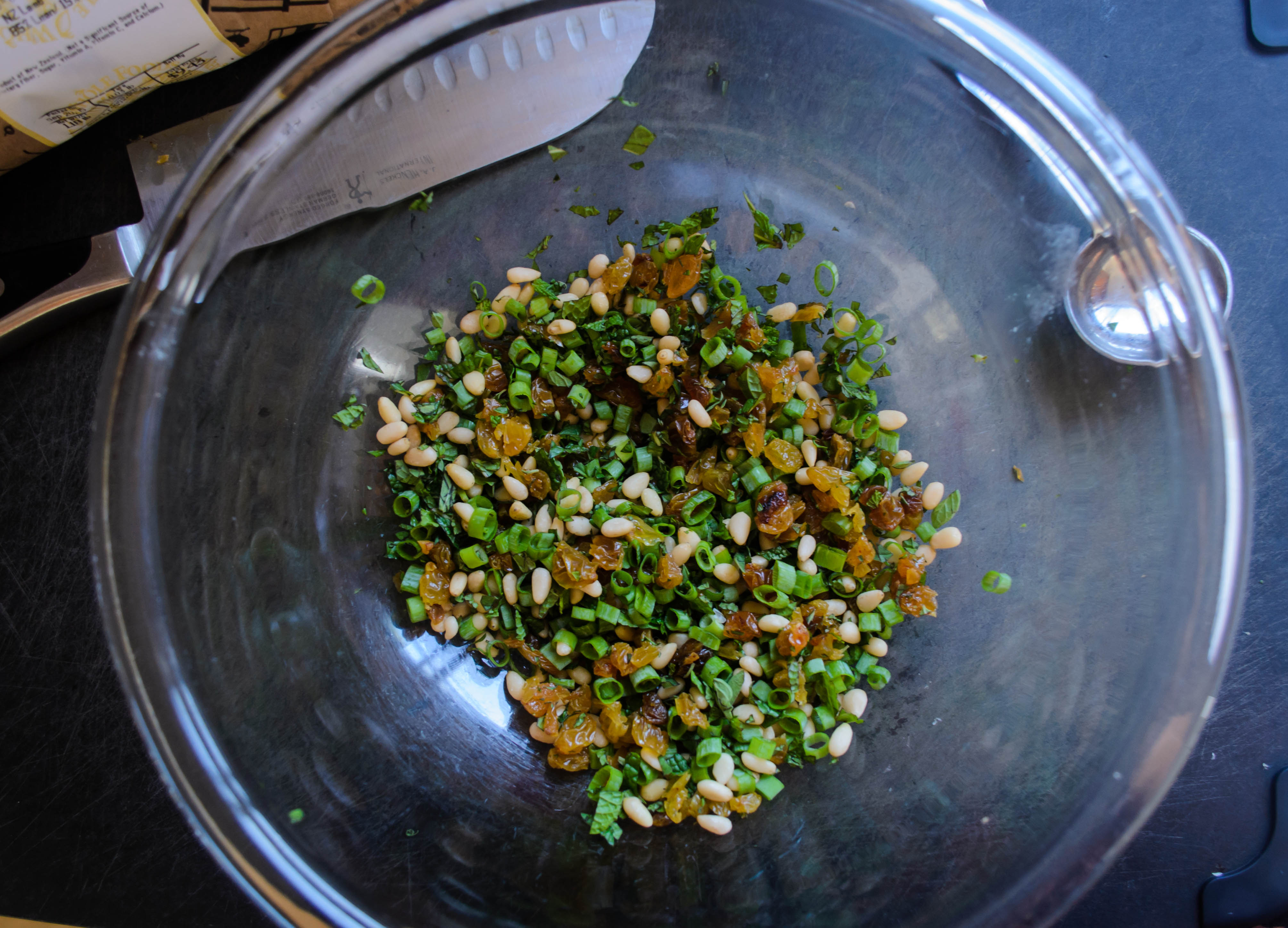
2015 Blog September-0423To bring lamb into the meatball fold (too much? I couldn’t resist), I went back to the mint pairing with a few fresh sprigs, but decided to dress up the seasonings a bit more, pushing these meatballs in a Mediterranean direction. Oregano joined the mint, along with green onions, pine nuts, a small handful of coarsely chopped golden raisins, a tiny touch of cayenne pepper to keep things interesting. Fresh breadcrumbs soaked in cream keep the meat mixture springy and moist, and after a sear and a simmer in beef broth, they are fragrant and herbaceous, tugging toward both the savory and the sweet.

2015 Blog September-0426In dreaming these up, I knew I wanted to play with the sweetness of the traditional mint jelly, but push it in a more grown-up direction. Lamb and chutneys are also a common pairing, since lamb goes so nicely with fruit, and in searching for that agradolce flavor – the Italian sweet/tart/sour answer to a gastrique, I hit upon a thick, puckering drizzle of pomegranate juice and balsamic vinegar, reduced down into a glossy syrup, that would be as delectable over vanilla ice cream as it is here over meat. To finish, according to my notes, all is needed is lemon zest and a “sparing crumble of feta.”

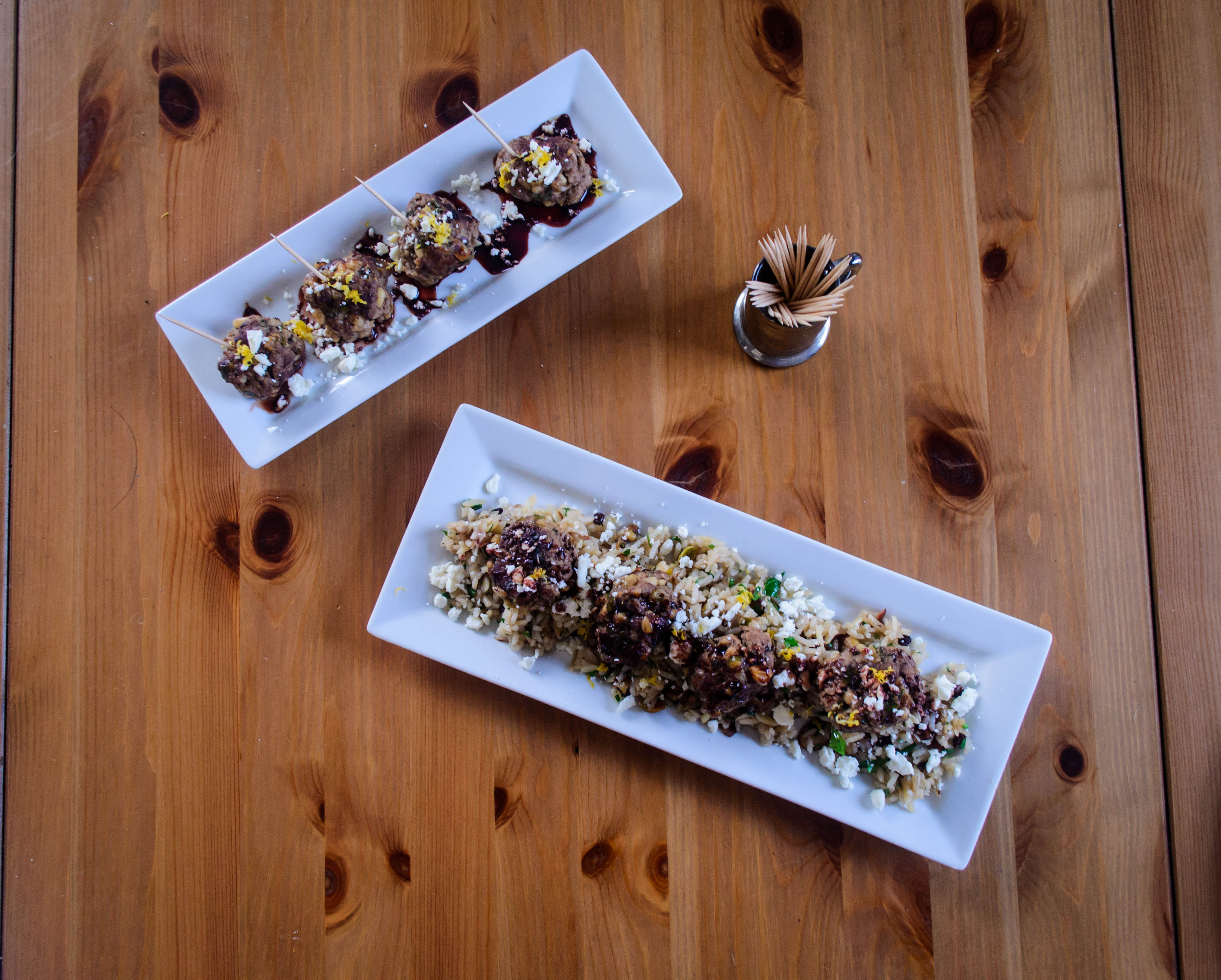
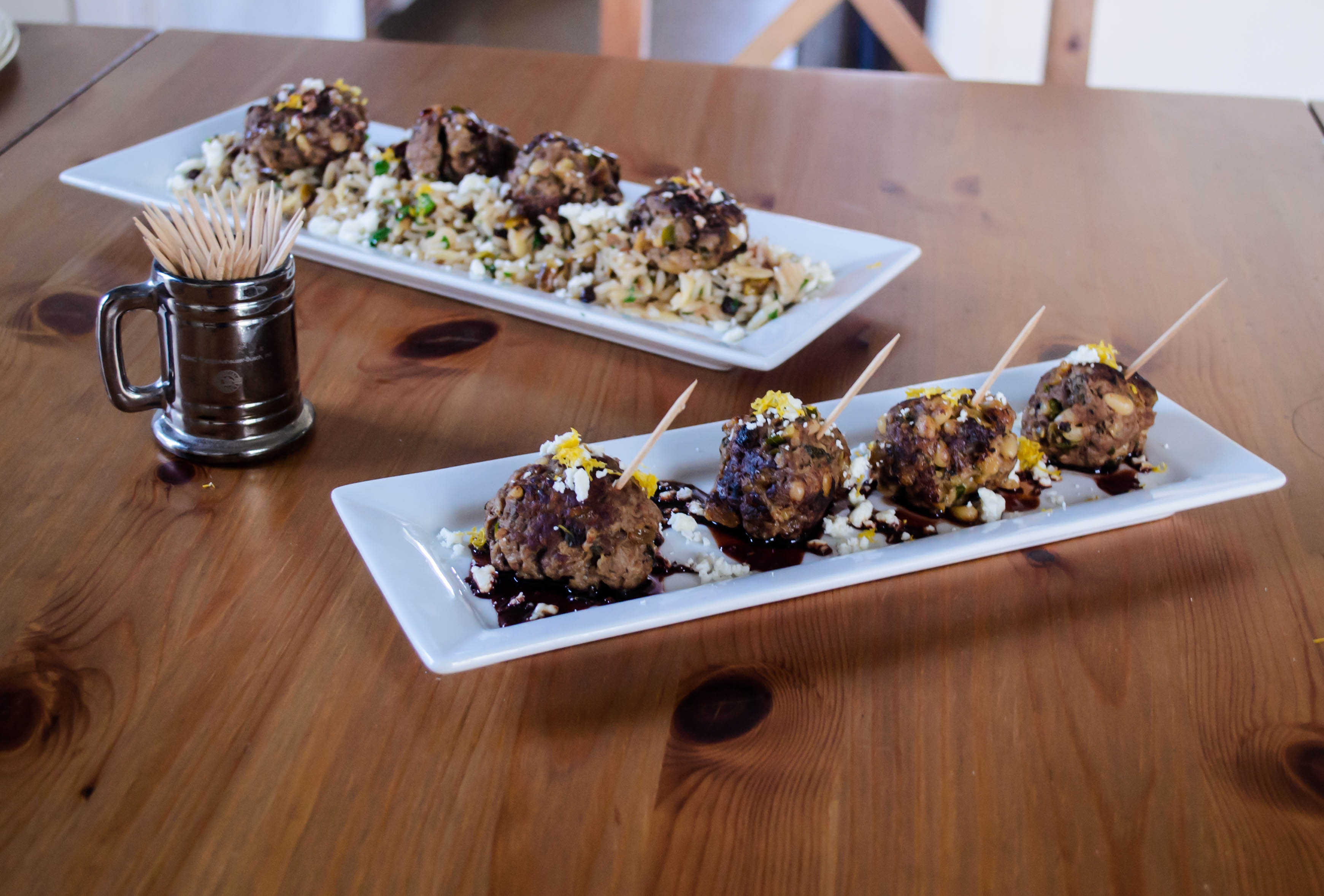
2015 Blog September-04332015 Blog September-0435Just like this – a meatball drizzled in syrup, sprinkled with briny cheese and a touch of bitter citrus rind, these make perfect appetizers. They require only a toothpick, and since they are even better at room temperature than they are steaming from the pan (time to cool gives the herbs a chance to assert their flavors), they are ideal for a party. If you’re looking for an entrée application, though, I also opted for a basmati pilaf, all nutty and fluffy and toasted, spiked with currants and nuts and a little fresh parsley to finish, that these meatballs can be happily snuggled into.

2015 Blog September-04312015 Blog September-0437These are, without question, my favorites of the meatball project thus far. When it’s done right, the play of savory and sweet is one of my favorite taste combinations. And I must, for the sake of your stomachs, eschew modesty and admit: here, it is done right.

2015 Blog September-0444

Lamb meatballs with basmati pilaf and pomegranate balsamic drizzle
Serves 4-5 (with 18-20 1-½ tablespoon meatballs)
45 minutes if you’re quite efficient, 60-90 minutes if you’re not
For drizzle:
¼ cup balsamic vinegar
1 cup unsweetened pomegranate juice
For meatballs:
1 cup fresh breadcrumbs
½ cup milk or cream
1 lb. ground lamb
¼ cup finely sliced green onions, dark and light green parts only (save the bulbs for another night)
1 tablespoon minced fresh oregano
2 tablespoons minced fresh mint
¼ cup roughly chopped golden raisins
¼ cup pine nuts
½ teaspoon salt
⅛ teaspoon cayenne pepper
3 tablespoons olive oil
1-2 cups beef broth
For pilaf:
3 tablespoons butter
3 tablespoons roughly chopped pistachios
3 tablespoons sliced almonds
¼ cup minced red onion
¾ cup basmati or other long-grain rice
¼ cup orzo (small rice-shaped pasta)
1 bay leaf
3 tablespoons currants
¾ teaspoon black pepper
½ teaspoon salt (but taste your chicken broth first – you may need more or less salt)
2 cups low-sodium chicken broth
¼ cup roughly chopped parsley, to finish
To serve:
½ cup finely crumbled feta cheese
zest from one lemon


  • Combine the balsamic vinegar and pomegranate juice in a small pot and set it over medium heat. Bring to a boil, then reduce to just simmering and let it go for 30-40 minutes, stirring occasionally, until it has become a thick, glossy syrup the consistency of molasses. When that happens, remove from heat immediately and set aside.
  • In a glass measuring cup or small bowl, combine the fresh breadcrumbs and the milk or cream and let sit for about 10 minutes to soak. While they suck up the moisture, chop and prep your remaining meatball ingredients (and the pilaf ingredients, if you have time).
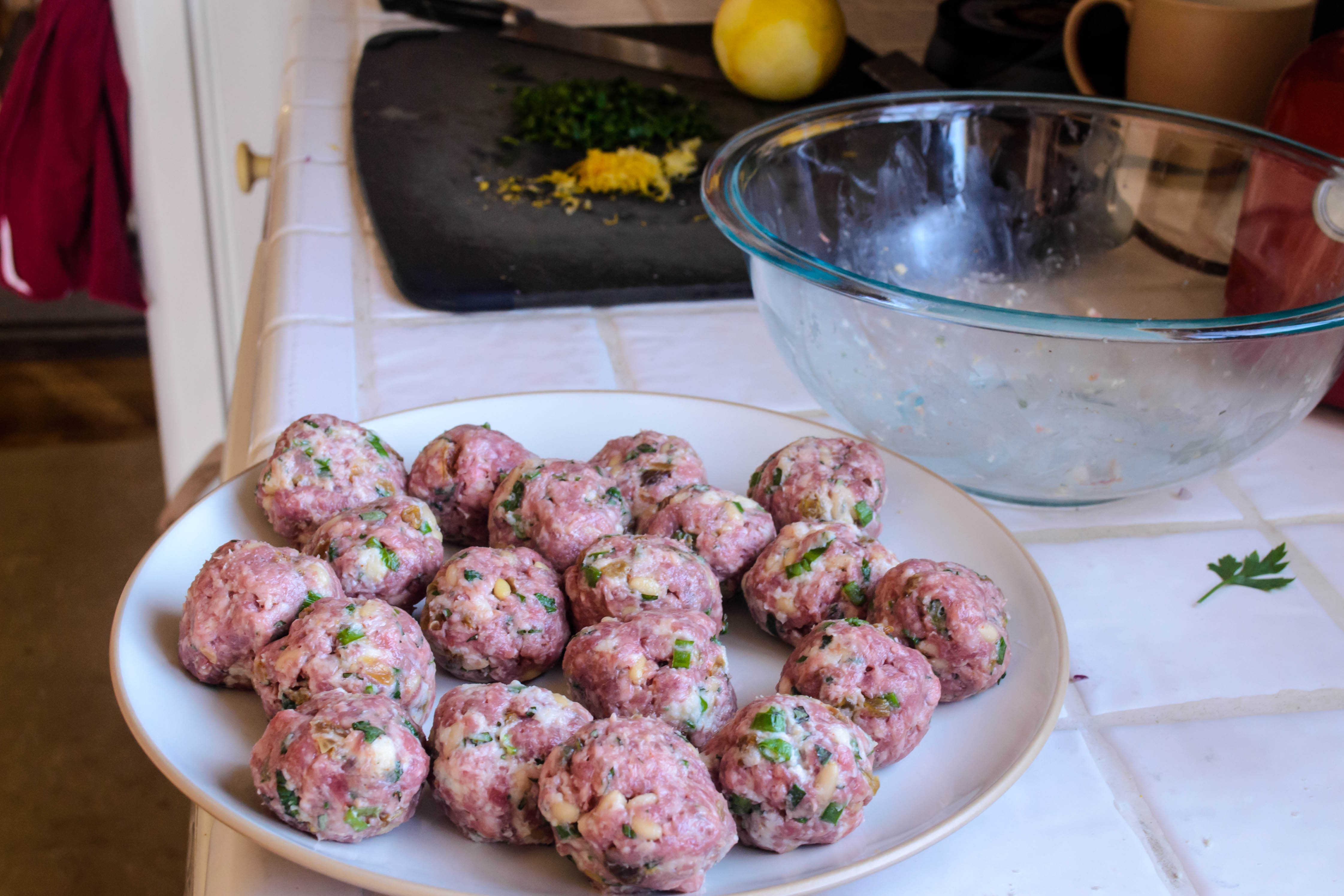
  • Add the ground lamb, the green onions, the oregano, the mint, the golden raisins, the pine nuts, the ½ teaspoon of salt, and ⅛ teaspoon cayenne pepper to a medium mixing bowl. Using a fork or your fingers, lift the bread crumbs out of the milk or cream, let any excess liquid drip off briefly, and add them to the other meatball ingredients. Use your fingertips to combine the meatball ingredients, mixing lightly but thoroughly to distribute the wet bread and the sticky meat evenly.
  • In a large skillet, heat the 3 tablespoons of olive oil over medium heat. Add about a teaspoon of the meat mixture and fry for about a minute on each side until cooked through. Taste for seasoning and adjust salt and cayenne pepper quantities as desired. It’s okay to leave them slightly undersalted, though, as the feta you’ll crumble over at the end is so salty.
  • With moistened hands, scoop up 1-½ tablespoon quantities of the meat mixture and roll them into spheres. This should net you 18-20 meatballs. Place as many meatballs as will fit in a single layer without touching one another in the preheated skillet, and brown on all sides over medium heat – about 2 minutes per side. Remove to a clean plate. Repeat until all meatballs are browned on the outsides.
  • Wipe out the meatball skillet with a paper towel to remove the excess fat, then add the 1-2 cups beef broth and bring to a simmer. When it is bubbling, carefully add the meatballs back into the skillet – you want enough liquid that it comes approximately halfway up the sides of the meatballs. Cover with a tight-fitting lid and let simmer 15-20 minutes, turning all meatballs once.
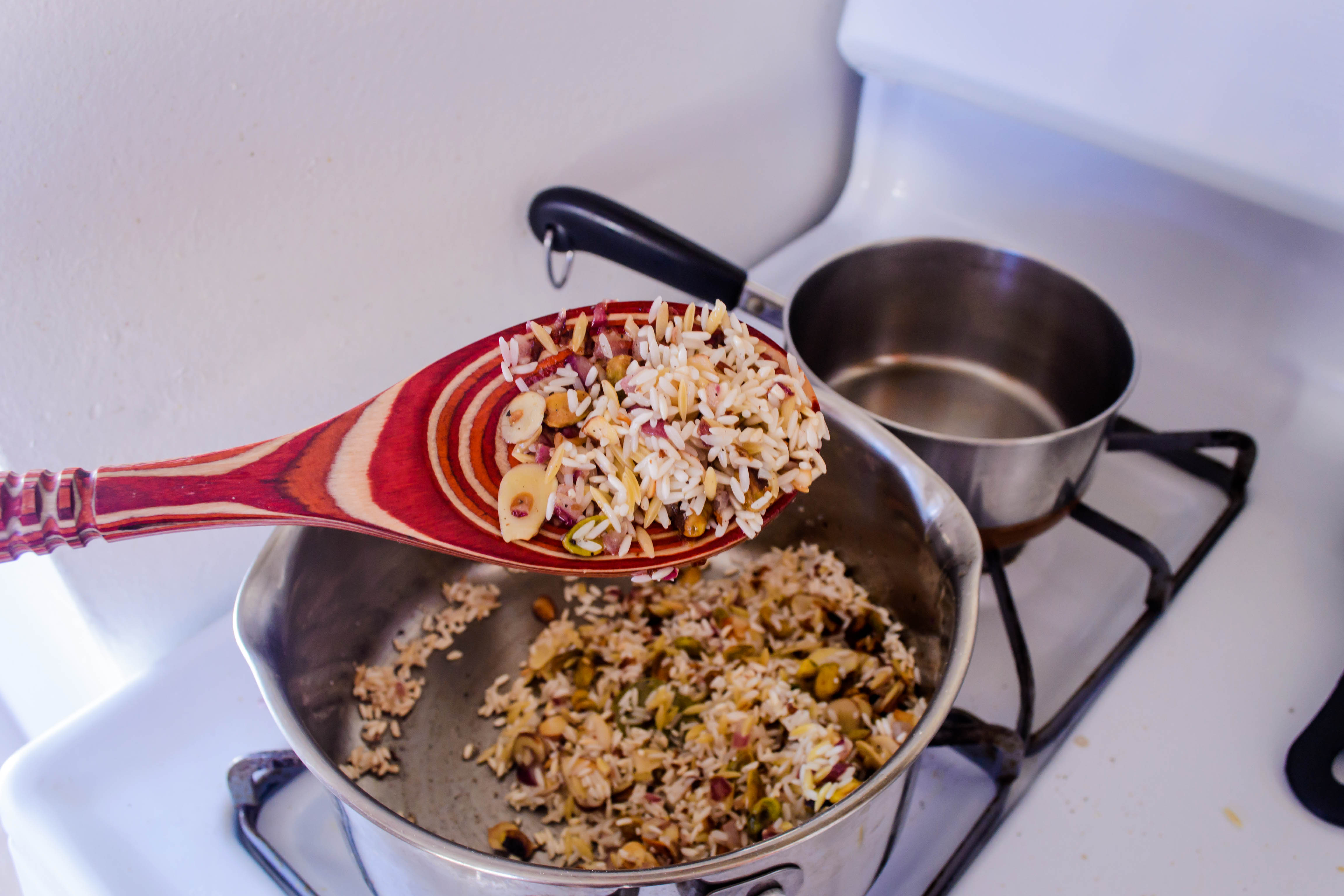
  • The moment the meatballs hit their simmer, make the rice. Heat the 3 tablespoons butter in a medium pot over medium heat. Add the pistachios and almonds and toast, stirring frequently, until lightly browned. Add the ¼ cup minced red onion and sauté until onion is translucent and tender – 3-5 minutes. Stir frequently to ensure the nuts do not burn.
  • Add the rice and the orzo to the onion and nuts and stir to coat evenly with the melted butter. Toast over medium heat for 1-2 minutes, just until the rice gains some opacity. Add the black pepper, the salt, the bay leaf, the currents, and the chicken broth. Stir well and cover with a tight-fitting lid.
  • Bring the rice mixture to a boil, stir once more, and reduce heat to a simmer. Simmer 15 minutes, or until rice is tender and has absorbed all the broth. Stir in the parsley and fluff with a fork before serving.
  • To serve, nestle 4-5 meatballs per diner on a bed of the fluffy pilaf. Drizzle a few teaspoons of the thick, glossy pomegranate syrup over the meatballs, crumble on some feta and lemon zest, and serve warm or at room temperature.
  • Alternatively, for appetizers, make a decorative drizzle of the pomegranate glaze on an attractive platter (I prefer white, for the contrast), spear the meatballs and place them atop the glaze layer, and then dust the whole thing lightly with feta and lemon zest. Serve the rice alongside, or not at all.

Seared Salmon with Pea Pesto and Celery Root Puree

If you are a certain type of food blogger, one who is interested in trends of the food and restaurant world, not just the backdrop and vintage props Pinterest tells us are all the rage this month, then you care about and try to integrate sustainability, and seasonality, and local foods into your cooking. You are all about ramps and rhubarb in the spring, you plan zucchini dishes for late summer and early autumn when that crop is glutted. You wouldn’t dream of presenting a heavy stew or cream-based soup unless the weather has been cold. You let the year and its turning rule your kitchen.

2015 Blog August-0298I try to be that kind of blogger. I try to keep my food in tune with the seasons and plan vegetable dishes according not just to what appears at my farmers’ market, but to be sensitive to the fact that not everyone is in Southern California, so not everyone has the same plethora of options I do. I even try to plan for holidays, and get appropriate dishes out there ahead of time (sometimes barely) in case you want to make them. Sometimes it works, sometimes it doesn’t.

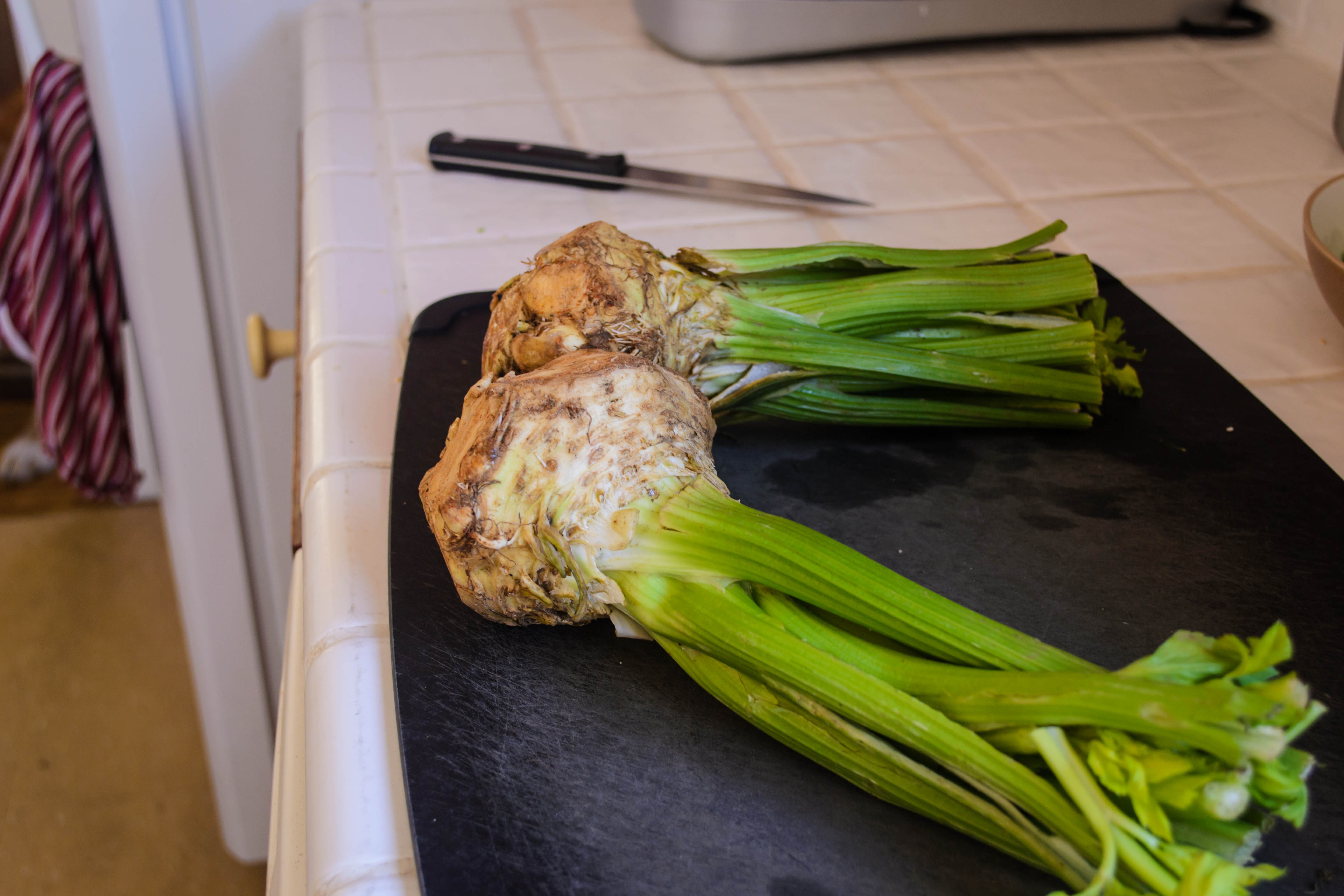
2015 Blog August-0286But here’s the thing: I’m also ruled by my stomach. Sometimes I don’t want zucchini. Sometimes I would rather roast than grill. Sometimes there’s a combination I dream up that sounds so good I don’t want to wait until the “right” time to cook it and present it to you. That’s the case this week. This is, if I were being a responsible food person, without question a spring dish. The peas could be fresh out of the pod, the dill is all about feathery fronds and new shoots. I cook the salmon so the skin is crispy, then balance the flesh side atop lemon slices in the pan to keep it moist and tender, all freshness and brightness. The celery roots, on the other hand, are the last dregs of winter, knobbly and earthy and strange, adding pale richness to complement the salmon and tame the sprightly sharpness of the pesto.

2015 Blog August-0292But when I thought of it – a nutty pesto of peas and walnuts, seasoned with dill instead of basil or mint and almost on the verge of being too salty, sitting atop a piece of moist, pink salmon with crisp skin, all surrounded by the creamy celery-scented puree, I couldn’t wait half a year. It had to happen now.

There’s not much to say about this dish, story-wise. No childhood memory or restaurant meal inspired it. I just thought the combination sounded good, and it was. The pesto, in particular, though admittedly not the most appealing shade of green, is a surprising and intriguing punch. Dill works very well with peas as well as lemon, and the tannic bitterness of toasted walnuts tames the sweetness of the peas enough to keep them in the savory realm.

2015 Blog August-0295Note: the puree does take the longest time to create, since the starchy roots can take up to half an hour to soften. If you’re very efficient, you’ll be able to prep the remainder of the components while the hunks of celery root are simmering. I am not all that efficient, so I made the pesto first just in case. You know you best, so plan accordingly.

2015 Blog August-0298

Seared Salmon with Pea Pesto and Celery Root Puree
45-50 minutes prep and cook time
Serves 4
For celery root puree:
2 medium celery roots, any attached stalks removed, peeled and chopped into small chunks
1-2 cups milk
1 clove garlic, skin removed
1 teaspoon salt
¼ teaspoon pepper (use white pepper if you don’t want flecks)
6 ounces mascarpone cheese, at room temperature
For pea pesto:
1 cup (4 ounces) peas, fresh or frozen
⅓ cup walnut pieces
1 clove garlic, skin removed
2 tablespoons lemon juice
2-3 tablespoons chopped fresh dill
½ teaspoon salt (or to taste)
¼ teaspoon fresh black pepper (or to taste)
¼ cup olive oil
For salmon:
4 filets of salmon, 4-6 ounces each
½ teaspoon salt
¼ teaspoon fresh black pepper
2 tablespoons olive oil
1 lemon, cut into ¼ inch slices


  • To make the celery root puree, place the chunks of chopped celery root in a medium pot and pour in enough milk just to cover. Add salt and pepper and toss in the garlic clove. Bring to a boil over medium-high heat, then immediately turn down the heat, and cook at a bare simmer until celery root pieces are fork tender, 20-30 minutes.
  • Once roots are tender, remove the pot from the heat, add the mascarpone cheese, and let sit for 5-10 minutes just to cool. Use an immersion blender or a regular blender (be VERY careful with the hot liquid) to blend to a smooth puree.
  • While the celery root chunks are simmering, remove the salmon from the fridge and its packaging and sprinkle it with the ½ teaspoon salt and ¼ teaspoon pepper. Then set it aside. We want it to come up to room temperature so it cooks evenly.
  • To make the pea pesto, either blanch your fresh peas by dropping them into boiling water for 1-2 minutes before a quick drain, or defrost your peas if they are frozen.
  • Toast the walnut pieces in a dry pan just until they smell roasty and are slightly darker brown. Let them cool, then toss them into a food processor with the garlic and whir these together into damp crumbs. Add in the dill and whir again to break up the fronds.
  • Dump the cooled peas into the processor and pulse at 2-second intervals 3-4 times to create a chunky, clumpy mixture that is not quite a paste.
  • Finally, add the lemon juice, salt, pepper, and olive oil, and pulse again in 2-second intervals until you have a thick, barely emulsified paste. You want this to be spoonable, not pourable, so keep your eye on the texture.
  • When you are ready to cook the salmon, heat 2 tablespoons of olive oil in a large skillet over medium heat until the oil is rippling and shimmering in the heat. Carefully add the salmon skin-side down (oil will likely spatter a bit in excitement when you do, so stand back!), and let it cook undisturbed for 5 minutes. Really! Don’t mess with it!
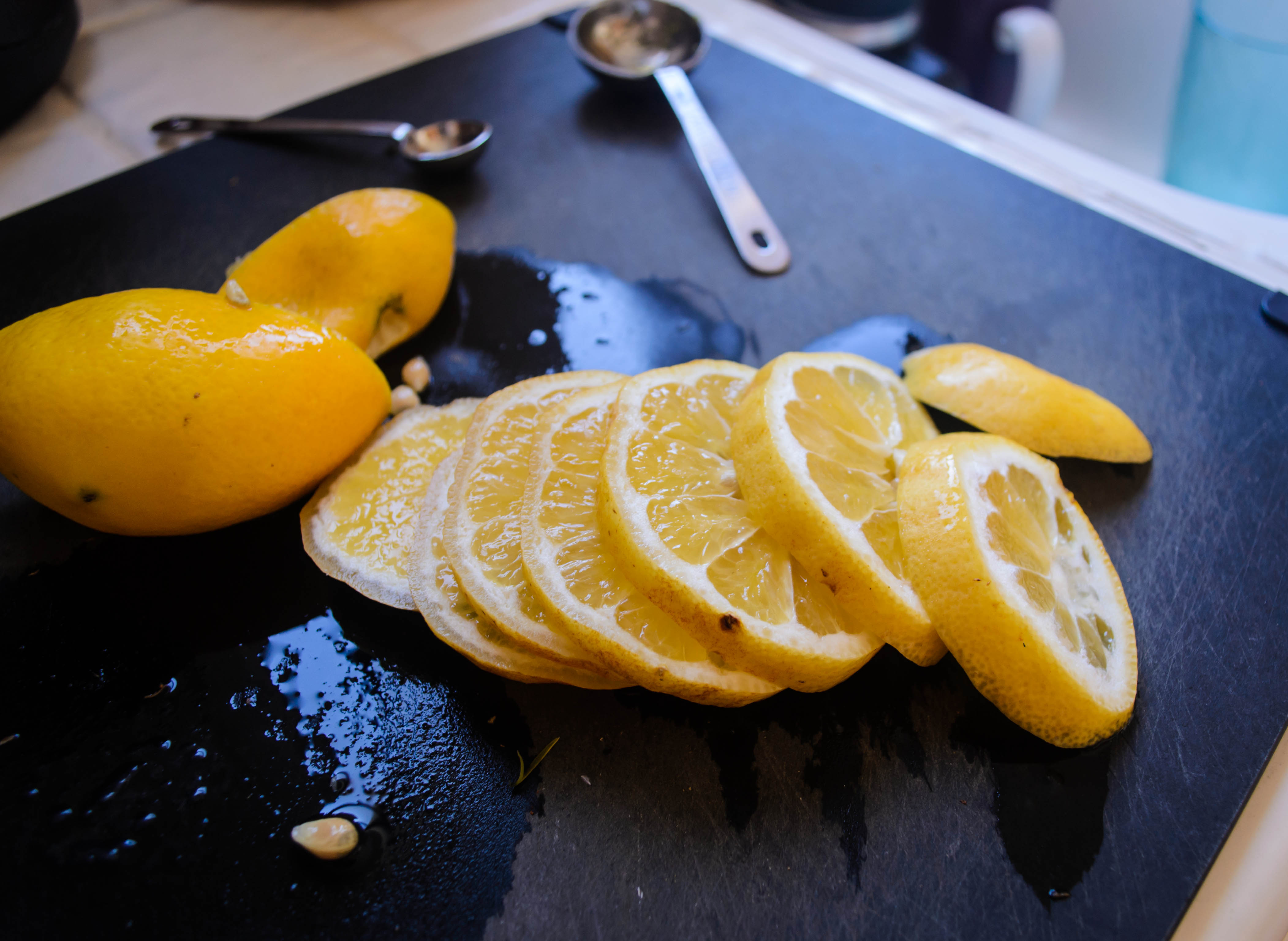
  • After 5 minutes, top each salmon piece with 2-3 lemon slices and carefully flip over so that the lemon slices, not the flesh of the salmon, are in contact with the pan. Again, this may cause some spattering of the oil, so be careful. Let the salmon cook atop the lemon slices for another 2-3 minutes, or until just done in the center.
  • To serve, pour ⅓–½ cup celery root puree into the base of a small plate or a shallow bowl. Place a piece of salmon skin-side up atop in the center of the pool of puree (leave the lemon slices in the skillet, or serve one off to the side if desired). Top the salmon with 1-2 tablespoons of the pea pesto, and serve immediately.

Chocolate Stout Floats with Bourbon Caramel

2015 Blog September-0416Labor Day deserves to be celebrated. The reason we have not just a three-day weekend this week, but a weekend at all, is a result of the hard work and fighting of workers, federations, and labor unions demanding reasonable working conditions and time off. In many industries, they helped us get fair working conditions. Their efforts should be commemorated.

2015 Blog September-0420I think, though, on Labor Day we should treat ourselves more than fairly. We should treat ourselves well. We should celebrate what has been fought for and allow ourselves not an indulgence, but a reward we deserve. After all, we work hard!

real shoes: crucial caramel-making equipment!

real shoes: crucial caramel-making equipment!

In my case, of course, this reward is food. I’m not completely devoted to the Labor Day barbecue tradition (in fact, tonight we are having arroz con pollo), but I do think a special dish is an appropriate method of celebration. Let’s do dessert.

2015 Blog September-0399

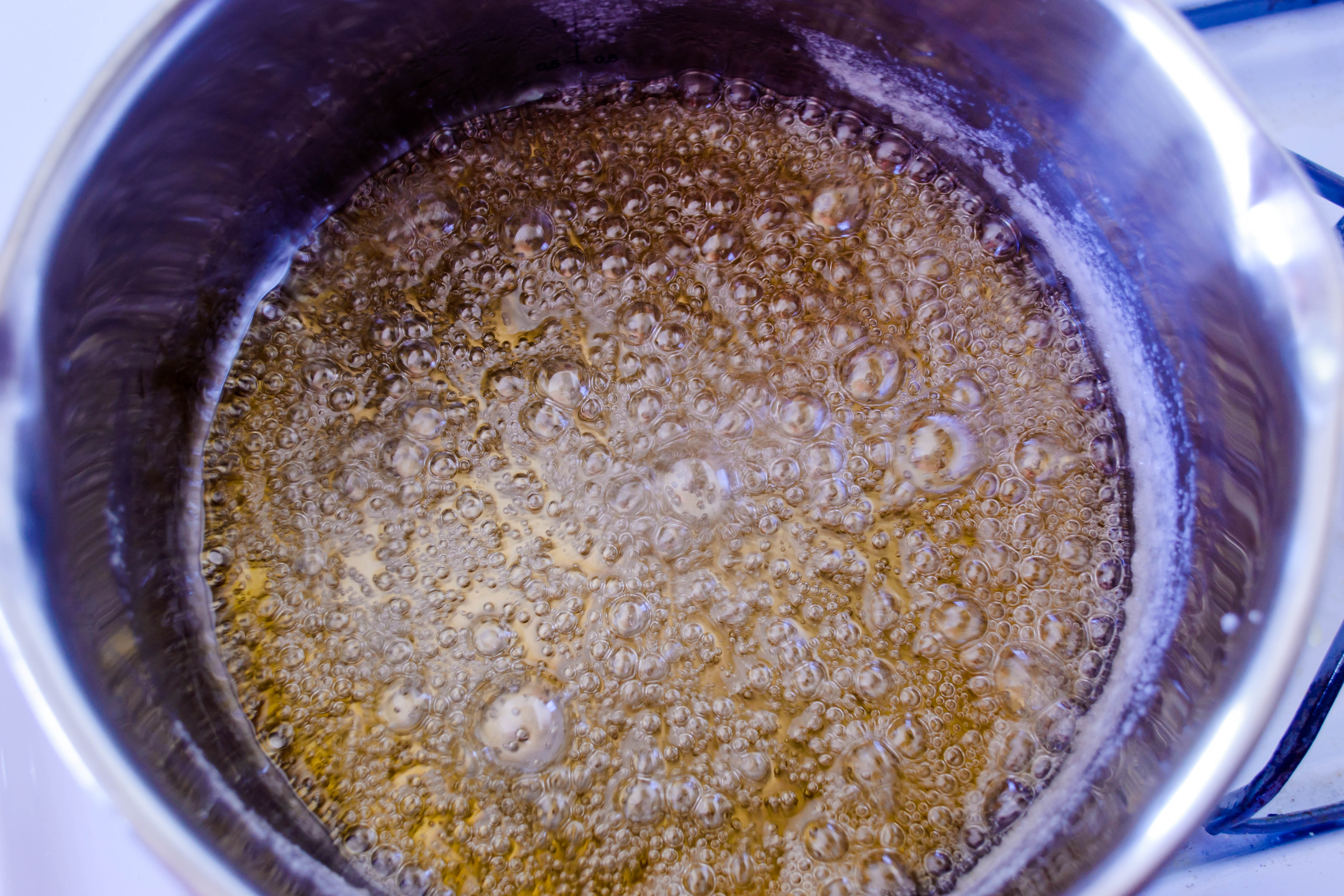
dissolved sugar, rapid bubbling

2015 Blog September-0401

sugar caramelizing around pot edges

2015 Blog September-0402

approaching dark amber color; almost time to add the cream.

Like Labor Day, this dessert of just rewards has several origin stories. The first is simple: as I noted here, a few months ago my friend B. asked for my tips on bourbon dessert sauces. One of her attempts involved a bourbon caramel to douse over ice cream, and terrified as I am of the whole boiling sugar thing that is required for caramel, I couldn’t pass up the challenge. I wasn’t quite satisfied, though, with presenting a recipe for caramel sauce enrobing a simple scoop of ice cream. I wanted something a bit more exciting.

2015 Blog September-04042015 Blog September-04052015 Blog September-04062015 Blog September-0409The answer came during our summer trip to Oregon. The night of our reunion with our dissertation crew, we had chocolate stout floats for dessert: tooth-achingly cold scoops of vanilla bean ice cream drowning in a bitter fizzing cocoa bath of cold, black beer. With each spoonful, you can moderate the combination, choosing just a fleck of ice cream, or mixing the whole thing into a pale, drinkable swirl. The following day, we repeated the dessert with a new set of friends, and one of them judiciously declared the need to slosh in a shot of bourbon.

Mic drop.

There it was.

2015 Blog September-0411So what I have for you today, in celebration of our hard work, is a chocolate stout float drizzled with bourbon caramel. It’s a perfect dessert for a hot day, because though it’s far from light, it’s gloriously cold. You can make the caramel sauce earlier in the day, so by the time your belly is ready for dessert, it will have had ample time to cool (and, if you’re doing the barbecue thing, you won’t have had to deal with the stove for several hours). The ice cream and beer are in lovely, tenuous balance with one another – almost too sweet, almost too bitter – and the just-shy-of-bitter notes in the caramel (which is, after all, almost-burnt sugar), play off of both. The bourbon here is noticeable, especially after the caramel cools down, but it isn’t overwhelming. It’s a light, floral, vanilla note that capitalizes on the toasty flavors already created by making the caramel.

2015 Blog September-0413You can serve this in whatever quantities, by whatever process you like. I followed my usual method in considering the caramel and adapted several recipes, but mostly this one, along with several sensible suggestions by David Lebovitz. He’s right – you really do have brave the smoke and the suspiciously-close-to-burning smell of the sugar cooking, lest you end up with something that’s just sweet, not developed and complex. And warming your cream before adding it to the vat of boiling sugar makes good sense for easier integration, but you should still take precautions and wear shoes no matter how hot it is in your kitchen. Boiling sugar burns are serious business.

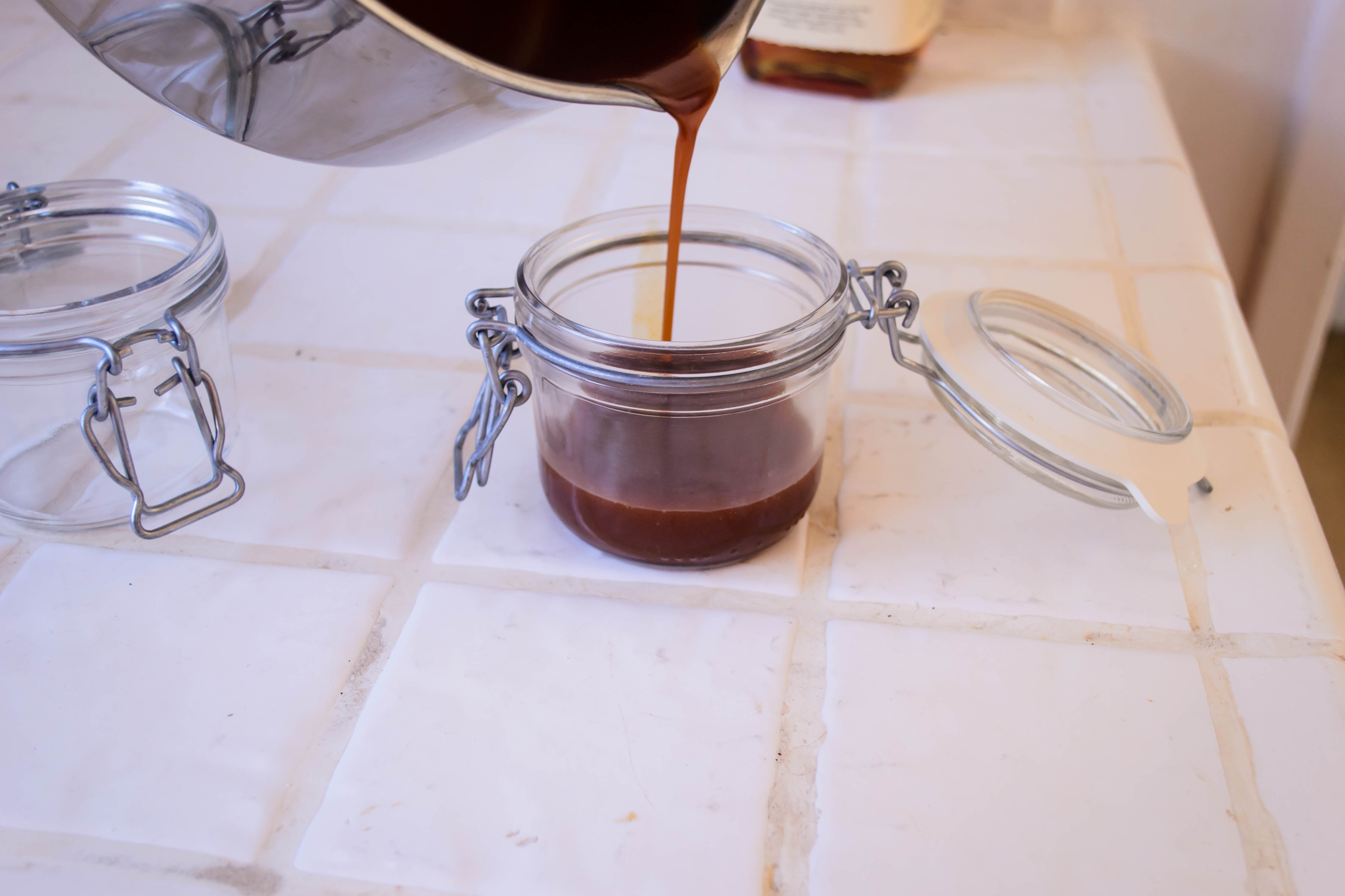
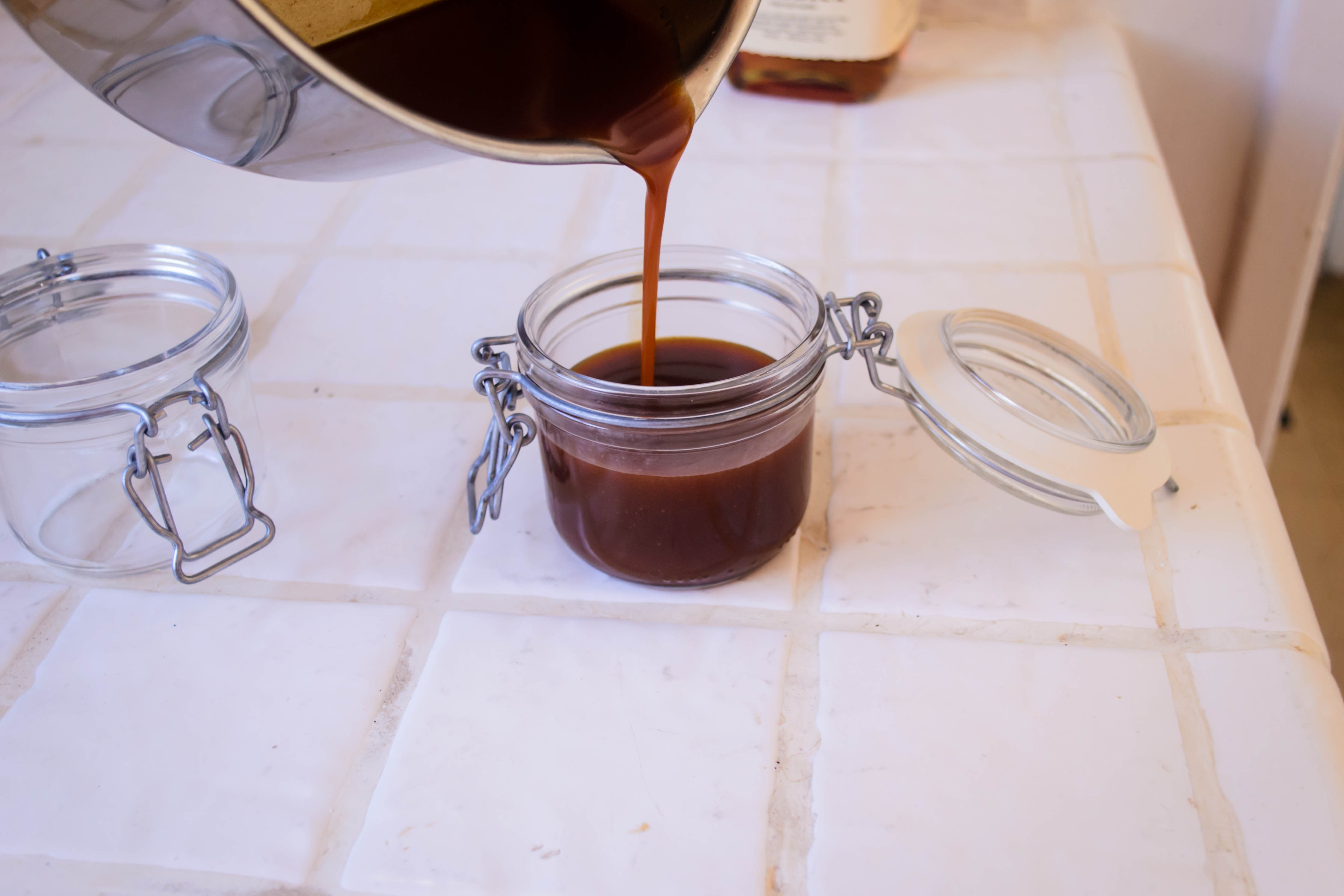
2015 Blog September-0417When it comes to serving, we like to scoop in some ice cream first, then top it up with the beer. As this delicious experiment explains, this nets you a lovely, creamy foam on top, on which you can drizzle as much caramel sauce as you want. The sauce thickens as it cools, so what barely coats a spoon while hot will pour even thicker than maple syrup once it’s had time to chill for a while. The layer that sinks and coats the bottom of the glass makes for a lovely last few sips, too.

2015 Blog September-0420

Chocolate Stout Floats with Bourbon Caramel Sauce
Makes about 1 cup caramel sauce
Approximately 20 minutes active cook time, plus an hour (or more) for the sauce to cool
For bourbon caramel:
1 cup sugar
¼ cup water
½ cup room temperature or warm heavy cream (helps it incorporate faster)
¼ cup bourbon
½ teaspoon salt
For float:
Vanilla ice cream
Chilled chocolate stout


  • For the bourbon caramel, stir the sugar and water together in a medium pot that is heavy in weight and light in color (the light color lets you see the color change in the caramel sauce – very important). Cook over medium high heat, stirring, until the sugar dissolves and the mixture becomes clear.
  • Now, stop stirring. If you have one, use a wet pastry brush to brush down any sugar crystals that have adhered to the sides of the pot so they can melt along with the rest of the mix.
  • Without stirring, let the melted sugar simmer over medium or medium-high heat until the outside edge starts to darken, about 7-8 minutes. Bubbles will be very fast. It’s important not to stir because you don’t want any unmelted sugar crystals falling in and marring the perfect smooth texture.
  • As the edges darken, swirl the mixture gently and keep cooking until the whole bubbling pot is the color of dark maple syrup, another 2-5 minutes. The bubbling will slow and thicken, and the mixture will smoke a bit and may begin to smell burnt – don’t be afraid! It really does need to cook to this dark amber color, or the final product will taste overly sweet (besides, as Lebovitz points out, if you do end up burning it, you’ve only lost 1 cup of sugar which, though bothersome, is not a huge financial disaster).
  • Remove from heat (I mean it!) and, with a whisk at the ready, add both the cream and the bourbon. Stand back! It will bubble up vigorously, and the bubbles will continue to form quite quickly for the rest of the cooking process. Whisk in the salt and set the pot back over medium heat, whisking until the sauce is smooth. Cook for an additional minute, just to ensure smooth texture (and to cook off some of the alcohol in the bourbon!). The sauce will remain thin at this point.
  • Remove from heat and cool – it will thicken to the texture of cold honey while at room temperature, and even to something more like dulce de leche when refrigerated.
  • To serve, place a scoop or two of vanilla ice cream in a tall glass. Pour in 6-8 ounces of cold chocolate stout, pausing as needed to avoid overflow. Atop the thick, rich foam that forms, drizzle a tablespoon or two of the caramel sauce and dig in.

Five-Seed Loaves

2015 Blog September-0394Growing up, my sister and I ate a lot of reasonably healthy food. Mom wasn’t the “crunchy granola type,” especially not by the time my sister showed up, but her waffle recipe involved wheat germ, and my lunchtime sandwich bread always had a measure of whole wheat in it. When I got a little older, it seemed like the more seeds and nuts a loaf contained, the more likely my mom was to buy it. Nine grains? Hearty nuts and seeds? R. and I wouldn’t always eat it, but it was probably in our freezer.

2015 Blog September-0359Thus I felt a certain fondness when I started to consider this month’s Twelve Loaves assignment of seed breads. I knew I wanted multiple seeds, and I knew I wanted them on the inside and outside of my loaves. A bit of internet research led me to Suzanne’s lovely little site Flour Arrangements, and even if she hadn’t had a great seeded loaf recipe to work with and adapt, I would have been enticed by her blog’s clever title (not the mention how many great sounding loaves she’s made – I can’t wait to adapt her multigrain pumpkinseed loaf as the weather cools – I’m thinking of adding some pumpkin puree and rye flour, and maybe some oatmeal).

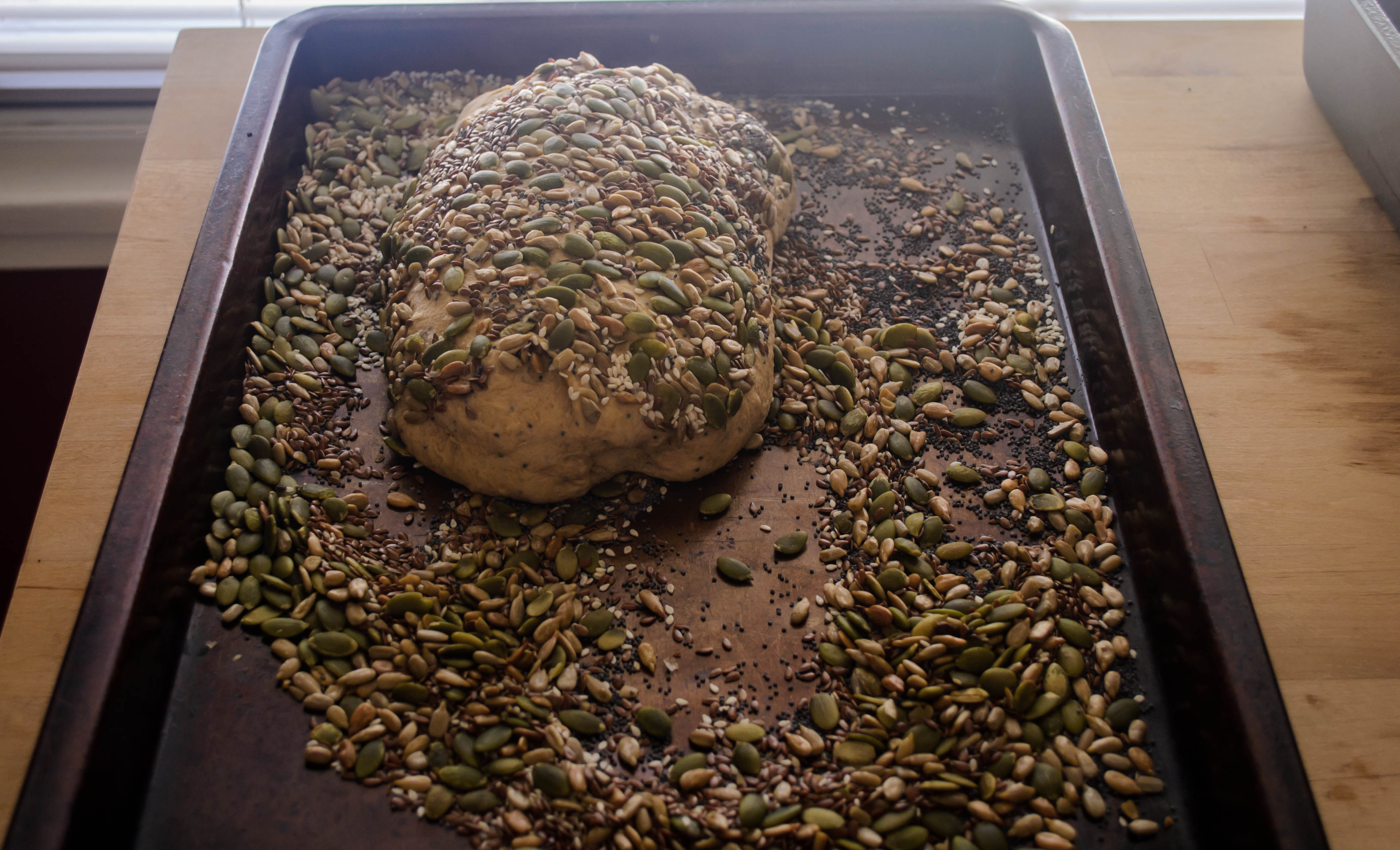
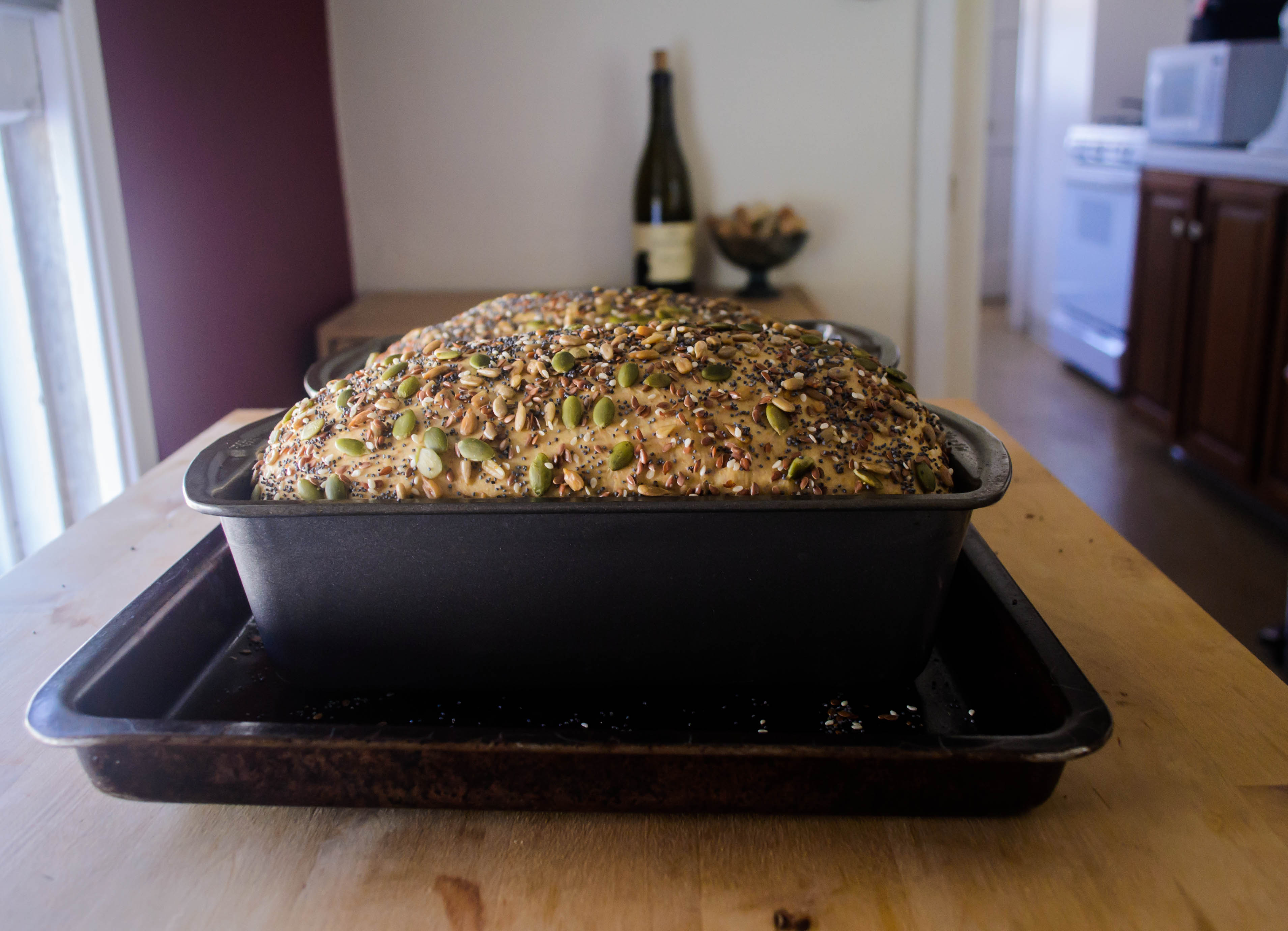
2015 Blog September-03642015 Blog September-0366I kept her recipe mostly the same, only replacing oil with butter and adding a few additional seeds for a total of five: sesame, poppy, sunflower, pumpkin, and flax.

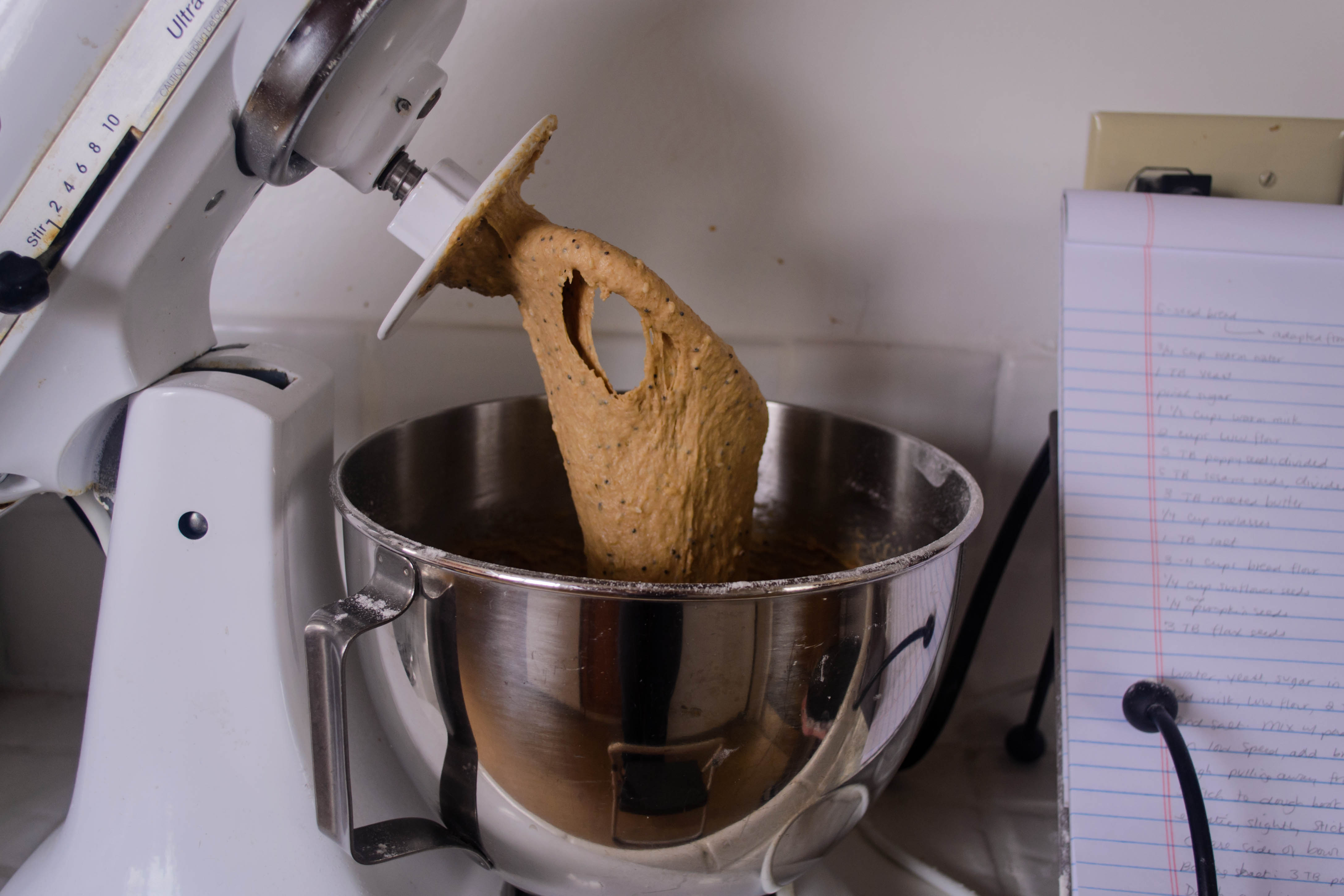
2015 Blog September-03672015 Blog September-0369I’ve been baking mainly sourdough loaves lately, trying different ratios of starter and flour, comparing notes with S. about various stirring or folding techniques instead of kneading the dough, tipping in just enough whole wheat flour to make a nutty loaf that isn’t too dense, and getting used to long, slow rise times and overnight rests in the refrigerator to develop a tangier sour flavor. Imagine my delight, then, when my bowl of dough, bolstered by its full tablespoon(!) of yeast, agreeably puffed enough to press against its plastic wrap lid in a little over an hour. Not only that, but after carefully pressing and rolling the lovely tight loaves I’d formed through a jumble of seeds, they swelled again in their pans to triumphant heights. Sourdough is delicious and tends to be my go-to for everyday toast, but it is an exercise in patience and in long-term benefits. These loaves, though they do require two rises, expand so eagerly it feels like a reward for a job well done.

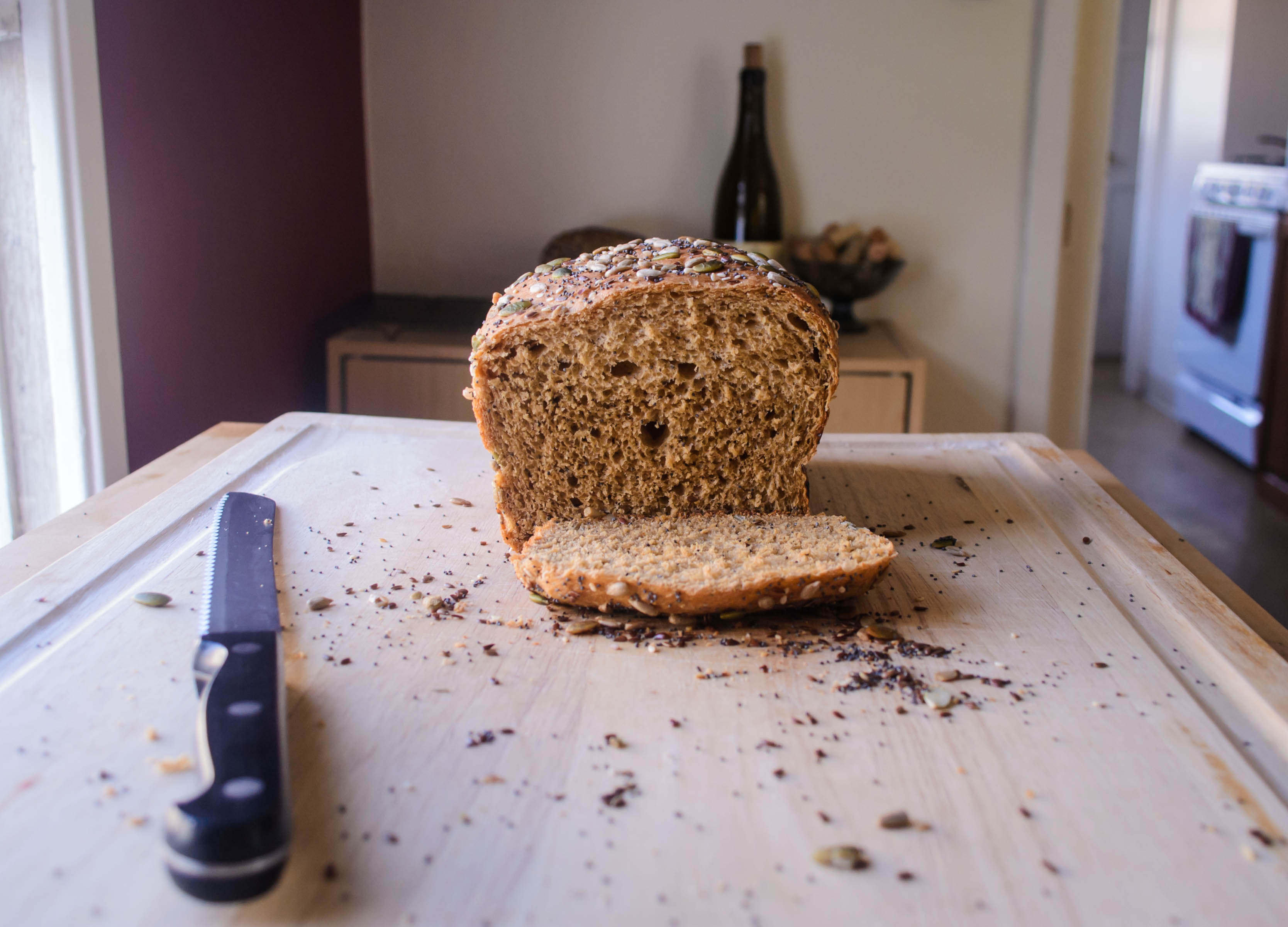
2015 Blog September-0376And really, these are a reward. Yes, the seeds you’ve so carefully pressed into the surface of the dough go everywhere – when you turn the baked loaves out of the pans, when you slice into them, when you bag and store them – but those that stay affixed offer a really nice set of flavors and textures. The heat and time in the oven toasts and crisps them lightly, and the flax seeds in particular take on a roasted taste and a slippery crunch I find incredibly appealing. And that’s just the surface. Inside, the crumb is tender and light and barely sweet, as soft as a commercially made pre-sliced loaf, but with the hearty, toasty, wholesome feel and flavor that comes with homemade.

2015 Blog September-0384You could certainly trade out the seeds here if you wanted – caraway would give a stronger anise-y feel, tiny nigella or black onion seeds would make for a more savory flavor, maybe good for meat or tomato based sandwiches. But I am devoted to sweet breakfast toast, and this bread, toasted or not, welcomes salted butter and cinnamon sugar so nicely I must admit I never explored beyond that combination.

2015 Blog September-0390

Five-Seed Loaves
Adapted from Seeded Wheat Bread on Flour Arrangements
Makes 2 9×5 inch loaves
4-5 hours, approximately (including rising/resting time)
¾ cup warm water
1 tablespoon active dry yeast
pinch white sugar
1 ½ cups warm milk
2 cups whole wheat flour
5 tablespoons poppy seeds, divided
5 tablespoons sesame seeds, divided
3 tablespoons very soft or melted butter
¼ cup molasses
1 tablespoon salt
3-4 cups bread flour
¼ cup sunflower seeds
¼ cup pumpkin seeds
3 tablespoons flax seeds


  • In the bowl of your stand mixer, or in a large bowl if you aren’t using a mixer, combine the warm water with the yeast and the pinch of sugar. Stir and let it sit for about 10 minutes until the mixture smells bread-like and the yeast has foamed up a bit.
  • Add the milk, whole wheat flour, butter, molasses, and salt to the yeast mixture. Add two tablespoons each of the poppy seeds and sesame seeds. Mix with the paddle attachment or with a wooden spoon until well combined.
  • With the mixer running on low speed, add the bread flour ½ cup at a time until you have a soft dough that pulls and tears away from the sides of the bowl. I needed all 4 cups of the flour, as it was a bit humid in my kitchen – you might need less depending on the day.
  • If you are using a stand mixer, switch to the dough hook. If you are mixing by wooden spoon, now is the time to turn the dough out onto a floured surface. Knead on medium speed for about 5 minutes if you are working by machine, or about 7-8 minutes by hand, to form a smooth and elastic but still sticky dough. It will still droop and pull when you stop kneading, not sit firmly in a cohesive ball. That’s okay. This ensures a more tender loaf.
  • Lightly grease the sides of a large bowl (I just use the stand mixer bowl; you don’t even have to clean it out) and position your dough in the middle of it. Cover tightly with plastic wrap and let it rise until doubled – 1½-2 hours, depending on how warm your house is.
  • As the rising period nears its end, combine the remaining 3 tablespoons poppy seeds, 3 tablespoons sesame seeds, and the sunflower, pumpkin, and flax seeds on a baking tray. Butter or grease two 9×5 inch loaf pans and set aside.
  • Punch down the risen dough to release trapped gas by gently depressing your fist into its center, then turn it out onto a very lightly floured board (too much flour and the seeds won’t stick). Divide the dough in equal halves, shape into tight loaves and roll each one in seeds, turning to coat the ends, or just pushing a palmful of seeds against the ends of the loaves.
  • Set the seed-coated loaves gently in the prepared loaf pans, pat remaining seeds on top and drizzle down into the corners. Drape lightly with plastic wrap and let rise again for about 45 minutes, until doubled once more. They swell beautifully.
  • About twenty minutes before the rising period ends, preheat your oven to 375F. When the loaves are fully risen, remove the plastic wrap and place them gently into the oven to bake for 30-40 minutes. To test for doneness, either use a digital thermometer and check for a temperature between 180-200F, or thump the bottom lightly for a hollow sound.
  • Cool loaves in pans at least 20 minutes, then turn out onto wire racks to cool completely before slicing. At all manipulation, seeds will scatter everywhere, but the flavor and texture are worth the mess.


Check out what our other awesome Twelve Loaves bakers made this month, below:

#TwelveLoaves is a monthly bread baking party created by Lora from Cake Duchess and runs smoothly with the help of Heather of girlichef, and the rest of our fabulous bakers.

Our host this month is Lora from Cake Duchess and our theme is Seeds. For more bread recipes, visit the #TwelveLoaves Pinterest board, or check out last month’s selection of #TwelveLoaves Malt Breads!

For more bread recipes, visit the #TwelveLoaves Pinterest board, or check out last month’s selection of #TwelveLoaves Malt Breads!

If you’d like to bake along with us this month, share your Seed Bread using the hashtag #TwelveLoaves!