Sweet.

I’ve complained before about the sometimes-too-sweet-sweetness of sweet potatoes, and of the potential dangers of the salty-sweet combo (and at the same time, too!), but sometimes they do work.  And when they work, and work well?  Incredible.  If you have any love for sweet potatoes at all, you MUST try this dish.

“41. Toss chunks of sweet potato and 2-inch lengths of scallion with neutral or peanut oil. (Again, a little sesame oil helps). Roast, turning as necessary, until nicely caramelized; drizzle with soy.”

This sounded like it had potential, and didn’t require a lot from the store.  Double bonus points already.  Here’s what I used:

2 medium sweet potatoes (mine had orange flesh, so I guess that means they may have been yams)
1 bunch green onions, roots trimmed off

2 TB vegetable oil

1 TB sesame oil

2-3 TB soy sauce

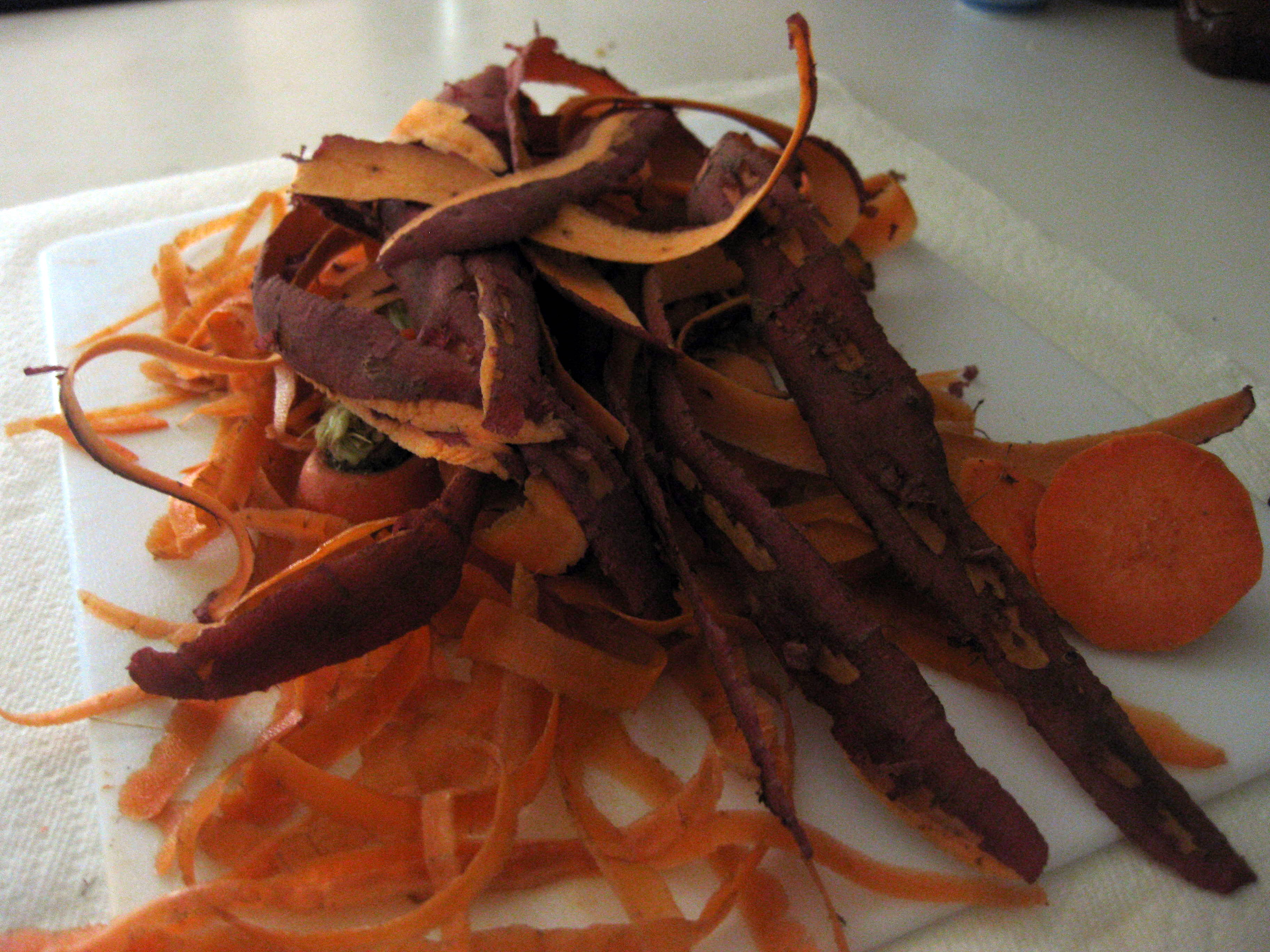
Since I don’t know what Bittman’s preferred roasting temperature is, I guessed that 400F would likely be fine, and cranked on the oven to preheat.  I peeled and then chunked up my sweet potatoes, trying to keep the cubes about 1-inch in size, so the outsides wouldn’t burn before the insides were cooked through.  I cut my green onions into approximately 2-inch lengths, then tossed them together with the sweet potatoes and both kinds of oil on a cookie sheet.  The amount of oil you use will depend on how big your sweet potatoes are – you want them to glisten and smell strongly of sesame, but not be drowning in a puddle on the bottom of the sheet tray.  We’re roasting, not frying.

I slipped the tray into the oven and let it roast for almost an hour, checking every 15 minutes or so for doneness, browning, and to turn things over.  At 45 minutes in, the chunks of sweet potato were meltingly tender, but they weren’t really getting brown on the outside.  I shimmied the oven temperature up to 450F and tossed everyone around again.

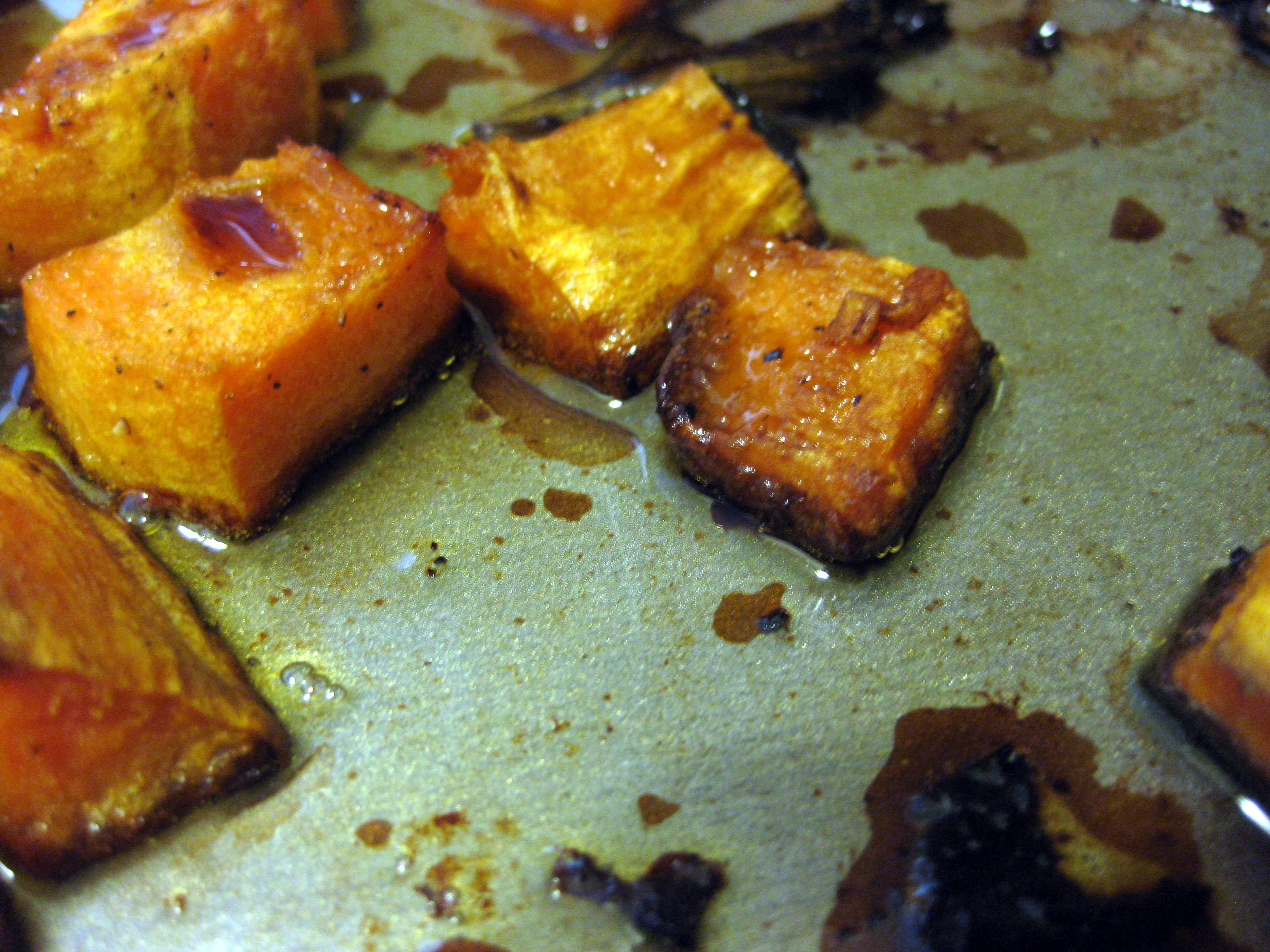
A quick 15 minutes later, I rescued the tray from the oven to see perfection.  The sweet potatoes had crisp crusty edges, the green onions were wilted and faded (this sounds bad but it was a very, very good thing), and when I drizzled the soy sauce over the whole thing the sizzling smell was delightful: salty and earthy and deep.
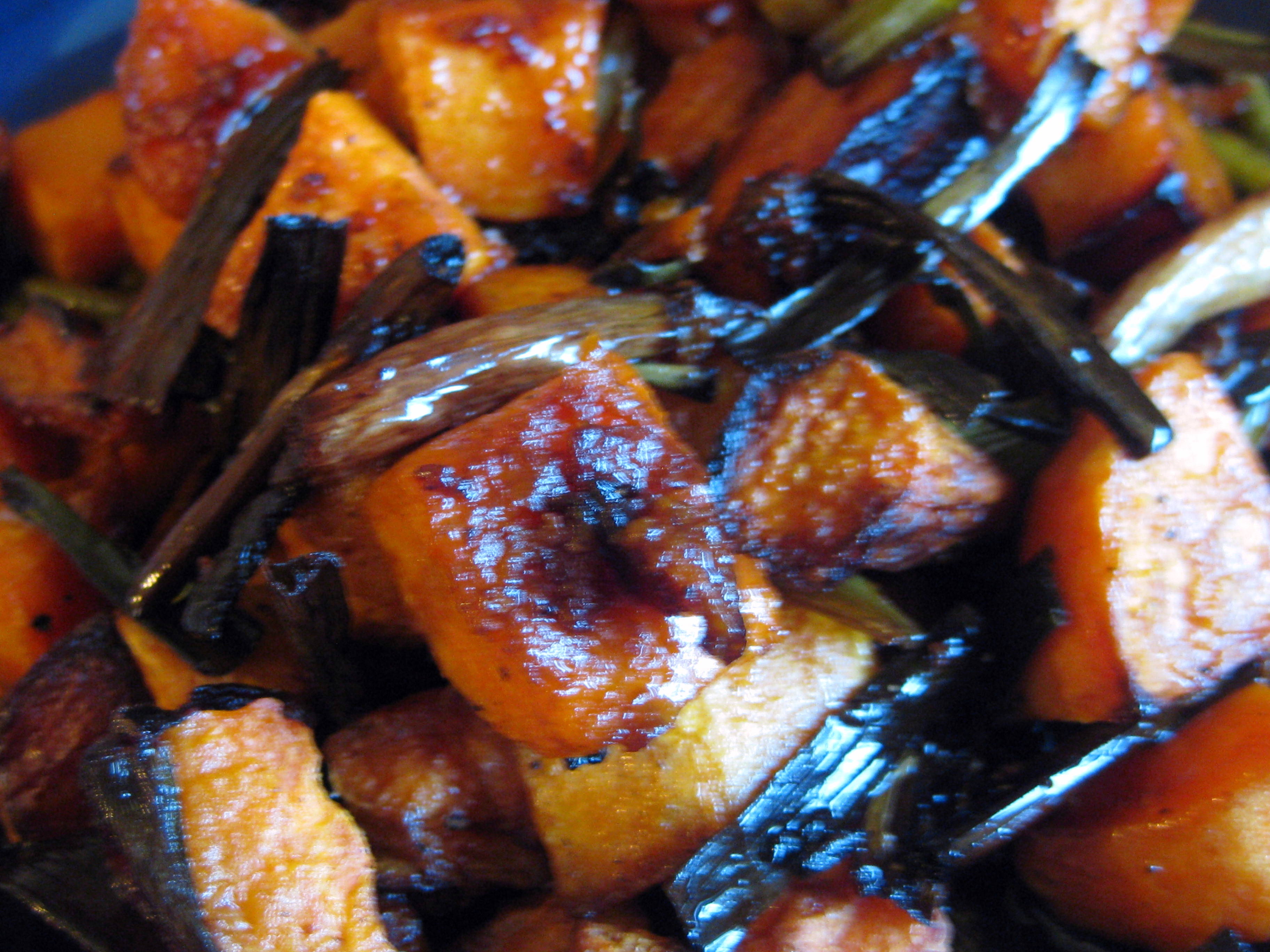
We tasted, and then we inhaled like ravenous, sweet-potato-deprived beasts.  This was SO GOOD.  The sweet potato flesh was as tender as a puree, but the caramelized sides offered a captivating chewiness.  True caramel, I think, has to stick to your teeth, and these clung to our teeth just like candy.  But they weren’t overly sweet.  The combination of green onion, sesame oil, and soy sauce gave a decidedly savory swing to the dish, and possessed that magical saliva inducing quality.  In fact, though we had two other components to our meal aside from the sweet potatoes, nothing made it into the fridge to store for another day.  N. and I kept finding ourselves back in front of the platter, even as we went about the remainder of our evening.  Passing through the kitchen to get a glass of water, and another chunk of potato, glistening with oil, gone.  Loading a plate into the dishwasher, and a straw of onion, wrapped around itself with just-burnt edges, sliding across my tongue.  Bedtime found the plate empty, with only the residue of soy sauce and sesame pooling in the middle.  N.’s assessment: “You can make this anytime.  Whenever you want.  Win.”

True, but I would make two changes.  First, I would start the oven out at 450F rather than 400F.  The potato chunks were cooked through well before I liberated them from the heat, and a higher temperature would brown them faster.  For the same reason, however, I would also add the onions in partway through the cooking process.  Instead of roasting them for the full hour, I’d throw them in at the half hour mark so they wouldn’t burn.

At this higher temperature, it could be that a full hour isn’t necessary – maybe only 45 minutes.  Or 35.  Or 55.  Check often and toss well, and when they are cooked through and the beautiful orange and bronze of autumn in the Northeast?  It’s time to scarf them. 
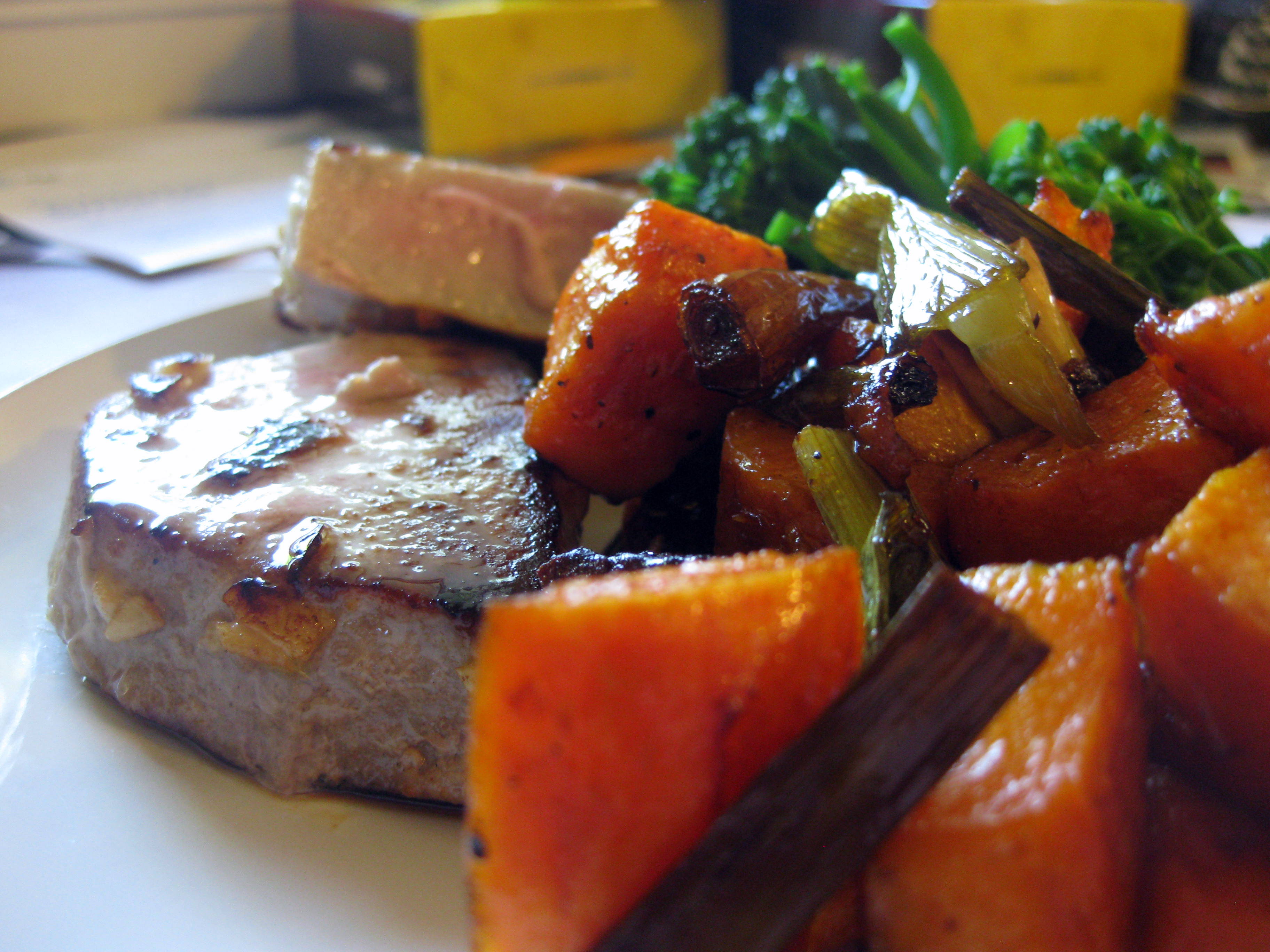
The sweet potatoes were really the stars of our meal, but we had them with broccolini and some pan-fried yellowfin tuna that I’d marinated for ½ an hour in garlic, ginger, lime juice, olive oil, and a tiny splash of soy sauce.  Successful, if a bit overcooked (I like my fish rare, N. likes his almost well done), but nothing compared to the caramel crusted stars of the show.

Out of Stock

This week’s Bittman exploration became, I must admit, something of an experiment thanks to what can only be termed “first world problems.”  Here’s what he suggests:

“31. Combine cooked wild rice with caramelized onions (nearly burnt onions are almost as good, and faster), chopped figs and fresh rosemary. Bake in an oiled dish or use as stuffing.” 

I knew this sounded good – an intriguing mix of sweet and savory ingredients – and I knew how I was going to quickly acquire the correct items: Trader Joe’s.  My local TJ’s has reorganized lately, so while I had no trouble finding some half dried black mission figs, I couldn’t locate either rosemary or wild rice.  I have bought, in the past, a vacuum sealed bag of already cooked wild rice, which I was planning the dinner around, and despite having a pair of very earnest and very determined young gentlemen scour the shelves, nothing turned up.

I went home.

With two key ingredients missing, I grudgingly went out to the garden and stripped a branch of my own slowly, reluctantly growing rosemary, all the while whispering to it what a good cause it was donating to, while my heartstrings cried piteously for the poor tiny plant.  What I finally came up with was as follows:

1 cup raw brown rice, cooked according to package directions

½ of the biggest red onion I’ve ever seen, diced

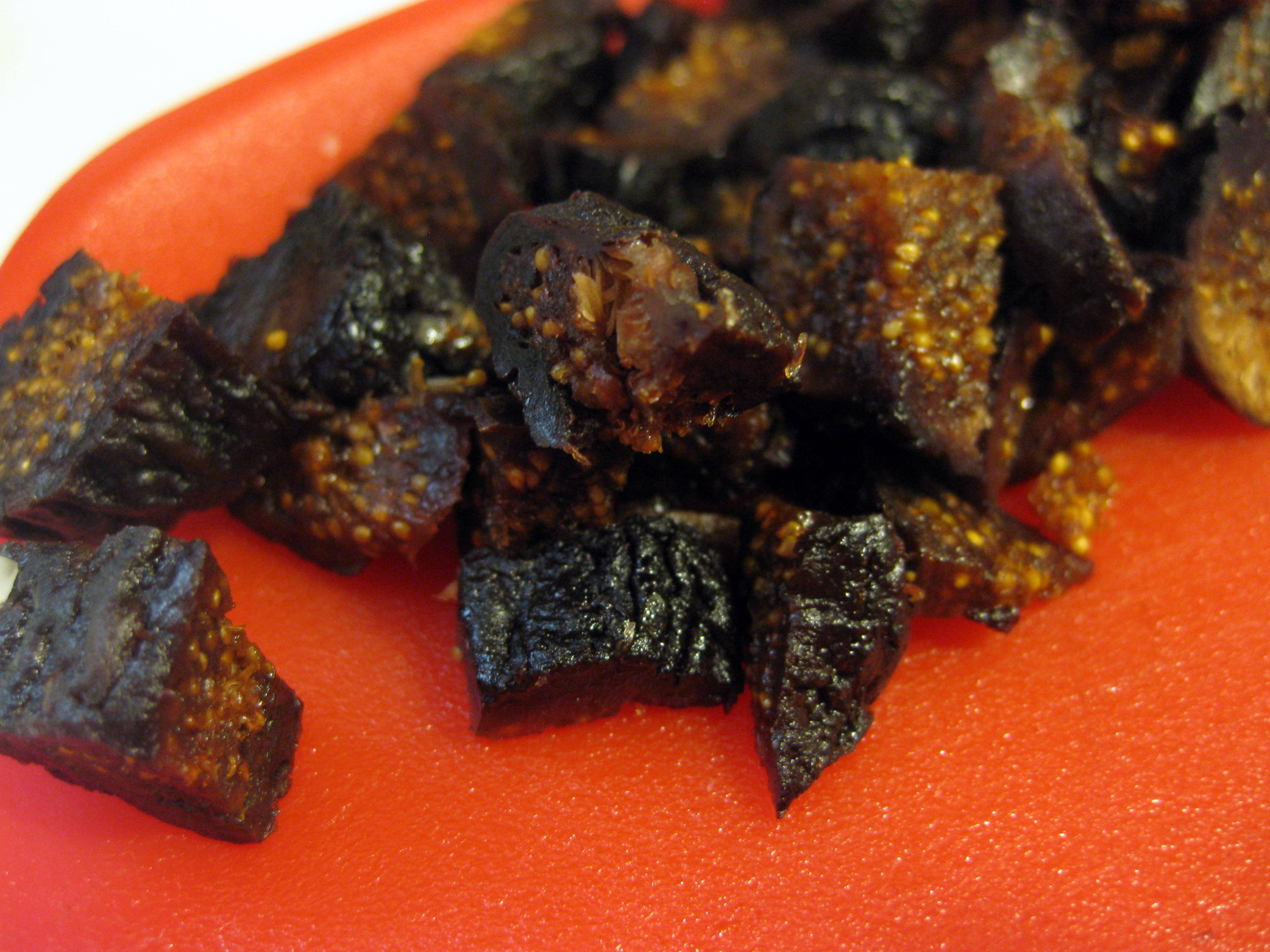
12 figs, chopped (choose fresh or dried according to your preference)

1 teaspoon rosemary (only because I was stingy.  Use more, by all means)

A few grinds each salt and pepper

2 TB olive oil

While the rice steamed away in my rice cooker, I heated olive oil in my largest skillet and cooked the onions gently over medium for 15-20 minutes, monitoring them carefully so they would just caramelize, not burn.

When the rice was done and the onions were nicely browned with deep, bronzed edges, I looked at the kitchen clock and realized two things.  1.) I was hungry, and it was already past the time we usually eat dinner, and 2.) it was already quite warm in the kitchen, and turning on the oven to bake this off did not sound like fun.  It would take too long, and it would produce too much sweat.  Instead, I decided to sizzle the rice briefly in the skillet with the other ingredients. 

I dumped in the rice and added the figs – alien wonder fruit that they are – the rosemary and the seasoning.  I let them all mingle for a few minutes while I finalized our side dishes: Italian sausages and green beans cooked in red wine.  Then, service!

Each individual part of our dinner was good.  The sausages were well spiced, the beans were zesty and crisp and salty, and the rice was delightful.  It definitely read sweet, since the onions were mellow and tender and the figs were chewy and fragrant.  I love the texture of brown rice, since it maintains an al dente toothsome quality even after its lengthy cooking time, and in this dish the slight chewiness was nicely comparable to the figs.

I can imagine there would be a nice woodsiness to the original version of this dish, both in flavor and appearance.  Rosemary is such an earthy herb, and if you left the leaves unchopped they would look like little pine needles.  Further, the dark, somewhat anise-musty flavor of wild rice and its similar piney appearance would make this a dish akin to a shady day on the forest floor.  Pleasant but complex, with earthy spice and the surprising sweet crunch of the fig seeds.

Here’s the thing, though, and as with numerous moments this week this goes back to the “first world problems” thing: these individual dinner components didn’t go together very well.  Here’s what I recommend instead to pair with this rice dish.  Pound out a turkey or chicken cutlet.  Spread a piece of prosciutto across the flattened surface.  On top of the meat, crumble some gorgonzola or goat cheese and, if you’re feeling adventurous, maybe a handful of baby arugula leaves.  Roll the poultry cutlet up around the meat and cheese and, if necessary, tie off with some kitchen twine to keep it closed.  Bake or pan fry until the poultry is fully cooked.  The salty, creamy richness will pair nicely with the sweet figs and onions in the rice, and the pepperiness of the arugula will provide a cleansing bite for your tongue.

Incidentally, if you’re wondering about this combination of ingredients, I’ll give you a quick run-down of my favorite pizza topping combination, and you’ll see the connection: on top of plenty of grated mozzarella cheese, distribute caramelized onions, sliced figs, prosciutto, and crumbled gorgonzola cheese.  When the pizza comes out of the oven, sprinkle fresh arugula leaves across the top.  It sounds discordant, but it’s outrageously good.

Go forth and experiment!  And tell me how it tastes!

Indulgence

This week my shopping list was a bit wonky.  I was buying food for a party, and the idea that we might have to, you know, eat this week went to the wayside.  I never once looked at my Bittman options.  I bought nothing to make one of his meals.

So I beg you to indulge me, as I present something a little different.  Indulge me my favorite indulgence: cheesecake.

For this recipe, I’d love to get some feedback.  I’ve never made a cheesecake before, let alone one impregnated with Nutella.  I don’t usually like “stuff” added to my cheesecake, but inspired by the frosting on Tartelette’s Nutella cupcakes crafted for World Nutella Day, I thought this one might just be okay.  If you make this, please let me know if you change anything and how those changes work out.

Nutella Cheesecake

(some measurements are approximate)

Crust:

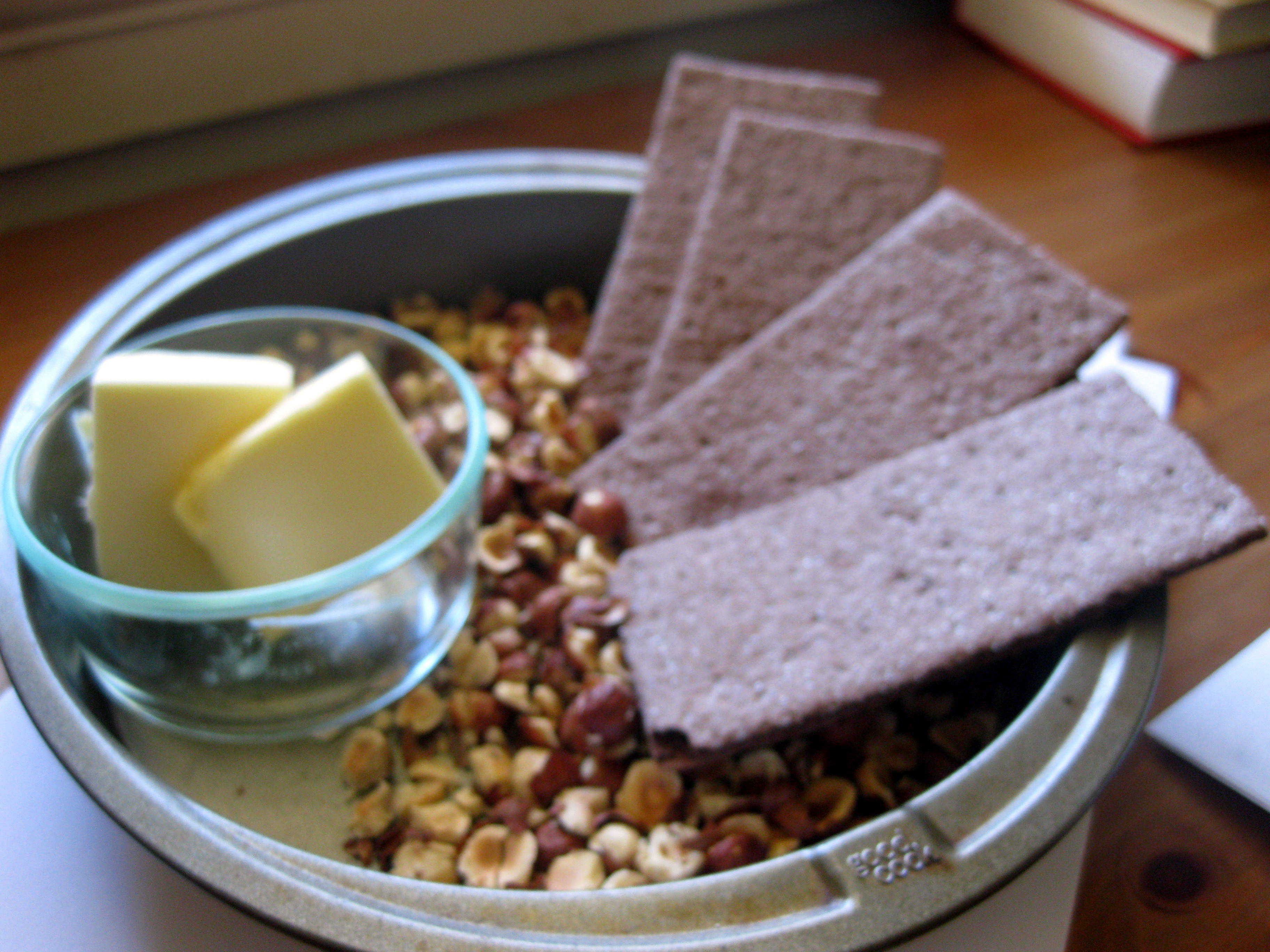
1 cup toasted, coarsely chopped hazelnuts

8-10 chocolate graham crackers, broken in big pieces

6 TB melted butter

1/8 tsp salt

1/3-1/2 cup sugar, or to taste

In a food processor, pulverize the hazelnuts until very fine – almost a meal.  Add graham crackers, salt, and sugar and grind until everything is homogenous and very fine.  With food processor running, dribble in melted butter and pulse until crumbs are moistened and clumping together.  Dump out into the baking vessel of your choice (I don’t have a springform pan, so I used a 9X13” glass baking dish.  I don’t know how these amounts would correspond to a springform pan).  Using your fingers or the curved bottom of a measuring cup, tamp down the crumbs into a crust of uniform thickness over the bottom and partway up the sides of the vessel you have chosen.

I did not pre-bake the crust, and because it ended up a little crumbly I suspect one of two things could be improved: either it needed more butter to hold it together, or it needed to be pre-baked.  If you do one of these things and have desirable results, please let me know so I can amend the recipe!

Set crust aside while you whip up the filling.

Filling:

all ingredients should be at room temperature

3 bricks full-fat cream cheese

1 cup Nutella

4 eggs

1-2 tsp vanilla extract

½ – 1 cup sugar, or to taste

In the bowl of a stand mixer (or in a large bowl with an electric mixer), beat up the cream cheese until very fluffy and well combined.  This may take a few minutes – don’t skimp on this part because it will ultimately result in less uniform filling.  Scraping down the sides several times during the process is helpful to catch any unblended cream cheese hiding out on the edges of the bowl.

When cream cheese is very light and all has the same consistency, scrape down the sides and add the Nutella.  Beat again, and again be sure it gets fully incorporated so there are no pockets of plain, unblended cream cheese.

Add vanilla and sugar to taste, and blend again until very well incorporated.  Because the Nutella is already sweet and the crust is sweet, start with ½ cup of sugar and give the filling a taste before adding more.  It may be sweet enough for you with only ½ cup.  If not, add more, blend again, and taste again until you are satisfied with the sweetness.

With the mixer running, add the eggs one at a time and wait until each is fully incorporated before adding the next.  Again, be sure to scrape down the sides of the bowl to be sure the filling is of homogeneous texture.  By the time the last egg is incorporated, the mixture should be pourable and slightly soupy.

Pour into the room temperature crust.  If you pre-baked the crust, let it cool (or pop it into the refrigerator for a few minutes) before adding the filling so you don’t start cooking the filling before putting it in the oven.  This would result in an unevenly baked product, which is not what we want.

With all the filling on top of the crust, spread it out a little with a spatula to be sure it forms an even layer.  You may want to lift and tap the whole baking vessel on the counter a few times to help the filling evenly distribute, settle, and release air bubbles (this is good to do with cake batter as well).

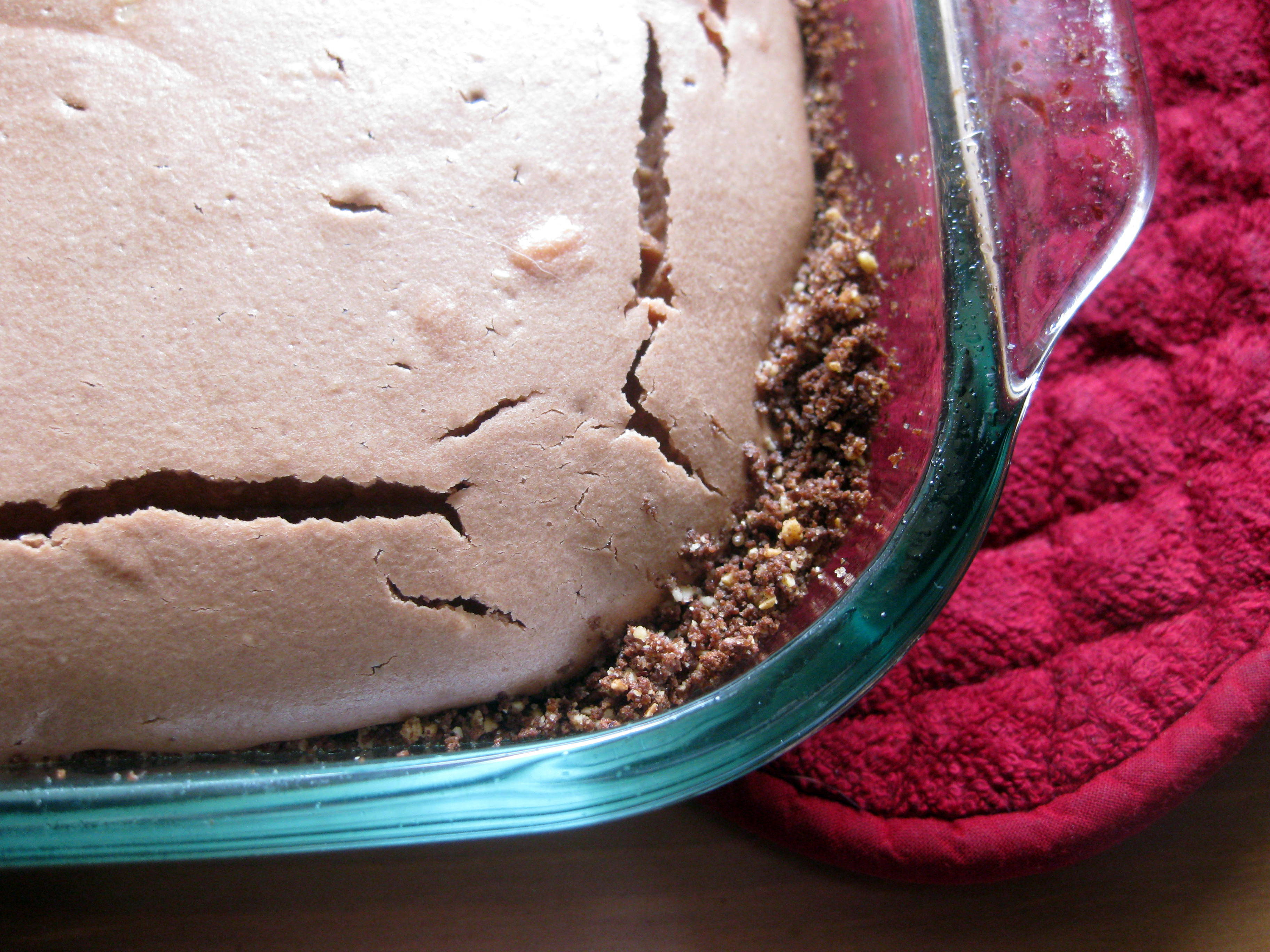
Stow your precious vessel in an oven preheated to 350F for about 45 minutes, or until the center is just barely set (you should be able to touch it very lightly and come away with a clean finger, but it should still look the tiniest bit wobbly when you gently shake the pan).  Don’t be afraid to take it out at this point – I left mine in the oven with the heat off and the door open for an extra ten minutes because I was afraid it wasn’t done, but this resulted in big cracks around the edges of the filling, which means I overcooked it.  Still, though, photographic evidence doesn’t lie:

Let the cheesecake cool completely on a rack on your counter-top (away from the heat of the cooling oven), then cover it, put it in the refrigerator, and chill for a few hours to help it set up.  Remove, slice, and serve, and don’t expect the leftovers to last very long.  It’s very rich, it’s very chocolaty, and it’s very, very good.

Redemption!

Last week’s experiment left us, as you may recall, a bit underwhelmed.  Or perhaps just whelmed, in my case.  I didn’t love it, I certainly didn’t hate it.  This week we needed a real comeback kid to reinvigorate and inspire us.

We found it.

“39. Trim crimini or Portobello mushrooms and chop stems.  Cook crumbled sausage in olive oil until it begins to brown, then add stems and chopped onion and garlic.  Mix with cooked rice, an egg for every 2 cups of mushrooms and enough bread crumbs and Parmesan to bind slightly.  Spoon the stuffing into the mushroom caps and bake until tender.” 

Since the temperature was relatively cool going into Saturday afternoon, I thought I’d give it a try.  The players were all there, from the old three-coursers of my childhood: meat, starch, and veg.  Here, though, they were nicely tangled together and collected in their very own serving vessel.  It sounded enticing.

I assembled:

4 medium Portobello mushrooms

3 cups cooked rice (1 cup brown, 2 cups white)

1 lb. pork sausage

4 garlic cloves, finely minced

¼ cup red onion, diced

1 egg, lightly beaten

½ cup bread crumbs (I used Italian seasoned crumbs)

¼ cup finely grated Parmesan cheese

I put my sausage in a skillet with a tablespoon or so of olive oil, broke it up a little with a wooden spatula, and took on the mushroom caps while it started to sizzle.  I scraped out the gills and then dug my spoon down into the spongy “meat,” excavating great lumps of mushroom while being careful not to break through the bottom of the cap.  I probably left a good ¼ – ½ inch shell.  Along with the stems, I chopped up these pieces fairly finely.

Because I didn’t want all the grease the sausage had exuded, I drained it, reserving no more than a few tablespoons, and put the fully cooked sausage crumbles into a bowl along with the cooked rice.  Then I spilled the mushrooms into the flavorful skillet and let them brown.  I chopped up the onion and garlic and added them in a few minutes after I’d started the mushrooms.  The smell was perfect.  I read once that the smell of sautéing garlic and onions is a great way to impress a man.  This is one of those half truths.  In reality, I think, it’s a great way to impress anyone.  If I had to choose my top ten favorite scents, that would be one of them.  It might even crest into top five.

When the onions were tender and translucent, I killed the heat and poured the vegetation into my mixing bowl with the rice and sausage.  Because I had WAY more than would fit into four mushroom caps, I reserved all but about two cups for later use before adding the egg.

I mixed the egg into the mixture with a fork, then dumped on some bread crumbs and Parmesan.  The quantities of these last two components, as Bittman says, will depend largely on the composition of your bowl.  You may need (or want) more of one or both, you may need less.  When I was satisfied, the filling clumped together only slightly, and only when pressed.  I would wager a guess that you don’t want it too clumpy or too solidly packed, or it will take too long to heat all the way through in the oven.

I lumped, and piled, and stacked the filling into the mushroom caps, which I’d positioned on a baking sheet.  Then I plunged the whole thing into the oven, which was preheated to a temperature that, embarrassingly, escapes me.  It was one of three temps: 350, 375, or 400F.  Though a higher temperature will of course produce a crunchier, browner top, I don’t think this variance of 50 degrees will make an amazing amount of difference to your results.

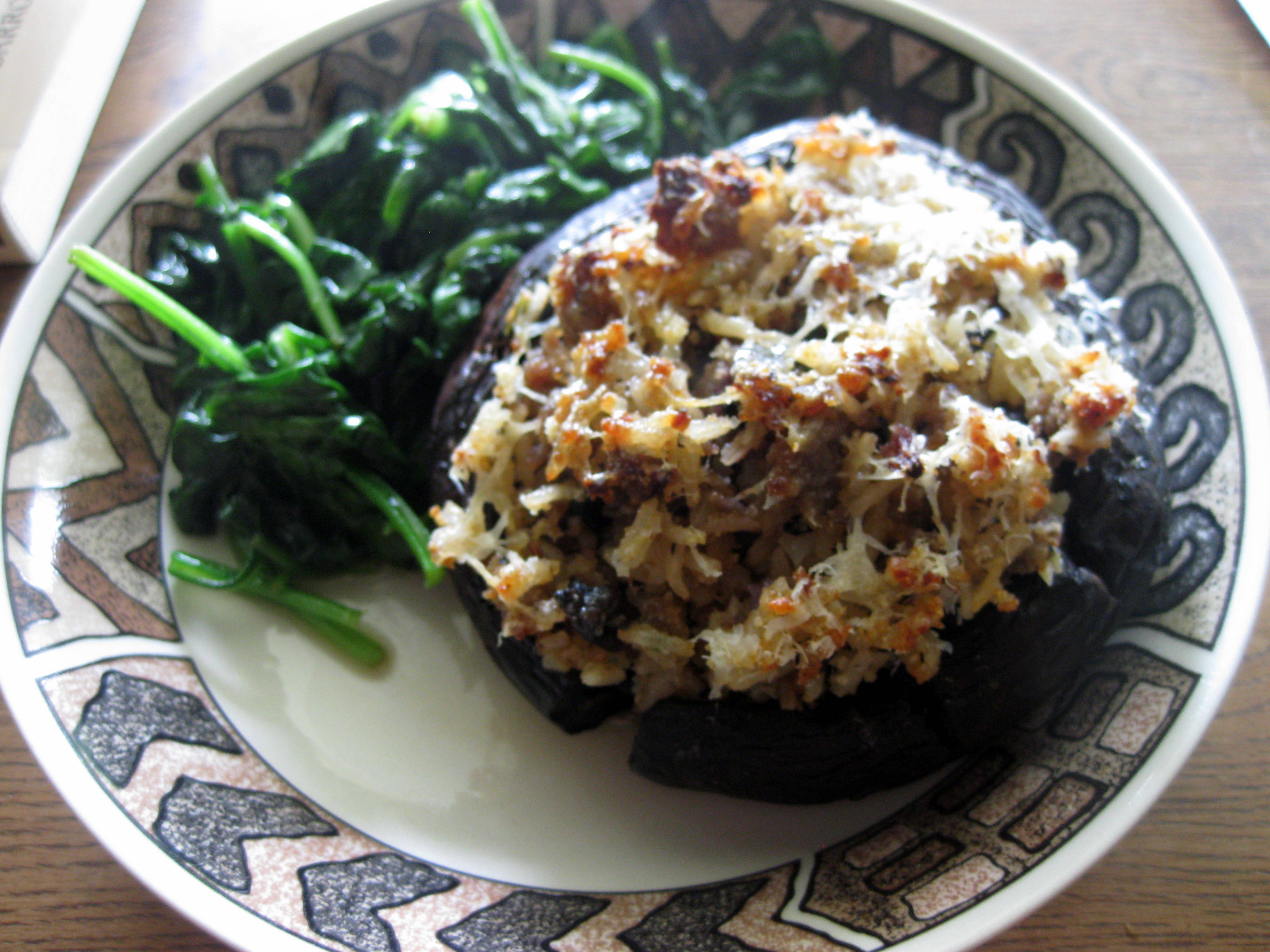
Whatever the case, I gave the mushrooms half an hour to become magical, and was far from disappointed.  The Portobello caps themselves darkened in color, turning from musty dusty brown to rich and deep.  They softened, going tender but not watery, and retaining enough textural integrity that we needed knives to slice through neatly.

As for the filling, can you say umami?  The mystical, MSG-esque “fifth taste” was well in evidence here.  Not only did we have the rich beefiness of the mushrooms themselves, as vessels and interspersed throughout, but we had the sausage, herby-spicy-rich, and the brown rice, which added not only appealing texture but also an earthy taste.  Next time I would use solely brown rice for this dish, because its taste and lingering toothsome quality were so nice.  I suspect some of the flavor punch was a result of cooking the rice in a garlicky homemade chicken broth, which I would certainly recommend, if you have some on hand.  We rounded out the meal with kale chips and beer and both were, I feel, wise choices.*  Kale has a deep, slightly bitter flavor, but it mellows when you roast it, and the paprika and sea salt I sprinkled on top made it a smoky, salty delight.  The beer, of course, added to the earthy quality of the meal, with its lingering yeast flavors.

As we dug our way through the hidden treasures these mushrooms held, N. turned to me and said “Redemption.”  I think that says it all.


* This photo, however, does not show kale chips.  It shows steamed spinach, which was the accompaniment for lunch the following day.

Getting back into it…

I tell my students that it’s important to be specific when they write.  I tell them to be careful with pronouns – to be sure the subject they refer to is clear – and to add description and make their vocabularies work for them.

And yet, as a self-proclaimed word nerd, I do enjoy a little ambiguity when it comes to titles, lines of text, phrases, something to, shall we say, chew over.  Maybe this means I like poetry after all.  So let’s take on this title together.  It could mean “getting back into being in Oregon for the summer.”  This could certainly be true.  My vacation was phenomenal and I didn’t want it to be over, and even though summery weather has finally come to the Northwest, returning home means certain other, less welcome truths.  My title here could also mean “getting back into my dissertation.”  Yet again, a necessary activity I’m not quite wholly invested in yet.  I need to be.  We’re almost a week into July and I’ve only read one short scholarly book and one chapter of another, and though I’ve thought a bit about my work, I don’t have much to show for it yet.

Finally, and perhaps most applicable, my title could refer to this blog, Bittman, and cooking in general.  I didn’t take my laptop with me on vacation, and I hoped to sustain you on those limited – but admittedly lip-smacking – shots from my week at the beach, but now I’m well back and well behind.  Going out to eat and sampling masterworks from my various relatives made me at once anxious to return to my kitchen and, strangely, resistant to actually going in there and producing anything.  To top it off, because this week’s Bittman was not my favorite, I’ve been having trouble mustering the inspiration to write about it.

Because my cooking urge has been beaten back a bit, perhaps by the heat, or perhaps because all I want to eat is grilled food (hear that, N.?), I thought a raw salad would be a good choice for us.  Then, trying to be ambitious, I thought I’d throw in a bread-y accompaniment, and check two recipes off at once.

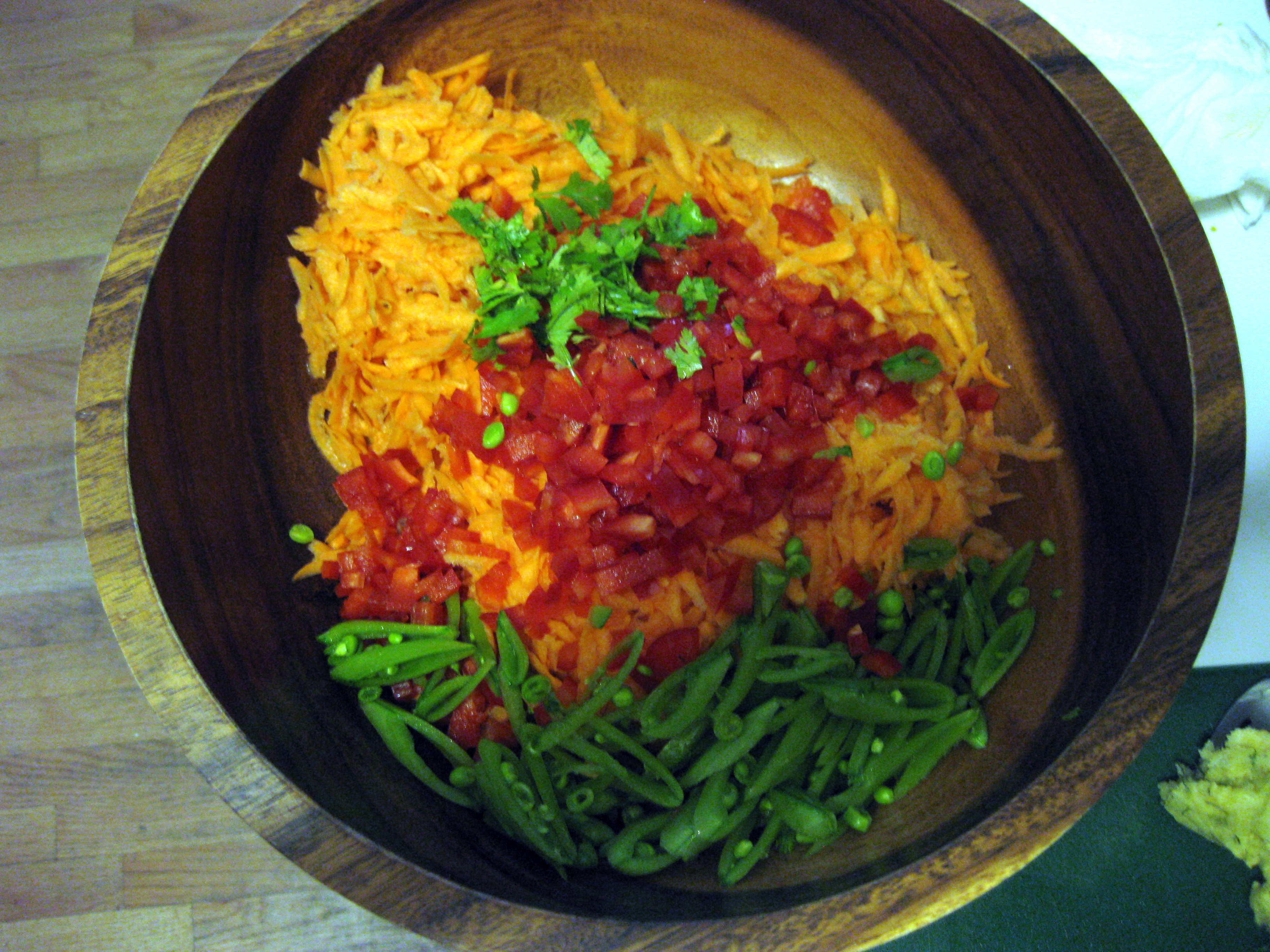
“66. In a blender, whip olive oil, lime juice, a little red onion and a stemmed and seeded jalapeno.  Toss with lots of shredded raw sweet potato, diced red bell pepper and chopped cilantro.” 

In theory, this sounded fresh and healthful and good.  Zesty.  I collected

2 medium sweet potatoes (actually, I used the orange ones called Beauregard yams)

1 large red bell pepper, diced

2 TB chopped fresh cilantro

juice of one lime

¼ – ½ cup olive oil, depending on how much lime juice you have

¼ cup red onion, roughly chopped

1 jalapeno, or to taste (I used half a large, green jalapeno and the dressing was only mildly spicy)

I also added a handful of thinly, diagonally sliced sugar snap peapods, because they were swelling almost out of their skins in my garden.

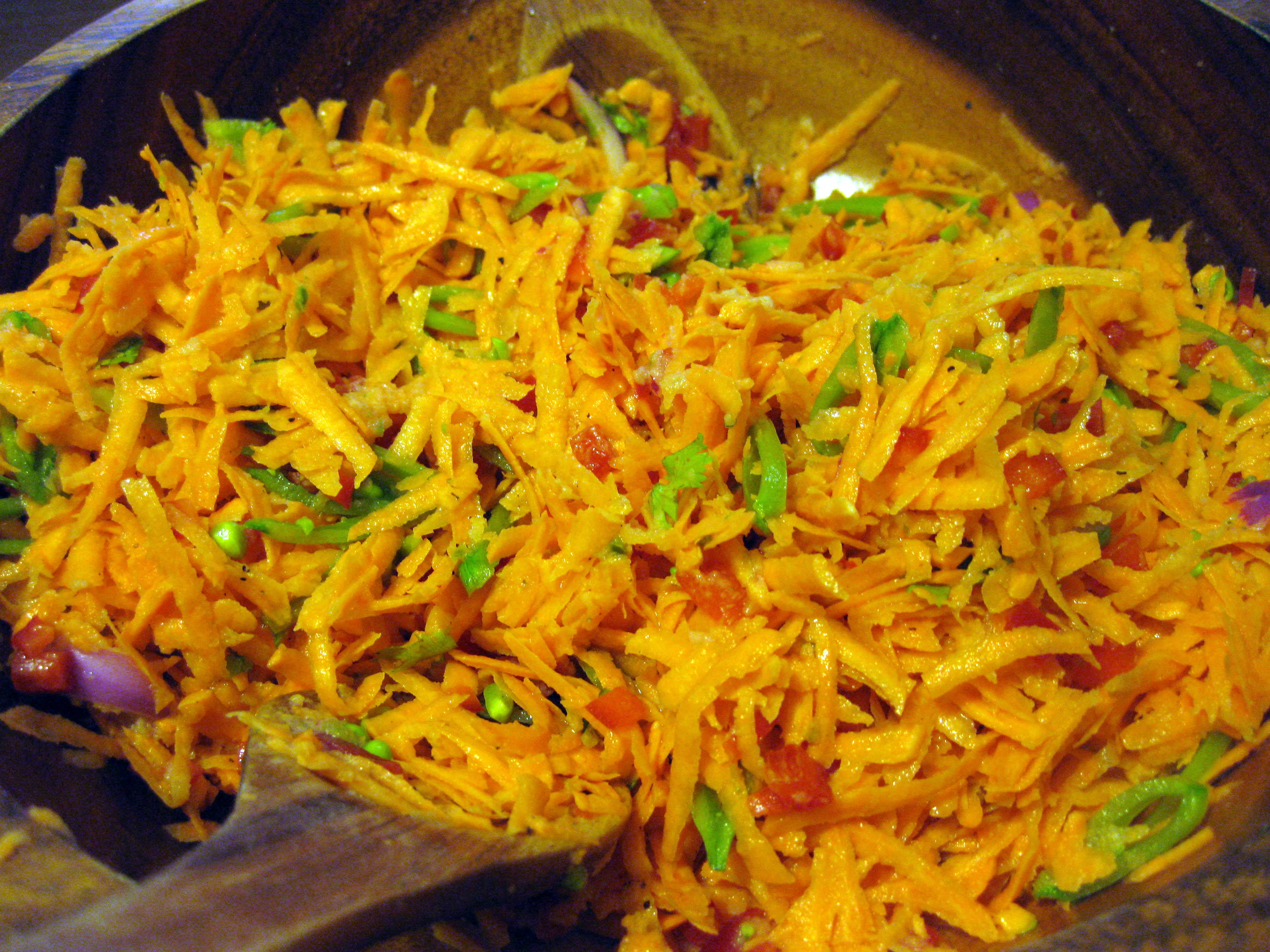
Before making the dressing, I shredded my sweet potatoes and submerged them in cold water in an effort to lift free some of their starchiness and make for a more pleasing mouthfeel.  I left them alone for almost an hour while I made the dill-Cheddar puffs (see below).  When I finally lifted and drained the tatters of potato, I squeezed as much water as I could out of them, and they looked and tasted almost exactly like a pile of carrots.

As Bittman directs, I whirred the dressing ingredients in my blender before tossing it with the vegetables, and that was that.  Easy!  I knew we were in trouble, however, when N. turned to me and asked “so what do you think?”  He never asks this!  In fact, as I’ve mentioned before, he rarely opines positively about food.  I knew he didn’t like it.  His assessment was of dissonance: he said he kept expecting either the flavor of carrots, or something that had been cooked.  What we were eating instead was a mildly flavored, slightly starchy crunch with bright, zesty-green-spicy notes. 

I thought the flavors were nice, but thought it wasn’t sufficient as a main dish salad.  This was a dish to be consumed in small heaps, not a giant, plate-filling mound.  My new challenge, then, consists of repurposing the leftovers, since N. is not interested.  I’m thinking a take on latkes, or a stuffing for a pita alongside some falafel or spiced ground lamb, or maybe even players in a spinach salad.  What this tells me, in all cases except the third, is that apparently I wanted some fat in this dish.  Good thing, then, that this wasn’t the only thing we ate that night.

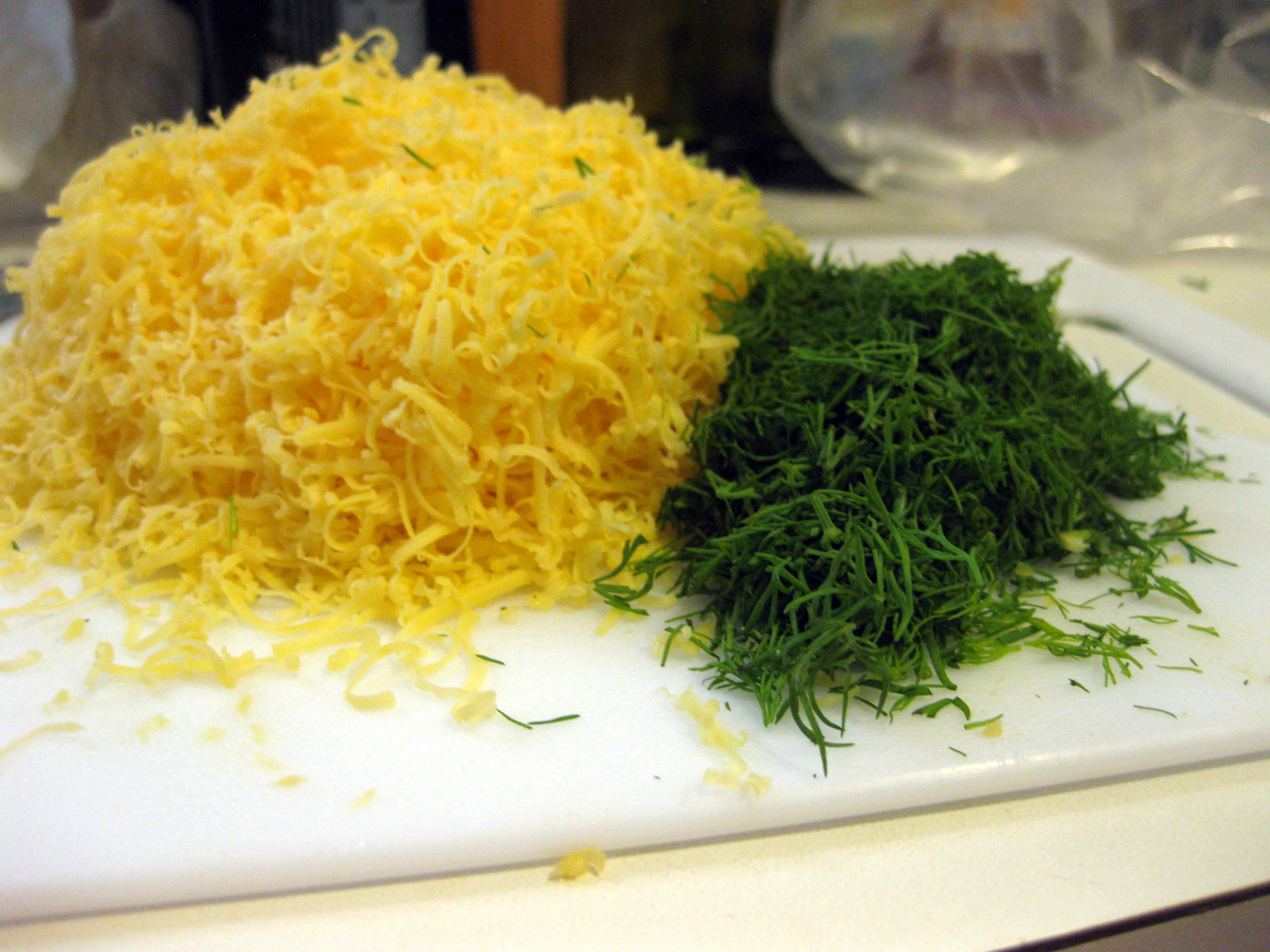
“Dill-Cheddar Puffs: Combine 1 cup water with ½ stick of butter and ½ teaspoon of salt in a saucepan over medium heat and bring to a boil.  When the butter melts add 1 ½ cups flour and cook, stirring, until the dough forms a ball, about 5 minutes.  Turn off the heat, then add 3 eggs, one at a time, beating well until the mixture is glossy.  Stir in 2 cups grated Cheddar and 2 tablespoons freshly chopped dill.  Drop teaspoons of the batter on greased baking sheets and bake at 425 degrees until lightly browned, about 10 to 15 minutes.”

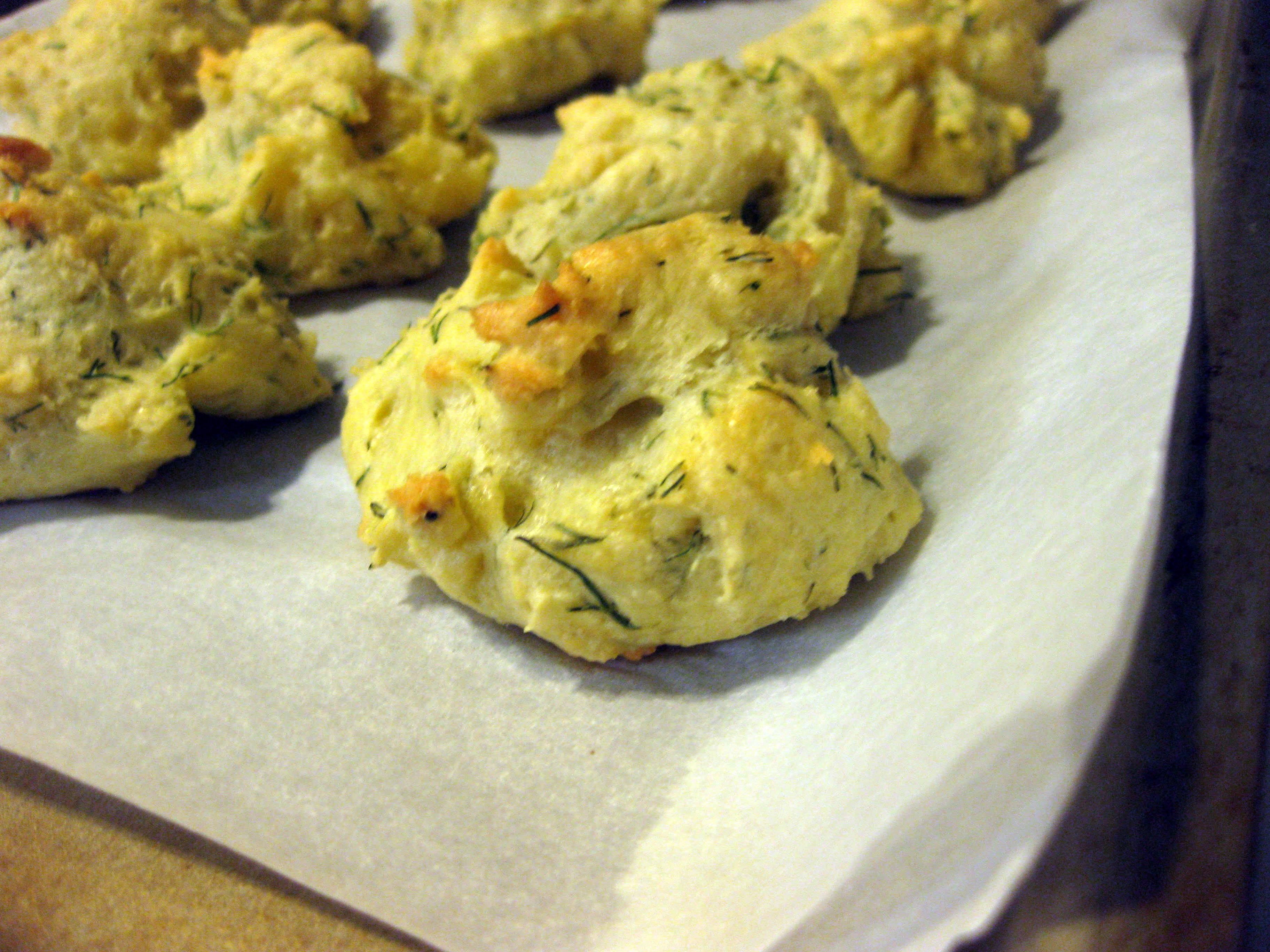
This doesn’t need much comment, either in terms of ingredients or procedure, since Bittman spells it out pretty specifically.  Basically these are savory, filling-less cream puffs.  My mistake, sadly, was ignoring the meaning of “teaspoons” when it came to the size of the batter droplets.  I did more like tablespoons-on-steroids, and as a result they were undercooked at the end of 15 minutes, and overcooked after I’d plunged them back in for another 10.

I ate them both ways, and both ways the flavor was excellent, but at 15 minutes the insides of each puff were still quite sticky.  Even overcooked, while the puffs were still warm they were tasty – crisp, dry, craggy exteriors with an eggy, cheesy middle, and the strong, pleasant grassiness of dill keeping them feeling much lighter than they were.  Either way, N. went back for a refill of puffs even after he’d replaced the salad on his plate with some leftovers.

With slightly better size management, these would have been a monumental success.  They’d make lovely canapes at a party, either whole as little pop-in-your-mouth bites, or split and filled.  If you did want to fill these, cream cheese or smoked salmon might hit the right tone.  Or, if you were feeling adventurous, perhaps both! 

And so with this, I will try to put myself back on schedule.  Back to gardening, back to reading, back to cooking.  Back to feeling excited about it all!  I hereby banish the summer slump of boredom-because-I-don’t-feel-like-doing-what-needs-to-get-done, and the let’s-go-out-again-because-none-of-my-recipes-are-exciting-tonight, and the too-lazy-to-snap-pictures-while-I’m-stirring blues.  I’m back, friends.  I’m back and back into it.

Sunburst

Orange is a hot color. It’s flame and earthy warmth and friendly heat. But it’s also freshness and citrus-bright and spicy. It’s a fall color and a summer color. This is convenient, considering Oregon’s spastic and reluctant attempts to approach spring/summer. Interestingly too, the particular orange combination Bittman offered us this past week was a salad made from winter root vegetables, with a peppery summery acidic dressing. Juxtaposition of seasons. Juxtaposition of flavors.

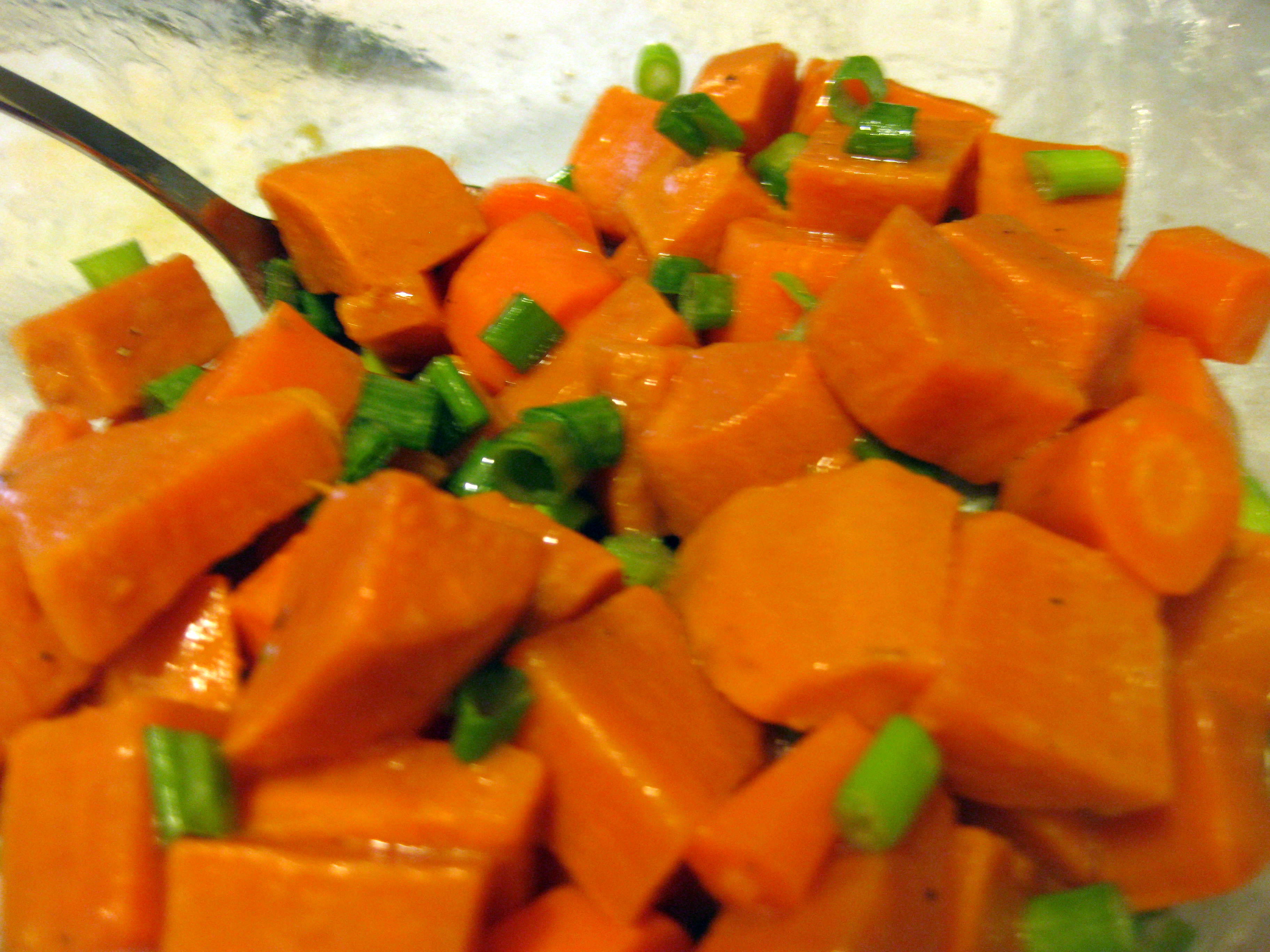
68. Peel sweet potatoes and boil until tender, drain and cool; dice. Treat carrots the same way. Make sauce of Dijon mustard, olive oil, cider vinegar and chopped scallions. Toss all together.”

Here’s what I used:

1 big Beauregard yam, peeled

3 large carrots, peeled

4 green onions, thinly sliced

2 TB dijon mustard

2 TB cider vinegar

2-3 TB olive oil

salt and pepper to taste

Bittman’s recipe seemed to advocate boiling the carrots and sweet potato whole. I decided to shorten the cooking time and cut the vegetables into chunks first. I boiled them in lightly salted water for fifteen or twenty minutes, or until the sweet potato chunks were tender and the carrots still had a touch of texture. Drained, they were startlingly bright against my white colander and I had to sample one. And then another. And then another of each.

They tasted like sweetness and familiarity. I set them aside to let them cool for an hour.

When they were well cooled, I tossed in the green onions, ground on some black pepper, and mixed up the dressing. I combined the mustard, the vinegar, and some salt and pepper in a measuring cup, then blended them with a fork into a homogenized mixture. Then, still whisking constantly, I added the olive oil in a slow stream, whisking persistently until the mixture emulsified. Then, of course, all that remained was to pour it over the vegetables and toss them gently together for full immersion.

While this sat, I prepped its accompaniment. I brought some chicken stock to a boil, then tossed in a bagful of frozen peas. When the liquid resumed its boil, I stirred in a box of couscous and clapped the lid on to let the absorption process commence. I wasn’t sure it was going to work, because I feared the peas might have soaked up too much of the liquid and the tiny beads of semolina wouldn’t cook properly. I feared in vain. When I fluffed the couscous five minutes later, it was cooked and tender, the peas were steaming, and I stirred in some chopped fresh parsley for kicks.

Now, instead of a steaming vegetable dish and a cold pasta salad, we had hot, vegetable-laced pasta and a cold vegetable salad. It was a delicious juxtaposition, with the wintry roots flavored in bright, commanding acidity and the couscous dressed with springiness. I loved what the mustard and vinegar did for the carrots and the sweet potatoes, playing against their inherent sweetness to add complexity and interest. Cleaning up after dinner, N. and I couldn’t stop grabbing chunks of their sour-sweet tastiness with our fingers out of the bowl. I will certainly make this one again.

The nice thing about this dish was how, even in its odd mixture of summery flavors and autumnal base, it mirrored my own summer thus far. Eugene has been mostly dreary, offering pockets and blotches of sunlight and teasing us with predictions of 70F degree weather, then delivering a sky socked in fog and breezes of misty drizzle. This isn’t June gloom. This is June despair.

But this past weekend, as the bright chunks of winter took on summer flavors, I left Eugene for warmth, for sun, and for vacation. This week and next week, I cannot promise another post. But I can promise that my pale shoulders will toast, my hair will bleach out, and my brain will slow down its frantic pace. I’ll keep track of what I eat, and I’ll photograph the triumphs and surprises to share upon my return to internet-land. And I hope, fervently, your last weeks of June will be as orange as I know mine will be.