Grain Games

When I was a teenager, my aunt gave the family a book of board games.  There were little flat pieces that looked like mancala stones to play the games in a zip-up baggie that hung off the spiral binding of the book, and lots of games we had never heard of and, in truth, some that we never ended up playing.  In fact, after some experimentation there was only one game that ended up being played with any regularity.  It was called “Dalmation Pirates and the Volga Bulgars,” and featured a board drawn over a beautiful clay-sculpted background of waves a tiny town, and even a Playdough-looking sea serpent.  The objective was for the 24 pieces representing the pirates to try and occupy completely the nine spaces representing the town.  The objective for the Bulgars, of course, was to prevent this from happening by capturing (through jumping pieces, like checkers) enough Pirates to make their occupation impossible.

I was never a fan of checkers or chess, or even Othello, because I wasn’t very good at them and didn’t like the idea of investing enough losses to learn the game well and begin to excel, but for some reason this Pirates vs. townspeople game appealed to me.  I played it with my dad, and I always wanted to be the Bulgars.  Maybe I liked the art surrounding the game, maybe I liked the fact that it was new to both of us, but something about it appealed, and I was good at it.  My defense of my town was of paramount importance, and my land- and sea-going people-pieces were strong and resilient and very fond of capturing pirates.

This seems like a strange way for a food-related post to begin, and indeed my memory is based on homophones, not homonyms, but this week’s Bittman choice reminded me of this old favorite:

“49. Halve and seed acorn, butternut or delicata squash and roast until squash begins to soften. Meanwhile, cook bulgur, drain and toss with coarsely chopped pine nuts and currants. Add a bit of the stuffing to each squash half and sprinkle with cinnamon. Bake until squash is tender.”

I don’t cook bulgur very often, but every time I hear the word, see the word, think about this hardy, tasty grain, my mind goes not to the food itself, but back to a winter afternoon, sitting on the floor in the living room with my dad, playing “Dalmation Pirates and the Volga Bulgars” in a room only recently divested of shreds of wrapping paper.  It’s that kind of fond memory.

With the autumnal flavor combinations in this dish, I could see it accompanying a game of Pirates vs. Bulgars quite nicely.  Here’s what I used:

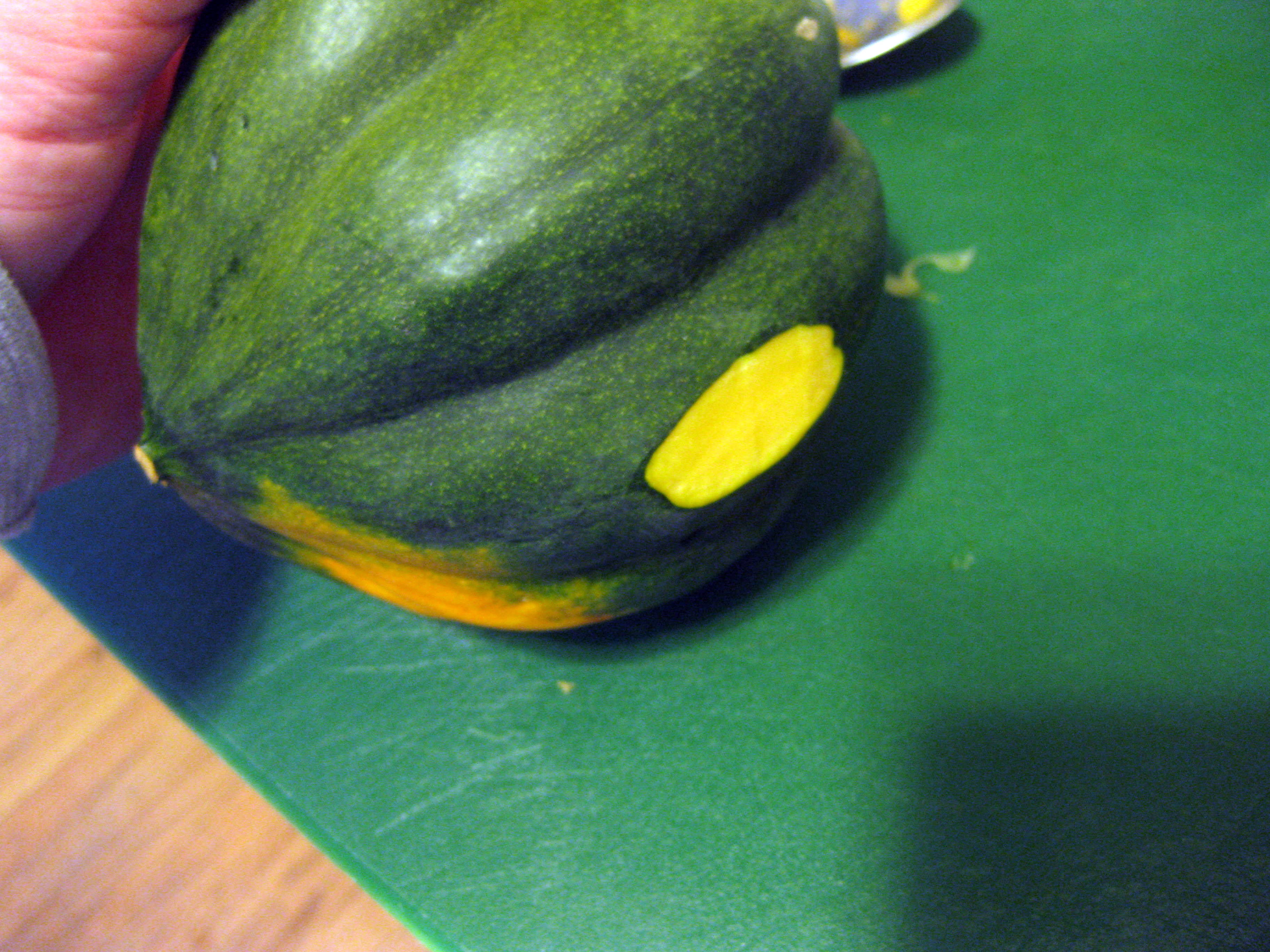
1 acorn squash, halved, seeded, and balanced by cutting a thin strip from one of the ridges to help it stand up
1 cup bulgur wheat, cooked in 2 ½ cups water or broth

2-3 TB pine nuts, toasted and coarsely chopped

2-3 TB currants

2-3 TB parsley, finely minced

4 TB butter

1 tsp cinnamon or to taste

Salt and pepper

After prepping the squash, I nestled them against each other in a 9-inch metal cake pan, salted and peppered the inside well, added probably ½ TB of butter to each well, and stowed them in the oven, which I’d preheated to 375F.

While the squash began making, I prepared the bulgur.  I used 2 ½ cups of water for my 1 cup of bulgur, and tossed in 2 TB of butter just to add some richness.  Preparing bulgur is like a combination of rice and couscous: you allow the water to come to a boil, then add the bulgur and cook until the water is absorbed and the grains are tender but still chewy.  It took about 25 minutes.
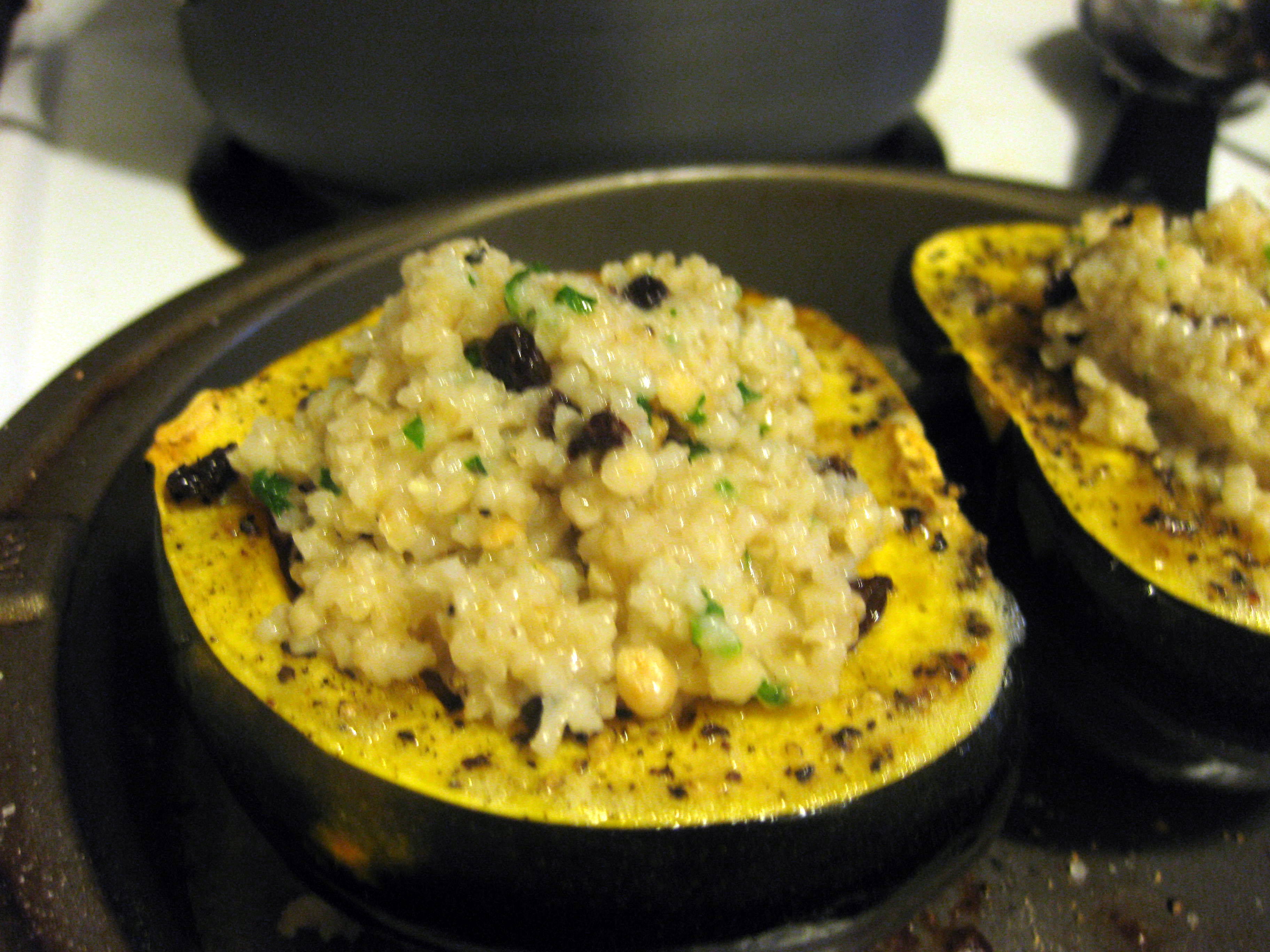
When the bulgur was done, I stirred in the pine nuts, currants, and parsley, which is not on Bittman’s recipe but which I had kicking around in the fridge, begging to add some color to something.  I excavated my squash babies from the oven, basted them up the sides a bit with the now-melted butter in their cavities, then filled up those caves with a few mounded scoops of bulgur stuffing.  I sprinkled the top with cinnamon and then, spurred perhaps by watching too much Paula Deen on the Food Network, halved my last TB of butter and pressed the little cubes gently atop each mound of stuffing.

My Bittman Bulgurs went back into the oven for about 20 minutes while I prepped the rest of our meal: chicken basil sausages and sautéed greens.  Trader Joe’s occasionally has a tremendous sack of mixed “southern” greens including mustard greens, turnip greens, and a few other shreds of deliciousness that I like quite a bit.  Taking my cue from last week’s green bean triumph, I blanched a big pot of these greens for a few minutes, scorched off my sausages, then added the drained greens to the sausage pan, where they sizzled insistently and picked up some meaty flavors.

When I dared to peek at the squash boats, and tentatively poked down into their hopefully-now-softened flesh with a fork, I found the stuffing had taken on a crunch-promising-crust and the squash beneath was achingly tender. 
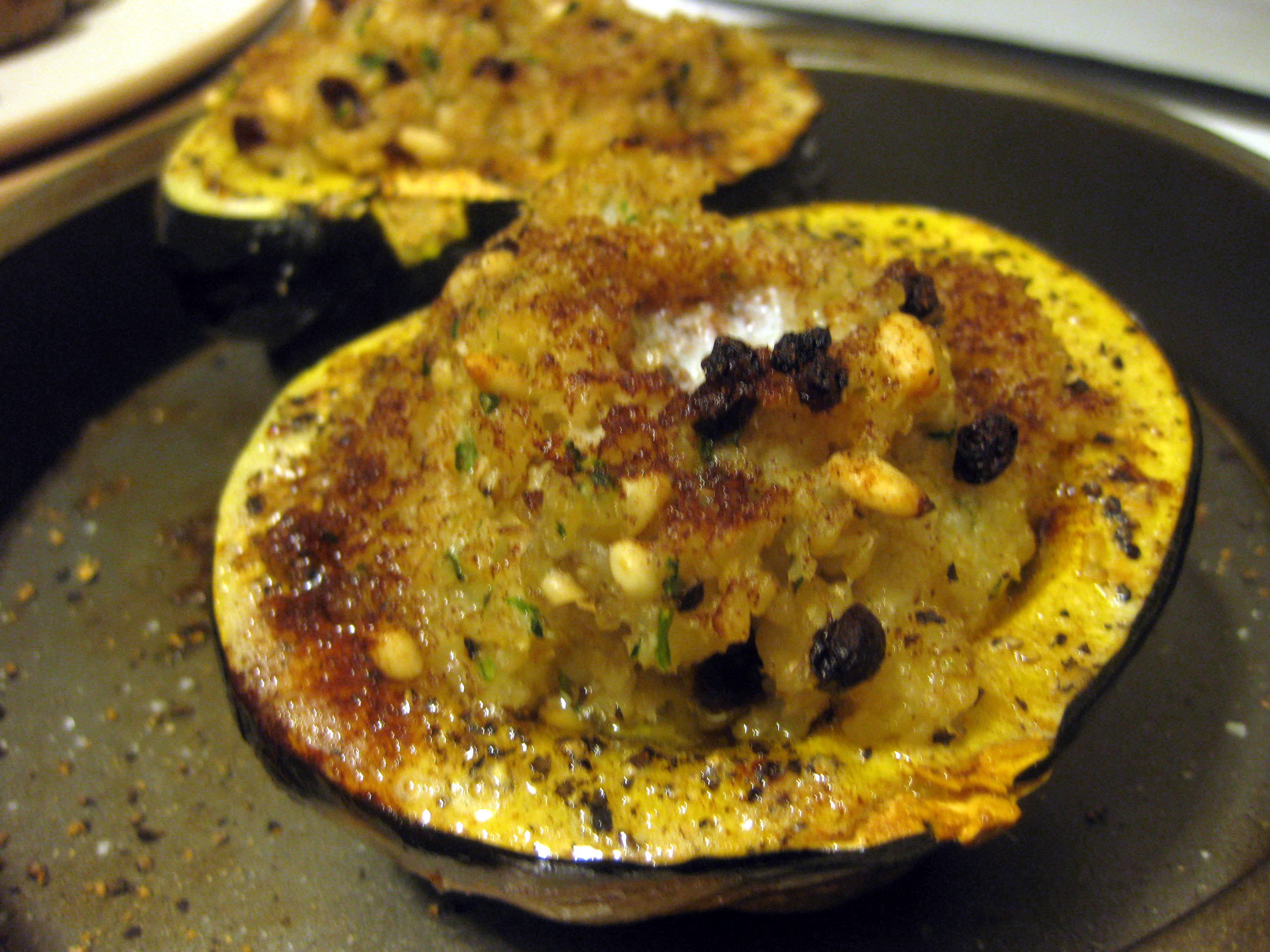
When we dug in, cracking through the crunchy tip of the stuffing pinnacles and scraping the soft orange squash beneath it, I wasn’t sure what to anticipate.  The cinnamon idea was throwing me off.  Even though there was no added sweetener, the cinnamon gave off warm spicy dessert tones, and I think I was expecting that to clash with the squash.  But I had forgotten, somehow, momentarily, that propensity of squash to collect flavors and, chameleon-like, transform itself from a savory item to a potential dessert.  And yet here, while it blended well with the cinnamon and the currants, neither the stuffing nor its vessel read dessert.  They were just warm and comforting, with the surprise spice and crunch on top to add excitement.  The bulgur was still slightly chewy, with that golden nuttiness whole grains so often have, and I considered that if you wanted to make this gluten-free, you could use brown rice or quinoa with fairly similar results.
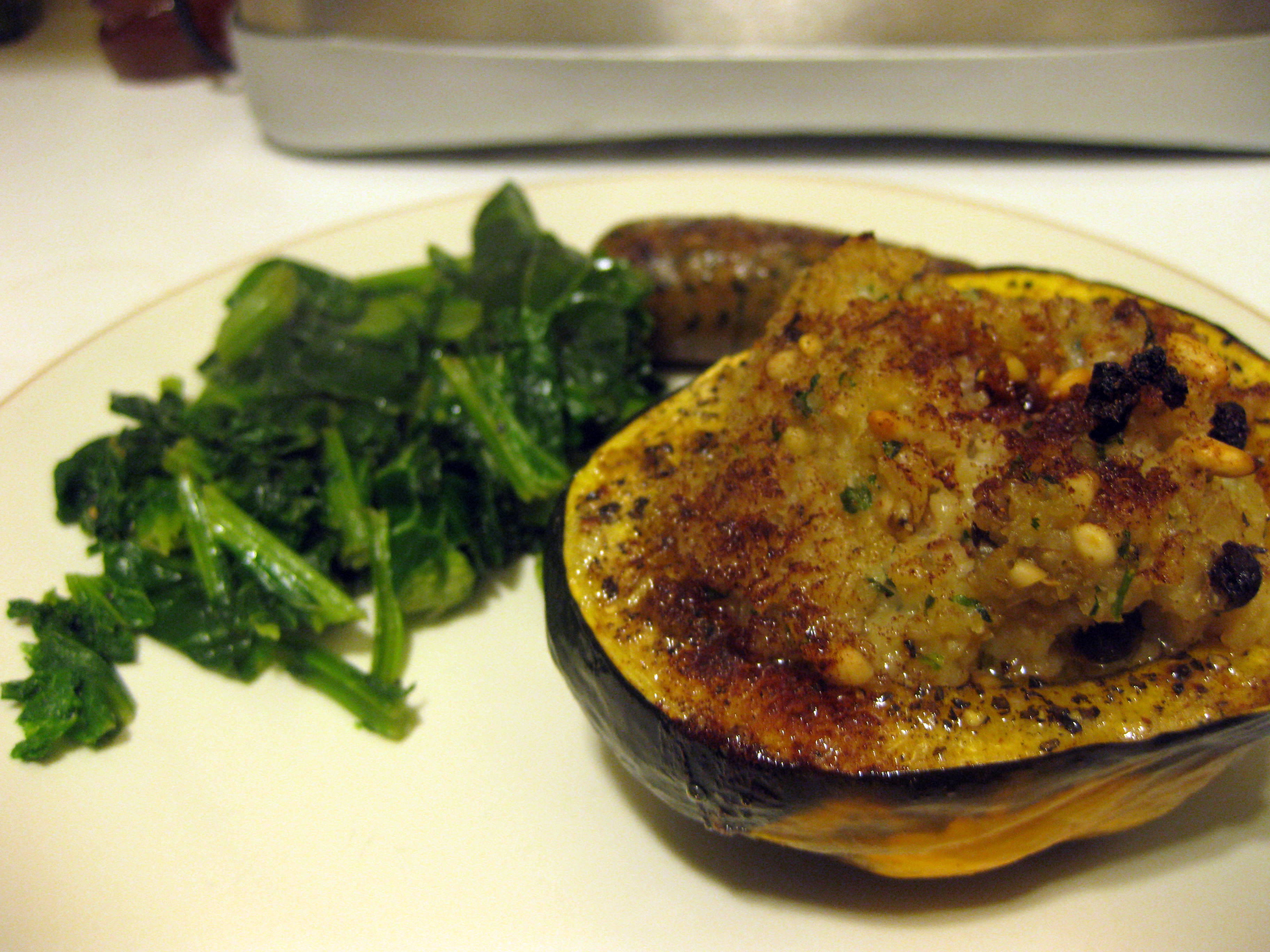
Packing up the remains of dinner, I realized with delight that one slightly manipulated half of acorn squash fits perfectly in one of my round Tupperware containers.  I wedged it in carefully, added a bit more stuffing, and offered it a benediction: “Good night, Lunch.”
Snowmageddon

Last weekend as N. and I headed to the grocery store, we hadn’t yet started thinking about the weather forecast, which called for unseasonably low nighttime temperatures and – gasp – even a smattering of that fluffycold white stuff they get in “Northerly” climates.  And yet, despite that, my menu plan ended up full of beans, Nature’s little warmer-uppers.  We wanted chili.  We wanted my aunt Nancy’s slow cooker baked beans.  Even the Bittman pick of the week featured beans:

“58. Pour a mixture of cooked white beans (with a little cooking or canning liquid) and grated, sauteed winter squash into an oiled baking dish.  Mix together fresh bread crumbs, dots of butter and chopped fresh sage and spread over the top; broil until golden brown.”

It was like we were physically attuned to the impending chill, though not mentally aware of it.  “Use pantry food!” my subconscious suggested, “Canned foods don’t go bad!  Stock up on canned foods!”  And when Snowmageddon came?  A whisperfall of beautiful flakes… for a few hours at most.  The inch or two that stacked up in our backyard over Wednesday night was gone by Thursday afternoon.  The chance that classes on Friday might have to be canceled due to unsafe morning driving conditions was a quiet dream that faded as quickly as the snow.

And yet we had beans aplenty.  To make the Bittman pick, I used:

2 15 oz. cans white kidney beans (or cannelini beans)

½ large butternut squash, peeled, seeded, and grated (I used the grating tool on my food processor)

¼ of a sourdough baguette, a few days old, torn into pieces and splintered into crumbs in the food processor

4 TB. butter

1 tsp fresh rosemary, finely chopped (I didn’t have any fresh sage in the house, and I wasn’t about to venture out to the frosty back garden to see if my sage plant was even still alive)

salt and pepper to taste

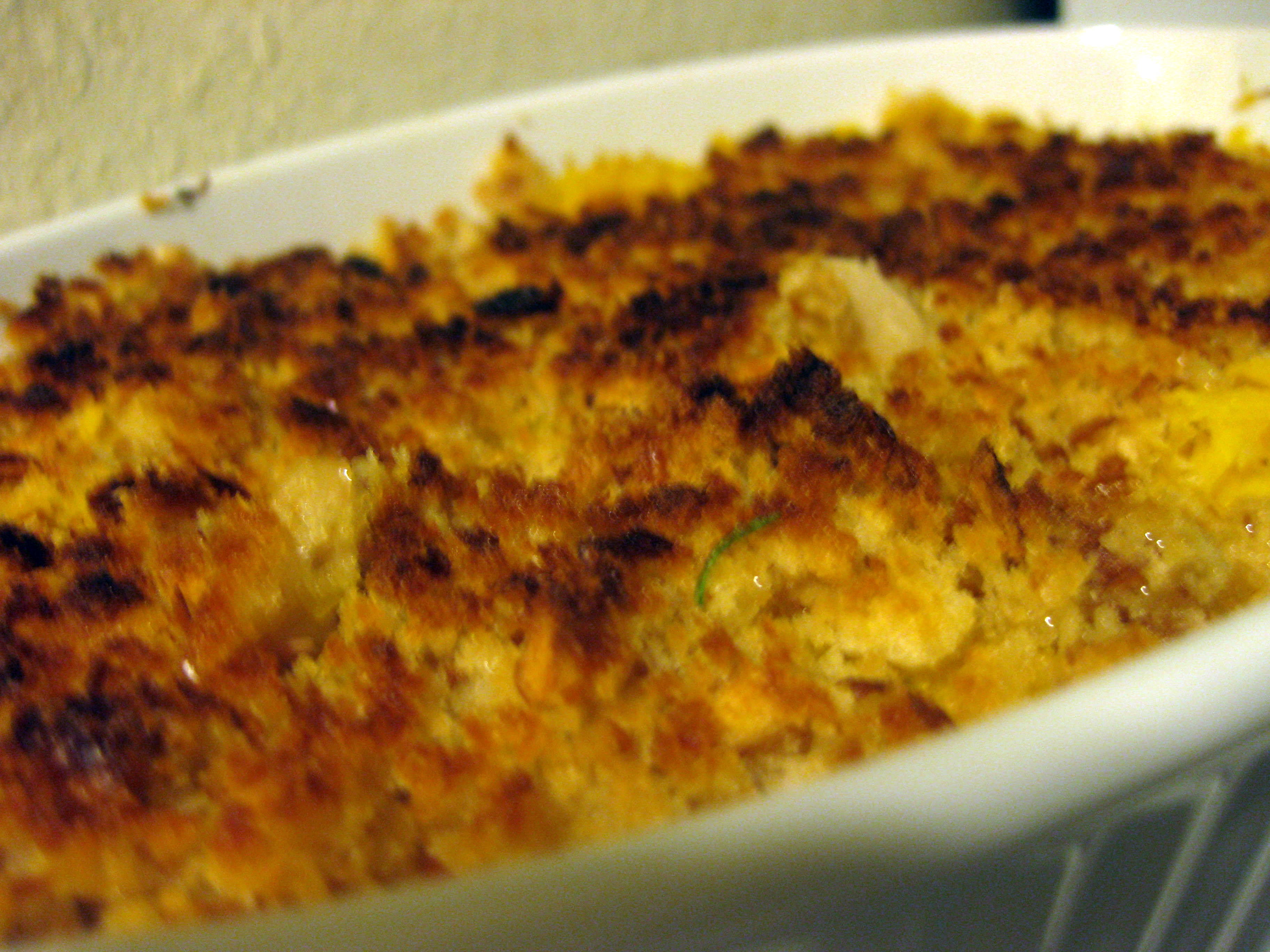
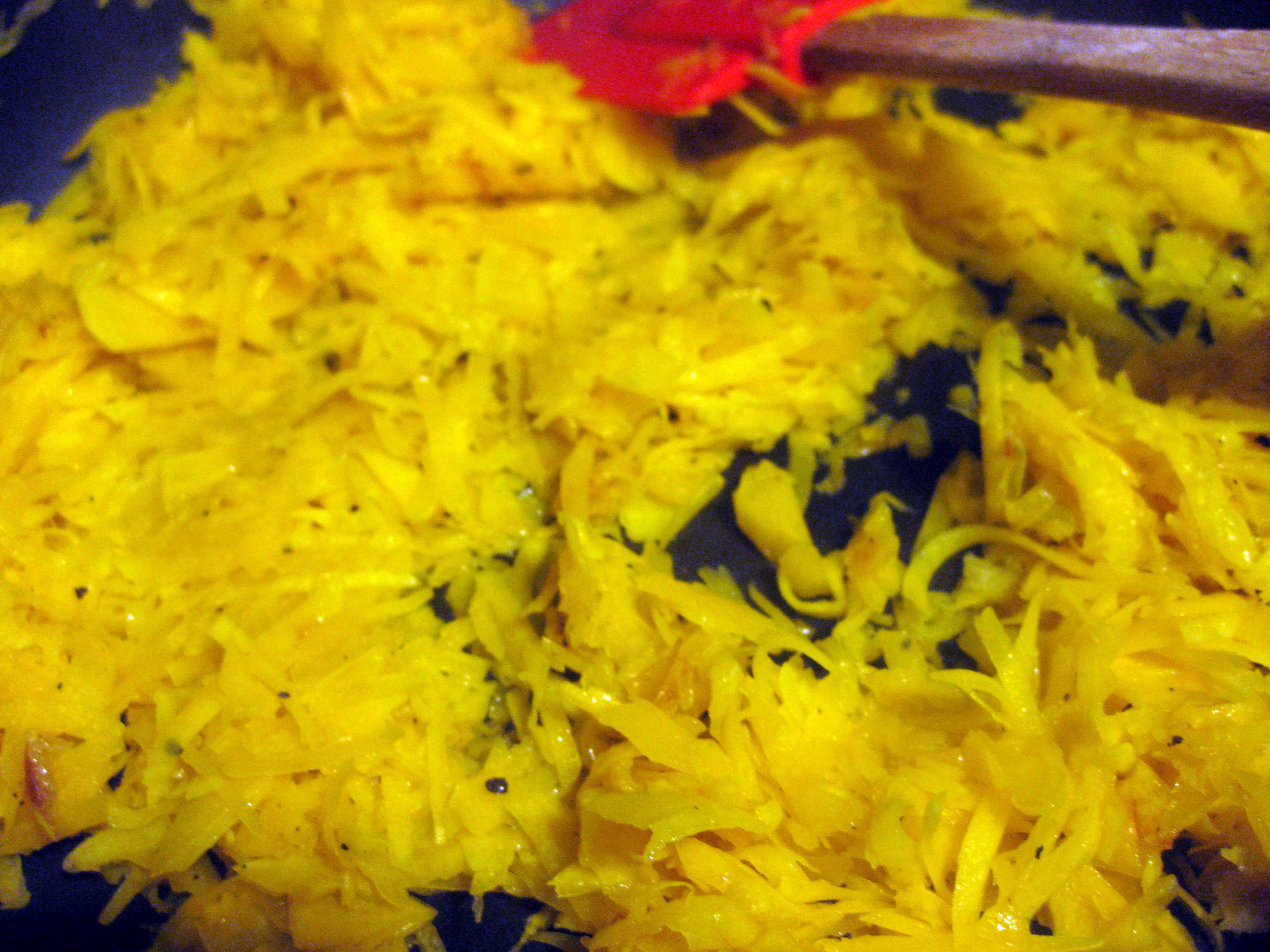
After grating the squash, I tossed it into a large skillet with half the butter and plenty of salt and pepper, then sauteed until it was just starting to pick up some color from the bottom of the pan.  I took it off the heat and mixed it in a large casserole dish with the two cans of beans, which I forgot to save any liquid from.  While the squash warmed the beans a bit, I melted the remaining butter in a bowl and then dumped what amounted to probably almost 2 cups of bread crumbs into it, where I mixed them around with a fork and then my fingers to make sure everyone had some buttery goodness seeped in.  I added the rosemary and a little pepper, then spread out a thick layer over the beans and squash.

Because the beans were still pantry-cold and I knew the broiling process would not sufficiently warm them, I stuck the casserole dish into the oven on its lowest setting while I got the rest of dinner working.

Chicken sausages were browning and blistering in a skillet while I blanched some green beans, and then had a brilliant idea.  Why not pick up some of that greasy meaty leftover sludge on our veg?  That stuff is almost more flavorful than the meat itself, which is why cooks and chefs are always advocating using it as a base for sauces.  Quick, quick, quick, I grated about a teaspoon of lemon zest and one clove of garlic on my microplane, then dumped green beans, seasonings, and a few tablespoons of white wine into the same smoking skillet I’d just liberated the sausages from.  While the beans wallowed in their hot tub treatment I slid the casserole under the broiler and amazingly, everyone was ready at about the same time.

The sausages were tasty, but they were storebought and nothing particularly special.  The Bittman dish was good, and I’ll say more about that in a moment, but I cannot extol enough the virtues of these green beans!  They were perfectly cooked – still slightly crisp to give your teeth something to play with, and scented by the sharpness of garlic, lemon, and the slightly acidic wine, which reduced to almost nothing in the minute and a half or so it was in the pan.  And the browned bits from the bursting sausages gave the beans a richness they scarcely deserved.  It was like those good restaurant vegetables: crisp and buttery because they are drenched in the stuff, but here it was the tiniest slick of fat distributed beautifully over half a pound of slender beans, giving them all the right flavors to awaken pretty much every kind of taste bud.  So delicious.

As for the Bittman dish, it was a bit eclipsed by its green side.  The butternut squash, seasoned well and sauteed gently before meeting its companion ingredients, was delicious.  It was light and fresh, and combined with zucchini, carrots, potatoes, or parsnips (or any combination thereof), it would make wonderful latke-style shredded vegetable pancakes or hash browns.  Perhaps because I neglected to save any canning liquid from the beans, the dish itself needed a binder.  It was good, and our snow-fearing, protein-craving bodies ate big servings, but it needed something to become spectacular.

Addressing the leftovers a day or two later, I figured out what had to be done to elevate this dish.  It needed green.  It needed more complexity.  It needed to cease being a side, but to become a casserole-type-main in its own right.  It needed to be, if such a thing exists, a baked hash.

In a big serving bowl, I layered some fresh spinach, half a leftover sausage, chopped into small pieces, and plenty of the squash and bean mixture and heated them up together with a little bit of butter.  Putting the spinach on the bottom helped it wilt under the heat of the other ingredients.  This was the way to eat this dish.  In the spinach, the beans found a flavor to sing harmony, and the sausage pieces added a saltiness the relatively bland beans and bread crumbs needed.  We will have this again, but next time I will add chopped spinach, chard, or perhaps zucchini, and maybe some crumbled cooked pork sausage.  Good things.  Warming things.  Warm bellies to stand against the snow.  Even if it only lasts a few hours.

Going Greek

On some Friday nights, after visiting a bar near campus where we share Happy Hour with folks from our department, N. and I stroll back to the parking lot where we’ve left our car, arm in arm and happy to be starting the weekend together.  We approach the lot, now almost empty of cars, only to find it occupied by three or four large, noisy, overstuffed school buses, jammed to the gills with undergrads in disco dresses, in plastic pants, in formalwear and stacked heels and spiked hair and too-short skirts.  Last week there were a few girls in lederhosen.  They are from fraternities and sororities, heading out to formal nights or costume nights or party-till-you-forget-who-you-are nights, and we have to skirt around the buses in our car to escape from the parking lot and head home.

The lederhosen last week got me thinking: I’ve seen a definite shortage of togas among these party-goers (and I’m not just punning on the shortness of skirts here), replaced by lots of skimpy costumes.  It made me wonder whether they know that the tradition of fraternity toga parties is from the designation of these organizations as “Greek.”  Do they recognize this connection, or have they made the leap that togas are costumes, but there are lots of other costumes, so let’s just have a costume party?

I was never a sorority girl, and though I love a good costume party, I haven’t yet attempted the complex transformation from innocent white bed sheet to Classical garment.  Togas are one thing, but this week’s Bittman choice is, to me, a much more enjoyable way of going Greek. 

“62. Spinach-Cheese Pie: Sauté chopped garlic and two pounds of chopped spinach in plenty of olive oil until wilted and tender.  Remove from the heat and stir in ½ to ¾ cup crumbled feta or firm goat cheese, and a tablespoon chopped dill or mint. Layer 5 sheets phyllo dough in a greased baking dish, brushing each one with olive oil before adding the next. Spread the spinach over the phyllo, then top with 5 more phyllo sheets, each brushed with olive oil. Tuck in the edges if they extend over the ends of the pan, slash the top of the pie diagonally in a few places and bake until golden brown, 30-40 minutes.”

This is basically spanakopita, so I knew from the beginning it would be good.  With the addition of 3-4 thinly sliced green onions and liberal seasoning of salt and pepper in my spinach, I followed this unusually precise almost-recipe to the letter.  Here’s what I used:

2 10 oz. packages frozen chopped spinach, defrosted and very well drained (I know this isn’t two pounds, but it’s what I had in the freezer)

4 cloves garlic, finely minced

4 green onions, finely sliced (white and green parts)

1 generous TB finely chopped dill

½ cup crumbled feta cheese

10 sheets phyllo dough

Olive oil

Salt and pepper

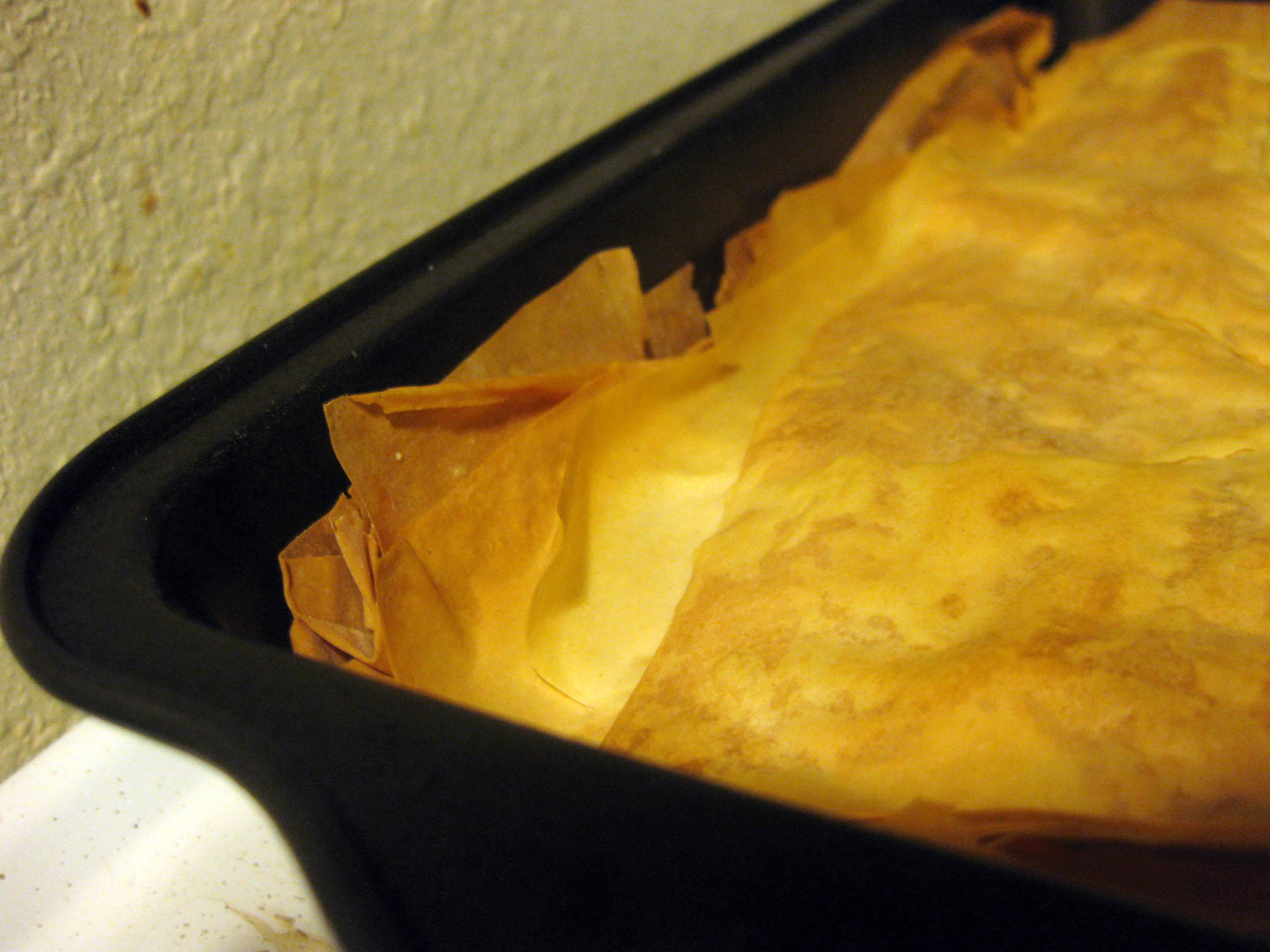
I forgot to snap a shot of the filling before tucking it in, but the fully constructed “pie” was lovely.  I opted not to fold under all the edges after layering up in a baking dish, because I love that crunchy paper-thin crispness exposed edges of phyllo take on in the oven.  Messy sheets are not always a bad thing.

I let the crisping, warming, melting, softening happen for 30 minutes in an oven preheated to 375F, and readied our soup course.

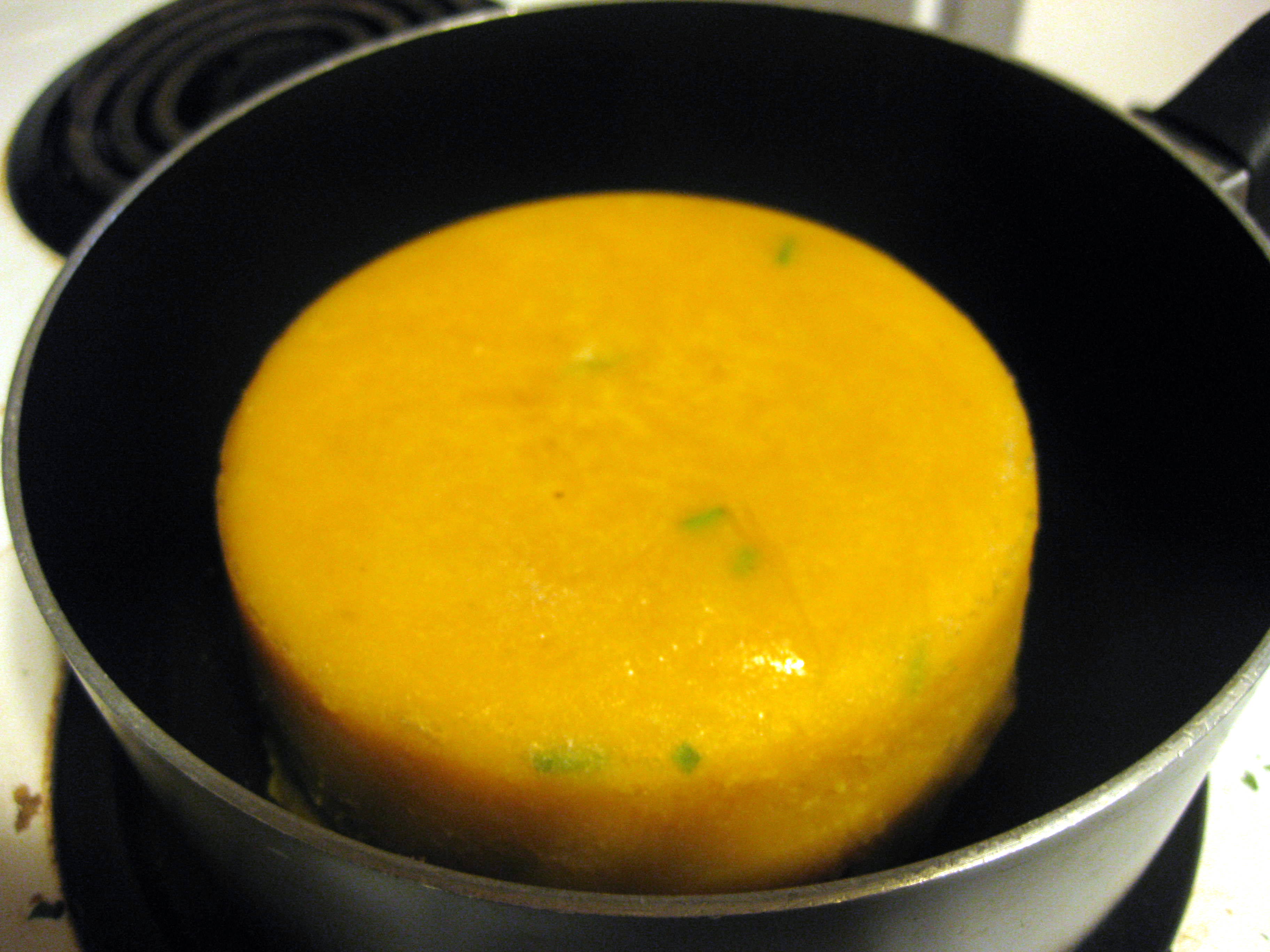
To contrast the green and soft matte golden brown of the spanakopita, I turned to a frozen friend: butternut squash soup from this fall, which we’d consumed half of and stashed away the remainder for a lazier day.  I plunked the solid orange disk into a pot and added a splash of roasted garlic-infused chicken broth to loosen it up a little (the original batch had been more like a puree than a soup).  Then I left it to its own devices on medium low until sluggish bubbles were forming and the spanakopita was golden and done.

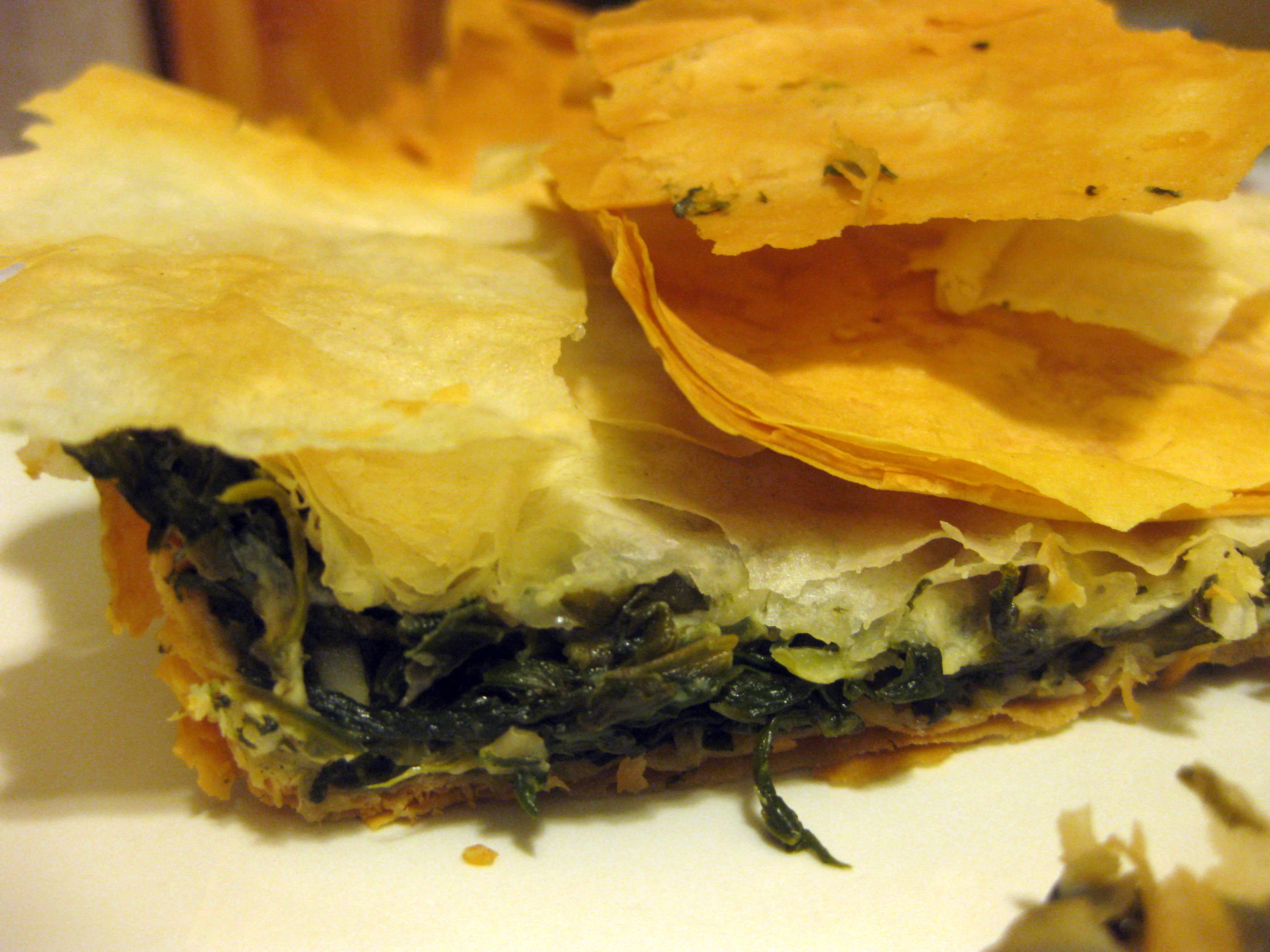
This is why I love phyllo: look at those edges!  Fragile shards of flaky crunch where the edges protrude alone, but the soft tender feeling of pastry on the inner layers.  I decided I like the flavor and texture of butter between the sheets slightly better than olive oil, but this way was probably better for us.  Butter just adds additional richness.


This was so tasty, and so surprisingly light that we were glad of the soup as a hearty accompaniment.  The phyllo really does give the impression, when it is layered together like this, of a thick crust, but it is so thin and fragile that it’s almost like having no starch at all in the dish.  The spinach, dill, and feta mixture is the perfect blend: green hearty healthy tenderness from the spinach, bright freshness from the dill, and crumbly tart salty brine from the feta interspersed amidst the vegetation.  If you didn’t want to take the time with the phyllo, this would also make a great quiche filling, or a Mediterranean option to pack into stuffed mushrooms.

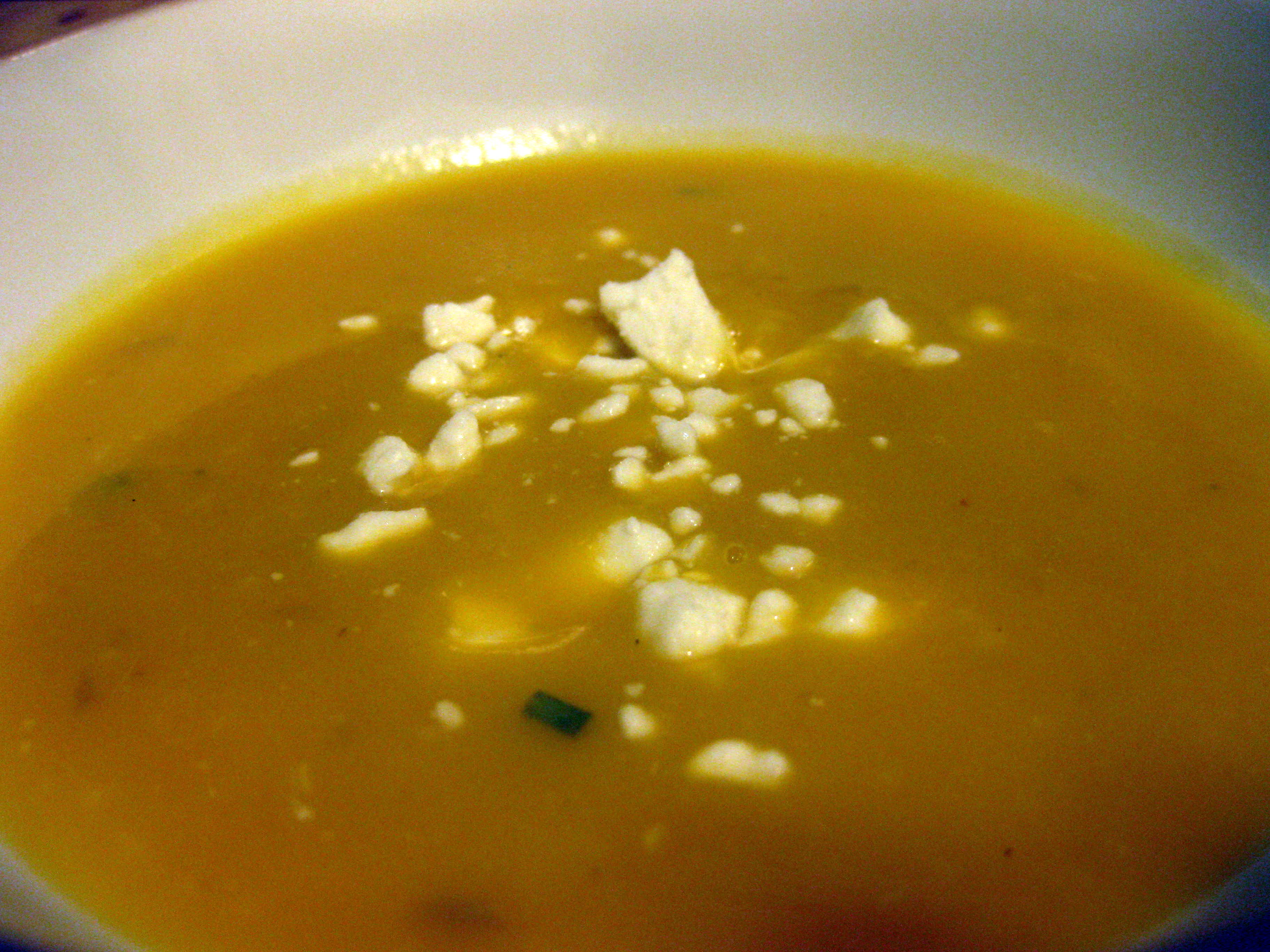
The feta was so good in the spanakopita itself that I thought it would make a nice topping for the soup, brightening the slow comforting sweetness of the squash and potato mixture.

It’s good to be right.

Stacked

One of the most impressive looking desserts, to me, is a trifle.  Those elegant layers in wonderful colors (especially if one of those colors is the dark rich brown of chocolate), stacked carefully together and topped with whipped cream and fruit and dark chocolate shavings…

But the impressive thing about them, to me, is how skilled the artist who puts them together has to be to get everything just so – the layers sit happily atop one another, the beautiful serving glass doesn’t have smears of pudding where the cake should be – it’s a skill I, with my limited patience and tendency for mess in the kitchen, simply do not possess.  Of course, I don’t make a lot of trifles.

For this week’s Bittman, however, I made what he calls a Vegetable Torta, which apparently is supposed to have layers.  He says:

“47. Vegetable Torta: Roast sliced eggplant, zucchini, tomatoes and onions.  Stack in layers with fresh basil in a well-oiled springform or roasting pan and top with bread crumbs or Parmesan (or both); bake for 20 minutes or so.”

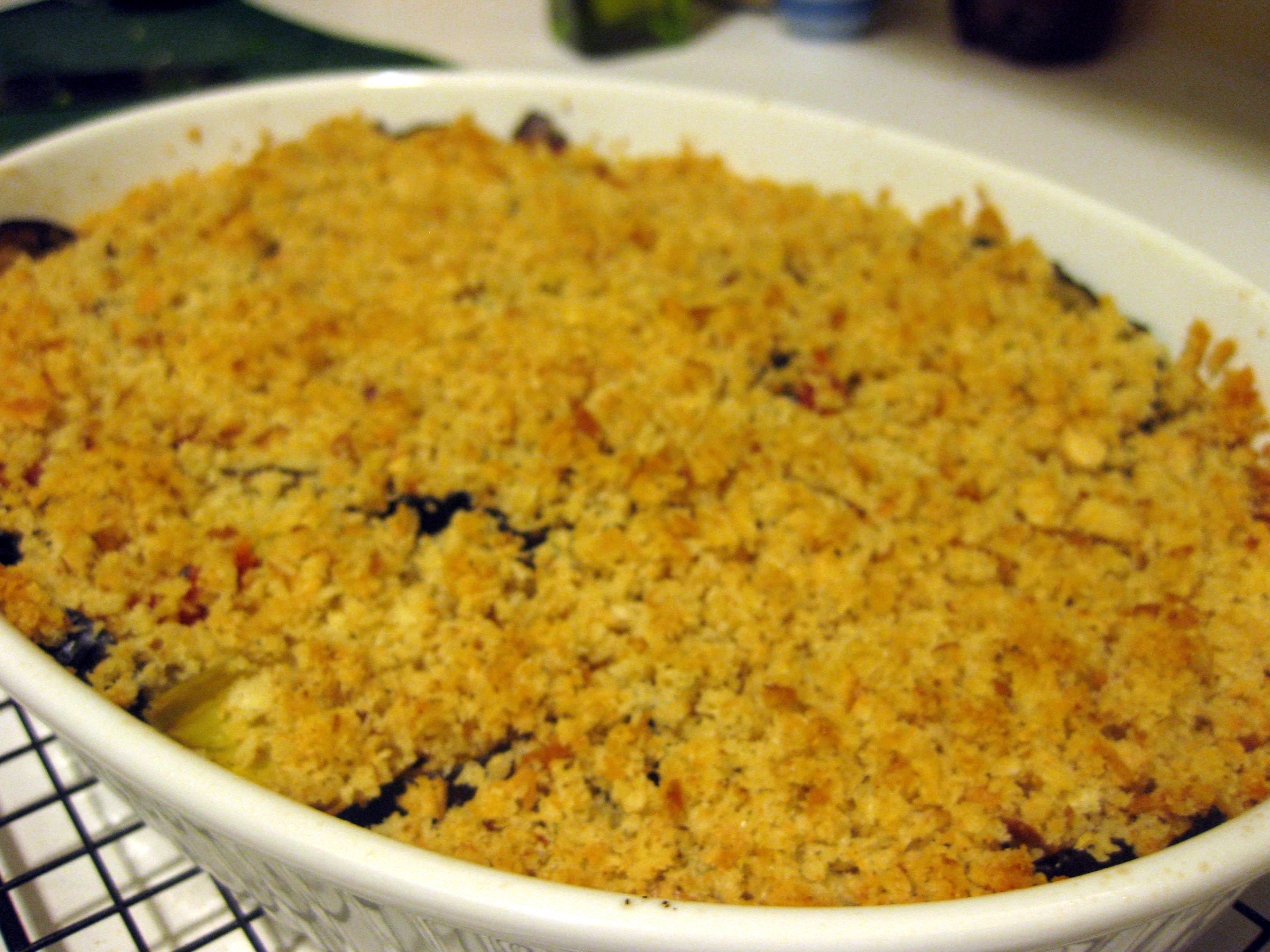
I made a number of decisions about these directions, at least two of which were evidently somewhat silly.  I don’t care for roasted tomatoes (unless they are intended for salsa or are being oven dried), so I opted for a shiny orange bell pepper instead.  Because I often overestimate how much of everything I will need and end up with WAY more dinner than N. and I could consume in 2 or 3 days, let alone one sitting, I am trying to be more conscious about my tendency to overbuy.  For this dinner, therefore, I proudly limited myself to only one eggplant, two zucchini, one pepper… in short, less than I ordinarily would have used.  Because N. is such a big fan of any kind of bread product, which includes panko or toasty bread crumbs of any kind, I decided to use a shallow, oval Corningware-type baking dish I bought myself recently rather than a tall sided pan, because this would allow more space for bread crumbs, which means more bread.  This was silly because when it came time to layer, there was neither enough material nor enough room.  The vegetables nestled nicely in with each other, but they settled in on the same level.  No stacking necessary, apparently.

Here’s what I used:

1 eggplant, cut in ½ inch slices

2 medium zucchini, cut in ¼ inch slices

1 orange bell pepper, seeded, cut in ¼ inch rings

1 leek, white and light green parts thinly sliced

Olive oil

2 cups fresh white bread crumbs

1 TB butter

2 TB freshly grated Parmesan cheese

1 tsp garlic powder

1 tsp freshly ground black pepper

8-10 julienned oil-packed sun-dried tomatoes, drained

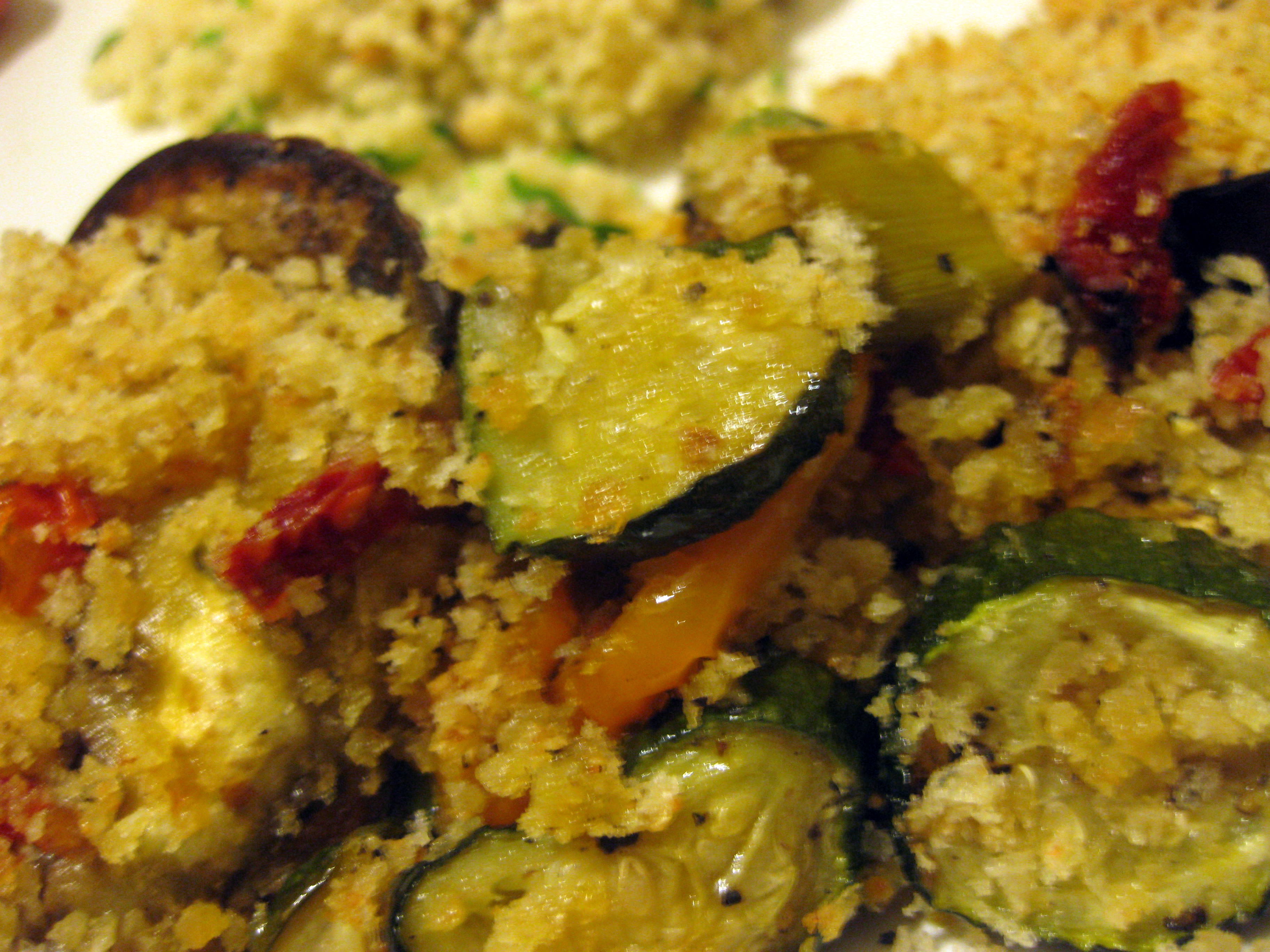
I tossed the vegetables in a liberal bath of olive oil, sea salt, and black pepper, then spread them out onto two cookie sheets, trying to keep them all in a single layer so they wouldn’t inhibit one another’s roasting.  In an oven preheated to 400F, I roasted them for about half an hour.  They softened and collected lovely dark roasty spots and it was a good thing I left the house for a while, because otherwise I probably would have stood over the cooling racks and eaten half the eggplant right then and there.

Resisting the urge to eat dinner at 3:30pm, I returned to the cooled slices later.  With the oven preheating to 375F, I (failing to layer) arranged the vegetables in my shallow oval dish.  As a last minute flash of inspiration and idiocy, I tucked a handful of sun-dried tomatoes in and around my little veg slices, and completely forgot the basil.

Since I made the bread crumbs by running the torn scraps of a sourdough baguette through my food processor, I dumped the butter, cheese, garlic powder, and some pepper right in on top of the crumbs and pulsed the whole thing a few times until the fat seemed evenly distributed.  I topped the vegetables with a liberal crumb layer and stowed it in the oven.

While the vegetables softened even more and offered each other new flavor profiles, I heated some chicken stock and olive oil to make couscous.  At the last minute, as I fluffed the tiny pasta with a fork (trying in vain not to scratch up the bottom of the pot), I added some toasted pine nuts and a few tablespoons of minced fresh parsley for added nuttiness and freshness.

The flavors of both torta and couscous were excellent.  I will continue to make couscous this way (I usually use chicken stock but haven’t ever really stirred in additional components before), but the torta needed some adjustments.  As I mentioned with my first Bittman experiment, it was really just roasted vegetables with a crumb topping.  There’s nothing wrong with that, per se, but I felt as though it were missing a binding agent.  Perhaps using tomatoes instead of a bell pepper would yield some juices, which would make the collection a bit saucier.  Perhaps using the recommended pan and enough vegetables to layer things up would have married flavors and created more cohesion.  Perhaps basil would have magically tied the whole thing together.  Perhaps, and this is badness from the baddest part of me, integrating slices of fresh mozzarella cheese before baking would make this dish – it would become like a mixed vegetable Eggplant Parmesan, but with the breading in crumbled topping form rather than fried around the eggplant slices.

How does it always end up being about the cheese?

Experimentation: Meat and Potatoes

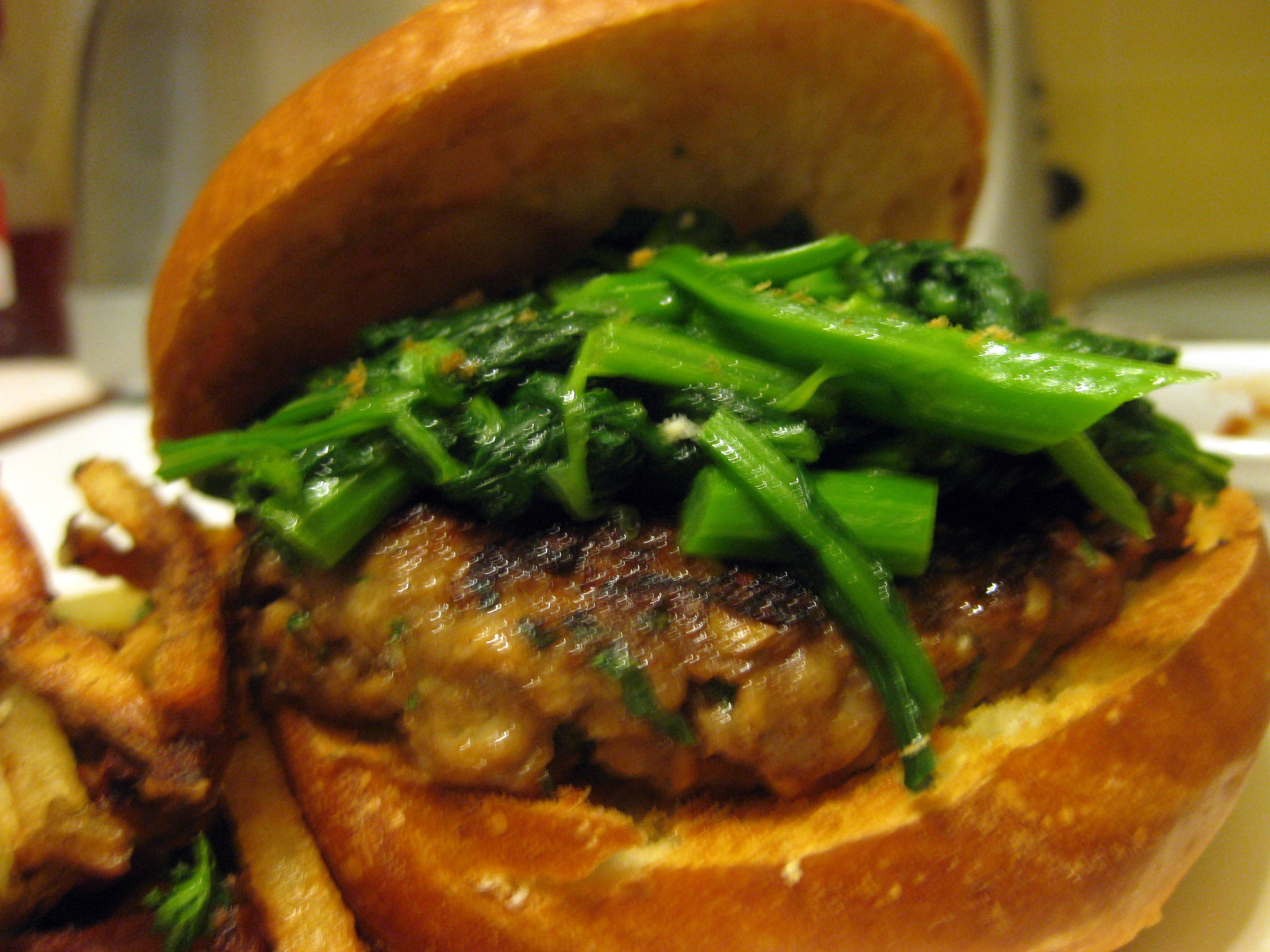
I somehow ended up with half a pound of pork sausage this past week. I don’t often buy ground pork, but after a triumphant breakfast calzone attempt (scrambled eggs, browned sausage, and cheddar cheese all folded up inside a pizza crust? Yes please!), I had half a package left to play with. The flavors of garlic and ginger crept into my mind, and in a moment of gourmet-level-clarity, they were joined by the words Asian Inspired Sausage Burger. With some potatoes shivering in the garage and a feverishly nodding, all-but-drooling response from my husband, I decided to go whole hog, so to speak, and make fries as our side. With the recipe coming together in my head, I bought fresh Kaiser rolls, a springy, fresh, brighter-than-bright-green bunch of broccoli rabe, and set myself to work.

For the fries:

2 russet potatoes, scrubbed clean

1-2 tsp. Coarse salt

1 tsp freshly ground black pepper

2 TB olive oil

2 TB minced fresh parsley

1 TB finely minced garlic

Preheat the oven to 425F. Cut the potatoes into four thin planks by halving the potato lengthwise and then halving each half. Cut each plank into strips the size you want your fries to be. On a cookie sheet or in a bowl, toss the potato strips in salt, pepper, and olive oil. Arrange in a single layer on a cookie sheet – if possible so that the fries do not touch each other. This will allow for uniform crispness. Bake for 35-45 minutes, turning fries every ten minutes, or until desired crunch is attained. Sprinkle with garlic and parsley and serve immediately.

Fries have to have a sauce, and since we were going Asian inspired with the burgers I wanted something more exciting than ketchup (also, in an admission that I know marks me as practically un-American, I will reveal to you that I don’t like ketchup. I don’t know why, I just don’t. It makes eating french fries at restaurants a sometimes tedious business). I rifled through my fridge and found some likely looking customers.

Fry sauce:

¼ cup ketchup

2 TB chili garlic sauce or to taste

2 TB black bean sauce or to taste(oyster sauce would work here too)

Combine well and serve with fries.

While the fries were growing progressively toasty and the sauce was, well, awaiting some skinny dippers, I set to work on the main event.

For 2 burgers:

½ lb. ground pork sausage (or beef, or turkey, or chicken)

1 TB finely minced or grated garlic (use a microplane to grate)

1 TB finely minced or grated ginger

1-2 TB black bean sauce (oyster sauce would probably work well too)

plenty of freshly ground black pepper

2 TB minced fresh parsley

1 bunch broccoli rabe, thick stems and florets removed

Mix all ingredients except the broccoli rabe gently in a medium bowl with a fork or with your hands. Press into two patties slightly wider in circumference than the buns you will be using. I made them fairly thin so they would cook faster.

Heat a TB of olive oil in a skillet over medium heat and add the burgers. Cook, flipping only once, until nicely browned and fully cooked. Time will depend on how thick you have made the patties; I think ours took only 4-5 minutes per side, if not less.

Meanwhile, blanch broccoli rabe in boiling water and then shock in ice water to stop the cooking process. Drain and dry well, then chop roughly. At the last minute, split, butter, and broil the buns until golden, and toss the broccoli rabe with a little sesame oil in a hot skillet until it is warm and any remaining water has sizzled away.

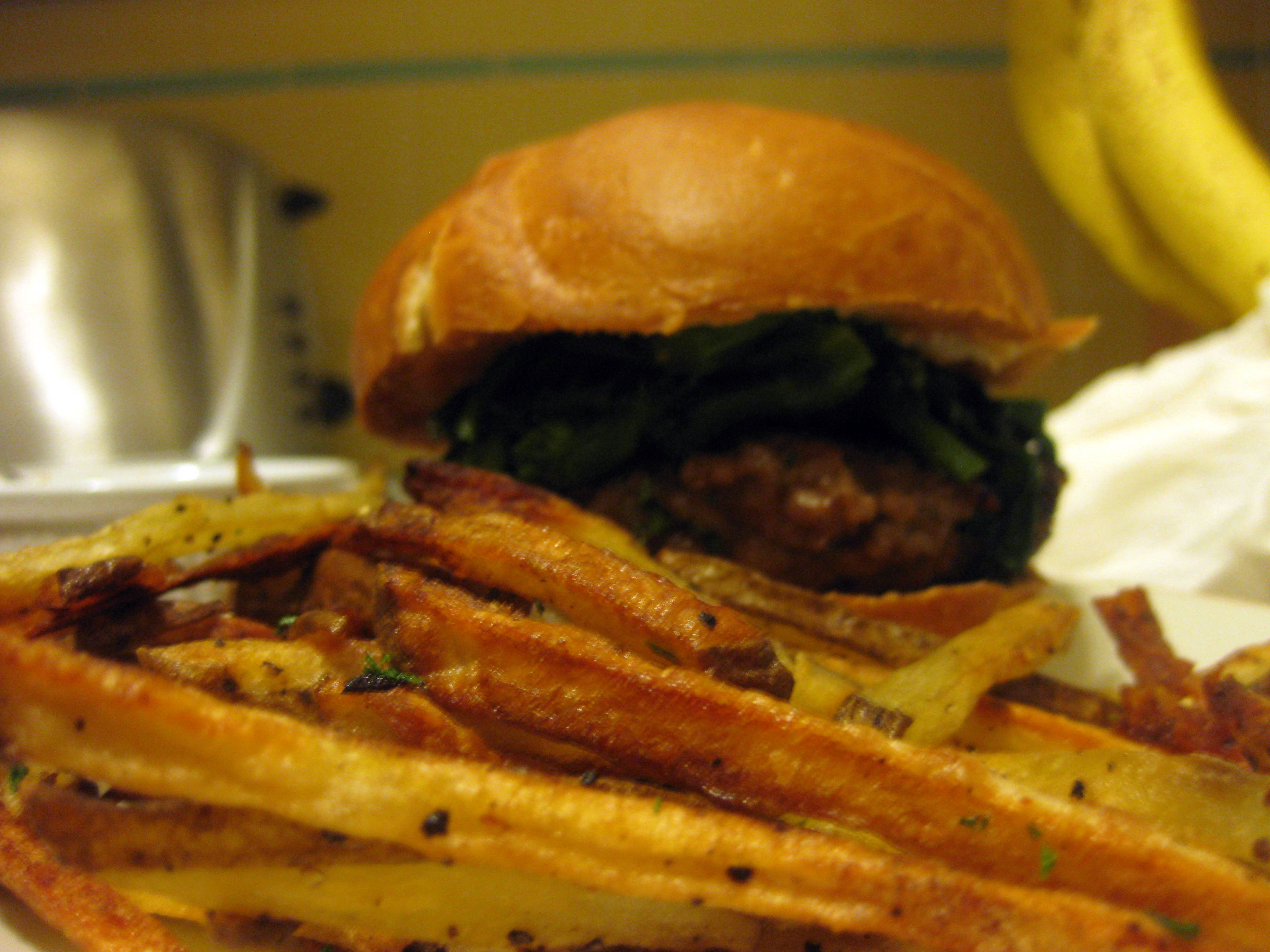
Serve burgers on hot toasted buns topped with broccoli rabe saute beside a big pile of piping hot fries. Because there was plenty of flavor mixed into the patty I didn’t think the burgers needed any condiment adornment, but if you feel they are dry or want an extra kick, use the fry sauce or condiment of your choice to dress them up.

These were really, really good. The garlic and the ginger gave the burgers a bright, mouth-warming zing. I’m not going to say they made the burgers spicy because that’s not the right word, but they definitely upped the excitement of the sausage and gave it a new flair. The black bean sauce added salty umami saliva-inspiring richness so that I didn’t miss the cheese I usually can’t be without. The broccoli rabe cut the rich saltiness of the burger with its bitter notes, which meant a lovely duel of flavors across my tongue. The french fry accompaniment was a delightful treat – they were crunchy and crisp but starchy and light inside. The salt, garlic and parsley were bright bursts of freshness I wanted to lap up even after the fries were gone, and the sauce was a pleasant way of tying them in with the flavor profile of the burgers.

A sesame bun or ciabatta roll would also have made a nice vehicle for burger delivery, and pairing them with Rogue Brewery’s Morimoto Soba Ale would have been a beautiful choice, and almost stereotypically in keeping with the theme. But you know, stereotypes are so often based on a kernel of truth, and the kernel here is deliciousness.

Hindsight

One of the valuable lessons this Bittman project is teaching me is flavor combinations.  I like to think I am a pretty good cook, and lord knows I can follow a recipe (well, when I’m paying attention…), but I am still learning how to put ingredients together without a guide.  Mark Bittman’s 101 is teaching me about this in two ways.  First, he provides me with glorious combinations of ingredients to try out.  Second, because I am not serving these dishes each week with “Thanksgiving dinner,” I am learning that before I make each item, I am only guessing how well it will match with the rest of the meal I’ve envisioned.  This week, we took on acorn squash, which is one of my favorites:

“45. Render some chopped bacon in a bit of oil, then add apple chunks; cook until nearly soft.  Meanwhile, bake halved and seeded acorn, butternut, or delicata squash until they start to soften.  Fill squash with apple mixture and finish baking.”

Much as I love winter squash, I was faced again with the difficulty of deciding what else to serve with what I hoped would be boats of delight.  Because our last squash experiment had needed something more substantial than the quinoa I paired it with, I decided this time on organic chicken sausages with roasted red pepper and garlic.

Bacon and apples sounded amazing and decadent, but I decided to add a little to Bittman’s foundation.  Here’s what I used:

1 acorn squash, halved and seeded

½ lb bacon, chopped

2 apples, skin on (I used Braeburns), quartered, cored, and chunked

½ a medium onion, diced (red onion added mild flavor and nice color)

1 tsp fresh rosemary, finely chopped

Salt, pepper, and olive oil

I preheated the oven to 400F for the squash.  To keep them standing upright, I sliced a very thin piece off the “bottom” of the rind where I wanted it to sit.  Just a little peel off the rind made a flat surface for the squash to balance on.  I wedged the halves into a cake pan and sprinkled liberally with salt, pepper, and olive oil.  I put them into the oven for about 20 minutes and concentrated on the stuffing.

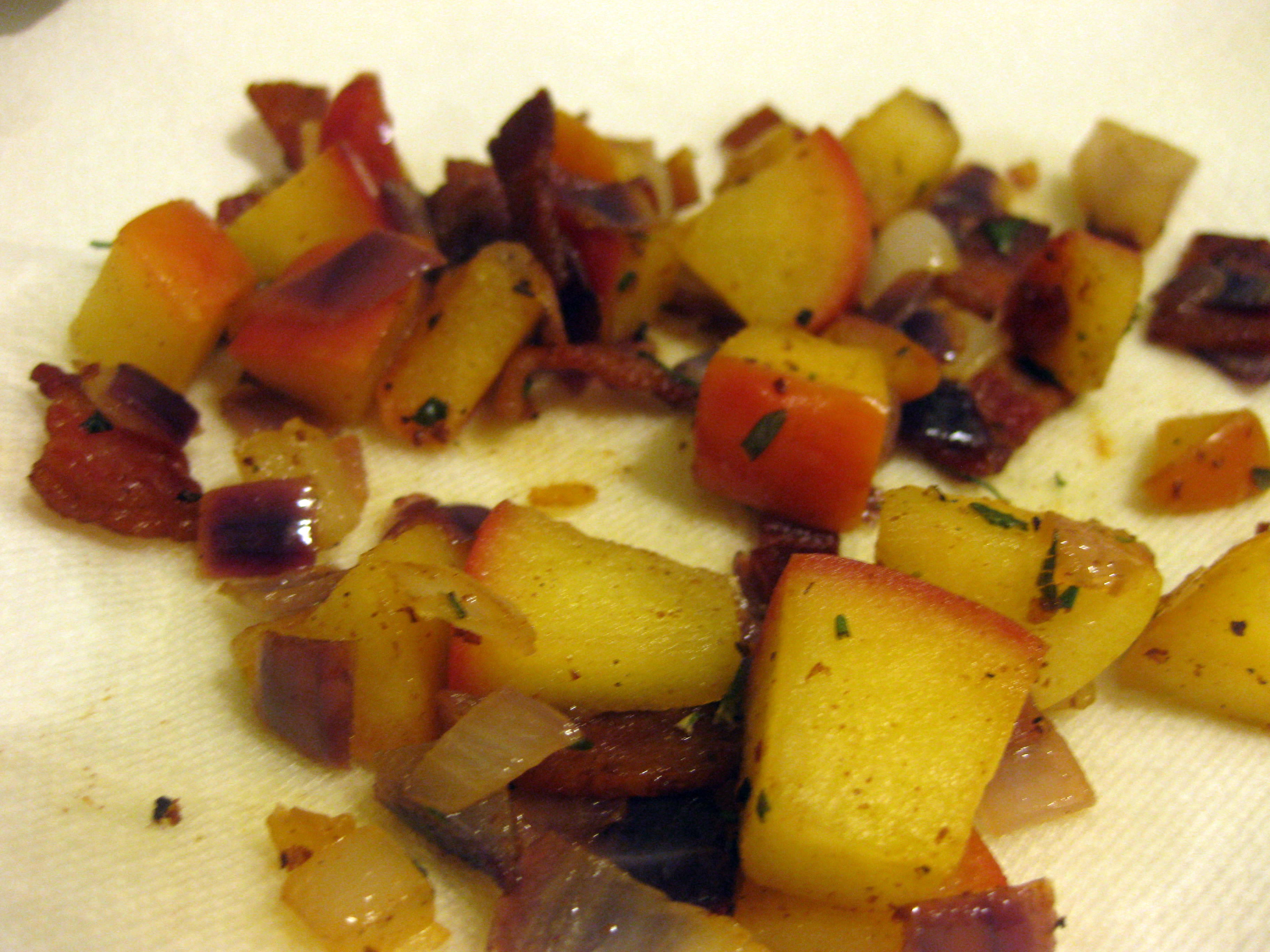
I decided to eschew the extra oil, and put my squares of bacon into a dry pan on medium.  While it sizzled, whining and complaining about the heat, I chopped the apples and onions.  With the bacon halfway to crisp, I dropped in the onions, wanting to give them time to grow tender and sweeten.

When the bacon was teetering on the edge of barest crispness, I added the apple chunks.  They only needed five minutes to begin to soften before I turned the stove off.  Because I knew they were going to continue cooking in the oven, I didn’t want them to lose all their texture in the pan.

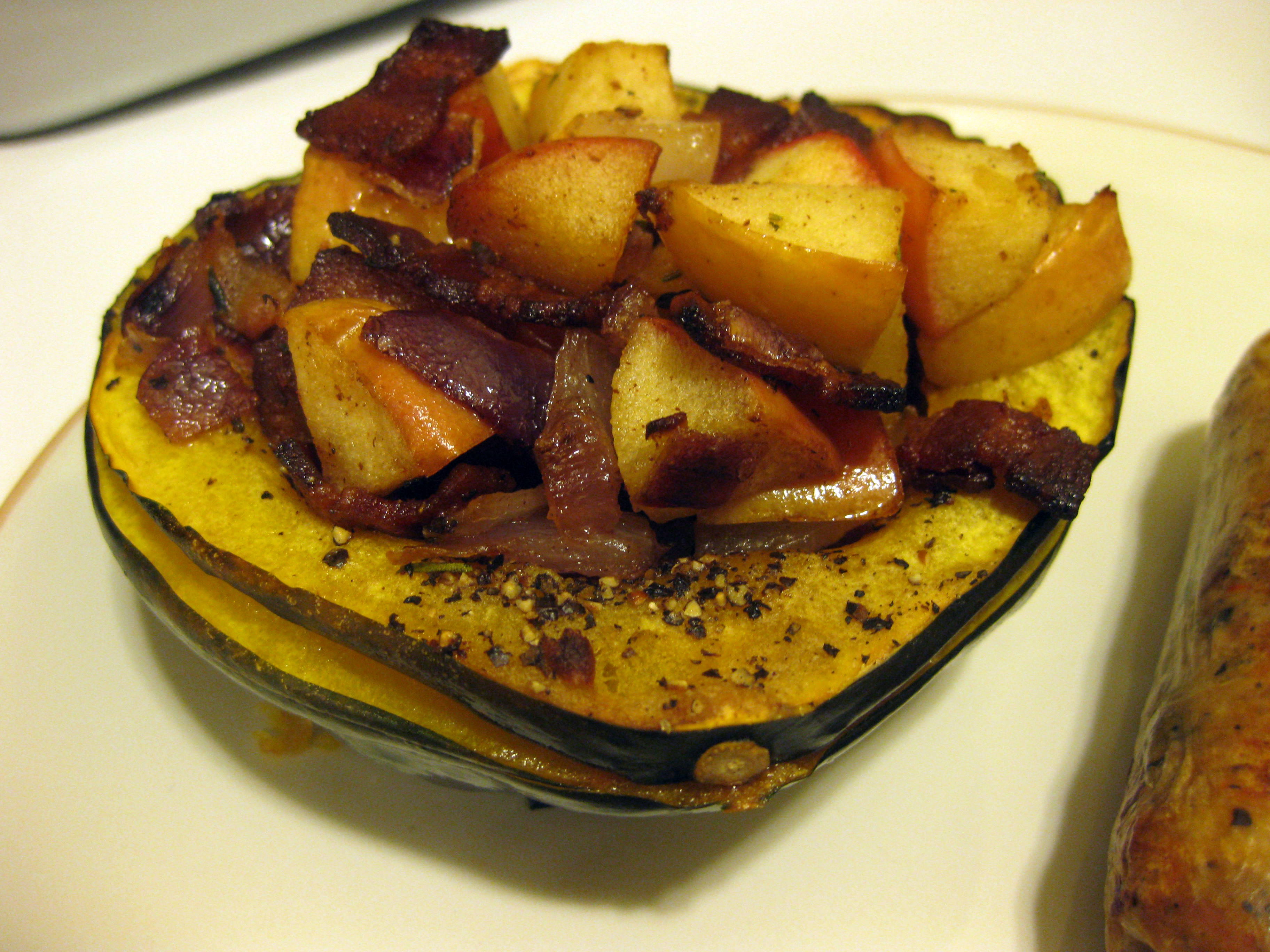
In three quick sweeps, I folded the rosemary into my apple mixture, slipped the squash out of the oven, and packed the boats full, no, overflowing.  They looked beautiful, and it was difficult to say goodbye as the oven door closed between us for another 20 minutes.

With sausages sizzling and charring and smoking ever so slightly on the stovetop, I liberated the stuffed squash and loaded them onto our plates.  The smell was wonderful, and the flavor matched.  The squash and apples were sweet, but had soaked up some of the bacon fat, which complicated their flavor.  The bacon itself was meaty and fatty and crispy and salty (I love bacon, can you tell?) and perfect.  It was a nice textural component as well, as the squash was beautifully soft and creamy, and the apples were barely toothsome.  As I had hoped, the sharp piney flavor of the rosemary kept the dish from being too rich.  It was a lovely herbal note.

Because I packed the boats so full, the bacon in the dish was more than just an accent, as I had somehow expected it would be.  Therefore, the side of chicken sausage I had chosen was not the best possible pairing.  It was not until the next day as I heated up the leftovers and ate them alongside a corn muffin we’d had as a side earlier in the week that I realized what would have been perfect: golden circles of baked or fried polenta.  I chose meat when I should have chosen starch.  But as I am learning with this project, there was really no way I could have known the perfect side until I had tasted the dish.  That means to get it perfect we will have to have this again.  “What a shame!” she exclaimed with a wink and a smirk.

This is absolutely a recipe to keep and try out.  I’d imagine the ingredients you stuff the squash with could be changed up: apples could be replaced with pears, bacon with prosciutto, or you could go more savory and add leeks or garlic, but if your squash boat includes bacon I’d recommend serving with a starchy side rather than meat – polenta, cornbread, maybe even buttered noodles or gnocchi.  My 20/20 hindsight says it would be better balanced.  And in a meal in which the vessel threatens to fall over and spill its rich treasures across your plate if you don’t take measures to keep it upright, balance is a necessary thing.