Polling…

Eight or nine months ago, two good friends of ours (mine, N.’s, our department’s) got married.  Because they were in Canada at the time on a Fulbright scholarship, no one here in Oregon who adores them were able to share their celebration in person.

But they are back now, and I have conspired to throw them a belated reception in my backyard in a few weeks.  We will be grilling, but I know there will be plenty of chopping, roasting, sauteing, and baking as well.  I have plans, but I’d love to hear some input:  if you were going to an upscale backyard BBQ, bringing your own grillables and perhaps a bottle of wine, what would you be bringing?  What kinds of side dishes would you hope to eat?  What items should not be missed when we assemble our menu?

First fire

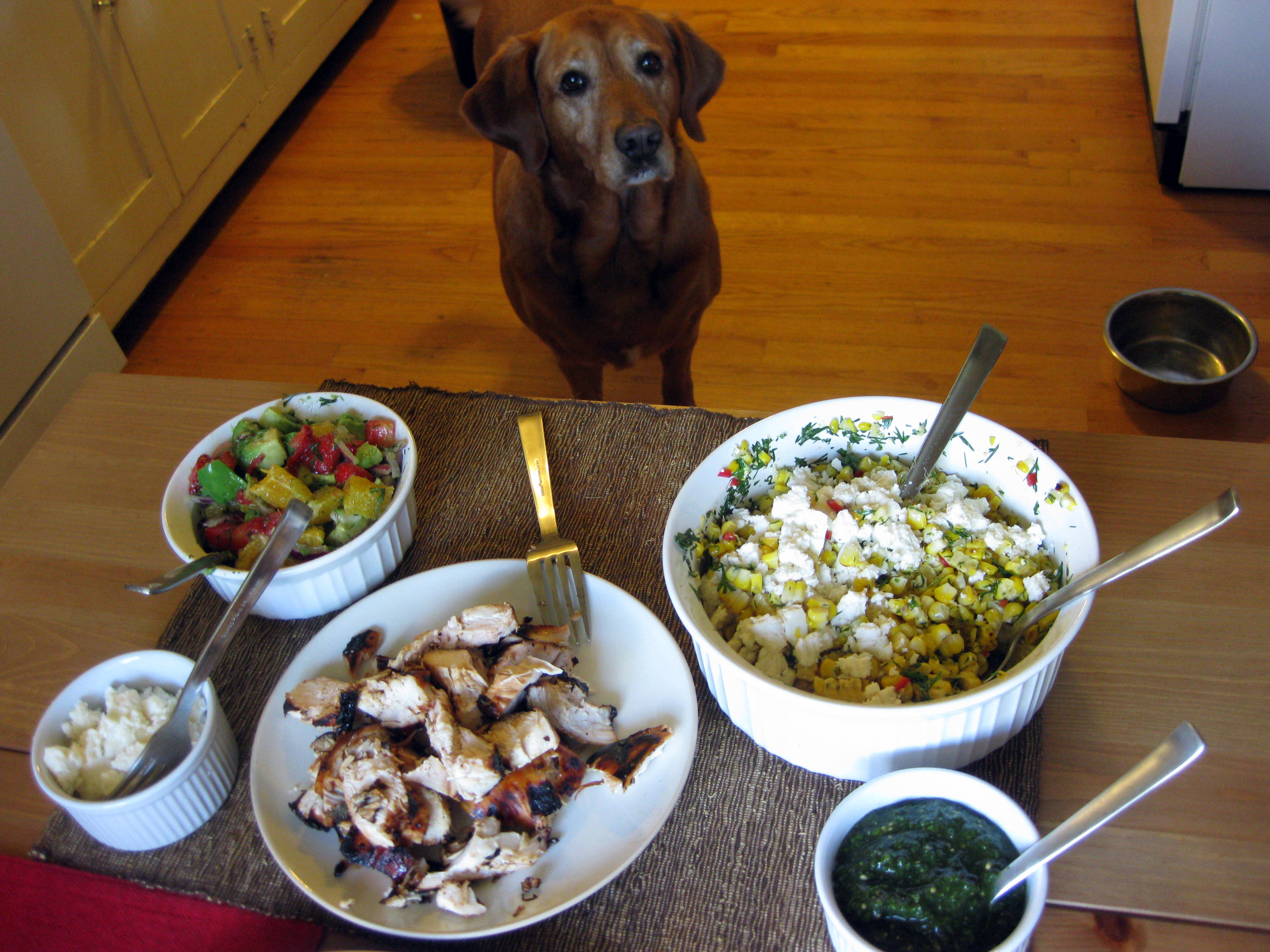
Don’t look back.  Don’t stop and talk to your loved ones.  Do not pass GO or collect $200.  Just grab your beer bottle, your children, your spouse, whoever, and run to your grill.  You must make and eat this, now: Honey-lime Chicken Fajitas with Grilled Fresh Corn and Avocado-Orange Salad.

At my request, N. just lugged our baby gas grill out for its first showing of the season.  It just needed to be dusted off, scraped down, and switched on.  And then we cover it with unreasonably delectable things like these fajitas from the June 2008 issue of Cuisine at Home (the recipe for the chicken can be found here).  With my numerous food magazine subscriptions expired, and me on a graduate student budget, I’ve started going back through old issues by month and, rather than cooking whatever I want willy-nilly, only permitting myself to use recipes from the month we’re in.  Thus this month I have four issues of various titles from June to choose from.  I didn’t need to look further than June 2008, though.

N. did an excellent job grilling the chicken breasts, which got crunchy caramelized exteriors from the honey in the marinade.  While he was busy, I was able to compose our two sides.

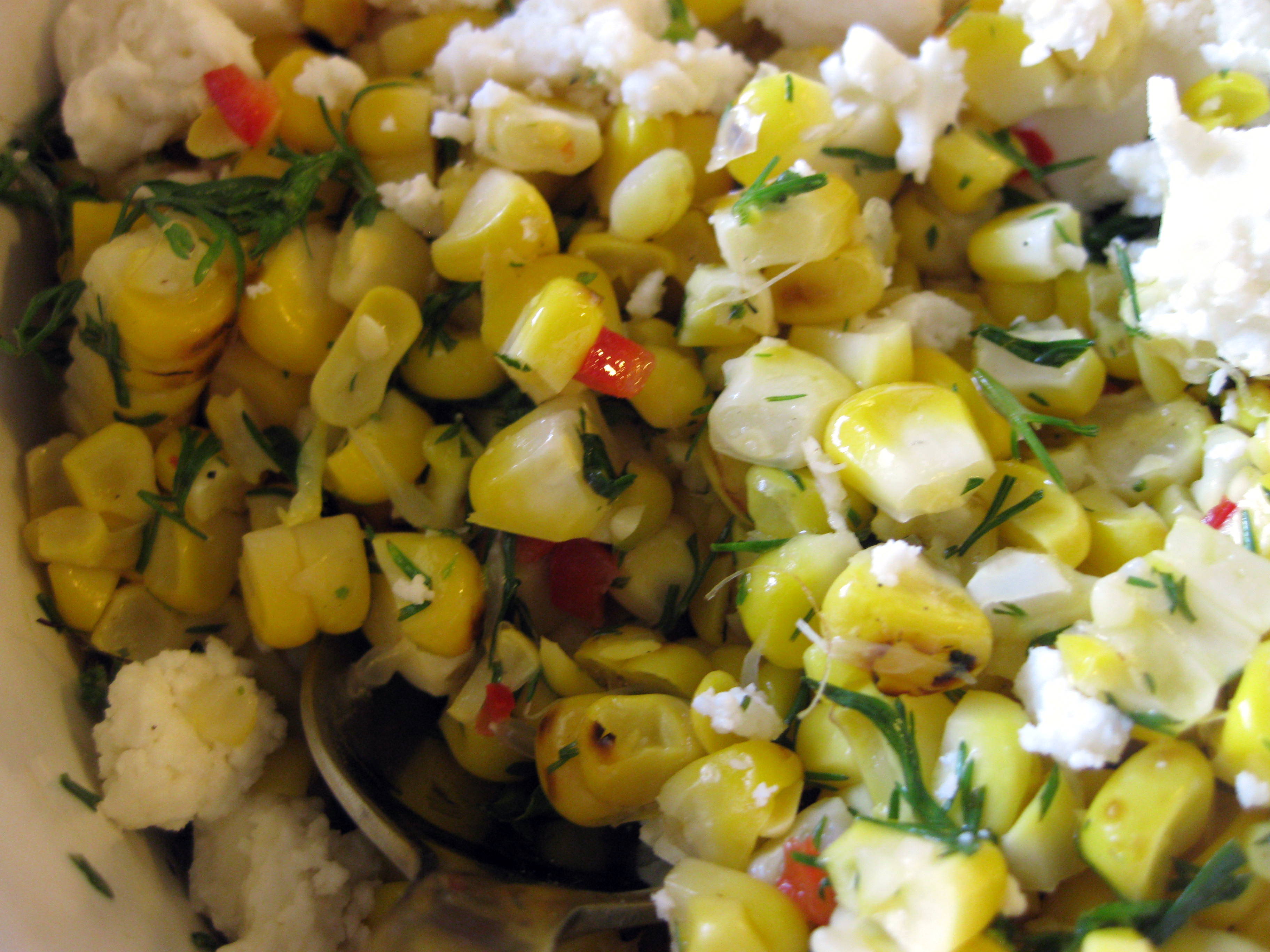
Love it or hate it, the cilantro in this grilled corn mixture added bright, grassy freshness and went with the sweetness of the corn extremely well.  Surprisingly, the queso fresco I crumbled over the top went along well too, probably because the salad was all freshness and crisp juiciness, and benefited from some creamy curds of cheese.

Because we had a sudden profusion (read: six) of tart garnet strawberries weighing down their respective stems in the backyard, I made a fruity addition to the Avocado-Orange salad Cuisine at Home offered.  Eliminating the garlic from the recipe and using the orange’s dripping liqueur instead of lime juice (one of my limes was most reluctant to give up anything), I mixed the roughly chopped strawberries in with an avocado, an orange, a few pinches of cilantro, and some salt and pepper.  Then I tried not to eat everything in the bowls while I waited for N. to bring the chicken in.

Fingers burning, we sliced it, then loaded up warm flour tortillas with thick moist slices of chicken, crumbles of queso fresco, sweet juicy pops of corn, and some green salsa (not homemade, but what can you do?).  I substituted a spoonful of Avocado-Orange salad for the salsa on my second fajita, and was equally overwhelmed.  So fresh.  So fragrant.  Such a pleasing, intriguing combination of flavors.

So quickly gone.

In homage to California produce

One of the things I’ve learned about myself as a cook is that while I am very good at choosing, following, and accurately executing recipes, I am not particularly imaginative – or impressed by my results – without them.  To combat this, as should be clear from my recent exposition on lasagna, I have been paying closer attention to ingredient combinations on restaurant menus.  With more practice and likely greater culinary training than my own, chefs in restaurants have an understanding of how ingredients work together, and which ones will meld together well, which is something that I am still learning.

So, I have been taking notes and copying descriptions from meals that I enjoy and establishments that I have been impressed by, and trying to recreate them in my own way.  Inspired by the ridiculously beautiful shelves of greenery in the Raley’s grocery store in N.’s hometown, I wanted to make something fresh and delicious with plenty of produce.  We eat out quite a bit when we visit our parents, because with time to make the trip down to California only twice a year, it tends to be a festive week or two.  Therefore, one evening when N.’s parents were out bowling, my vision turned green.  There were bright, dripping bunches of broccolini, and rapini, and dandelion greens, and kale and turnip greens, and that was just the beginning.  I don’t think I’ve ever seen dandelion greens in a grocery store before, and was tempted, but forced myself to be realistic.  I thought back to our trip to Ashland in July, when N. had this:

IMG_1420

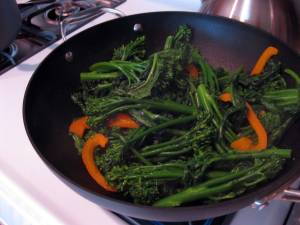
Gnocchi in an herb, wine and garlic sauce, topped by a rosemary-grilled breast of chicken, bell peppers, and broccolini.  Inspiration achieved.  I grabbed both broccolini and rapini from the produce shelves, a beautiful orange bell pepper, and some pre-made gnocchi from the refrigerated area.  N. has been yearning after these pillowy little fluffs of potato pasta, so I was happy to oblige.

IMG_1615

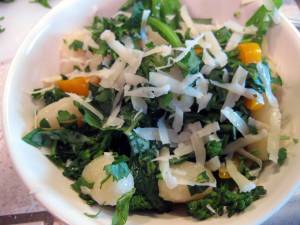
Surrounded by emerald leaves, buds, and juicy stems on the kitchen counter of my in-laws’ house, I chopped up the greens and steamed them briefly to reduce some of the bitterness that I know hides in these lesser-loved brassica hybrids.  When they were just tender, I drained off the water and moved them to a deep skillet, where I stir-fried them with thinly julienned bell pepper slices while the gnocchi boiled.  I added some garlic, and at the last minute tossed in the gnocchi, some leftover parsley from a previous night’s adventure, and a few small chunks of butter.  It wasn’t the most sophisticated sauce, but the colors were just gorgeous.  We topped our bowls with parmesan cheese and filled our bellies with vegetables.

IMG_1617

It was so simple, but so fresh, and the flavors were strong and tasty.  I like bitter vegetables a bit more than N. does, so to make this again I would steam the broccolini and rapini a bit longer, and perhaps in chicken or vegetable broth rather than water.  This would probably also make a silkier sauce, as would a dash or two of a full-bodied white wine.  However, this fresh burst of vegetables reenergized and refreshed us, and boosts my confidence about my plan of attack.  With N.’s Ashland dinner recreated, and three butternut squashes slowly swelling in the garden, my meal from the same night may be next on the “restaurant recreation” horizon.  Squash stuffed ravioli in a sage brown butter sauce with crumbled biscotti and gorgonzola cheese, anyone?

Food words

The words we use when we talk about food, and the attitudes they invoke, positive or negative, intrigue me.  For example, “buttery” is a good word.  It connotes flaky pastries, dense nut-filled cakes, rich bready desserts or breakfasts.  However, “oily” is a bad word, and “greasy” is even worse.  Why is that?

(This will seem like something of a non-sequitur, but I promise you’ll see where I’m going here in a paragraph or two.)

I recently saw the Meryl Streep/Amy Adams movie Julie&Julia.  While I will leave the review to my friend S., who is good at that sort of thing, I will comment that the food cinematography in the movie is marvelous.  I don’t know whether it is always real food they are using or not, but the colors were deep, the textures were luscious, and the sounds (mixing, slicing, carving) were pretty realistic.  At one particular point in the movie, as Julie Powell and her husband are sitting down to a dinner of bright red and yellow rustic-looking bruschetta, all six of the women I saw the movie with (including me) said something between “ohhhhh,” “mmmmmmm,” and “yum.”  Or maybe all three.  So a few nights later, inspired by the bursts of orange from the sungold cherry tomato plant in my backyard, I decided to try out Julie and Eric Powell’s dinner.

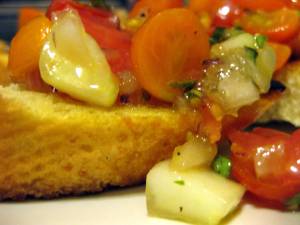
Starting with my favorite basic bruschetta recipe, I chopped up one red early girl tomato, a few dozen cherry tomatoes, a peeled and seeded cucumber from the back garden, and a handful of red onion.  Then I added julienned basil (backyard again!), salt, pepper, olive oil, and a tiny splash of red wine vinegar.  Then I let it sit in the fridge for a few hours while we went about our business. IMG_1522

After watching a dear colleague successfully defend her dissertation and then celebrate accordingly, we picked up a loaf of sourdough bread on the way home and the magic really began.  Generally when I make bruschetta, I toast the bread slices in the broiler.  However, in her rendition in the movie, Julie Powell (or Amy Adams; I don’t know whether Julie Powell ever actually made this) fried her bread in olive oil.  Wanting to stay as true to the beautiful food in the movie as I could, I opted to do the same.

Though some of my bread got a little dark, most of it turned out just fine.

IMG_1526

We stacked up the vegetables on the bread, covering every square millimeter possible before biting in and, of course, losing half the tomatoes to the plates below.  They squirted down our chins and slicked up our hands, but it was worth it, and here we return to my initial question.  The tomatoes were good and juicy, the cucumber was crisp, the basil added the right zing, but the bread was really what made the dish excellent.  It absorbed enough olive oil to be a beautiful golden brown color, and the crumbs of each slice became crisp; the perfect surface to stand up to the weight of the tomatoes, but still soak up a little of the juice the vegetables had created.  Biting into a slice was a textural experience, because the inside of the bread was still soft, but the crust was crunchy and the outer surfaces were crispy, and the whole thing was deliciously… oily?  Oiled?  In our low/no-fat culture, obsessed with cleanliness and thinness and sleekness, the idea of oil seems objectively negative.  But this was wonderful and delicious and silky and superb.  What can I call it?  Can we bring back, can we reclaim “oily” to mean what it should mean?  That crispness with buttery rich moisture I experienced with our weeknight dinner?  I think we should.

IMG_1527

Zucchini Days of Summer, Part 2

Anticipating a bumper crop of zucchini from the moment we planted our starts, I spent the late spring / early summer evenings scouring cookbooks for likely recipes.  I marked so many that now it’s just a project of choosing between them.  For Part 2 of this continuing series, I chose zucchini fritters.

IMG_1496

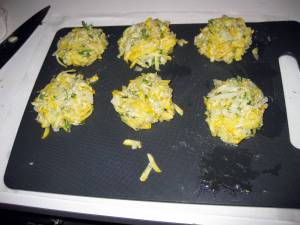
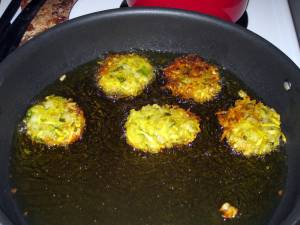
These were sticky, but pretty easy to assemble, being simply a mix of shredded zucchini, onion, some herbs, and flour.  The fritters in this photo look remarkably like cheddar cheese, but that is actually yellow zucchini, which is part of the reason for this sequence of posts.  We thought we were purchasing one zucchini plant (green) and one crookneck summer squash plant.  However, the yellow squashes ended up looking suspiciously like… guess what… zucchini!  And indeed, that is what they are.  Two zucchini plants = more creative zucchini recipes for me.

IMG_1500

With the fritters delicately molded, I scooped them gently into a big pan of shimmering olive oil to fry (not to toot my own photography-skills horn, but I love how you can see the texture of the olive oil in the pan in this photograph.  When recipes elusively call for adding the food when the oil is “shimmering,” I’m pretty sure this is a textbook example of what they mean).  With the oil only about ¼ inch deep and nice and hot before adding the victims, they didn’t absorb too much.

IMG_1503

After a brief drain on paper towels, I stacked them all up on a plate, added crumbled feta cheese and finely grated parmesan cheese to the top, and served hot.  The hotter the better, I think.

IMG_1505

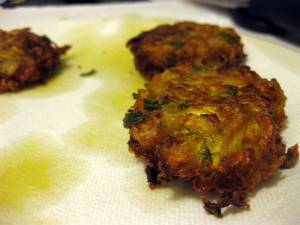
You can see the texture here: the onion and flour made these fritters reminiscent of latkes, although the flavor was definitely zucchini, with the sharp greenness of the chopped herbs and the salty tang of the feta and parmesan.  They were crispy but still moist, and despite it being our third zucchini dish in two weeks, there were no leftovers.

Homegrown Feast

Michael Pollan, author of “The Omnivore’s Dilemma” and “In Defense of Food” (the latter of which is on my wish list, if anyone is so inclined…) has written a New York Times article about the upcoming movie “Julie & Julia,” the show “The Next Food Network Star” and the network from which it springs, and about food and the American mentality for it in general.  He considers why food, and cooking, have become spectator sports instead of daily endeavors, and concludes that a combination of increasing work hours, ever advancing kitchen technologies, and endlessly multiplying availability of quick and easy processed foods, are leading us out of the kitchen.  However, speculating that the instinctive, reptilian parts of our minds that are always subconsciously searching for sustenance are attracted by the appearance of food being made, we like the Food Network with its fancy presentations, competitive cooking shows, and analyses of restaurants.  Though this does not surprise me about American society in general, I am trying to set myself apart from this norm.  Hence the blog, the backyard garden, the subscriptions to cooking magazines… I try to pick up techniques and inspirations from Food Network shows, though I do admit to sometimes just enjoying watching someone else do the cooking.  However, today was something of a proud moment, considering Pollan’s article, which I read shortly after lunchtime.  Today each one of my meals included something homemade or homegrown.

For breakfast I feasted on toast topped by pluot-raspberry jam, lovingly preserved by a friend and colleague.  It was glossy and thick and sweet-tart with lumps of fruit inside, my favorite way.  I like my jams and preserves to still resemble the fruits they once came from, so they feel a little more real.

Lunch was one of my favorite summertime meals.  In celebration of our first full size ripe tomato (we’ve had great luck with the sungold cherries so far, but the big tomatoes are blushing only grudgingly), I picked it, carved it into thick slices, and had myself a juicy, creamy, yummy tomato sandwich.  I like my bread toasted, with mayonnaise on both sides to hold in the seeds and tender flesh of the tomato.  That’s all.  Ungarnished.  Unfancy.  Fresh and delectable.

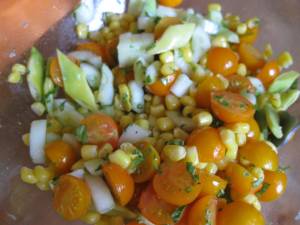
Dinner was a big triumph.  At my best estimate, about 70% of our dinner came from either my garden, or our neighbor’s.  Armed with cherry tomatoes, a few yellow pole beans, green onions, basil, and oregano from my yard, and a cucumber accompanied by a zucchini practically the size of a T-ball bat from our neighbor’s garden, I went to work.  I blanched the beans since a few of them were quite long and I was afraid they would be tough, before combining them with the halved sungolds, sliced cucumber, and a cup or two of defrosted frozen corn.
IMG_1379

I tossed these with a really simple vinaigrette of just red wine vinegar, some sugar, and a touch of olive oil.  Salt, pepper, and a small handful of julienned basil, and the salad was done.  I set it aside to marinate while I fixed the main event.

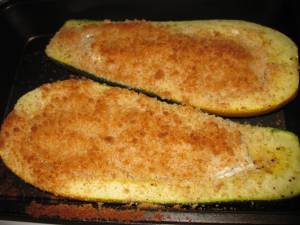
The zucchini was so big that I knew the seeds would be fully developed, so I sliced the monster in half lengthwise and scooped out the seeds, leaving the flesh behind.  I added salt, black pepper, and a little olive oil to the flesh before placing the halves in a roasting pan.  Per a distantly related recipe I found in a vegetarian cookbook, I added a little water to the roasting pan and slapped some aluminum foil over the top before letting them cook for about fifteen minutes, just to start softening up the flesh.  Meanwhile I mixed up the filling.  After finely chopping the green onions and oregano from the garden, I mixed them into some goat cheese along with garlic powder and Penzey’s Black and Red pepper mix that I particularly like.  When the zucchini halves finished their steam, I took them out, filled them with the cheese mixture, and topped them with considerable mounds of fresh white bread crumbs.  Then it was back into the oven for another 25 minutes, when the bread crumbs were suitably golden for my taste.
IMG_1383

When they came out, we cut off thick slices and ate them with the salad as a side.  The zucchini flesh was tender but still had some texture to it, and I was surprised to find that the skin was not a bit bitter.  The goat cheese lent a tangy flavor that was, surprisingly, not so strong that it overpowered the vegetable.  The bread crumbs were a nice touch, adding a crunchy texture and toasty flavor to the dish.  I think when I make this again (our own zucchini promise that I will), I may add some lemon juice or another acidic flavor to the cheese mixture.  I generally like my vegetables with lemon, and the goat cheese has a unique tartness that leads me to believe it would pair well with a squeeze of citrus.

IMG_1388

Feeling like a ecologically, environmentally, locally responsible citizen of the world, I can’t help but feel a twinge of longing for ice cream… packaged, processed, hermetically sealed… but maybe I’ll settle for a homebaked blueberry struesel bar instead.