The Buttercream Project 3

My favorite weekends always turn out to be the ones that revolve around cooking.  You know the ones I mean.  You have a dinner party, or a potluck, or an afternoon on the porch surrounded by cookbooks, or you watch a marathon of FoodNetwork shows while almost absent-mindedly spooning one of your favorite indulgences into your mouth…

I wouldn’t know what that’s like…

Seriously, though, I am suddenly having one of those weekends.  Our friend Sh. is sharing a pulled pork dinner with us tonight, so by 9am (which felt like 8am, cursed Daylight Savings…) I was standing at the kitchen counter, pouring ginger ale and Jack Daniels whiskey atop 4 pounds of pork butt in my slow cooker, and deciding whether it needed anything besides salt and pepper to round out the flavors (I decided on a big chunk of fresh ginger and a few shakes of Worcestershire sauce).  Now, I’m sitting in the kitchen babysitting a pot of polenta, which I’ll cook, spread, and chill today to be cut into squares, pan-fried, and eaten later this week, and keeping a wandering eye on some cornbread, which we’ll have tonight with the pulled pork.

And yet this post isn’t about any of those things.  Whether you believe it or not after that extended tangential introduction, this post is about buttercream.  Again. 
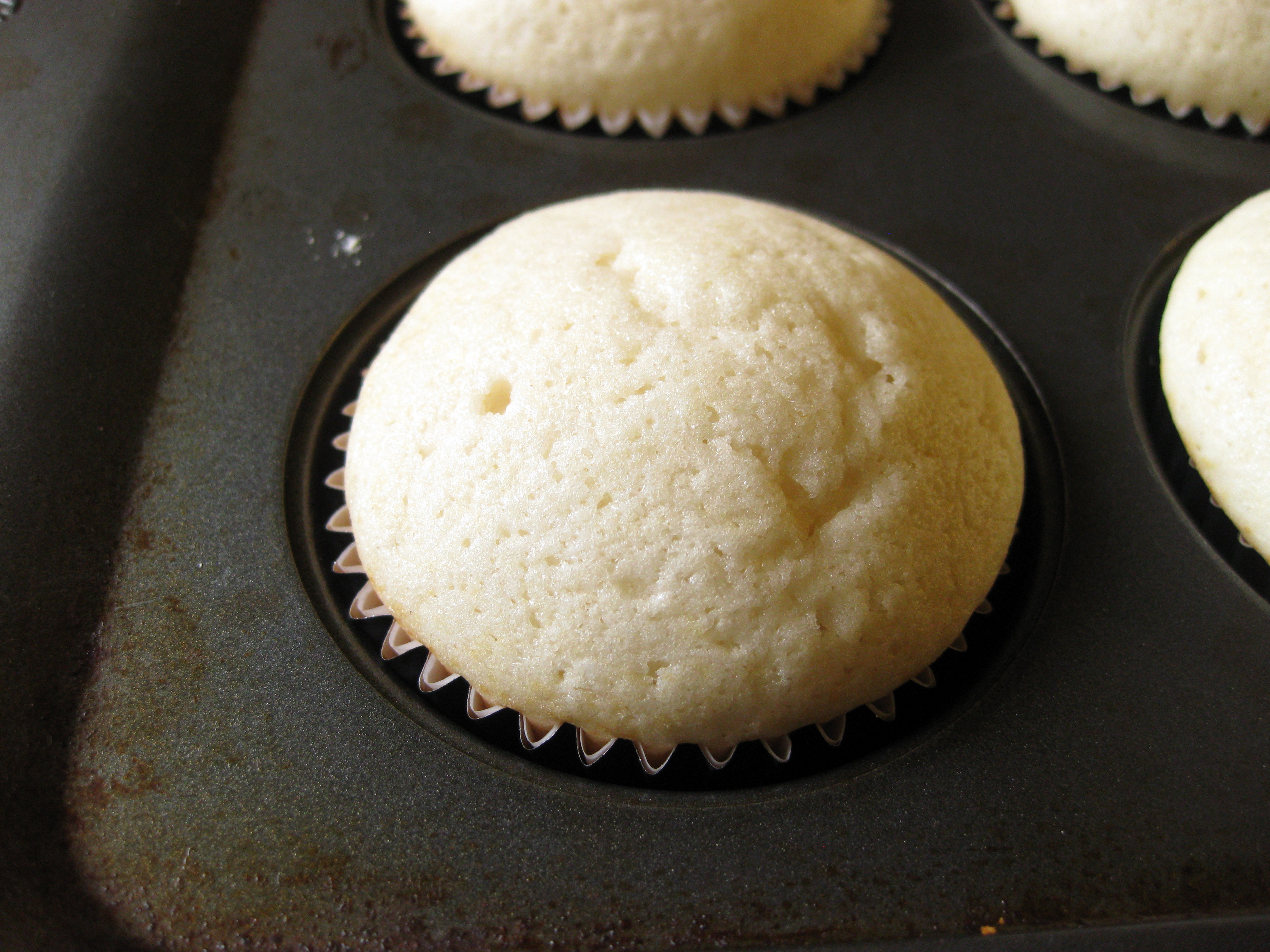
I’ve completed my third buttercream experiment, and I must report mixed success.  I decided this time I’d better try out the cake recipe I’ll be using for the wedding in cupcake form so I could start nailing down baking times.  On a whim, I picked up some cake flour, which I’ve never used before.  This was for texture: often my cupcakes, if they are not chocolate, end up with a suspiciously muffin-like consistency, and I didn’t want that for these babies.  I also picked up some mascarpone cheese to continue the experiment in de-sweetening the frosting.
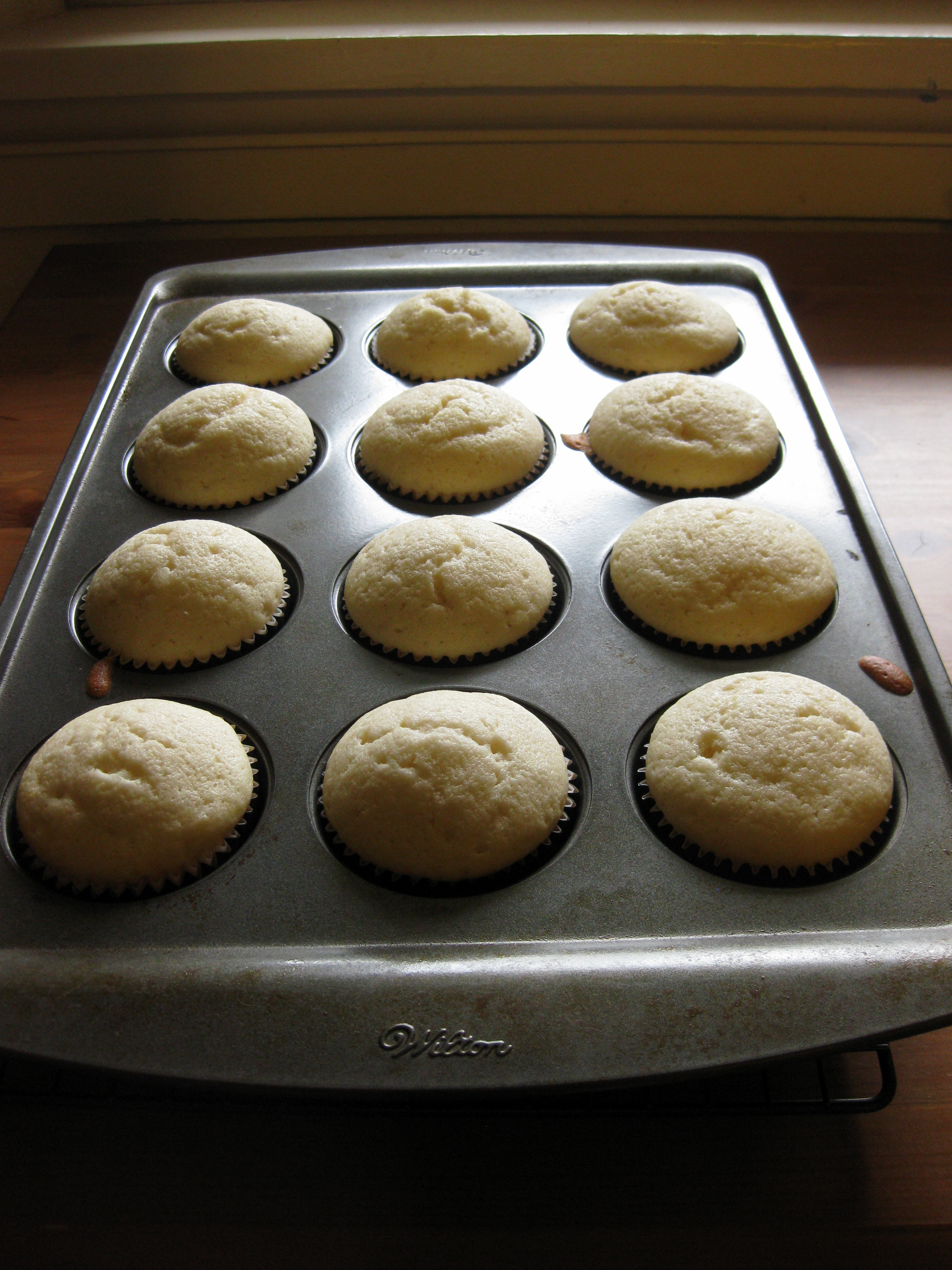
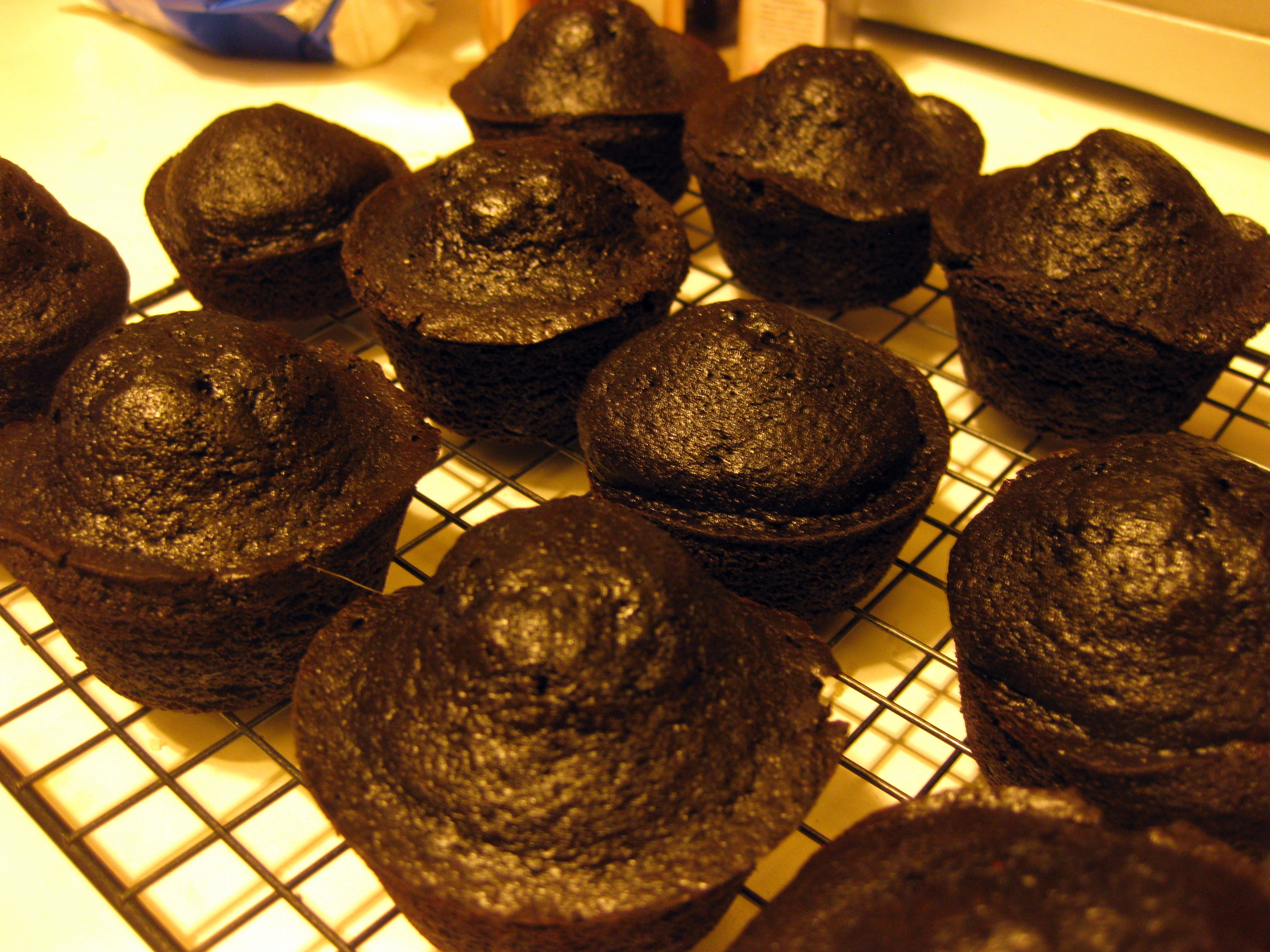
The baking process involved a lot of checking the cupcakes with a trembling toothpick, hoping for the barest of moist crumbs, not a completely clean tester.  I have found the completely clean tester is a recipe for overcooked baked goods, especially when it’s something very tender and delicate like cupcakes, because the cake continues to cook for a while as it sits in its tin on the cooling rack.  Tough cupcakes would not do.  Fortunately for me, they cooked up the color of pale cream and sported perfectly slight, perfectly shaped domes. They were pillowy tender.  They smelled good too – sweet and soft with the barest hint of floral fruitiness from the sparkling wine I used.

As they cooled, I started the buttercream process.  I wasn’t nervous at all this time – hadn’t my previous attempt come out smooth and creamy and lusciously perfect?  This time, I was golden.

This time, unfortunately, my kitchen was about 59 degrees Fahrenheit and, despite having left the butter out for hours and hours, it wasn’t the same squashy softness it had been last time.  The mascarpone cheese I decided to use was fresh from the fridge, since it was already soft enough that it didn’t occur to me having it at room temperature would make a difference.

It does.
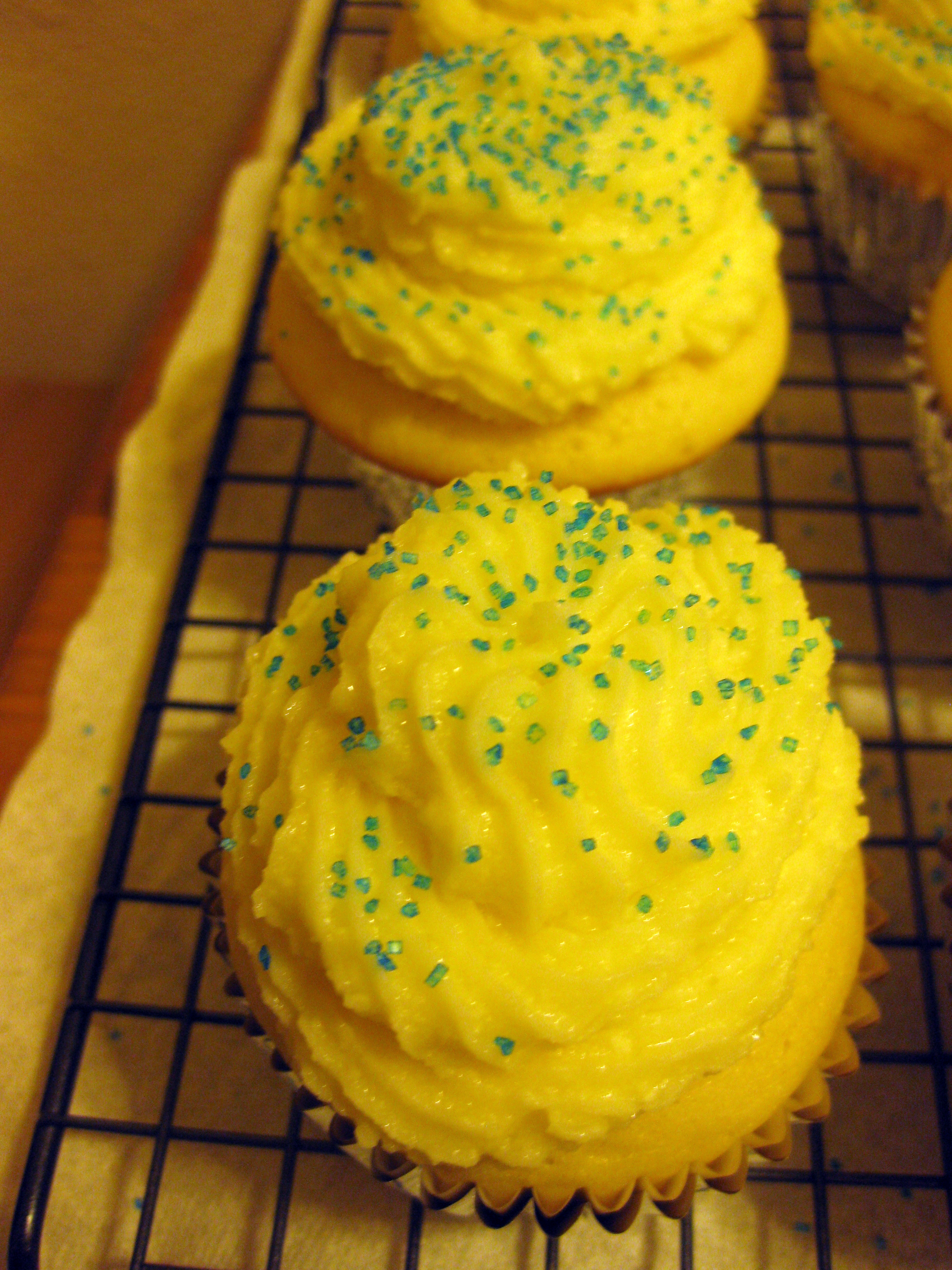
Here’s what happened.  I whipped together a cup of butter and a cup of mascarpone cheese.  I sifted in about 3 cups of powdered sugar, a slight sprinkle of salt, and then trickled in a couple tablespoons of whole milk and a splash of vanilla (I can’t find champagne extract anywhere besides Amazon.com, where it costs upwards of $12 for a teensy bottle.  Needless to say I haven’t bitten that bullet).

Immediately I knew this wasn’t going to be perfect.  Already I could see tiny little clumps of butter, rechilled by the cold cheese, and tiny lumps of sugar, courtesy of a hasty and careless sifting session.  I pressed on regardless, deciding in the moment that this experiment was about taste, not texture.  Let’s get the taste right first, I told myself, to avoid the tumble into hysterical depression the blue poo cake had wrought.

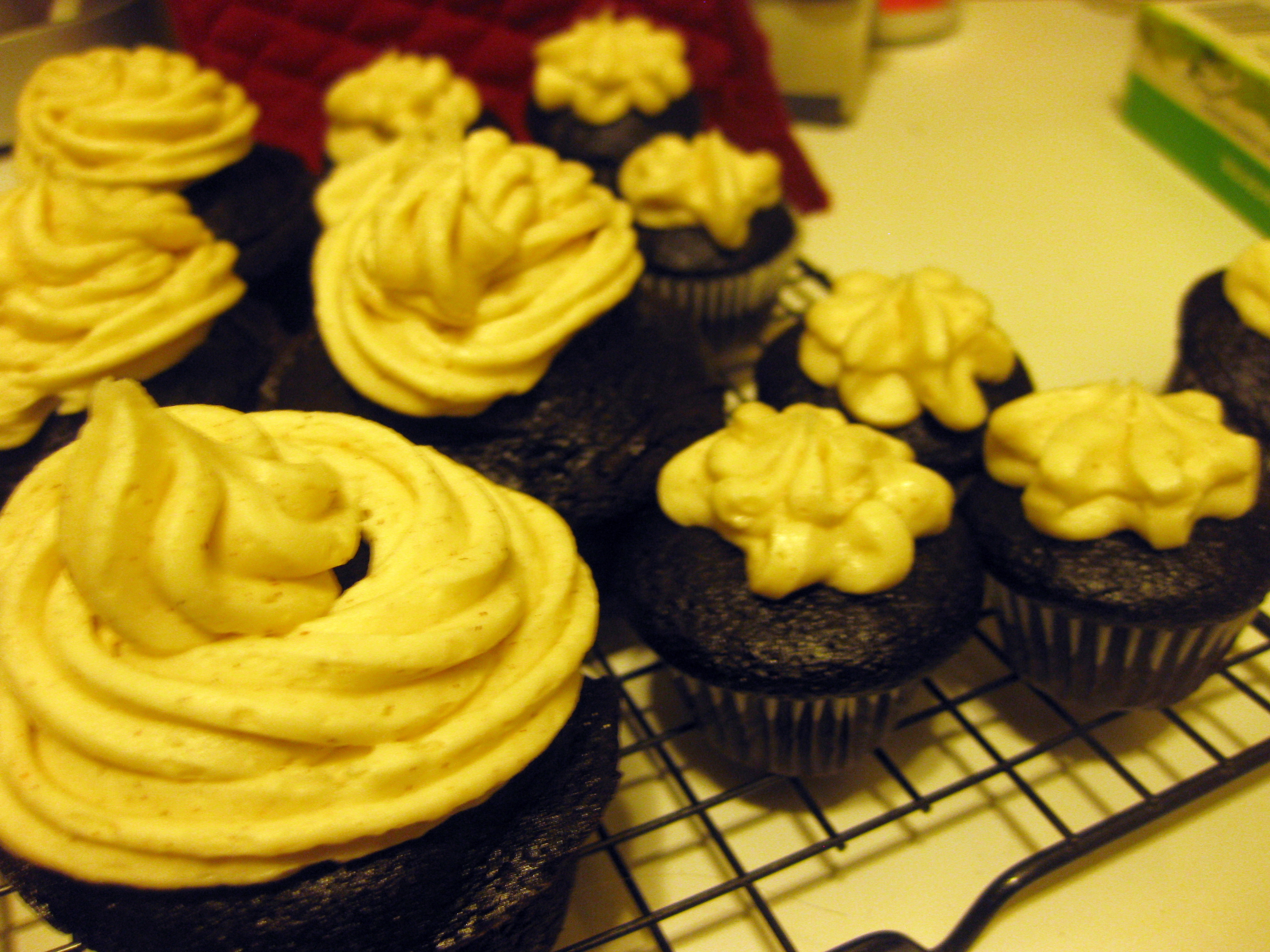
So I loaded up a piping bag with my new fancy-pants metal star tip and went to work on the full sized cupcakes.  In the process I got enough frosting on my fingers to be able to taste, and I have to say I was incredibly pleased.  The mascarpone cheese added another layer of velvet and creaminess, and because it is not sweet to begin with, there wasn’t as much overwhelming saccharine powdered sugar taste to the finished product.  The touch of salt probably helped with that too.  It was just incredibly rich and moist and lovely.

The texture, on the other hand, sucked.  Well, that’s not fair.  It wasn’t ideal.  It was slightly grainy, and the star tip’s sharp edges combined with my not-exactly-quite-as-smooth-as-I’d-wanted icing produced rough crumples on my swirls of frosting rather than delicate demure rosettes.

Hasty, thoughtless, and stubborn, I pressed on to my next experiment.  I’d found this the previous month: a video tutorial about making beautiful blue flowers on mini cupcakes, and I wanted to surprise my bride by testing these out.  I considered, as I dripped blue food coloring into the remaining buttercream, rewatching the video.  And then I talked myself out of it.  I’d watched it twice, I remembered basically what she’d said to do, and she made it look abysmally simple.  I’m marginally artistic.  How hard could it be? 

For starters, the frosting was now looking a little wet.  Terrified of a repeat blue poo scenario, I added more powdered sugar.  But now I was in a hurry, because I had girlfriends coming over for a TV night and I wanted to serve them beautiful, frosted cupcakes (notice I didn’t say beautifully frosted cupcakes.  I was trying to be realistic).  So I didn’t sift the sugar.

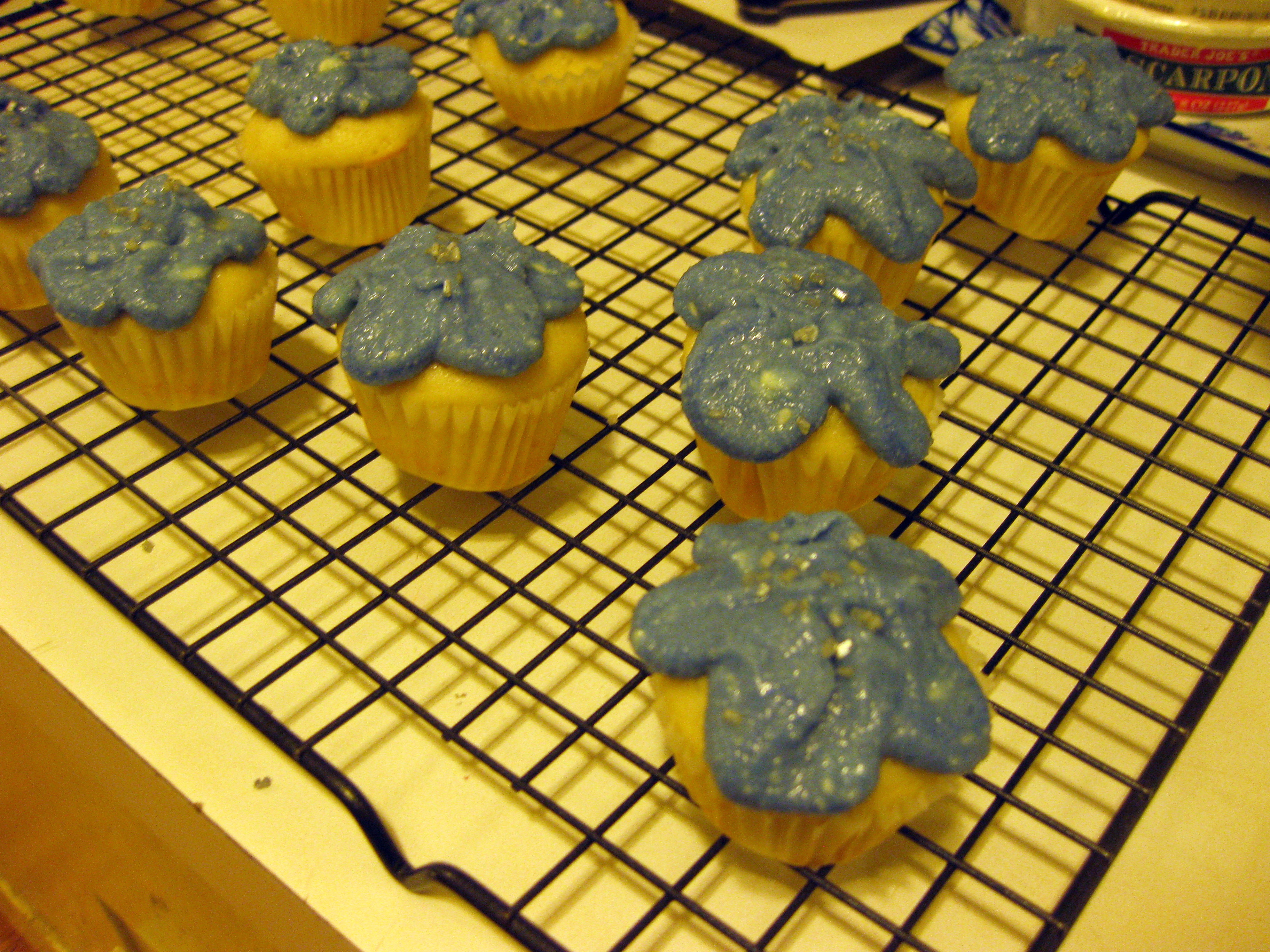
This, as you might expect, resulted in more lumps.  But I was not to be discouraged.  I slapped some icing into a bag with a tip that looked similar to the one in the video tutorial, and started trying to make flower petals.  I made circular blobs.  There were no delicate curling edges, no gentle petal shapes, and the lumps of powdered sugar I’d stubbornly ignored made the frosting emerge from the piping tip unevenly.  I ended up with deformed starfish in a lovely cornflower-esque shade on the mini cupcakes, and a spotty lace pattern surrounded by blue blobs on the tiny taster cake I’d made for the bride and groom.  (It was supposed to be cornelli lace, but when hunks of cold butter in your frosting burst out through the piping tip, all bets are off.)  I did, however, glean a valuable tip for frosting a cake from the Barefoot Contessa: once you have your layer covered, dip your frosting spatula in very hot water and run it gently over the sides and top surface of the cake.  The hot water lightly melts the very outer molecules of butter and sugar and solders them together while smoothing them out, resulting in a perfectly level layer of frosting.  I tried this out to great success.
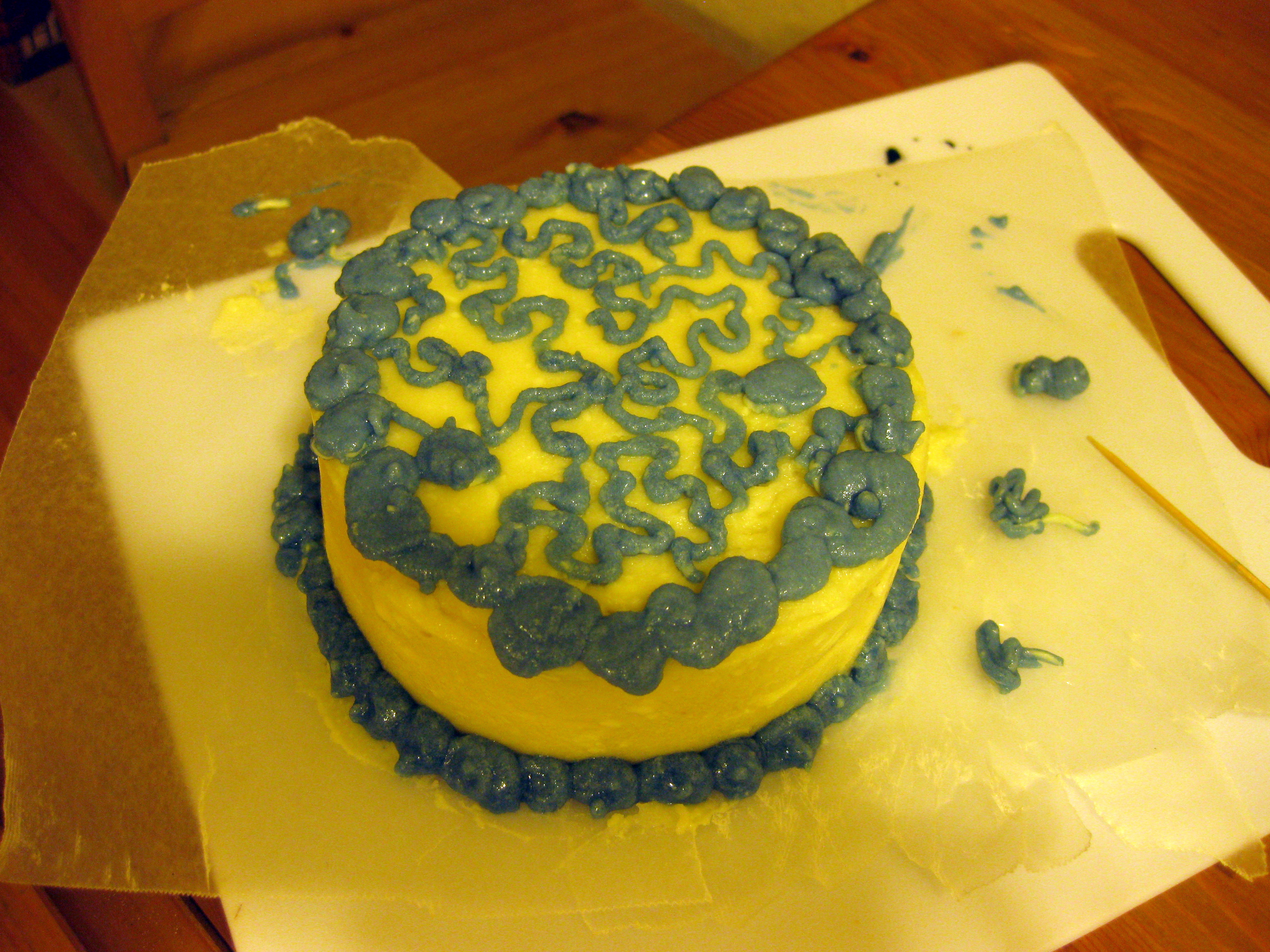
But back to the cupcakes.  Undaunted by their aesthetically challenged appearance, I sprinkled them with silver-gray sprinkles and presented them proudly to my friends, who pronounced them praiseworthy masterpieces.  I privately thought them too kind, but it is gratifying to have good friends who support your stubborn goofy screw-ups and prevent you from being too hard on yourself.

It was only the next day that I rewatched the tutorial video and saw that not only was a using the wrong tip to pipe these petals, but I was holding it the wrong way.  This gave me hope.  Next time, next time when butter and mascarpone are at the same temperature, when it’s warmer in the kitchen, when a fresh bag of powdered sugar and careful sifting result in a perfectly velvet texture, and when I acquire a rose petal icing tip, I will be on my way.  The flowers won’t be perfect, but they will actually resemble flowers.  Next time. 
I keep ending these posts by talking about what I will do next time.  Upon reflection, it seems dangerous to be counting always on next time in this project.  There will come a time when “next time” no longer works, and on that day in July I’d better get everything right.  What if the butter is too soft?  What if I over whip it?  What if there are lumps?

Fortunately I still have a few next times to lean on.

The Buttercream Problem 2: What Problem?

Thanks for the support and thoughts on my previous buttercream post.  I appreciate knowing you are out there, lurkers and likers!

The title of this post might be a bit of a lie, because can you really call something “Problem, part 2” if it isn’t too much of a problem anymore?  Maybe “The Buttercream Project” would be more accurate.

Anyway, I owe this amelioration of gloop, sludge, and anxiety in part to my own intuition, but in larger part to Leah at “So, How’s it Taste?” and her recipe for Cinn-Chili Chocolate Cupcakes with Cinnamon Buttercream.  With a chapter draft submitted and a guiltlessly girly shopping trip/reward for my efforts over, I wanted to bake a little something for my officemates AND do a buttercream practice.

Here’s what I learned:

It’s important to sift the powdered sugar.  Otherwise you end up with little clumpy bits that don’t incorporate completely (which happened at New Year’s on the blue poo cake).

It’s important that the butter be fully softened, and that you whip it up well before adding any of the sugar, lest it not incorporate fully (which happened at New Year’s on the blue poo cake).

A couple of tablespoons of whole milk help smooth things out.

I probably should use champagne extract or flavoring, not champagne itself, because so little liquid is needed to keep this pipe-able and smooth (but not turning into blue poo.  I’m just saying…).

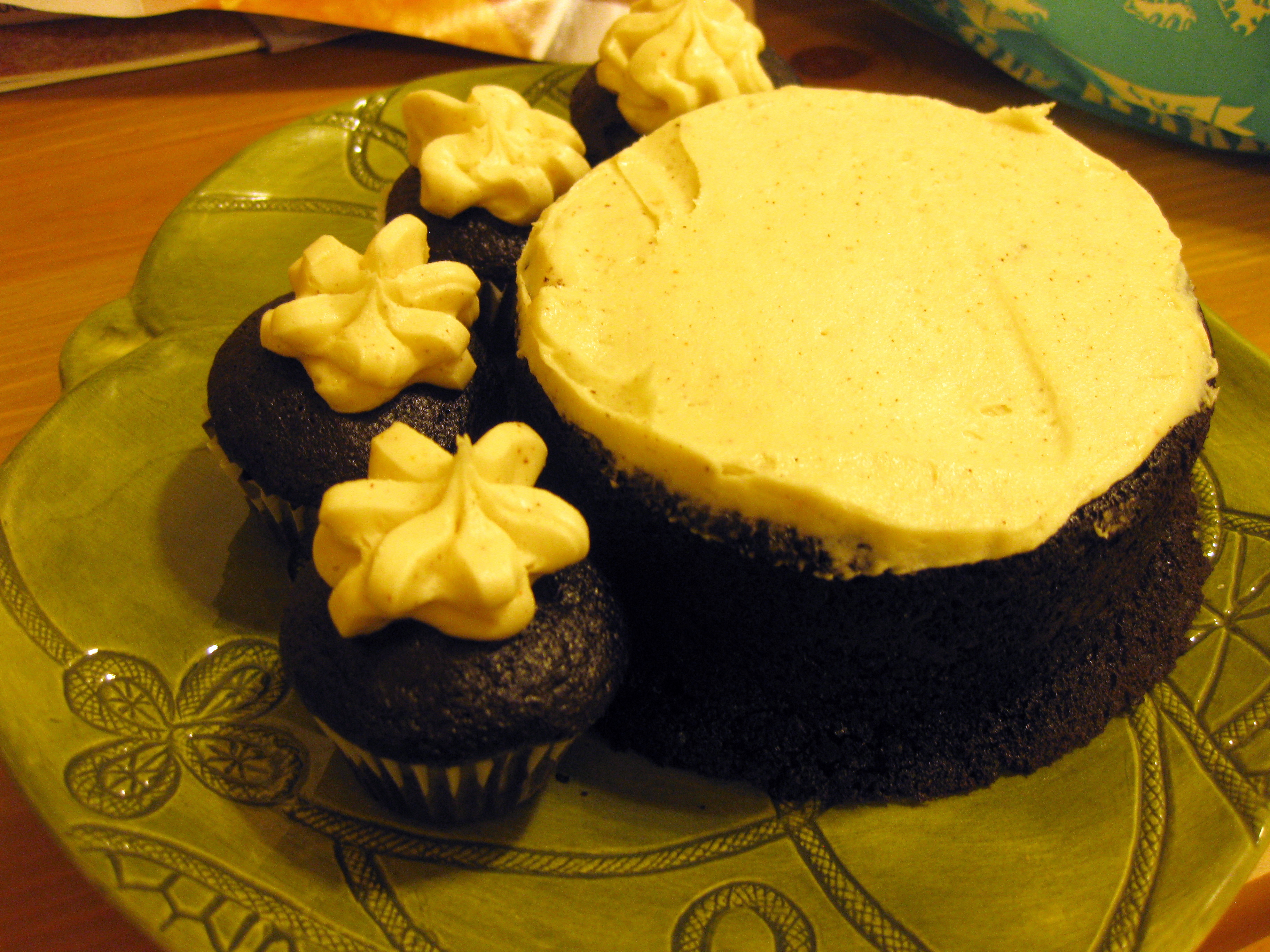
So the frosting whipped up really nicely – smooth and buttery and even – but the cupcakes were no slouch either. The combo of chocolate, cinnamon, and cayenne is, I’ve decided, one that should be present in everything from cupcakes to hot cocoa to coffee to a spread for sourdough toast. It was warm and toasty and dark and rich and left just a little lingering heat in the back of your throat after the last swallow of cupcake. The cakes were really, really dark – almost black – because I used Hershey’s “Special Dark” cocoa powder instead of just the regular stuff. They had a nice moist crumb and weren’t overwhelmingly sweet.

The buttercream was delicious too. It was pretty sweet, though that’s difficult to combat, I think, but the heat of the cayenne and the warmth of the cinnamon in the frosting cut the sugar. Also, after a night in the fridge the frosting seemed less aggressively sweet – giving the butter and sugar time to hang out together might have done something the mellow the cloying flavor buttercream can have. I used less cayenne in the frosting than Leah’s recipe specifies, though I did add the barest sprinkle over the top when the cupcakes were all frosted.

Here’s what I learned about the process of frosting: cupcakes are easy, and a properly made buttercream spreads with surprising smoothness over a flat surface (I made one tiny “cake” for the bride and groom as a taster and smoothed icing across the top). With an offset spatula or a metal scraper at my disposal, I bet I can get the thing even and gorgeous.

Here’s what I learned from the bride: she LOVES the idea of doing cupcakes and mini cupcakes as additions to the cake, and we’ve decided to use an asymmetrical cake stand  for the actual cakes. This means I don’t have to stack anything, just make three separate, differently sized cakes, and a Subaru-load of cupcakes.

So here’s the plan: the cakes will get frosted with buttercream and decorated in some as-yet-to-be-determined way. The cupcakes will get frosted with a star tip much like I’ve done here, and possibly drizzled with blue crystal sprinkles. As for the mini cupcakes, I found a tutorial for making pansy-like flowers out of buttercream on minis, and the next time I do a trial run I’m going to give this a try to see if it’s something me and my meager piping skills can pull off.

Next month: I’ll make the champagne batter the cake will actually be made of and bake it in cupcake form so I can start to get times down. It wouldn’t do to have dry cupcakes. Then I’ll try out this flower pattern on the minis and see how it turns out. With luck, it will go as well as this month’s new buttercream recipe did!

Stay tuned… I added a “wedding” tag, and all the buttercream and cake-related posts will end up in that category for easier access.

The Buttercream Problem

Folks, I have a problem.  It’s called buttercream.

I’ve been offered the great privilege of making a wedding cake for some dear friends who are tying the knot this summer.  I’ve never made a wedding cake before.  I’ve made a lot of cakes, most of them chocolate (in truth, most of them this one), but this is the big time.

I know the cake itself is going to be champagne.

I know the filling is going to be a lovely light whipped mascarpone cream, possibly dotted with fresh raspberries.

I suspect the frosting needs to be buttercream, because the bride wants to cover the cake in fondant (it’s going to be hot, it’s a cleaner look, it can be painted on with beautiful blue coloring).  But just in case I get good enough at smoothing out the buttercream, maybe we can just leave it at that.

I’ve done one practice run, for a small New Year’s Eve party we hosted (the wedding is in July, so there’s some time here).  The cake was delicious.  The filling was amazing.  The frosting was…

a disaster.

It was a simple American buttercream containing butter, powdered sugar, vanilla, and a splash of champagne to go with the cake flavor.  I think the butter was too cold.  I think the powdered sugar wasn’t well sifted.  I think proportions were off.  The resulting frosting was gloppy and grainy and oozing, and when I spread it on the cake it clumped and ran and blubbered down the sides. You know how jeans that are too long for you puddle around your feet at the bottom?  Now imagine that in white, and made out of frosting, and on my cake.  That’s what it looked like.

When I was too frustrated to look at it anymore, I stuck it in the fridge for a while, hoping it would harden up a bit so I could spread it with more success.  While that happened, I mixed some blue gel food coloring into the remaining bowl of frosting and whipped that up, in hopes that a few rosettes on top of the cake would save it a little.

An hour later, I took on the icing again.  I scraped off some of the worst slumps and filled up my piping bag with the beautiful blue I’d created.  With a star tip, I piped on a rosette.  It dissolved into a blob and blurbed toward the edge of the cake.  I somehow lost touch with reality and instead of trying to scrape it off, I made four more around the cake.  They all slumped over the edge.  I tried to pipe a pretty pattern around the bottom edge.  It looked like a long ribbon of blue poo.  I shoved the cake back into the fridge and drank a couple of glasses of champagne before serving it. It was New Year’s Eve.  It was clearly the right thing to do.

So here’s the issue: I have to make a better buttercream.  I’ve done some research and found some killer looking recipes.  I’m planning to use champagne extract instead of actual champagne to avoid any issues with acidity or carbonation.  I’m planning to use fully softened butter.  I’m contemplating blending in some mascarpone to add body and lessen the overwhelming sweetness buttercream can have.

But I’ve also seen conflicting theories about how much milk to add during the whipping process and how long to whip and whether or not to add shortening so the color is a little whiter.  I’ve seen seen creamy dreamy looking recipes for Italian and Swiss buttercreams.  I’m in a buttercream frosting float.  Or, rather, I’m floating in ideas about buttercream frosting.

So I’m looking to you, tiny multiverse of readers.  Have you made buttercream?  How did it turn out?  What recipe did you use?  Was it American, Italian, or Swiss?  Did it spread smoothly?  Was it overly sweet?

Help!

Candyland

My two favorite board games when I was a kidlet were Chutes & Ladders, and Candyland.  I liked the first, but found it slightly stressful, since it seemed I inevitably ended up sliding down the longest possible slide and having to restart the game from the beginning.  Looking back, I wonder whether the primary design of this game was to keep children occupied with it for as long as possible, to give exhausted parents a chance to rest.  Having no siblings at that point in my life, if this was the goal of the game it backfired in my family.

But Candyland?  Candyland I loved.  And I loved it not so much for the gameplay itself, but for the fantastical characters and decorated board, and for the outrageously wonderful idea that a whole kingdom could be made out of and based around candy.  It was like “Cloudy with a Chance of Meatballs,” but better.  Because it was candy.  My favorite figure in the game was Queen Frostine.  She had blueish silver hair that came down to her waist, and a sparkling rock candy scepter.  I still remember the first sentence or two provided about her in the game description: “Peacefully adrift on an ice cream float in an ice cream sea…” Pretty, powerful, royal, and living in ice cream.  It was everything I thought I had ever wanted.

When Candyland was at last boxed up for good and covered in an inch or two of dust in our attic, I retained a love for both miniatures and candy.  Thus, truffles were like little boulders, or tree stumps, and gingerbread houses were the most romantic, creative way of celebrating the desserts of the holiday season.

Now, as an adult but also a student, my holiday budget is somewhat limited.  But I know, since I share my life and most of my friendships with other graduate students, that food – especially a special, out of the ordinary sort of food – makes a good gift.  So, with the holiday season approaching and the term ending, early in December I celebrated my extraordinarily timely submission of my first dissertation chapter by hiding books, pencils, and papers from myself and instead filling my kitchen with bags and boxes of chocolate.  I submerged myself back into Candyland.  Not as Queen Frostine this time, but as a new character: the Empress of Truffletown, perhaps.  I wrote some time ago about my first experience with truffle production, and this time I wanted to explore some new flavors – add my own sweet twists to the basic recipe. 

The basic procedure is to coat squares of ganache in melted chocolate.  It seems to me after some experimentation that the right ratio in a ganache is 6-8 tablespoons of liquid for each 8 oz. of melted chocolate.  At least 6 of these liquid tablespoons should be heavy cream.  But the really exciting part lies in the possibilities for the other 2 tablespoons…

I made three varieties: Amaretto White Chocolate Truffles, Gingerbread Truffles, and Peppermint Truffle, and popped them into some pretty, festive boxes I found.  Then, just for fun, I also whipped up some Almond Butter cups.  My willing taste testers declared the Amaretto and the Almond Butter cups the best selections.

Amaretto White Chocolate Truffles:

To make this flavor, I melted 6 TB of heavy cream with 8 oz. white chocolate over a double boiler.  When the mixture was almost completely melted, I carefully stirred in 2 TB amaretto.  When it was completely smooth, I added a few tablespoons each finely chopped dried apricots, and finely minced, toasted almonds.  I stirred the whole thing together quickly, poured it into a plastic wrap lined loaf pan, and stowed it in the fridge to harden.

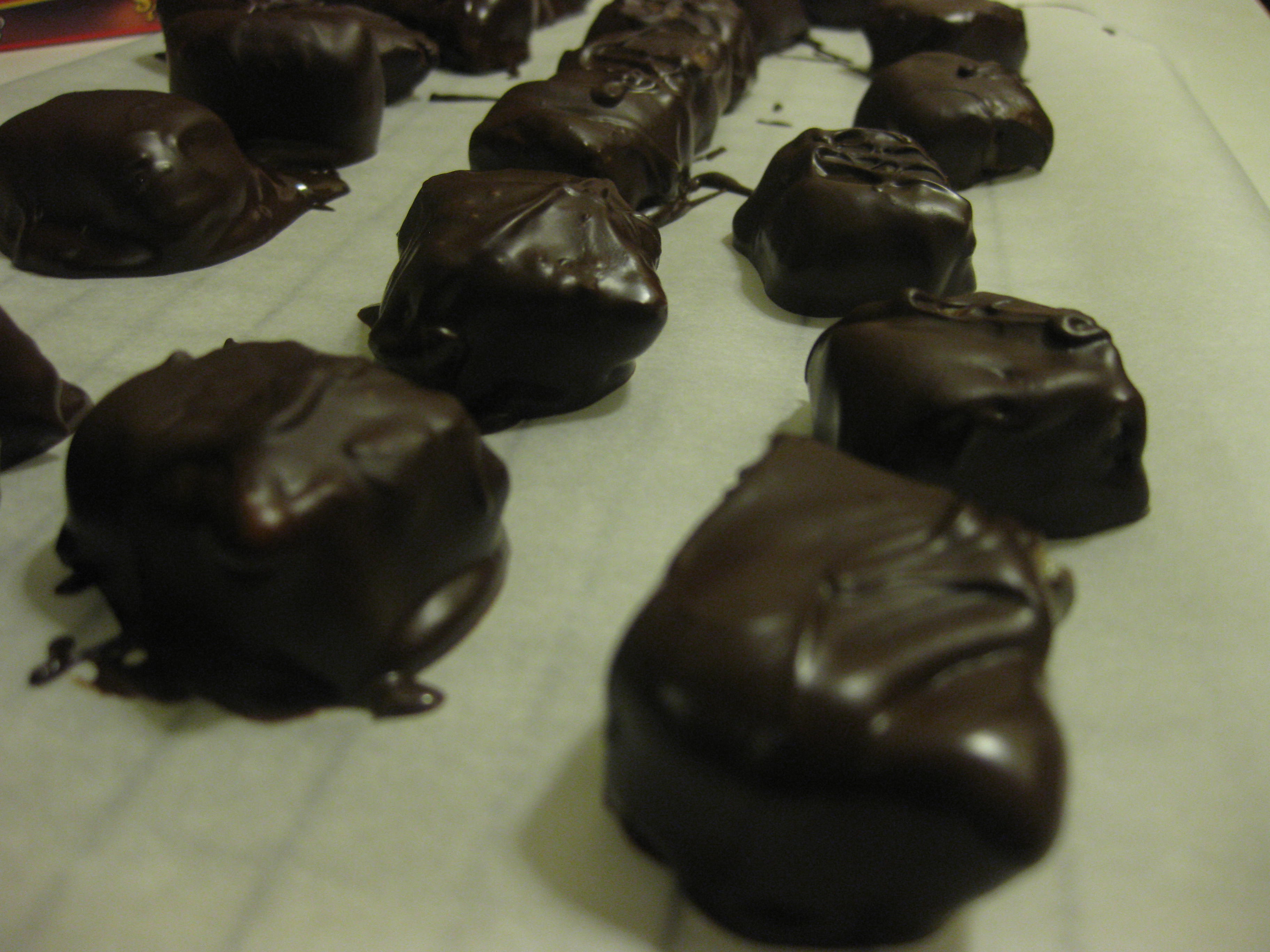
The following day, I pried the block of creamy white goodness, studded with precious gems of flavor, out onto a board, cut it in squares, and dunked each in melted semi-sweet chocolate.  After letting these harden on parchment paper, I added a white chocolate drizzle to the top for a little flair.  They were incredible.  The white chocolate was delicately flavored by the amaretto, which is one of my favorite liqueur varieties.  Nutty and rich and sweet, and here punctuated by the soft crunch of almonds and the slight chew of apricot chunks.  This variety is definitely one for the recipe books.  I will absolutely be making it again and again.

Gingerbread Truffles:

I followed the same basic procedure for these as for the Amaretto version, though I used dark chocolate as my base for the ganache.  Lacking a ginger flavored liqueur, I melted the chocolate with only 6 TB heavy cream, and stirred in about a ¼ cup finely chopped candied ginger.  Again, I refrigerated, again, I removed, sliced, and dipped.  Then, while the outer layer of chocolate was still glossy and wet, I sprinkled a good teaspoon or two of powdered gingersnap cookie crumbs atop each truffle.  Spicy and warm in the back of the throat, with a pleasing crispy crunch from the cookie powder.  I did find, with these, that the ganache was a bit crumbly after it hardened, perhaps because it was made with less liquid.  I would up the amount of heavy cream in the mixture to 7 or a full 8 tablespoons to try and combat this issue.

Peppermint Truffles:

For these, I combined 8 oz. of milk chocolate with 6 tablespoons of heavy cream and 2 tablespoons of peppermint schnapps we had kicking around in the back of our liquor cabinet.  This time, instead of pouring into a loaf pan, I just left the ganache in the glass bowl I was using as the top portion of my homemade double boiler.  While I waited for it to cool and solidify into that glorious fudgy paste ganache becomes, I broke up and crunched several candy canes into bits.  The bottom of the peppermint schnapps bottle proved an excellent tool for this project.  A rolling pin would probably also work well for this.  As I scooped out each tablespoon of ganache, I rolled it into a ball with my hands and then rolled it through the candy cane flakes, creating a pinkish minty snowball to add to the collection.  I wasn’t as thrilled with the flavor of these; the schnapps came through more as the harsh grate of alcohol rather than the spicy-cool flavor of peppermint, but my taste testers didn’t complain.  They were Christmas-y in appearance, which no doubt leant to their appeal.  If I do this flavor again, I might use only one tablespoon of schnapps, rather than 2.

Almond Butter Cups:

I was much less exact with these, working mostly for flavor rather than creating a recipe.  Again, I melted 8 oz. of chocolate – semi-sweet this time.  Then, I mixed a few tablespoons of powdered sugar into a cup or so of almond butter.  Trader Joe’s makes a really good crunchy variety with roasted flax seeds, so that is what I was using.  When the sugar and the butter were well combined, I scooped it into my chocolate and let them melt together into smooth, thick ribbons.  Then I poured a tablespoonful or so directly into candy papers.  I found that setting each paper into the depressions in a mini muffin tin made them stand up straight and not collapse when the hot chocolate mixture was added.  I refrigerated my muffin-tin-full to let them set up.  Imagine taking a bite of a Reese’s Peanut Butter Cup.  Now imagine it tastes of almonds instead of peanuts.  Now imagine that nutty flavor is mixed evenly through the chocolate, rather than sitting in the center, and that it is interspersed by the crispy, deep, roasty-ness of golden flax seeds.

Presenting boxes of these collected divinities to my officemates, a few close friends, our neighbors, and finally our families, I felt like a benevolent ruler.  Sure, it’s only my little kitchen where I rule with a chocolate-daubed fist, but my offerings were wide and sweet.  Move over, Candyland.  This is Truffletown.

2010 Thanksgiving Menu

I get excited about holidays that involve cooking waaaayyyyy earlier than I should (then again, since our Target already has a Christmas section erected, complete with at least six artificial trees, maybe I’m not totally unhealthy).  I even told my mom over the phone this past Sunday that I’d probably go grocery shopping for the holiday late this week or this weekend.  Right, with two weeks to go.  I was already a week ahead of myself and willing to completely skip seven days of reality so I could buy a turkey.

But I love the way food impacts a holiday, and not just because I love eating.  For my family, food has a binding quality.  I love to cook, my mom taught me how and she loves to cook, my sister is developing an enjoyment and adventuresome spirit in the kitchen, and my dad… likes eating the food we make.  But still, it gives us something to talk about, something to share with each other, and something to do together, when we are in the same kitchen.  I feel close to them through the food we create.

At Thanksgiving, my mom and I make most of the dinner, my sister pipes in with seasoning suggestions, my dad carves the turkey, N. tastes things and generally tries to stay out of the way, and Lucy’s nose never stops twitching.  Every hour or so, little click-clacking dog claws tiptoe into the kitchen to take a sniff and clean the floor.

So I’ve already thought through the entire menu.  I know exactly what we’re having.  I’m even contemplating spending my evening tonight making a detailed grocery list for the big shopping trip.  Excessive?  Premature?  Perhaps.  But so delicious.

Here’s the menu for our Thanksgiving this year:

Appetizers: whole heads of roasted garlic with soft goat cheese and toasted baguette, roasted nuts with brown sugar and rosemary, assorted dried fruit.

Dinner: herb roasted turkey with giblet gravy, stuffing, chipotle mashed sweet potatoescreamed spinach and artichoke bake, and whole berry cranberry sauce.

Desserts: Mom’s pumpkin pie with whipped cream, and pumpkin cheesecake squares.  My sister doesn’t love pumpkin pie, so this year there will be two desserts.  If the recipe I invent for her works out well, I’ll post it here.

What are you having for Thanksgiving dinner this year?

Frankenbrownies

I love Halloween.  We always have a party, and I always go overboard with the variety and quantity of treats I make.  I get nervous about whether we will have enough food, and then I get anxious about whether I’ll be able to pull everything together in time.  It can be a little scary…

I also loved the pumpkin enchiladas I posted about here.  I never would have expected the flavors of rich, fruity pumpkin, mild creamy goat cheese, and the deep roasty chocolate of mole sauce to go together well.  But they did, and it got me thinking of other ways of combining this trio.  Spurred by a statement of dessert desire by a sick friend, the project became brownies.  Pumpkin cream cheese brownies: could such a thing be?

There are a million recipes for brownies, but I went with Dave Lebovitz’s Cheesecake Brownies, which turned out to be a really good idea. Though I was at first thrown off by and nervous about the complete lack of leavening products, I fought back my temptation to add some baking powder and mixed the ingredients exactly as written.  It was the right choice.

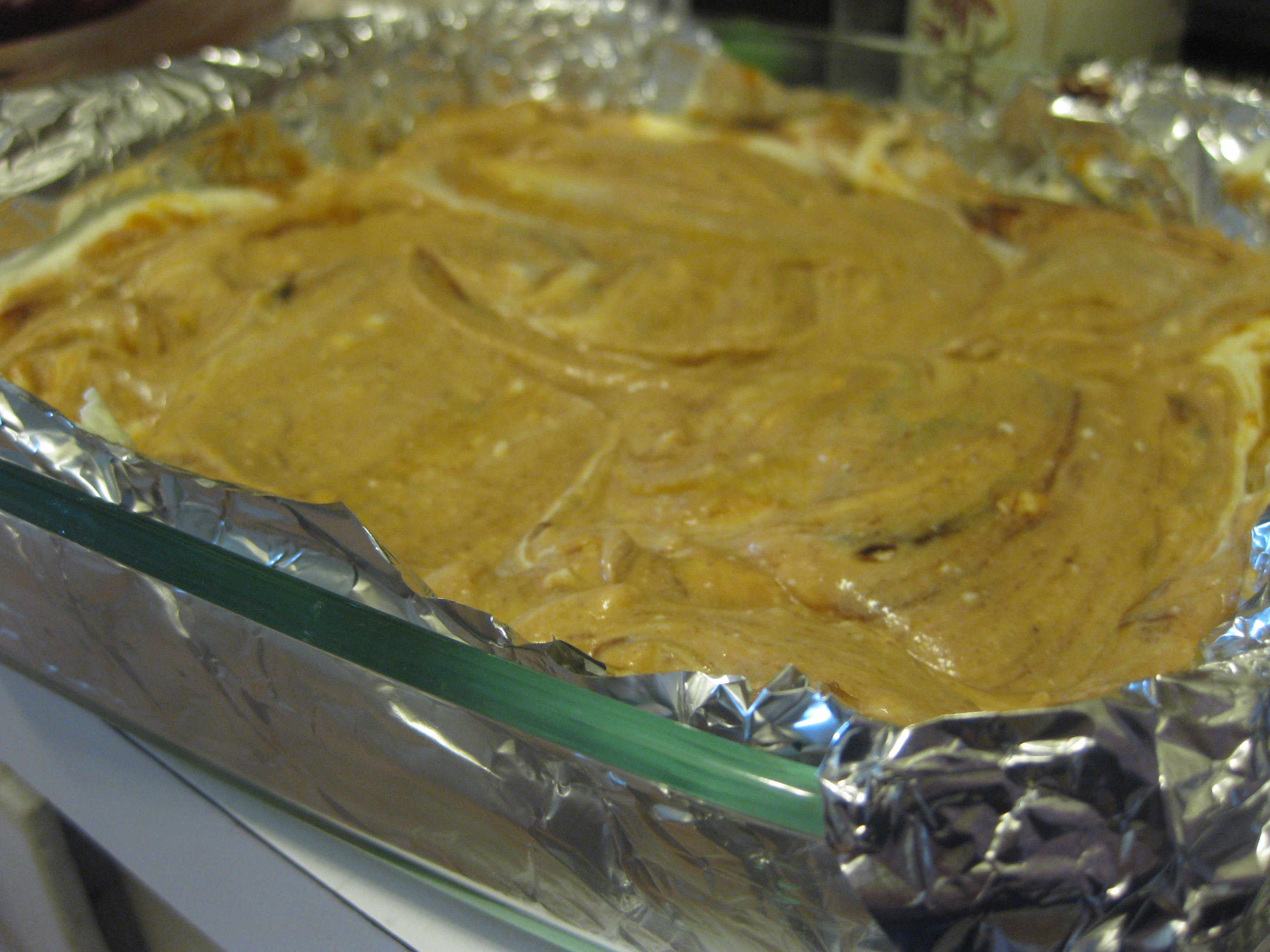
Rather than simply swirling the cream cheese dollops with the thick, shiny chocolate batter, I also added about a cup of pumpkin puree mixed with a teaspoon or two of pumpkin pie spice.  I swirled.  I swirled and swirled and swirled, and still no chocolate came to the surface.  I scooped and plopped and swirled some more, and finally a few rich brown slivers came to the surface.  It was kind of a monster.  But keeping in mind that at its Latin roots, a “monster” bears in its etymology the idea of showing us something, I decided that was good enough, and I’d have to wait and see what it had to show me.  I deposited my weighty, ugly baby into the oven for almost an hour.

Fifteen minutes or so into the cooking process, I started to smell that incredible, mouthwatering aroma of chocolate cooking.  Half an hour in, a delicate curl of cheesecake inserted itself into the scented air.  I couldn’t smell the pumpkin much, but suddenly there was chocolate-cheesecake-spiciness, and I wanted to pull the whole thing out and just eat the whole thing with a spoon.

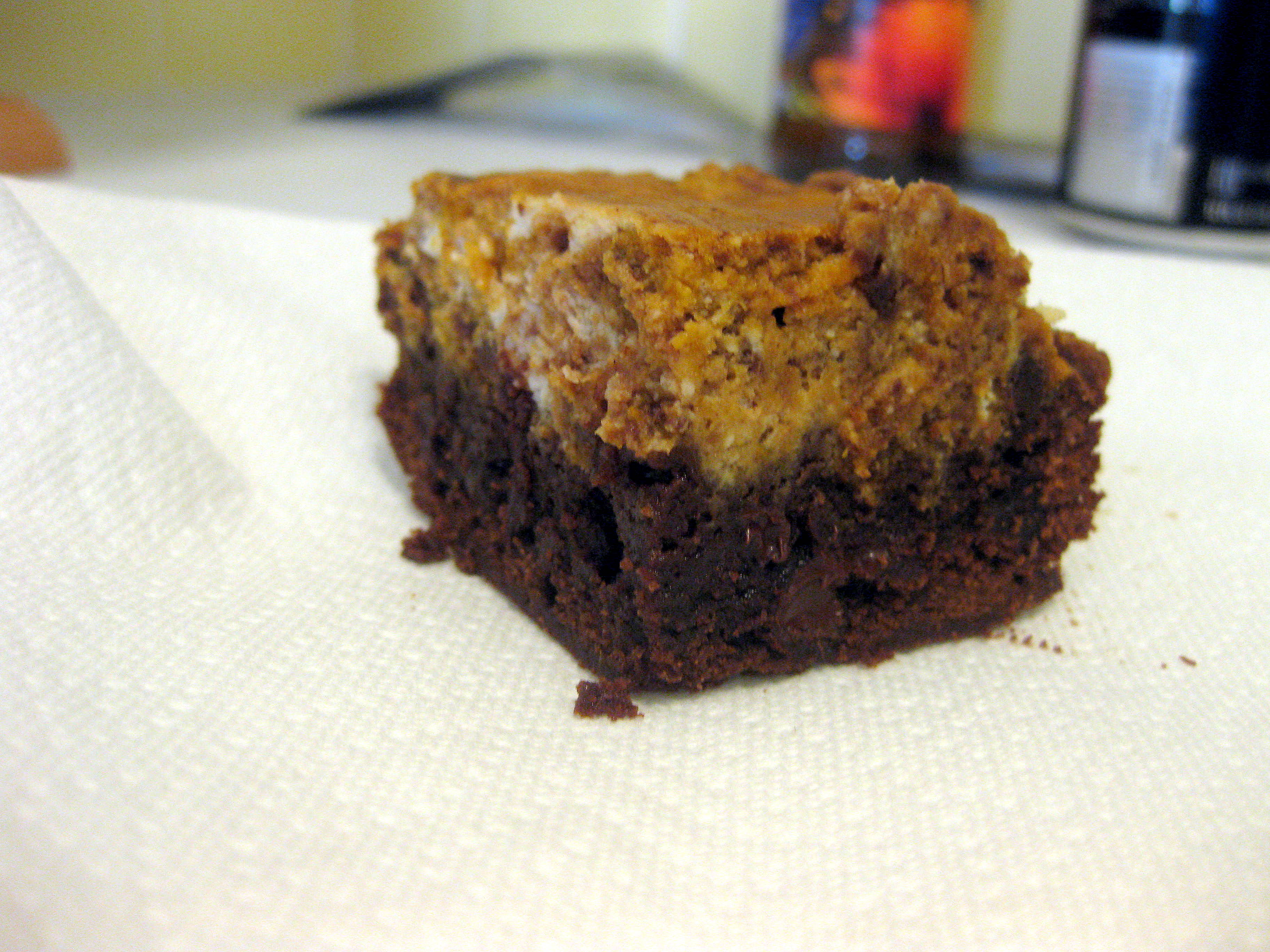
I resisted, and when the collection of smells had solidified into a… well… a thing from which an inserted toothpick came out clean, I set it aside on the counter to cool.  It was truly a frankensteinian creation.  The brownie layer was dark and rich and barely disturbed, while the top was a delicate whipped pale orange that cut like a harvest-flavored mousse.

The taste was so good.  The brownie was dark and rich; it was definitely of the fudgy brownie ilk rather than the cakey, flakey brownie.  The pumpkin and the cream cheese read like a pumpkin cheesecake, with all the creamy smoothness of a cheesecake and all the spongy custard-y quality of pumpkin pie.  They were delicious together, just as the same flavors – with considerably less sweetness – melded in my pumpkin enchiladas.

While the flavor was great, it did read more like a layered dessert than a brownie.  I think this is because I used the full amount of cream cheese mix Dave Lebovitz calls for PLUS a cup of pumpkin puree.  There was just too much goodness to swirl evenly.  My proposed solution to this is to layer half the chocolate, then dollop on the cream cheese and pumpkin, then top it with the other half of the chocolate batter before mixing.  It seems it will be easier to swirl together the much denser, thicker chocolate with the delicate creaminess of the additional flavors if the chocolate is divided up.

This was truly a Frankenstein creation, but it was certainly not a monster, except perhaps in the sense that it demonstrated deliciousness.  It will make its debut at our Halloween party this year, swirled and sliced and dressed to impress, in orange and “black.”  Its trio of components all vying to be the star means I won’t have to make as many kinds of treats, because here’s the trick: this is a three-in-one.

See, trick-or-treat’s not so scary…