Pillows of Delight

Following my new habit of “borrowing” recipes from restaurants by pillaging their menu descriptions, I want to report another recent triumph.  “Borrowing” and “pillaging” sound so naughty, as though I’ve done something vaguely wrong or shameful.  But most of the time I’ve never even tried the dish, I’m just taking suggestions about ingredient combinations.  Really it’s more sensible behavior.  Sensible and well grounded, and a little bit sly and spicy.  Like this dish, in fact.  How convenient!

Gnocchi with butternut squash, carmelized pears, and swiss chard in a nutmeg brown butter sauce

Ingredients:
2 boxes pre-made refrigerated gnocchi (ours were from Market of Choice)
2 pears, a little underripe
1 big bunch of swiss, red, or rainbow chard (the Saturday Market had enormous bunches of the most beautiful rainbow chard I have ever seen)
1 medium butternut squash (a back garden triumph!)
olive oil
1/2 cup (1 stick) butter
salt and pepper
freshly grated nutmeg
splash of white wine (optional)

Procedure:

* I preheated the oven to 350F while I peeled, halved, de-seeded, and diced the butternut squash into squares about the same size as the gnocchi.  Then I tossed the chunks in olive oil, salt and pepper on a baking sheet and baked them until the squash is tender, maybe about 45 minutes. When they were soft inside and gave slightly to the touch outside, I set them aside to cool.

* When the squash was close to done, I began melting the butter over medium to medium-high heat in a big pan. At the same time, I put some salted water on to boil for the gnocchi in a pot.

* With the butter melted and starting to darken in color a little, I added the two pears. Like the squash, these should be cubed in about the same size as the gnocchi.  If all the major players are about the same size, they play better on the fork and in your mouth.  I cranked up the heat to medium high so the pears could take on a little color, being careful not to break them up when I gently turned them so they could coat in the hot buttery bath.  After about ten minutes, when they were just getting golden, I added salt, pepper, and nutmeg to taste.  Then, for a little tang, a splash of white wine.

* While pears were cooking (oh mighty multi-tasker I), I prepped the chard, tearing the leaves off the stems and chopping the stems up into fairly small pieces.  For extra flavor and extra vegetation, I mixed the stems in with the pears and let them cook until they got tender, which probably took another five or ten minutes.  I sliced the remaining chard leaves into manageable, fork friendly slices.

* With the water boiling, I plopped in the little pillowy gnocchi to the pot and the chard to the vegetable pan at about the same time.  Though the chard almost overflowed my largest skillet, while I gently incorporated it into the pears and butter sauce it wilted down amazingly quickly.

* When the gnocchi floated to the surface (that’s not true, they boiled up and threatened to overflow my stovetop!) I drained them well before adding them and the reserved butternut squash squares to the pan for some gentle incorporation.  Bearing in mind the constant food show recommendation to season each layer of a dish, I added more salt, pepper, and more grated nutmeg to taste.  When the squash squares were heated through to my liking, I served up big bowlfuls.

IMG_1966

The combination was delicious.  The gnocchi were soft and chewy, and though the pears and butternut squash were also soft, I didn’t feel that there was an unpleasing lack of textural variety in the dish.  The pears almost melted when they touched my tongue, and the butternut squash had taken on some crunch on the outside from being in the oven.  The bitterness of the chard with the sweetness of the pears and the warmth of the nutmeg worked amazingly well together.  Best of all, the next day the flavors had really had time to mingle and meld, and the spice of the nutmeg deepened into a more pronounced seasoning throughout the dish.  A freshly brewed, well-spiced hot cider or rum punch might be a delightful and unusual accompaniment to this, but I just had a glass of some of the chardonnay that I added to the sauce.  And that was good too.  I told my Mom about this one, and she demanded it as a weekend-after-Thanksgiving-remedy-from-too-much-turkey.  Sounds like a win to me!

Homage to Stratigraphy: Lasagna #2

After both taking and making suggestions for improvement about the lasagna I made here, I decided to take advantage of the last few weeks of outdoor Farmers’ Markets and take a second stab.  I believe I have now created the ultimate: Wild Mushroom and Spinach Lasagna with Arugula Pesto and Sundried Tomato Cream Sauce.  Since I have had several requests, I am willing to share the recipe with y’all.  Here goes, and keep in mind that most of my measurements are approximations.

Preheat oven to 350F and make sure you have a 9×9 square glass baking dish.

Ingredients:
1/2 lb (?) mixed wild mushrooms (I used reconstituted dried shiitakes and golden chanterelles from the Saturday Market)
1-2 bags baby spinach leaves
2 bunches arugula
(your own mix for pesto, or my cheat: 3-4 TB premade pesto, to blend with arugula)
Olive oil
4 TB butter
3 cloves garlic, finely chopped
1/4 cup flour
2 cups milk or cream (or a mixture)
Splash of white wine (if desired)
salt and pepper
2-4 TB sundried tomatoes, finely chopped
1 16oz. container ricotta cheese
1/2 cup grated mozzarella cheese
1/4-1/2 cup grated Parmesan
no boil lasagna noodles

Procedure:
1. Roughly chop the mushrooms and fry them in a medium saucepan in olive oil or butter to your liking.  Don’t rush them.  Keep them on about medium heat and wait, patiently or impatiently, until they have sucked up all the butter, expelled their own liquids, and then regained those liquids to become browned but still tender.
2. Add the spinach and cook just until it has wilted but still retains its bright green color, then set the mushroom and spinach mixture aside.
3. Meanwhile, whir together arugula, premade pesto, and a little extra olive oil in a blender or food processor (or just make your own arugula pesto).
4. In a medium saucepan, melt butter. Add garlic and cook just until fragrant. Add flour and combine well to make a roux. When flour is well incorporated and has cooked for a minute or two, add milk or cream slowly, stirring or whisking well until clumps are incorporated. Season with salt, pepper and white wine to taste.  A little grating of fresh nutmeg might also not be amiss.  Add sundried tomatoes and stir gently until thickened to your liking.
5. Combine all three cheeses
6. Assembly: spread a layer of sauce in the bottom of your pan and add a layer of no-boil lasagna noodles. Then, add layers in your preferred order. I stacked cheese, arugula pesto, mushroom and spinach mixture, then sauce in that order before adding another layer of noodles and repeating the process. Repeat until you run out of filling ingredients (should be about half a box of noodles, if you are using Barilla and a square pan). After adding the final layer of pasta, top with any remaining sauce, cheese, and/or pesto, and then add a generous layer of grated Parmesan. (If you don’t have sauce to add to the top, the final layer of noodles will not soften as nicely as they should.  I discovered this as I made my first cut.)
7. Bake for 45 minutes or until the cheese on top is browned and looks a little crunchy, and the fillings are bubbling up on the sides. If possible, wait for five minutes before cutting in, because the slices will hold together better this way.

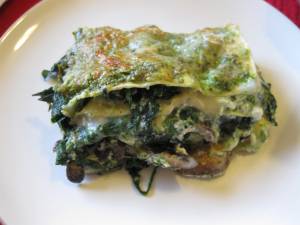
IMG_1962

Enjoy.  Gorge.  Disintegrate.  Burn your mouth on the cheese and decide you don’t care, eat chilled slices you cut out of hand straight from the fridge at midnight, or have your neighbors over and just decimate the whole thing in one sitting, for I declare this the ultimate spinach and mushroom lasagna.

Trick or treat!

Since Halloween was on a Saturday this year, we donned devil horns, walked downtown, and found a window seat at Davis’ Restaurant and Bar.  Right across the street from John Henry’s, Jameson’s, and The Horsehead, it offered a tantalizing view of the night’s revelers.  We whetted our appetites for the festivities with the Mezze plate, which consisted of babaganoush, hummus, and tzatziki with warm pita triangles.  I thought the cumin flavor in the hummus was a little bit too strong, but the babaganoush was really excellent.  Then our server brought around the dessert tray.  Among other delicious looking choices (two flavors of cheesecakes in tiny round presentation, a huge and luscious parfait, and a butternut squash pie) there was a creme brulee.  A chocolate and cayenne creme brulee.  I had to have it.

IMG_1960

Sweet, spicy, hard crackling sugar shell with a soft and creamy chocolate mousse underneath, dark and delicious.  A perfect Halloween treat.  And trick.

In homage to California produce

One of the things I’ve learned about myself as a cook is that while I am very good at choosing, following, and accurately executing recipes, I am not particularly imaginative – or impressed by my results – without them.  To combat this, as should be clear from my recent exposition on lasagna, I have been paying closer attention to ingredient combinations on restaurant menus.  With more practice and likely greater culinary training than my own, chefs in restaurants have an understanding of how ingredients work together, and which ones will meld together well, which is something that I am still learning.

So, I have been taking notes and copying descriptions from meals that I enjoy and establishments that I have been impressed by, and trying to recreate them in my own way.  Inspired by the ridiculously beautiful shelves of greenery in the Raley’s grocery store in N.’s hometown, I wanted to make something fresh and delicious with plenty of produce.  We eat out quite a bit when we visit our parents, because with time to make the trip down to California only twice a year, it tends to be a festive week or two.  Therefore, one evening when N.’s parents were out bowling, my vision turned green.  There were bright, dripping bunches of broccolini, and rapini, and dandelion greens, and kale and turnip greens, and that was just the beginning.  I don’t think I’ve ever seen dandelion greens in a grocery store before, and was tempted, but forced myself to be realistic.  I thought back to our trip to Ashland in July, when N. had this:

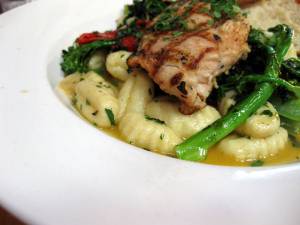
IMG_1420

Gnocchi in an herb, wine and garlic sauce, topped by a rosemary-grilled breast of chicken, bell peppers, and broccolini.  Inspiration achieved.  I grabbed both broccolini and rapini from the produce shelves, a beautiful orange bell pepper, and some pre-made gnocchi from the refrigerated area.  N. has been yearning after these pillowy little fluffs of potato pasta, so I was happy to oblige.

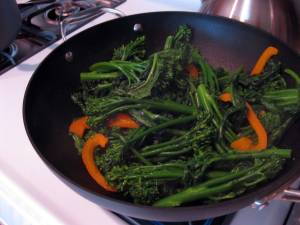
IMG_1615

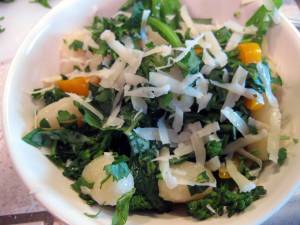
Surrounded by emerald leaves, buds, and juicy stems on the kitchen counter of my in-laws’ house, I chopped up the greens and steamed them briefly to reduce some of the bitterness that I know hides in these lesser-loved brassica hybrids.  When they were just tender, I drained off the water and moved them to a deep skillet, where I stir-fried them with thinly julienned bell pepper slices while the gnocchi boiled.  I added some garlic, and at the last minute tossed in the gnocchi, some leftover parsley from a previous night’s adventure, and a few small chunks of butter.  It wasn’t the most sophisticated sauce, but the colors were just gorgeous.  We topped our bowls with parmesan cheese and filled our bellies with vegetables.

IMG_1617

It was so simple, but so fresh, and the flavors were strong and tasty.  I like bitter vegetables a bit more than N. does, so to make this again I would steam the broccolini and rapini a bit longer, and perhaps in chicken or vegetable broth rather than water.  This would probably also make a silkier sauce, as would a dash or two of a full-bodied white wine.  However, this fresh burst of vegetables reenergized and refreshed us, and boosts my confidence about my plan of attack.  With N.’s Ashland dinner recreated, and three butternut squashes slowly swelling in the garden, my meal from the same night may be next on the “restaurant recreation” horizon.  Squash stuffed ravioli in a sage brown butter sauce with crumbled biscotti and gorgonzola cheese, anyone?

My First Lasagna

Since I’ve been in California for roughly the past two weeks, I haven’t shared any foodie experiments or revelations.  Yes, I cooked and ate delicious food on my trip, and yes, I brought my camera with me.  However, I neglected to bring the correct cable to plug the camera into a computer and upload the photos.  I’m home now, and certainly have things to share, but for the moment I’m much more excited about tonight’s dinner, which is currently just starting to emit cheesy delicious aromas from the oven.

I have never made lasagna before.  I’ve heard a lot of complaints about how it’s labor intensive and time consuming, and since two of the major ingredients are ground beef and tomato sauce, I’ve steered clear.  I like ground beef in hamburgers, and occasionally in burritos or meatloaf, but I’d prefer that it stay away from my pasta.  As for the tomato sauce, since I’ve entered adulthood cooked tomatoes in almost any form upset my stomach.  Therefore I have found a large number of alternative pizza and pasta toppings so I can still enjoy Italian cuisine.  But lasagna… that was always a roadblock that I wasn’t overly inspired to circumvent.

Then N. and I went to Ashland for our two year wedding anniversary.  In addition to the delicious food that we ordered from Pasta Piatti on Main Street (a must-visit, in my opinion), I salivated over most of the options on the menu, including, to my surprise, their take on the perennial classic: lasagna.  Here’s their description, and tell me this doesn’t sound amazingly delicious: roasted wild mushrooms, layered pasta, spinach, ricotta, parmesan, arugula pesto, white sauce.  I mean, I guess if you’re not a mushroom fan then it wouldn’t sound amazingly delicious, but I suspect substitutions could be made.  I scribbled down this description on the back of a receipt that I’d jammed in my wallet, and it traveled through the state (and into the next!) with me for the next few weeks.  Then we saw a dip into what might be the beginning of the fall season.  The temperature dropped.  The rain returned for the morning.  It was conveniently Saturday so that I could go and pick up a few things from the Saturday Market.  It was cool enough to turn on the oven, and so I decided to brave the lasagna.

It was a little bit time consuming, if only because there were multiple steps, but I wouldn’t call it particularly labor intensive.  Here’s what I did:

  • Reconstituted a package of shiitake mushrooms in a mixture of warm water and white wine for half an hour (tip: never buy dried shiitakes in the produce section; they cost about twice as much for about half as many mushrooms as they do in the Asian foods aisle!)
  • Chopped and blanched a bunch of Italian kale and about ½ lb. of baby spinach, drained and cooled in a colander.
  • Sliced and fried a generous handful of crimini mushrooms in butter, adding some pepper and the drained, squeezed, sliced shiitakes when the criminis were about half done.  When both kinds were done to my liking, I deglazed the pan with some white wine (I had about a ¼ of a bottle I was trying to finally evict from my refrigerator) and then continued to cook the mushrooms just until the liquid had evaporated.  Then I set them aside in a bowl to cool.
  • While the mushrooms were cooking, I made the arugula pesto.  I must confess, I love the idea but hate the practice of making my own pesto.  I can never seem to get the ratios right.  But for this dish, I had what I must call an ingenious fix.  I had a container of store-bought pesto in the fridge, and I combined four or five TB. of this with probably 2 cups of arugula in my food processor and pulsed them together.  Flawless, and so much easier than making it from scratch.
  • Using the same pan as I cooked the mushrooms in (I’m big on reducing the number of dishes needed for a meal), I made a roux with about 3 TB. each of butter and flour, then added between 1 and 2 cups of milk to create a white sauce.  When it was thickened, I added some pepper, freshly grated nutmeg, and the last few tablespoons of that pesky bottle of wine.
  • Then it was time to assemble.  Since I’ve never made this before, I actually found deciding which order to add ingredients to be the most challenging part.  I put down some sauce first, then a layer of no-boil pasta, then a mixture of ricotta cheese and arugula pesto, topped by the veggies and sauce.  Then I repeated, confining myself to three layers of pasta so our dinner would be heavy on the vegetables.  On the top layer of pasta, I spread the last little bit of sauce, a little bit more ricotta and pesto, and then a generous layer of grated parmesan cheese.  When I stuck it in the oven, it looked like this*:

IMG_1717

When it came out 45 minutes later, it looked like this:

IMG_1723

The cheese was browned and crusty, the sauce was bubbling up around the corners, and miraculously, my worst fears did not come to fruition, as the no-boil lasagna noodles were soft and chewy.  I was secretly afraid they would be crunchy, because I’m not familiar enough with the product to know how they work.  Here’s my review: the mixture of both greens and mushrooms was great, and made the dish taste satisfyingly healthy (well, as healthy as cheese-laden pasta gets, I suppose).  The arugula pesto added a satisfying bitterness, which I’m sure was helped along by the kale.  And of course, it was creamy and cheesy and actually came out of the baking dish in servable pieces, rather than collapsing all over itself in messy piles.  Actually, if I may toot my own horn for a moment, the whole thing was rather beautiful.  Somehow, despite not really knowing what I was doing, I got the proportions of fillings to cheese to pasta to sauce pretty much right.  A nice crisp white wine would go nicely with a large square of lasagna, which is convenient as you could simply drink the wine you were also soaking and deglazing the mushrooms with.

IMG_1726

All in all, it was a good, tasty dinner, but it’s definitely a work in progress.  N. and I both decided that, lacking the usual piquant, acidic bite of the tomatoes in a red sauce, the dish was actually missing something.  The flavors of the cheese, the pesto, and vegetables were good, but they were a little muddy without that sweet tangy top note of tomato.  For next time, I will be making a few additions.  To attempt to compensate for the missing acidity of the tomatoes, I’ll add extra lemon juice to the pesto mixture.  We both agreed that maybe adding a sprinkle of parmesan cheese along with the ricotta in each layer would add a nice touch; I don’t use much salt when I cook, and sometimes the deep greens like spinach and kale need some to enhance their flavors.  Extra parmesan mingling with the vegetables while they bake might accomplish this without actually having to add salt.  I might also add some of my beloved Penzey’s Black and Red pepper blend the next time to the white sauce, just to spice it up a little bit.  It was creamy and thick and good, but really, milk, butter and flour cooked together have only so much flavor on their own.

Other additions, or accompaniments, that have occurred to me since dinner include mixing finely chopped sundried tomatoes into either the white sauce or the mushrooms.  They would add that intense tomato flavor without the heavy sauce that upsets my stomach.  Thinly sliced fresh tomatoes in between each layer, or maybe only on the top layer underneath the parmesan cheese, might accomplish the same thing.  Finally, an old friend from high school T. just told me about a sauce she makes of roasted tomatoes and red peppers that might do the trick, and I wonder whether a plain old roasted red pepper sauce would have the same zippy tang as tomatoes?  Certainly it would be pretty, even if it was drizzled over the top or added plate-side.  Lasagna #1: down.  Lasagna #2 awaits…

* Nota bene: as a geologist’s daughter, I am all but obligated to understand and appreciate cross-sections as a method of conveying information.  Conveniently enough, this seems like a perfect strategy for photographing lasagna!

Food words

The words we use when we talk about food, and the attitudes they invoke, positive or negative, intrigue me.  For example, “buttery” is a good word.  It connotes flaky pastries, dense nut-filled cakes, rich bready desserts or breakfasts.  However, “oily” is a bad word, and “greasy” is even worse.  Why is that?

(This will seem like something of a non-sequitur, but I promise you’ll see where I’m going here in a paragraph or two.)

I recently saw the Meryl Streep/Amy Adams movie Julie&Julia.  While I will leave the review to my friend S., who is good at that sort of thing, I will comment that the food cinematography in the movie is marvelous.  I don’t know whether it is always real food they are using or not, but the colors were deep, the textures were luscious, and the sounds (mixing, slicing, carving) were pretty realistic.  At one particular point in the movie, as Julie Powell and her husband are sitting down to a dinner of bright red and yellow rustic-looking bruschetta, all six of the women I saw the movie with (including me) said something between “ohhhhh,” “mmmmmmm,” and “yum.”  Or maybe all three.  So a few nights later, inspired by the bursts of orange from the sungold cherry tomato plant in my backyard, I decided to try out Julie and Eric Powell’s dinner.

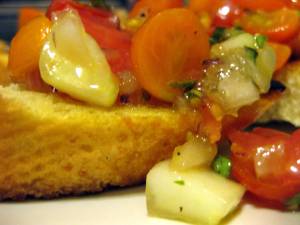
Starting with my favorite basic bruschetta recipe, I chopped up one red early girl tomato, a few dozen cherry tomatoes, a peeled and seeded cucumber from the back garden, and a handful of red onion.  Then I added julienned basil (backyard again!), salt, pepper, olive oil, and a tiny splash of red wine vinegar.  Then I let it sit in the fridge for a few hours while we went about our business. IMG_1522

After watching a dear colleague successfully defend her dissertation and then celebrate accordingly, we picked up a loaf of sourdough bread on the way home and the magic really began.  Generally when I make bruschetta, I toast the bread slices in the broiler.  However, in her rendition in the movie, Julie Powell (or Amy Adams; I don’t know whether Julie Powell ever actually made this) fried her bread in olive oil.  Wanting to stay as true to the beautiful food in the movie as I could, I opted to do the same.

Though some of my bread got a little dark, most of it turned out just fine.

IMG_1526

We stacked up the vegetables on the bread, covering every square millimeter possible before biting in and, of course, losing half the tomatoes to the plates below.  They squirted down our chins and slicked up our hands, but it was worth it, and here we return to my initial question.  The tomatoes were good and juicy, the cucumber was crisp, the basil added the right zing, but the bread was really what made the dish excellent.  It absorbed enough olive oil to be a beautiful golden brown color, and the crumbs of each slice became crisp; the perfect surface to stand up to the weight of the tomatoes, but still soak up a little of the juice the vegetables had created.  Biting into a slice was a textural experience, because the inside of the bread was still soft, but the crust was crunchy and the outer surfaces were crispy, and the whole thing was deliciously… oily?  Oiled?  In our low/no-fat culture, obsessed with cleanliness and thinness and sleekness, the idea of oil seems objectively negative.  But this was wonderful and delicious and silky and superb.  What can I call it?  Can we bring back, can we reclaim “oily” to mean what it should mean?  That crispness with buttery rich moisture I experienced with our weeknight dinner?  I think we should.

IMG_1527