The Week of Magical Eating, Day Five: Phoebe-Phriendly

I realized recently that if I lived alone, I would not cook the way I do now.  I would eat scrambled eggs, I would eat yogurt and granola and pasta.  I would cook occasionally, but what I do now built out of a desire to care for my then-boyfriend, now-husband.  Some of it was, admittedly, to impress him, because he was eating microwave dinners and frozen bagged teriyaki concoctions.  But some of it was born from a desire to nurture him, because he was eating microwave dinners and frozen bagged teriyaki concoctions!
Somewhere along the line, I discovered that I really liked this whole cooking thing.  It became challenging but fulfilling, stress-relieving and relaxing, but also a self-induced obligation.  Deep within these seemingly-contradictory-but-somehow-harmonious-co-existing attributes, the urge to feed and nurture remained.  I cook because I love.  It is the best, most sincere, heartiest way I know how to show my deep affection and fierce warmth.  If I cook for you, it means I care about you.
As I have mentioned on this blog before, I have a friend Ph. who presents some challenges to my ordinary routine.  She is a good friend.  I care about her.  Therefore, I want to feed her.  But her particular dietary needs present me with unusual requirements.  Not only does she eat gluten-free, but dairy-free, corn-free, and nut-free.  This has, much like the Caesar dressing in my previous post, become a minor obsession for me.  I never realized how much of my love involved cheese, milk, and butter, to say nothing of wheat products.  But I care, and I feel driven, and I want to cook for her.  It has become a kind of mission for me.  So I have been educating myself; experimenting with alternative flours, rejoicing in olive oil, learning about how soy milk reacts differently than cows’ milk.  I have done some reading, found some new “friends” online, and discovered with delight how many flour and starch options exist in the bulk foods section of Market of Choice.
Despite all this, I haven’t done much baking yet.  I find myself a little intimidated because I don’t like failure.  I don’t know how these new ingredients react to each other yet, and I dislike the idea of presenting substandard or imperfect food.  But I bucked up my courage recently and made my way through my first bag of rice flour.  One semi-triumph was a version of Elana’s “Magically Moist Cherry and Apricot Cake” from Elana’s Pantry.  Since Elana uses almond flour as her primary gluten-free alternative, I cannot use her recipes verbatim.  Ph. cannot eat tree nuts.  Additionally, Elana uses alternative sweeteners, and I have not yet delved into the mysterious world of agave nectar.  So some amendments needed to be made.
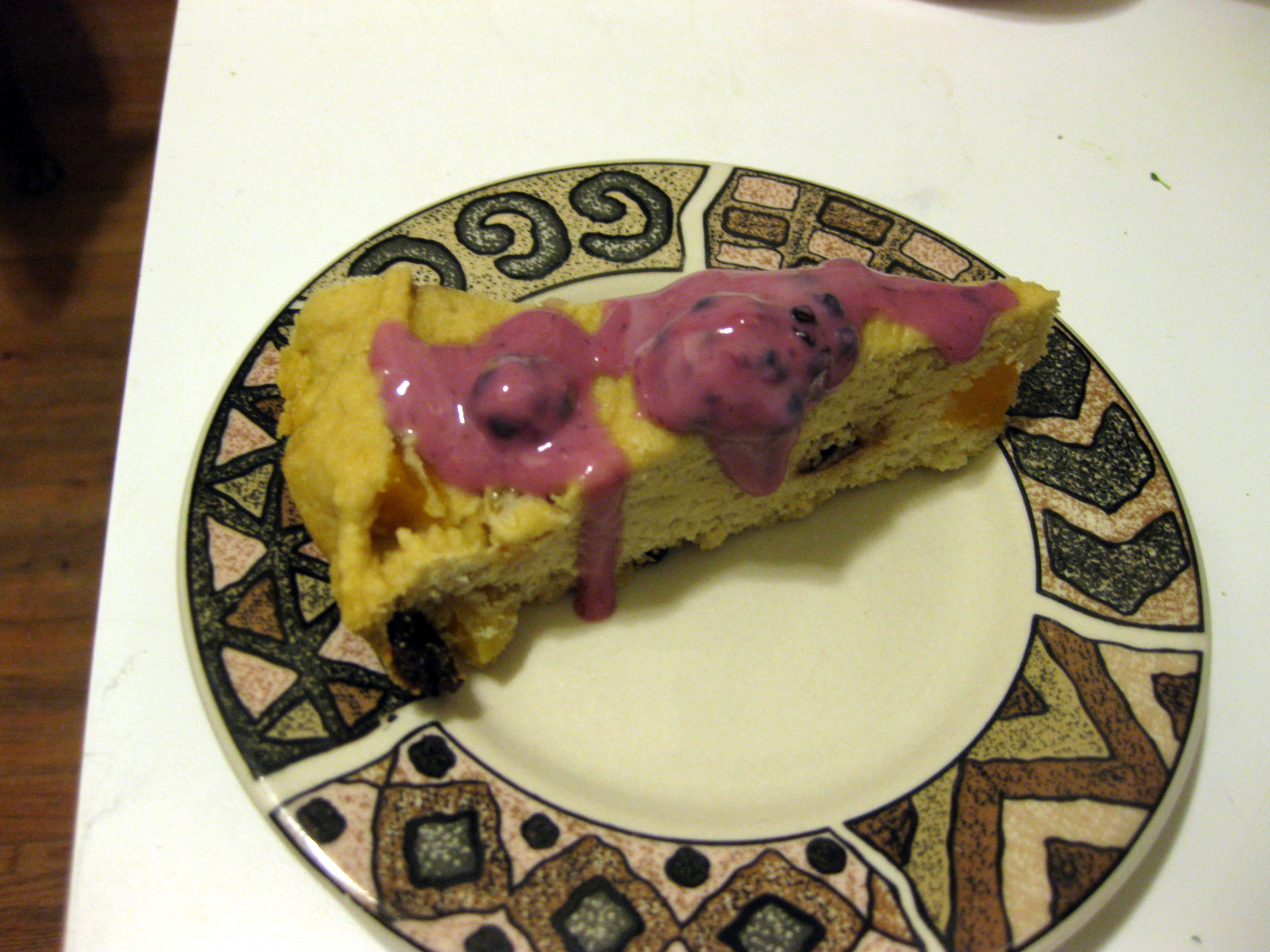
For a girls’ TV night, to which Ph., ironically enough, was not able to attend, I attempted Elana’s cake.  I used white rice flour instead of almond flour, and sugar instead of agave.  Since the resulting clumpy, bumpy batter would not have poured, per the directions, if I’d pointed a gun to my bowl, I added a few splashes of soy milk until things loosened up a bit.  I smoothed the dough out in my pie plate and stuck it in the oven.  Thanks, I suspect, to the soy milk addition, I had to up the cooking time by ten minutes or so, and when I took it out of the oven, it certainly didn’t look like Elana’s.  Hers looked moist with a lovely crumb and a golden crust.  Mine hadn’t lost the spatula-smoothing strokes I’d used to even out the batter.  I broke off a clumpy edge and took a taste.
It was tasty, if different.  Rice flour seems to contribute a grainy texture that I’m not thrilled with, so I know that more experimentation awaits.  But the cake was not as dry as I had feared it would be.  Finally, a baked good that Ph. could eat safely and enjoy (she loves dried fruit).  Since, as it turned out, she was not able to partake on that evening, I broke all my rules to make the dish completely Ph-Phriendly, and made a yogurt glaze to drizzle over the top.  Vanilla yogurt, defrosted frozen blackberries, and a tiny splash of creme de cassis.  This added just the moisture the cake seemed to need.  A few days later I had a slice spread with cream cheese.  That was good too.  Oh what would I give for nondairy cream cheese?
So experiment #1 is complete.  Next up, new flours, mixes of flours, and maybe a fruit crisp.  Doors are opening, and I’m on a mission.
The Week of Magical Eating Day Two: Belated Valentine

Belated Valentine, from my kitchen to you:

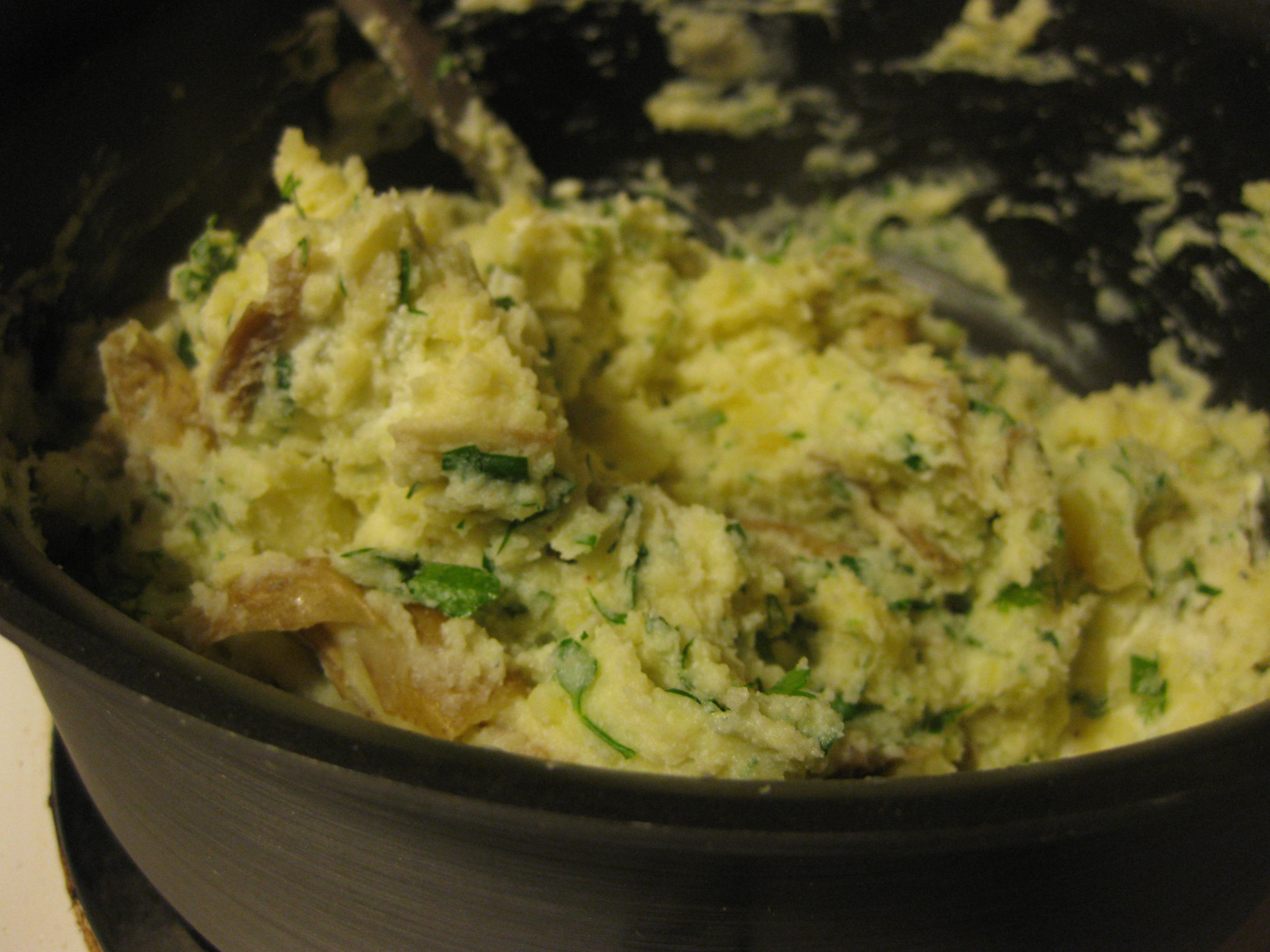
I am a big believer in comfort food.  For me, mashed potatoes are a comfort food that are impossible to get tired of.  They can be made in so many ways: with butter, with olive oil, with sour cream, whipped, blended, smashed, gravy-ed.  Two things seem to remain true about them.  1.) there are never enough, and 2.) they get cold too fast.  How to combat this?  It helps that I am only cooking for two, but had my first lessons, triumphs, and failures in a kitchen that fed four nightly.  I haven’t yet mastered the downsizing process, but in cases like mashed potatoes, N. and I actually benefit from my over exuberance.

The key element to mashed potatoes, I think, is including enough fat.  Otherwise all you end up with is crumbly boiled potato.  I take my fat options extremely seriously, and in considering all the creamy options, I decided to play with ricotta cheese during this round.  Not only would this add a cheesy dimension, which is almost never a bad thing, but would contribute a velvety texture and give the potatoes a way of clinging together as they crumbled under the force of my masher.

I dropped a bag of baby Yukon golds into a pot of half salted water, half leftover chicken broth that didn’t get stirred into the risotto from the previous night’s adventure.  Then, in a moment of sudden, startling inspiration, I cracked three whole, unpeeled garlic cloves off the bulb and tossed them in too.  Considering the plans for the following night, these paper-wrapped, pungent little cloves could tie the whole week together.

While the potatoes boiled, I considered their final destination.  Ricotta cheese is nice, but it certainly could be improved upon.  I chopped up a good handful of dill and Italian parsley, and on sudden urge, grated a handful of parmesan cheese too.

I like my mashed potatoes chunky, and I know that most of a potato’s nutrients are found in its skin, so I like to make mashed potatoes with new or fingerling potatoes, or with red-skinned potatoes, which all have thin skins with unobjectionable flavors.  This adds to the nutritious value of the final result, and it saves me time because I don’t have to peel a bunch of potatoes in preparation.  Additionally, the skins add a nice textural element as they yield their hold on the starchy interior and shred through the pot upon mashing.

After draining and peeling the garlic cloves, I added and gently mashed together the following with the softened soldiers:

  • 4 TB butter
  • ½ cup milk
  • 8 oz. part-skim ricotta cheese
  • ¼ – ½ cup grated parmesan cheese
  • ¼ cup roughly chopped fresh parsley
  • 2-3 TB chopped fresh dill
  • Sea salt and black pepper

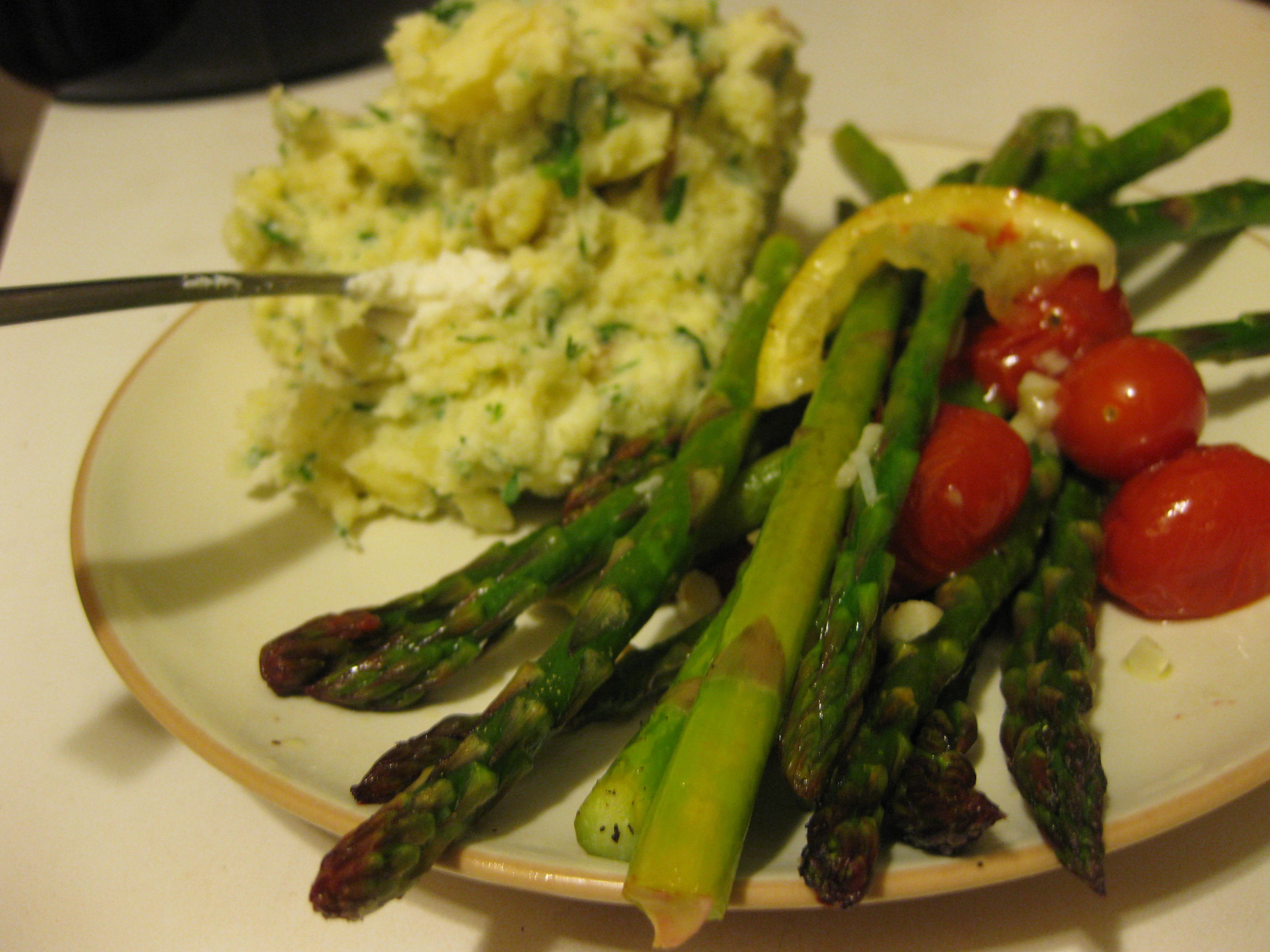
Using a plastic masher is invaluable because you can do your mixing and mashing right in the pot, which ensures that the potatoes stay hot longer.  We mounded ours up on warm plates and ate them alongside roasted asparagus.  The ricotta was a great addition; it was not super cheesy, but recognizably creamy and smooth.  It definitely added richness and tamed the starchiness of the potatoes.  The combination of herbs was a success.  With the additional richness of the cheese, having bright pops of green both visually and orally made the dish feel, not exactly healthy, but not overbearing.  Besides, with a side of asparagus and burst cherry tomatoes, we weren’t being all that bad…

The Week of Magical Eating: Day One

With my exam over, and firm commands from my adviser to give myself a break for a week or two (she said a month, but she and I are both too dedicated and both such workhorses that I doubt that will happen), I can concentrate on the important things: food, and husband.  Fortunately, since he needs to be fed, these important things can work in tandem.  So I send my apologies to Joan Didion, and promise to report to you a Week of Magical Eating.  Some dishes will be fancy, fresh, and well prepared.  Some will probably be valiant attempts to use up leftovers.  Either way, I will try to check in with my results.

Day one, yesterday, also happened to be Valentine’s Day.  Neither N. nor I particularly support this Hallmark holiday, likely as a result of residual bitterness before meeting one another and deciding that no one but each other should ever be subjected to either of us again.  However, thanks to my rapidly ebbing stress and rising ability to enjoy normal activities like shopping and cooking without feeling guilt about not studying, I was able to secure ingredients for dinner on the special side.  Not for VDay, but for each other.

As a congratulatory gesture for passing my exam, one of my officemates gave me the ingredients for Kir Royale: champagne and crème de cassis.  This blackcurrant liquor smells sweet with the promise of a bite.  Mixed with champagne, it was much less sweet than I had imagined; my taste buds were prepared for something dessert-like, but the mix was delicious and fresh, and the color was appetizing too.

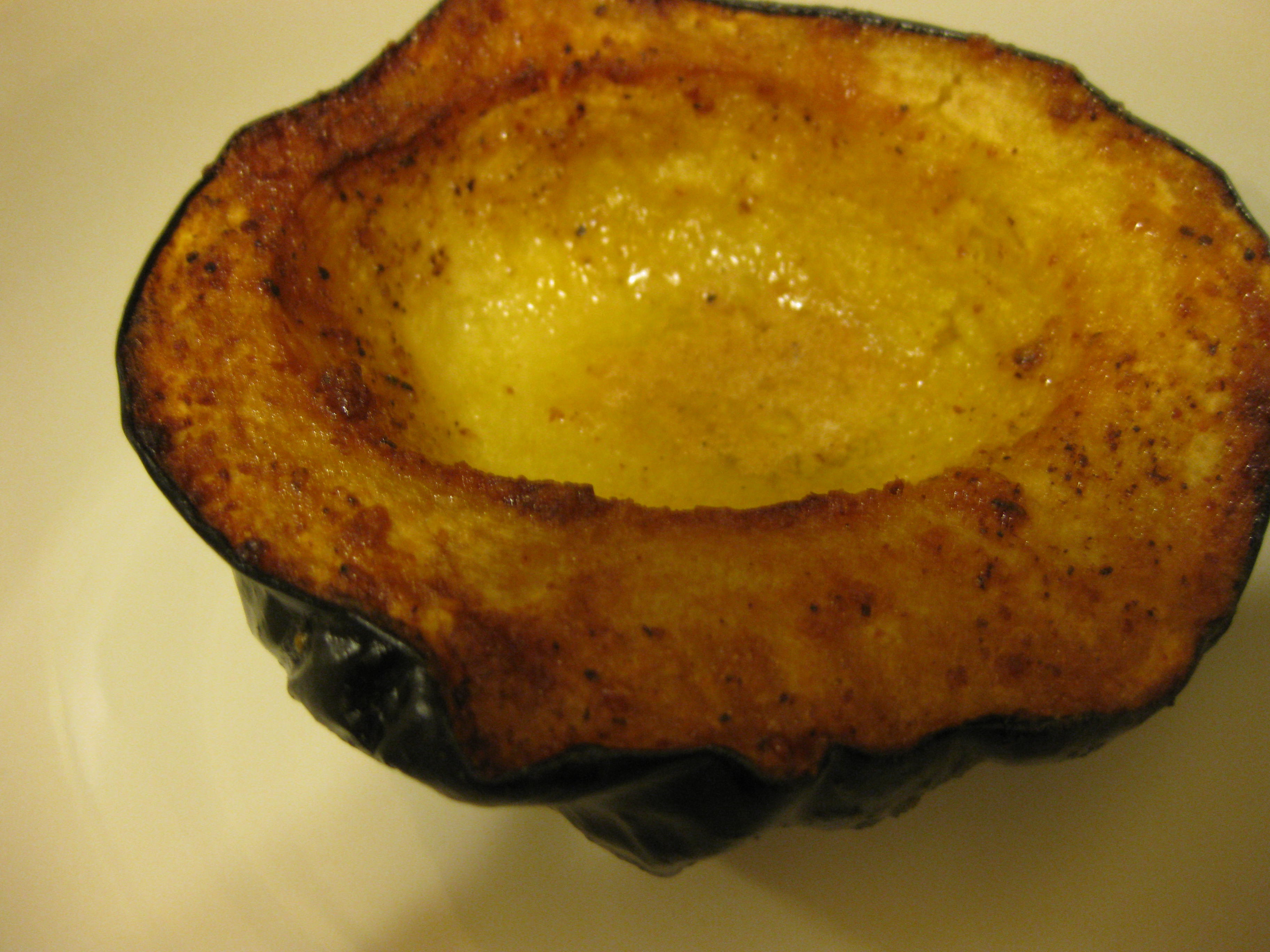
With our aperitifs poured, and an acorn squash halved, liberally basted with butter, honey, mustard, and shoved unceremoniously into the oven, I embarked on Jaime Oliver’s spinach and goat cheese risotto.  I’ve made this dish before, and was craving its fresh green notes and rich tanginess.  To make things extra special, and since between the two of us on a Sunday night we deemed it unwise to drink an entire bottle-o’-bubbly, I used champagne instead of white wine to deglaze my risotto pan after lightly toasting the rice and onions.  In the end result I couldn’t taste a difference, but I like to think the champagne contributed to the light tang of the final dish.

Piled high on a plate, it was creamy, it was luscious, with pockets of goat cheese slowly melting in amidst the kernels of rice that never lose their bite completely.  The acorn squash as a vegetable side, though it has a completely different flavor profile, works nicely with this risotto, I think, in part because the color contrast is so striking.  After an hour in the oven, the rind gets thin, flexible and yet crackling at the same time, and if you don’t mind burning the tips of your fingers, you can hold the caramelized edges with one hand while you scrape the flesh out with a spoon held in the other.

Nothing bitter here.  Honey, crème de cassis, goat cheese, sweetness layered on sweetness, but not enough to be cloying.  Exactly, perhaps, how Valentine’s Day ought to be.

Post-exam bliss. And chocolate.

As I mentioned a post or two ago, this Friday I had to take an exam.  A very-big-deal exam, the outcome of which determined my ability to move on in the program.  And I passed it.  This means I am now free to move toward my dissertation, and that I am a doctoral candidate (well, almost, first I have to create and get approved a dissertation prospectus)!

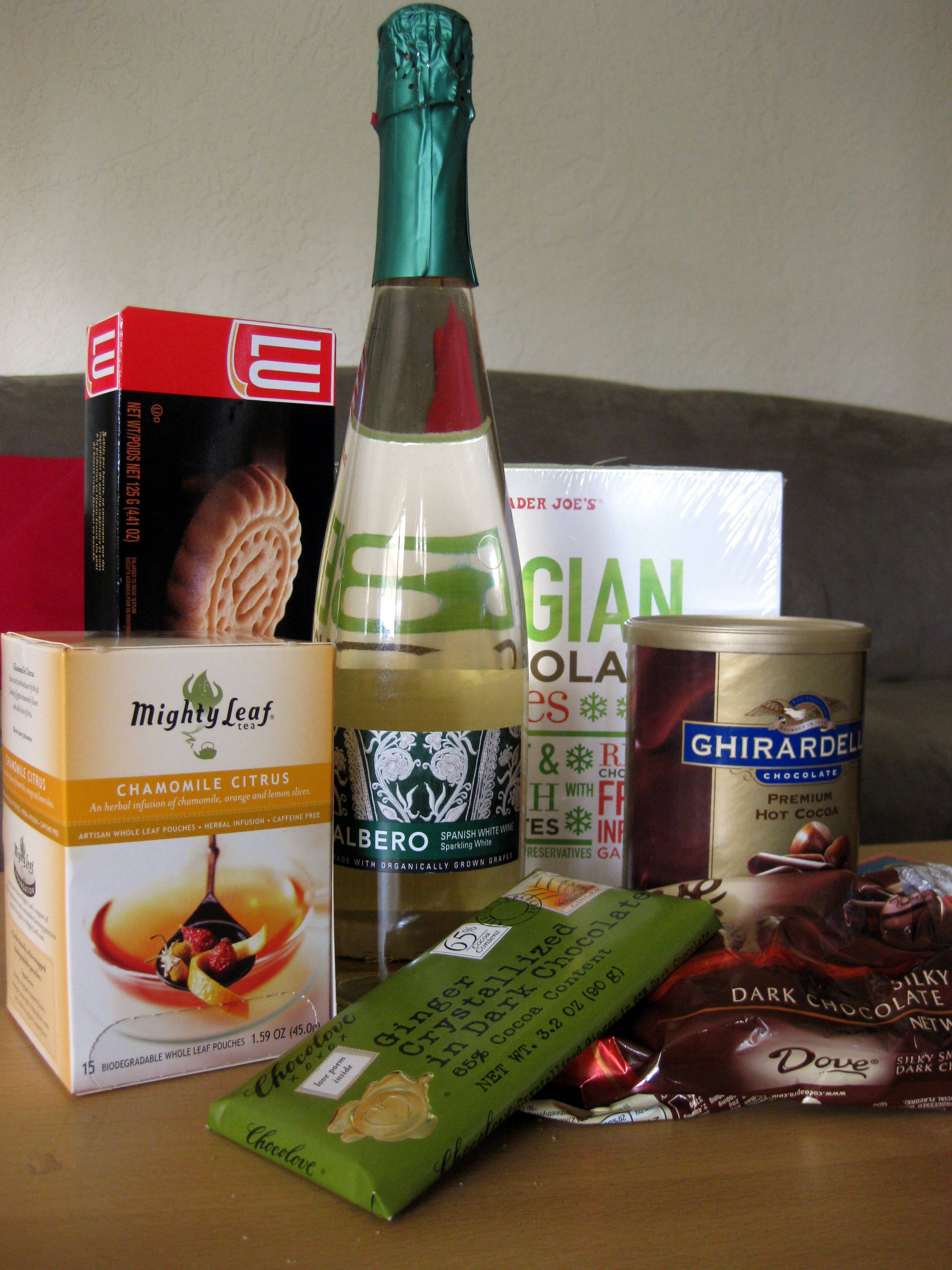
Excitingly, in a project that does have food as a focus (although more the ways of eating it than the preparation and aestheticism thereof), I received some unexpected but delightful well-wishes in the form of food, when I went out to brunch with some friends/colleagues last Sunday morning.  As we crowded around our table at Midtown Marketplace, some with omelets, some with pancakes, me with a glorious hazelnut waffle topped with mixed berry compote, they began emptying pockets, purses, jackets, and loaded this impressive loot onto the table before me:

This was far more than I expected, and far more than I needed, but it was so brimming with love and support that I was quite overwhelmed.  The breakdown: Dove chocolates (bottom right), always a delicious and reliable standard.  I took the bag to my office to share with my office-mates, since they have had to listen to and encourage me throughout the process of preparing for this exam.

The Belgian chocolates (back right) were a selection of five fruit flavors blended with different types of chocolate (milk, dark, and white) and had some delightful combinations.  I shared these around the office as well.

The candied ginger spiked chocolate bar, which N. dubbed “crack,” was outrageous.  Spicy little chunks of candied ginger in smooth luscious dark chocolate; we finished the bar in two days… now all I want is to make my own candied ginger and wrap it lovingly in a truffle to recreate the experience.

The tea (middle left) is chamomile citrus, and is incredibly beautiful.  The ingredients are left whole, and enclosed in transparent little cloth packages sewn together with soft twine.  You can actually see the chamomile flowers, little strips of dehydrated orange zest, and the other leaves and blossoms used to create the tea.  With a drizzle of honey, it is the perfect not-too-indulgent bedtime beverage.  With the addition of a few shortbread cookies (back left), it becomes rather more indulgent.  These cookies were so rich and buttery that I thought they would leave my fingertips buttery, like the aftermath of a big handful of popcorn.  Just softened in the tea, they were lent an appealing subtle citrus flavor.

For true indulgence, the Ghiradelli cocoa mix is your best bet from this table of luxuries.  It is chocolate and hazelnut, so in essence it is like drinking a hot cup full of Nutella.  Incredibly rich and delicious.  I have only mixed it with water thus far, but the package recommends mixing with heated milk, which would only add to the indulgence!

Finally, the tall bottle in the middle is a Spanish sparkling white wine by Albero, which the bottle claims is made with organically grown grapes.  I have not yet popped the cork of this delightful looking treat, but when I do I expect to feel the same sort of rush of relief and unbelieving but effervescent bliss that I did yesterday afternoon, when my adviser and the chair of my examination committee shook my hand and told me “Congratulations!”

Focaccia for the win

I have mentioned before, on this very blog, that I am afraid of yeast.  However, as it has surely become clear by now, I love baking.  It was only a matter of time before these two truths collided and a new truth was constructed.  As I told my students only a few days ago, it was not always a “truth” that our solar system was heliocentric.  They grudgingly accepted this, but I now elatedly announce that I am no longer afraid of yeast!  Perhaps a bit timid, a bit guarded still, but not afraid.  What has changed, you ask?

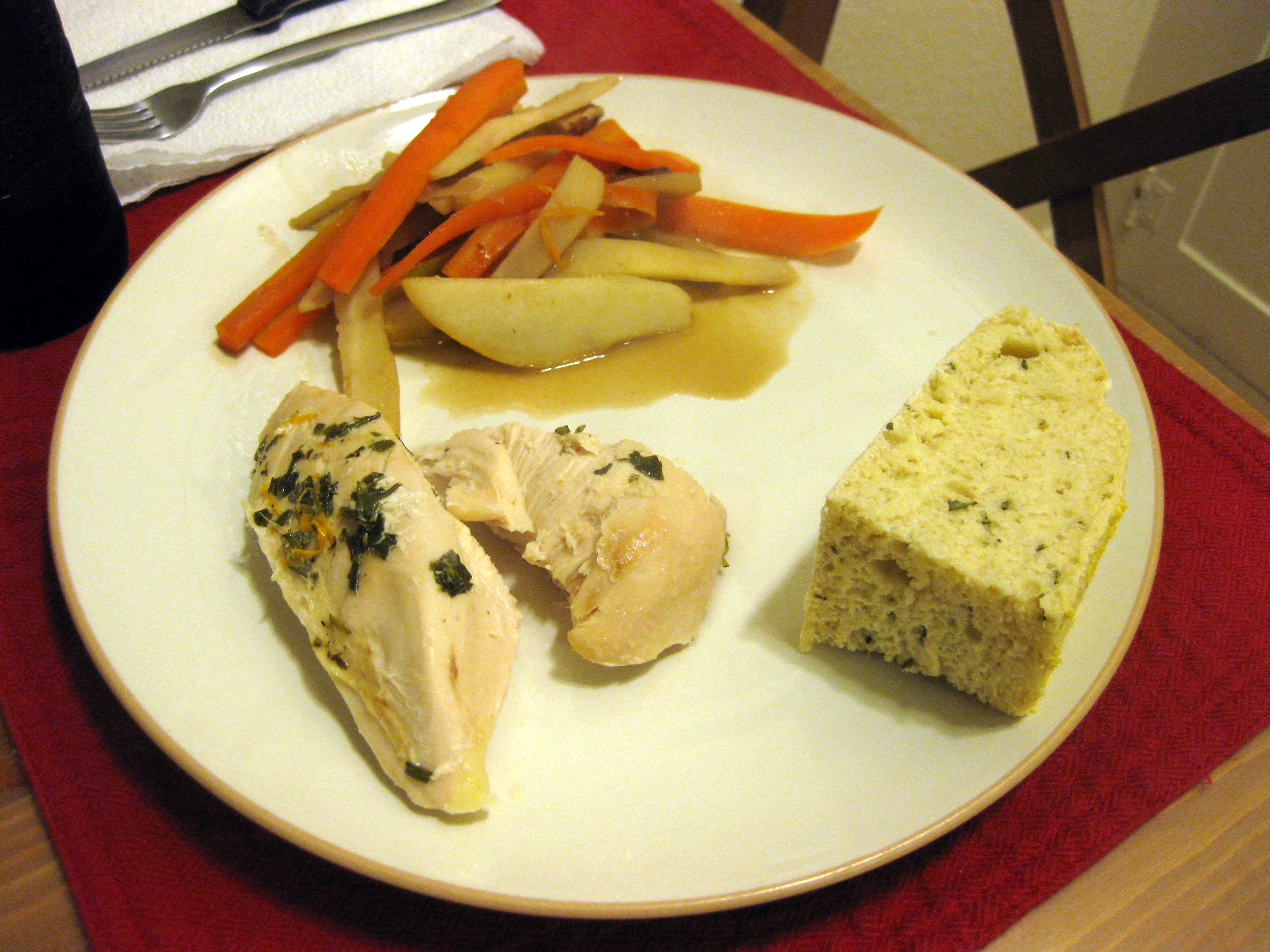
This is a rosemary olive oil focaccia-style loaf from a cookbook put out by Food and Wine Magazine that I finally got up the guts to try out.  I learned three things by making it: 1.) yeast is not as easy to screw up as I thought; 2.) following directions is smart; and 3.) the way to a man’s heart may really be through his stomach.  At least if he shares a last name with my husband.

While this bread was not difficult to make, I think it would have been better if I had read the recipe more carefully.  After assuming I had killed my yeast when it all sank in the warm water I sprinkled it over, I didn’t bother to knead the dough before setting it aside to rise.  Then I baked it at the wrong temperature and despaired when it didn’t seem done before realizing my mistake.  And after all that, it was still delicious.

The bottom half inch or so was denser than the rest of the loaf, and I don’t know why that happened, unless it was related to my inability to read the directions the first time through.  But it was really, very good.  The olive oil made the texture pleasant – moist and chewy, and the rosemary contributed a nice, herby, woodsy flavor that contrasted well against the brisk brightness of the sea salt that also flavored the bread.  It is amazing how something with so few ingredients (flour, yeast, oil, water, salt, rosemary, and cornmeal) can have so much flavor.  And excitingly, as the recipe itself declares, this bread has endless flavor combination possibilities.  Next time I think I will add chopped kalamata olives.  N. agrees.

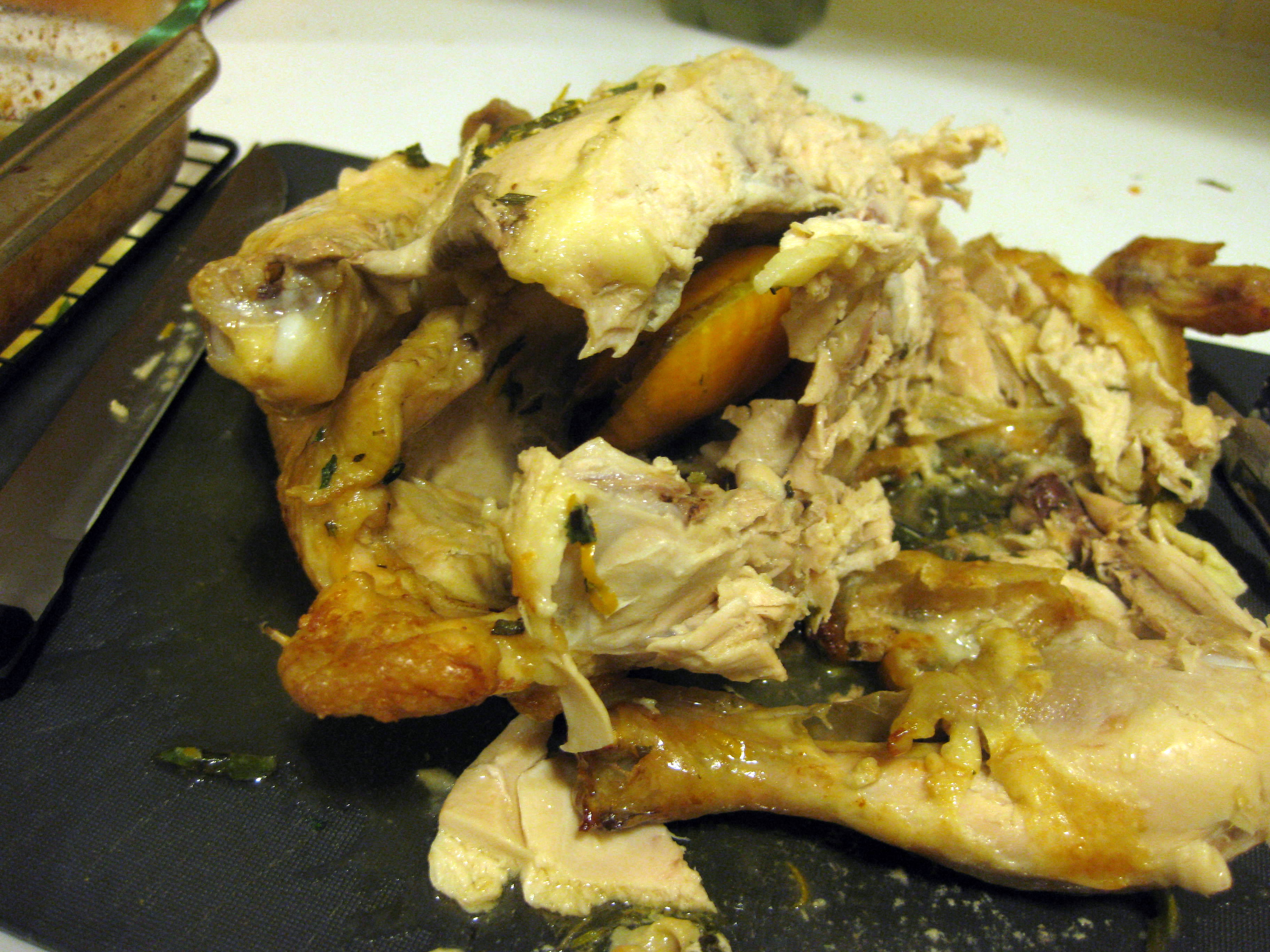
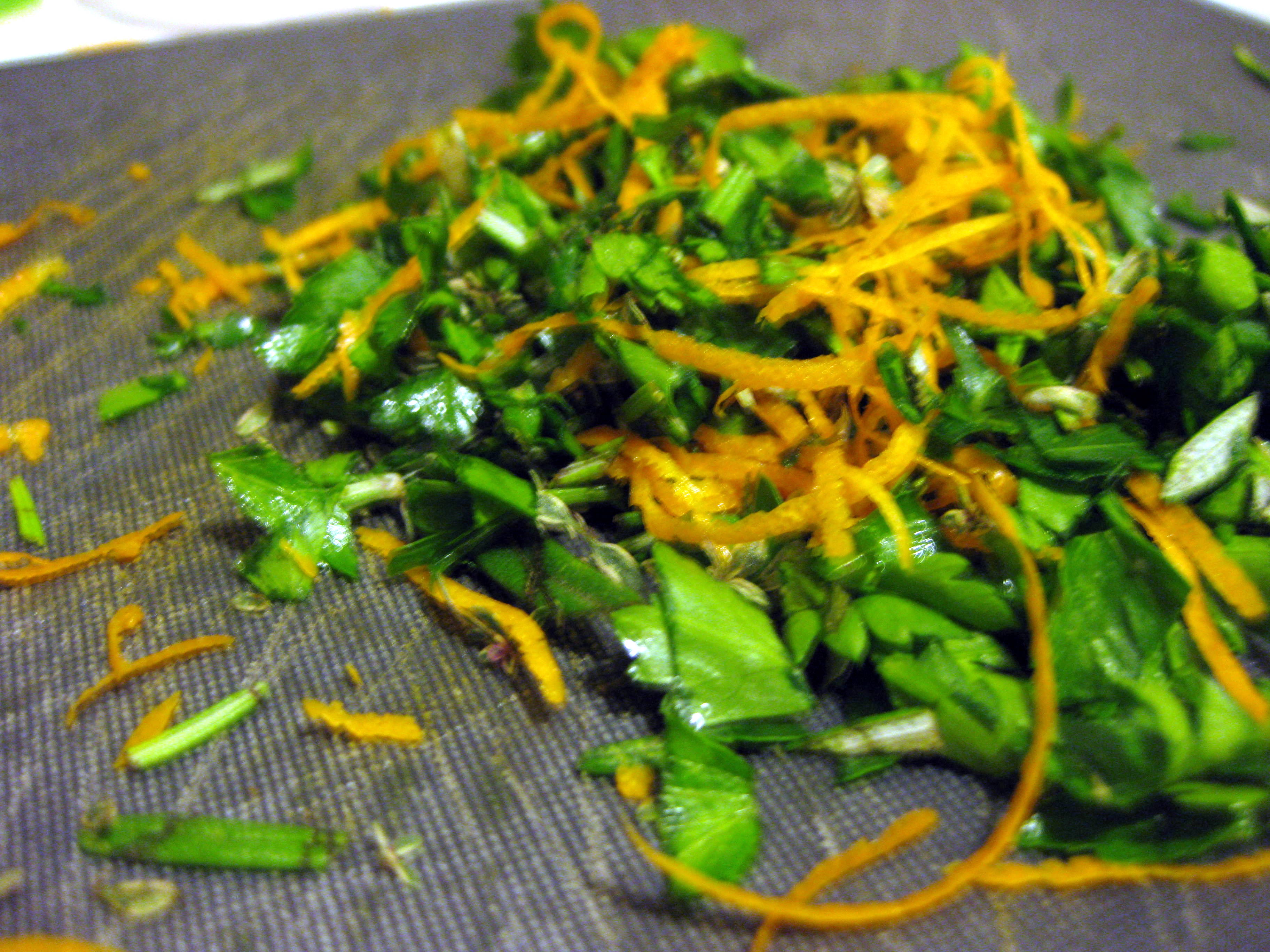
What was really glorious about this bread was how well I managed to combine and link flavors in the dinner that went with it.  We had a roast chicken and a vegetable side to go along with my yeasty triumph, and in the choices of aromatics I was able to clearly connect each dish.  The bread contained rosemary, and so when I made an herbed butter rub to massage under the chicken’s skin, I included plenty of fresh rosemary.

Our vegetable side consisted of glazed carrots, parsnips and pears with craisins and pecans.  Since the glaze was mostly orange juice, I added orange zest to my chicken herb rub and stuck a few orange slices inside the cavity of the chicken before it went in to roast.  If I had remembered in time, I would have added orange zest to the bread dough as well, to really link all three elements together.

The orange did, I think, add a delicate sweetness to the chicken, though I’m not sure it was recognizably citrus.  I think lemon would be more identifiable.  But the butter made even the white meat of the chicken tremendously succulent, and the herbs and garlic definitely added a punch and depth to the flavor.

The veggies were rich with autumnal flavors, and while I enjoyed them, I think they would match better with a pork or turkey main rather than chicken.  In fact, they might be delicious as a vegetable dish for Thanksgiving; the craisins make that an easy link-up.  Since carrots and pears are already sweet, the craisins and pecans were a natural pairing.  I always think pecans have a kind of caramel or molasses-like smokiness to them, which seemed to work very well with the herby, spicy notes of the parsnips.

Given that somewhat wild flavor the parsnips impart, a strongly spiced root beer or sarsaparilla might make a fitting non-alcoholic beverage pairing to this meal, or maybe even a ginger ale like Blue Sky that prides itself on natural flavors.

So let’s take a moment here and reflect: Roast chicken, glazed vegetables, and homemade bread.  Two of these three dishes required advanced planning and multiple stages, and then (as per usual, these days) I made broth from the chicken carcass after it was picked clean, with plans already in mind for the leftovers.  Long cooking times, “complex” procedures, and making use of every part of the meal.  If that doesn’t say Sally Homemaker to you, I don’t know what does.  All I can say is: I promise that I did not wear pearls while I cooked this meal.

2009: A Multi-part Christmas

Christmas 2009 was a multi-part, multi-occasion, multi-meal event.  I suppose when your family expands, and the number of people you love and visit with expands, the great foodie benefit is that you get to cook more and eat more.  I cooked a lot.  I also ate a lot.  I want to share some of the delicious, tipsy triumphs with you, despite the sobering truth that the new term of school begins on Monday morning, bright and early, at 8am.  Really, for me, it will begin at more like 6:30am, but 8 o’clock is when I will greet my new class of freshmen.

But that’s just an excuse for the following excuse: forgive me if the updates do not arrive as thick and fast as the food did at our multi-part Christmas dinner(s).  I will try to keep a schedule of one update a week, but, like Mary Poppins, I try to avoid piecrust promises (easily made, easily broken).  I can only try.  So here goes.

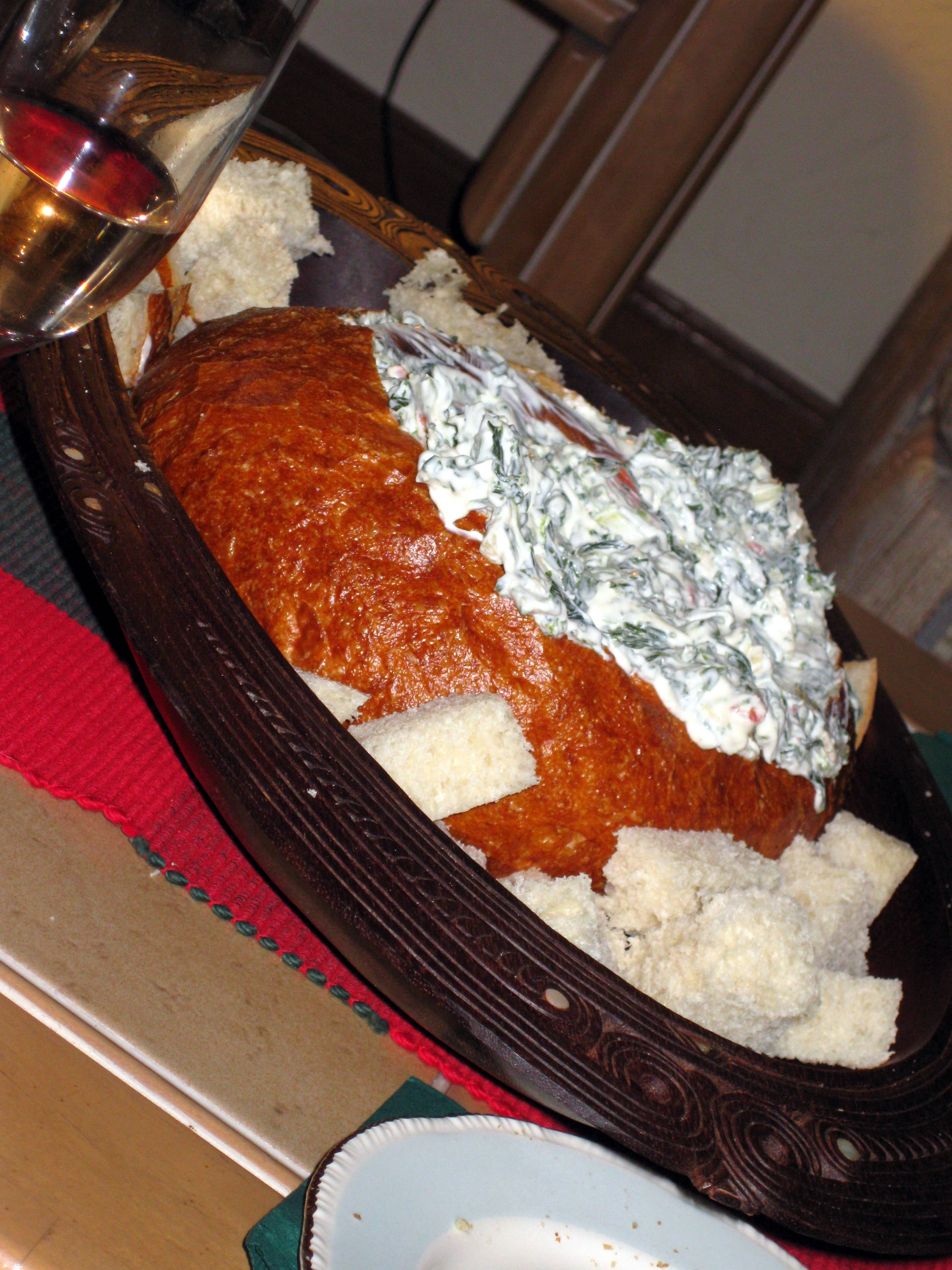
On December 23rd, we had our first Christmas dinner.  This took place at my parents’ house, and featured a series of appetizers.  Here are a few of the highlights:

Spinach dip in a bread bowl, a timeless classic.

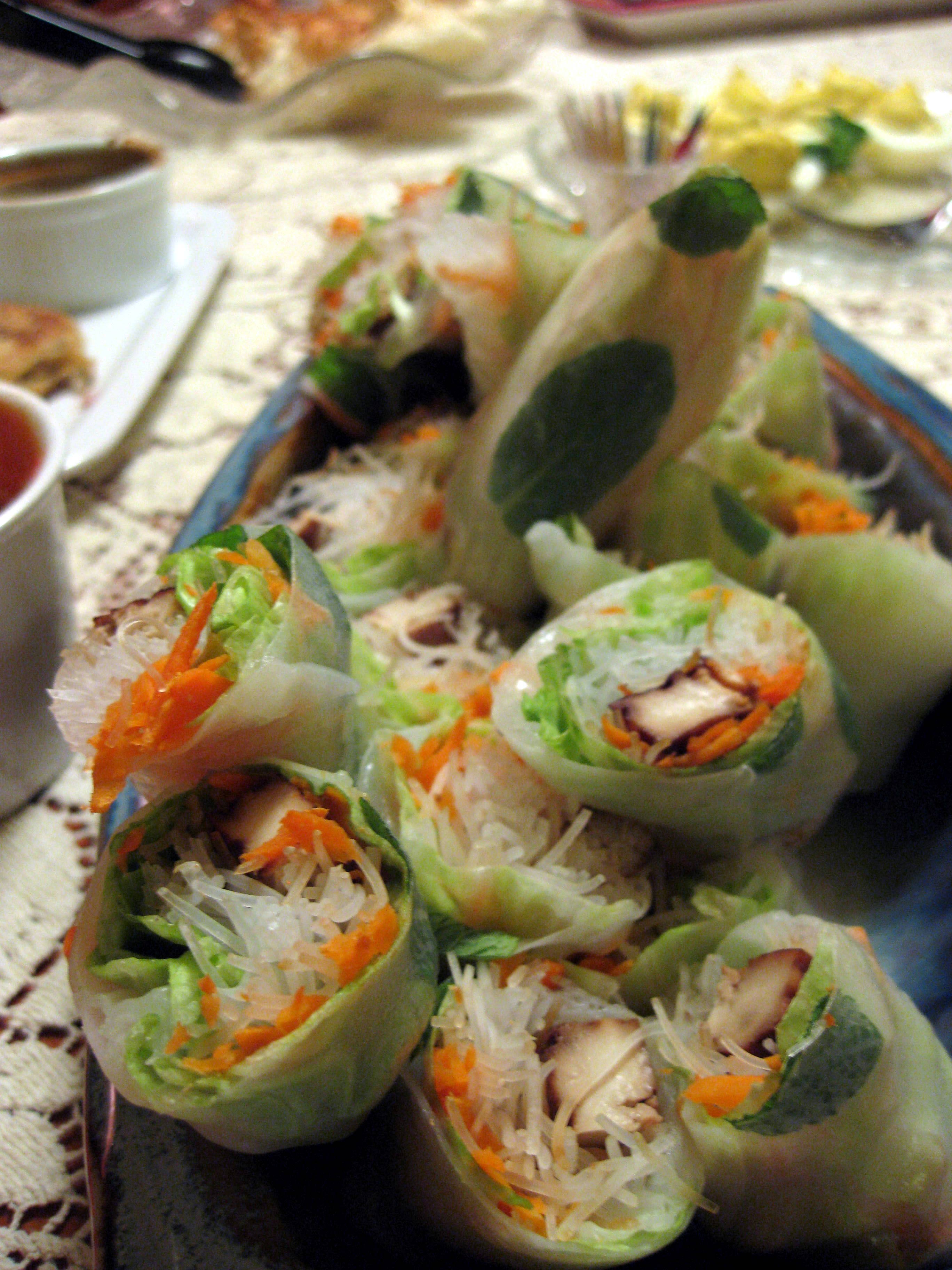
Vegetable spring rolls with tofu and mint.

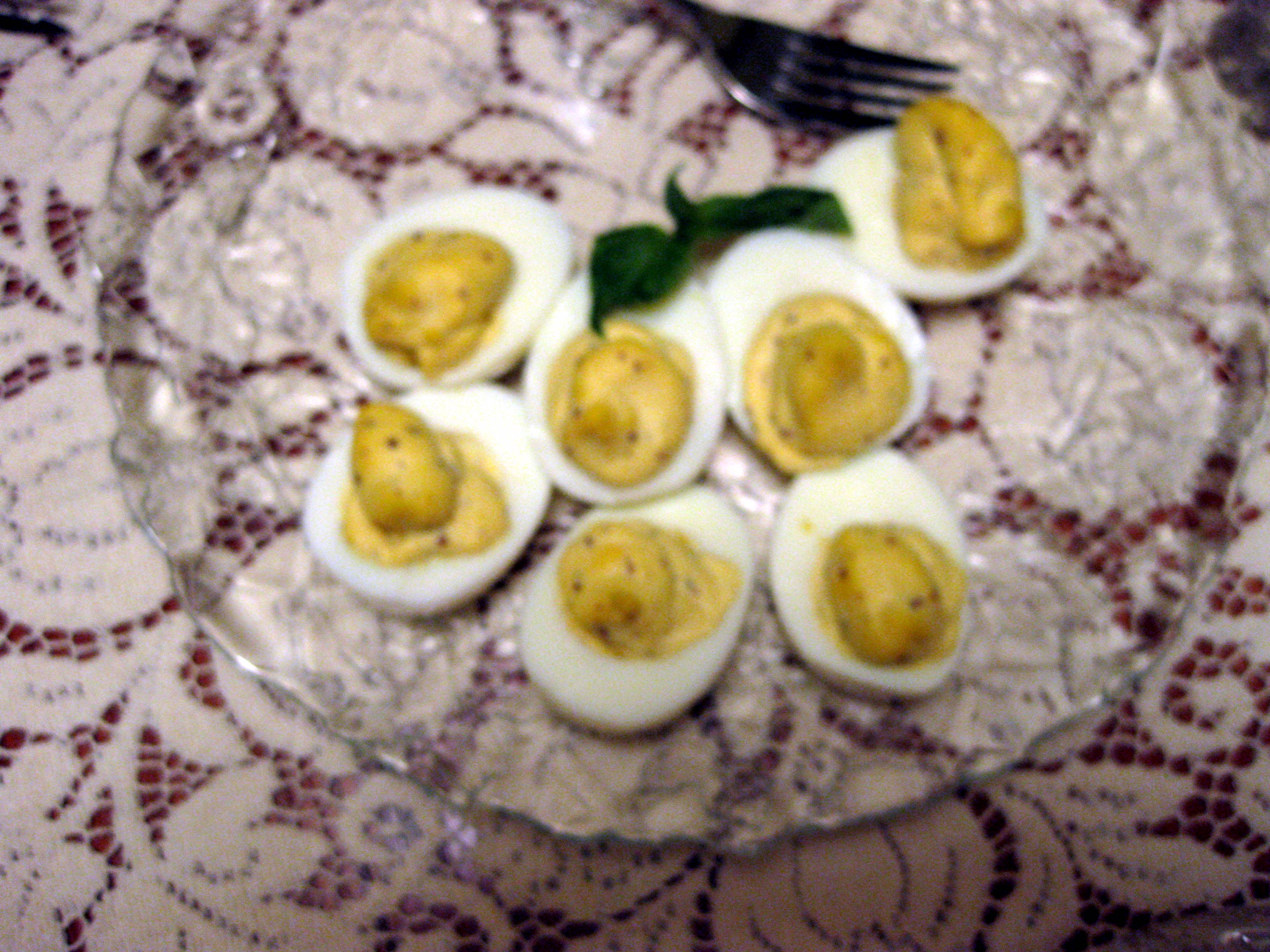
And the feature, which my sister specifically asked me to share: deviled eggs.

Forgive the blurred quality; I blame the mood lighting in our dining room.  Or perhaps my trembling hands, eager for a second round of hors d’oeuvre-age.

Deviled eggs are a party food with almost no exception.  No one seems to want to take the time to make them as a quick lunch, say, not even after Easter when most people have all the necessities available and partially prepped.  When the are made, they are often drenched in mayonnaise, over salted, given curious unneeded additions like pickle relish, hot sauce, strange herb combinations, and then to add insult to injury, so completely covered in paprika like a deserted house gets covered in dust a month after its inhabitants split that you can’t even see the beautiful contrast of yellow and white.  They are like little egg-shaped daisies.  This is why I am not a professed poet.

Anyway, the eggs.  I have finally found a perfect deviled eggs recipe.  It comes from the cookbook put out by Cooks Illustrated magazine, called the “The New Best Recipe,” which, like most of my culinary collection, I received as a wedding gift.  It is simple: just eggs, mayonnaise, whole grain mustard, and a splash each of vinegar and Worcestershire sauce, along with some salt and pepper.  The mayo makes it creamy, the vinegar adds a sharp tang to clear any heaviness you might feel from the combination of fats, and the seeds from the mustard pop in your mouth when you bite down on them, which I find to be a delightful and different sensation.  Texture in food is becoming increasingly important to me, and though the difference between the soft filling and the hard boiled albumen of the egg is there, it is subtle, like the distance between pudding and custard.  The mustard, then, offers new dimension.

Aside from the ingredients, the other strike of genius of this recipe is its recommendation to overstuff the eggs.  Deviled eggs look so much more appetizing when they are mounded (or piped) high with tasty tangy filling, and the way to accomplish this seems clearly to use one extra yolk.  It’s so simple, but I never would have thought of it!

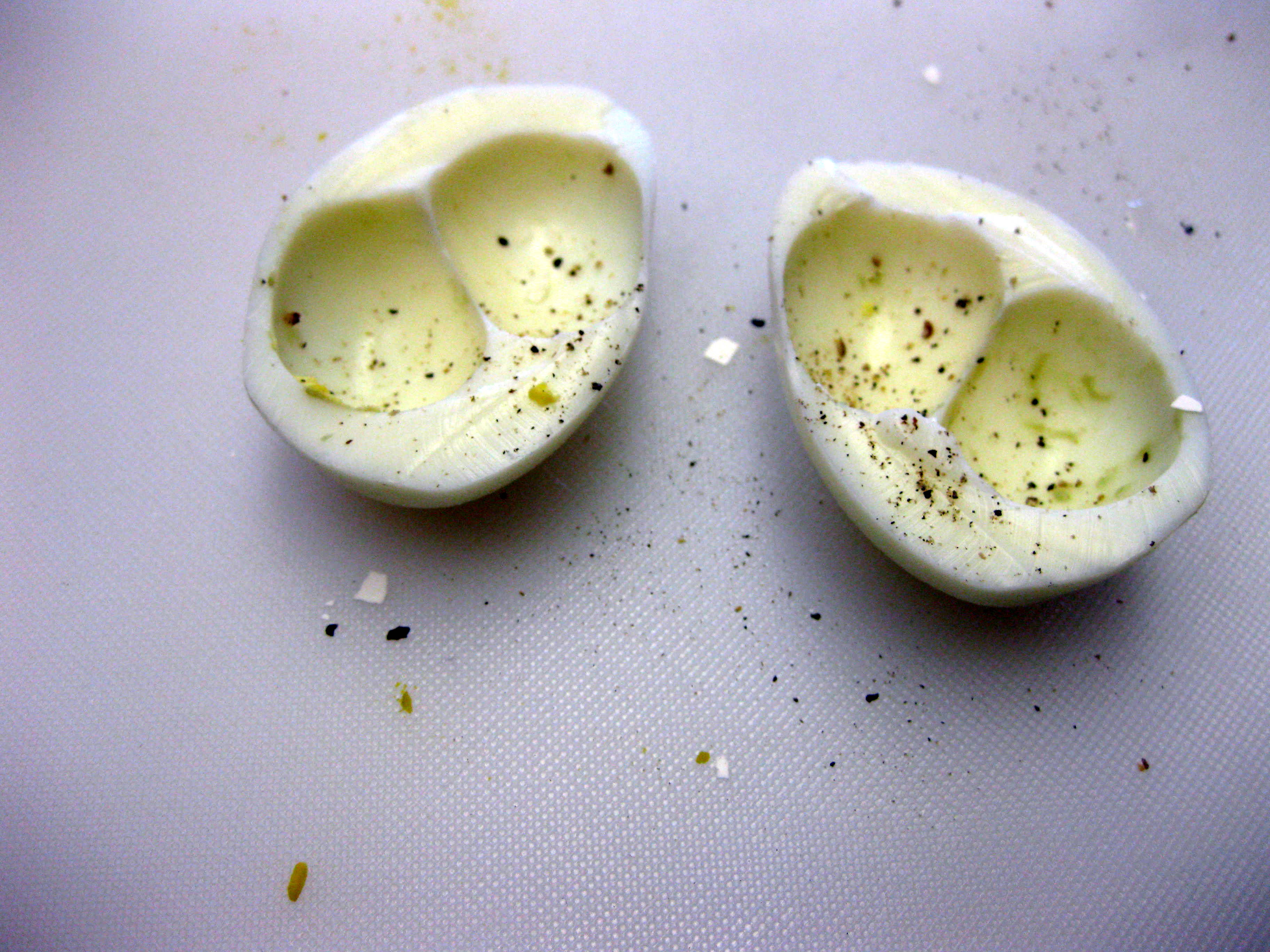
Fortunately for us, the eggs seemed to know my plan.  Observe: twins!

Ingredients:

  • 7 large eggs, hard boiled (tip: if you hard boil them the night before preparing this recipe, they will peel much more easily in the morning!)
  • 3/4 teaspoon whole-grain mustard
  • 3 tablespoons mayonnaise
  • 1 1/2 teaspoons white or red wine vinegar
  • 1/4 teaspoon Worcestershire sauce
  • Salt & Pepper

Directions:

1) Peel the eggs and cut each in half lengthwise. Remove the yolks and place in a small bowl. Discard two of the whites (I usually tear at least one set and am distressed by their loss of aesthetic value: these are the ones to just pop in your mouth right there) and arrange the remaining whites on your serving vessel.

2) Mash the yolks with a fork. Add the mustard, mayonnaise, vinegar, Worcestershire sauce, and salt & pepper to taste. Stir with a rubber spatula, mashing against the side of the bowl until smooth. This can take a while, and you really have to be dedicated about seeking out and breaking down all the clumps of yolk, or your filling won’t be as pleasing in consistency.  Taste and adjust seasoning to your liking.

3) If you have a piping bag, fill it up with the yolk mixture and pipe into the empty whites, making tall rosettes.  Don’t worry, you will have plenty of filling if you have one more yolk in your mixture than you have pairs of whites to fill.  If you don’t have a piping bag, scrape all the filling into an empty gallon Ziploc bag, keeping it away from one bottom corner.  Seal the bag, trying to eliminate as much air as possible, then snip off one of the bottom corners of the bag with scissors, maybe just big enough for the tip of your pinky finger to fit through.  Presto, instant piping bag!  Fill the whites immediately before serving, so the filling stays fully emulsified.  Exult and enjoy.