Summer Salad Sonata

As we launch unforgivingly into what will be my fourth complete Oregon summer (we moved up halfway into one, so that doesn’t count), I’m reminded of Monty Python.  Specifically, I’m reminded of the animated plot-moving section in QHG when the narrator tells us that “A year passed: winter changed into spring, spring changed into summer, summer changed back into winter, and winter gave spring and summer the miss and went straight on into autumn… until one day…”  Oregon, I call foul.  After a wretched winter, we’d barely touched into spring temperatures when we’re suddenly awash with summer.  Except for the allergies, which linger in heavy layers of nose clogging pollen to remind us not only that Linn County just to the north is the grass seed capital of the world, but that it’s not quite summer yet, even though my feet are bare and my window fan is running at full blast.

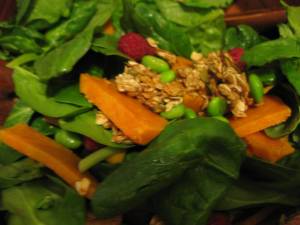
So it’s hot, that’s basically what I’m trying to get across here.  I’ve lost my California hardiness, but then again, it’s been four years.  Apparently my computer has lost its tolerance for heat as well.  Despite being mid-term-paper, I took long breaks throughout the day during which I shut the poor machine down so it wouldn’t die of heat exhaustion.  The fan was running overtime, to the point that I actually pointed another fan at the box in hopes that this would help cool things off.  With all this impending heatstroke, the last thing I wanted was a hot meal for dinner.  Thankfully, my latest issue of Cuisine at Home charged me with the challenge to “build a better salad.”  In congruence with their directions, I produced the following opus:
IMG_0650

At its bass line, that’s a spinach salad you see there, but the accompaniment is really what makes it sing.  It featured steamed sweet potato slices, raspberries, defrosted frozen edamame, and homemade granola.  Like a complex perfume or a fine wine, a good salad needs a top note.  Ours was a vigorously whisked dressing of yogurt, mayonnaise, garlic powder, salt and pepper.

The best part is imagining what to do with the leftover granola.  I’m thinking yogurt… honey… fresh raspberries…
Plumbing the Depths of the Sesame Crusted Sublime

A week or so ago, when we had a span of delightful warm weather, a number of truly wonderful things happened. My wonderful friend S. drove us to Lowe’s where we bought lumber to create garden plots, my wonderful husband N. built us said garden plots, and I spent about two wonderful hours too long in the early Spring sun getting my neck, chest, and arms burned while I introduced young plants to their new homes. The upshot of these two glorious afternoons was the creation of a vegetable and herb garden. The backlash was the toasted skin.

Oddly inspired by the fire burning my skin from within, and not wanting anything involving the oven for dinner, I set about morphing together two recipes: my mom’s friend Jen’s Chinese Chicken Salad with a really delicious seared ahi salad I had at Henry’s 12th Street Tavern (http://henrystavern.com/index.php) for my 1 year wedding anniversary.

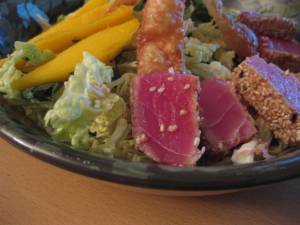
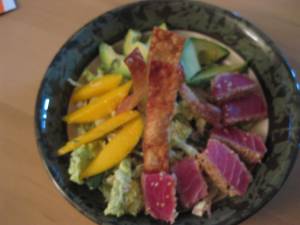
Taking my own toasting into account, I dredged a beautiful hunk of sushi grade ahi in sesame seeds. I seared it lightly on all sides so that the sesame seeds were nutty smelling and golden on the outside and the tuna had layers of doneness culminating in a glorious rare center. I mounded up a mixture of savoy cabbage, chives, and (I know, so gauche but so good) crumbled ramen noodles in our salad bowls, and topped it with thin slices of tuna, mango, and avocado, then crowned the whole thing with some deep fried won ton strips.

It was perfect. The tangy acidity of the mango cut through the buttery richness of the avocado and the achingly, meltingly perfect tuna center. The perfect bite was all three heavy hitters on one forkful, followed by a crunchy bite of won ton to change up the texture and cleanse the palate. I won’t lie; the cabbage salad was really just there for looks. And to pretend we were getting our full serving of vegetables. We really just wanted this tropical take on sashimi. Now, with my sunburn a fading memory, clouds back in the skies, and rain on the way, I can only remind you of that shiny glimpse of springtime:

img_0422img_0421

Rice Parade

In my mind, few foods are as simply clean and perfect as a pot of perfectly cooked rice. If foods were chosen to embody colors, rice would be the perfect candidate for whiteness. Think about it. Freshly made, just off the heat, the first time you fluff it to break up some of the clumps, it’s like little pillows. It smells comforting and grainy and nutty and warm, it’s stuffed in heating pads and pillows, it’s thrown at weddings, it’s an amazing little miracle all on its own – tiny individual grains, hard and pointed, but after 20 minutes in bubbling water they magically become this beautiful, warm, sticky heap of comfort. You can do anything with them, but why would you? How can you possibly improve upon the perfection of a fresh, hot, sticky/chewy/creamy/nutty pot of white rice?

By turning it into pudding.

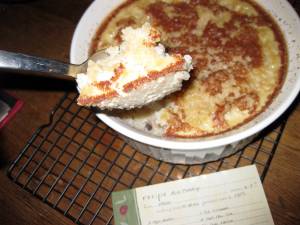
I’ve never liked the look of those stovetop rice puddings that are soupy and goopy – almost like the consistency of hot cereal. No, when I think pudding, I want something that sets up firm and has to be broken through with a spoon, not just scooped up. I want a custard. Given our crazy weather today, my mom’s amended rice pudding recipe is perfect.

Cook two cups of raw rice in a pot on the stovetop until done, then take the pot off the heat, remove the lid, and let the rice cool.

In a large casserole dish combine:

3 eggs, beaten

3 cups milk

¾ cups sugar

1 ½ tsp. vanilla

¾ cups raisins

1 generous tsp. cinnamon

Cooled, cooked rice

Place casserole dish in another larger, shallow dish (I use a glass pie plate) and fill the shallow dish about halfway with hot water. Cook, uncovered, in a preheated 350 degree oven for 45-60 minutes, or until custard is just set. Remove from oven. Cool. Consume.

img_0311

Soy love story

During my first year off from college, I lived in a house full of girls. There were five of us. Even if I wasn’t now happily married, I would never do that again. Too many showers, too many door slams, too much food in the fridge. Have you ever tried to contain all of your perishable food in one fifth of the refrigerator? There’s no division by product, there’s no organization, just a crowded heap of undifferentiated ingredients.

While living in this harem, however, my closest friend in the house was vegetarian, and made great use of that one product so often labeled as simply a vegetarian food item and shoved by the rest of us omnivores into a back, ignored corner of the fridge of life: tofu. I had never dealt with the stuff before, and was slightly mystified by its enigmatic properties. My friend, over the course of several “housemate date nights” that inevitably incorporated deliciously good food and deliciously bad TV, showed me the way.

img_0304

Step one: cut extra-firm tofu into squares (I use a 14 oz. block and usually cut 4x6x2, or whatever looks like a nice bite-size piece). Marinate tofu squares in soy sauce for ten or fifteen minutes (again, rough estimate, but I’d say these guys are sharing about ½ cup of tamari).

Step two: strain tofu squares and toss them in a light coating of brewers’ or nutritional yeast. Small flake is preferable, but large flake works fine too in a pinch. Nutritional yeast is usually available in grocery stores that have a bulk bin section.

Step three: sauté tofu in several tablespoons of very hot oil in a wok or frying pan. Don’t scramble it around too much because the coating of yeast will fall off and a major part of the flavor will be lost to the bottom of the pan. This sautéing (or stir-frying, if you prefer) process always takes longer than I expect it to. Be patient. Allow the squares to develop a dark golden color and a firm crust around the outside. When they are done, they will look like little croutons, but the taste is infinitely more complex and interesting and, of course, different given the soft tofu center of these squares of delight.

img_0309

I’ve enjoyed these in Pad Thai, stir fries, on baked potatoes, and inevitably plain and scorchingly hot right out of the frying pan. They add a deep, earthy, salty flavor. There is something very pleasurable about eating them, because the outside takes on a texture somewhere between crunchy and chewy for your teeth to play with, and the inside just melts away. N. claims they are delicious with beer, which makes sense, considering that they are crusted in yeast. Tonight’s application? I’m thinking fried rice.

The interesting thing about this recipe was that my housemate never had to find room to store any leftovers in our fridge. We always ate them all.

Hasty Bites 2

I have tried, in recent months, to create not only a list before going to that temptation-laden den that is the grocery store, but also a meal plan for the week, so that I can see as I shop how the seemingly random ingredients I toss haphazardly into my cart (inevitably squeaky, sticky, or with a bum wheel) fit together.

Of course, this doesn’t always work.  Usually I veer off from my established course (from the meal plan, that is.  The shopping cart leads me physically astray throughout the voyage) when I hit the produce section.  In very late fall and very early spring, my weakness is asparagus.  Pencil-thin spears, that woody green color of new growth – at this time of year these bunches of promise not only attract me from a flavor perspective, but they mean something about the weather.  Since it is only February, this is sometimes a lie, but they give me something to look forward to – they permit me brief rememberances of what Spring means (in the sense that the weather warms and the sky blues, not that the allergens arrive).

My new favorite way to cook asparagus is not on the stovetop, as Mom taught me, but in the oven.  img_0206

I snap the stems of the asparagus and combine them, a scattering of cherry tomatoes, two or three minced cloves of garlic, the juice from half a lemon and the juiced lemon half, sliced, on a baking sheet.  I toss my veg liberally with olive oil, then add black pepper and sea salt.  At 400, a bunch of skinny spears usually takes about 15 minutes to cook.  If you’re feeling less technical about the whole thing, once most of the tomatoes have begun to burst it’s a good time to check for doneness.

We had our roasted asparagus with big, beautiful pan-fried salmon filets.  Just salt, pepper, olive oil, and a sprinkle of dill on each.

img_0210

Hasty Bites

A friend S. told me today that I hadn’t updated in a while and really should see to my absence.  Unacceptable.  I sputtered, considering all the usual excuses.  I’ve been sick all week.  I’m so busy.  I have needy students, a dog desperate for exercise, books piling up that need reading, but she was right.  I just needed the text, and lord knows I’m not short on text.  I talk text in my sleep.  Which I’ve been getting a lot of lately, what with being sick.

The point is, she guilted me like a Greek Grandmother.  Appropriately enough, my response is Spanikopita!

It was one of those brilliant flashes of leftover magic.  Phyllo dough languishing from some fanciful application.  Feta just weeping in its own milk to be used.  Dill wilting down with every passing day.  I usually think of spanikopita either as a kind of delicious Greek lasagna, or as individually wrapped servings.  This evening, in what I can see is playing into a theme,  I didn’t have the time for either.

Hastily, I buttered and stacked my sheets of phyllo and draped them over a pie dish.  Then I mixed a beaten egg, a few slivered green onions, a defrosted, wrung dry box of chopped spinach, at least a tablespoon of chopped dill, crumbled feta, and black pepper, then poured it down onto the dry surface of the top layer of dough and wrapped the whole thing up like a money bag.  I pinched the top together, fanned out the edges, and lovingly brushed the outside with butter before baking for half an hour or so.

I’ve never cooked feta long enough to melt it, and something very interesting happens to the flavor.  Pavlov wasn’t Greek, but I think you’ll know what I mean when I cite him in relation to my usual reaction to feta cheese.  Something about the sharp tang.  But this application made the cheese more mellow, almost creamy, and certainly no less delicious.

Happy, S.?  There’s another bite/byte where this came from in your almost immediate future…