Focaccia for the win

I have mentioned before, on this very blog, that I am afraid of yeast.  However, as it has surely become clear by now, I love baking.  It was only a matter of time before these two truths collided and a new truth was constructed.  As I told my students only a few days ago, it was not always a “truth” that our solar system was heliocentric.  They grudgingly accepted this, but I now elatedly announce that I am no longer afraid of yeast!  Perhaps a bit timid, a bit guarded still, but not afraid.  What has changed, you ask?

This is a rosemary olive oil focaccia-style loaf from a cookbook put out by Food and Wine Magazine that I finally got up the guts to try out.  I learned three things by making it: 1.) yeast is not as easy to screw up as I thought; 2.) following directions is smart; and 3.) the way to a man’s heart may really be through his stomach.  At least if he shares a last name with my husband.

While this bread was not difficult to make, I think it would have been better if I had read the recipe more carefully.  After assuming I had killed my yeast when it all sank in the warm water I sprinkled it over, I didn’t bother to knead the dough before setting it aside to rise.  Then I baked it at the wrong temperature and despaired when it didn’t seem done before realizing my mistake.  And after all that, it was still delicious.

The bottom half inch or so was denser than the rest of the loaf, and I don’t know why that happened, unless it was related to my inability to read the directions the first time through.  But it was really, very good.  The olive oil made the texture pleasant – moist and chewy, and the rosemary contributed a nice, herby, woodsy flavor that contrasted well against the brisk brightness of the sea salt that also flavored the bread.  It is amazing how something with so few ingredients (flour, yeast, oil, water, salt, rosemary, and cornmeal) can have so much flavor.  And excitingly, as the recipe itself declares, this bread has endless flavor combination possibilities.  Next time I think I will add chopped kalamata olives.  N. agrees.

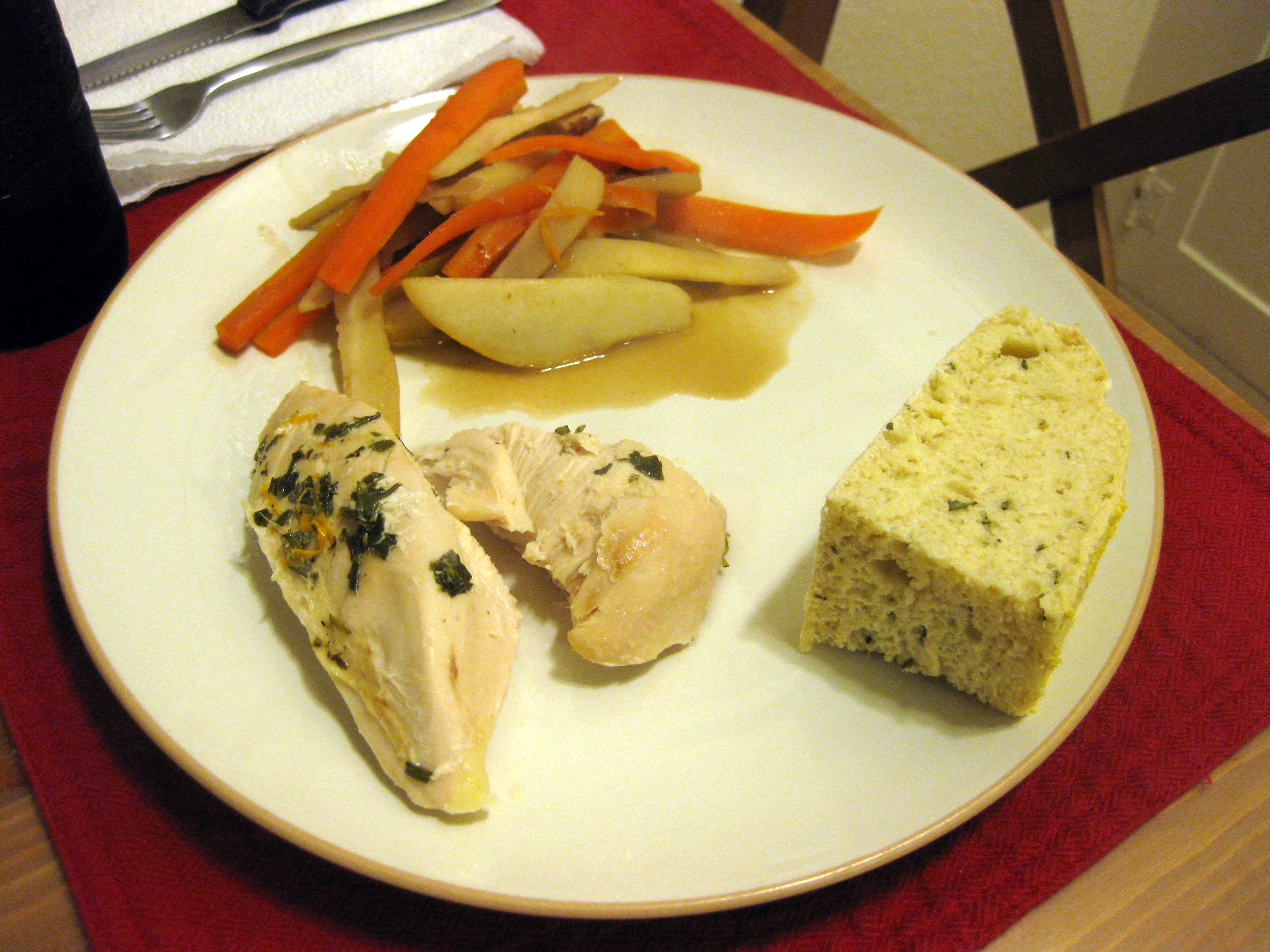
What was really glorious about this bread was how well I managed to combine and link flavors in the dinner that went with it.  We had a roast chicken and a vegetable side to go along with my yeasty triumph, and in the choices of aromatics I was able to clearly connect each dish.  The bread contained rosemary, and so when I made an herbed butter rub to massage under the chicken’s skin, I included plenty of fresh rosemary.
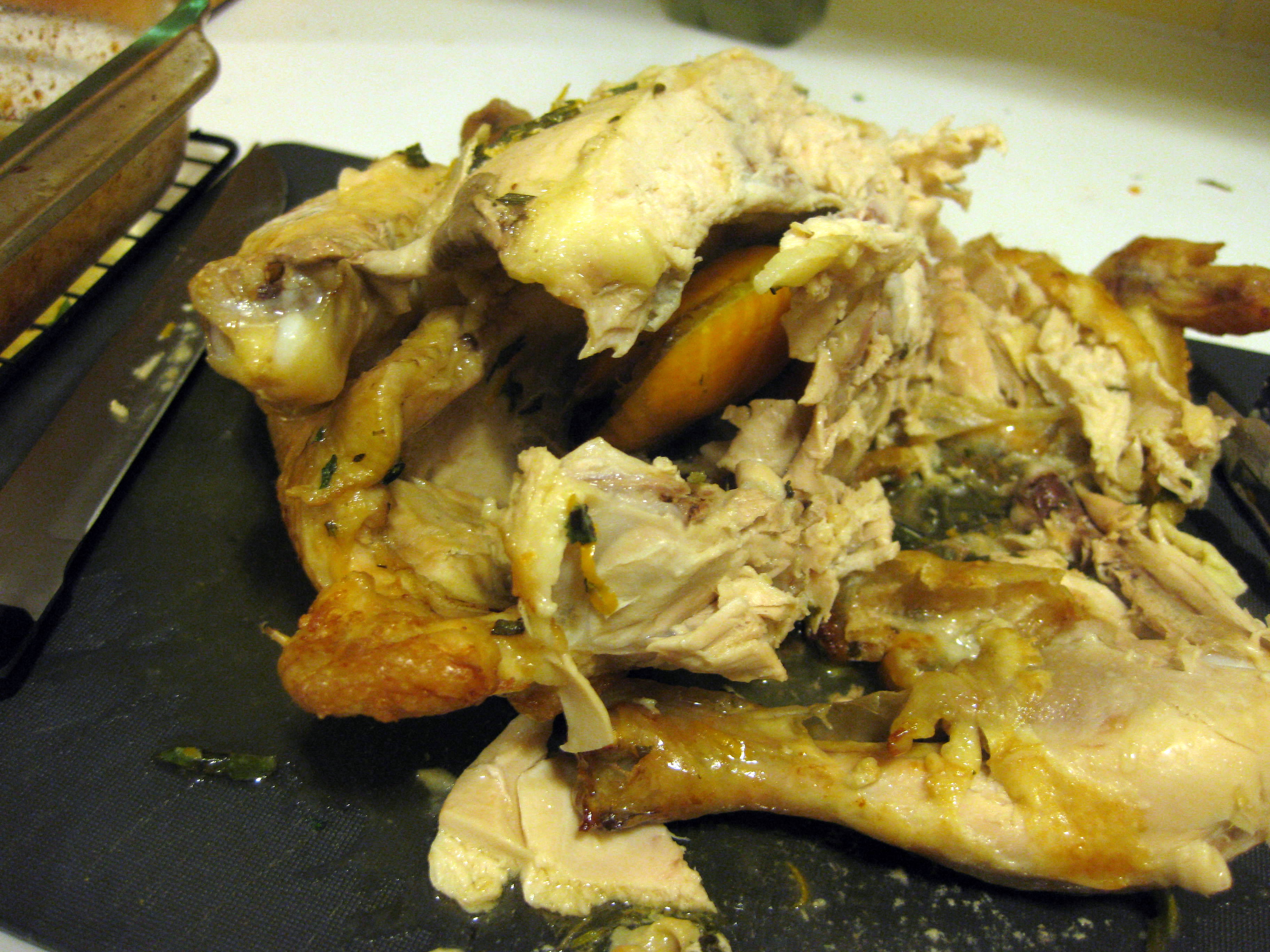
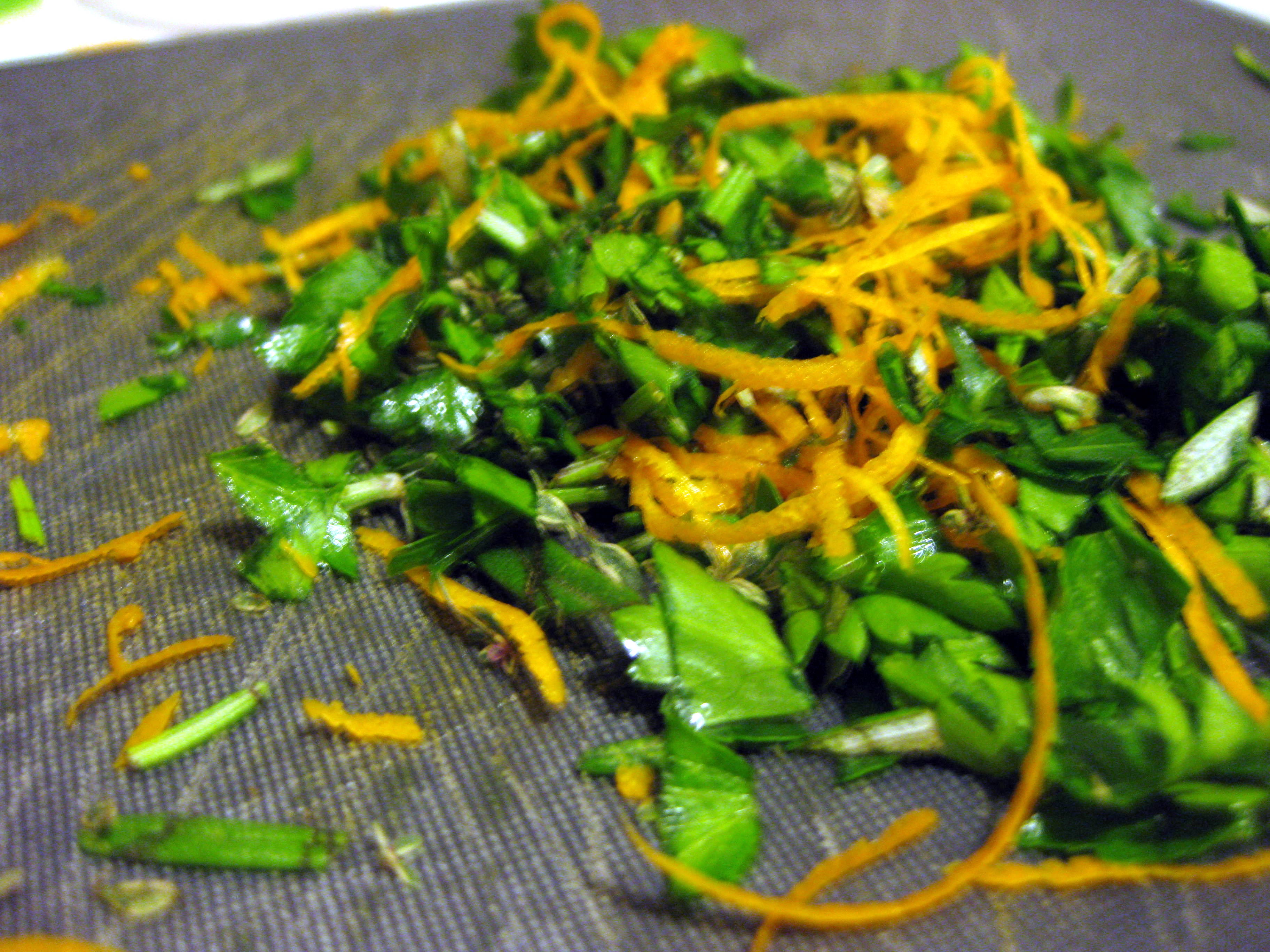
Our vegetable side consisted of glazed carrots, parsnips and pears with craisins and pecans.  Since the glaze was mostly orange juice, I added orange zest to my chicken herb rub and stuck a few orange slices inside the cavity of the chicken before it went in to roast.  If I had remembered in time, I would have added orange zest to the bread dough as well, to really link all three elements together.
The orange did, I think, add a delicate sweetness to the chicken, though I’m not sure it was recognizably citrus.  I think lemon would be more identifiable.  But the butter made even the white meat of the chicken tremendously succulent, and the herbs and garlic definitely added a punch and depth to the flavor.

The veggies were rich with autumnal flavors, and while I enjoyed them, I think they would match better with a pork or turkey main rather than chicken.  In fact, they might be delicious as a vegetable dish for Thanksgiving; the craisins make that an easy link-up.  Since carrots and pears are already sweet, the craisins and pecans were a natural pairing.  I always think pecans have a kind of caramel or molasses-like smokiness to them, which seemed to work very well with the herby, spicy notes of the parsnips.

Given that somewhat wild flavor the parsnips impart, a strongly spiced root beer or sarsaparilla might make a fitting non-alcoholic beverage pairing to this meal, or maybe even a ginger ale like Blue Sky that prides itself on natural flavors.

So let’s take a moment here and reflect: Roast chicken, glazed vegetables, and homemade bread.  Two of these three dishes required advanced planning and multiple stages, and then (as per usual, these days) I made broth from the chicken carcass after it was picked clean, with plans already in mind for the leftovers.  Long cooking times, “complex” procedures, and making use of every part of the meal.  If that doesn’t say Sally Homemaker to you, I don’t know what does.  All I can say is: I promise that I did not wear pearls while I cooked this meal.
Food words

The words we use when we talk about food, and the attitudes they invoke, positive or negative, intrigue me.  For example, “buttery” is a good word.  It connotes flaky pastries, dense nut-filled cakes, rich bready desserts or breakfasts.  However, “oily” is a bad word, and “greasy” is even worse.  Why is that?

(This will seem like something of a non-sequitur, but I promise you’ll see where I’m going here in a paragraph or two.)

I recently saw the Meryl Streep/Amy Adams movie Julie&Julia.  While I will leave the review to my friend S., who is good at that sort of thing, I will comment that the food cinematography in the movie is marvelous.  I don’t know whether it is always real food they are using or not, but the colors were deep, the textures were luscious, and the sounds (mixing, slicing, carving) were pretty realistic.  At one particular point in the movie, as Julie Powell and her husband are sitting down to a dinner of bright red and yellow rustic-looking bruschetta, all six of the women I saw the movie with (including me) said something between “ohhhhh,” “mmmmmmm,” and “yum.”  Or maybe all three.  So a few nights later, inspired by the bursts of orange from the sungold cherry tomato plant in my backyard, I decided to try out Julie and Eric Powell’s dinner.

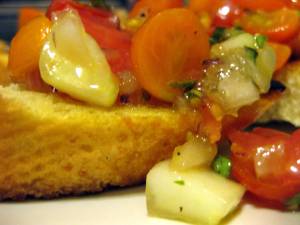
Starting with my favorite basic bruschetta recipe, I chopped up one red early girl tomato, a few dozen cherry tomatoes, a peeled and seeded cucumber from the back garden, and a handful of red onion.  Then I added julienned basil (backyard again!), salt, pepper, olive oil, and a tiny splash of red wine vinegar.  Then I let it sit in the fridge for a few hours while we went about our business. IMG_1522

After watching a dear colleague successfully defend her dissertation and then celebrate accordingly, we picked up a loaf of sourdough bread on the way home and the magic really began.  Generally when I make bruschetta, I toast the bread slices in the broiler.  However, in her rendition in the movie, Julie Powell (or Amy Adams; I don’t know whether Julie Powell ever actually made this) fried her bread in olive oil.  Wanting to stay as true to the beautiful food in the movie as I could, I opted to do the same.

Though some of my bread got a little dark, most of it turned out just fine.

IMG_1526

We stacked up the vegetables on the bread, covering every square millimeter possible before biting in and, of course, losing half the tomatoes to the plates below.  They squirted down our chins and slicked up our hands, but it was worth it, and here we return to my initial question.  The tomatoes were good and juicy, the cucumber was crisp, the basil added the right zing, but the bread was really what made the dish excellent.  It absorbed enough olive oil to be a beautiful golden brown color, and the crumbs of each slice became crisp; the perfect surface to stand up to the weight of the tomatoes, but still soak up a little of the juice the vegetables had created.  Biting into a slice was a textural experience, because the inside of the bread was still soft, but the crust was crunchy and the outer surfaces were crispy, and the whole thing was deliciously… oily?  Oiled?  In our low/no-fat culture, obsessed with cleanliness and thinness and sleekness, the idea of oil seems objectively negative.  But this was wonderful and delicious and silky and superb.  What can I call it?  Can we bring back, can we reclaim “oily” to mean what it should mean?  That crispness with buttery rich moisture I experienced with our weeknight dinner?  I think we should.

IMG_1527

First Bounty

Though we have been harvesting sugar snap peas by the bowlful for the past few weeks, and though we probably still have enough preparing for maturity on the vine for me to freeze a bagful, it didn’t feel like we really had a harvest on our hands until a few days ago, when I picked these:

IMG_1249

I know it seems crazy, and I know I’ll be sick of it before August is over, but despite the heat and despite the impending pounds of zucchini and despite my encouragement to myself to eat better at breakfast time, I couldn’t resist.  Despite all that, I made zucchini bread.

IMG_1253

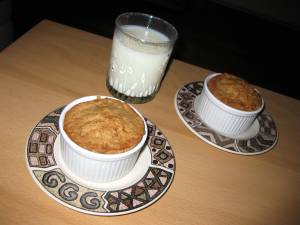
As you can see, whether it was the monster zucchini I grated up that exceeded the recipe’s requirement a little bit, or whether it was because my thrift store loaf pan was on the small side, I had extra batter.  Fortunately, my sweet little too-seldom-used ramekins called to me from the cupboard, and I heeded their siren song.  In addition to the loaf, we also had four big muffin-sized servings.  The advantage of this was that they were ready for consumption much sooner, and consume we did.  Here’s my serving suggestion:

IMG_1254

The recipe I use for zucchini bread right now is from Bon Appetit’s latest cookbook.  This isn’t the magazine, it’s the full book, and this particular version is called Zucchini Spice Bread.  It has a hefty teaspoon of cinnamon added to the standard mix, and with 2 cups of zucchini as well as a cup of toasted nuts (I used pecans because I was out of walnuts, and may have liked it better with the substitution), it seems like one of the healthier quickbreads out there, as well as using up a decent amount of zucchini.  And the flavor.  The flavor is stupendous.  Since the nuts are toasted, they donate more of a crunch and a warm richness to the bread.  Because there is so much zucchini, they don’t dry out the bread too much, which is sometimes a complaint I have about nuts.  The zucchini itself is mild but still present, and the bread is not too sweet.  It has a nice moist crumb to it but the top gets crusty, so the whole thing is just a medley of textures that I really enjoy.  Here’s to the joy of baked goods, the joy of home grown vegetables, and the very special joy of being able to eat them both at the same time!

IMG_1256

Shots of Summer

Just a few quick shots to remind us that summer has finally arrived.  I’m proud to say that some of this produce is from my own tiny backyard garden plot!

Soft, sweet, whole bulbs of roasted garlic:IMG_0768

Cherries from the Saturday Market, tart and taut:

IMG_0936

Lunch one weekday – spicy stir-friend rainbow chard with half a wheat bagel:IMG_0939

Snap pea, squash blossom, and nasturtium risotto:IMG_1063

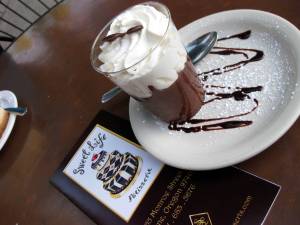
Goodies from Sweet Life Patisserie – I love the hand-painted look of the tiny flowers on the square of chocolate:

IMG_1065IMG_1066

IMG_1068