The Buttercream Project: Wedding day, part two

Saturday morning – Wedding day! – was beautiful and bright and promising.  Our now-from-Seattle friends had arrived the night before, we’d all slept, the cakes had chilled, and now after a brief wedding day breakfast with the bride and groom’s families and out of town guests, I’d be on to decorating.  When I settled in to the buttercream production this time, I had an epiphany.  At Mom’s house, I had used an electric hand mixer instead of a stand mixer, and the buttercream had been fluffy and smooth and glorious.  What if, instead of using the paddle attachment on my stand mixer, I used the whisk?

This was, finally, the right thing to do.  I wish fervently I had thought of it the first day.  The frosting came together faster, and whipped up a bit smoother.  It was, I perhaps imagined, brighter ivory than the previous batches, and there were no chunks of butter to cause me piping distress.  If only, if only, the day before… but that is immaterial (and perhaps inaccurate too, since there were other factors, other differences, like the temperature of the butter, the temperature of the cheese, the amount of time spent whipping, the quantity of lime juice, etc) .

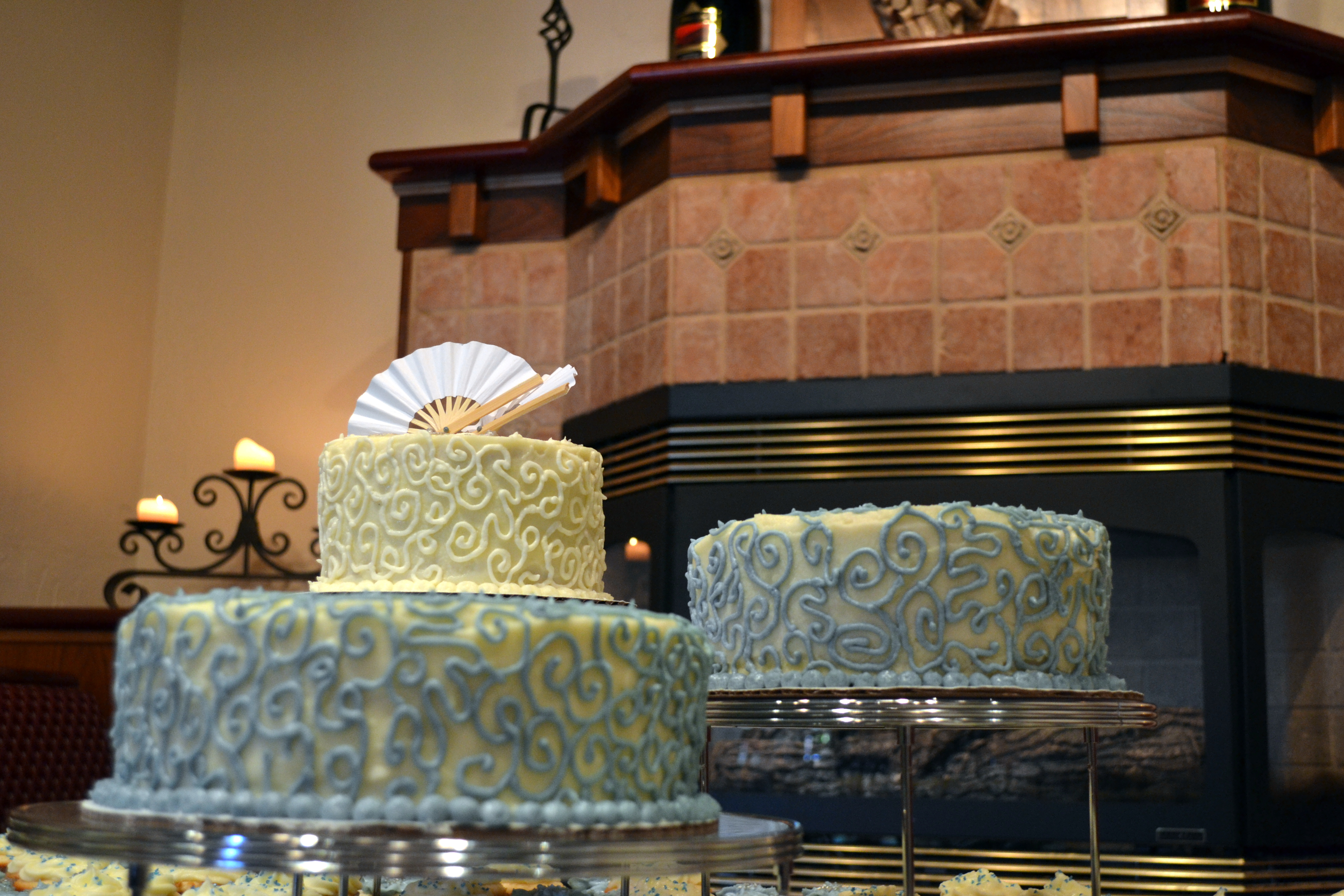
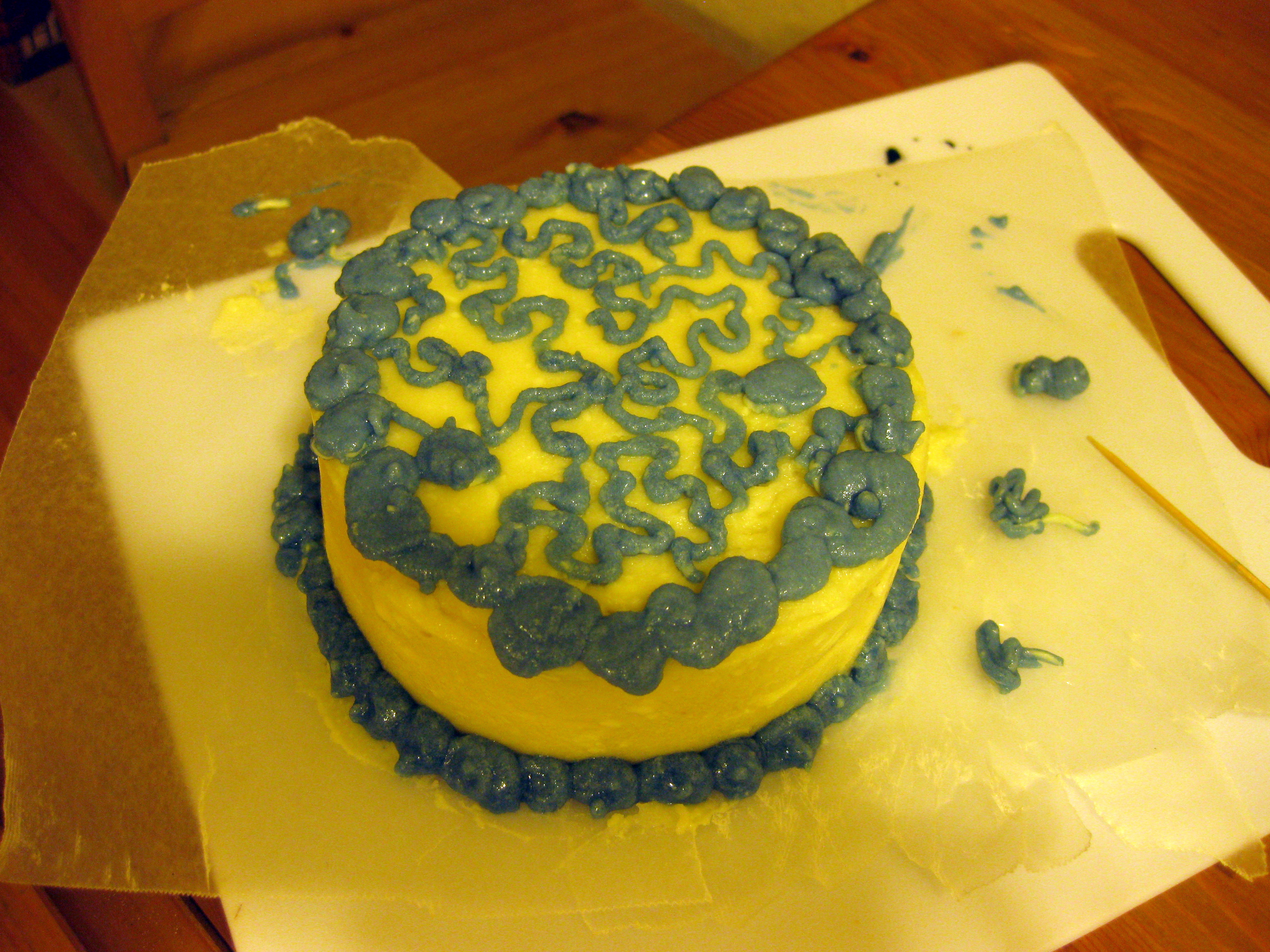
I piped.  I piped and I piped.  And things started to look better.  A lot better.  Most of the worst imperfections were hidden under the ivory and then delicate blue swirls and scrolls I snaked onto the cakes.  They actually started to look nice.  This might not be a disaster after all.  When I added a ring of round, pearl-like blobs to the bottom border of each, I started to feel happy with my project.

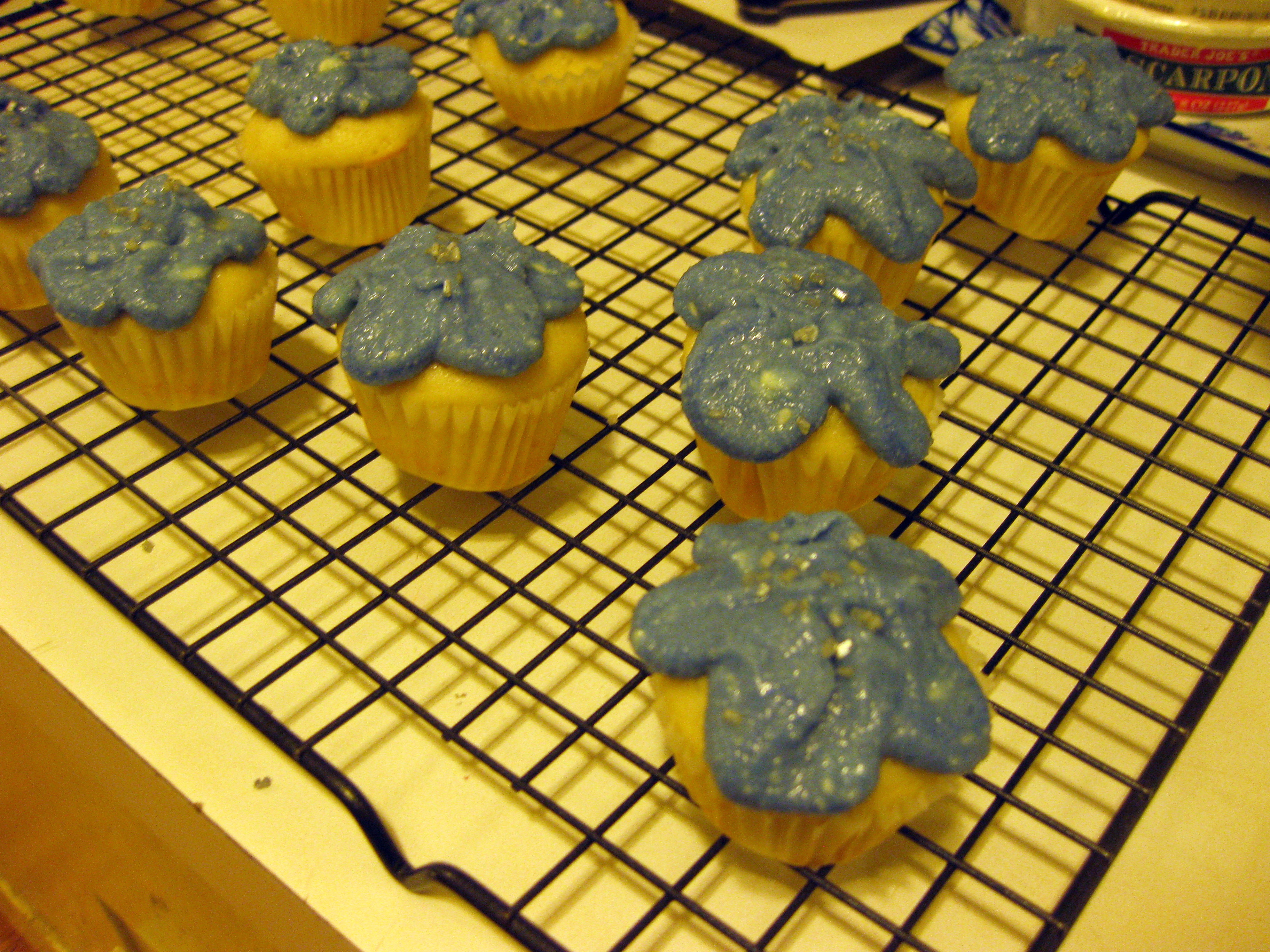
With the cakes done, all that remained were 92 miniature cupcakes.  All.  Right.  I had half a bowl of perfectly blue frosting.  Against my own better judgment (hey, it had worked out okay the day before with the gelatin in the filling), instead of starting over with a brand new batch, I decided to add more butter and more powdered sugar to the bowl, and try to tint it to match what I had already done as I went.  It worked.  I wanted a slightly thicker consistency of frosting for the flowers I planned to pipe so this mixture had to be more butter than mascarpone.  That worked out well, really, because I was out of mascarpone again anyway.

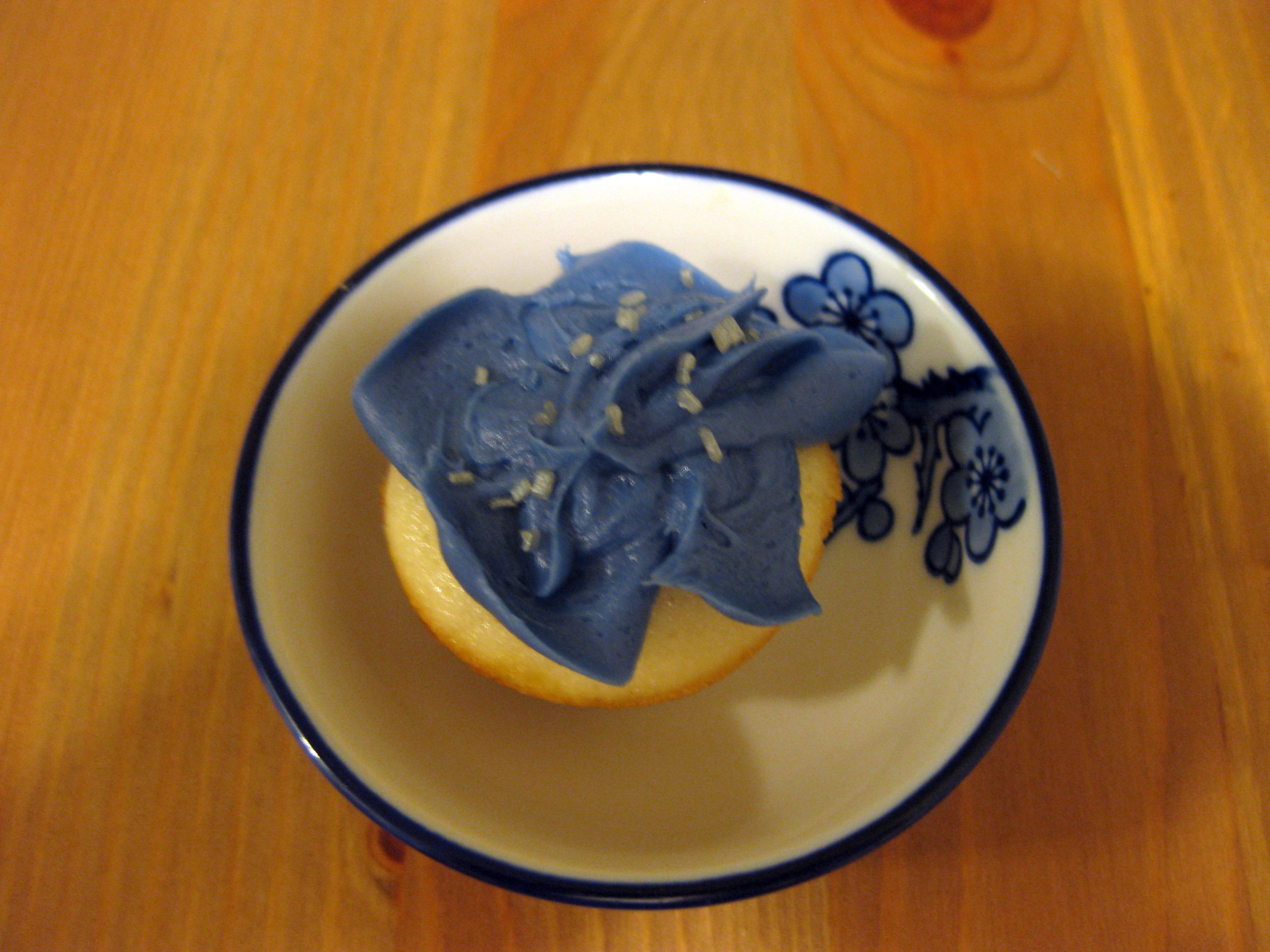
With time ticking, I filled up another piping bag with one of the new rose petal tips H. had bought me and went to work, remembering what I’d learned months ago about which way to swivel the cupcake as I frosted.  It took me a handful to get into a groove, remembering when to apply pressure and when to release, but once I got going I was making beautiful little horseshoe movements that resulted in sugary flower petals!  To perfect the color (not baby blue, but not dark blue either), I’d mixed a tiny bit of black gel dye in with the blue.  This resulted in a lovely periwinkle with just a hint of gray, matching almost exactly the blue on the couple’s save-the-date cards.  The exact blue of the wedding.  Boom.

N. would probably like me to add here that as I finished each handful of minis, he deliberately drizzled on a small quantity of silver-gray sprinkles.  My dear friend M., who arrived in mid-afternoon to coo over the product and do my hair for the event, would probably also like me to add that she took over sprinkling duties for the last dozen or so.  In fact, it was M. and S. who saw me through the last sheet tray of minis as, hand aching from the constant pressure and odd angle, I suddenly realized I was going to finish.
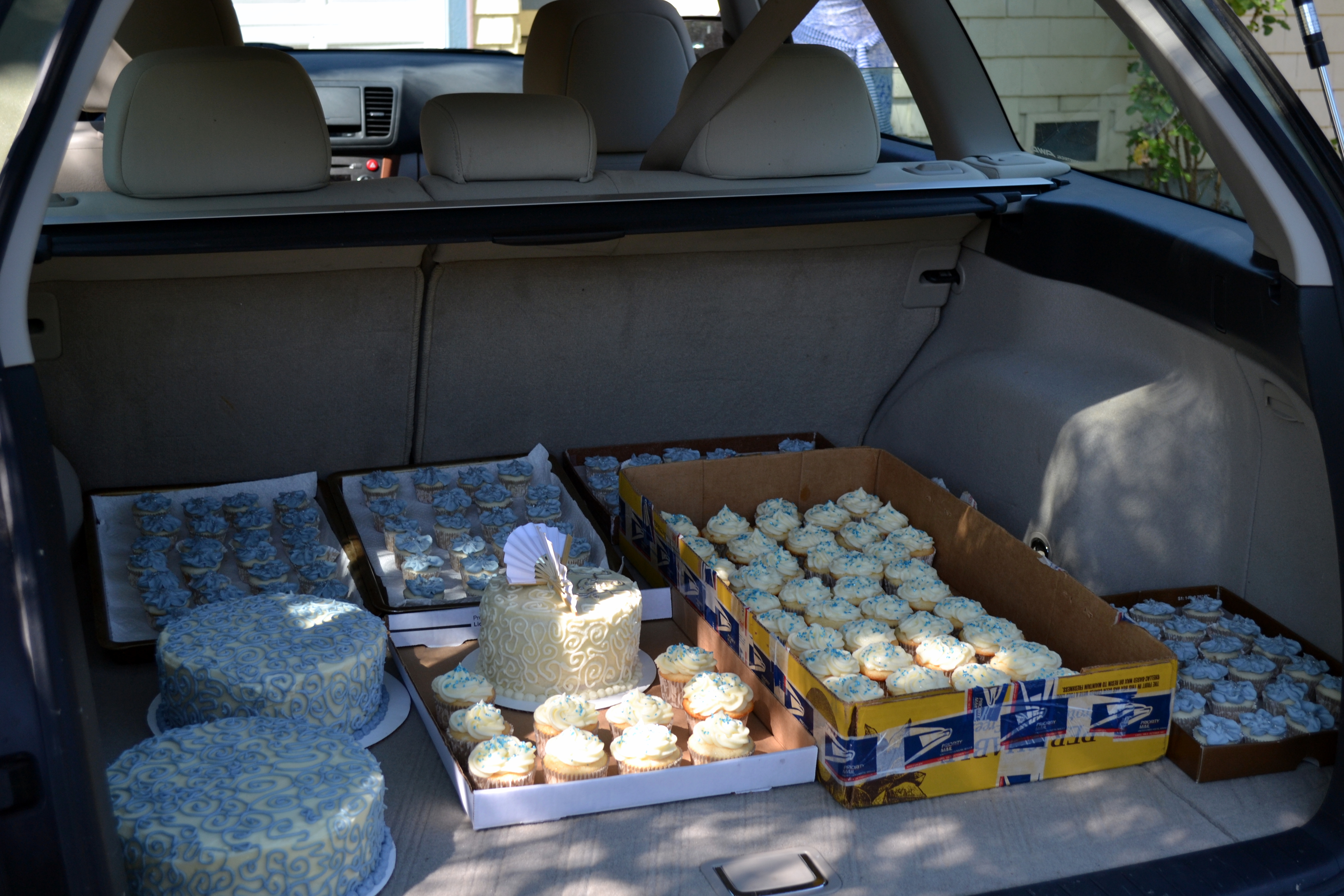
The winery where the wedding took place was a half hour drive from town on winding and sometimes roughly surfaced roads.  Though we positioned the cakes and cupcakes carefully in the back of our Subaru, I still got a little white-knuckled every time N. drove around the bend.  What if, after all that work, we got going a little too fast and one of the cakes slid into the side of the car?  What if, despite the air conditioning running at full blast, it was too hot in the car and the frosting started to slump off?  What if we did get there safely, but I dropped a cake on the way from the parking lot into the building?  I had packed flats as well as a bag of white frosting and a bag of blue in case of an emergency, but I’m not sure I was emotionally prepared to fix any problems that might happen on the way.  Not in a busy winery with the bride and groom’s families darting around setting things up.

Fortunately I didn’t have to.  Three or four of the minis fell over during our ride, but because I’d stuck them in the freezer for a few minutes while I got dressed, their frosting remained hard enough that it didn’t crumple much.

Setup was easy and disaster free.  Some of the wedding party helped carry the precious cargo in from the car, and when every last cupcake was situated on the table, I have to say it looked pretty fantastic.  I made a wedding cake.  And people liked it.
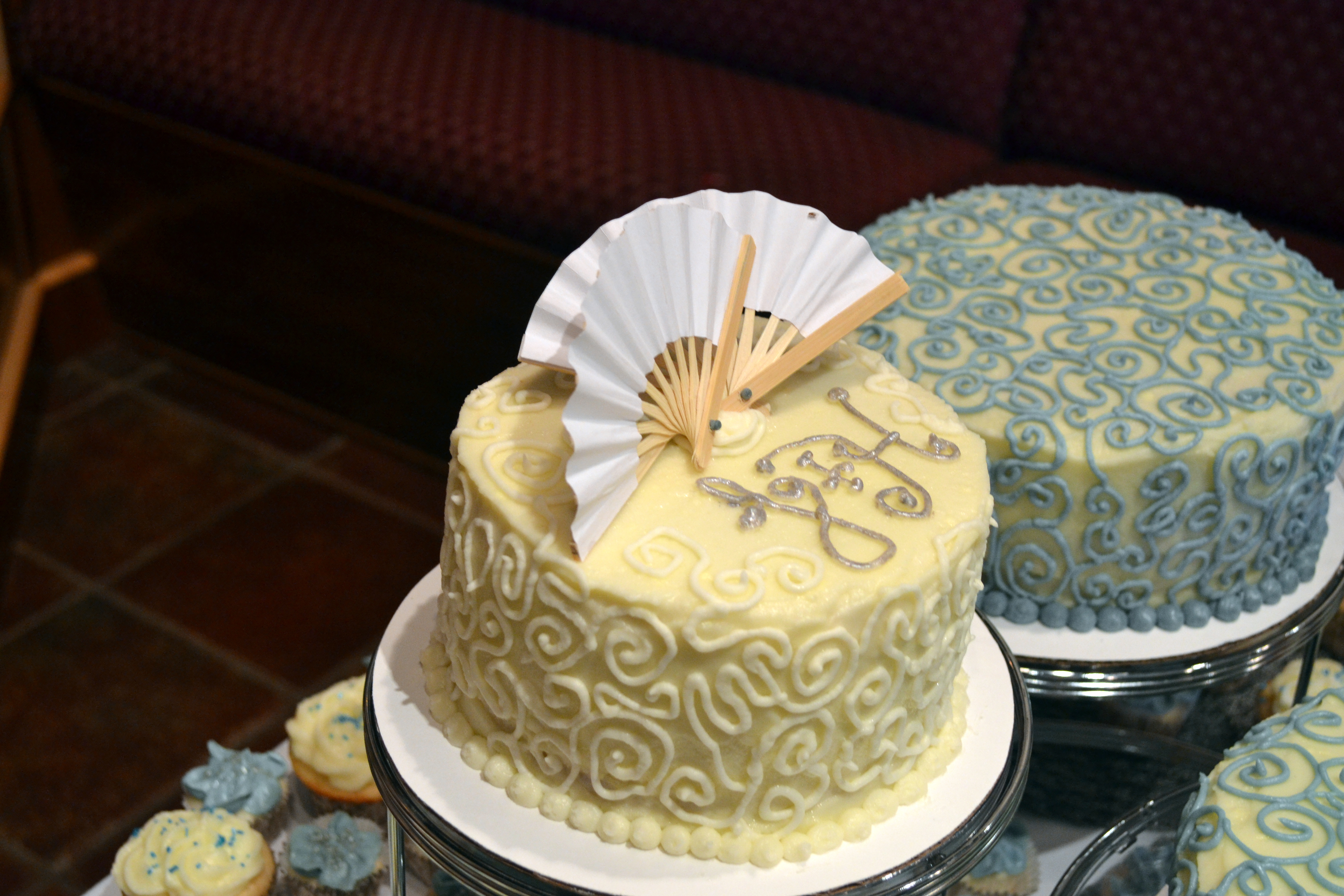
Final thoughts on this massive saga: I will not be going into the wedding cake business.  I would happily make another cake or three for friends who requested it, but I think I’d want to go to at least one cake decorating class first.  I will also not use American buttercream again, except for petal work like I did on the minis.  It’s just too sweet.  I loved the taste of the cakes I made, and the filling was a wonderful, bright tartness (the color contrast was great too), but the buttercream was just achingly sweet, even with the addition of lime juice to the mix.  For my sophomore performance, if I ever have such an opportunity, I would try an Italian or Swiss buttercream instead, relying on cooked egg whites for structure rather than powdered sugar.  As a thank you, J. and H. let me keep all the baking and decorating equipment they bought for the project (thanks again, you two!), so I’m set for all kinds of future practice.

I have to say, though, despite all my moaning and complaining and anxiety, I was really happy with how the cakes looked, and delighted with the reactions I received.  The bride and groom took home the leftovers and ate them the next day, and the one after that.  They were still good.  N. and I ate the trimmings and cupcake guts smothered in leftover filling, and they were delicious.  It was, regardless of the exhaustion and concern during the journey, a monumental success.  I can only thank J. and H. for letting me be such a big part of their day, and wish them all the joy in the world – joy like clouds of powdered sugar, perhaps – for the rest of their lives together.  N. and I love you both.

The Buttercream Project: Wedding Day, part one!

So…

I made a wedding cake.  For a wedding.  And it was served.  At a wedding.  And no one threw anything at me, or snickered behind my back, or insinuated the bride and groom would have made a better choice by hiring a professional baker.

In fact, several guests, and a few of the employees at the winery where the event was held asked me where I worked, or whether I had a business, or how many wedding cakes I had made before.  I was forced to respond to these questions thusly: my kitchen, no, none.  And they were surprised!  And I, still struggling with the sickeningly sweet baggage of failed buttercreams weighing down my memory, was surprised they were surprised.

But there we were!

Deep breath; here’s how we got there, in two parts:

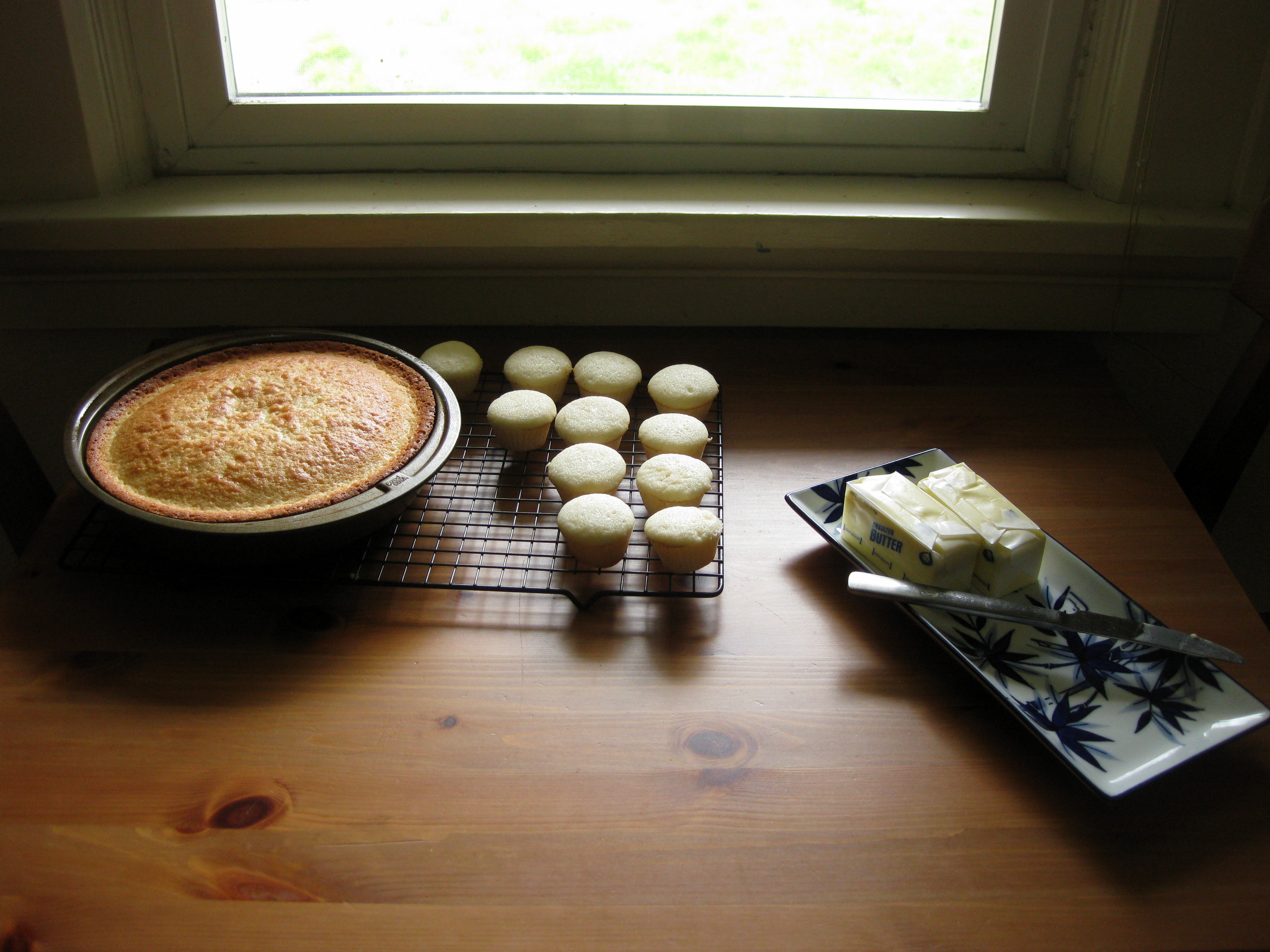
The wedding took place on a Saturday.  After consulting a professional baker through a friend who is also her sister, I decided to do all the baking on Thursday, the majority of the frosting on Friday, and the detailed decorations and mini cupcake flowers on Saturday morning.  The cakes would still taste fine, she said, and the rewards of working with day-old rather than freshly baked cake are staggering.

My biggest comment about the whole process is that everything takes longer than you expect it to.  And it “takes a village,” as they say.  I knew approximately how much cake I was going to make, but I didn’t really stop and think about how much time it would take to bake, or how much space it would require, or what 36 egg yolks looks like (6 egg whites in each batch of batter = 36 unused yolks).

Anyway, I baked on Thursday, and despite my naïve assumption that I would bake in the morning, tidy up the kitchen and rest in the afternoon, I baked almost all day.  See, butter takes time to come to room temperature, and egg whites take a while to whip to soft peaks, and when you only have one muffin tin you can only make 12 full size cupcakes at a time!  My friend J. joined me for lunch, which was a welcome break (relatedly, crisp, juice-laden pink spears of watermelon are incredible when you don’t have to slice them up yourself, and Stash’s pomegranate raspberry green tea makes a wonderful iced tea that requires zero sweetener), and a bit later M. came by to keep me company while I scooped and poured and measured and mixed and sweated and burned myself only twice!  The entire day!

Completion of the day’s project took some finagling, because as much as we tried to use up perishables to create fridge space, it hadn’t occurred to me how much room it would take to fit one 9”, one 8”, and one 6” cake in there along with 52 cupcakes and 90-something mini cupcakes.  There weren’t enough shelves!  We improvised by double stacking the cupcakes and minis on sheet trays, separating each with upside down drinking glasses to keep them from squashing each other.

Thursday night, I was exhausted.

But that was nothing.

Friday, I got up with excited anticipation and set a pot of water to boil so I could peel the apricots for the filling.  Once the raspberry apricot compote was cooked down to a thick, sticky jam and nearly ready to chill, I would set out the butter.  I knew now it didn’t take an eternity to soften.  This was going to be a breeze.  It would be my best buttercream ever.  Well, as these things often go, it wasn’t, and it wasn’t.  

Apricots don’t like losing their skins.  They hang onto them like some living thing.  By scoring an x in the bottom of each and plunging them into a boiling bath for a minute or so, I thought I would be able to slip them free and naked, like peaches.  Instead, the skin came off in little peels as though they’d been sunburned, and sometimes it wouldn’t come off at all, unless attached to chunks of flesh.  This, then, took longer than I’d anticipated.

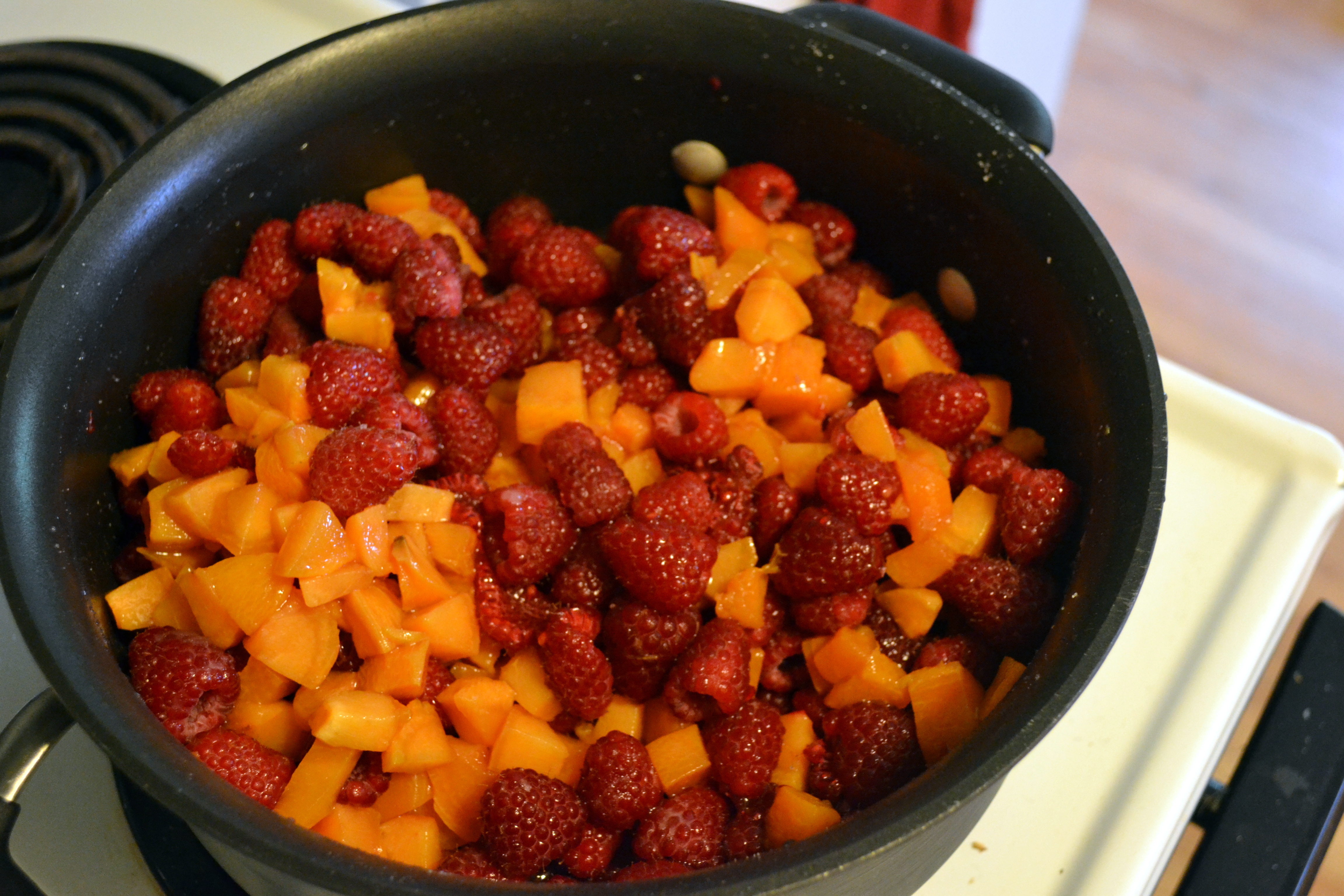
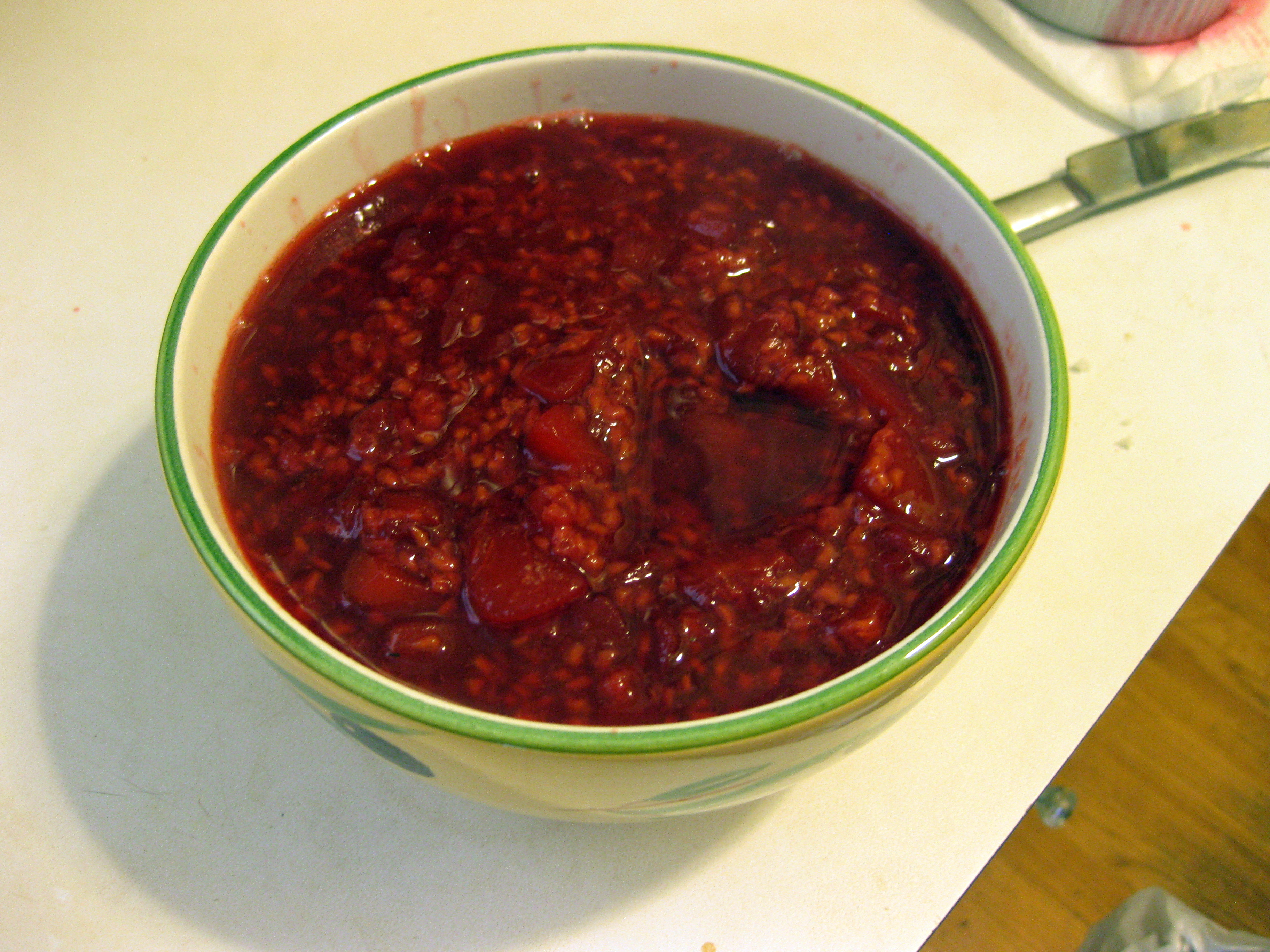
When the apricots were finally mostly nude, slippery chunks of ruddy gold, I flopped them into a big stock pot with 3 pints of dewy, just-rinsed raspberries, a light sprinkling of sugar (maybe ½ cup?), and the leftover champagne from the previous day’s baking.  There was maybe a cup of liquid when I began, and I worried this would not be enough.  Half an hour later, as the raspberries broke into fragrant, molten juice, I worried there was too much liquid.

I’ve never made jam, so I don’t know how long it really takes for fruit to boil off its liquid, but at an hour into the process, when I still wasn’t mixing up a batch of buttercream, I panicked and poured off about half the compote into a colander, making the sink look like a murder had been committed.  Too afraid to pour off any more lest I lose the flavor, I plopped the sodden fruit bits back into the pot and boiled a bit longer.  Then, when things still weren’t thickening and I was despairing for time (morning was already almost gone), I made a daring, despairing, hand-wringing choice of desperation and poured two packets of gelatin powder into some water, sloshed it about to combine, and tipped it into my steaming, bubbling, red gold concoction.  Alchemy, do your magic!  I bubbled the whole thing on the stove for a minute or two longer, then turned off the heat, held my breath, squeezed my eyes almost shut, and poured the whole thing into a glass bowl which I topped with plastic wrap and shoved into the freezer.  Now it just needed to chill, and we’d be back in business.  I’d be done by mid-afternoon with plenty of time to tidy up before the rehearsal dinner (I should add that during all the hand-wringing and the despair and the certainty that accepting J&H’s desire to have me bake for their wedding was a mistake, N. was very supportive.  He helped me monitor the pot while I showered and cleaned the bathroom in preparation for out of town guests staying with us while they attended the wedding.  He’s a dream).

My sense of timing, ever prescient, was of course wrong again.

It was 6-8 cups of boiling hot near-liquid.  Cooling takes time!  Cooling takes, as it turns out, a lot of time.

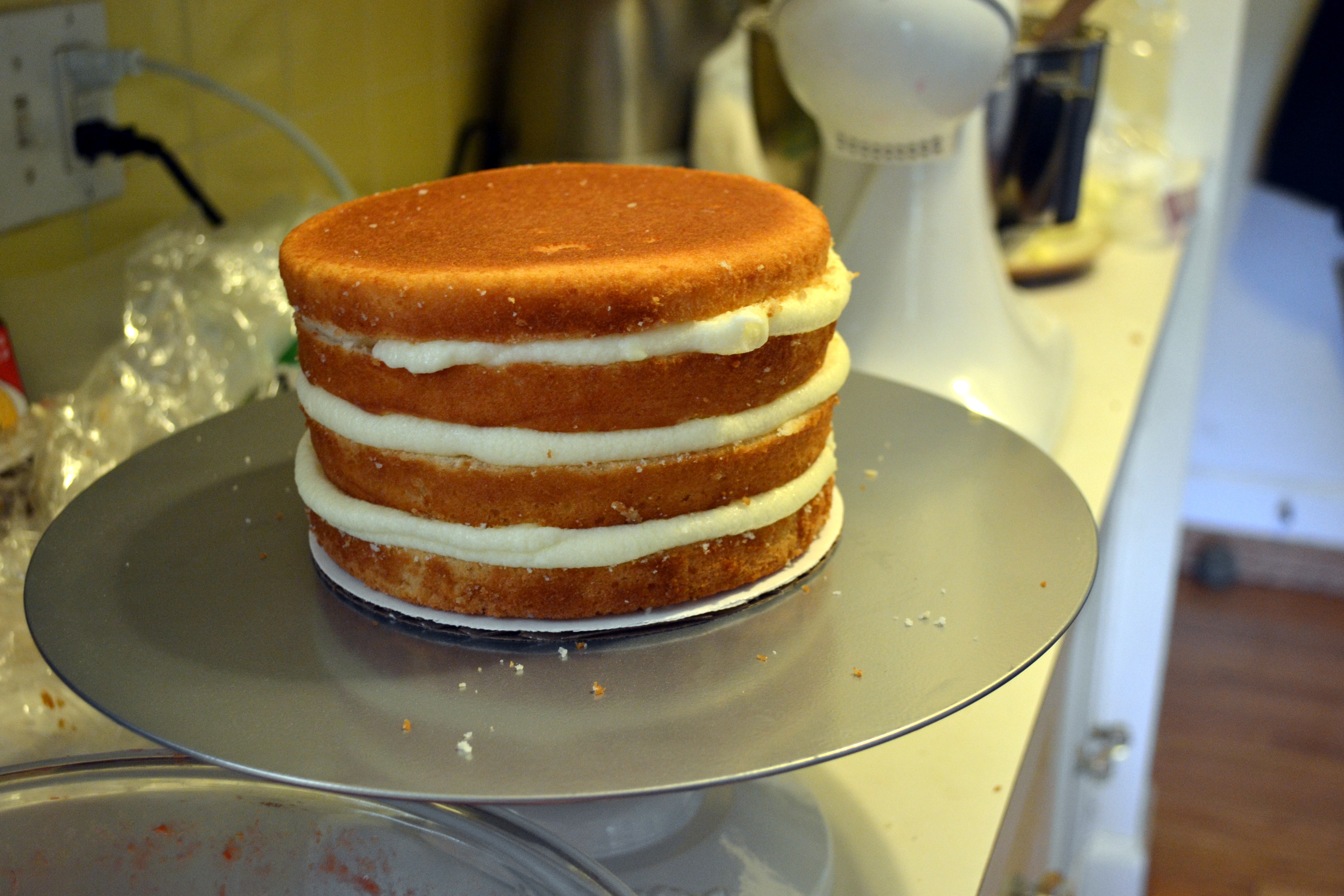
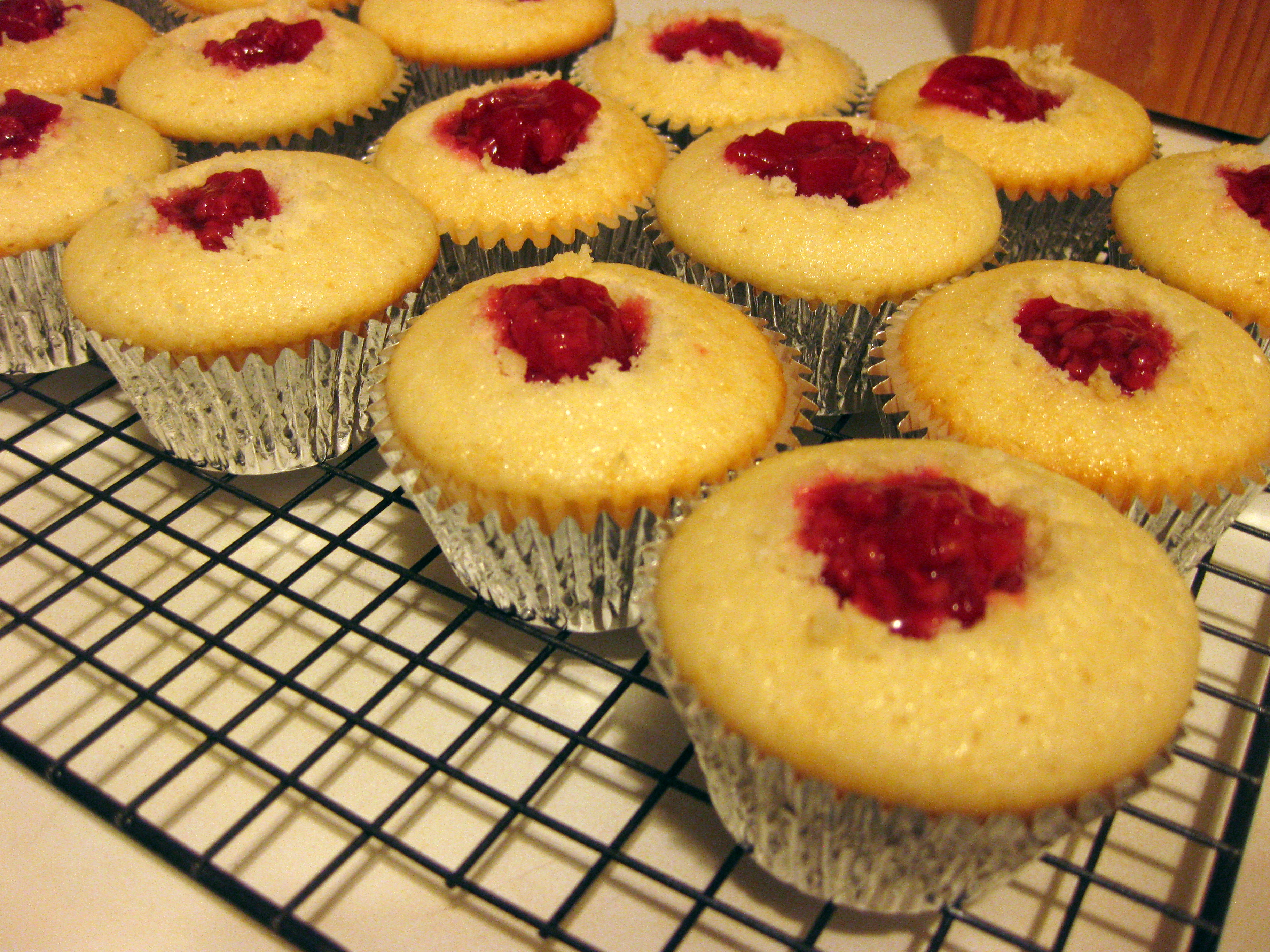
No matter.  In the meantime, I hollowed out the cupcakes to receive the (hopefully eventually) cool filling, and trimmed and halved each pale gold circle of cake so there would be four approximately even layers to each one.  Unable to stand it any longer, I took the butter and mascarpone cheese out of the refrigerator to soften.

What I made, when I made it, was not my best batch of buttercream.  Remember the one from June that I made at my mom’s house?  Remember the sharp edges and beautiful, smooth consistency?  This one was a step backward.  It was clumpy.  It was grainy.  It was so, so sweet.  If I were a professional baker, I would have thrown out the whole thing and started again.  But I’m not.  I’m a home-trained amateur, and though I took into account everything I’d taught myself over the past six months and continued to beat and beat and add more lime juice and beat, at a certain point I had to frost something.  No worries, I thought, it’s just the crumb coat.  Just do the crumb coat, and it’ll be fine.  It was.  It worked exactly like a crumb coat should.  After piping a generous circle of frosting around the top edge of each layer and spooning in a nice puddle of filling, I stacked the cakes as evenly as I could.  I scraped on the crumb coat, catching moist, delicate, champagne-flavored bits, and as I finished each cake I returned them carefully to the fridge so this first all-important layer of icing could harden. 

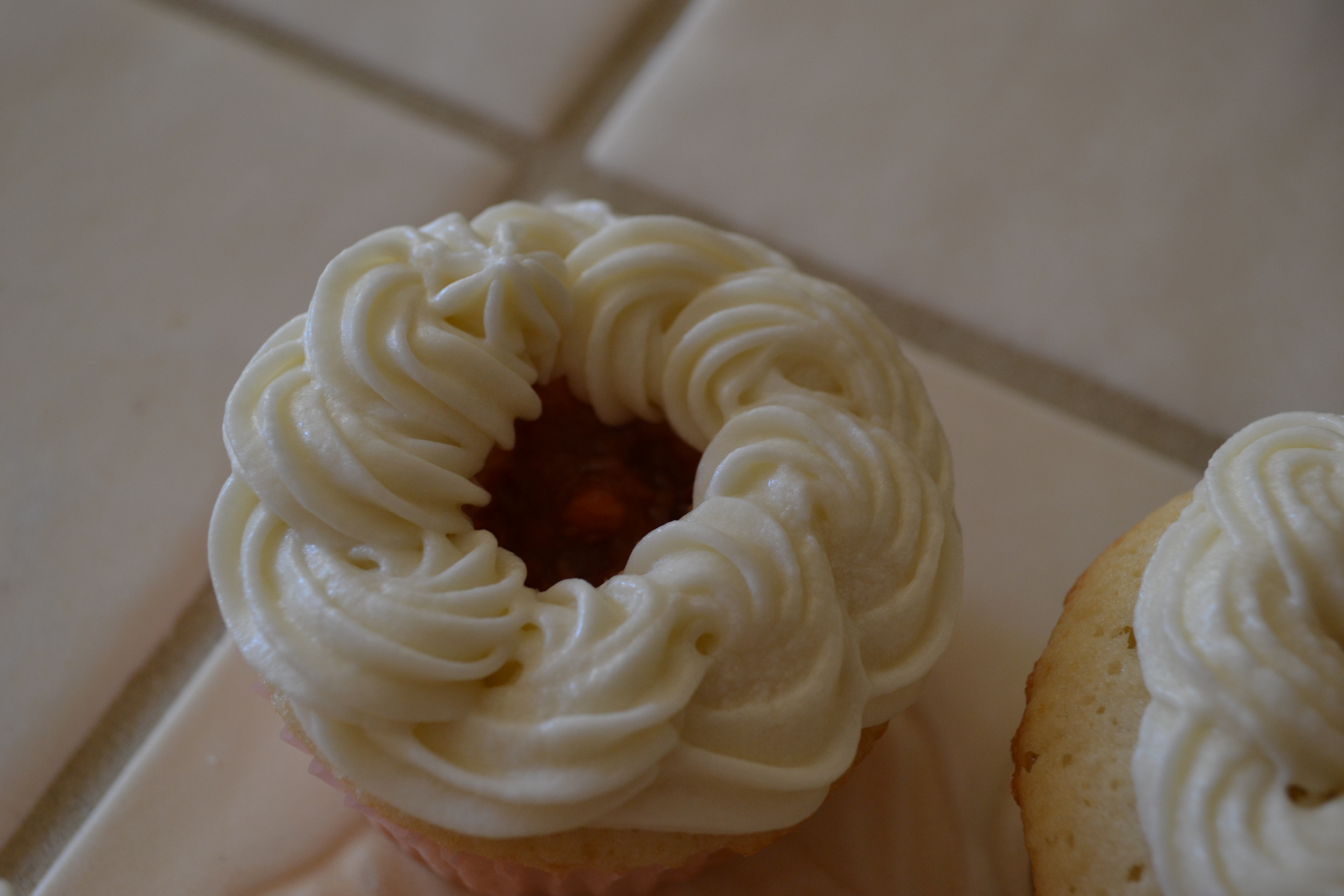
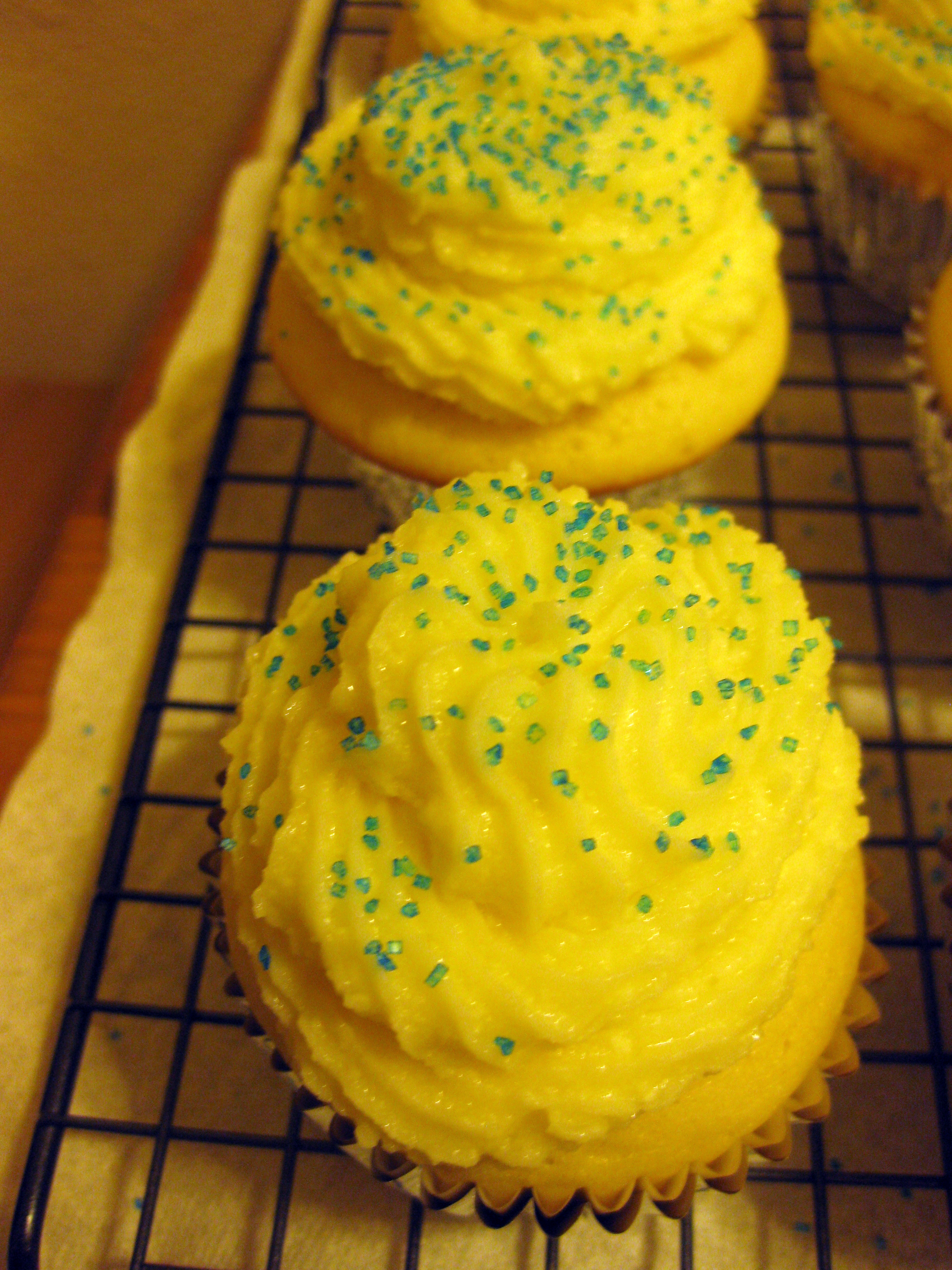
In the meantime, I filled and frosted the cupcakes with careful swirls.  Contrary to my most recent performance, these did not come out in sharp rosettes.  In fact, a few of them threatened to plump into blobs.  But I administered a careful sprinkling of blue sugar anyway, and shoved them, too, into the fridge to think about what they’d done.

A new batch of buttercream was now required.  And I was out of mascarpone cheese.  As always, this was more of a challenge than I’d anticipated.  It was nearing 4pm, the rehearsal dinner was in less than 3 hours, and I wasn’t done yet.  Okay, just go and buy some more mascarpone.  The grocery store two blocks from us didn’t have any.  The grocery store on the south side of town did, but it was a different brand, a higher price, and a looser consistency.  And cold.  Deep breath.  Beat its brains out.  This batch was, admittedly, a bit better than the first, but still not the smooth creamy perfection I’d achieved in June.  But it was what I had.  I would deal.  It was just frosting.  I could conquer it.

When I finished the first cake – the 8” one, I think – I called N. in to have a look.  “Be honest,” I said to him, “does this look decent?”  We agreed that while it wasn’t great, it was probably passable.  I pressed on to the 9”.  When this one was done, I felt my stomach sinking.  Yes, I had carefully covered the crumb coat, and yes, I had dipped my spatula in hot water and let it glide carefully and quickly over the surface when I was finished to smooth things out, but I could see tiny chunks of butter in the mixture.  I could see where the icing wasn’t absolutely smooth.  There were dents and cracks and, inevitably, the indentation of my knuckle from a moment of carelessness.  I filled that one in.  By the time the 6” cake was done, I was almost ready to cry.  It looked the best of the three (practice is important, people), but I was tired and disappointed with myself and worried that the bride and groom would second-guess their choice.  Still, all that could be done was to carefully deposit them back into the fridge, try in vain to scrub the blue dye from the blue sprinkles off my hands, and go to the rehearsal dinner.  The detail work, which I’d never had time to practice, would have to wait until morning…

The Buttercream Project, part 6

Buttercream and I are getting more comfortable with each other (and we’d better be, since the wedding is in one week.  One week!).  To prove this to myself, and because my family was clamoring for a taste of the cake I’ve been practicing for so long, I made a batch of wedding cupcakes while visiting my parents a few weeks ago.  My mom acted as sous chef, and we produced a batch together that will, thanks to time slipping away from me, serve as my final practice before I execute the real thing at the end of this coming week.

This practice run was an exercise in slight changes.  Not only did I not have cake flour to work with, or as many raspberries as I wanted for the filling, or enough champagne to add to the fruit compote, I was also working with a new oven, new tools (my mom has an electric mixer, but not a KitchenAid stand mixer, which is what I use at home), and a new friend: I’ve upgraded cameras.  I’m now (mostly) shooting with a Nikon D3100, a fantastic graduation gift courtesy of my folks.  It’s amazing.  I love it.  But I digress…

With regular instead of cake flour, the baking time needed to be increased by a minute or two (science-types: why might this be?  Does it take longer for regular flour to absorb liquids than cake flour?), and in my impatience, a few of the cupcakes fell in the middle and remained a bit gummy.  Initially this upset me, but the wonderful thing about filling is that you hollow out the center of the cupcake, which eliminated any underbaked batter completely.

My mom dipped apricots in a boiling bath so she could slip them easily out of their skins, and she chopped them up in a medium dice to add to the mush of raspberries we had available, water, a small drift of sugar, and a generous splash of dry white wine.  We cooked this down for at least half an hour, then poured off some of the remaining liquid and cooked it a bit more. What was left was the consistency of loose jam, and pleasantly melon-colored.  To be honest, though the combination was nice and the filling tasted fine with the cupcakes, I think it could have benefited from less cooking time and less sugar.

Baked, cooled, hollowed and filled, the cupcakes just needed their final element: perhaps the tastiest nemesis anyone has ever had.  I only let the butter and mascarpone cheese soften for half an hour or so.  In my mom’s summer kitchen, it was in the low 70s and the butter had a slight give at the press of a finger, but was not as achingly soft as it would be for chocolate chip cookies.  This seemed to be the right move.  It whipped together with the cheese easily and well – no large clumps of butter, no separation of fat from liquid.  I added powdered sugar a half cup at a time, as I’ve been doing, this time through my mom’s sifter, an ancient, squeaky-creaky crank-powered tube of tin.  Only one tablespoon of milk trickled in, and then I had a stroke of genius.  The problem with this frosting – the problem I’ve been searching in vain for ways to combat without compromising the texture – is that it’s too sweet.  Sitting in a wicker basket on the counter next to me was a large, juicy lime.  What would happen if we whipped a little lime juice into the frosting?

Revelation.  The good kind.  Just a tablespoon of lime juice and the frosting already tasted less sweet.  Another tablespoon and it was markedly less saccharine, but still no citrus flavor overwhelmed it, and it piped on beautifully in both swirls and curlie-cues.  This is an experiment to be repeated.  In a week.  One week.

The Buttercream Project part 5

It’s funny, the things we feel we have to do to catch up with life.  Thursday was a big day: I successfully defended my dissertation, the last step on the way toward becoming a PhD in English literature.  So I guess I’m a doctor now, of a sort.  And now that the defense is over, and summer is (supposedly) on its way, I’m trying to find footing in the landslide of other responsibilities I’ve let slide: getting back in touch with friends, grading student work, cleaning up an office I’ll have to vacate in a month or so, and remembering (much to my dismay) an unwritten conference paper I have to present at the end of July.  And yet, rather than doing any of those things, the most important obligation I feel I must fulfill is this one: sharing how my most recent efforts on the cupcake front – now almost a month old – came out. 

The answer is spectacular.  I think, barring any further requests or complaints from the bride and groom, I have hit on THE mixture we’ll be using for the wedding.  And of course, as always, I’ve learned some things too.

Last time I made a floaty, creamy filling that coated the tongue and whispered with sweetness.  This time, I wanted something tart – almost aggressive – to to cut through the sometimes overwhelming clouds of frosting.  I combined 1 bag each frozen raspberries and frozen peach chunks, 1-2 cups champagne, and about ¼ cup of sugar in a small pot, and simmered them together for 20-30 minutes.  I was hoping for a thickened, jam-like compote, but I think there was too much champagne for that, and the mixture stayed fairly loose.  The flavor was great, though – with such a small quantity of sugar, the tartness of the fruit and champagne made the mixture bright and assertive.

When the cupcakes were baked, and both they and this ruby mixture were completely cool, I cut the middles out of the full sized cupcakes and deposited a teaspoon or two of filling into each.  To my relief, despite being thin, the juice of the filling did not bleed through and stain the exterior of the cakes.  Bright red splotches on otherwise pristine ivory-white wedding cupcakes would be disastrous.

When I mixed up the frosting this time, my butter and mascarpone cheese were not as terrifically soft as they were in my last attempt.  Therefore, they creamed together without the fearful separation I wrote about previously.  The edges and ripples of the swirls were still not as rigid and fluted as they are on bakery cakes, but they were still okay.  And when I went to frost the mini cupcakes, I finally figured out what was going on.

I ran low on frosting as I approached the minis, and because I was now out of mascarpone cheese I plopped a half-softened half-stick of butter into my mixer and let it rip.  Immediately, even though I hadn’t upped the ratio of sugar in the mix, this frosting was different.  The flowers, which I’ll say more about in a minute, actually had fluted edges, and the frosting required more pressure to liberate from my piping bag.  Mascarpone cheese, even when it’s cold, is already softer than butter.  It is never going to result in the same consistency as pure buttercream because it is such a soft cheese.  So while it is fine for simple swirls or covering a cake, it is not great for detail work that requires sharp edges or fine points.

As you can see, these are the best flowers I’ve made so far, thanks mostly to the higher ratio of butter to mascarpone in the frosting.  I still wondered why mine did not seem to ripple out of the petal tip I was using the same way they do in the instructional video I’m using, until I remembered – what an epiphany – that I’m left handed.  If you turn a cupcake to the left while you hold the piping bag in your right hand, you probably need to turn the cupcake to the right if you’re going to hold the piping bag in your left hand.  I realized this minutes too late to apply it this time around, but now I know.  That way the icing will emerge from the piping bag in the same pattern as it would for a right handed person. 

Survey said these were the best version I’d attempted yet by leaps and bounds.  The filling was perfect because it provided the right counterpoint to the achingly sweet frosting and the delicately sugary cake.  The flowers looked like flowers, and the blue sugar I found for the full size cupcakes is a deep enough blue to look sophisticated and adult (previous, lighter versions would bit better on sweets for a baby shower than on wedding cupcakes).

Next month, the challenge is piping.  I’ve purchased some beautiful ivory and gray cupcake wrappers that we’ll be using for the wedding, and I’d like to be able to imitate – if not copy – the leafy designs on them as the piped décor on one of the full sized cakes.  This will give me at least one more trial run with buttercream before the big day, and allow me to prove my theory about the mini cupcake flowers.  It will also, assuming Oregon’s weather gets its act together and remembers it’s Memorial Day weekend, give me a chance to see how the frosting behaves in warmer temperatures.

Fingers metaphorically crossed (it’s too hard to type otherwise)!

The Buttercream Project part 4

Time has come and gone and I am now not only a Bittman truant, but two buttercream posts behind. I’ve got to catch up. But I have an excuse. It looks like this:

Yes, the dissertation is complete. Well, it’s complete in the sense that I’ve distributed it to my committee. Three weeks from now – three weeks from yesterday, actually – I will defend it. But in the meantime, cupcakes!

What I learned this round, which I baked about a month ago:

Cake flour makes the most delicate, light, bakery-style cake. It’s worth the extra cost.

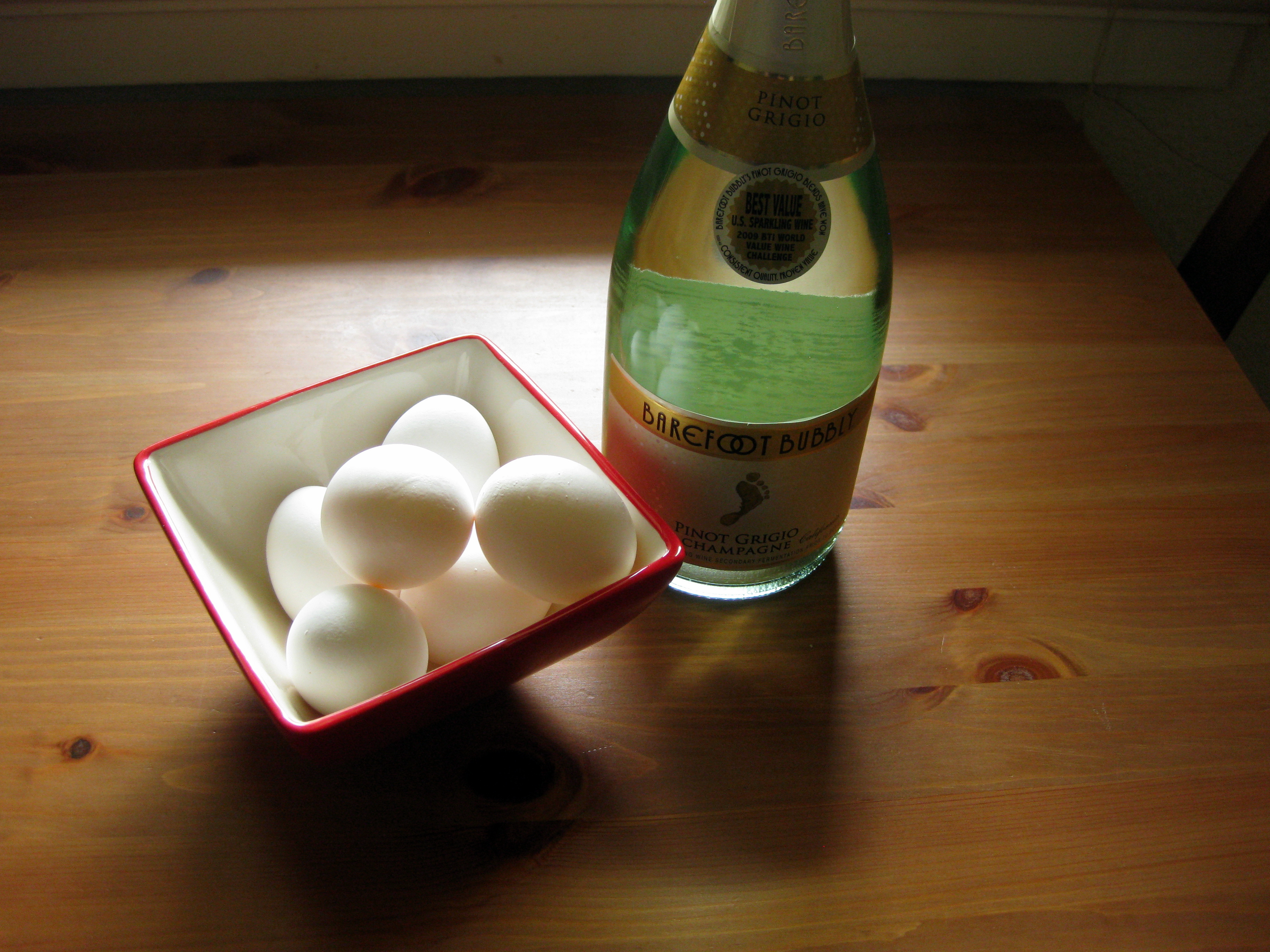
Barefoot’s Pinot Grigio sparkling wine is a good choice for cake; it has a crisp brightness and is strong enough to stand out as a distinct flavor once the cake is cooked.

Buttercream sometimes looks like it’s going to fail, but then you just continue to whip it and it comes together.

This round, I did champagne cake with a mascarpone and apricot jam filling, and mascarpone buttercream. I wanted to try a full sized cake so I could practice getting the frosting nice and smooth.

My assessments: the cake was perfect. It smelled good, it tasted good, it had a moist crumb with a slight squish between the teeth – excellent eating. Cornelli lace all over the top is really quite pretty, but not too twee or too formal.


The filling was… okay. Tasty, but not perfect. I think the jam with the mascarpone added too much richness to an already rich product. Perversely, I think this particular filling would be better with a chocolate cake. It would be a contrast in both color and flavor that simply wasn’t present here. J. and H. liked it, and of course their vote is most important, but I wasn’t satisfied yet.

The buttercream, my nemesis, was almost a disaster. I made a big batch of frosting, because I wanted to frost the full cake and practice making flowers on the mini cupcakes. I bought myself a petal tip from Michael’s and was itching to try it out. This time, it would have to be perfect.

Here’s the thing, though. When you double the amount of fat in a frosting, you also have to double the amount of sugar! As I whipped together a cup of butter and a cup of mascarpone cheese, and as I added cup after cup of powdered sugar, things were not coming together. No, in fact things were starting to separate. A pool of liquid formed as the clumps of butter and cheese turned into strange creamy granules instead of an even mass. I started to fret. I got a little scared.  This was NOT how this round was supposed to go.

And then, logic and revelation triumphed over fear. Maybe the fat was too warm. Yes, it was melting in protest. I stowed it in the fridge for twenty minutes or so.

When I pulled it out, it was better, but still disappointingly far from smooth. And then I remembered: if you have to use 3-4 cups of sugar for 1 cup of butter, you’ll probably have to use 6-8 cups of sugar for 2 cups of fat. And I’m trying to get a PhD…

As I added more sugar, things got a little better. As I added more sugar, it started to smooth out. And then after my final addition, I let the mixer rip for a good minute or two, and magic happened. The frosting smoothed and softened and became this delicious creamy cloud. My lungs heaved relief. The moral of this, apparently, is: if your buttercream isn’t perfect, add more sugar and beat it longer. Whip the resistance right out of it.

Despite the improved texture and the excellent flavor, my frosting attempts were still imperfect. The swirls I put on the full size cupcakes threatened to topple over the delicately curved hills onto which I optimistically piped them. They still looked nice, but the edges and ripples weren’t sharp, and I shoved them into the refrigerator before they had time to break down any further.

The mini cupcake flowers were another fresh learning experience. I tried. Oh I tried. I watched the video twice and followed it exactly, and again, the petals were thick and dull. They looked more flower-like than my previous attempt, but they weren’t the beautiful fluted edges Alice achieves with such ease. Nevertheless, for me, improvement is improvement. Progress counts. This was the best so far, and just needed some minor (I hoped) adjustments to make it wedding-worthy.

It’s a good metaphor for my own progress, really. Even the best work can stand improvement. Let’s hope my revisions, as I note them, are as minor as tweaking a frosting method. Flute the edges. Visit the thesaurus. Adjust a sentence or two. Or five. Add powdered sugar. Enjoy.  Aren’t these things, at their heart, not so different? Let’s hope so.

The Buttercream Project 3

My favorite weekends always turn out to be the ones that revolve around cooking.  You know the ones I mean.  You have a dinner party, or a potluck, or an afternoon on the porch surrounded by cookbooks, or you watch a marathon of FoodNetwork shows while almost absent-mindedly spooning one of your favorite indulgences into your mouth…

I wouldn’t know what that’s like…

Seriously, though, I am suddenly having one of those weekends.  Our friend Sh. is sharing a pulled pork dinner with us tonight, so by 9am (which felt like 8am, cursed Daylight Savings…) I was standing at the kitchen counter, pouring ginger ale and Jack Daniels whiskey atop 4 pounds of pork butt in my slow cooker, and deciding whether it needed anything besides salt and pepper to round out the flavors (I decided on a big chunk of fresh ginger and a few shakes of Worcestershire sauce).  Now, I’m sitting in the kitchen babysitting a pot of polenta, which I’ll cook, spread, and chill today to be cut into squares, pan-fried, and eaten later this week, and keeping a wandering eye on some cornbread, which we’ll have tonight with the pulled pork.

And yet this post isn’t about any of those things.  Whether you believe it or not after that extended tangential introduction, this post is about buttercream.  Again. 

I’ve completed my third buttercream experiment, and I must report mixed success.  I decided this time I’d better try out the cake recipe I’ll be using for the wedding in cupcake form so I could start nailing down baking times.  On a whim, I picked up some cake flour, which I’ve never used before.  This was for texture: often my cupcakes, if they are not chocolate, end up with a suspiciously muffin-like consistency, and I didn’t want that for these babies.  I also picked up some mascarpone cheese to continue the experiment in de-sweetening the frosting.

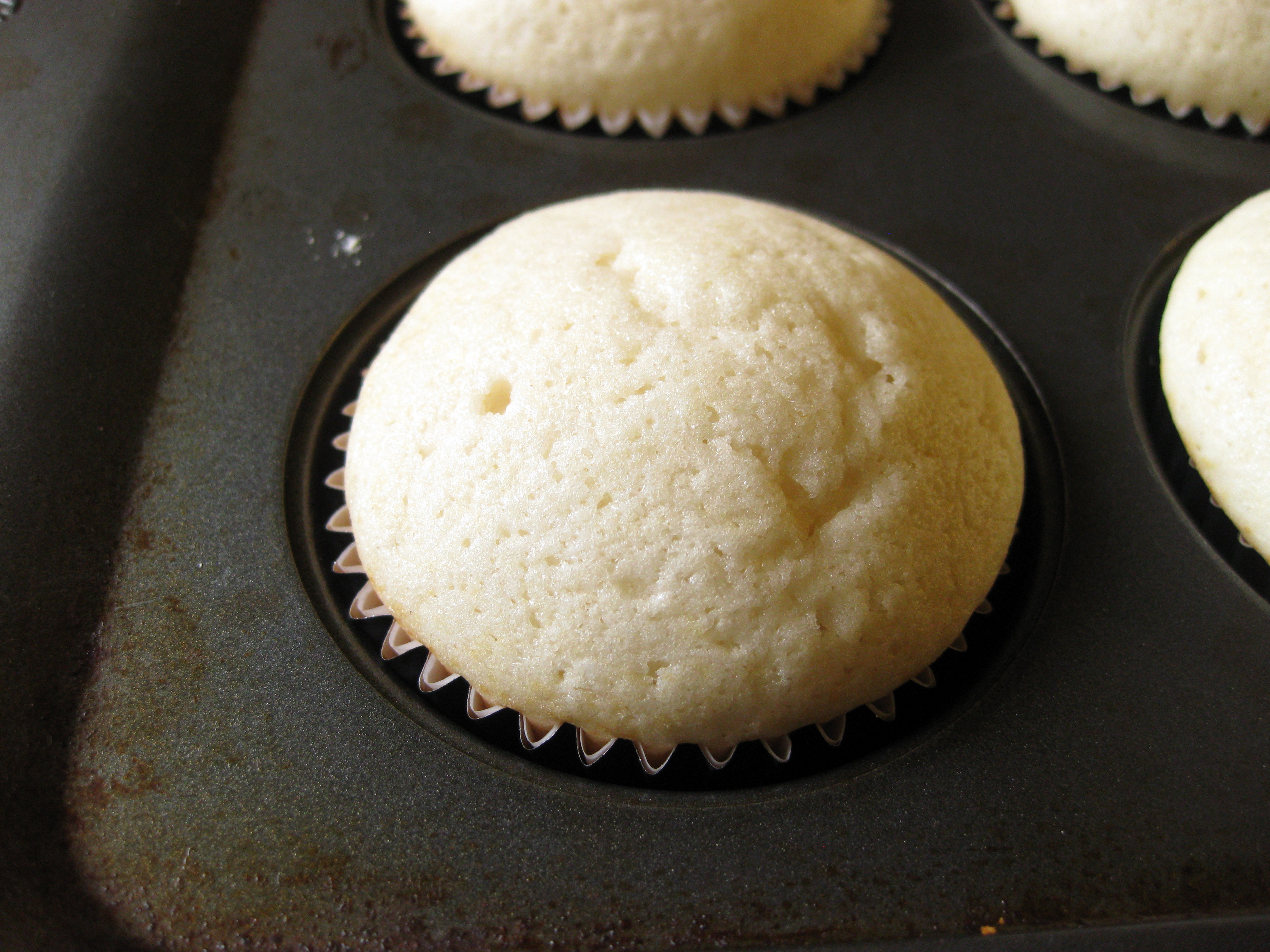
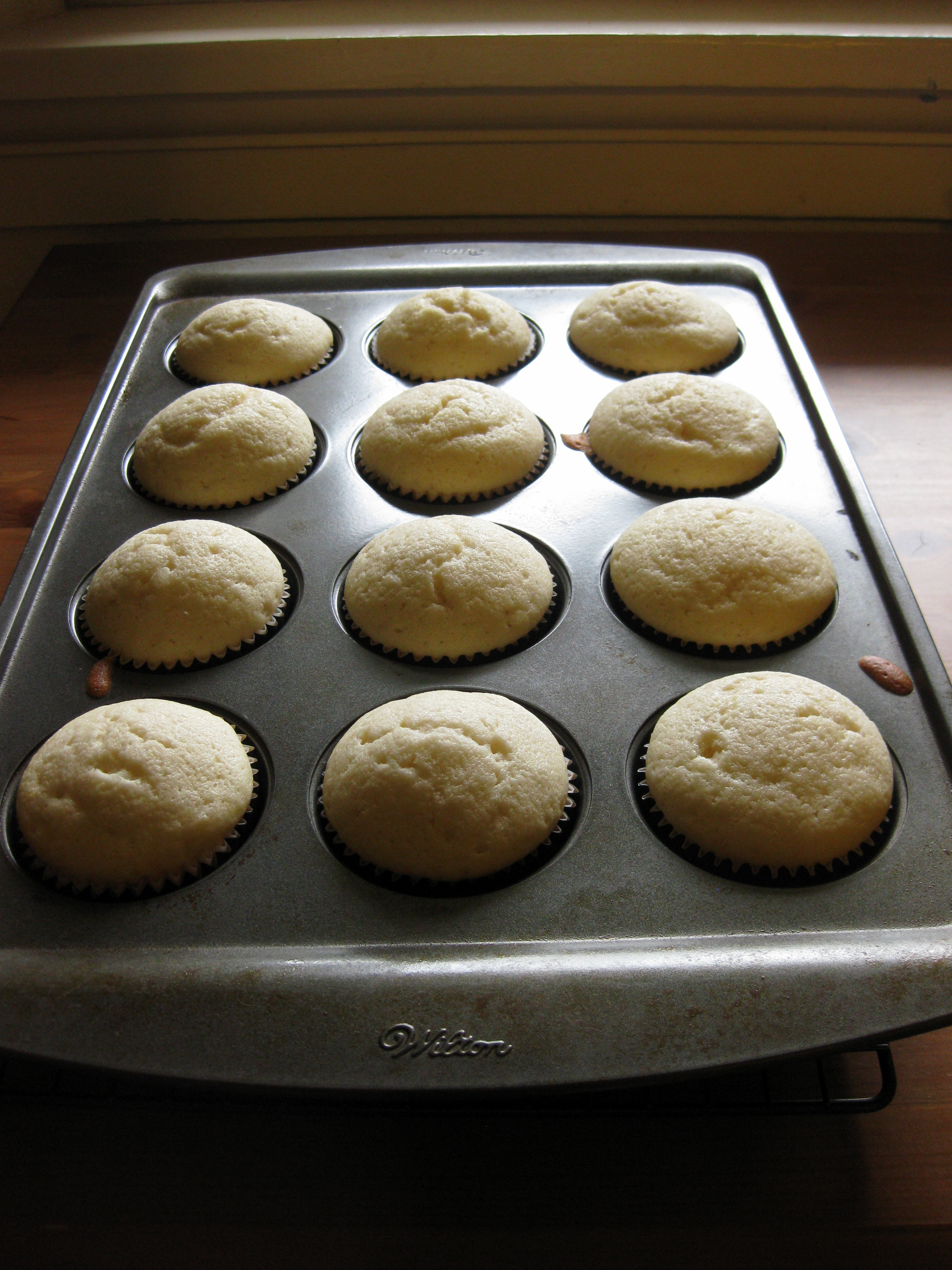
The baking process involved a lot of checking the cupcakes with a trembling toothpick, hoping for the barest of moist crumbs, not a completely clean tester.  I have found the completely clean tester is a recipe for overcooked baked goods, especially when it’s something very tender and delicate like cupcakes, because the cake continues to cook for a while as it sits in its tin on the cooling rack.  Tough cupcakes would not do.  Fortunately for me, they cooked up the color of pale cream and sported perfectly slight, perfectly shaped domes. They were pillowy tender.  They smelled good too – sweet and soft with the barest hint of floral fruitiness from the sparkling wine I used.

As they cooled, I started the buttercream process.  I wasn’t nervous at all this time – hadn’t my previous attempt come out smooth and creamy and lusciously perfect?  This time, I was golden.

This time, unfortunately, my kitchen was about 59 degrees Fahrenheit and, despite having left the butter out for hours and hours, it wasn’t the same squashy softness it had been last time.  The mascarpone cheese I decided to use was fresh from the fridge, since it was already soft enough that it didn’t occur to me having it at room temperature would make a difference.

It does.

Here’s what happened.  I whipped together a cup of butter and a cup of mascarpone cheese.  I sifted in about 3 cups of powdered sugar, a slight sprinkle of salt, and then trickled in a couple tablespoons of whole milk and a splash of vanilla (I can’t find champagne extract anywhere besides Amazon.com, where it costs upwards of $12 for a teensy bottle.  Needless to say I haven’t bitten that bullet).

Immediately I knew this wasn’t going to be perfect.  Already I could see tiny little clumps of butter, rechilled by the cold cheese, and tiny lumps of sugar, courtesy of a hasty and careless sifting session.  I pressed on regardless, deciding in the moment that this experiment was about taste, not texture.  Let’s get the taste right first, I told myself, to avoid the tumble into hysterical depression the blue poo cake had wrought.

So I loaded up a piping bag with my new fancy-pants metal star tip and went to work on the full sized cupcakes.  In the process I got enough frosting on my fingers to be able to taste, and I have to say I was incredibly pleased.  The mascarpone cheese added another layer of velvet and creaminess, and because it is not sweet to begin with, there wasn’t as much overwhelming saccharine powdered sugar taste to the finished product.  The touch of salt probably helped with that too.  It was just incredibly rich and moist and lovely.

The texture, on the other hand, sucked.  Well, that’s not fair.  It wasn’t ideal.  It was slightly grainy, and the star tip’s sharp edges combined with my not-exactly-quite-as-smooth-as-I’d-wanted icing produced rough crumples on my swirls of frosting rather than delicate demure rosettes.

Hasty, thoughtless, and stubborn, I pressed on to my next experiment.  I’d found this the previous month: a video tutorial about making beautiful blue flowers on mini cupcakes, and I wanted to surprise my bride by testing these out.  I considered, as I dripped blue food coloring into the remaining buttercream, rewatching the video.  And then I talked myself out of it.  I’d watched it twice, I remembered basically what she’d said to do, and she made it look abysmally simple.  I’m marginally artistic.  How hard could it be? 

For starters, the frosting was now looking a little wet.  Terrified of a repeat blue poo scenario, I added more powdered sugar.  But now I was in a hurry, because I had girlfriends coming over for a TV night and I wanted to serve them beautiful, frosted cupcakes (notice I didn’t say beautifully frosted cupcakes.  I was trying to be realistic).  So I didn’t sift the sugar.

This, as you might expect, resulted in more lumps.  But I was not to be discouraged.  I slapped some icing into a bag with a tip that looked similar to the one in the video tutorial, and started trying to make flower petals.  I made circular blobs.  There were no delicate curling edges, no gentle petal shapes, and the lumps of powdered sugar I’d stubbornly ignored made the frosting emerge from the piping tip unevenly.  I ended up with deformed starfish in a lovely cornflower-esque shade on the mini cupcakes, and a spotty lace pattern surrounded by blue blobs on the tiny taster cake I’d made for the bride and groom.  (It was supposed to be cornelli lace, but when hunks of cold butter in your frosting burst out through the piping tip, all bets are off.)  I did, however, glean a valuable tip for frosting a cake from the Barefoot Contessa: once you have your layer covered, dip your frosting spatula in very hot water and run it gently over the sides and top surface of the cake.  The hot water lightly melts the very outer molecules of butter and sugar and solders them together while smoothing them out, resulting in a perfectly level layer of frosting.  I tried this out to great success.

But back to the cupcakes.  Undaunted by their aesthetically challenged appearance, I sprinkled them with silver-gray sprinkles and presented them proudly to my friends, who pronounced them praiseworthy masterpieces.  I privately thought them too kind, but it is gratifying to have good friends who support your stubborn goofy screw-ups and prevent you from being too hard on yourself.

It was only the next day that I rewatched the tutorial video and saw that not only was a using the wrong tip to pipe these petals, but I was holding it the wrong way.  This gave me hope.  Next time, next time when butter and mascarpone are at the same temperature, when it’s warmer in the kitchen, when a fresh bag of powdered sugar and careful sifting result in a perfectly velvet texture, and when I acquire a rose petal icing tip, I will be on my way.  The flowers won’t be perfect, but they will actually resemble flowers.  Next time. 

I keep ending these posts by talking about what I will do next time.  Upon reflection, it seems dangerous to be counting always on next time in this project.  There will come a time when “next time” no longer works, and on that day in July I’d better get everything right.  What if the butter is too soft?  What if I over whip it?  What if there are lumps?

Fortunately I still have a few next times to lean on.