Sunburst

Orange is a hot color. It’s flame and earthy warmth and friendly heat. But it’s also freshness and citrus-bright and spicy. It’s a fall color and a summer color. This is convenient, considering Oregon’s spastic and reluctant attempts to approach spring/summer. Interestingly too, the particular orange combination Bittman offered us this past week was a salad made from winter root vegetables, with a peppery summery acidic dressing. Juxtaposition of seasons. Juxtaposition of flavors.

68. Peel sweet potatoes and boil until tender, drain and cool; dice. Treat carrots the same way. Make sauce of Dijon mustard, olive oil, cider vinegar and chopped scallions. Toss all together.”
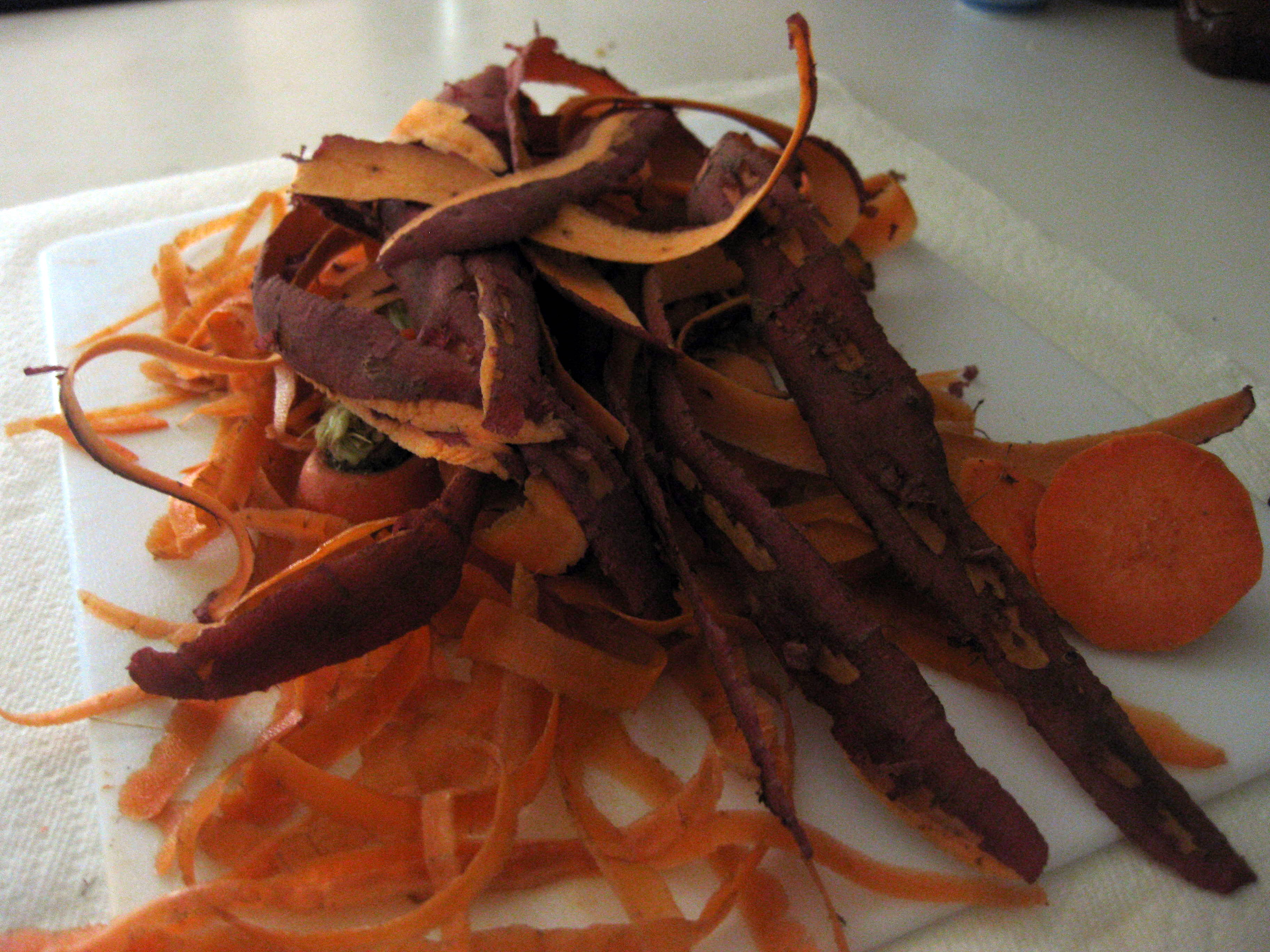
Here’s what I used:

1 big Beauregard yam, peeled

3 large carrots, peeled

4 green onions, thinly sliced

2 TB dijon mustard

2 TB cider vinegar

2-3 TB olive oil

salt and pepper to taste

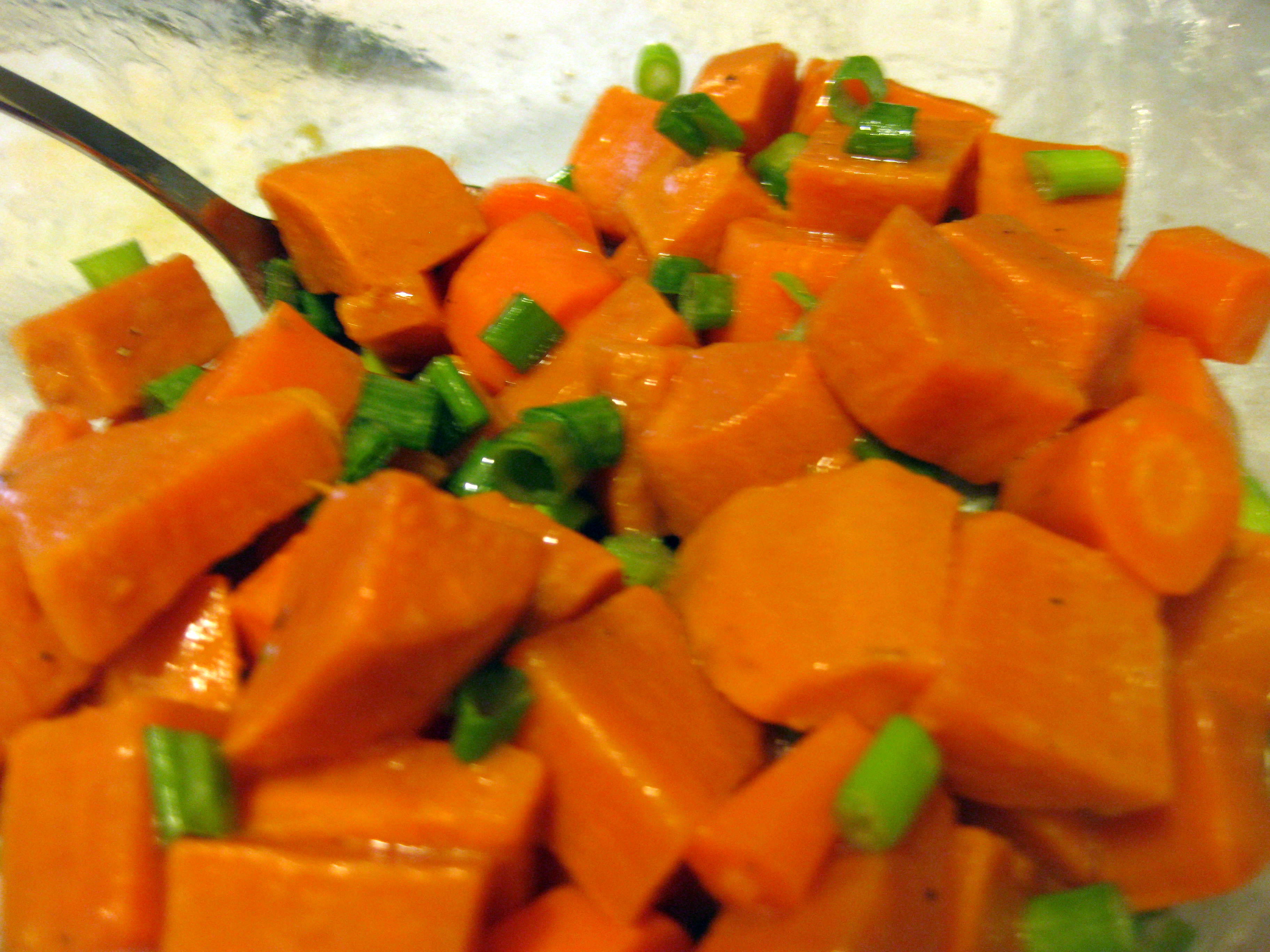
Bittman’s recipe seemed to advocate boiling the carrots and sweet potato whole. I decided to shorten the cooking time and cut the vegetables into chunks first. I boiled them in lightly salted water for fifteen or twenty minutes, or until the sweet potato chunks were tender and the carrots still had a touch of texture. Drained, they were startlingly bright against my white colander and I had to sample one. And then another. And then another of each.

They tasted like sweetness and familiarity. I set them aside to let them cool for an hour.

When they were well cooled, I tossed in the green onions, ground on some black pepper, and mixed up the dressing. I combined the mustard, the vinegar, and some salt and pepper in a measuring cup, then blended them with a fork into a homogenized mixture. Then, still whisking constantly, I added the olive oil in a slow stream, whisking persistently until the mixture emulsified. Then, of course, all that remained was to pour it over the vegetables and toss them gently together for full immersion.
While this sat, I prepped its accompaniment. I brought some chicken stock to a boil, then tossed in a bagful of frozen peas. When the liquid resumed its boil, I stirred in a box of couscous and clapped the lid on to let the absorption process commence. I wasn’t sure it was going to work, because I feared the peas might have soaked up too much of the liquid and the tiny beads of semolina wouldn’t cook properly. I feared in vain. When I fluffed the couscous five minutes later, it was cooked and tender, the peas were steaming, and I stirred in some chopped fresh parsley for kicks.

Now, instead of a steaming vegetable dish and a cold pasta salad, we had hot, vegetable-laced pasta and a cold vegetable salad. It was a delicious juxtaposition, with the wintry roots flavored in bright, commanding acidity and the couscous dressed with springiness. I loved what the mustard and vinegar did for the carrots and the sweet potatoes, playing against their inherent sweetness to add complexity and interest. Cleaning up after dinner, N. and I couldn’t stop grabbing chunks of their sour-sweet tastiness with our fingers out of the bowl. I will certainly make this one again.

The nice thing about this dish was how, even in its odd mixture of summery flavors and autumnal base, it mirrored my own summer thus far. Eugene has been mostly dreary, offering pockets and blotches of sunlight and teasing us with predictions of 70F degree weather, then delivering a sky socked in fog and breezes of misty drizzle. This isn’t June gloom. This is June despair.

But this past weekend, as the bright chunks of winter took on summer flavors, I left Eugene for warmth, for sun, and for vacation. This week and next week, I cannot promise another post. But I can promise that my pale shoulders will toast, my hair will bleach out, and my brain will slow down its frantic pace. I’ll keep track of what I eat, and I’ll photograph the triumphs and surprises to share upon my return to internet-land. And I hope, fervently, your last weeks of June will be as orange as I know mine will be.
Changing tastes

I was not a picky eater when I was a child.  I liked almost everything, and I was willing to try probably 99% of what I was offered.  I liked vegetables, I liked fish, I liked salsa, I liked avocados… I liked food.

One of the few items that did not please my palate was cauliflower.  My mom always steamed it, and even smothered in a cheese sauce it had this musty, boiled cabbage flavor I couldn’t stand.  It felt mealy in my mouth and it looked pale and unappetizing: horrible vegetable brains I wasn’t supposed to gag over.

Recently, however, I’ve discovered roasted vegetables.  Well, I knew that if you cut root vegetables into chunks, doused them in olive oil, salt and rosemary and roasted them for almost an hour the result would be tender starchy delight, but I hadn’t done much with other victims.  Potatoes?  Yes.  Carrots and onions wedged in next to a leg of lamb?  Sure thing.  Asparagus with some lemon juice and delicate, bursting cherry tomatoes?  Definitely.  Cauliflower?  I was doubtful.  Until a few months ago.  I found a recipe for slow cooked “tandoori” chicken with a side of roasted cauliflower, and my husband’s pleading eyes convinced me to try it.  Liberally soused with olive oil, coriander and paprika, trapped in the oven at 450F for the better part of an hour, cauliflower became amazing.  Its cut surfaces deepened to mahogany and took on the appearance of that burnt sugar crust atop crème brulee.  Its florets got rough and crispy and, as I described to my slightly incredulous sister, became like cauliflower popcorn.  And I liked it.  With sea salt on top it was outrageously good.  N. and I plowed through a whole head of it by ourselves that night.

So I was okay with this week’s Bittman.  In fact, I was pretty excited.

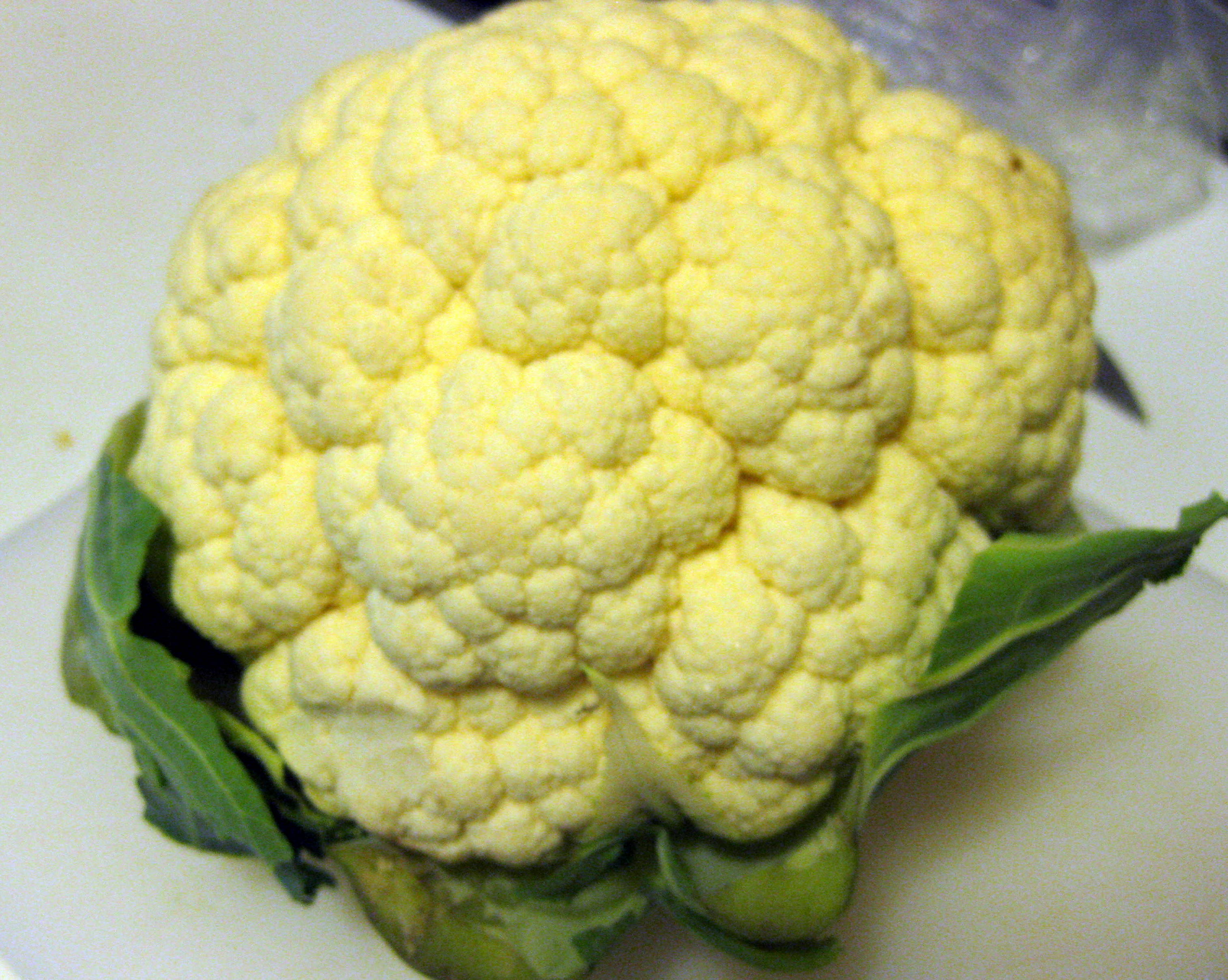
“51. Steam cauliflower florets and toss with olive oil. Roast with peeled whole garlic cloves and chopped bacon at 400 degrees for 20 minutes.  Chopped parsley is a worthwhile addition.”

Not only was this – according to my new, cauliflower-appreciating minset – a delectable-sounding collection of ingredients, it was really easy.  I readied:

1 large head of cauliflower, cut into florets

¼ cup olive oil (approximate)

6-8 whole garlic cloves, peeled

5 slices bacon, chopped

Black pepper to taste

¼ cup chopped parsley

Ordinarily, I tell you what I did and then comment on it.  Here, I’d like to do the opposite.  I followed Bittman’s directions and, whether it was because I cut too large of pieces or because I overcrowded my baking tray, at the end of 20 minutes at 400F, my cauliflower was overcooked and my bacon was barely past raw.  I hiked up the heat and left it in for another 15 minutes, anxiously checking while we scarfed our side dish to hold back our hunger, which the smell of slowly-rendering bacon does nothing to assuage.

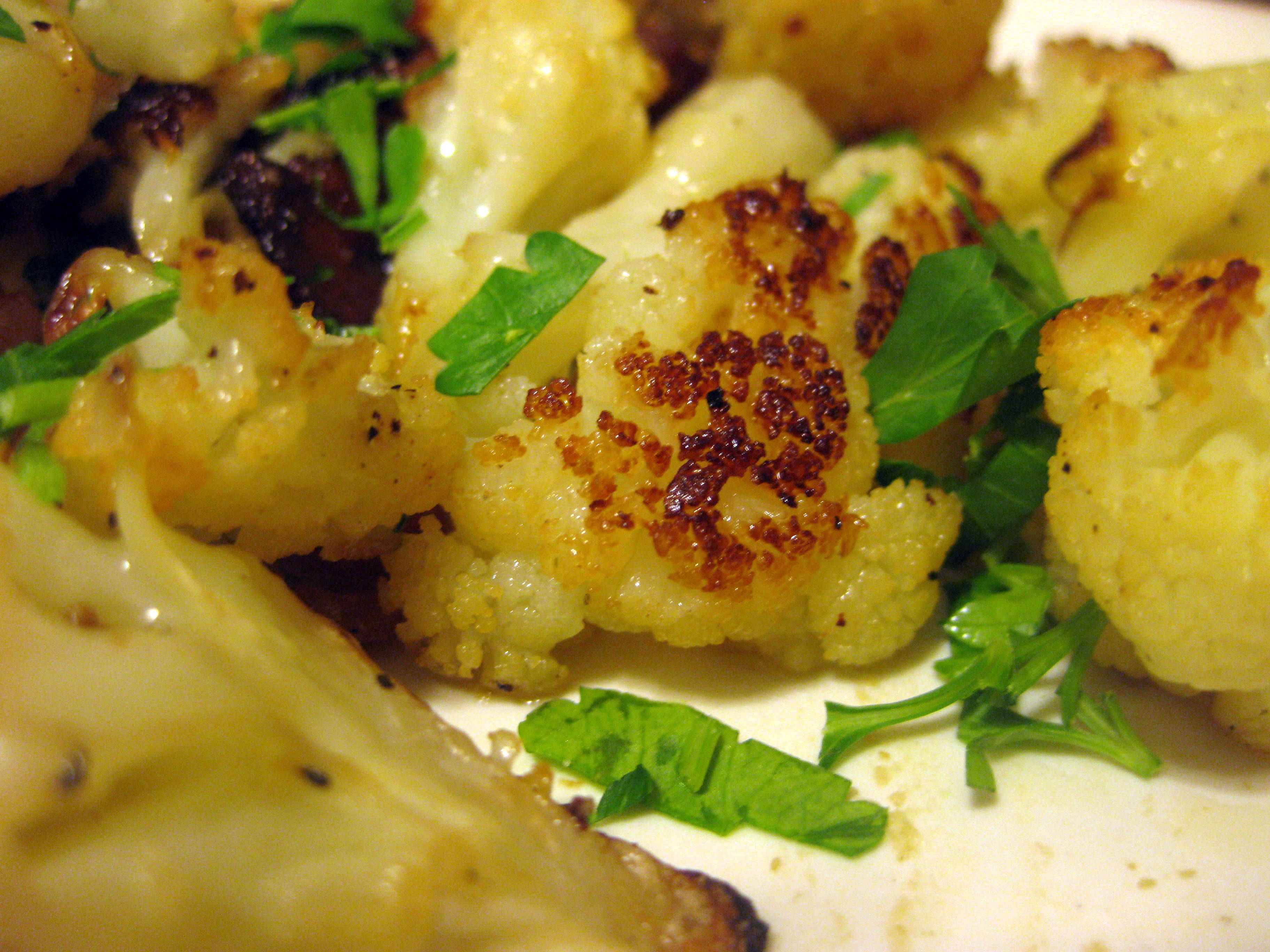
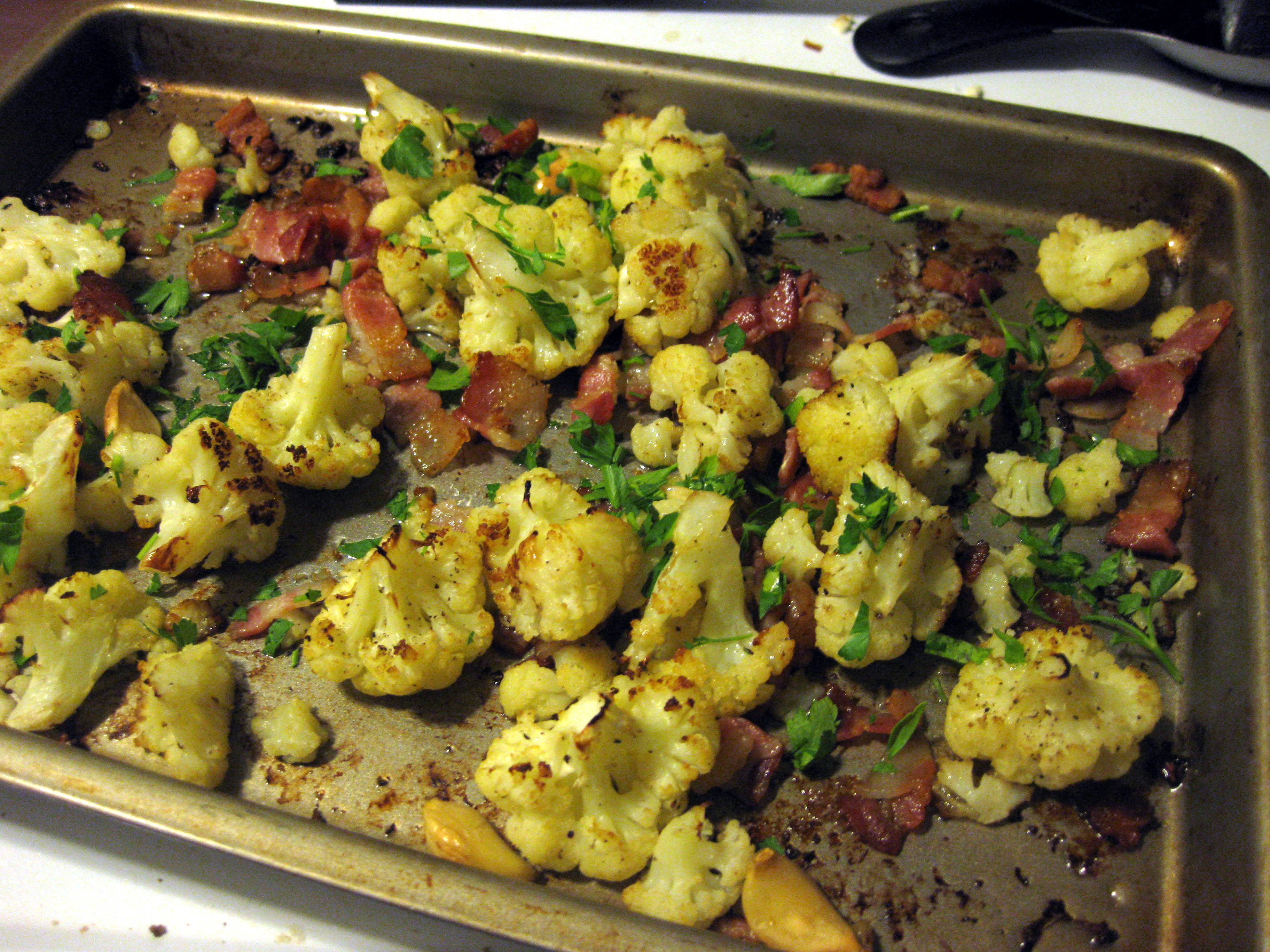
When it was finally done, with deep crinkly bits on the cauliflower and glistening bacon fat making the pan slick, I tossed on some parsley, scooped huge helpings onto our plates, and we collapsed into it.  It was good.  The blend of flavors was really wonderful.  The mild cauliflower, made almost sweet by its roasting treatment, was helped along by the smoky saltiness of the bacon, and when you got a garlic clove in there as well, it was magic against the taste buds.  The problem was in the texture and execution.  Because it had already been steamed, and because I had to add extra cooking time, the cauliflower was essentially the texture of mashed potatoes.  This might be acceptable in some cases – in fact, I’ve read recipes that call for pureed cauliflower as an addition or flat out replacement for mashed potatoes – but that wasn’t what this was supposed to be about.  I wanted some vegetal resistance against my teeth.  I wanted tenderness and give inside a golden shroud, but something still lingering to slice through.  This was all softness.  So here’s my procedure suggestion:

Preheat the oven to 450F.

Toss the raw cauliflower florets and the garlic cloves in olive oil and arrange in a single layer on a baking tray or cookie sheet.  Pepper them well.  Add the bacon, still trying to keep everything in a single layer and evenly distributed across the pan.

Roast for 20-30 minutes, checking frequently after 20 minutes, or until bacon is cooked through and cauliflower is dotted with crisp with golden-brown edges.  When desired doneness is achieved, sprinkle with fresh parsley and serve. 

This might be a delicious side with some grilled salmon and a green salad, or as an alternative to french fries alongside a burger.  We had ours, I must admit with slight shame, paired with Stouffer’s boxed stuffing.  I did cook it with homemade chicken broth, but the packaged cubes of something-that-once-resembled-bread and dried, barely reconstituted onion bits remained the same.  Sometimes you need some shameful comfort, and these red boxed Thanksgiving classics are what does it for me.

With cauliflower in my “might be love” file, at least when it’s roasted till its whole constitution seems altered, my list of foods I don’t care for – short to begin with – is becoming almost nonexistent.  There are some processed foods I don’t like, but I’m not going to feel bad about that or try to develop a taste for them.  “I’ll eat anything” doesn’t need to include mushy canned green beans or frozen pasta with pellets of sauce.  When it comes to food – whole, natural food – I can now safely say, with very few exceptions, just to be safe, I like everything.

Leafing through

Writing is slow.  And it’s difficult.  I learned this when I was first considering authorship (I wanted to write young adult novels, and then I wanted to write fantasy novels, and then I wanted to write The Great American Novel.  And then I decided to go to graduate school).  Yet I forget this with dependable, routine frequency, and then when I sit down to write something, I’m astounded and dismayed when it turns out to be challenging.

But cooking is often fast.  And it’s not all that difficult, if you’re paying attention.  So it’s funny that I seem compelled to combine the two.  Something that is over so quickly – created in half an hour, consumed in another – takes me a week to contemplate and fit words to.  And this surprises me, for some reason.  It’s synesthetic, really.  Taking the products of senses and forcing them into words is neither easy nor accurate.  And yet if we’re going to write about food, that’s what must be done…

“Poach broccoli rabe or stemmed greens like collard leaves, then drain and chop. Combine with chopped water chestnuts and diced mushrooms in a skillet with sesame or peanut oil, minced garlic and hot pepper flakes. Cook until vegetables soften and dry a bit.”

I permitted myself a few shortcuts this week, purchasing already-sliced water chestnuts and a big sack of greens from Trader Joe’s.

Approximations:

1 16 oz. bag mixed cooking greens

1 small can sliced water chestnuts

2 cups chopped mushrooms

¼ cup vegetable oil

2 TB sesame oil

4-6 cloves garlic, finely minced

½ tsp red pepper flakes, or to taste

2 TB soy sauce, or to taste

I heated up a pot full of salted water and dumped in the greens when the water came to a boil.  They only took a few minutes to cook, and when the thickest stems were just crisp tender, I declared them done and drained the pot, leaving the leaves in a colander so they could drip as dry as possible.

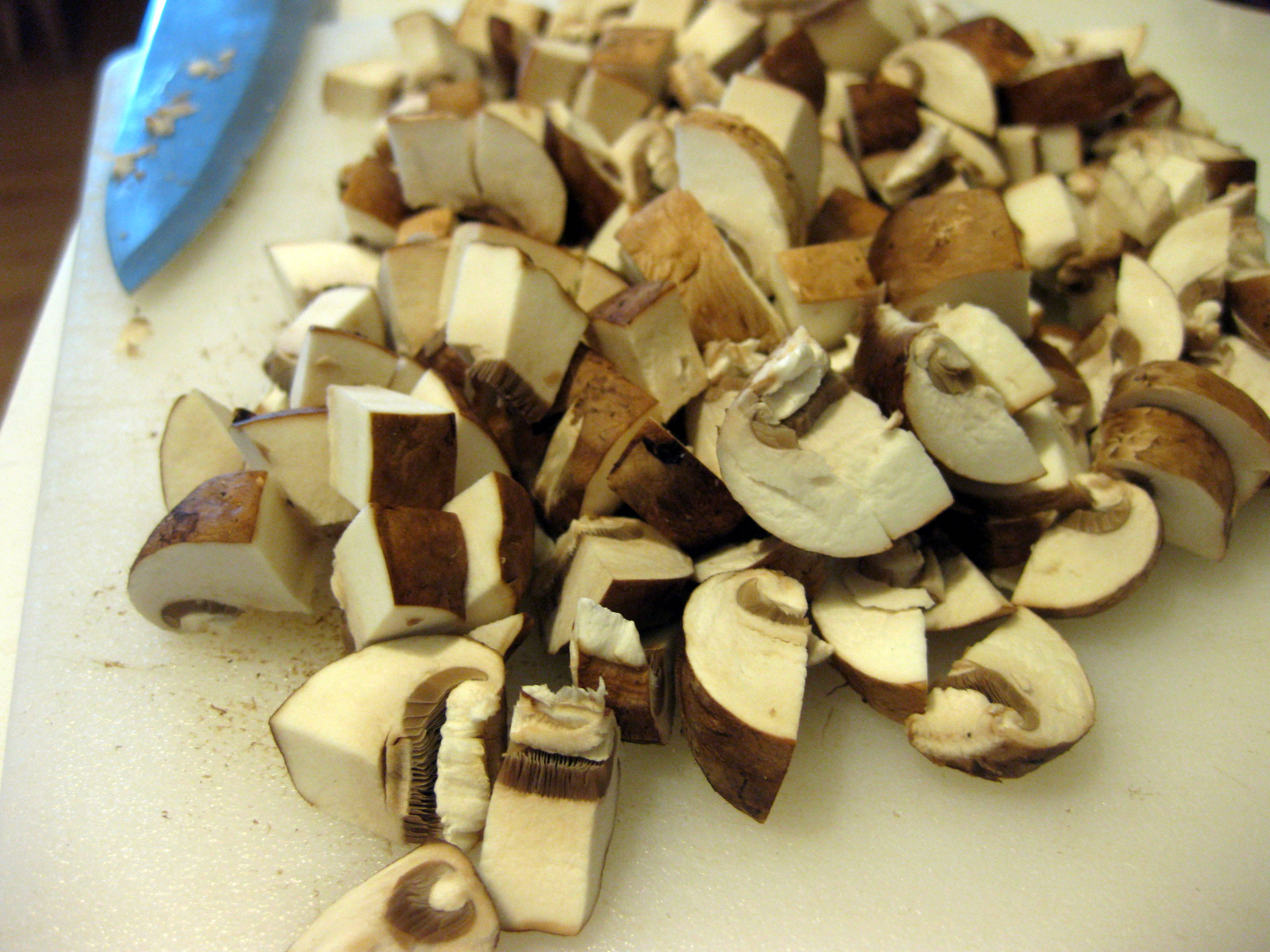
In a large skillet, I heated up the oil while I chopped mushrooms.  I think sesame oil has a very strong flavor and it sometimes burns, and since mushrooms tend to absorb quite a bit, I thought I’d give them a mixture to sizzle in.  When their color had darkened and they had given up their moisture, I tossed in the sliced water chestnuts and the garlic.

I’ve gotten into a bad habit of turning away from the stove lately, assuming things will take longer than they do (perhaps misapplying to the kitchen what I’ve learned so grudgingly about writing?) and returning to the smell of char, so I was careful to add my cooked, drained greens only moments after tossing the garlic around the pan.  Then I tossed on some red pepper flakes and gave the skillet a vigorous stir.

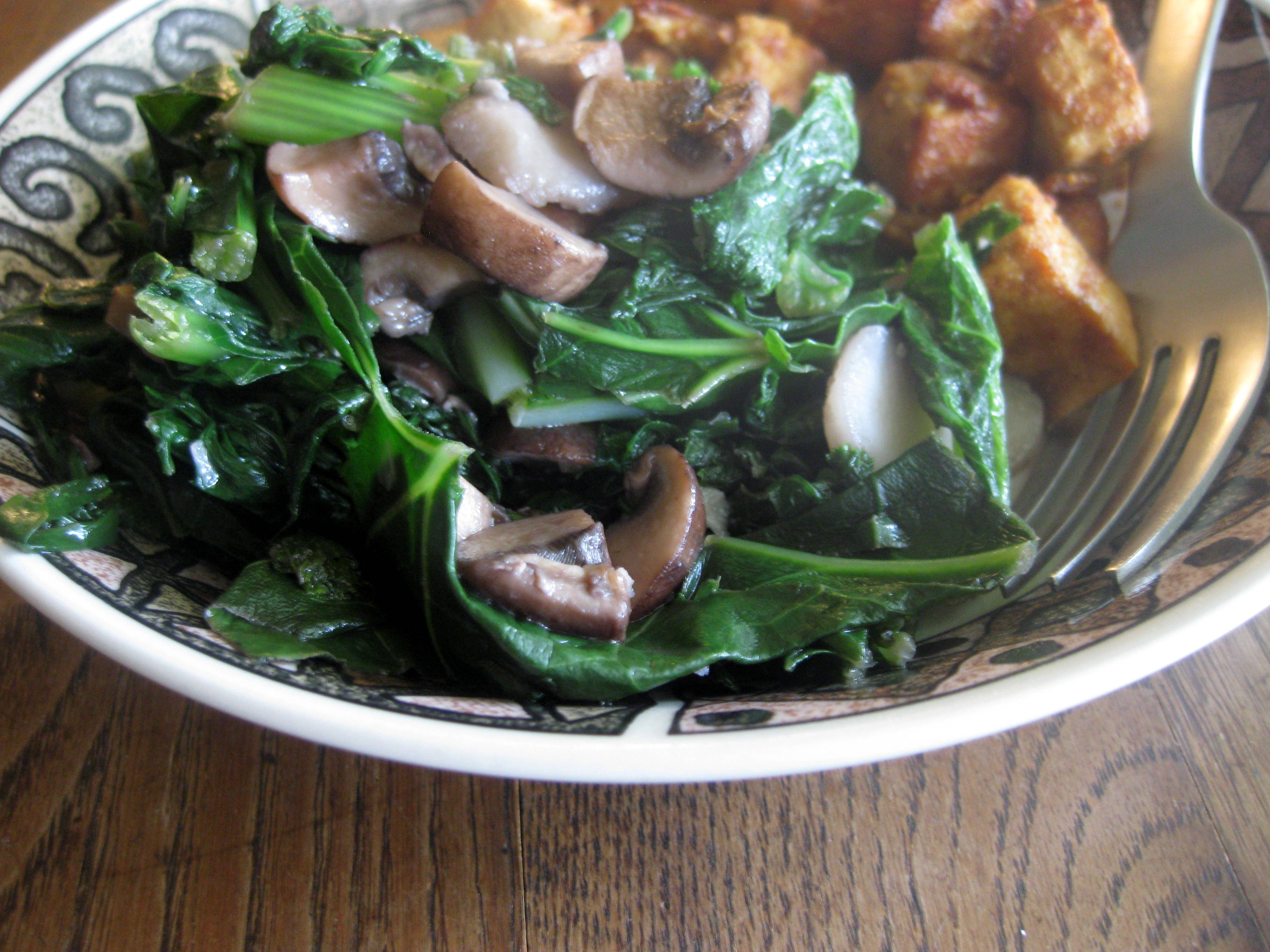
Because I served this with my favorite tofu recipe, I didn’t expect the greens to need any extra salt, but when N. and I tasted we realized it was missing something.  The simple addition of a few splashes of soy sauce rounded things out perfectly.  The greens had a tender crunch that is becoming one of my favorite textures; it’s the barest resistance against the teeth and then a soft chewiness that fills your mouth – I don’t know how to properly describe it.  The water chestnuts, on the other hand, scream with texture and crispness, though they don’t taste like much.  The mushrooms offer up such rich deep flavor that I almost didn’t need to textural contrast of the water chestnuts.  If I made this again I might leave them out.  The soft tender slipperiness of the cooked vegetables made this a dish with such comfort and familiarity that I could have eaten the whole pot on my own.   Easily.  Quickly.  Nothing like writing.

If writing is slow, for me, eating is like reading.  Both are acts of consumption: the words leap into your brain from the page and you must digest them to find their meaning.  The food slips into your mouth and lends flavor, nutrition, sustenance.

I’ve always done both more quickly than I should.  But when it tastes so good, what else can you do?

Iron Chef

Some years ago, my friend A. suggested I host an Iron Chef party.  We were taking suggestions for themes, and among others she offered this one.  I was intrigued.  How would it work?  Who would choose the ingredients?  Who, most importantly, would win?  I must admit to harboring some jealous desire to be the victor, should such an event take place.  I like to cook, and I like to feed people, and I’m a bit of a hostess-who-wants-to-be-the-mostest, so it seemed like a competition in which I would not only excel, but feel extreme competition.

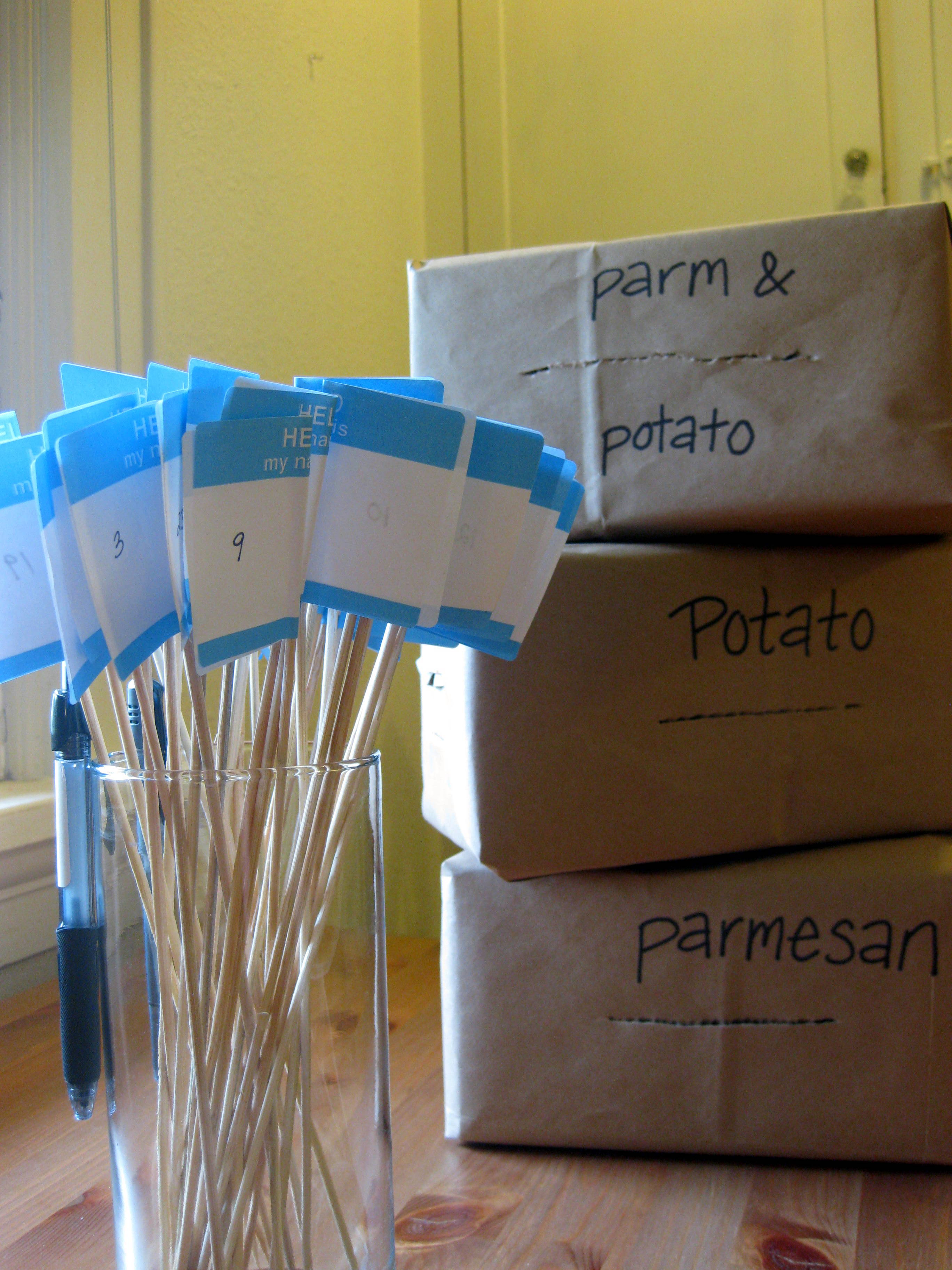
Then school happened and I put it aside for a while.  Long enough, in fact, that A. moved away and years passed.  It was not until last Saturday that this long awaited, long anticipated event actually took place.  Through a public poll, secret ingredients were chosen.  They were revealed in the invitations: the Iron Chef Potluck 2011 would feature potatoes and Parmesan cheese.

Fortunately for me, in need not only of potato and cheese inspiration but also multiple dishes (gotta make sure everyone’s fed and happy!), I had Bittman.  I chose two intriguing potato-based party dishes.

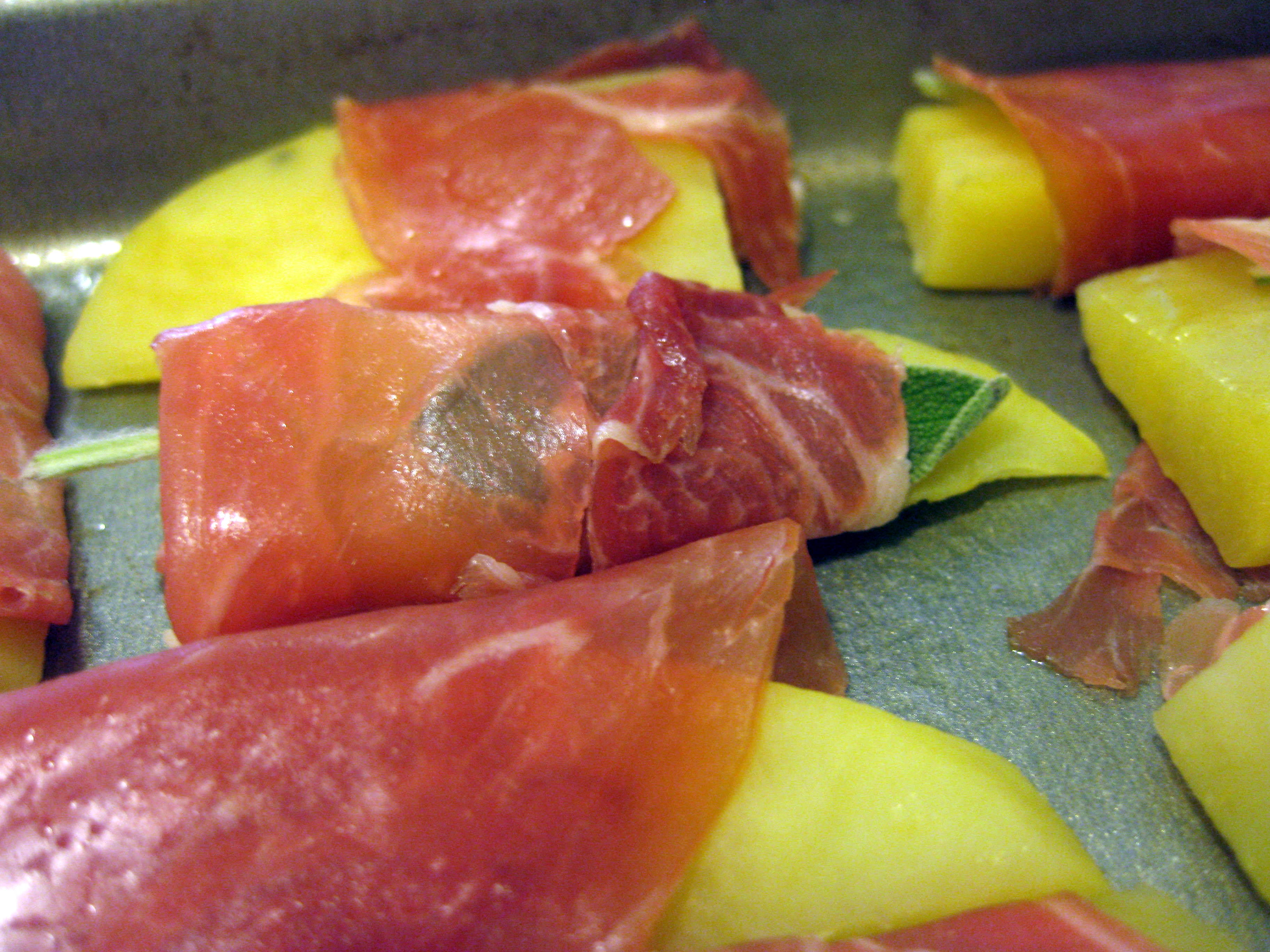
“48. Cut sweet potatoes into wedges; boil until tender.  Drain and toss with olive oil.  Wrap each with a prosciutto slice and a sage leaf, then roast until browned.”

This sounded outrageous.  Outrageous easy, outrageous good.  I used:

2 large sweet potatoes, halved lengthwise and sliced into wedges

2 packages of prosciutto (basically you just need a piece for each potato wedge, so it depends how many wedges you have)

1 package of sage leaves (same thing here)

Olive oil spray

Additional directions are not really needed here – Bittman’s original text tells you exactly what to do.  I boiled the sweet potatoes for 10 minutes or so until they were tender but not falling apart.  When they were completely cool I sprayed them and the baking pan with olive oil spray, pressed a sage leaf against the flesh of the sweet potato wedge, and wrapped it up with prosciutto.

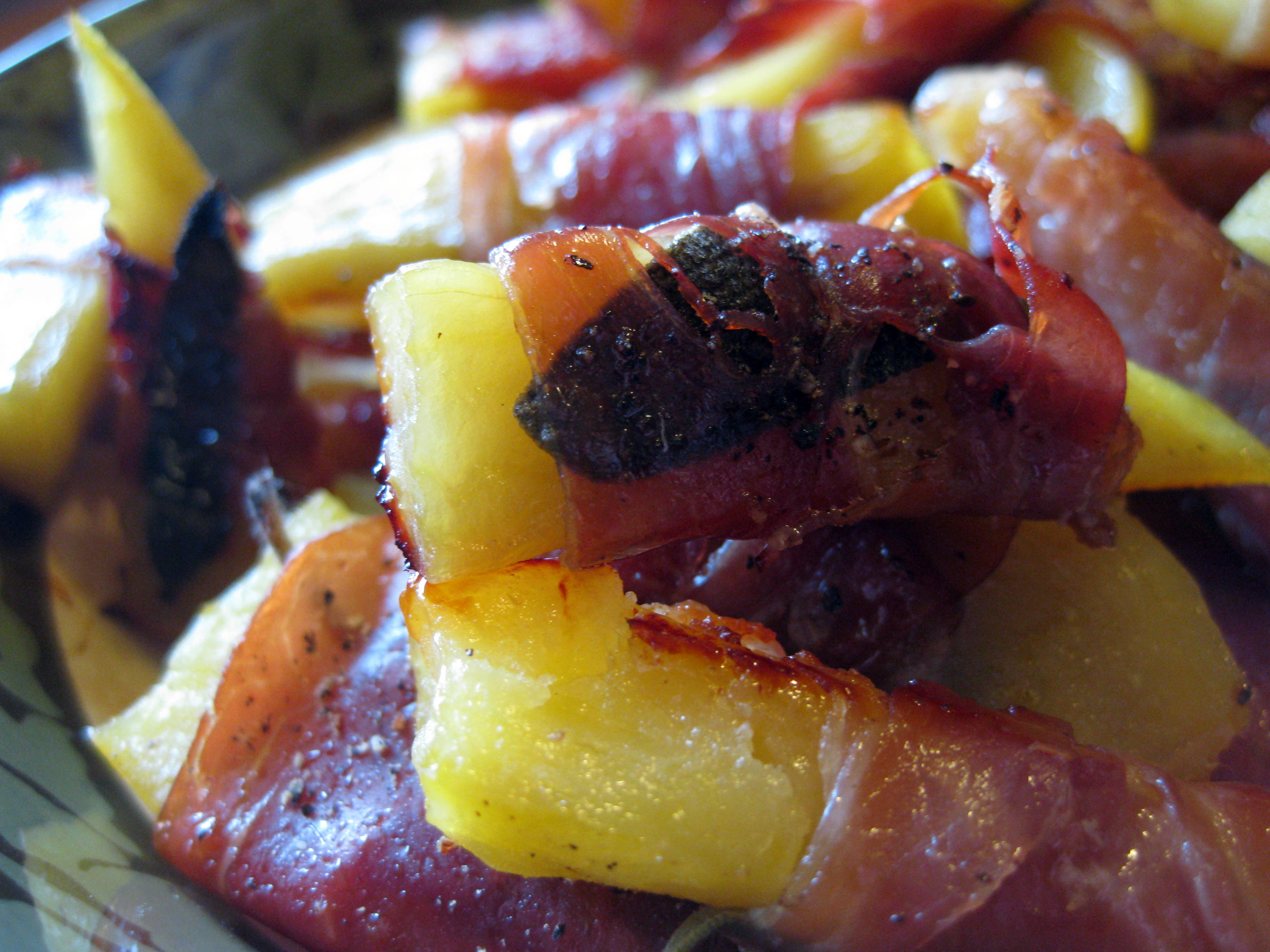
I preheated the oven to 400F and roasted these little packets for almost half an hour.  At this point, the prosciutto was getting crispy and, truth be told, I needed the oven for other items.  The sweet potato spears never got browned, and I suspect the oven temperature was too low.  When you bake French fries the oven has to be up really high, so the next time I make these I will set the temperature at least to 450F.  I suspect only then will the kind of caramelization Bittman hints at take place on the sweet potato.

Regardless of browning, these were good.  The sage packs a punchy flavor, so if you’re not a fan of that sharp autumnal herbiness, skip it or use something less pungent.  The prosciutto-potato pairing was genius.  Salty and crispy paired with mild tender sweetness, all in a two-bite package.  Perfect party food.  I could have stood leaning over the counter with a bowl of these beside me for the whole afternoon.

But no.  The time of the party was approaching.  I had to move on with only a sampling.

“Autumn Rolls: Shred sweet potatoes or carrots and Brussels sprouts or cabbage.  Roll them up with fresh sage or mint and some sprouts in rice paper.  (Add sliced shrimp if you like.)  Make a dipping sauce of soy, garlic, grated or minced ginger and honey.”

I had never thought about serving sweet potatoes raw (though Bittman does suggest this in multiple dishes), but I was drawn to it because it seemed in keeping with the Iron Chef project: in a challenge like this, using the ingredient in every one of its forms seems logical.  If you can boil it, roast it, mash it, bake it, why not shred it up and use it still crunchy?

Regardless, I decided some extra preparation was necessary.  I used the following:

½ large sweet potato, shredded and soaked in cold water for ten minutes to remove starchiness.

½ small head of cabbage, very finely sliced

30-40 mint leaves

1 cup sprouts (I used clover)

Rice paper wrappers

½ cup soy sauce (I used gluten-free)

2 cloves garlic, finely minced

½ inch knob of fresh ginger, grated

2 TB honey or to taste

After soaking the sweet potato in a cold water bath and changing the water once to drain away as much starchiness as possible, I decided the shreds seemed pleasantly crisp without leaving a “raw potato” residue on my tongue.  I tossed them together with the cabbage and about a tablespoon of soy sauce.  I put this with the rest of the ingredients (through rice paper) in an assembly line and executed my rolls.

These are not difficult, once you get the hang of them, but they are time consuming.  It takes me at least half an hour to roll up a batch of these, and I’ve made them many, many times.

Soak a wrapper in warm water until it is very pliable.  This takes 45 seconds or so.  When it is the consistency of wet tissue, spread it on a paper towel or kitchen towel and then flip over and spread again.  This gets excess water off so you don’t have a soggy roll.  At this point I usually put the next one into the water so it’s ready by the time I’m done rolling.   Since I took pictures of almost every step, let’s do this Pioneer Woman style.

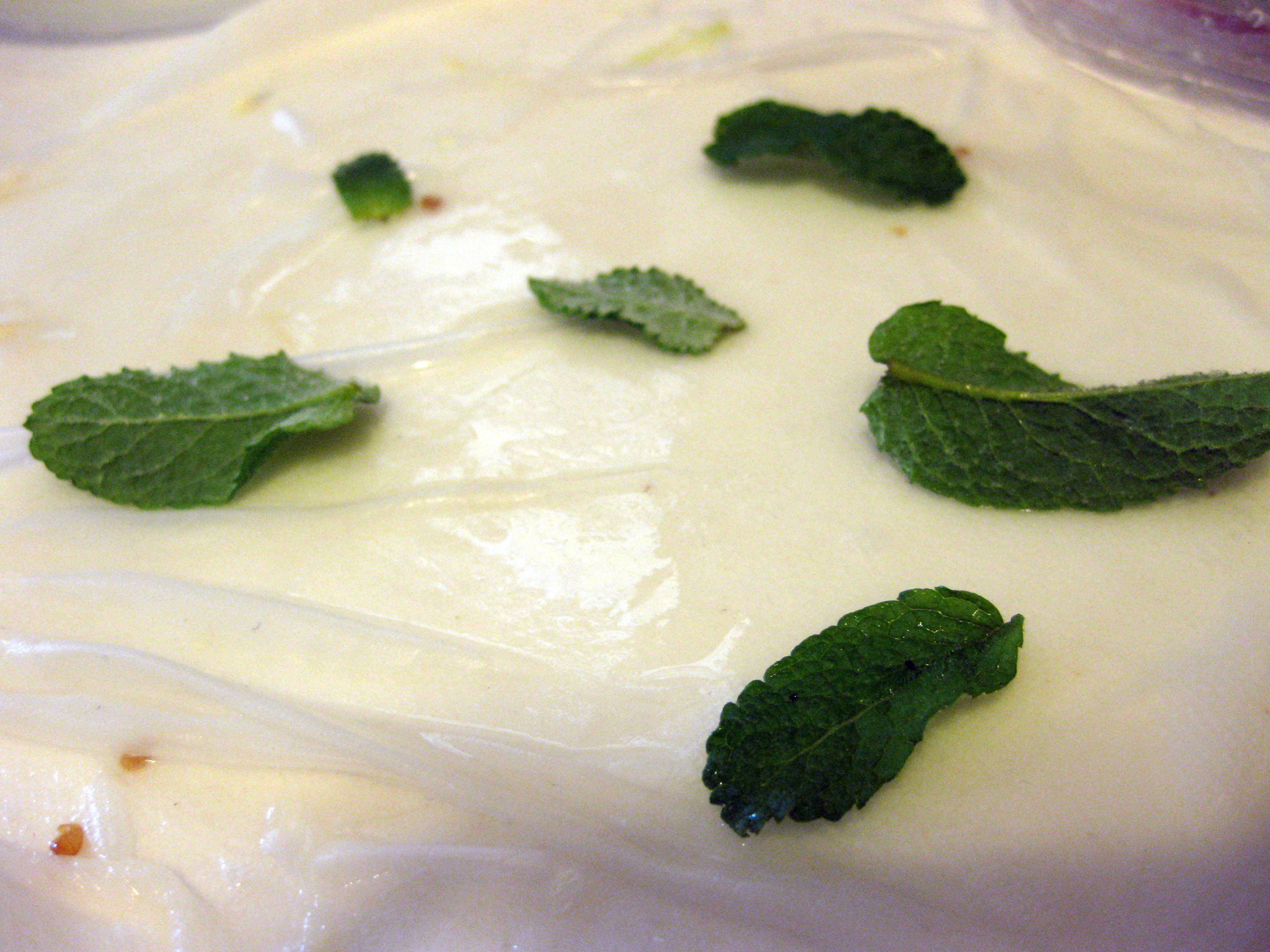
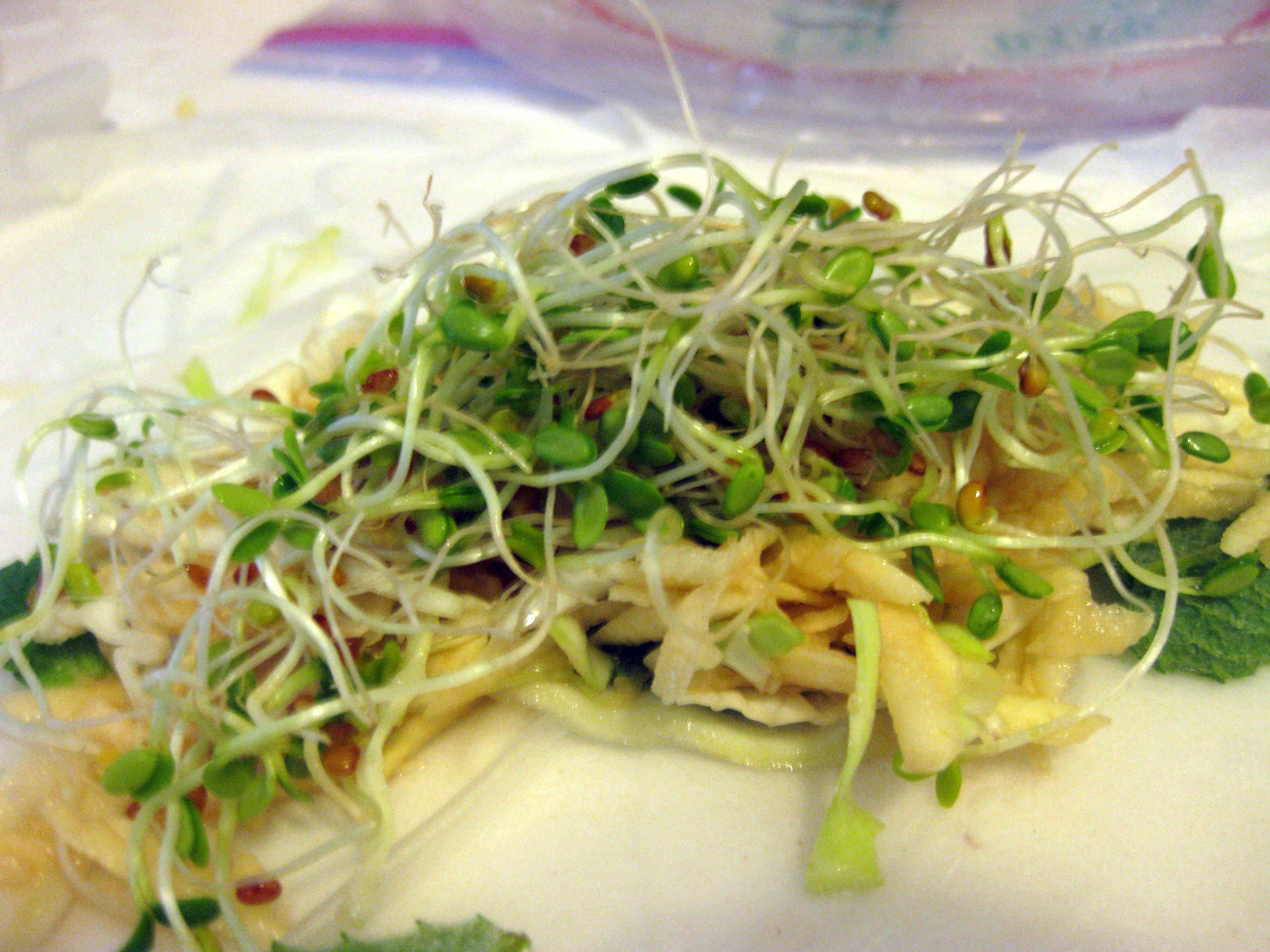
Place a few mint leaves all over the wrapper.

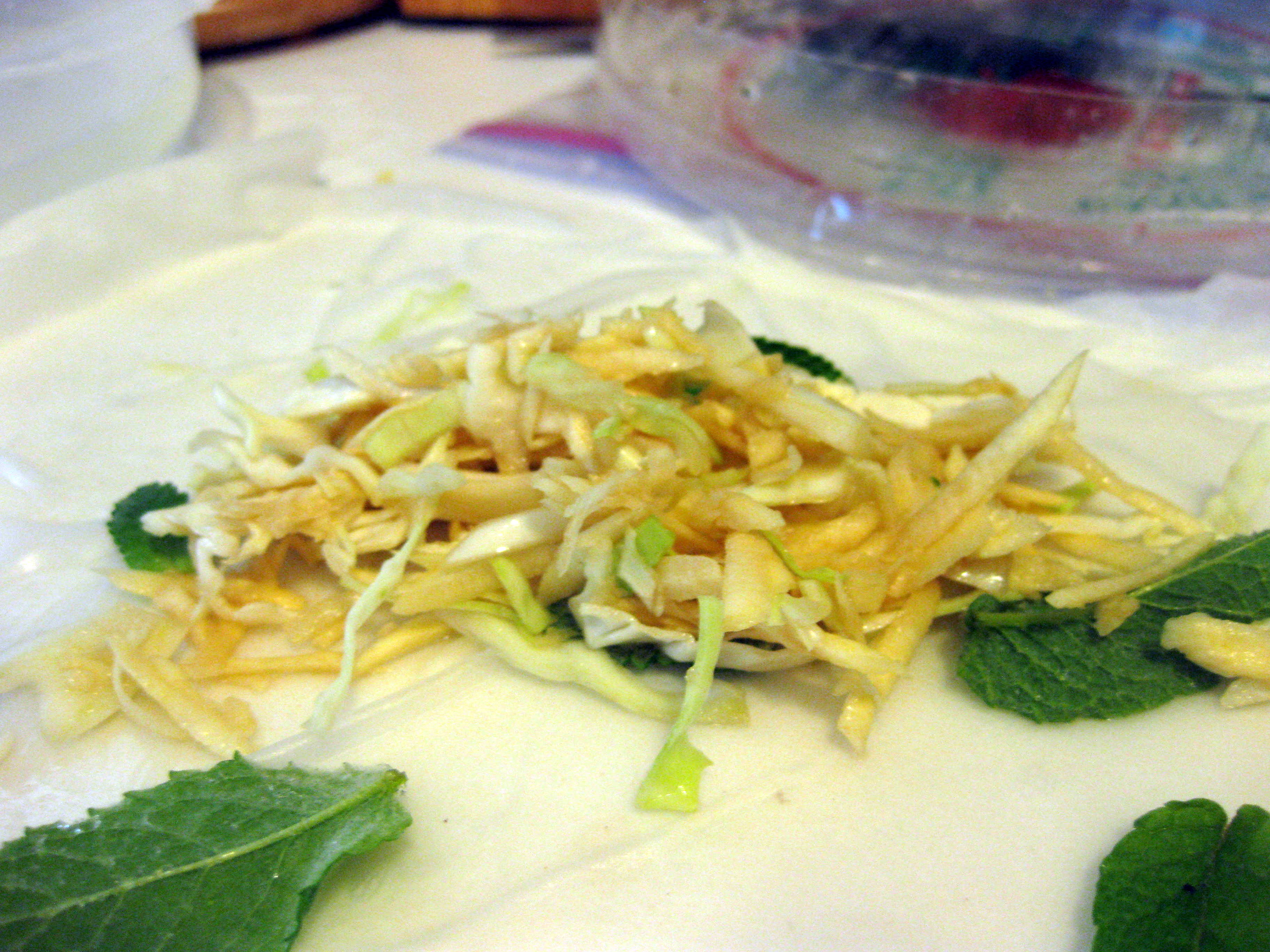
Add a tablespoon or two of the sweet potato and cabbage mixture.

Add the sprouts.

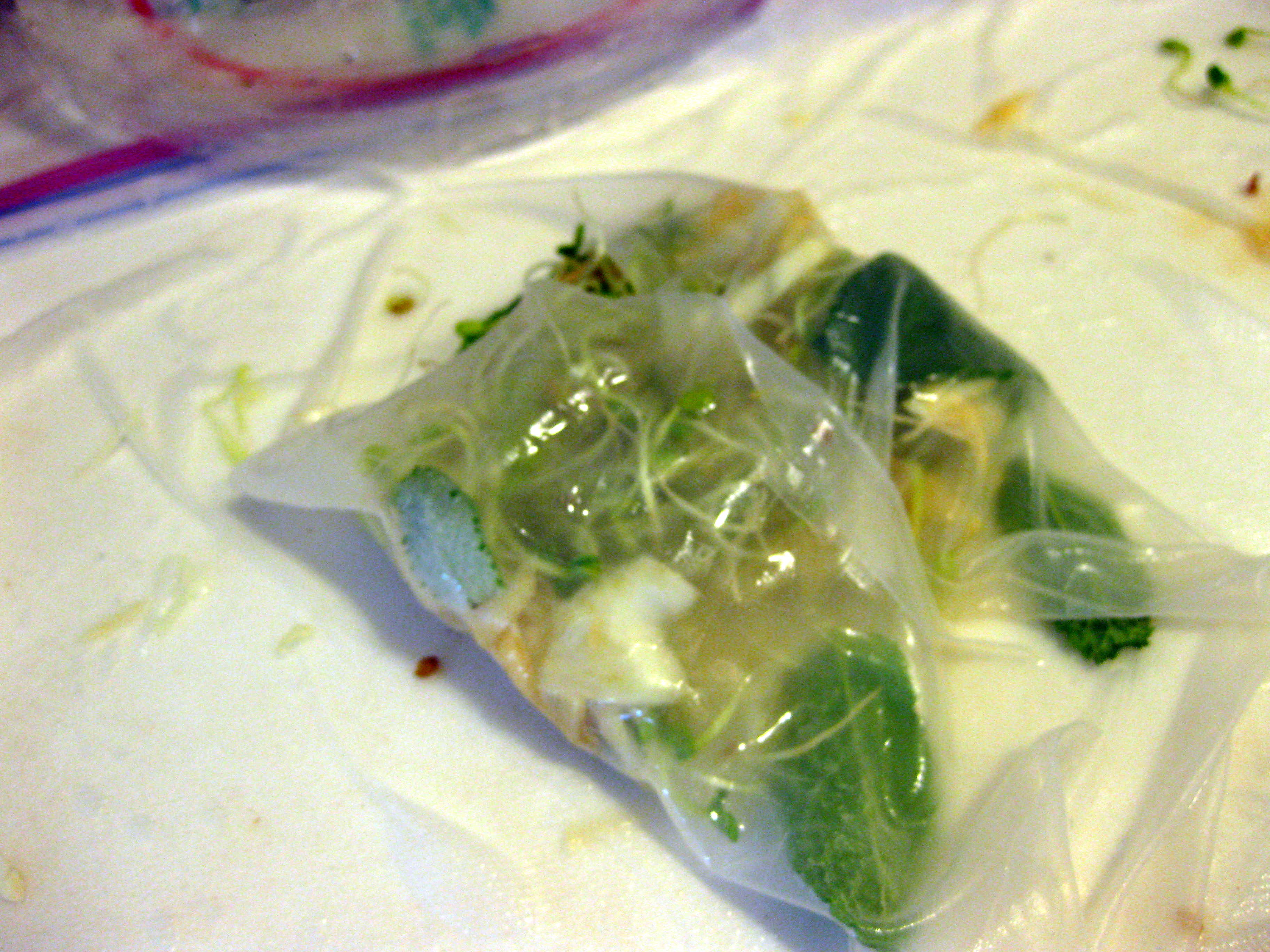
Fold in the sides until they overlap across the toppings.

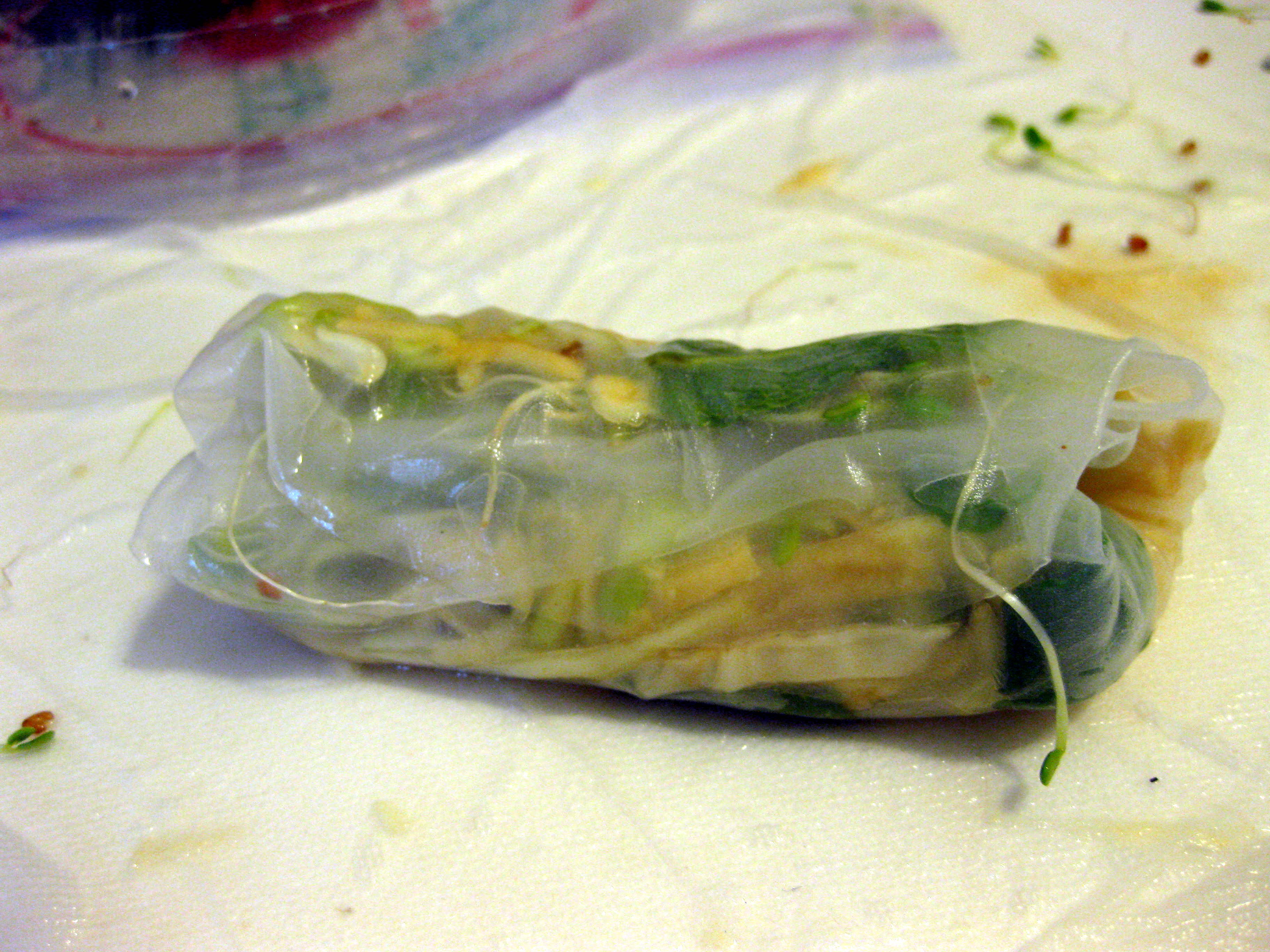
Now fold over the side closest to you and then roll the whole thing into a tiny burrito.

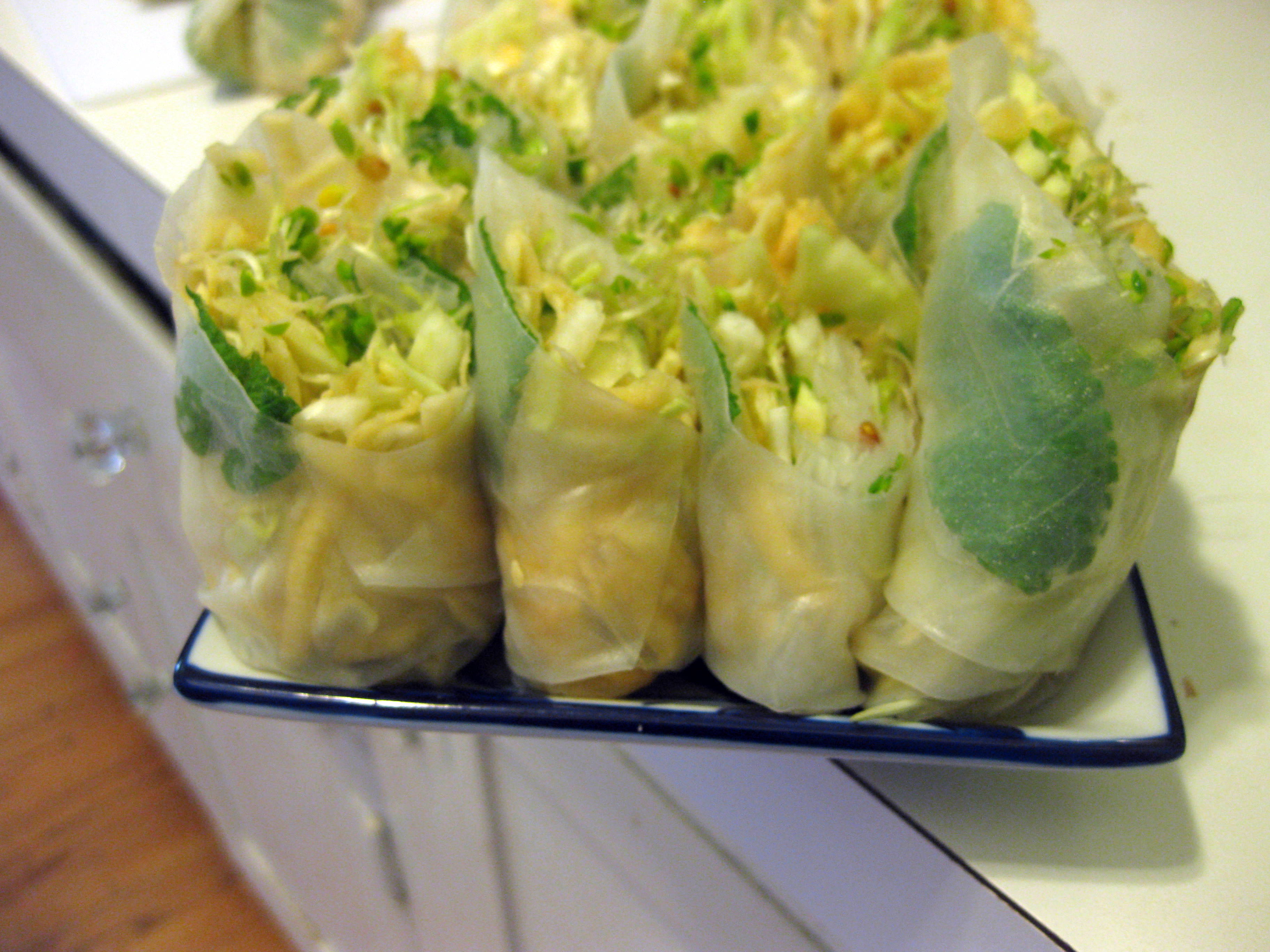
Line them all up like little soldiers and you’re ready to go!  I usually slice them in half on an angle.  I do this for two reasons: 1.) it looks really pretty, and 2.) they aren’t huge and overwhelming looking as finger food.  It’s also nice because it allows your guests to get a peek at what’s inside. 

While I was rolling, I put the sauce ingredients in a very small saucepan and turned the heat on low.  With minimal stirring to be sure the honey wasn’t burning on the bottom, I had a slightly thickened dipping sauce in 10 or 15 minutes.

These were delightfully fresh.  The cabbage and sweet potato gave nice crunch, the sprouts were an interesting, almost tickly feel against your tongue, and the sauce was ridiculously tasty.  Again, with the salty-sweet theme I unconsciously adopted, the honey and the soy sauce played excellently against each other, and it got just thick enough, and with just enough bite from the aromatics I added, that it complemented the fresh rawness of the rolls very well.

Both these offerings were delicious, and despite the competitive gnawing I sometimes feel inside, neither of them took the ultimate prize.  We allowed everyone up to three votes: one for best representative of potatoes, one for best representative of Parmesan cheese, and one for best incorporation of both.  The ultimate honor went to the cheese.

Take a gander:

This is a parmesan crisp topped with a slice of salami, a slice of quince paste, and a twist of caramelized onion.  Talk about salty-sweet!  When I asked the winner for permission to post his dish, he agreed and, delightfully, offered the following specifics:

Parmesan Crisps can be found at: http://projects.washingtonpost.com/recipes/2007/05/09/lacy-parmesan-wafers/
I used only 1 Tsp of cheese because I wanted a smaller diameter crisp. 
topped with smoked salami (1/8in thick slice)
slice of quince paste (1/8in thick)
sauteed onions (~1/2tsp) (one sweet onion, olive oil, pinch of sea salt, 1 tsp sugar, 2 tsp butter) .
serve at room temperature.

Congrats, Iron Chef 2011!

Mistakes can still be delicious

Though many of Bittman’s 101 Make Ahead Sides seem clearly autumnal, and some downright Thanksgiving-y, some are a bit further afield.  This week we went with one of the latter.

“40. Peel and trim pearl onions and toss them with a mixture of minced ginger, garlic, chilis and peanut oil. (A little sesame oil is good, too.) Roast until nicely caramelized, then drizzle with soy sauce.”

This clearly called for an Asian theme, so I bought tofu and bok choy for an accompanying stir-fry.  As for the sideshow-in-the-spotlight, I went the easy route and assembled:

1 bag frozen whole peeled pearl onions, defrosted

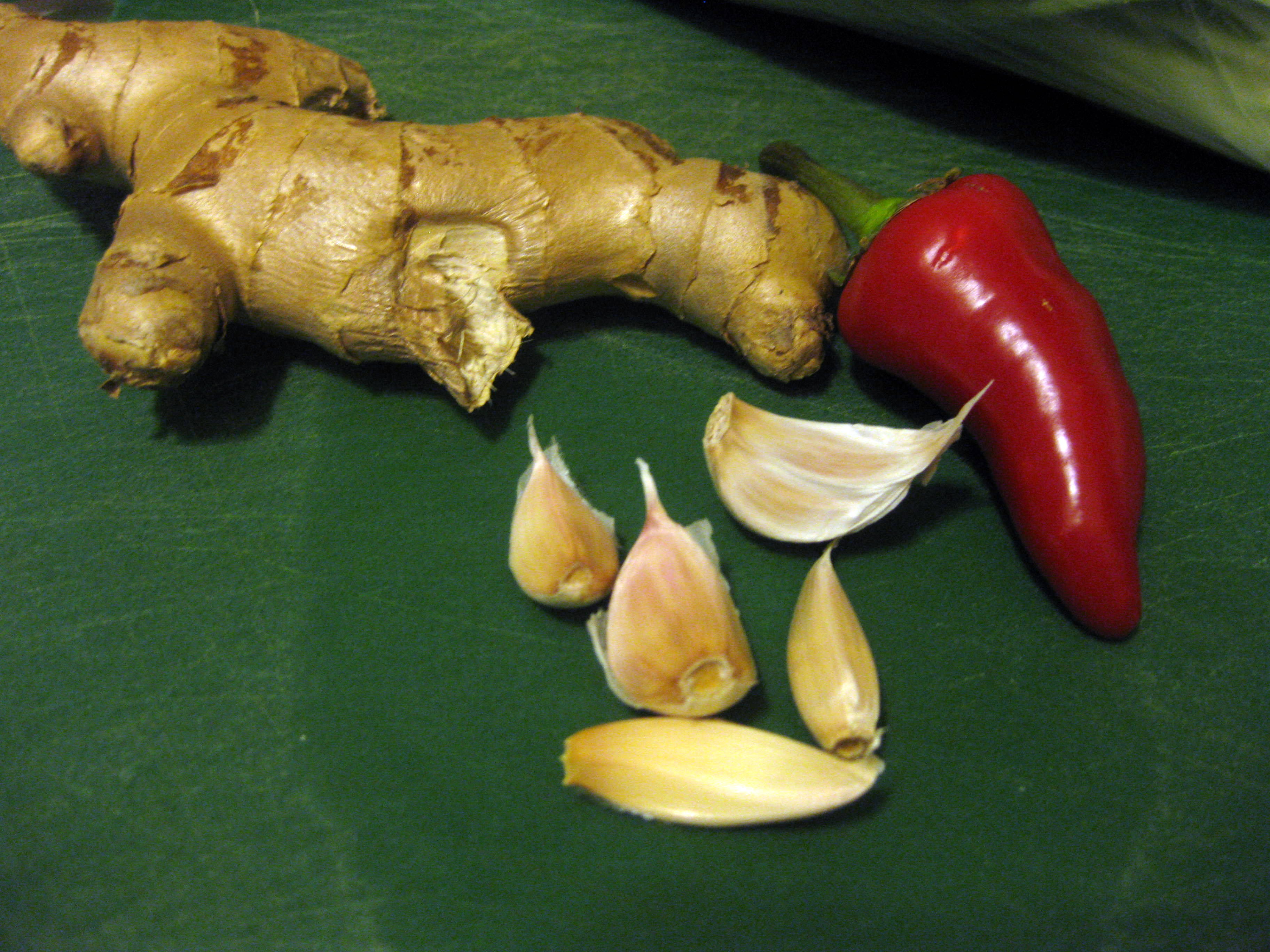
5 cloves garlic, finely minced

2-inch knob of fresh ginger, peeled and finely minced

1 red jalapeno, seeded and diced fine

2 TB olive oil (I didn’t have peanut oil and the olive oil was right there on the counter…)

1 TB sesame oil

2 TB soy sauce

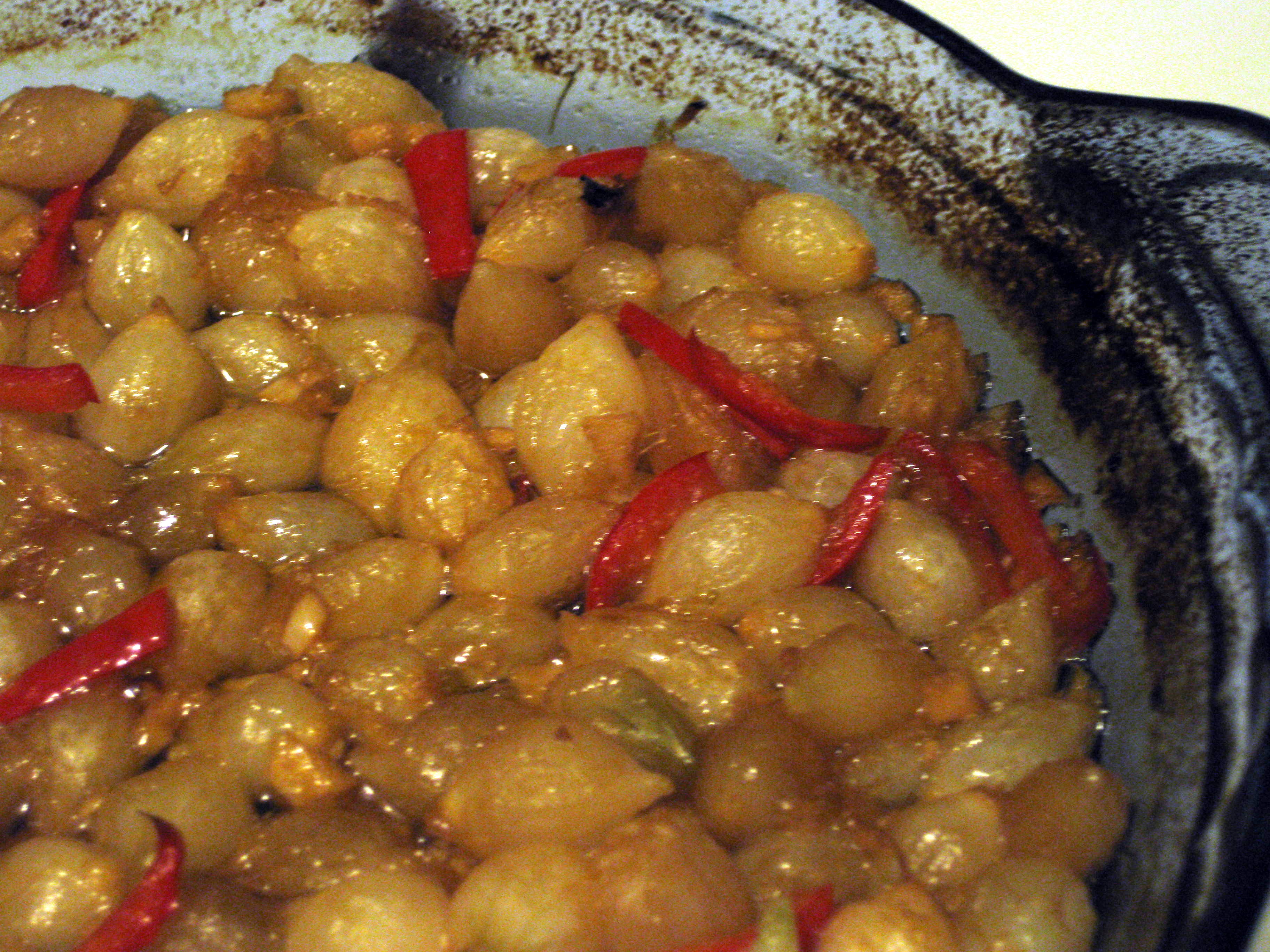
I did as Bittman instructed, with the exception that, skimming the recipe too quickly, I mixed the soy sauce in with the onions and everything rather than waiting until they were done.  This, like hastily dumping the onions into a pie plate while they were still slightly frozen, was a mistake.  This dish needs dryness to work.  Or, rather, it needs its primary moisture to come from fat, like anything you roast, and not from a water-based liquid.  It also, I suspect, needed a cookie sheet rather than a glass pie dish to roast in.  Something about the conductivity of metal plus the extra space a cookie sheet would have afforded would, I suspect, have produced better results.

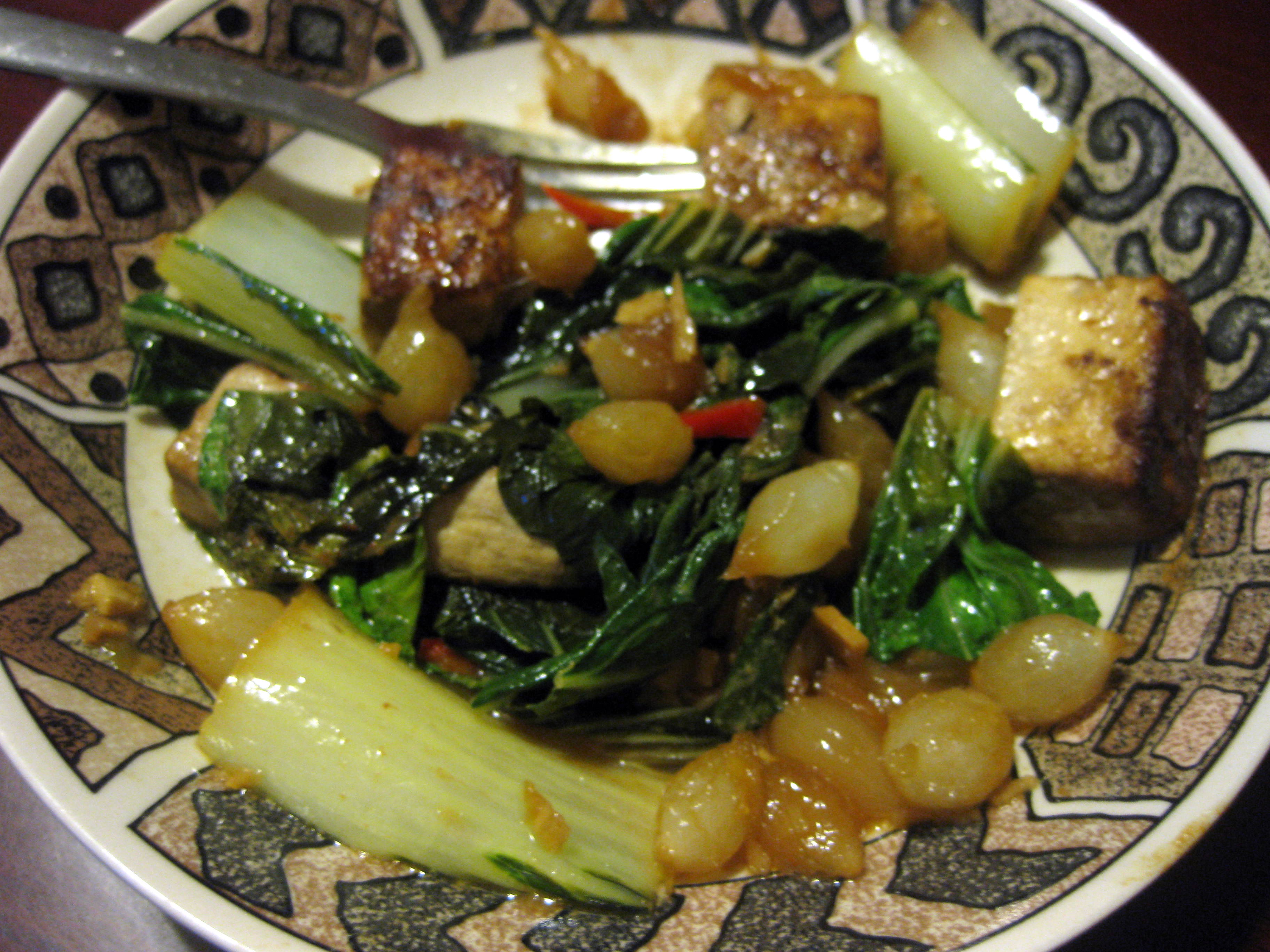
Not that my results were bad!  I preheated the oven to 400F and slid the onions in for 20 minutes while I made the stirfry of tofu and greens.  I used my favorite tofu recipe, adding the bok choy in when the tofu was about halfway done.  Then I added a few tablespoons each of white wine and soy sauce to give the bok choy something to soften into, and to add a little flavorful sauciness to the dish.

When the 20 minutes I’d allotted the onions were up, I slid them out to find basically zero caramelization.  All the color you can see in this photo is from the soy sauce.  I attribute this to three things: the onions were too wet from a combination of the soy sauce and the not-quite-completed defrosting process, the pan was too crowded, and I wasn’t patient enough to leave them in longer (N. had gone on an epic 12-mile run earlier in the day and could not wait much longer for dinner).  So there was no beautiful toasty browning, but we ate them anyway.

They were mild and sweet with sharp kicks from the aromatics: a faint burn from the garlic, a forward warmth from the ginger, and the barest suggestion of spiciness from the pepper (leave the seeds in for more heat).  They were tasty, but I suspect they needed that caramelization to be really special.  I ended up tossing them in with my tofu and bok choy and eating the whole thing as a single stir-fry, as if they were supposed to be commingled.  They forgave my mistakes, coexisted, and rather than a side-act-acting as a main and a main with side features, they just became dinner. 

Capacity

It’s getting a little busy around here.  Being a PhD student is a strange “profession,” if you can call it that, because the workload hefts itself around in such varied ways.  In the past week I have been a researcher, a teacher, a session organizer (for a conference that doesn’t take place until July 2012!), a not-nearly-ready-even-though-my-flight-leaves-Thursday conference attendee, as well as a housewife, a hostess, an unprofessional baker, a very unprofessional blogger, and a dogmom.  And the craziest thing is, with only two or three exceptions that’s what I am every week.  It tends to produce feelings of insufficiency.

So this past week we picked a stuffing.  It seemed only appropriate, since I have such a full plate in the figurative sense, to match this in the literal world.

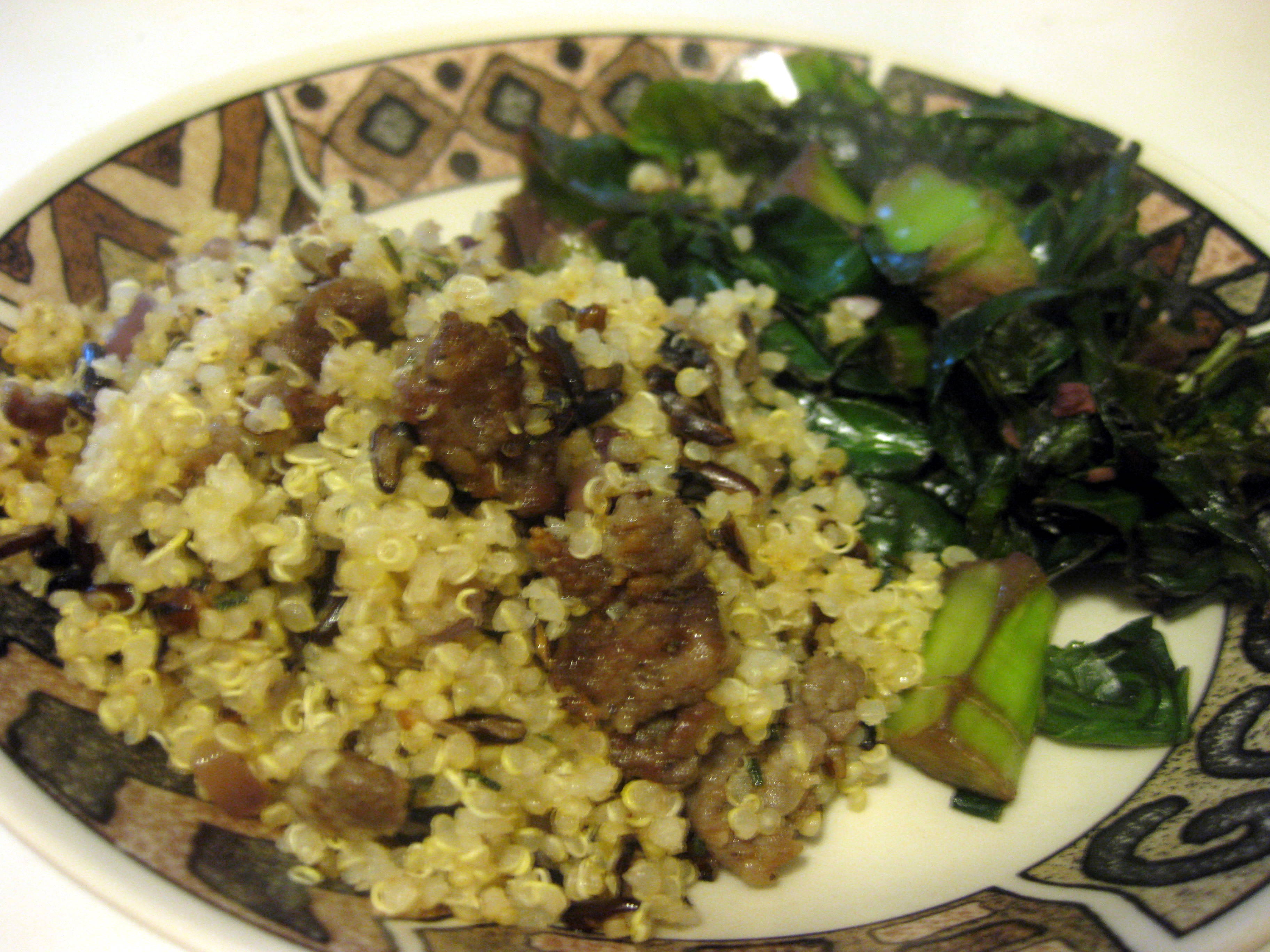
“24. Combine a little cooked wild rice with much more cooked quinoa; sauté crumbled sweet Italian sausage with onion and fresh rosemary.  Toss together.  Bake in an oiled dish or use as stuffing.”

Since I never stuff poultry, and the pork chops I would consider stuffing are on N.’s “I don’t eat that” list, I guess what we ate this week was a “dressing,” which is a term I’ve never understood.  Nevertheless, I collected ingredients, once again feeling delight at Trader Joe’s as I found a bag of pure, pre-cooked wild rice, and assembled the following:

1 cup raw quinoa, cooked according to package directions

½ cup wild rice

8 oz. Italian pork sausage

¼ cup red onion, diced

1 TB fresh rosemary, minced

Salt and pepper to taste

While the quinoa cooked, I added the sausage to a skillet with a tiny slick of oil and broke it up with a spatula so it would brown into crumbles.  When the sausage was more than halfway done, I added the onions and then the rosemary so their flavors would mingle and they would benefit from the sausage fat as a caramelizing agent.

When quinoa and sausage (and friends) were done, I stirred the meat mixture and the wild rice into the quinoa, then put it in an ovenproof casserole dish and stowed it in a 350F oven for half an hour.

In the last few minutes of baking time, I prepared our side dish: in the same pan as I had cooked the sausage, I tossed about half a bag of mixed southern greens and a few minced cloves of garlic.  As they began to cook down, I added a generous splash of red wine and a tablespoon or so of soy sauce.  This tenderized the tougher stems and flavored the leaves with tangy, salty assertiveness.

The greens were, as I already knew they would be, delicious.  We are entering the time of year when I start to crave excessive quantities of vegetables (last night I kept returning to the kitchen to snag lukewarm pieces of kale from a saucepan, and tonight’s leftover roasted broccoli didn’t even make it to the refrigerator), so the pile of slightly bitter, slightly saline roughage on my plate was the highlight for me.  The quinoa “stuffing” was also very tasty.  I don’t usually add meat to my stuffings, but here the fattiness of the sausage was a welcome foil to the nutty, healthy-feeling quinoa.  The wild rice and rosemary lent woodsy, piney flavors, making this an ideal stuffing for a wintry dinner.  I do think pork chops would receive this filling well, as would portabella mushrooms.  For us, as the wine sauce from the greens slowly bled its way across the plate into the quinoa, it was a lovely, protein packed dinner. 

But as so frequently seems to happen with these Bittman experiments, the leftovers took me by pleasant surprise.  The next day, I dressed a plate of arugula with lemon juice, olive oil, salt and pepper, then topped it with a few scoops of the quinoa mixture and popped it in the microwave for a minute.  The resulting warm salad was stupendous.  The lemon juice added just the right kick of acid, which I hadn’t realized the dish had been lacking.  Salty, crunchy, comforting and peppery all at once, it was a lunch that needed no accompaniment.  And when you are nearing your capacity from trying to be everything at once, realizing you are going to make it and you need no accompaniment is an empowering thing.