Soy love story

During my first year off from college, I lived in a house full of girls. There were five of us. Even if I wasn’t now happily married, I would never do that again. Too many showers, too many door slams, too much food in the fridge. Have you ever tried to contain all of your perishable food in one fifth of the refrigerator? There’s no division by product, there’s no organization, just a crowded heap of undifferentiated ingredients.

While living in this harem, however, my closest friend in the house was vegetarian, and made great use of that one product so often labeled as simply a vegetarian food item and shoved by the rest of us omnivores into a back, ignored corner of the fridge of life: tofu. I had never dealt with the stuff before, and was slightly mystified by its enigmatic properties. My friend, over the course of several “housemate date nights” that inevitably incorporated deliciously good food and deliciously bad TV, showed me the way.

img_0304

Step one: cut extra-firm tofu into squares (I use a 14 oz. block and usually cut 4x6x2, or whatever looks like a nice bite-size piece). Marinate tofu squares in soy sauce for ten or fifteen minutes (again, rough estimate, but I’d say these guys are sharing about ½ cup of tamari).

Step two: strain tofu squares and toss them in a light coating of brewers’ or nutritional yeast. Small flake is preferable, but large flake works fine too in a pinch. Nutritional yeast is usually available in grocery stores that have a bulk bin section.

Step three: sauté tofu in several tablespoons of very hot oil in a wok or frying pan. Don’t scramble it around too much because the coating of yeast will fall off and a major part of the flavor will be lost to the bottom of the pan. This sautéing (or stir-frying, if you prefer) process always takes longer than I expect it to. Be patient. Allow the squares to develop a dark golden color and a firm crust around the outside. When they are done, they will look like little croutons, but the taste is infinitely more complex and interesting and, of course, different given the soft tofu center of these squares of delight.

img_0309

I’ve enjoyed these in Pad Thai, stir fries, on baked potatoes, and inevitably plain and scorchingly hot right out of the frying pan. They add a deep, earthy, salty flavor. There is something very pleasurable about eating them, because the outside takes on a texture somewhere between crunchy and chewy for your teeth to play with, and the inside just melts away. N. claims they are delicious with beer, which makes sense, considering that they are crusted in yeast. Tonight’s application? I’m thinking fried rice.

The interesting thing about this recipe was that my housemate never had to find room to store any leftovers in our fridge. We always ate them all.

Hasty Bites 2

I have tried, in recent months, to create not only a list before going to that temptation-laden den that is the grocery store, but also a meal plan for the week, so that I can see as I shop how the seemingly random ingredients I toss haphazardly into my cart (inevitably squeaky, sticky, or with a bum wheel) fit together.

Of course, this doesn’t always work.  Usually I veer off from my established course (from the meal plan, that is.  The shopping cart leads me physically astray throughout the voyage) when I hit the produce section.  In very late fall and very early spring, my weakness is asparagus.  Pencil-thin spears, that woody green color of new growth – at this time of year these bunches of promise not only attract me from a flavor perspective, but they mean something about the weather.  Since it is only February, this is sometimes a lie, but they give me something to look forward to – they permit me brief rememberances of what Spring means (in the sense that the weather warms and the sky blues, not that the allergens arrive).

My new favorite way to cook asparagus is not on the stovetop, as Mom taught me, but in the oven.  img_0206

I snap the stems of the asparagus and combine them, a scattering of cherry tomatoes, two or three minced cloves of garlic, the juice from half a lemon and the juiced lemon half, sliced, on a baking sheet.  I toss my veg liberally with olive oil, then add black pepper and sea salt.  At 400, a bunch of skinny spears usually takes about 15 minutes to cook.  If you’re feeling less technical about the whole thing, once most of the tomatoes have begun to burst it’s a good time to check for doneness.

We had our roasted asparagus with big, beautiful pan-fried salmon filets.  Just salt, pepper, olive oil, and a sprinkle of dill on each.

img_0210

Christmas food part 3 – the Christmas dinner anti-tradition

Though the food in this post, and the topic at large are from Christmas, the need for posting is largely a result of a newly established Ladies’ Spaghetti Night that I recently attended.In true occupatio style, I will say nothing of A.’s marvelous sauce, chunky with sweet, acidic tomatoes and impossibly large slices of button mushrooms.I will not mention how good the bread, delicately seeded and torn in large chunks from the loaf, was when we smashed cloves of roasted garlic over it.No, the reason for this post is one of the people involved in the genesis of this weekly pastafest.Though she was not present at the particular gathering of which I speak, she was in my thoughts because she cannot eat gluten.She also can’t do dairy.This means that when Ph. is in attendance, we have to have gluten-free pasta.It also means that since almost everything I cook involves bread, butter, or cheese in some form, rarely do I make anything that Ph. can eat.

All that changed on Christmas Day (I think, since I haven’t cleared the recipe with her yet).Let me explain.For probably a decade, my family has done Thanksgiving and Christmas with another family who my parents have known since at least the time that I was born.I’m the oldest of the four kids between the two families, so that’s a long time.Three or four years ago at about 5:30pm on December 25th, over a steaming baked brie and a ¾ eaten bread bowl of spinach dip, five of the eight of us decided that we weren’t hungry.We had eaten appetizers with such enjoyment and such gusto that the standing rib roast my dad was asking whether he should carve seemed utterly extraneous.We decided a new plan was in order.Appetizer Christmas.

Since that fateful day, we’ve had a Christmas meal of 100% appetizers – mainly finger food or toothpick-able items that come in cute, single-size servings.Same goes for dessert.We’ve done coconut shrimp, we’ve done tempura, we’ve done Swedish meatballs and stuffed mushrooms and pate.For dessert, truffles, individual espresso chocolate cakes, and tiny cheesecakes made in muffin tins.img_00551

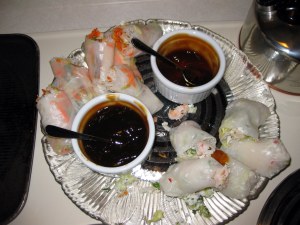
This year, I made spring rolls.Here’s where Ph. comes in, because they were made with rice noodles and rice wraps.No flour.No wheat.No cheese.I found the recipe here: http://www.ivu.org/recipes/chinese/spring-rolls.html and highly recommend it with minimal alterations.

I found that making these in a two person assembly line was really effective.While I jammed small piles of carrot, lettuce, mint, and noodles into each wrapper, my mom dipped and flipped the next wrapper to bat in a wide, shallow Tupperware of warm water until it lost its rigid structure and became elastic.Warm water works the best for this, and we discovered that each rice paper round needs between 30-50 seconds in the water.After a few botched first tries (I’ve never rolled a spring roll before), we settled into the perfect harmony of dipping, rolling, and transferring.It took me exactly the amount of time to stuff and wrap a spring roll as it took for the next wrapper to melt into perfect texture.When we made the sauce, which my sister took charge of, we substituted lime juice for some of the broth and water for the rest, since one of our fellow consumers is vegetarian.It turned out thick and sweet and a perfect accompaniment.

I definitely side with the recipe’s author in calling for mint with no substitutions in this recipe.Since I have an ample crop just poking their little heads up in the backyard amidst the decimation of stalks left over from last fall, this herbal portion is easily reproducible.Pressing and baking the tofu, which I had never done before, gave it a whole new texture that my dad (who is marginally obsessed with the power of soy) and I both really enjoyed.I think others did too, but he and I professed it the most loudly.The compressed slices sucked in the tamari I glugged over them, and smelled so good that I didn’t even mind the burn I got when, too excited to be remotely intelligent, I reached in and grabbed the cookie sheet I was baking the slices on out of the oven without a potholder.The tofu and the skin on my hand both survived.Ah, the magic of Christmas.

img_0036

Christmas food part 2: Christmas Eve dinner

Behold, for I bring you tidings of great joy:

dsc_3659

Christmas Eve dinner this year was a beautiful leg of lamb, crusted with herbs and nestled lovingly amidst a mound of chunked carrots and red potatoes.  Adorned with slivers of garlic and massaged with black pepper, fresh rosemary from the front garden, and olive oil, the lamb not only gained an assertively herby crust, but as it cooked its juices spilled over the potatoes and carrots, leaving them creamy and beatifully flavored.  Even N, who doesn’t care much for lamb, loved the flavor it left behind on the vegetables.

Inside, after we overenthusiastically cut in and sliced out four or five pieces and then thought better of it and enclosed the lamb in aluminum foil to rest for a few minutes, we ended up with meat done medium well but still juicy and tender.  That’s what lamb is supposed to be, I suppose.  Though we had the requisite mint jelly and horseradish, the meat had enough flavor of its own, and enough crunch and earthy kick from the herb crust, that it hardly needed accompaniment.  Each slice was shot through with a fine vein of fat, pearly and translucent, that I tried to get a taste of with each bite.  I’m beginning to understand what the Food Network snobbies call “mouth feel,” as the textures of this dinner were almost as pleasing as the taste.

*** This lovely photo was taken by my dad, just before carving into the haunch.

Slow and Steady wins the Roast

Now that the slow-cooker and I are friends, I put it to work again yesterday.Calling on the small, tissue-papery pages of the instruction-and-recipe manual that came with the machine, I set out to break through N.’s clogged nostrils (courtesy of the first cold of the season) by embarking on Chicken with 40 Cloves of Garlic.

Still clad in pajamas, I made a bed for the chicken by cutting a few longish spears of celery and arranging them over the bottom of the stoneware. Then, after evicting the gizzards from the chicken’s insides, I shoved a sprig each of Italian parsley, thyme, rosemary, and sage safely inside to flavor our bird from the ribs out. The chicken settled nicely into the pot as well. After counting up and scattering around forty cloves of unpeeled garlic, which was an impressive 2½ bulbs, I chopped up another sprig of each type of herb and sprinkled that over the top of the chicken. I added some sea salt and pepper as well, for a little extra flavoring.

The smell that pervaded the house for the rest of the day would have driven away even the most determined vampire. It was divine. The dog spent much of her day pacing slowly through the kitchen, nose in the air and hard at work. I spent much of my day making excuses to go into the kitchen and cast loving glances at dinner. After about hour five, N. informed me that he could smell something, and after hour six or seven he altered his evaluation to decide that something smelled good! This was all I could have hoped for, but there was more.

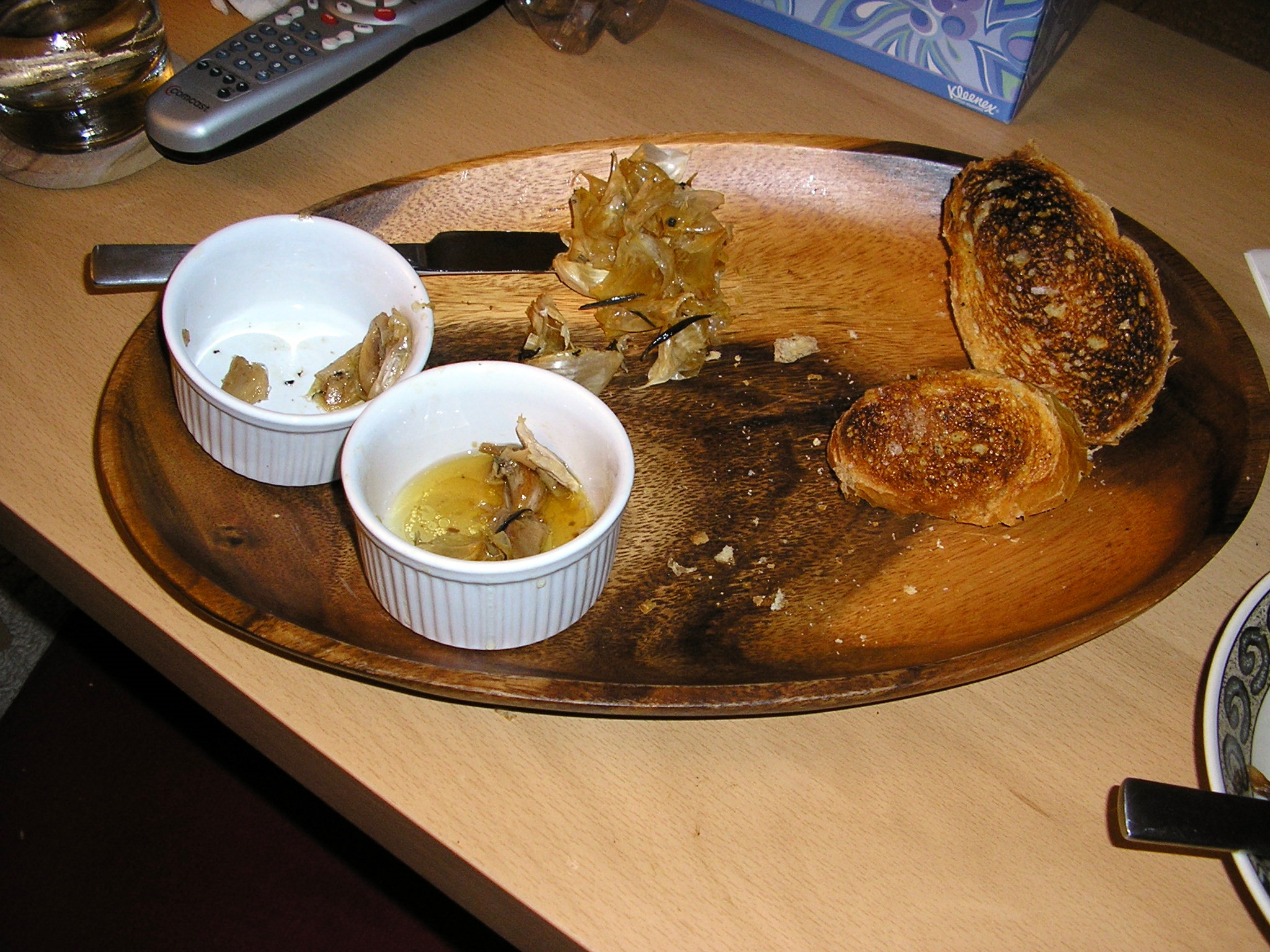
After about nine hours, our bird was so tender that it fell into pieces when I tried to lift it from the slow cooker. I pulled out as many cloves of slow-roasted, golden-brown, almost sweet-smelling garlic as I could, and while the chicken cooled a little I sliced half a loaf of leftover sourdough bread and, after liberal application of olive oil, sea salt, and black pepper, broiled it until golden to serve as our vehicles for garlic consumption.

The chicken was moist and delicately herby, while the garlic oozed out of its skins to top the toast, needing no convincing whatsoever.We suffered a few burned fingertips from our anxious efforts, but as you can see, that didn’t even slow us down.

Summer comfort food

The woman at right is my Aunt Nancy.

Just below her is one of the many, many reasons I love her.

My slow-cooker and I have a Machiavellian relationship. I want desperately to love it, but I fear it. My reasoning for this is, like many of my food fears, mostly irrational. Shortly after acquiring said slow-cooker, I created a disappointingly leathery pot roast. From that day forth until two or three nights ago, I’ve been wary of the beast, and it has sat in a cabinet. However, a few days ago I embarked on Nancy’s slow-cooker baked beans recipe that I’ve adored and coveted for a number of years now, and I can say with surety that I’m no longer afraid (I think), as it came out perfectly.

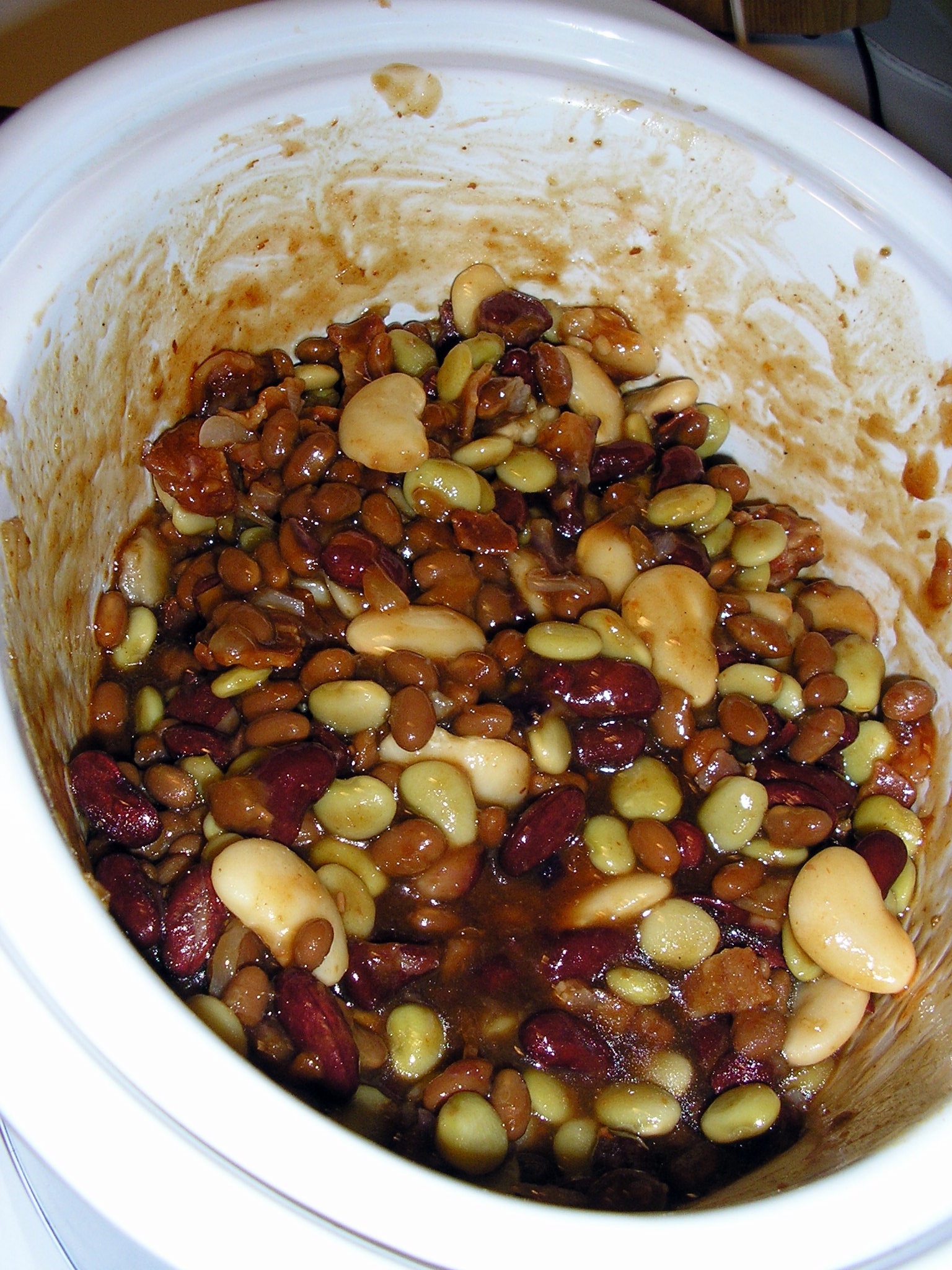
The mixture of beans is great, and despite the 6 hours of cooking time, they keep their texture very well. Imagine the little bowl of frijoles de la olla that you get as a side at some TexMex places. Though our baked beans do not remotely resemble those frijoles in taste, the final texture is fairly similar. The beans hold their shape, but the liquid ingredients create a kind of mix between a sauce and a glaze, and somehow hold the beans in a kind of suspended animation of glory.

Nancy’s Crockpot Baked Beans:

1 can baked beans (all cans between 14-16oz).

1 can lima beans

1 can butter beans

1 can kidney beans, rinsed

½ lb. bacon, cut up and fried

1 large onion, sautéed in bacon grease

1 c ketchup

1½ – 2 c brown sugar

2 tsp vinegar

Drain and rinse lima, butter, and kidney beans only (baked bean liquid is necessary for the sauce). Mix all ingredients together. Either cook in a slow cooker for about 6 hours (add a ladle of water if they seem dry), or bake in the oven in a 2 qt casserole at 350o for 1 hour.

I’ve thought about ways you might amend this recipe to be vegetarian, and I think it just wouldn’t be as good. The bacon adds necessary elements of flavor. The sauce becomes quite sweet from the ketchup and brown sugar, and though bacon can also be somewhat sweet, the meaty flavor does contribute something to the finished product, cutting through the starchy beans and the syrupy sauce. Maybe it’s a smokiness that the beans can’t quite develop sans pork product. In any case, the closest I’ve come so far to developing a theoretical veggie version is maybe experimenting with flavored vinegars, rather than the standard white.

In any case, the final result according to the recipe is a bubbling mass of sweet, protein-packed goodness. It’s like edible magma that warms you up from inside. In a way, the flavor reminds me a little bit of that sweet red bean paste that sometimes comes in steamed buns. I served this with sautéed cabbage and peppercorn crusted pork loin. Drool.