Focaccia for the win

I have mentioned before, on this very blog, that I am afraid of yeast.  However, as it has surely become clear by now, I love baking.  It was only a matter of time before these two truths collided and a new truth was constructed.  As I told my students only a few days ago, it was not always a “truth” that our solar system was heliocentric.  They grudgingly accepted this, but I now elatedly announce that I am no longer afraid of yeast!  Perhaps a bit timid, a bit guarded still, but not afraid.  What has changed, you ask?

This is a rosemary olive oil focaccia-style loaf from a cookbook put out by Food and Wine Magazine that I finally got up the guts to try out.  I learned three things by making it: 1.) yeast is not as easy to screw up as I thought; 2.) following directions is smart; and 3.) the way to a man’s heart may really be through his stomach.  At least if he shares a last name with my husband.

While this bread was not difficult to make, I think it would have been better if I had read the recipe more carefully.  After assuming I had killed my yeast when it all sank in the warm water I sprinkled it over, I didn’t bother to knead the dough before setting it aside to rise.  Then I baked it at the wrong temperature and despaired when it didn’t seem done before realizing my mistake.  And after all that, it was still delicious.

The bottom half inch or so was denser than the rest of the loaf, and I don’t know why that happened, unless it was related to my inability to read the directions the first time through.  But it was really, very good.  The olive oil made the texture pleasant – moist and chewy, and the rosemary contributed a nice, herby, woodsy flavor that contrasted well against the brisk brightness of the sea salt that also flavored the bread.  It is amazing how something with so few ingredients (flour, yeast, oil, water, salt, rosemary, and cornmeal) can have so much flavor.  And excitingly, as the recipe itself declares, this bread has endless flavor combination possibilities.  Next time I think I will add chopped kalamata olives.  N. agrees.

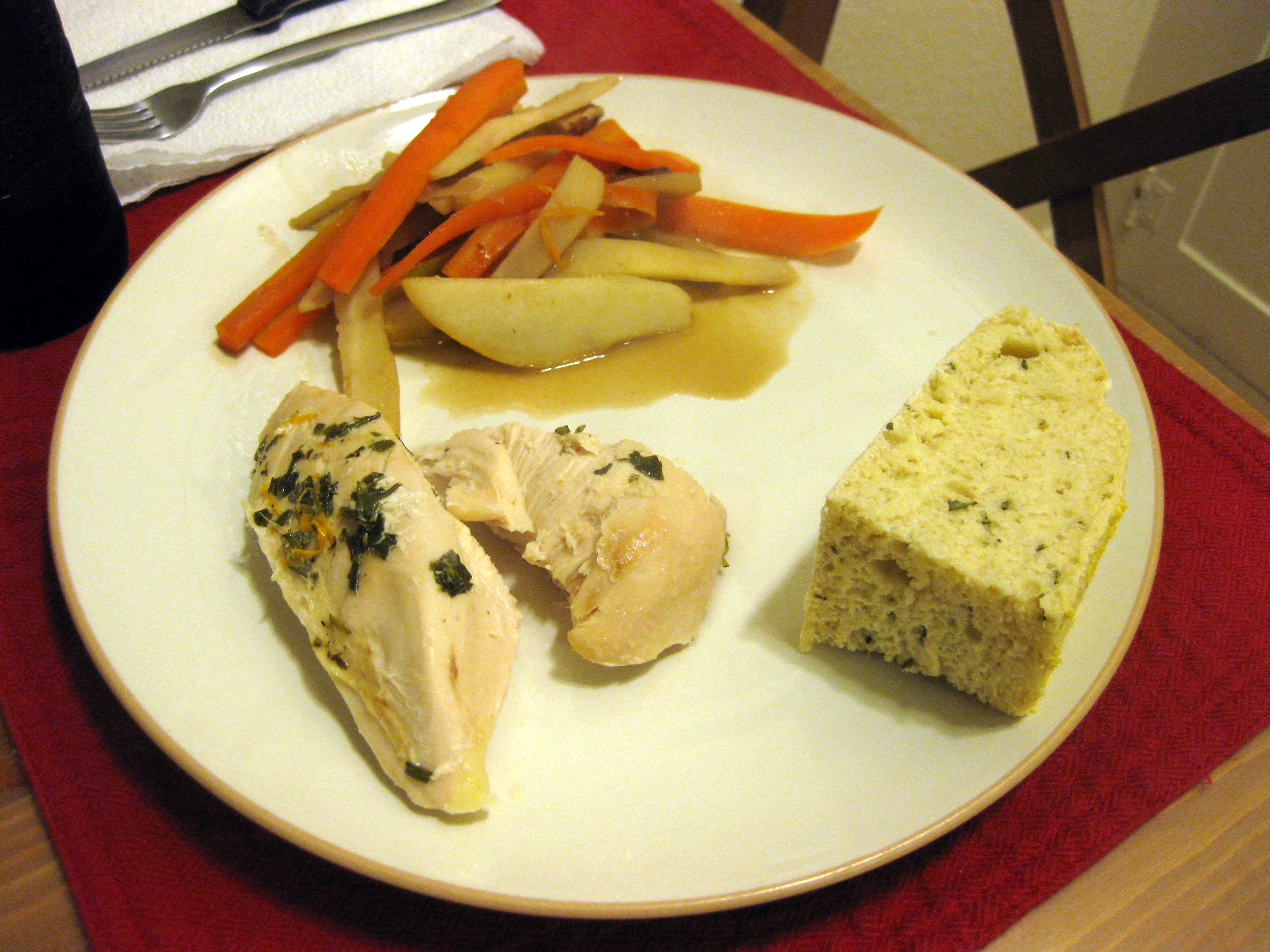
What was really glorious about this bread was how well I managed to combine and link flavors in the dinner that went with it.  We had a roast chicken and a vegetable side to go along with my yeasty triumph, and in the choices of aromatics I was able to clearly connect each dish.  The bread contained rosemary, and so when I made an herbed butter rub to massage under the chicken’s skin, I included plenty of fresh rosemary.
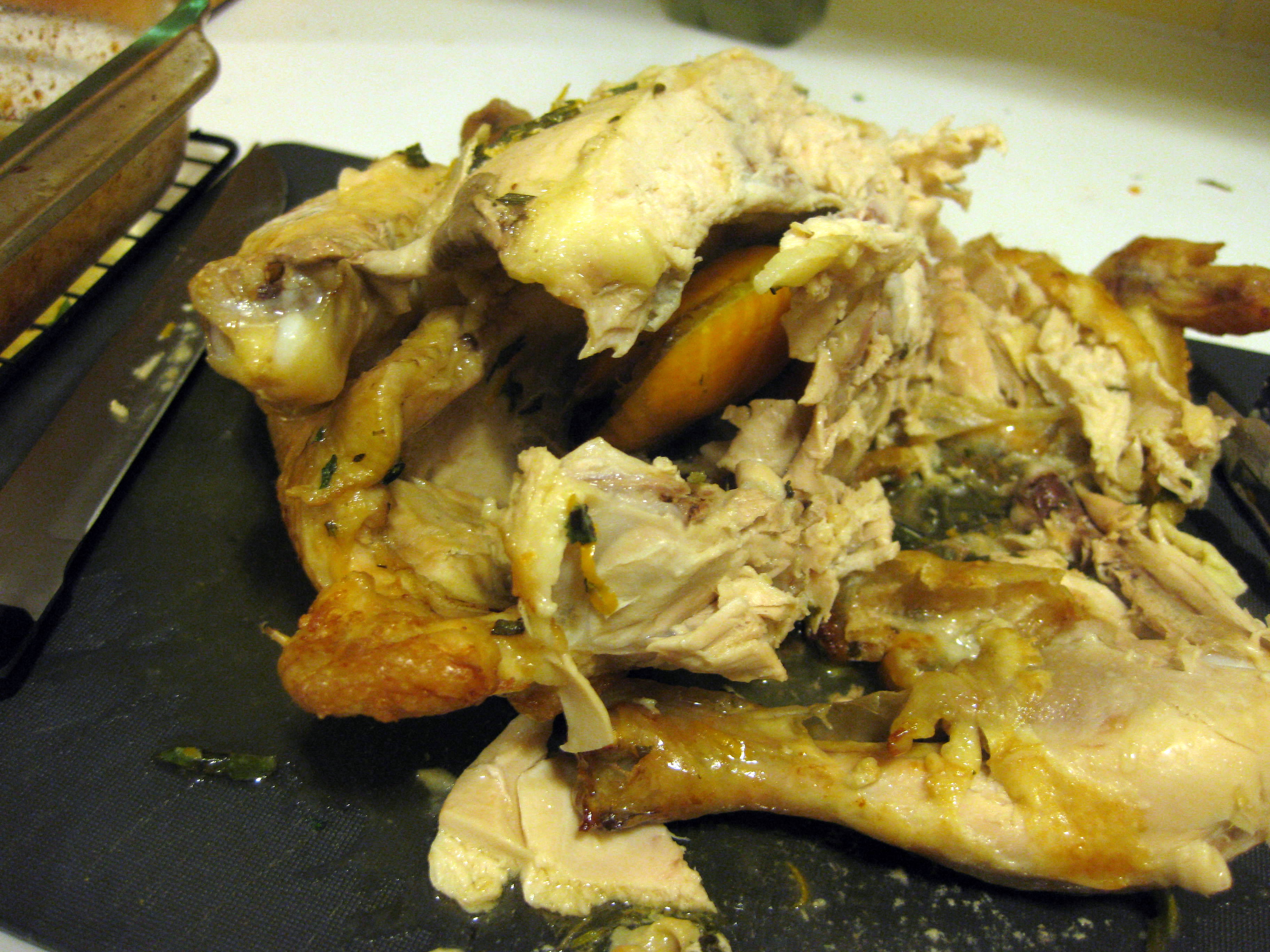
Our vegetable side consisted of glazed carrots, parsnips and pears with craisins and pecans.  Since the glaze was mostly orange juice, I added orange zest to my chicken herb rub and stuck a few orange slices inside the cavity of the chicken before it went in to roast.  If I had remembered in time, I would have added orange zest to the bread dough as well, to really link all three elements together.
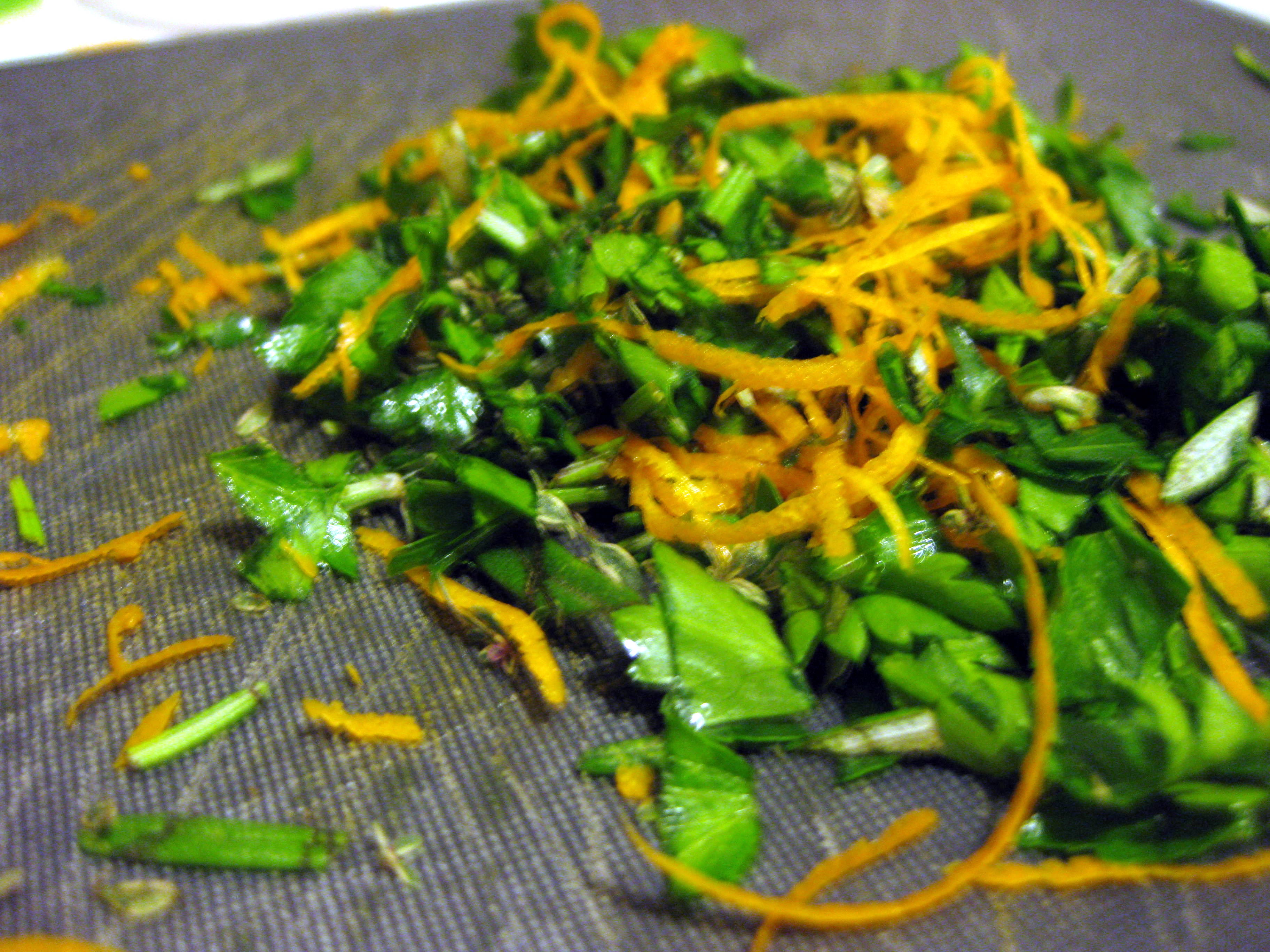
The orange did, I think, add a delicate sweetness to the chicken, though I’m not sure it was recognizably citrus.  I think lemon would be more identifiable.  But the butter made even the white meat of the chicken tremendously succulent, and the herbs and garlic definitely added a punch and depth to the flavor.

The veggies were rich with autumnal flavors, and while I enjoyed them, I think they would match better with a pork or turkey main rather than chicken.  In fact, they might be delicious as a vegetable dish for Thanksgiving; the craisins make that an easy link-up.  Since carrots and pears are already sweet, the craisins and pecans were a natural pairing.  I always think pecans have a kind of caramel or molasses-like smokiness to them, which seemed to work very well with the herby, spicy notes of the parsnips.

Given that somewhat wild flavor the parsnips impart, a strongly spiced root beer or sarsaparilla might make a fitting non-alcoholic beverage pairing to this meal, or maybe even a ginger ale like Blue Sky that prides itself on natural flavors.

So let’s take a moment here and reflect: Roast chicken, glazed vegetables, and homemade bread.  Two of these three dishes required advanced planning and multiple stages, and then (as per usual, these days) I made broth from the chicken carcass after it was picked clean, with plans already in mind for the leftovers.  Long cooking times, “complex” procedures, and making use of every part of the meal.  If that doesn’t say Sally Homemaker to you, I don’t know what does.  All I can say is: I promise that I did not wear pearls while I cooked this meal.
In homage to California produce

One of the things I’ve learned about myself as a cook is that while I am very good at choosing, following, and accurately executing recipes, I am not particularly imaginative – or impressed by my results – without them.  To combat this, as should be clear from my recent exposition on lasagna, I have been paying closer attention to ingredient combinations on restaurant menus.  With more practice and likely greater culinary training than my own, chefs in restaurants have an understanding of how ingredients work together, and which ones will meld together well, which is something that I am still learning.

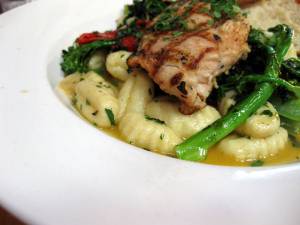
So, I have been taking notes and copying descriptions from meals that I enjoy and establishments that I have been impressed by, and trying to recreate them in my own way.  Inspired by the ridiculously beautiful shelves of greenery in the Raley’s grocery store in N.’s hometown, I wanted to make something fresh and delicious with plenty of produce.  We eat out quite a bit when we visit our parents, because with time to make the trip down to California only twice a year, it tends to be a festive week or two.  Therefore, one evening when N.’s parents were out bowling, my vision turned green.  There were bright, dripping bunches of broccolini, and rapini, and dandelion greens, and kale and turnip greens, and that was just the beginning.  I don’t think I’ve ever seen dandelion greens in a grocery store before, and was tempted, but forced myself to be realistic.  I thought back to our trip to Ashland in July, when N. had this:

IMG_1420

Gnocchi in an herb, wine and garlic sauce, topped by a rosemary-grilled breast of chicken, bell peppers, and broccolini.  Inspiration achieved.  I grabbed both broccolini and rapini from the produce shelves, a beautiful orange bell pepper, and some pre-made gnocchi from the refrigerated area.  N. has been yearning after these pillowy little fluffs of potato pasta, so I was happy to oblige.

IMG_1615

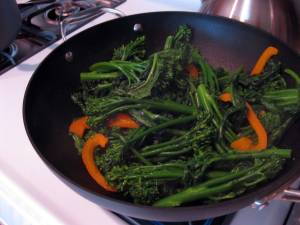
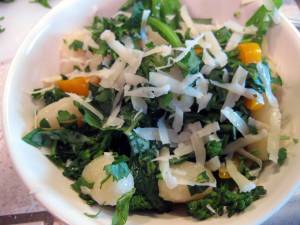
Surrounded by emerald leaves, buds, and juicy stems on the kitchen counter of my in-laws’ house, I chopped up the greens and steamed them briefly to reduce some of the bitterness that I know hides in these lesser-loved brassica hybrids.  When they were just tender, I drained off the water and moved them to a deep skillet, where I stir-fried them with thinly julienned bell pepper slices while the gnocchi boiled.  I added some garlic, and at the last minute tossed in the gnocchi, some leftover parsley from a previous night’s adventure, and a few small chunks of butter.  It wasn’t the most sophisticated sauce, but the colors were just gorgeous.  We topped our bowls with parmesan cheese and filled our bellies with vegetables.

IMG_1617

It was so simple, but so fresh, and the flavors were strong and tasty.  I like bitter vegetables a bit more than N. does, so to make this again I would steam the broccolini and rapini a bit longer, and perhaps in chicken or vegetable broth rather than water.  This would probably also make a silkier sauce, as would a dash or two of a full-bodied white wine.  However, this fresh burst of vegetables reenergized and refreshed us, and boosts my confidence about my plan of attack.  With N.’s Ashland dinner recreated, and three butternut squashes slowly swelling in the garden, my meal from the same night may be next on the “restaurant recreation” horizon.  Squash stuffed ravioli in a sage brown butter sauce with crumbled biscotti and gorgonzola cheese, anyone?

Food words

The words we use when we talk about food, and the attitudes they invoke, positive or negative, intrigue me.  For example, “buttery” is a good word.  It connotes flaky pastries, dense nut-filled cakes, rich bready desserts or breakfasts.  However, “oily” is a bad word, and “greasy” is even worse.  Why is that?

(This will seem like something of a non-sequitur, but I promise you’ll see where I’m going here in a paragraph or two.)

I recently saw the Meryl Streep/Amy Adams movie Julie&Julia.  While I will leave the review to my friend S., who is good at that sort of thing, I will comment that the food cinematography in the movie is marvelous.  I don’t know whether it is always real food they are using or not, but the colors were deep, the textures were luscious, and the sounds (mixing, slicing, carving) were pretty realistic.  At one particular point in the movie, as Julie Powell and her husband are sitting down to a dinner of bright red and yellow rustic-looking bruschetta, all six of the women I saw the movie with (including me) said something between “ohhhhh,” “mmmmmmm,” and “yum.”  Or maybe all three.  So a few nights later, inspired by the bursts of orange from the sungold cherry tomato plant in my backyard, I decided to try out Julie and Eric Powell’s dinner.

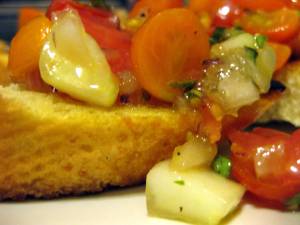
Starting with my favorite basic bruschetta recipe, I chopped up one red early girl tomato, a few dozen cherry tomatoes, a peeled and seeded cucumber from the back garden, and a handful of red onion.  Then I added julienned basil (backyard again!), salt, pepper, olive oil, and a tiny splash of red wine vinegar.  Then I let it sit in the fridge for a few hours while we went about our business. IMG_1522

After watching a dear colleague successfully defend her dissertation and then celebrate accordingly, we picked up a loaf of sourdough bread on the way home and the magic really began.  Generally when I make bruschetta, I toast the bread slices in the broiler.  However, in her rendition in the movie, Julie Powell (or Amy Adams; I don’t know whether Julie Powell ever actually made this) fried her bread in olive oil.  Wanting to stay as true to the beautiful food in the movie as I could, I opted to do the same.

Though some of my bread got a little dark, most of it turned out just fine.

IMG_1526

We stacked up the vegetables on the bread, covering every square millimeter possible before biting in and, of course, losing half the tomatoes to the plates below.  They squirted down our chins and slicked up our hands, but it was worth it, and here we return to my initial question.  The tomatoes were good and juicy, the cucumber was crisp, the basil added the right zing, but the bread was really what made the dish excellent.  It absorbed enough olive oil to be a beautiful golden brown color, and the crumbs of each slice became crisp; the perfect surface to stand up to the weight of the tomatoes, but still soak up a little of the juice the vegetables had created.  Biting into a slice was a textural experience, because the inside of the bread was still soft, but the crust was crunchy and the outer surfaces were crispy, and the whole thing was deliciously… oily?  Oiled?  In our low/no-fat culture, obsessed with cleanliness and thinness and sleekness, the idea of oil seems objectively negative.  But this was wonderful and delicious and silky and superb.  What can I call it?  Can we bring back, can we reclaim “oily” to mean what it should mean?  That crispness with buttery rich moisture I experienced with our weeknight dinner?  I think we should.

IMG_1527

Soy love story

During my first year off from college, I lived in a house full of girls. There were five of us. Even if I wasn’t now happily married, I would never do that again. Too many showers, too many door slams, too much food in the fridge. Have you ever tried to contain all of your perishable food in one fifth of the refrigerator? There’s no division by product, there’s no organization, just a crowded heap of undifferentiated ingredients.

While living in this harem, however, my closest friend in the house was vegetarian, and made great use of that one product so often labeled as simply a vegetarian food item and shoved by the rest of us omnivores into a back, ignored corner of the fridge of life: tofu. I had never dealt with the stuff before, and was slightly mystified by its enigmatic properties. My friend, over the course of several “housemate date nights” that inevitably incorporated deliciously good food and deliciously bad TV, showed me the way.

img_0304

Step one: cut extra-firm tofu into squares (I use a 14 oz. block and usually cut 4x6x2, or whatever looks like a nice bite-size piece). Marinate tofu squares in soy sauce for ten or fifteen minutes (again, rough estimate, but I’d say these guys are sharing about ½ cup of tamari).

Step two: strain tofu squares and toss them in a light coating of brewers’ or nutritional yeast. Small flake is preferable, but large flake works fine too in a pinch. Nutritional yeast is usually available in grocery stores that have a bulk bin section.

Step three: sauté tofu in several tablespoons of very hot oil in a wok or frying pan. Don’t scramble it around too much because the coating of yeast will fall off and a major part of the flavor will be lost to the bottom of the pan. This sautéing (or stir-frying, if you prefer) process always takes longer than I expect it to. Be patient. Allow the squares to develop a dark golden color and a firm crust around the outside. When they are done, they will look like little croutons, but the taste is infinitely more complex and interesting and, of course, different given the soft tofu center of these squares of delight.

img_0309

I’ve enjoyed these in Pad Thai, stir fries, on baked potatoes, and inevitably plain and scorchingly hot right out of the frying pan. They add a deep, earthy, salty flavor. There is something very pleasurable about eating them, because the outside takes on a texture somewhere between crunchy and chewy for your teeth to play with, and the inside just melts away. N. claims they are delicious with beer, which makes sense, considering that they are crusted in yeast. Tonight’s application? I’m thinking fried rice.

The interesting thing about this recipe was that my housemate never had to find room to store any leftovers in our fridge. We always ate them all.

Christmas food part 3 – the Christmas dinner anti-tradition

Though the food in this post, and the topic at large are from Christmas, the need for posting is largely a result of a newly established Ladies’ Spaghetti Night that I recently attended.In true occupatio style, I will say nothing of A.’s marvelous sauce, chunky with sweet, acidic tomatoes and impossibly large slices of button mushrooms.I will not mention how good the bread, delicately seeded and torn in large chunks from the loaf, was when we smashed cloves of roasted garlic over it.No, the reason for this post is one of the people involved in the genesis of this weekly pastafest.Though she was not present at the particular gathering of which I speak, she was in my thoughts because she cannot eat gluten.She also can’t do dairy.This means that when Ph. is in attendance, we have to have gluten-free pasta.It also means that since almost everything I cook involves bread, butter, or cheese in some form, rarely do I make anything that Ph. can eat.

All that changed on Christmas Day (I think, since I haven’t cleared the recipe with her yet).Let me explain.For probably a decade, my family has done Thanksgiving and Christmas with another family who my parents have known since at least the time that I was born.I’m the oldest of the four kids between the two families, so that’s a long time.Three or four years ago at about 5:30pm on December 25th, over a steaming baked brie and a ¾ eaten bread bowl of spinach dip, five of the eight of us decided that we weren’t hungry.We had eaten appetizers with such enjoyment and such gusto that the standing rib roast my dad was asking whether he should carve seemed utterly extraneous.We decided a new plan was in order.Appetizer Christmas.

Since that fateful day, we’ve had a Christmas meal of 100% appetizers – mainly finger food or toothpick-able items that come in cute, single-size servings.Same goes for dessert.We’ve done coconut shrimp, we’ve done tempura, we’ve done Swedish meatballs and stuffed mushrooms and pate.For dessert, truffles, individual espresso chocolate cakes, and tiny cheesecakes made in muffin tins.img_00551

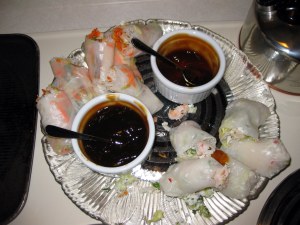
This year, I made spring rolls.Here’s where Ph. comes in, because they were made with rice noodles and rice wraps.No flour.No wheat.No cheese.I found the recipe here: http://www.ivu.org/recipes/chinese/spring-rolls.html and highly recommend it with minimal alterations.

I found that making these in a two person assembly line was really effective.While I jammed small piles of carrot, lettuce, mint, and noodles into each wrapper, my mom dipped and flipped the next wrapper to bat in a wide, shallow Tupperware of warm water until it lost its rigid structure and became elastic.Warm water works the best for this, and we discovered that each rice paper round needs between 30-50 seconds in the water.After a few botched first tries (I’ve never rolled a spring roll before), we settled into the perfect harmony of dipping, rolling, and transferring.It took me exactly the amount of time to stuff and wrap a spring roll as it took for the next wrapper to melt into perfect texture.When we made the sauce, which my sister took charge of, we substituted lime juice for some of the broth and water for the rest, since one of our fellow consumers is vegetarian.It turned out thick and sweet and a perfect accompaniment.

I definitely side with the recipe’s author in calling for mint with no substitutions in this recipe.Since I have an ample crop just poking their little heads up in the backyard amidst the decimation of stalks left over from last fall, this herbal portion is easily reproducible.Pressing and baking the tofu, which I had never done before, gave it a whole new texture that my dad (who is marginally obsessed with the power of soy) and I both really enjoyed.I think others did too, but he and I professed it the most loudly.The compressed slices sucked in the tamari I glugged over them, and smelled so good that I didn’t even mind the burn I got when, too excited to be remotely intelligent, I reached in and grabbed the cookie sheet I was baking the slices on out of the oven without a potholder.The tofu and the skin on my hand both survived.Ah, the magic of Christmas.

img_0036

Derridean BBQ

Call me a post-structuralist, but since arriving in graduate school and submerging myself in contented and sometimes even enthusiastic nerdiness, I’ve become intrigued with the idea of slippage. How can words with clear definitions become other words? On a lesser but related note, I’ve always been fascinated with what must be the gradual process of how nouns become verbs and vice versa. The focus of this discussion, of course, is Barbecue. It being Labor Day weekend, the natural assumption to this Oregonian is that barbecues will take place. However, barbecue is, rightfully and literally, neither the name of an event, nor is the accurate word for the type of cooking that I assume will take place at the gathering I have just been to. Before we get to the food, let’s have a brief history lesson, shall we?

Thanks to the ever faithful Food Network, and of course the estimable wisdom of Wikipedia (yes, I’m a bad graduate student!), I know that there are primarily two methods of outdoor cooking in the US. Barbecue generally refers to a slow, often all day process of indirect heat and smoke, often achieved within a large, enclosed apparatus that looks nothing like the “BBQ” you can buy at Home Depot or Target. Grilling, on the other hand, is the process that involves placing meat on a rack over charcoal or propane heat and cooking it quickly, directly over the flames. Why, then, do we not say that we’re going to a grill? Perhaps because the tradition of barbecue as a slow process is uniquely American. Perhaps this is a square versus rectangle argument. Perhaps I should start telling people that I’m going to a grill, and add this new noun to the dubious regional dialect I find myself immersed in.

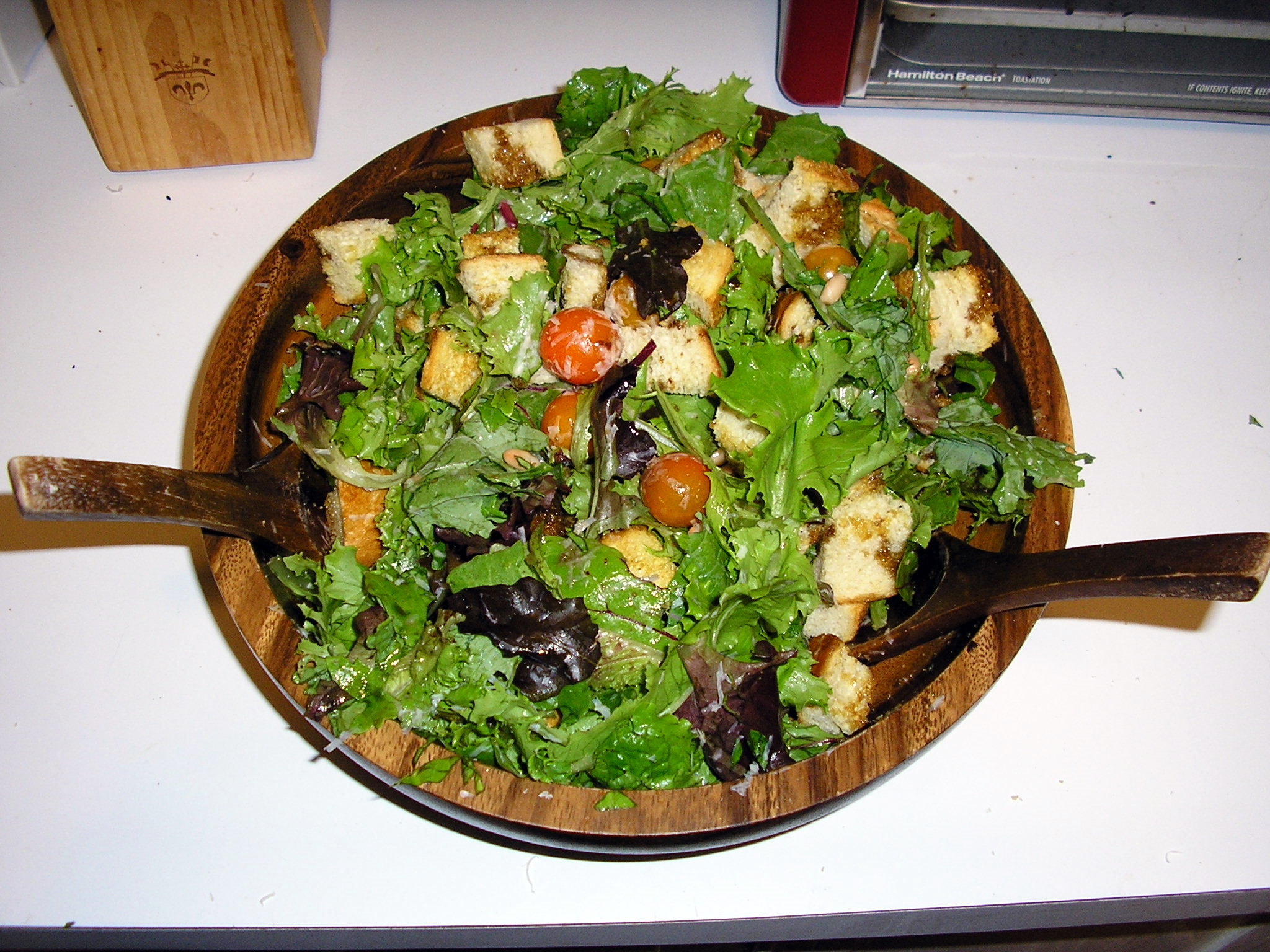
So, for the Grill that I attended last night, I decided to go simple and, knowing there would be ample meat for the tasting (and glorious glutting), I made a panzanella salad. Stepping this traditional bread and tomatoes salad up a few notches with the addition of local mesclun greens, basil, cannellini beans, and parmesan cheese makes it almost fit to be a meal in itself. But I still ate one of the hand made lamb and goat cheese burgers.

Panzanella salad

Toss together in a large salad bowl:

4-6 cups bagged mixed greens (I used a mesclun mix from the local Farmers’ Market)

1 pint cherry tomatoes or 3-4 tomatoes cut in bite-size pieces (I used Sungolds from the Farmers’ Market)

¼ cup julienned basil (from my backyard basil plant)

1 can white beans, drained and rinsed

½ cup freshly grated parmesan cheese

1/3 cup balsamic vinaigrette (my recipe follows)

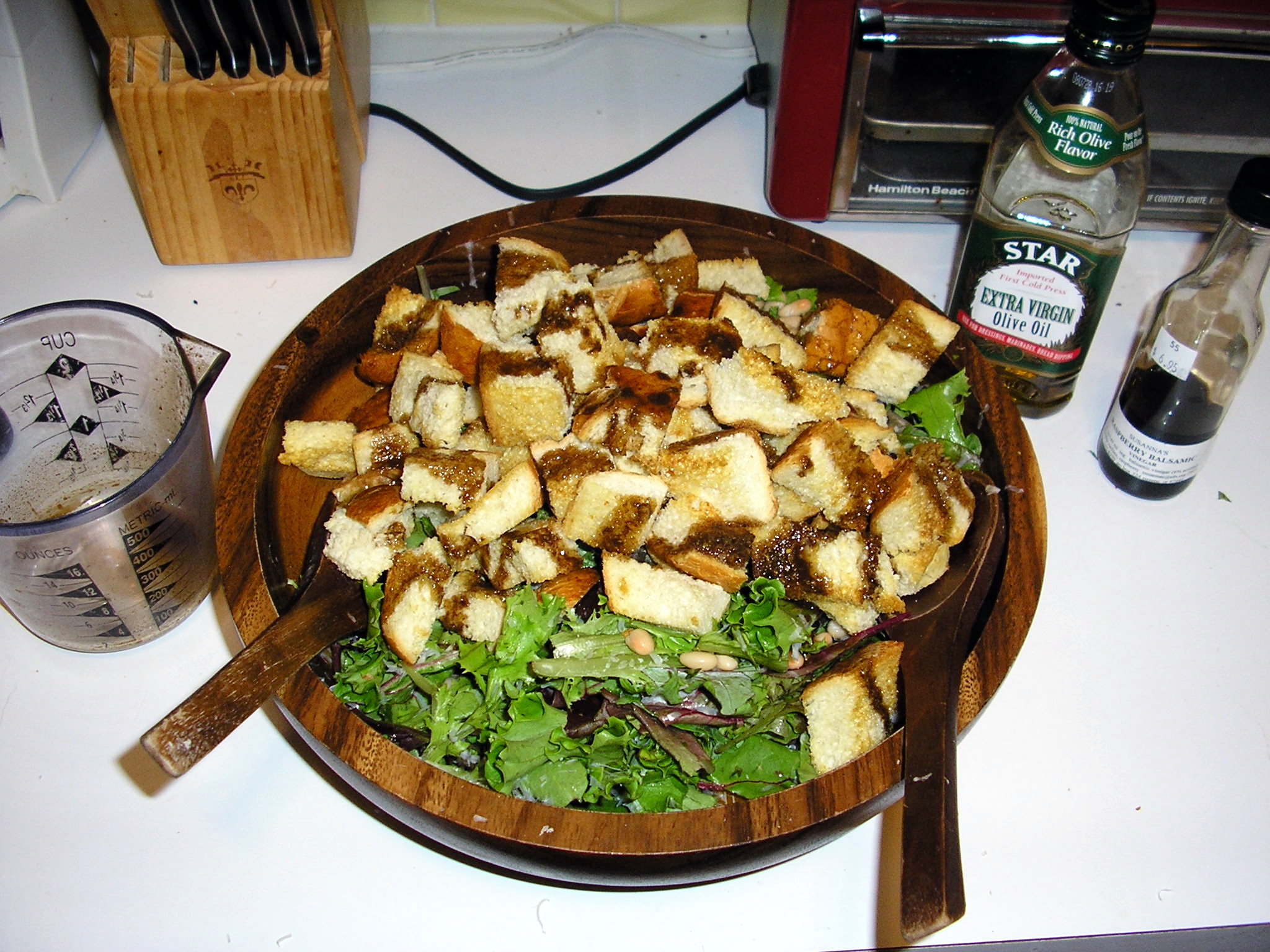
2 cups freshly baked sourdough croutons (my recipe follows)

Vinaigrette:

Squeeze of spicy brown mustard

A few tablespoons balsamic vinegar (To make it extra special, I use a locally made Raspberry Balsamic)

Whisk in enough extra virgin olive oil to equal 1/3 cup of dressing

Croutons:

Cut about ½ of a sourdough baguette into bite size chunks, scatter onto a cookie sheet and spray liberally with an olive oil cooking spray. Bake in a 400° oven for 10-15 minutes or until all pieces are golden brown and crisp to the touch.

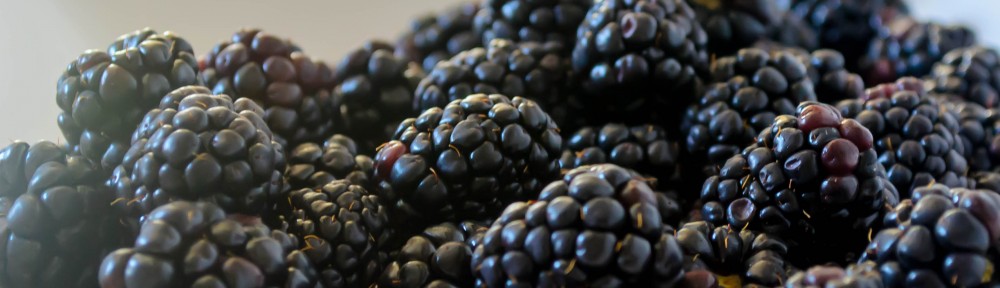
In addition to the lamb burgers, which were cooked only to medium and therefore excruciatingly delicious (N. likes his meat very well done, and pink interiors make him nervous, which means the pink and juicy center is reserved for special occasions for me), we ate a delicious spicy cream cheese dip on tortilla chips, a pesto and cherry tomato pasta salad, locally made (I think) vegan peanut butter and chocolate chip cookies, and a cocktail I invented with the help of my backyard bounty; essentially a blackberry mojito without the mint. I was encouraged to name my creation, and told in no uncertain terms to remember it so I could make it again, and so my rough estimates follow below.

Blackberry Crush

6-8 very ripe blackberries

1 TB sugar

1 TB lime juice

1-2 oz. white rum (or to taste)

Ice

Club soda or other sparkling mixer

Muddle together the blackberries, sugar, and lime juice at the bottom of a pint glass. Add rum, ice, and top up with club soda. Garnish with a lime slice and a few whole blackberries, skewered and balanced on the edge of the glass.

Happy Labor Day weekend!