Resistance

There are 3½ weeks to go until my whole dissertation is due to my committee. I’m through revising three of the six chapters, and embarked on the fourth this morning. Dinners vacillate wildly between complex assemblages of roasted vegetables with ancient grains, comforting cheese-laden casseroles, and baked potatoes with steamed broccoli. My Bittman file (yes, I keep the selections in a manila folder, wouldn’t you?) is buried somewhere under piles of criticism on medieval theology and monographs about poems you’ve never heard of. And the selection I have to share wasn’t my favorite. As usual, these things combine to mean I have all but zero motivation to post. But I’ll do it anyway. For you. Because this project needs completion.
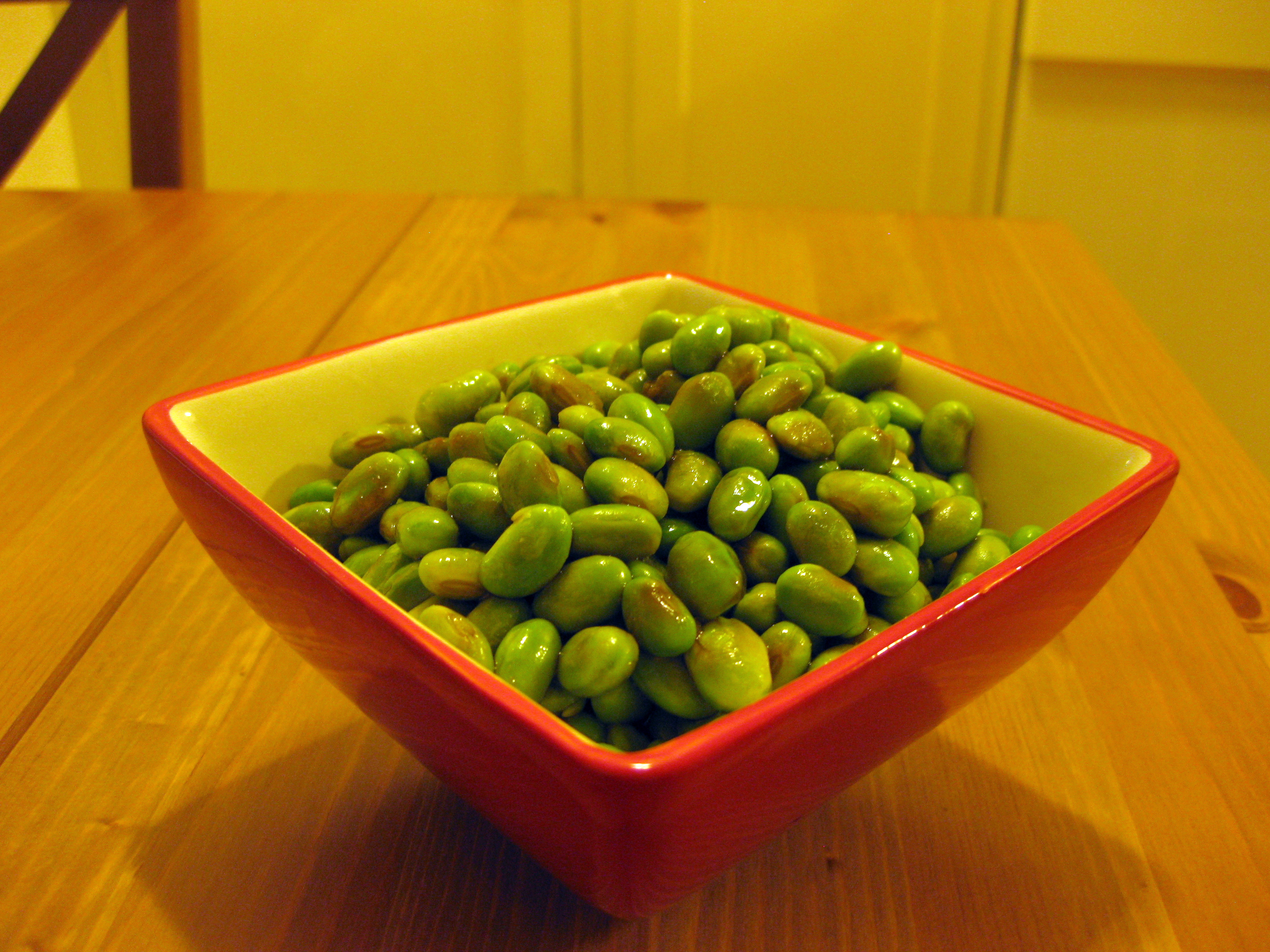
“55. Steam and salt edamame. Whisk soy and honey together in a small saucepan over low heat. Add grated ginger and a bit of cornstarch, stir until slightly thickened and pour over edamame.”

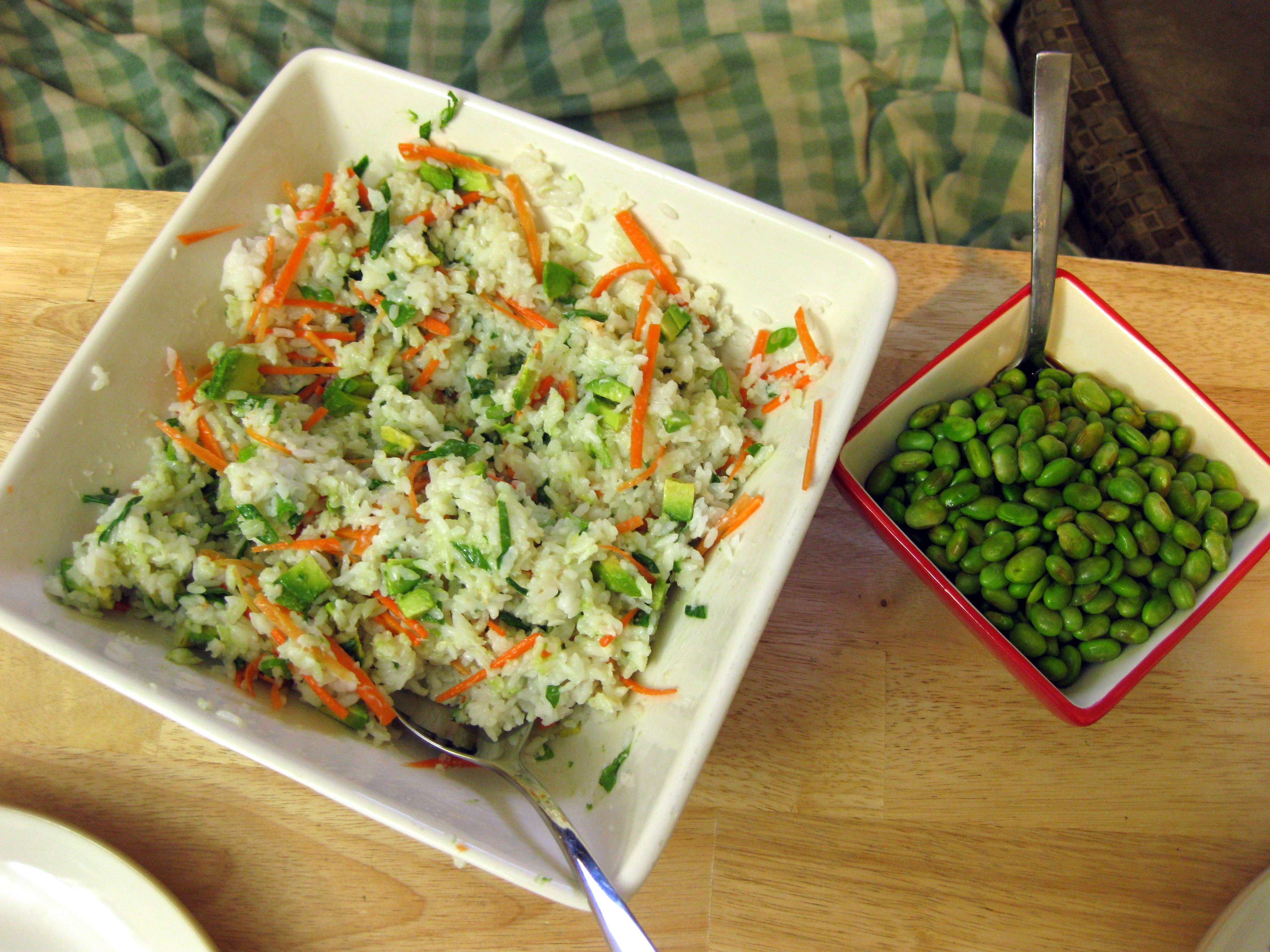
This sounded intriguing, so I decided to pair it with a dish my friend and colleague J. calls “scatter sushi”: all the ingredients you might find in your favorite roll diced small and integrated into a bowl of well vinegared sushi rice. Ours had carrots, green onions, crumbled roasted seaweed, avocado, and crab meat. I’ve also made it with shrimp (when N. was out of town, of course), and it’s delicious.
But anyway, again I’m resisting the heart of the post. Here goes:

16 oz. frozen edamame, blanched in boiling salted water, then drained

½ cup reduced sodium soy sauce

2 TB honey

2 tsp ginger, grated with my microplane

2 tsp cornstarch

As the edamame were blanching, draining, and cooling, I mixed the other ingredients together in a small saucepan and brought them to a slight simmer.  The sauce took a minute or two to thicken, and once it was barely viscous I drizzled it over my bowl of beans and served with a slotted spoon.

This had promise, but in its current form I think it fell a little flat. I didn’t love the slippery slickness the cornstarch imparted to the dressing: it clung to my lips and tongue in an unappealing way. Or maybe there was just too much of it. I think this concept would realize its potential if it became part of a full salad stuffed with brightness and texture: red bell pepper, finely julienned carrots, green onion, maybe even grilled tofu or roasted sweet potato or chunks of firm-fleshed white fish. It needed only a light dressing, not the soupy drenching I gave it. And maybe the sauce didn’t even need the cornstarch. I recognize its thickening purposes, but couldn’t the soy sauce just be reduced a bit instead?

As I work through revisions on the longest, most involved project I’ve ever undertaken, I find myself only rarely wanting to completely start over.  And I think that’s good.  Revisions are one thing, but stubborn resistance and insisting on from-scratch perfection can stay in the kitchen…
Spiking your stuffing

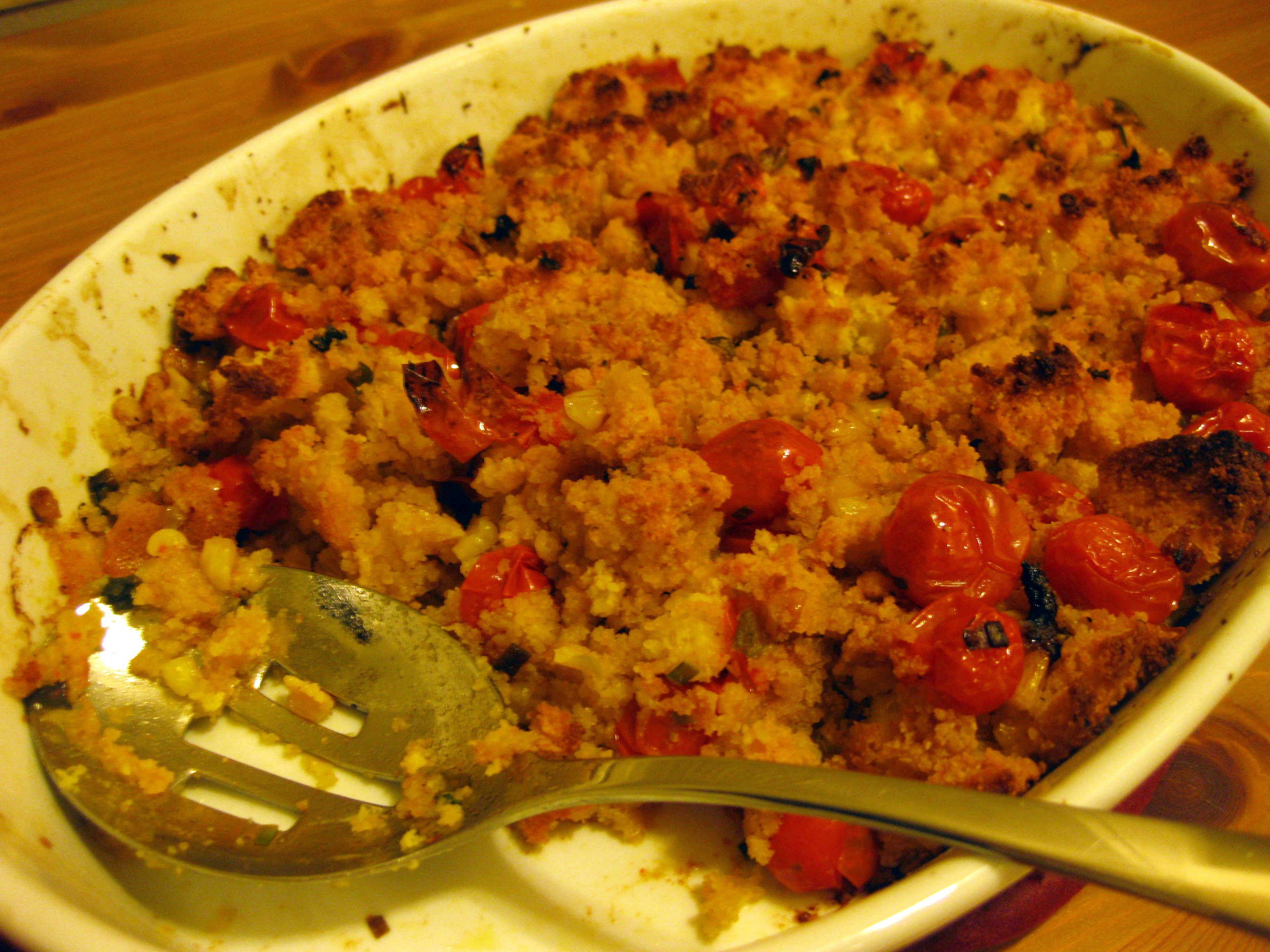
The one part of Thanksgiving dinner I refuse to make from scratch is the stuffing.  I don’t know why, but no stuffing has ever lived up to the Stove-top brand blend my mom puts together: one box of turkey stuffing, one box of cornbread stuffing, mixed up and tossed together and then, rather than just stirred into boiling water, baked in a casserole dish for twenty minutes or so right before serving, so the top is crusty and crunchy.  This is easy to do, since it takes my dad at least twenty minutes to get the turkey carved.  This is smart to do because it makes a texture contrast and provides a gravy sponge.  Other stuffing mixes I’ve tasted, and the homemade one I attempted this past year for A., who doesn’t like celery (have you ever tried to find a stuffing mix without celery?  Impossible!), just haven’t measured up.

And then, Bittman.

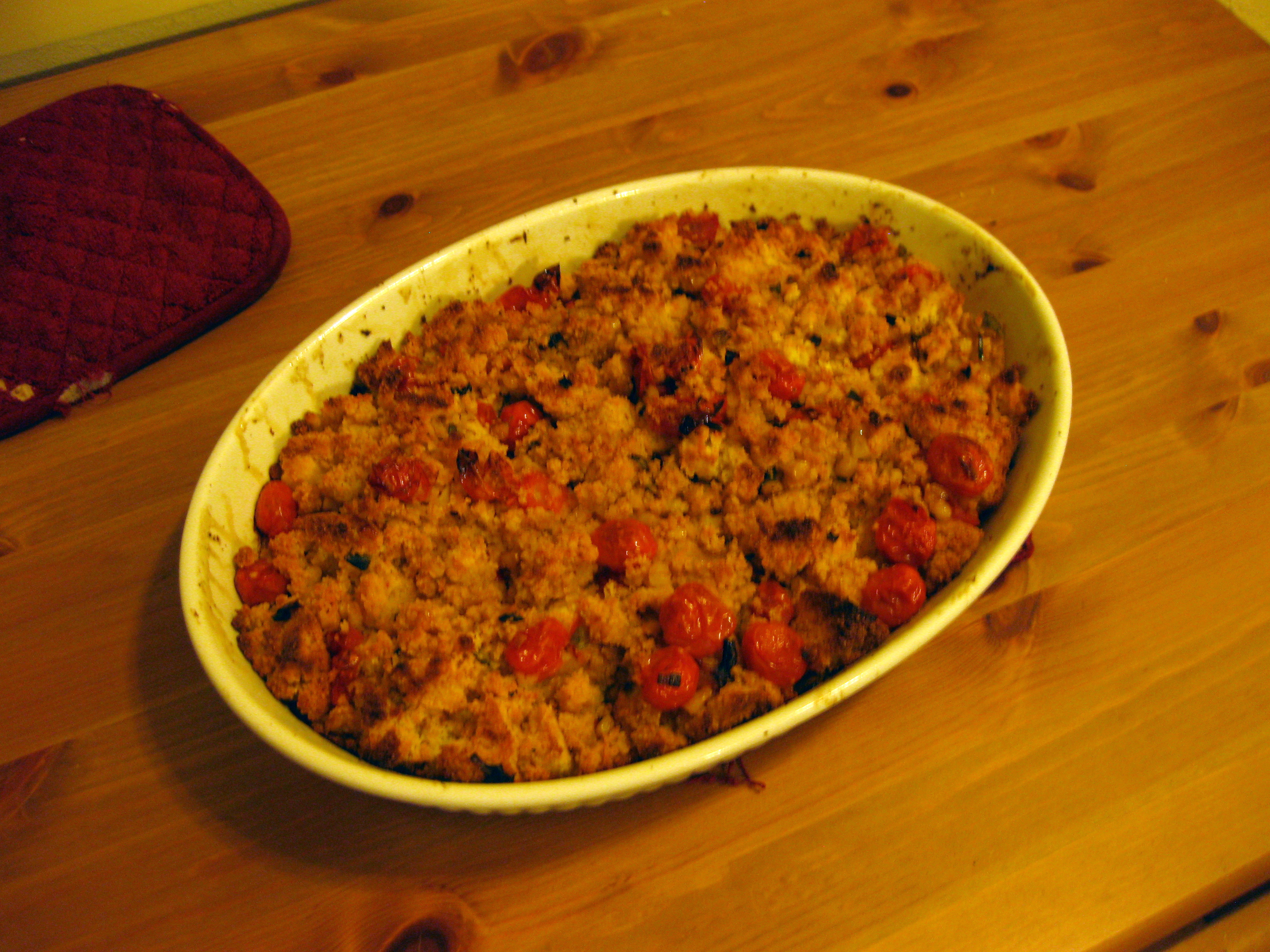
“26. Chop corn bread into cubes. Sauté cherry tomatoes, scallions and corn kernels in butter or oil. Deglaze the pan with beer, then empty the pan over the corn bread. Bake in an oiled dish or use as stuffing.”

You guys, this was amazing.  And given how you now know I feel about stuffing, that’s saying something.  Amazing.  Here’s what I used:

6 cups (roughly) corn bread cubes, toasted (use your favorite recipe)

4 TB butter

6-8 beefy green onions

1 pint red cherry tomatoes, rinsed and dried

1 cup corn, fresh or frozen (if frozen, defrost it first)

Salt and pepper

12 oz. beer (I used Drifter)

I made a pan of cornbread from my favorite recipe in a larger pan than usual; I thought this would result in a slightly drier bread, so it wouldn’t become mushy when the liquid was poured over it.  The cornbread was still pretty moist and springy, though, so after it had cooled for a while I cubed it, scuffed it around in the pan a bit to separate the clinging pieces, and tossed it back in the oven at 400F for fifteen minutes or so to get some toasty edges and dark golden spots on it, then set it aside to cool completely.  This worked beautifully and I’d recommend it, especially if your cornbread is moist and cakey.

While the oven was occupied by an herb-stuffed chicken (again, I know.  I can’t help it), I melted the butter in a skillet over medium heat and sliced the green onions, using the white and green portions.  I tossed these little rings into the sizzling butter along with the corn, and agitated them gently.  When the onions were soft and the corn just beginning to caramelize, I added the cherry tomatoes and seasoned the whole skillet with salt and pepper and, on a whim, a few shakes of garlic powder.

I turned the heat up to medium high for just a few minutes until the cherry tomatoes started to burst through their skins, spilling pulp into the mix, and the corn had browned delightfully, leaving the kitchen smelling like summer.

I then switched off the heat and poured in a full bottle of beer, nutty, yeasty, and brown (Drifter is a pale ale, so it has some body and depth – I wouldn’t go any lighter than pale ale, and might in fact prefer something darker: a brown ale like Newcastle, or even a porter if it’s not too strong).  The aroma changed from summer to fall harvest in an instant as the beer fizzed over the vegetables.

After scraping the bottom of the skillet gently with a spatula to remove any persistent browned bits, I poured the whole steaming bubbling mass over my pan of cornbread cubes and tossed gently to distribute the liquid evenly.  Then I stowed the pan in the oven: 350F for 25-30 minutes until the top is deeply golden and just crunchy.

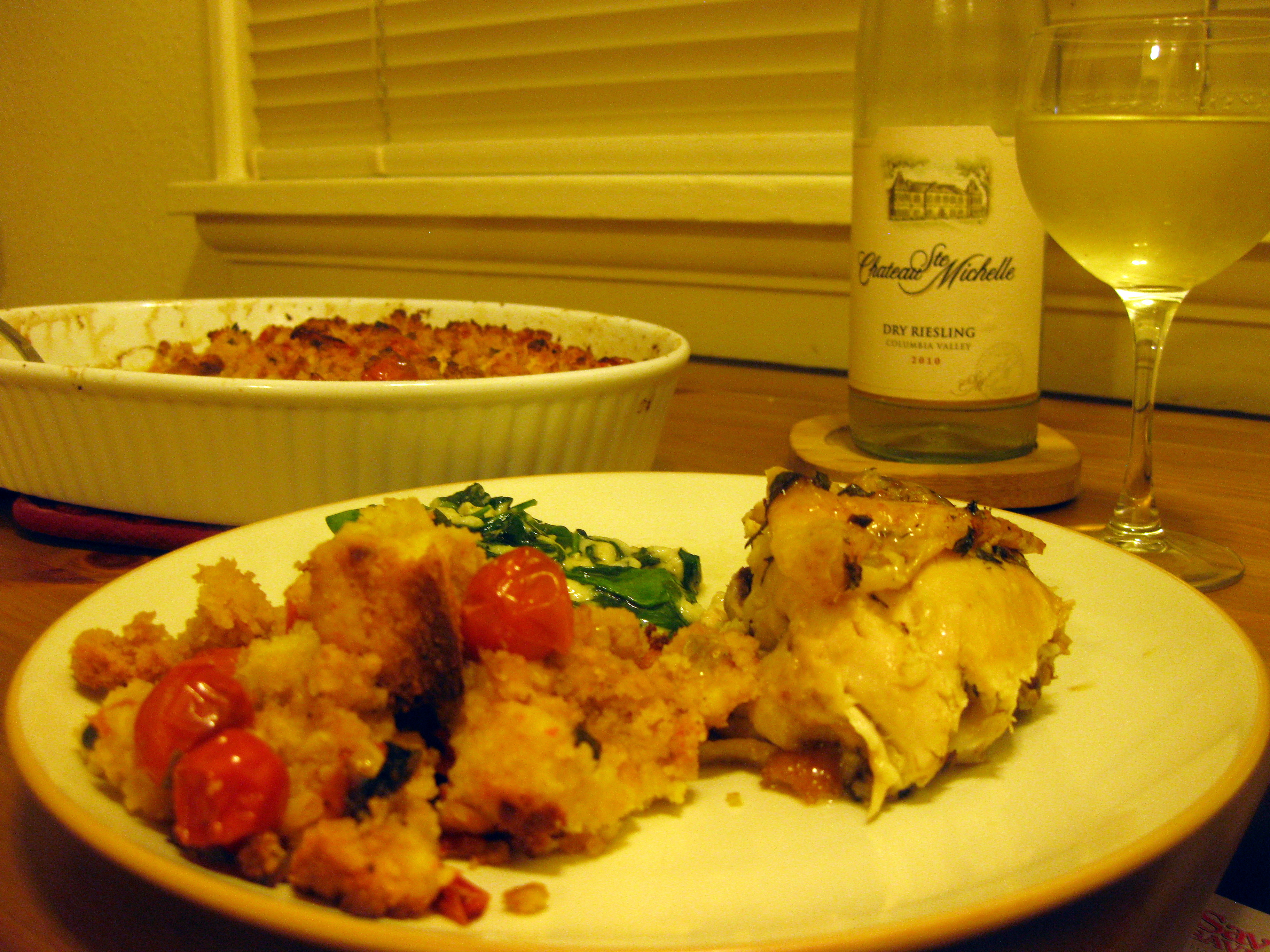
We ate this with roasted chicken and creamed spinach.  Vegetarians shield your eyes, but the chicken just collapsed so beautifully across my carving board that I felt I had to show you:

But the stuffing!  The stuffing was incredible.  The cornbread soaked up the beer, and the sweetness of the bread plus the sourness of the ale created this yeasty glory I couldn’t stop eating.  And I don’t like beer.  It was just such a perfect liquid for this dish, contributing just the right amount of malty bitterness.  The tomatoes got richer and sweeter in the oven, as did the corn kernels, and they partnered with the green onions to make such a good accompaniment to the cornbread that I’m almost tempted to add them into the batter in my next pan.  Or maybe into a compound butter to spread on top.  That would be better, texture-wise.  Green onions, cherry tomatoes, and corn: three musketeers. 

This stuffing was gone in two days.  With only two of us eating.  It was that good.  If you’re in the Northwest, where Spring is shunning us, make this now while you still need your oven to keep warm.  Accompanying some baked sweet potatoes and leafy greens, this becomes a vegetarian meal.  If you use oil instead of butter and have a good egg replacement, it could be vegan.  If your cornbread is free of wheat flour and you use gluten-free beer, it could be gluten-free as well.  However you make it, make it.  This one is too good not to try.

Marshmallow Topping for Adults

To me, there is no better title for this entry than Bittman’s designation.  Sometimes things don’t need to be complicated or alliterated or made cleverer.  Sometimes all they need is a little story to get them started.

For the past five years or so, my family has been driving up to Oregon to spend Thanksgiving at our house.  Since we discovered a recipe for Chipotle Mashed Sweet Potatoes, which melds the flavors of autumn with the heat of adobo sauce, we haven’t needed any additional fixings for our tubers.  This was not always true.  When we used to share Thanksgiving with a very dear set of family friends, L. inevitably made sweet potato casserole.  You know the one.  The sweet potato casserole.  Boiled sweet potatoes, mashed or beaten smooth.  Sweetened – as she was always proud to proclaim – only with orange juice.  Smoothed into a square glass baking dish and then topped until no hint of orange could be seen with a careful and meticulous layer of miniature marshmallows.  Thieving hands were scowled at.  Broil to perfect, swollen, golden-brown puff.

I liked this.  Well, I liked the idea of it.  Mashed sweet potatoes are delicious, and toasted marshmallows are my favorite part about a campfire.  But together, especially next to turkey and dressing and tart wonderful cranberries, it was never my favorite.  Bittman offers a grown-up alternative:

“60. Marshmallow topping for adults: Roast or boil chunks of sweet potato, put them in an oiled baking dish, top with dots of cream cheese, and sprinkle with a mixture of brown sugar, chopped pecans and chopped fresh sage. Broil until lightly browned.”

In my imaginary food dictionary, this would appear under “decadence.”  It just sounds so rich and so perfect, without the chalky powdered sugar edge of marshmallows.  Here’s how it happened:

1 ½ huge sweet potatoes cut into 1 inch chunks (I think I used the kind marked as “garnet yams”)

2/3 cup chopped pecans

Scant ½ cup brown sugar, or perhaps less.  It was a bit sweet.

1 TB finely chopped sage

4 oz. cream cheese

About an hour before you intend to broil this, stow an 8 oz. block of cream cheese in the freezer. This is just enough time to allow it to firm up enough to cut into chunks without mushing all over your hands.

Preheat the oven to 400F.

Toss the sweet potato chunks in olive oil, salt, and pepper, then roast them on a baking sheet for 35 minutes or until soft and slightly caramelized.  While they roast, combine the pecans, brown sugar, and sage in a small bowl and toss together well.

When the sweet potatoes are tender, transfer them to a lightly oiled 9×9 inch glass baking dish.  Remove the cream cheese from the freezer and cut it into small chunks.  Scatter the chunks of cheese evenly across the surface of the sweet potatoes, then crumble the pecan mixture evenly over the beautiful field of orange and white you’ve created.

Broil the whole delectable mess until the sugar caramelizes and begins to melt, and the cream cheese goes a little weak in the knees.  Don’t let it go too long or the sugar will burn.

Eat.

We did just that.  There was very little left over for repeat meals, so I had no excuse to repurpose the leftovers.  But in this case I wouldn’t have needed to, because it was stellar.  A bit on the overly sweet side, perhaps, but that’s what made it such an accurate modernization of the marshmallow madness it mimics.  The cream cheese, broiled to the edge of melting, was a tangier, softer version of the marshmallows from the original, and its form in small chunks just losing their shape made it look similar too.  Pecans and sweet potatoes are great friends, and with the addition of the brown sugar they became the equivalent of that couple on Valentine’s Day.  You know the one I mean.  Except you get to eat this, so it’s much better than intruding within a 20 foot radius of that couple.  The sage was an earthy, herby warmth that I wouldn’t suggest omitting.

My only suggestion about this, aside from perhaps cutting back a bit on the quantity of brown sugar, would be to add a little salt into the topping mix.  It would be a nice extra bite to bring out the pecan flavor, and salt with brown sugar is just so darn tasty.

This was delicious with Brussels sprouts seared in a cast iron pan, but it would be equally good with stuffed pork chops, or roast chicken, or the big Thanksgiving bird itself.  Or just in a big bowl, with a big spoon, and a private table.  And no one looking.  Fanciest take on sweet potato casserole I’ve seen in a while.

If that’s not fancy enough for you, I thought of a way of making it even fancier.  For appetizers, cut the sweet potatoes into rounds instead of chunks.  Roast and mix topping as directed.

Instead of freezing the cream cheese, let it come to room temperature and put it in a piping bag with a star tip.  When the sweet potatoes are roasted and have cooled a bit, pipe the cream cheese in a pretty little whirl atop the sweet potato round, then sprinkle with the topping and broil as before.  Presto!  Brilliance in two little bites.  No marshmallows required.

Revisions

At this point in the dissertation process, I am nearing the point where the researching will be finished, the drafting will be done, and the most hated part will begin: revision. Sometimes things don’t seem to need to change – to have a new vision, a “re” vision, is a strange and uncomfortable thing. It’s a painful process to re-imagine arguments, to rephrase key passages, whether they are written eloquently or clumsily. Cutting out words, sentences, whole paragraphs deemed “unnecessary” or “wordy” is as painful as amputation at the worst, and stings like picking a scab at best. Adding in new material and knitting new transitions is almost as bad. And at the end, you give it away to be read by others, who tell you what else needs to be done with it. There isn’t, at this stage, much savoring.

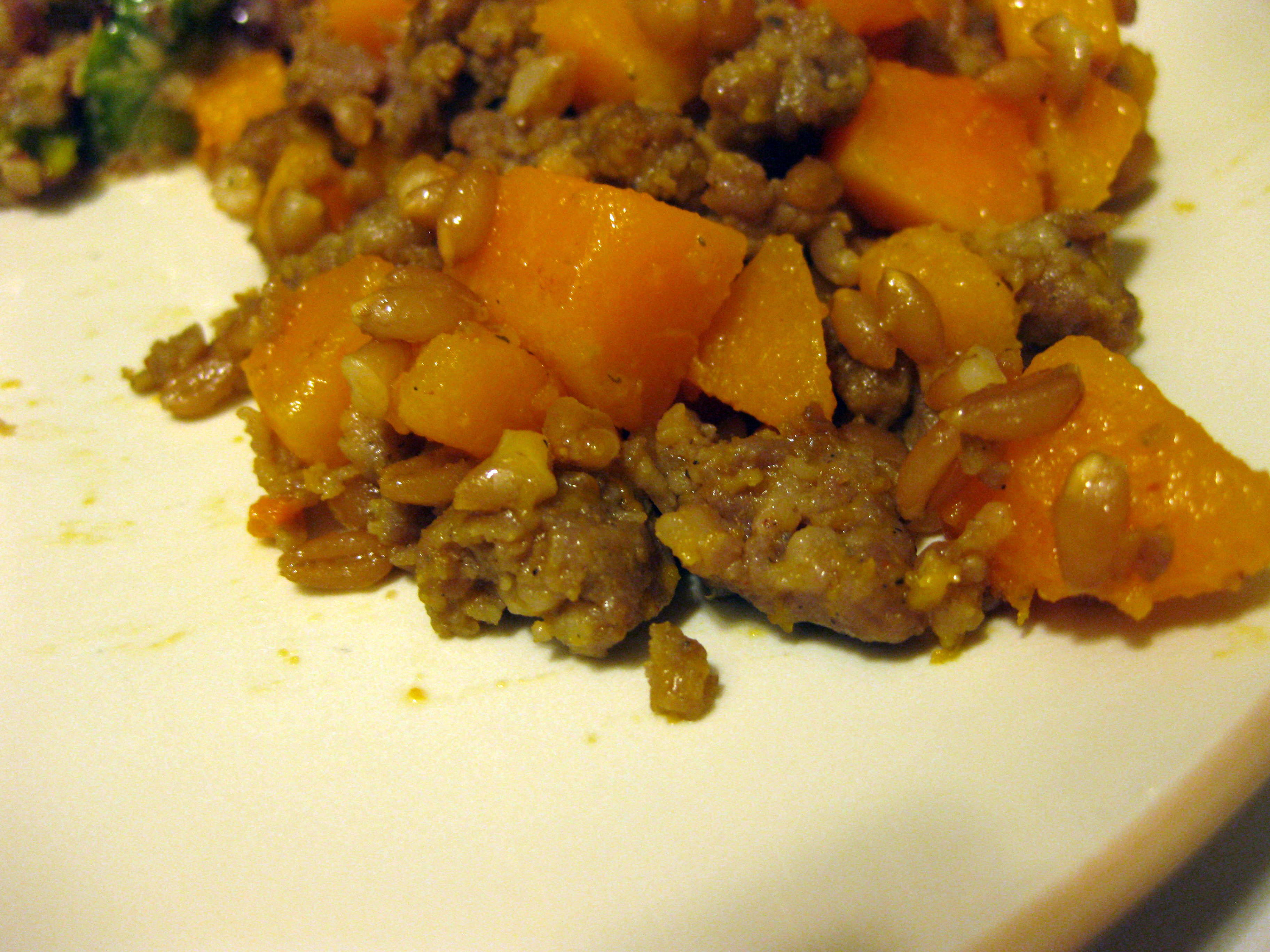
Thank goodness cooking isn’t like that. I love revising what I’ve done in the kitchen. So here, instead of telling you what I did (which involved undercooked ingredients and a side of roasted brussels sprouts in gorgonzola sauce), I’m going to tell you what I should have done. I’m going to tell you how to make this Bittman dish into a fantastic breakfast-for-dinner hash.

37. Sauté crumbled sweet Italian sausage with cubes of butternut squash in a bit of oil. Toss in cooked farro and dress with more oil and lemon juice. Serve as a salad or toss with grated Parmesan and use as a stuffing.

Here’s how it should have gone down:

1 cup emmer farro

2 cups water

4 cups chicken or vegetable broth

1 small butternut squash, peeled, seeded, and cut into 1-inch chunks

16 oz. pork sausage

4 eggs, or as many people as you intend to serve

2 cups baby spinach or chopped kale leaves, hard stems removed

Juice from ½ a lemon

Salt and pepper to taste

The night before you want to eat this, put the farro in a pot with the water and leave it overnight. This starts to break down the grains.

After the farro has soaked overnight (and most of the next day probably won’t hurt), add it to boiling broth and simmer for two hours, or until the grains have bloomed and softened. In the last few minutes, add the spinach or kale and cook just until wilted. The farro will still be a bit crunchy, and may or may not have absorbed all the broth. If not, drain the pot and set aside.

While the farro cooks, preheat the oven to 400F. Toss the butternut squash chunks with olive oil, salt and pepper, and roast until the squash is tender.

In a large skillet over medium heat, crumble and brown the sausage. When it is fully cooked, drain off some of the grease, then add the farro, greens, and squash to the skillet and toss together, just to let the grains and vegetables soak up some of the sausage fat and flavor. Squeeze in the lemon juice and season to taste with salt and pepper.

In another, smaller skillet, heat the reserved sausage grease and fry your eggs sunny side up, until the yolks are barely runny and the whites’ edges are frizzled and beautifully brown.

Serve your hash with a fried egg on top.  With a side of sourdough toast rubbed with garlic, if you like.  Let the yolk mix with the squash and sausage and hearty grain.  It won’t take much; you’ll quickly be full. Full of warmth and goodness. It’s the right kind of meal for winter.

Sick soup

Clearly the past week did not go as planned. No Bittman posts appeared here, and no new recipes were made. Until today at lunch.

I don’t get sick very often. When I do, it’s usually a head cold that lasts mayyyyybe three or four days until I get frustrated with it and flood myself with so much liquid that the cold just gets flushed right out of me. This week was different. I don’t know whether this thing that hit me was cold or flu, but it knocked me over, dragged me around for a while, and then pummeled me almost senseless.

My wonderful husband has been nursing me on simple, nutritious dinners and generally keeping me out of the kitchen, which has been a strange experience. But as this morning wound to a close, with husband and dog-daughter out on a walk, I was suddenly struck with a craving for – of all things – Cup’o’noodle soup. You know, the kind in the styrofoam cup with the peel-back paper top, packed with noodles and freeze-dried vegetables and crusty little shrimp? Yeah, I wanted that for the first time in probably ten years. Maybe more.

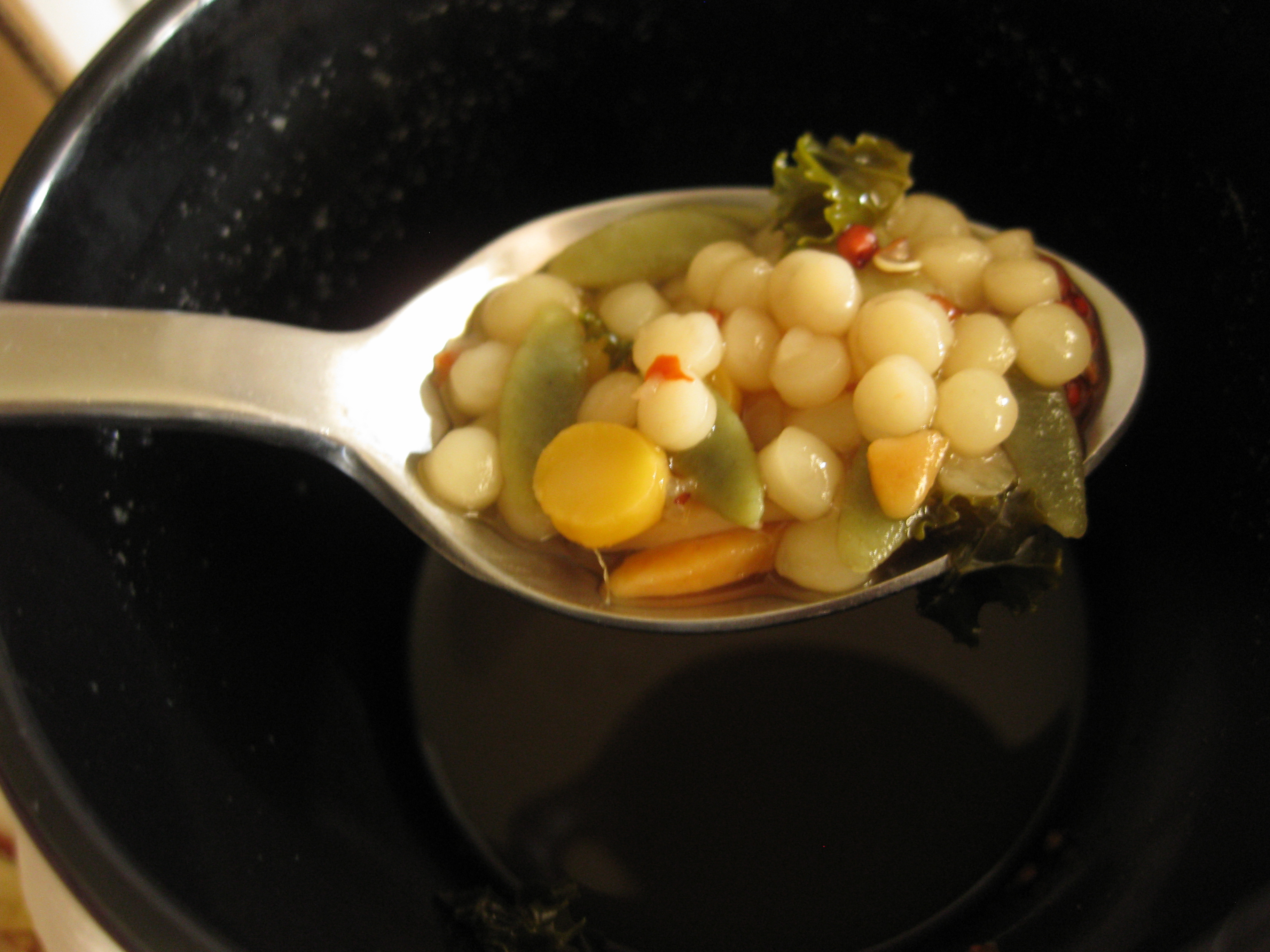
Of course we don’t have Cup’o’noodle in the house. But we did have frozen turkey broth, made from the carcass of our Thanksgiving turkey. And I had the memory of my friend M.’s suggestion for “garlic tea” as a cold remedy. I went to work in slow, hobbling steps.

In a pot, I put:

3 cups turkey broth (shlooped out of a freezer container in one icy cylinder)

6-10 cloves of garlic, well smashed

2-inch knob of ginger

½ tsp red chili flakes

I turned the heat up and let this come to a boil, where I left it rolling for about 10 minutes to let the garlic and ginger flavors really permeate the broth.*  Then I added:

1 cup loosely packed torn kale leaves

1-2 TB soy sauce

¼ lemon (I squeezed out the juice and then added the wedge of lemon as well)

½ cup Trader Joe’s harvest blend (Israeli couscous, split peas, red quinoa, and orzo)

I let this simmer away for 10-15 minutes, until the kale was wilted and the grains were cooked.

Then I ate the whole pot. 

It was delicious. It wasn’t the over-salted, noodle-y guilty-awesome of Cup’o’noodle, but it was comforting and satisfying and spicy and rich and felt healthy. The lemon juice added a necessary brightness, and the grains blend made it filling enough for lunch. The garlic, the ginger and the chili flakes all have their own kind of spiciness, and all were welcome and throat-soothing and tummy-warming.

If you’re not feeling well (or even if you are!), make yourself a pot of this. To bulk it up, add more grains, or sub that out for noodles, or add some pre-cooked shredded chicken or squares of tofu. If you don’t like kale, add some spinach in the last five minutes instead. Using vegetable broth would easily make this vegetarian and vegan, and using tofu or rice noodles instead of the grains blend would easily make this gluten-free.


* At this point, you could strain out the garlic and ginger, and add the vegetables and grains to a clear broth. I didn’t, but then again, I’m the sicko.

Soup’s on!

No time for lengthy reflections today, but we did cross a milestone last week: finally broached the soup selection on my long-neglected Bittman list!

“Saute sliced shallots in olive oil, then add chunks of butternut squash, some rosemary and chicken stock or water to cover. As the soup simmers, bake strips of prosciutto until crisp. Puree the soup, swirl in some cream if you like and serve topped with crumbled prosciutto.”

This sounded easy and tasty, and with no less than 20 cups of homemade turkey stock chilling in the freezer after Thanksgiving, I had just the thick, tasty broth to add extra flavor to this soup.  Given vegetable availability and my preferences, I changed things up a little.  I used:

1 whole acorn squash, halved, seeded, and brushed with olive oil, salt and pepper

1 TB olive oil

1 shallot, sliced thin

2 cups turkey stock

2 sprigs rosemary, stems removed and leaves minced

¼ – ½ cup heavy cream

salt and pepper to taste

4 slices prosciutto

I preheated my oven to 400F and put the acorn squash halves cut side down on a cookie sheet, leaving them to roast for almost an hour, until a knife inserted went through the skin and flesh like jelly.  Then I took them out and set them aside to cool until I could handle them without searing my own flesh. 

I replaced the squash in the oven with prosciutto, spreading out four slices on parchment paper on a cookie sheet and baking until they got crisp, about 15 minutes.

In a deep pot, I heated olive oil over medium heat and added the shallot slices, letting them soften and then caramelized a bit, till they were pale gold in color and smelled sweet.

When the squash was cool, I scraped all the flesh out of the shells and dumped the flesh into the pot with my caramelized shallot.  I added my turkey stock just to cover the squash, the rosemary, a little salt and pepper, and brought it to a slow simmer.

Once the soup was simmering and seemed evenly heated, I pulled it off the stove for a moment to use my immersion blender until the soup was a glistening puree of gorgeous autumn velvet.  Back on the stove with a perfect texture, I added the cream and stirred gently to integrate it, watching the bright orange mellow into a rusty gold.

Dolloped into warm bowls, I crumbled prosciutto over the top of the soup and, as a last textural element, inserted a slice of sourdough toast, broiled with olive oil and rubbed with a raw garlic clove before sitting down to eat.

This was so tasty.  Lik Orangette, soups sometimes leave me feeling wanting, especially because I use my own stock, which is so much less salty than any processed broth or soup out there.  But this one was far from bland.  Roasting the squash and caramelizing the shallot lent a lovely nutty richness.  The rosemary added a sharp herby punch to the smooth creamy velvet of the soup.  And the prosciutto was just the right salty meaty indulgence, though for a vegetarian version you could certainly use a frico of parmesan cheese instead. 

If you’re not in the mood for soup, I think this could be a nice change-up to mashed potatoes as well.  Just reduce or drain off the stock and serve nicely pureed alongside a frittata, or some roast chicken and pan-crisped green beans.