Will go barefoot for onions

Over the past year or so, Ina Garten and I have become good friends. She doesn’t know this; she doesn’t know I exist. Her Food Network show at first struck me as pretentious, with its demands for homemade chicken stock, Dutch process cocoa, and all the highest quality and therefore highest priced ingredients. The reminders of the Hamptons and the floral arranger and food photographer guests were a bit heavy to me. For a graduate student, Ina’s lifestyle and, I thought, her food, were beyond my budget.
In continuing to watch, however, Ina grew on me. Maybe it was by comparison to the other increasingly noisy newcomers to the network, or maybe it was my building confidence in my skills as a cook, but she is now among my favorite of the TV chefs. She cooks like me. Or, perhaps more accurately, she cooks the way I would cook if I had the means. She speaks plainly, but you can tell she is well educated in her field. She is messy. She doesn’t mind the occasional drip of batter onto a white counter-top or puff of flour onto a silk shirt. She looks like she enjoys food, and feeding people, and eating with them. Without really realizing it, I also found that more often than not when I turned to the Food Network website to find recipe suggestions, the recipe I ended up choosing was hers. I have made her Italian Wedding Soup, I have made her lemon bars, I have made several of her vegetable side dishes, and as of last week, I have also made her French Onion Soup.
This soup has, for almost a decade, been one of my restaurant go-to items. I love it. I love how it looks when it arrives at the table, with crusty bubbled Swiss cheese enameled onto the side of the soup crock. I love how it smells, with the fragrant sweetness of long-cooked onions steaming out once you break that crunchy-chewy protective cheese blanket. And really, an aromatic soup of sweet onion tendrils in rich meaty broth with the accompaniment of bread and cheese? I hardly even need to extol the flavor.
As seems to be a recurring theme here, however, I was always intimidated by the thought of making this soup. I don’t know why. I had every intention of doing so for a number of years, even registering for (and receiving) a pair of red French Onion Soup bowls as wedding gifts. It has been almost three years since I added these bowls to my kitchen collection, and yet it took until last week to put them to their intended use. With gigantic onions in my pantry, Swiss cheese in my fridge, and two-day-old baguette slowly getting crunchy on my counter, I went trolling for recipes and, to no great surprise, ended up with Ina’s. In addition to the dozens upon dozens of good reviews, it looked easy, and it looked really good.
In addition to halving the recipe, I made only minor changes. As several of the reviews note, it took longer than the 20 minutes allotted for the onions to get really brown and caramelized. I didn’t have the bourbon or sherry that Ina calls for, so I used a mixture of red and white wine, which I found to add depth and rich flavor. I didn’t have, nor would I want to use, veal stock, so I mixed beef broth with homemade chicken stock as a substitute. Since I am getting reacquainted with my garden as the weather slowly, grudgingly warms, I also added two big sprigs of thyme from my thriving little soldier.
When the onions had browned down in my soup pot and were delicate, pliable, and dark gold, I added red wine and let them simmer together. I brought a little piece of onion in to N., who was sitting on the couch and sniffing appreciatively, and he said only “ooohhhhh” after slurping down the offering. It was unlike the onion it had once been in almost every way. Soft, melting against the tongue, sweet but dizzingly rich with the addition of the red wine flavor. No bitter harshness, only mellow tenacity. Then I added beef broth, and white wine, and left the whole thing to simmer. As Ina says, “how bad could that be?”
It was far, far from bad. When the pot had simmered sufficiently (translation: when the smell was too enticing for us to resist any longer), I wedged a piece of toasted sourdough baguette into the bottoms of the aforementioned bowls, ladled steaming soup on top, and then mashed on as much grated Swiss and Parmesan cheese as would fit across the top. I broiled these little offerings until the cheese began to brown and crisp, and then we ate.
It was amazing, and I am again astounded by how inexpensive the ingredients are that make up this luxurious soup. As I have already mentioned, the onions softened but still held their shape, and became like oddly shaped little sponges for the flavors of the wine and broth. The cheese was melted in stringy gooey strands on the bottom, against the broth, but hardened into a crunchy crisp on the top, making two different flavors simply thanks to its textural change: toasty and salty on top, creamy and reminiscent of fondue on the bottom.
I am already devastated that I only made a half recipe, because we wolfed down our servings, we scarfed up the leftovers, and now sitting here typing, with a Spring headcold making my sinuses pound, I am overwhelmed by desire for a big steaming bowl of this rich, comforting composition. Thanks, Ina.

Post-partum parcels of joy

After passing my exam a couple weeks ago, I went and spoke with my adviser to find out what I should be doing to keep on track.  She told me to rest.  Rest!  Actual, warranted permission to lie around, to catch up on terrible reality television series, to take naps and sleep in, uninterrupted by guilt about conferences, articles or (gulp) the dissertation!
Of course this didn’t last long.  Like any kid after the first few weeks of summer vacation, I got bored.  So I turned to the kitchen, as usual, to vent my new creative focus.  I spent my weekend on a few special projects.  As I’ve mentioned before, it has become something of a hobby of mine to “collect” menu descriptions from restaurants and try to recreate them.  On this occasion, I didn’t even have to do that much guesswork.
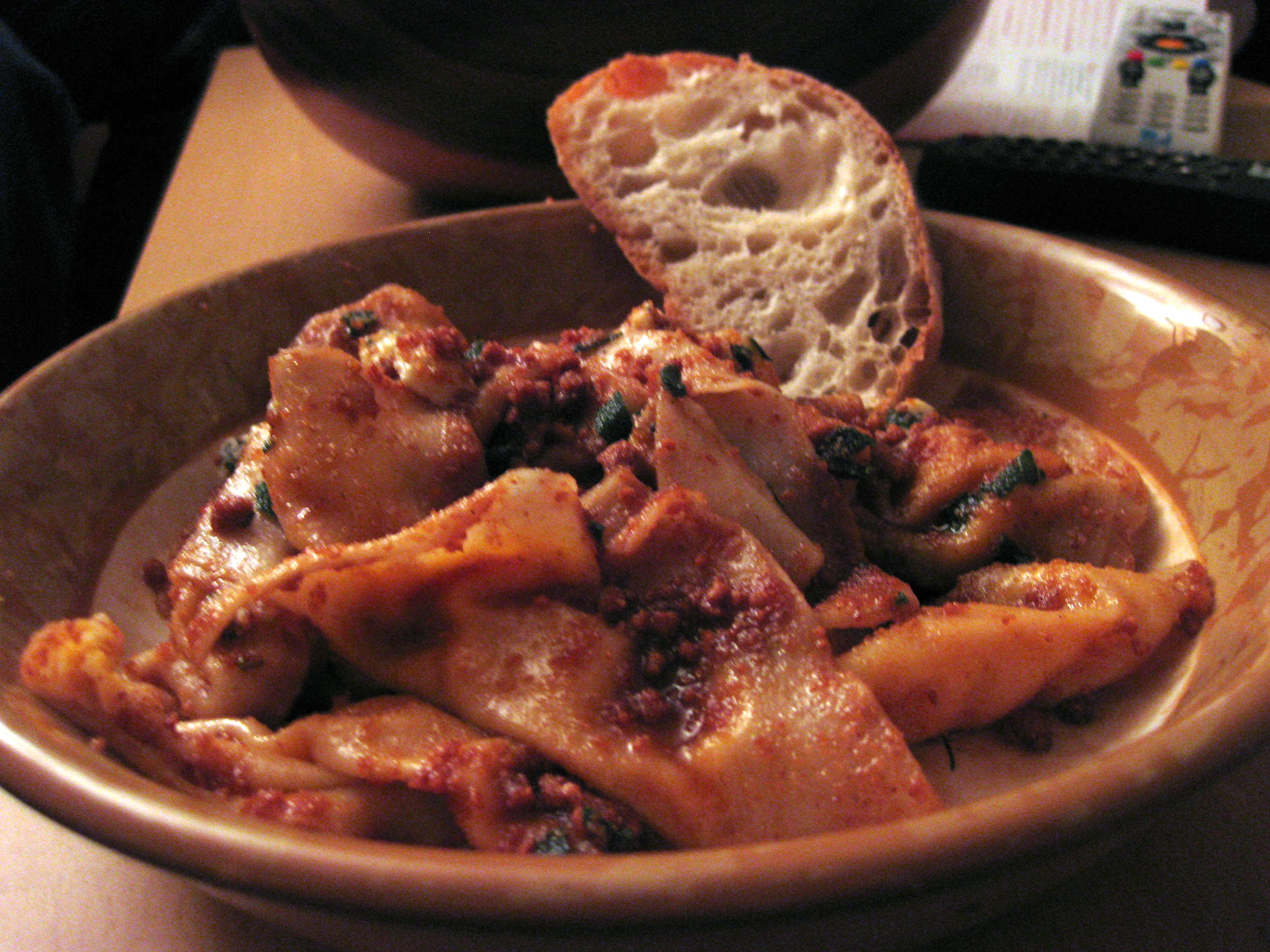
Pasta Piatti in Ashland is a favorite of mine, and I’ve mentioned it before.  When N. and I had dinner there in celebration of our second wedding anniversary this past summer, I had their butternut squash ravioli in a brown butter sauce with sage, crumbled biscotti cookies, and “Oregonzola” cheese from Rogue Creamery.  It looked like this:

Gloriously, the restaurant posts recipes for some of their dishes on their website, and the filling for their extravagantly delicious squash ravioli is one of them.  Make this at home?  Yes, please.

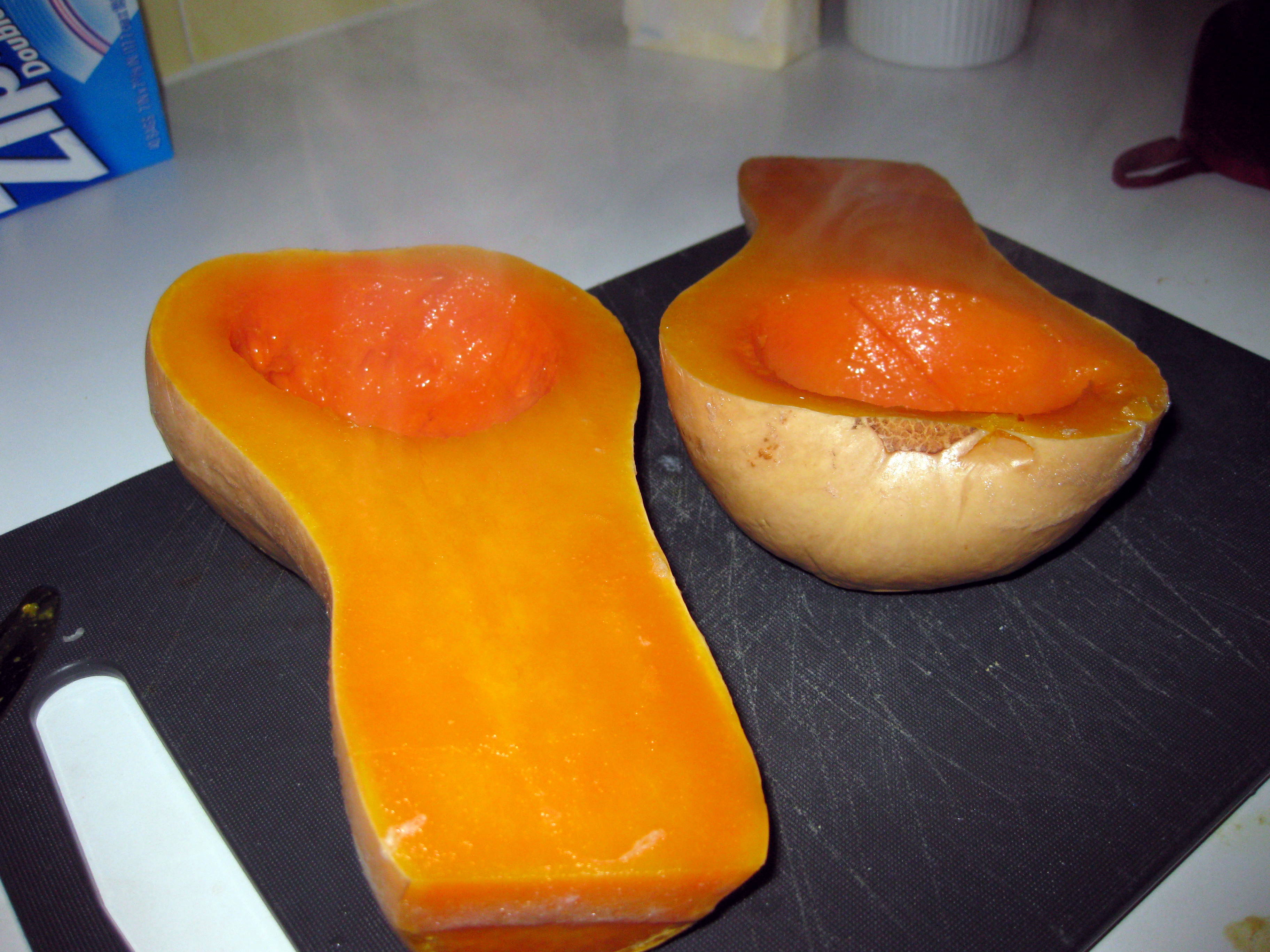
It’s a process, but I think it’s worth it.  See the recipe for detailed directions, but note that there are a few inconsistencies (i.e. do you food process the onion along with the squash and garlic, or just fold it in?).  It took about an hour for the squash to cook and the garlic to soften and fill the house with its sweet buttery aroma.  I processed together the squash, garlic, sauteed onion (though I used shallot), and egg yolks, but folded in the cheeses so they wouldn’t melt or gum up the blades of my food processor.
When the filling is cooled, you can address containment.  Though you could certainly make your own fresh pasta, or maybe even stuff large shells or manicotti, I addressed a package of square wonton wrappers.

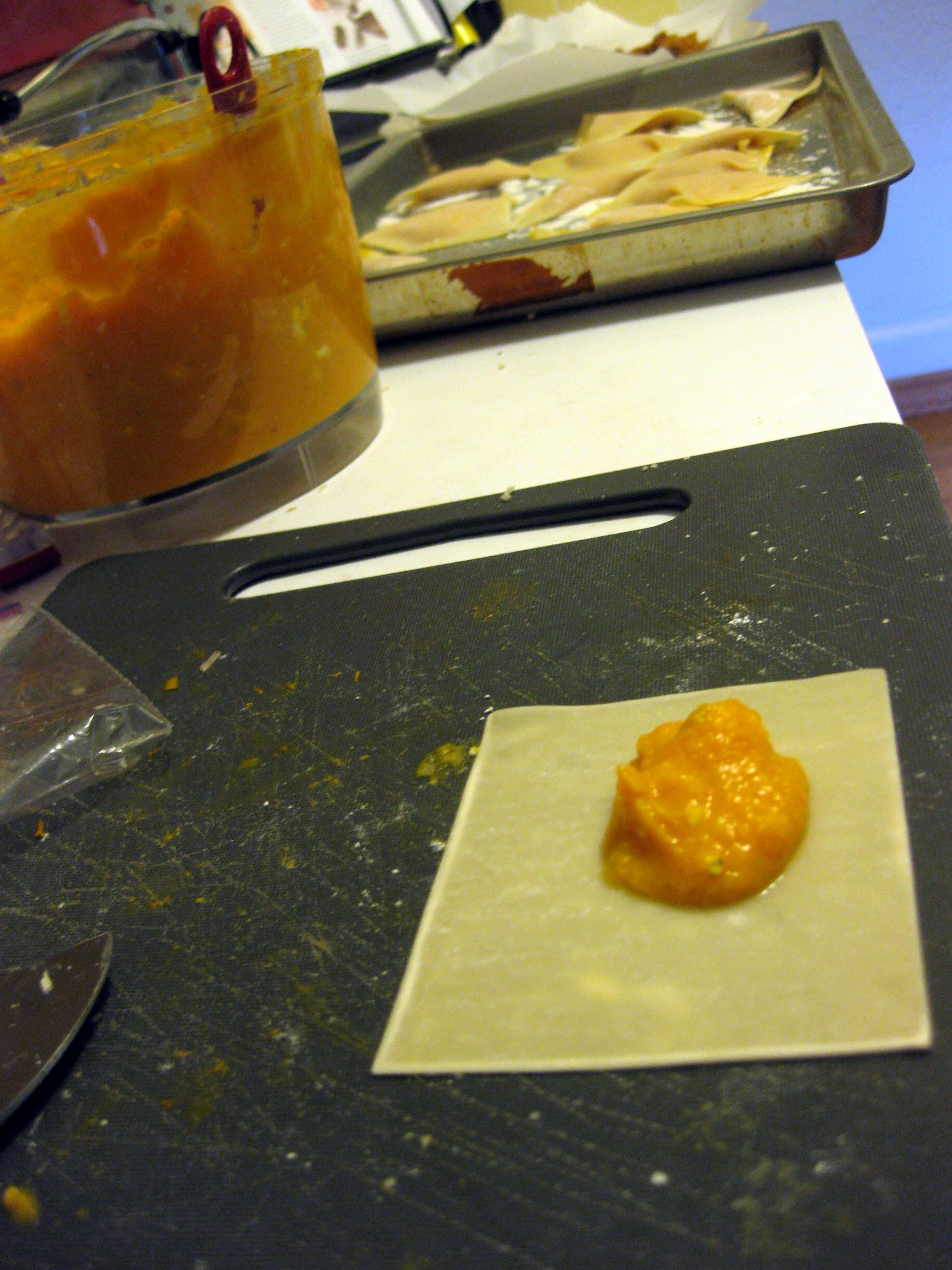
Made from wheat flour and fairly flexible, wonton wrappers are a good, easy substitute for fresh pasta.  I loaded up each square with about ½ a tablespoon of filling, wet the edges, and folded them into semi-clean, somewhat isosceles triangles.  How that word survived in the memory banks astounds me.  Geometry was a long time ago.  After spreading the little packages on a well floured cookie sheet, I stowed them in the refrigerator for an hour or so to let the seal set while I got everything else ready.  With water heating on the back burner to boil my squash-stuffed parcels, I readied the rest of the arsenal:

½ cup (1 stick) unsalted butter
2 TB fresh sage, minced or in chiffonade
½ – 1 cup graham cracker crust crumble (recipe follows)
2 oz. Oregonzola cheese, crumbled (or any gorgonzola or mild blue cheese)
salt and pepper to taste

1.  During a downtime in the cooking process (either while the butternut squash and garlic are roasting or as the ravioli are cooling down in the refrigerator), mix together about a cup of graham cracker crust with 2 TB brown sugar and 2 TB melted butter.  Spread the mixture on a parchment paper lined cookie sheet and bake at 325 or 350 until deep golden brown and crumbly.  Crumble up and cool.  Pasta Piatti uses crumbled almond biscotti.  I just used what I had in my pantry and it worked out very well.
2.  While you wait for the water to boil for the raviolis, melt the butter in a large pan over medium heat.  When foam subsides, the butter will begin to turn a deep gold and then brown.  As it moves from gold to brown, toss in the sage and allow it to fry until almost crisp; crunchy little shards of herbage.  You may at this point have to turn down the heat so the butter will not burn while the ravioli cook.
3.  The ravioli will only need 3-4 minutes to cook in rapidly simmering, salted water.  I let the water cool from a rolling boil before dropping them in a few at a time because I wasn’t sure how well sealed they were, and I wanted to forestall explosions or leaking.  I was mostly successful.  When they float to the top of the pot, scoop them out with a strainer or a slotted spoon and deposit them carefully into the butter sauce, draining off as much water as possible before adding them to the skillet.
4.  When all raviolis have joined the dark golden buttery bath, fold them gently into the sauce and add the cookie and cheese crumbles.  Mix again gently and serve with bread and salad.

We had a ciabatta loaf from Trader Joe’s and a salad of romaine, arugula, thinly sliced Granny Smith apple, pomegranate seeds, and walnut halves as a side.  I made a quick dressing from finely diced shallot and sage, with honey, white wine vinegar, and mayonnaise.  Thanks to an impromptu Trader Joe’s trip for the gorgonzola cheese, the pomegranate seeds and the ciabatta, I was able to pair dinner with a TJ’s special: Green Fin white table wine.  This is made from organic grapes, which supposedly eliminate some of the problems caused by tannins (headache, bad hangover), but also tastes delicious.  It’s a bit on the sweet side, which seems good for this meal; the sweetness of the butternut squash and the cookie crumbs in the sauce offers the peril of bitterness to an ordinarily lovely white wine.

But let’s get on to the important bit: the ravioli.  The filling is soft and luscious, since it has been blended, and the wonton wrappers are so delicate after their boiling bath that they almost dissolve on your tongue.  With a whole head of roasted garlic in the mix, you might expect a stronger garlic flavor, but because it is roasted it just melts into the background as a sweet, mellow support for the squash.  Sage and squash are a natural pairing, and the herb adds a little freshness to the nutty, almost caramel notes of the brown butter.  These flavors all blend so well, but the real glory of the dish in my mind is in the contrasting crumbles.  The cookies and the cheese are such opposites in flavor and in texture; the cookies are crisp and sweet-crunchy, even after a dunk in butter, while the cheese maintains its structural integrity for a while as the dish cools on your plate (ahem, it would, if the dish had long enough to cool on your plate before you devoured every last bit) and provides a creamy, slightly chewy counterpoint.  Since gorgonzola is not terribly sweet and, in fact, has its own definitive funk to it in flavor and in aroma, it coats your palate a bit, protecting it from the potentially overwhelming sweetness of the squash, the butter, the cookies.
This is a beautiful dinner.  It would also make a rich, out-of-the-ordinary dessert, and an unconventional but satisfying breakfast.  But we didn’t leave enough for all that…

The Week of Magical Eating days 3 and 4: Soup and Salad

Since sharing lunch with my friend S. a few weeks ago, I have developed a minor obsession with Caesar Salad.  The crispest romaine, whether to add the Parmesan by shreds, crumbles, grates or curls, the perfectly textured crouton: crisp and golden on the outside, with the barest hint of residual chewiness deep within.  But mostly, the object of mystery and allure is the dressing.  It’s tangy but creamy and rich but still light, and pulls the flavors of the salad together to make it a phenomenon.  I decided to make it.  In the gloom of winter, I don’t have the opportunities I’d like to find farm-fresh eggs, and locally grown egg yolk is all I would feel comfortable using without cooking it.  Besides, N. gets worried about raw foods sometimes, and he doesn’t care for the idea of fish in dressing, so egg and anchovy were out.  I poked around online and found some vegan Caesar salad dressings with interesting suggestions, including the addition of brewer’s yeast and tamari to add the salty richness of anchovy.  I collected ideas and then, as usually happens, ended up making my own.

Mayonnaise, lemon juice, brown mustard, tamari, pepper, and garlic went into the mixing vessel that came with my immersion blender.  I pulsed these ingredients together a few times until the garlic was chopped and things were looking paste-like, and then streamed in some olive oil with the blender running until it reached a more dressing-y consistency.  It’s a work in progress, and I didn’t take note of amounts, but it began to capture that lofty Caesar flavor as I added additional spoonfuls of mayo here and lemon there… a bit too much mustard in the first squeeze.  Over-enthusiasm, you know. Tossed with fresh greens, lemon wedges, and sourdough croutons from half a baguette, it was almost right.  Almost there, but close enough for a weeknight.

The next night, inspired by a recipe request I couldn’t fulfill from D., I scoured the ‘nets for a suitable looking black bean soup.  Our salad accompanied a slow cooked chicken with 40 cloves of garlic, and I saved the garlic-infused broth our chicken expelled in the crock pot, so I had a wonderful flavorful stock to use for soup.

After sliding a pan of batter in and a loaf of cornbread out of the oven half an hour later, I commenced to create Dave Lieberman’s black bean soup, found here:  http://www.foodnetwork.com/recipes/dave-lieberman/black-bean-soup-recipe/index.html

I made a few changes to his recipe, for one reason or another, which I’ll share because I thought the result turned out well.

I cooked my bacon until crispy before draining out some of the fat (which ended up mixed with dogfood; Lucy was ecstatic!) and adding only 1 ½ onions.  Instead of Dave’s can of chicken broth, I used the leftovers from our chicken, which were about 1 ½ cups, and about a third of a bottle of New Belgium 1554 for a little extra flavor and fizz (then I handed the remainder of the bottle to N.  Beer and bacon = happy little family!).  I eliminated the ketchup and forgot the lime juice, and added my cilantro right at the end rather than letting it cook.  I decided I wanted a fresher green flavor, so it would serve as a garnish.

Then we went a little crazy with toppings.  I crumbled up some queso fresco, which I am having a deep affair of intrigue with, and used up my single-serving ramekins providing serving dishes for cheese, sour cream, green onion tops, more cilantro, and lime wedges.  The photo below isn’t the most aesthetically pleasing composition, but it was belly-warming and hearty, and tasted marvelous.  We usually have trouble finishing up leftovers from soup, but it has been only four or five days since I made this, and the remains are already gone.  That should tell you something.

Homage to Stratigraphy: Lasagna #2

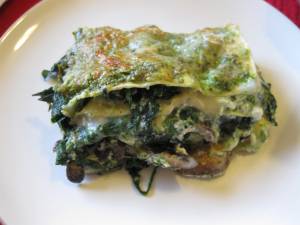
After both taking and making suggestions for improvement about the lasagna I made here, I decided to take advantage of the last few weeks of outdoor Farmers’ Markets and take a second stab.  I believe I have now created the ultimate: Wild Mushroom and Spinach Lasagna with Arugula Pesto and Sundried Tomato Cream Sauce.  Since I have had several requests, I am willing to share the recipe with y’all.  Here goes, and keep in mind that most of my measurements are approximations.

Preheat oven to 350F and make sure you have a 9×9 square glass baking dish.

Ingredients:
1/2 lb (?) mixed wild mushrooms (I used reconstituted dried shiitakes and golden chanterelles from the Saturday Market)
1-2 bags baby spinach leaves
2 bunches arugula
(your own mix for pesto, or my cheat: 3-4 TB premade pesto, to blend with arugula)
Olive oil
4 TB butter
3 cloves garlic, finely chopped
1/4 cup flour
2 cups milk or cream (or a mixture)
Splash of white wine (if desired)
salt and pepper
2-4 TB sundried tomatoes, finely chopped
1 16oz. container ricotta cheese
1/2 cup grated mozzarella cheese
1/4-1/2 cup grated Parmesan
no boil lasagna noodles

Procedure:
1. Roughly chop the mushrooms and fry them in a medium saucepan in olive oil or butter to your liking.  Don’t rush them.  Keep them on about medium heat and wait, patiently or impatiently, until they have sucked up all the butter, expelled their own liquids, and then regained those liquids to become browned but still tender.
2. Add the spinach and cook just until it has wilted but still retains its bright green color, then set the mushroom and spinach mixture aside.
3. Meanwhile, whir together arugula, premade pesto, and a little extra olive oil in a blender or food processor (or just make your own arugula pesto).
4. In a medium saucepan, melt butter. Add garlic and cook just until fragrant. Add flour and combine well to make a roux. When flour is well incorporated and has cooked for a minute or two, add milk or cream slowly, stirring or whisking well until clumps are incorporated. Season with salt, pepper and white wine to taste.  A little grating of fresh nutmeg might also not be amiss.  Add sundried tomatoes and stir gently until thickened to your liking.
5. Combine all three cheeses
6. Assembly: spread a layer of sauce in the bottom of your pan and add a layer of no-boil lasagna noodles. Then, add layers in your preferred order. I stacked cheese, arugula pesto, mushroom and spinach mixture, then sauce in that order before adding another layer of noodles and repeating the process. Repeat until you run out of filling ingredients (should be about half a box of noodles, if you are using Barilla and a square pan). After adding the final layer of pasta, top with any remaining sauce, cheese, and/or pesto, and then add a generous layer of grated Parmesan. (If you don’t have sauce to add to the top, the final layer of noodles will not soften as nicely as they should.  I discovered this as I made my first cut.)
7. Bake for 45 minutes or until the cheese on top is browned and looks a little crunchy, and the fillings are bubbling up on the sides. If possible, wait for five minutes before cutting in, because the slices will hold together better this way.

IMG_1962

Enjoy.  Gorge.  Disintegrate.  Burn your mouth on the cheese and decide you don’t care, eat chilled slices you cut out of hand straight from the fridge at midnight, or have your neighbors over and just decimate the whole thing in one sitting, for I declare this the ultimate spinach and mushroom lasagna.

Dinner for one

At the beginning of October, N. went to a literary conference in Spearfish, South Dakota.  That’s right, Spearfish.  For almost a week.  Now, I don’t even like eating dinner alone, much less rattling around the empty (all-but-dog) house in the evening and settling into bed by myself (again, aside from the dog who spent each night usurping more of my blankets).  You hear the creaking and settling of an old house much more clearly when something is out of the ordinary.

To assuage my loneliness, of course, I turned to food.  There are several items in this wonderful culinary world that N. doesn’t like.  One of them is shrimp.  I know, I must be crazy for having married him with such a deficiency (another of his dislikes is coconut.  Crazy!), but otherwise he’s pretty perfect.  So in his absence, I ate shrimp.  A recent issue of Cooking Light had a wonderful looking shrimp pasta recipe that I wanted to try out, and with the crustacean hater a full time zone away, this was my opportunity.

Shrimp, pine nuts, a little white wine, basil, and some nutmeg and pepper spiced cream made the sauce, and I tossed spaghetti into it and folded the creamy sauce around the long strands of pasta before adding a generous grating of Parmesan cheese.  Though this sounded like an excellent meal all on its own, I have been making an effort lately to be sure I include some kind of vegetable (or fruit) material in my meals, and a few julienned leaves of basil wasn’t going to cut it on this one.

I turned to tomatoes.  Our sungold cherry tomato plant, with which I’ve been having a serious love affair all summer, provided me with several generous handfuls of tiny, deep orangey-gold spheres of sweet juicy flavor explosions.  I drizzled a little olive oil over them in a small skillet and agitated them in the pan until they started to burst their skins.  Then I added salt, pepper, and two big glugs of balsamic vinegar and let it heat through until barely simmering.  Then I couldn’t stand it anymore, and ate a huge helping of tomatoes and pasta.

It was delicious.  The sauce for the pasta was creamy and luscious, punctuated by bursts of freshness from the basil, and deep, complex buttery nuttiness from the pine nuts and nutmeg.  The tomatoes, meanwhile, were tart and sweet – almost sweet enough to be dessert.  When I went back for a second helping (what can I say, I was all by myself with no one to help me enjoy the feast!), an amazing thing had happened.  Though I had turned off the stove (safety first!), I had left the pan containing the tomatoes on the cooling burner, and there was enough residual heat to begin to reduce the balsamic vinegar.  What remained was a slowly thickening syrup of balsamic and sweet cherry tomato juice, sticky and oozing among the deflating tomatoes.  I couldn’t stand it, I gobbled up the remaining spoonfuls and left the rest of the pasta for another day.

At my house, dinner for one looked like this:

IMG_1796

My First Lasagna

Since I’ve been in California for roughly the past two weeks, I haven’t shared any foodie experiments or revelations.  Yes, I cooked and ate delicious food on my trip, and yes, I brought my camera with me.  However, I neglected to bring the correct cable to plug the camera into a computer and upload the photos.  I’m home now, and certainly have things to share, but for the moment I’m much more excited about tonight’s dinner, which is currently just starting to emit cheesy delicious aromas from the oven.

I have never made lasagna before.  I’ve heard a lot of complaints about how it’s labor intensive and time consuming, and since two of the major ingredients are ground beef and tomato sauce, I’ve steered clear.  I like ground beef in hamburgers, and occasionally in burritos or meatloaf, but I’d prefer that it stay away from my pasta.  As for the tomato sauce, since I’ve entered adulthood cooked tomatoes in almost any form upset my stomach.  Therefore I have found a large number of alternative pizza and pasta toppings so I can still enjoy Italian cuisine.  But lasagna… that was always a roadblock that I wasn’t overly inspired to circumvent.

Then N. and I went to Ashland for our two year wedding anniversary.  In addition to the delicious food that we ordered from Pasta Piatti on Main Street (a must-visit, in my opinion), I salivated over most of the options on the menu, including, to my surprise, their take on the perennial classic: lasagna.  Here’s their description, and tell me this doesn’t sound amazingly delicious: roasted wild mushrooms, layered pasta, spinach, ricotta, parmesan, arugula pesto, white sauce.  I mean, I guess if you’re not a mushroom fan then it wouldn’t sound amazingly delicious, but I suspect substitutions could be made.  I scribbled down this description on the back of a receipt that I’d jammed in my wallet, and it traveled through the state (and into the next!) with me for the next few weeks.  Then we saw a dip into what might be the beginning of the fall season.  The temperature dropped.  The rain returned for the morning.  It was conveniently Saturday so that I could go and pick up a few things from the Saturday Market.  It was cool enough to turn on the oven, and so I decided to brave the lasagna.

It was a little bit time consuming, if only because there were multiple steps, but I wouldn’t call it particularly labor intensive.  Here’s what I did:

  • Reconstituted a package of shiitake mushrooms in a mixture of warm water and white wine for half an hour (tip: never buy dried shiitakes in the produce section; they cost about twice as much for about half as many mushrooms as they do in the Asian foods aisle!)
  • Chopped and blanched a bunch of Italian kale and about ½ lb. of baby spinach, drained and cooled in a colander.
  • Sliced and fried a generous handful of crimini mushrooms in butter, adding some pepper and the drained, squeezed, sliced shiitakes when the criminis were about half done.  When both kinds were done to my liking, I deglazed the pan with some white wine (I had about a ¼ of a bottle I was trying to finally evict from my refrigerator) and then continued to cook the mushrooms just until the liquid had evaporated.  Then I set them aside in a bowl to cool.
  • While the mushrooms were cooking, I made the arugula pesto.  I must confess, I love the idea but hate the practice of making my own pesto.  I can never seem to get the ratios right.  But for this dish, I had what I must call an ingenious fix.  I had a container of store-bought pesto in the fridge, and I combined four or five TB. of this with probably 2 cups of arugula in my food processor and pulsed them together.  Flawless, and so much easier than making it from scratch.
  • Using the same pan as I cooked the mushrooms in (I’m big on reducing the number of dishes needed for a meal), I made a roux with about 3 TB. each of butter and flour, then added between 1 and 2 cups of milk to create a white sauce.  When it was thickened, I added some pepper, freshly grated nutmeg, and the last few tablespoons of that pesky bottle of wine.
  • Then it was time to assemble.  Since I’ve never made this before, I actually found deciding which order to add ingredients to be the most challenging part.  I put down some sauce first, then a layer of no-boil pasta, then a mixture of ricotta cheese and arugula pesto, topped by the veggies and sauce.  Then I repeated, confining myself to three layers of pasta so our dinner would be heavy on the vegetables.  On the top layer of pasta, I spread the last little bit of sauce, a little bit more ricotta and pesto, and then a generous layer of grated parmesan cheese.  When I stuck it in the oven, it looked like this*:

IMG_1717

When it came out 45 minutes later, it looked like this:

IMG_1723

The cheese was browned and crusty, the sauce was bubbling up around the corners, and miraculously, my worst fears did not come to fruition, as the no-boil lasagna noodles were soft and chewy.  I was secretly afraid they would be crunchy, because I’m not familiar enough with the product to know how they work.  Here’s my review: the mixture of both greens and mushrooms was great, and made the dish taste satisfyingly healthy (well, as healthy as cheese-laden pasta gets, I suppose).  The arugula pesto added a satisfying bitterness, which I’m sure was helped along by the kale.  And of course, it was creamy and cheesy and actually came out of the baking dish in servable pieces, rather than collapsing all over itself in messy piles.  Actually, if I may toot my own horn for a moment, the whole thing was rather beautiful.  Somehow, despite not really knowing what I was doing, I got the proportions of fillings to cheese to pasta to sauce pretty much right.  A nice crisp white wine would go nicely with a large square of lasagna, which is convenient as you could simply drink the wine you were also soaking and deglazing the mushrooms with.

IMG_1726

All in all, it was a good, tasty dinner, but it’s definitely a work in progress.  N. and I both decided that, lacking the usual piquant, acidic bite of the tomatoes in a red sauce, the dish was actually missing something.  The flavors of the cheese, the pesto, and vegetables were good, but they were a little muddy without that sweet tangy top note of tomato.  For next time, I will be making a few additions.  To attempt to compensate for the missing acidity of the tomatoes, I’ll add extra lemon juice to the pesto mixture.  We both agreed that maybe adding a sprinkle of parmesan cheese along with the ricotta in each layer would add a nice touch; I don’t use much salt when I cook, and sometimes the deep greens like spinach and kale need some to enhance their flavors.  Extra parmesan mingling with the vegetables while they bake might accomplish this without actually having to add salt.  I might also add some of my beloved Penzey’s Black and Red pepper blend the next time to the white sauce, just to spice it up a little bit.  It was creamy and thick and good, but really, milk, butter and flour cooked together have only so much flavor on their own.

Other additions, or accompaniments, that have occurred to me since dinner include mixing finely chopped sundried tomatoes into either the white sauce or the mushrooms.  They would add that intense tomato flavor without the heavy sauce that upsets my stomach.  Thinly sliced fresh tomatoes in between each layer, or maybe only on the top layer underneath the parmesan cheese, might accomplish the same thing.  Finally, an old friend from high school T. just told me about a sauce she makes of roasted tomatoes and red peppers that might do the trick, and I wonder whether a plain old roasted red pepper sauce would have the same zippy tang as tomatoes?  Certainly it would be pretty, even if it was drizzled over the top or added plate-side.  Lasagna #1: down.  Lasagna #2 awaits…

* Nota bene: as a geologist’s daughter, I am all but obligated to understand and appreciate cross-sections as a method of conveying information.  Conveniently enough, this seems like a perfect strategy for photographing lasagna!