Hindsight

One of the valuable lessons this Bittman project is teaching me is flavor combinations.  I like to think I am a pretty good cook, and lord knows I can follow a recipe (well, when I’m paying attention…), but I am still learning how to put ingredients together without a guide.  Mark Bittman’s 101 is teaching me about this in two ways.  First, he provides me with glorious combinations of ingredients to try out.  Second, because I am not serving these dishes each week with “Thanksgiving dinner,” I am learning that before I make each item, I am only guessing how well it will match with the rest of the meal I’ve envisioned.  This week, we took on acorn squash, which is one of my favorites:

“45. Render some chopped bacon in a bit of oil, then add apple chunks; cook until nearly soft.  Meanwhile, bake halved and seeded acorn, butternut, or delicata squash until they start to soften.  Fill squash with apple mixture and finish baking.”

Much as I love winter squash, I was faced again with the difficulty of deciding what else to serve with what I hoped would be boats of delight.  Because our last squash experiment had needed something more substantial than the quinoa I paired it with, I decided this time on organic chicken sausages with roasted red pepper and garlic.

Bacon and apples sounded amazing and decadent, but I decided to add a little to Bittman’s foundation.  Here’s what I used:

1 acorn squash, halved and seeded
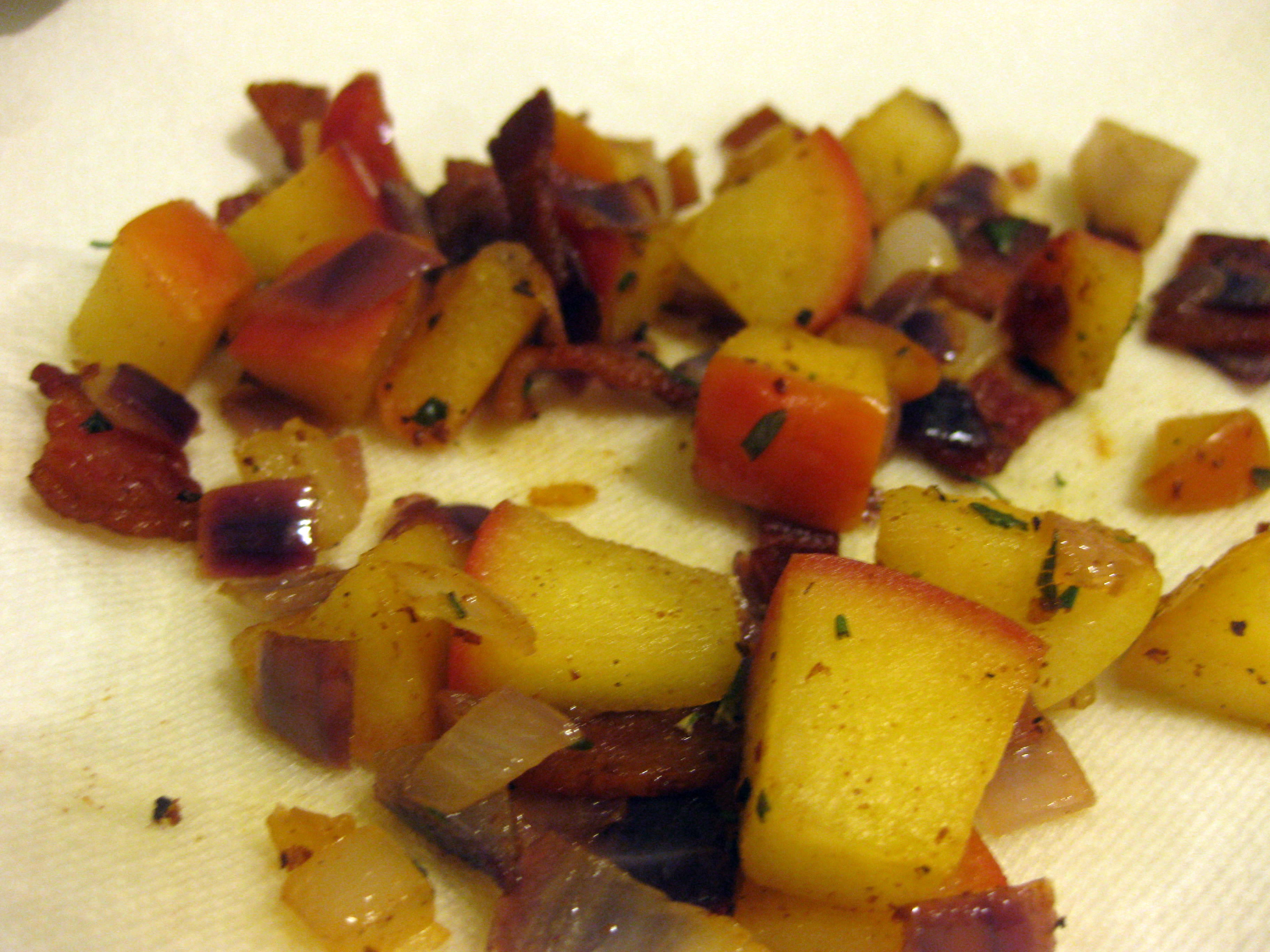
½ lb bacon, chopped

2 apples, skin on (I used Braeburns), quartered, cored, and chunked

½ a medium onion, diced (red onion added mild flavor and nice color)

1 tsp fresh rosemary, finely chopped

Salt, pepper, and olive oil

I preheated the oven to 400F for the squash.  To keep them standing upright, I sliced a very thin piece off the “bottom” of the rind where I wanted it to sit.  Just a little peel off the rind made a flat surface for the squash to balance on.  I wedged the halves into a cake pan and sprinkled liberally with salt, pepper, and olive oil.  I put them into the oven for about 20 minutes and concentrated on the stuffing.

I decided to eschew the extra oil, and put my squares of bacon into a dry pan on medium.  While it sizzled, whining and complaining about the heat, I chopped the apples and onions.  With the bacon halfway to crisp, I dropped in the onions, wanting to give them time to grow tender and sweeten.

When the bacon was teetering on the edge of barest crispness, I added the apple chunks.  They only needed five minutes to begin to soften before I turned the stove off.  Because I knew they were going to continue cooking in the oven, I didn’t want them to lose all their texture in the pan.

In three quick sweeps, I folded the rosemary into my apple mixture, slipped the squash out of the oven, and packed the boats full, no, overflowing.  They looked beautiful, and it was difficult to say goodbye as the oven door closed between us for another 20 minutes.

With sausages sizzling and charring and smoking ever so slightly on the stovetop, I liberated the stuffed squash and loaded them onto our plates.  The smell was wonderful, and the flavor matched.  The squash and apples were sweet, but had soaked up some of the bacon fat, which complicated their flavor.  The bacon itself was meaty and fatty and crispy and salty (I love bacon, can you tell?) and perfect.  It was a nice textural component as well, as the squash was beautifully soft and creamy, and the apples were barely toothsome.  As I had hoped, the sharp piney flavor of the rosemary kept the dish from being too rich.  It was a lovely herbal note.
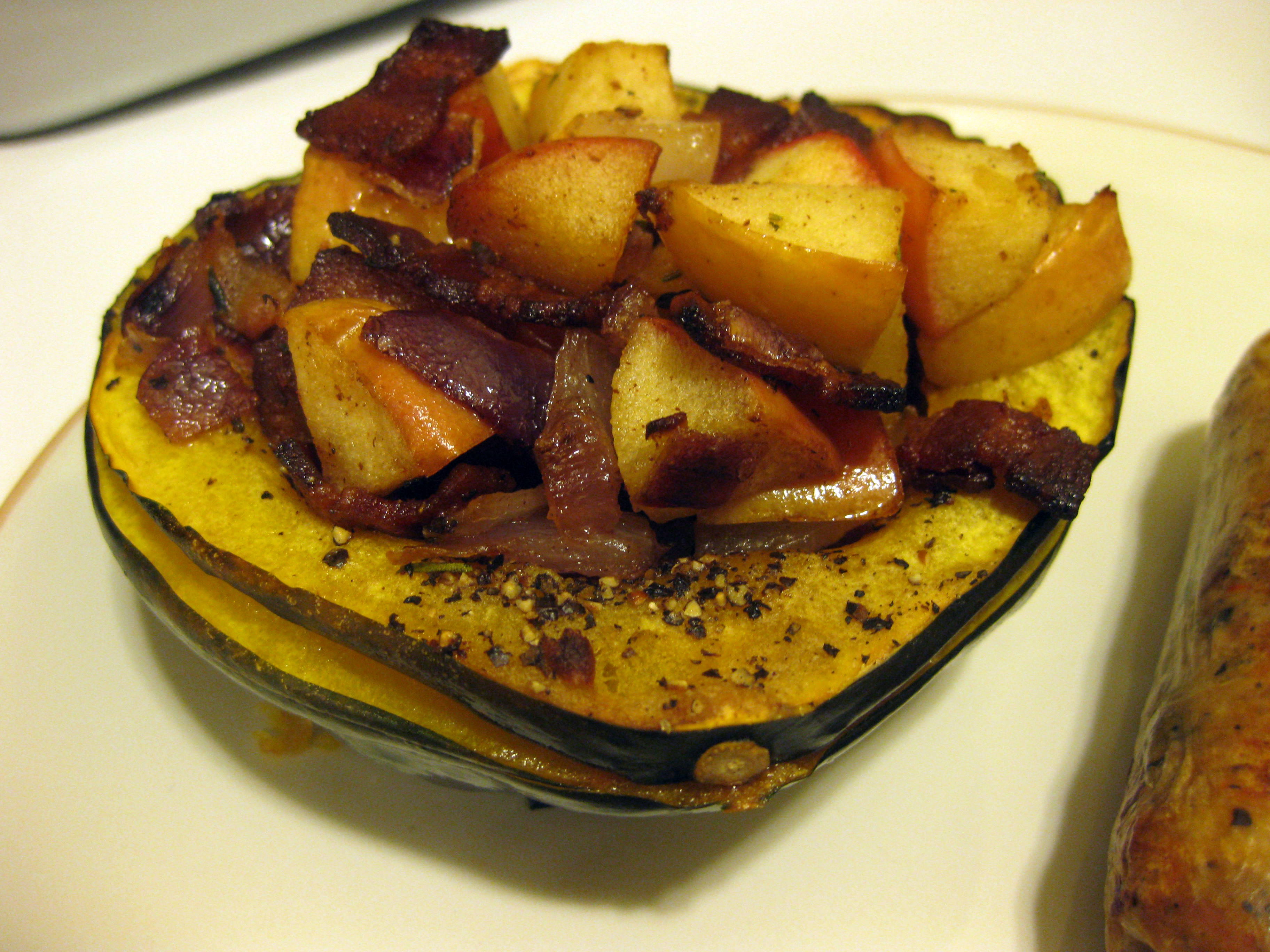
Because I packed the boats so full, the bacon in the dish was more than just an accent, as I had somehow expected it would be.  Therefore, the side of chicken sausage I had chosen was not the best possible pairing.  It was not until the next day as I heated up the leftovers and ate them alongside a corn muffin we’d had as a side earlier in the week that I realized what would have been perfect: golden circles of baked or fried polenta.  I chose meat when I should have chosen starch.  But as I am learning with this project, there was really no way I could have known the perfect side until I had tasted the dish.  That means to get it perfect we will have to have this again.  “What a shame!” she exclaimed with a wink and a smirk.

This is absolutely a recipe to keep and try out.  I’d imagine the ingredients you stuff the squash with could be changed up: apples could be replaced with pears, bacon with prosciutto, or you could go more savory and add leeks or garlic, but if your squash boat includes bacon I’d recommend serving with a starchy side rather than meat – polenta, cornbread, maybe even buttered noodles or gnocchi.  My 20/20 hindsight says it would be better balanced.  And in a meal in which the vessel threatens to fall over and spill its rich treasures across your plate if you don’t take measures to keep it upright, balance is a necessary thing.

Currying flavors

The thing about Mark Bittman’s make-ahead sides is that they are all ostensibly created with a main of turkey in mind.  They are, after all, Thanksgiving inspirations.  Therefore, when I ask myself the inevitable question each week “what should I serve this with?”, I suppose I shouldn’t be surprised when the first thing that pops into my head is “that would taste really good with roast fowl!”  Of course it would.  That plays into the composition of Bittman’s list.

But we don’t want turkey every week, or chicken, for that matter.  Lately, both for ease, for cleanliness, for cost, and in some minor and embarrassingly halfhearted respects for moral and environmental concerns, I’ve been more drawn to vegetarian fare.  Potatoes, rice, grains, beans: these guys don’t cross-contaminate my kitchen.

So I’m having to be unusually creative in my search for accompaniments for the accompaniments I’m cooking.  This week N. chose, from a short list, an interesting combination:

“43. Toss chunks of butternut squash with butter and curry powder.  Roast until half-tender, then stir in chunks of apple and some maple syrup.  Cook, shaking the pan occasionally, until everything is nicely browned and tender.”


The mystery about butternut squash is, for me, as with some other orange produce, whether to treat it as a starch or a vegetable.  It seems to occupy some strange and unnecessarily cryptic middle ground.  It’s not green or leafy, but it’s also clearly not a tuber, no matter how much its deep autumnal color reminds me of a good hearty yam.  Yet, if I’m not serving meat with dinner, pairing a butternut squash roast with  vegetables seems not substantial enough, but opting to serve it alongside, say, mashed potatoes, seems excessively filling and somehow repetitive.

I opted for another strange middle ground and went for sauteed red chard stirred into quinoa.  As a nod to the seasonal intentions of the squash dish, I cooked my quinoa in turkey broth I made and froze a day or two after Thanksgiving.  I like the deeper, richer flavor that results from cooking grains and small pastas in broth or milk rather than water.  So our dinner basically consisted of two side dishes, but I decided I didn’t really mind.

Here’s how it went:

1 medium butternut squash, peeled, seeded, and chopped into small chunks

2 apples (I used Braeburns) quartered, cored, and chopped into chunks

1 onion, diced (I thought the extra savory flavor would be nice, since apples and squash are so sweet)

1 TB curry powder

2 TB melted butter

1-2 TB maple syrup

I tossed the chunks of squash on a cookie sheet with melted butter and curry powder, then slid it into a preheated 375F oven to roast for 20 minutes.  Meanwhile I prepped my apples and onions.  After 20 minutes when the squash chunks were just beginning to give, I pulled the pan out of the oven and added the apples, onions, and maple syrup – a decadent drizzle over the top that I hoped would pair well with the curry – mixed it all around together, and dropped it back in the oven for another 20 minutes (but really, it took almost half an hour).

While the roasting fruits softened and the maple syrup made suggestions of carmelization on their corners, I addressed our other side dish.  I stripped the chard leaves from the stems, chopped the stems into a fairly small dice, and plunged them into a pot with a couple teaspoons of olive oil.  I sauteed them over medium heat until they were just beginning to soften, then added the quinoa.  In one of my favorite quinoa recipes, Danny (the Chef of Gluten-Free Girl and the Chef ) suggests toasting the quinoa before adding any liquid, much as you toast the rice in a risotto before deglazing the pan.  I toasted for a few minutes, then poured in the turkey stock and clapped on the lid.  When there were only five minutes left on my timer, I added the chopped chard leaves into the mix, stirred it together well, and replaced the lid so it could finish cooking.  It worked perfectly.  The chard had just enough time to steam as the final few tablespoons of water were absorbed, but not enough time to overcook and lose all semblance of texture.  I can’t stand that sliminess that greens sometimes get after too much contact with the heat.  To my delight, the quinoa had taken on a lovely deep rosy color thanks to the chard stems, and the toasty nutty crunch of the grain worked really nicely with the healthful greenness of the chard leaves.

When I pulled the butternut and apple mixture out of the oven, all I could smell was sweetness and curry.  The maple syrup had thinned in the heat, but cloyed onto the chunks of fruit as it cooled again.  The mixture was really nice.  Butternut squash and apples are very good friends, and leaving the skins of the apples on was a wise choice because it added textural interest to the dish.  The curry made the flavors deep and warm and spiced, and the maple syrup was a nice hit of sweetness.  This one I would make again with no reservations, and only one (okay, maybe two) changes.  I put the diced onions right onto the cookie sheet, raw from my cutting board.  When I make this again, I will soften them lightly in butter first.  They didn’t roast quite long enough to quell the astringent tang onions sometimes have, and I could feel them in the back of my throat afterward.  Mellowing them out on the stovetop first would be the right thing to do.

To change it up from curry, I think garam masala would also be delicious on this mixture, and fortunately (and conveniently!) enough, Aarti of aarti paarti has just posted suggestions for making your own!  How timely!  How fortuitous!  Let’s make some!  And then, make this autumnal dish.  Maybe with turkey.  Maybe with chicken sausage.  Maybe, as I realized only after dinner was over, with potato masala burgers from Trader Joe’s.  What a congenial blend of spices that would be to curry favor with your family!

Apologies for the punning… I couldn’t resist.

Candyland

My two favorite board games when I was a kidlet were Chutes & Ladders, and Candyland.  I liked the first, but found it slightly stressful, since it seemed I inevitably ended up sliding down the longest possible slide and having to restart the game from the beginning.  Looking back, I wonder whether the primary design of this game was to keep children occupied with it for as long as possible, to give exhausted parents a chance to rest.  Having no siblings at that point in my life, if this was the goal of the game it backfired in my family.

But Candyland?  Candyland I loved.  And I loved it not so much for the gameplay itself, but for the fantastical characters and decorated board, and for the outrageously wonderful idea that a whole kingdom could be made out of and based around candy.  It was like “Cloudy with a Chance of Meatballs,” but better.  Because it was candy.  My favorite figure in the game was Queen Frostine.  She had blueish silver hair that came down to her waist, and a sparkling rock candy scepter.  I still remember the first sentence or two provided about her in the game description: “Peacefully adrift on an ice cream float in an ice cream sea…” Pretty, powerful, royal, and living in ice cream.  It was everything I thought I had ever wanted.

When Candyland was at last boxed up for good and covered in an inch or two of dust in our attic, I retained a love for both miniatures and candy.  Thus, truffles were like little boulders, or tree stumps, and gingerbread houses were the most romantic, creative way of celebrating the desserts of the holiday season.

Now, as an adult but also a student, my holiday budget is somewhat limited.  But I know, since I share my life and most of my friendships with other graduate students, that food – especially a special, out of the ordinary sort of food – makes a good gift.  So, with the holiday season approaching and the term ending, early in December I celebrated my extraordinarily timely submission of my first dissertation chapter by hiding books, pencils, and papers from myself and instead filling my kitchen with bags and boxes of chocolate.  I submerged myself back into Candyland.  Not as Queen Frostine this time, but as a new character: the Empress of Truffletown, perhaps.  I wrote some time ago about my first experience with truffle production, and this time I wanted to explore some new flavors – add my own sweet twists to the basic recipe. 

The basic procedure is to coat squares of ganache in melted chocolate.  It seems to me after some experimentation that the right ratio in a ganache is 6-8 tablespoons of liquid for each 8 oz. of melted chocolate.  At least 6 of these liquid tablespoons should be heavy cream.  But the really exciting part lies in the possibilities for the other 2 tablespoons…

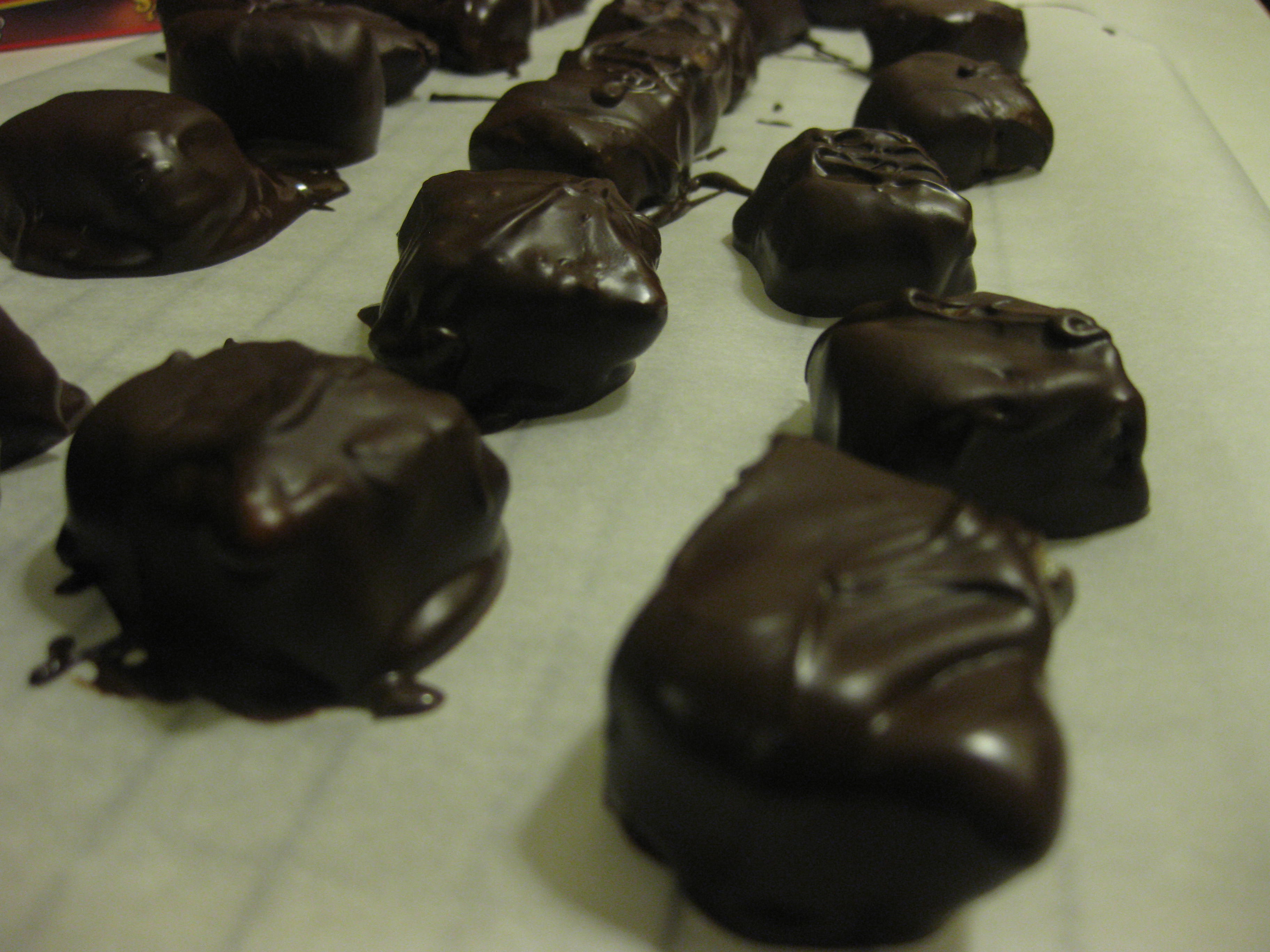
I made three varieties: Amaretto White Chocolate Truffles, Gingerbread Truffles, and Peppermint Truffle, and popped them into some pretty, festive boxes I found.  Then, just for fun, I also whipped up some Almond Butter cups.  My willing taste testers declared the Amaretto and the Almond Butter cups the best selections.

Amaretto White Chocolate Truffles:

To make this flavor, I melted 6 TB of heavy cream with 8 oz. white chocolate over a double boiler.  When the mixture was almost completely melted, I carefully stirred in 2 TB amaretto.  When it was completely smooth, I added a few tablespoons each finely chopped dried apricots, and finely minced, toasted almonds.  I stirred the whole thing together quickly, poured it into a plastic wrap lined loaf pan, and stowed it in the fridge to harden.

The following day, I pried the block of creamy white goodness, studded with precious gems of flavor, out onto a board, cut it in squares, and dunked each in melted semi-sweet chocolate.  After letting these harden on parchment paper, I added a white chocolate drizzle to the top for a little flair.  They were incredible.  The white chocolate was delicately flavored by the amaretto, which is one of my favorite liqueur varieties.  Nutty and rich and sweet, and here punctuated by the soft crunch of almonds and the slight chew of apricot chunks.  This variety is definitely one for the recipe books.  I will absolutely be making it again and again.

Gingerbread Truffles:

I followed the same basic procedure for these as for the Amaretto version, though I used dark chocolate as my base for the ganache.  Lacking a ginger flavored liqueur, I melted the chocolate with only 6 TB heavy cream, and stirred in about a ¼ cup finely chopped candied ginger.  Again, I refrigerated, again, I removed, sliced, and dipped.  Then, while the outer layer of chocolate was still glossy and wet, I sprinkled a good teaspoon or two of powdered gingersnap cookie crumbs atop each truffle.  Spicy and warm in the back of the throat, with a pleasing crispy crunch from the cookie powder.  I did find, with these, that the ganache was a bit crumbly after it hardened, perhaps because it was made with less liquid.  I would up the amount of heavy cream in the mixture to 7 or a full 8 tablespoons to try and combat this issue.

Peppermint Truffles:

For these, I combined 8 oz. of milk chocolate with 6 tablespoons of heavy cream and 2 tablespoons of peppermint schnapps we had kicking around in the back of our liquor cabinet.  This time, instead of pouring into a loaf pan, I just left the ganache in the glass bowl I was using as the top portion of my homemade double boiler.  While I waited for it to cool and solidify into that glorious fudgy paste ganache becomes, I broke up and crunched several candy canes into bits.  The bottom of the peppermint schnapps bottle proved an excellent tool for this project.  A rolling pin would probably also work well for this.  As I scooped out each tablespoon of ganache, I rolled it into a ball with my hands and then rolled it through the candy cane flakes, creating a pinkish minty snowball to add to the collection.  I wasn’t as thrilled with the flavor of these; the schnapps came through more as the harsh grate of alcohol rather than the spicy-cool flavor of peppermint, but my taste testers didn’t complain.  They were Christmas-y in appearance, which no doubt leant to their appeal.  If I do this flavor again, I might use only one tablespoon of schnapps, rather than 2.

Almond Butter Cups:

I was much less exact with these, working mostly for flavor rather than creating a recipe.  Again, I melted 8 oz. of chocolate – semi-sweet this time.  Then, I mixed a few tablespoons of powdered sugar into a cup or so of almond butter.  Trader Joe’s makes a really good crunchy variety with roasted flax seeds, so that is what I was using.  When the sugar and the butter were well combined, I scooped it into my chocolate and let them melt together into smooth, thick ribbons.  Then I poured a tablespoonful or so directly into candy papers.  I found that setting each paper into the depressions in a mini muffin tin made them stand up straight and not collapse when the hot chocolate mixture was added.  I refrigerated my muffin-tin-full to let them set up.  Imagine taking a bite of a Reese’s Peanut Butter Cup.  Now imagine it tastes of almonds instead of peanuts.  Now imagine that nutty flavor is mixed evenly through the chocolate, rather than sitting in the center, and that it is interspersed by the crispy, deep, roasty-ness of golden flax seeds.

Presenting boxes of these collected divinities to my officemates, a few close friends, our neighbors, and finally our families, I felt like a benevolent ruler.  Sure, it’s only my little kitchen where I rule with a chocolate-daubed fist, but my offerings were wide and sweet.  Move over, Candyland.  This is Truffletown.

Heralding Fall

A few weeks ago, N. and I took some friends to Agate Alley bistro, and one of them ordered the Pumpkin Enchiladas.  I was intrigued.  I took a mental note: these would soon appear in my humble little kitchen.

Then summer came to a close.  School started.  And that means I went crazy.  This is my first year dissertating, which means I need to stop playing on the internet and start playing with ideas.  And so the pumpkin enchiladas, and my ability to post here, went on hold.

But Tuesday night, magic happened.  In celebration, perhaps, of the second day of the second week of my second-to-last year as a graduate student (fingers majorly crossed, folks!), I decided to take a few hours with my nose out of books.  And they were pretty incredible (the hours off AND the results).  With my own twists and considerations about ingredients, I put together:

Pumpkin, Roasted Garlic, and Goat Cheese Enchiladas in quick mole sauce.

Enough people have asked me for my recipe (hah!) that I’m going to post in a more traditional ingredient-and-process list format, to make it easier to follow.  This is approximate, however, so tweak and twiddle as you so desire.  I ended up making 5 enchiladas.

Ingredients:

1 whole head garlic, split horizontally

1 – 2 shallots, sliced thin

corn tortillas

1/2- 1 cup pure pumpkin puree

crumbled goat cheese

crumbled queso fresco cheese

handful of pumpkin seeds

Quick Mole Sauce, or your favorite mole, ready to go at the time of assembly.

(I know, this is not a “homemade” mole sauce, and it doesn’t taste exactly the same.  But it’s a good shortcut, I think, and let’s face it: if you want to make these enchiladas to enjoy on a weeknight, most of you aren’t going to take the time to make a mole from scratch.  I’m not ashamed.  I added extra unsweetened chocolate to this recipe, but otherwise kept it mostly the same).

  • Preheat your oven to 400F.  Place the garlic halves in a small dish, drizzle with oil, salt and pepper, and cover tightly with aluminum foil (or just wrap loosely in foil).  Roast in the oven for about an hour, or until cloves are very soft and very golden.  Burnished but not burnt.  Cool, then squeeze the cloves out of the papers and mash them into a paste.  During this time, you can take advantage of the oven being on to roast your pumpkin seeds.  They will only take 5-10 minutes, though, so don’t lose track of them or they will burn.
  • Caramelize shallot slices in a skillet.  They should be dark, dark, like French Onion Soup onions.  Set aside to cool.
  • Turn oven down to 350F. Spread the bottom of a baking dish (I used glass) with mole sauce.
  • Prepare and assemble enchiladas: working with one tortilla at a time, spread the tortilla with the garlic paste, then top with 2-3 TB each pumpkin puree, goat cheese, and shallots (or to taste). Carefully roll up the tortilla and fit it, loose edge down, into the baking dish, pressing each enchilada tightly against its compatriots.
  • Top enchiladas with a thick, even layer of mole sauce.  Sprinkle with goat cheese and queso fresco crumbles to your liking.  I say the more, the better when it comes to cheese, but that’s just me…
  • Bake for 30 minutes, or until the cheese is soft and the sauce is bubbly.  Queso fresco and goat cheese, depending on which types you use, don’t melt and burble the way other cheeses do, but they will soften and collapse on themselves a bit.
  • To serve, sprinkle with toasted pumpkin seeds and enjoy with spicy refried black beans, Spanish rice, guacamole, or whatever you so desire!

I was a bit concerned, at first, that the mole would overpower any other flavor, but it didn’t.  This dish executed an intriguing and intricate dance between dinner and dessert.  Ingredients that often appear in sweet circumstances remained decidedly savory.  The pumpkin and the goat cheese were so creamy and rich, like a harvest cheesecake enfolded in a tortilla.  I could have used more roasted garlic paste, but there’s always next time.  The chocolate in the mole, too, holds the expectation of sweetness but none of the sugary suggestion of a dessert.  Instead it provided a perfect bite of creamy-spicy-chewy-oozing-warmth, with an almost unexpected nutty crunch from the pumpkin seeds.

Also good were last scrapings and bites of loose cheese crumbles, sticky caramelized mole sauce in the bottom of the baking dish, and a last, perfect, creamy green square of avocado.

Dark beer, perhaps even a chocolate stout, would be a lovely accompaniment.

Dancing in the Kitchen with Gluten-Free Girl and the Chef

Shauna and Danny Ahern are my friends.  I don’t know them, we’ve never met, and though I read Shauna’s blog Gluten-Free Girl with a dedication that trips along the border between religious devotion and obsessive-compulsive disorder, I doubt she has ever glanced at mine.  I have drooled over the food (and made some of it!), I have laughed at her triumphs, I have felt my biological clock chime when she speaks of her daughter.  In late July, I sat on my sofa with tears streaming down my face, choking for breath as I read the beautiful story of her wedding.  As a writer myself, I admire her style, her skill with words, and her ability to talk lovingly, richly, thoughtfully about food, about family, about opportunity and love.  I feel like I know these people.  I wish I really did.

A few weeks ago, Shauna announced that along with the forthcoming publication of the cookbook/love story she and Danny “the Chef” wrote together (Gluten-Free Girl and the Chef: A Love Story with 100 Tempting Recipes, listed on Amazon at http://www.amazon.com/Gluten-Free-Girl-Shauna-James-Ahern/dp/0470419717), they were willing to share three preview recipes with interested parties.  I was, of course, one of these, and in a flurried email exchange, I suddenly had three brilliant recipes, replete with stories, to dance to in my little kitchen.

I ended up only making two of the three, mostly because N. doesn’t like shrimp, so a plate of seared prawns in almond garlic sauce did not sound appealing to him.  But if everything in the cookbook is as stellar in flavor and straightforward in instructions as the two recipes I did conquer over as many days, everyone should own a copy of this book, whether you eat gluten-free or not.

Friday night N. and I went to a last-hurrah-of-summer-bbq at the home of J., my birthday twin, and his partner HP.  Troubled by the notion of bringing the chocolate cake again (I’ve made it several times this summer already), I cast about mentally for another idea, and there was the pdf recipe for GFG’s chocolate peanut butter brownies.  My mouth started to moisten.  Chocolate, butter, sugar, peanut butter, and my first experimentation with xantham gum?  Yes, thank you, I think I will!

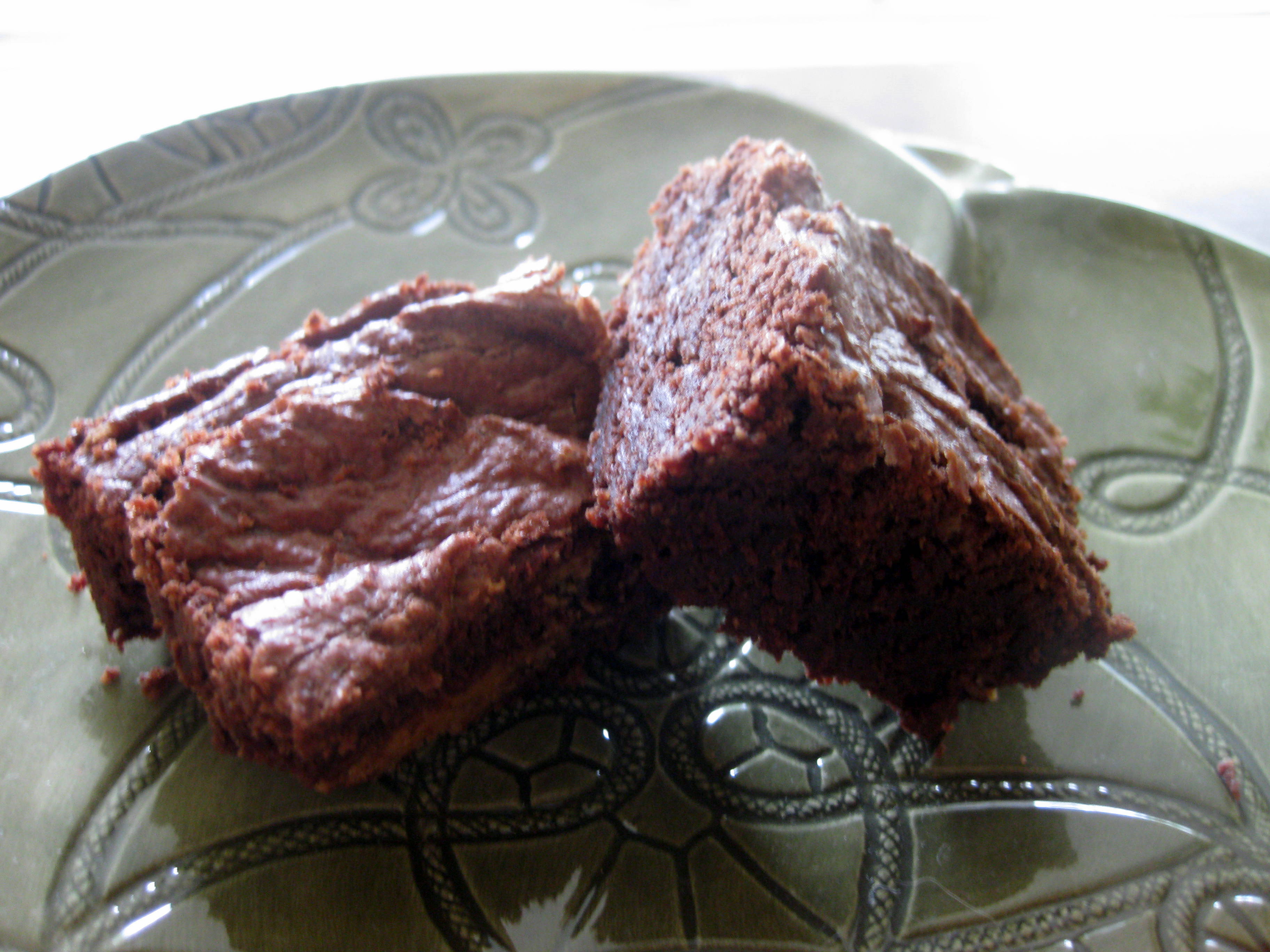
As brownies go, it was a fairly standard procedure of careful melting, mixing, swirling, baking, but oh the delight of tasting!  In the short section about the recipe preceding the ingredient list, the words “Reese’s Peanut Butter Cup” appear.  They aren’t kidding.  With the peanut butter swirled gently into the deep chocolate batter (and there is no other word for the color than that: chocolate) and my fingers cautiously tasting stray blobs of batter, I wanted to stop and eat the batter.  Half of it would bake up just as nicely as the whole pan, right?

I resisted, and slipped the dish into the oven, relinquishing it from sight for half an hour.  Still tasting the batter, I could detect a slight grainy texture that I attributed to the alternative flours used (my previous experimentations with gluten-free flours have not always been great, but they have always been grainy), so I was a little worried about that.  But after the pan cooked, cooled, and came to the party with me, my concern lifted.  I wouldn’t have had to tell anyone these brownies were gluten-free.  I wanted to, because I must admit I wanted to brag a bit about participating in this project (and get the word out there!), but there was no explaining to do.

Oh Shauna.  Oh Danny.  The taste!  The crumb was rich and moist, the pockets of peanut butter were sticky bombs of candy-like delight.  I couldn’t even get a photo in before the hordes descended on the pan.  Seven people decimated ¾ of the pan in ten minutes.  Almost everyone went back for seconds.  Ever thoughtful of my not-so-narrow waistline (and hips, and thighs, and butt), I generally try to leave leftovers at other people’s houses when I choose dessert as my contribution to a meal.  Not this time.  The remaining brownies came with me, clasped tightly on my lap as we drove home in the rain.

Saturday, I ventured out into the weather again to pick up a few last ingredients for my second dance with Gluten-Free Girl and the Chef; it’s hard to make a pasta dish containing lemons, olives, anchovies and pine nuts when you don’t have lemons or pine nuts in your kitchen.  I grumped to myself as I walked to the store and back.  Why did I need this stuff?  I knew I shouldn’t, but it would just be easier to substitute ingredients.  The brownies had been good (liar, understatement of the century!), but this was just pasta.  I could post about the brownies and leave it at that…

I was so wrong.  With water for brown rice pasta considering coming to a boil, I prepped ingredients and tried to imagine what this was going to taste like.  N. had already been frightened by the idea of anchovies, and I knew he was envisioning a cheap pizza draped with little fishy bodies.  I told him that Shauna and Danny said not to be afraid.  He said “hmph,” which meant he was unconvinced.  He doesn’t know Shauna and Danny like I do.

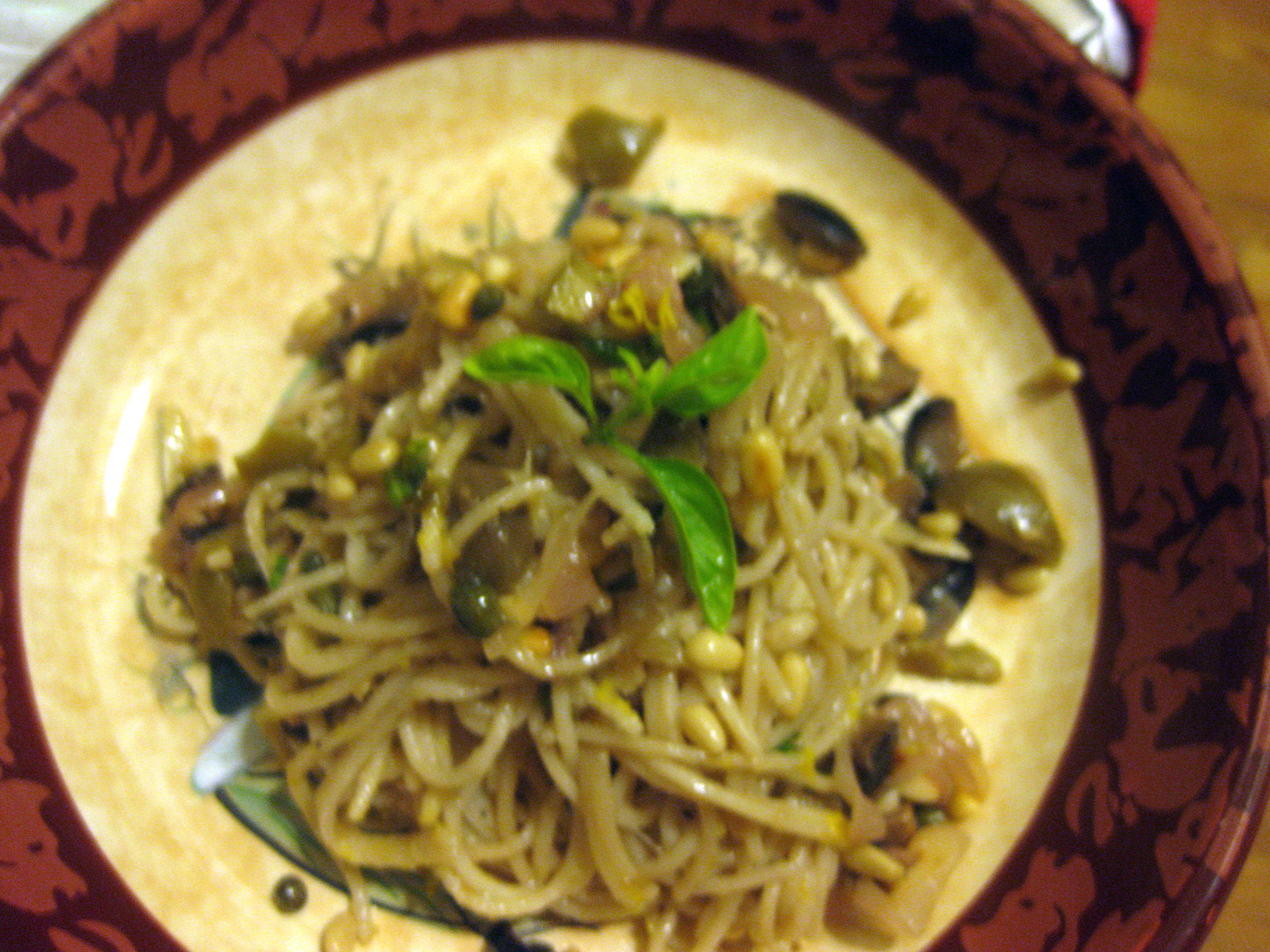
With the toasty, nutty perfume of not-quite-burned pine nuts still lingering in the kitchen, I sautéed a collection of vegetables in my biggest skillet, hurriedly chopping and slicing in between stirring sessions.  I’m always too anxious to cook to bother readying all my mise en place before scraping a boardful of ingredients into the pan.  At the point that the roughly chopped mix of olives I’d kept stowed in the back of my fridge and the finely chopped little fillets of anchovy hit the pan, I felt my knees buckle.  The smell was incredible.  When I added capers and lemon juice, I had a Proustian epiphany of Corsica, of Greece, of Spain.  Except I’ve never been to Spain.  Or Corsica.  Or anywhere in Greece.  It was just a strong enough, rich enough, delicious enough smell that it lifted me from the stained hardwood floor of my kitchen and transported me onto some magical different plane of Mediterranean glory.

Carefully twirling the pasta through sauce, I had to be careful not to drool on it.  These flavors: is this umami?  It was almost more than I could manage to mix in pine nuts, lemon zest, a clumsy chiffonade of basil – I just wanted to eat it straight out of the skillet.

We sat down to eat.  I tried to do one of those perfect forkfuls where you get a tiny sample of everything.  I tried to think objectively about what I was about to experience, about what vocabulary I would use to describe it, about how I could speak like a food critic about it.  I don’t know how.  Here are my words, all I can manage: earthy.  Warm.  Salty-bright-tangy-acidic-perfect.  Briny.  Tart.  Meltingly rich.  Flavor bomb.  Somewhat reminiscent of chicken piccata, but deeper, richer, earthier, nuttier.

And N.?  He scraped his plate.  I asked him what he thought so I could make a report.  “It was excellent.”  As I’ve written before, N. is generally restrained in his verbal praise of food.  And this was “excellent.”

I’ve never bought anchovies before.  I might never allow them out of my pantry again.  This recipe, whether we use gluten-free pasta or not, will fast become one of my staples.  For me, it’s too distinctive to have all the time.  It’s too special.  But for those nights when I need something powerful to wake my taste buds, when I need something that makes my mouth feel alive, this is it.  This was like eating a tango.

Go to a bookstore.  Order Gluten-Free Girl and the Chef: A Love Story with 100 Tempting Recipes.  Rejoice in the story and in the recipes and in the wonderful opportunity to eat really, really good food.  Dance in your kitchen.  And then tell me about it.  And tell Shauna.  I know she’d want to know.

Homecoming

Bodily home from vacation, but my mind is refusing to admit that it’s time to work again. With two writing related project deadlines in September, the beginning of the new school year, and that looming dissertation thing in the background, the time for reluctance and inactivity is over.

Yeah, tell that to my sunbathing motivation and my zinc-nosed inspiration. Since returning home, my productivity has been almost nil.

Far opposite holds true in my backyard. Despite a very, very slow start and still largely unresponsive tomatoes, the garden has rebounded and seems determined to make up for its early uncertainty. Every one of our eight peppers has a small green bell swelling on it. Tiny might-be tomatillos are forming inside wasted flower buds on each of the two plants. Cucumbers and zucchinis, oddly shaped but still tasty, are pushing their way out into the sun. Even the eggplants are growing and fruiting! But the real stars, the real miraculously successful, grocery-store quality items are my pole beans. The first sowing was a failure (too cold), but in the second sowing ten or twelve leaves pushed up out of the ground, and on Monday, as we crawled out of the car after a punishing nine hour drive, at least two pounds of ripe, juicy, six-inch long green beans hung ready from the vines.

What could be better, I thought as I looked at them with grinning awe, than a garden-fresh stir-fry to welcome us home? After two weeks of rich food and restaurant dates, we needed some vegetation in our systems, and here was our own garden graciously willing to oblige!

I started some sticky rice in the rice cooker and ran outside to divest our leafy residents of their harvest.

Eggplant and green bean stir-fry seemed to be the obvious menu choice. I simmered water in a skillet and tossed in the halved green beans, cooking them until they were just tender. Then I drained off the water, added vegetable oil and sesame oil, and tossed in chunks of eggplant and some white sesame seeds. Six minutes later, when the eggplant was juicy and soft and the beans had taken some dark marks from the heat of the pan, I scooped big spoonfuls onto a bed of fresh hot rice, and we ate without talking until every bite was gone.

It’s nice to be home.