Vegetable pickles, three kinds

Food Blog April 2015-0565Not long ago, I finished Cooked, Michael Pollan’s latest, in which he seeks to elucidate the magic of our kitchens. He looks at the transformative power of each of the four elements when applied to ingredients, and works to understand the connections we draw from and through what we eat as it ceases to be raw materials and becomes food. I couldn’t put it down. I tore through it like a fluffy bedtime novel, as my friend S. probably knew I would when she sent me a copy.

Food Blog April 2015-0548In a number of ways, Pollan’s investigation reminded me of my own scholarly work a few years ago when I was a graduate student. Though I was focused on medieval literature, I was intensely interested in what we could learn about human – and not-so-human – beings by examining the literary depictions of how and what they ate. Dietary habits, I thought, along with sexual practices, might be what determines humanness within this field of literature. Too much, too little, or too weird, and your food habits moved you outside what we think of as human, and into something else.

Food Blog April 2015-0546Unsurprisingly, as anyone who has researched food and its cultural impacts deeply knows, this led me to anthropologist Claude Levi-Strauss and The Raw and the Cooked, the first volume of his elaborate, complex exploration of human myth and culture. Without getting too academic, I’ll just say that Levi-Strauss thinks a great deal of the development of culture happens as – and as a result of – foodstuffs transforming from raw to cooked. His analogy equates the wild to the raw, and the civilized to the cooked.

Food Blog April 2015-0549Pollan pulls on and plays with this idea, considering that if indeed cooked food represents culture or civilization, then there must be something about the cooking process itself that is civilizing and bridging. The four elements he examines are aligned with four types of cooking methods: fire explores the tradition of barbecue; water looks at stews and braising; air relates his adventures in the magic/science of bread baking; and earth digs into fermentation, the weird, marginally repulsive transformation of fresh food into pickles, or beer, or cheese – food that is prized and yet impacted by earth and death and rot.
Food Blog April 2015-0552This, too, reminded me of my own work (and don’t worry, we’re getting to the recipe part here soon), particularly an article I ran across as I was working on the Chaucer chapter of my dissertation. Subtitled “The Raw, the Cooked, and the Rotten,” the article took on Levi-Strauss’s nature/culture formulation and added a step to accommodate one of the characters in Chaucer’s The Canterbury Tales. If raw food is wild and cooked food is civilized, what happens when that cooked food goes bad? This seemed to equate to my idea of people who had exceeded the limits of humanness through their eating habits, turning food into waste.
Food Blog April 2015-0557But I was looking at food habits from a perspective of too little as well as too much. What about superhuman beings who survived without eating, or whose bodies remained impenetrable, and un-penetrated, by the eventual corruption of food? I hypothesized making this triangle a square: adding preservation as a fourth corner. Suspended in limbo by sealing oneself against the external corruption consumption and digestion can bring, you remain preserved. This is not humanly possible, but it is not considered with disgust in medieval literature. Rather, such individuals hang closer to the divine than to the monstrous or subhuman.
Food Blog April 2015-0551Though this is not quite the four-some Pollan presents, I think fermentation and preservation have some similarities. In being preserved by their “cooking” process, fermented foods and preserved foods are mysterious blends of human and natural magic. Jams and jellies, preserved by being cooked with sugar, are the sweet side of this equation. Pollan opts to explore sauerkraut and cheese and beer. Today, I’m taking on pickles: simple raw, sliced vegetables transformed, “cooked,” and held in briny limbo by vinegar, sometimes sugar, and salt.

Food Blog April 2015-0559When N. and I got serious, we started using pickles as a metaphor for our relationship. In most refrigerators, there is a jar of pickles shoved way in the back, often on the top shelf, getting in the way of the orange juice and the milk and the mayonnaise. When you finally pull that jar out and peer inside, it’s almost never full. There are one or two pickles in there, floating around in the dill-and-peppercorn-laced brine, warty and sour and beautiful. The ubiquity of that pickle jar became our metaphor. As long as there were pickles in our fridge, we would be okay.
Food Blog April 2015-0560As with most Americans, I would wager, the pickles I was accustomed to when I was younger were always cucumber based, and usually dill (though I am a fiend for bread and butter pickles). I had no real sense that other sorts of vegetables could be pickled (aside from beets, thanks to my Nana) until I started frequenting the McMenamins pubs, an Oregon and Southern Washington chain of sorts featuring decent beer, good burgers, and remarkably slow service. Our little graduate crew went often – there were three different locations in the city of Eugene alone. Their hummus platter, ever present on the appetizer menu, came with a variety of vegetables along with triangles of pita, and often the spears of green bean and carrot, and the occasional nub of cauliflower, were pickled. Of course I had little thought of doing this myself until, chasing after an elusive potato salad that included pickled green beans, I started noticing how expensive these various vegetable pickles were in the grocery store. Recreating that potato salad required pickled green beans, dammit, and as a poor graduate student I was both unable and morally opposed to spending $7.99 on a slender little jar.

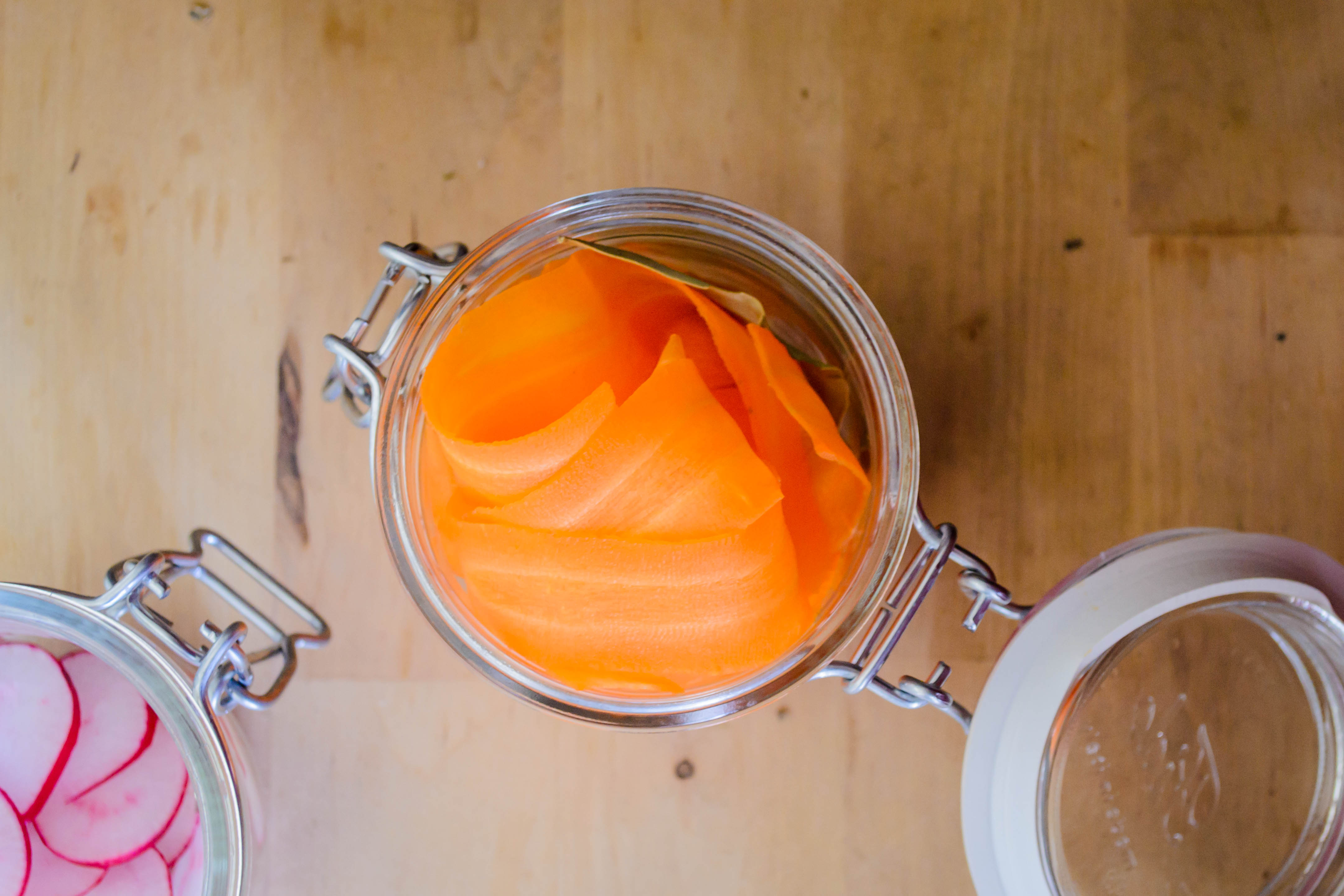
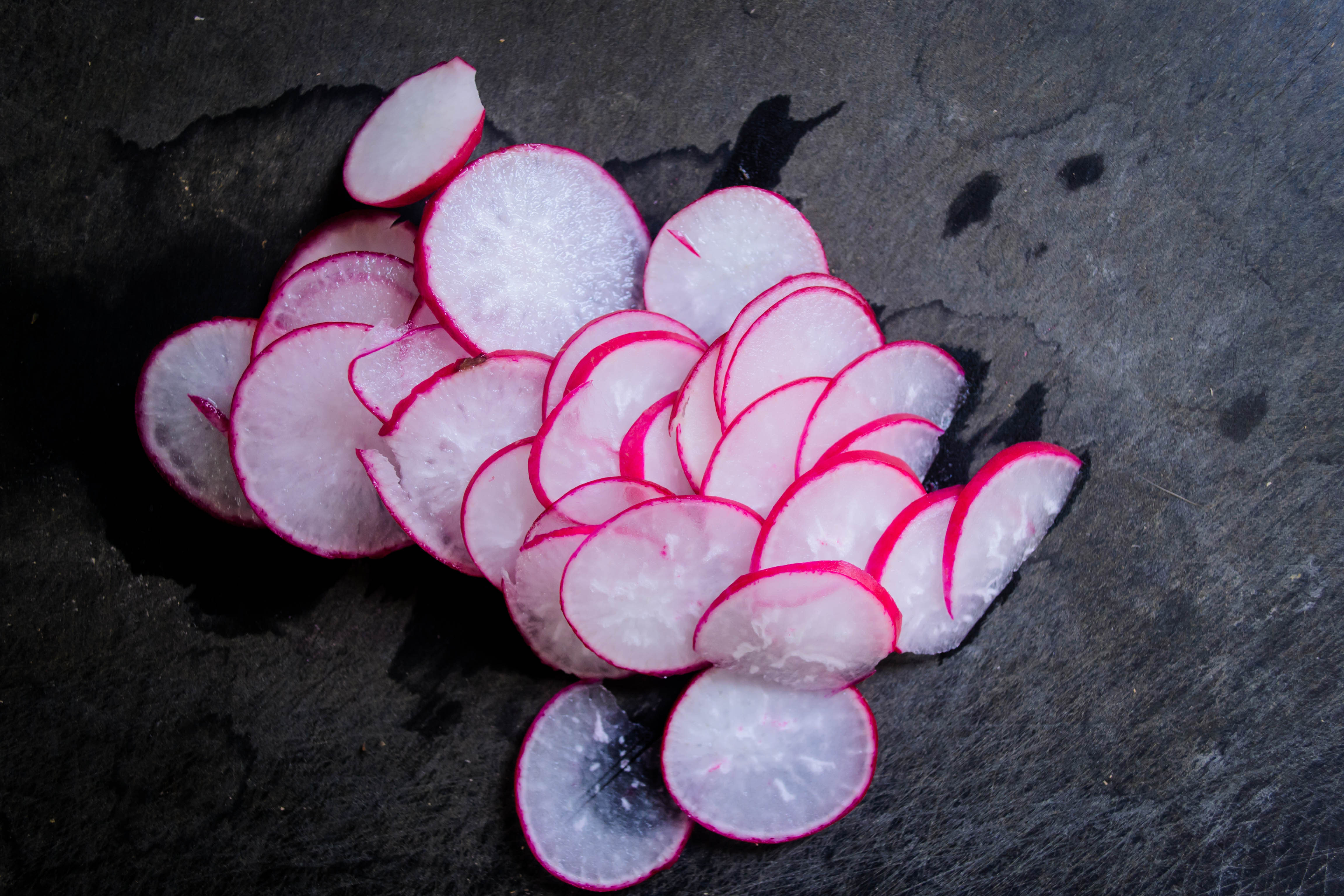
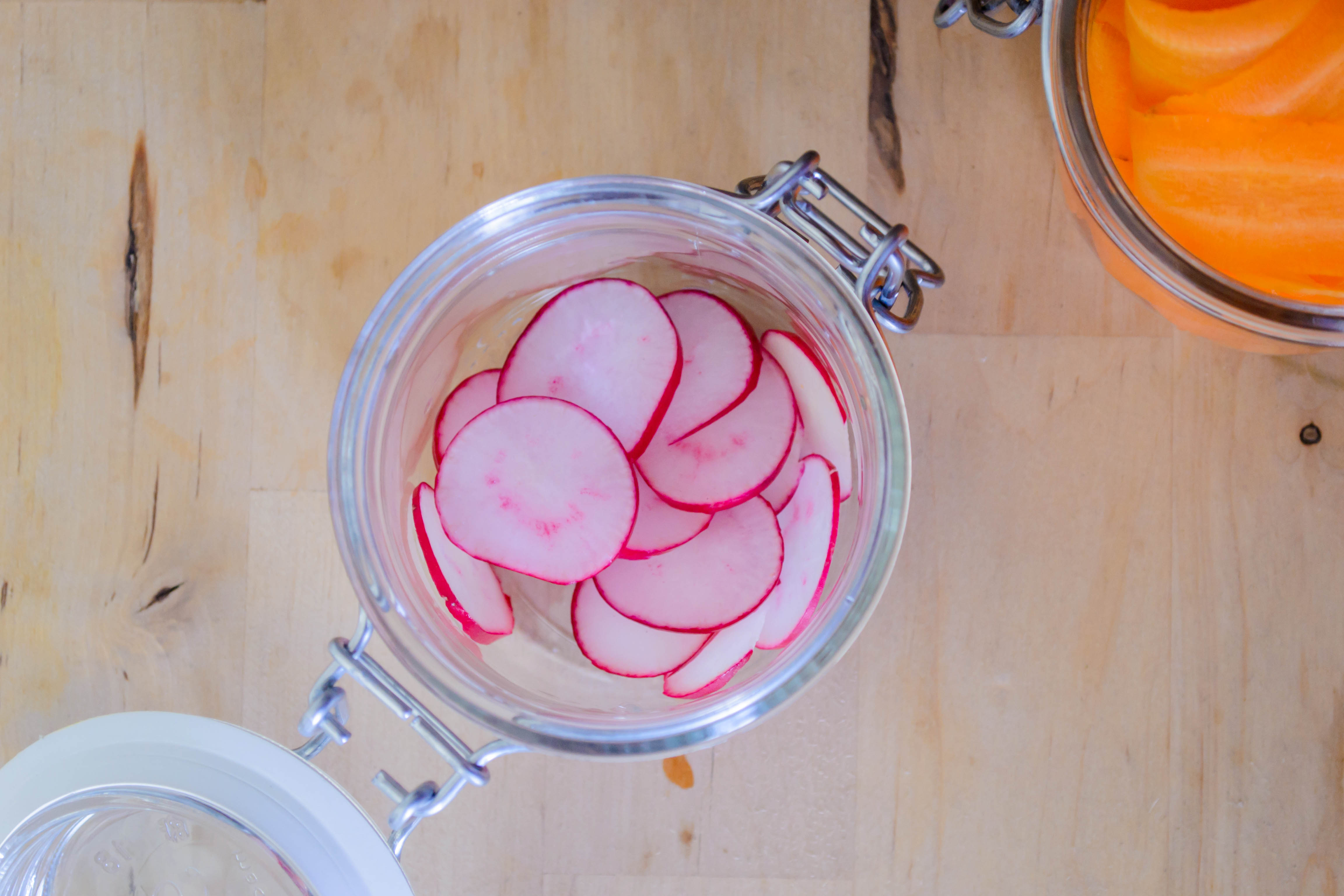
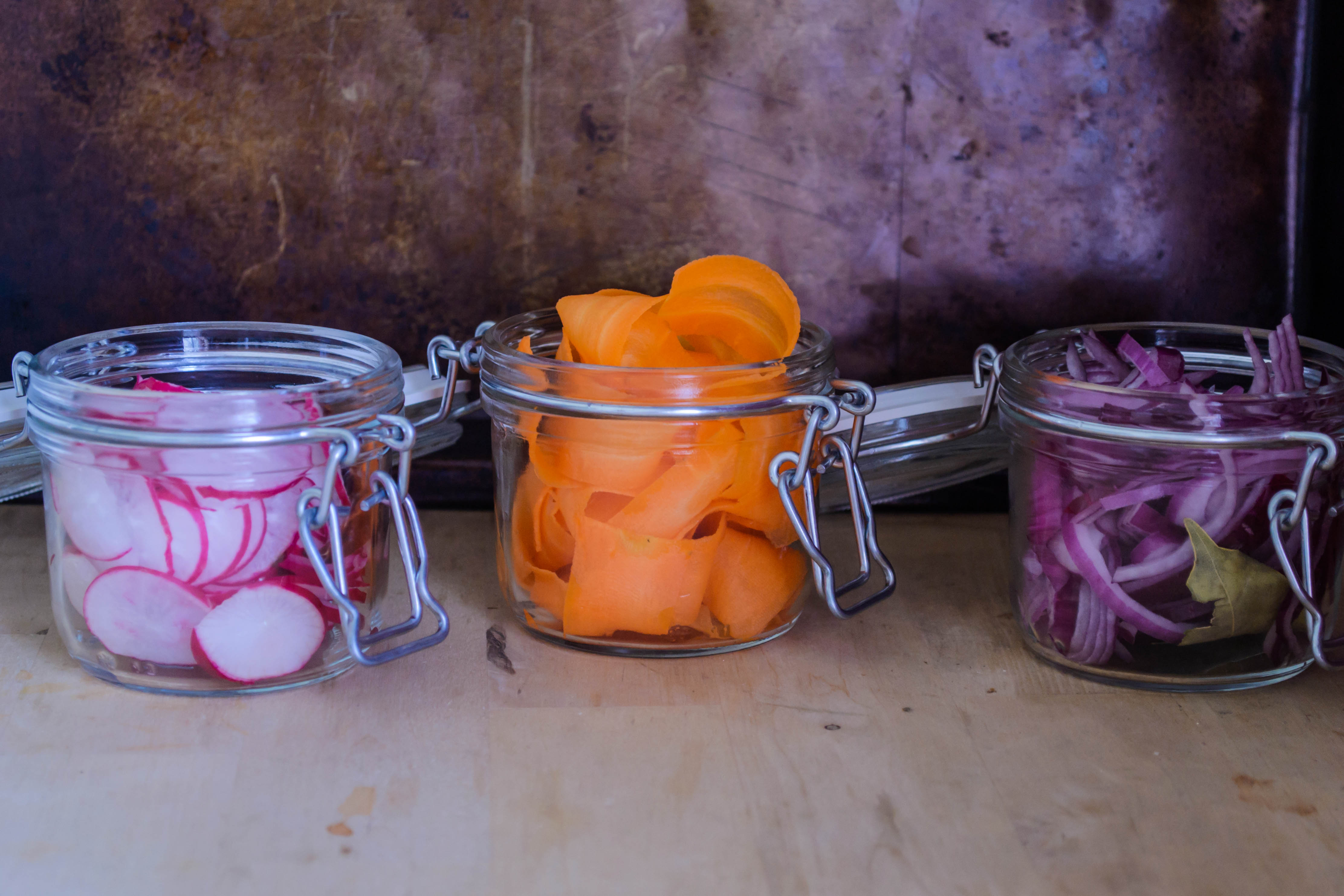
Food Blog April 2015-0561Fortunately, vegetable pickles are easy and fall within even a humanities graduate student’s budget. Vinegar, sugar, and a healthy shower of salt, heated to a simmer to dissolve the crystals. Jam as many vegetables as you can into a jar, shove in some flavoring agents: bay leaf, mustard seeds, dill, fennel, and pour on the vinegar. Cap, relocate to the fridge, and remember them a few days later when they’ve had a chance to sour up.
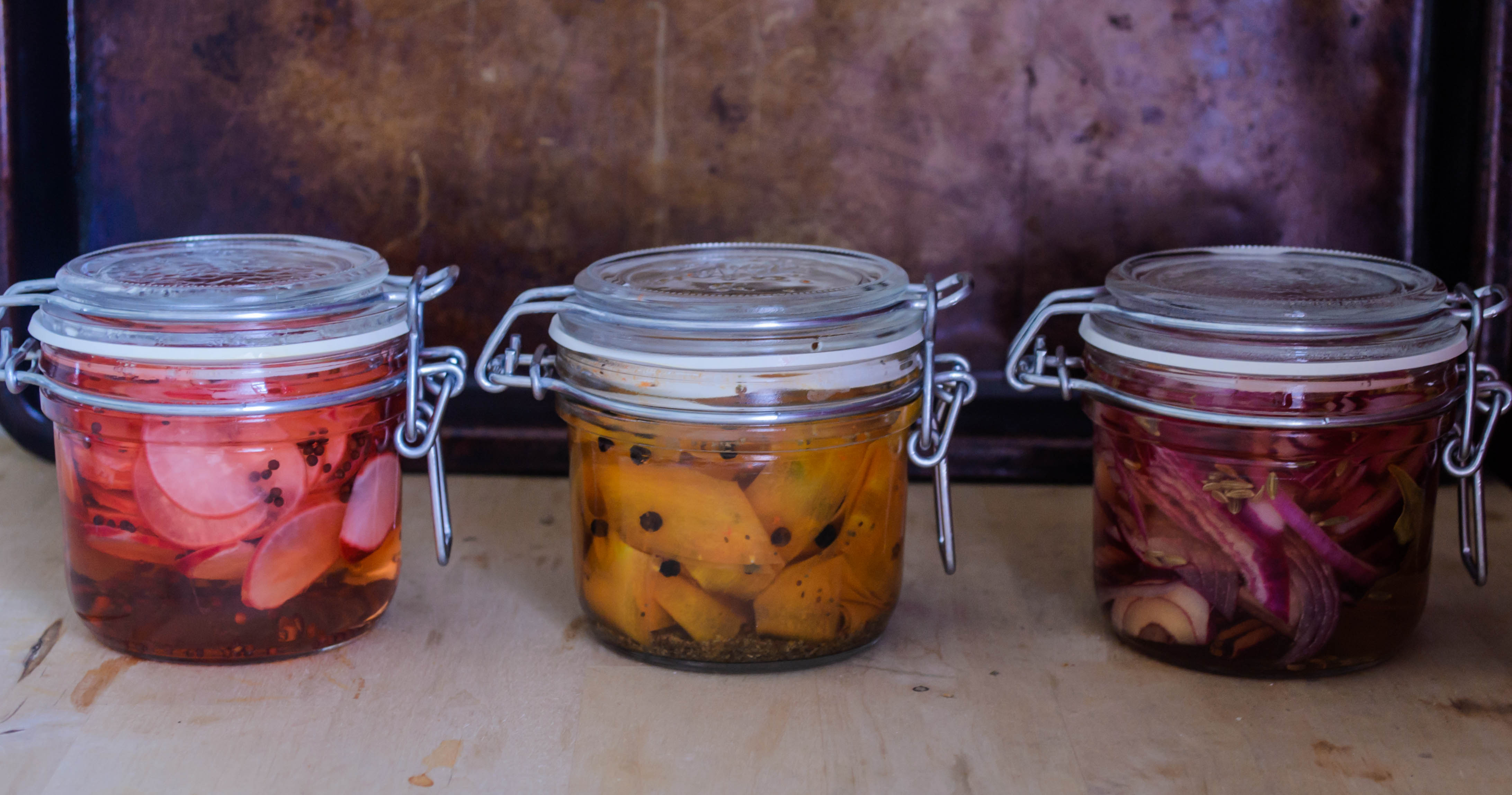
Food Blog April 2015-0562Vegetable pickles seem entirely suitable for the season. Fresh, young vegetables are great for pickling, especially while they are still small in size, so the vinegar can penetrate faster. Slender carrots, or plump radishes, or the tiny lanterns of young peppers, are a sign of spring that is often gone too fast. Pickles, though, hold that spring forever, jarred and capped and safe on the top shelf lurking behind the orange juice. Though they are not unaltered – the raw crispness is indeed transformed – in that way too they are like a spring gone by, or perhaps the memories of that spring that remain. It’s not that perfect, warm day anymore, but you remember its brightness – you need only uncap the jar and fish out a crisp briny souvenir.
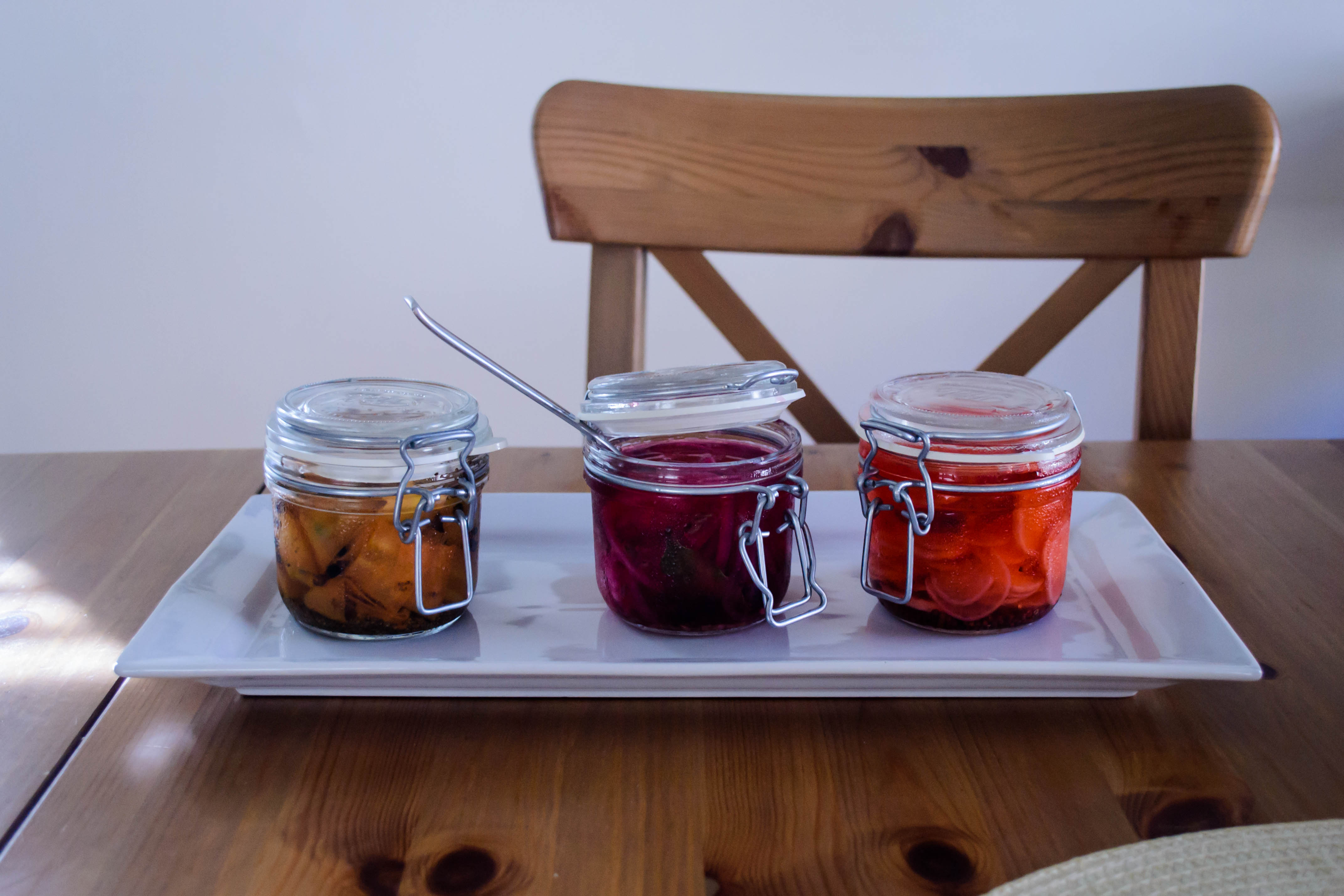
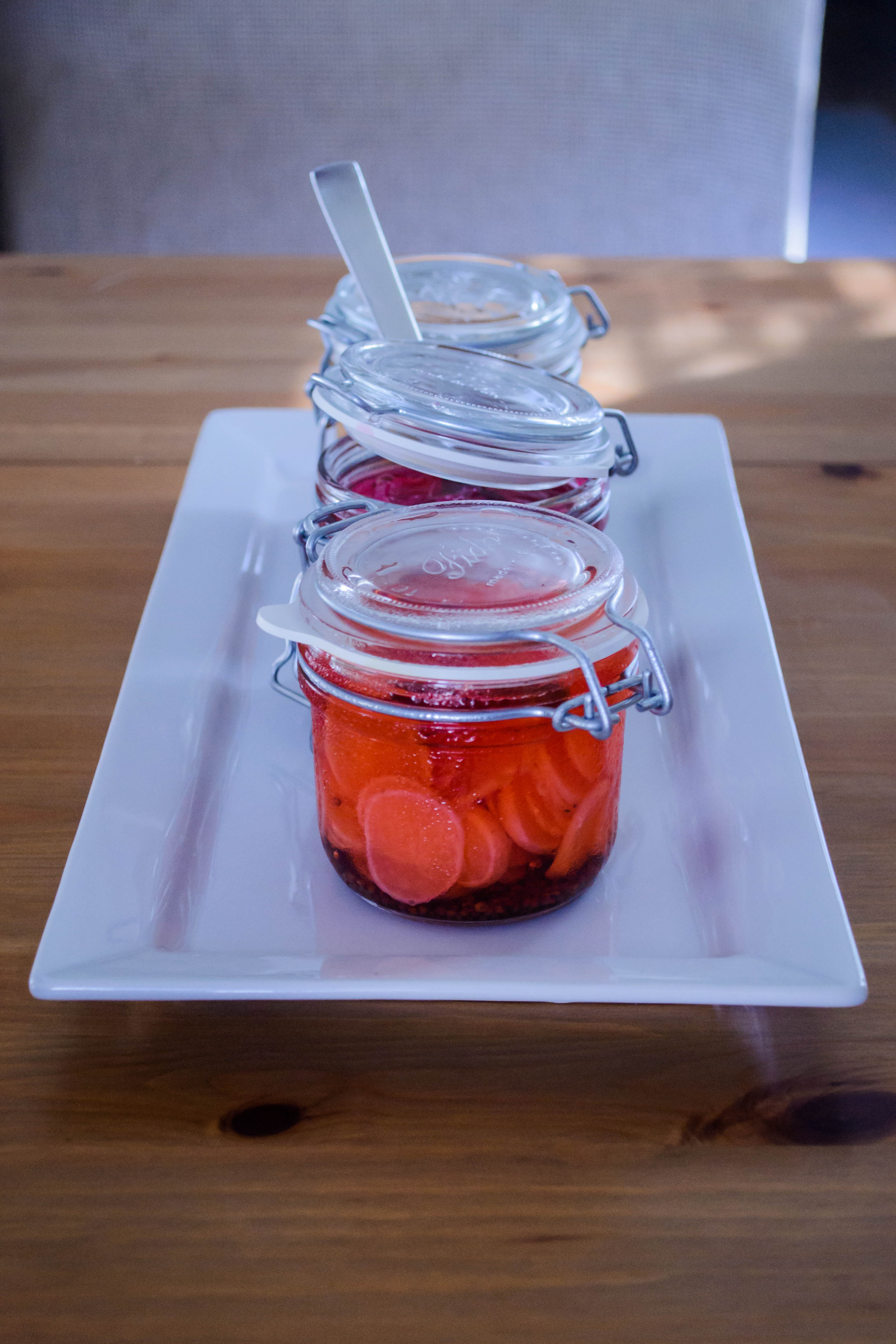
Food blog April 2015-0616I’ve done three types of pickle here: onion, carrot, and radish. Each is seasoned with a different combination of spices, and because I like to be fancy, I’ve used a different variety of vinegar. The radishes, I must admit, are my favorite. To play on their peppery flavor, I’ve added mustard seeds and a dried chili, but teased them as well with a heaping helping of sugar for the sweet-hot kick.
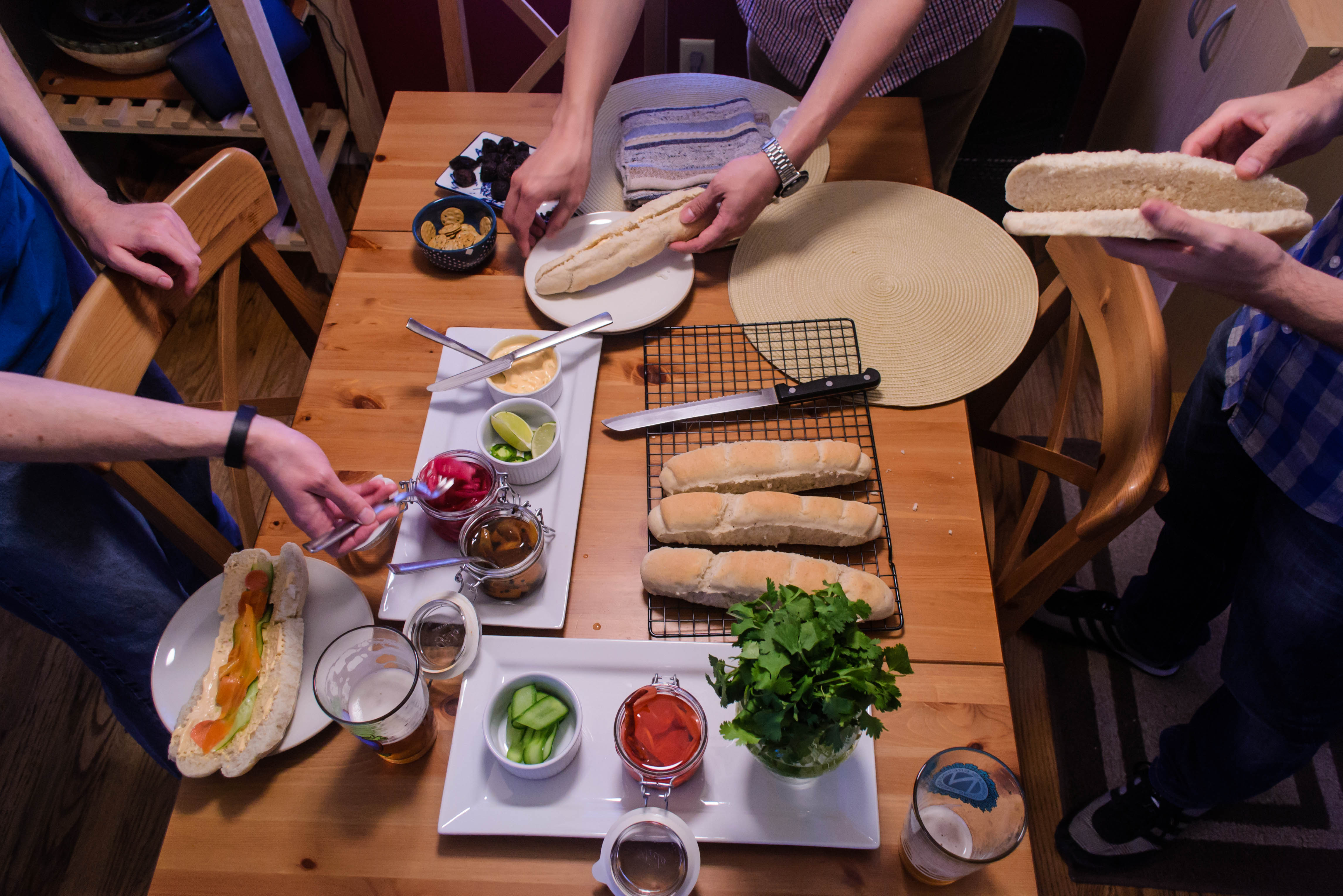
Food blog April 2015-0634While these are lovely in salads, as part of a cheese or hummus plate, or just bright and sour on a fork, they are dynamite on a sandwich. And as the above photo suggests, it is on a sandwich that they found their sprightly home for us. Specifically, on a banh mi sandwich, that fresh, crisp Vietnamese invention. Even more specifically, on the idea that spawned my whole 2015 project: a banh mi-tball. There are essentially three components to this sandwich. These pickles are the first. Next week we’ll look at the bread (the true banh mi), and in the third and final installment, pork meatballs awash in aromatics, simmered in a miso-spiked broth I wanted to drink all on its own.

But for the moment, let’s just revel in the transformative magic of pickles. You’ll need the week for them to get good and sour before you can properly enjoy the sandwich anyway.
Food blog April 2015-0619

Refrigerator Vegetable Pickles
My jars held 6 ounces (¾ cup), so these measurements are keyed to that.
Carrots:
carrot ribbons from 1 carrot to fill jar (use a vegetable peeler to create long strips)
⅔ cup white wine vinegar
2 teaspoons celery seed
2 teaspoons kosher salt
2 teaspoons sugar
1 teaspoon whole black peppercorns
Sweet/hot Radishes:
thinly sliced radishes to fill jar
1 small dried chili pepper
scant ⅔ cup rice wine vinegar (unseasoned)
2 teaspoons salt
4 tablespoons sugar (¼ cup)
2 teaspoons black mustard seeds
Onions:
thinly sliced red onion to fill jar
1 bay leaf
⅔ cup cider vinegar
2 teaspoons salt
2 teaspoons sugar
1 teaspoon fennel seed
  • For each: fill a heat-safe, lidded jar with vegetable slices (add chili or bay leaf, in the radish or onion case, respectively).
  • In a small pot, combine vinegar, salt, sugar, and other spices. Heat over medium-high, stirring occasionally, until liquid reaches a rolling boil and salt and sugar have completely dissolved.
  • Carefully, pour vinegar mixture over vegetables in jar until full. Gently push vegetables into liquid if needed – they will want to float.
  • Close jars tightly and refrigerate until vegetables are pickled to your liking – at least 2-3 days.

Mushroom Kale Quesadillas

Food Blog March 2015-0538Because I have the habit of wanting to impress you, the simple, day-to-day dinners I make often don’t end up here because they don’t strike me as “blog-worthy,” as I’m fond of saying. But much as I want to blow you away all the time, this is a silly habit. The point is not over-the-top impressive, outrageously original, faultlessly styled plates. At least it shouldn’t be. The point is good food. And yet because I get sucked in by things like Pinterest and Tastegawking and Foodspotter and vice versa, we had these mushroom kale quesadillas three or four times in a month because they were so damn delicious I couldn’t stop thinking about them before I realized they might be something I should share with you. Even though they are simple. Even though they are just quesadillas.

Food Blog March 2015-0533Because, seriously? Mushrooms. Kale. Cheese. Toasted tortillas. What a combination! Quesadillas are, weirdly enough, a kind of touchstone for me. If I wrote one of those memoir/cookbook mash-ups, a quesadilla would have to find its way in there somewhere, because when I stop and think about it for three seconds, my life contains a number of memory-charged quesadilla incidents. Example: when my family moved from Southern to Northern California shortly after I graduated from high school, some of the first ingredients in our new fridge were tortillas, cheddar, and salsa. As my mom unpacked the kitchen and the movers unloaded box after box after box from the massive truck into our new garage, we realized the morning had wasted thin and we were starving. Cue Chelsea at the stove with a skillet and spatula rinsed free of box dust seconds ago, flipping quesadillas. They weren’t magnificent, because they were just cheddar folded inside a flour tortilla, but when the cheese melted and sizzled out the sides, and the fat hidden in that deceptively dry flour tortilla browned in huge freckles all over the surface, no one wanted anything else for lunch, including the movers. We used up the whole package of tortillas and most of the cheese, but it was nice to watch everyone unfolding the fried half-moons and pouring liberal doses of salsa over the molten orange goo inside.

Food Blog March 2015-0527Quesadillas are best when you don’t think about them too much. What I mean is, they are best when they contain a quantity of cheese you’d rather not cop to. During our second year of living together, my college roommate K. wondered briefly why she liked my quesadillas so much more than hers. Part of it was undeniably the fact that food tastes so much better when someone makes it for you. But part of it, we determined, was that I used more cheese than she did. Great blocks of monterey jack sacrificed themselves to feed our quesadilla longing, and K. placed me permanently in charge of quesadilla production, as long as I never told her how much cheese I was folding inside. In those days, we upgraded from spooning a scoop up jarred salsa inside to smashing a velvet green half of avocado over the top, and maybe a luscious scoop of sour cream. These lunches were probably, now that I think about it, the base of much of my weight gain that year (the post-break-up pints of Godiva ice cream were likely the other culprits). But in retrospect, my “sophomore sixteen” is so much less important than how good those quesadillas were with their different kinds of softness and the crisp, almost oily tortilla in between.

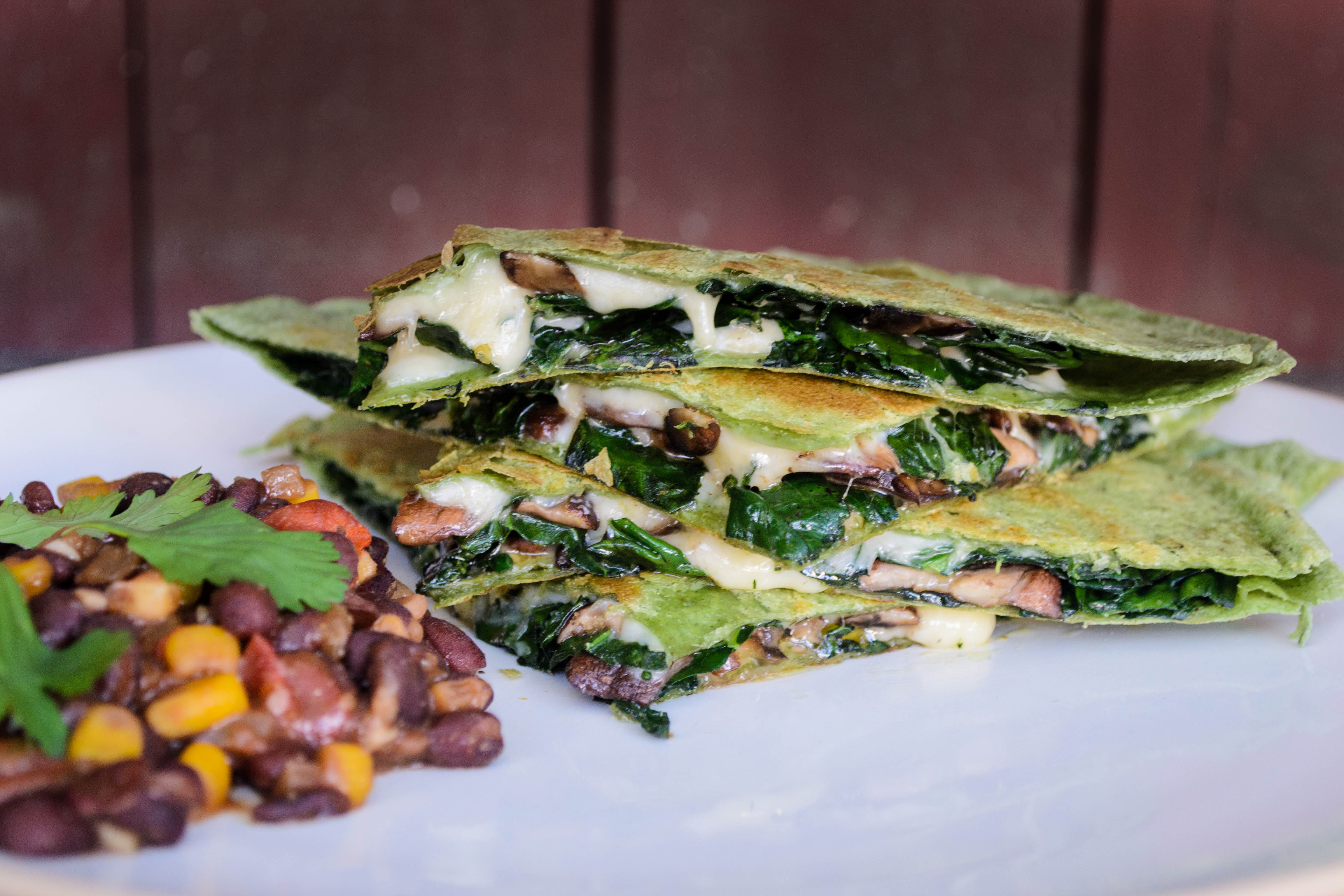
Food Blog March 2015-0523Food Blog March 2015-0525Though I’m still on board with a simple monterey jack quesadilla with avocado, guacamole, or salsa of any kind smeared over the top, I gradually realized quesadillas could also be employed to funnel vegetables into us. I don’t skimp on the cheese – no sense forgetting what I’ve learned – but now I jam in layers of corn or spinach or, in this version, thinly sliced mushrooms pan roasted until golden and almost crisp, folded together with torn leaves of kale barely wilted with some olive oil and salt. In quantity, cheese is non-negotiable, but the variety you mound on is a personal choice. I’m partial these days to pepperjack for that lovely extra kick, but regular, dependable old monterey jack, or a combination of jack and fontina or gouda would also be glorious. Here I’m using spinach tortillas in a combination vain attempt to make these seem healthier, and because I just dig the flavor, but you could use plain flour tortillas, or even corn, though they will obviously require less filling.

Food Blog March 2015-0528I’m not going to make the claim that these quesadillas will turn a mushroom and kale hater into a mushroom and kale lover, because we’re really not hiding the vegetables; we’re celebrating the way they complement the cheese and toasty tortilla. But they might turn a mushroom tolerator into an almost-fan, and someone who is tired of kale might find in them a gasp of fresh breath. And they will without question provide you with a quick, delicious dinner item that is absolutely perfect with a side of these beer braised beans.

Food Blog March 2015-0540

Mushroom Kale Quesadillas
Serves 2 as a main dish, 4-6 as an appetizer
2 tablespoons olive oil
16 ounces crimini mushrooms (1 pound)
5-6 ounces kale, tough stems removed
2 cups monterey jack or pepperjack cheese, or a mixture of soft white cheeses
4 burrito size tortillas (I like the spinach ones)
  • Heat the 2 tablespoons olive oil over medium heat until glistening. Add the sliced mushrooms and sauté over medium for 8-10 minutes, until they are nicely golden and some are barely crisp.
  • Add the kale to the cooked mushrooms and sauté for another 3-4 minutes until barely wilted but still bright green; season with salt and pepper if desired. Remove from heat and set aside to cool slightly.
  • To build the quesadillas, lay out the bottom tortilla and scatter ⅔ cup of the cheese evenly across it. Add half the mushroom and kale mixture, then scatter ⅓ cup of cheese on top of the vegetables. Top with the second tortilla. This construction – cheese, vegetables, cheese – holds in the vegetables because the cheese melts on both sides of them, binding them inside. This makes for easier, cleaner flipping.
  • Cook the quesadilla in a dry pan (I use the same one I cooked the mushrooms and kale in, just wiped clean with a paper towel) over medium to medium-high heat until the bottom tortilla is nicely browned (or slightly charred, if you like that), and the bottom layer of cheese is well melted; 3-4 minutes. Flip and repeat.
  • While the first quesadilla cooks, build the second one as described above.
  • When both sides of the quesadilla are nicely browned and crisp, remove from heat. Wait 1-2 minutes before slicing to avoid losing too much cheese. Repeat with second and all subsequent quesadillas.
  • Repeat with second and all subsequent quesadillas.
  • To serve, cut in quarters (or smaller wedges) and offer with guacamole, sour cream, salsa, or just bare and crisp and oozing and perfect.

Apple Onion Breakfast Meatballs

I have to admit, this meatball is a bit of a cheat. I mean, when it comes right down to it, this is a breakfast sausage patty, spiked with small chunks of apple and onion sautéed in butter, slivers of sage, and a generous glug or two of maple syrup. And plenty of black pepper, of course. I know, what’s to complain about there? But essentially, it’s just that, rolled into a meatball form instead of flattened into a patty. I’ve made this a number of times already as a sausage patty, and the simple change feels a bit dishonest – a bit like a masquerade. But the thing is, it allows me to tell you about an event for which I feel a great deal of fondness. So consider this a cheat with good intentions. An excuse, let’s say, to tell you about a time of warmth which, as the winter rolls on, might be something you need.

(Additionally, as I’ve recently noticed, sorry about the lousy photo quality on the in-post photos. I’m thinking this is largely due to artificial lighting, which makes maybe one good thing about that whole Daylight Saving Time curse that has fallen upon us, but also might be a WordPress thing, because if you click on the image for a larger version, it looks clearer and higher quality – more like the original shot.)

Food Blog March 2015-0431The apple and onion in these meatballs (or patties) play very well with the sage and the fatty pork, and the maple syrup results in stellar caramelization, while giving a nod to the “breakfast” idea. This combination was so successful at home in some trial runs and at a summer gathering last July that I broke it out again this January. One of my dearest family friends, a young woman I’ve known so long it feels strange to acknowledge that she is, in fact, a young woman rather than a kid, got married in November, in Chile. She and her now-husband’s Southern Hemisphere nuptials meant that only a small handful of her American friends and family were able to attend. In January, then, while many of us were still off work for the holiday, they had a “stateside celebration” in northern California, which N. and I thankfully were able to attend.

Food Blog March 2015-0420The bride’s mother, whose capacity for party planning is unparalleled, rented a house for the weekend for the “kids” to stay in, and as the oldest members of that no-longer-accurate category, N. and I somehow got in under the age wire and hung out with the “young people” at the party house. This allowed for opportunities like feeding (fat, greedy, possibly possessed) miniature ponies who happen to live on the grounds, wandering an impressive, decked-out-for-Christmas back garden, exclaiming over the proliferation of strange decor choices in the house (lots of religious imagery, a fully decorated Christmas tree in every room of the house, a large rocking horse at the foot of our bed, Victorian and Rococo linens and bathroom paintings, modern art pieces contributed by grateful former guests, a fur stole my sister briefly considered wearing to the party), and riding to and from the event itself in an aesthetically impressive but poorly stocked limousine, my first limo ride ever. (Really, this house was amazing. A Secret Garden/Windsor Mystery House of a place, and we were so lucky to get to experience it).

Food Blog March 2015-0423To offer my thanks, of course I turned to food, offering to cook breakfast for all of the “kids” on the morning of the marriage blessing ceremony. This offer was met with enthusiastic approval, and so my sister and I got up early(ish) and set about finding the least battered tools in the kitchen (it contained an astounding variety of dishes and utensils, but as you might expect of a rental property, many were not well maintained) to make breakfast-for-eight. Among the offerings were these same sausage patties, which were met with considerable acclaim. There were no leftovers.

Food Blog March 2015-0425I realize this is not much about meatballs, but for me, food is so tied to the people I’m feeding and the events surrounding its production that they become part of the taste. These people we were celebrating are so dear to me, and became so with such haste, that I can’t remember a time I didn’t think of them as an extension of my family. She was my bridesmaid when I married, and now at the celebration of her own marriage, it felt so tied to my own declarations of love and familial belonging. As I said when I offered my toast at their reception – while remarking on the tendency my eyes suddenly had at trying, on their own, to alleviate California’s massive drought – there has never been a time when I was not so, so happy to see them. This has been true from the very first time we met (it was raining then, too, relieving this poor parched state once again, as the now-bride’s father welcomed us in with the shout “We’re having a rain party!”), till that evening, surrounded by others they love, who love them.

Food Blog March 2015-0430This is all a bit tumbling and confessional and warm, but I know you’re really here for the meatballs, so let’s get to it. All I’ve done is taken the same ingredients from my sausage patties and rolled them into a meatball, rather than flattening them for the pan. But really, they are perfect either way. They are one of those offerings that, even if they get a little dark on the bottoms from the sugars in the maple syrup (and they may, so don’t despair), they are gobbled up willingly. And even if they stay in the pan a bit too long because you are taking the time to catch up with family who re friends who are family, they stay moist thanks to the apple and onion threaded through them. They are a standby indulgence. I hope they become that for you as well.

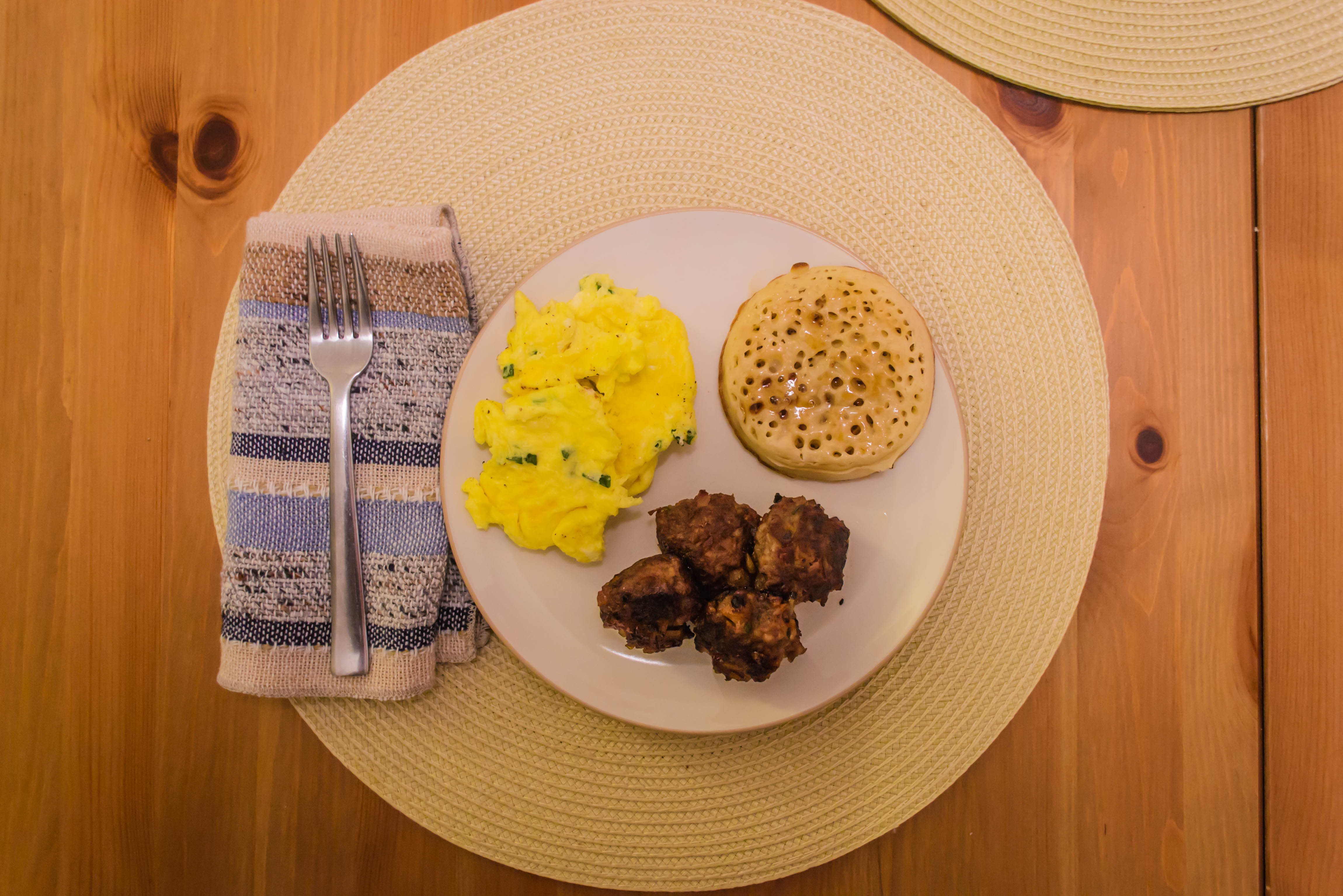
Serving suggestions: as you can see, we had ours alongside a fluffy pile of scrambled eggs and some well toasted crumpets. They would also be perfect stuffed inside a pillowy buttermilk biscuit as a fancy little breakfast sandwich bite, and I certainly wouldn’t say no to a pyramid of them gracing a belgian waffle or two. In short, pick your breakfast favorite, and add these.


Apple Onion Breakfast Meatballs
Serves 2-3 (but is easily doubled or even tripled)
2 tablespoons butter
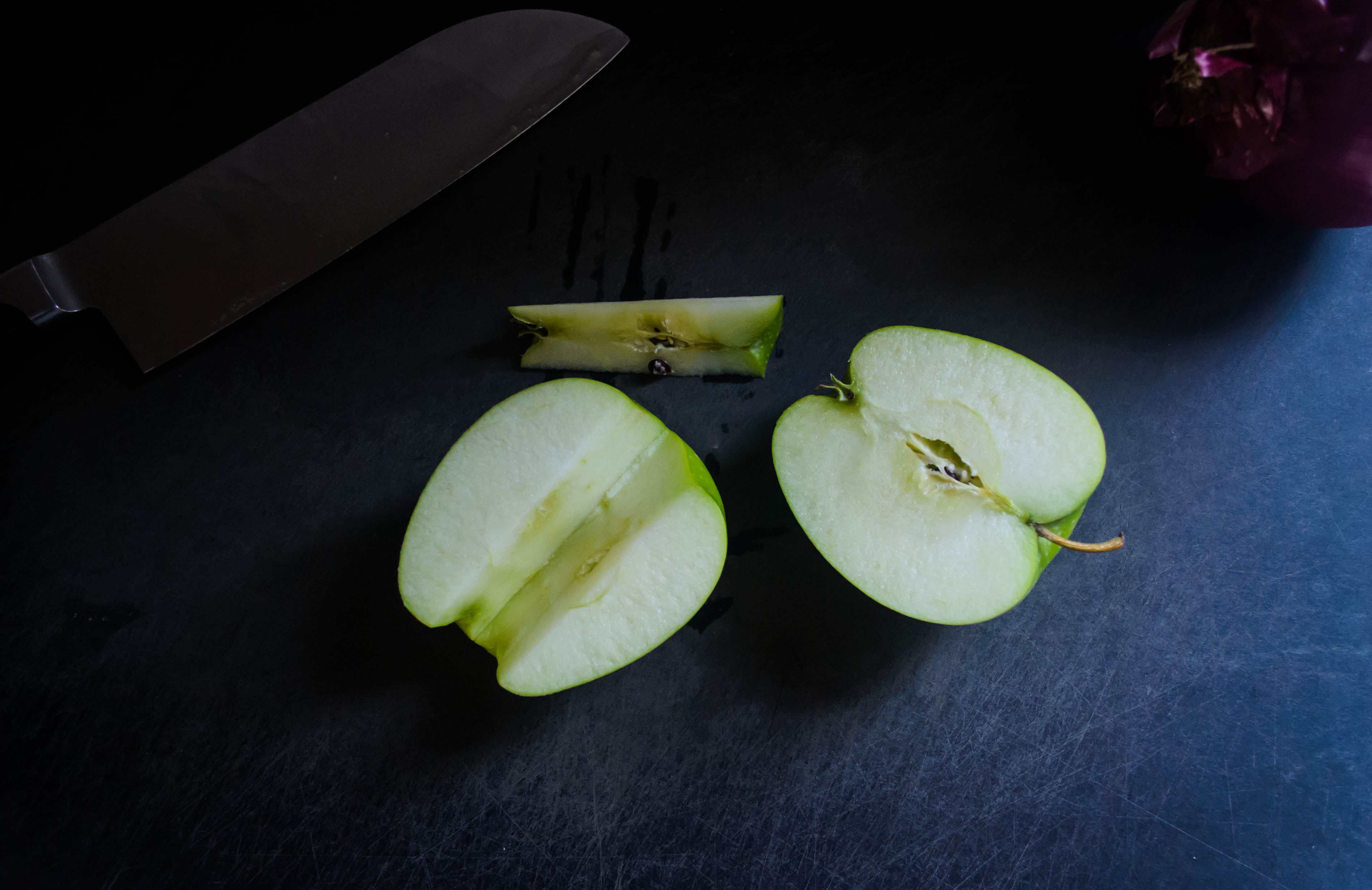
⅔ cup diced green apple (about half a medium apple)
⅔ cup diced red onion (about half a small onion)
⅛ teaspoon each salt and pepper
1-2 teaspoons sage (sage is strong!)
8 ounces pork sausage
2 tablespoons maple syrup


  • Heat 2 tablespoons butter over medium heat. When melted, add apples and onions, season with ⅛ teaspoon each salt and pepper, and cook over medium or medium-low heat until tender: 5-8 minutes.
  • In the last 30 seconds or so of cooking, add the sage and stir to integrate. Then remove from heat and let cool until room temperature or barely warm.
  • In a medium bowl, combine the sausage, maple syrup, and cooled apple and onion mixture. This is already seasoned, thanks to the salty sausage, the sweet syrup, and the salt and pepper added to the cooked apples and onions. If you like a heavy hand with the seasonings, though, feel free to add an additional ⅛ teaspoon each of salt and pepper.
  • Using moistened fingertips, mix well until apple and onion pieces are evenly distributed. Moisten the palms of your hands as well, then gently roll mixture into 10-12 equal sized balls – it will be soft.
  • Heat the same skillet you used for the apple and onion over medium heat and gently add the meatballs evenly spaced, not touching each other. Cook over medium heat until browned on all sides – about 3 minutes per side – then cover the skillet with a lid and turn the heat down to medium-low. Let sizzle until meatballs are cooked all the way through – another 8-10 minutes. If the bottoms of the meatballs begin to look a bit on the dark side, add a few tablespoons of water to the pan.
  • Serve hot or warm with breakfast foods of your fancy.

Mom and Myrna’s (Swedish) Meatballs

I fervently hope you have at least one recipe in your arsenal that your family is just mad about. In my case, I guess that might be… tacos? Or perhaps, pardon the sub-par photography, pot pie. For my mom, this recipe is a take on Swedish meatballs from an old cookbook with a faded gold cover. Populated by numerous, lightly ethnic recipes from various European and Mediterranean regions, the cookbook is most stained and marked (Mom makes adjustments in the margins with pencil) on the “Myrna’s Meatballs” recipe. On the facing page is a photograph of a woman (Myrna, I guess) with well-teased chestnut hair, large glasses, and a round face, in the process of lighting candles over a nicely stocked dining room table.

Food Blog February 2015-0364The meatballs themselves, with their mixture of beef and pork seasoned with warm spices and draped in rich brown gravy, are definitely a take on the Swedish smorgasbord classic, and my family is nuts for them. Every year when we plan our Christmas menu, the one item that doesn’t change, it seems, is these meatballs. This past year, because the plan was all rolled appetizers, the meatballs didn’t fit the theme. Rather than skip them, however, they became Christmas Eve dinner instead. Christmas was saved. For Christmas 2015, we’ve already decided the theme will be “food on a stick” (because, I mean, what else would we do while eating the current year’s offerings than plot options for next year’s celebration?). My sister has already excitedly declared that we’ll just stab the meatballs with toothpicks, and that’s one dish done.

Food Blog February 2015-0349I must confess: I like these meatballs quite a bit, and I enjoy them when they show up in the Christmas spread, but they aren’t quite on my deathbed menu. They are tender and tasty, and the gravy in particular – depth and extra richness imparted by a mere teaspoon of instant coffee powder – is a savory treat. But something about the meatball itself made me want to fiddle.

Food Blog February 2015-0350In one of those lovely coincidences the universe sometimes hands out, the Cooks Illustrated issue in my, well, my bathroom magazine rack (what?) just happened to contain a Swedish meatball recipe, and though many of the ingredients were the same as Myrna’s immortal list, the procedure was different enough to catch my attention. Since one of the things – I think – I wanted to adjust about the family meatball of choice was the texture, it seemed fortuitous to combine-and-conquer.

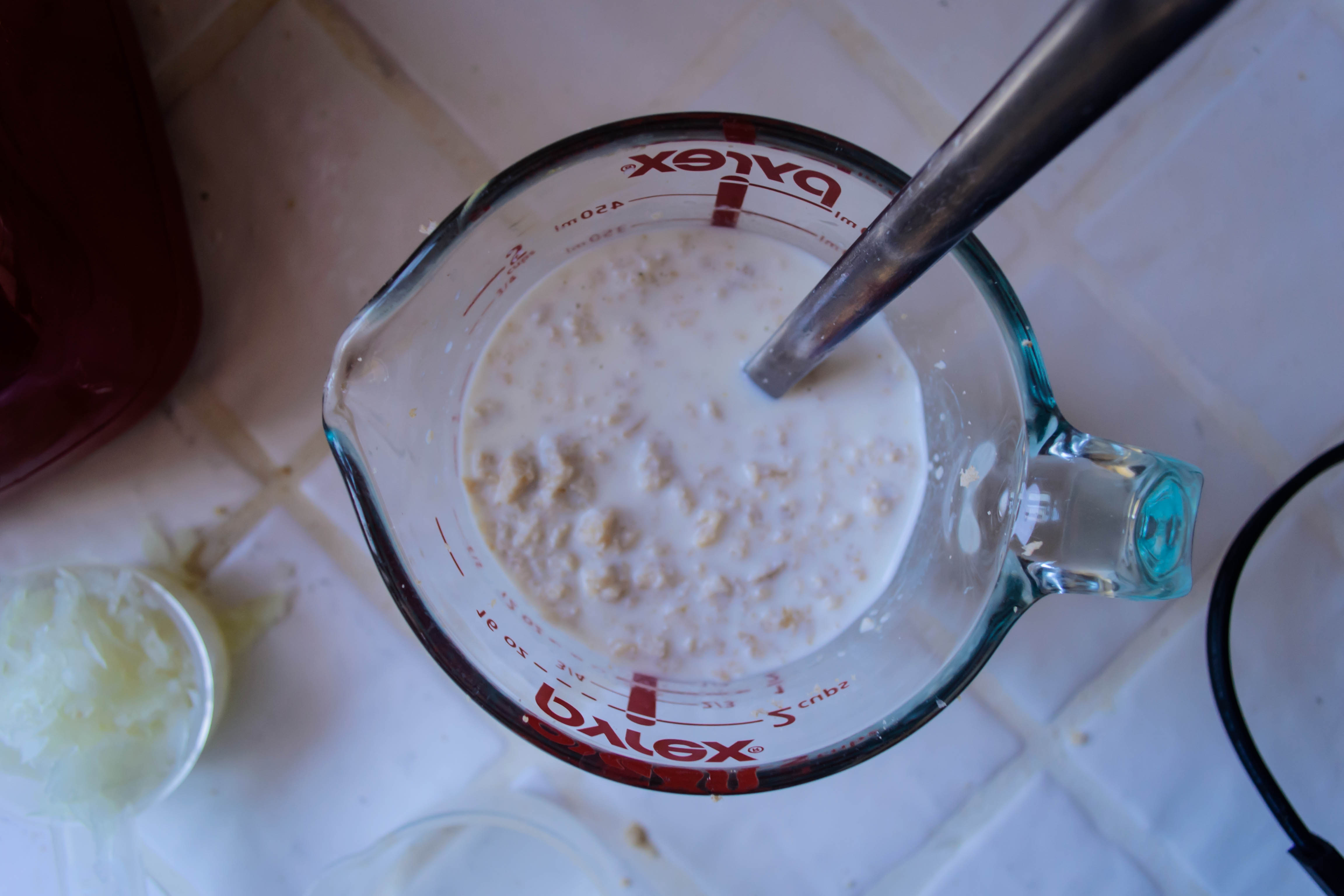
Food Blog February 2015-0352The main difference in the CI version of Swedish meatballs is the way the meat is prepared. Mom and Myrna knead together the pork, beef, a handful of parsley, spices (plenty of black pepper, as Mom is always telling me), lightly sauteed onions, and  breadcrumbs soaked in milk (called a panade) in a bowl before forming soft balls. Taking a cue from sausage making, CI recipe tester J. Kenji Alt instead vigorously paddles the pork in a stand mixer with spices, baking powder for lightness, and the traditional sopping panade. A touch of brown sugar goes in too, for a background hint of sweetness. Grated onions and salt join this combination, and the whipped meat paste is only lightly combined with ground beef. This results in a tender, light meatball with a sort of springiness, achieved by stretching the meat proteins in the pork as it is paddled into a paste-y emulsion. It also more evenly distributes the fat through the meat, which seemed worth imitating.

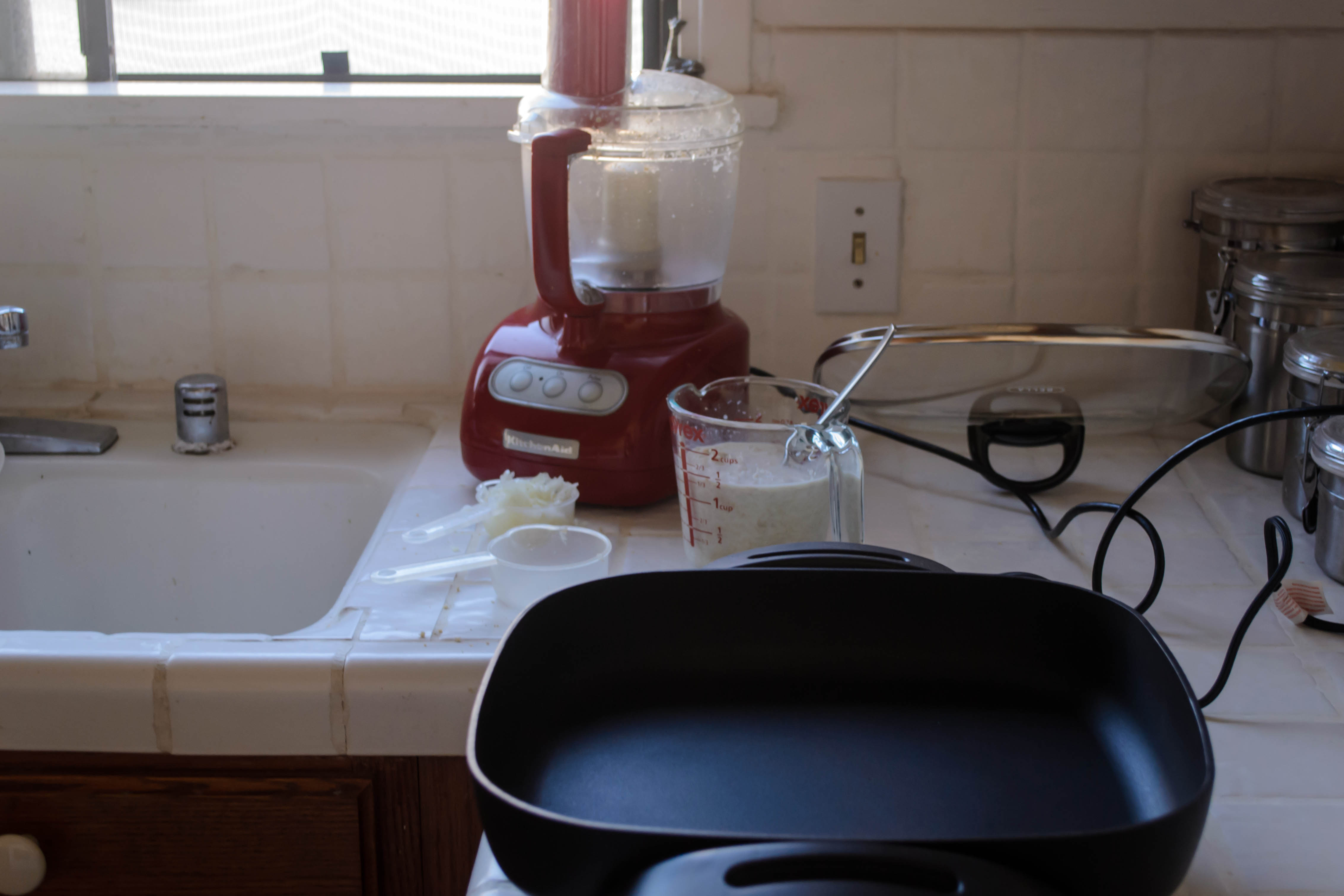
Food Blog February 2015-0353In my version, because I also wanted to minimize the number of dishes I was going to make N. wash (our version of an egalitarian kitchen: whoever cooks, the other one has to wash up. You can guess how this usually works out), I decided to go for the food processor instead of the stand mixer. I was going to use it to make fresh breadcrumbs anyway, and decided relying on it to grate my onions and mix up the meat would keep things easy. In retrospect, this seems counter-intuitive – wouldn’t the blade tear apart the meat proteins, rather than elongating them? Yet it did produce a pleasing texture.

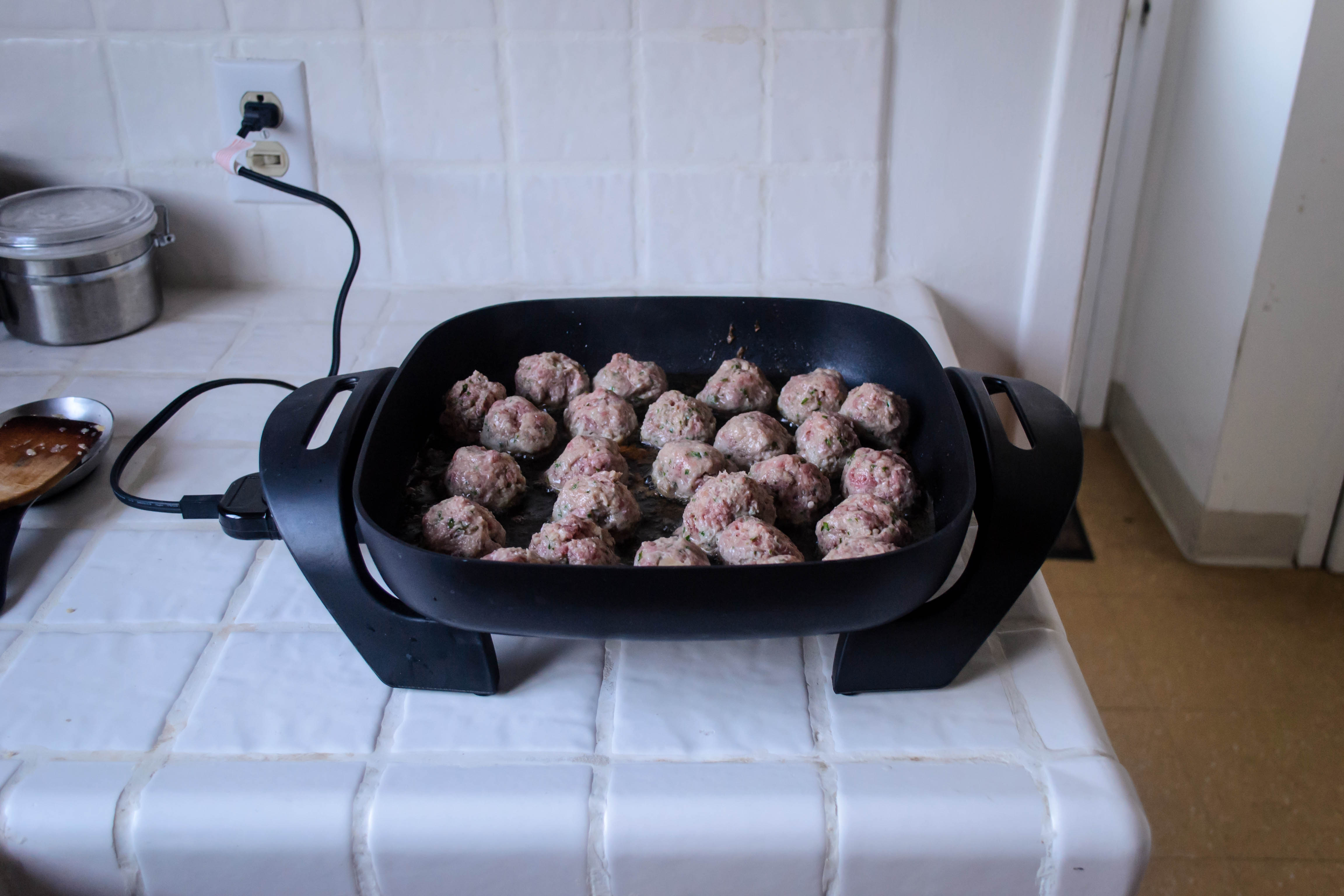
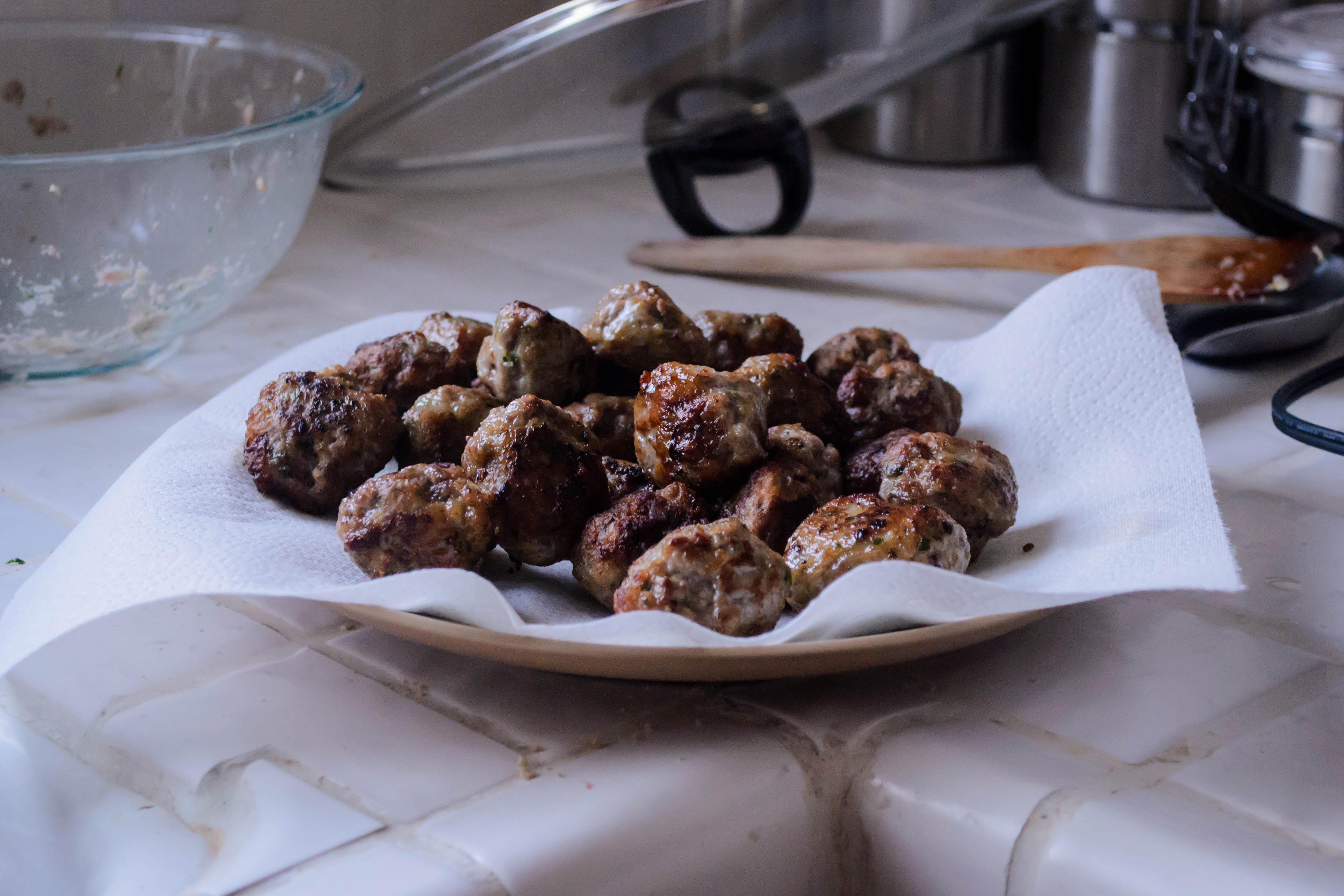
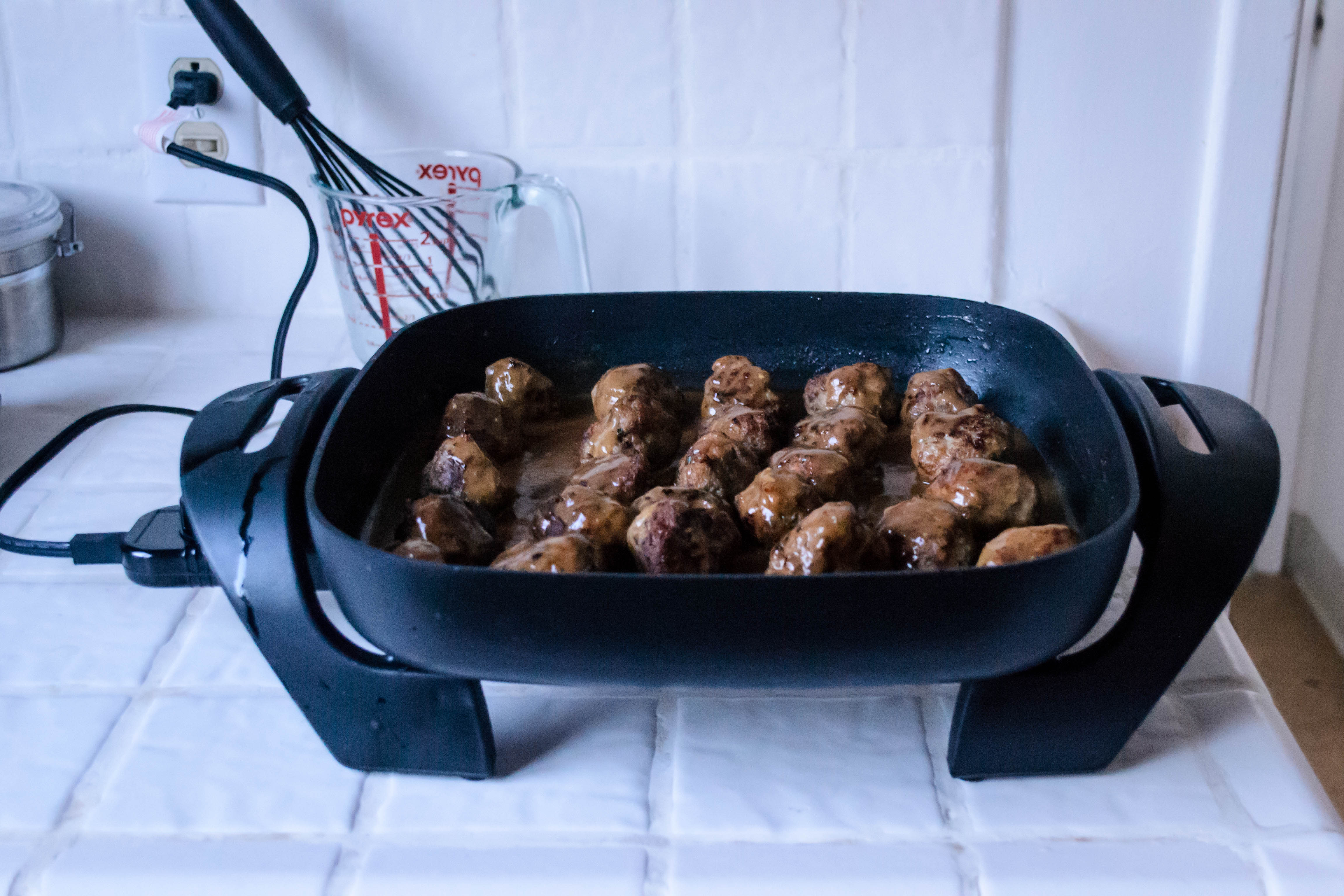
Food Blog February 2015-0355Mom (and Myrna) brown their meatballs in a few tablespoons of butter, then finish them by simmering them in the gravy for half an hour. The CI version, on the other hand, does more of a shallow fry in vegetable oil, cooking the meatballs completely and then just running them through a quick turn in the sauce. I decided, again, on a slight compromise. I used less oil than the CI recipe, and browned the meatballs on all sides, opting to use my electric skillet so I could control the oil temperature. Once the meatballs were golden and felt almost crisp, I drained them, whisked up the sauce in the same skillet, and returned them to the gravy for the requisite half hour simmer. Any opportunity to add flavor seemed like the right thing to do.

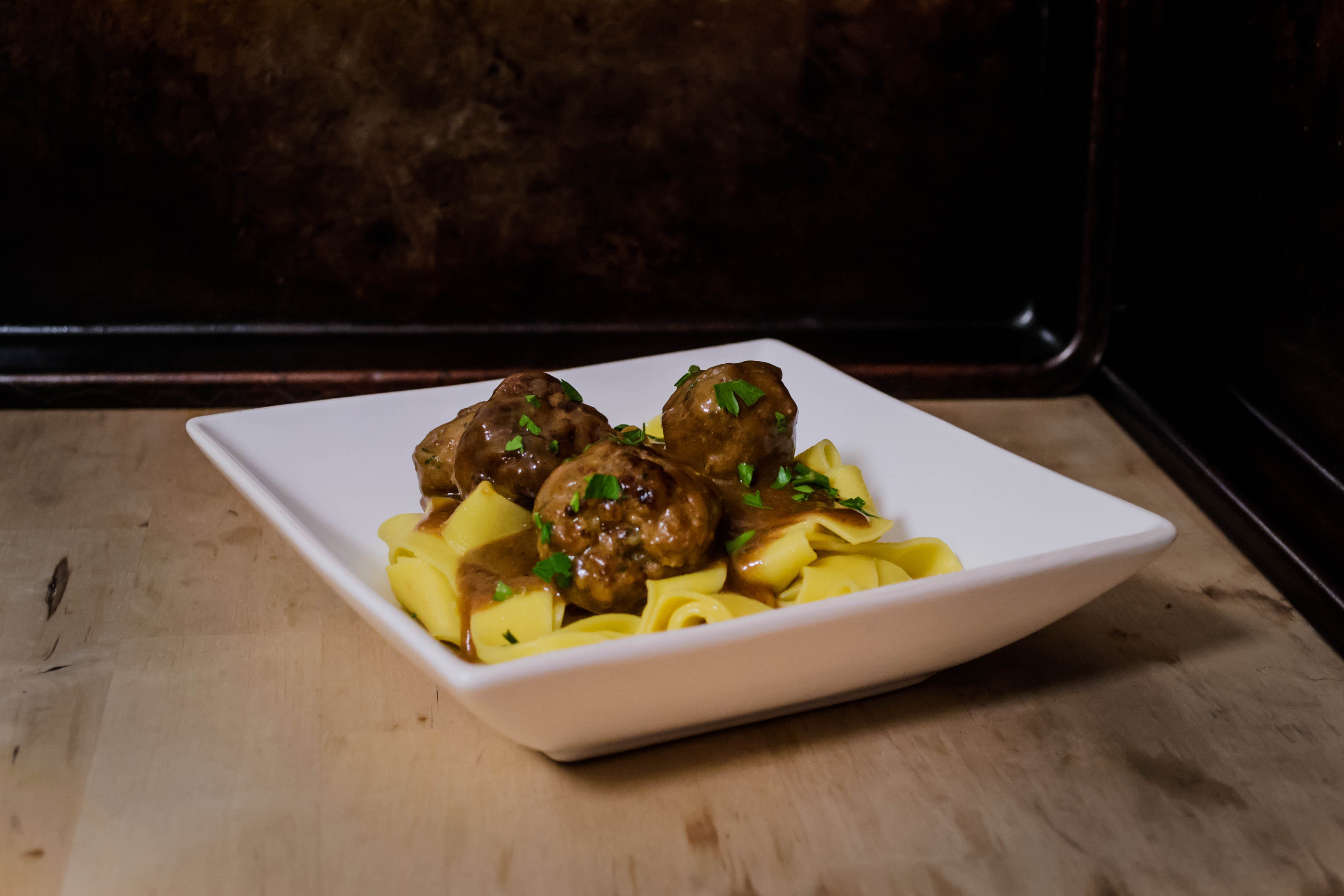
Food Blog February 2015-0356When we couldn’t take the aroma anymore (the dog kept appearing in the doorway of the kitchen, wagging and smiling. Their eternal hope is so encouraging and so sad), I boiled up some egg noodles, tossed them with butter and parsley, and ladled on the main event.

Food Blog February 2015-0360I don’t think I’m allowed to say that my meatballs were better than Mom’s. But they were very, very good. I think the textural change – a subtle tenseness to the exterior that burst when you bit through it, and a tightness to the meatball that was somehow not at all dense – was an improvement. I also added a reserved squeeze of dijon mustard to both the panade mixture and the sauce, and that, along with the bare hint of sweetness from the brown sugar, was a good choice.

Food Blog February 2015-0366But in addition to the texture and the minimal flavor upgrades, I think the nest of buttery noodles made the dish. When we eat these meatballs at Christmas time, they are usually part of a large spread – one little corner of a plate full of wildly varied appetizer items. Here, resting atop an eggy bed, glazed with thick gravy, we really had a chance to appreciate their deep, warm flavors.

Food Blog February 2015-0364

Mom and Myrna’s (Swedish) Meatballs
Makes 25-30 1-inch meatballs
For meatballs:
1½ cups bread crumbs (from 1-2 slices of bread)
1 cup whole milk or half and half
1 teaspoon dijon mustard
⅓ cup grated onion (about ½ of a large onion)
1 tablespoon butter
½ pound ground pork
¼ cup chopped fresh parsley + 1 tablespoon for serving
⅛ teaspoon fresh grated nutmeg
⅛ teaspoon ground allspice
⅛ teaspoon freshly ground black pepper
1 teaspoon salt
½ teaspoon brown sugar
1 teaspoon baking powder
½ pound ground beef
1 cup vegetable oil
For gravy:
2 tablespoons butter
2 tablespoons flour
1 teaspoon instant espresso powder
1 teaspoon dijon mustard
½ teaspoon brown sugar
1¼ – 1½ cups beef broth
salt and pepper to taste (taste first; sodium content in beef broth may vary)
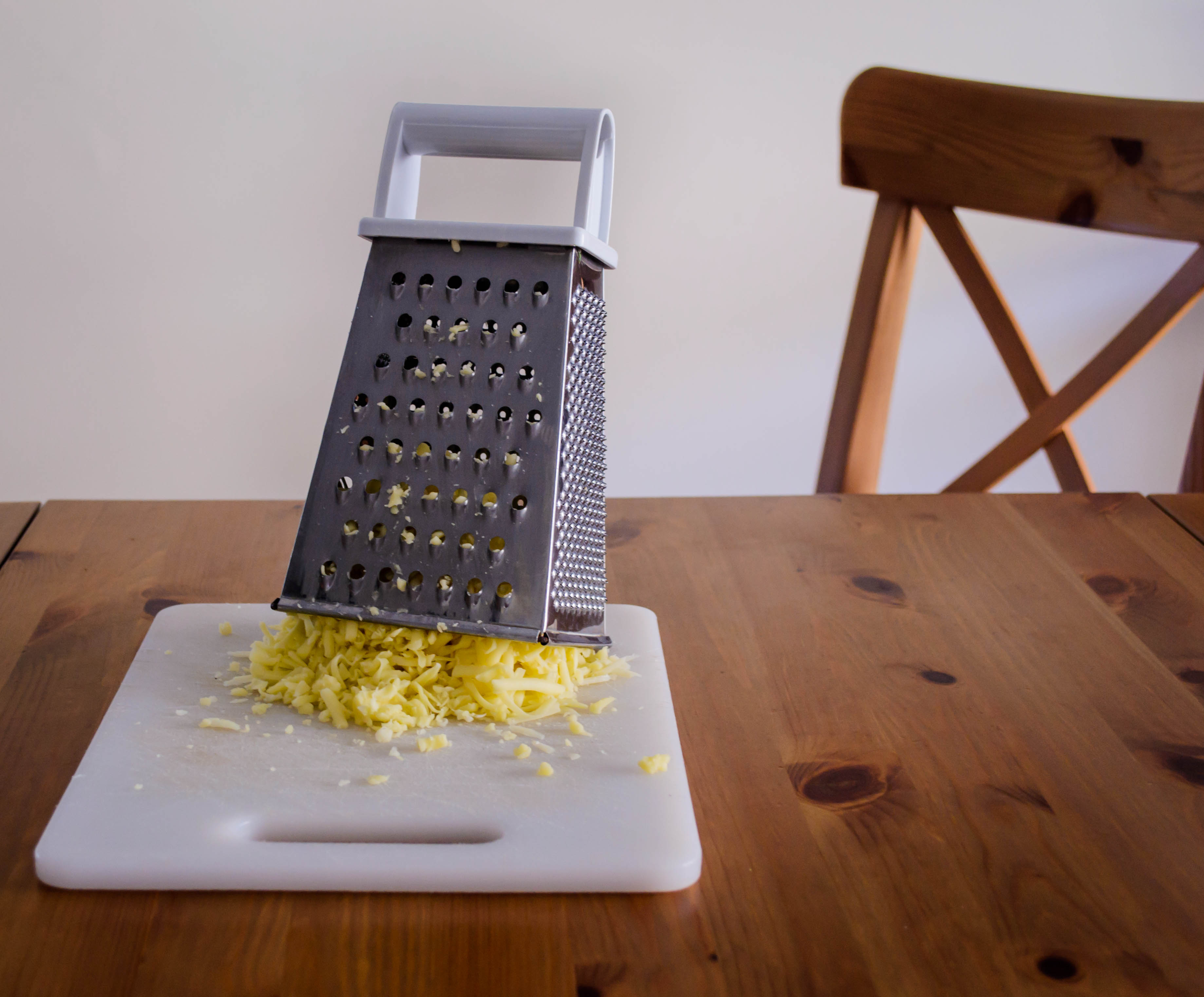
  • Using the disc shredder of a food processor or a box grater, grate the onion and cook it in 1 tablespoon butter over medium low heat until tender and translucent but not browned. Set aside to cool.
  • While onion cooks and cools, use the regular blade of a food processor to create 1½ cups bread crumbs from 1-2 slices of bread (stale is fine). Combine the bread crumbs, the milk or half and half, and 1 teaspoon of dijon mustard in a small bowl and let soak for 5 minutes.
  • Add the ground pork, cooled onions, ¼ cup parsley, salt, baking powder, brown sugar, and spices to the food processor. Squeeze out the soaked bread and add that as well.  Process for 1-2 minutes into a smooth, homogenous mixture. Pause to scrape down the sides as needed.
  • Dump the pork and bread paste into a large bowl and add the ground beef. Using your hands or a spatula (but hands work better), gently fold the beef into the pork mixture until just incorporated. With moistened hands, form generous tablespoon-sized balls (about 1 inch) from the meat mixture.
  • Heat oil in a straight-sided skillet to 350F, or until the first meatball sizzles when cautiously dipped in. I used my electric skillet to help monitor the temperature. Fry the meatballs, turning as needed, until brown on all sides – about 5 minutes. Remove and let drain on a paper towel-lined plate or tray while you make the gravy.
  • For gravy, carefully pour out the remaining oil in the pan, but leave any browned bits behind for extra flavor. These are called fond. Melt the 2 tablespoons butter over medium heat, then sprinkle in the flour and whisk together. Let flour and butter cook for 1-2 minutes into a loose, lightly golden smear. Stir in the instant espresso powder, the brown sugar, and the dijon mustard. Add the beef broth, whisking constantly to deter lumps. Continue to whisk slowly until mixture reaches a simmer and thickens to a gravy consistency. Taste for seasoning, keeping in mind flavors will intensify as it continues to simmer.
  • Add the meatballs to the gravy in the pan, cover, and cook over low to medium low heat for 30 minutes, basting the meatballs occasionally.
  • Serve hot or warm over buttered egg noodles, mashed or boiled potatoes, or with toothpicks for an appetizer or smorgasbord spread. Sprinkle the final tablespoon of parsley over the starch or the meatballs themselves for a little brightness.

Roasted Cauliflower and Chick Pea Tacos

Food Blog February 2015-0342I’m sure it won’t surprise you to learn this, but I am one of those people who makes a meal plan. Every week, before we head to the grocery store, I write out a shopping list. I like to know what we’ll be eating most nights ahead of time, to be sure the pantry is adequately stocked, but also to prevent a lot of impulse buys or take-out emergencies (also I just love making lists. You probably aren’t surprised by that either). When I put the meal plan together, I usually ask N. for some input. Sometimes it’s because I need a little inspiration, sometimes it’s because I want to make sure he’s getting a meal or two he’s excited about, and sometimes, I’ll admit, it’s just because I want him to feel like he has some say about what happens in our kitchen.

Food Blog February 2015-0322This considerate move doesn’t always play out as helpfully as expected, however. Most weeks, without even looking at the list or at the meals I’ve proposed, he immediately says “tacos.” Nothing else gets this kind of instantaneous, definitive response. Tacos. Sometimes, when he says this, we’ve just had tacos. Sometimes, when I query him further, he doesn’t seem very enthusiastic about the suggestion he’s just made. Sometimes I’m just not in the mood for tacos (I mean, we JUST had them) and so I nod and smile and write down something else instead.

Food Blog February 2015-0324Finally, though, I got curious, and yesterday I asked him why he suggests tacos so frequently. Does he really like them that much? What is it about a taco that he finds so compelling? Turns out it’s not the food, exactly, but the name. Be warned, people. This is what happens when you fall for a words person. He really likes the sound of the word “taco.”  It is, he claims, an interesting sounding word. You can put emphasis on each of the syllables in turn, you can change the pronunciation of the vowel, you can draw out the length of each part of the word, all with different sounds and results. He then proceeded to say “taco” four or five times. It is, I must admit, a fun word to say. I’ll wait while you try it a few times…

Food Blog February 2015-0328As much fun as the word is, N. noted that he likes the dish as well, and it got me thinking about the constituent parts – what makes a taco a taco? As I see it, tacos break down into three major components: the shell, the “meat,” and the sauce. Of course you can – and often should – add cheese and lettuce and other garnishes, but I think you have to have at least these three parts. Once you have these critical components, you can take your tacos in a variety of directions.

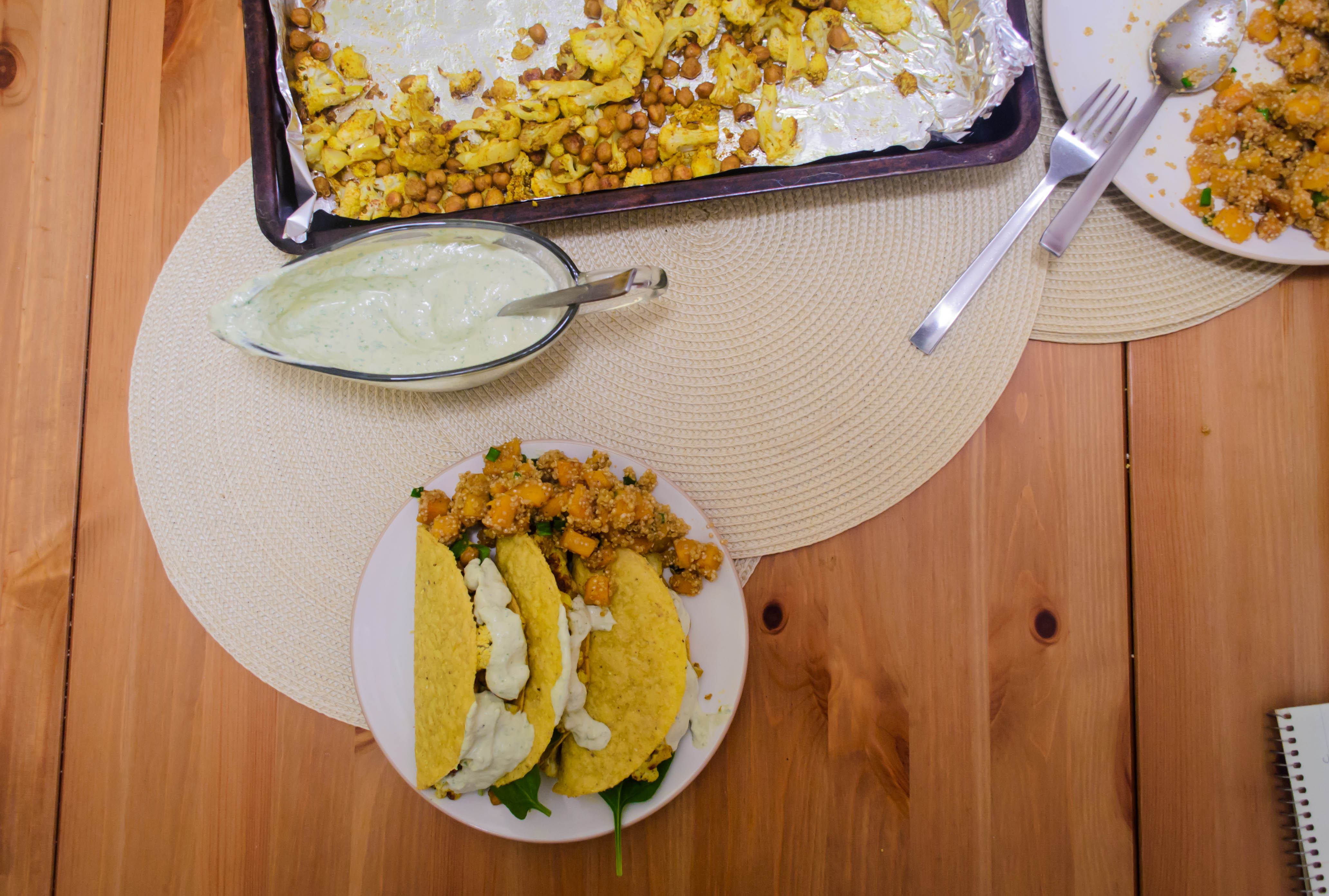
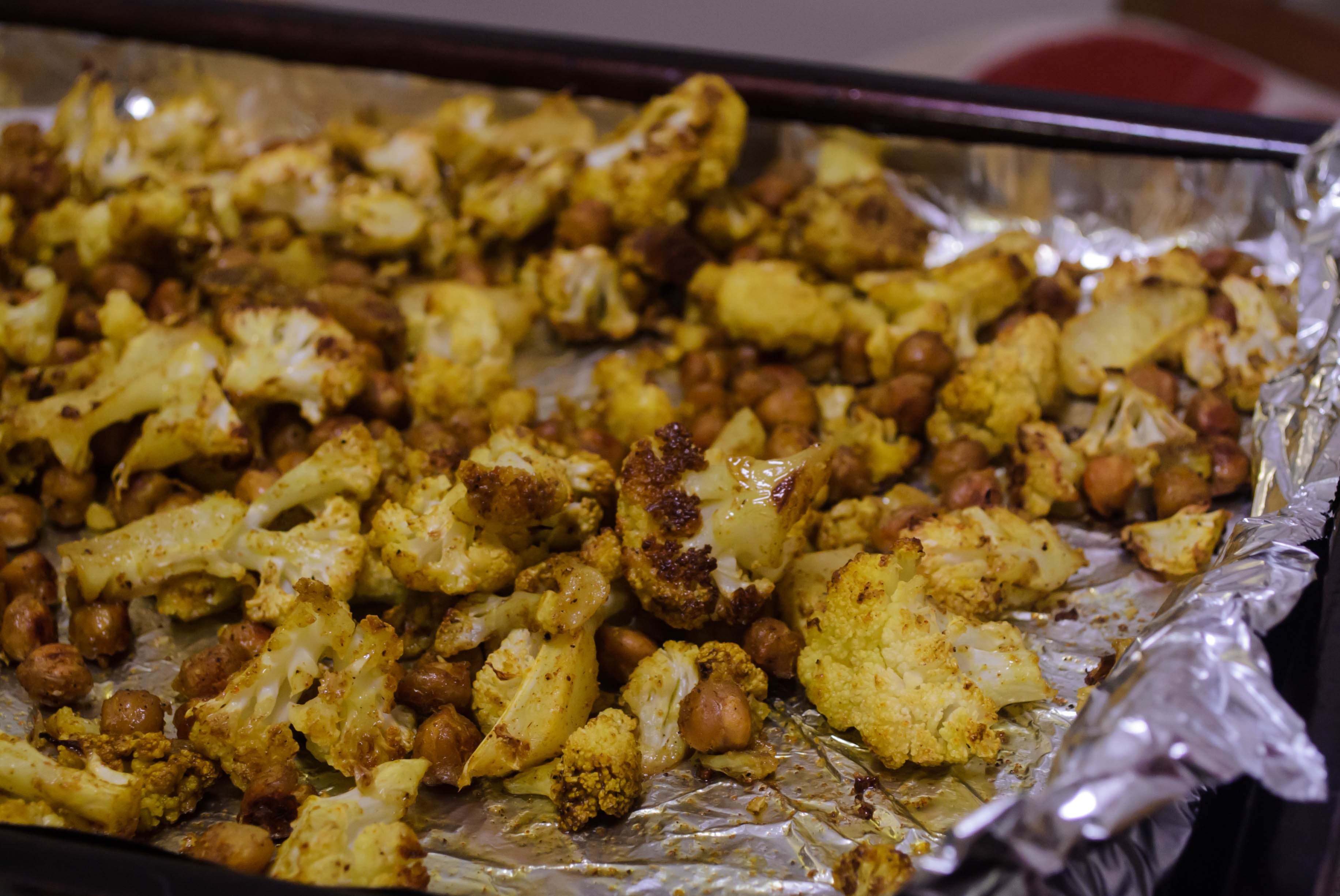
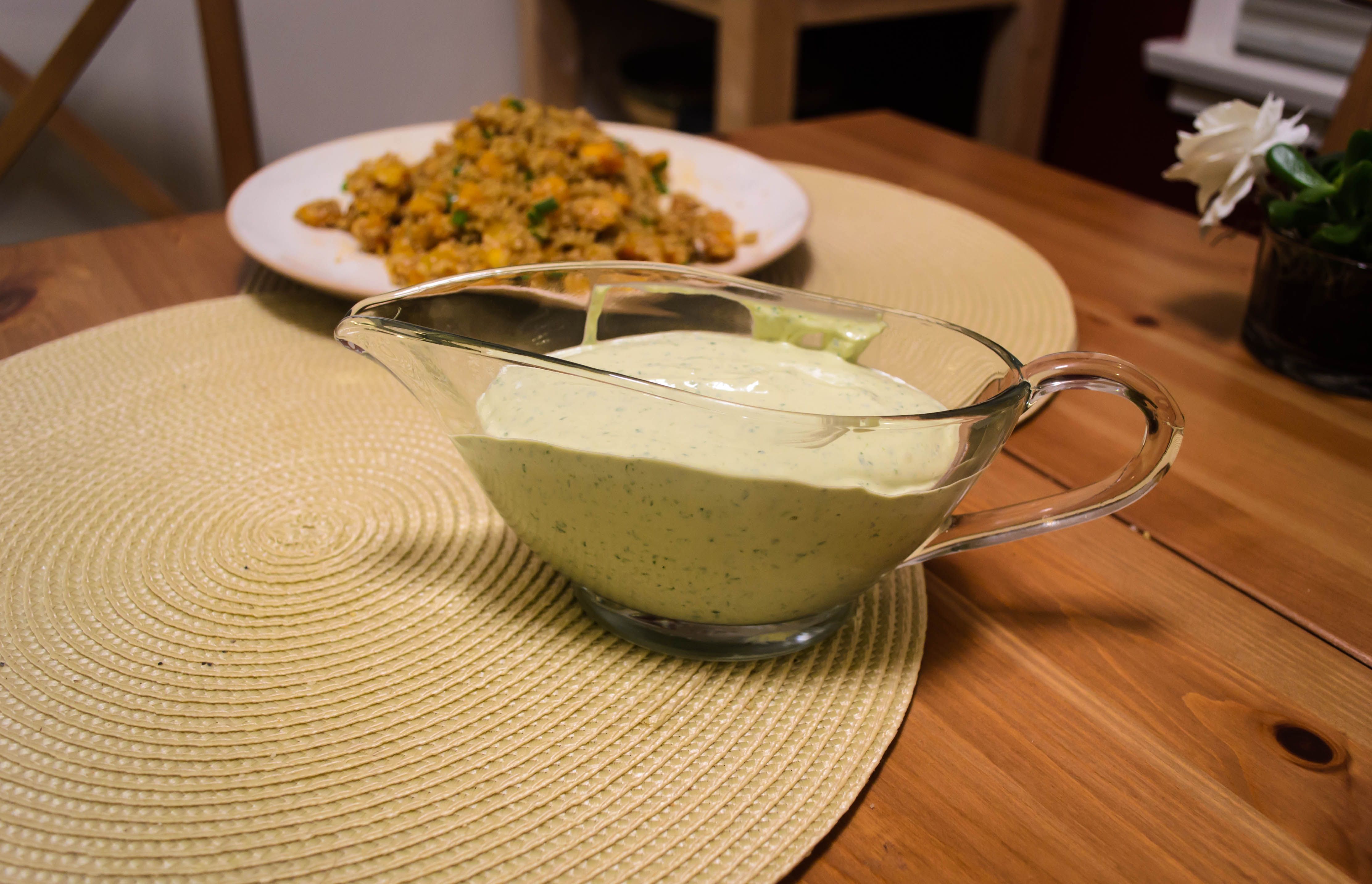
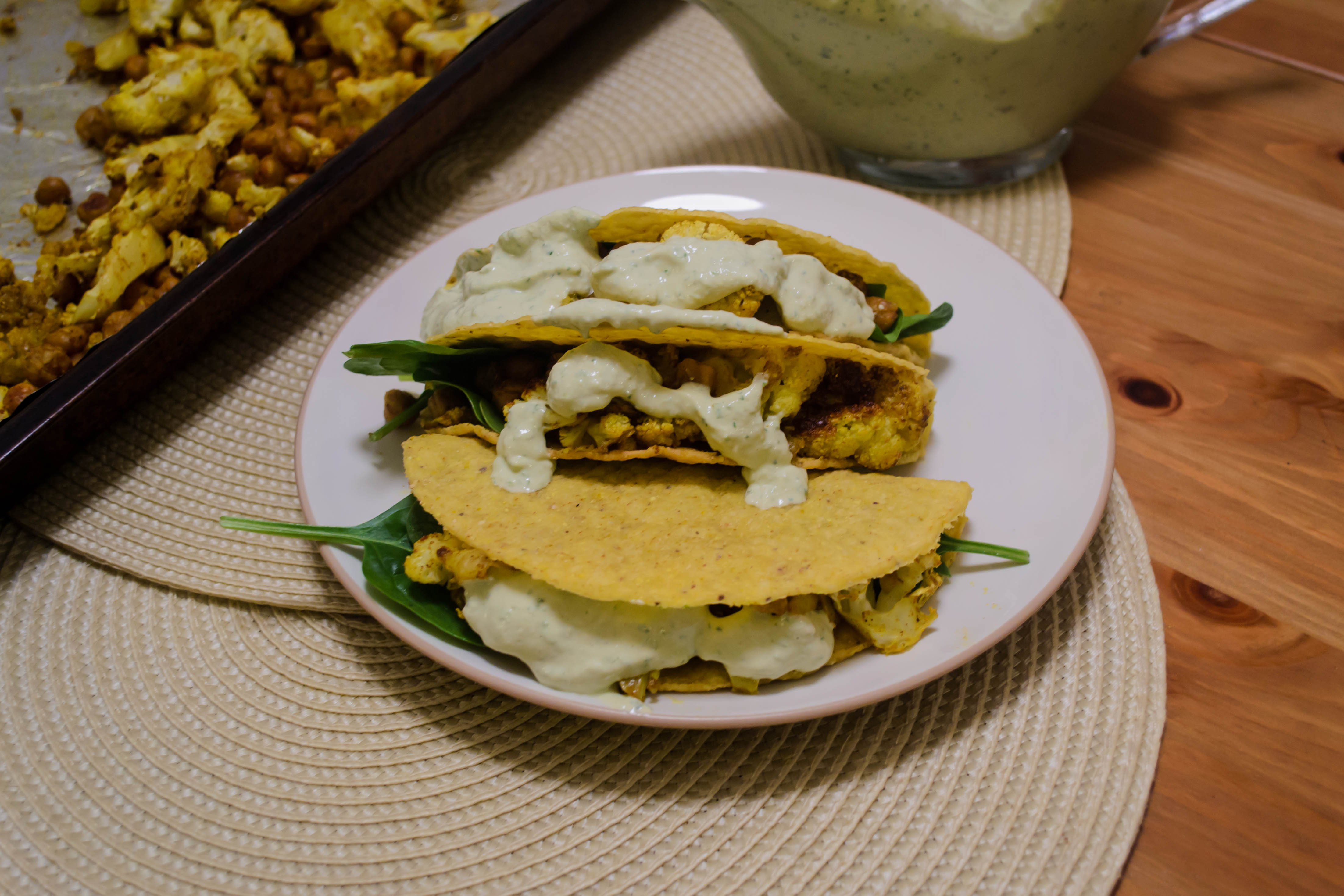
Food Blog February 2015-0335Perhaps because N. is so fond of them – whether it’s the word or the dish itself – I quickly tire of the standard ground-meat-with-cheese-and-things compilation, and look for other options. We’ve had grilled zucchini tacos with crumbled queso fresco and lime, dozens of incarnations of fish tacos (my favorite always involves a corn relish and plenty of smashed avocado), tofu tacos overloaded with pepperjack cheese, and I’m working on a potato taco inspired by an amazing version at – of all places – the Getty Museum cafeteria. This time around, though, I wanted something a little more outside the box (or should I say outside the shell? No, you’re right, I probably shouldn’t. Let’s pretend it didn’t happen). I’m not sure where the combination came from (if I’m honest, probably Pinterest), but I decided on a tumble of roasted cauliflower and chick peas, liberally spiced with a ras al hanout-esque blend and drizzled with a sauce of tahini and yogurt, tangy with lemon and flecked with parsley.

Food Blog February 2015-0332What resulted was not N.’s favorite taco ever (though I doubt it will stop him from requesting them), but I am finding, a day or two later, that I’m mildly obsessed with them, especially the sauce. It wasn’t fancy, but there was something quietly brilliant about how the yogurt and parsley lightened up the earthiness of the tahini. Roasted vegetables, though I will almost never say no to a bowl of them, can feel a little heavy. Blanketed with this sauce, they are bright and buoyant, and the creamy spread is just as fitting against the soft unctuousness of the cauliflower as it is against the toasted crunch of the chick peas.

Food Blog February 2015-0336This is one of those recipes where the list of spices looks daunting, and by all means, if your spice cabinet is not as ridiculous overflowing full as mine is, go easy on yourself and use a pre-mixed blend. I won’t judge. Ras al hanout is a North African combination of spices, one of those lovely warm mixtures incorporating options American dishes usually reserve for desserts. Really, though, any mixture of Mediterranean or Middle Eastern spices would be lovely here – choose your favorite and apply accordingly.

Food Blog February 2015-0338Once you’ve got the spices sorted, this dish is a multi-tasker’s dream. The cauliflower and chick peas need a good chunk of time in the oven at high heat, and while they are roasting you have plenty of time to whip up the sauce, warm the taco shells according to your favorite method, and even concoct a side dish (we ended up with sautéed cubes of butternut squash folded into a bit of cooked quinoa and a shower of green onions). By the time the filling finishes roasting, all you have left to do is scoop and serve, and if you’ve been reasonably efficient it has probably taken you just under an hour.Food Blog February 2015-0342*Note: you’ve probably noticed by now, and may be horrified by the omission, that these tacos don’t include a cheese component. With the yogurt and the deep earthy roasted flavors of the vegetables, I found I didn’t miss it. If you can’t do without, however, I suggest a few crumbles of feta to fill the void.


Roasted Cauliflower and Chick Pea Tacos
Makes 10-12 tacos

For the tacos:

½ teaspoon ground cardamom
½ teaspoon ground cumin
½ teaspoon ground coriander
½ teaspoon ground ginger
½ teaspoon ground turmeric
½ teaspoon freshly cracked black pepper
¼ teaspoon ground allspice
¼ teaspoon ground cloves
¼ teaspoon cayenne pepper
1 teaspoon coarse salt
6 tablespoons olive oil
1 head cauliflower, cut into bite-size florets
15 ounce can chick peas, drained and dried
1 cup loosely packed baby spinach leaves
taco shells
For the sauce:
½ cup tahini
½ cup plain greek yogurt
½ cup flat-leaf parsley
2-3 tablespoons lemon or lime juice, or a combination
1 teaspoon honey
½ cup water, to thin
salt and pepper, to taste


  • Line two baking trays with aluminum foil and place them in the oven. Preheat oven, trays and all, to 450F.
  • In a small bowl, combine all of the spices and the salt, stirring to be sure they are well-blended. Add the olive oil and stir or whisk to combine.
  • In a large bowl, toss the cauliflower with about ⅔ of the spiced olive oil mixture, then spread on one of the preheated baking trays in a single layer (if possible).
  • In the same bowl, toss the chick peas with the remaining olive oil and spice mixture, then spread onto the other baking tray.
  • Stow both baking trays in the oven and roast at 450F for 20 minutes. After 20 minutes, remove the tray of chick peas, shake them around a bit to deter sticking, and set aside. They should be toasty and crunchy. Shake and stir the tray of cauliflower pieces to promote even browning, then return just the cauliflower tray to the oven and roast for another 10-15 minutes, until both sides of most pieces are nicely browned.
  • While vegetables are roasting, combine the tahini, yogurt, parsley, honey, and lemon juice in a food processor and whir to create a thick paste. With the food processor running, dribble in the ½ cup of water slowly to transform the paste into a sauce. You may not need the entire ½ cup – thin to your desired consistency. Season to taste with salt and pepper, then set aside and prepare your chosen form of taco shells according to your preferences.
  • When the cauliflower is nicely browned and tender, toss it with the chick peas and stuff the mixture into taco shells with a few spinach leaves for freshness. Top with tahini yogurt sauce and serve immediately.

Lemony Leek Meatballs

I’m sure you’ve been waiting with bated breath for this post. I’ve made you yearn for it for half the month already! But I didn’t want to announce my intent without something to show for it, and now I finally have a triumphant opening act. Can I get a drumroll? The project I’ve decided on for 2015 is…. meatballs.

Food Blog January 2015-0230Meatballs appear in almost every culture. Albondigas find their way into soup in Hispanic cooking. Chinese meatballs are often steamed or boiled. Keftedes are Greek, kofta or kufteh appear in Middle Eastern dishes. A Swedish version coats very small rounds with a sumptuous gravy and serves them with potatoes and lingonberry jam. The classic American meatball, which is in fact of Italian origin, nestles amidst a mound of well-sauced pasta.

But they aren’t just, as the name suggests, balls of meat. Many meatball recipes combine different types of ground meat to maximize flavor but also adjust fat content. Very lean ground meats, like veal, which some meatball preparations use for its flavor, are often combined with something like pork or fattier beef to ensure tenderness and structural integrity. Bread in some form, whether dry and powdered or fresh, springy crumbs, is a frequent ingredient in a meatball. Though this could be to stretch the meat content (think bread crumbs as “filler” in a crab cake), it also absorbs fat and creates a lighter final product – “light” meatballs are often texturally prized above the dense thickness of a meatloaf, for example.

Food Blog January 2015-0222Most meatball recipes also incorporate some sort of aromatics, and sometimes eggs, to the mixture. This isn’t a mere unflattened hamburger; it’s a creation unto itself, and it needs some backup singers to really make the performance impressive. Onions or garlic, sweated or sautéed before incorporating, are common additions. Herbs, parsley perhaps the most common, are also frequent meatball interlopers.

Food Blog January 2015-0220In deciding on meatballs as my project for the year, I am challenging myself with ratios and with flavor combinations. Ratio-wise, the quantities of meat to bread crumbs to eggs to seasoning must be considered; I want a meatball with good structural integrity – it can’t fall apart during cooking – but I also want something light and springy, not tough and dense. Thus quantities, but also mixing and cooking techniques, must be mastered. As for flavor combinations, this isn’t a dish where you can taste a little at a time. It’s not a slice of roast pork that you can eat with or without the vegetable side. Everything in that little sphere must mingle well. Every ingredient must belong, with nothing extra and nothing missing.

Food Blog January 2015-0221I must admit that I am not a huge fan of the most common meatball incarnation in this country. The planet-sized spheres that arrive, drowning in marinara, balanced uneasily atop a plate of spaghetti, have never thrilled me. But outside that standard, pasta-draped option, I love a good meatball. I hope you do too.

So here’s the challenge: once a month, I will present you a meatball recipe. I have some ideas already, but I’m starting myself out gently with a few recipe adaptations before I strike out into unpracticed territory. And if you have any meatball ideas you’d like to see actualized, let me know in the comments or send me an email! I’ll happily cook something up.

Food Blog January 2015-0225For the opening act, I looked no further than Yotam Ottolenghi and Sami Tamimi in their stellar cookbook Jerusalem. I love this volume. When I bought it for myself last year, I gave up marking recipes I wanted to try with a post-it note because, let’s face it, that’s just not helpful when you are marking almost every page. But the Lemony Leek Meatballs, curiously filed in the vegetable section, stood out. First of all, as Ottolenghi and Tamimi note, they are packed with a staggering quantity of leeks which, despite the beef that makes up the “meat” component, really do emerge as stars in the dish. Secondly, the sauce, chicken broth spiked with a tremendous dose of lemon juice, sounded so bright and aggressive with flavor that I just wanted to drink a mugful.

Food Blog January 2015-0226I wasn’t disappointed. The meatballs sear up golden and aromatic, and as they simmer in the sauce they soak up its acidity and turn it into something outrageous – an intensely savory lemon caramel coating around fragrant pyramids (mine wouldn’t stay round). The leeks and beef are a stellar combination, and the addition of fresh bread crumbs as well as the gently pulverized leeks keep the meatballs light and fresh, probably why they are classified as an appetizer or starter in Jerusalem.

Food Blog January 2015-0228I’ve made a few changes from the original, a dicey business with beloved traditional recipes like many of these, but they are minor. Rather than steaming the leeks, I’ve sautéed them gently in a mixture of butter and olive oil for extra flavor. To keep with my project theme, I’ve maintained the ball shape, rather than flattening them into patties as Ottolenghi and Tamimi direct. Finally, as I’ve noted below, I increased the number of meatballs – rather than 8, as in the original recipe, I’ve done 12, and really you could easily make 16 from the same amount of mixture.

Food Blog January 2015-0236Forewarning: this is a lengthy process. Like, if you are really on top of your game and quick on the prep and ready to multitask, “lengthy” means about two hours. The leeks must be cooked down first, which takes a good 20 minutes, and then cooled. The meat mixture, once it’s formed into balls, must be chilled for a full half hour to ensure that they stay together in the pan. After searing, the meatballs simmer in the rich, tart broth for another half hour, and then must cool a bit, as they taste better just warm or at room temperature than scaldingly hot out of the pan. All this means you are looking at almost two hours of prep and cooking time – not onerous, particularly because half an hour of that is just cooling your heels while your meatballs do the same, but worth noting before you charge in hoping to have dinner on the table in the blink of an eye.

Serving suggestions: tuck them into warm pita or naan with the yogurt and perhaps a few slices of cucumber, or sit them on a bed of fragrant couscous shot through with toasted nuts and green onions, or maybe some finely chopped dried apricots. Add a sprinkle of good, tart feta to the top for some extra zing.

Lemony Leek Meatballs
adapted from Jerusalem
serves 2-3 as an entree, 4-6 as part of an appetizer plate
NOTE! Takes the better part of 2 hours
6 large trimmed leeks, root end and dark green portion removed
1 tablespoon butter
3 tablespoons olive oil, divided
2 teaspoons salt, divided
1 teaspoon freshly ground black pepper
9 ounces ground beef (just over ½ a pound)
scant 1 cup bread crumbs (1-2 slices)
2 large eggs
1¼ cups chicken stock
⅓ cup freshly squeezed lemon juice (about 2 lemons)
⅓ cup greek yogurt
1 tablespoon finely chopped parsley
  • Slice the trimmed leeks in half lengthwise to form long half-cylinders. Rinse well, being sure the water gets in between the layers, where dirt can be hidden. Shake off and slice across into ¾ inch slices.
  • Heat 1 tablespoon butter and 1 tablespoon olive oil in a 12-inch skillet over medium heat. Add the leeks and ½ teaspoon salt, and clamp on the lid. Cook, stirring occasionally, for 20 minutes, until the leeks are completely tender but not browned.
  • Drain leeks in a colander, pushing them against the sides with the flat of a wooden spoon to press out some of the water. Leave to cool, then squeeze out any residual water with a clean kitchen towel.
  • Dump leeks into a food processor and pulse a few times until well chopped, but not mush. Place them in a large bowl with the ground beef, bread crumbs, eggs, 1 teaspoon of salt, 1 teaspoon of black pepper, and use your fingertips to gently combine the ingredients into a homogenous mix. Try not to overwork. The final mixture will be quite soft.
  • Gently form the mix into 12-16 equal balls and refrigerate 30 minutes (this gives the bread crumbs some time to absorb some of the fat and liquid in the mixture, and helps these delicate, soft meatballs stay together).
  • Heat the remaining 2 tablespoons olive oil over medium-high heat in the same large skillet (wipe it out first if there is leek detritus lingering). Gingerly add the meatballs, being sure they don’t touch, and sear until golden-brown on all sides (2-3 minutes for each side); you can do this in batches if necessary.
  • Now, pour on the chicken stock – it should come about halfway up the sides of the meatballs; maybe a bit higher. Add the lemon juice and remaining ½ teaspoon salt. Bring to a boil, then pop on the lid, turn the heat down to medium or medium-low, and simmer gently for 30 minutes.
  • After 30 minutes, remove the lid and cook for a few more minutes, if necessary, until almost all the liquid in the pan has evaporated. Remove the pan from the heat and set it aside to cool.
  • Serve the meatballs just warm or at room temperature, with a dollop of the yogurt and a sprinkle of parsley.