 When I told my parents that my blog project for 2015 was meatballs, my dad immediately said “I know how you should start your first entry.” He recommended the children’s retelling of the old folk song “On Top of Old Smokey” which, rather than a lament about lost love, relates a warning tale about losing your meatball (all covered with cheese) as the result of a poorly timed sneeze. After rolling off the table and onto the floor, the poor meatball rolls out the door, into the garden, and collapses to mush under some shrubbery. Fear not, however! In the springtime, it grows into a tree, presumably studded with fresh, hot, cheesy meatballs.
 Since my first entry was a.) already written and b.) decidedly middle eastern, Dad’s song suggestion didn’t seem to fit. It did make me reconsider, though, my initial proclamation against the classic meatballs usually crowning the spaghetti-and– combination. My objections were memories of uninspiring flavor and texture – the classic meatballs can be mealy and soft inside, and they are so drowned in red sauce their own flavors are rendered unapparent.
 The decision to make the classic, then, required three challenges: the meatballs themselves had to be light, springy, tender, and flavorful – all of the techniques I’d been honing throughout the year would be put into application here – the pasta had to be perfectly cooked, and there would need to be sauce. The meatballs, as the feature, needed to have the right texture – I decided on milk-soaked breadcrumbs for tenderness, but not too many. Many classic Italian-American meatballs combine multiple types of meat – I chose pork and beef for a strong pairing of fat and flavor. Some meatballs also use ground veal, but I have ethical concerns about veal and so I choose not to purchase it. The pork, with its fattiness, and the beef with its lean flavor, would be perfect. Using pork as well as beef eliminated the need for an egg as a binder. Raw ground pork clings to itself and everything around it, so these meatballs hold together with no trouble.
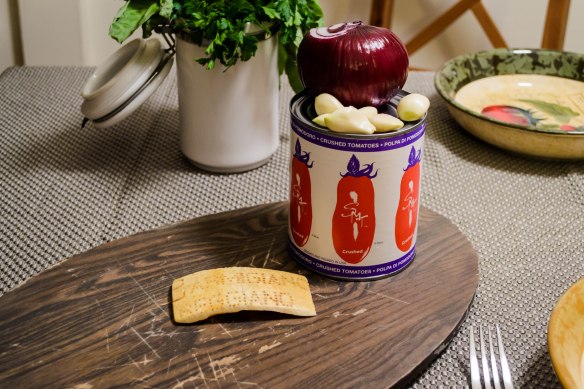 Flavorings are, I think, the most important part of a meatball. Rather than a bland ball of, well, meat, I wanted these to be interesting in their own right. Parsley was a definite, and I decided I wanted some basil as well. Finely grated onion and garlic sweated down in a bit of olive oil would add flavor as well as moisture, to keep the meatballs from getting dry. Finally, there needed to be parmesan cheese. Ina Garten’s Italian Wedding Soup features baked chicken meatballs oozing with cheese, and the salty gooiness is so appealing; I knew I wanted to imitate it with mine.
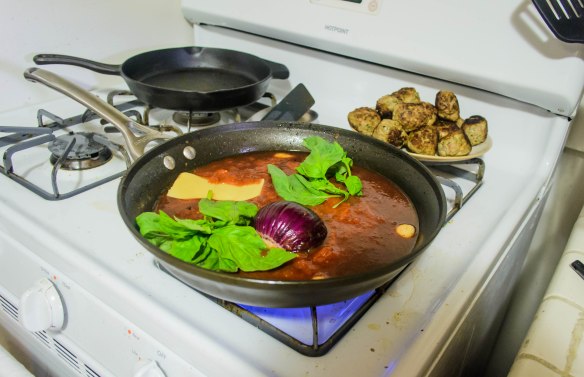
 Meatballs managed, there was then the sauce to contend with. Tomato sauce and I have a long, fraught history. I never much cared for the sort that dripped out of jars, and during my teenage years it flat out upset my stomach. The idea of meatballs burbling away in that acidic, over-processed stuff was beyond unappealing. But I’ve started making my own tomato sauces in the last few years, and I’ve found that rather than tomato paste and sugar, garlic and red wine seem to be the key flavoring components for a satisfying pasta topper. For this one, I started with Smitten Kitchen’s incarnation of a three ingredient tomato sauce, but couldn’t deal with the probably stellar simplicity of it, and succumbed to adding red wine, garlic, basil, red pepper flakes, and – my ultimate pasta sauce weapon – a parmesan cheese rind (I keep them in the freezer when there’s no more cheese to grate from them) to the original trio of canned tomatoes, an onion, and butter.
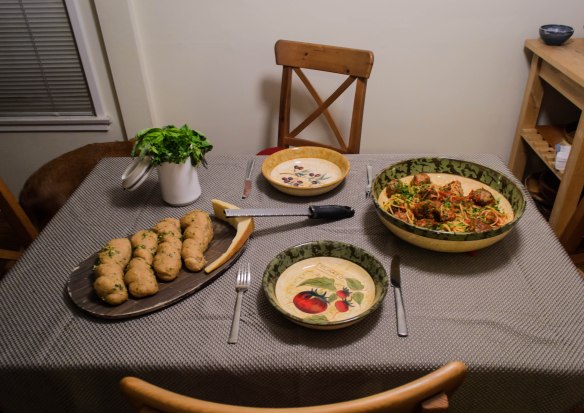
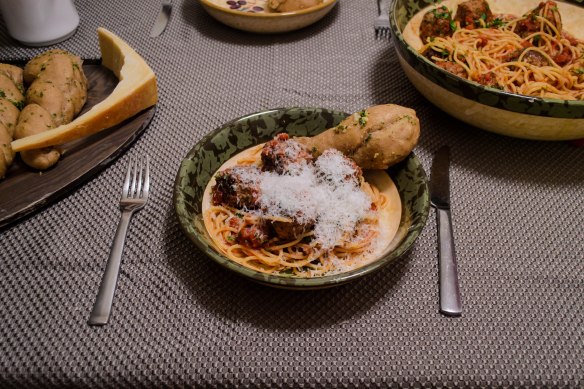
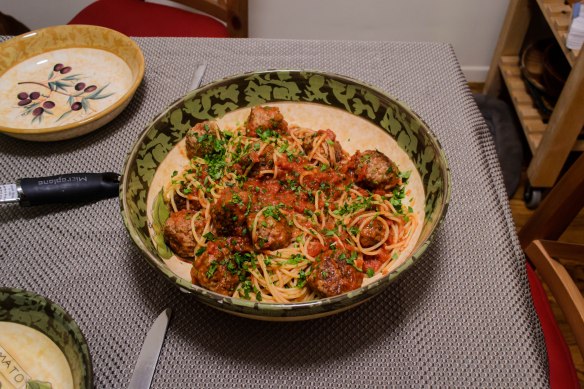 While it would be sacrilege to call this anything like the “best spaghetti and meatballs” (in today’s world, that title is probably copyrighted anyway), it was a very satisfying way to conclude the project.* The meatballs were flavorful and tender and held together well. The sauce was deeply savory but still fresh and light and strongly tomato-y. Crowned with some fresh herbs and a fluffy shower of grated parmesan, it was worth holding onto, and certainly nothing to sneeze at.
 *Though I’ll be back next week with a few end-of-year reflections on the project in its entirety.
Classic Spaghetti and Meatballs
About 90 minutes
Serves 4-6
For meatballs:
scant 1½ cups fresh bread crumbs (1-2 slices)
1 cup milk, cream, or half and half
¼ cup olive oil, divided
⅓ cup grated onion (about ½ a large onion)
2 large or 3 small garlic cloves
½ pound ground beef
½ pound ground pork
2 tablespoons chopped fresh parsley
2 tablespoons chopped fresh basil
⅛ teaspoon pepper
½-¾ teaspoon salt
⅓ cup grated parmesan
For sauce:
½ cup dry red wine
28 ounces crushed tomatoes (I like the San Marzano brand)
3 tablespoons butter
½ a large, peeled onion
6 whole, peeled garlic cloves
3-4 inch hunk of parmesan rind, if you have one
2 stalks basil
salt and pepper to taste
1 pound hot cooked spaghetti
¼ cup chopped parsley
extra parmesan cheese, to serve
- Use a food processor to make your bread crumbs, then add them to the milk in a two-cup glass measuring cup, and let them soak for 10-15 minutes.
- Use the same food processor (you don’t even have to rinse it out) to process the onion and garlic – toss in the onion in a few pieces, and the whole garlic cloves, and pulse until almost paste – only very small, grated-looking bits will remain.
- Heat 1 tablespoon of the olive oil in a large skillet over medium-low heat. Scrape in the onions and garlic, sprinkle very lightly with salt and pepper, and sweat until tender and translucent; 5-8 minutes. Turn off the heat and move to a glass bowl to cool slightly.
- While the onions and garlic are cooking, use the food processor again to chop the herbs and the parmesan cheese. Drain the bread crumbs by squeezing them lightly with your hand, then add the crumbs, the herbs, and the cheese to your cooling onion and garlic mixture. Toss together lightly.
- When the bread and aromatics mixture is room temperature or only barely warm, add the ground beef, the pork, and the salt and pepper. Use your fingertips to combine – you want to evenly distribute the ingredients, but not overmix. Keep it as light as possible.
- In the same large skillet you used for the onions and garlic, heat the remaining 3 tablespoons of olive oil over medium heat. Fry about 1 teaspoon of the meat mixture until cooked through, then taste for seasoning, and adjust in the remaining mixture if needed.
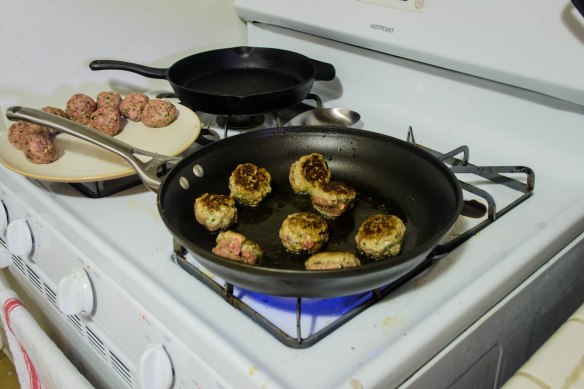
- Roll the remaining meatball mixture into 16 equal sized meatballs (they will be about 3 tablespoons each) . Carefully place them into the skillet, not touching one another (you will probably need to do this in two batches), and sear, undisturbed, for about 2 minutes. When this first side is golden brown, flip over and fry for another 2 minutes, again until golden brown. When browned nicely on all sides, remove to a clean plate and repeat with the remaining meatballs.
- When all meatballs are browned and removed from the pan, add the wine all at once and use a wooden spoon or spatula to scrape around and remove the browned bits from the bottom into the wine, where they will act as flavoring agents. Add in the canned tomatoes, the onion half, the garlic cloves, the parmesan rind, if using, and the stalks of basil. Stir to combine. As soon as the sauce starts to bubble, turn the heat down to medium low and simmer for 10 minutes.
- This is a good time to start a pot of salted water for your spaghetti.
- After the sauce has simmered 10 minutes, taste it and add salt and pepper as needed, but go easy on the salt – the parmesan rind will release some salinity, and the meatballs themselves will as well. Nestle in the meatballs and simmer another 10 minutes, then flip over each meatball and simmer a final 10 minutes, for a total of 30 minutes.
- Discard the onion, garlic, basil, and parmesan rind, then drain the cooked spaghetti and add it into the sauce. Use tongs to gently work it through the sauce, coating it completely.
- Serve directly onto warm plates, or carefully slither into a serving bowl. Sprinkle with herbs and fluffy grated parmesan cheese. I recommend a side of garlic bread, and maybe a green salad.







 "blackberry-eating in late September"