Mon petit chou

And so, I’ve well and truly slacked.  At least in the food department.  Well, at least in the Bittman project part of the food department.  This year’s back-to-school experience of the frantic race-over-uneven-pavement-while-juggling-eggs-and-firecrackers was enhanced by the addition of navigating the cloudy, jagged-edged seas of the academic job market for the first time.  Three weeks in, and I’m starting to collect myself a little, realizing how much work this takes, and that I have to grab my free moments when they present themselves, not whenever I want them to happen.  And while by no means is my hiatus replaced by my regular schedule of the summer, I am slowly adjusting in a way that leaves me just enough time to be with you here tonight.  Well, that and N.’s kind insistence that he tackle the current sink full of dishes.  Don’t hold your breath for my next post, but here’s a snack, if you will, to tide things over?

Two Bittman recipes for you, then, and a brief assessment of each.  Oh, and an apology: since it has been several weeks since I made either of these, even my rough estimate ingredient quantities have long since flown my mind, to be replaced by such niceties as why Beowulf never had a male heir, how many pages my 33 students will produce together during the next week, and how I can make my 54 page first dissertation chapter into a 20 page writing sample.
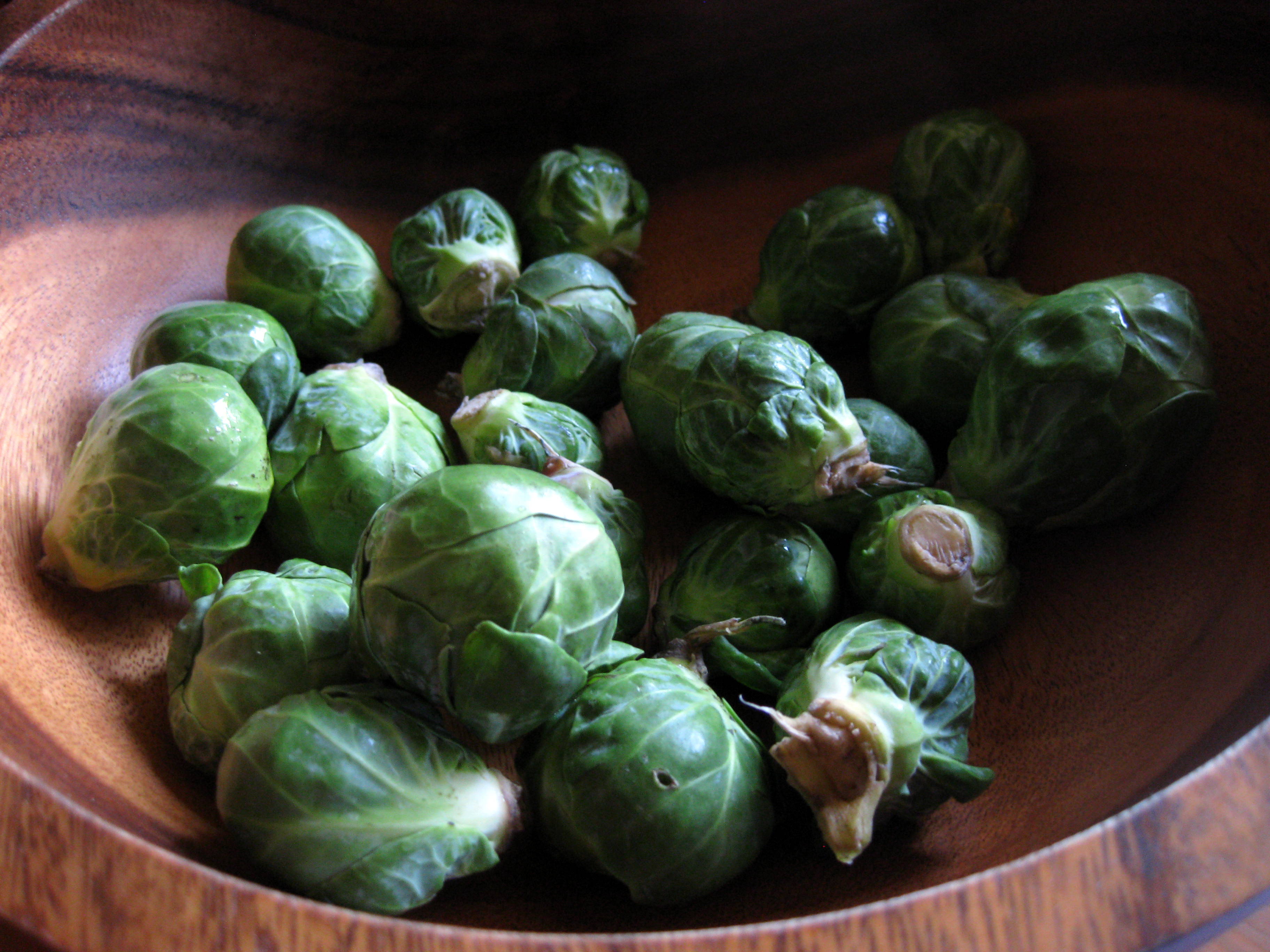
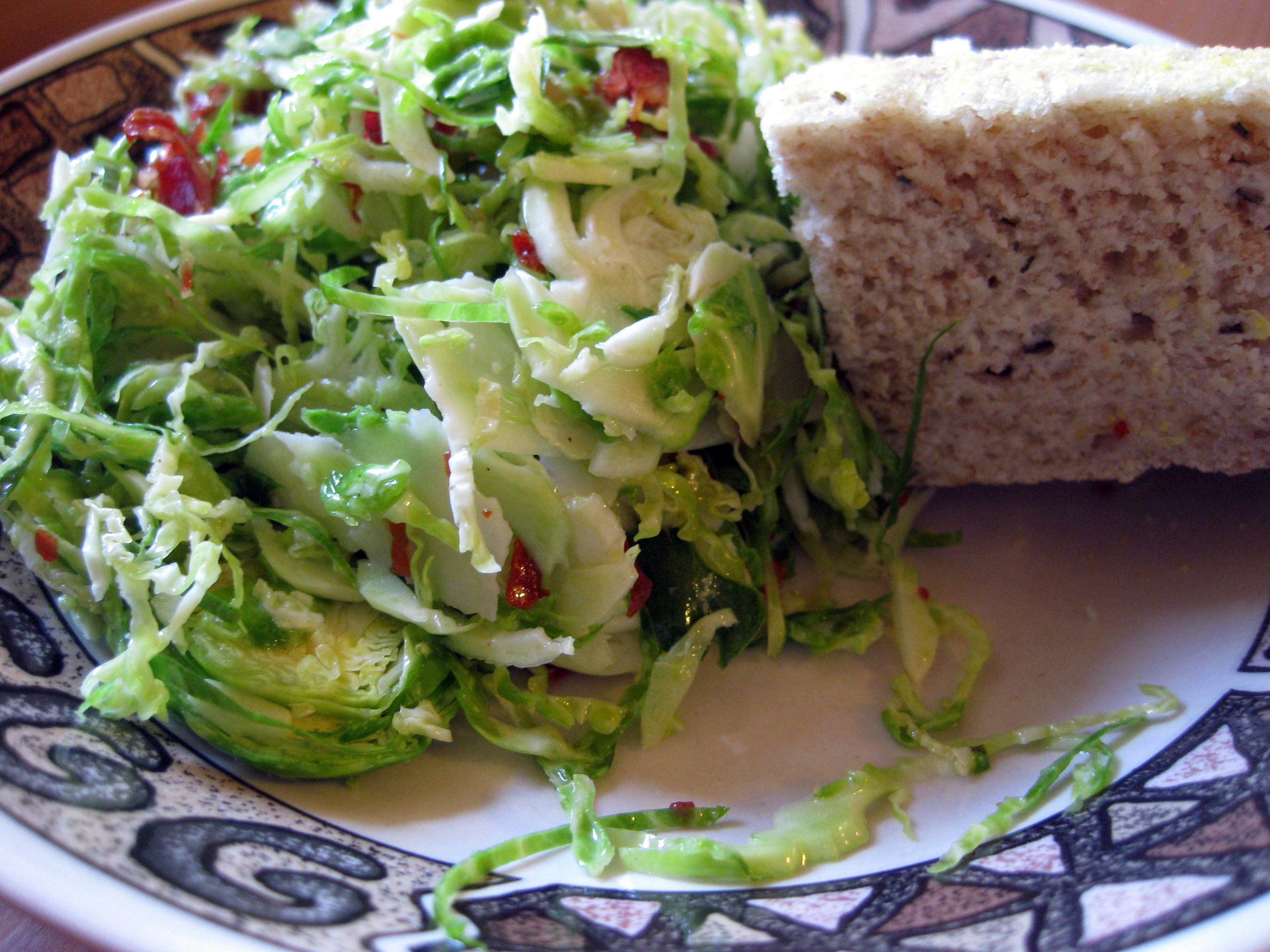
72. Trim and shred raw brussels sprouts (the slicer on a food processor works well). Toss with lemon vinaigrette and shaved or grated Parmesan. Crumbled bacon, as usual, is a welcome visitor here.

Brussels sprouts are one of those near-universal vegetables no one seems to like.  They are bitter and, when boiled, smelly, and can only be saved when eaten in combination with copious quantities of cream or sugared vinegar.  Or, as it turns out, raw with lemon, cheese, and cured pork.  I used prosciutto instead of bacon, baking it for fifteen minutes or so on a cookie sheet lined with parchment paper, and the effect was fabulous.  The prosciutto snapped into sharp fragments of pink shrapnel, and so the textual combination of the dish was amazing.  The sprout shreds (I did use my food processing slicer, and it worked perfectly) were crunchy and crisp but thin and light, like miniature tufts of coleslaw.  The cheese was chewy and grainy, and the prosciutto was crisp and flavorful, filing my mouth with saliva that the tart astringency of the lemon-honey vinaigrette I made just barely dried away.  This would be a great replacement for the heaviness of coleslaw, and is a near perfect quartet of ingredients.  Chopped salted walnuts or roasted, soy sauce drenched shiitake mushrooms might be a vegetarian-friendly replacement for the prosciutto or bacon, but I wouldn’t dare replace the cheese with anything.  It was far too perfect a nutty saltiness against the green resistance of the baby cabbages themselves. 
 

83. Onion-Rosemary Skillet Bread: In a 12-inch cast iron pan, sauté half a large, thinly sliced red onion in about ¼ cup olive oil until soft and beginning to color. Combine a cup of whole wheat flour with 1 teaspoon salt and 1 tablespoon rosemary leaves; add 1 ½ cups water and whisk until smooth. Pour the batter into the hot skillet and bake in a 450-degree oven until the flatbread is crisp on the edges and releases easily from the pan, about 30 to 40 minutes.

Since I got my cast iron skillet (a birthday gift that was purchased using last year’s Christmas present [don’t ask, it confuses me too]), I’ve been looking for recipes that let me use it as much as possible.  Though I am having trouble getting used to the whole well-seasoned thing (no soap?  Really?!), I adore the quick, crusty brown sear it imparts to anything you dump into it.  The appeal of making bread in this stove-to-oven vessel was too strong to pass up.

The challenge?  I bought a 10-inch skillet, and my math skills are weak for anything more complicated than halving or doubling a recipe.

I… estimated.

I did a pretty good job too, with two exceptions: the onions and the oil.  As a consequence, we ended up with a very onion-y bread that was also quite greasy.  Additionally, I was impatient in trying to emancipate my funny little bread from the pan, which resulted in some severe aesthetic imperfections (by which I mean, the whole thing broke up and we ate it in chunks rather than cutting slices). 

Still, it was really tasty.  I’ve never tasted fry bread, but I suspect this is probably similar.  The onion and rosemary worked well together, and the crunchy exterior of the bread was a delightful texture.  No leavening, no sweetening, and no rise time, just bread for dinner in less than an hour?  And out of a cast iron skillet?  We’ll be having this one again, and I intend to get the measurements right this time.

Currying flavors

The thing about Mark Bittman’s make-ahead sides is that they are all ostensibly created with a main of turkey in mind.  They are, after all, Thanksgiving inspirations.  Therefore, when I ask myself the inevitable question each week “what should I serve this with?”, I suppose I shouldn’t be surprised when the first thing that pops into my head is “that would taste really good with roast fowl!”  Of course it would.  That plays into the composition of Bittman’s list.

But we don’t want turkey every week, or chicken, for that matter.  Lately, both for ease, for cleanliness, for cost, and in some minor and embarrassingly halfhearted respects for moral and environmental concerns, I’ve been more drawn to vegetarian fare.  Potatoes, rice, grains, beans: these guys don’t cross-contaminate my kitchen.

So I’m having to be unusually creative in my search for accompaniments for the accompaniments I’m cooking.  This week N. chose, from a short list, an interesting combination:

“43. Toss chunks of butternut squash with butter and curry powder.  Roast until half-tender, then stir in chunks of apple and some maple syrup.  Cook, shaking the pan occasionally, until everything is nicely browned and tender.”


The mystery about butternut squash is, for me, as with some other orange produce, whether to treat it as a starch or a vegetable.  It seems to occupy some strange and unnecessarily cryptic middle ground.  It’s not green or leafy, but it’s also clearly not a tuber, no matter how much its deep autumnal color reminds me of a good hearty yam.  Yet, if I’m not serving meat with dinner, pairing a butternut squash roast with  vegetables seems not substantial enough, but opting to serve it alongside, say, mashed potatoes, seems excessively filling and somehow repetitive.

I opted for another strange middle ground and went for sauteed red chard stirred into quinoa.  As a nod to the seasonal intentions of the squash dish, I cooked my quinoa in turkey broth I made and froze a day or two after Thanksgiving.  I like the deeper, richer flavor that results from cooking grains and small pastas in broth or milk rather than water.  So our dinner basically consisted of two side dishes, but I decided I didn’t really mind.

Here’s how it went:

1 medium butternut squash, peeled, seeded, and chopped into small chunks

2 apples (I used Braeburns) quartered, cored, and chopped into chunks

1 onion, diced (I thought the extra savory flavor would be nice, since apples and squash are so sweet)

1 TB curry powder

2 TB melted butter

1-2 TB maple syrup

I tossed the chunks of squash on a cookie sheet with melted butter and curry powder, then slid it into a preheated 375F oven to roast for 20 minutes.  Meanwhile I prepped my apples and onions.  After 20 minutes when the squash chunks were just beginning to give, I pulled the pan out of the oven and added the apples, onions, and maple syrup – a decadent drizzle over the top that I hoped would pair well with the curry – mixed it all around together, and dropped it back in the oven for another 20 minutes (but really, it took almost half an hour).

While the roasting fruits softened and the maple syrup made suggestions of carmelization on their corners, I addressed our other side dish.  I stripped the chard leaves from the stems, chopped the stems into a fairly small dice, and plunged them into a pot with a couple teaspoons of olive oil.  I sauteed them over medium heat until they were just beginning to soften, then added the quinoa.  In one of my favorite quinoa recipes, Danny (the Chef of Gluten-Free Girl and the Chef ) suggests toasting the quinoa before adding any liquid, much as you toast the rice in a risotto before deglazing the pan.  I toasted for a few minutes, then poured in the turkey stock and clapped on the lid.  When there were only five minutes left on my timer, I added the chopped chard leaves into the mix, stirred it together well, and replaced the lid so it could finish cooking.  It worked perfectly.  The chard had just enough time to steam as the final few tablespoons of water were absorbed, but not enough time to overcook and lose all semblance of texture.  I can’t stand that sliminess that greens sometimes get after too much contact with the heat.  To my delight, the quinoa had taken on a lovely deep rosy color thanks to the chard stems, and the toasty nutty crunch of the grain worked really nicely with the healthful greenness of the chard leaves.

When I pulled the butternut and apple mixture out of the oven, all I could smell was sweetness and curry.  The maple syrup had thinned in the heat, but cloyed onto the chunks of fruit as it cooled again.  The mixture was really nice.  Butternut squash and apples are very good friends, and leaving the skins of the apples on was a wise choice because it added textural interest to the dish.  The curry made the flavors deep and warm and spiced, and the maple syrup was a nice hit of sweetness.  This one I would make again with no reservations, and only one (okay, maybe two) changes.  I put the diced onions right onto the cookie sheet, raw from my cutting board.  When I make this again, I will soften them lightly in butter first.  They didn’t roast quite long enough to quell the astringent tang onions sometimes have, and I could feel them in the back of my throat afterward.  Mellowing them out on the stovetop first would be the right thing to do.

To change it up from curry, I think garam masala would also be delicious on this mixture, and fortunately (and conveniently!) enough, Aarti of aarti paarti has just posted suggestions for making your own!  How timely!  How fortuitous!  Let’s make some!  And then, make this autumnal dish.  Maybe with turkey.  Maybe with chicken sausage.  Maybe, as I realized only after dinner was over, with potato masala burgers from Trader Joe’s.  What a congenial blend of spices that would be to curry favor with your family!

Apologies for the punning… I couldn’t resist.

Bittman 1: Baking Broccolini

With the first week of January down, I am happy to report that I’ve kept up with my resolution so far (yeah, yeah, so it’s only been one week…).  This past week we enjoyed our first in the series of Mark Bittman’s Thanksgiving sides.  Here is his suggestion:

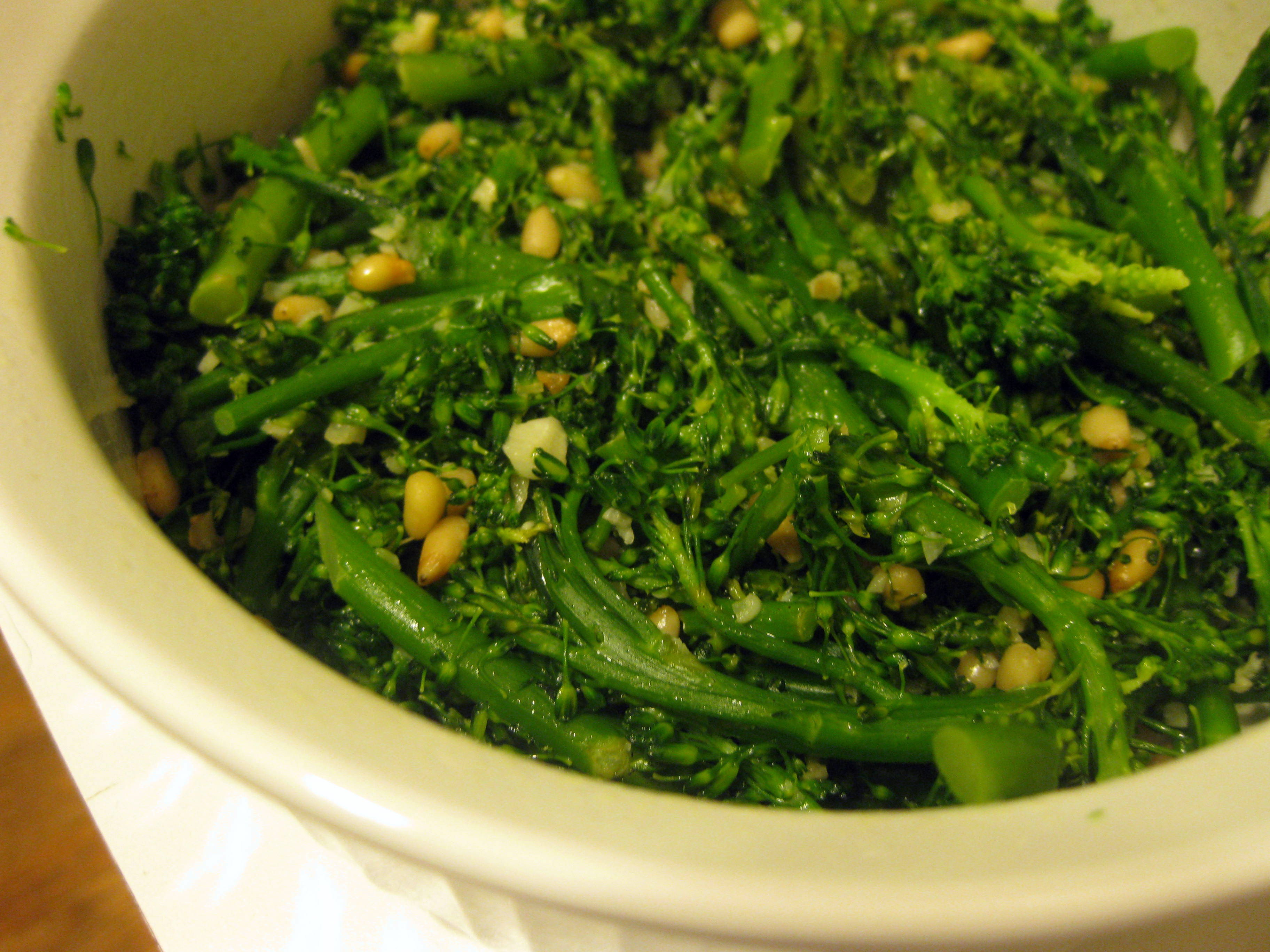
“65. Sauté garlic and pine nuts in olive oil until the garlic softens; add trimmed, blanched, chopped broccoli rabe (or broccoli).  Put into a buttered baking dish, top with Parmesan and bread crumbs and bake until the topping browns.”

As you can see, he gives lots of room for adjustments and personal preference: this is not a recipe, this is a collection of ingredients that dance together well, and what rhythms you might coax them into.  I did the following, in these approximated proportions:

6-8 cloves garlic, smashed and minced

¼ cup pine nuts

2 TB olive oil

2 bunches broccolini (splitting the broccoli / broccoli rabe difference)

½ cup panko bread crumbs

1 TB butter

2 TB Parmesan cheese

I heated the olive oil over medium heat and sauteed away.  Though I can see the need to blanch both broccoli and broccoli rabe before letting it color in the pan with the pine nuts and garlic, my broccolini was a touch on the soft side by the time it came out of the oven, so it probably didn’t need the 3-4 minutes I gave it in boiling water.  Even when I bake them, I like my veggies to maintain a little crispness, and this had almost none.

While the broccolini absorbed the garlicky nutty olive oil in the skillet, I mooshed together my panko, butter, and Parmesan into little crackery clumps.  After spraying a casserole dish with olive oil cooking spray and dumping in the vegetable mix, I topped it with the panko crumbles and stuck it in the oven at 350F for half an hour.  The panko got a little brown, but not quite the golden color I was hoping for.  My thoughts for repairing this are two: 1.) either the oven temperature needed to be hotter, or 2.) I needed more butter in the topping mixture.

This was a good start – aside from the slightly limp broccolini, the flavors were nice and sharp and salivary-gland-inducing.  Garlic and Parmesan are never a bad thing together, and the toasty buttery crunch of the pine nuts went well with the slightly bitter greenness of the broccolini.  We did think, however, that the mix was a little on the dry side.  I was expecting something casserole-ish, and what I got could just as easily have been tossed on a cookie sheet and served: more like roasted vegetables than a finished casserole dish.  It needed, if it was to become a casserole, some kind of sauce or binding ingredient.

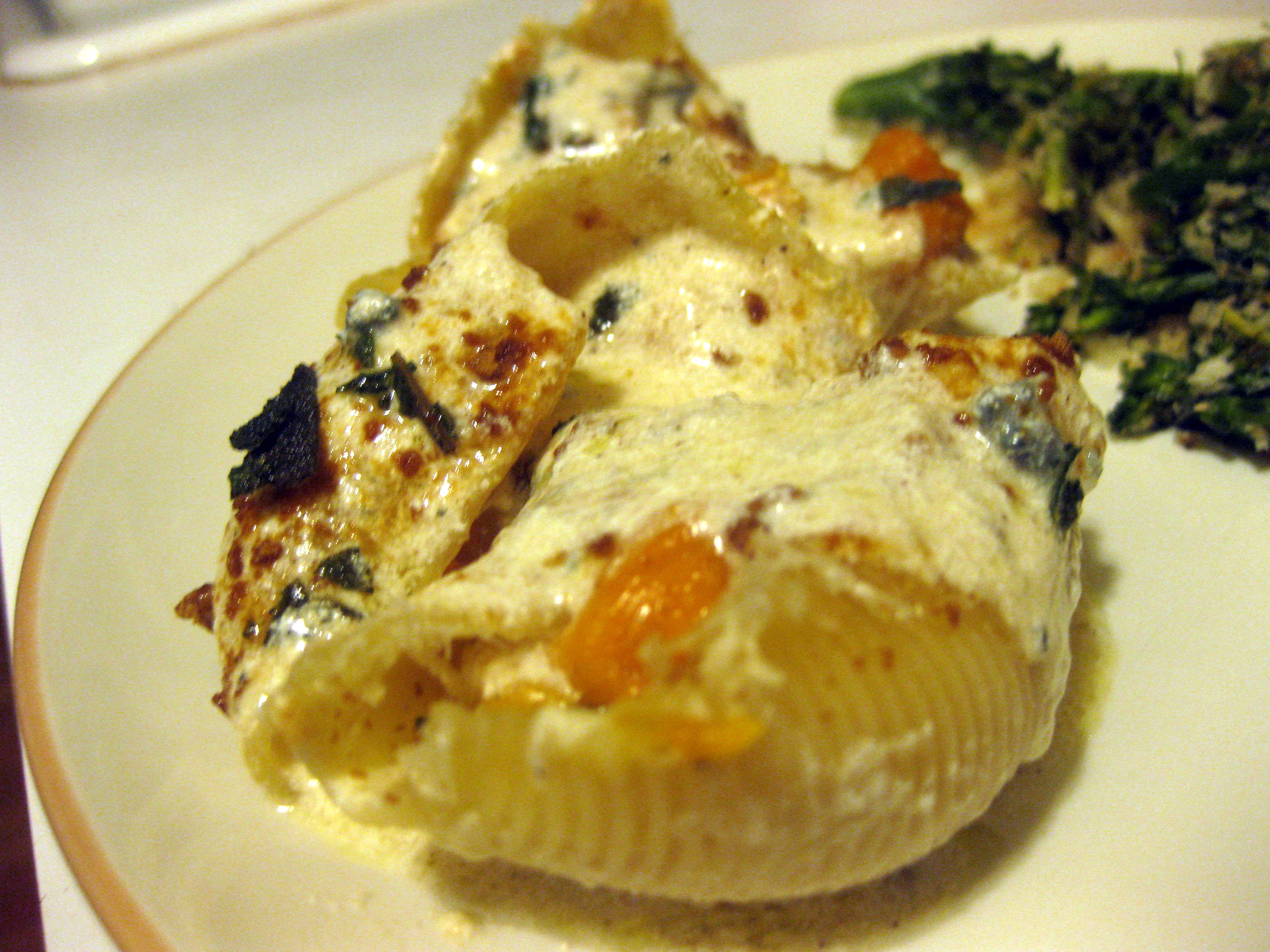
Enter the rest of our meal: butternut and pumpkin stuffed shells with gorgonzola cream sauce.

I had some butternut squash ravioli filling kicking around in my freezer, and part of a can of pumpkin in the fridge.  That, along with the half cup or so of gorgonzola in my cheese drawer and the remaining glugs of half and half from a richer project, became a use-all-this-stuff-up-as-soon-as-possible challenge.  I cooked off some large pasta shells, leaving them a little underdone, and arranged them in a pie plate.  Then I added the pumpkin to the squash mixture, loaded into a gallon ziploc bag with one corner snipped off, and piped the filling into my shells.  I dusted them with a snowy layer of Parmesan cheese and loaded them into the oven with my broccolini.

While pasta and veg baked for half an hour, I set my attention to the sauce I was about to make up.  I fried some sage leaves in butter, my new favorite trick, and then lifted them out and set them to dry on a paper towel.  With the sage-infused butter bubbling, I added some wine and let it reduce a little.  Then I glugged in some half and half, which promptly separated a little – I think it was the acidity of the wine and the refrigerator cold temperature of the dairy, which made it want to curdle.  I should have added the half and half first and the wine second.  I was a little worried about this separation, but it only affected the appearance of the sauce, and not the taste or texture.  Onward!  I crumbled my gorgonzola into the pan and stirred gently until it melted.  That was it.  No thickening agents – the cheese did that job for me – no extra spices or herbs or aromatics, just butter, wine, cream, and cheese.

When the shells were done, with just little golden tips on the exposed edges of pasta, I poured the silky rich blue-veined sauce right over top of them.  Then I crumbled my fried sage over the drenched shells, and sprinkled the whole thing with some pulverized gingersnap cookies.  A touch of fancy, if you will.

The shells were divine.  Not much texture, besides the cookie crumbles, but really, don’t you want just velvet and richness in a stuffed shell?  The cheese sauce was the missing link the broccolini needed.  It was tangy and rich and silken and perfect, and I ended up letting it trickle across my plate to meld with the vegetables and gently perfect them.  Next time, we may add a little cheese sauce before baking the broccolini, and see how that turns out.  I imagine the perfect, decadent accompaniment to baked potatoes…

N. has already picked out which dish we will be trying next week, so stay tuned!

Thanksgiving veg 2010

My family always argues over a Thanksgiving vegetable dish.  My dad doesn’t like the classic green bean casserole made with Cream of Mushroom Soup and crispy fried onion ring crumbles.  He can’t get past the condensed soup flavor.  When I asked him last year what vegetable I should make instead, he suggested lima beans.  We made green bean casserole anyway.

One year my Mom and I tried making this dish from scratch.  We figured, fresh green beans lightly steamed, thick chunks of mushrooms, a silky white sauce, and what could be better?  That was the year I determined that part of what I like so much about the classic green bean casserole is… the taste of processed condensed soup.  I can’t help it.  I love the savory, umami saltiness of it, and the homemade substitute was just not an acceptable replacement for me.

One year at Thanksgiving with some family friends, they brought a big salad to supplement our carbohydrate-rich, overloaded plates.  The bowl was passed around the table.  No one took any salad except L, who had made it in the first place.  When she protested, her husband uttered the truest words anyone has ever spoken: “Thanksgiving is not about lettuce.”  So salad, too, failed the test.

Now that October is over, the challenge again rears its head: which vegetables can I dress up to complement the comforting classics we always serve?  While N. was gone at a conference recently, I fiddled around with some trial dishes and voila, Thanksgiving Veg 2010 was born: creamed spinach and artichoke bake.  It’s the comfort and familiarity of creamed spinach, with the flavors and reminiscence of spinach artichoke dip.  Perfection, no?

Here’s what you need:

4 TB butter

4 cloves garlic, crushed and minced

1 – 2 leeks, white and pale green parts only, chopped fine

4 TB flour

Generous grating of fresh nutmeg

2 cups milk or cream

4 oz. cream cheese

At least 10 oz. spinach (that’s the amount in one frozen box, but I used fresh because I prefer it)

16 oz. can of artichoke hearts in water, drained and quartered

Salt and pepper to taste

Topping:

2 TB butter

½ cup or more of Panko bread crumbs

2-3 TB parmesan cheese, grated

Melt the butter in a large skillet over medium heat.  When it is nearly all melted, add the garlic and sauté for just a minute or two, until the aroma is enticing.  Add the leeks and sauté until they are softened.  Leeks are a new love of mine.  They are the least aggressively flavored members of the onion family, and I think they taste like a cross between a sweet onion and garlic.  They don’t have that astringency onions sometimes do, and I think they are like a stalk of springtime.  I’ve started putting them in frittatas, and when I had one left over on the night I made this little concoction, it seemed like the perfect thing to add in.

When the leeks are tender but not browned, add the flour and nutmeg.  Add some pepper too, if you like.  Stir in until well incorporated with no huge floury lumps, and cook for a minute or two until the flour is pale golden in color.  Then add the milk, slowly, whisking the entire time.  I added it in installments of probably half a cup each, stirring until the milk was fully integrated into the flour mixture.  I found this helped avoid lumps, making a smoother base overall.  Add the cream cheese and mix in.  Whisking fairly constantly, let the milk come to a boil.  It will thicken as it heats.

When the milk is quite thick, add the spinach and artichoke hearts.  The spinach will wilt quickly, and as soon as it is looking soft, kill the heat.  Since this is going to bake for a while, you don’t want to overcook the spinach because it will lose its beautiful color and begin to look muddy.

Salt and pepper to taste.  You could stop here and eat this whole delectable mess right out of the skillet, but I wasn’t ready to quit yet.  After all, it takes my dad about half an hour to carve a turkey, so the oven is (mostly) free.  Why not take advantage of that?

With your oven at a preheated 350F, carefully dump the spinach and artichoke mixture into a baking dish (I used a glass nine-inch pie pan).  Set it aside for a moment while you make the topping.

Mix together the Panko bread crumbs and parmesan cheese with the softened butter.  Drop the buttery crumbs in little clumps all over the top of the spinach and artichoke mixture.  If you don’t get the vegetables completely covered, that’s okay.  In fact, it’s good, because it means any exposed edges of leeks or artichokes will get a little toasty and golden.  More texture = more exciting to eat!

Bake the whole thing for about half an hour at 350F, or until the crumbs on top are browned and the sauce is bubbling at the edges.  Remove and consume.

What I liked about this dish was… well, innumerable.  But the basics: I love creamed spinach, and this was a more extravagant, luxurious take on it.  I also love spinach dip, and this reminded me of it, but without the excessive mayonnaise, the MSG-laced spice mixture, or the pounds of parmesan that go into a hot artichoke version.  The bread crumbs on top were a welcome textural element, especially for a Thanksgiving table, where stuffing, mashed potato, and even the tender juicy turkey, all lack an essential crunchiness.  Not that you would want your mashed potatoes to be crunchy, but it is a sensation for your mouth often missing from this meal.

I told my mom about this dish when I spoke to her on the phone this weekend, and before I could finish explaining what it was, she had already confirmed that this, indeed, would be our Thanksgiving vegetal offering.  Challenge met, and challenge exceeded!  Now I just have to wait for the end of November…

Seattle: Day One

As the end of my first year of marriage to N. approached, we decided that instead of gifts, our anniversary treats to ourselves (and each other) would be brief trips to see or do something fantastic.  Our first wedding anniversary, we saw Eddie Izzard live in Portland.  It was fantastic.  Then we went to the zoo.  Our second year, we saw Macbeth in Ashland, then went to Crater Lake.  Again, fantastic.  This year, we outdid ourselves a bit and spent a few days in Seattle (again, ending the trip with the zoo… I have a weak spot for zoos…).

I write this here because we took this opportunity not only to see the sights, but to taste them.  Seattle has a bit of a reputation for being a foodie haunt, and we decided if we were treating ourselves to the voyage, we might as well… well… eat well… during it.  I sent out a call for suggestions and my friend S. responded with an impressive list of possibilities, so what I’ll present to you here are our highlights of Seattle in food.

After lunch on the road (smoked mozzarella sandwich at the McMenamin’s in Centralia, which unexpectedly came free because our server forgot to put in our order and consequently comped our whole lunch), we set foot in Seattle in mid-afternoon with plenty of time to sightsee a bit before dinner.  We planned our evening at the top of the Space Needle, and ended up deciding on Oddfellows Café and Bar.  The space was great: open and airy with lots of exposed wood ceiling beams, and one old, mellow brick wall.   It’s close to the campus of Seattle Central Community College, and we could feel the youthful vibe of the place in the décor and the demeanor of our fellow diners.  Our server had probably finished up classes an hour or two before serving us dinner.

And what a dinner!  We started off with drinks, since it had been a long drive.  N. had a local porter, and I had pear cider.

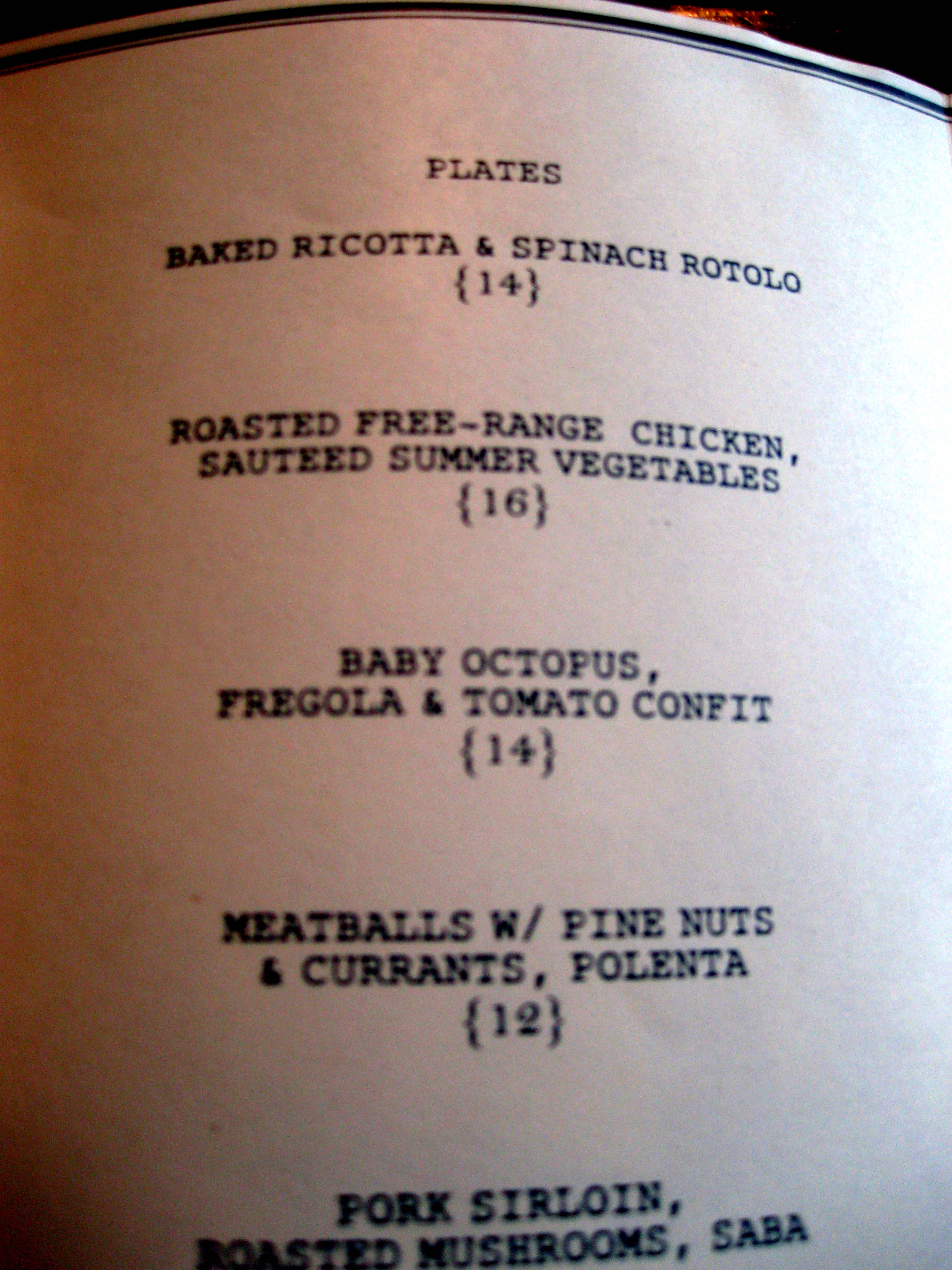
The menu was simple and clean, and though at first I was a bit disappointed by the small number of entrée choices, it only took me the first two lines on the menu to decide what I was having and to guess (accurately) what N. would order.

I had the rotolo, a beautiful rolled pasta, like conchiglioni mated with lasagna, lovingly topped with a blanket of this beautiful tangy, sweet, slightly acidic tomato sauce.  The pasta itself was stuffed, rolled, sliced and flipped on its side to expose its creamy filling to the eye.  It was filled with a mixture of spinach and ricotta cheese, with a light herbiness I haven’t figured out yet.  Oregano, maybe, and perhaps chives.  Though we had agreed upon ordering, I was almost unwilling to hand my plate across the table to share. 

But it’s good to share.  Really, really good.  N. ordered the roasted chicken with summer vegetables, and when it came, almost half a chicken, I knew how good this would be.  With N. a white meat man and me a dark meat fan, he would take a nibble of the thigh, consume the breast, and gladly pass along the rich leg to me.  The chicken was very simply roasted, hot and juicy with crisp brown skin and perfect saltiness.  Really a sexy lady all around.  The meat was tender and rich, and as our knives took turns plunging into the flesh, little rivulets of fat trickled across the plate into the vegetables on the other side, which became the unexpected superstars of the dinner experience.

“Summer vegetables,” in this case, meant a mélange of green beans and thick medallions of green and yellow zucchini.  They were crisp tender and lovingly coated in lemony buttery perfection.  Crunchy, citrusy, peppery, and with the addition of the chicken fat mixing in, perfectly indulgent too.

We passed on dessert this evening, but only because we didn’t want to overdo it on the first night…

Homecoming

Bodily home from vacation, but my mind is refusing to admit that it’s time to work again. With two writing related project deadlines in September, the beginning of the new school year, and that looming dissertation thing in the background, the time for reluctance and inactivity is over.

Yeah, tell that to my sunbathing motivation and my zinc-nosed inspiration. Since returning home, my productivity has been almost nil.

Far opposite holds true in my backyard. Despite a very, very slow start and still largely unresponsive tomatoes, the garden has rebounded and seems determined to make up for its early uncertainty. Every one of our eight peppers has a small green bell swelling on it. Tiny might-be tomatillos are forming inside wasted flower buds on each of the two plants. Cucumbers and zucchinis, oddly shaped but still tasty, are pushing their way out into the sun. Even the eggplants are growing and fruiting! But the real stars, the real miraculously successful, grocery-store quality items are my pole beans. The first sowing was a failure (too cold), but in the second sowing ten or twelve leaves pushed up out of the ground, and on Monday, as we crawled out of the car after a punishing nine hour drive, at least two pounds of ripe, juicy, six-inch long green beans hung ready from the vines.

What could be better, I thought as I looked at them with grinning awe, than a garden-fresh stir-fry to welcome us home? After two weeks of rich food and restaurant dates, we needed some vegetation in our systems, and here was our own garden graciously willing to oblige!

I started some sticky rice in the rice cooker and ran outside to divest our leafy residents of their harvest.

Eggplant and green bean stir-fry seemed to be the obvious menu choice. I simmered water in a skillet and tossed in the halved green beans, cooking them until they were just tender. Then I drained off the water, added vegetable oil and sesame oil, and tossed in chunks of eggplant and some white sesame seeds. Six minutes later, when the eggplant was juicy and soft and the beans had taken some dark marks from the heat of the pan, I scooped big spoonfuls onto a bed of fresh hot rice, and we ate without talking until every bite was gone.

It’s nice to be home.