The Week of Magical Eating days 3 and 4: Soup and Salad

Since sharing lunch with my friend S. a few weeks ago, I have developed a minor obsession with Caesar Salad.  The crispest romaine, whether to add the Parmesan by shreds, crumbles, grates or curls, the perfectly textured crouton: crisp and golden on the outside, with the barest hint of residual chewiness deep within.  But mostly, the object of mystery and allure is the dressing.  It’s tangy but creamy and rich but still light, and pulls the flavors of the salad together to make it a phenomenon.  I decided to make it.  In the gloom of winter, I don’t have the opportunities I’d like to find farm-fresh eggs, and locally grown egg yolk is all I would feel comfortable using without cooking it.  Besides, N. gets worried about raw foods sometimes, and he doesn’t care for the idea of fish in dressing, so egg and anchovy were out.  I poked around online and found some vegan Caesar salad dressings with interesting suggestions, including the addition of brewer’s yeast and tamari to add the salty richness of anchovy.  I collected ideas and then, as usually happens, ended up making my own.

Mayonnaise, lemon juice, brown mustard, tamari, pepper, and garlic went into the mixing vessel that came with my immersion blender.  I pulsed these ingredients together a few times until the garlic was chopped and things were looking paste-like, and then streamed in some olive oil with the blender running until it reached a more dressing-y consistency.  It’s a work in progress, and I didn’t take note of amounts, but it began to capture that lofty Caesar flavor as I added additional spoonfuls of mayo here and lemon there… a bit too much mustard in the first squeeze.  Over-enthusiasm, you know. Tossed with fresh greens, lemon wedges, and sourdough croutons from half a baguette, it was almost right.  Almost there, but close enough for a weeknight.

The next night, inspired by a recipe request I couldn’t fulfill from D., I scoured the ‘nets for a suitable looking black bean soup.  Our salad accompanied a slow cooked chicken with 40 cloves of garlic, and I saved the garlic-infused broth our chicken expelled in the crock pot, so I had a wonderful flavorful stock to use for soup.

After sliding a pan of batter in and a loaf of cornbread out of the oven half an hour later, I commenced to create Dave Lieberman’s black bean soup, found here:  http://www.foodnetwork.com/recipes/dave-lieberman/black-bean-soup-recipe/index.html

I made a few changes to his recipe, for one reason or another, which I’ll share because I thought the result turned out well.

I cooked my bacon until crispy before draining out some of the fat (which ended up mixed with dogfood; Lucy was ecstatic!) and adding only 1 ½ onions.  Instead of Dave’s can of chicken broth, I used the leftovers from our chicken, which were about 1 ½ cups, and about a third of a bottle of New Belgium 1554 for a little extra flavor and fizz (then I handed the remainder of the bottle to N.  Beer and bacon = happy little family!).  I eliminated the ketchup and forgot the lime juice, and added my cilantro right at the end rather than letting it cook.  I decided I wanted a fresher green flavor, so it would serve as a garnish.

Then we went a little crazy with toppings.  I crumbled up some queso fresco, which I am having a deep affair of intrigue with, and used up my single-serving ramekins providing serving dishes for cheese, sour cream, green onion tops, more cilantro, and lime wedges.  The photo below isn’t the most aesthetically pleasing composition, but it was belly-warming and hearty, and tasted marvelous.  We usually have trouble finishing up leftovers from soup, but it has been only four or five days since I made this, and the remains are already gone.  That should tell you something.

The Week of Magical Eating Day Two: Belated Valentine

Belated Valentine, from my kitchen to you:

I am a big believer in comfort food.  For me, mashed potatoes are a comfort food that are impossible to get tired of.  They can be made in so many ways: with butter, with olive oil, with sour cream, whipped, blended, smashed, gravy-ed.  Two things seem to remain true about them.  1.) there are never enough, and 2.) they get cold too fast.  How to combat this?  It helps that I am only cooking for two, but had my first lessons, triumphs, and failures in a kitchen that fed four nightly.  I haven’t yet mastered the downsizing process, but in cases like mashed potatoes, N. and I actually benefit from my over exuberance.

The key element to mashed potatoes, I think, is including enough fat.  Otherwise all you end up with is crumbly boiled potato.  I take my fat options extremely seriously, and in considering all the creamy options, I decided to play with ricotta cheese during this round.  Not only would this add a cheesy dimension, which is almost never a bad thing, but would contribute a velvety texture and give the potatoes a way of clinging together as they crumbled under the force of my masher.

I dropped a bag of baby Yukon golds into a pot of half salted water, half leftover chicken broth that didn’t get stirred into the risotto from the previous night’s adventure.  Then, in a moment of sudden, startling inspiration, I cracked three whole, unpeeled garlic cloves off the bulb and tossed them in too.  Considering the plans for the following night, these paper-wrapped, pungent little cloves could tie the whole week together.

While the potatoes boiled, I considered their final destination.  Ricotta cheese is nice, but it certainly could be improved upon.  I chopped up a good handful of dill and Italian parsley, and on sudden urge, grated a handful of parmesan cheese too.

I like my mashed potatoes chunky, and I know that most of a potato’s nutrients are found in its skin, so I like to make mashed potatoes with new or fingerling potatoes, or with red-skinned potatoes, which all have thin skins with unobjectionable flavors.  This adds to the nutritious value of the final result, and it saves me time because I don’t have to peel a bunch of potatoes in preparation.  Additionally, the skins add a nice textural element as they yield their hold on the starchy interior and shred through the pot upon mashing.

After draining and peeling the garlic cloves, I added and gently mashed together the following with the softened soldiers:

  • 4 TB butter
  • ½ cup milk
  • 8 oz. part-skim ricotta cheese
  • ¼ – ½ cup grated parmesan cheese
  • ¼ cup roughly chopped fresh parsley
  • 2-3 TB chopped fresh dill
  • Sea salt and black pepper

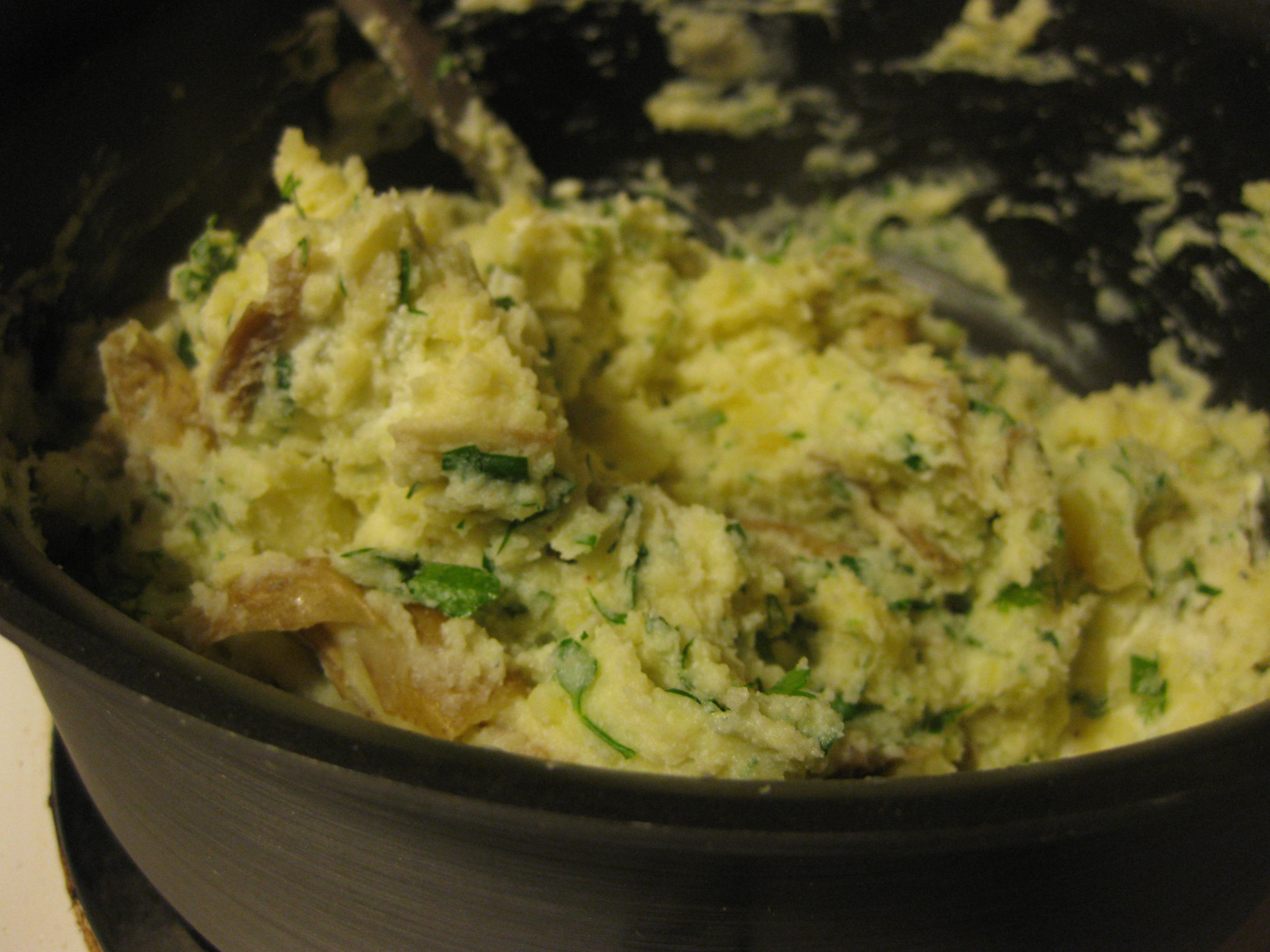
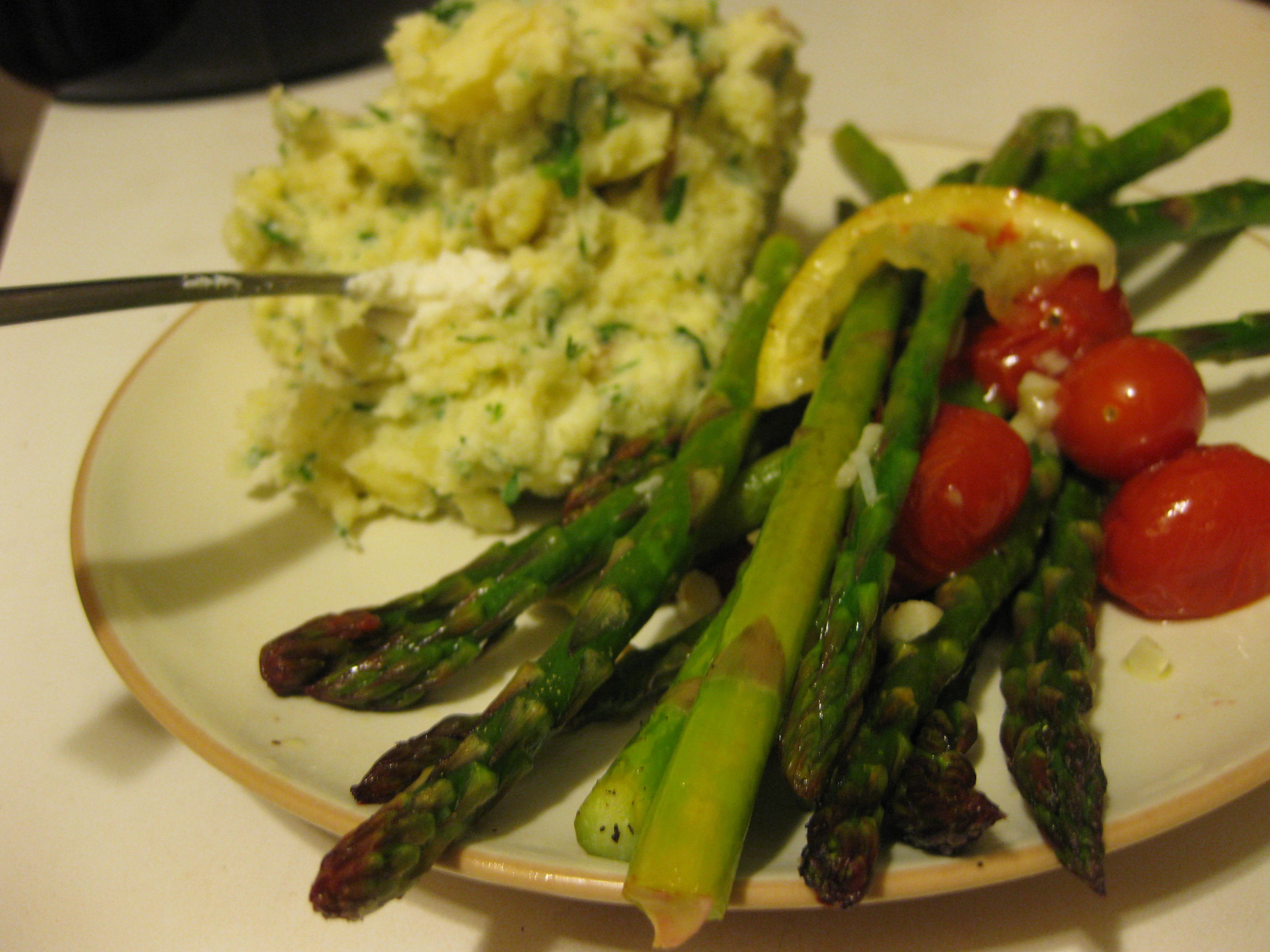
Using a plastic masher is invaluable because you can do your mixing and mashing right in the pot, which ensures that the potatoes stay hot longer.  We mounded ours up on warm plates and ate them alongside roasted asparagus.  The ricotta was a great addition; it was not super cheesy, but recognizably creamy and smooth.  It definitely added richness and tamed the starchiness of the potatoes.  The combination of herbs was a success.  With the additional richness of the cheese, having bright pops of green both visually and orally made the dish feel, not exactly healthy, but not overbearing.  Besides, with a side of asparagus and burst cherry tomatoes, we weren’t being all that bad…

The Week of Magical Eating: Day One

With my exam over, and firm commands from my adviser to give myself a break for a week or two (she said a month, but she and I are both too dedicated and both such workhorses that I doubt that will happen), I can concentrate on the important things: food, and husband.  Fortunately, since he needs to be fed, these important things can work in tandem.  So I send my apologies to Joan Didion, and promise to report to you a Week of Magical Eating.  Some dishes will be fancy, fresh, and well prepared.  Some will probably be valiant attempts to use up leftovers.  Either way, I will try to check in with my results.

Day one, yesterday, also happened to be Valentine’s Day.  Neither N. nor I particularly support this Hallmark holiday, likely as a result of residual bitterness before meeting one another and deciding that no one but each other should ever be subjected to either of us again.  However, thanks to my rapidly ebbing stress and rising ability to enjoy normal activities like shopping and cooking without feeling guilt about not studying, I was able to secure ingredients for dinner on the special side.  Not for VDay, but for each other.

As a congratulatory gesture for passing my exam, one of my officemates gave me the ingredients for Kir Royale: champagne and crème de cassis.  This blackcurrant liquor smells sweet with the promise of a bite.  Mixed with champagne, it was much less sweet than I had imagined; my taste buds were prepared for something dessert-like, but the mix was delicious and fresh, and the color was appetizing too.

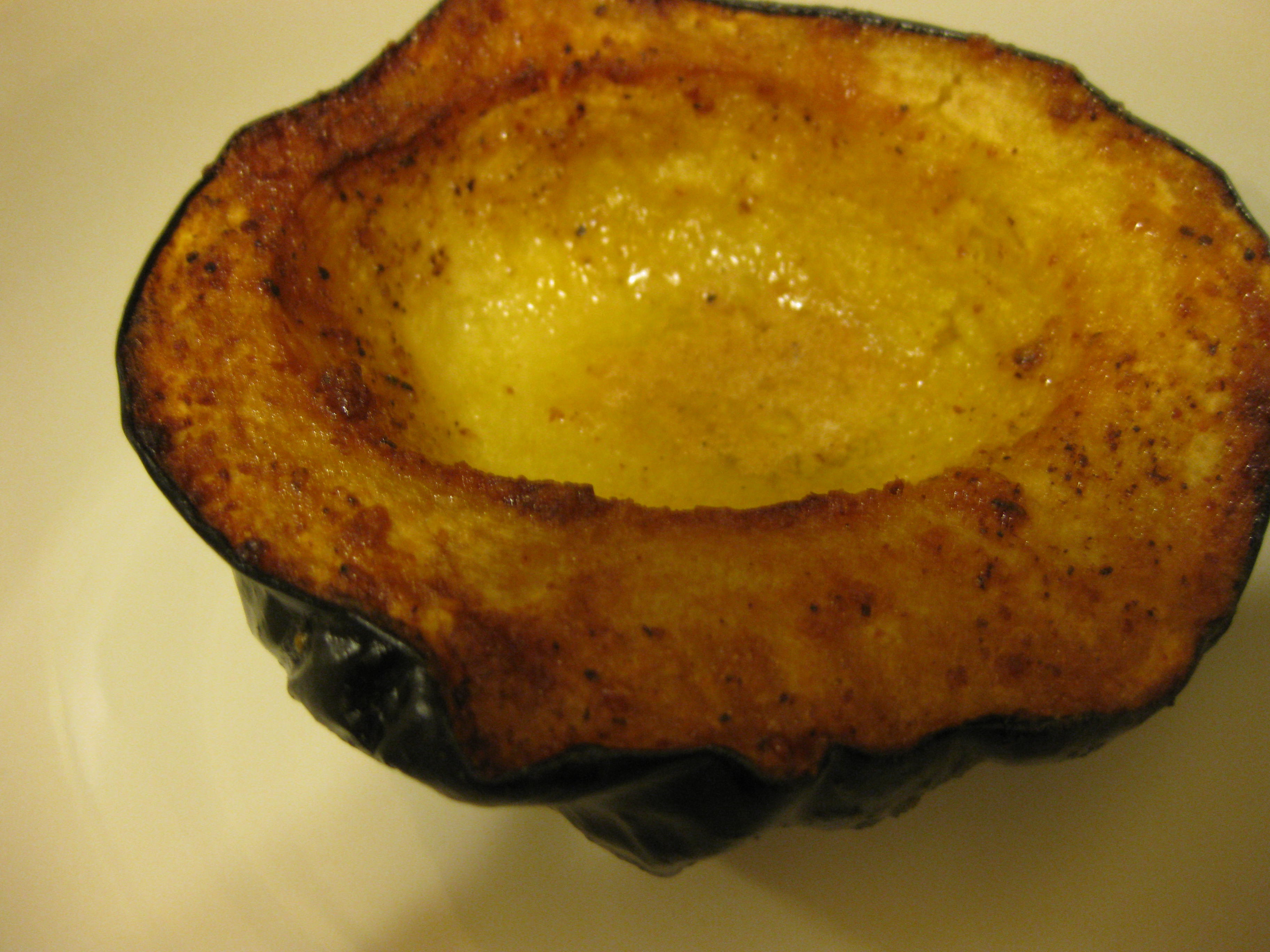
With our aperitifs poured, and an acorn squash halved, liberally basted with butter, honey, mustard, and shoved unceremoniously into the oven, I embarked on Jaime Oliver’s spinach and goat cheese risotto.  I’ve made this dish before, and was craving its fresh green notes and rich tanginess.  To make things extra special, and since between the two of us on a Sunday night we deemed it unwise to drink an entire bottle-o’-bubbly, I used champagne instead of white wine to deglaze my risotto pan after lightly toasting the rice and onions.  In the end result I couldn’t taste a difference, but I like to think the champagne contributed to the light tang of the final dish.

Piled high on a plate, it was creamy, it was luscious, with pockets of goat cheese slowly melting in amidst the kernels of rice that never lose their bite completely.  The acorn squash as a vegetable side, though it has a completely different flavor profile, works nicely with this risotto, I think, in part because the color contrast is so striking.  After an hour in the oven, the rind gets thin, flexible and yet crackling at the same time, and if you don’t mind burning the tips of your fingers, you can hold the caramelized edges with one hand while you scrape the flesh out with a spoon held in the other.

Nothing bitter here.  Honey, crème de cassis, goat cheese, sweetness layered on sweetness, but not enough to be cloying.  Exactly, perhaps, how Valentine’s Day ought to be.

Post-exam bliss. And chocolate.

As I mentioned a post or two ago, this Friday I had to take an exam.  A very-big-deal exam, the outcome of which determined my ability to move on in the program.  And I passed it.  This means I am now free to move toward my dissertation, and that I am a doctoral candidate (well, almost, first I have to create and get approved a dissertation prospectus)!

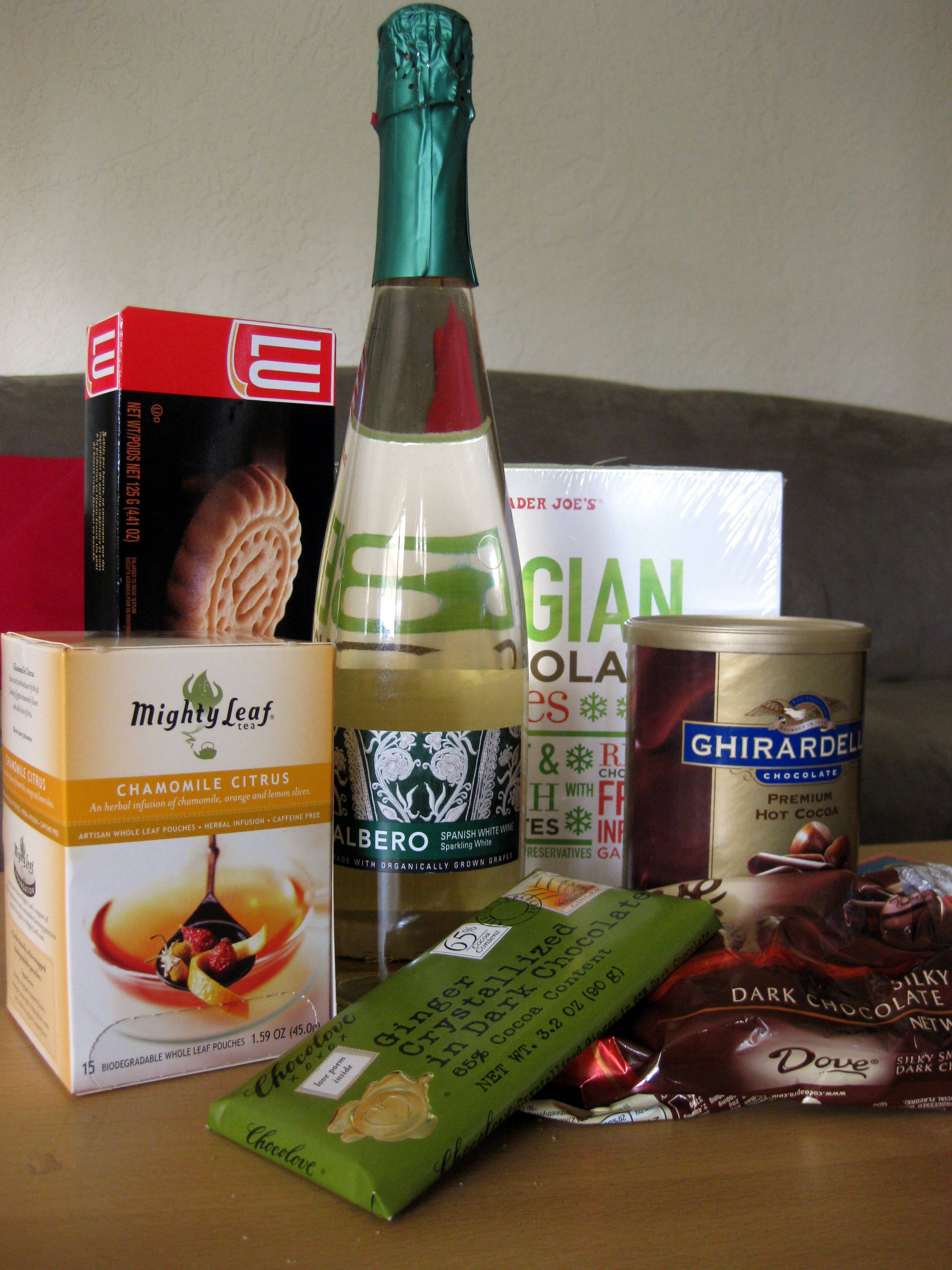
Excitingly, in a project that does have food as a focus (although more the ways of eating it than the preparation and aestheticism thereof), I received some unexpected but delightful well-wishes in the form of food, when I went out to brunch with some friends/colleagues last Sunday morning.  As we crowded around our table at Midtown Marketplace, some with omelets, some with pancakes, me with a glorious hazelnut waffle topped with mixed berry compote, they began emptying pockets, purses, jackets, and loaded this impressive loot onto the table before me:

This was far more than I expected, and far more than I needed, but it was so brimming with love and support that I was quite overwhelmed.  The breakdown: Dove chocolates (bottom right), always a delicious and reliable standard.  I took the bag to my office to share with my office-mates, since they have had to listen to and encourage me throughout the process of preparing for this exam.

The Belgian chocolates (back right) were a selection of five fruit flavors blended with different types of chocolate (milk, dark, and white) and had some delightful combinations.  I shared these around the office as well.

The candied ginger spiked chocolate bar, which N. dubbed “crack,” was outrageous.  Spicy little chunks of candied ginger in smooth luscious dark chocolate; we finished the bar in two days… now all I want is to make my own candied ginger and wrap it lovingly in a truffle to recreate the experience.

The tea (middle left) is chamomile citrus, and is incredibly beautiful.  The ingredients are left whole, and enclosed in transparent little cloth packages sewn together with soft twine.  You can actually see the chamomile flowers, little strips of dehydrated orange zest, and the other leaves and blossoms used to create the tea.  With a drizzle of honey, it is the perfect not-too-indulgent bedtime beverage.  With the addition of a few shortbread cookies (back left), it becomes rather more indulgent.  These cookies were so rich and buttery that I thought they would leave my fingertips buttery, like the aftermath of a big handful of popcorn.  Just softened in the tea, they were lent an appealing subtle citrus flavor.

For true indulgence, the Ghiradelli cocoa mix is your best bet from this table of luxuries.  It is chocolate and hazelnut, so in essence it is like drinking a hot cup full of Nutella.  Incredibly rich and delicious.  I have only mixed it with water thus far, but the package recommends mixing with heated milk, which would only add to the indulgence!

Finally, the tall bottle in the middle is a Spanish sparkling white wine by Albero, which the bottle claims is made with organically grown grapes.  I have not yet popped the cork of this delightful looking treat, but when I do I expect to feel the same sort of rush of relief and unbelieving but effervescent bliss that I did yesterday afternoon, when my adviser and the chair of my examination committee shook my hand and told me “Congratulations!”

Focaccia for the win

I have mentioned before, on this very blog, that I am afraid of yeast.  However, as it has surely become clear by now, I love baking.  It was only a matter of time before these two truths collided and a new truth was constructed.  As I told my students only a few days ago, it was not always a “truth” that our solar system was heliocentric.  They grudgingly accepted this, but I now elatedly announce that I am no longer afraid of yeast!  Perhaps a bit timid, a bit guarded still, but not afraid.  What has changed, you ask?

This is a rosemary olive oil focaccia-style loaf from a cookbook put out by Food and Wine Magazine that I finally got up the guts to try out.  I learned three things by making it: 1.) yeast is not as easy to screw up as I thought; 2.) following directions is smart; and 3.) the way to a man’s heart may really be through his stomach.  At least if he shares a last name with my husband.

While this bread was not difficult to make, I think it would have been better if I had read the recipe more carefully.  After assuming I had killed my yeast when it all sank in the warm water I sprinkled it over, I didn’t bother to knead the dough before setting it aside to rise.  Then I baked it at the wrong temperature and despaired when it didn’t seem done before realizing my mistake.  And after all that, it was still delicious.

The bottom half inch or so was denser than the rest of the loaf, and I don’t know why that happened, unless it was related to my inability to read the directions the first time through.  But it was really, very good.  The olive oil made the texture pleasant – moist and chewy, and the rosemary contributed a nice, herby, woodsy flavor that contrasted well against the brisk brightness of the sea salt that also flavored the bread.  It is amazing how something with so few ingredients (flour, yeast, oil, water, salt, rosemary, and cornmeal) can have so much flavor.  And excitingly, as the recipe itself declares, this bread has endless flavor combination possibilities.  Next time I think I will add chopped kalamata olives.  N. agrees.

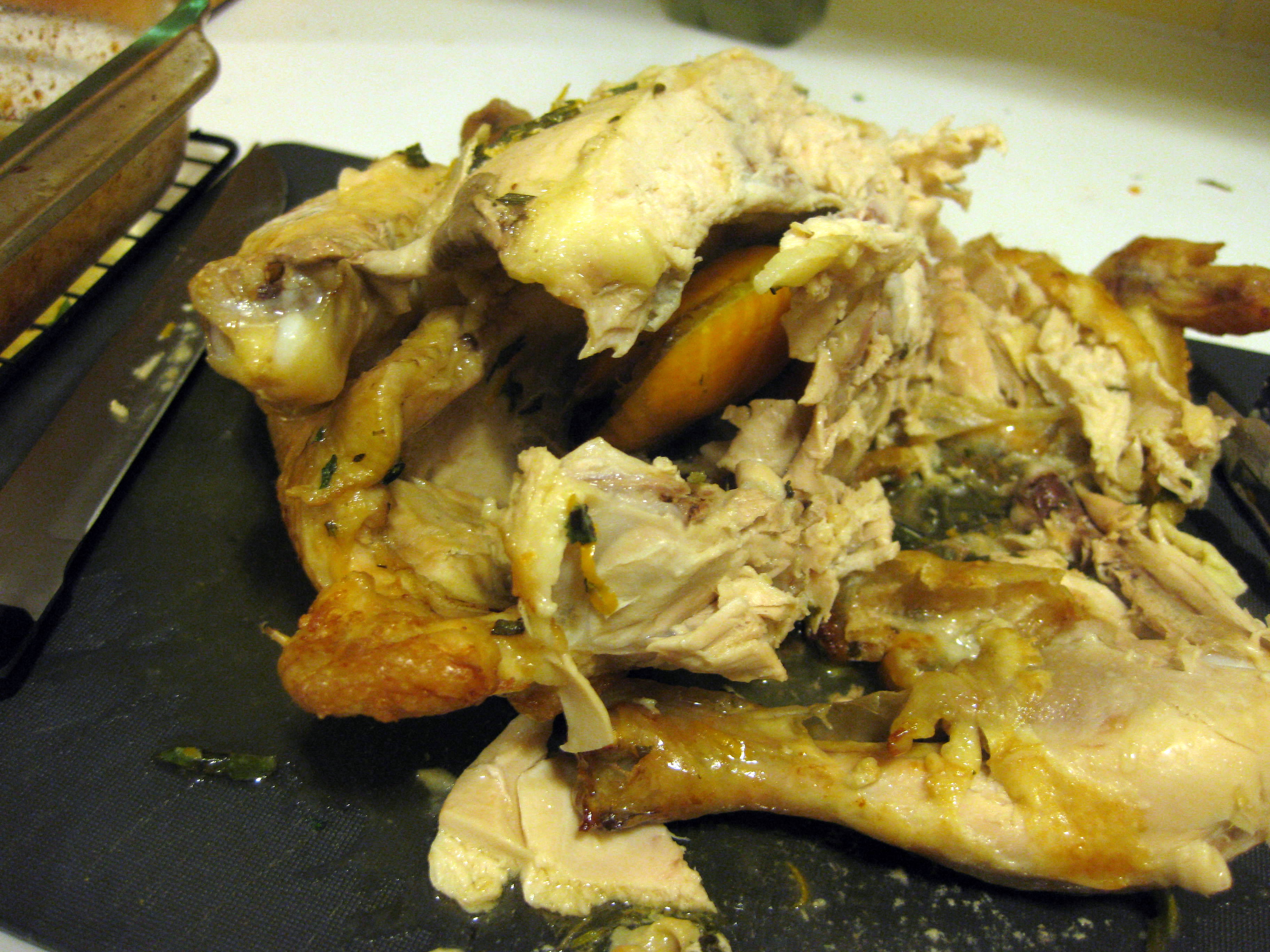
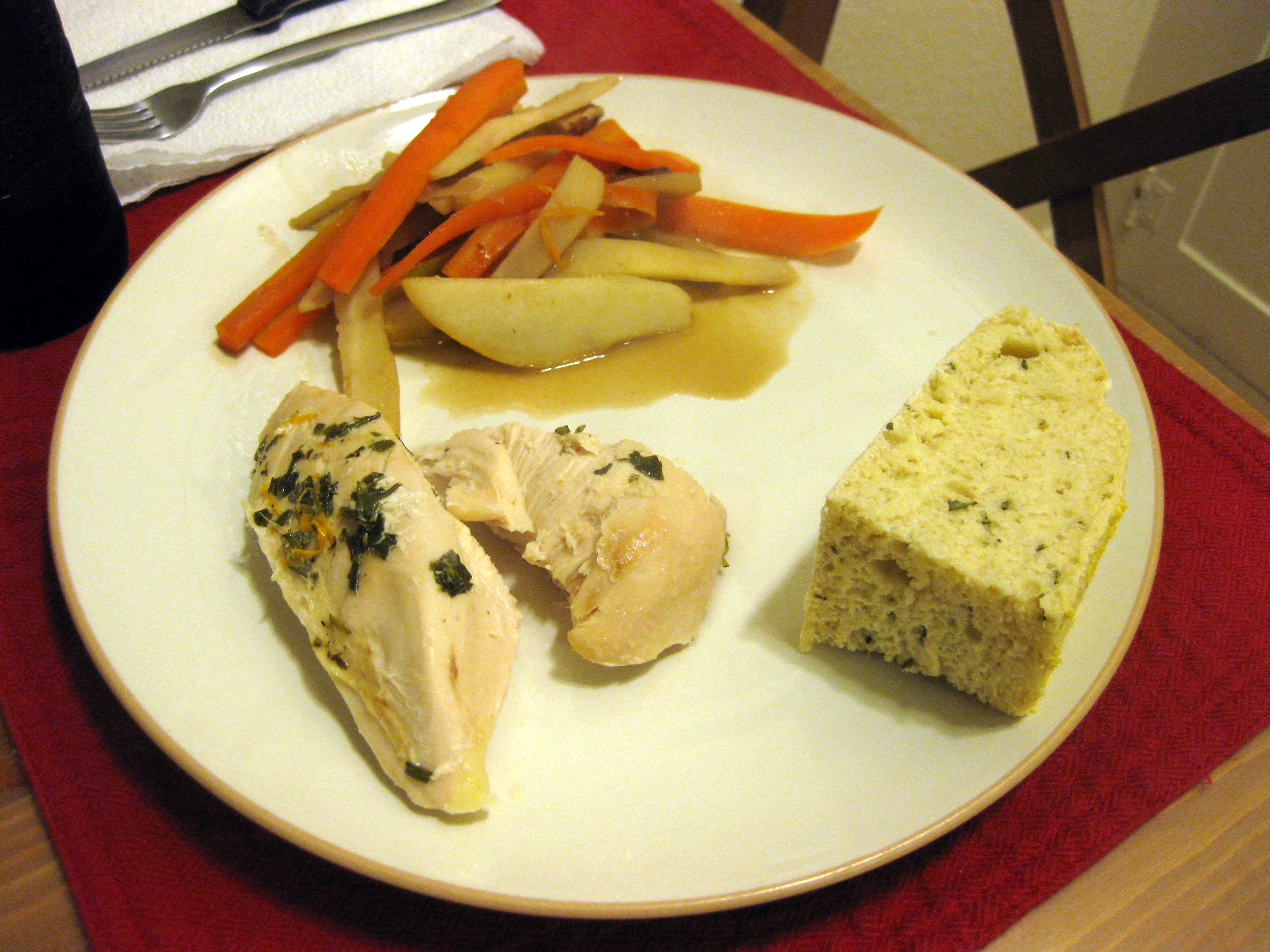
What was really glorious about this bread was how well I managed to combine and link flavors in the dinner that went with it.  We had a roast chicken and a vegetable side to go along with my yeasty triumph, and in the choices of aromatics I was able to clearly connect each dish.  The bread contained rosemary, and so when I made an herbed butter rub to massage under the chicken’s skin, I included plenty of fresh rosemary.

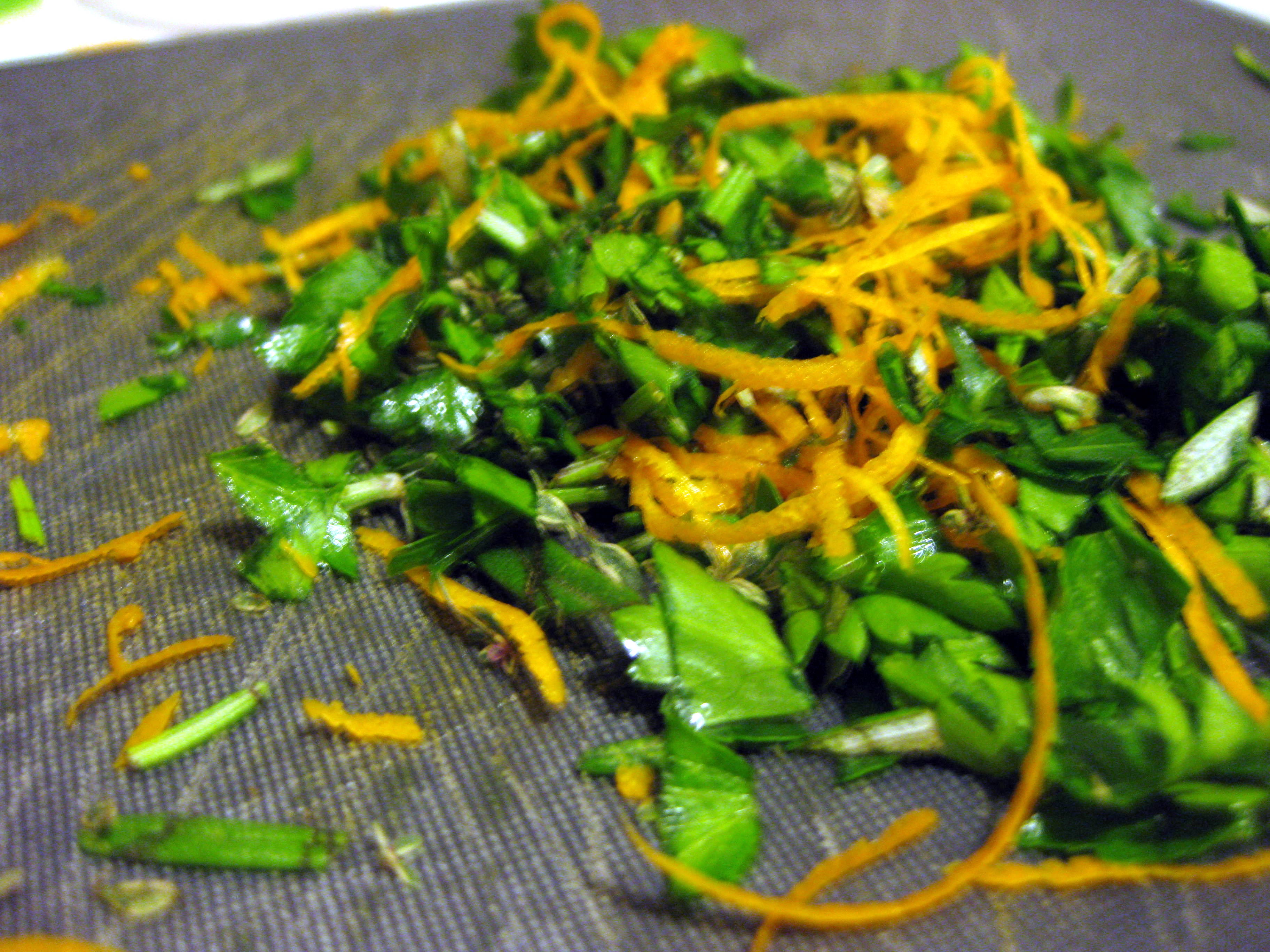
Our vegetable side consisted of glazed carrots, parsnips and pears with craisins and pecans.  Since the glaze was mostly orange juice, I added orange zest to my chicken herb rub and stuck a few orange slices inside the cavity of the chicken before it went in to roast.  If I had remembered in time, I would have added orange zest to the bread dough as well, to really link all three elements together.

The orange did, I think, add a delicate sweetness to the chicken, though I’m not sure it was recognizably citrus.  I think lemon would be more identifiable.  But the butter made even the white meat of the chicken tremendously succulent, and the herbs and garlic definitely added a punch and depth to the flavor.

The veggies were rich with autumnal flavors, and while I enjoyed them, I think they would match better with a pork or turkey main rather than chicken.  In fact, they might be delicious as a vegetable dish for Thanksgiving; the craisins make that an easy link-up.  Since carrots and pears are already sweet, the craisins and pecans were a natural pairing.  I always think pecans have a kind of caramel or molasses-like smokiness to them, which seemed to work very well with the herby, spicy notes of the parsnips.

Given that somewhat wild flavor the parsnips impart, a strongly spiced root beer or sarsaparilla might make a fitting non-alcoholic beverage pairing to this meal, or maybe even a ginger ale like Blue Sky that prides itself on natural flavors.

So let’s take a moment here and reflect: Roast chicken, glazed vegetables, and homemade bread.  Two of these three dishes required advanced planning and multiple stages, and then (as per usual, these days) I made broth from the chicken carcass after it was picked clean, with plans already in mind for the leftovers.  Long cooking times, “complex” procedures, and making use of every part of the meal.  If that doesn’t say Sally Homemaker to you, I don’t know what does.  All I can say is: I promise that I did not wear pearls while I cooked this meal.

Excuses and slow-roasted salmon

I know, I know, I broke my once-a-week resolution.  But you see, I have this exam hanging over my head.  It’s a two part oral examination that involves me reading a paper I’ve written about a 14th century poem, and a committee of three professors listening and then quizzing me both about the paper, and then in the second part of the exam, about medieval literature in general, based upon a hundred-or-so item list I have put together.  My exam is next Friday.  It’s a little intimidating.

But I don’t want to talk about that now.  I want to talk about salmon.  Even if you are not a seafood person, chances are you are okay with salmon.  It’s a beautiful fish.  It’s meaty and rich and juicy and can be cooked in a number of ways.  One of our treats in the last few days of the winter break was slow roasting a huge filet of it.

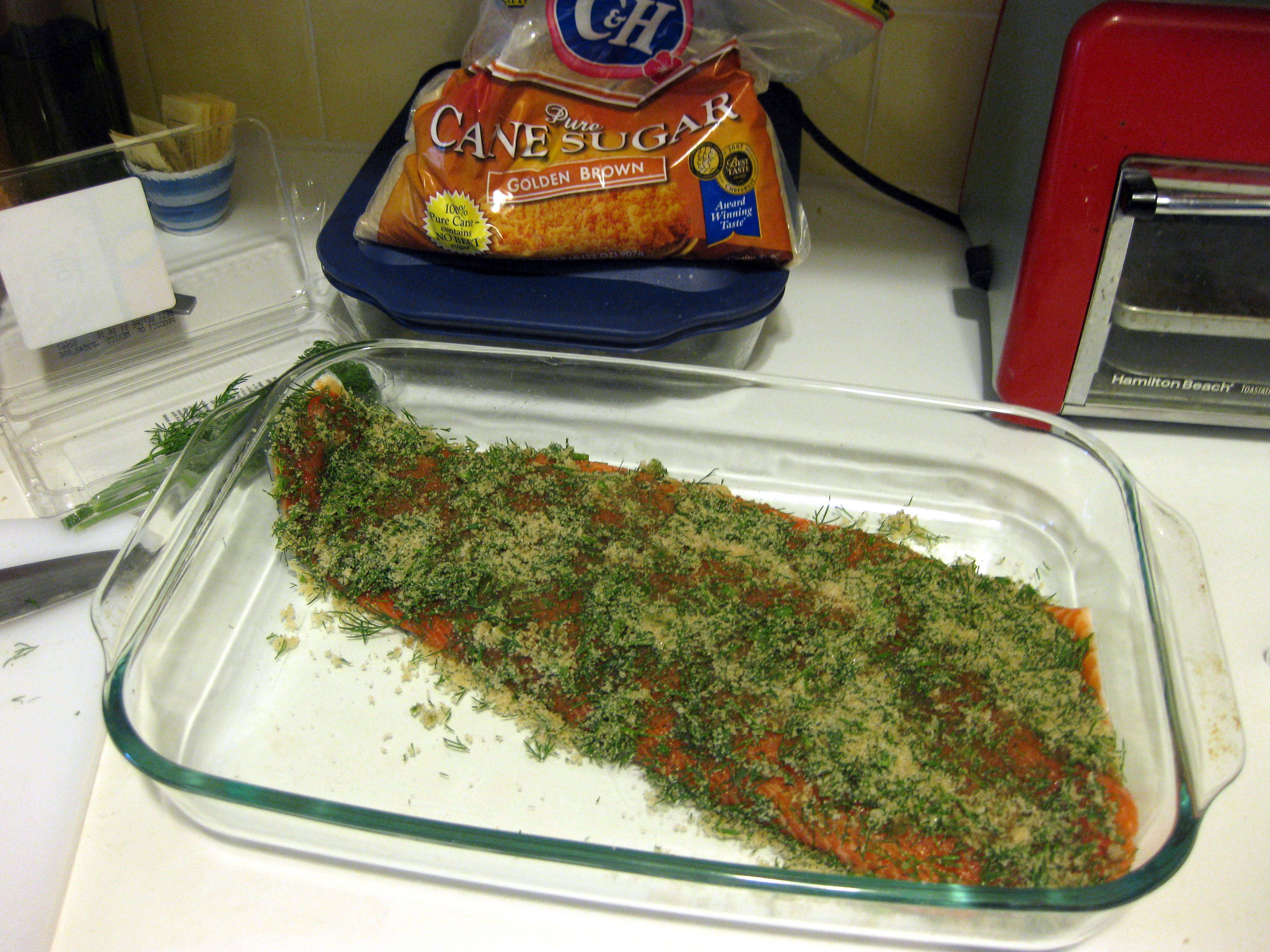
I had never experimented with slow roasting like this before.  Per my recipe’s directions, I stirred together brown sugar, sea salt, and a big handful of fresh, finely chopped dill.  I love dill.  It has this fresh green smell to it that makes me feel alive and happy, and mixing it with sugar had to be a good thing.  Once combined, I sprinkled the mixture over the fish and packed it in, rubbing and pushing the herbed sugar against the flesh so the flavors could penetrate.  Then I slapped plastic wrap over the top of my baking dish and stowed it in the fridge for 5 hours.

With eons to go before dinner, I preheated the oven to 175F, unwrapped the baking dish and transferred the fish to a cookie sheet before sticking it in the barely-warmed oven and leaving it for over an hour.  Over an hour!  For fish!  I could hardly believe it either.  Trusting in the recipe, I left it alone for what felt like forever.  After a time, the smell of roasted fish and caramelizing sugar started to fill the house, and this wasn’t a briny, salty, fishy kind of smell, this was almost like a thick roast of red meat.  Once in a while there was a crackling noise from hot fat oozing out of the fish and sizzling against the cookie sheet.

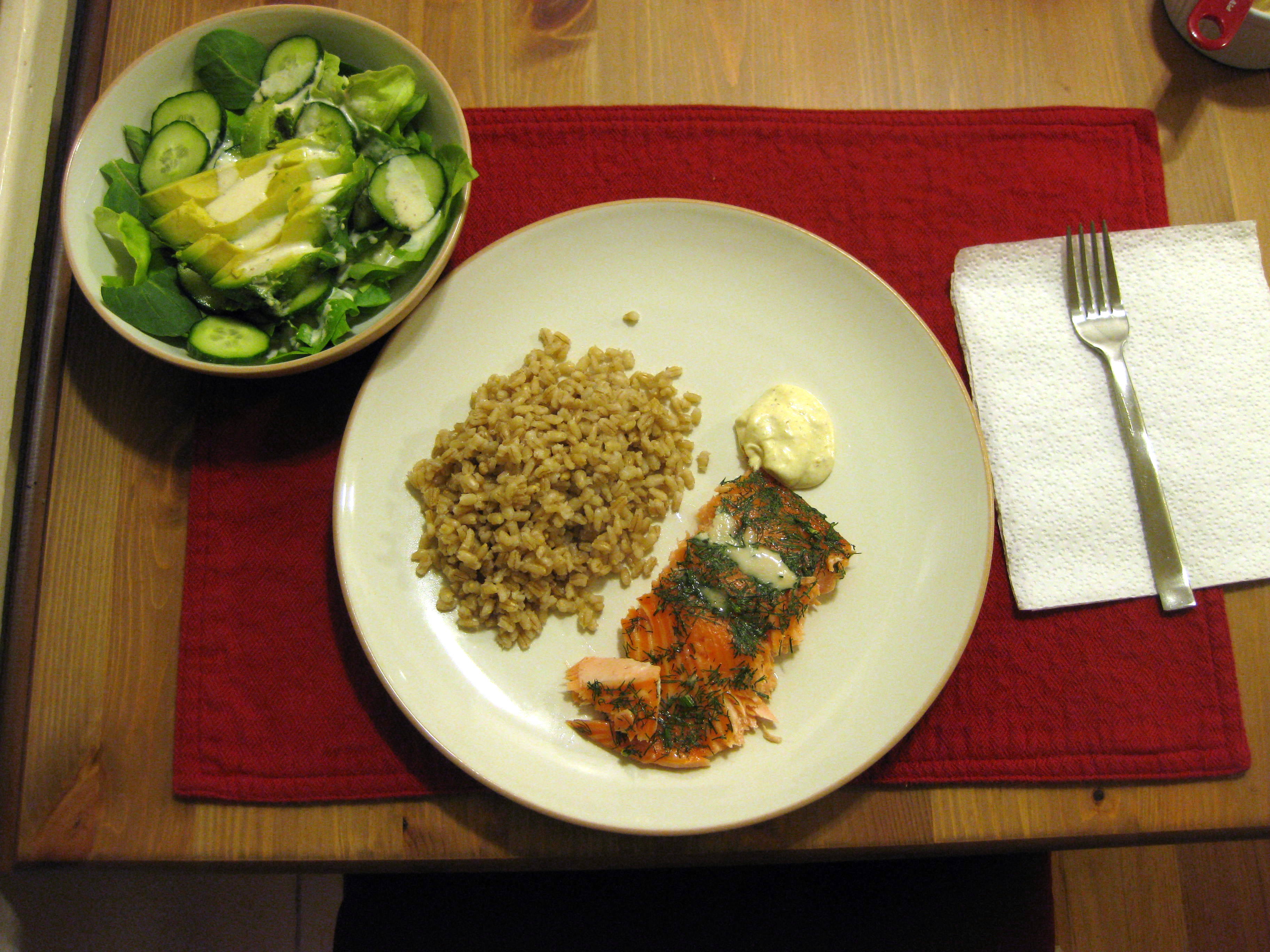
Meanwhile, I prepped our side dishes: barley simmered in chicken broth and a green salad of butter lettuce, cucumbers, and sliced avocado.  As the fish recipe called for a dipping sauce of mayonnaise and whole grain mustard, I made a salad dressing with the same two flavors, adding white wine vinegar to thin it out, and a drizzle of honey to prevent it from being too bitter.  Hooray for tying flavors together!

When the timer went off for the fish, I opened the oven door and despaired.  The little cracks in the sugar coating that I could see fish through looked bright pinky-red still, as if the fish was quite raw.  Gulping back disappointment, I gently flaked into the filet with a fork and almost had to pick myself up off the floor, where my knees were threatening to melt into a puddle.  The fish was perfect.  It was cooked, and the texture was silky but firm and buttery smooth.

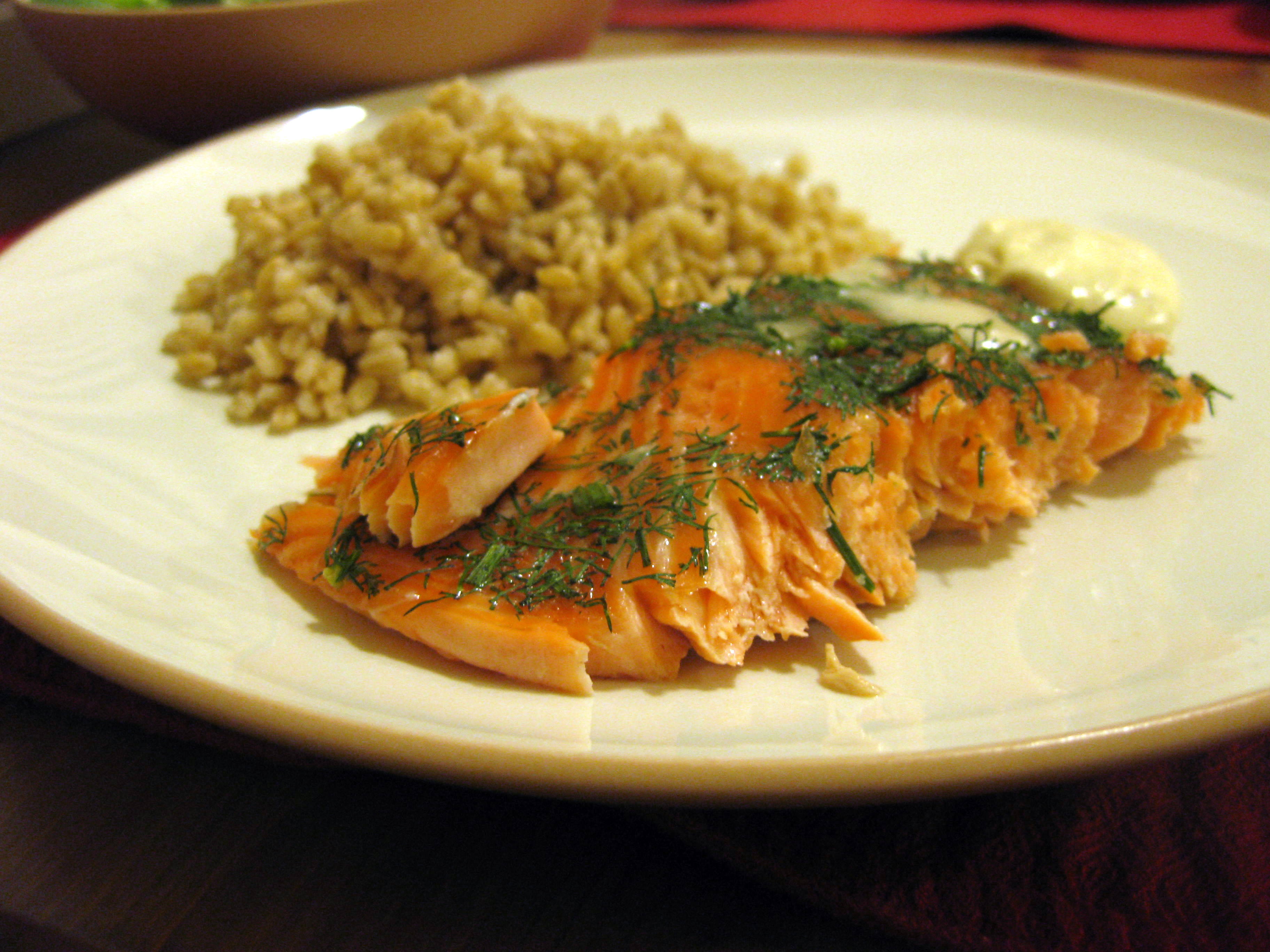
We ate.  The salmon was remarkable.  Though I only had it in the refrigerator for five hours (hey, we were hungry!) and the recipe called for eight, the meat was on its way toward the texture of smoked salmon, rather than baked or roasted.  I don’t know what the slow heat did, exactly, but the fish peeled off its skin in perfect fork sized chunks.  It was so rich and smooth that it was almost like eating a slice of warm butter.  The sugar surprisingly did not overpower the taste of the fish, and the mayonnaise-mustard sauce was tangy and added just the perfect touch of acid.  I was surprised that it wasn’t too creamy, with the silkiness of the salmon, the smooth mayonnaise, and the sweet sugar, but the punch of chewiness from the barley leant a nice contrast in texture, and the crisp butter lettuce and cucumbers in our salad didn’t hurt either.

Let’s see a close-up:

I think if the fish had chilled and marinated inside its sweet rub for a full eight hours before getting the slow heat treatment, the texture would have been even more pleasing.  N., who isn’t a big seafood fan, pronounced this a tentative success the first night, but the next day, when he had a cured salmon sandwich with thinly slice cucumbers, mayonnaise sauce, and a crisp leaf of lettuce on toasted sourdough, he was a complete convert.  We will have this again, when my exam is over and time operates normally again.  When I have time to devote to a dinner I begin almost ten hours ahead, and time to linger over it when it is finally, triumphantly ready.  Here’s the recipe I used, if you want to give it a try yourself.