Emptying the Fridge III: Crack(er)ing the Code

Last week I told you about my favorite new dip.  White beans, toasted almonds, the piney sharpness of rosemary, the heady perfume of orange zest… and promised to provide a vessel on which to deliver this deliciousness to your eager taste buds.  N. and I discovered shortly after my first foray into this creamy blend of balanced spice that the ideal vehicle for consumption was not in fact a spoon, but the best crackers ever: Trader Joe’s Raisin Rosemary Crisps.  In fact, these are good not just as a vehicle, but a snack in their own right.  Every time I went to the pantry to retrieve a few for dip spreading, I’d find them gone, thanks to N.’s voracious nibbling.

I wondered at one point, as I broke down yet another cracker box for recycling, how difficult they would be to make myself.  I’ve never made crackers before, but looking at the list of ingredients – sunflower seeds, millet, raisins, baking soda – it seemed doable, and further, thanks to the kind of collection that happens in established kitchens, when you don’t remember why you have something like toasted millet or roasted ground flaxseed but you just do, I had every single dry ingredient in my pantry, waiting to be used up so they didn’t have to make the move to California.  On that door dividing me from opportunity, he was pounding with a brass knocker.

So I set about experimenting, and today I can offer you not one, but two ways of making these crackers yourself.  They aren’t perfect replicas.  They will always be discernable as imitations.  But they are delicious, and they are pretty darn close.  Only a thinner knife, a bit of whole wheat flour, and patience, I suspect, separates them…

Here’s what you need:

1 ½ cups all-purpose flour

½ cup whole wheat flour (the first time I made these, I used equal parts AP and WW flour, and the result was a bit heavy.  Using 2 cups AP instead of adding the WW would probably make the crackers even lighter, and the TJ’s ingredient list doesn’t contain WW flour at all)

1 tsp baking soda

¾ tsp coarse sea salt (I used Maldon, with which I have a deep love affair)

2 TB roasted, ground flax (if you have whole flaxseeds, use them!  Just toast them in a dry pan until fragrant and beginning to darken, and whiz them in a spice grinder, or your husband’s coffee grinder, if that’s the machinery you happen to have)

1/3 cup millet

½ cup sunflower seeds, toasted or not, salted or not, just use what you can find

¼ cup brown sugar

1 TB finely chopped dried rosemary (again the spice grinder works really well for this – chopping dried rosemary with a knife is an exercise in absurdity: it flies everywhere)

½ cup craisins

¾ cup buttermilk

Whisk together all ingredients except buttermilk until seeds, nuts, and fruit are evenly distributed.

Add buttermilk and cut in with a fork or pastry blender until dough starts to lump together.  It will be roughly the consistency of biscuit or Irish soda bread dough.  At this point, switch to your hands (the best tools, really, aren’t they?) and knead the dough for three minutes or so, until it all comes together and becomes a bit less shaggy.  You can either dump the mixture onto a lightly floured board to knead it, or you can be lazy like me and knead it in the bowl.

At this point, you have a choice.  If you want flat, rectangular crackers like Ry-Krisp or Stone Ground Wheat, roll out your dough into a big thin rectangle (1/8 inch thick or even less, if you can) and cut gridlines along your dough with a pizza cutter.  Create whatever size squares, rectangles, trapezoids, or polyhedrons you desire, then place them close (but not quite touching) together on a baking sheet lined with parchment paper or sprayed with non-stick spray.  Slide them into a preheated 300F oven for 45 minutes.  You’ll end up with crunchy crackers with the slightest bit of give in the center, evenly colored with a dense crumb.  They are a little like miniature flatbreads. 

If you want slightly lighter crisps with a darker “crust” perimeter and a sprightly, Panko-like crunch, there is only one inspiration to which you can look: biscotti.  I liked the flat crackers.  I did.  They were tasty, they were good with the dip, and they were relatively quick: roll, cut, bake, done.  But they weren’t the ephemeral cracker experience I was after.

If you’re going the biscotti route, once the dough is kneaded together well, divide it in thirds.  Instead of rolling it out on a board, roll it into a long, thin “worm” of dough on some plastic wrap.  Press, squeeze, and moosh it into a log of even thickness, using the plastic wrap to help you.  Wrap up securely in the plastic, then pop it into the fridge.  Repeat with the other sections of dough, each in their own piece of plastic wrap.  Refrigerate for at least three hours (my trusty biscotti recipe from which I estimated times and temperatures says you can leave them in the fridge for up to three days). 

When you are ready to bake, take the worm/logs out of the fridge and unwrap.  Leaving them sitting on the open plastic wrap, paint them lightly with buttermilk to encourage browning.  You could probably paint them with egg wash too, but the TJ’s box doesn’t list egg as one of its ingredients… Carefully move the buttermilked logs to a baking sheet, then place in a preheated 325F oven for 30-40 minutes, or until the tops have swelled and are lightly golden.  Let them cool completely. 

You will find when you move your logs that the bottoms are browner than the tops.  I am toying with the idea of slowly rolling these logs as they bake so that each side comes in contact with the metal of the baking sheet for ten minutes or so during the baking.  This might make the finished logs a bit more rectangular (and hence capable of producing square crackers), and it might make each edge evenly brown.  Let me know if you try it out, and I’ll do likewise.
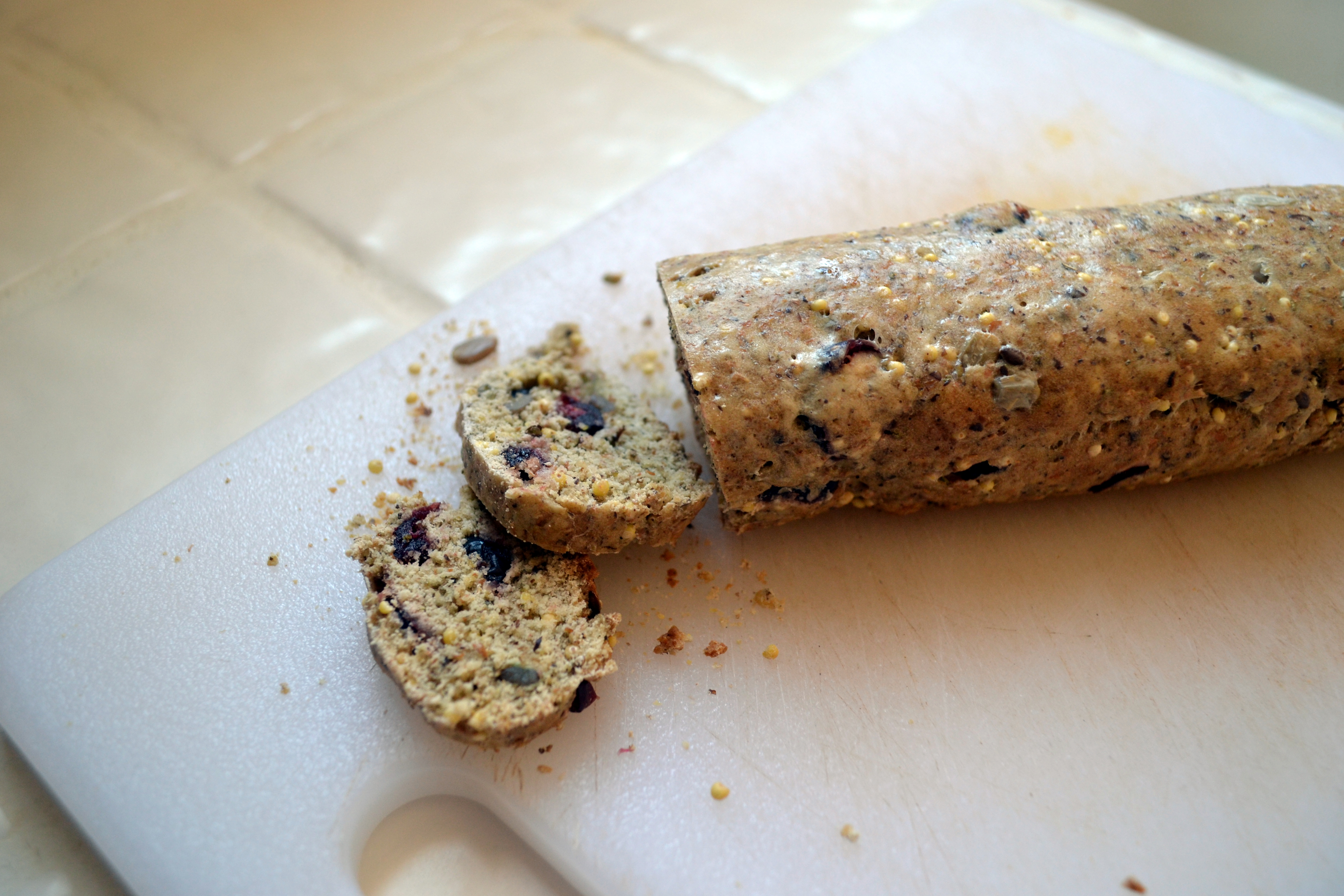
When the logs are cool, carefully cut them into thin slices with a serrated knife.  Some of mine crumbled a bit, especially when there were craisins at the edges of the log, but that just meant more sample scraps.  My ideal would be 1/8 inch thick or even thinner, if you can manage it.  But really, what you want here are crackers of the thickness you want to bite into.

Position your slices on a baking tray in a single layer (it’s fine if they touch each other, as long as they aren’t in layers) and bake in a preheated 300F oven for about 20 minutes.  The edges will bronze a bit deeper, and the centers will flush golden brown.  They won’t feel quite crunchy yet, but take them out anyway: much of the crisping happens as the crackers cool.

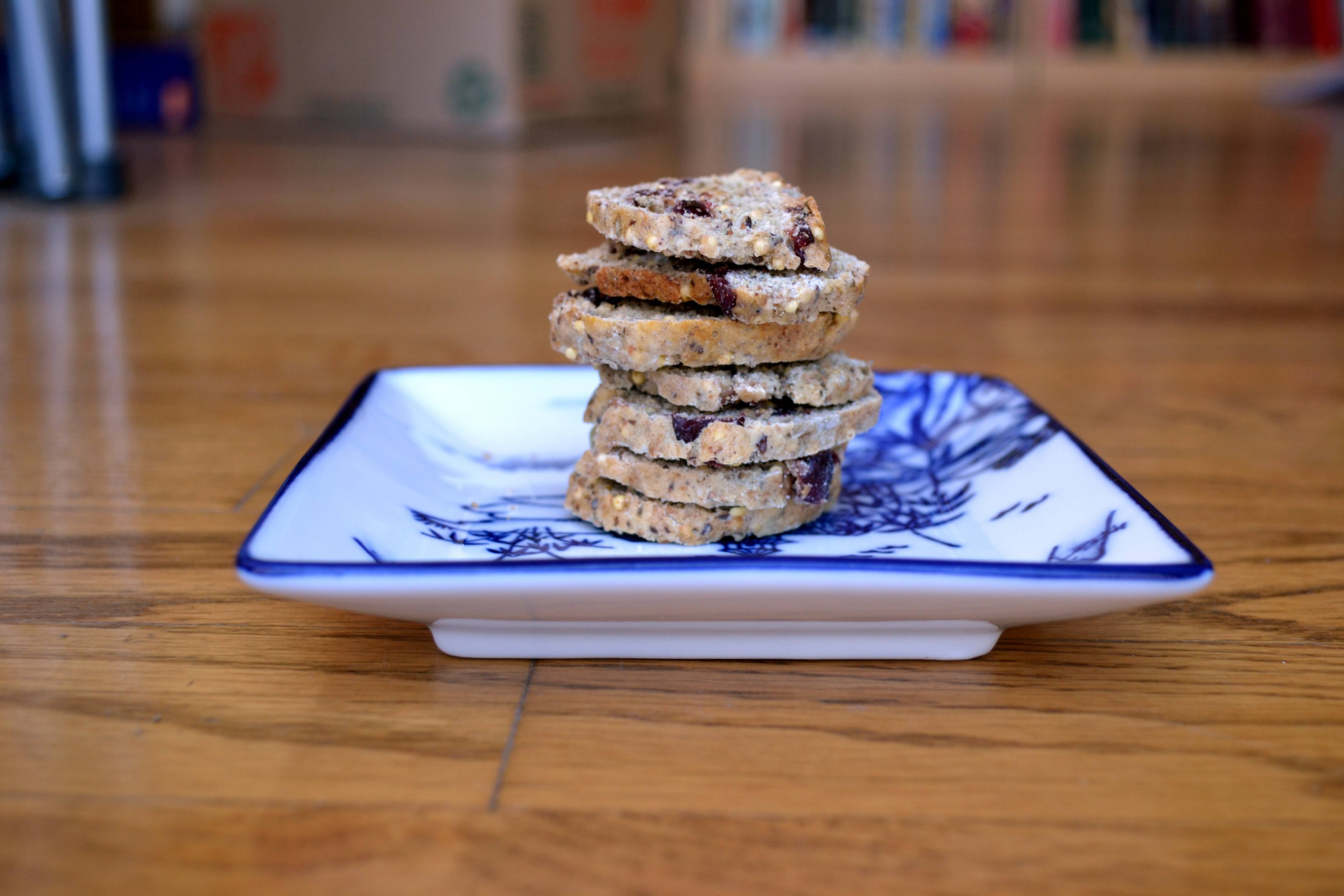
In an hour or so, when they are cool and crisp, I recommend you slather them with my almond white bean dip, or maybe a thick slice of rich brie, or some sharp, tangy goat cheese, and consume.  They are deep and toasty in flavor, the nuts and seeds lend appealing texture and different kinds of crunch, and they are just barely sweet from the brown sugar and the craisins.  I like the switch to cranberries as the fruit source, because they pair so nicely with the orange zest in my dip, but also because their uncompromising tartness makes these crackers interesting enough to eat all on their own.  Enjoy!

The Buttercream Project: Wedding day, part two

Saturday morning – Wedding day! – was beautiful and bright and promising.  Our now-from-Seattle friends had arrived the night before, we’d all slept, the cakes had chilled, and now after a brief wedding day breakfast with the bride and groom’s families and out of town guests, I’d be on to decorating.  When I settled in to the buttercream production this time, I had an epiphany.  At Mom’s house, I had used an electric hand mixer instead of a stand mixer, and the buttercream had been fluffy and smooth and glorious.  What if, instead of using the paddle attachment on my stand mixer, I used the whisk?

This was, finally, the right thing to do.  I wish fervently I had thought of it the first day.  The frosting came together faster, and whipped up a bit smoother.  It was, I perhaps imagined, brighter ivory than the previous batches, and there were no chunks of butter to cause me piping distress.  If only, if only, the day before… but that is immaterial (and perhaps inaccurate too, since there were other factors, other differences, like the temperature of the butter, the temperature of the cheese, the amount of time spent whipping, the quantity of lime juice, etc) .

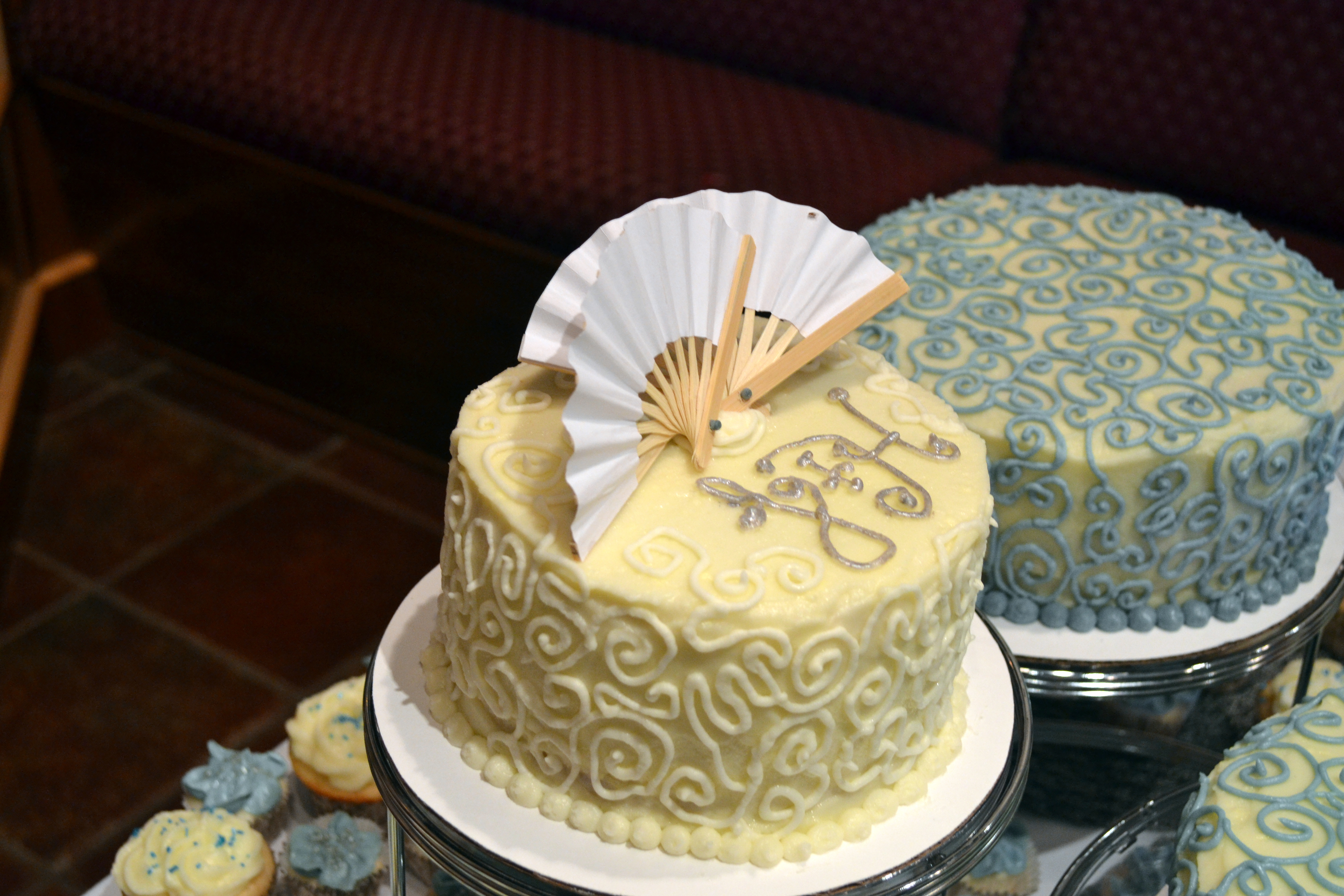
I piped.  I piped and I piped.  And things started to look better.  A lot better.  Most of the worst imperfections were hidden under the ivory and then delicate blue swirls and scrolls I snaked onto the cakes.  They actually started to look nice.  This might not be a disaster after all.  When I added a ring of round, pearl-like blobs to the bottom border of each, I started to feel happy with my project.

With the cakes done, all that remained were 92 miniature cupcakes.  All.  Right.  I had half a bowl of perfectly blue frosting.  Against my own better judgment (hey, it had worked out okay the day before with the gelatin in the filling), instead of starting over with a brand new batch, I decided to add more butter and more powdered sugar to the bowl, and try to tint it to match what I had already done as I went.  It worked.  I wanted a slightly thicker consistency of frosting for the flowers I planned to pipe so this mixture had to be more butter than mascarpone.  That worked out well, really, because I was out of mascarpone again anyway.

With time ticking, I filled up another piping bag with one of the new rose petal tips H. had bought me and went to work, remembering what I’d learned months ago about which way to swivel the cupcake as I frosted.  It took me a handful to get into a groove, remembering when to apply pressure and when to release, but once I got going I was making beautiful little horseshoe movements that resulted in sugary flower petals!  To perfect the color (not baby blue, but not dark blue either), I’d mixed a tiny bit of black gel dye in with the blue.  This resulted in a lovely periwinkle with just a hint of gray, matching almost exactly the blue on the couple’s save-the-date cards.  The exact blue of the wedding.  Boom.

N. would probably like me to add here that as I finished each handful of minis, he deliberately drizzled on a small quantity of silver-gray sprinkles.  My dear friend M., who arrived in mid-afternoon to coo over the product and do my hair for the event, would probably also like me to add that she took over sprinkling duties for the last dozen or so.  In fact, it was M. and S. who saw me through the last sheet tray of minis as, hand aching from the constant pressure and odd angle, I suddenly realized I was going to finish.

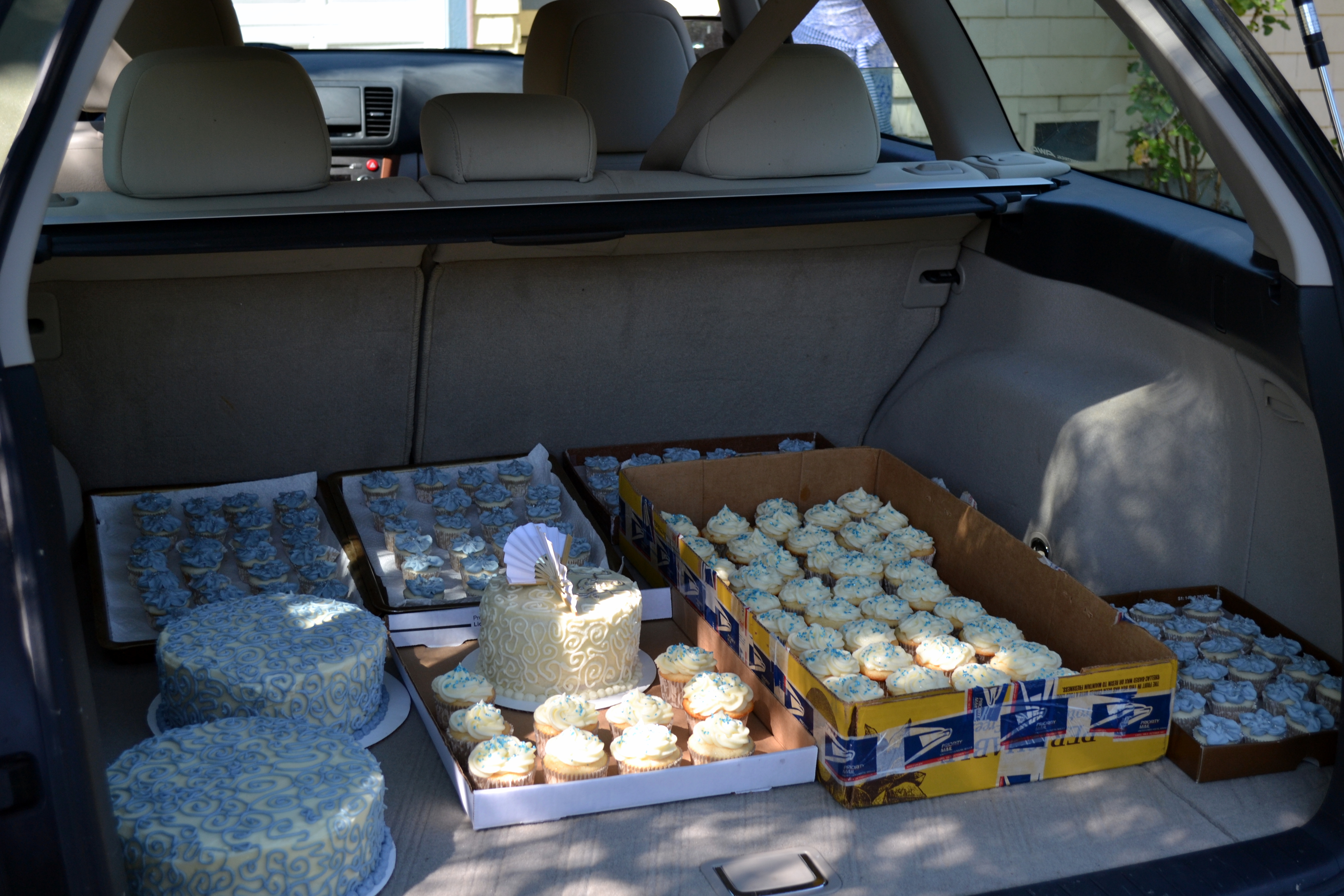
The winery where the wedding took place was a half hour drive from town on winding and sometimes roughly surfaced roads.  Though we positioned the cakes and cupcakes carefully in the back of our Subaru, I still got a little white-knuckled every time N. drove around the bend.  What if, after all that work, we got going a little too fast and one of the cakes slid into the side of the car?  What if, despite the air conditioning running at full blast, it was too hot in the car and the frosting started to slump off?  What if we did get there safely, but I dropped a cake on the way from the parking lot into the building?  I had packed flats as well as a bag of white frosting and a bag of blue in case of an emergency, but I’m not sure I was emotionally prepared to fix any problems that might happen on the way.  Not in a busy winery with the bride and groom’s families darting around setting things up.

Fortunately I didn’t have to.  Three or four of the minis fell over during our ride, but because I’d stuck them in the freezer for a few minutes while I got dressed, their frosting remained hard enough that it didn’t crumple much.

Setup was easy and disaster free.  Some of the wedding party helped carry the precious cargo in from the car, and when every last cupcake was situated on the table, I have to say it looked pretty fantastic.  I made a wedding cake.  And people liked it.

Final thoughts on this massive saga: I will not be going into the wedding cake business.  I would happily make another cake or three for friends who requested it, but I think I’d want to go to at least one cake decorating class first.  I will also not use American buttercream again, except for petal work like I did on the minis.  It’s just too sweet.  I loved the taste of the cakes I made, and the filling was a wonderful, bright tartness (the color contrast was great too), but the buttercream was just achingly sweet, even with the addition of lime juice to the mix.  For my sophomore performance, if I ever have such an opportunity, I would try an Italian or Swiss buttercream instead, relying on cooked egg whites for structure rather than powdered sugar.  As a thank you, J. and H. let me keep all the baking and decorating equipment they bought for the project (thanks again, you two!), so I’m set for all kinds of future practice.

I have to say, though, despite all my moaning and complaining and anxiety, I was really happy with how the cakes looked, and delighted with the reactions I received.  The bride and groom took home the leftovers and ate them the next day, and the one after that.  They were still good.  N. and I ate the trimmings and cupcake guts smothered in leftover filling, and they were delicious.  It was, regardless of the exhaustion and concern during the journey, a monumental success.  I can only thank J. and H. for letting me be such a big part of their day, and wish them all the joy in the world – joy like clouds of powdered sugar, perhaps – for the rest of their lives together.  N. and I love you both.

Spiking your stuffing

The one part of Thanksgiving dinner I refuse to make from scratch is the stuffing.  I don’t know why, but no stuffing has ever lived up to the Stove-top brand blend my mom puts together: one box of turkey stuffing, one box of cornbread stuffing, mixed up and tossed together and then, rather than just stirred into boiling water, baked in a casserole dish for twenty minutes or so right before serving, so the top is crusty and crunchy.  This is easy to do, since it takes my dad at least twenty minutes to get the turkey carved.  This is smart to do because it makes a texture contrast and provides a gravy sponge.  Other stuffing mixes I’ve tasted, and the homemade one I attempted this past year for A., who doesn’t like celery (have you ever tried to find a stuffing mix without celery?  Impossible!), just haven’t measured up.

And then, Bittman.

“26. Chop corn bread into cubes. Sauté cherry tomatoes, scallions and corn kernels in butter or oil. Deglaze the pan with beer, then empty the pan over the corn bread. Bake in an oiled dish or use as stuffing.”

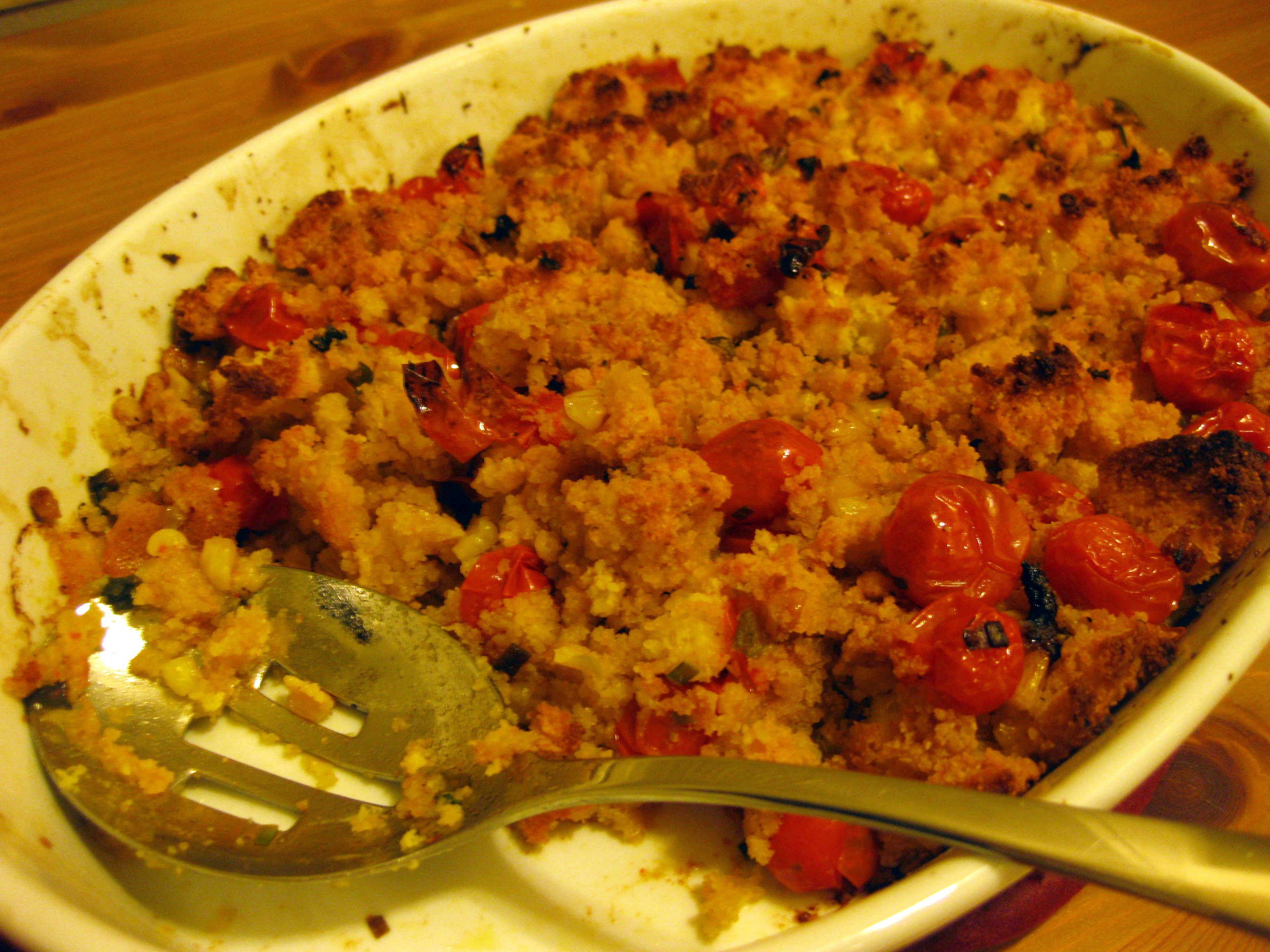
You guys, this was amazing.  And given how you now know I feel about stuffing, that’s saying something.  Amazing.  Here’s what I used:

6 cups (roughly) corn bread cubes, toasted (use your favorite recipe)

4 TB butter

6-8 beefy green onions

1 pint red cherry tomatoes, rinsed and dried

1 cup corn, fresh or frozen (if frozen, defrost it first)

Salt and pepper

12 oz. beer (I used Drifter)

I made a pan of cornbread from my favorite recipe in a larger pan than usual; I thought this would result in a slightly drier bread, so it wouldn’t become mushy when the liquid was poured over it.  The cornbread was still pretty moist and springy, though, so after it had cooled for a while I cubed it, scuffed it around in the pan a bit to separate the clinging pieces, and tossed it back in the oven at 400F for fifteen minutes or so to get some toasty edges and dark golden spots on it, then set it aside to cool completely.  This worked beautifully and I’d recommend it, especially if your cornbread is moist and cakey.

While the oven was occupied by an herb-stuffed chicken (again, I know.  I can’t help it), I melted the butter in a skillet over medium heat and sliced the green onions, using the white and green portions.  I tossed these little rings into the sizzling butter along with the corn, and agitated them gently.  When the onions were soft and the corn just beginning to caramelize, I added the cherry tomatoes and seasoned the whole skillet with salt and pepper and, on a whim, a few shakes of garlic powder.

I turned the heat up to medium high for just a few minutes until the cherry tomatoes started to burst through their skins, spilling pulp into the mix, and the corn had browned delightfully, leaving the kitchen smelling like summer.

I then switched off the heat and poured in a full bottle of beer, nutty, yeasty, and brown (Drifter is a pale ale, so it has some body and depth – I wouldn’t go any lighter than pale ale, and might in fact prefer something darker: a brown ale like Newcastle, or even a porter if it’s not too strong).  The aroma changed from summer to fall harvest in an instant as the beer fizzed over the vegetables.

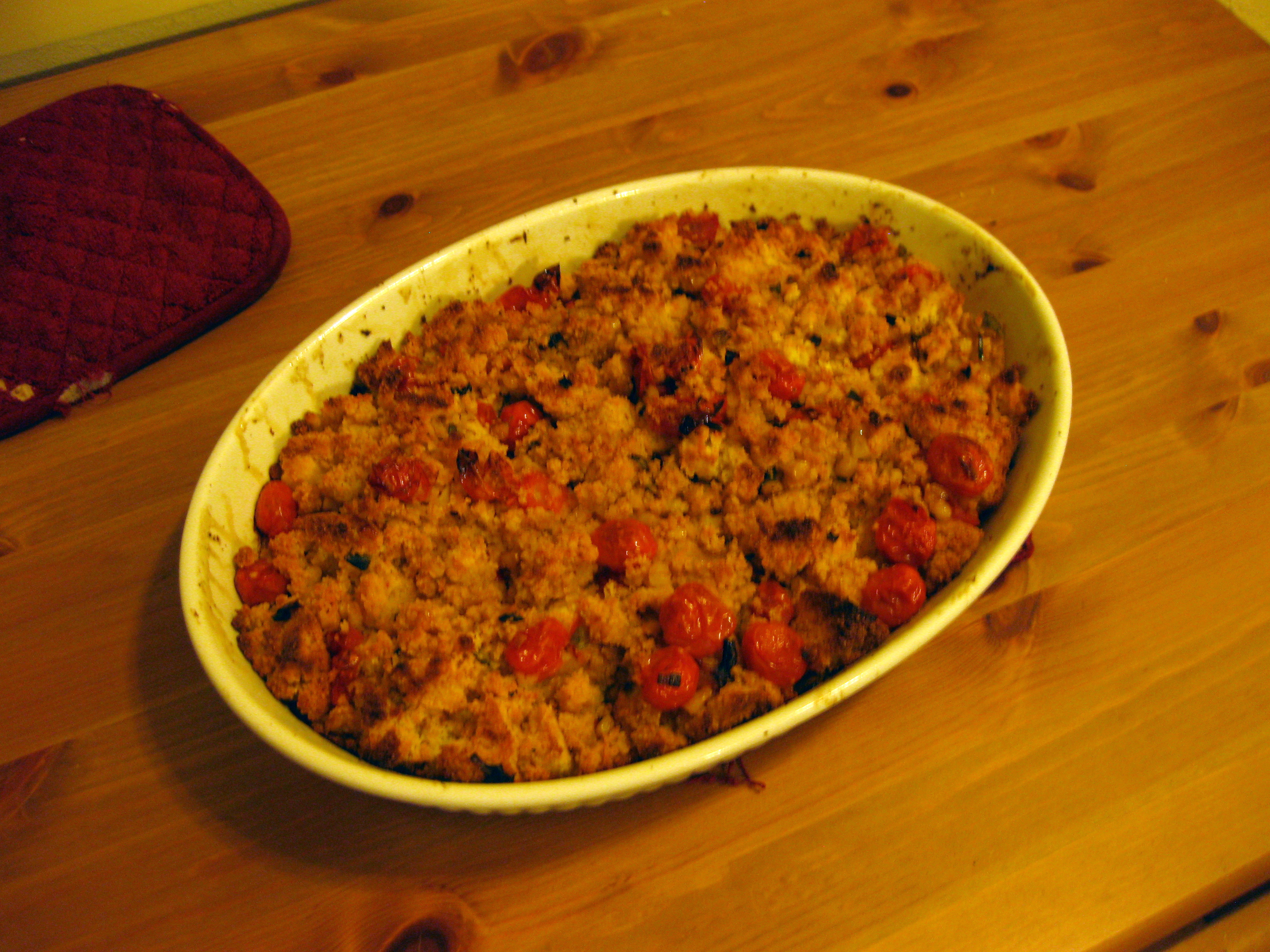
After scraping the bottom of the skillet gently with a spatula to remove any persistent browned bits, I poured the whole steaming bubbling mass over my pan of cornbread cubes and tossed gently to distribute the liquid evenly.  Then I stowed the pan in the oven: 350F for 25-30 minutes until the top is deeply golden and just crunchy.

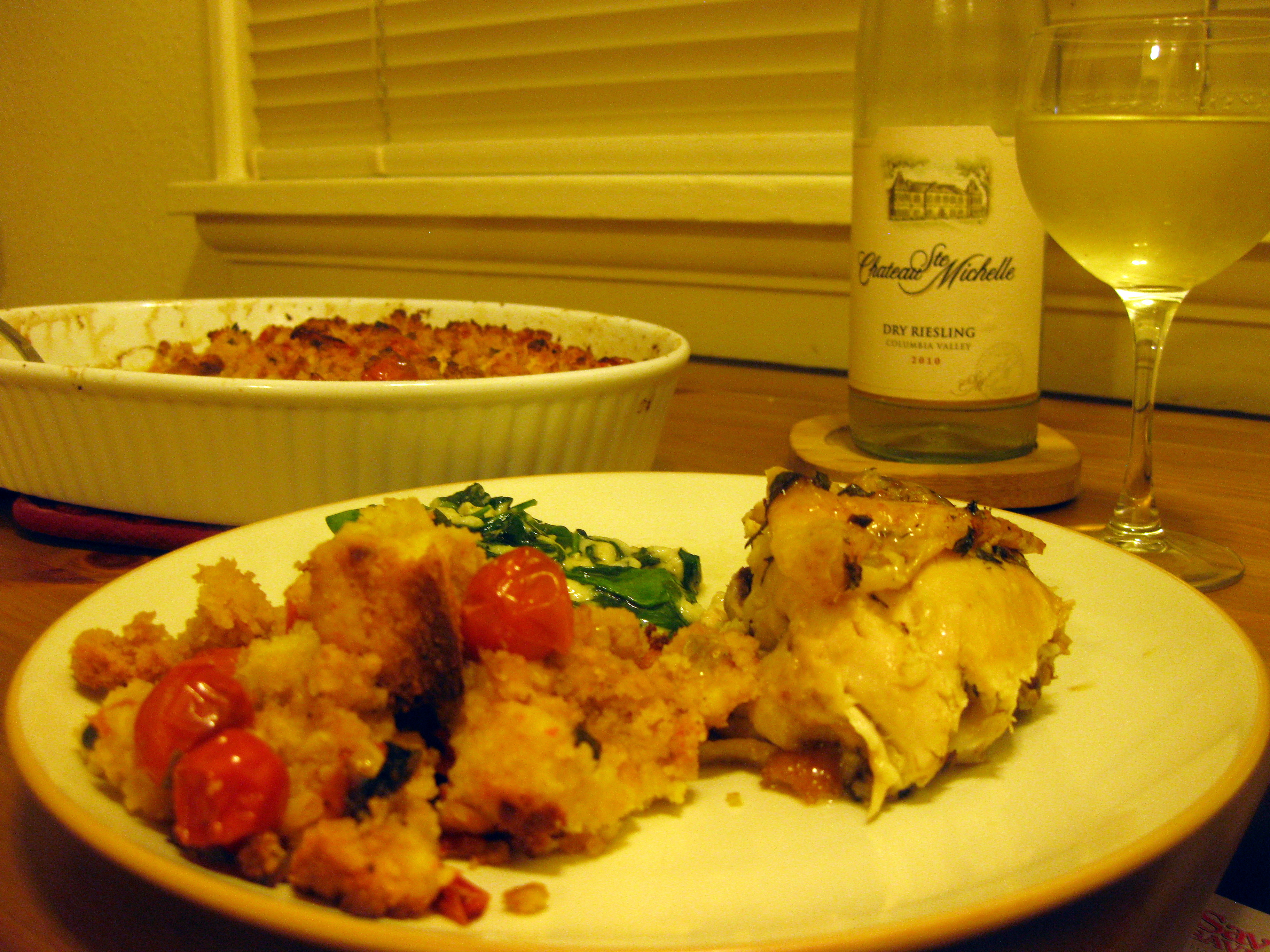
We ate this with roasted chicken and creamed spinach.  Vegetarians shield your eyes, but the chicken just collapsed so beautifully across my carving board that I felt I had to show you:

But the stuffing!  The stuffing was incredible.  The cornbread soaked up the beer, and the sweetness of the bread plus the sourness of the ale created this yeasty glory I couldn’t stop eating.  And I don’t like beer.  It was just such a perfect liquid for this dish, contributing just the right amount of malty bitterness.  The tomatoes got richer and sweeter in the oven, as did the corn kernels, and they partnered with the green onions to make such a good accompaniment to the cornbread that I’m almost tempted to add them into the batter in my next pan.  Or maybe into a compound butter to spread on top.  That would be better, texture-wise.  Green onions, cherry tomatoes, and corn: three musketeers. 

This stuffing was gone in two days.  With only two of us eating.  It was that good.  If you’re in the Northwest, where Spring is shunning us, make this now while you still need your oven to keep warm.  Accompanying some baked sweet potatoes and leafy greens, this becomes a vegetarian meal.  If you use oil instead of butter and have a good egg replacement, it could be vegan.  If your cornbread is free of wheat flour and you use gluten-free beer, it could be gluten-free as well.  However you make it, make it.  This one is too good not to try.