Marshmallow Topping for Adults

To me, there is no better title for this entry than Bittman’s designation.  Sometimes things don’t need to be complicated or alliterated or made cleverer.  Sometimes all they need is a little story to get them started.

For the past five years or so, my family has been driving up to Oregon to spend Thanksgiving at our house.  Since we discovered a recipe for Chipotle Mashed Sweet Potatoes, which melds the flavors of autumn with the heat of adobo sauce, we haven’t needed any additional fixings for our tubers.  This was not always true.  When we used to share Thanksgiving with a very dear set of family friends, L. inevitably made sweet potato casserole.  You know the one.  The sweet potato casserole.  Boiled sweet potatoes, mashed or beaten smooth.  Sweetened – as she was always proud to proclaim – only with orange juice.  Smoothed into a square glass baking dish and then topped until no hint of orange could be seen with a careful and meticulous layer of miniature marshmallows.  Thieving hands were scowled at.  Broil to perfect, swollen, golden-brown puff.

I liked this.  Well, I liked the idea of it.  Mashed sweet potatoes are delicious, and toasted marshmallows are my favorite part about a campfire.  But together, especially next to turkey and dressing and tart wonderful cranberries, it was never my favorite.  Bittman offers a grown-up alternative:

“60. Marshmallow topping for adults: Roast or boil chunks of sweet potato, put them in an oiled baking dish, top with dots of cream cheese, and sprinkle with a mixture of brown sugar, chopped pecans and chopped fresh sage. Broil until lightly browned.”

In my imaginary food dictionary, this would appear under “decadence.”  It just sounds so rich and so perfect, without the chalky powdered sugar edge of marshmallows.  Here’s how it happened:

1 ½ huge sweet potatoes cut into 1 inch chunks (I think I used the kind marked as “garnet yams”)

2/3 cup chopped pecans

Scant ½ cup brown sugar, or perhaps less.  It was a bit sweet.

1 TB finely chopped sage

4 oz. cream cheese

About an hour before you intend to broil this, stow an 8 oz. block of cream cheese in the freezer. This is just enough time to allow it to firm up enough to cut into chunks without mushing all over your hands.

Preheat the oven to 400F.

Toss the sweet potato chunks in olive oil, salt, and pepper, then roast them on a baking sheet for 35 minutes or until soft and slightly caramelized.  While they roast, combine the pecans, brown sugar, and sage in a small bowl and toss together well.

When the sweet potatoes are tender, transfer them to a lightly oiled 9×9 inch glass baking dish.  Remove the cream cheese from the freezer and cut it into small chunks.  Scatter the chunks of cheese evenly across the surface of the sweet potatoes, then crumble the pecan mixture evenly over the beautiful field of orange and white you’ve created.

Broil the whole delectable mess until the sugar caramelizes and begins to melt, and the cream cheese goes a little weak in the knees.  Don’t let it go too long or the sugar will burn.

Eat.

We did just that.  There was very little left over for repeat meals, so I had no excuse to repurpose the leftovers.  But in this case I wouldn’t have needed to, because it was stellar.  A bit on the overly sweet side, perhaps, but that’s what made it such an accurate modernization of the marshmallow madness it mimics.  The cream cheese, broiled to the edge of melting, was a tangier, softer version of the marshmallows from the original, and its form in small chunks just losing their shape made it look similar too.  Pecans and sweet potatoes are great friends, and with the addition of the brown sugar they became the equivalent of that couple on Valentine’s Day.  You know the one I mean.  Except you get to eat this, so it’s much better than intruding within a 20 foot radius of that couple.  The sage was an earthy, herby warmth that I wouldn’t suggest omitting.

My only suggestion about this, aside from perhaps cutting back a bit on the quantity of brown sugar, would be to add a little salt into the topping mix.  It would be a nice extra bite to bring out the pecan flavor, and salt with brown sugar is just so darn tasty.

This was delicious with Brussels sprouts seared in a cast iron pan, but it would be equally good with stuffed pork chops, or roast chicken, or the big Thanksgiving bird itself.  Or just in a big bowl, with a big spoon, and a private table.  And no one looking.  Fanciest take on sweet potato casserole I’ve seen in a while.

If that’s not fancy enough for you, I thought of a way of making it even fancier.  For appetizers, cut the sweet potatoes into rounds instead of chunks.  Roast and mix topping as directed.

Instead of freezing the cream cheese, let it come to room temperature and put it in a piping bag with a star tip.  When the sweet potatoes are roasted and have cooled a bit, pipe the cream cheese in a pretty little whirl atop the sweet potato round, then sprinkle with the topping and broil as before.  Presto!  Brilliance in two little bites.  No marshmallows required.
Mon petit chou

And so, I’ve well and truly slacked.  At least in the food department.  Well, at least in the Bittman project part of the food department.  This year’s back-to-school experience of the frantic race-over-uneven-pavement-while-juggling-eggs-and-firecrackers was enhanced by the addition of navigating the cloudy, jagged-edged seas of the academic job market for the first time.  Three weeks in, and I’m starting to collect myself a little, realizing how much work this takes, and that I have to grab my free moments when they present themselves, not whenever I want them to happen.  And while by no means is my hiatus replaced by my regular schedule of the summer, I am slowly adjusting in a way that leaves me just enough time to be with you here tonight.  Well, that and N.’s kind insistence that he tackle the current sink full of dishes.  Don’t hold your breath for my next post, but here’s a snack, if you will, to tide things over?

Two Bittman recipes for you, then, and a brief assessment of each.  Oh, and an apology: since it has been several weeks since I made either of these, even my rough estimate ingredient quantities have long since flown my mind, to be replaced by such niceties as why Beowulf never had a male heir, how many pages my 33 students will produce together during the next week, and how I can make my 54 page first dissertation chapter into a 20 page writing sample.

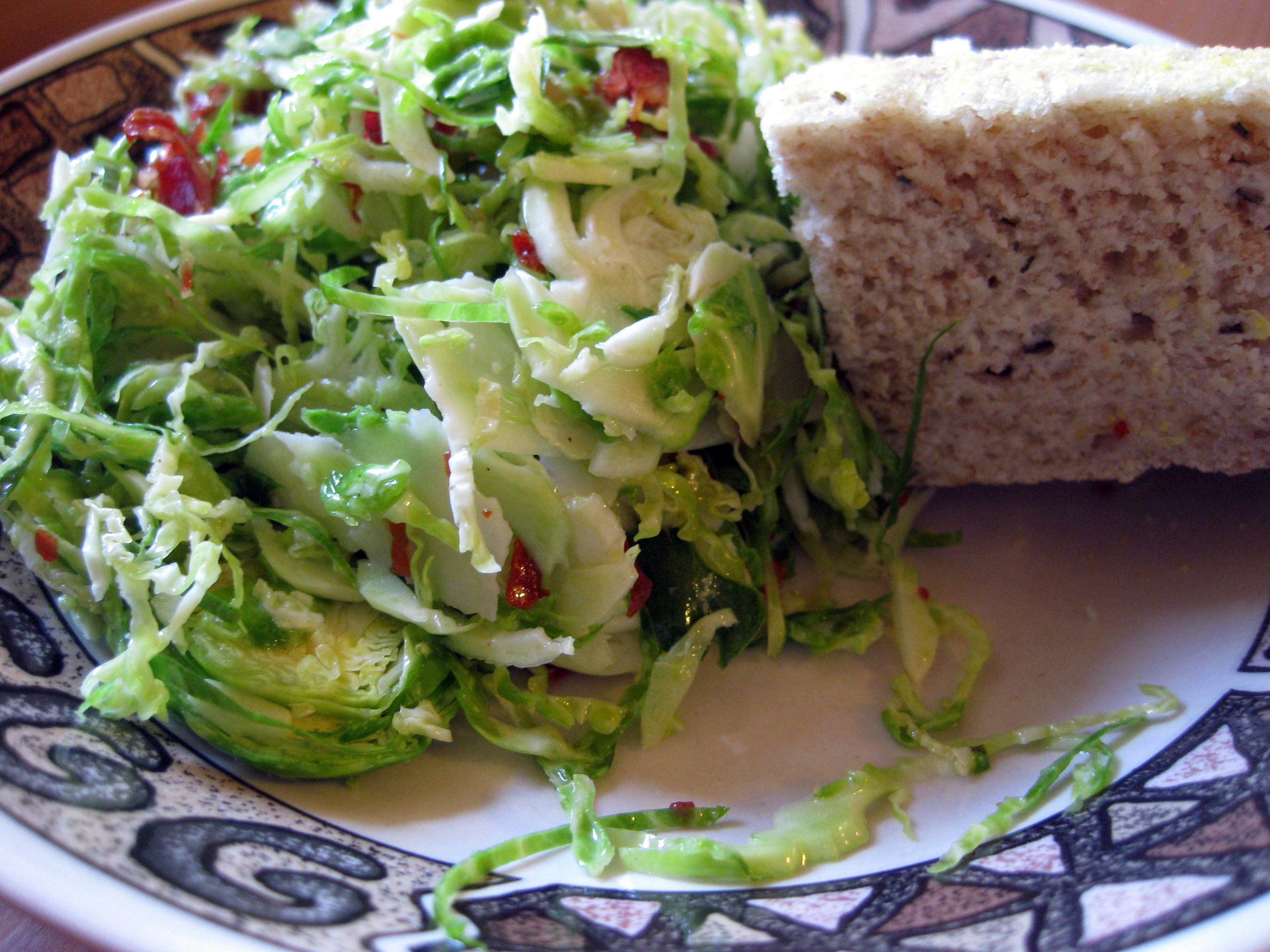
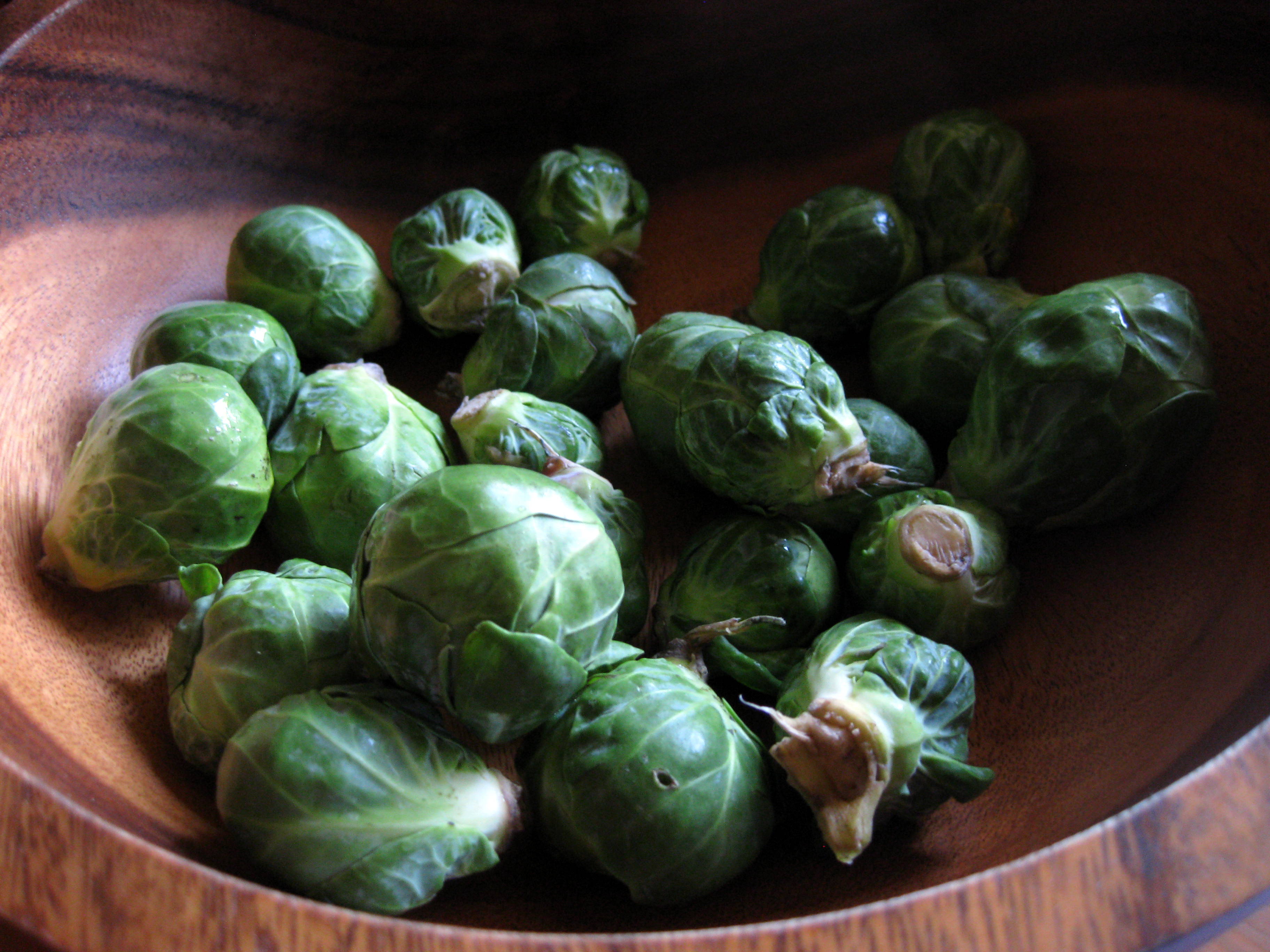
72. Trim and shred raw brussels sprouts (the slicer on a food processor works well). Toss with lemon vinaigrette and shaved or grated Parmesan. Crumbled bacon, as usual, is a welcome visitor here.

Brussels sprouts are one of those near-universal vegetables no one seems to like.  They are bitter and, when boiled, smelly, and can only be saved when eaten in combination with copious quantities of cream or sugared vinegar.  Or, as it turns out, raw with lemon, cheese, and cured pork.  I used prosciutto instead of bacon, baking it for fifteen minutes or so on a cookie sheet lined with parchment paper, and the effect was fabulous.  The prosciutto snapped into sharp fragments of pink shrapnel, and so the textual combination of the dish was amazing.  The sprout shreds (I did use my food processing slicer, and it worked perfectly) were crunchy and crisp but thin and light, like miniature tufts of coleslaw.  The cheese was chewy and grainy, and the prosciutto was crisp and flavorful, filing my mouth with saliva that the tart astringency of the lemon-honey vinaigrette I made just barely dried away.  This would be a great replacement for the heaviness of coleslaw, and is a near perfect quartet of ingredients.  Chopped salted walnuts or roasted, soy sauce drenched shiitake mushrooms might be a vegetarian-friendly replacement for the prosciutto or bacon, but I wouldn’t dare replace the cheese with anything.  It was far too perfect a nutty saltiness against the green resistance of the baby cabbages themselves. 


83. Onion-Rosemary Skillet Bread: In a 12-inch cast iron pan, sauté half a large, thinly sliced red onion in about ¼ cup olive oil until soft and beginning to color. Combine a cup of whole wheat flour with 1 teaspoon salt and 1 tablespoon rosemary leaves; add 1 ½ cups water and whisk until smooth. Pour the batter into the hot skillet and bake in a 450-degree oven until the flatbread is crisp on the edges and releases easily from the pan, about 30 to 40 minutes.

Since I got my cast iron skillet (a birthday gift that was purchased using last year’s Christmas present [don’t ask, it confuses me too]), I’ve been looking for recipes that let me use it as much as possible.  Though I am having trouble getting used to the whole well-seasoned thing (no soap?  Really?!), I adore the quick, crusty brown sear it imparts to anything you dump into it.  The appeal of making bread in this stove-to-oven vessel was too strong to pass up.

The challenge?  I bought a 10-inch skillet, and my math skills are weak for anything more complicated than halving or doubling a recipe.

I… estimated.

I did a pretty good job too, with two exceptions: the onions and the oil.  As a consequence, we ended up with a very onion-y bread that was also quite greasy.  Additionally, I was impatient in trying to emancipate my funny little bread from the pan, which resulted in some severe aesthetic imperfections (by which I mean, the whole thing broke up and we ate it in chunks rather than cutting slices). 

Still, it was really tasty.  I’ve never tasted fry bread, but I suspect this is probably similar.  The onion and rosemary worked well together, and the crunchy exterior of the bread was a delightful texture.  No leavening, no sweetening, and no rise time, just bread for dinner in less than an hour?  And out of a cast iron skillet?  We’ll be having this one again, and I intend to get the measurements right this time.

Vignettes

The Oxford English Dictionary defines a vignette as

An ornamental or decorative design on a blank space in a book or among printed matter, esp. at the beginning or end of a chapter or other division, usually one of small size or occupying a small proportion of the space; spec. any embellishment, illustration, or picture uninclosed in a border, or having the edges shading off into the surrounding paper; a head-piece or tail-piece.

Very well, then.  If you’ll permit me, I present you a few vignettes, accompanied only by a smattering of explanatory text, of the food we’ve been playing with over the past few months, while my dissertation lengthened and my sad little blog slowly became emaciated.  Since this is a season of excess, I’d like to fatten it up a bit.  Here’s a start:

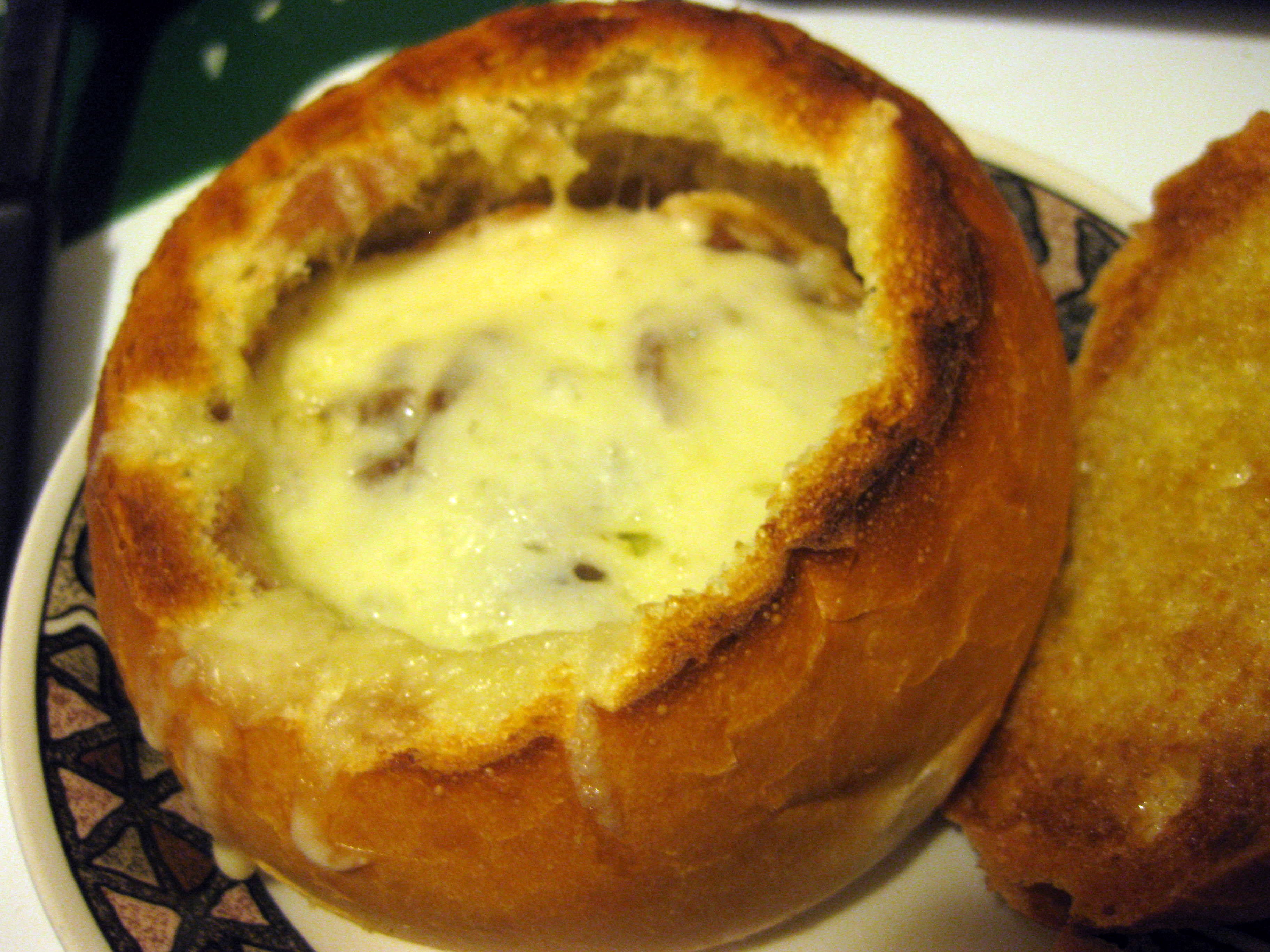
Serving suggestion for French Onion soup: hollow out a sourdough bread bowl, toast the inside, coat with a crust of Parmesan cheese, and flood with soup.  Top with Swiss cheese and broil until the bread crusts and the cheese blisters.  Try not to burn your tongue.

To celebrate, or perhaps provide an epitaph for, our pathetic tomato season this year, I made a roasted green salsa for Halloween.  Tomatillos, which flourished happily, green tomatoes, which did not, jalapeno, onion, garlic, and plenty of cumin.  Roasted, cooled, pulsed together with salt, lime juice, and cilantro.  Tickling and spicy and smoky, and perfect for a rainy Halloween.

Seeking fruit without the healthful feeling, I made crustless “apple pie” one evening with great triumph.  Apples sliced thinly, tossed with a tablespoon or two of flour, butter, and a hefty sprinkling each of sugar and cinnamon, bake in the oven for half an hour.  I left the skin on for color, chew, and nutrients, and we were both delighted with the syrupy excellence they eschewed.  It was not unlike the filling in an apple pie crepe from The Vintage which, if you haven’t visited, you should.  With haste.

Spurred toward the heady, heavy, comforting feel of winter food by this apple pieless dessert, we delved into the season of rich sauces, hearty vegetables, and warm fatty indulgences.  Perhaps yearning for protein in the darkness of November’s cold snap, we opted for a rich beer and beef stew replete with parsnips, carrots, and cup after cup of rich brown mushrooms spilling earthy thickness into the stew.  Whole grain mustard offered intrigue, a whole bottle of Jubelale provided dark yeasty flavor, and a glug of beef broth tied the flavors together.  Good stew meat from Long’s Meat Market (warning: the website has sound) was the clear star, and even the “low quality” stew meat I bought, intended to be cooked long and low to tenderize, was so juicy, so flavorful, and so ridiculously good, that I couldn’t stop myself from gulping down three or four pieces after only searing them crusty brown on all edges.  Lucky for us, I made a full recipe and froze half, so when the celebratory delectability of December ends and the long, cold middle of winter sweeps into Oregon, we will have reserves to bolster us until the sun appears again. 

Fortunately this same reserve will not have to serve this site.  Holidays approach, and with them a break from school, which means a break from dissertating, a break from grading, and a break from relentless reading.  Rather, I intend to poise myself in my kitchen and dart behind and before the camera, mincing, stirring, pouring, focusing, clicking.  And, inevitably, writing.  To you.  Happy December!

2010 Thanksgiving Menu

I get excited about holidays that involve cooking waaaayyyyy earlier than I should (then again, since our Target already has a Christmas section erected, complete with at least six artificial trees, maybe I’m not totally unhealthy).  I even told my mom over the phone this past Sunday that I’d probably go grocery shopping for the holiday late this week or this weekend.  Right, with two weeks to go.  I was already a week ahead of myself and willing to completely skip seven days of reality so I could buy a turkey.

But I love the way food impacts a holiday, and not just because I love eating.  For my family, food has a binding quality.  I love to cook, my mom taught me how and she loves to cook, my sister is developing an enjoyment and adventuresome spirit in the kitchen, and my dad… likes eating the food we make.  But still, it gives us something to talk about, something to share with each other, and something to do together, when we are in the same kitchen.  I feel close to them through the food we create.

At Thanksgiving, my mom and I make most of the dinner, my sister pipes in with seasoning suggestions, my dad carves the turkey, N. tastes things and generally tries to stay out of the way, and Lucy’s nose never stops twitching.  Every hour or so, little click-clacking dog claws tiptoe into the kitchen to take a sniff and clean the floor.

So I’ve already thought through the entire menu.  I know exactly what we’re having.  I’m even contemplating spending my evening tonight making a detailed grocery list for the big shopping trip.  Excessive?  Premature?  Perhaps.  But so delicious.

Here’s the menu for our Thanksgiving this year:

Appetizers: whole heads of roasted garlic with soft goat cheese and toasted baguette, roasted nuts with brown sugar and rosemary, assorted dried fruit.

Dinner: herb roasted turkey with giblet gravy, stuffing, chipotle mashed sweet potatoescreamed spinach and artichoke bake, and whole berry cranberry sauce.

Desserts: Mom’s pumpkin pie with whipped cream, and pumpkin cheesecake squares.  My sister doesn’t love pumpkin pie, so this year there will be two desserts.  If the recipe I invent for her works out well, I’ll post it here.

What are you having for Thanksgiving dinner this year?

Thanksgiving veg 2010

My family always argues over a Thanksgiving vegetable dish.  My dad doesn’t like the classic green bean casserole made with Cream of Mushroom Soup and crispy fried onion ring crumbles.  He can’t get past the condensed soup flavor.  When I asked him last year what vegetable I should make instead, he suggested lima beans.  We made green bean casserole anyway.

One year my Mom and I tried making this dish from scratch.  We figured, fresh green beans lightly steamed, thick chunks of mushrooms, a silky white sauce, and what could be better?  That was the year I determined that part of what I like so much about the classic green bean casserole is… the taste of processed condensed soup.  I can’t help it.  I love the savory, umami saltiness of it, and the homemade substitute was just not an acceptable replacement for me.

One year at Thanksgiving with some family friends, they brought a big salad to supplement our carbohydrate-rich, overloaded plates.  The bowl was passed around the table.  No one took any salad except L, who had made it in the first place.  When she protested, her husband uttered the truest words anyone has ever spoken: “Thanksgiving is not about lettuce.”  So salad, too, failed the test.

Now that October is over, the challenge again rears its head: which vegetables can I dress up to complement the comforting classics we always serve?  While N. was gone at a conference recently, I fiddled around with some trial dishes and voila, Thanksgiving Veg 2010 was born: creamed spinach and artichoke bake.  It’s the comfort and familiarity of creamed spinach, with the flavors and reminiscence of spinach artichoke dip.  Perfection, no?

Here’s what you need:

4 TB butter

4 cloves garlic, crushed and minced

1 – 2 leeks, white and pale green parts only, chopped fine

4 TB flour

Generous grating of fresh nutmeg

2 cups milk or cream

4 oz. cream cheese

At least 10 oz. spinach (that’s the amount in one frozen box, but I used fresh because I prefer it)

16 oz. can of artichoke hearts in water, drained and quartered

Salt and pepper to taste

Topping:

2 TB butter

½ cup or more of Panko bread crumbs

2-3 TB parmesan cheese, grated

Melt the butter in a large skillet over medium heat.  When it is nearly all melted, add the garlic and sauté for just a minute or two, until the aroma is enticing.  Add the leeks and sauté until they are softened.  Leeks are a new love of mine.  They are the least aggressively flavored members of the onion family, and I think they taste like a cross between a sweet onion and garlic.  They don’t have that astringency onions sometimes do, and I think they are like a stalk of springtime.  I’ve started putting them in frittatas, and when I had one left over on the night I made this little concoction, it seemed like the perfect thing to add in.

When the leeks are tender but not browned, add the flour and nutmeg.  Add some pepper too, if you like.  Stir in until well incorporated with no huge floury lumps, and cook for a minute or two until the flour is pale golden in color.  Then add the milk, slowly, whisking the entire time.  I added it in installments of probably half a cup each, stirring until the milk was fully integrated into the flour mixture.  I found this helped avoid lumps, making a smoother base overall.  Add the cream cheese and mix in.  Whisking fairly constantly, let the milk come to a boil.  It will thicken as it heats.

When the milk is quite thick, add the spinach and artichoke hearts.  The spinach will wilt quickly, and as soon as it is looking soft, kill the heat.  Since this is going to bake for a while, you don’t want to overcook the spinach because it will lose its beautiful color and begin to look muddy.

Salt and pepper to taste.  You could stop here and eat this whole delectable mess right out of the skillet, but I wasn’t ready to quit yet.  After all, it takes my dad about half an hour to carve a turkey, so the oven is (mostly) free.  Why not take advantage of that?

With your oven at a preheated 350F, carefully dump the spinach and artichoke mixture into a baking dish (I used a glass nine-inch pie pan).  Set it aside for a moment while you make the topping.

Mix together the Panko bread crumbs and parmesan cheese with the softened butter.  Drop the buttery crumbs in little clumps all over the top of the spinach and artichoke mixture.  If you don’t get the vegetables completely covered, that’s okay.  In fact, it’s good, because it means any exposed edges of leeks or artichokes will get a little toasty and golden.  More texture = more exciting to eat!

Bake the whole thing for about half an hour at 350F, or until the crumbs on top are browned and the sauce is bubbling at the edges.  Remove and consume.

What I liked about this dish was… well, innumerable.  But the basics: I love creamed spinach, and this was a more extravagant, luxurious take on it.  I also love spinach dip, and this reminded me of it, but without the excessive mayonnaise, the MSG-laced spice mixture, or the pounds of parmesan that go into a hot artichoke version.  The bread crumbs on top were a welcome textural element, especially for a Thanksgiving table, where stuffing, mashed potato, and even the tender juicy turkey, all lack an essential crunchiness.  Not that you would want your mashed potatoes to be crunchy, but it is a sensation for your mouth often missing from this meal.

I told my mom about this dish when I spoke to her on the phone this weekend, and before I could finish explaining what it was, she had already confirmed that this, indeed, would be our Thanksgiving vegetal offering.  Challenge met, and challenge exceeded!  Now I just have to wait for the end of November…

Cheese and macaroni

I pride myself a bit on escaping from some of the pressures and temptations of processed food. I like to cook, I like homemade food, and I like when my shelves are full of whole ingredients and natural products and grains and all that snobby stuff. If I can (relatively) easily make it from scratch, I try not to buy it premade.

But there are always exceptions, and sometimes they are the very worst kind. You see, most of my life I have hated all but one variety of macaroni and cheese. My mom’s elbow noodles in cheesy bechamel with bread crumbs on top? Can’t stand it. The crunchy baked roasting hot steaming vessel-o-mac from Cornucopia, one of our go-tos? Merely tolerable. But that kind that comes in a blue box? That kind with the chewy, rubbery noodles and toxic neon orange powdery “cheese”? Oh god, I love it. I wait till it’s 10 for $10 at the grocery store and stock up. Sometimes I peek into the back of my cupboard just to check that I have a box or two stockpiled there. I’m not ashamed.

And yet… and yet I always feel like I’m missing something. There must be an element of worth to homemade mac and cheese. People love it! Our friend X is practically a connoisseur. I finally decided I, not the mac, must be the problem. I love pasta with cheese on it, I love fettuccine alfredo, so where, I asked myself, did the problem arise?

In the sauce.

The closest I’ve come to enjoying a bowl of homemade, baked macaroni was a version in which the sauce was made of (as near as I could tell) two things: butter and cheese. It’s the white sauce I apparently take issue with. Thick and creamy but bland, with all the graininess of melted cheese but only 50% of the flavor. Ever notice how a chocolate milkshake has only the palest color and flavor of chocolate compared to a big scoop of rich, fudgy ice cream? Cheese sauce seems to do the same thing to cheese.

So the natural solution seemed to me to tinker around in my kitchen, producing numerous casseroles of ever increasing cheesiness, until I found a ratio I (gasp!) actually enjoyed. Perversely, however, given my strange penchant of creating and serving new food to friends and family without testing it first, I decided to make macaroni and cheese for my in-laws during our visit to their home.

I don’t know what made me think of it. I don’t know what made me decide it was a good idea. But suddenly, there I was in the tiny grocery store in their little town in the Sierra Nevada foothills, buying cheese and elbow noodles and Panko breadcrumbs. Baby, I was makin’ mac’n’cheese.

I must admit to borrowing a bit from Pioneer Woman’s recipe, but I made a few alterations of my own. Here’s the rundown of ingredients, some approximated:

1 pound elbow noodles (1 16oz. box)

¼ cup butter (½ a stick)

¼ cup flour

2 tsp spicy brown mustard

2 cups milk, room temperature

1 egg, beaten, room temperature

garlic salt

black pepper

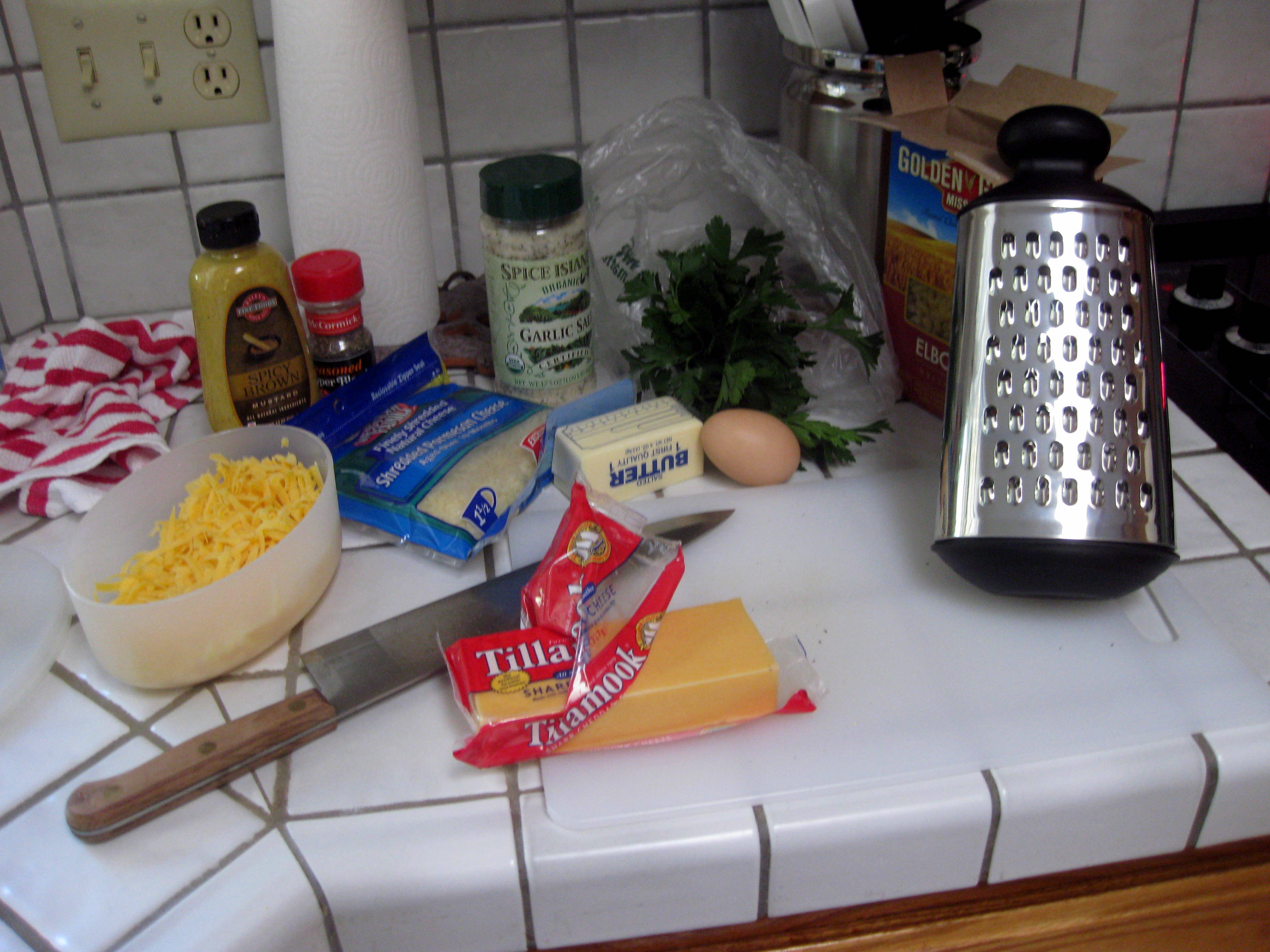
3-4 cups cheese? I used an 8oz. block of sharp cheddar, 2 generous handfuls of parmesan, and some already grated leftover medium cheddar stowed in the fridge.

¼ cup chopped fresh parsley

Topping:

2 TB butter

½ cup Panko breadcrumbs

2 TB parmesan

2-3 TB sharp cheddar

  • Cook the noodles in boiling water until almost done. They should still be a little underdone on the inside, because they are going to continue to cook when we bake them. Drain well and set them aside until we call for them.
  • Melt the butter in a large pot or pan over medium to medium-high heat. As it melts, add the flour and stir in, making a smooth golden paste. This is a roux.
  • After letting the roux cook for a minute or two, watching it carefully and stirring frequently so it doesn’t burn, add the mustard. As Pioneer Woman said, this adds a really nice but not recognizable tang to the finished dish.
  • Begin adding the milk gradually. I probably added in three or four additions. Stir or whisk well after each addition of milk, until the mixture is smooth and does not have big lumps of flour. When all the milk is added, let it cook, stirring occasionally, for about five minutes until it starts to emit heavy reluctant bubbles and becomes quite thick and rich. Turn the heat down to low. This is a bechamel, or basic white sauce.
  • Slowly, stirring constantly, add about ¼ cup of the bechamel to the beaten egg. This is tempering, which starts the egg cooking slowly so it mixes in smoothly in liquid form. If you just tipped the egg into the sauce hot on the stovetop, it would scramble and leave little eggy bits in your smooth wonderful mixture. After tempering, add the egg and sauce mixture, now warmed and safe, back into the bechamel. Season to taste. I used garlic salt and seasoned pepper, because that’s what I found in my mother in-law’s spice cupboard.
  • Add the cheese in handfuls, stirring until each addition is melted before adding the next. This way your sauce doesn’t get overwhelmed with clumps of cheese, and if you decide it is cheesy enough without the whole amount, you can stop where you like. I wanted it to start to get stringy and clingy, as the cheese overwhelms the milk completely.
  • Add the parsley and the cooked, drained noodles. Stir to combine.
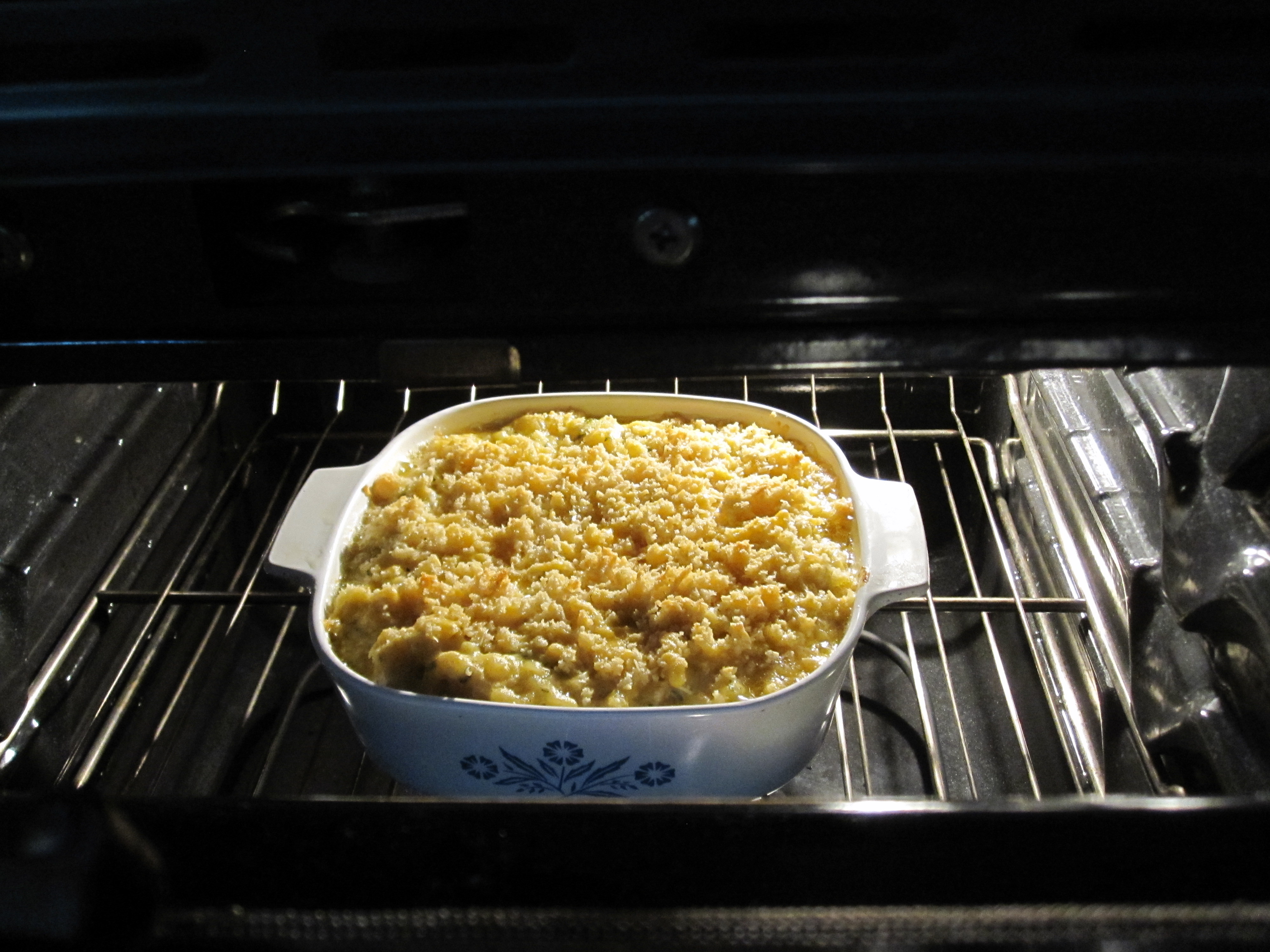
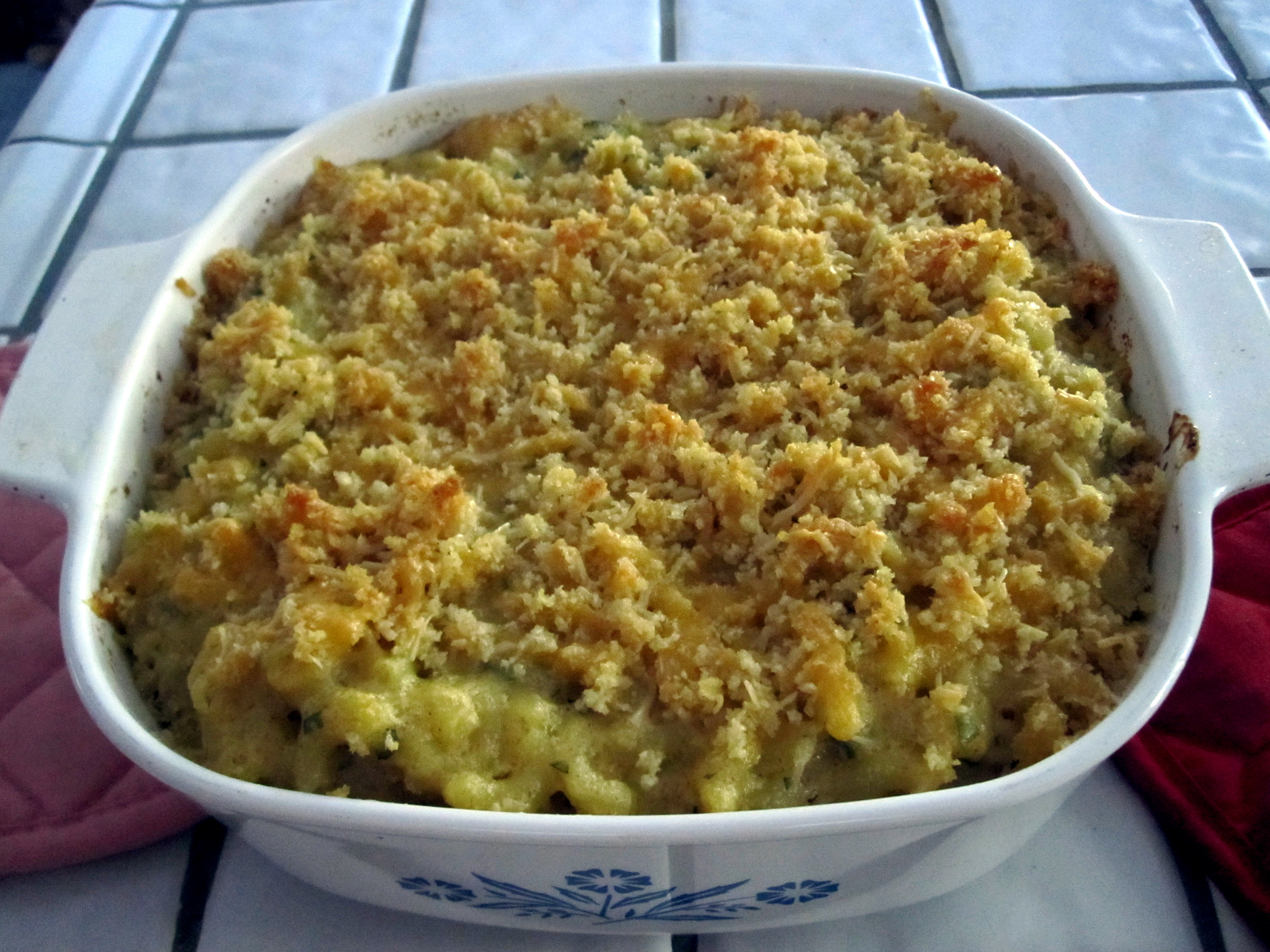
  • Pour the sticky cheesy mixture into a buttered 2 quart casserole dish and load it up with the topping (procedure follows), then bake in a preheated 350F oven for about 30 minutes, or until the edges are bubbling up from the bottom and the topping has become relentlessly golden and crisp. Eat.

To make the topping,

  • Pinch about two TB of butter into pieces in a bowl.
  • Add the bread crumbs, parmesan, and cheddar and mix together as you would a streusel for a crisp. You want small chunky pieces, and you want the cheeses and crumbs to be evenly distributed. This makes a lot for a casserole dish of macaroni, but N. really loves a crunchy topping so I always add a little more than, perhaps, the average person would. Adjust to your tastes.

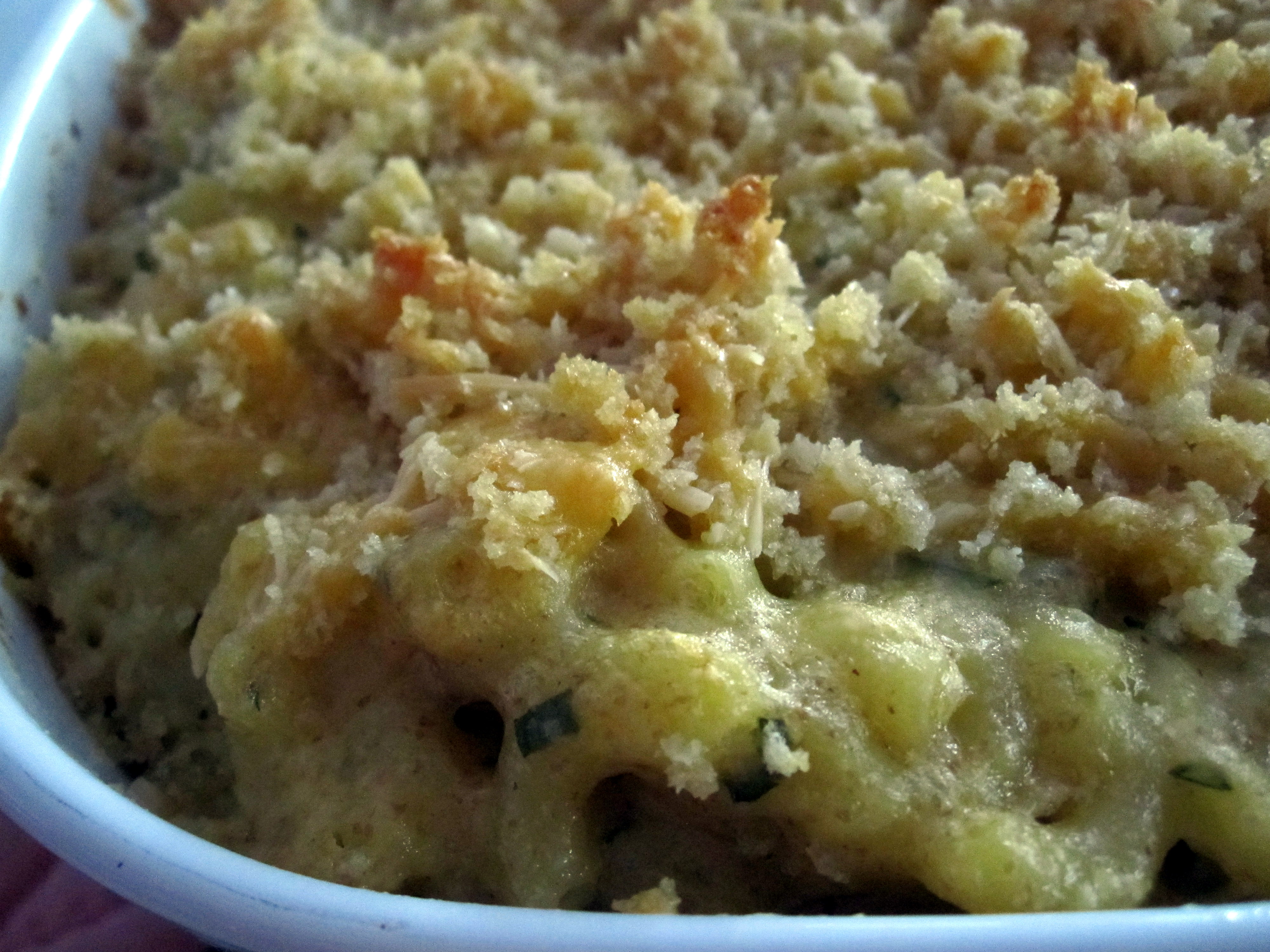
When the topping was taking on a burnished shade and the combination of butter from the sides of the dish and cheese from the sauce was boiling and bursting up around the sides, I liberated our dinner from the oven and we dug into it anxiously, dropping large spoonfuls onto our plates. The noodles had soaked up a lot of the bechamel during their stint in the oven, leaving the decadent suggestion of creaminess but the overwhelming assault of cheesy flavor holding them together. The topping was the perfect combination of sizzling salty crunchy sharpness and, served beside steamed broccoli and whole wheat focaccia, I must admit, I liked it. I went back for seconds. I had it for lunch the next day. Forget macaroni and cheese. Give me, for the rest of time, cheese with macaroni.