Breakfast for Dinner

I have a curious relationship with breakfast food.  The heavy kind, the kind you get from a diner or a good bed-and-breakfast or a hotel, doesn’t sit well with me in the morning.  It’s too much, it weighs me down.  But it’s food I love.  Potatoes, eggs, bacon, quiche, pancakes, cinnamon rolls… the list goes on.  So I take full advantage of every opportunity I get to eat this kind of food later in the day.

Enter Friday, April 2nd:  for the third year running, N. and I are hosting a Breakfast for Dinner potluck.  We try to host one party per term, usually with some loose theme, and I think this one is my favorite.  My mouth is already watering at the possibilities.

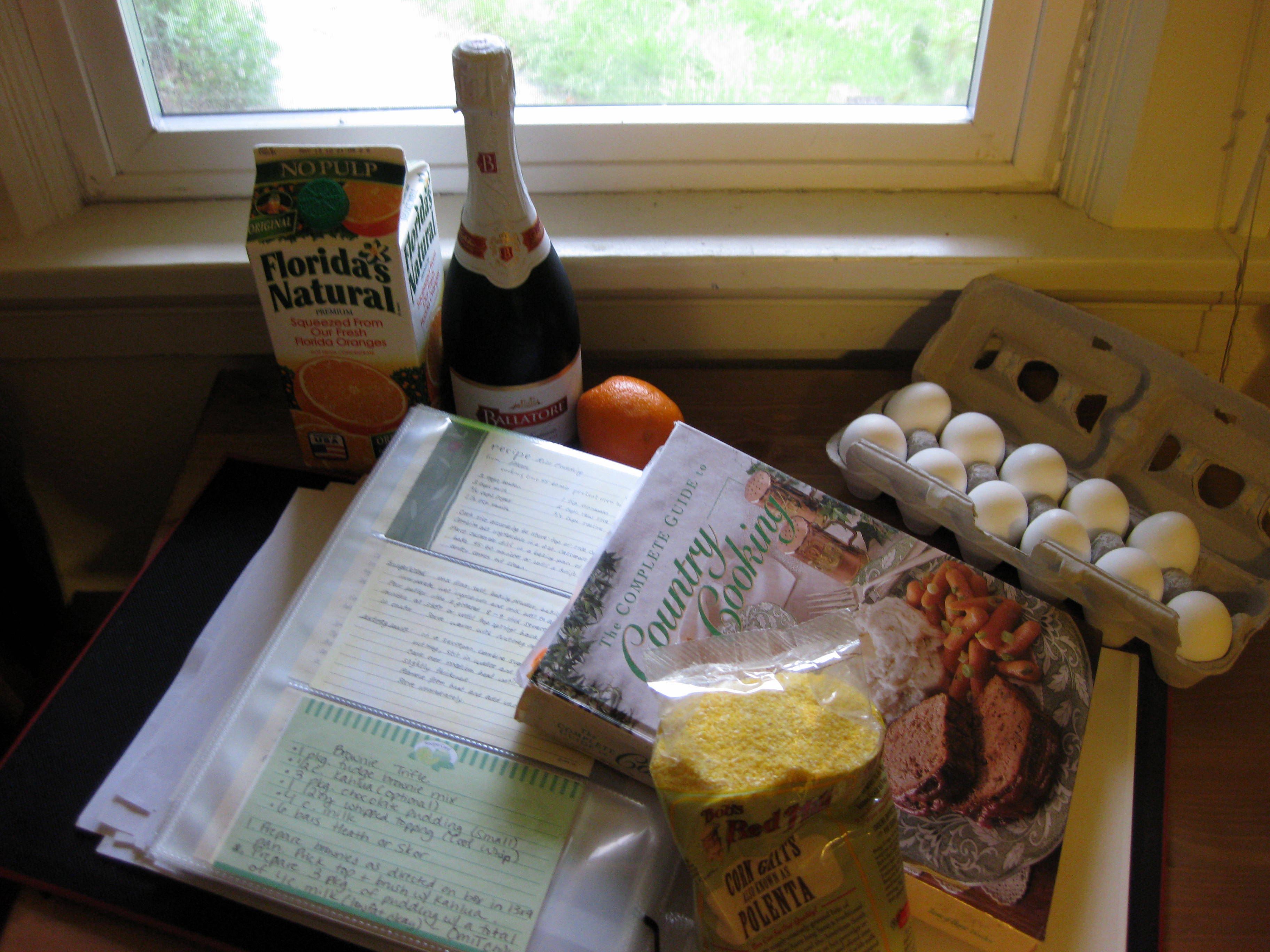
Here’s a preview of my own menu for the evening: 

Ph-Ph rice pudding

Jalapeno cheese grits casserole

Cranberry donuts

Deviled eggs

Spiked hot apple cider

Mimosas

Yum.

Will go barefoot for onions

Over the past year or so, Ina Garten and I have become good friends. She doesn’t know this; she doesn’t know I exist. Her Food Network show at first struck me as pretentious, with its demands for homemade chicken stock, Dutch process cocoa, and all the highest quality and therefore highest priced ingredients. The reminders of the Hamptons and the floral arranger and food photographer guests were a bit heavy to me. For a graduate student, Ina’s lifestyle and, I thought, her food, were beyond my budget.
In continuing to watch, however, Ina grew on me. Maybe it was by comparison to the other increasingly noisy newcomers to the network, or maybe it was my building confidence in my skills as a cook, but she is now among my favorite of the TV chefs. She cooks like me. Or, perhaps more accurately, she cooks the way I would cook if I had the means. She speaks plainly, but you can tell she is well educated in her field. She is messy. She doesn’t mind the occasional drip of batter onto a white counter-top or puff of flour onto a silk shirt. She looks like she enjoys food, and feeding people, and eating with them. Without really realizing it, I also found that more often than not when I turned to the Food Network website to find recipe suggestions, the recipe I ended up choosing was hers. I have made her Italian Wedding Soup, I have made her lemon bars, I have made several of her vegetable side dishes, and as of last week, I have also made her French Onion Soup.
This soup has, for almost a decade, been one of my restaurant go-to items. I love it. I love how it looks when it arrives at the table, with crusty bubbled Swiss cheese enameled onto the side of the soup crock. I love how it smells, with the fragrant sweetness of long-cooked onions steaming out once you break that crunchy-chewy protective cheese blanket. And really, an aromatic soup of sweet onion tendrils in rich meaty broth with the accompaniment of bread and cheese? I hardly even need to extol the flavor.
As seems to be a recurring theme here, however, I was always intimidated by the thought of making this soup. I don’t know why. I had every intention of doing so for a number of years, even registering for (and receiving) a pair of red French Onion Soup bowls as wedding gifts. It has been almost three years since I added these bowls to my kitchen collection, and yet it took until last week to put them to their intended use. With gigantic onions in my pantry, Swiss cheese in my fridge, and two-day-old baguette slowly getting crunchy on my counter, I went trolling for recipes and, to no great surprise, ended up with Ina’s. In addition to the dozens upon dozens of good reviews, it looked easy, and it looked really good.
In addition to halving the recipe, I made only minor changes. As several of the reviews note, it took longer than the 20 minutes allotted for the onions to get really brown and caramelized. I didn’t have the bourbon or sherry that Ina calls for, so I used a mixture of red and white wine, which I found to add depth and rich flavor. I didn’t have, nor would I want to use, veal stock, so I mixed beef broth with homemade chicken stock as a substitute. Since I am getting reacquainted with my garden as the weather slowly, grudgingly warms, I also added two big sprigs of thyme from my thriving little soldier.
When the onions had browned down in my soup pot and were delicate, pliable, and dark gold, I added red wine and let them simmer together. I brought a little piece of onion in to N., who was sitting on the couch and sniffing appreciatively, and he said only “ooohhhhh” after slurping down the offering. It was unlike the onion it had once been in almost every way. Soft, melting against the tongue, sweet but dizzingly rich with the addition of the red wine flavor. No bitter harshness, only mellow tenacity. Then I added beef broth, and white wine, and left the whole thing to simmer. As Ina says, “how bad could that be?”
It was far, far from bad. When the pot had simmered sufficiently (translation: when the smell was too enticing for us to resist any longer), I wedged a piece of toasted sourdough baguette into the bottoms of the aforementioned bowls, ladled steaming soup on top, and then mashed on as much grated Swiss and Parmesan cheese as would fit across the top. I broiled these little offerings until the cheese began to brown and crisp, and then we ate.
It was amazing, and I am again astounded by how inexpensive the ingredients are that make up this luxurious soup. As I have already mentioned, the onions softened but still held their shape, and became like oddly shaped little sponges for the flavors of the wine and broth. The cheese was melted in stringy gooey strands on the bottom, against the broth, but hardened into a crunchy crisp on the top, making two different flavors simply thanks to its textural change: toasty and salty on top, creamy and reminiscent of fondue on the bottom.
I am already devastated that I only made a half recipe, because we wolfed down our servings, we scarfed up the leftovers, and now sitting here typing, with a Spring headcold making my sinuses pound, I am overwhelmed by desire for a big steaming bowl of this rich, comforting composition. Thanks, Ina.

Candy Girl

Sometimes, it’s not enough to just cook beautiful, delicious food (she said modestly).  Sometimes, you have to make something really special, just because.

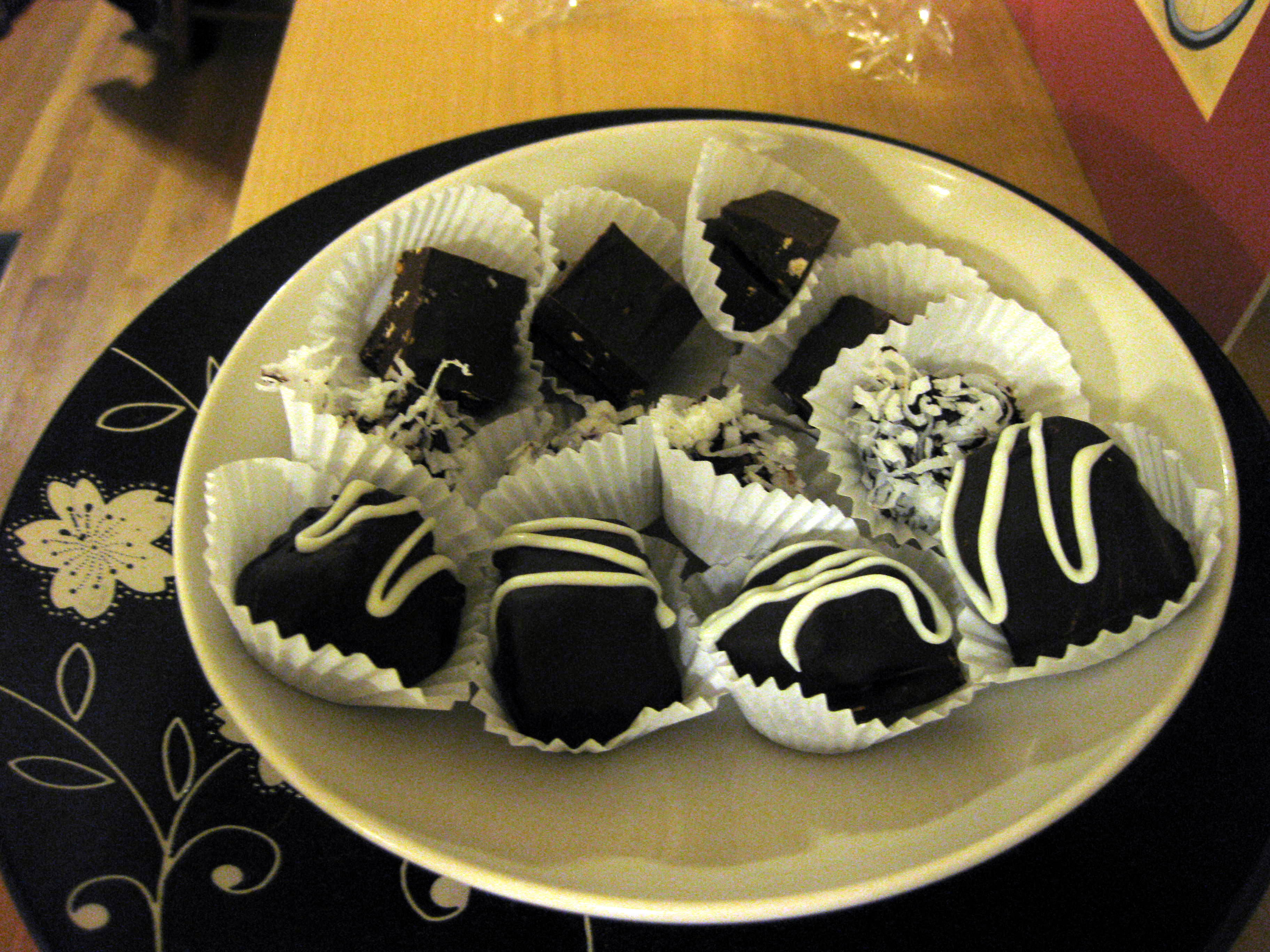
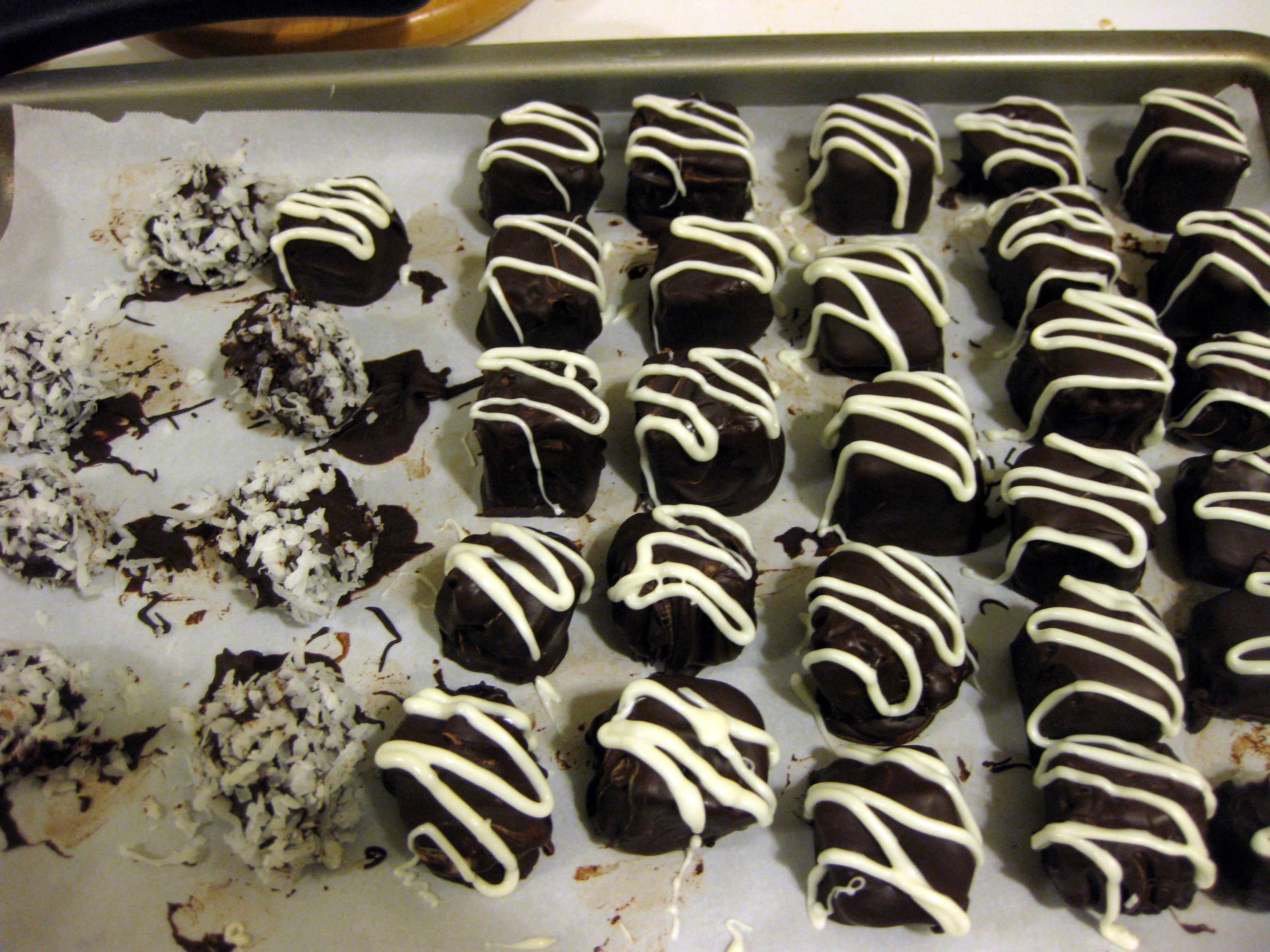
Something like this:
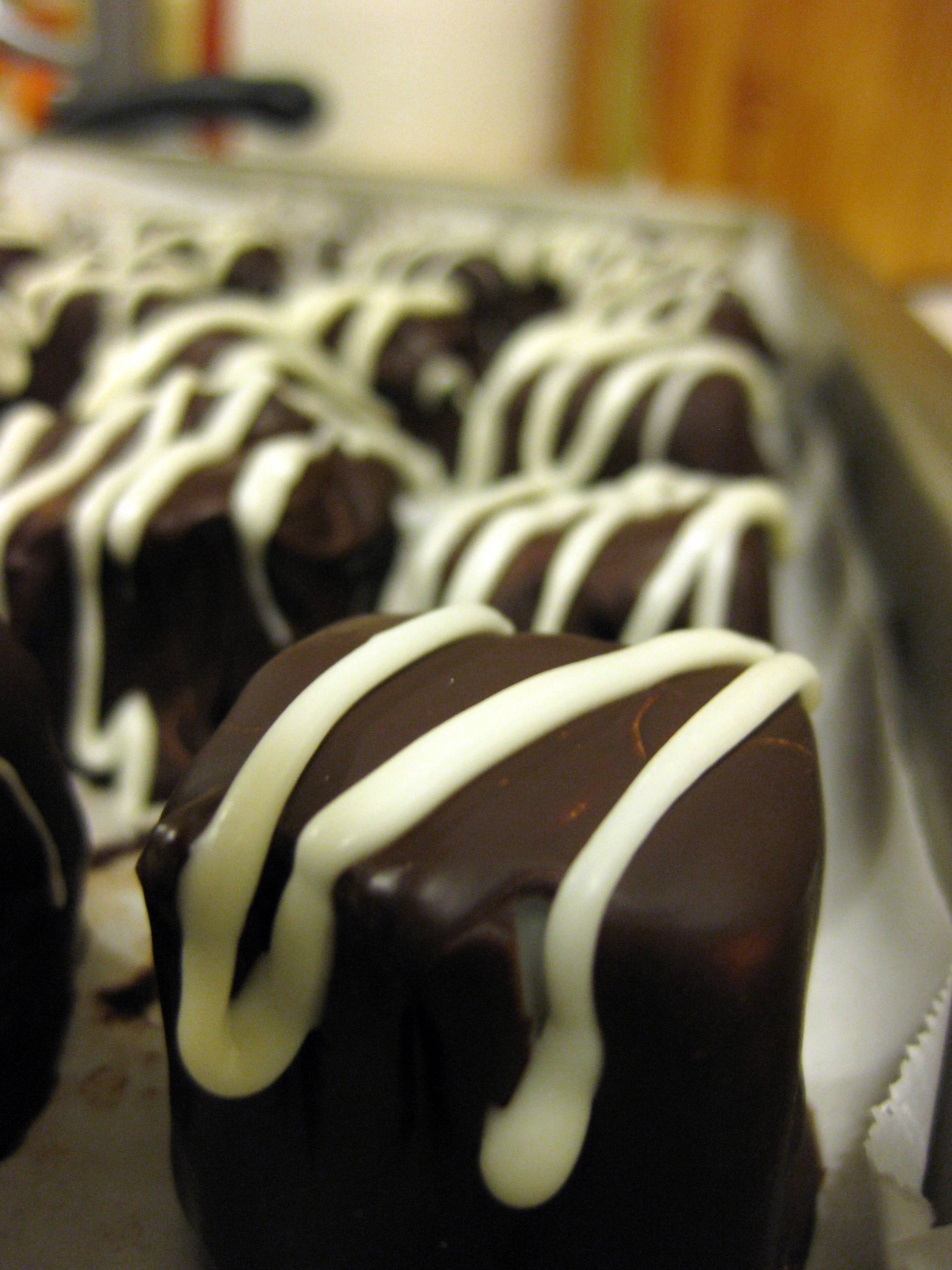
Yes, these are chocolate truffles.  Yes, I made them by hand.  I did not make them by imagination, though.  They were created thanks to the February issue of Cuisine at Home magazine, and an unintended modification to Elana’s Pantry’s nut butter balls.

I won’t go into a step-by-step written process, but here’s how it went:

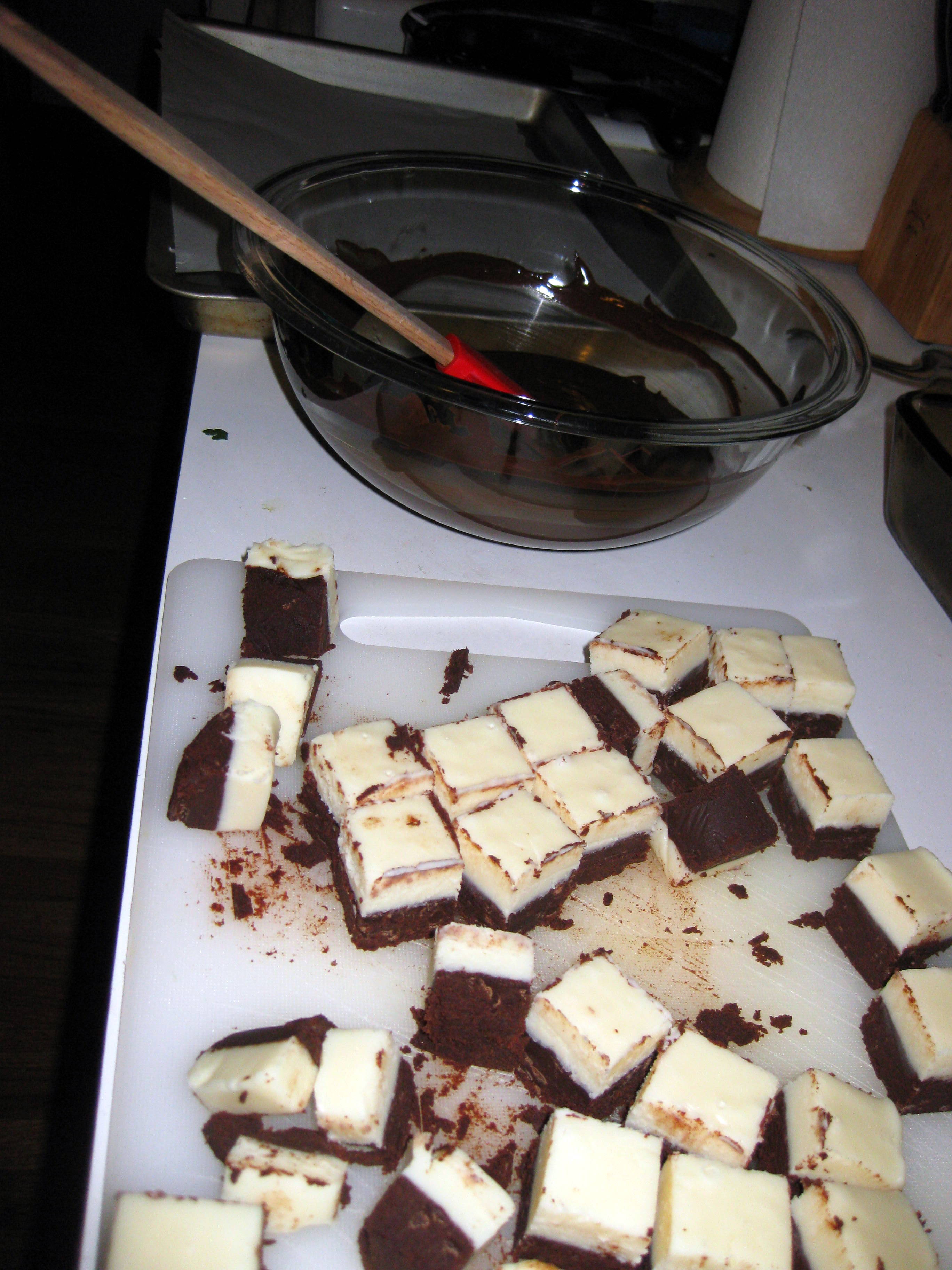
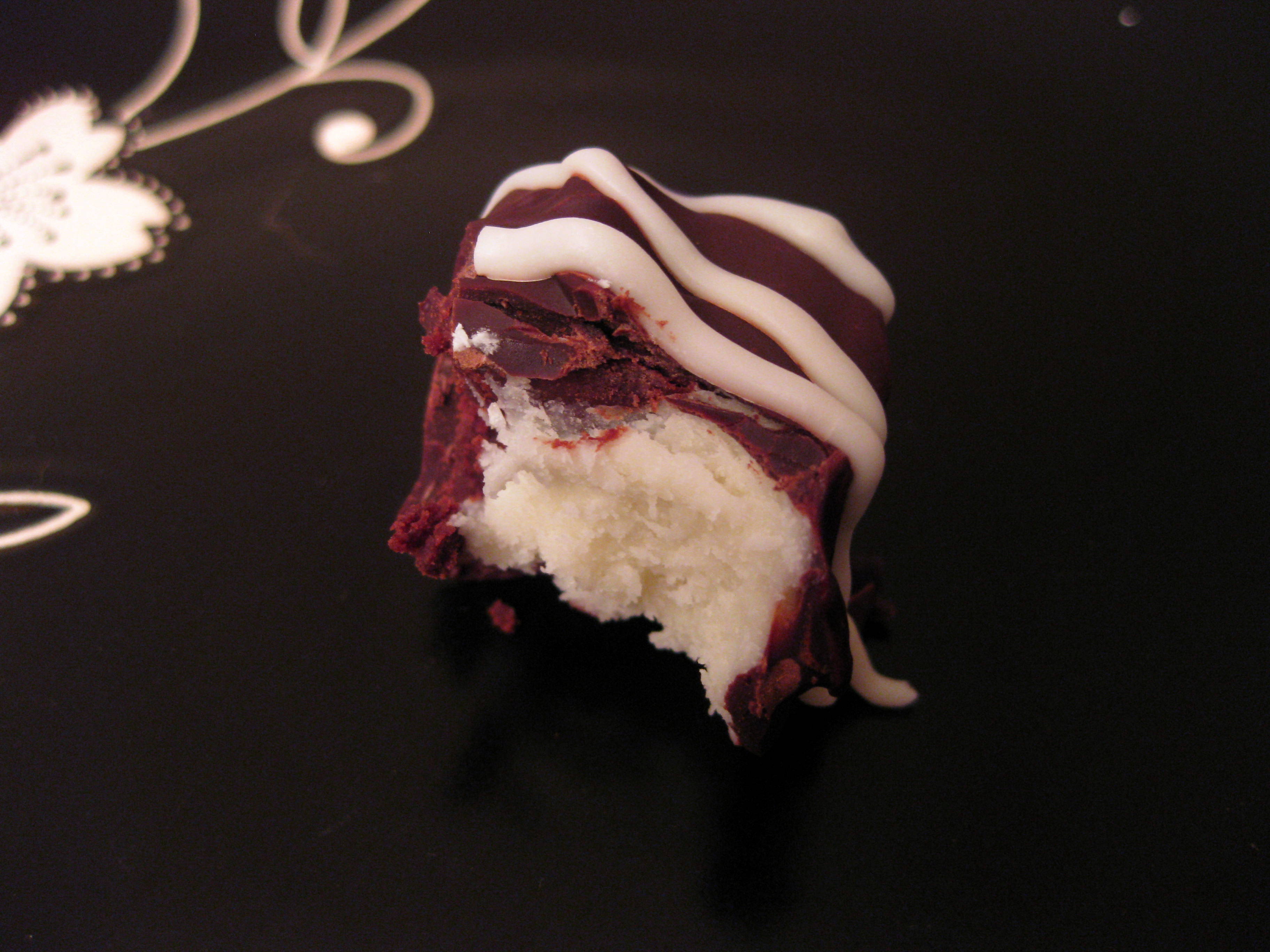
First you have to make two kinds of chocolate ganache.  One contains bittersweet chocolate, heavy cream, and crème de cassis.  It gets poured into a plastic-wrap-lined loaf pan and refrigerated for an hour or so, just until firm enough to maintain a solid top surface.  The other contains white chocolate, heavy cream, and almond extract.  I didn’t have almond extract, so mine contained amaretto.
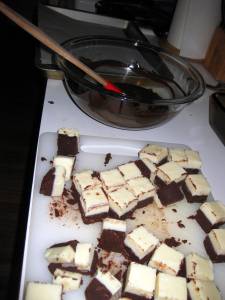
This gets layered on top of the dark chocolate and chilled.  I left it in the fridge overnight.  Then, when everything is firm and solid (as solid as ganache gets, anyway), you pull it out of the loaf pan by the overhanging edges of plastic wrap and cut the block into truffle sized squares.

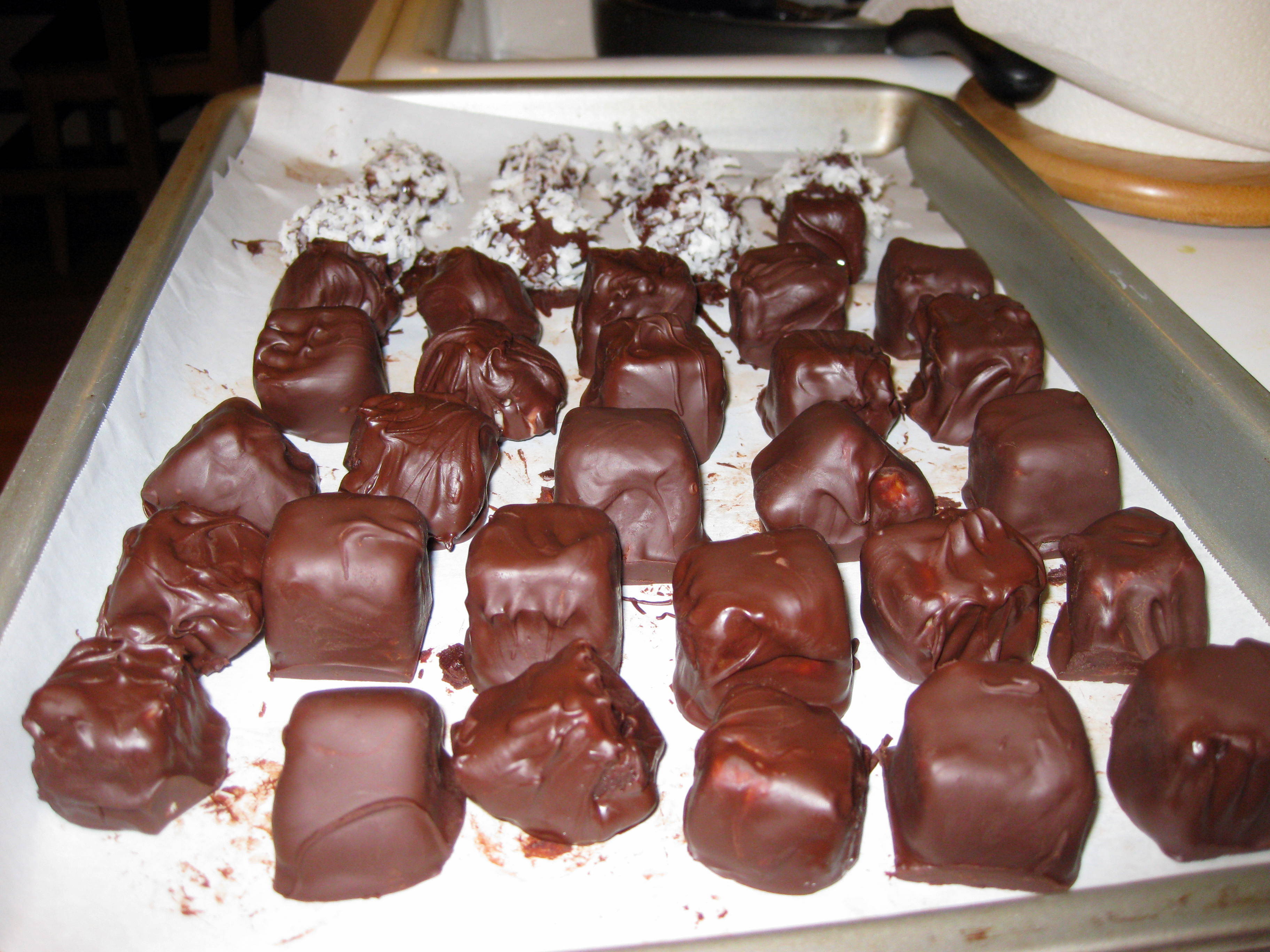
While you are releasing and unwrapping and cutting, melt some additional chocolate, dark or semisweet this time.  Just pure chocolate this time.  When it was smooth and luscious and liquid, I used two forks to quickly dunk and coat each ganache square before transferring them to parchment paper.
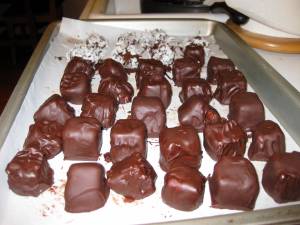
This was a pretty systematic process, so I got thinking while I was working.  I had some crunchy almond butter from Trader Joe’s, and a few weeks before I had drooled over Elana’s nut butter balls.  Why not make some myself?  On a suggestion from her comments thread, I mixed the almond butter with a few tablespoons of powdered sugar in hopes of firming it up a bit.  Then I stuck it in the refrigerator to chill it and maybe make it easier to form into individual pieces.  While that was chilling down, I finished the first set of truffles.  I melted some white chocolate chips in the microwave, scooped the sweet goo into a plastic bag with one bottom corner cut off, and squeezed out a nice drizzle over the tops of my little soldiers.  Just to change it up a little, I rolled some of the smaller squares in shredded coconut.

Isn’t that gorgeous?  Now, I’m no Bakerella, but that looks pretty darn impressive to me!
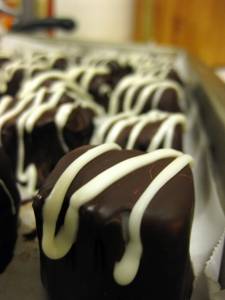
After encasing each little chocolate triumph in mini muffin papers, I stowed them gently in Tupperware and took out the nut butter.  I rolled five balls.  It was decidedly not firm.  I decided to freeze the individual pieces on a plastic cutting board to solidify them before dipping them in warm melted chocolate.  I pushed the board onto what looked like an empty shelf in the freezer.  It was not empty.  The almond butter mashed all over a gallon freezer bag full of salmon.  I sat down on the floor and just stared at the delicious mess I had created.  How to fix this?  I scraped off as much of the nut butter as I could salvage and, in a moment of minor genius, added it to the bowl of melting semisweet chocolate chips I already had on the stove, ready to receive its next set of victims.  The almond butter melted in nicely, and I was able to pour my little disaster in a bread pan to cool and cut.  Remembering Elana’s suggestion, I sprinkled the top with coarse sea salt.  Brilliant.  Cut into squares, it was a perfect mixture of texture and sweet-salty contrast.

And the truffles weren’t bad either.
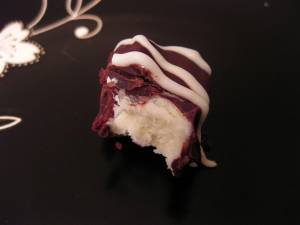
The tuxedo colored layers of ganache inside the slightly crunchy chocolate shell are visually stunning, and have a very subtle liqueur flavor that somehow enhances their chocolate-y richness.  They are impressive to look at, mouth-coating-ly opulent to eat, and better than anything you will find in a See’s candy box.  I brought small plate offerings to my officemates as thank yous for how supportive they have been toward me as I studied for my exam.  I read about and admire those people who can make mixed platters of sweets for holidays.  My Nana was always one of them.  Now, it would appear, I am fast amassing the skills and recipes necessary to do the same.  Maybe I should start taking orders.
The Week of Magical Eating: The End

After a week of hard work for N. and plenty of cookery for me, I came home from grocery shopping last Saturday and routine disintegrated.   N. and I looked at each other, and we looked at our books, and we looked at the tentative sunshine falling onto our porch, and we decided to take our dog-daughter to the beach.  Sure, there was cooking to be done and reading to be done, and editing and grading and cogitation.

But there was also this:

And that made it all worthwhile.

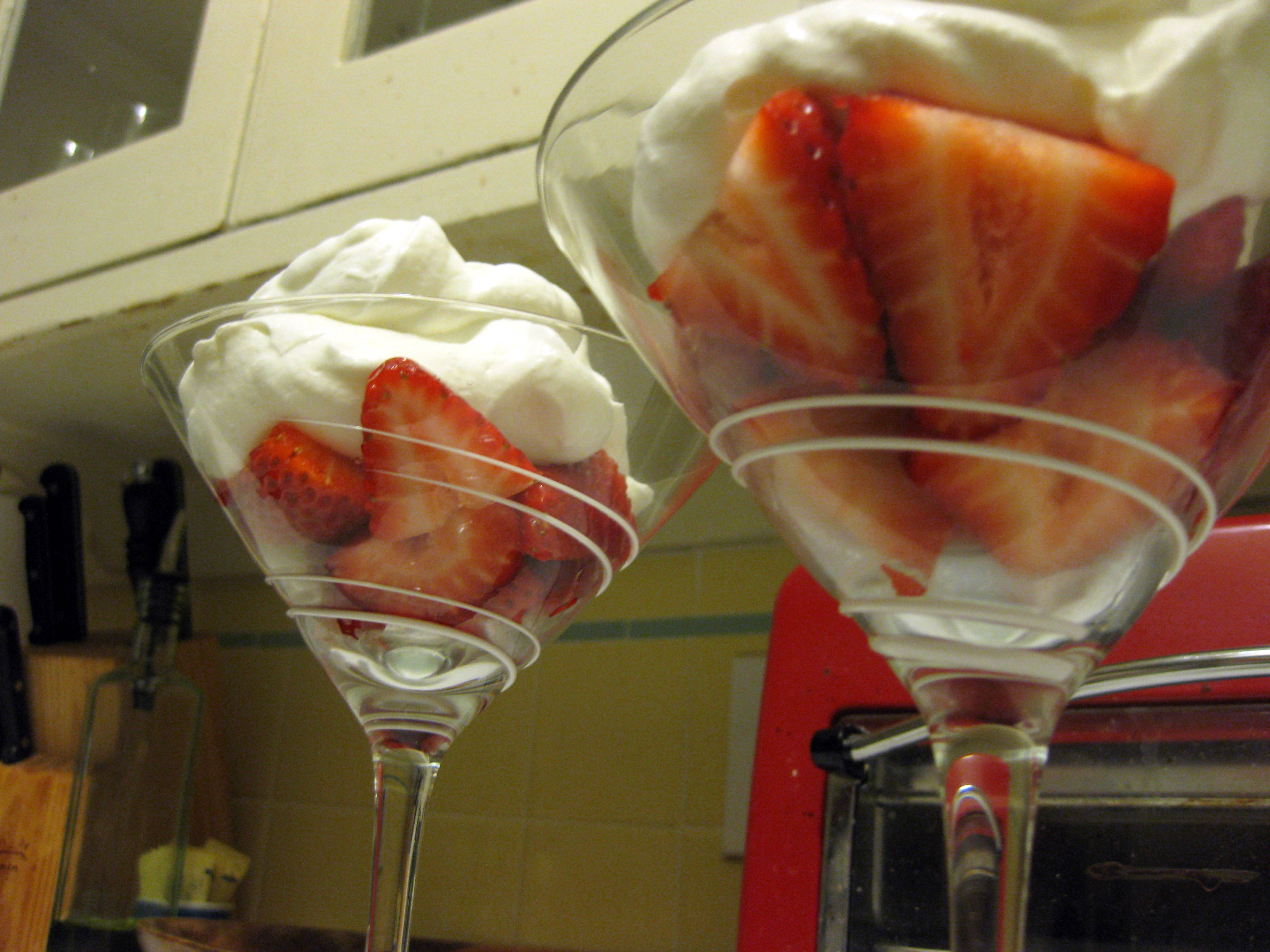
And then when we got home, sandy and tired and smiling, the house smelled like strawberries from the buy-one-get-one-free sale I couldn’t help but take advantage of during my grocery adventure.  So there was nothing else to do but eat them.  A whir of cream with a sprinkle of sugar in my trusty stand mixer, some quick coring knife-work, and two beautiful glasses, and voila, dessert is served. 

The Week of Magical Eating, Day Five: Phoebe-Phriendly

I realized recently that if I lived alone, I would not cook the way I do now.  I would eat scrambled eggs, I would eat yogurt and granola and pasta.  I would cook occasionally, but what I do now built out of a desire to care for my then-boyfriend, now-husband.  Some of it was, admittedly, to impress him, because he was eating microwave dinners and frozen bagged teriyaki concoctions.  But some of it was born from a desire to nurture him, because he was eating microwave dinners and frozen bagged teriyaki concoctions!
Somewhere along the line, I discovered that I really liked this whole cooking thing.  It became challenging but fulfilling, stress-relieving and relaxing, but also a self-induced obligation.  Deep within these seemingly-contradictory-but-somehow-harmonious-co-existing attributes, the urge to feed and nurture remained.  I cook because I love.  It is the best, most sincere, heartiest way I know how to show my deep affection and fierce warmth.  If I cook for you, it means I care about you.
As I have mentioned on this blog before, I have a friend Ph. who presents some challenges to my ordinary routine.  She is a good friend.  I care about her.  Therefore, I want to feed her.  But her particular dietary needs present me with unusual requirements.  Not only does she eat gluten-free, but dairy-free, corn-free, and nut-free.  This has, much like the Caesar dressing in my previous post, become a minor obsession for me.  I never realized how much of my love involved cheese, milk, and butter, to say nothing of wheat products.  But I care, and I feel driven, and I want to cook for her.  It has become a kind of mission for me.  So I have been educating myself; experimenting with alternative flours, rejoicing in olive oil, learning about how soy milk reacts differently than cows’ milk.  I have done some reading, found some new “friends” online, and discovered with delight how many flour and starch options exist in the bulk foods section of Market of Choice.
Despite all this, I haven’t done much baking yet.  I find myself a little intimidated because I don’t like failure.  I don’t know how these new ingredients react to each other yet, and I dislike the idea of presenting substandard or imperfect food.  But I bucked up my courage recently and made my way through my first bag of rice flour.  One semi-triumph was a version of Elana’s “Magically Moist Cherry and Apricot Cake” from Elana’s Pantry.  Since Elana uses almond flour as her primary gluten-free alternative, I cannot use her recipes verbatim.  Ph. cannot eat tree nuts.  Additionally, Elana uses alternative sweeteners, and I have not yet delved into the mysterious world of agave nectar.  So some amendments needed to be made.
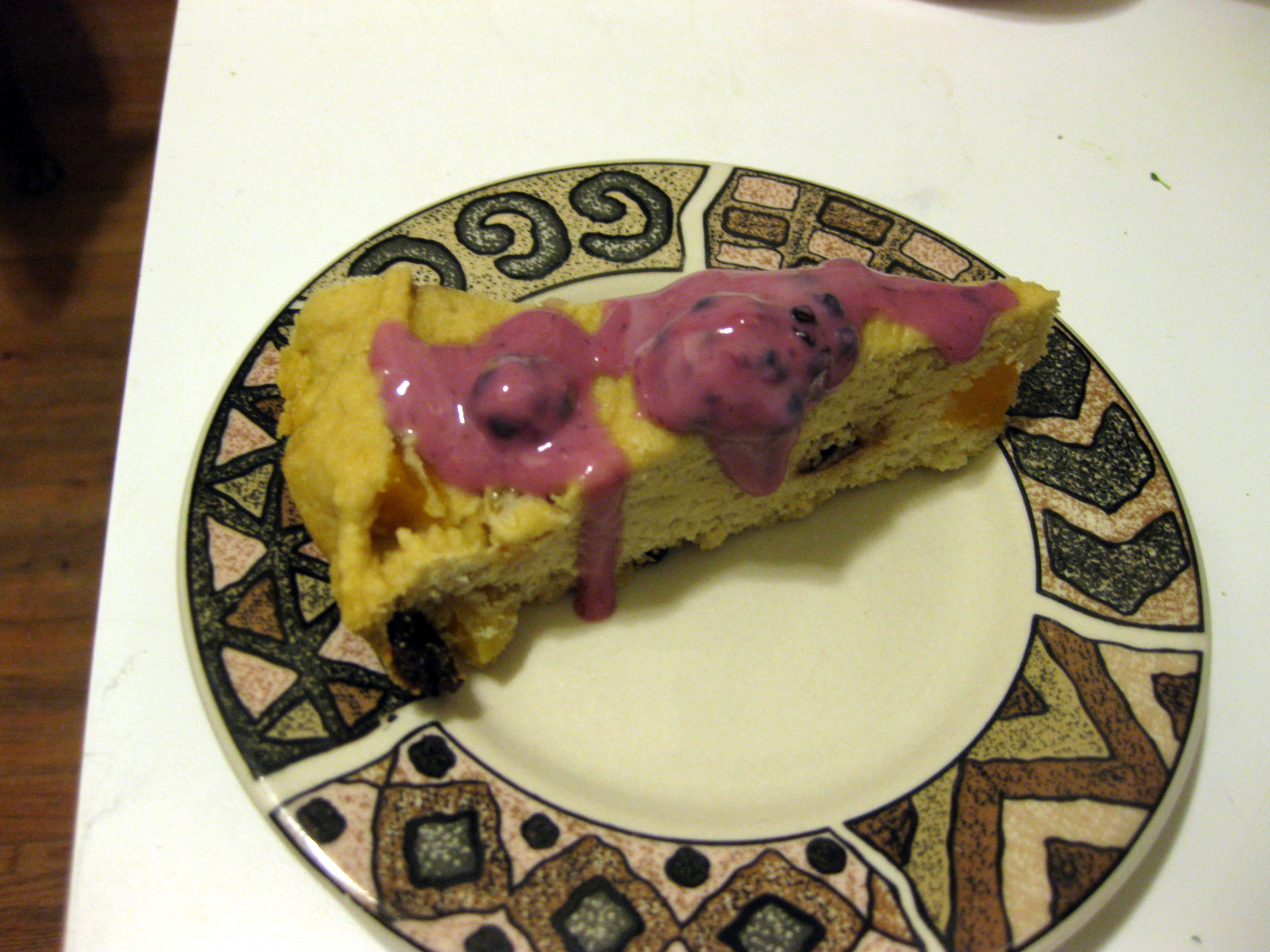
For a girls’ TV night, to which Ph., ironically enough, was not able to attend, I attempted Elana’s cake.  I used white rice flour instead of almond flour, and sugar instead of agave.  Since the resulting clumpy, bumpy batter would not have poured, per the directions, if I’d pointed a gun to my bowl, I added a few splashes of soy milk until things loosened up a bit.  I smoothed the dough out in my pie plate and stuck it in the oven.  Thanks, I suspect, to the soy milk addition, I had to up the cooking time by ten minutes or so, and when I took it out of the oven, it certainly didn’t look like Elana’s.  Hers looked moist with a lovely crumb and a golden crust.  Mine hadn’t lost the spatula-smoothing strokes I’d used to even out the batter.  I broke off a clumpy edge and took a taste.
It was tasty, if different.  Rice flour seems to contribute a grainy texture that I’m not thrilled with, so I know that more experimentation awaits.  But the cake was not as dry as I had feared it would be.  Finally, a baked good that Ph. could eat safely and enjoy (she loves dried fruit).  Since, as it turned out, she was not able to partake on that evening, I broke all my rules to make the dish completely Ph-Phriendly, and made a yogurt glaze to drizzle over the top.  Vanilla yogurt, defrosted frozen blackberries, and a tiny splash of creme de cassis.  This added just the moisture the cake seemed to need.  A few days later I had a slice spread with cream cheese.  That was good too.  Oh what would I give for nondairy cream cheese?
So experiment #1 is complete.  Next up, new flours, mixes of flours, and maybe a fruit crisp.  Doors are opening, and I’m on a mission.

The Week of Magical Eating Day Two: Belated Valentine

Belated Valentine, from my kitchen to you:

I am a big believer in comfort food.  For me, mashed potatoes are a comfort food that are impossible to get tired of.  They can be made in so many ways: with butter, with olive oil, with sour cream, whipped, blended, smashed, gravy-ed.  Two things seem to remain true about them.  1.) there are never enough, and 2.) they get cold too fast.  How to combat this?  It helps that I am only cooking for two, but had my first lessons, triumphs, and failures in a kitchen that fed four nightly.  I haven’t yet mastered the downsizing process, but in cases like mashed potatoes, N. and I actually benefit from my over exuberance.

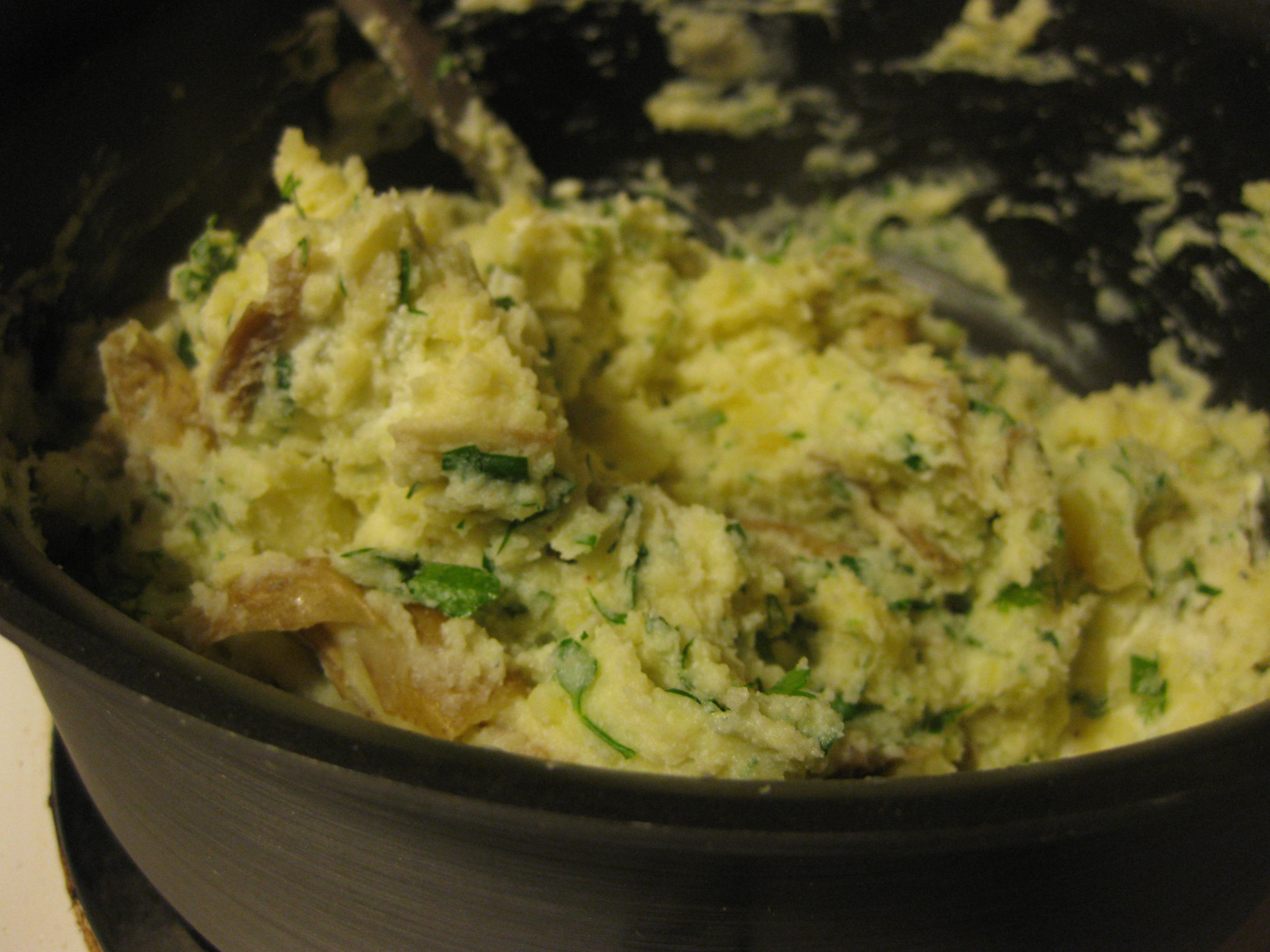
The key element to mashed potatoes, I think, is including enough fat.  Otherwise all you end up with is crumbly boiled potato.  I take my fat options extremely seriously, and in considering all the creamy options, I decided to play with ricotta cheese during this round.  Not only would this add a cheesy dimension, which is almost never a bad thing, but would contribute a velvety texture and give the potatoes a way of clinging together as they crumbled under the force of my masher.

I dropped a bag of baby Yukon golds into a pot of half salted water, half leftover chicken broth that didn’t get stirred into the risotto from the previous night’s adventure.  Then, in a moment of sudden, startling inspiration, I cracked three whole, unpeeled garlic cloves off the bulb and tossed them in too.  Considering the plans for the following night, these paper-wrapped, pungent little cloves could tie the whole week together.

While the potatoes boiled, I considered their final destination.  Ricotta cheese is nice, but it certainly could be improved upon.  I chopped up a good handful of dill and Italian parsley, and on sudden urge, grated a handful of parmesan cheese too.

I like my mashed potatoes chunky, and I know that most of a potato’s nutrients are found in its skin, so I like to make mashed potatoes with new or fingerling potatoes, or with red-skinned potatoes, which all have thin skins with unobjectionable flavors.  This adds to the nutritious value of the final result, and it saves me time because I don’t have to peel a bunch of potatoes in preparation.  Additionally, the skins add a nice textural element as they yield their hold on the starchy interior and shred through the pot upon mashing.

After draining and peeling the garlic cloves, I added and gently mashed together the following with the softened soldiers:

  • 4 TB butter
  • ½ cup milk
  • 8 oz. part-skim ricotta cheese
  • ¼ – ½ cup grated parmesan cheese
  • ¼ cup roughly chopped fresh parsley
  • 2-3 TB chopped fresh dill
  • Sea salt and black pepper

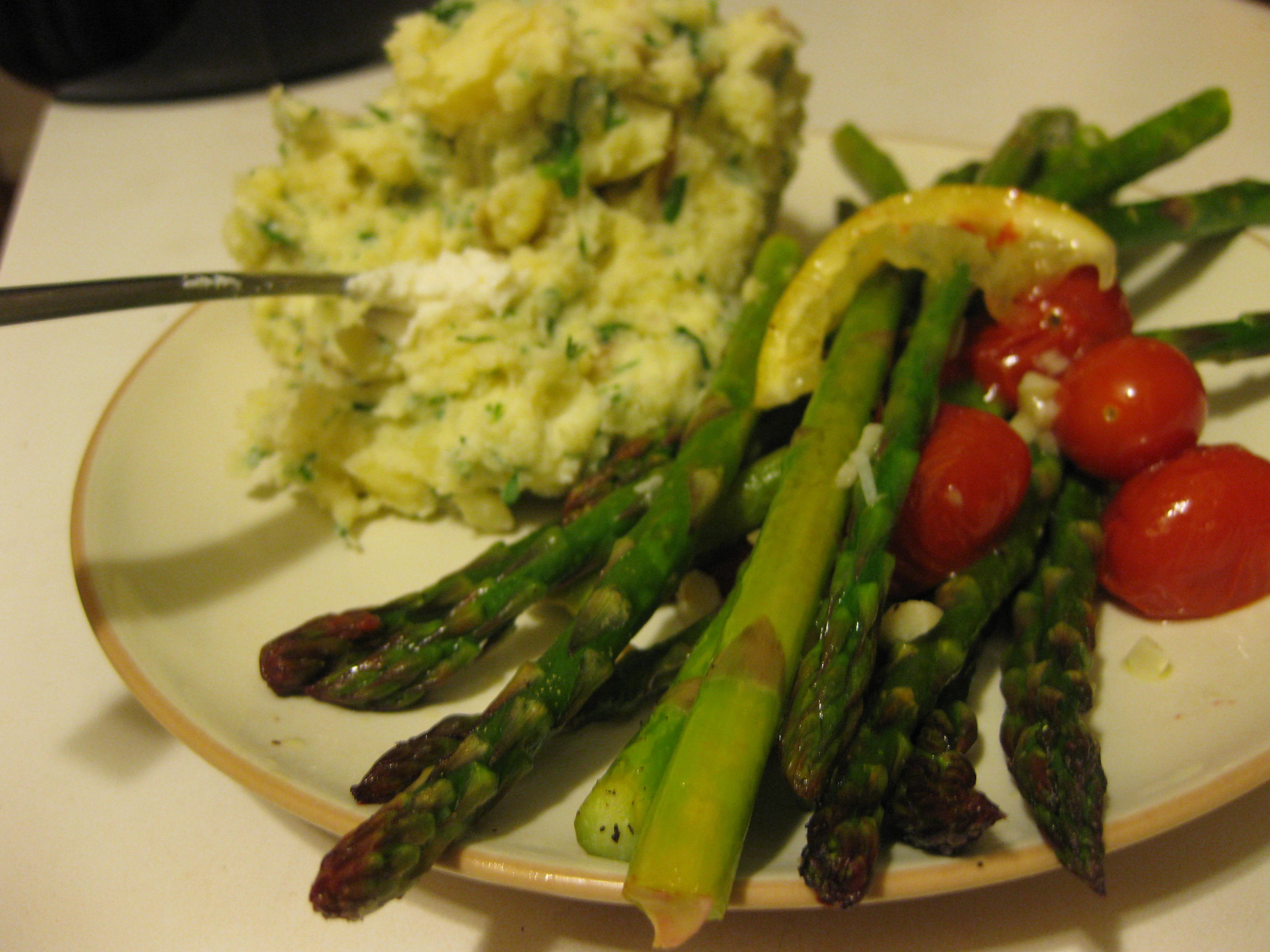
Using a plastic masher is invaluable because you can do your mixing and mashing right in the pot, which ensures that the potatoes stay hot longer.  We mounded ours up on warm plates and ate them alongside roasted asparagus.  The ricotta was a great addition; it was not super cheesy, but recognizably creamy and smooth.  It definitely added richness and tamed the starchiness of the potatoes.  The combination of herbs was a success.  With the additional richness of the cheese, having bright pops of green both visually and orally made the dish feel, not exactly healthy, but not overbearing.  Besides, with a side of asparagus and burst cherry tomatoes, we weren’t being all that bad…