Soup’s on!

No time for lengthy reflections today, but we did cross a milestone last week: finally broached the soup selection on my long-neglected Bittman list!

“Saute sliced shallots in olive oil, then add chunks of butternut squash, some rosemary and chicken stock or water to cover. As the soup simmers, bake strips of prosciutto until crisp. Puree the soup, swirl in some cream if you like and serve topped with crumbled prosciutto.”

This sounded easy and tasty, and with no less than 20 cups of homemade turkey stock chilling in the freezer after Thanksgiving, I had just the thick, tasty broth to add extra flavor to this soup.  Given vegetable availability and my preferences, I changed things up a little.  I used:

1 whole acorn squash, halved, seeded, and brushed with olive oil, salt and pepper

1 TB olive oil

1 shallot, sliced thin

2 cups turkey stock

2 sprigs rosemary, stems removed and leaves minced

¼ – ½ cup heavy cream

salt and pepper to taste

4 slices prosciutto

I preheated my oven to 400F and put the acorn squash halves cut side down on a cookie sheet, leaving them to roast for almost an hour, until a knife inserted went through the skin and flesh like jelly.  Then I took them out and set them aside to cool until I could handle them without searing my own flesh. 

I replaced the squash in the oven with prosciutto, spreading out four slices on parchment paper on a cookie sheet and baking until they got crisp, about 15 minutes.

In a deep pot, I heated olive oil over medium heat and added the shallot slices, letting them soften and then caramelized a bit, till they were pale gold in color and smelled sweet.

When the squash was cool, I scraped all the flesh out of the shells and dumped the flesh into the pot with my caramelized shallot.  I added my turkey stock just to cover the squash, the rosemary, a little salt and pepper, and brought it to a slow simmer.

Once the soup was simmering and seemed evenly heated, I pulled it off the stove for a moment to use my immersion blender until the soup was a glistening puree of gorgeous autumn velvet.  Back on the stove with a perfect texture, I added the cream and stirred gently to integrate it, watching the bright orange mellow into a rusty gold.

Dolloped into warm bowls, I crumbled prosciutto over the top of the soup and, as a last textural element, inserted a slice of sourdough toast, broiled with olive oil and rubbed with a raw garlic clove before sitting down to eat.

This was so tasty.  Lik Orangette, soups sometimes leave me feeling wanting, especially because I use my own stock, which is so much less salty than any processed broth or soup out there.  But this one was far from bland.  Roasting the squash and caramelizing the shallot lent a lovely nutty richness.  The rosemary added a sharp herby punch to the smooth creamy velvet of the soup.  And the prosciutto was just the right salty meaty indulgence, though for a vegetarian version you could certainly use a frico of parmesan cheese instead. 

If you’re not in the mood for soup, I think this could be a nice change-up to mashed potatoes as well.  Just reduce or drain off the stock and serve nicely pureed alongside a frittata, or some roast chicken and pan-crisped green beans.
Vignettes

The Oxford English Dictionary defines a vignette as

An ornamental or decorative design on a blank space in a book or among printed matter, esp. at the beginning or end of a chapter or other division, usually one of small size or occupying a small proportion of the space; spec. any embellishment, illustration, or picture uninclosed in a border, or having the edges shading off into the surrounding paper; a head-piece or tail-piece.

Very well, then.  If you’ll permit me, I present you a few vignettes, accompanied only by a smattering of explanatory text, of the food we’ve been playing with over the past few months, while my dissertation lengthened and my sad little blog slowly became emaciated.  Since this is a season of excess, I’d like to fatten it up a bit.  Here’s a start:

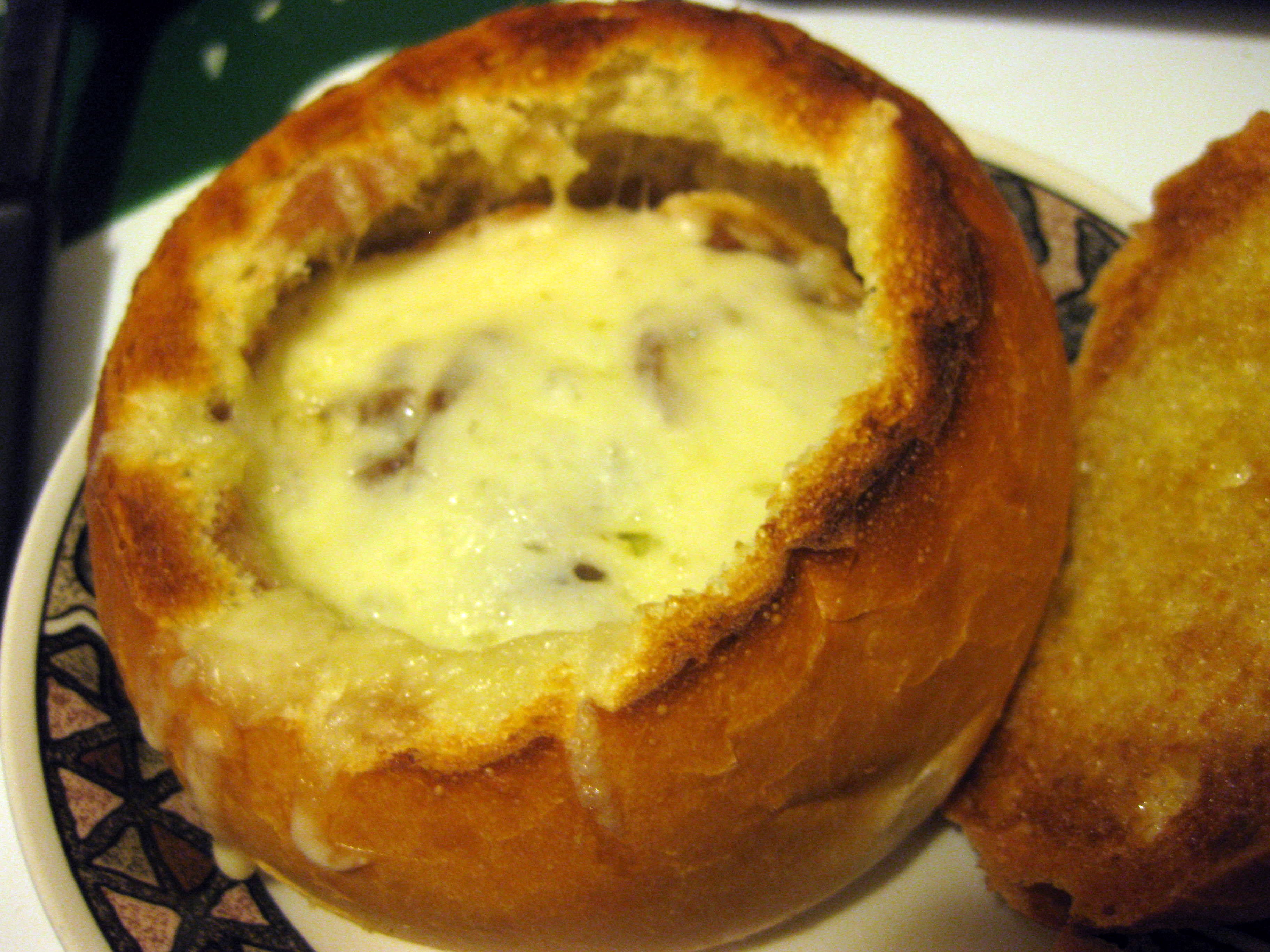
Serving suggestion for French Onion soup: hollow out a sourdough bread bowl, toast the inside, coat with a crust of Parmesan cheese, and flood with soup.  Top with Swiss cheese and broil until the bread crusts and the cheese blisters.  Try not to burn your tongue.

To celebrate, or perhaps provide an epitaph for, our pathetic tomato season this year, I made a roasted green salsa for Halloween.  Tomatillos, which flourished happily, green tomatoes, which did not, jalapeno, onion, garlic, and plenty of cumin.  Roasted, cooled, pulsed together with salt, lime juice, and cilantro.  Tickling and spicy and smoky, and perfect for a rainy Halloween.

Seeking fruit without the healthful feeling, I made crustless “apple pie” one evening with great triumph.  Apples sliced thinly, tossed with a tablespoon or two of flour, butter, and a hefty sprinkling each of sugar and cinnamon, bake in the oven for half an hour.  I left the skin on for color, chew, and nutrients, and we were both delighted with the syrupy excellence they eschewed.  It was not unlike the filling in an apple pie crepe from The Vintage which, if you haven’t visited, you should.  With haste.

Spurred toward the heady, heavy, comforting feel of winter food by this apple pieless dessert, we delved into the season of rich sauces, hearty vegetables, and warm fatty indulgences.  Perhaps yearning for protein in the darkness of November’s cold snap, we opted for a rich beer and beef stew replete with parsnips, carrots, and cup after cup of rich brown mushrooms spilling earthy thickness into the stew.  Whole grain mustard offered intrigue, a whole bottle of Jubelale provided dark yeasty flavor, and a glug of beef broth tied the flavors together.  Good stew meat from Long’s Meat Market (warning: the website has sound) was the clear star, and even the “low quality” stew meat I bought, intended to be cooked long and low to tenderize, was so juicy, so flavorful, and so ridiculously good, that I couldn’t stop myself from gulping down three or four pieces after only searing them crusty brown on all edges.  Lucky for us, I made a full recipe and froze half, so when the celebratory delectability of December ends and the long, cold middle of winter sweeps into Oregon, we will have reserves to bolster us until the sun appears again. 

Fortunately this same reserve will not have to serve this site.  Holidays approach, and with them a break from school, which means a break from dissertating, a break from grading, and a break from relentless reading.  Rather, I intend to poise myself in my kitchen and dart behind and before the camera, mincing, stirring, pouring, focusing, clicking.  And, inevitably, writing.  To you.  Happy December!

Will go barefoot for onions

Over the past year or so, Ina Garten and I have become good friends. She doesn’t know this; she doesn’t know I exist. Her Food Network show at first struck me as pretentious, with its demands for homemade chicken stock, Dutch process cocoa, and all the highest quality and therefore highest priced ingredients. The reminders of the Hamptons and the floral arranger and food photographer guests were a bit heavy to me. For a graduate student, Ina’s lifestyle and, I thought, her food, were beyond my budget.
In continuing to watch, however, Ina grew on me. Maybe it was by comparison to the other increasingly noisy newcomers to the network, or maybe it was my building confidence in my skills as a cook, but she is now among my favorite of the TV chefs. She cooks like me. Or, perhaps more accurately, she cooks the way I would cook if I had the means. She speaks plainly, but you can tell she is well educated in her field. She is messy. She doesn’t mind the occasional drip of batter onto a white counter-top or puff of flour onto a silk shirt. She looks like she enjoys food, and feeding people, and eating with them. Without really realizing it, I also found that more often than not when I turned to the Food Network website to find recipe suggestions, the recipe I ended up choosing was hers. I have made her Italian Wedding Soup, I have made her lemon bars, I have made several of her vegetable side dishes, and as of last week, I have also made her French Onion Soup.
This soup has, for almost a decade, been one of my restaurant go-to items. I love it. I love how it looks when it arrives at the table, with crusty bubbled Swiss cheese enameled onto the side of the soup crock. I love how it smells, with the fragrant sweetness of long-cooked onions steaming out once you break that crunchy-chewy protective cheese blanket. And really, an aromatic soup of sweet onion tendrils in rich meaty broth with the accompaniment of bread and cheese? I hardly even need to extol the flavor.
As seems to be a recurring theme here, however, I was always intimidated by the thought of making this soup. I don’t know why. I had every intention of doing so for a number of years, even registering for (and receiving) a pair of red French Onion Soup bowls as wedding gifts. It has been almost three years since I added these bowls to my kitchen collection, and yet it took until last week to put them to their intended use. With gigantic onions in my pantry, Swiss cheese in my fridge, and two-day-old baguette slowly getting crunchy on my counter, I went trolling for recipes and, to no great surprise, ended up with Ina’s. In addition to the dozens upon dozens of good reviews, it looked easy, and it looked really good.
In addition to halving the recipe, I made only minor changes. As several of the reviews note, it took longer than the 20 minutes allotted for the onions to get really brown and caramelized. I didn’t have the bourbon or sherry that Ina calls for, so I used a mixture of red and white wine, which I found to add depth and rich flavor. I didn’t have, nor would I want to use, veal stock, so I mixed beef broth with homemade chicken stock as a substitute. Since I am getting reacquainted with my garden as the weather slowly, grudgingly warms, I also added two big sprigs of thyme from my thriving little soldier.
When the onions had browned down in my soup pot and were delicate, pliable, and dark gold, I added red wine and let them simmer together. I brought a little piece of onion in to N., who was sitting on the couch and sniffing appreciatively, and he said only “ooohhhhh” after slurping down the offering. It was unlike the onion it had once been in almost every way. Soft, melting against the tongue, sweet but dizzingly rich with the addition of the red wine flavor. No bitter harshness, only mellow tenacity. Then I added beef broth, and white wine, and left the whole thing to simmer. As Ina says, “how bad could that be?”
It was far, far from bad. When the pot had simmered sufficiently (translation: when the smell was too enticing for us to resist any longer), I wedged a piece of toasted sourdough baguette into the bottoms of the aforementioned bowls, ladled steaming soup on top, and then mashed on as much grated Swiss and Parmesan cheese as would fit across the top. I broiled these little offerings until the cheese began to brown and crisp, and then we ate.
It was amazing, and I am again astounded by how inexpensive the ingredients are that make up this luxurious soup. As I have already mentioned, the onions softened but still held their shape, and became like oddly shaped little sponges for the flavors of the wine and broth. The cheese was melted in stringy gooey strands on the bottom, against the broth, but hardened into a crunchy crisp on the top, making two different flavors simply thanks to its textural change: toasty and salty on top, creamy and reminiscent of fondue on the bottom.
I am already devastated that I only made a half recipe, because we wolfed down our servings, we scarfed up the leftovers, and now sitting here typing, with a Spring headcold making my sinuses pound, I am overwhelmed by desire for a big steaming bowl of this rich, comforting composition. Thanks, Ina.

The Week of Magical Eating days 3 and 4: Soup and Salad

Since sharing lunch with my friend S. a few weeks ago, I have developed a minor obsession with Caesar Salad.  The crispest romaine, whether to add the Parmesan by shreds, crumbles, grates or curls, the perfectly textured crouton: crisp and golden on the outside, with the barest hint of residual chewiness deep within.  But mostly, the object of mystery and allure is the dressing.  It’s tangy but creamy and rich but still light, and pulls the flavors of the salad together to make it a phenomenon.  I decided to make it.  In the gloom of winter, I don’t have the opportunities I’d like to find farm-fresh eggs, and locally grown egg yolk is all I would feel comfortable using without cooking it.  Besides, N. gets worried about raw foods sometimes, and he doesn’t care for the idea of fish in dressing, so egg and anchovy were out.  I poked around online and found some vegan Caesar salad dressings with interesting suggestions, including the addition of brewer’s yeast and tamari to add the salty richness of anchovy.  I collected ideas and then, as usually happens, ended up making my own.

Mayonnaise, lemon juice, brown mustard, tamari, pepper, and garlic went into the mixing vessel that came with my immersion blender.  I pulsed these ingredients together a few times until the garlic was chopped and things were looking paste-like, and then streamed in some olive oil with the blender running until it reached a more dressing-y consistency.  It’s a work in progress, and I didn’t take note of amounts, but it began to capture that lofty Caesar flavor as I added additional spoonfuls of mayo here and lemon there… a bit too much mustard in the first squeeze.  Over-enthusiasm, you know. Tossed with fresh greens, lemon wedges, and sourdough croutons from half a baguette, it was almost right.  Almost there, but close enough for a weeknight.

The next night, inspired by a recipe request I couldn’t fulfill from D., I scoured the ‘nets for a suitable looking black bean soup.  Our salad accompanied a slow cooked chicken with 40 cloves of garlic, and I saved the garlic-infused broth our chicken expelled in the crock pot, so I had a wonderful flavorful stock to use for soup.

After sliding a pan of batter in and a loaf of cornbread out of the oven half an hour later, I commenced to create Dave Lieberman’s black bean soup, found here:  http://www.foodnetwork.com/recipes/dave-lieberman/black-bean-soup-recipe/index.html

I made a few changes to his recipe, for one reason or another, which I’ll share because I thought the result turned out well.

I cooked my bacon until crispy before draining out some of the fat (which ended up mixed with dogfood; Lucy was ecstatic!) and adding only 1 ½ onions.  Instead of Dave’s can of chicken broth, I used the leftovers from our chicken, which were about 1 ½ cups, and about a third of a bottle of New Belgium 1554 for a little extra flavor and fizz (then I handed the remainder of the bottle to N.  Beer and bacon = happy little family!).  I eliminated the ketchup and forgot the lime juice, and added my cilantro right at the end rather than letting it cook.  I decided I wanted a fresher green flavor, so it would serve as a garnish.

Then we went a little crazy with toppings.  I crumbled up some queso fresco, which I am having a deep affair of intrigue with, and used up my single-serving ramekins providing serving dishes for cheese, sour cream, green onion tops, more cilantro, and lime wedges.  The photo below isn’t the most aesthetically pleasing composition, but it was belly-warming and hearty, and tasted marvelous.  We usually have trouble finishing up leftovers from soup, but it has been only four or five days since I made this, and the remains are already gone.  That should tell you something.

Roast Chicken, part II

With the falling temperatures and rising rains of autumn comes another unfortunate event.  Well, it’s unfortunate in the sense that it interrupts me from my otherwise regularly schedule internet time.  So that means it’s unfortunate for the regular updating of this blog, because I stop posting.

School.

We’re in the middle of the third week now, and this is the first time I’ve really had the chance to sit down and get back to the story.  It’s all being sitting on the back burner up until now.  Which is oddly appropriate, given our current topic.

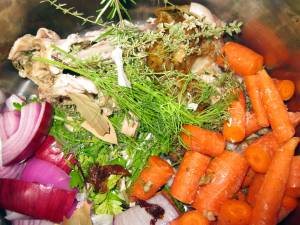
You’ll remember that when last we met, my first roast chicken had been liberated of meat.  The carcass itself I lowered into my gigantic gleaming aluminum pasta pot.  I added roughly chopped red onion chunks and quartered carrots.  Then I tossed in a liberal mix of herbs: thyme, sage, parsley, rosemary, dill, two or three bay leaves, and a small cupped handful of black peppercorns.  I finished by cracking a head of garlic and strewing several cloves, paper wrapped still, around the carcass.  I added probably twelve cups of water, and lidded the whole pot up to simmer for two and a half hours.

IMG_1770

When I strained out the bones and wasted vegetables, I was able to pour ten cups of rich, buttery-colored stock into my largest Tupperware.  At Ina Garten’s helpful suggestion courtesy of the Food Network website, I stowed the container in the fridge overnight, and was rewarded the next morning by a thick layer of fat across the top of the broth, which I scooped off before portioning out the golden liquid into smaller amounts in freezable containers.  Though I will not use it for everyday applications that only call for a cup or half a cup of broth, now I will have homemade chicken broth for clear soups and risottos.  You can bet that if this roast chicken obsession continues, I will need to start saving every lidded container that goes through my kitchen.  Scrubbed and labeled, yogurt and cottage cheese containers alike will be homes to ice-crystalled, rock hard pints of lovingly simmered stock.  C’mon, winter cold, I dare you to take on my broth base.