Bourbon vanilla pastry cream over pan-roasted stone fruit

2015 Blog August-0309After a few scrapped drafts of this post, both on the computer and in the kitchen, I’ve decided it’s basically a food representation of “To a Mouse” by Scottish poet Robert Burns. Though the title may not ring familiar, it contains perhaps the most famous – or at least well-known – line of his whole oeuvre: “the best laid plans of mice and men gang aft agley” or, if you’re not adept in 18th century Scottish diction, “often go awry.”

2015 Blog August-0265Things go awry. They just do. In this case, the inspiration, the trial run, the ingredient acquisition, and even the writing itself (there are two previous drafts of this post in my trash can that I never want to see again), all caused enough problems that this post almost didn’t happen.
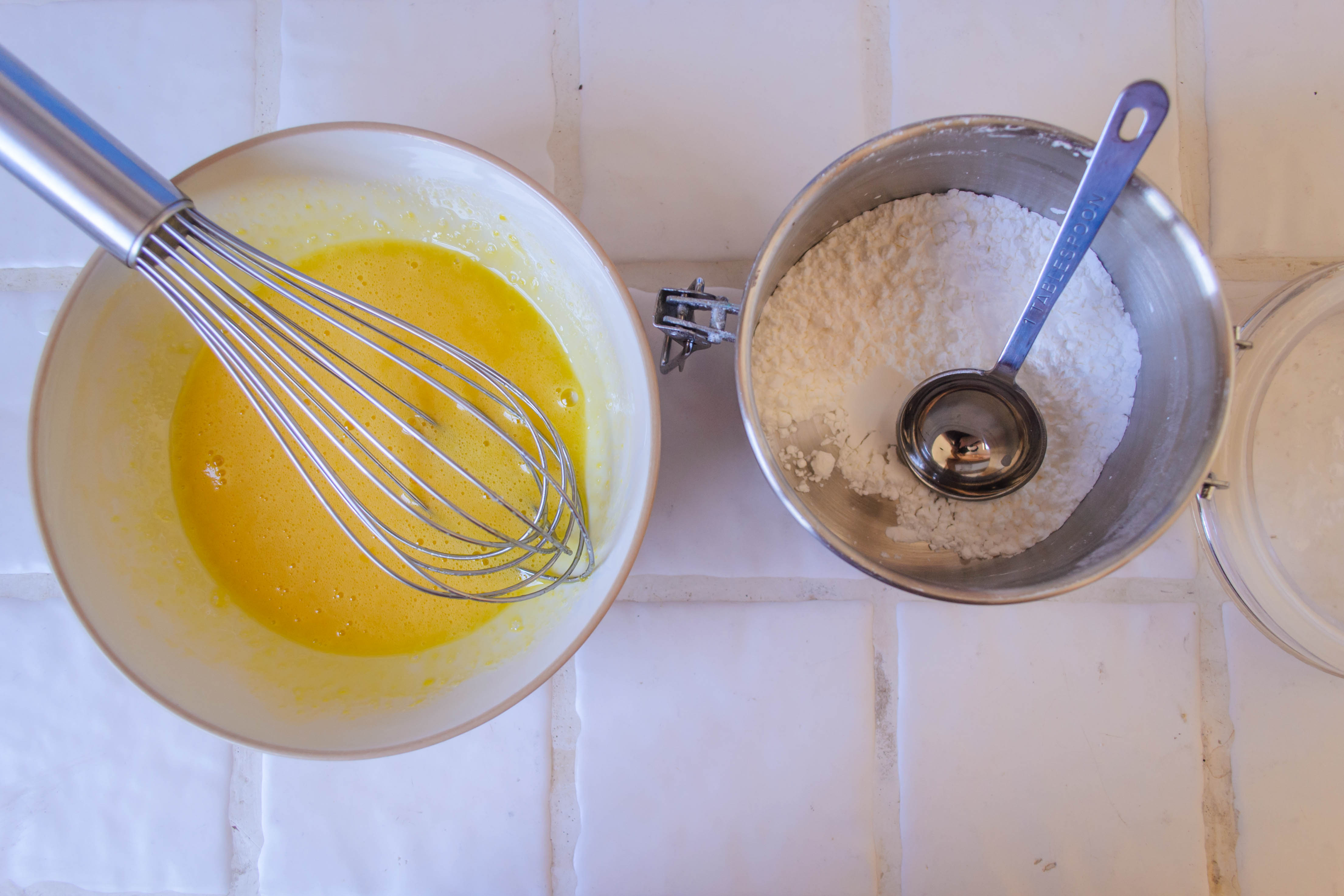
2015 Blog August-0274But I’m getting ahead of myself. Let’s back up to bourbon. Through a conversation with a friend and former colleague on Facebook, I assigned myself a project: she said she’s been experimenting with bourbon dessert sauces, and wanted tips. In particular, she’s interested in a bourbon vanilla sauce that would be good served over ice cream and peaches. There had been texture and thickness and sweetness imbalances along the way, and I was immediately hooked on the challenge.

2015 Blog August-0278For the next month I took this sauce through a ridiculous number of mental transformations – at first it was going to be a riff on this nutmeg sauce, then it was going to be more like a caramel, and then it was going to be akin to a crème anglaise, thickened with egg and carefully tempered. Never mind that pouring what is essentially unfrozen, unchurned ice cream over a bowl of ice cream seems excessive.

2015 Blog August-0282The crème anglaise plan, though, went awry, as you might have suspected. I crawled out of the kitchen leaving behind a bowl of curdled weirdness that had used up the last few tablespoons of bourbon in the house and refused to think about it for a few days. It wasn’t an eggs scrambling problem. It was a two-fold issue, I think, of poorly managed temperature differences, and the fat in the sauce not getting along with the quantity of alcohol I added.

2015 Blog August-0285When I tried again, the sauce had, again, transformed. Now, in a house with limited air movement, during a patch of quite warm weather, as the sun slowly dripped across our roof, sauce seemed too fast-moving. As if echoing my own sluggishness in my appetites, I wanted something thick and smooth to dollop atop a piece of fruit. And I wanted it to be ice cold.
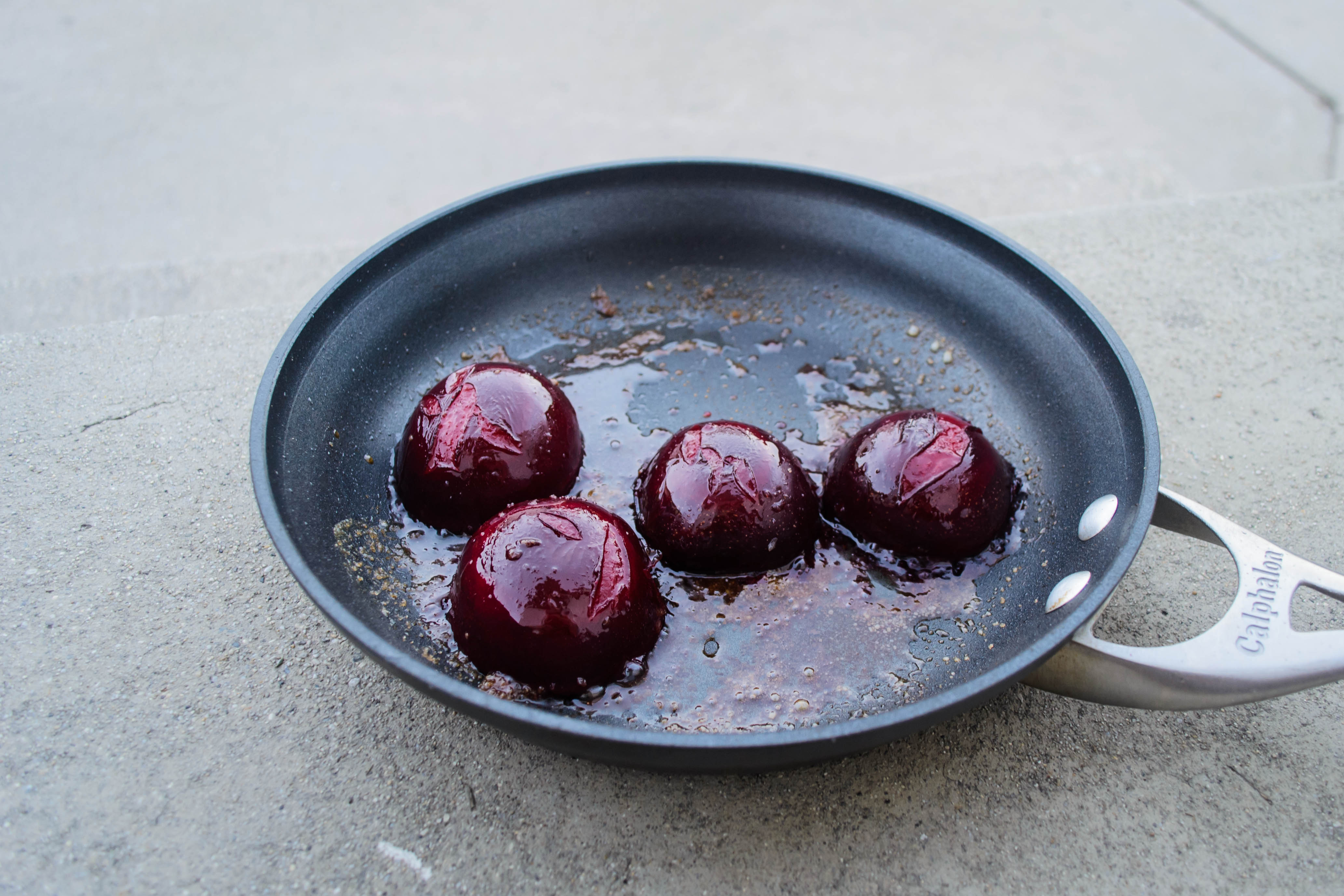
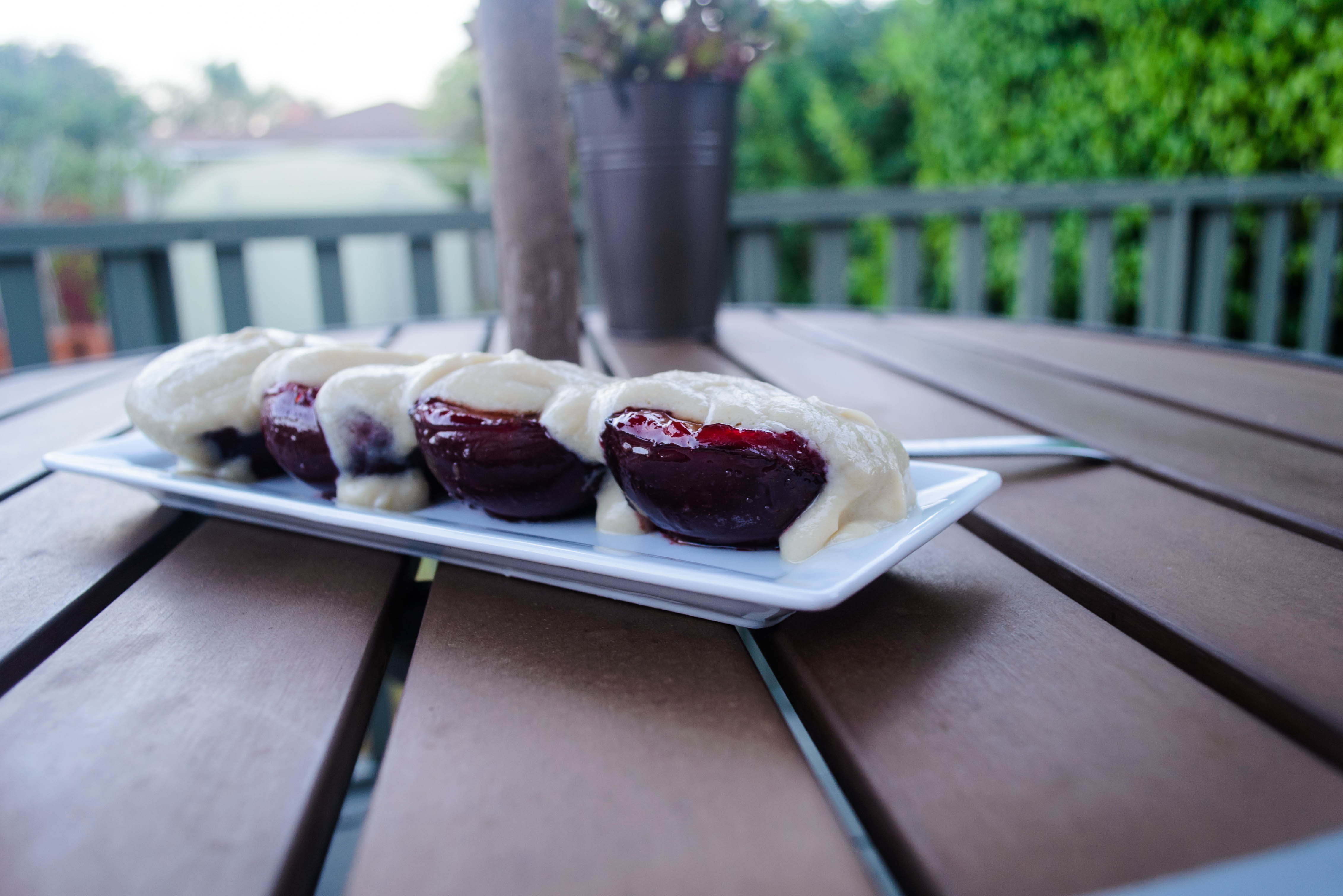
2015 Blog August-0307So I ended up with a pastry cream. This is not a sauce, B., even though that’s what you were after. It’s not particularly easy or quick, and it’s almost not even pourable. What it is, though, is rich, and cold, and thick, and strongly bourbon-y (so make sure you choose one you like!), and magnificent draped thickly over whatever stone fruit you happen to have. It’s also a good option for entertaining, because once it has been cooked it needs to chill for a few hours, which makes it very easy to casually slide it out of the fridge, spoon it thickly over a row of grilled or pan-roasted plums, or peaches, or apricots, and sit back down again before your guests really registered you were “making” dessert.

2015 Blog August-0308This, then, seems an apropos message for the week before the semester starts up again: things go wrong. They are going to go wrong. And then you have to decide what you’re going to do about it and work it out. So if you’re expecting hiccups, and imperfections, and requisite second takes, you’ll likely be calmer and cooler in the long run. Not a bad state of being in a heat wave or a first week of school. And if we’re being absolutely honest, having a new bottle of bourbon in the house during that week is not a bad state of being either. Just in case.

2015 Blog August-0318

Bourbon Vanilla Pastry Cream over Pan-Roasted Stone Fruit
Makes 2 – 2½ cups of cream
For the pastry cream:
2 cups half and half or 1 cup cream and 1 cup milk
¼ cup + 2 tablespoons bourbon, divided
Pinch of salt
½ cup sugar, divided
4 egg yolks
3 tablespoons cornstarch
1 tablespoon vanilla
2 tablespoons cold butter
For the roasted stone fruit:
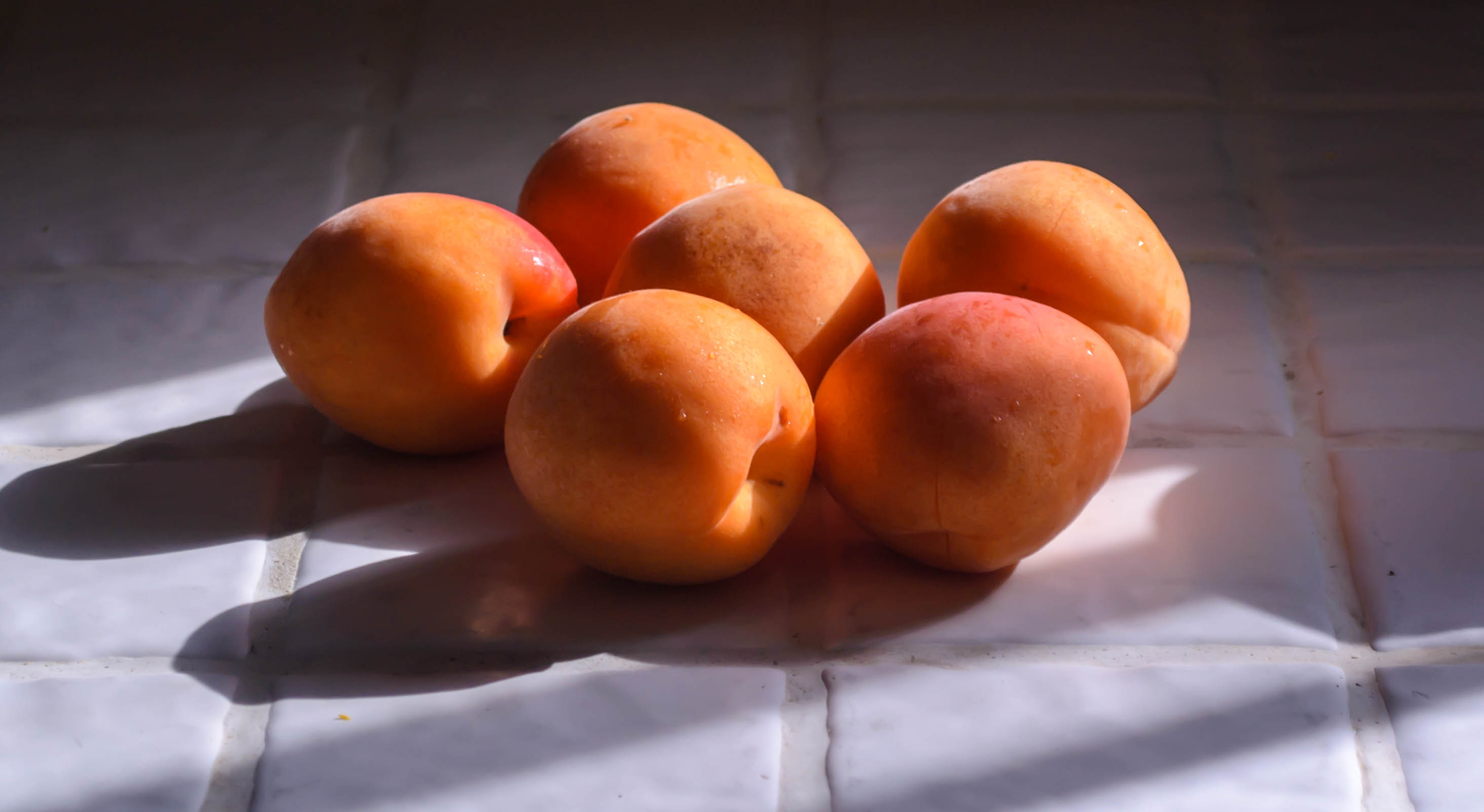
1 whole plum OR ½ a peach OR 2-3 apricots per diner
1 tablespoon raw sugar per diner
Pinch ground black pepper, optional (best on plums, I think)
2 tablespoons butter


  • To make the pastry cream, heat the half and half (or milk and cream mixture), ¼ cup of the bourbon, 6 tablespoons of the sugar, and the pinch of salt in a small saucepan over medium heat. Bring it to a bare simmer. We don’t want it to reach a full boil.
  • While the liquid mixture warms, whisk the egg yolks together with the remaining 2 tablespoons of sugar in a small bowl. Beat well until you can no longer feel any graininess from the sugar.
  • Whisk the cornstarch into the yolk and sugar mixture until all powder is gone and the mixture becomes thick and pale. It will take on a texture like melted ice cream.
  • When the milk mixture has come to a simmer, remove it from the heat and dribble about 2 tablespoons of it into the yolks, whisking furiously and continuously. This tempers the egg yolks – that is, heats them up just enough so that when they are added to the pot, they will be less likely to scramble.
  • Now, take a breath and a firm hold on your whisk, and pour the yolk mixture into the pot of milk, whisking continuously. Place the pot back over medium heat and continue to whisk until the mixture returns to a simmer. It will quickly become very thick – a bit like slightly diluted mayonnaise in texture – and take on a glossy sheen. The occasional big, sluggish bubble might emerge.
  • Once the mixture simmers, remove it from the heat and add in the vanilla, the remaining 2 tablespoons of bourbon, and the cold butter. Whisk continuously until the butter has melted in and everything is combined.
  • Pour the hot pastry cream through a fine sieve or mesh strainer into a bowl. Stir and push through with a spatula to catch any solid bits of egg or other unwelcome textural imperfections.
  • Place a piece of plastic wrap directly against the surface of the hot pastry cream (this prevents it from developing a “skin” across the top) and deposit it in the refrigerator until well chilled. The finished product will be approximately the thickness of mayonnaise.
  • When dessert looms near, prepare the fruit. Cut each fruit in half and twist or cut out the pit. Set halves cut-side up and sprinkle the exposed flesh with the raw sugar, using about 1 tablespoon per serving (so if you’re serving peaches, you might want less fruit per person than if you’re serving apricots. Either way, evenly distribute 1 tablespoon of sugar per serving over the halves of fruit). Sprinkle on the pinch of black pepper, if using.
  • Heat the butter over medium-high heat in a skillet large enough to accommodate all of the fruit halves. When it sizzles, add the fruit, cut-side down, and let it cook undisturbed for 2-3 minutes, until the sugar is well melted and has caramelized into the fruit.
  • Flip the fruit over so it is cut-side up and cook another 2 minutes, until the skin wrinkles and tears a bit. This will result in fruit that is warmed through, but still firm to the bite. If you like your fruit softer, cook a few minutes longer or cut into smaller pieces.
  • To serve, position the fruit cut-side up on a plate, and dollop on a few spoonfuls of the pastry cream. If you go back for seconds, consider letting a friend drive you home.
 

Grapefruit Bars

Food Blog February 2015-0311It’s citrus season. The trees are heavy. An amble through my neighborhood right now would send you past oranges, mandarins, tangerines, lemons, and who knows what other hybrids and splices, all sagging on their branches, almost unable to bear their own weight. When we first moved here in the summer of 2012, I couldn’t believe how much fruit was wasted. Who in their right mind could let it just fall to the ground and rot? And yet as I type, my own lemon tree – sequestered away in its little corner of our backyard – is groaning with a load I can’t reach, its thick, sharp tangle of twigs protecting it from an invading ladder.

Food Blog February 2015-0237So when I cast about for a subject to post about this week, you’d think I would have wandered out and reached up, pulling what fruits I could reach down from my own harvest. But lemons aren’t my favorite. Oh I love a fresh, pulpy lemonade. I could eat lemon curd straight out of the jar. And a tiny, hangnail-puckering squeeze into a chicken or a bean dish is almost essential. But if I’m going to celebrate citrus season and its glories, I’m going to go with my favorite: grapefruit.

Food Blog February 2015-0303Sometimes maligned for its stubborn, bitter pith and its curious ability to render certain drugs either useless or too effective, it is my favorite because it is so complex. Sweet, tangy, sour, infernally juicy, it, and not orange juice, is my choice of beverage when I’m sick. I love the smell of the peel under my fingernails. I could eat grapefruit (and have) until my tongue stung and my lips swelled with the tartness.

Food Blog February 2015-0304But if grapefruit is a bit testy as a raw product, it’s equally challenging in a dish. There are (at least compared to other citrus fruits) a paucity of grapefruit dessert recipes out there, which has always seemed like a shame to me. The lovely play of sweet and sour with that beautiful color (I prefer a red grapefruit myself) seems perfect to match with sugar.

Food Blog February 2015-0306Tired of the standard, tried-and-true lemon bar, then, I set out to conquer a grapefruit version. My first time through yielded highly positive results – grapefruit zest and lemon zest in the shortbread crust, just for some extra bright punch, a silky smooth custard layer of pale salmon pink, and a careful dusting of powdered sugar across the top. A few adjustments, a bit less flour, and it would be perfect.

Food Blog February 2015-0307Of course, I didn’t take any photographs of this perfect little bar, because I was only experimenting. Yesterday, when I made the batch to share with you, I learned what can go wrong. You see, the basic recipe for a fruit bar like this is to make a shortbread crust – flour, butter, sugar, a breath of salt and maybe a little flavoring agent or two – and bake it just until it starts to turn a bit golden. Then you let it cool a bit until the butter, now molten, solidifies to make a firm layer. You pour on a mixture of fruit juice, eggs, more sugar, and possibly some kind of thickening agent (cornstarch, in this case), and then carefully lever the quavering thing back into the oven to cook through.

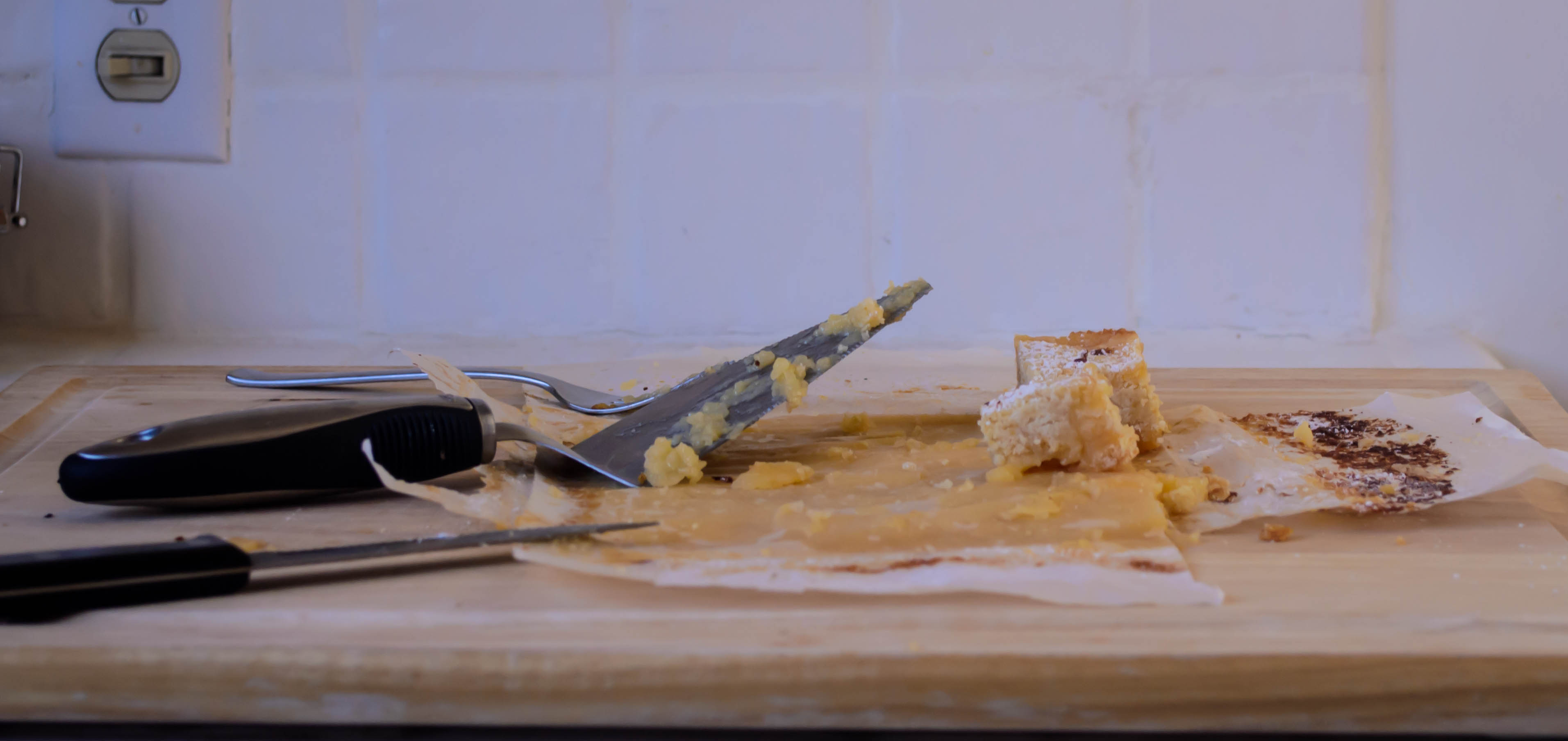
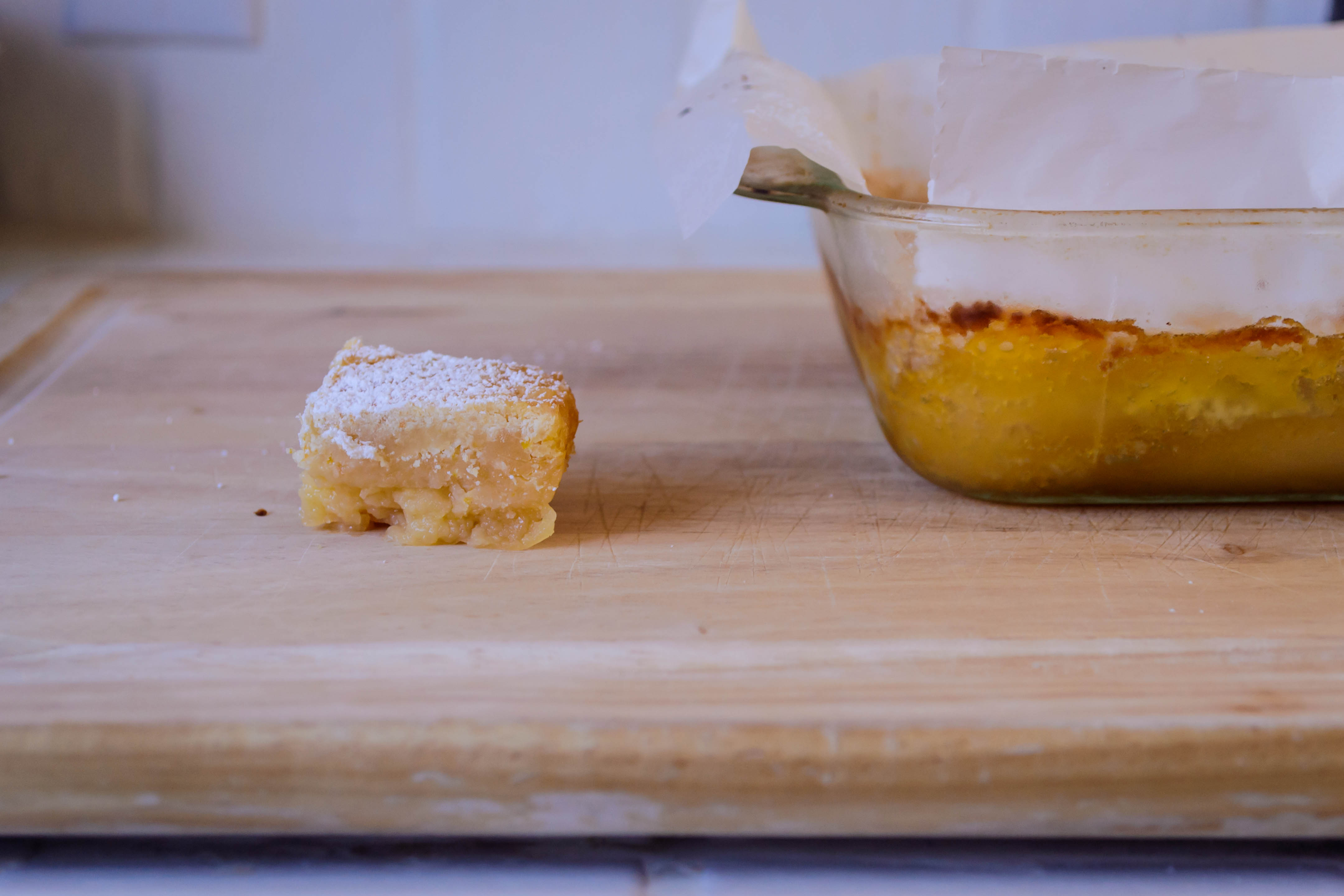
Food Blog February 2015-0308The middle step – letting the crust cool – is important. Yesterday I forgot about that step. Here’s what happens when you don’t: the beautiful, pale pink liquid filling plunges straight down, bursts through the crust, and breaks it up into floating islands of mush. You despair. You yell. You say some words that make you glad the windows weren’t open. Then you put it in the oven anyway, and even though what comes out isn’t exactly what you were intending, it still looks passable and it tastes perfect.

Food Blog February 2015-0312Curiously, as my grapefruit bars baked, the disrupted crust layer floated up above the (apparently) heavier “filling” layer. What came out of the oven looked more like a cake than the bars format I was expecting, but aside from making it a bit harder to cut (the grapefruit filling smooshes out as you press the blade down), they were fairly acceptable. Tangy, sweet, a play of light crunch and velvet curd, and a huff-inducing layer of powdered sugar over the top to keep you from inhaling too fast.

Food Blog February 2015-0314So the directions I’m providing you are what you should do. They will give you the expected format: a layer of shortbread-like crust on the bottom, topped by a thick layer of soft, slightly jiggly essence of grapefruit. Just don’t forget to let the crust cool. Unless you’d prefer, to echo the persnickety challenge of grapefruit itself, my upside down version. Food Blog February 2015-0320

Grapefruit bars
Makes 9×9 inch pan
Crust:
8 tablespoons butter (½ a cup or 1 stick), at room temperature, cut into cubes
½ cup sugar
1 cup all-purpose flour
¼ teaspoon salt
zest of 1 grapefruit (for extra punch in the crust, add the zest of 1 lemon as well)
Filling:
3 eggs
1 cup sugar
zest of 1 grapefruit
1 cup freshly squeezed grapefruit juice (2-3 large grapefruits)
4 tablespoons butter, at room temperature, cut into cubes
2 tablespoons cornstarch
powdered sugar, for dusting


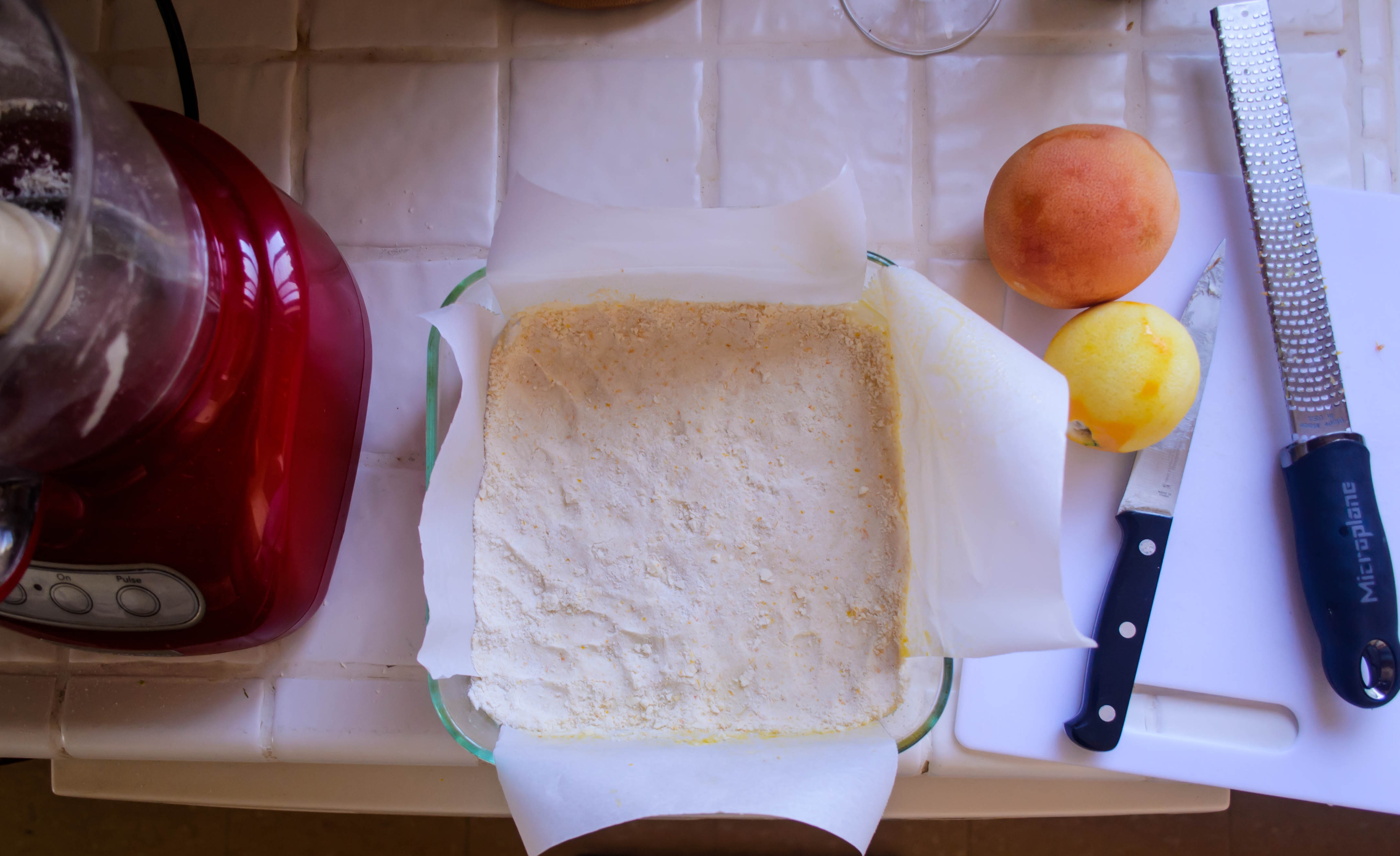
  • Preheat the oven to 350F and prepare your baking pan: cut two 15-inch sheets of parchment paper and arrange them in a cross shape, then insert this cross shape into a 9×9 inch baking dish with the edges hanging out. This forms a kind of sling that will help you remove the bars from the baking dish without breaking them apart. Spray the inside of the dish (including the parchment paper) with non-stick spray, for extra insurance.
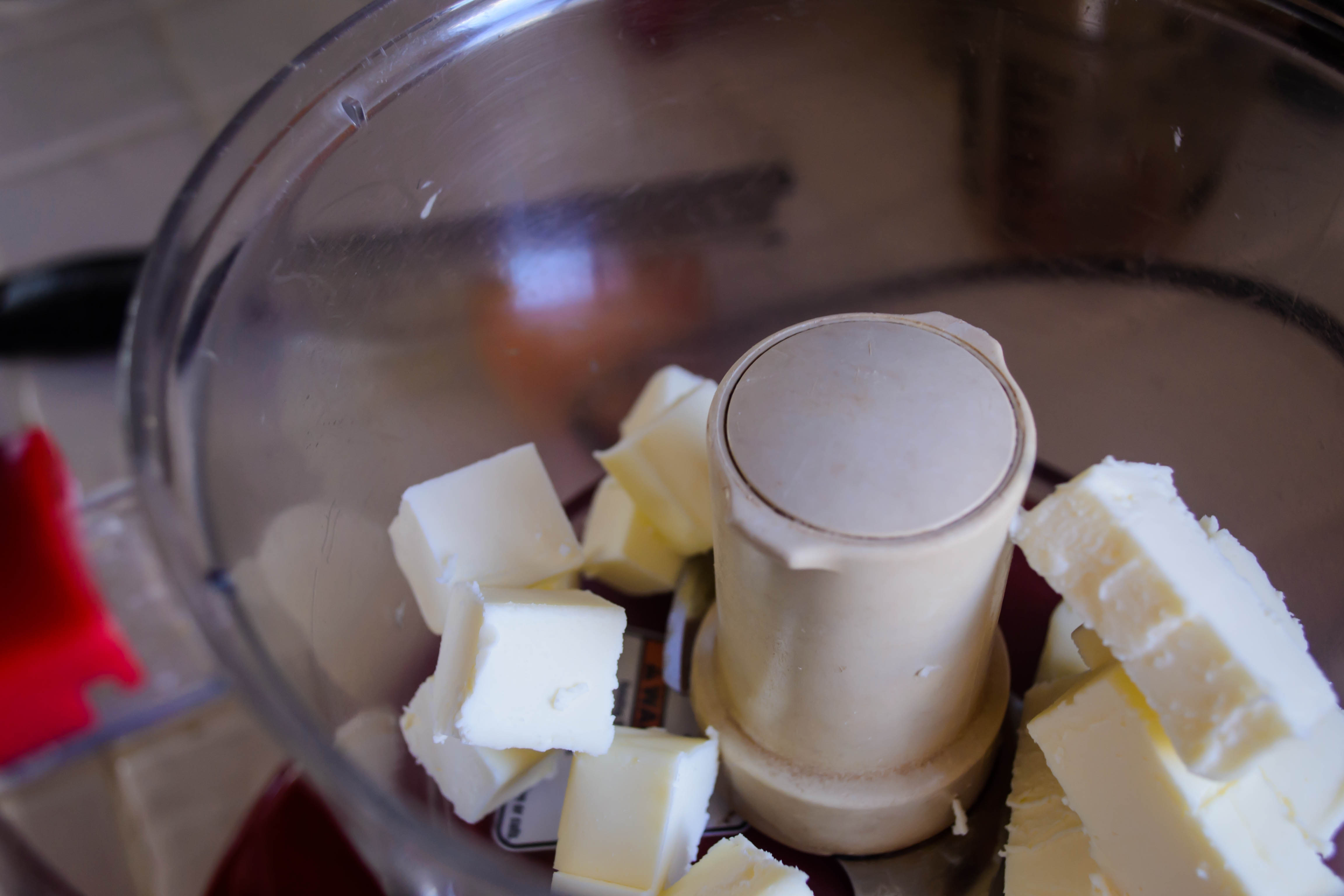
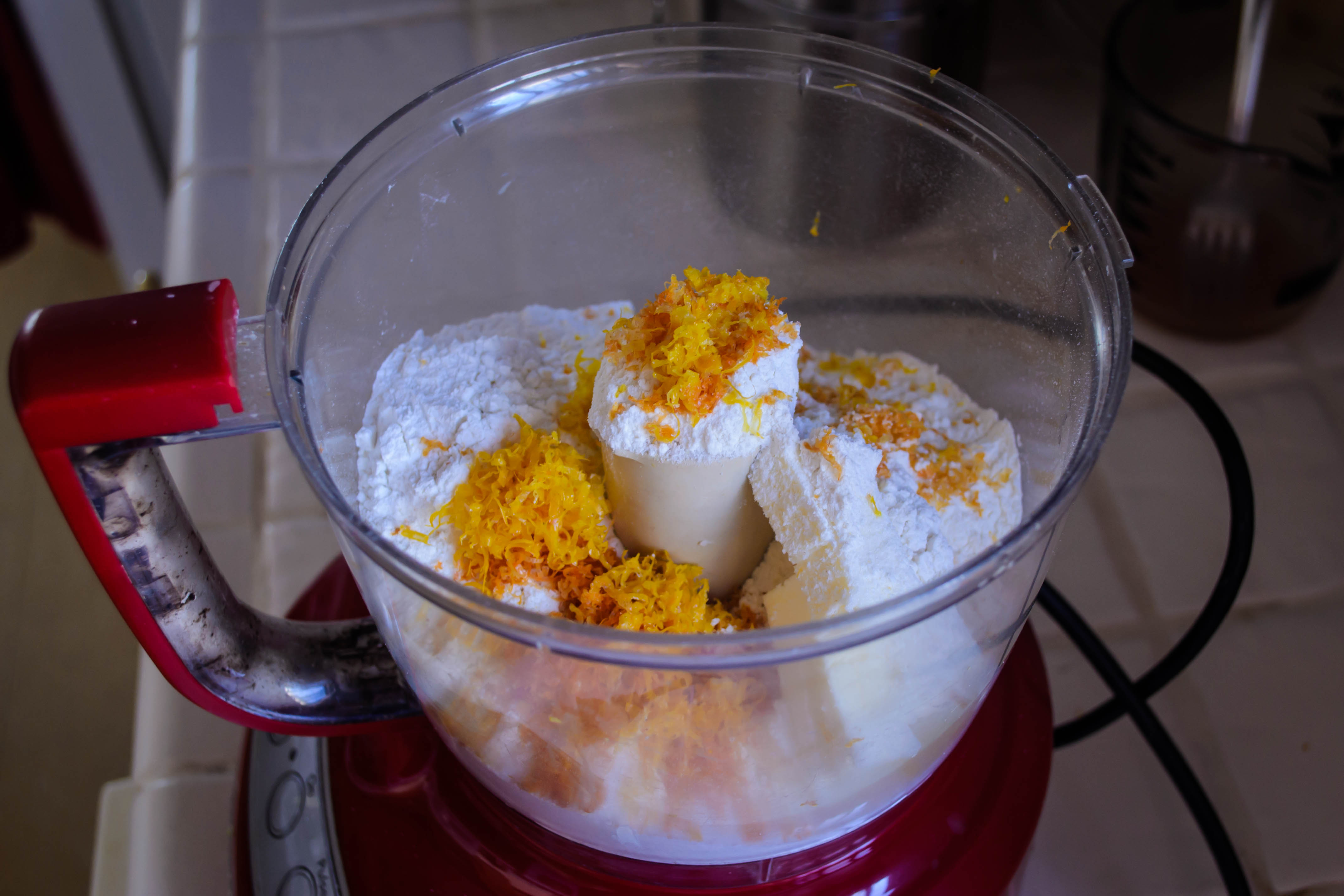
  • To make the crust, place the butter, sugar, flour, salt, and zest into a food processor and let run until the ingredients are combined and begin to clump together a bit.
  • Dump and scrape the clumpy crust bits straight into the prepared baking dish, and use your fingers or the smooth bottom of a measuring cup or a glass to gently but firmly tamp the crust down into an even layer.
  • Bake at 350F for 15-20 minutes, until it is pale golden brown and has a tender crust. If it puffs up while baking, stab it a few times with a fork to deflate it. Remove from oven and let cool for at least 10 minutes.
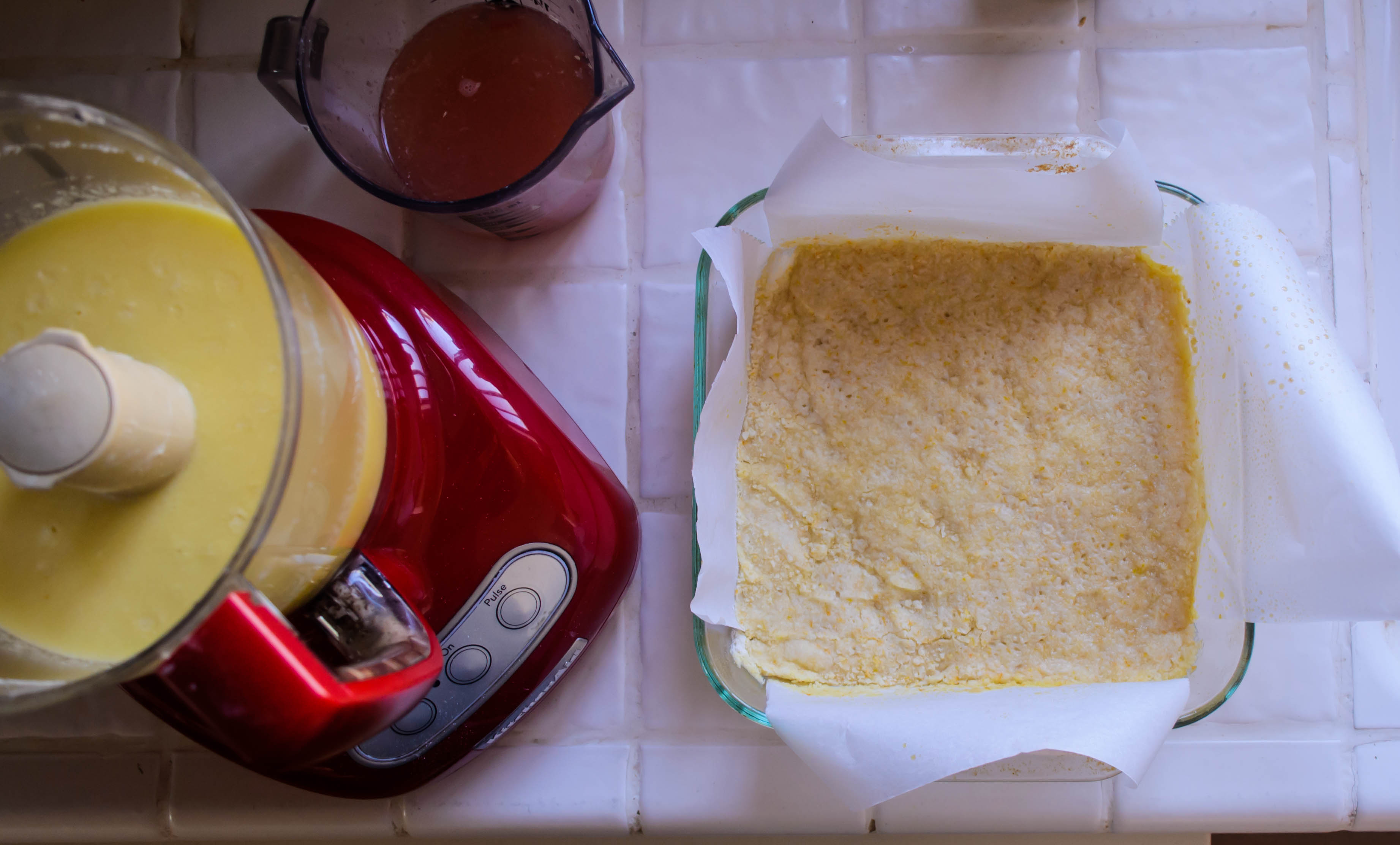
  • While the crust cools, make the filling. In the same food processor bowl (you don’t even have to wash it; so many of the ingredients are the same), place the eggs, sugar, butter, cornstarch, and grapefruit zest. Whiz to combine.
  • Add the grapefruit juice and whiz to combine again. The mixture will be quite liquid and will look curdled, but it will bake up just fine.
  • Note: there isn’t quite enough fat in this mixture to emulsify fully, which means if you leave it sitting for a while it will separate. Whir it up once more just before pouring onto the crust, or make and pour on immediately, and it should be fine.
  • Carefully pour the filling over the crust, then just as carefully, return it to the oven (the filling will slosh around a bit if you are too hasty about this) and bake for 40 minutes, or until the filling is just set. It may leave the barest sticky bit of grapefruit-y curd on your finger when you test it.
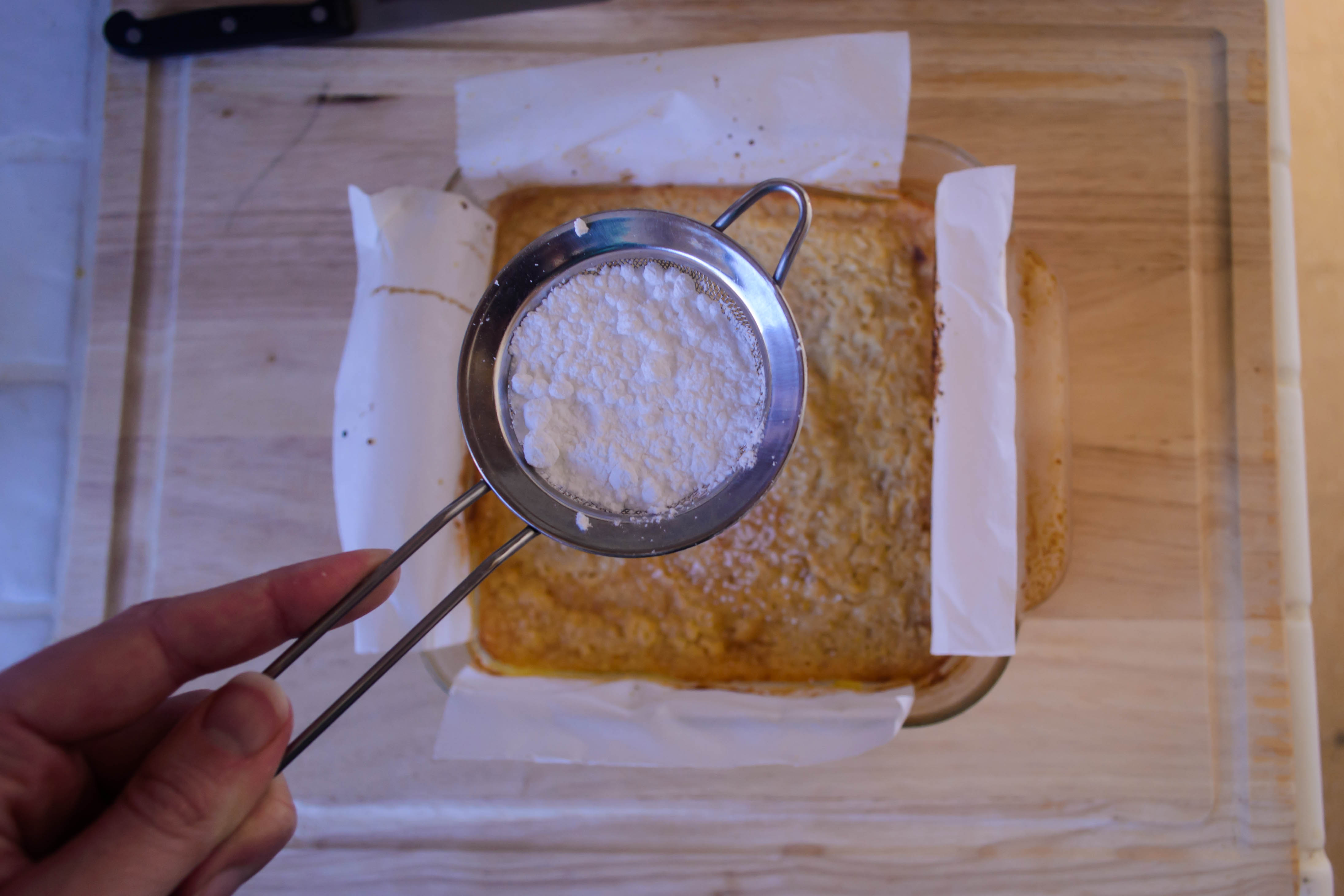
  • Let cool completely (seriously), then dust with a healthy layer of powdered sugar, if desired. If you dust it while hot, the bars will immediately absorb all the powdered sugar.
  • To slice for serving, use the parchment paper sling to hoist the whole square out of the baking dish onto a cutting board. Trim off the edges if you wish, then use a very sharp knife or a pizza cutter to slice into squares or rectangles of desired sizes. If the knife or pizza cutter gets gummed up along the way, dip it into a dish of hot water in between slices.

Apricot Ginger Thumbprint Cookies

Food Blog December 2014-0956Up until I was in college, almost every year my family received a heavy box a week or two before Christmas. As soon as we tore through the tape we could smell them: Nana’s cookies. Ladylocks or cream horns, nut-rolls, pizzelles, thumbprints, sometimes chocolate dipped apricots or seven layer bars; everything nestled in its own individual wrapping and ready to be devoured. And she didn’t just send them to us, but to the families of her other two children as well, and who knows who else. I’m sure she saved a few for herself and Pap – who was quite the cookie fiend – to eat as the holidays approached.

Food Blog December 2014-0943I never thought about it when I was a kid, but this must have taken her weeks to do. I can only imagine the organization that went into it – I’m sure dough was made ahead of time and frozen until she was ready to bake, and what a baking day(s) it must have been! How many cookie sheets would that be, all rotating in and out of the oven? How many measuring spoons and bags of flour and sugar and butter?

Food Blog December 2014-0941I had big plans this season. I was going to give you with a week of cookies, presenting my favorite holiday offerings with which you could grace your own dessert bar (and if you have one of those, I politely demand to be invited over). Just one cookie recipe a day, and you and I would both be set for the whole season.

Food Blog December 2014-0944Alas, as usual, that whole having a day job thing took over. Amidst the stacks of papers, however, one cookie managed to sweet talk its way through: a modest tray of thumbprints that, offered up in my department’s mailroom, disappeared in less than two hours. My people are cookie people.

Food Blog December 2014-0946Thumbprints were always included in Nana’s Christmas cookie box. Somewhere between a sugar cookie and shortbread, but with brown sugar rather than white, the soft dough gets rolled into a ball, dunked in egg whites and then coated in chopped nuts. A gentle squash in the middle of the ball gives the cookie its name, and provides a little receptacle for more sweetness – after baking, Nana always filled the little cavity of the cookie with pink or blue royal icing.

Food Blog December 2014-0948I hadn’t thought about thumbprint cookies in years, but at some point this summer, something reminded me of these pretty little sweets and I knew I wanted to make my own version. None of my relatives – good bakers all – had a copy of Nana’s recipe, but one of my aunts told me to start with Betty Crocker, and gave me a few hints about how Nana might have adapted her version. In mine, I’ve replaced the margarine I’m almost sure Nana used with butter, and gone with a fruit-based jammy chutney for the center rather than the sweet icing she favored. Apricot and crystallized ginger, chopped fine or pulverized in the food processor, cooked down with some water, some sugar, and some lemon zest create a beautiful glossy compote reminiscent of those tubs of candied fruit that show up in grocery store produce sections this time of year, but with fresher, cleaner flavor.

Food Blog December 2014-0949It has been a long time since I tasted one of Nana’s thumbprints, but my first bite of these, still warm from the oven, told me I was close. The cookie itself is buttery and crumbly, both features enhanced by its walnut coating, and not overly sweet. The apricot and ginger filling give it a spicy-sweet character that went as well with the walnuts as I’d hoped, and they are actually tastier the day after baking. My recipe wound up making a mere 2 ½ dozen cookies, which doesn’t sound like a pittance, but when I brought home an empty tray after making my offering at work, N. and I wished we’d saved more than the four cookies I’d laid aside for us.

Food Blog December 2014-0952As a friend shocked me by revealing last night, it’s only ten days till Christmas, and Hanukkah starts tomorrow already. I hope your plans are going well, and if you do have the urge to bake something sweet for someone you love, this little gem of a cookie should be hard to resist.

Food Blog December 2014-0955

Apricot Ginger Thumbprints
Adapted from Betty Crocker
Makes about 2 ½ dozen cookies
For the filling:
1 cup dried apricots
¼ cup crystallized ginger
Zest of one lemon
¾ cup water
1 tablespoon brown sugar
Pinch salt
For the dough:
½ cup brown sugar
1 cup butter, soft but not melted (2 sticks)
1 teaspoon vanilla
2 egg yolks
2 egg whites
2 cups all-purpose flour
½ teaspoon salt
1 ½ – 2 cups finely chopped walnuts


  • Make the filling first, since it will need time to cool after cooking.
  • With a sharp knife or a food processor, chop the apricots and ginger until very fine.
  • Place apricot and ginger bits in a small pot with lemon zest, water, brown sugar, and the pinch of salt. Bring to a bubble, then reduce heat to medium-low and simmer until the mixture becomes thick, 15-20 minutes. Stir occasionally.
  • When mixture is a thick, jammy consistency, remove from heat and set aside to cool completely.
  • While apricot ginger mixture cools, preheat the oven to 350F and make the cookie dough.
  • Cream the butter until light and fluffy – about 2 minutes.
  • Add the brown sugar and cream together another 2 minutes, until this, too, is light and fluffy. Add the egg yolks and vanilla, and mix well to combine.
  • Sprinkle in the flour and salt, mix well to combine into a clumpy dough approximately the consistency of wet sand.
  • If at this point the dough is too soft to work with, stow it in the fridge for 15 minutes or so to let the butter harden up a bit.
  • While the dough chills, use a fork to lightly beat the egg whites, reserving them in a small bowl.
  • Chop or process the walnuts into small crumbs.
  • When you are ready to form the cookies, use a spoon or your fingers to portion out and roll 1-inch balls of dough. Dunk each ball in the egg whites, then roll in the walnuts until well coated.
  • Place each ball on a greased or parchment-lined cookie sheet, spacing them about 2 inches apart.
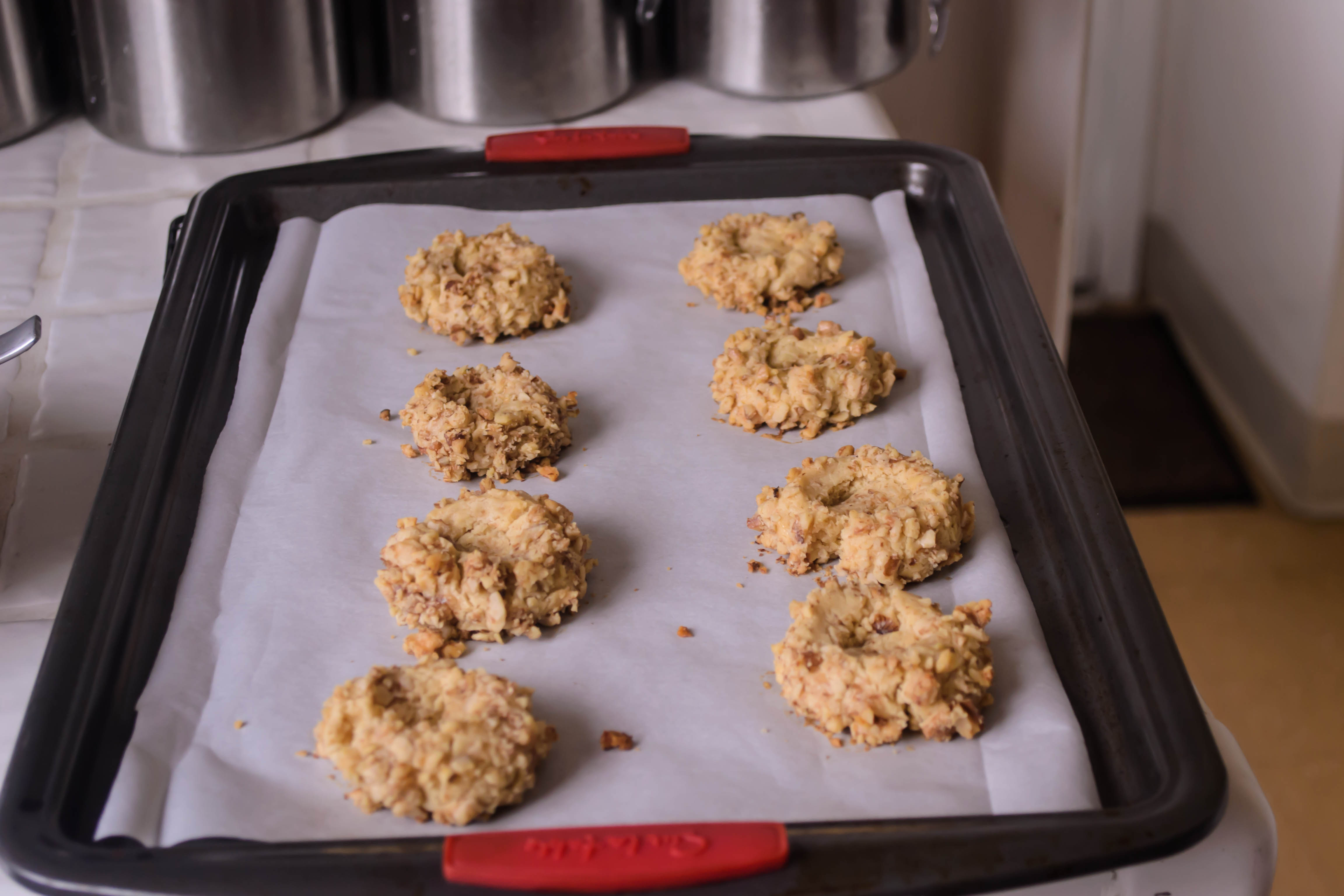
  • When your cookie sheet is full, use your thumb or finger to push down into the center of each cookie ball, making a depression. That’s the thumbprint!
  • Bake at 350F for 15 minutes, until cookies are lightly golden and have swelled up.
  • Upon removing the cookies from the oven, use the back of a spoon to lightly press down on the depressed area again, as it may have puffed up during baking.
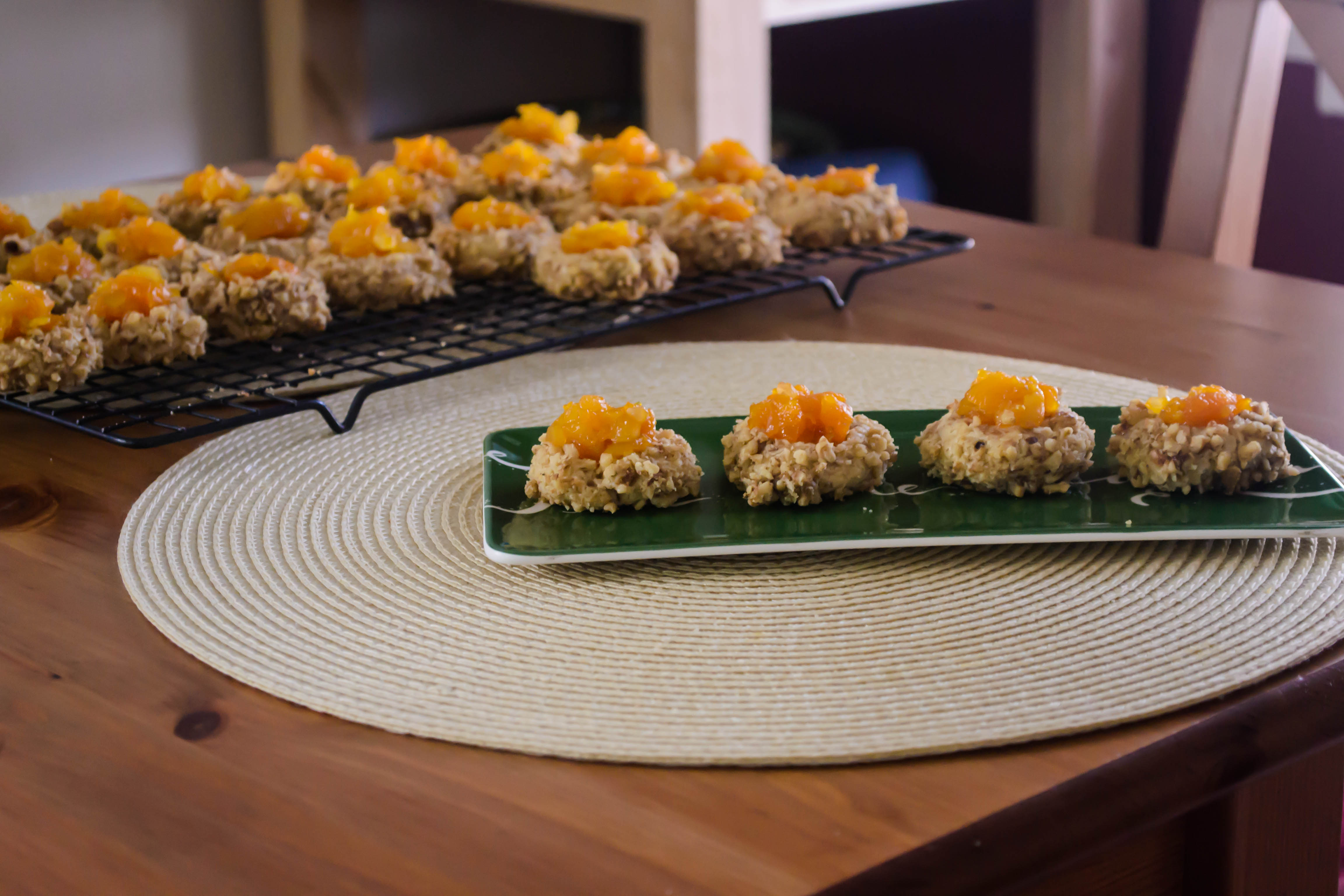
  • Let cool on cookie sheet for 1 minute, then remove to a wire rack. While still warm, fill the center with apricot ginger mixture – each cookie should fit about ½ a teaspoon of the fruit filling.
  • Cookies are best cooled completely, and only get better the second day, though I suspect they won’t last much longer than that.


Pumpkin Pecan Sweet Rolls – #TwelveLoaves

Food Blog November 2014-0866The time of peace is coming. I can feel it. I need it. This is week 14 of a 16 week semester, and though I had a brief respite from grading this weekend, this week papers begin pouring in again. And this is not to say that my weekend wasn’t busy. It was crammed, jammed, packed, precariously scheduled. It was just busy with other things. But I felt, for just a moment, the peace I’m craving.  I caught myself, about five minutes into dusting the living room, enjoying it.

I’ll wait while that sinks in.

I was enjoying. dusting.

Food Blog November 2014-0809Food Blog November 2014-0812Before you think me a complete freak, let me say this is a highly irregular occurrence. I don’t enjoy dusting. In fact, within ten minutes of noticing this odd feeling of pleasure, I was tired of the activity again. But for those few minutes, there was something so calming, so reassuring, so soft and easy about running a cloth over the bookshelves and the side table and the TV stand. It was a moment that was easy to escape from. It was mentally effortless. I thought, “I need this.” I need this peace, this feeling of being brainless with no guilt.

Food Blog November 2014-0816Food Blog November 2014-0819Fortunately, this time is approaching like a freight train (it would be nicer if it were approaching like fog, or frosting, or some other delicate F word, but we must be honest…). The commercials I try not to pay attention to when I watch television loudly broadcast how many shopping days are left until Christmas. Within my family, texts about gifts have started flying. I may or may not already know exactly what I’m wearing for my family’s Christmas dinner.

Food Blog November 2014-0824Food Blog November 2014-0825Food Blog November 2014-0827Food Blog November 2014-0832Food Blog November 2014-0834But that’s getting ahead of things. That’s the full stop. We do get a funny little moment of pause first, which is what the dusting was for. My parents arrive on Wednesday to celebrate Thanksgiving. It will be the first year my sister doesn’t join us. This is, when I think about it, a stab of selfish sadness. But that only lasts a moment, because instead of winging her way all the way across the country to be with us for one short weekend, she’ll be with her partner and her dog, with his family. This is a joyful thing. She sent me a photo of a batch of pumpkin bread cake pops she made to take along. She said something about “impressing purposes.” She won’t need cake pops to do that.

Food Blog November 2014-0842Food Blog November 2014-0845Food Blog November 2014-0846It does seem like pumpkin is the thing to do these days. I was unsurprised that this month’s Twelve Loaves project calls for that most celebrated of squashes. I typically try to imagine something no one else will have made for the Twelve Loaves challenge, but this month I decided to loosen up. The fact was, I wanted pumpkin sweet rolls. So no matter how many other people chose this too (two so far), I was making them. Originality be damned. Sometimes you just have to make what you’re craving.

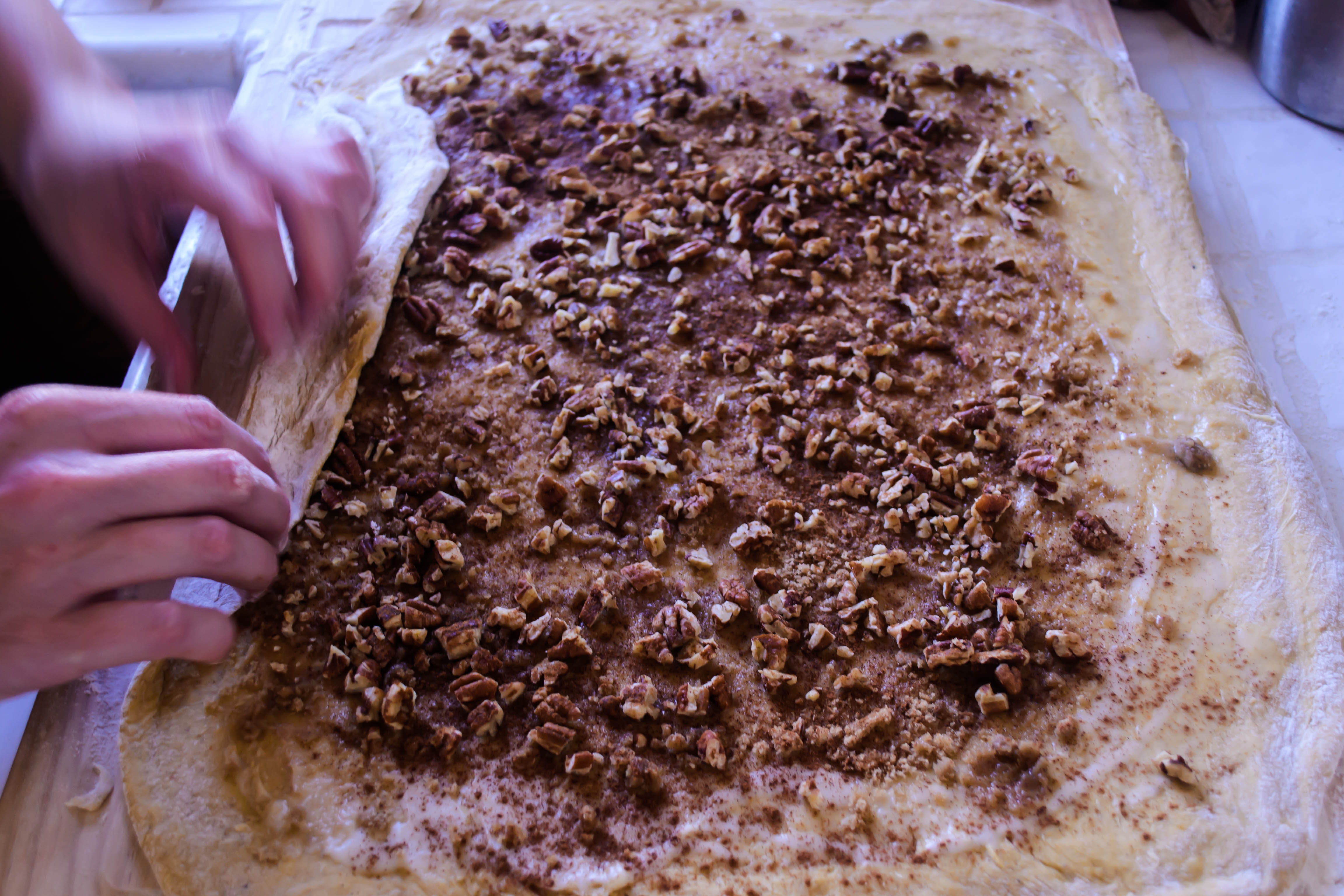
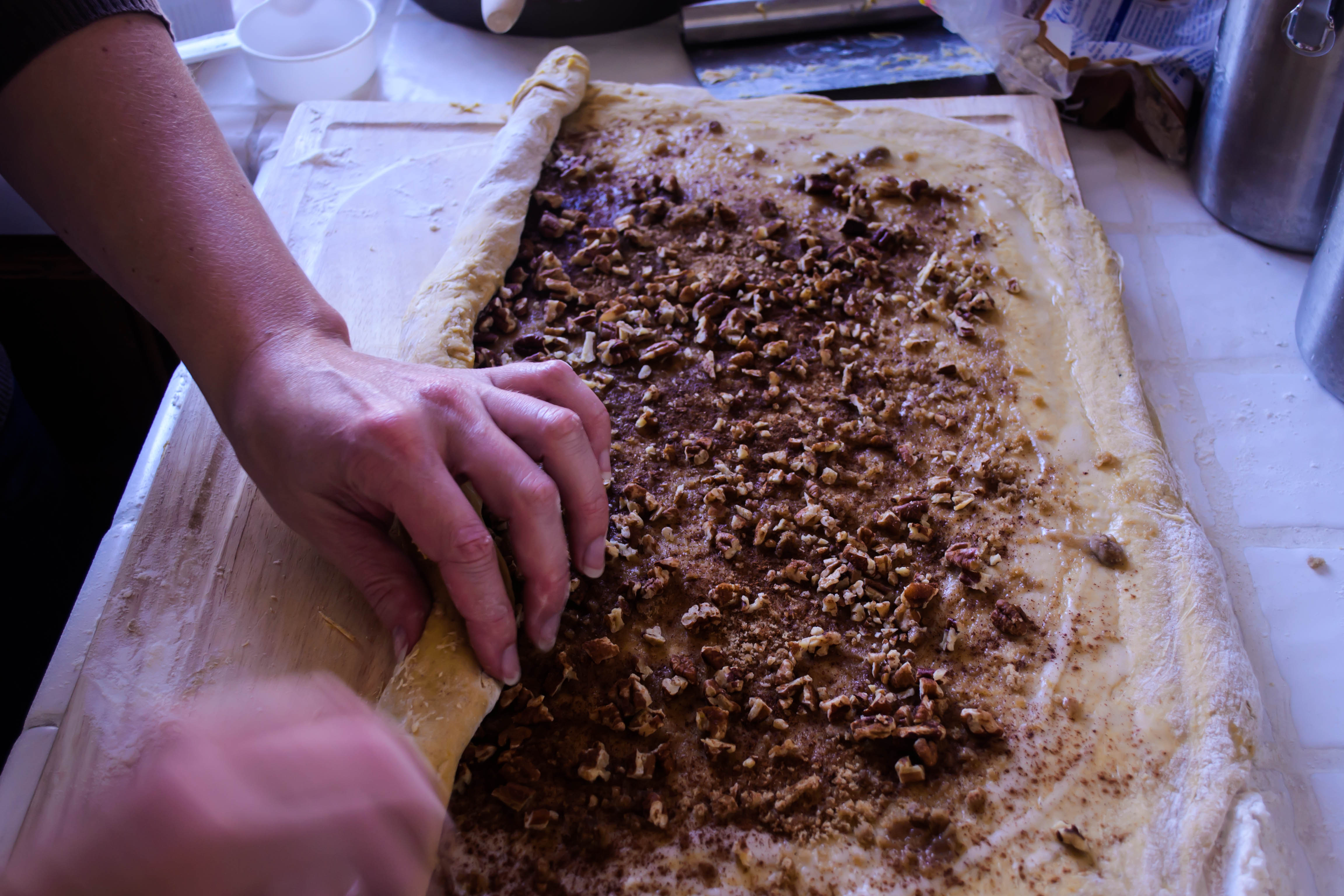
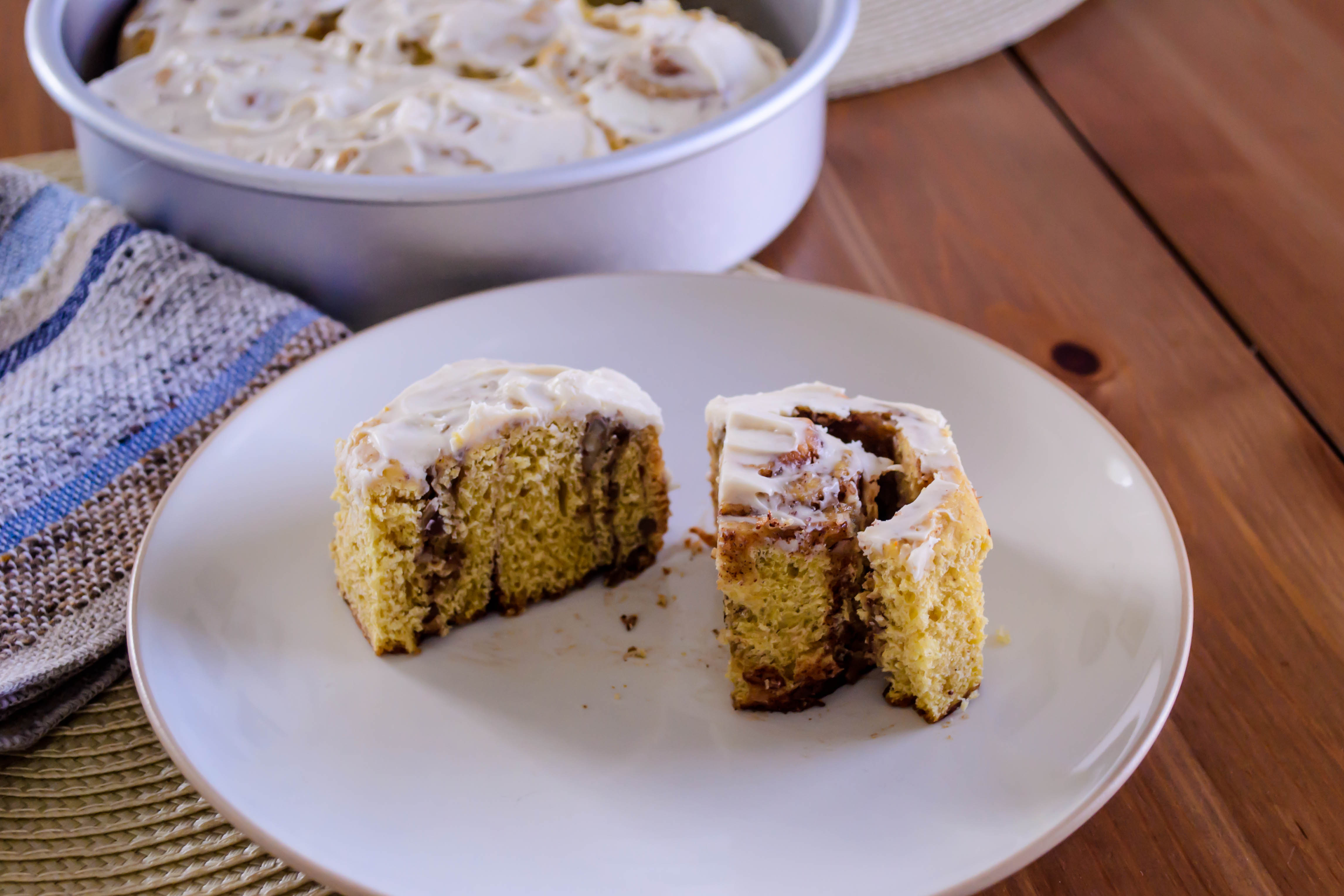
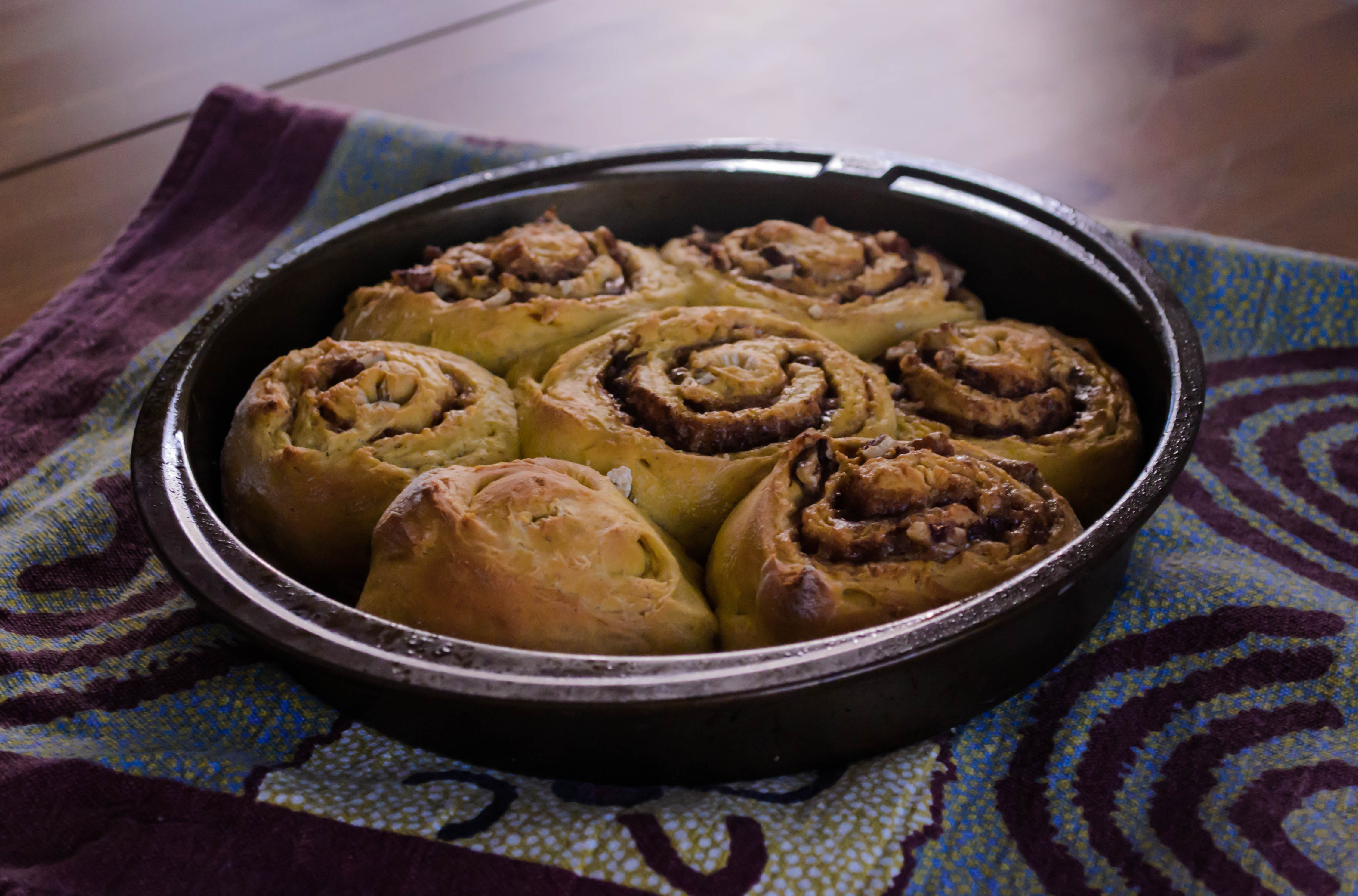
Food Blog November 2014-0849For these rolls, I started with my Nana’s sweet roll dough, but used all whole milk instead of water for added richness. I replaced the white sugar with brown, to play with the autumnal feel of the pumpkin, and spiked the dough with all the spices that usually find their way into pumpkin pie. And then, of course, the bright orange vegetal sweetness of pumpkin puree. Once risen and rolled out, I spread it with melted butter, more brown sugar and cinnamon, and a scattering of toasted, chopped pecans. Rolled, sliced, and baked, they puffed into glorious swirls – orange gold, with dark bronze bubbling fissures twisting through them. Pulled apart just like that, they were delicious. Because I didn’t overdo it on the sugary center, they could almost pass as breakfast.

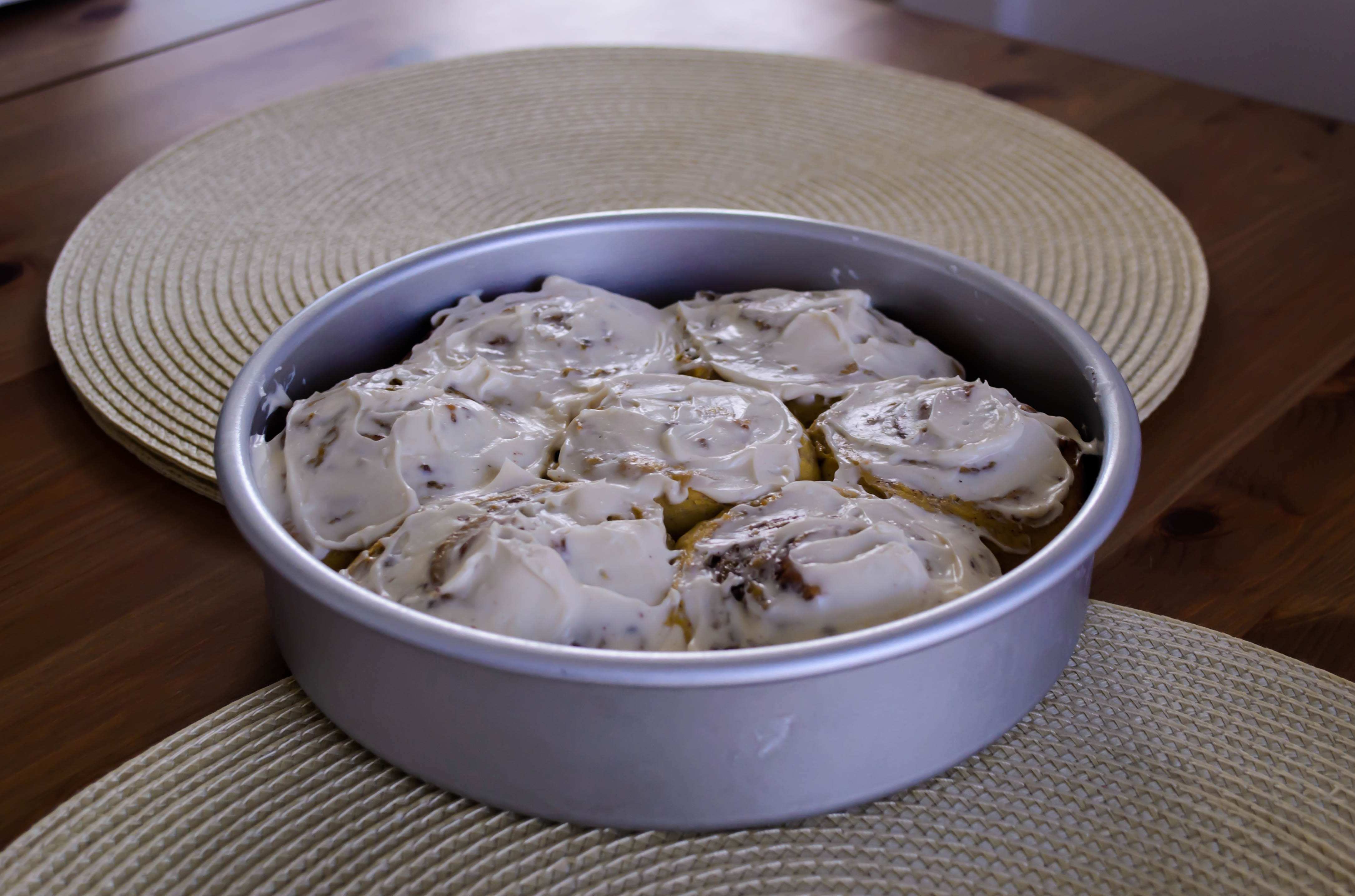
Food Blog November 2014-0854But this is holiday food, and holiday food is so often about excess that I couldn’t help myself. A quick whip of cream cheese with a breath of powdered sugar, a splash of vanilla, and just a touch of heavy cream to loosen it up, and I had a soft, thick frosting to spread over their golden tops.

Food Blog November 2014-0851I left two pans in the department mailroom at work. By the time I left in mid-afternoon, there weren’t even crumbs left.

Food Blog November 2014-0855Making these rolls is an investment. They have a long ingredient list. The dough can be quite sticky. They require two rises. They demand rolling, chopping, toasting, sprinkling, whipping, spreading… but they also require pulling into shreds of sweet chewy dough, and assiduous finger licking. And meditative savoring. And here’s the thing: the holiday season often feels hectic. There is shopping to be done, and traveling to navigate, and wrapping and cooking and impressing family you rarely see, and all of that can feel like too much to squeeze in a complicated baking project.

Food Blog November 2014-0863But I think, if you embark on such a baking project, knowing the time it requires, and sinking into its gentle rising and baking schedule, it provides its own kind of peace. Besides, these are too good not to make. So just make some. Thanksgiving breakfast, maybe. You’ll thank me later.

Food Blog November 2014-0867

Food Blog November 2014-0869

Pumpkin Pecan Sweet Rolls
Makes about 30

For dough:
4 ½ teaspoons active dry yeast
1 cup lukewarm milk
1 cup + a pinch brown sugar
1 teaspoon salt
2 eggs
½ cup (8 tablespoons or one stick) soft butter
1 cup pumpkin puree, canned or fresh (if canned, be sure it is not pumpkin pie filling)
1 teaspoon vanilla
1 teaspoon ground cinnamon
½ teaspoon ground nutmeg
½ teaspoon ground ginger
¼ teaspoon ground cloves
6-7 cups all-purpose or bread flour
For filling:
½ cup (8 tablespoons or one stick) melted butter
1 cup brown sugar
2 teaspoons ground cinnamon
1 cup toasted, chopped pecans
For frosting:
8 ounces room temperature cream cheese
1 teaspoon vanilla
¾ cup powdered sugar
3-4 tablespoons heavy cream


  • In the bowl of a stand mixer, combine yeast, lukewarm milk, and the pinch of brown sugar. Stir, then let sit for 5-10 minutes until the yeast is bubbling and smells like fresh bread.
  • Once the yeast has woken up, add the rest of the sugar, the salt, the eggs, the butter, the pumpkin puree, and the vanilla. Mix on medium-low speed with the paddle attachment to combine.
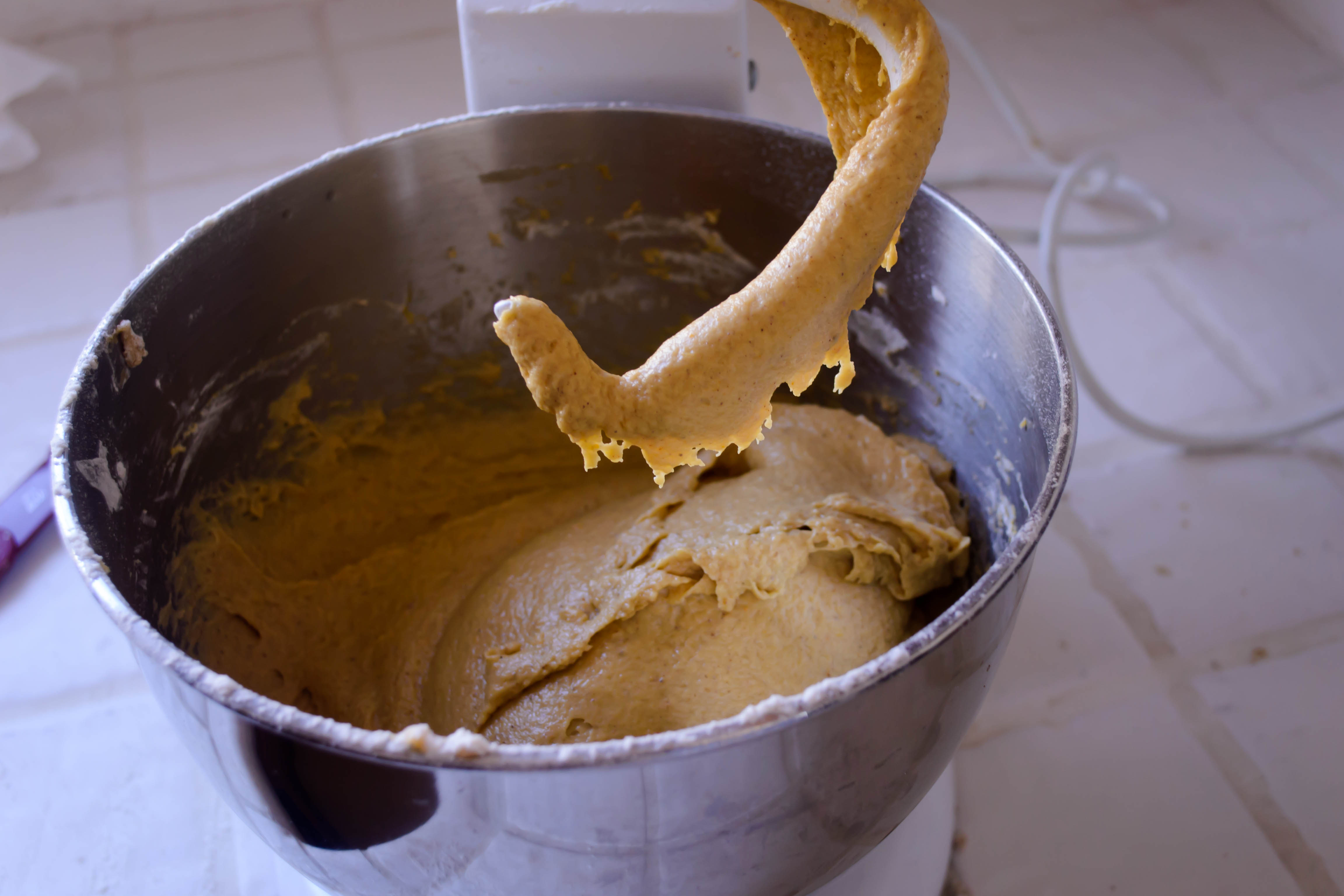
  • Add 4 cups of the flour and all of the spices, and mix on medium-low again to combine. You will have something like orange cake batter. Add 2 additional cups of flour (this is 6 total) and mix to combine.
  • Switch from the paddle attachment to the dough hook and knead for about 5 minutes, or until a sticky but slightly elastic dough has formed. It will not become a firm ball, but will pull away from the sides of the bowl in stretchy threads. If the dough is not pulling away from the sides of the bowl at all after the first three minutes, begin adding the remaining cup of flour ¼ cup at a time, kneading well in between each addition.
  • When the dough is kneaded, spray the sides of the bowl with a non-stick spray, roll the dough over in it once or twice to coat, then cover the bowl tightly with plastic wrap and set it aside to rise until doubled – about 90 minutes.
  • While the dough rises, prepare the filling ingredients – toast and chop the pecans, melt the butter, and get the cinnamon and brown sugar measured out for easy application. While you’re at it, spray pans with non-stick spray. I used two 9-inch and two 8-inch cake pans. Square or rectangular pans would work fine as well.
  • Dump the risen dough onto a well floured board. If it is aggressively sticky, dust the top of the dough with flour as well and knead by hand a few times, until it is easier to work with.
  • With a dough scraper, a pizza cutter, or a sharp knife, cut the dough in half and stow one half back in the bowl. We will work with one half at a time.
  • Using a well floured rolling pin, roll the first half of dough into a thin rectangle (about ¼ inch thick, if you can manage it). The size of this rectangle will depend on how much your dough has risen. Aim for thickness rather than dimensions.
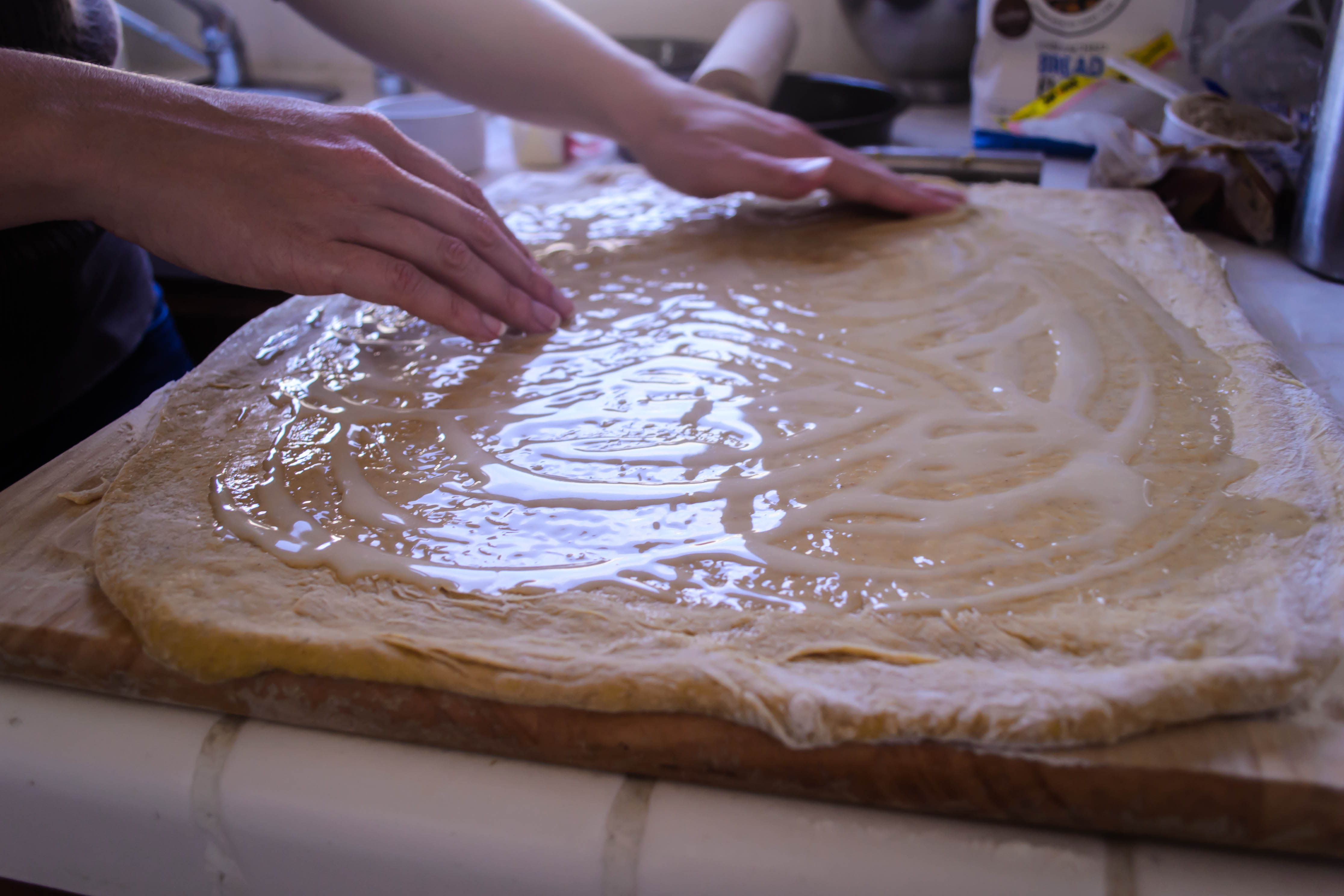
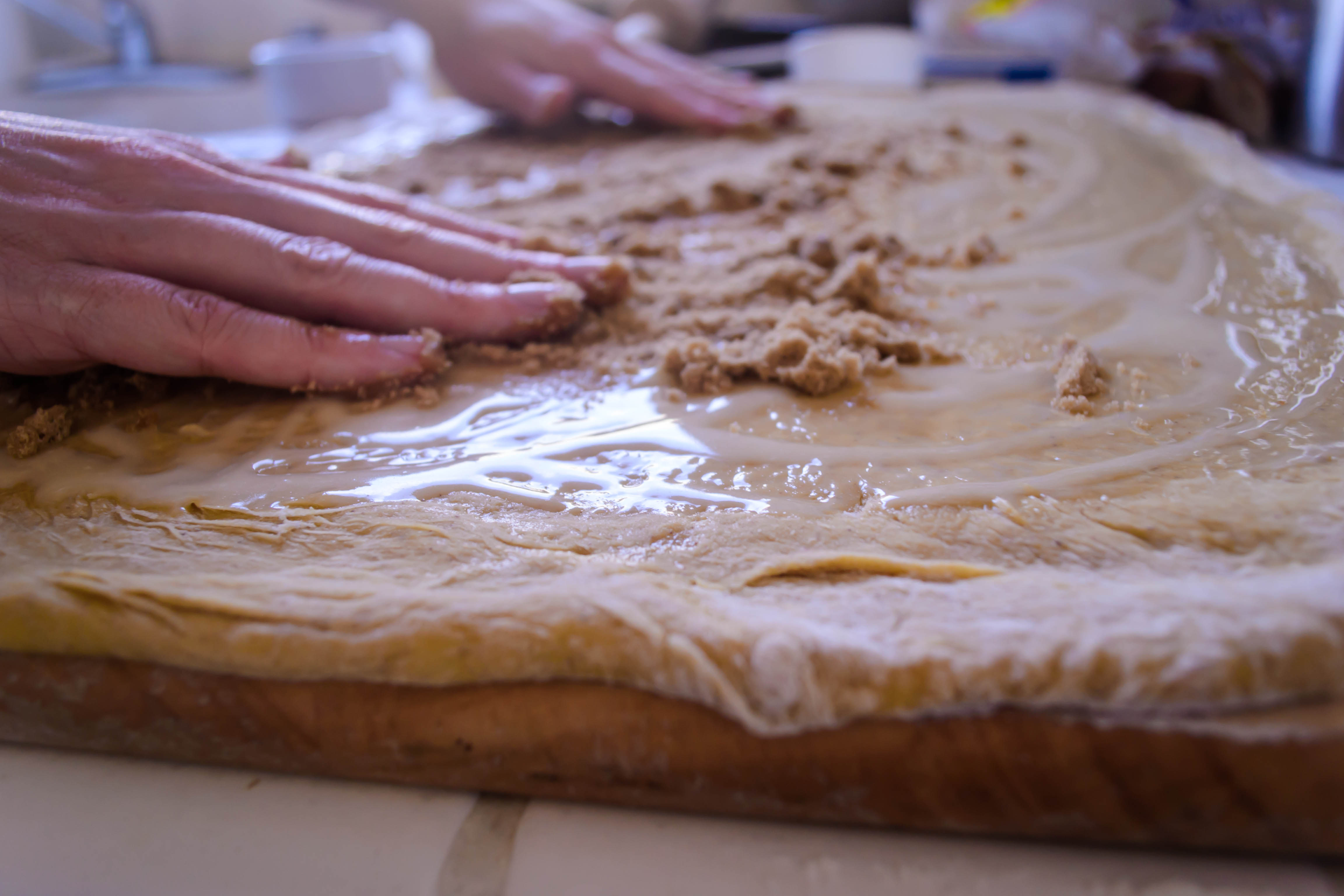
  • Pour half of the butter over your dough and spread it across the surface with your fingers. Leave a border of about ½ inch on all sides.
  • Sprinkle half of the brown sugar and half of the cinnamon over the surface, again respecting the border. Spread for even coverage if needed.
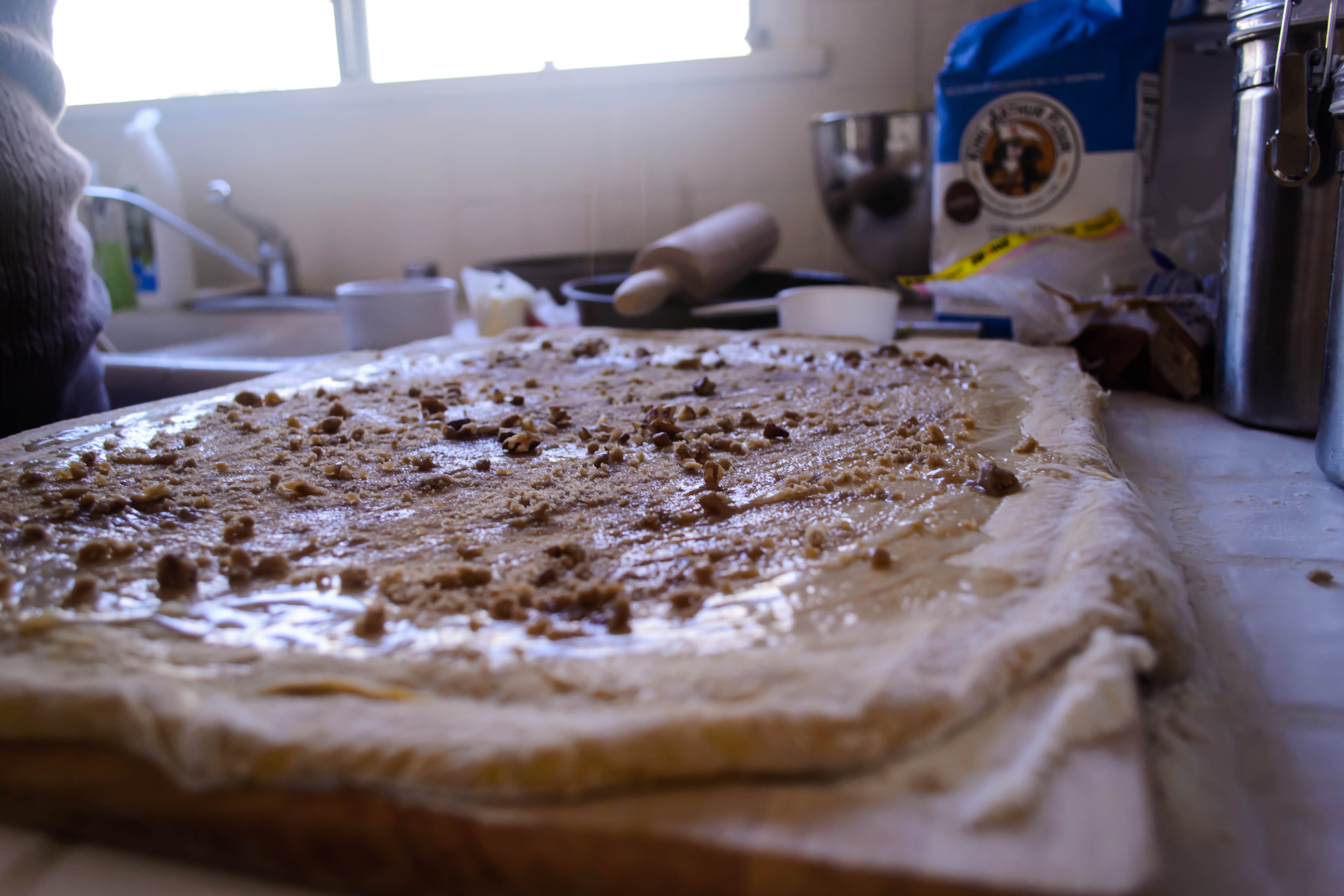
  • Sprinkle half the pecans over the buttered, sugared surface.
  • Now, we roll. Beginning in the middle of the long edge of your dough rectangle, begin to roll up the dough into a long log. Once you have rolled a revolution or two in the center, move your hands toward the edges, rolling them up as well to create an even log. As you reach the end, pull the loose edge of dough firmly against the log you have made and pinch and crimp it into the already rolled dough to create a seal.
  • Using a serrated knife, cut your log into slices 1 to 1-½ inch thick. To do this without squashing the rolls, use almost no pressure as you saw the knife back and forth.
  • Settle the slices with the filling swirl exposed in your prepared pans, and repeat the process with the remaining half of the dough.
  • When all of your rolls are, well, rolled, drape the pans with clean kitchen towels or plastic wrap and let them rise again for 45 minutes.
  • During the last 30 minutes of this second rise, preheat the oven to 350F.
  • After their second rise, the rolls should have noticeably puffed and be pressing against each other. Remove the towels or plastic wrap and stow the pans in the oven for 20-22 minutes, until the rolls are nicely browned and the filling inside is beginning to bubble. Remove and set aside to cool while you make the frosting.
  • In a medium bowl (or, if you’ve been proactive enough to wash your stand mixer bowl, use that), whip the cream cheese until very smooth with a whisk or electric mixers. Add the vanilla, the powdered sugar, and 3 tablespoons of the cream, and mix to combine. You are looking for a texture a touch thicker than condensed milk – too thick to pour, but loose enough to wilt toward the edges of your icing spatula. If it seems too thick, add the final tablespoon of cream and mix again.
  • While the rolls are still warm, spread with the frosting. This makes enough for about one tablespoon per roll. I found individual dollops, then careful spreading over one roll at a time, made for a more attractive result than just globbing on a pile and spreading over all of the rolls at once.
  • Separate rolls using a butter knife or an icing spatula and serve warm (they are fine at room temperature too, but if you refrigerate the leftovers, I recommend warming them up before eating, as the dough gets a little dry when cold).

Apricot Coffeecake Ring #TwelveLoaves

Food blog July 2014-0388Things get a little lax in the summer. Example: you’re not getting a sauce this month. What can I say? I’ve been on vacation! I’ll make it up to you in August, though, along with a slew of other delectable options I’ve got pending. I was determined, however, not to fall behind in my Twelve Loaves baking. In my haste to stay on schedule, I merely glanced at the beautiful apricots gleaming up from Lora’s bread this month, and assumed these gorgeous fleshly globes were the theme of July’s assignment.

Food blog July 2014-0362Food blog July 2014-0364Food blog July 2014-0365Turns out the theme was “summer fun.” Well. I think I’m still glad I went with apricots. Their beautiful swelling cheeks and slight fuzzy skins remind me of a healthy summery glow. After a week of beaches and bronzed bodies, the peachy simplicity of apricots seemed like the right move.

Food blog July 2014-0366I’ve been auditioning yeasted coffeecake recipes for a while now, sometimes ending up with a stunner, sometimes with something that merits a revisit, and sometimes with something that wasn’t a yeasted coffeecake at all. But for this, I turned to the place I should have looked from the very beginning: Baking Illustrated. This hefty volume from the brains and kitchens of the Cook’s Illustrated crew does all the heavy lifting for me, and if I’m ambitious enough to read the whole story, tells me why and how each item came to be, from a food science, aesthetics, and taste-bud angle.

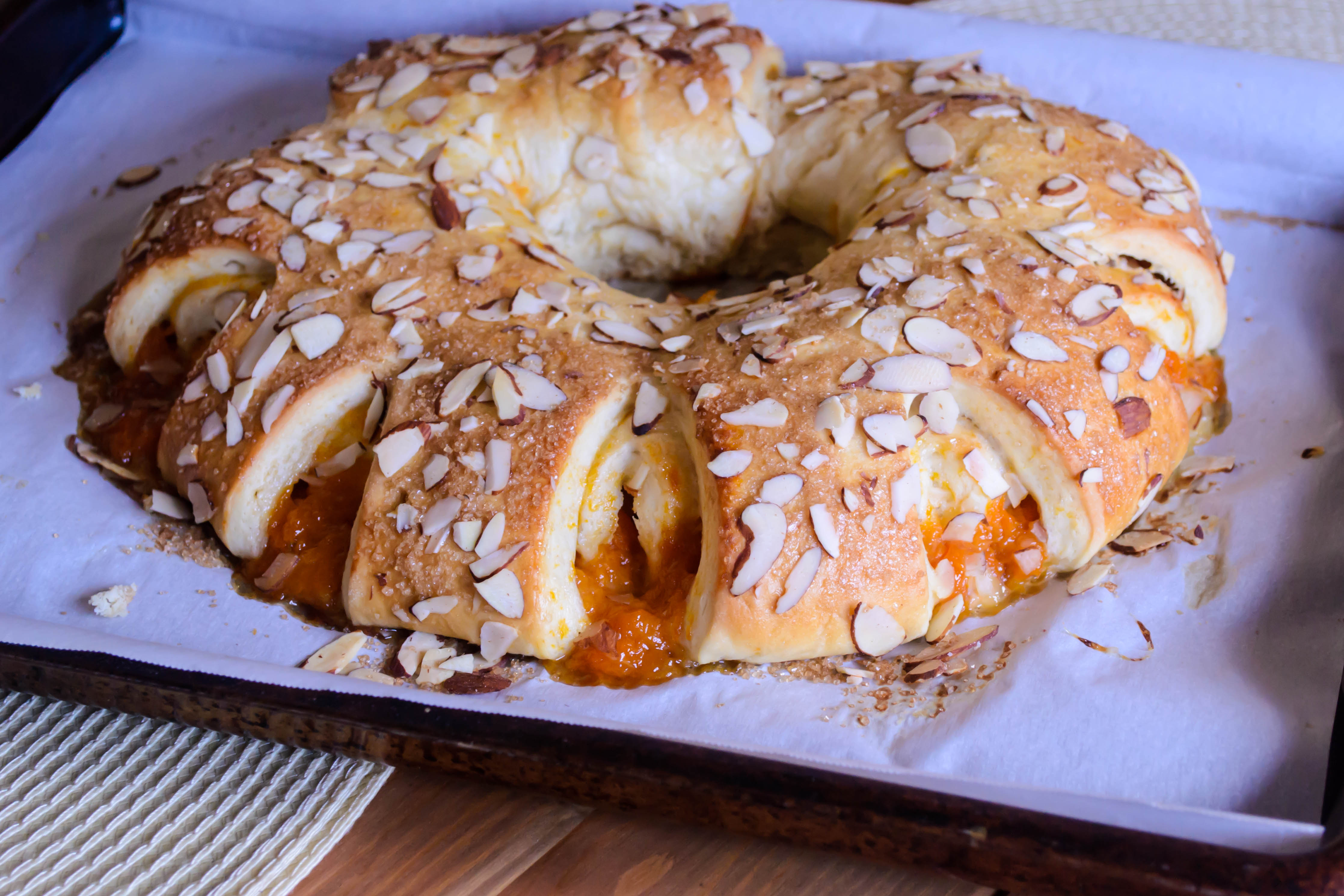
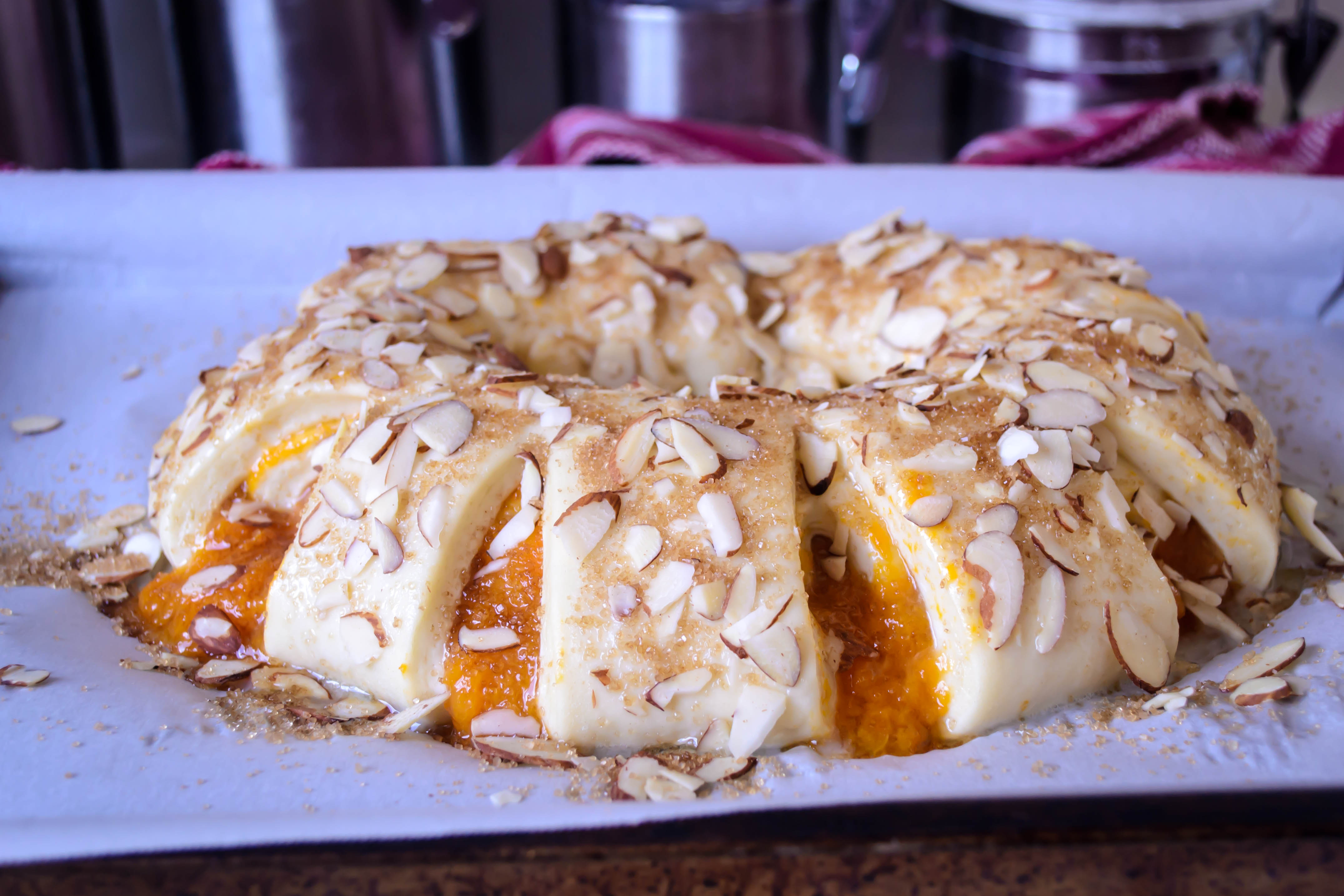
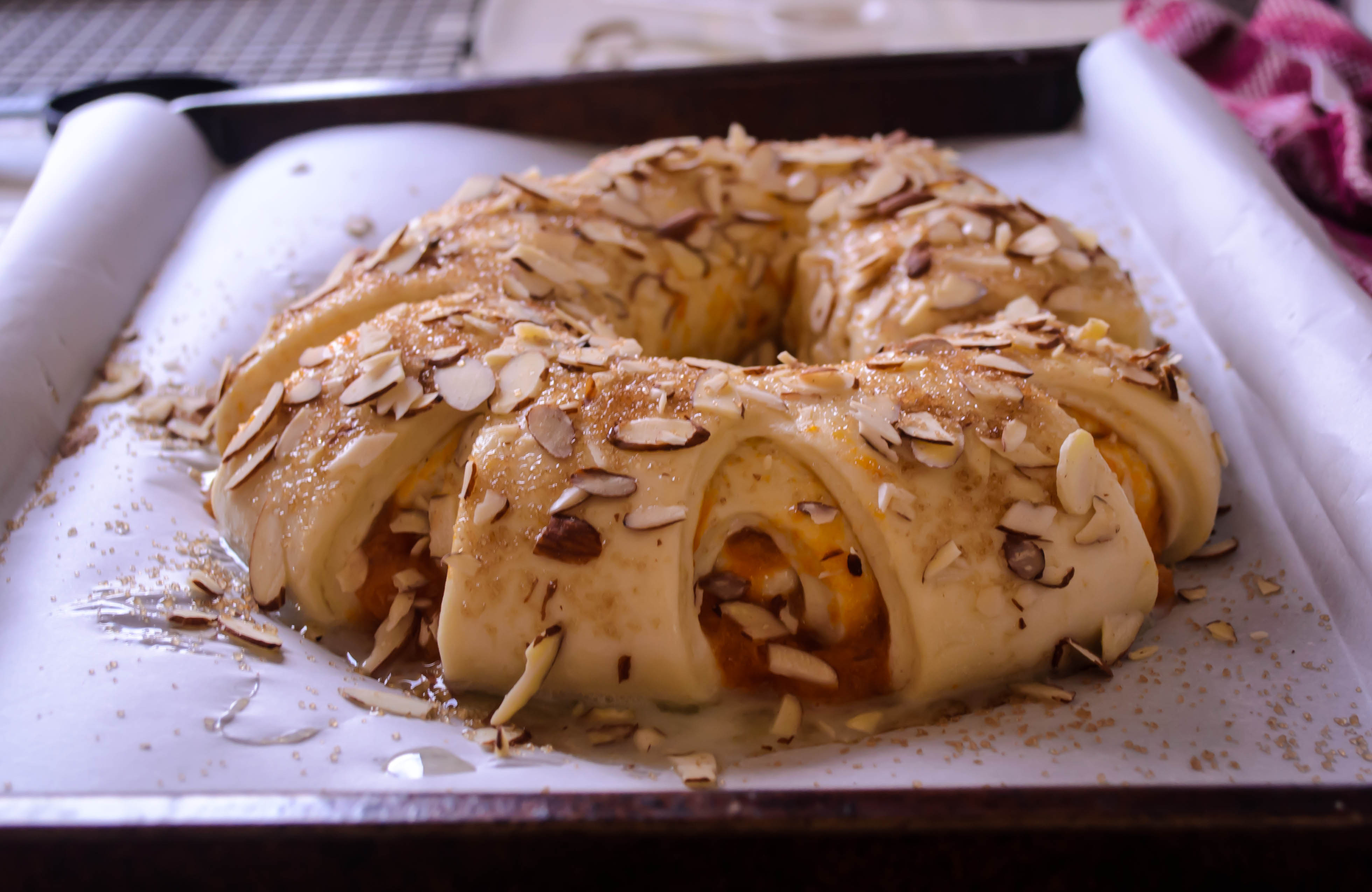
Food blog July 2014-0356Food blog July 2014-0358Food blog July 2014-0367Food blog July 2014-0369This loaf is slightly adapted from their yeasted coffeecake recipe with an orange-apricot filling. I omitted the orange, used fresh rather than dried apricots, and opted to forgo the heavy streusel and icing in favor of a light sprinkle of almonds and a bit of coarse sugar for an appealing crunch. I took their suggested horseshoe shape and swung it all the way into a circle for a pretty golden ring oozing jammy splotches.

Food blog July 2014-0371Food blog July 2014-0373When this came out of the oven, I – forgive me the overshare – just about drooled right on it. The apricot filling escapes in spots, bubbling and thickening like the filling at the edges of a pie. The dough itself, crusty on top with its sugared almond adornments, is burnished and soft and puffy and gorgeous. Describing the creation to his parents the evening we sampled it, N. called it a giant bearclaw, and though the loaf is a bit denser than a doughnut, the effect of the snipped dough with caramelized filling oozing through is similar.

Food blog July 2014-0374Are you sold? Let me tell you one more thing. This cake is essentially a two-day project. I’m serious. But don’t run off just yet! This is actually an advantage for a summer loaf. Because it has so much butter in it, and a pair of eggs to boot, it takes this dough a long time to rise. For the same reasons, it has to be chilled after its initial rise before you can really work with it at all. It’s quite similar to brioche in that way. But this is an advantage because it means you are not switching on the oven in the middle of the day, when your hair is already plastered to your forehead and you cannot bear to be in the kitchen another instant. It’s a mix in the morning, a long rise in a preheated house, and then you can shove it in the fridge and ignore it until early the following morning, when you finally bake. It means a little planning ahead, but I think it works out better in the long run.

Food blog July 2014-0378Besides, when you taste this, with its sugared crunch and soft elastic chew and golden sunshine-y tart-sweet apricot, I think you’ll decide it was worth it.

Happy midsummer. I wish you heaps of fun.

Food blog July 2014-0400

Apricot Coffeecake Ring
Adapted from Baking Illustrated
Makes one 8-10 inch ring
Note: this is, unless you are willing to get up very early in the morning, a two day baking process. I think it’s totally worth it, but be sure to give yourself sufficient time to execute it.
Note: because this is a very rich dough, it is also very soft and sticky. It will be difficult to work with by hand, so I’m only including directions for a stand mixer.
Dough:
2 teaspoons active dry yeast
3 tablespoons warm milk
¼ cup sugar
2 large eggs
½ teaspoon vanilla
2 – 2½ cups bread flour (you may not need the entire amount)
1 teaspoon salt
8 tablespoons (1 stick, or 4 ounces) unsalted butter, softened but not melted, cut into small chunks
Apricot filling:
1½ cups peeled, chopped apricots (for me, this was 5 apricots)
1 tablespoon brown sugar
1 tablespoon rum, optional
Topping:
1 egg white
1 teaspoon milk or cream
2-3 tablespoons raw sliced almonds
1-2 tablespoons coarse sugar (I used turbinado)
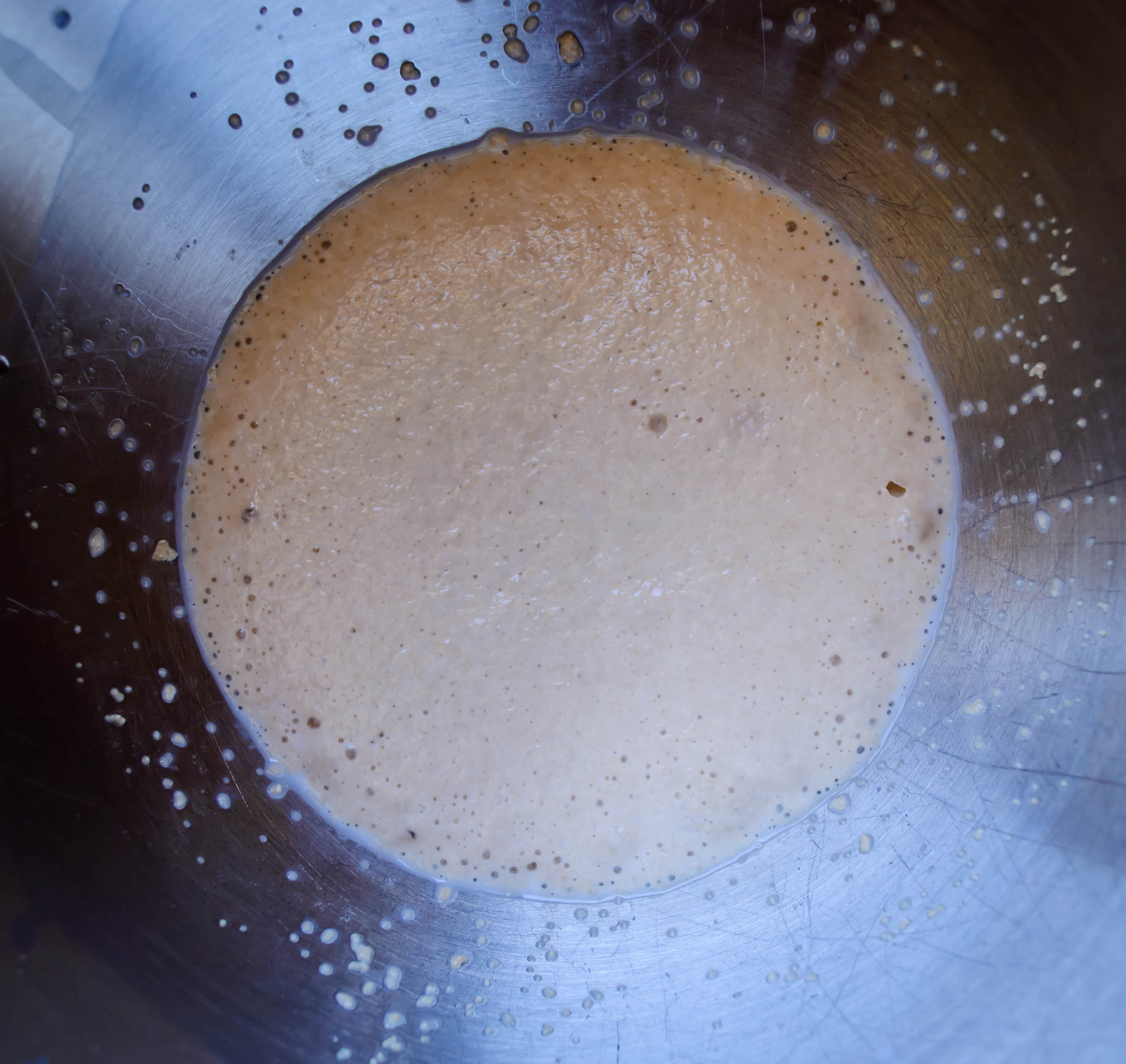
  • Sprinkle the yeast and a pinch of the sugar over the warm milk in the bowl of your stand mixer, stir to dissolve a bit, and let sit for 5-10 minutes until the yeast is bubbly.
  • Add the remaining sugar, the eggs, and the vanilla, and mix on low speed with the paddle attachment until combined.
  • Now, add the salt and 1 ¼ cups of the flour, and again mix on low speed until the flour is incorporated.
  • Increase the speed by one notch so you are at medium-low, and begin adding the butter one chunk at a time, beating until each chunk is incorporated before adding the next. This will take a few minutes, but it allows them to disperse evenly into the dough. When all the butter is incorporated, the mixture will look like thick cake batter.
  • With all the butter incorporated, replace the paddle attachment with the dough hook and add 1 cup of flour. Run the mixer at medium-low for about 5 minutes, kneading until the dough is soft and fairly smooth. If it looks disastrously sticky or does not seem to be coming together, you can add the remaining flour a tablespoon or two at a time, but be sure you knead thoroughly between each addition. This is supposed to be a soft dough.
  • After you’ve kneaded for 5 minutes on medium-low, increase the mixer speed to medium and knead an additional 2 minutes. According to Baking Illustrated, this tightens up the dough a bit.
  • Cover the dough tightly with plastic wrap and let it rise in a warm spot until it doubles in size. This should take 3-4 hours (it’s a rich, heavy dough; it will take the yeast a while to work through all that butter!).
  • When the dough has doubled, punch it down by depressing your fist gently into its center, replace the plastic wrap, and stow it in the fridge overnight (Baking Illustrated’s precise instructions are “at least 4 or up to 24 hours”).
  • When you are ready to make the filling, which also needs to chill thoroughly before being added to the dough, heat a medium pot of water to boiling. Score the bottoms (flower end, not stem end) of each apricot by cutting a shallow x through the skin and just barely into the flesh with a sharp knife. Plunge the scored apricots into the boiling water and leave them for about 60 seconds. Then, remove them, drain them, and set them aside until they are cool enough to handle.
  • Using a small knife, carefully peel back the skins of the apricots starting at the x you’ve scored into the bottom. The skins may already be peeling away, and should separate from the flesh easily. If they prove particularly stubborn, stick them back in the boiling water for another 30 seconds.
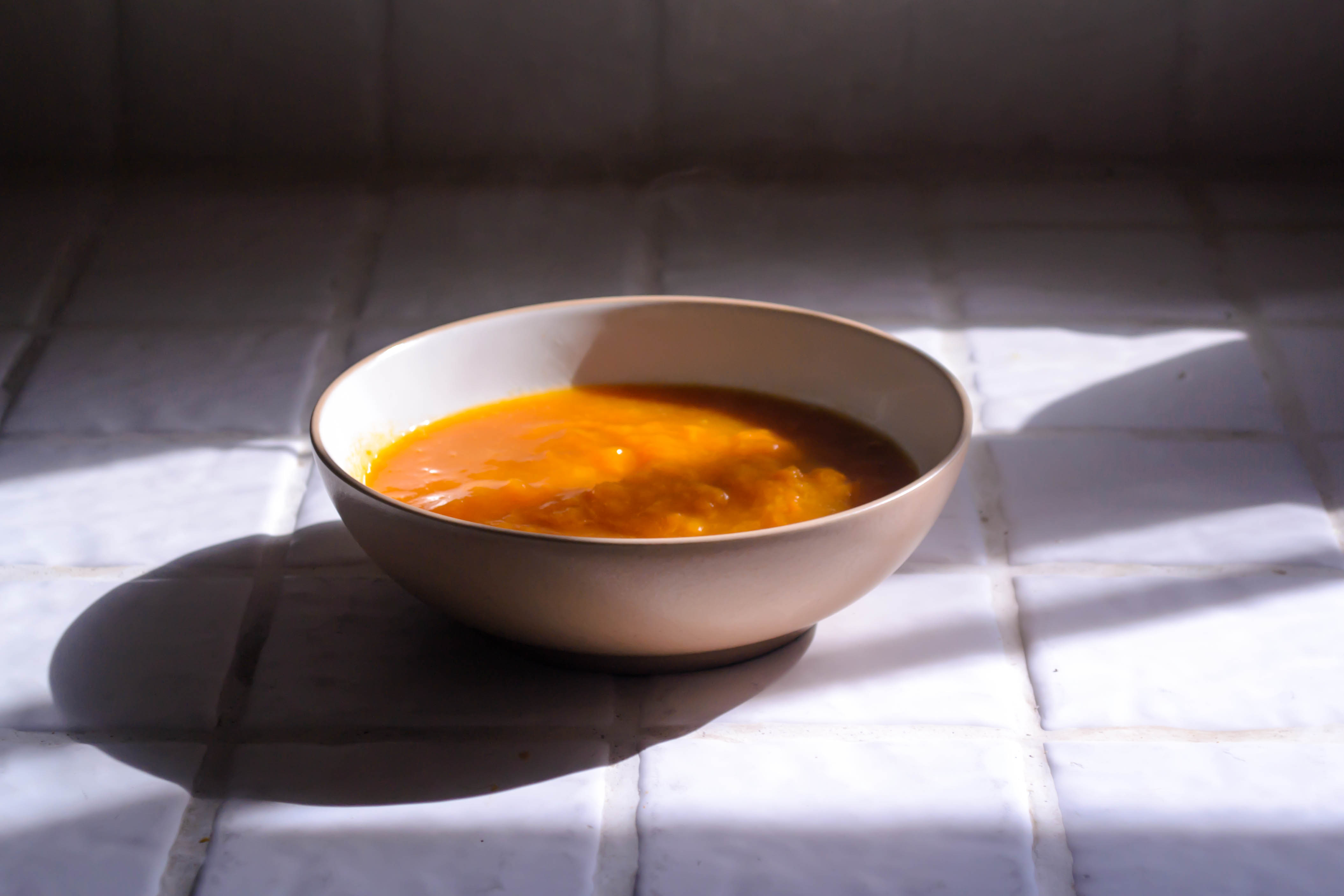
  • Remove the pits and chop the peeled apricots, then put them into a pot with the brown sugar and rum, and cook over medium heat for 5-7 minutes, until they collapse into a glorious pulpy mess. Remove from heat and pulse the mixture in a food processor until almost smooth. Or, if you are lazy like me, mash it up with a potato masher. Either way, once your apricots are almost smooth, stow them in the refrigerator until quite cold.
  • When you are ready to shape the coffeecake, remove the chilled dough from the refrigerator and gently dump and scrape it out onto a well floured board. Pat the dough out into a roughly 6×5 inch rectangle, lightly flour the top, then use a rolling pin and some elbow grease to flatten the dough into a smooth, 15×9 inch rectangle (it will be about ¼ inch thick).
  • Spread the cold apricot filling over this large rectangle of dough, leaving at least a ½ inch border on all edges.
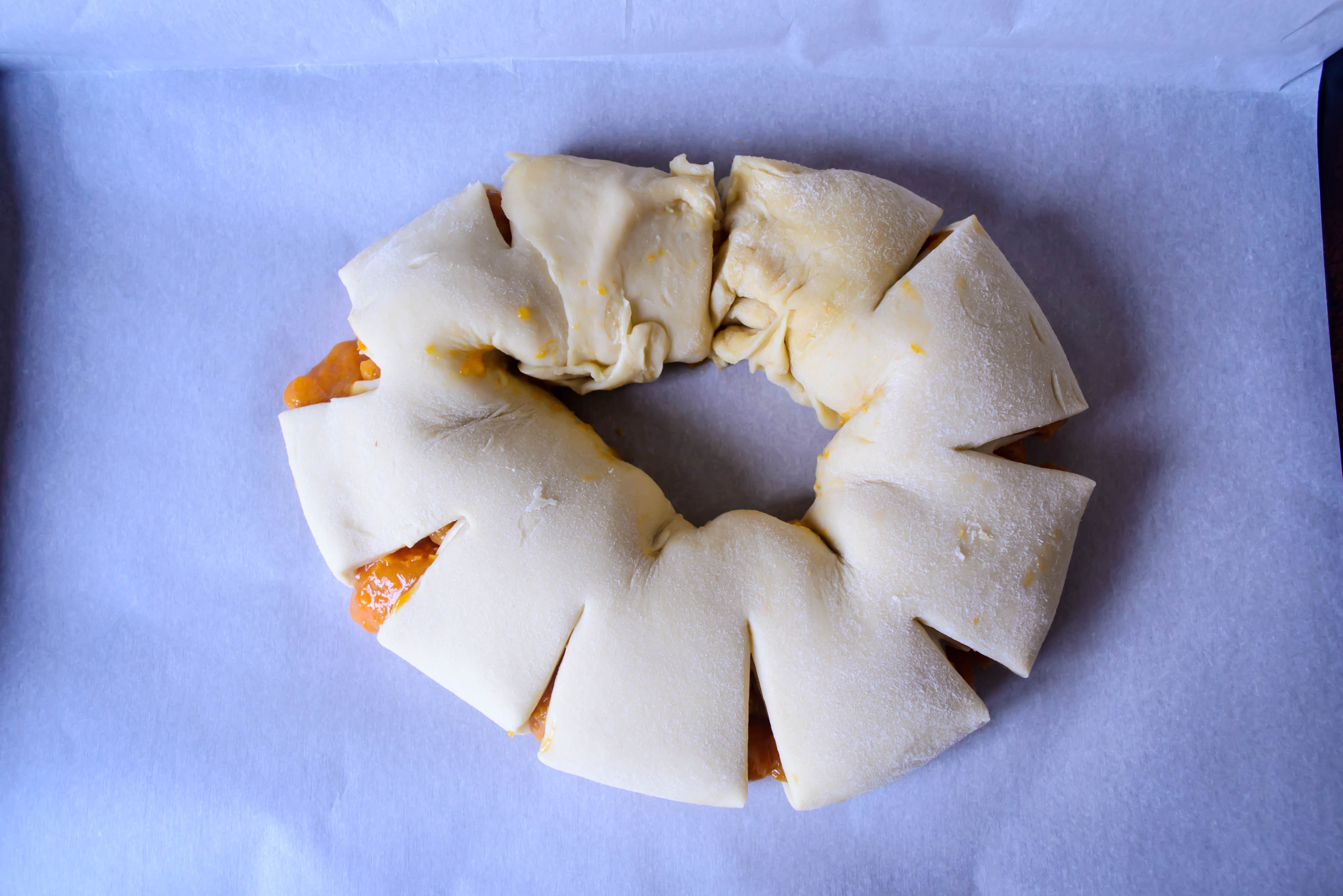
  • Using both hands and starting with one of the longer edges, roll the dough up tightly into a long log. Seal the seam securely by pinching the dough, then coax the log into a circle and pinch the ends together to join them in a ring shape. During this process some of the filling will likely ooze out; don’t worry too much about it.
  • Transfer the ring of dough to a parchment paper lined baking sheet. With a pair of kitchen scissors, snip about halfway through the log at 2-inch intervals. Again, you will get some lovely orange ooze. No worries; this will get lovely and caramelized when it bakes. Just drape some plastic wrap or a clean kitchen towel over the whole thing and let it rise again until slightly puffed; about 90 minutes.
  • 30 minutes before you are ready to bake, preheat the oven to 350F with a rack in the middle.
  • When the loaf has risen again, beat the egg white and milk together and brush it over the exposed dough evenly. Sprinkle the sliced almonds and coarse sugar over the loaf, and then slide it into the oven and bake until deeply golden and registering around 190F on an instant-read thermometer. This should take 25-35 minutes.
  • Cool at least 20 minutes on a wire rack (just slide the parchment straight from sheet tray to cooling rack) before slicing and serving.
  • This cake is amazing warm or cold, and though I suspect it would last a week wrapped in foil and refrigerated, we scarfed it within 3 days.