Stacked

One of the most impressive looking desserts, to me, is a trifle.  Those elegant layers in wonderful colors (especially if one of those colors is the dark rich brown of chocolate), stacked carefully together and topped with whipped cream and fruit and dark chocolate shavings…

But the impressive thing about them, to me, is how skilled the artist who puts them together has to be to get everything just so – the layers sit happily atop one another, the beautiful serving glass doesn’t have smears of pudding where the cake should be – it’s a skill I, with my limited patience and tendency for mess in the kitchen, simply do not possess.  Of course, I don’t make a lot of trifles.

For this week’s Bittman, however, I made what he calls a Vegetable Torta, which apparently is supposed to have layers.  He says:

“47. Vegetable Torta: Roast sliced eggplant, zucchini, tomatoes and onions.  Stack in layers with fresh basil in a well-oiled springform or roasting pan and top with bread crumbs or Parmesan (or both); bake for 20 minutes or so.”

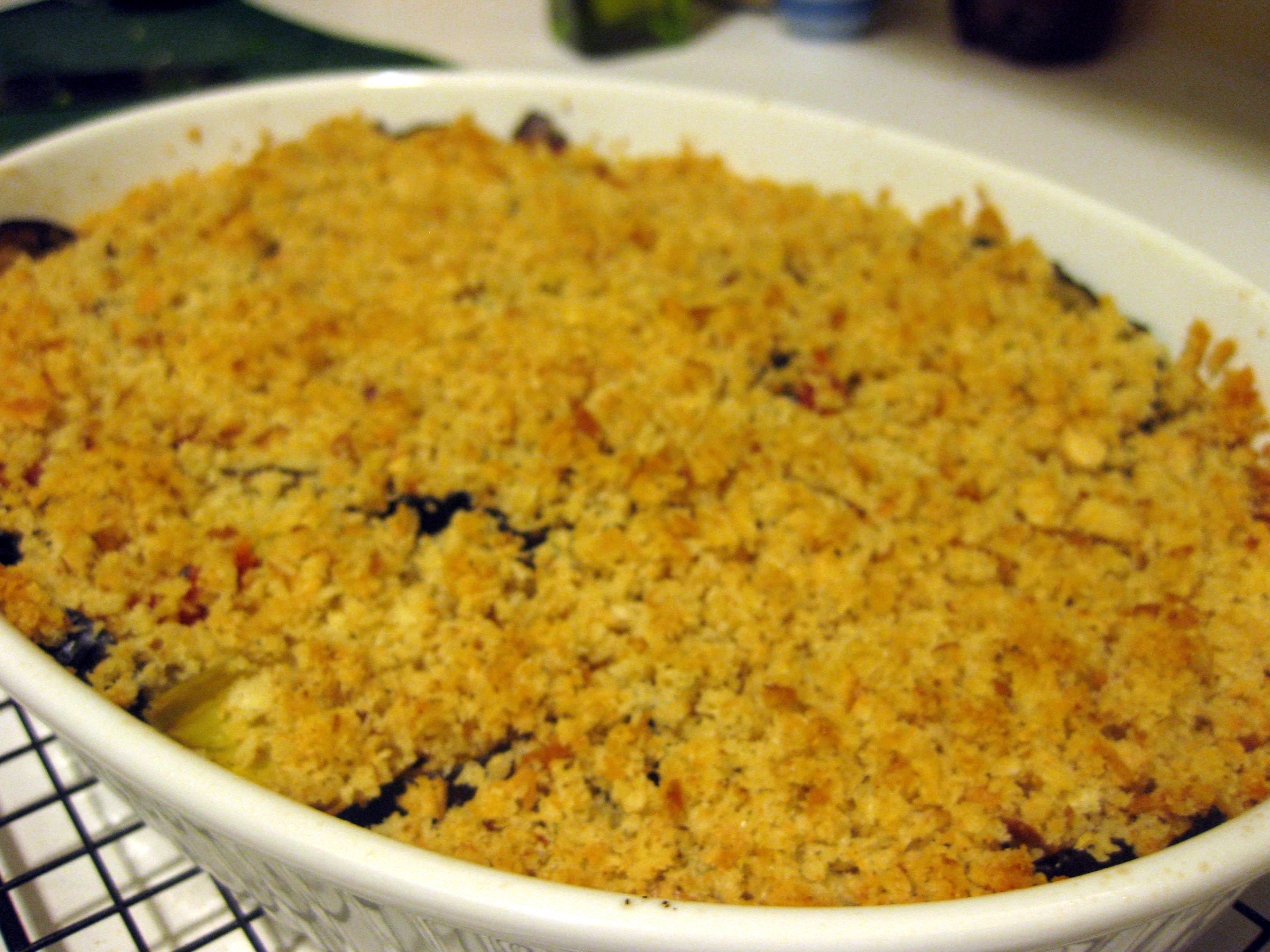
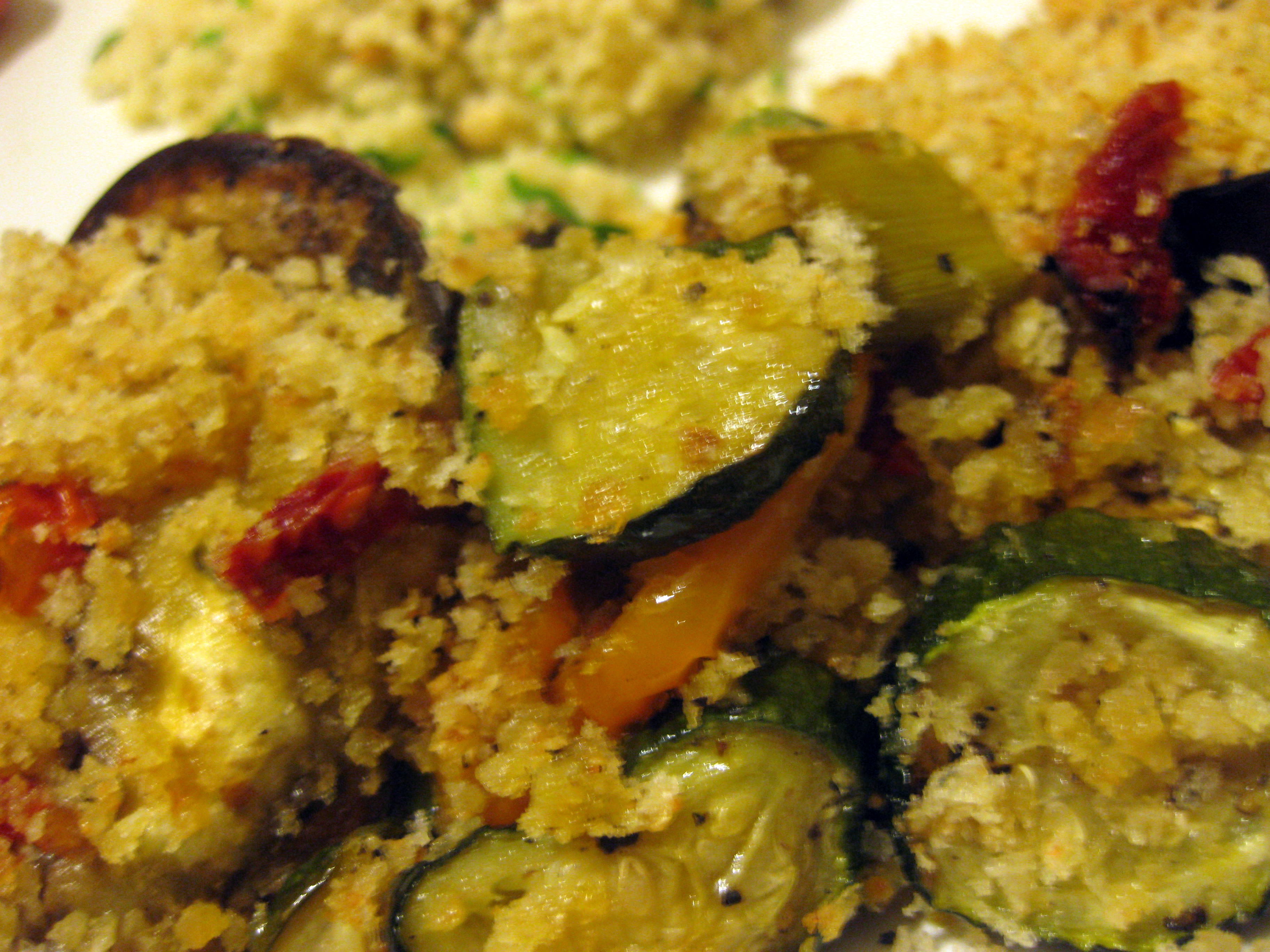
I made a number of decisions about these directions, at least two of which were evidently somewhat silly.  I don’t care for roasted tomatoes (unless they are intended for salsa or are being oven dried), so I opted for a shiny orange bell pepper instead.  Because I often overestimate how much of everything I will need and end up with WAY more dinner than N. and I could consume in 2 or 3 days, let alone one sitting, I am trying to be more conscious about my tendency to overbuy.  For this dinner, therefore, I proudly limited myself to only one eggplant, two zucchini, one pepper… in short, less than I ordinarily would have used.  Because N. is such a big fan of any kind of bread product, which includes panko or toasty bread crumbs of any kind, I decided to use a shallow, oval Corningware-type baking dish I bought myself recently rather than a tall sided pan, because this would allow more space for bread crumbs, which means more bread.  This was silly because when it came time to layer, there was neither enough material nor enough room.  The vegetables nestled nicely in with each other, but they settled in on the same level.  No stacking necessary, apparently.

Here’s what I used:
1 eggplant, cut in ½ inch slices

2 medium zucchini, cut in ¼ inch slices

1 orange bell pepper, seeded, cut in ¼ inch rings

1 leek, white and light green parts thinly sliced

Olive oil

2 cups fresh white bread crumbs

1 TB butter

2 TB freshly grated Parmesan cheese

1 tsp garlic powder

1 tsp freshly ground black pepper

8-10 julienned oil-packed sun-dried tomatoes, drained

I tossed the vegetables in a liberal bath of olive oil, sea salt, and black pepper, then spread them out onto two cookie sheets, trying to keep them all in a single layer so they wouldn’t inhibit one another’s roasting.  In an oven preheated to 400F, I roasted them for about half an hour.  They softened and collected lovely dark roasty spots and it was a good thing I left the house for a while, because otherwise I probably would have stood over the cooling racks and eaten half the eggplant right then and there.

Resisting the urge to eat dinner at 3:30pm, I returned to the cooled slices later.  With the oven preheating to 375F, I (failing to layer) arranged the vegetables in my shallow oval dish.  As a last minute flash of inspiration and idiocy, I tucked a handful of sun-dried tomatoes in and around my little veg slices, and completely forgot the basil.

Since I made the bread crumbs by running the torn scraps of a sourdough baguette through my food processor, I dumped the butter, cheese, garlic powder, and some pepper right in on top of the crumbs and pulsed the whole thing a few times until the fat seemed evenly distributed.  I topped the vegetables with a liberal crumb layer and stowed it in the oven.

While the vegetables softened even more and offered each other new flavor profiles, I heated some chicken stock and olive oil to make couscous.  At the last minute, as I fluffed the tiny pasta with a fork (trying in vain not to scratch up the bottom of the pot), I added some toasted pine nuts and a few tablespoons of minced fresh parsley for added nuttiness and freshness.

The flavors of both torta and couscous were excellent.  I will continue to make couscous this way (I usually use chicken stock but haven’t ever really stirred in additional components before), but the torta needed some adjustments.  As I mentioned with my first Bittman experiment, it was really just roasted vegetables with a crumb topping.  There’s nothing wrong with that, per se, but I felt as though it were missing a binding agent.  Perhaps using tomatoes instead of a bell pepper would yield some juices, which would make the collection a bit saucier.  Perhaps using the recommended pan and enough vegetables to layer things up would have married flavors and created more cohesion.  Perhaps basil would have magically tied the whole thing together.  Perhaps, and this is badness from the baddest part of me, integrating slices of fresh mozzarella cheese before baking would make this dish – it would become like a mixed vegetable Eggplant Parmesan, but with the breading in crumbled topping form rather than fried around the eggplant slices.
How does it always end up being about the cheese?
Hindsight

One of the valuable lessons this Bittman project is teaching me is flavor combinations.  I like to think I am a pretty good cook, and lord knows I can follow a recipe (well, when I’m paying attention…), but I am still learning how to put ingredients together without a guide.  Mark Bittman’s 101 is teaching me about this in two ways.  First, he provides me with glorious combinations of ingredients to try out.  Second, because I am not serving these dishes each week with “Thanksgiving dinner,” I am learning that before I make each item, I am only guessing how well it will match with the rest of the meal I’ve envisioned.  This week, we took on acorn squash, which is one of my favorites:

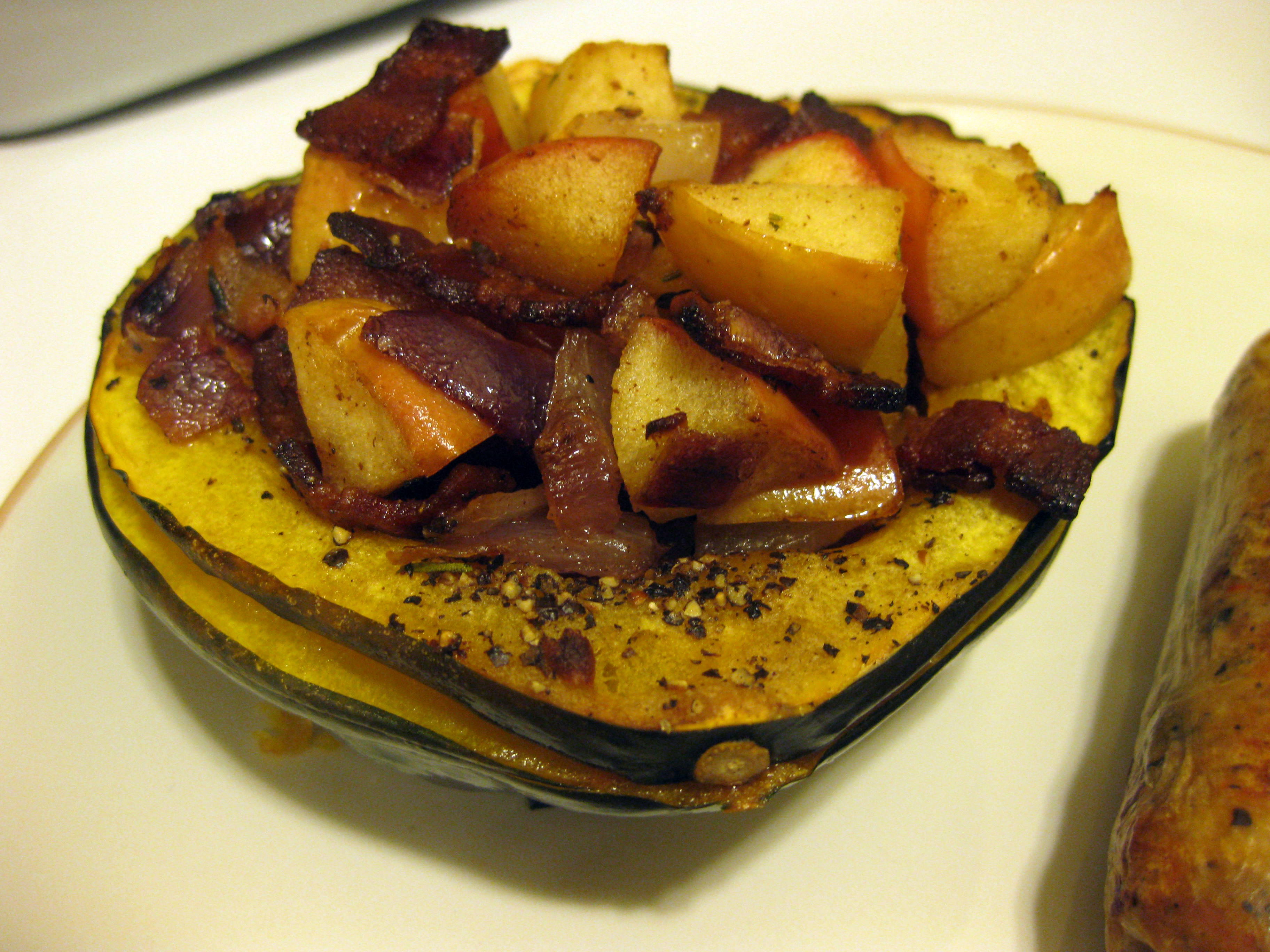
“45. Render some chopped bacon in a bit of oil, then add apple chunks; cook until nearly soft.  Meanwhile, bake halved and seeded acorn, butternut, or delicata squash until they start to soften.  Fill squash with apple mixture and finish baking.”

Much as I love winter squash, I was faced again with the difficulty of deciding what else to serve with what I hoped would be boats of delight.  Because our last squash experiment had needed something more substantial than the quinoa I paired it with, I decided this time on organic chicken sausages with roasted red pepper and garlic.

Bacon and apples sounded amazing and decadent, but I decided to add a little to Bittman’s foundation.  Here’s what I used:

1 acorn squash, halved and seeded

½ lb bacon, chopped

2 apples, skin on (I used Braeburns), quartered, cored, and chunked

½ a medium onion, diced (red onion added mild flavor and nice color)

1 tsp fresh rosemary, finely chopped

Salt, pepper, and olive oil

I preheated the oven to 400F for the squash.  To keep them standing upright, I sliced a very thin piece off the “bottom” of the rind where I wanted it to sit.  Just a little peel off the rind made a flat surface for the squash to balance on.  I wedged the halves into a cake pan and sprinkled liberally with salt, pepper, and olive oil.  I put them into the oven for about 20 minutes and concentrated on the stuffing.

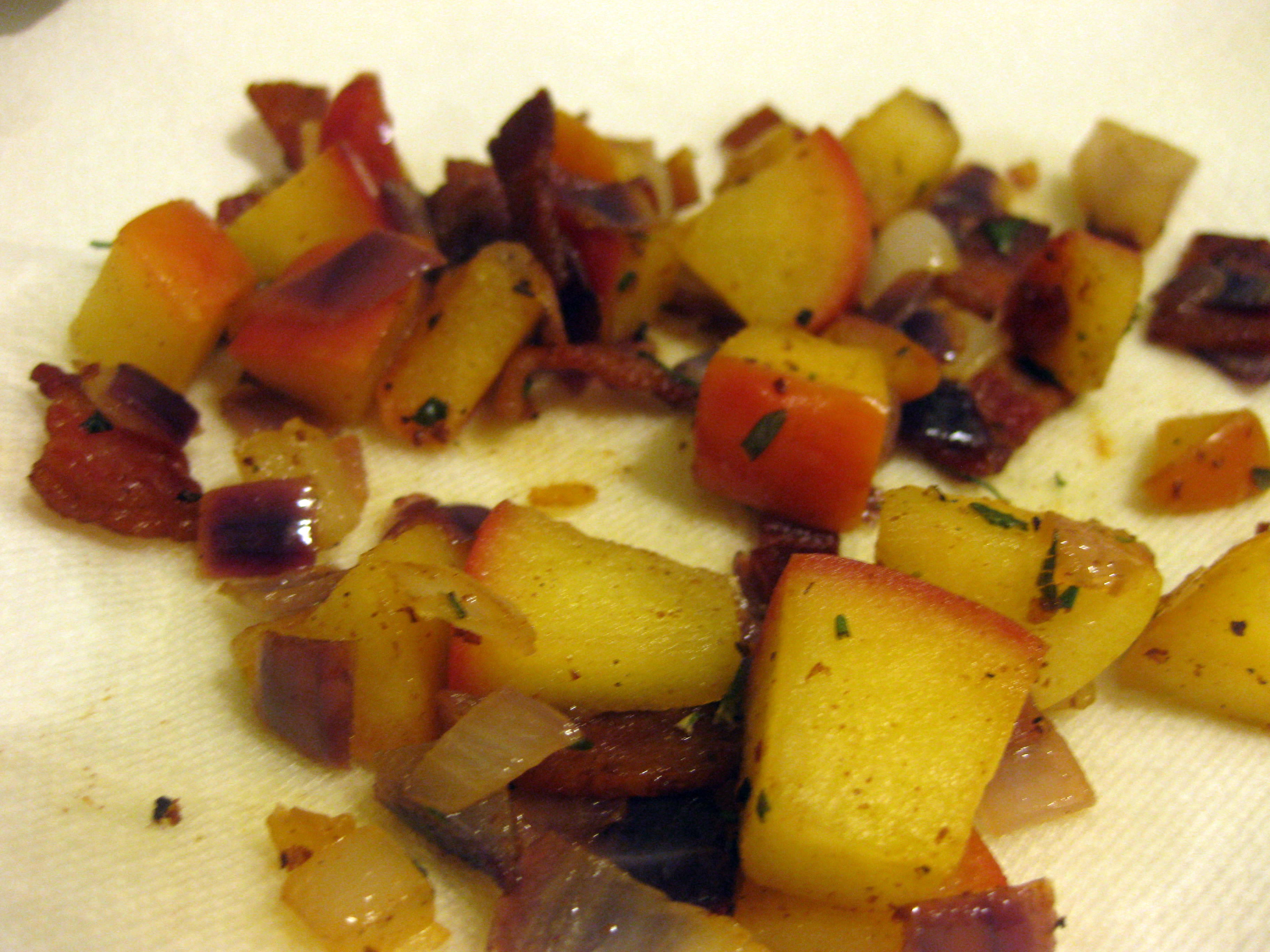
I decided to eschew the extra oil, and put my squares of bacon into a dry pan on medium.  While it sizzled, whining and complaining about the heat, I chopped the apples and onions.  With the bacon halfway to crisp, I dropped in the onions, wanting to give them time to grow tender and sweeten.

When the bacon was teetering on the edge of barest crispness, I added the apple chunks.  They only needed five minutes to begin to soften before I turned the stove off.  Because I knew they were going to continue cooking in the oven, I didn’t want them to lose all their texture in the pan.

In three quick sweeps, I folded the rosemary into my apple mixture, slipped the squash out of the oven, and packed the boats full, no, overflowing.  They looked beautiful, and it was difficult to say goodbye as the oven door closed between us for another 20 minutes.

With sausages sizzling and charring and smoking ever so slightly on the stovetop, I liberated the stuffed squash and loaded them onto our plates.  The smell was wonderful, and the flavor matched.  The squash and apples were sweet, but had soaked up some of the bacon fat, which complicated their flavor.  The bacon itself was meaty and fatty and crispy and salty (I love bacon, can you tell?) and perfect.  It was a nice textural component as well, as the squash was beautifully soft and creamy, and the apples were barely toothsome.  As I had hoped, the sharp piney flavor of the rosemary kept the dish from being too rich.  It was a lovely herbal note.

Because I packed the boats so full, the bacon in the dish was more than just an accent, as I had somehow expected it would be.  Therefore, the side of chicken sausage I had chosen was not the best possible pairing.  It was not until the next day as I heated up the leftovers and ate them alongside a corn muffin we’d had as a side earlier in the week that I realized what would have been perfect: golden circles of baked or fried polenta.  I chose meat when I should have chosen starch.  But as I am learning with this project, there was really no way I could have known the perfect side until I had tasted the dish.  That means to get it perfect we will have to have this again.  “What a shame!” she exclaimed with a wink and a smirk.

This is absolutely a recipe to keep and try out.  I’d imagine the ingredients you stuff the squash with could be changed up: apples could be replaced with pears, bacon with prosciutto, or you could go more savory and add leeks or garlic, but if your squash boat includes bacon I’d recommend serving with a starchy side rather than meat – polenta, cornbread, maybe even buttered noodles or gnocchi.  My 20/20 hindsight says it would be better balanced.  And in a meal in which the vessel threatens to fall over and spill its rich treasures across your plate if you don’t take measures to keep it upright, balance is a necessary thing.

Currying flavors

The thing about Mark Bittman’s make-ahead sides is that they are all ostensibly created with a main of turkey in mind.  They are, after all, Thanksgiving inspirations.  Therefore, when I ask myself the inevitable question each week “what should I serve this with?”, I suppose I shouldn’t be surprised when the first thing that pops into my head is “that would taste really good with roast fowl!”  Of course it would.  That plays into the composition of Bittman’s list.

But we don’t want turkey every week, or chicken, for that matter.  Lately, both for ease, for cleanliness, for cost, and in some minor and embarrassingly halfhearted respects for moral and environmental concerns, I’ve been more drawn to vegetarian fare.  Potatoes, rice, grains, beans: these guys don’t cross-contaminate my kitchen.

So I’m having to be unusually creative in my search for accompaniments for the accompaniments I’m cooking.  This week N. chose, from a short list, an interesting combination:

“43. Toss chunks of butternut squash with butter and curry powder.  Roast until half-tender, then stir in chunks of apple and some maple syrup.  Cook, shaking the pan occasionally, until everything is nicely browned and tender.”


The mystery about butternut squash is, for me, as with some other orange produce, whether to treat it as a starch or a vegetable.  It seems to occupy some strange and unnecessarily cryptic middle ground.  It’s not green or leafy, but it’s also clearly not a tuber, no matter how much its deep autumnal color reminds me of a good hearty yam.  Yet, if I’m not serving meat with dinner, pairing a butternut squash roast with  vegetables seems not substantial enough, but opting to serve it alongside, say, mashed potatoes, seems excessively filling and somehow repetitive.

I opted for another strange middle ground and went for sauteed red chard stirred into quinoa.  As a nod to the seasonal intentions of the squash dish, I cooked my quinoa in turkey broth I made and froze a day or two after Thanksgiving.  I like the deeper, richer flavor that results from cooking grains and small pastas in broth or milk rather than water.  So our dinner basically consisted of two side dishes, but I decided I didn’t really mind.

Here’s how it went:

1 medium butternut squash, peeled, seeded, and chopped into small chunks

2 apples (I used Braeburns) quartered, cored, and chopped into chunks

1 onion, diced (I thought the extra savory flavor would be nice, since apples and squash are so sweet)

1 TB curry powder

2 TB melted butter

1-2 TB maple syrup

I tossed the chunks of squash on a cookie sheet with melted butter and curry powder, then slid it into a preheated 375F oven to roast for 20 minutes.  Meanwhile I prepped my apples and onions.  After 20 minutes when the squash chunks were just beginning to give, I pulled the pan out of the oven and added the apples, onions, and maple syrup – a decadent drizzle over the top that I hoped would pair well with the curry – mixed it all around together, and dropped it back in the oven for another 20 minutes (but really, it took almost half an hour).

While the roasting fruits softened and the maple syrup made suggestions of carmelization on their corners, I addressed our other side dish.  I stripped the chard leaves from the stems, chopped the stems into a fairly small dice, and plunged them into a pot with a couple teaspoons of olive oil.  I sauteed them over medium heat until they were just beginning to soften, then added the quinoa.  In one of my favorite quinoa recipes, Danny (the Chef of Gluten-Free Girl and the Chef ) suggests toasting the quinoa before adding any liquid, much as you toast the rice in a risotto before deglazing the pan.  I toasted for a few minutes, then poured in the turkey stock and clapped on the lid.  When there were only five minutes left on my timer, I added the chopped chard leaves into the mix, stirred it together well, and replaced the lid so it could finish cooking.  It worked perfectly.  The chard had just enough time to steam as the final few tablespoons of water were absorbed, but not enough time to overcook and lose all semblance of texture.  I can’t stand that sliminess that greens sometimes get after too much contact with the heat.  To my delight, the quinoa had taken on a lovely deep rosy color thanks to the chard stems, and the toasty nutty crunch of the grain worked really nicely with the healthful greenness of the chard leaves.

When I pulled the butternut and apple mixture out of the oven, all I could smell was sweetness and curry.  The maple syrup had thinned in the heat, but cloyed onto the chunks of fruit as it cooled again.  The mixture was really nice.  Butternut squash and apples are very good friends, and leaving the skins of the apples on was a wise choice because it added textural interest to the dish.  The curry made the flavors deep and warm and spiced, and the maple syrup was a nice hit of sweetness.  This one I would make again with no reservations, and only one (okay, maybe two) changes.  I put the diced onions right onto the cookie sheet, raw from my cutting board.  When I make this again, I will soften them lightly in butter first.  They didn’t roast quite long enough to quell the astringent tang onions sometimes have, and I could feel them in the back of my throat afterward.  Mellowing them out on the stovetop first would be the right thing to do.

To change it up from curry, I think garam masala would also be delicious on this mixture, and fortunately (and conveniently!) enough, Aarti of aarti paarti has just posted suggestions for making your own!  How timely!  How fortuitous!  Let’s make some!  And then, make this autumnal dish.  Maybe with turkey.  Maybe with chicken sausage.  Maybe, as I realized only after dinner was over, with potato masala burgers from Trader Joe’s.  What a congenial blend of spices that would be to curry favor with your family!

Apologies for the punning… I couldn’t resist.

Bittman 1: Baking Broccolini

With the first week of January down, I am happy to report that I’ve kept up with my resolution so far (yeah, yeah, so it’s only been one week…).  This past week we enjoyed our first in the series of Mark Bittman’s Thanksgiving sides.  Here is his suggestion:

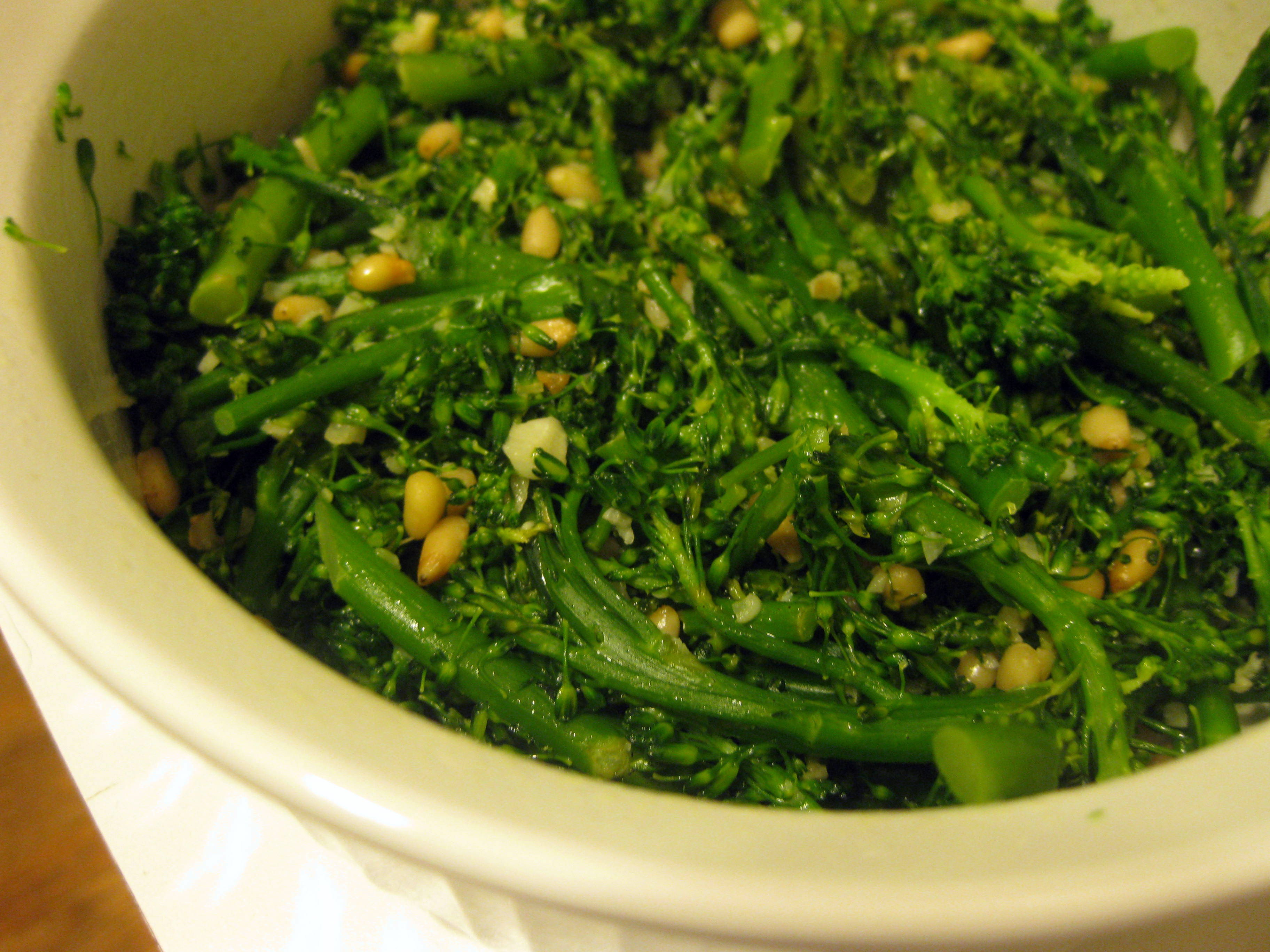
“65. Sauté garlic and pine nuts in olive oil until the garlic softens; add trimmed, blanched, chopped broccoli rabe (or broccoli).  Put into a buttered baking dish, top with Parmesan and bread crumbs and bake until the topping browns.”

As you can see, he gives lots of room for adjustments and personal preference: this is not a recipe, this is a collection of ingredients that dance together well, and what rhythms you might coax them into.  I did the following, in these approximated proportions:

6-8 cloves garlic, smashed and minced

¼ cup pine nuts

2 TB olive oil

2 bunches broccolini (splitting the broccoli / broccoli rabe difference)

½ cup panko bread crumbs

1 TB butter

2 TB Parmesan cheese

I heated the olive oil over medium heat and sauteed away.  Though I can see the need to blanch both broccoli and broccoli rabe before letting it color in the pan with the pine nuts and garlic, my broccolini was a touch on the soft side by the time it came out of the oven, so it probably didn’t need the 3-4 minutes I gave it in boiling water.  Even when I bake them, I like my veggies to maintain a little crispness, and this had almost none.

While the broccolini absorbed the garlicky nutty olive oil in the skillet, I mooshed together my panko, butter, and Parmesan into little crackery clumps.  After spraying a casserole dish with olive oil cooking spray and dumping in the vegetable mix, I topped it with the panko crumbles and stuck it in the oven at 350F for half an hour.  The panko got a little brown, but not quite the golden color I was hoping for.  My thoughts for repairing this are two: 1.) either the oven temperature needed to be hotter, or 2.) I needed more butter in the topping mixture.

This was a good start – aside from the slightly limp broccolini, the flavors were nice and sharp and salivary-gland-inducing.  Garlic and Parmesan are never a bad thing together, and the toasty buttery crunch of the pine nuts went well with the slightly bitter greenness of the broccolini.  We did think, however, that the mix was a little on the dry side.  I was expecting something casserole-ish, and what I got could just as easily have been tossed on a cookie sheet and served: more like roasted vegetables than a finished casserole dish.  It needed, if it was to become a casserole, some kind of sauce or binding ingredient.

Enter the rest of our meal: butternut and pumpkin stuffed shells with gorgonzola cream sauce.

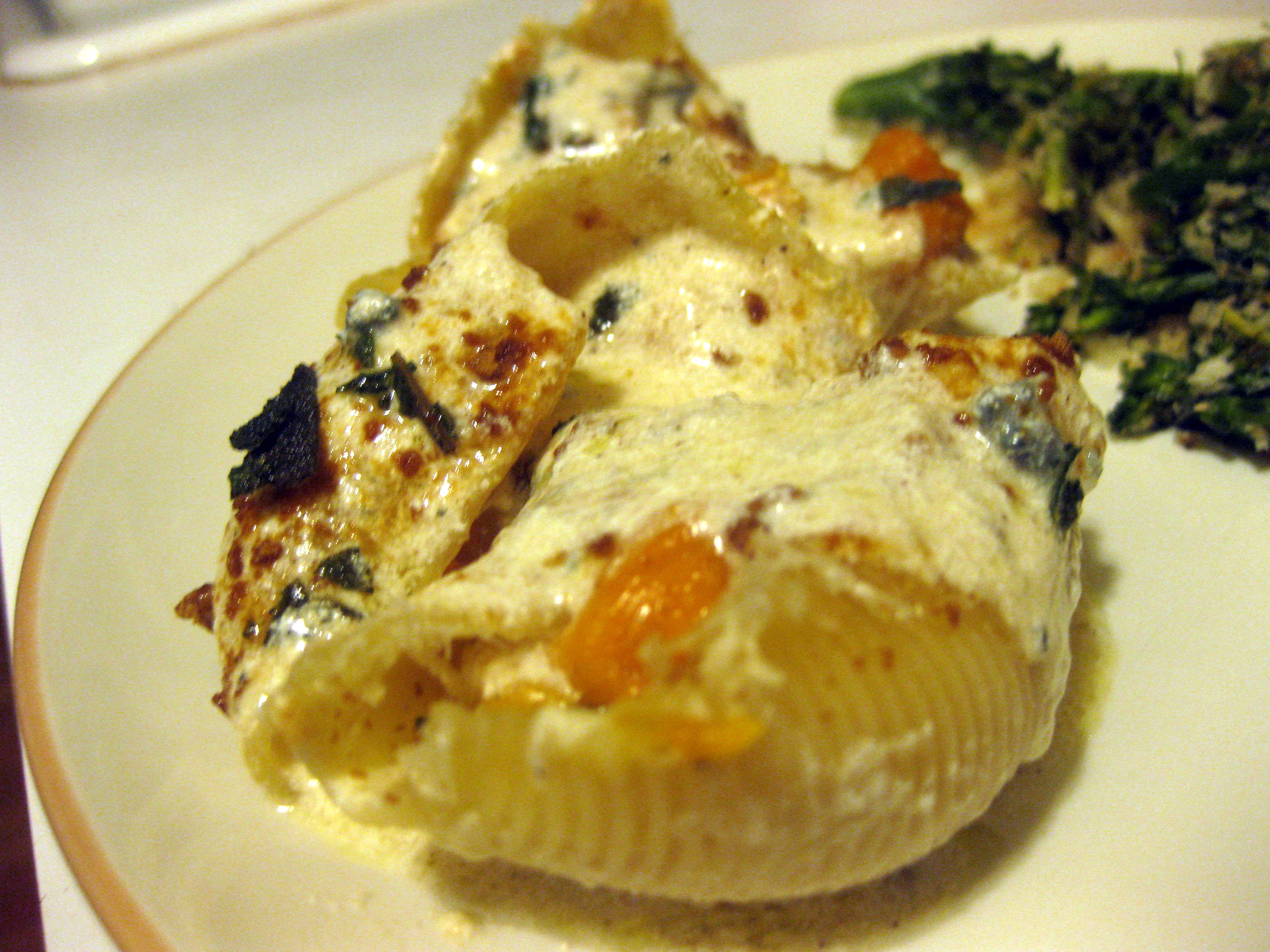
I had some butternut squash ravioli filling kicking around in my freezer, and part of a can of pumpkin in the fridge.  That, along with the half cup or so of gorgonzola in my cheese drawer and the remaining glugs of half and half from a richer project, became a use-all-this-stuff-up-as-soon-as-possible challenge.  I cooked off some large pasta shells, leaving them a little underdone, and arranged them in a pie plate.  Then I added the pumpkin to the squash mixture, loaded into a gallon ziploc bag with one corner snipped off, and piped the filling into my shells.  I dusted them with a snowy layer of Parmesan cheese and loaded them into the oven with my broccolini.

While pasta and veg baked for half an hour, I set my attention to the sauce I was about to make up.  I fried some sage leaves in butter, my new favorite trick, and then lifted them out and set them to dry on a paper towel.  With the sage-infused butter bubbling, I added some wine and let it reduce a little.  Then I glugged in some half and half, which promptly separated a little – I think it was the acidity of the wine and the refrigerator cold temperature of the dairy, which made it want to curdle.  I should have added the half and half first and the wine second.  I was a little worried about this separation, but it only affected the appearance of the sauce, and not the taste or texture.  Onward!  I crumbled my gorgonzola into the pan and stirred gently until it melted.  That was it.  No thickening agents – the cheese did that job for me – no extra spices or herbs or aromatics, just butter, wine, cream, and cheese.

When the shells were done, with just little golden tips on the exposed edges of pasta, I poured the silky rich blue-veined sauce right over top of them.  Then I crumbled my fried sage over the drenched shells, and sprinkled the whole thing with some pulverized gingersnap cookies.  A touch of fancy, if you will.

The shells were divine.  Not much texture, besides the cookie crumbles, but really, don’t you want just velvet and richness in a stuffed shell?  The cheese sauce was the missing link the broccolini needed.  It was tangy and rich and silken and perfect, and I ended up letting it trickle across my plate to meld with the vegetables and gently perfect them.  Next time, we may add a little cheese sauce before baking the broccolini, and see how that turns out.  I imagine the perfect, decadent accompaniment to baked potatoes…

N. has already picked out which dish we will be trying next week, so stay tuned!

2010 Thanksgiving Menu

I get excited about holidays that involve cooking waaaayyyyy earlier than I should (then again, since our Target already has a Christmas section erected, complete with at least six artificial trees, maybe I’m not totally unhealthy).  I even told my mom over the phone this past Sunday that I’d probably go grocery shopping for the holiday late this week or this weekend.  Right, with two weeks to go.  I was already a week ahead of myself and willing to completely skip seven days of reality so I could buy a turkey.

But I love the way food impacts a holiday, and not just because I love eating.  For my family, food has a binding quality.  I love to cook, my mom taught me how and she loves to cook, my sister is developing an enjoyment and adventuresome spirit in the kitchen, and my dad… likes eating the food we make.  But still, it gives us something to talk about, something to share with each other, and something to do together, when we are in the same kitchen.  I feel close to them through the food we create.

At Thanksgiving, my mom and I make most of the dinner, my sister pipes in with seasoning suggestions, my dad carves the turkey, N. tastes things and generally tries to stay out of the way, and Lucy’s nose never stops twitching.  Every hour or so, little click-clacking dog claws tiptoe into the kitchen to take a sniff and clean the floor.

So I’ve already thought through the entire menu.  I know exactly what we’re having.  I’m even contemplating spending my evening tonight making a detailed grocery list for the big shopping trip.  Excessive?  Premature?  Perhaps.  But so delicious.

Here’s the menu for our Thanksgiving this year:

Appetizers: whole heads of roasted garlic with soft goat cheese and toasted baguette, roasted nuts with brown sugar and rosemary, assorted dried fruit.

Dinner: herb roasted turkey with giblet gravy, stuffing, chipotle mashed sweet potatoescreamed spinach and artichoke bake, and whole berry cranberry sauce.

Desserts: Mom’s pumpkin pie with whipped cream, and pumpkin cheesecake squares.  My sister doesn’t love pumpkin pie, so this year there will be two desserts.  If the recipe I invent for her works out well, I’ll post it here.

What are you having for Thanksgiving dinner this year?

Thanksgiving veg 2010

My family always argues over a Thanksgiving vegetable dish.  My dad doesn’t like the classic green bean casserole made with Cream of Mushroom Soup and crispy fried onion ring crumbles.  He can’t get past the condensed soup flavor.  When I asked him last year what vegetable I should make instead, he suggested lima beans.  We made green bean casserole anyway.

One year my Mom and I tried making this dish from scratch.  We figured, fresh green beans lightly steamed, thick chunks of mushrooms, a silky white sauce, and what could be better?  That was the year I determined that part of what I like so much about the classic green bean casserole is… the taste of processed condensed soup.  I can’t help it.  I love the savory, umami saltiness of it, and the homemade substitute was just not an acceptable replacement for me.

One year at Thanksgiving with some family friends, they brought a big salad to supplement our carbohydrate-rich, overloaded plates.  The bowl was passed around the table.  No one took any salad except L, who had made it in the first place.  When she protested, her husband uttered the truest words anyone has ever spoken: “Thanksgiving is not about lettuce.”  So salad, too, failed the test.

Now that October is over, the challenge again rears its head: which vegetables can I dress up to complement the comforting classics we always serve?  While N. was gone at a conference recently, I fiddled around with some trial dishes and voila, Thanksgiving Veg 2010 was born: creamed spinach and artichoke bake.  It’s the comfort and familiarity of creamed spinach, with the flavors and reminiscence of spinach artichoke dip.  Perfection, no?

Here’s what you need:

4 TB butter

4 cloves garlic, crushed and minced

1 – 2 leeks, white and pale green parts only, chopped fine

4 TB flour

Generous grating of fresh nutmeg

2 cups milk or cream

4 oz. cream cheese

At least 10 oz. spinach (that’s the amount in one frozen box, but I used fresh because I prefer it)

16 oz. can of artichoke hearts in water, drained and quartered

Salt and pepper to taste

Topping:

2 TB butter

½ cup or more of Panko bread crumbs

2-3 TB parmesan cheese, grated

Melt the butter in a large skillet over medium heat.  When it is nearly all melted, add the garlic and sauté for just a minute or two, until the aroma is enticing.  Add the leeks and sauté until they are softened.  Leeks are a new love of mine.  They are the least aggressively flavored members of the onion family, and I think they taste like a cross between a sweet onion and garlic.  They don’t have that astringency onions sometimes do, and I think they are like a stalk of springtime.  I’ve started putting them in frittatas, and when I had one left over on the night I made this little concoction, it seemed like the perfect thing to add in.

When the leeks are tender but not browned, add the flour and nutmeg.  Add some pepper too, if you like.  Stir in until well incorporated with no huge floury lumps, and cook for a minute or two until the flour is pale golden in color.  Then add the milk, slowly, whisking the entire time.  I added it in installments of probably half a cup each, stirring until the milk was fully integrated into the flour mixture.  I found this helped avoid lumps, making a smoother base overall.  Add the cream cheese and mix in.  Whisking fairly constantly, let the milk come to a boil.  It will thicken as it heats.

When the milk is quite thick, add the spinach and artichoke hearts.  The spinach will wilt quickly, and as soon as it is looking soft, kill the heat.  Since this is going to bake for a while, you don’t want to overcook the spinach because it will lose its beautiful color and begin to look muddy.

Salt and pepper to taste.  You could stop here and eat this whole delectable mess right out of the skillet, but I wasn’t ready to quit yet.  After all, it takes my dad about half an hour to carve a turkey, so the oven is (mostly) free.  Why not take advantage of that?

With your oven at a preheated 350F, carefully dump the spinach and artichoke mixture into a baking dish (I used a glass nine-inch pie pan).  Set it aside for a moment while you make the topping.

Mix together the Panko bread crumbs and parmesan cheese with the softened butter.  Drop the buttery crumbs in little clumps all over the top of the spinach and artichoke mixture.  If you don’t get the vegetables completely covered, that’s okay.  In fact, it’s good, because it means any exposed edges of leeks or artichokes will get a little toasty and golden.  More texture = more exciting to eat!

Bake the whole thing for about half an hour at 350F, or until the crumbs on top are browned and the sauce is bubbling at the edges.  Remove and consume.

What I liked about this dish was… well, innumerable.  But the basics: I love creamed spinach, and this was a more extravagant, luxurious take on it.  I also love spinach dip, and this reminded me of it, but without the excessive mayonnaise, the MSG-laced spice mixture, or the pounds of parmesan that go into a hot artichoke version.  The bread crumbs on top were a welcome textural element, especially for a Thanksgiving table, where stuffing, mashed potato, and even the tender juicy turkey, all lack an essential crunchiness.  Not that you would want your mashed potatoes to be crunchy, but it is a sensation for your mouth often missing from this meal.

I told my mom about this dish when I spoke to her on the phone this weekend, and before I could finish explaining what it was, she had already confirmed that this, indeed, would be our Thanksgiving vegetal offering.  Challenge met, and challenge exceeded!  Now I just have to wait for the end of November…