Ranch Biscuits

We are still awash in boxes (and the desktop computer that I use for photo editing is still sitting in a closet, so these are straight from the camera shots) in this new house that is our house (our house! That is ours! No more landlord! I’m just a little bit excited about this…), but it is starting to feel like home. This “like home” is a different kind of “like home” feeling, though – unlike any I’ve felt thus far in my adult life. Previously, “home” meant “a place I will live for a few years.” It meant “this space I occupy but will, at some point, move on from.” While there is certainly the possibility that at some point, some day, we will dislodge ourselves from this house, it won’t be for a while. This is a place to actually do all those “maybe someday” things we’ve put off: lining drawers. Acquiring “grown-up” bookshelves (read: shelves that actually cost more than $30 or so). Planning and planting a vegetable garden. Finally framing those diplomas. And as anxious and antsy as I am to have it “finished,” we don’t have to do those things immediately, because we’re going to live in this lovely, quirky little house for a long time.

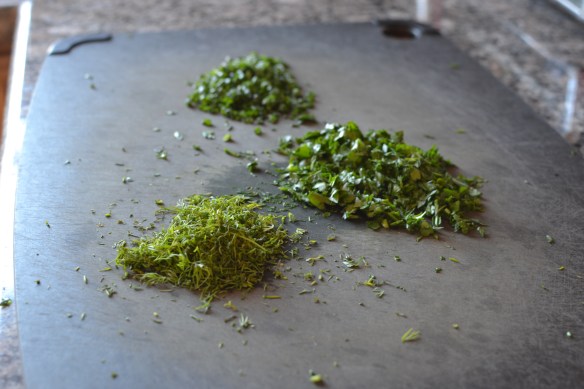
None of that is a beautiful transition into these biscuits, though don’t they look nice against that backsplash? (I promise I’ll stop talking about the backsplash soon.) They’ve been hanging out at the back of my consciousness for a while now, poking at me, and now that it’s grilling season and all I want to do is sit out back with a very cold drink and watch N. manhandle well marinated beef on the grill, I thought these would make a nice accompaniment to anything barbecue related. The flavors of ranch dressing in a sky-high biscuit make sense. I mean, they already share buttermilk in common, and herbs like dill and chives are a lovely way of perking up your average biscuit and making it more interesting. The kick of garlic, of onion powder, and of a little dry mustard could do nothing but improve the whole situation.

Aided by my adaptation of Ruhlman’s folding and turning method for biscuits with well-puffed layers, these inflated gorgeously in the oven and found their way in multiples to our plates (the first set we tore through were still so warm it was hard to discern the individual flavors). We inhaled the batch in a day and a half, and while they were delicious – herby and kicky and tangy from the buttermilk – we realized while devouring our second helping that we weren’t sure precisely how closely their flavors mimicked ranch dressing, since it had been so long since either of us had tasted that childhood standby.

So here’s my thought for you, as the fourth of July, that ultimate of grill-based holidays, approaches: if you try these, as a side for your ribs or a mop for your baked beans or an ever-so-tolerant napkin for the drips of melted butter coursing from your corn (oh, or maybe even as a sandwich base for the leftovers, with a slick of mayonnaise on both split sides to add that final missing ranch-y ingredient), will you let me know, friends, if they remind you of ranch dressing?

Ranch Biscuits
Makes 9-10 3-inch biscuits
30-40 minutes
2 cups all-purpose flour
1 teaspoon sugar (I like turbinado, but any granulated sugar will do)
1 teaspoon salt
2 tablespoons baking powder
1 teaspoon onion powder
1 teaspoon dry mustard
¼ teaspoon paprika
¼ teaspoon ground black pepper
2 tablespoons finely chopped dill
2 tablespoons finely chopped chives
2 tablespoons finely chopped parsley
2 garlic cloves, finely minced
6 tablespoons cold butter, cut into chunks
6 ounces cold buttermilk (about ¾ cup)


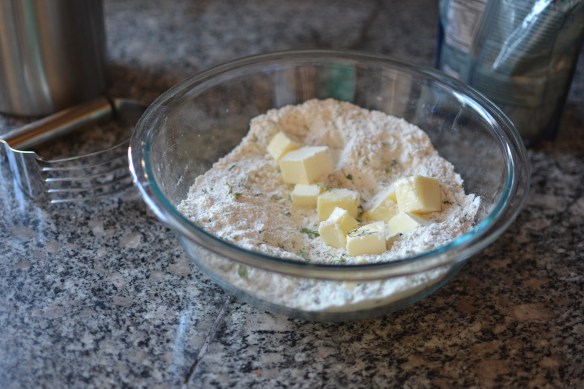
  • Preheat your oven to 400F and line a baking sheet with parchment paper. In a medium bowl, whisk together the flour, sugar, salt, baking powder, onion powder, dry mustard, paprika, and black pepper. Add the finely chopped herbs and the garlic and whisk well to ensure even distribution (these wetter ingredients will want to clump together).
  • Plop in the cubes of cold butter and use a pastry cutter or your fingers to work the fat into the flour mixture. You are looking for butter bits the size of small peas. Pour in the buttermilk and use a fork or your fingers to mix it through the flour and butter mixture and bring the whole thing together into a shaggy, soft ball of dough (if it seems too dry and is not coming together, just set it aside for a minute or three – this will give the flour time to absorb the buttermilk a bit more).
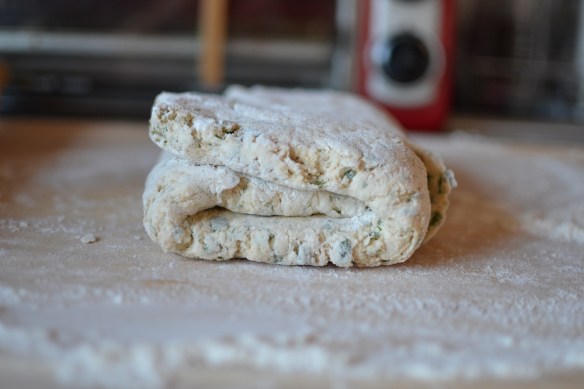
  • Turn the dough out onto a well floured board, sprinkle some more flour on top, and knead with your hands two or three times just to catch any loose bits. With a rolling pin or your hands, press or roll the dough into a rough rectangular shape about ½ an inch thick. Fold the dough into thirds, then roll out again. Repeat, again folding the dough into thirds and then rolling it out; this creates more flaky layers. If the dough sticks to your board, use the flat blade of a butter knife or a pastry scraper to help you lift it free.
  • After you’ve rolled and folded, rolled and folded (so you’ll have done a total of six folds), roll out once more, this time to a thickness of 1 inch, and use a 3-inch round cutter (or the lip of a glass) to punch out biscuits. Push the cutter straight down through the dough; don’t twist until you are all the way through to the board, or you’ll crush the flaky layers! Repeat, placing the biscuit rounds on your parchment lined baking sheet, until you can’t punch out any more rounds. Re-roll the dough scraps (no need to fold again unless you want to) and repeat – with a 3-inch cutter, you should be able to make 9-10 biscuits about 1 inch thick.
  • Arrange the biscuits, evenly spaced, on the parchment lined baking sheet and bake for 18-20 minutes, until they are well puffed and the tops are pale golden and slightly dry.
  • Let cool for just a minute or two, then wrap up in a basket or stack on a tray, and watch them disappear.
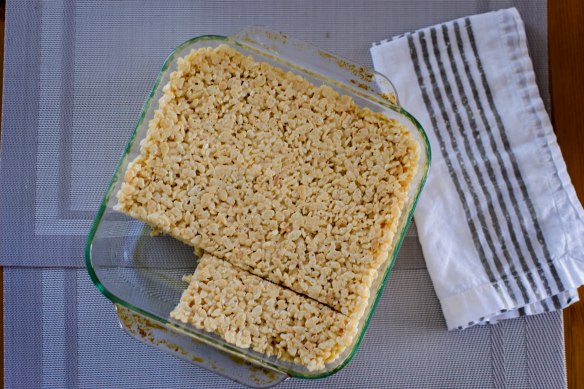
Miso Brown Butter Krispie Treats

This one is, I have to admit, a bit of a cheat. But when it’s the day after the horror that is the spring time change, a fifteen minute “baking” project that barely adapts perfection is about all a person can be expected to churn out.

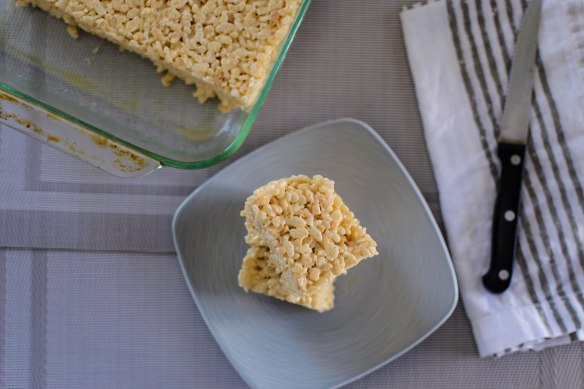
Have you had Smitten Kitchen’s salted brown butter crispy treats? Please tell me you have. It’s one of the recipes that was so successful on her blog that she put it into her first cookbook as a tried and true favorite. One of our friends calls them “the precious” and I have to say, he’s not far off. The same old gooey, crunchy squares from childhood, but bumped up with the nutty toastiness of brown butter, and a judicious sprinkle of sea salt that makes them fly. We first discovered them through a batch S. made, and she consequently became our dealer while we were in Oregon, though now that we’re so many miles separate from her I’ve had to take up the mantle myself.

I’m not sure what gave me the idea – perhaps seeing several miso caramels on Food Network, or maybe SK’s own miso caramel corn – but the idea of adding a scoop of miso paste to these already flawless squares seemed to toe the line between genius and potentially horrifying.

So I did it.

The result is, surprisingly, somehow butterscotch-esque, despite no brown sugar or vanilla in the mix, and completely addictive. There’s no flaky sea salt anymore – the miso has plenty of salinity of its own – although I think you could get away with a tiny sprinkle if you can’t do without so I’ve made it optional, and I don’t even think you’d need to brown the butter, but I still did because since it needs to be melted anyway, it’s not really that much more effort.

So here, backed by Deb’s ingenuity and a mere four ingredients (well, five if you add salt), is my offering for you today: all the goo, all the sweetness, all the crunch, but with a new twist that will, I suspect, leave you tasting, and tasting again, and suddenly wondering where the whole pan got off to, because you couldn’t possibly have just eaten the entire thing…

Miso Brown Butter Krispie Treats
Marginally adapted from Smitten Kitchen‘s salted brown butter crispy treats
15-20 minutes
Makes 8×8- or 9×9-inch square pan of treats
8 tablespoons unsalted butter (½ cup; 4 ounces)
1-1½ tablespoons miso paste
⅛ teaspoon salt, optional
10 ounce bag of marshmallows
6 cups crisped rice cereal


  • Butter or spray an 8×8 or 9×9 inch pan, then set aside.
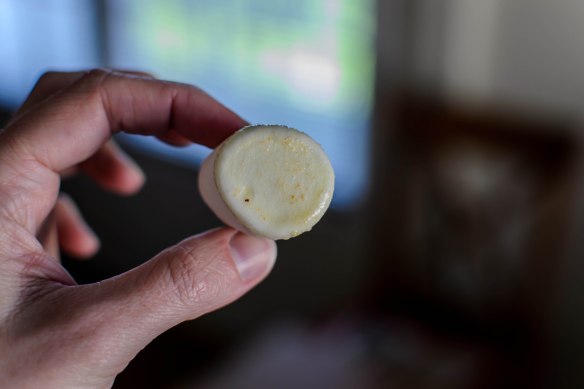
  • Add the butter to a saucepan and melt over medium heat. Once it has completely melted, turn the heat down to medium-low and keep an eye on it as it foams up, then subsides, then starts to brown into toasty little bits on the bottom of the pot. It’s easiest to use a pot that does not have a dark surface, since you can see color changes in the butter more easily. If your pot has a black surface, though, and you think you’re there, you can quickly dunk in a marshmallow and see whether the butter it captures has brown flecks in it (then, if you must, you can eat it). The moment you discern these little brown flecks, turn the heat off so the butter solids won’t burn.
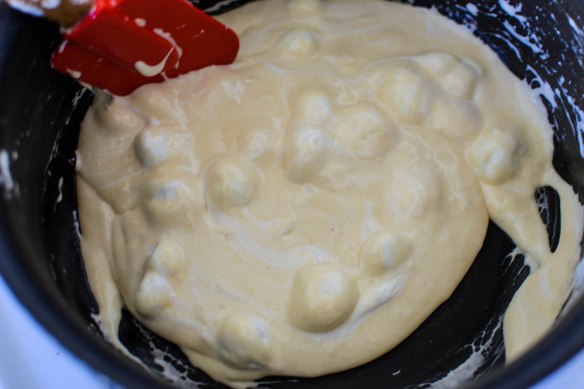
  • With the heat off, add the miso paste, the salt, if using, and the marshmallows. Stir firmly with a flexible rubber spatula, being sure to distribute the miso paste evenly. The residual heat should be enough to melt the marshmallows, and you’ll end up with a sticky, pale golden pool of goo. Add the 6 cups of cereal all at once and stir in. You’ll need to be quite firm, again, to ensure even distribution.
  • Dump and scrape the cereal mixture into the prepared pan and press down firmly into an even layer, being sure to push it into the corners as well. You can use the same rubber spatula for this, or a piece of waxed paper, or the bottom of the cup measure you used for the cereal – it shouldn’t stick too much.
  • Set aside until fully cooled, then cut into squares of your desired size and consume.

Guest Post: Cheddar and Green Onion Sourdough Artisan Boule

Guest post from my friend and colleague (frolleague!) K., with whom I discuss bread baking procedures and triumphs on a frantic, high-volume, excitable and regular basis. Enjoy!

BlackberryEating has officially declared 2017 the year of the soup project just in time for the cold reality of this winter: Montana is 40 below, New England is buried in snow and West Coasters down to San Diego are cold and wet from an atmospheric river that’s brought more rain in the last six weeks than in as many years.

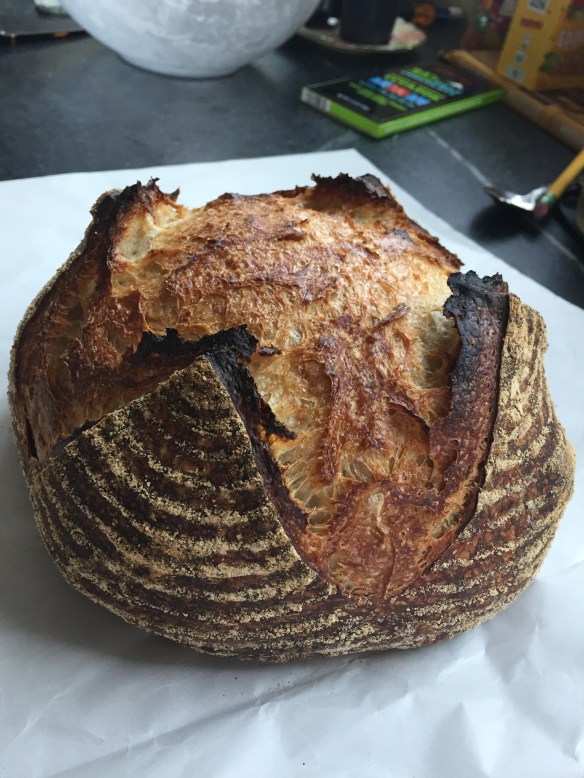
So let’s honor this project with really good bread, the stunning artisan kind, with the open crumb, shattery crust and intense bread flavor that will drive. your. people. wild. And since everyone knows that good bread is made — not bought — this homemade cheddar onion sourdough boule will be the perfect compliment to a comforting pot of simmering soup — unless you eat it before the first ladle of liquid hits the bowl, which can happen.

image-1-pretty-loaf

A few caveats before the formula:

1) Don’t have a sourdough starter? Make one. You’ll never buy commercial bread or use commercial yeast again. Loaded with hydrogenated oils, nitrates, sugar, bleaching agents and other harmful substances, store-bought bread is just plain bad for you. And commercial yeast is devoid of the healthful bacteria that makes fermented food so darn healthy. Breads made from commercial yeast go stale faster, taste blah, are harder to

digest, and have a higher glycolic index, among other issues. This makes commercial bread profitable and convenient, but not good and healthy.

“Sourdough Starter, America’s Rising Pet” by Sam Sifton, which ran in the NYT recently, says it all. Once you get your starter fermenting on a regular schedule — rising up and then collapsing back in a consistent manner — it’s ready to use in your bread.

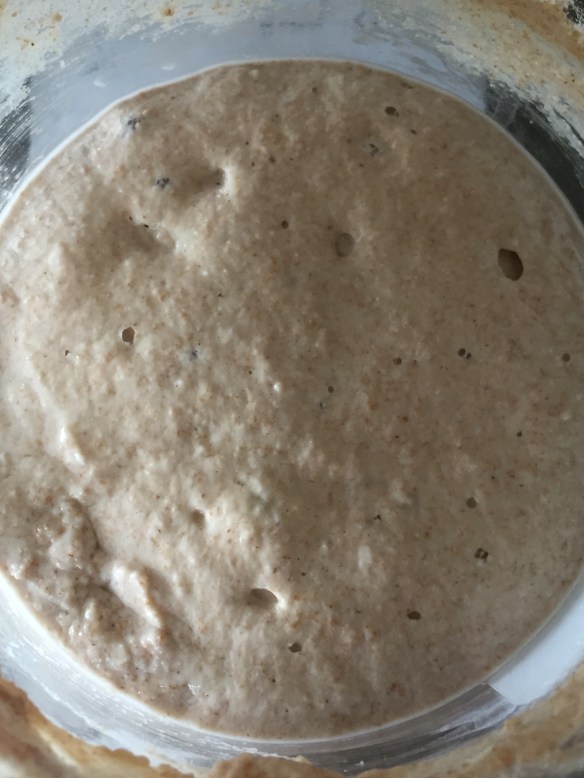
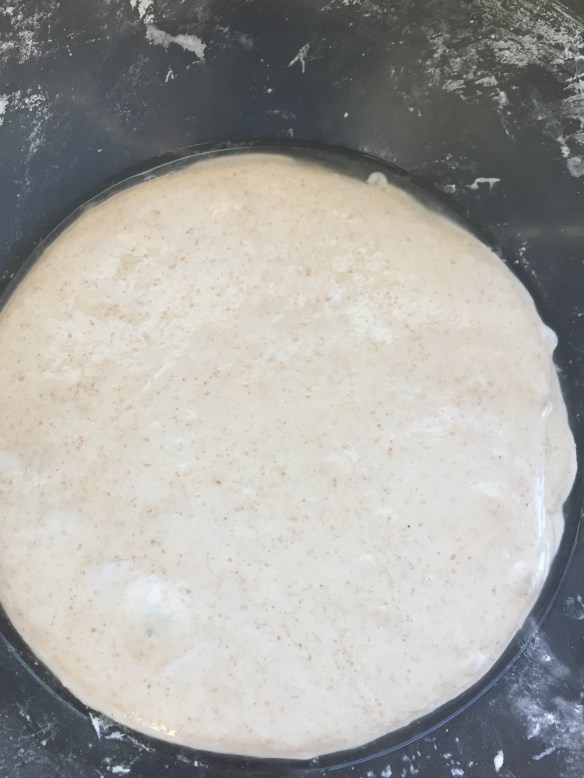
I started mine more than two years ago. The directions I was reading said starter consists of flour, water and wild yeast. I tried to order the wild yeast on Amazon. Nope. I Googled it. Nothing. What? Eventually I figured out that the wild yeast are in the air all around me (duh) and you catch them by mixing equal parts flour (50/50 mix of King Arthur’s all-purpose and wheat flours) and filtered water and then waiting. Within a week the starter was bubbling, and now it’s fast and strong. I feed it daily, sometimes twice.

image-2-starter

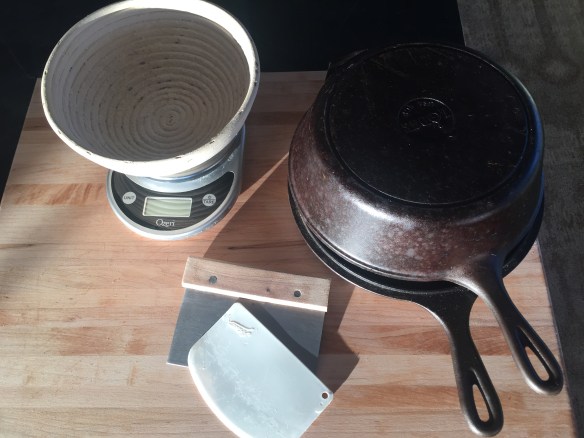
2) Invest in the basic bread-making tools: a bench knife, dough spatula, scale, banneton, thermometer, and cast iron combo cooker. You need these to turn out dazzling, delicious bread.

image-3-tools

3) Using the very best flour possible makes a huge difference. I use a combination of King Arthur Bread Flour and 10 – 20 percent high extraction wheat flour from Grist and Toll in Pasadena, the only local miller I’ve found in the greater Los Angeles area. They use a stone mill to make whole-grain, small-batch, fresh, local organic flour. And they ship! I love the hard white for its mild nutty flavor. Grist and Toll flour creates a silky, manageable dough that is loaded with nutrition. Read about stoneground, high-extraction flour here.

image-4a-and-5a-ka-bread-flourimage-4b-and-5b-g_t-wheat_

4) Be patient. Start your dough the day before you make soup and refrigerate it overnight for a next-day bake. It’s easy to make bread, but fermentation takes time. And good dough handling takes a minute, but you’ll get it, and you’ll be so glad you did. Homemade bread is a game changer. And don’t worry if the first few loaves don’t turn out perfect. Just eat them and start again.

Cheddar and Green Onion Sourdough Artisan Boule (perfect for two with a pot of soup)
The Formula
300 grams flour (270g King Arthur Bread Flour & 30g Grist and Toll Red Fife)
225g water, slightly warmed
75g starter (It’s ready to use when it’s on the rise and a bit of it floats in water.)
5g Kosher salt
4oz. sharp cheddar, cut into small cubes and brought to room temperature.
¼ – ½ cup chopped green onion (I chop them thick) and brought to room temperature.
Cornmeal or polenta for dusting
Razor blade

The Dough

  • Pour 210g warmed water in a clear bowl.
  • Add starter and mix until incorporated.
  • Add flour and mix into a shaggy dough. Let it sit for half hour.

image-6shaggy-dough_

  • Add the salt and the rest of the warmed water. Dissolve the salt in the water and work it into the dough by folding it in or cutting it in. Let it sit for half an hour.

image-7autolyse_

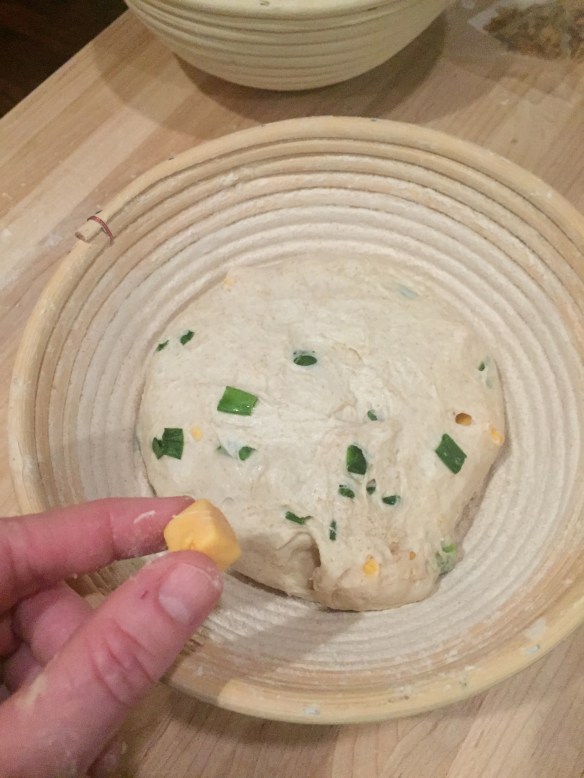
  • Flatten the dough out a bit, spread the cubes and press them into the dough. Do your best to space them out. Do the same with the onion.

image-8-cheese-and-onion-in-dough_

  • Pull all the dough edges up and fold over, encapsulating the cheese and onion.
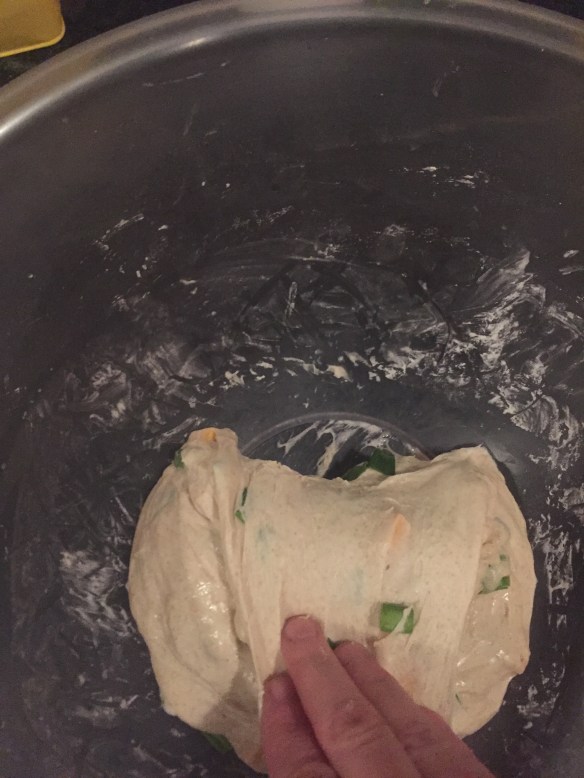
  • Leave it for 45 minutes, then stretch and fold again. Repeat every 45 minutes (or so) for the next several hours, until the dough starts to get fuller and come together. This will take time. Give it 4 to 6 hours and 6 to 8 stretch and folds. Be patient and get gentler with your folds as you go.

image-10-stretch-and-fold

  • Once the dough is noticeably a bit puffy and fuller, turn it onto a floured board. Lightly flour the top and flip it over using the bench knife. Do one more very gentle, half-hearted round of folds, so the dough is roughly round, and gently flip it back over.

image-11-rough-round-bench-rest

  • Let it sit for half an hour.
  • Lightly flour the top. Flip it again and do a final fold. Start your fold at the top edge, then the right side, then the left, then fold the edge nearest to you up and over and keep rolling the whole ball so the seam side is down.

There is your boule!

image-16-final-boule-dough

  • Spin it once or twice on the board to seal that bottom seam. Flour your banneton well. You don’t want the dough sticking to the banneton.
  • Slide your bench knife under the boule and gently place it upside down (seam side up) in the banneton.

image-17-dough-in-banneton-cheese-chunk-removal

  • Cover with foil and put in the fridge to bake the next day.

The Bake

  • Place your combo cooker in the oven and preheat to 500 degrees. Once preheated, wait another 20 minutes. You want it screaming hot.
  • Take your dough out of the fridge. I pluck any cheese cubes that are sticking way out of the dough.
  • Take the combo cooker out of the oven using heavy silicone mitts. Take the top off and dust the bottom of the cooker with cornmeal. It will smoke but that’s OK.

image-18-cornmeal-in-combo-cooker_

  • Lightly flour the seam side of your dough and your hands and then gently turn the dough out into the bottom of the combo cooker. Be careful. That sucker is hot.
  • Using a new razor or ultra-sharp kitchen knife, slice a cross into the top of the dough. This allows the bread to expand and rise to its full potential.

image-19-score

  • Replace the top and put it all into the oven. Cook for 10 minutes, then turn heat down to 450. Cook for another 15 minutes, then remove the top. Watch your eyes! You will release a cloud of hot steam.
  • Cook another 15 -18 minutes. Bake it out strong but don’t burn it. You want the internal temperature to reach at least 210F.
  • Put the loaf on a rack and let it cool, sitting there being beautiful while you make the soup. It’s a fine companion.

image-20-final-loaf

P.S. After you’ve demolished the loaf, keep those crumbs for mac and cheese.

Save

Carrot and Sweet Potato Salad with Lime Vinaigrette

2016-food-blog-september-0821I mention my sister pretty frequently in this little space. Although she lives across the country from me, across disciplines, across life experiences, across personalities, she is my kitchen sounding board. When I think of a recipe concept and I can’t decide whether it sounds amazing or insane, I text R. When I have a triumph or a disaster, I text R. When I find a recipe online that I know MUST be tried… you get the idea.

2016-food-blog-september-0798In three little weeks, R. is getting married. I feel incredibly privileged that she has asked me to stand beside her in her wedding party as the woman of honor. We’ve spent the past year or so discussing little details and working through planning frustrations and pinning, pinning, pinning to her wedding pinterest board. And yet, because so many miles separate us geographically, I can’t do the things that my role in the wedding party traditionally requires of me. I can’t plan a bridal shower or a bachelorette party, because I’m only hopping on a plane to get to the wedding a few days before it happens. I can’t coordinate all the bridesmaids, because, well, because R. is such a good planner that I haven’t had a chance. Sure, I can do her makeup and hold her bouquet and give a toast on the big day, but it doesn’t feel like enough for my own sister.

2016-food-blog-september-0808Since so much of my love is filtered through food, it was, of course, a menu that finally made me feel like I was contributing sufficiently. R. and her fiancé aren’t having a rehearsal dinner, mostly because they aren’t having a rehearsal – their venue is an hour away from their home, and it seemed like a lot of trouble to truck out there the morning before just to spent twenty minutes deciding who will stand where and in what order when we could just get there a little early the day of and do the same thing. But we will have a lot of family arriving to town the day before the wedding, so having a casual little dinner the night before did seem like a nice thing to do, and this “welcome dinner,” as we’re calling it, became my responsibility. I’ve plotted out a menu, created and sent invitations, and this weekend, did a run-through of one of the new dishes we’ll be making for the occasion.

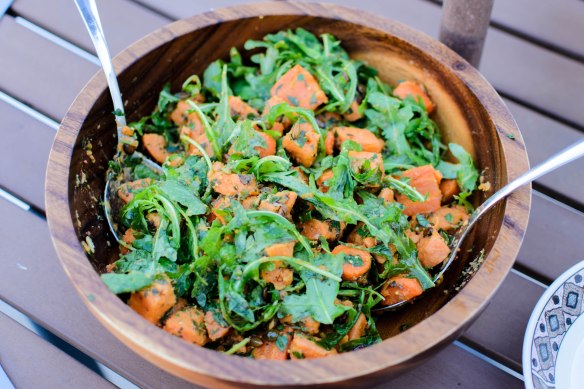
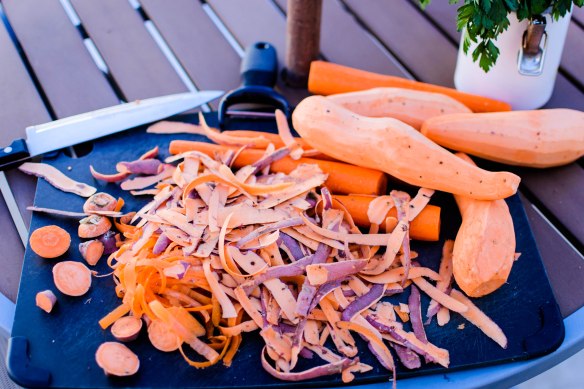
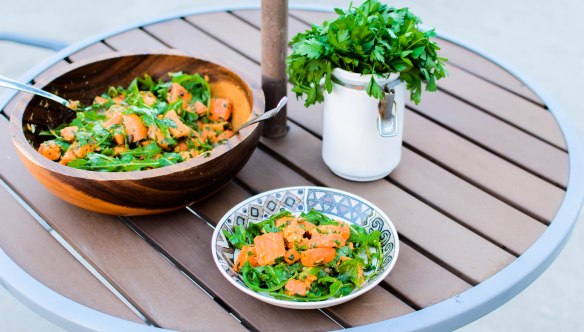
2016-food-blog-september-0809The dinner is in a park at a picnic shelter, so we are leaning largely on casual fare, but because it’s such a special occasion, we wanted a cut above your standard hamburger patties and potato salad. Since it will be mid-October, and it has been R’s dream to have a fall wedding for a very long time, we are working with an autumnal theme – there will be spiked and non-spiked apple cider, a slaw of brussels sprouts with toasted walnuts and dried cranberries, a substantial pasta salad with robust dressing and bitter radicchio threaded through, and this: a salad as good warm as it is cold or room temperature, of tender carrot and sweet potato chunks wrapped in a lime vinaigrette busy with herbs. To keep it light as well as autumnal, at the last minute the vegetable chunks get tossed with a scattering of well-toasted pumpkin seeds and a few big handfuls of delicate baby arugula.

2016-food-blog-september-0815The seed for this salad idea came from a Bittman project recipe, and I’ve tweaked and fiddled with it a few times now, until this iteration seemed exactly right. Virginia in October, which is where and when we’re headed, is a funny transitional point on the space/time continuum. It can be downright chilly, but it can also spike back up into summer temperatures, or it can gift you with a sudden downpour. It’s hard to know which you’re going to get, and sometimes it might offer up some of each in the same day! This salad dances well with them all. The orange root vegetable base and the pumpkin seeds point straight at Halloween and Thanksgiving, but juxtaposing them with a bright lime vinaigrette and soft, summery herbs makes the finished dish feel light. I ended up adding a spoonful of whole grain mustard for another kind of tartness, and this along with the peppery arugula prevents the starchy vegetables from reading too sweet.

2016-food-blog-september-0818Though I like the salad just how it is here, it is admittedly ripe for adjustments of all kinds. Replacing the pumpkin seeds with roasted pistachios might take things in a springy direction, and you could certainly bulk it up a bit with crumbled feta or goat cheese or even golden raisins, though these might tip the sweetness scales a bit overly much. You could use orange or lemon juice instead of lime in the vinaigrette, you could replace the arugula with baby spinach or kale and serve it warm; you could of course change out the herb combination to your preference. Add some nicely grilled bratwurst, or stir in a few ladles of buttery couscous or farro or quinoa, and you have a complete meal.

2016-food-blog-september-0824As I kept thinking about this salad, I realized it was ideal in so many ways. Since it can be served warm or cold, it works with whatever version of fall your home might be throwing at you – whether it’s the decidedly fall evenings in the northeast, or the Santa Ana wind-riddled mid-90s madness in Southern California. This is a transitional salad for a transitional season. And forgive me as I wax poetic on you, but it is also a nice metaphor for the occasion: a salad that moves easily between meteorological seasons seems perfect for a couple about to transition between seasons of life.

2016-food-blog-september-0836

Carrot and Sweet Potato Salad with Lime Vinaigrette
Serves 6 as a side
45-60 minutes including cooling time
1 pound carrots (about 4 large)
2 pounds orange-fleshed sweet potatoes (about 4 medium)
2 tablespoons salt
¼ cup pumpkin seeds (2 ounces)
1 tablespoon whole grain mustard
1 tablespoon honey
6 tablespoons lime juice (2-3 limes)
¼ cup olive oil
¼ cup chopped fresh parsley
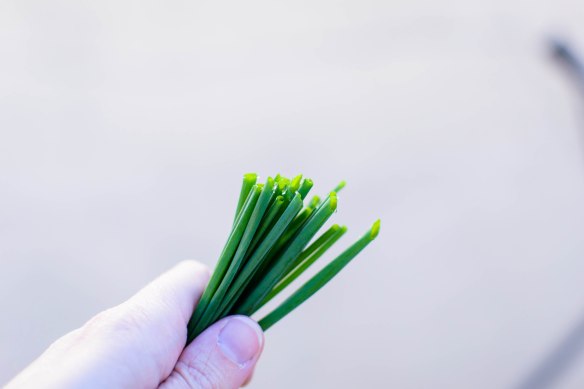
2 tablespoons chopped chives
2 tablespoons chopped mint leaves
¼ teaspoon black pepper, or to taste
1-2 cups baby arugula


  • Fill a large pot about ¾ of the way full of water, add the 2 tablespoons salt, and bring to a boil.
  • While you wait for the water to heat, peel the carrots and sweet potatoes and cut them into 1-2 inch chunks, a bit bigger than bite-sized.
  • When the water reaches a rolling boil, add the carrot chunks and cook for 5 minutes with the lid off – the carrots will take a bit longer than the sweet potatoes.
  • After the first five minutes of cooking, add he sweet potato chunks and continue to cook until the vegetables are tender but not mushy or falling apart – about 8-10 minutes depending on the size of your chunks. Immediately drain and set aside to cool for 10-15 minutes, then transfer to a large bowl.
  • While the vegetables are cooking, toast the pumpkin seeds in a 350F oven until they are browned and popping – about 5-10 minutes. A toaster oven works really well for this if you don’t want to heat up your house too much. When they are ready, set them aside to cool.
  • In a 2-cup glass measuring cup, whisk together the honey, the mustard, and the lime juice. Slowly drizzle in the olive oil, whisking constantly, to form a nicely emulsified dressing. Stir in the herbs and add black pepper to taste.
  • After the cooked vegetable chunks have cooled for 10-15 minutes and been relocated to a large bowl, pour the dressing over them and toss gently to coat everything evenly.
  • If you want the dish to be warm, add the arugula and pumpkin seeds, toss gently to combine, and serve immediately. The greens will wilt considerably as they hit the warm vegetables.
  • If you prefer the dish at cold or at room temperature, wait to add the arugula and pumpkin seeds until just before serving.
  • This will keep in the refrigerator for a day or two, though any greens you’ve incorporated will look considerably less sprightly after the first day.


Blackberry Spring Rolls

2016 Food Blog August-0725Obvious confession: I haven’t been very good at keeping up with my 2016 blog challenge this summer. I mean, I haven’t been stellar at keeping up with blogging in general, but the challenge fell by the wayside pretty significantly. Let’s climb back onto that horse.

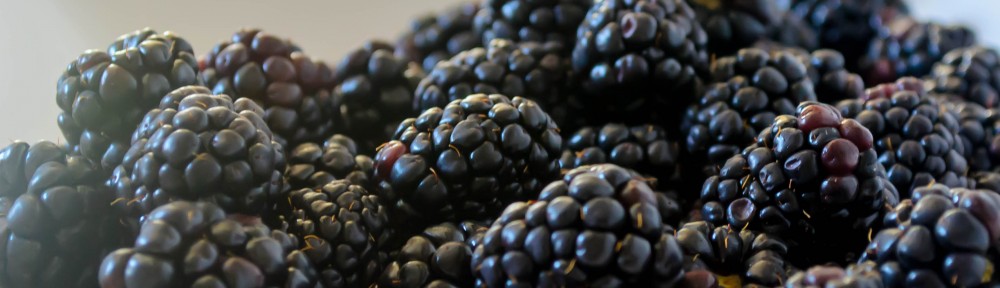
2016 Food Blog August-06912016 Food Blog August-0698It’s fun to try to guess why various search term combinations might have led to my site in particular. Some I can’t even begin to imagine, but some – like this one – are fairly obvious. A site eponymously dedicated to the summery multi-faceted gems that are blackberries should really have more berry-centric recipes, despite the fact that the name has nothing to do with my food predilections and everything to do with my inescapable fondness for literature. (Also, if you like spring rolls and haven’t made these, get thee to the kitchen!) Two birds with one recipe, then.

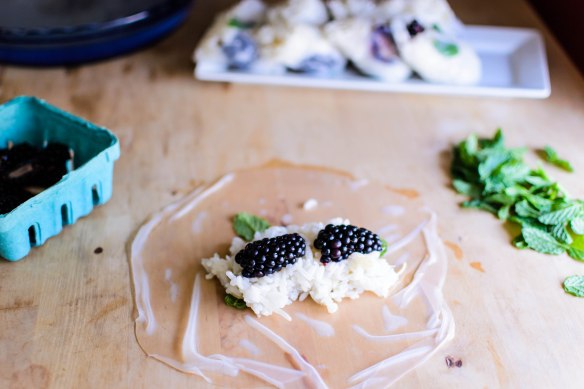
2016 Food Blog August-0700In trying to imagine what a blackberry spring roll would consist of, I veered sweet almost immediately. Blackberries can be tart, but they also have a deep lushness that begs to be bolstered with sugar in some form. Since I can’t see fit to make a spring roll without mint (seriously, it is key), I had to find some kind of filler that paired well with the fresh coolness of mint and the dark tart-sweet of blackberries, and landed on coconut rice. Some shredded coconut in there as well for extra flavor and texture, and a sprinkling of finely chopped crystallized ginger, and these funny little rolls were sounding promising.

2016 Food Blog August--5Filled, pressed, rolled, and sliced, they were indeed promising – delicious, in fact – if a bit odd. When I sampled the first one, I found I wasn’t sure whether I liked it. Then I found myself eating the third, and decided I must. Blackberries and coconut are not a pairing I think of immediately, but henceforth I will, as should you. The tart berry is perfect to cut through the luxurious fattiness of the sweet coconut, like a dish of berries and whipped cream with an extra, tropical flavor. The mint and ginger, since they are good with both, complement equally, adding a breath of freshness and a warm, sweet spice to keep things interesting.
2016 Food Blog August-0703Further, it was an interesting exercise to decide what sort of snack this was. Inescapably sweet, yes, but not quite a dessert. Upon discussion my sister and I decided they would work well as a palate cleanser on an eclectic brunch table, or perhaps an offering at something delicate and fancy, like a certain sort of baby or bridal shower. I used sweetened shredded coconut, but you could certainly use unsweetened and end up with a slightly more savory product.

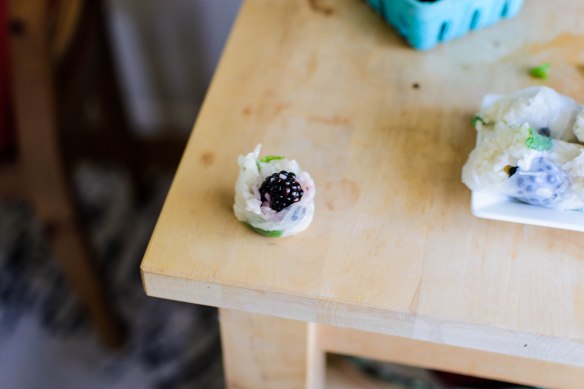
2016 Food Blog August-0713As with any spring roll, these are a project. You do have to compress the rice filling pretty assertively to get a nice, tight roll, and the blackberries and mint leaves need to be arranged just so to make them pleasingly visible in the finished product. Typically spring rolls are sliced in half on a bias to expose the lovely filling; doing so does bring these closer to bite-size, but it also gives the rice opportunity to spill out, and since the blackberries are only present in a few key spots, it doesn’t have the same aesthetic advantage. The presentation of these rolls is about the exterior – they have a stained glass window effect, as the veins of the mint leaves and the individual little drupelets of the berries press invitingly against the translucent wrapper.

2016 Food Blog August-0723After a few more left the platter, I thought about what else could be done with these. Rice, a blackberry or two, and a few mint leaves are a lovely combination, but perhaps almost too stark. Mango chunks, then, could be added if you want to up the fruit quotient, and in addition to, or perhaps instead of, the crystallized ginger, you could add some lime zest to the rice. Thai basil could replace or supplement the mint for another herbaceous note. I even considered wafer-thin slices of jalapeno, either raw or candied, for a different kind of heat.

2016 Food Blog August--2-32016 Food Blog August-07052016 Food Blog August-07062016 Food Blog August-07072016 Food Blog August-0708

Blackberry spring rolls
10-12 spring rolls (20-24 halves), depending on size and quantity of blackberries
45-60 minutes
1 cup cal rose or other short or medium grain rice
14 ounce can of coconut milk + 2 ounces water
1 cup shredded coconut, sweetened or unsweetened
3 tablespoons finely minced crystallized ginger
30-40 spearmint leaves
1 pint blackberries, rinsed, gently dried, and halved
Rice paper wrappers (I like the brand with the rose on the packaging)
Warm water


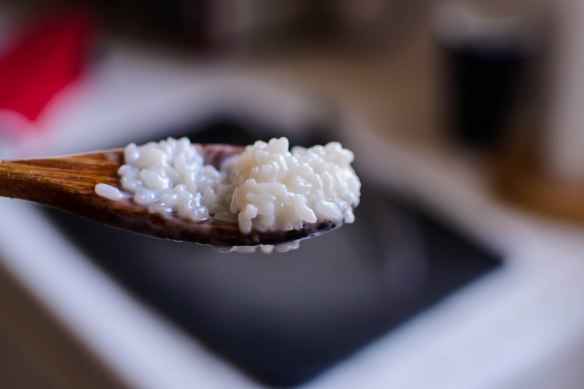
  • Combine the rice, the coconut milk, and the 2 ounces of water in a medium pot, cover, and bring to a boil. Stir quickly, replace the lid, and lower the heat to a simmer. Cook 15-20 minutes, until the liquid is absorbed and the rice cooked through. It will be very creamy, which will help it stick together in the roll.
  • Stir the shredded coconut and the minced ginger into the hot rice, then set aside to cool until just warm or at room temperature.
  • While the rice cools, pluck the mint leaves and prepare the blackberries.
  • To roll, set up an assembly line – mint, then blackberries, then rice mixture. Be sure to have a plate or other vessel on which to place your finished rolls at the end of the line-up. Add warm water to a wide, shallow dish or bowl that the rice paper will fit into. You will address this step first.
  • Submerge one rice paper wrapper in the warm water and let it sit until it becomes completely pliable. I find this tends to take somewhere between 30 and 45 seconds.
  • When the rice paper is ready, remove and place on a flat surface. If you wish, you can briefly spread it on a paper towel to soak up some of the drips, but this isn’t strictly necessary.
  • Place 3-4 mint leaves around the rice paper wrapper, bottom surface facing up. This ensures the top, more attractive side of the leaf will be visible through the wrapper on the finished roll.
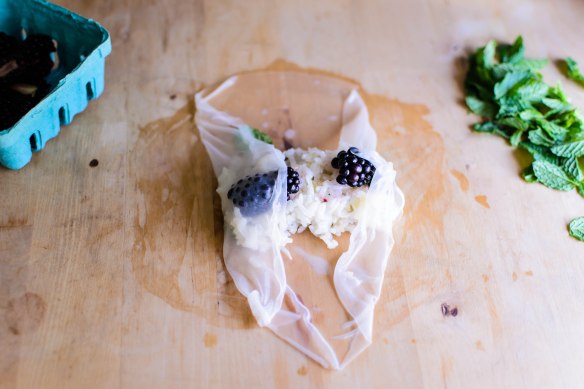
  • Now, place two blackberry halves, cut side up, about a half inch apart in the center of the wrapper. Top the cut berries with 2 tablespoons of the rice mixture. With damp hands, press the rice mixture gently together in a log shape down the middle of the wrapper; the idea is to get it to stick together so you end up with a tighter roll. Top the rice mixture with two more blackberry halves, this time cut side down.
  • Now we roll! As the wrapper faces you, fold in the left and right “edges” over the ends of the rice log, so what you have looks like a long oval with two squared-off sides. Next, take the side of the wrapper closest to you and fold it completely over your fillings, then pull tight toward you. Roll up the wrapper, tucking each revolution tightly so the fillings are well contained. The tighter rolled, the better they will stay together.
  • Repeat until you run out of blackberries! You will get a nice rhythm established. I find I can complete a roll in the time it takes a new rice paper wrapper to soften. Then you are all set to start the next.
  • Just before serving, halve each roll on the bias (with a diagonal cut). If you have extra mint, you can press a leaf or a small sprig into the cut end of some of the rolls, for an attractive presentation.
  • These will keep, packaged in an air-tight container in the refrigerator, for 1-3 days. Let them come to room temperature before serving, or if you are in a rush, pop them in the microwave for 20-30 seconds, as the rice paper is tough and unpleasantly dry when cold.

Save

Save

Save

Summer Vegetable Tzatziki

2016 Food Blog August-0683Sometimes the most difficult thing about these posts is deciding what to call them. Cucumber yogurt dip sounds good, but because there is the same amount of tomatoes here as there is cucumber, such a title feels like a lie of omission. “Cucumber tomato yogurt dip” starts to sound clunky, and it excises the radishes that provide such a good peppery crunch to the whole thing. And really, if your title includes everything in the finished product, it’s not a title at all – it’s an ingredient list. I tell my students that titles are hard. A title is the summary of all summaries. It should catch the audience’s interest and encompass the topic at hand and suggest the writer’s stance on it. But then, you don’t want to fall into the trap of emotive language: “Delicious Cucumber Yogurt Dip” makes up your mind for you before you have a chance to taste the thing yourself. And while that may be a fine thing for something like a food blog, in writing as a larger practice, it can be a problem. Your evidence should make the argument for you, not your manipulation of alluring language (can you tell the fall semester is imminent?!). Besides, that’s a pretty bold promise!

2016 Food Blog August--4But we’re moving away from the issue: a late summer dip flush with vegetables, crammed with texture, bound by the creamy thickness of good greek yogurt. As I continued to dither over titles, I remembered another suggestion I give my students: play with your audience’s existing knowledge. In my intro level composition class, I structure our readings around the theme of “the journey,” and once ended up with a student paper entitled “Don’t Stop Believing.” Genius. Well then. Crisp vegetables, cool yogurt, herbs, just enough salt to pull the flavors together; let’s go with tzatziki.*

2016 Food Blog August-0657This is not the most pinterest-worthy pretty dish, because once you enrobe vegetables in a coating of yogurt, the whole thing takes on a blurred creaminess that I was concerned to see reminded me of those yogurt-based fruit salads of my youth that someone always insisted on adding banana to. But be consoled! Though this is, I suppose, technically a fruit salad in that the starring ingredients are only masquerading as vegetables, it is savory and crisp and cleanly refreshing, and there are no mushy browning slices of banana hidden amidst the bright flavors you were expecting.

2016 Food Blog August-0664Of course this is perfect with chips of all kinds, and would probably make a nice accompaniment to falafel or skewered meat. But since I was roasting a chicken for dinner, I wanted to avoid heat sources of any kind earlier in the day, so I had mine on well salted pita chips and, in spite of earlier vacillation over titles, ended up with this simplest of solutions: just call it lunch.

2016 Food Blog August-0665Note: alas, for all its merits, this tzatziki does not keep well, nor is it a promising “make ahead” option. The tomatoes and cucumbers begin to give off juice almost immediately, and though the yogurt is quite thick, it does get watered down within the hour. It is best, then, for those moments when you need something fresh and bright and cool and easy, and you need it NOW-thank-you-very-much.

2016 Food Blog August--2-2* I considered raita as well, but while cucumbers and yogurt are pretty standard for a tzatziki, raitas can have all sorts of vegetables in them, are often a bit thinner, and sometimes carry a hit of spice so that even as you are cooling off, you are heating up again. Tzatziki, with its dominant ingredients and its chunky reputation, seemed to fit better here.

2016 Food Blog August-0683

Summer Vegetable Tzatziki
Serves 2-4
10-15 minutes, depending on your chopping speed
1 cup greek yogurt (don’t sub regular yogurt; you need the thick texture to stand up to the wetness of the vegetables)
1 cup chopped cucumber, seeded if you wish
1 cup quartered cherry tomatoes
3 radishes, sliced, julienned, then cubed (directions below)
1 tablespoon your choice of finely chopped soft-stemmed herbs (I went with chives. Cilantro, parsley, basil, or dill are other possibilities)
½ teaspoon salt, or to taste
⅛ teaspoon black pepper, or to taste


  • This is laughably easy, guys. Combine all ingredients in a large bowl and stir to combine, then taste for seasonings and adjust accordingly. But I said I’d explain about the radishes, so here goes: remove the tops and tails, then cut into thin slices. Pile up a stack of the slices and cut straight down into skinny little matchsticks – this is a julienne cut. Then, if you want the pieces even smaller, cut up those matchsticks into tiny cubes. This ensures even distribution of radish pieces, and ensures you aren’t biting down onto a giant chunk, which is nice if your radishes are particularly peppery.
  • If desired, use a rubber spatula to pour and scrape the tzatziki into a pretty serving bowl, and serve with your choice of dippables.

Save