Blowing Hot and Cold

I’ve been uninspired to write this post, mostly because the weekend we just experienced made Punxsutawney Phil into a fat little liar.  And then today came, with a promise of freezing temperatures tonight and the specter of snow.  This is perversely appropriate then, because this Bittman recipe for Potato Leek soup is essentially vichyssoise, one of the best known chilled soups (along with Borscht and gazpacho). We had ours hot, but it is often chilled and served in small, sippable portions.
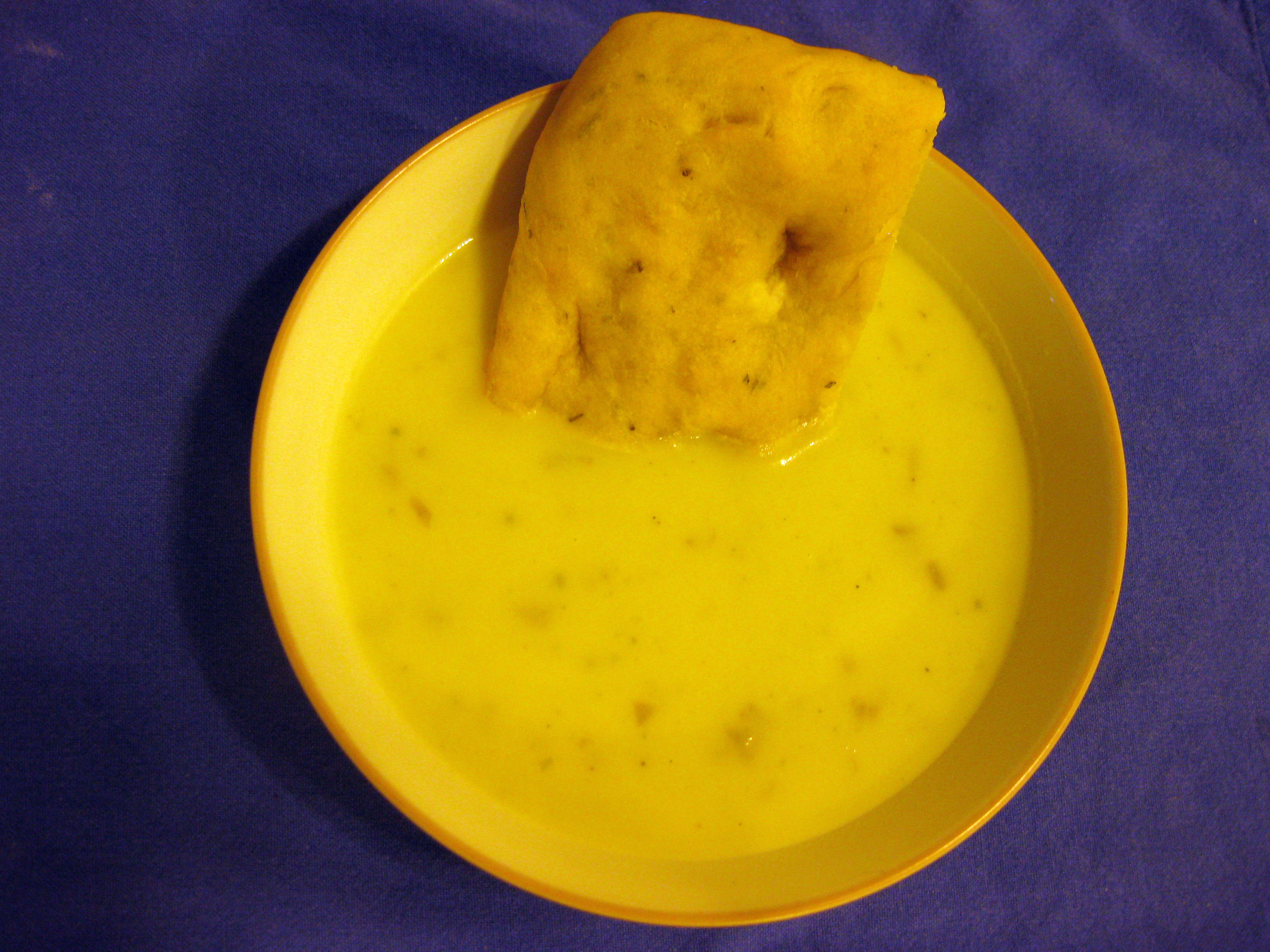
“22. Sauté leeks in butter until soft but not browned, then add cubed waxy potatoes, a little sage and stock or water to cover. Simmer until tender, puree and finish with about a cup of cream for every 6 cups of soup. Serve hot or cold, garnished with chives (if cold, call it vichyssoise).”

Here’s the line-up:

¼ cup butter

at least 3 leeks, maybe more, halved lengthwise, rinsed well to remove sand and dirt wedged between the layers, then sliced thinly into little crescent moon shapes
8 medium yukon gold potatoes, diced in smallish cubes

6 cups chicken or vegetable stock

salt and pepper to taste

6-8 sage leaves, torn or chopped

1 cup heavy cream

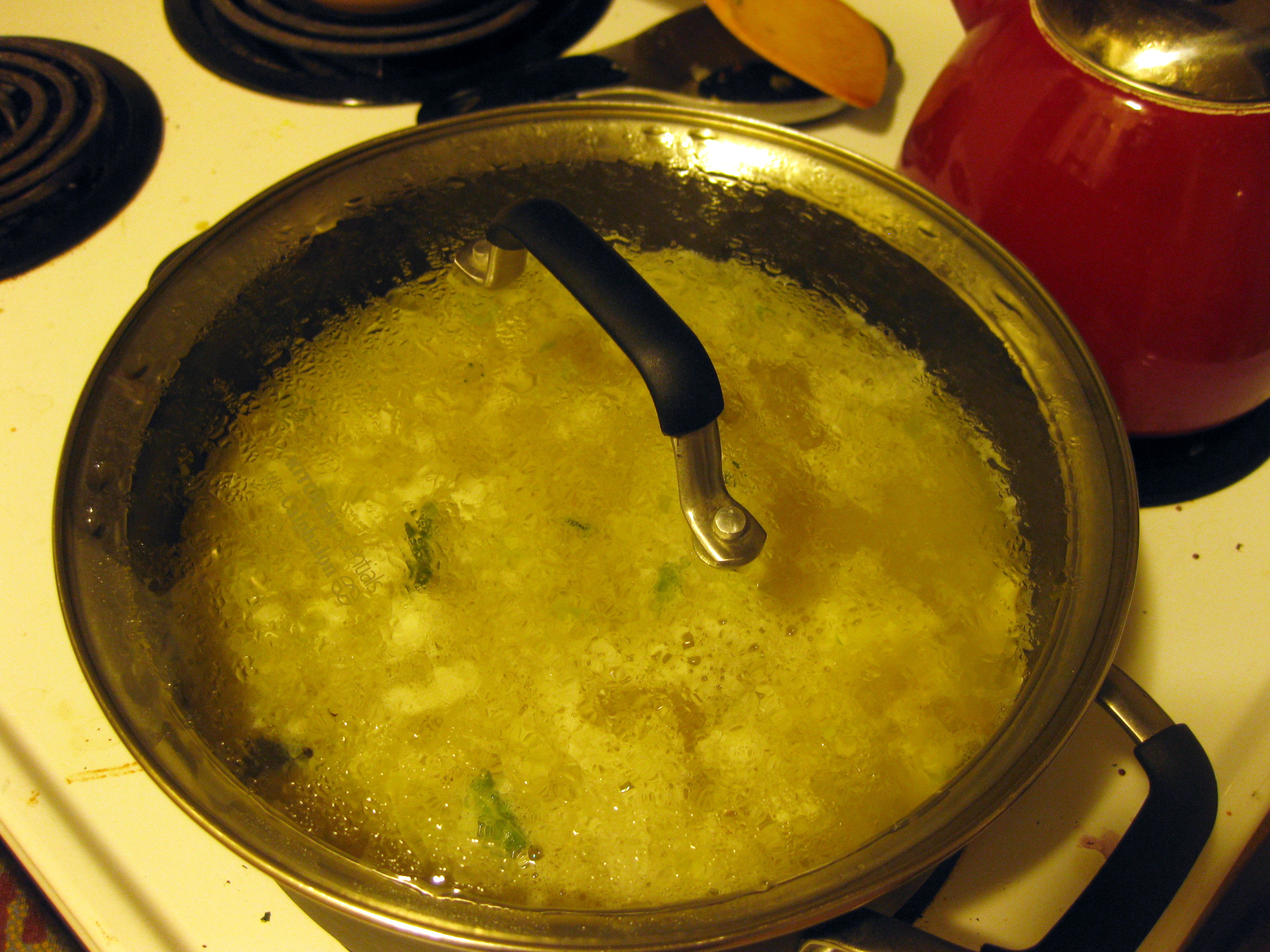
I can say right away that I wish I’d had more leeks for this.  My meager supply was just not enough for that unique, sweet garlic/onion flavor.  Nevertheless, I sliced them up and sautéed them in butter for that springy wonderful pale green aroma.  A tub of homemade chicken broth, the sage, and the diced potatoes followed, burbling together and permeating each other with flavor.

I let the pot simmer until a tentative fork prod proved the potatoes were tender – probably fifteen minutes – then seasoned with salt, pepper and, on a whim, a few taps of garlic powder.

I switched the heat off and let the pot cool off just until it wasn’t boiling anymore before taking my immersion blender to it.  Have you used an immersion blender?  I love mine.  It is a bright red Kitchen Aid model and I use it for blending soups and salad dressings.  I know it could also be used to whip cream or maybe even make hummus, though I haven’t yet put it through all its paces.

A few long dunks and careful swirls of the immersion blender and the chunks of potatoes became more of a mash.  Another few sessions and they transformed into a velvety soup.  Even the torn sage leaves were obliterated, leaving only a few shreds of potato skin (I never peel yukon golds) to disrupt the ivory smoothness.

When everything was well blended, I put the pot back on the heat, poured in a cup of cream, and stirred the swirls of white until the whole thing paled ever so slightly in color and the cream was completely incorporated.  It only took a few moments for the pot to rise back up to serving temperature, at which point we dipped it into bowls and sipped away.

It was smooth and hearty and rich.  It’s hard to make potatoes taste like anything but potatoes, but the additions of sage and cream and the barest onion-y flavor from the leeks came through.

I served this with a lovely loaf of dimpled rosemary foccaccia and a glass of white wine.  A thoroughly beige looking meal, but a satisfying one nonetheless.

But satisfying isn’t always enough.  This soup lacked intensity and freshness.  It was a winter meal, and my stomach, along with my skin and heart and brain, is craving spring.  So when I faced the leftovers, I felt the need for a pick-me-up.  The addition of a tablespoon or so of pesto stirred gently into the soup woke up the flavor considerably but somehow didn’t overwhelm the wholesome starchy creaminess of the potatoes.  Were I to make this soup again, pesto might become a required addition.  Or perhaps a gentle, fluffy layer of extra sharp white cheddar to blanket the top like the snow I hope does not fall on us tonight.  This was good, but it’s time for hot soup season to be over, and not yet time for cold soup season to begin.

Marshmallow Topping for Adults

To me, there is no better title for this entry than Bittman’s designation.  Sometimes things don’t need to be complicated or alliterated or made cleverer.  Sometimes all they need is a little story to get them started.

For the past five years or so, my family has been driving up to Oregon to spend Thanksgiving at our house.  Since we discovered a recipe for Chipotle Mashed Sweet Potatoes, which melds the flavors of autumn with the heat of adobo sauce, we haven’t needed any additional fixings for our tubers.  This was not always true.  When we used to share Thanksgiving with a very dear set of family friends, L. inevitably made sweet potato casserole.  You know the one.  The sweet potato casserole.  Boiled sweet potatoes, mashed or beaten smooth.  Sweetened – as she was always proud to proclaim – only with orange juice.  Smoothed into a square glass baking dish and then topped until no hint of orange could be seen with a careful and meticulous layer of miniature marshmallows.  Thieving hands were scowled at.  Broil to perfect, swollen, golden-brown puff.

I liked this.  Well, I liked the idea of it.  Mashed sweet potatoes are delicious, and toasted marshmallows are my favorite part about a campfire.  But together, especially next to turkey and dressing and tart wonderful cranberries, it was never my favorite.  Bittman offers a grown-up alternative:

“60. Marshmallow topping for adults: Roast or boil chunks of sweet potato, put them in an oiled baking dish, top with dots of cream cheese, and sprinkle with a mixture of brown sugar, chopped pecans and chopped fresh sage. Broil until lightly browned.”

In my imaginary food dictionary, this would appear under “decadence.”  It just sounds so rich and so perfect, without the chalky powdered sugar edge of marshmallows.  Here’s how it happened:

1 ½ huge sweet potatoes cut into 1 inch chunks (I think I used the kind marked as “garnet yams”)

2/3 cup chopped pecans

Scant ½ cup brown sugar, or perhaps less.  It was a bit sweet.

1 TB finely chopped sage

4 oz. cream cheese

About an hour before you intend to broil this, stow an 8 oz. block of cream cheese in the freezer. This is just enough time to allow it to firm up enough to cut into chunks without mushing all over your hands.

Preheat the oven to 400F.

Toss the sweet potato chunks in olive oil, salt, and pepper, then roast them on a baking sheet for 35 minutes or until soft and slightly caramelized.  While they roast, combine the pecans, brown sugar, and sage in a small bowl and toss together well.

When the sweet potatoes are tender, transfer them to a lightly oiled 9×9 inch glass baking dish.  Remove the cream cheese from the freezer and cut it into small chunks.  Scatter the chunks of cheese evenly across the surface of the sweet potatoes, then crumble the pecan mixture evenly over the beautiful field of orange and white you’ve created.

Broil the whole delectable mess until the sugar caramelizes and begins to melt, and the cream cheese goes a little weak in the knees.  Don’t let it go too long or the sugar will burn.

Eat.

We did just that.  There was very little left over for repeat meals, so I had no excuse to repurpose the leftovers.  But in this case I wouldn’t have needed to, because it was stellar.  A bit on the overly sweet side, perhaps, but that’s what made it such an accurate modernization of the marshmallow madness it mimics.  The cream cheese, broiled to the edge of melting, was a tangier, softer version of the marshmallows from the original, and its form in small chunks just losing their shape made it look similar too.  Pecans and sweet potatoes are great friends, and with the addition of the brown sugar they became the equivalent of that couple on Valentine’s Day.  You know the one I mean.  Except you get to eat this, so it’s much better than intruding within a 20 foot radius of that couple.  The sage was an earthy, herby warmth that I wouldn’t suggest omitting.

My only suggestion about this, aside from perhaps cutting back a bit on the quantity of brown sugar, would be to add a little salt into the topping mix.  It would be a nice extra bite to bring out the pecan flavor, and salt with brown sugar is just so darn tasty.

This was delicious with Brussels sprouts seared in a cast iron pan, but it would be equally good with stuffed pork chops, or roast chicken, or the big Thanksgiving bird itself.  Or just in a big bowl, with a big spoon, and a private table.  And no one looking.  Fanciest take on sweet potato casserole I’ve seen in a while.

If that’s not fancy enough for you, I thought of a way of making it even fancier.  For appetizers, cut the sweet potatoes into rounds instead of chunks.  Roast and mix topping as directed.

Instead of freezing the cream cheese, let it come to room temperature and put it in a piping bag with a star tip.  When the sweet potatoes are roasted and have cooled a bit, pipe the cream cheese in a pretty little whirl atop the sweet potato round, then sprinkle with the topping and broil as before.  Presto!  Brilliance in two little bites.  No marshmallows required.

Boxing Day

I have titled this entry not to call your attention to the boxes containing presents to be returned, or the boxes full of old newspaper snippets waiting to re-enclose ornaments and decorations for next year, but to the kind that hold leftovers safe in the fridge until you have room in your belly enough to think about eating again.

N.’s family does a big Christmas dinner, and I mean big: think Thanksgiving.  There’s a turkey, there’s stuffing, Christmas would be ruined without mashed potatoes, and there’s N.’s dad’s specialty: an ambrosia fruit salad complete with miniature marshmallows.

So on December 26th, while we listen to new music and test out our new toys and break in our new clothes, there are also new dishes to be considered.  After all, you can only re-eat Christmas dinner so many times in its original form before you long for a pizza.  On my work-off-Mom-in-law’s-chocolate-fudge walk this morning, through the deer-infested, hill dotted neighborhood in the Sierra Nevada foothills with the smell of fire and pine in my nose, I thought of a few tasty ways of working through the leftovers that I wanted to share.

For breakfast, or mid-morning, or mid-afternoon snack: toast a piece of whole-grain bread, with lots of nuts and seeds sprinkled along the top.  Spread it thick with cream cheese, then drape some whole berry cranberry sauce atop that.  Fold the bread over, or approach it open-face, and rejoice in the creamy rich sweet tart flavor.

As a dinner time side dish, take your leftover mashed potatoes and sprinkle with a hefty helping of black pepper and garlic powder.  Spread out on a plate or in an oven-safe dish, then cascade on a blizzard of parmesan or extra sharp cheddar cheese.  Microwave or bake in the oven until the potatoes are burbling hot and the cheese has melted into a gushy thick layer of melted awesome.  Eat.

For the turkey, there are a billion recipes out there.  This Turkey Pot Pie might be my favorite.  It’s rich, it’s homey and comforting, and as an extra bonus, it can take care of your leftover gravy too!

Hope your holiday was joyful and delicious.

Roots!

This is not a Bittman recipe.  But it is something I made.  It’s hearty, it’s autumnal, it’s colorful, and it’s easy.  Oh, and it allows you to turn your oven on for around an hour and thereby heat up your house a bit!

Roasted Root Vegetables

3 carrots, peeled and cut into chunks

3 parsnips, peeled and cut into chunks

2 purple topped turnips, peeled and cut into chunks

2 rutabegas, peeled and cut into chunks (see a pattern here?)

1 sweet potato (or 1/2 of a mammoth yam), peeled and cut into chunks

1 tsp dried rosemary, or to taste

1 tsp sea salt

1/2 tsp freshly ground black pepper

olive oil to coat

Preheat your oven to 400F.  Peel and cut all vegetables into equal, bite-sized chunks.  Toss them with seasonings and olive oil in a 9×13 inch glass baking dish.  Use enough olive oil so that all chunks of root vegetable get an even coating and glisten slightly.  Depending on size of vegetables, this might range from between 1/2 – 1 cup of oil.

Roast until all vegetables are tender and begin to brown on the outside, 45 minutes to an hour, depending on size.

As you can see, this is almost ridiculously easy.  You can substitute for any of these vegetables you don’t like – easy additions or change-outs would be regular or fingerling potatoes, beets, even celery root.  Choose what you love, mix them well, and enjoy!

Sweet.

I’ve complained before about the sometimes-too-sweet-sweetness of sweet potatoes, and of the potential dangers of the salty-sweet combo (and at the same time, too!), but sometimes they do work.  And when they work, and work well?  Incredible.  If you have any love for sweet potatoes at all, you MUST try this dish.

“41. Toss chunks of sweet potato and 2-inch lengths of scallion with neutral or peanut oil. (Again, a little sesame oil helps). Roast, turning as necessary, until nicely caramelized; drizzle with soy.”

This sounded like it had potential, and didn’t require a lot from the store.  Double bonus points already.  Here’s what I used:

2 medium sweet potatoes (mine had orange flesh, so I guess that means they may have been yams)

1 bunch green onions, roots trimmed off

2 TB vegetable oil

1 TB sesame oil

2-3 TB soy sauce

Since I don’t know what Bittman’s preferred roasting temperature is, I guessed that 400F would likely be fine, and cranked on the oven to preheat.  I peeled and then chunked up my sweet potatoes, trying to keep the cubes about 1-inch in size, so the outsides wouldn’t burn before the insides were cooked through.  I cut my green onions into approximately 2-inch lengths, then tossed them together with the sweet potatoes and both kinds of oil on a cookie sheet.  The amount of oil you use will depend on how big your sweet potatoes are – you want them to glisten and smell strongly of sesame, but not be drowning in a puddle on the bottom of the sheet tray.  We’re roasting, not frying.

I slipped the tray into the oven and let it roast for almost an hour, checking every 15 minutes or so for doneness, browning, and to turn things over.  At 45 minutes in, the chunks of sweet potato were meltingly tender, but they weren’t really getting brown on the outside.  I shimmied the oven temperature up to 450F and tossed everyone around again.

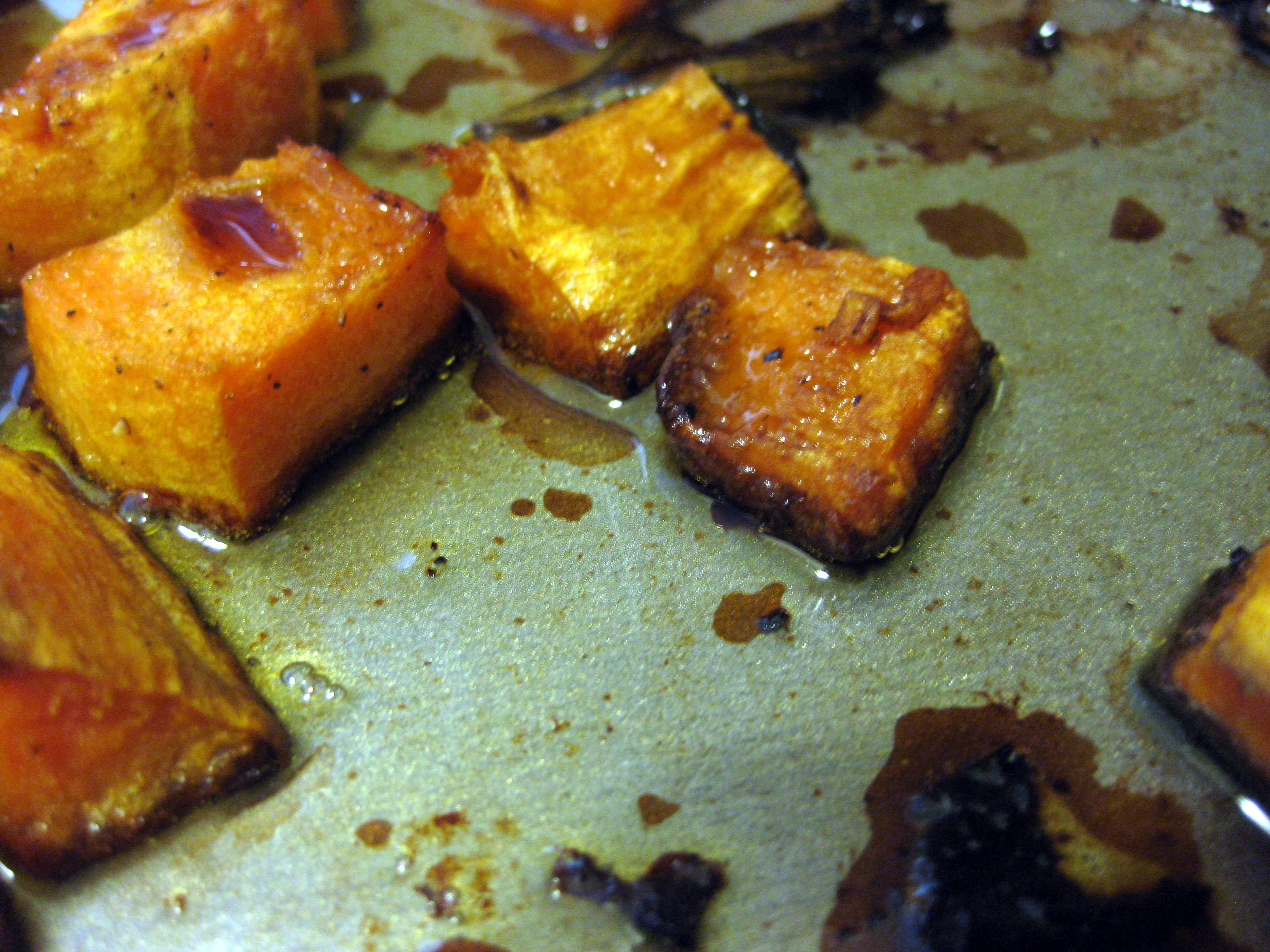
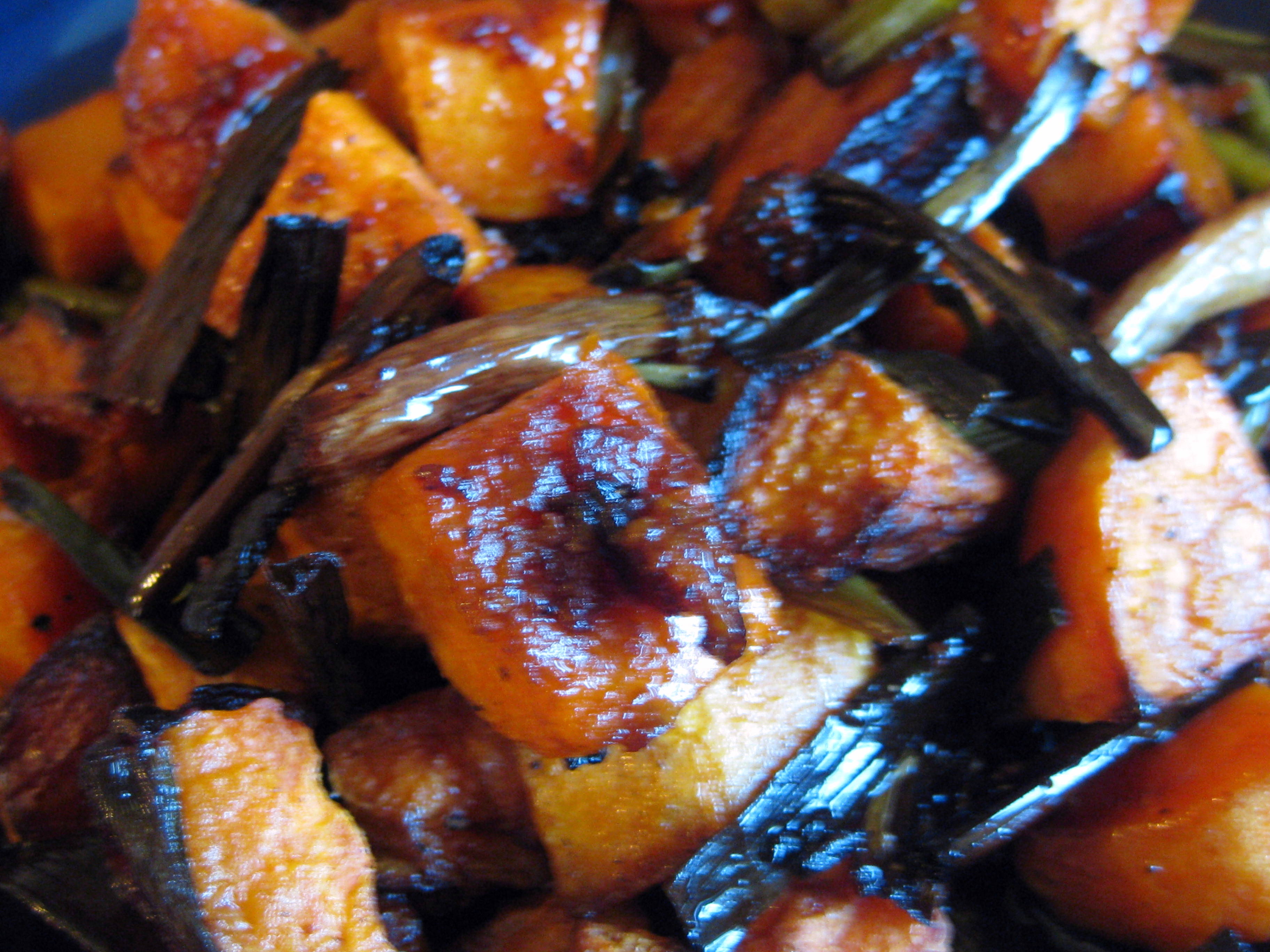
A quick 15 minutes later, I rescued the tray from the oven to see perfection.  The sweet potatoes had crisp crusty edges, the green onions were wilted and faded (this sounds bad but it was a very, very good thing), and when I drizzled the soy sauce over the whole thing the sizzling smell was delightful: salty and earthy and deep.

We tasted, and then we inhaled like ravenous, sweet-potato-deprived beasts.  This was SO GOOD.  The sweet potato flesh was as tender as a puree, but the caramelized sides offered a captivating chewiness.  True caramel, I think, has to stick to your teeth, and these clung to our teeth just like candy.  But they weren’t overly sweet.  The combination of green onion, sesame oil, and soy sauce gave a decidedly savory swing to the dish, and possessed that magical saliva inducing quality.  In fact, though we had two other components to our meal aside from the sweet potatoes, nothing made it into the fridge to store for another day.  N. and I kept finding ourselves back in front of the platter, even as we went about the remainder of our evening.  Passing through the kitchen to get a glass of water, and another chunk of potato, glistening with oil, gone.  Loading a plate into the dishwasher, and a straw of onion, wrapped around itself with just-burnt edges, sliding across my tongue.  Bedtime found the plate empty, with only the residue of soy sauce and sesame pooling in the middle.  N.’s assessment: “You can make this anytime.  Whenever you want.  Win.”

True, but I would make two changes.  First, I would start the oven out at 450F rather than 400F.  The potato chunks were cooked through well before I liberated them from the heat, and a higher temperature would brown them faster.  For the same reason, however, I would also add the onions in partway through the cooking process.  Instead of roasting them for the full hour, I’d throw them in at the half hour mark so they wouldn’t burn.

At this higher temperature, it could be that a full hour isn’t necessary – maybe only 45 minutes.  Or 35.  Or 55.  Check often and toss well, and when they are cooked through and the beautiful orange and bronze of autumn in the Northeast?  It’s time to scarf them. 

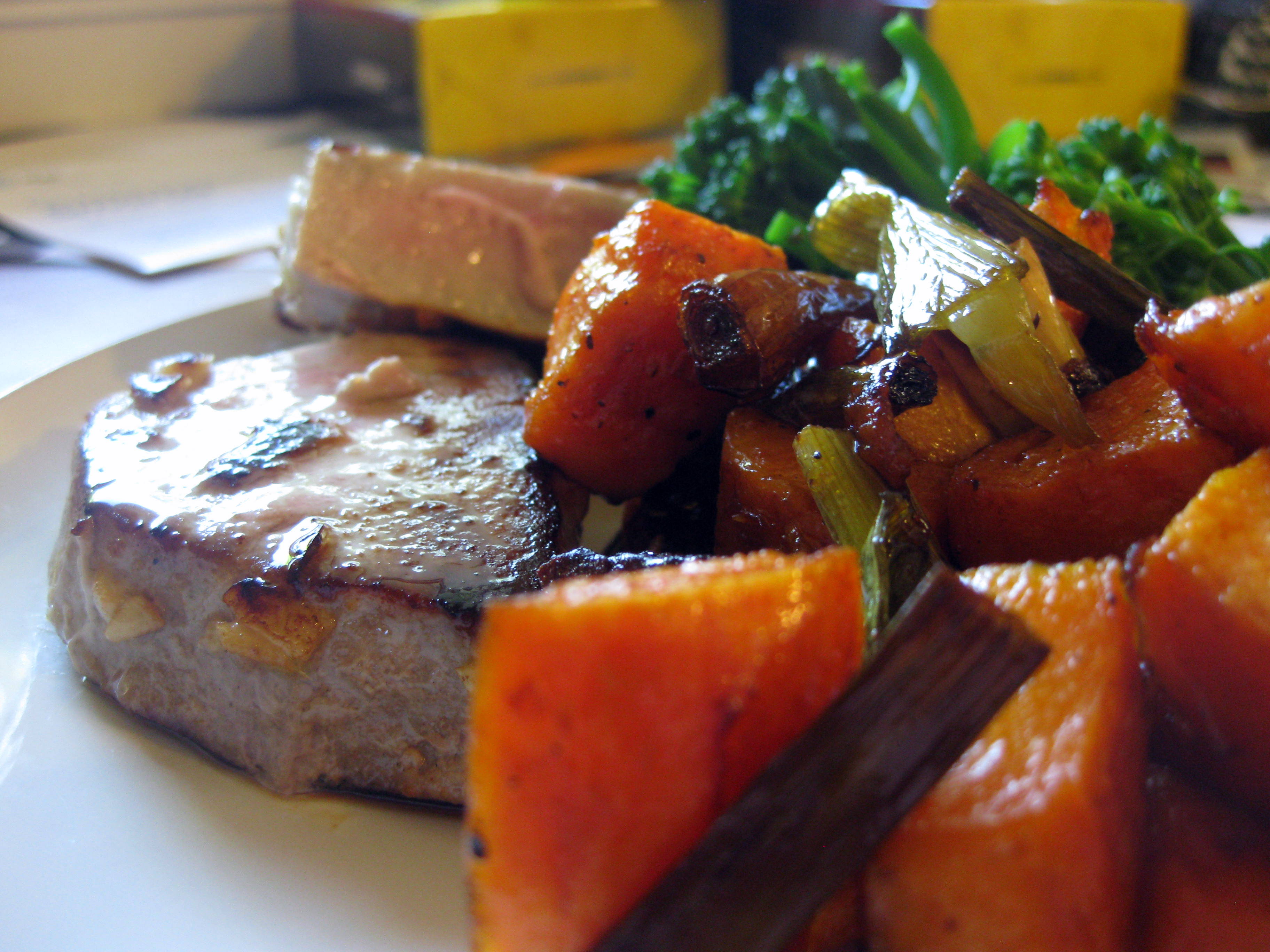
The sweet potatoes were really the stars of our meal, but we had them with broccolini and some pan-fried yellowfin tuna that I’d marinated for ½ an hour in garlic, ginger, lime juice, olive oil, and a tiny splash of soy sauce.  Successful, if a bit overcooked (I like my fish rare, N. likes his almost well done), but nothing compared to the caramel crusted stars of the show.

Menu planning

I have a bad habit.  Well, let’s not lie, I have many.  But pertaining to food, I have one particular potentially disastrous practice: I like to make food for company that I’ve never made before.  I have experimented with risotto, fancy baked pastas, doughnuts, all for company for the first time.  I have tried to diagnose this habit, and I can’t be sure where it comes from.  Maybe I think that once I’ve made it before, it becomes simple and easy and not adequately fancy.  I like to be fancy.  Maybe I want to show off a little.  Maybe I just get excited about trying new recipes.  Who knows?

Oddly, I noticed that the menu I currently have planned for the “Belated Reception” party N. and I are throwing contains almost no unattempted recipes.  Despite permission, no, encouragement even, from K. (one of our guests of honor) to use this gathering as an opportunity to try out fancy new dishes, the ideas I immediately gravitated toward were tried and true. With guests bringing their own grillable mains, K. and I will be making a series of sides.

Here’s a preview of the intended menu:

Marinated tofu skewers, grilled.

Grilled corn, cilantro, and lime salad

Grilled garlic bread (seeing a pattern here?)

Fresh tomato bruschetta

Pea and mint puree on crostini, topped with nasturtiums

German or red potato salad

Pasta salad with tomatoes, mozzarella, olives, and sundried tomato vinaigrette.

(Chips, salsa, guacamole, etc.)

For dessert, I’ll make two types of cake for folks to try, both drenched in alcohol (because that’s just the kind of hostess I am):

A reprisal of my terrifically successful Chocolate “tiramisu” cake (featured here).

Pink champagne cake (N. and I had champagne cake with strawberries at our wedding, and I’d like to return the favor).

In addition to wine, beer, and the usual party beverages, I will also make a Champagne-rum punch, a deadly recipe because it is fizzy and sweet and delicious, making you forget the two kinds of alcohol it contains as it fizzes right into your bloodstream.

Ah, summer living.