Project Cook: Seeded Pumpkin Biscotti

A few weeks ago, Irvin from Eat the Love posted on his instagram feed that he wasn’t seeing many pumpkin recipes from the bloggers he follows, and both politely and in fun, essentially told everyone to step it up! Instantly (although I’m definitely not one of his favorites – I doubt he knows I exist!) I knew I wanted to make pumpkin biscotti, using one of his tricks (more on that later). I would stud them generously with pumpkin seeds since I’d had that bag of pepitas in the pantry forever,* and maybe some other nuts, and top them with coarse, crunchy sugar or a criss-crossed shiny glaze, and I’d be right on trend.

And then, of course, I didn’t. Instead we had friends over, and I graded papers, and the kitchen was too warm, and I lost track of my biscotti for a while, but this past weekend, in between setting out Halloween decorations (and, of course, more grading), I finally got down to it. Supplies bought, I went looking for the rest of the ingredients, and after tearing through my pantry shelves, realized the wellspring inspiration for the whole recipes – the pumpkin seeds – were nowhere to be found.

Cut to me, grumbling and grouchy, on an emergency trip to the nearest grocery store, scouring what felt like every aisle until I finally found some, in measly little 2 ounce packages, next to the cocktail peanuts. Project back on track.

For the base dough, I turned to the gurus at King Arthur Flour. While their recipe looks delicious, I knew I wanted to raise the stakes a bit with various sources of crunch, and – here’s where Irvin becomes important for this recipe again – I wanted to use his pumpkin trick of drying the puree out on the stove before integrating it into the recipe. The problem with pumpkin, as I’ve noted previously, is its massive moisture content. The KAF recipe contains only ½ cup pumpkin puree, likely because it’s so wet that adding much more would not allow for crunchy cookies. I figured since I was going to reduce the moisture so much I could increase that quantity by half. This would give me a dryer ingredient with a more intense pumpkin flavor.
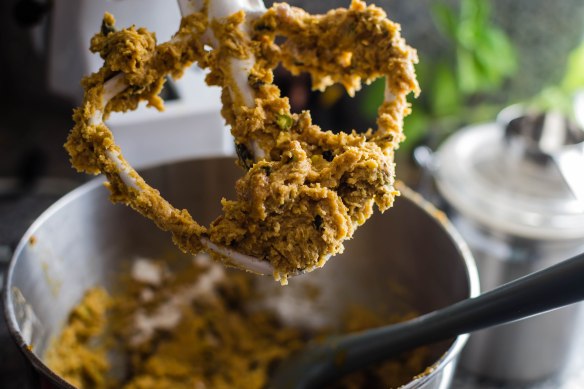
But making my mixture less wet entailed potential recipe problems. Biscotti should be crunchy, but reducing moisture content too much could lead to stale-tasting cookies, or a mix that didn’t hold together properly. Time to do some research. My favorite biscotti recipe, from the very first issue of Bon Appétit I ever bought, is flavored with lemon and walnut and has become a family Christmas standard. It differs considerably from the KAF recipe for pumpkin biscotti, with more egg, a good bit more butter, and of course a staggering 3 cups of chopped walnuts I was not planning to come even close to. The recipe creation then became guesswork, which involved a series of texts between me and my sister to try and figure out how to proceed.

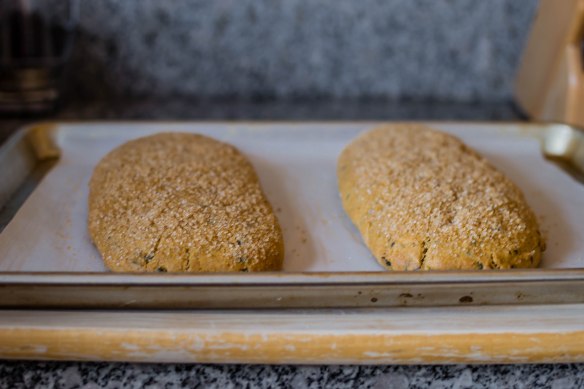
I settled on increasing the amount of egg and butter, but not quite as much as my old reliable standby. Since I’d be adding nuts and seeds, I also opted to change up KAF’s procedure a bit to match the one I was used to: rather than putting the shaped, sticky batter straight into the oven, I wrapped mine in plastic wrap (which also helps shape it – more below…), chucked it into the fridge for a few hours, and then unwrapped and baked it once it had firmed up.
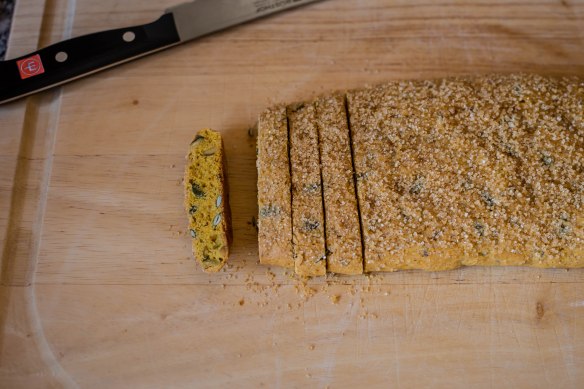
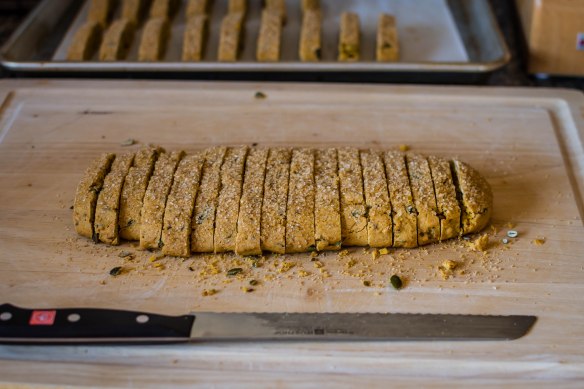
My go-to lemon and walnut biscotti recipe advocates cooling the flattened dough logs completely after their first bake, then slicing, lying the cookies down on their cut sides, and baking again at low heat. The KAF recipe I was half-following suggests cutting while still hot, then baking again with the cookies standing up on their flat bottom edges. I was intrigued and tried this new way, and I might never go back. Yes, the slicing requires delicacy, especially because the pumpkin seeds and pistachio pieces are harder than the surrounding dough, but cooking them standing up means first: the coarse sugar you press into the top stays put, and second: they brown evenly on both sides. Even browning, sugar-crunch layer, and you can even fit more on the baking tray at once. Say no more. I’m sold.

But I guess really there is one more thing to say, and that’s our assessment. These are outstandingly delicious. They are spicy and crunchy and not too sweet, and though the pumpkin flavor is mild it’s definitely there. The sparkling coarse sugar on top is perfect against the earthiness of the nuts and pumpkin seeds inside. It’s a good thing I’m taking a batch in to work tomorrow, because by the time I remembered I should count how many cookies this recipe made to report here, we had already eaten… enough of them… that guesswork was required, and when I realized I was eating what might have been my fourth in an hour or so, I sentenced them all to wait in a hard-to-open Tupperware on top of the fridge with the Halloween candy so they would be harder to access. We will certainly make these again, as should you. And I’ve already plotted out a version with amped up ginger and chopped dried apples for Christmas. Move over, lemon and walnut standard. Or at least be ready to share the plate.

* for a clear explanation of the difference between pepitas and plain old pumpkin seeds, see here.

Seeded Pumpkin Biscotti
Adapted from King Arthur Flour
Makes approximately 3 dozen
About 4 hours (including resting time) or overnight
1 cup pumpkin puree
½ cup pepitas
½ cup roughly chopped pistachios
6 tablespoons unsalted butter, softened
⅔ cups granulated sugar
1½ teaspoons ground cinnamon
¼ teaspoon ground nutmeg
scant ¼ teaspoon ground ginger
1½ teaspoons baking powder
½ teaspoon salt
2 eggs
2 cups all-purpose flour
1 tablespoon flax seeds
2-3 tablespoons coarse sugar, such as turbinado or demerara, for sprinkling


  • In a small skillet, cook the pumpkin puree over high or medium-high heat for about 15 minutes, stirring frequently, until the color has deepened and the puree has dried and has a texture something like a thick, crusted frosting. It will be reduced by about half. Set aside to cool.
  • While the pumpkin puree is reducing, if desired, toast the pepitas and chopped pistachios in a 300F oven for about 10 minutes. Set these aside to cool as well.
  • In a large bowl, or the bowl of your stand mixer, cream together the butter and granulated sugar. Add the cinnamon, nutmeg, ginger, salt, and baking powder, and beat with the paddle attachment until smooth and creamy.
  • Beat in the eggs and the cooled pumpkin puree until well combined. The pumpkin will take a minute or two to fully integrate.
  • With the mixer on low speed, add the flour a ½ cup at a time, then the flax seeds and the cooled pepitas and pistachios. Be sure to scrape the bottom of the bowl once or twice to ensure everything is mixed in. The resulting mixture will be very sticky.
  • Cut two pieces of cling wrap and spread them out on a clean counter. With a determined spatula, scrape half the dough mixture onto each. Using the plastic wrap, push and mold the dough into two long rectangles of about 10 x 2½ inches. Wrap them up in the plastic wrap, put them on a cookie sheet or other flat tray, and stow in the fridge for at least two hours, or overnight.
  • When you are ready to bake, preheat the oven to 350F. Retrieve the dough logs from the refrigerator, unwrap them from the plastic wrap, and position them an inch or two apart from one another on a parchment lined baking sheet. Sprinkle the tops with the 2-3 tablespoons coarse sugar, then use your hand to spread the sugar evenly and gently press it in to the top of the dough a bit so it adheres.
  • Bake the dough logs for 25 minutes; they will be just firm. Remove from the oven and let cool 10-15 minutes. Meanwhile, reduce the oven temperature to 325F.
  • After 10-15 minutes, use a sharp serrated knife to cut the logs crosswise into ½ inch slices. Use a gentle sawing motion to avoid breaking up the slices, which will still be very delicate at this point. Some of the nuts and seeds will be harder to cut through. Be sure to cut as straight up and down as possible; if the biscotti are thicker on the top than the bottom, they won’t stand up correctly for their second baking.
  • Stand the biscotti on their bottom edges on the same parchment lined baking sheet you used to bake the flattened logs. They can be fairly close together but should not be touching. Carefully return the pan to the 325F oven and bake for 40-45 minutes, until they are getting golden brown around the edges. They will still be soft in the middle.
  • KAF recommends turning off the oven, cracking the door, and allowing the biscotti to cool completely while inside, likely to ensure the finished cookies are crunchy. I did not do this because I had something else I needed to bake; I cooled them in the oven only 5 or 10 minutes, then removed the pan to a counter top and let them cool completely. Mine were still perfectly crisp all the way through.
  • Serve when completely cooled. Perfect with coffee, chai or other tea, or straight off the pan.
Zucchini Spice Bread with Cherries (now with post and recipe!)

This past summer, we did not grow zucchini. Still traumatized by the various baseball bats we had to consume the previous year, N. flatly refused it. He couldn’t find the humor even in my joke that we would only grow a small one… Needless to say, no zucchini graced our table this summer.

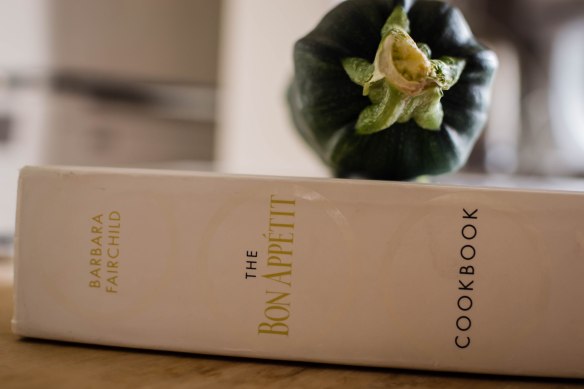
But I missed it. In particular, I missed my favorite zucchini bread recipe, a cinnamon-spiced affair with an appealingly-crusty top but still-moist center from The Bon Appétit Cookbook that I’ve made probably at least a dozen times. It’s lightly sweet, it’s not overwhelmingly, well, zucchini flavored, and you don’t even have to squeeze out the grated squash before adding it to the mixture. In fact, you shouldn’t; the recipe relies on some of that wetness to attain the correct consistency. Buying zucchini from the grocery store to put toward this purpose just didn’t seem right – this was, as the book itself declares, a recipe designed for a zucchini harvest.

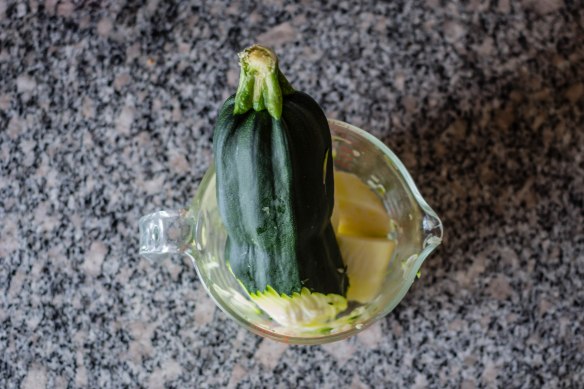
So when one of my coworkers advertised her bounty, I suggested that I’d be willing to take one of her prolific squashes off of her hands, and as a result I received a delivery at least as long as my forearm. Yes. This meant zucchini bread. To keep myself interested, in this incarnation I not only included the deeply toasted chopped walnuts the recipe calls for, but subbed in some almond flour for part of the all-purpose flour to add extra nuttiness and – not that this recipe needs it – assured moisture. I also added my most recent baking obsession: a generous few handfuls of tart dried cherries. And then, since just a loaf will never do, I made four. And I still had a chunk of zucchini left that’s probably still at least 6-7 inches long.

This recipe calls for two cups of grated zucchini. And that seems like a lot, until you realize it really only takes one reasonably sized squash to make that amount. So here I’m offering a recipe for two loaves, since if you’re facing down a bed-full of zucchini, that’s the least you’ll want to make. They freeze beautifully too, so you can sock away a loaf or two until you, or your family, or your neighbors, are feeling zucchini-receptive again. I’m sure I don’t need to tell you that, just in case the end pieces feel a little dry, toasting and adding a generous smear of cream cheese is revelatory.


Zucchini Spice Bread with Cherries
Adapted (barely) from The Bon Appétit Cookbook
Makes 2 loaves 9x5x3 inch loaves
2 cups chopped walnuts
6 large eggs
4 cups granulated sugar
2 cups vegetable oil
2 teaspoons vanilla
4 cups all-purpose flour
1 cup almond meal or almond flour
2 teaspoons salt
2 teaspoons ground cinnamon
2 teaspoons baking soda
½ teaspoon baking powder
4 cups coarsely grated zucchini, not squeezed
2½ cups dried tart cherries, such as Montmorency


  • Preheat the oven to 350F. While it heats, scatter the walnuts on a cookie sheet and put it in the oven to toast. The nuts should go about two shades darker brown and look slightly oily when you take them out. Once nicely toasted, remove from the oven and set aside to cool.
  • Prepare two metal loaf pans by spraying with non-stick cooking spray or rubbing with butter or oil.
  • Using an electric mixer or a stand mixer, beat the eggs in a large bowl until they are foamy. With the mixer running, gradually add the sugar, then beat until the mixture is very thick and pale. This takes a good 3-4 minutes. Slowly beat in the oil, then the vanilla.
  • In another bowl, whisk together the flour, the almond meal, the salt, cinnamon, baking soda, and baking powder. With the mixer on low speed, beat in this dry mixture in three additions, scraping down the sides of the bowl in between.
  • Gently fold in the walnuts and cherries to ensure even distribution. The batter will be extremely thick. Don’t despair! Fold in the zucchini (it will be almost too much for a standard stand mixer, but it will fit. Mostly). The batter will loosen up considerably as the grated pieces release moisture.
  • Divide the batter evenly between the two prepared pans and bake at 350F until the top is dry and crusty, and a toothpick or cake tester inserted comes out clean. This pretty dependably takes about 1 hour and 30 minutes. Cool the loaf for at least 5 minutes in the pan before turning it out onto a rack to cool completely.

Huevos Rancheros con Frico

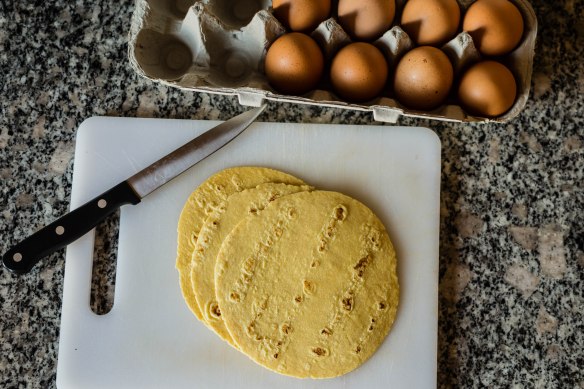
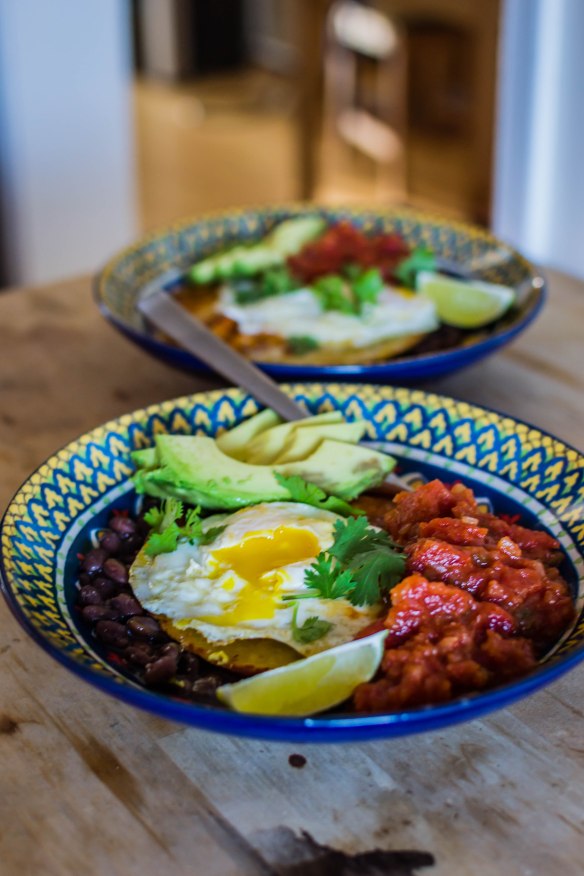
The first iteration of this meal was a lunch I threw together when I wasn’t satisfied by any of the leftovers already in my fridge. And it was easy: egg, cheese, tortilla, a scoop of salsa. Done. But instead of melting the cheese on top, I flopped the toasted tortilla over and held it down with my spatula so the cheese sputtered and hissed directly against the pan. A minute or two later, a quick but determined scrape, and the tortilla emerged with a frico of pepperjack welded on, crispy and seared and ready. And as soon as that happened, I was no longer alone at the stove. Suddenly instead of the sandwich he’d been intending, N. wanted my lunch. He was entranced by that crunchy layer of cheese, so a few days later we had it for dinner, this time bulking things up with the addition of a bed of black beans for the tortilla to rest on.

Three days later, we already wanted it again. A week after that, we had it a third time. That tells you something. And unlike so many of my recipes here, this is quick – no more than 20 minutes and it’s ready to go – and takes a few shortcuts along the way: canned black beans, jarred salsa. Of course you could go the extra mile and start from scratch, but for what is essentially the quickest weeknight dinner I’ve made in months, I’m not going to bother.

Huevos rancheros is a simple dish, usually eggs and salsa atop tortillas, with beans, cheese, and other accompaniments optional. Basically it’s a fried egg taco. Frico, on the other hand, is an Italian creation probably originally invented to use up cheese rinds. Though there is a version that incorporates potatoes and other vegetables fried into something like a rosti or latke (which N. has informed me he now wants), the sort Americans are probably most familiar with – and certainly my version here – is a thin round of plain old cheese, fried until it holds together.

Most fricos are made with hard cheeses – think “parmesan crisps” or similar – and can be fried just until they are malleable, then draped over a jar or muffin tin or rolling pin to shape them into baskets or bowls or other decorative shapes. But they can also be baked or fried until they are crisp and shattering discs you could stack in a savory napoleon or crumble onto a salad or, in my favorite application, crust the outsides of a grilled cheese sandwich.

But this frico is made with softer cheese: I tried both cheddar and pepperjack, and found I preferred the latter. When you first turn it into the pan, a distressing quantity of grease appears and the cheese bubbles worryingly around the outer edges of the tortilla, and you are sure this isn’t going to work at all. Give it a minute or two, though, and then cautiously but firmly apply your spatula, and the tortilla should have a crunchy, orange, lacquered coating. You then have only to set the egg on top, pile with accouterments, and gobble up the whole thing.

You can, of course, use multiple skillets here, and make more than one at the same time. I opted to cook the eggs first and set them aside to stay warm while I did the tortillas, because my dishwasher (I have one of those human models, not the mechanized kind) appreciates when my cooking projects don’t result in a whole sinkful. I’ve also opted in the ingredients to list quantities for each egg-cheese-tortilla stack, which of course can be easily doubled, tripled – or, should you have a large griddle and some brunch-loving friends – multiplied to serve what will no doubt be a happy crowd.

Huevos Rancheros con Frico
15-20 minutes
quantities and instructions for one, but oh-so-easily multiplied
½-1 cup canned black beans
1-2 tablespoons vegetable oil
1 egg
1 corn tortilla
1-2 ounces pepperjack cheese, thinly sliced
¼ cup salsa, or more as desired
3-4 avocado slices
optional: torn cilantro and/or a lime wedge


  • In a small pot, heat the black beans along with their liquid over medium heat; let them simmer until most but not all of the liquid has been absorbed and the beans are hot.
  • While the beans simmer, heat 1 tablespoon of the vegetable oil in a skillet over medium heat. Crack in the egg sunny-side up, sprinkle a little salt on the yolk, and cook until the white is just set and the edges are starting to brown slightly. Carefully flip over to finish either over easy or over medium, depending on your preferences. Remove and cover to keep warm (I like to place mine in the shallow bowl I use to serve and cover with another shallow bowl).
  • If the pan looks dry, add the other 1 tablespoon vegetable oil, let it heat for a minute, then add the tortilla. Fry the tortilla until well toasted with deeply browned spots on both sides.
  • Remove the fried tortilla from the pan and use a paper towel to wipe most of the oil out of the pan. Top the toasted tortilla with the pepperjack, arranging the slices so most of the tortilla surface is covered. Add back to the skillet, still on medium heat, with the pepperjack side down, directly against the surface of the pan. Cook undisturbed for 2-3 minutes. Fat from the cheese will be released and the cheese will look like it’s all going to ooze out the sides. Don’t worry.
  • After 2-3 minutes undisturbed, use a wide spatula to carefully but firmly loosen the cheese from the pan surface. Flip the whole tortilla back over so the cheese is on top.
  • To serve, pile the hot black beans in a shallow bowl. Place the tortilla, cheese side up, on top of the beans. Carefully put the egg on top of the cheese-crusted tortilla. Top with salsa, avocado, cilantro and lime if desired, and eat immediately.

Tempeh “breakfast sausage” crumbles

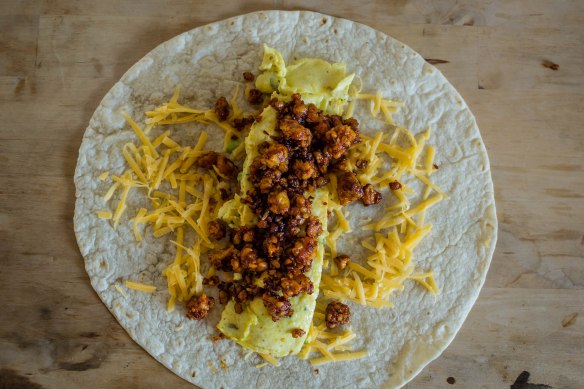
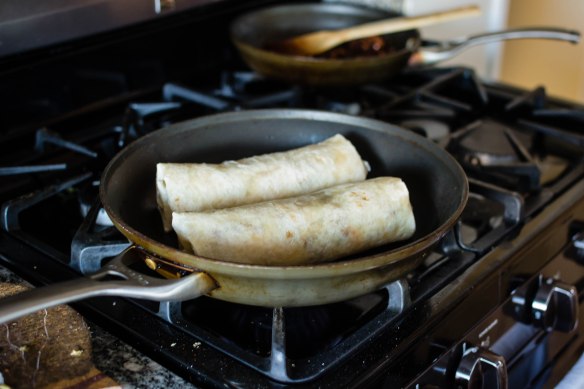
In our continuing efforts to reduce the amount of meat in our diet, I’ve been examining some of our standbys and thinking about how we could replace or eliminate the animal protein and still wind up with a delicious meal. One such subject for experimentation that yielded very satisfying results was our favorite comfort classic: the breakfast burrito. My typical procedure is gratuitous. I fry up some crumbled breakfast sausage, cook hash brown patties in the sausage grease (I like the ones from Trader Joe’s; starting from raw potatoes both takes a while and never yields the perfectly crispy results I’m after), then scramble some eggs. All this, along with some shredded cheese, sometimes a few slices of avocado, and some sort of spicy sauce, get folded into an enormous tortilla, and then seared on either side in a nice hot pan so the tortilla loses that raw flavor and the cheese has a chance to melt a bit.

Since there’s already so much happening inside that tortilla, subbing out the sausage and figuring out how to flavor tempeh to work as its stand-in seemed like a worthy project. The main issue that separates tempeh and sausage (besides that obvious truth that one is made from pig and the other is made from soy beans) is an absence of fat and salt. Frying the tempeh in plenty of olive oil and seasoning it aggressively seemed a logical step toward creating an adequate substitute. But before doing that, there’s a secret I’ve learned from S.: steaming.

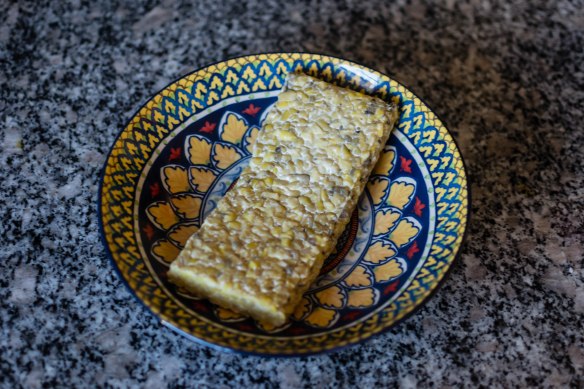
Tempeh is fully cooked when you open up that vacuum-sealed package and take out that weird, bumpy beige block. But it is also cold and hard and needs a little prep to make it more amenable to accepting flavor. After all, you can’t exactly stud it with garlic and rosemary like a leg of lamb. Wrapping the block in a damp kitchen towel (or just a paper towel) and popping it into the microwave for 2-3 minutes first makes it suck in flavors a bit better – I like to think of it as… opening its pores. From that point, you can marinate or salt or fry or whatever you like, and the tempeh will do a little more than just… get warm.

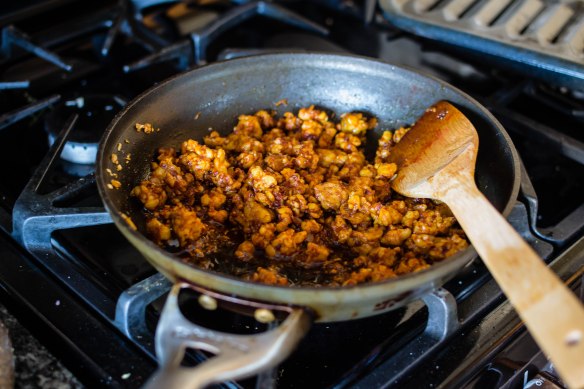
From there, fat and salt and flavor are your focus. I considered adding smokiness: the depth of smoked paprika and the funk of Worcestershire sauce seemed like a good bet. Finally, a little squeeze of tomato paste added color and savory richness the tempeh just didn’t have. All browned together with some black pepper made a satisfying pan-full, but in my second attempt I opted to sauté some onion and garlic first for added moisture and flavor complexity we were happy with.

Look, this isn’t really a replacement for breakfast sausage. It doesn’t taste like pork, and it doesn’t cook like it either. But it is delicious, and the texture is surprisingly close, especially when you combine it with other things. I wouldn’t put it on a pizza, but wrapped up with other deliciousness in a breakfast burrito, it is savory and comforting and feels a little fatty: exactly what we needed for the night before the new semester begins. Sprinkled over a baked potato along with some shredded cheese and maybe steamed broccoli, it would be outstanding. And I must admit, the little bit I have left over in the fridge? I’m looking forward to eating it cold, right out of the container, when I get home from – gulp – work tomorrow.

Tempeh sausage crumbles
About 15 minutes
1 shallot or ¼ medium onion, diced
2 cloves garlic, minced
¼ cup olive oil + possibly more
salt and pepper to taste
8 oz. tempeh
½–1 teaspoon smoked paprika
2 teaspoons tomato paste
2 teaspoons Worcestershire sauce (fair warning: Worcestershire usually contains anchovies, so if you don’t eat fish, you can replace this with soy sauce or even Bragg’s liquid aminos for a similar flavor.)


  • Liberate the tempeh from its packaging and wrap it lightly in either a clean, damp kitchen towel, or damp paper towels. In its wrapping, heat it in the microwave for 2 minutes, then set it aside until it has cooled enough to handle. This steams the tempeh, making it more receptive to absorbing flavors.
  • While the tempeh steams and then cools, heat the olive oil in a skillet over medium heat. Add the onion or shallot and garlic, and turn the heat down to medium low. Season with salt and black pepper and let them sweat until soft and translucent but not browned.
  • When it is cool enough to handle, crumble the tempeh – I like it like granola: some large chunks and some more like pea- and even oat-sized. Stir it into the onions and garlic and turn the heat back up to medium before adding the smoked paprika, tomato paste, and Worcestershire sauce. Stir well to incorporate everything.
  • Cook over medium heat for 5-8 minutes. If it looks dry after 2-3 minutes, add a tiny bit more oil. Taste for seasoning; it probably needs more salt and more pepper.
  • When the tempeh is heated through and has taken on some color on the outside, it is ready. Eat as is, or add to the entrée of your choice: over baked potatoes with some cheese and maybe steamed broccoli, in a hash, over a salad, or as we like it, wrapped up with hash browns, eggs, and cheddar in a breakfast burrito.

Crouton Cook-off

The problem with spending your whole Sunday thinking it’s Saturday is that you arrive to Monday morning out of breath and without a post to share! Good thing it’s still summer for this absent-minded professor.

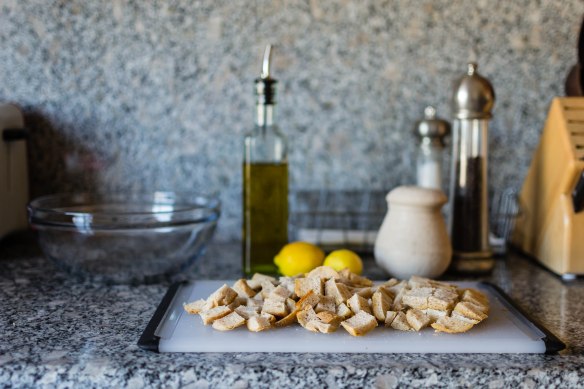
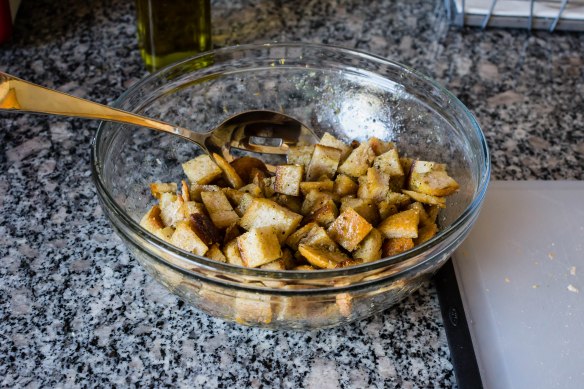
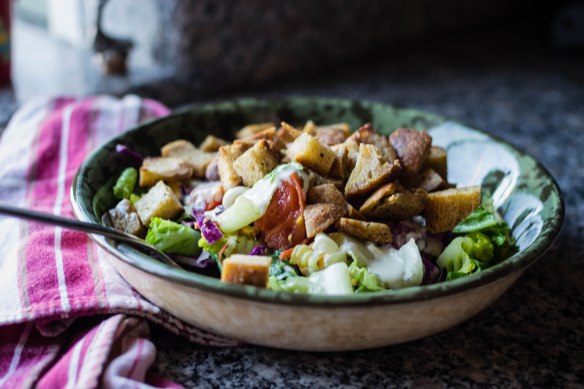
This week, instead of a complicated recipe, I thought I’d do a little experiment. Since I can’t make bread pudding all the time (fitting into my summer wardrobe is nice), and I refuse to toss the crusts from my weekly sourdough loaves* but I do still need room in the freezer for other things, I’ve been playing a lot with seasonings and cooking methods for croutons. My favorite way to flavor them, besides good old salt and pepper is, curiously enough, a healthy shake of poultry seasoning. The mix of herbs adds depth, and it’s nice to use that little canister more often than just on Thanksgiving Day. To lighten them up, lemon zest is also a frequent addition.
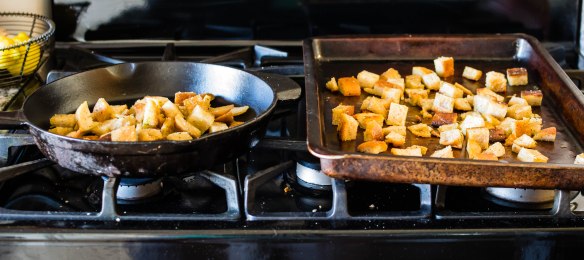
As for cooking method, I vacillate between baking the seasoned cubes and frying them in a skillet. Since in between salads I forget which I prefer, I decided to conduct a cook-off experiment, seasoning the whole batch exactly the same and then baking half the cubes and pan-frying the other half.

Ultimately, although the oven version came out a fraction crunchier, we determined the main difference between cooking method lies not in end result, but in investment of effort. The oven batch had merely to be tossed onto a cookie sheet and stowed in a preheated oven for about 20 minutes. The stovetop version had to be stirred frequently for about the same amount of time; leaving it unsupervised resulted in quickly burned bread. So we wind up with a win some, lose some set of options. On one hand, preheating and baking probably heats up your house more, but produces a slightly crisper end result with less effort from you. The stovetop method probably doesn’t warm up the room as much, and it doesn’t require as long to preheat, but if you aren’t willing to babysit the croutons, there’s less margin of error for achieving an even crunch without burning any edges. So… for perfect crisp croutons and very little effort on your part, bake your seasoned bread cubes. If it’s summer and you don’t have or want to use air conditioning, bake them in the morning, cool completely, and store in something airtight until the rest of the salad is made.

* If you still have more crusts than you know what to do with, I recently learned stale bread can be composted; see here for a short how-to.

Crouton Cook-off
Enough for 3-4 salads
zest of 2 small or 1 large lemon
1 teaspoon kosher salt or ½ teaspoon table salt
½ teaspoon black pepper
¼-½ teaspoon poultry seasoning
generous ¼ cup olive oil
2 cups bread, torn or cut in cubes of your desired size
  • If you are baking your croutons, first preheat the oven to 350F.
  • Whisk all ingredients except bread together in a large bowl.
  • Add bread cubes and toss well for even coating.
  • To bake, spread seasoned cubes on a cookie sheet and stow in the oven for 15-25 minutes, depending on how crunchy you want your end product. 15 minutes preserves some give in the middle; 20-25 minutes results in fully crunchy cubes.
  • If you are pan-frying rather than baking, heat a skillet over medium heat and add the seasoned cubes. Cook 15-20 minutes, stirring and flipping frequently for even browning.
  • For both cooking methods, set croutons aside to cool before serving. They will crisp just slightly more as they cool down, but not significantly.

Project Cook: Espresso Cake with Cardamom Buttercream

Theologically, pride is commonly understood as the most serious of the seven deadly sins. For medieval Christian thinkers, it was the wellspring: the sin from which all other sins derived. Some writers interpreted that Lucifer – the morning star, the best and most beautiful of the angels – was ousted from Heaven because he exhibited pride: in trying to rise above his station, rule over others, or see himself as equal with God, he was guilty of pride and thus cast out. In Paradise Lost Milton famously equates Lucifer with Satan, showing the extremes of pride as a sin: rather than simply being cast out of heaven, he is thrown all the way to Hell.

I think, though, that as dangerous as pride may be, I have a right to feel it about this dish. I’ve been rewatching the first two seasons of The Great British Baking Show with its new cast (quick assessment: I love and miss Mel and Sue dearly, but I think Noel and Sandi are doing a fine job, and I think I might prefer Prue to Mary Berry just a tad – she doesn’t let Paul get away with as much. Happy to hear your thoughts, fellow obsessors…), and I’m certain that was the source of my inspiration. Certainly it was how I came to the combination of coffee and cardamom.

This is a glorious play of flavors. Each component of the cake – the sponge, the filling, and the buttercream – has its own star. Together it is a layered, complex combination, but each part is uncrowded. The cake, one of the moistest I’ve ever made, pulls together buttermilk, vegetable oil, and eggs to ensure a tender, luscious crumb. Strong black coffee and instant espresso add flavor, but surprisingly, that flavor is subtle – a suggestion with a sneaky kick of caffeine rather than the bitter slap a cup of the stuff can have.

Cardamom flavors the buttercream, and here I decided I wanted something new. I’ve dabbled in American buttercream before, and though I’ve achieved praiseworthy fluffiness and pipe-able texture, it remains as a product overwhelmingly, tooth achingly sweet. There are other buttercreams out there – French and Swiss and Italian – that rely on eggs, rather than pounds of powdered sugar, for their structure. In part to assuage the sweetness problem but in larger part because I have all this meringue powder left from my royal icing experiment a few weeks ago, I decided to try one out, and I was magnificently rewarded: the Italian buttercream that enrobed the cake was fluffy and rich but surprisingly light, spicy from the cardamom and not overly sweet, and it spread and piped like a dream (the first time I typed cream. Appropriate I’d say, Mr. Freud).

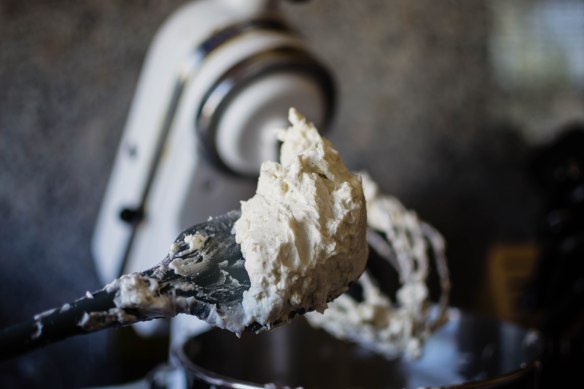
Italian buttercream, for all its advantages, is a bit of a terrifying bother to make. I used a King Arthur Flour recipe, which worked perfectly, but this component is a project in itself as it requires bringing a sugar syrup up beyond boiling temperature, making a meringue, pouring the molten sugar syrup carefully into the bowl of meringue while mixing, and then running your mixer until the whole thing cools by more than 100 degrees. Even then, you aren’t done: you next have to incorporate masses of butter, which can be neither too hot nor too cold, and you have to sit patiently through what looks like certain disaster as the whole bowl you’ve now coddled along for the last half hour suddenly turns into a sloppy, almost curdled-looking mess. But you have to be strong, and keep mixing, and eventually it does start to smooth and fluff and turn into buttery clouds.

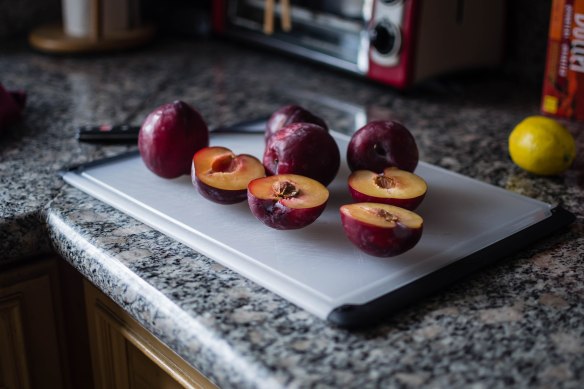
With all this richness, the filling in between needed to be sharp and fresh, to provide contrast and keep the dessert from getting sickly. I went with plums: stone fruit of any kind works beautifully with the slight citrus notes of cardamom, but I think plums, with their sometimes surprisingly tart bite that I’m convinced comes from the oh-so-thin layer of bright red in between their skins and flesh, are the best pairing. Simmered down with a bit of sugar and a healthy squeeze of lemon, they made a successful quasi-jam to spread between the layers.

You may have noticed there are no pictures of slices, or of the artful “cake with a section missing” to show off the layers. There’s a very good reason for this: I had no real occasion to make this cake. I just wanted to bake, and with a surprisingly free weekend as a result of – ahem – not very many assignments turned in on time, I launched into the creation of what sounded like a delightful dessert. To avoid, therefore, eating the whole thing ourselves, I took the whole cake to work and left it in the mailroom for my colleagues to enjoy. I left it there in the 7am hour, and when I went to pick up my dish in the early afternoon, only crumbs remained. Don’t feel bad for N. and me, though. I always carve off the rounded tops when I’m going to make a layer cake, and those can’t go to waste… we sampled and then resampled and then decimated them (pride giving way to gluttony?), with a fair sampling of both the jam and the frosting. And let me tell you something: for years, despite my experiments with whisky, with champagne, with fruit, with mousse, N. has demanded only one cake for every birthday, anniversary, or what have you. But after our sampling-turned-gorge, he said it might be okay to sub this in for The Cake once in a while. So sin or not, wellspring or not, I must admit feeling justified in my pride.

Espresso Cake with Cardamom Buttercream
Cake and buttercream adapted from Molly Yeh and King Arthur Flour, respectively
Makes a 4 layer cake from two 8 or 9 inch rounds
For the cake:
1½ cups sugar
2½ cups flour
1 teaspoon kosher salt
1 teaspoon baking soda
1½ teaspoon baking powder
2-3 teaspoons instant espresso powder
2 eggs
1 cup buttermilk
½ cup vegetable oil
1 tablespoon vanilla
¾ cups strong, cold coffee (I used a cold brew concentrate from Trader Joe’s)
For the filling:
6 plums
1 tablespoon lemon juice
½ cup sugar
For the Italian buttercream:
¼ cup water
⅝ cups sugar
¼ cup meringue powder
½ cup water
pinch salt
3 tablespoons sugar
3 sticks butter (24 tablespoons or ¾ of a pound) at a cool room temperature, cut into chunks
1-2 teaspoons ground cardamom


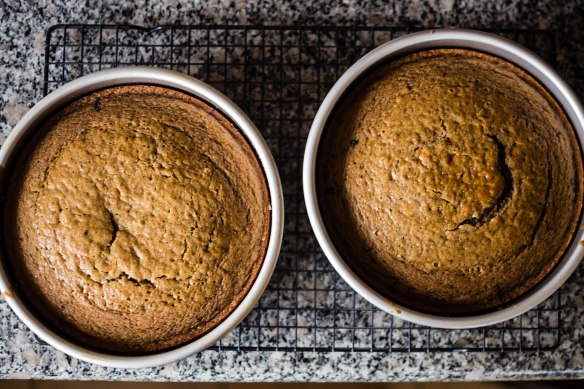
  • To make the cake, first preheat the oven to 350F and butter or spray two 8 or 9 inch cake pans with nonstick spray. In a large bowl, whisk together the dry ingredients: flour, sugar, salt, baking powder and soda, and instant espresso. In another bowl, whisk together the wet ingredients: eggs, buttermilk, oil, vanilla, and coffee. Carefully pour the wet mixture into the dry mixture and fold together just until everything is well incorporated. Be sure to scrape down the sides and check the bottom of the bowl for hidden clumps of flour.
  • Pour and scrape the batter into your prepared cake pans so each holds an even amount. Bake in the preheated 350F oven for 30-35 minutes, but begin checking for doneness at around 28 minutes. When done, a cake tester or toothpick inserted should have only a few moist crumbs. Remove from the oven and cool in pans for at least ten minutes, before removing from pans to cool completely on a wire rack.
  • While the cakes are cooling, make the filling. I opted not to peel the plums because I like the color and the texture the skins offer, but you can if you want: cut a small x in the bottom of each whole plum and immerse in boiling water for about 30 seconds. The skin should peel off fairly easily. Slice and pit the plums and dump them into a medium pot.
  • Skins or not, slice and pit the plums and add them, the lemon juice, and the sugar to a medium pot. Bring to a simmer, stirring occasionally, and cook until the plums have broken down and the mixture has slightly thickened. For me, this took around 20 minutes. Scrape out of the pot and into a bowl (to cool faster) and set aside to cool completely.
  • Once both cakes and jam have completely cooled, you can set to work on the buttercream. Start the ¼ cup water and ⅝ cups sugar cooking in a small pot. Check the temperature occasionally – it needs to come to 240F. While that is heating, make the meringue by whisking together the meringue powder, the ½ cup water, and the pinch of salt in the bowl of a stand mixer on high speed until you can see tracks forming in the fluffy white mixture. With the mixer running, sprinkle in the 3 tablespoons sugar and continue beating until the mixture is stiff.
  • When the sugar syrup has reached 240F, carefully remove it from the heat and even more carefully, with the mixer running on medium-low speed, pour all of the hot syrup slowly down the side of the bowl. Once it is incorporated, turn the mixer speed back up to high or medium high and continue whisking until the meringue mixture cools to at least 80F. KAF suggests you can speed this up by wrapping the bowl in ice packs, and I found this worked well.
  • As soon as the meringue cools the 80F (and no sooner!), turn the mixer speed down to medium and begin incorporating the butter a few pieces at a time, allowing them to fully integrate before adding more. When most of the butter is in the mix, add the cardamom: 1 teaspoon if you want a mild flavor, 2 teaspoons for a more assertive flavor.
  • After all the butter is added, keep on whisking. At a certain point the mixture will collapse on itself and look like a greasy, clumpy mess. Don’t despair. Just keep on mixing. As long as your meringue was no warmer than 80F when you started adding and your butter wasn’t melted, eventually it will start to smooth and get fluffy, and you’ll have frosting.
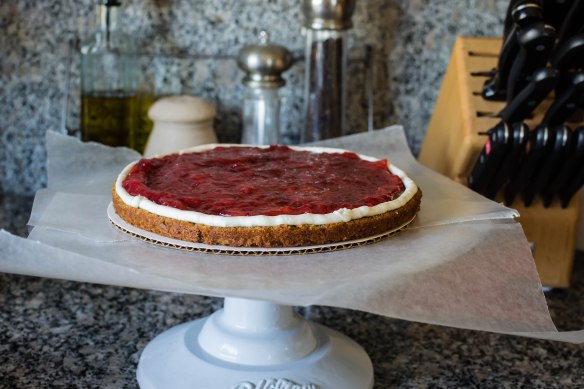
  • To assemble the whole thing, use a long serrated knife to carefully carve the rounded tops off each cake, then slice each in half for four thin layers. On a cake plate or cardboard round, place the first layer bottom side down (that is, the side that touched the bottom of the cake pan). (Reserve the other bottom for the very top layer; this allows for a flat, less crumb-y layer on the top.) Scoop a generous amount of buttercream into a piping bag fitted with a tip that has a wide opening of any shape. Pipe a circle of buttercream around the top edge of the bottom cake layer to create a border so the filling won’t escape. Inside this border, spoon about ⅓ of the plum jam and use the back of a spoon to carefully spread it out just to the buttercream.
  • Place another layer of cake on top of this buttercream and jam, lining it up carefully so it’s even with the one below. Repeat the border of buttercream and ⅓ of the plum jam.
  • Repeat for the third layer – you should now have used up all of the plum jam.
  • Stack the final cake layer with the bottom side (that is, the side that originally touched the cake pan) facing up.
  • To create a crumb coat, use an offset spatula to smooth a thin layer of frosting all the way around the cake. The idea here is to catch any crumbs that detach from the cake in this thin layer so when you add the rest of the frosting it will not have any tell-tale cake crumbs in the smooth frosting.
  • Scoop and pile all but about 1 cup of frosting onto the top of the cake and use an offset spatula to gently move it toward, down, and around the sides, until you have a smooth, even layer all the way around. Scoop the remaining cup or so of frosting into a piping bag fitted with a tip of your choosing – I used a large star tip – and decorate as desired.