Salty sweet

Week 4 of my project (hear that, everyone?  That means January is over and I’ve stuck with my resolution!), and we’ve had our first gathering of ingredients that resulted in a not-amazing dish.  I’m going to share it anyway, though, in the spirit of the project, because I have some ideas for amendment.

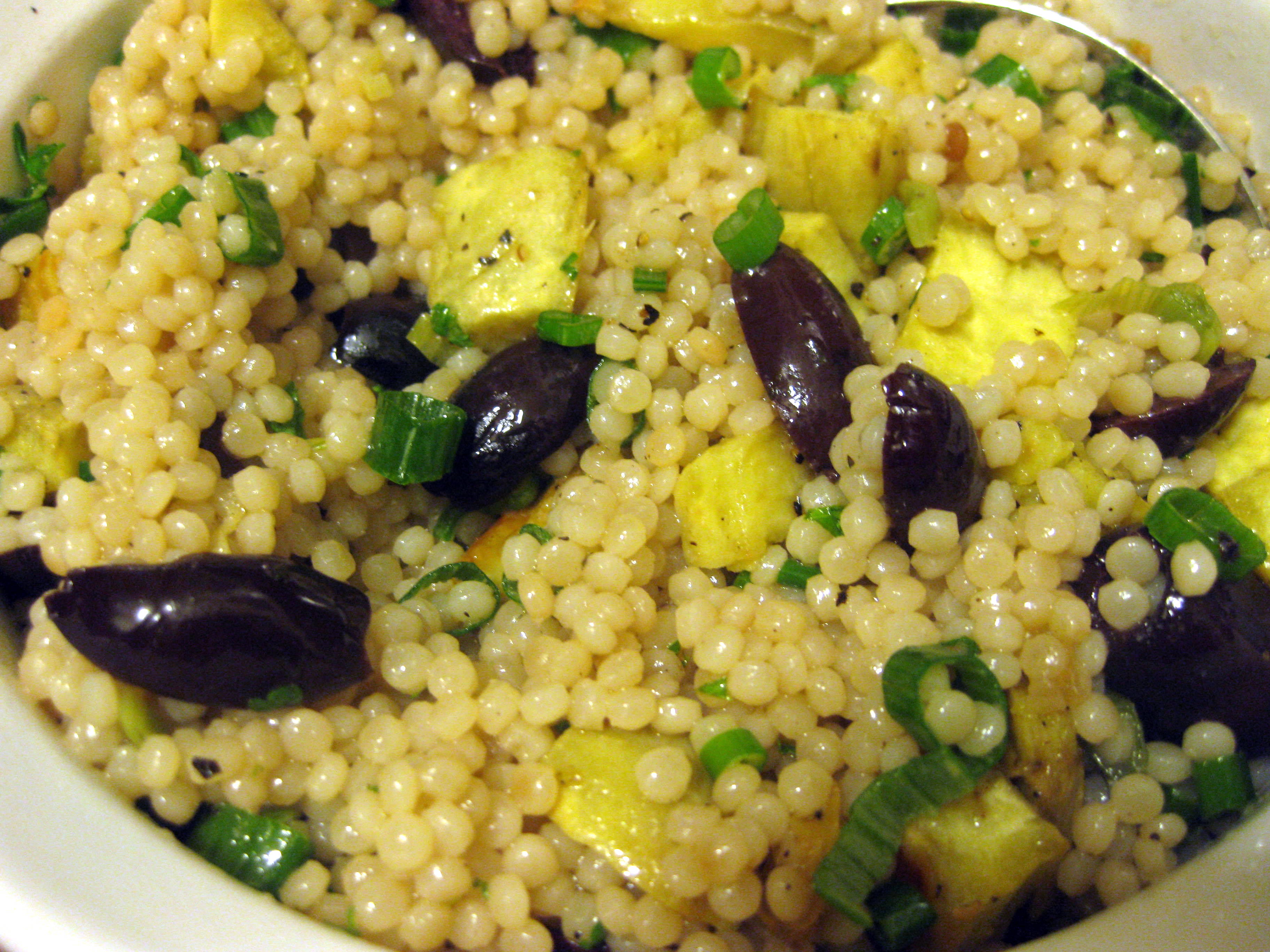
“33. Cook Israeli couscous in stock or water.  With a fork, stir in chopped, pitted Kalamata or other olives, chopped green onions and diced, poached or roasted sweet potatoes.  Dress with a vinaigrette.”

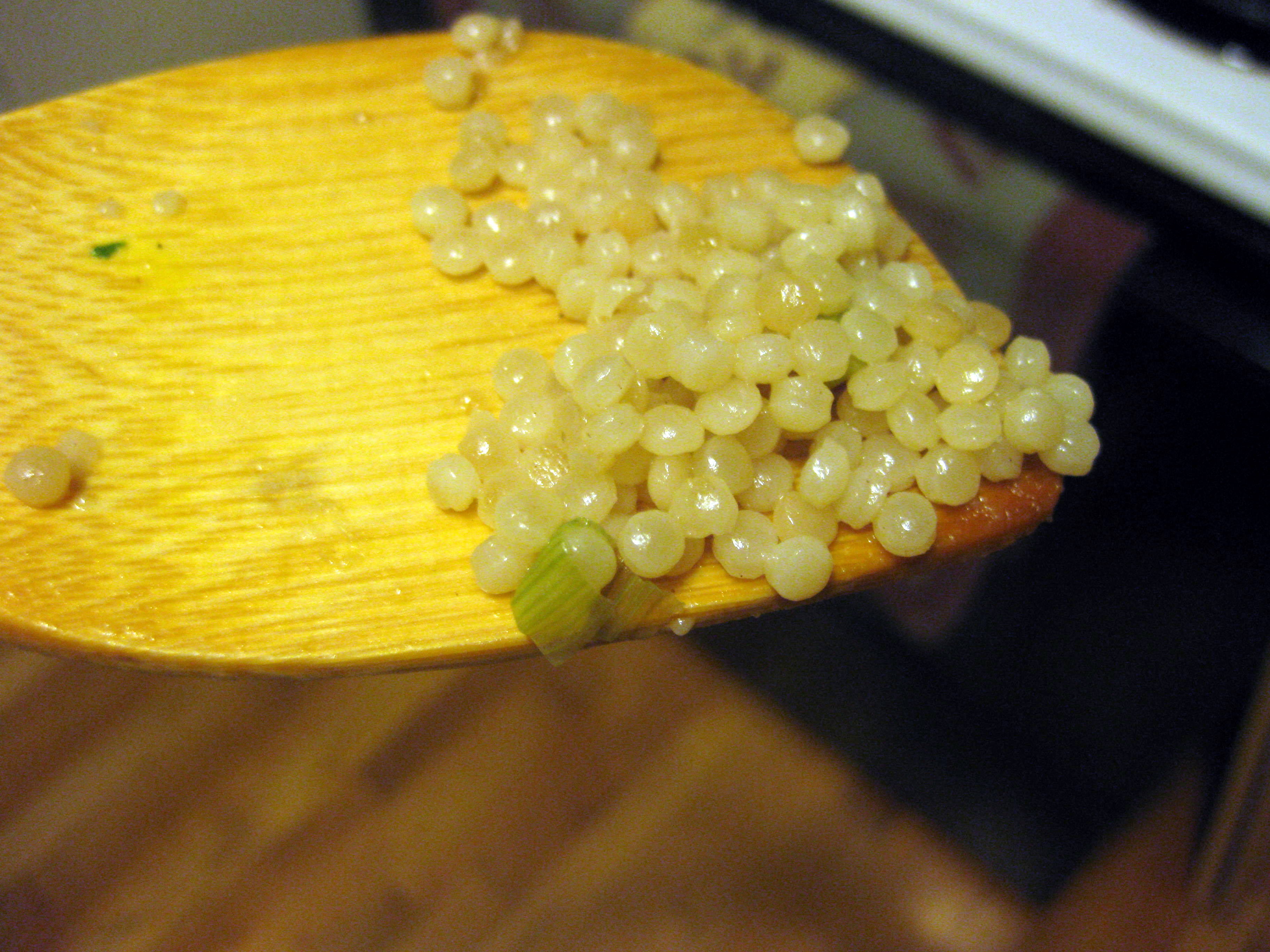
Dutifully, I found and purchased Israeli couscous and cooked it in chicken stock.  I roasted cubes of an enormous sweet potato because I thought the flavor would be more intense and therefore more exciting than just poaching it.  I halved my olives instead of chopping them finely because I was feeling a bit lazy, and I stirred together a vinaigrette of red wine vinegar, a squeeze of dijon mustard, a dribble of honey, and olive oil.  I dressed the couscous while it was still hot, as I’ve learned from experience with pasta salads that this helps the flavor of the dressing permeate the pasta.

And then we tasted.  The couscous was chewy and intriguing, like savory little balls of tapioca.  The green onions were crunchy and fresh, the olives were briny and salty and rich, and the sweet potato was… sweet.

I’m a fan of salty-sweet.  I like chocolate covered pretzels, I love salted caramels, I think craisins are a perfect accompaniment to roasted nuts, but this combination just didn’t thrill me.  Maybe we just had a too-sweet-sweet-potato, or maybe the olives should have been in smaller pieces to lessen their impact, or maybe I wasn’t in the mood for the reminiscences of Thanksgiving, but I think it just wasn’t the perfect collocation of ingredients for our usually investigative little taste-buds.  What I was wanting, I realized halfway through dinner, was acidity – more than the mildly tart vinaigrette I made was offering.  I wanted lemon zest, or capers, or even the glorious salt-packed earthy richness of anchovies.  And then I realized I wanted the dish to be Shauna and Danny’s Pasta with Lemon, Anchovies, and Olives.  And now that’s all I can think of.

So my recommendation for this collection of ingredients is to make one substitution.  Cook up the couscous.  It is filling without being overbearing, and the green onions and vinaigrette lighten it up.  Chop up the olives and fold them in, unapologetic.  They are delicious and they know it.  But leave out the sweet potato.  Replace it with something more savory, like sundried tomatoes or capers or shards of prosciutto.  And then add a squeeze of lemon juice and a few teaspoons of zest.  It will change the tenor of the dish.  It won’t marry nicely with roasted turkey and cranberries and mashed potatoes and green bean casserole anymore.  It won’t be out of place as a fresh take on pasta salad in the summer.  It wouldn’t complain, if you paired it with grilled chicken, or sausages, or Mediterranean-spiced kebabs.  But it will, I think, be good.

Loaded to bear

Considering my avid distaste for filling either roast bird or pork chops with stuffing (with the exception of chicken cordon bleu, which I love), I often forget the merit possible in stuffing other things – namely fruits and vegetables.  The built-in cavities in fruits like peppers and winter squash, and the concave shape of stemmed mushrooms seems to call out to be filled with something delicious, and too often I am deaf to those calls.  Fortunately this week’s Bittman choice reminded me to open my ears a bit.

“38. Trim crimini or portobello mushrooms and chop stems.  Sauté stems in butter or olive oil with chopped prosciutto, onions, chopped fresh herbs (rosemary, sage, parsley, etc.) and coarse fresh bread crumbs.  Stuff spoonfuls of the mixture into mushroom caps; roast until tender.”

This dish was a clear win.  For those of you who don’t like mushrooms, I can see this same parade of ingredients marching well together in a hollowed out zucchini half, but you will be missing the earthy indulgence of mushroom – that rich, meaty, brown flavor that is so intriguing and so deliciously musky.

The collected players:

1 package (4 oz. or so?) proscuitto, diced

3 cloves garlic, minced

4 green onions, white and green portions, thinly sliced

5-6 crimini mushrooms, chopped (I used these because I had some lying around.  If you didn’t have them, you could certainly omit them and just use the guts of the portobellos)

4 portobello mushrooms, stems removed, gills and insides excavated (you want only a thin shell so you can fit the maximum amount of stuffing)

scant tsp. each thyme and rosemary

black pepper

2 cups fresh white bread crumbs

olive oil

I turned the oven on to preheat to 350F and then set the prosciutto to cooking in a pan on medium high with just a touch of olive oil to help it along.  While it slowly rendered and crisped and crackled toward doneness, I prepped my vegetables.  When the meat was almost crispy, I added garlic, green onions, chopped mushrooms, herbs, and a bit more olive oil to the pan.  While that cooked down for a few minutes, I tore up half a loaf of leftover French bread and ground it into coarse crumbs in my food processor.

I dumped the crumbs into my skillet of veggie, turned the heat off, and added another tablespoon or two of olive oil to bind the ingredients together.  At this point I considered adding Parmesan cheese, thinking of both its binding power and its stellar flavor, but I tasted the crumbly filling and realized that the prosciutto was making it quite salty enough, and an extra pow of sharp cheese might be overkill.

I loaded the mushrooms to bear with heaping spoonfuls of filling, tamping it down in each cavity to fit as much as possible.  This was almost too much for four medium portobellos to handle.

With one last, loving drizzle of olive oil over the tops of my brimming vessels, I put the mushroom-laden casserole dish in the oven for half an hour.  Quick steamed green beans in the final minutes and we were ready!

Cutting into one of these roasted boats was an explosion.  The filling did not adhere to itself and instead came collapsing down onto the plate and covered the green beans.  This was not a bad thing.  In fact, the bread, now flavored with the porky richness of prosciutto and the fruity softness of olive oil, was a crisp and delectable crunch atop my barely tender beans.  As for the mushroom itself, it softened and took on a thick meatiness that was perfect with the prosciutto.  The crunchy bread crumbs soaked in the earthy juice of their vessel and we scarfed down all four mushrooms between the two of us.  And then I may have scraped the baking dish clean with my fingers.

Currying flavors

The thing about Mark Bittman’s make-ahead sides is that they are all ostensibly created with a main of turkey in mind.  They are, after all, Thanksgiving inspirations.  Therefore, when I ask myself the inevitable question each week “what should I serve this with?”, I suppose I shouldn’t be surprised when the first thing that pops into my head is “that would taste really good with roast fowl!”  Of course it would.  That plays into the composition of Bittman’s list.

But we don’t want turkey every week, or chicken, for that matter.  Lately, both for ease, for cleanliness, for cost, and in some minor and embarrassingly halfhearted respects for moral and environmental concerns, I’ve been more drawn to vegetarian fare.  Potatoes, rice, grains, beans: these guys don’t cross-contaminate my kitchen.

So I’m having to be unusually creative in my search for accompaniments for the accompaniments I’m cooking.  This week N. chose, from a short list, an interesting combination:

“43. Toss chunks of butternut squash with butter and curry powder.  Roast until half-tender, then stir in chunks of apple and some maple syrup.  Cook, shaking the pan occasionally, until everything is nicely browned and tender.”


The mystery about butternut squash is, for me, as with some other orange produce, whether to treat it as a starch or a vegetable.  It seems to occupy some strange and unnecessarily cryptic middle ground.  It’s not green or leafy, but it’s also clearly not a tuber, no matter how much its deep autumnal color reminds me of a good hearty yam.  Yet, if I’m not serving meat with dinner, pairing a butternut squash roast with  vegetables seems not substantial enough, but opting to serve it alongside, say, mashed potatoes, seems excessively filling and somehow repetitive.

I opted for another strange middle ground and went for sauteed red chard stirred into quinoa.  As a nod to the seasonal intentions of the squash dish, I cooked my quinoa in turkey broth I made and froze a day or two after Thanksgiving.  I like the deeper, richer flavor that results from cooking grains and small pastas in broth or milk rather than water.  So our dinner basically consisted of two side dishes, but I decided I didn’t really mind.

Here’s how it went:

1 medium butternut squash, peeled, seeded, and chopped into small chunks

2 apples (I used Braeburns) quartered, cored, and chopped into chunks

1 onion, diced (I thought the extra savory flavor would be nice, since apples and squash are so sweet)

1 TB curry powder

2 TB melted butter

1-2 TB maple syrup

I tossed the chunks of squash on a cookie sheet with melted butter and curry powder, then slid it into a preheated 375F oven to roast for 20 minutes.  Meanwhile I prepped my apples and onions.  After 20 minutes when the squash chunks were just beginning to give, I pulled the pan out of the oven and added the apples, onions, and maple syrup – a decadent drizzle over the top that I hoped would pair well with the curry – mixed it all around together, and dropped it back in the oven for another 20 minutes (but really, it took almost half an hour).

While the roasting fruits softened and the maple syrup made suggestions of carmelization on their corners, I addressed our other side dish.  I stripped the chard leaves from the stems, chopped the stems into a fairly small dice, and plunged them into a pot with a couple teaspoons of olive oil.  I sauteed them over medium heat until they were just beginning to soften, then added the quinoa.  In one of my favorite quinoa recipes, Danny (the Chef of Gluten-Free Girl and the Chef ) suggests toasting the quinoa before adding any liquid, much as you toast the rice in a risotto before deglazing the pan.  I toasted for a few minutes, then poured in the turkey stock and clapped on the lid.  When there were only five minutes left on my timer, I added the chopped chard leaves into the mix, stirred it together well, and replaced the lid so it could finish cooking.  It worked perfectly.  The chard had just enough time to steam as the final few tablespoons of water were absorbed, but not enough time to overcook and lose all semblance of texture.  I can’t stand that sliminess that greens sometimes get after too much contact with the heat.  To my delight, the quinoa had taken on a lovely deep rosy color thanks to the chard stems, and the toasty nutty crunch of the grain worked really nicely with the healthful greenness of the chard leaves.

When I pulled the butternut and apple mixture out of the oven, all I could smell was sweetness and curry.  The maple syrup had thinned in the heat, but cloyed onto the chunks of fruit as it cooled again.  The mixture was really nice.  Butternut squash and apples are very good friends, and leaving the skins of the apples on was a wise choice because it added textural interest to the dish.  The curry made the flavors deep and warm and spiced, and the maple syrup was a nice hit of sweetness.  This one I would make again with no reservations, and only one (okay, maybe two) changes.  I put the diced onions right onto the cookie sheet, raw from my cutting board.  When I make this again, I will soften them lightly in butter first.  They didn’t roast quite long enough to quell the astringent tang onions sometimes have, and I could feel them in the back of my throat afterward.  Mellowing them out on the stovetop first would be the right thing to do.

To change it up from curry, I think garam masala would also be delicious on this mixture, and fortunately (and conveniently!) enough, Aarti of aarti paarti has just posted suggestions for making your own!  How timely!  How fortuitous!  Let’s make some!  And then, make this autumnal dish.  Maybe with turkey.  Maybe with chicken sausage.  Maybe, as I realized only after dinner was over, with potato masala burgers from Trader Joe’s.  What a congenial blend of spices that would be to curry favor with your family!

Apologies for the punning… I couldn’t resist.

Bittman 1: Baking Broccolini

With the first week of January down, I am happy to report that I’ve kept up with my resolution so far (yeah, yeah, so it’s only been one week…).  This past week we enjoyed our first in the series of Mark Bittman’s Thanksgiving sides.  Here is his suggestion:

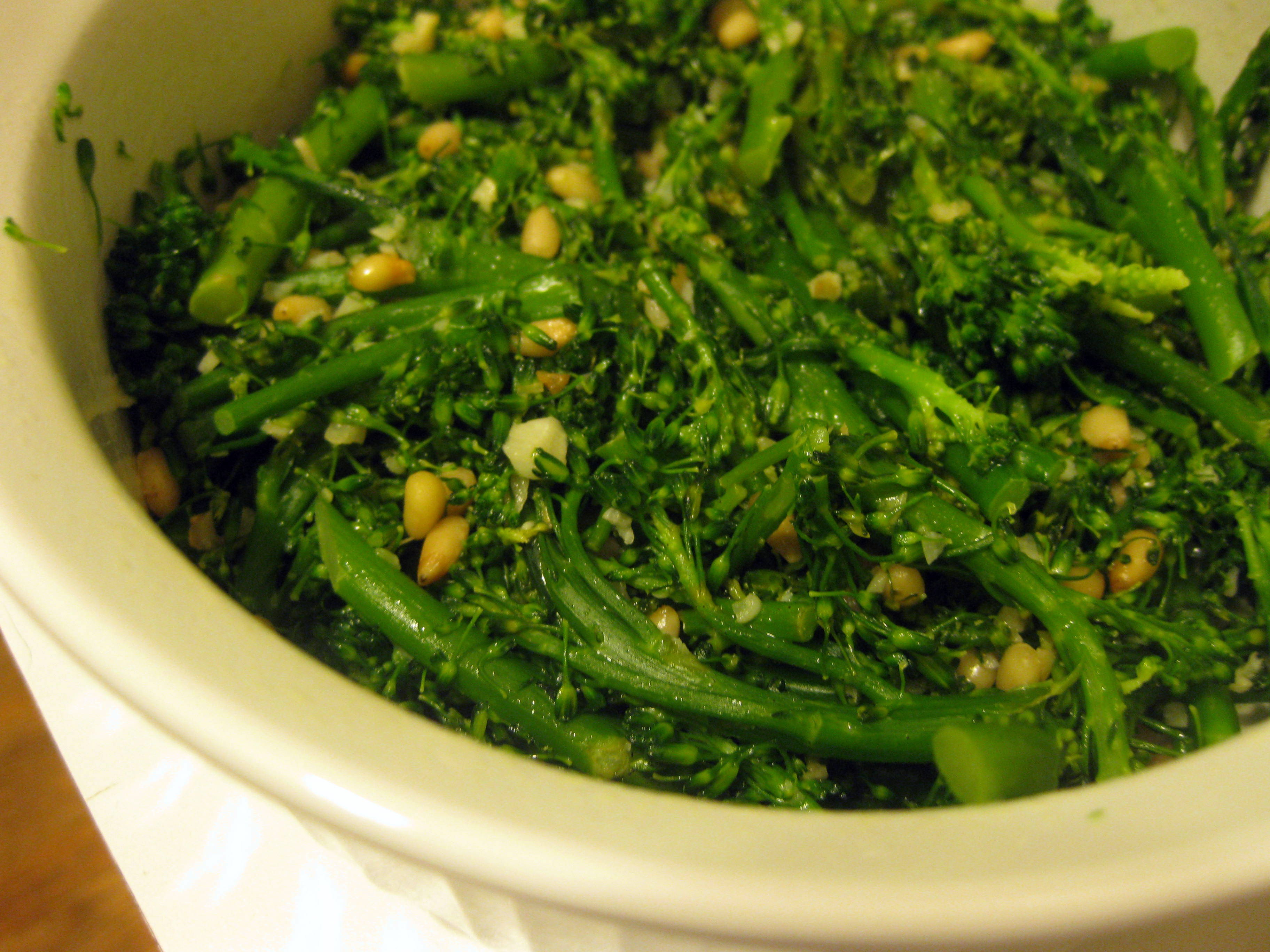
“65. Sauté garlic and pine nuts in olive oil until the garlic softens; add trimmed, blanched, chopped broccoli rabe (or broccoli).  Put into a buttered baking dish, top with Parmesan and bread crumbs and bake until the topping browns.”

As you can see, he gives lots of room for adjustments and personal preference: this is not a recipe, this is a collection of ingredients that dance together well, and what rhythms you might coax them into.  I did the following, in these approximated proportions:

6-8 cloves garlic, smashed and minced

¼ cup pine nuts

2 TB olive oil

2 bunches broccolini (splitting the broccoli / broccoli rabe difference)

½ cup panko bread crumbs

1 TB butter

2 TB Parmesan cheese

I heated the olive oil over medium heat and sauteed away.  Though I can see the need to blanch both broccoli and broccoli rabe before letting it color in the pan with the pine nuts and garlic, my broccolini was a touch on the soft side by the time it came out of the oven, so it probably didn’t need the 3-4 minutes I gave it in boiling water.  Even when I bake them, I like my veggies to maintain a little crispness, and this had almost none.

While the broccolini absorbed the garlicky nutty olive oil in the skillet, I mooshed together my panko, butter, and Parmesan into little crackery clumps.  After spraying a casserole dish with olive oil cooking spray and dumping in the vegetable mix, I topped it with the panko crumbles and stuck it in the oven at 350F for half an hour.  The panko got a little brown, but not quite the golden color I was hoping for.  My thoughts for repairing this are two: 1.) either the oven temperature needed to be hotter, or 2.) I needed more butter in the topping mixture.

This was a good start – aside from the slightly limp broccolini, the flavors were nice and sharp and salivary-gland-inducing.  Garlic and Parmesan are never a bad thing together, and the toasty buttery crunch of the pine nuts went well with the slightly bitter greenness of the broccolini.  We did think, however, that the mix was a little on the dry side.  I was expecting something casserole-ish, and what I got could just as easily have been tossed on a cookie sheet and served: more like roasted vegetables than a finished casserole dish.  It needed, if it was to become a casserole, some kind of sauce or binding ingredient.

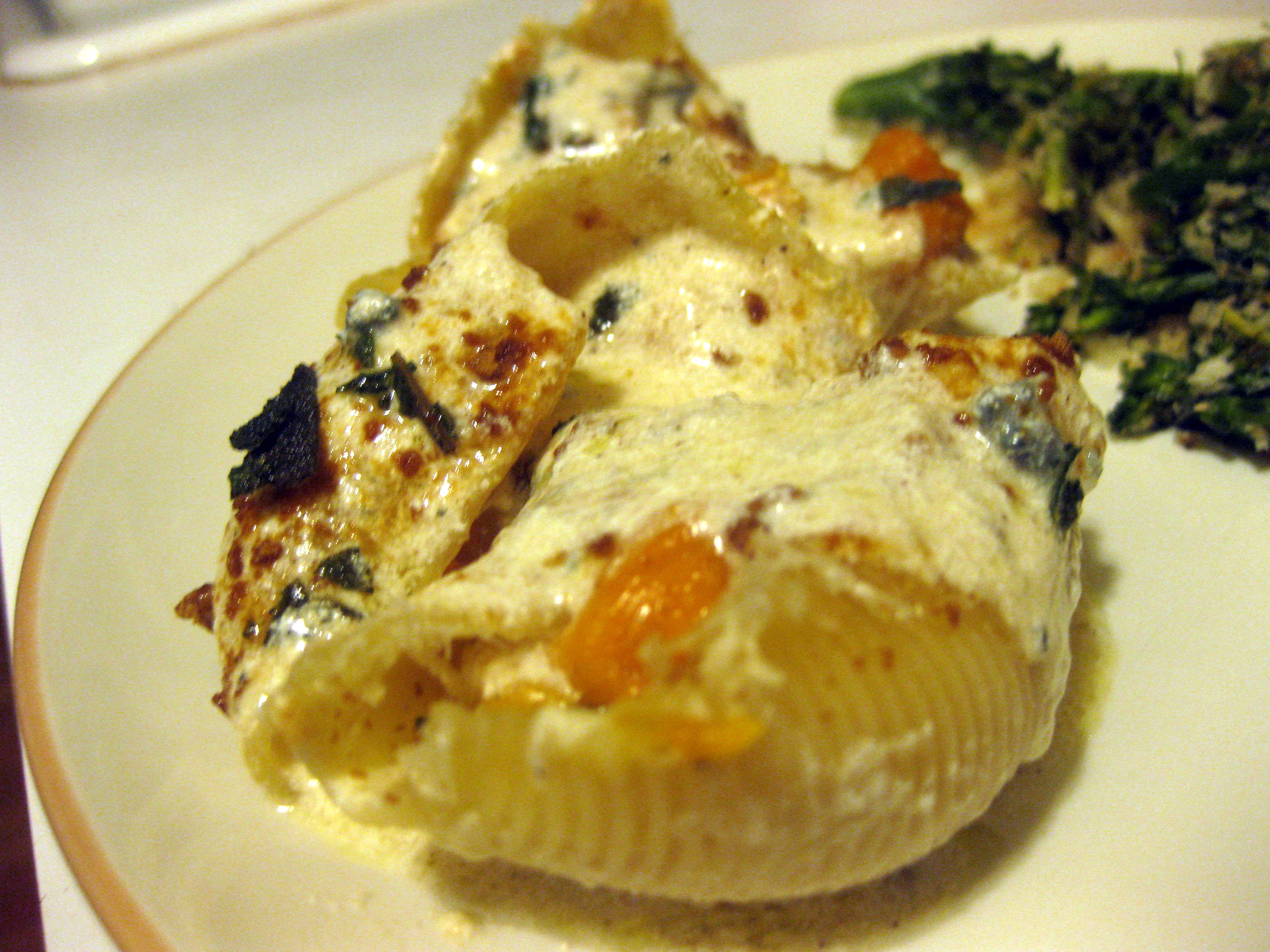
Enter the rest of our meal: butternut and pumpkin stuffed shells with gorgonzola cream sauce.

I had some butternut squash ravioli filling kicking around in my freezer, and part of a can of pumpkin in the fridge.  That, along with the half cup or so of gorgonzola in my cheese drawer and the remaining glugs of half and half from a richer project, became a use-all-this-stuff-up-as-soon-as-possible challenge.  I cooked off some large pasta shells, leaving them a little underdone, and arranged them in a pie plate.  Then I added the pumpkin to the squash mixture, loaded into a gallon ziploc bag with one corner snipped off, and piped the filling into my shells.  I dusted them with a snowy layer of Parmesan cheese and loaded them into the oven with my broccolini.

While pasta and veg baked for half an hour, I set my attention to the sauce I was about to make up.  I fried some sage leaves in butter, my new favorite trick, and then lifted them out and set them to dry on a paper towel.  With the sage-infused butter bubbling, I added some wine and let it reduce a little.  Then I glugged in some half and half, which promptly separated a little – I think it was the acidity of the wine and the refrigerator cold temperature of the dairy, which made it want to curdle.  I should have added the half and half first and the wine second.  I was a little worried about this separation, but it only affected the appearance of the sauce, and not the taste or texture.  Onward!  I crumbled my gorgonzola into the pan and stirred gently until it melted.  That was it.  No thickening agents – the cheese did that job for me – no extra spices or herbs or aromatics, just butter, wine, cream, and cheese.

When the shells were done, with just little golden tips on the exposed edges of pasta, I poured the silky rich blue-veined sauce right over top of them.  Then I crumbled my fried sage over the drenched shells, and sprinkled the whole thing with some pulverized gingersnap cookies.  A touch of fancy, if you will.

The shells were divine.  Not much texture, besides the cookie crumbles, but really, don’t you want just velvet and richness in a stuffed shell?  The cheese sauce was the missing link the broccolini needed.  It was tangy and rich and silken and perfect, and I ended up letting it trickle across my plate to meld with the vegetables and gently perfect them.  Next time, we may add a little cheese sauce before baking the broccolini, and see how that turns out.  I imagine the perfect, decadent accompaniment to baked potatoes…

N. has already picked out which dish we will be trying next week, so stay tuned!

Candyland

My two favorite board games when I was a kidlet were Chutes & Ladders, and Candyland.  I liked the first, but found it slightly stressful, since it seemed I inevitably ended up sliding down the longest possible slide and having to restart the game from the beginning.  Looking back, I wonder whether the primary design of this game was to keep children occupied with it for as long as possible, to give exhausted parents a chance to rest.  Having no siblings at that point in my life, if this was the goal of the game it backfired in my family.

But Candyland?  Candyland I loved.  And I loved it not so much for the gameplay itself, but for the fantastical characters and decorated board, and for the outrageously wonderful idea that a whole kingdom could be made out of and based around candy.  It was like “Cloudy with a Chance of Meatballs,” but better.  Because it was candy.  My favorite figure in the game was Queen Frostine.  She had blueish silver hair that came down to her waist, and a sparkling rock candy scepter.  I still remember the first sentence or two provided about her in the game description: “Peacefully adrift on an ice cream float in an ice cream sea…” Pretty, powerful, royal, and living in ice cream.  It was everything I thought I had ever wanted.

When Candyland was at last boxed up for good and covered in an inch or two of dust in our attic, I retained a love for both miniatures and candy.  Thus, truffles were like little boulders, or tree stumps, and gingerbread houses were the most romantic, creative way of celebrating the desserts of the holiday season.

Now, as an adult but also a student, my holiday budget is somewhat limited.  But I know, since I share my life and most of my friendships with other graduate students, that food – especially a special, out of the ordinary sort of food – makes a good gift.  So, with the holiday season approaching and the term ending, early in December I celebrated my extraordinarily timely submission of my first dissertation chapter by hiding books, pencils, and papers from myself and instead filling my kitchen with bags and boxes of chocolate.  I submerged myself back into Candyland.  Not as Queen Frostine this time, but as a new character: the Empress of Truffletown, perhaps.  I wrote some time ago about my first experience with truffle production, and this time I wanted to explore some new flavors – add my own sweet twists to the basic recipe. 

The basic procedure is to coat squares of ganache in melted chocolate.  It seems to me after some experimentation that the right ratio in a ganache is 6-8 tablespoons of liquid for each 8 oz. of melted chocolate.  At least 6 of these liquid tablespoons should be heavy cream.  But the really exciting part lies in the possibilities for the other 2 tablespoons…

I made three varieties: Amaretto White Chocolate Truffles, Gingerbread Truffles, and Peppermint Truffle, and popped them into some pretty, festive boxes I found.  Then, just for fun, I also whipped up some Almond Butter cups.  My willing taste testers declared the Amaretto and the Almond Butter cups the best selections.

Amaretto White Chocolate Truffles:

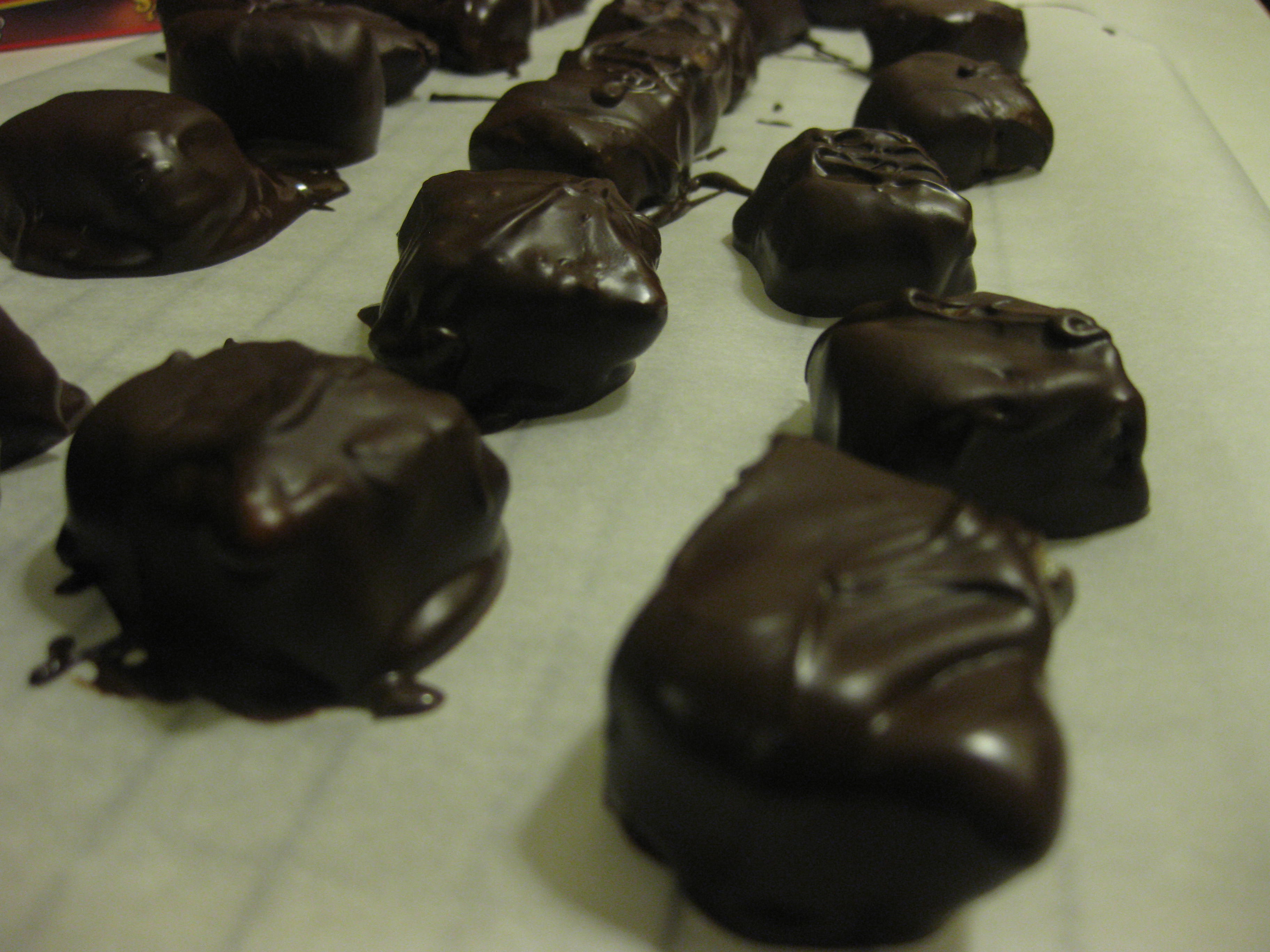
To make this flavor, I melted 6 TB of heavy cream with 8 oz. white chocolate over a double boiler.  When the mixture was almost completely melted, I carefully stirred in 2 TB amaretto.  When it was completely smooth, I added a few tablespoons each finely chopped dried apricots, and finely minced, toasted almonds.  I stirred the whole thing together quickly, poured it into a plastic wrap lined loaf pan, and stowed it in the fridge to harden.

The following day, I pried the block of creamy white goodness, studded with precious gems of flavor, out onto a board, cut it in squares, and dunked each in melted semi-sweet chocolate.  After letting these harden on parchment paper, I added a white chocolate drizzle to the top for a little flair.  They were incredible.  The white chocolate was delicately flavored by the amaretto, which is one of my favorite liqueur varieties.  Nutty and rich and sweet, and here punctuated by the soft crunch of almonds and the slight chew of apricot chunks.  This variety is definitely one for the recipe books.  I will absolutely be making it again and again.
Gingerbread Truffles:

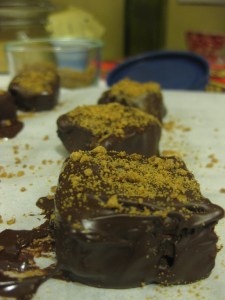
I followed the same basic procedure for these as for the Amaretto version, though I used dark chocolate as my base for the ganache.  Lacking a ginger flavored liqueur, I melted the chocolate with only 6 TB heavy cream, and stirred in about a ¼ cup finely chopped candied ginger.  Again, I refrigerated, again, I removed, sliced, and dipped.  Then, while the outer layer of chocolate was still glossy and wet, I sprinkled a good teaspoon or two of powdered gingersnap cookie crumbs atop each truffle.  Spicy and warm in the back of the throat, with a pleasing crispy crunch from the cookie powder.  I did find, with these, that the ganache was a bit crumbly after it hardened, perhaps because it was made with less liquid.  I would up the amount of heavy cream in the mixture to 7 or a full 8 tablespoons to try and combat this issue.

Peppermint Truffles:
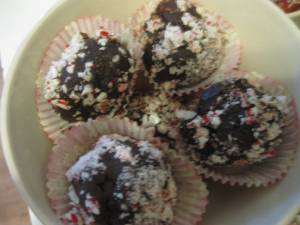
For these, I combined 8 oz. of milk chocolate with 6 tablespoons of heavy cream and 2 tablespoons of peppermint schnapps we had kicking around in the back of our liquor cabinet.  This time, instead of pouring into a loaf pan, I just left the ganache in the glass bowl I was using as the top portion of my homemade double boiler.  While I waited for it to cool and solidify into that glorious fudgy paste ganache becomes, I broke up and crunched several candy canes into bits.  The bottom of the peppermint schnapps bottle proved an excellent tool for this project.  A rolling pin would probably also work well for this.  As I scooped out each tablespoon of ganache, I rolled it into a ball with my hands and then rolled it through the candy cane flakes, creating a pinkish minty snowball to add to the collection.  I wasn’t as thrilled with the flavor of these; the schnapps came through more as the harsh grate of alcohol rather than the spicy-cool flavor of peppermint, but my taste testers didn’t complain.  They were Christmas-y in appearance, which no doubt leant to their appeal.  If I do this flavor again, I might use only one tablespoon of schnapps, rather than 2.

Almond Butter Cups:

I was much less exact with these, working mostly for flavor rather than creating a recipe.  Again, I melted 8 oz. of chocolate – semi-sweet this time.  Then, I mixed a few tablespoons of powdered sugar into a cup or so of almond butter.  Trader Joe’s makes a really good crunchy variety with roasted flax seeds, so that is what I was using.  When the sugar and the butter were well combined, I scooped it into my chocolate and let them melt together into smooth, thick ribbons.  Then I poured a tablespoonful or so directly into candy papers.  I found that setting each paper into the depressions in a mini muffin tin made them stand up straight and not collapse when the hot chocolate mixture was added.  I refrigerated my muffin-tin-full to let them set up.  Imagine taking a bite of a Reese’s Peanut Butter Cup.  Now imagine it tastes of almonds instead of peanuts.  Now imagine that nutty flavor is mixed evenly through the chocolate, rather than sitting in the center, and that it is interspersed by the crispy, deep, roasty-ness of golden flax seeds.
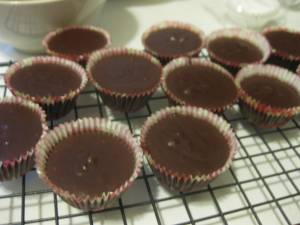
Presenting boxes of these collected divinities to my officemates, a few close friends, our neighbors, and finally our families, I felt like a benevolent ruler.  Sure, it’s only my little kitchen where I rule with a chocolate-daubed fist, but my offerings were wide and sweet.  Move over, Candyland.  This is Truffletown.

Bittman’s 101 make-ahead Thanksgiving sides

Mark Bittman is a miracle.   Cookbook author, food columnist, and just generally food enthusiast, he has a practical and delightful approach to food.  Simple, good ingredients, care in how flavors go together, and nothing is overly fussy.  I’ve been following his blog for six or eight months now, and slowly adding recipes to my “Must Make” file.

And now this.  A list of 101 autumnal recipes intended to ease the pressure on Thanksgiving day.  These are dishes that can be made ahead to free up space on the stovetop or in the oven.  But they are more than that.  They are 101 brilliant and varied ways of combining harvest and winter flavors.  This page is, in my humble opinion, an extremely valuable resource for spicing up your side dish repertoire.  And, in true Bittman style, he gives suggestions like “Bacon would also be welcome here,” or “chopped fresh parsley would not be amiss.”  Clearly this is about learning how flavors fit together, not about constructing firm recipe requirements.  As someone learning her way into developing original “recipe” combinations, this too is invaluable.

I’m thinking of working my way through these 101 ideas Julie&Julia style (at least the ones N. and I think look good – we’re not quite as militant as Julie Powell was.  Aspic?  Blech!).  Of course I will report on the results with photographic evidence.  What do you think?  A good way to spend the encroaching winter?