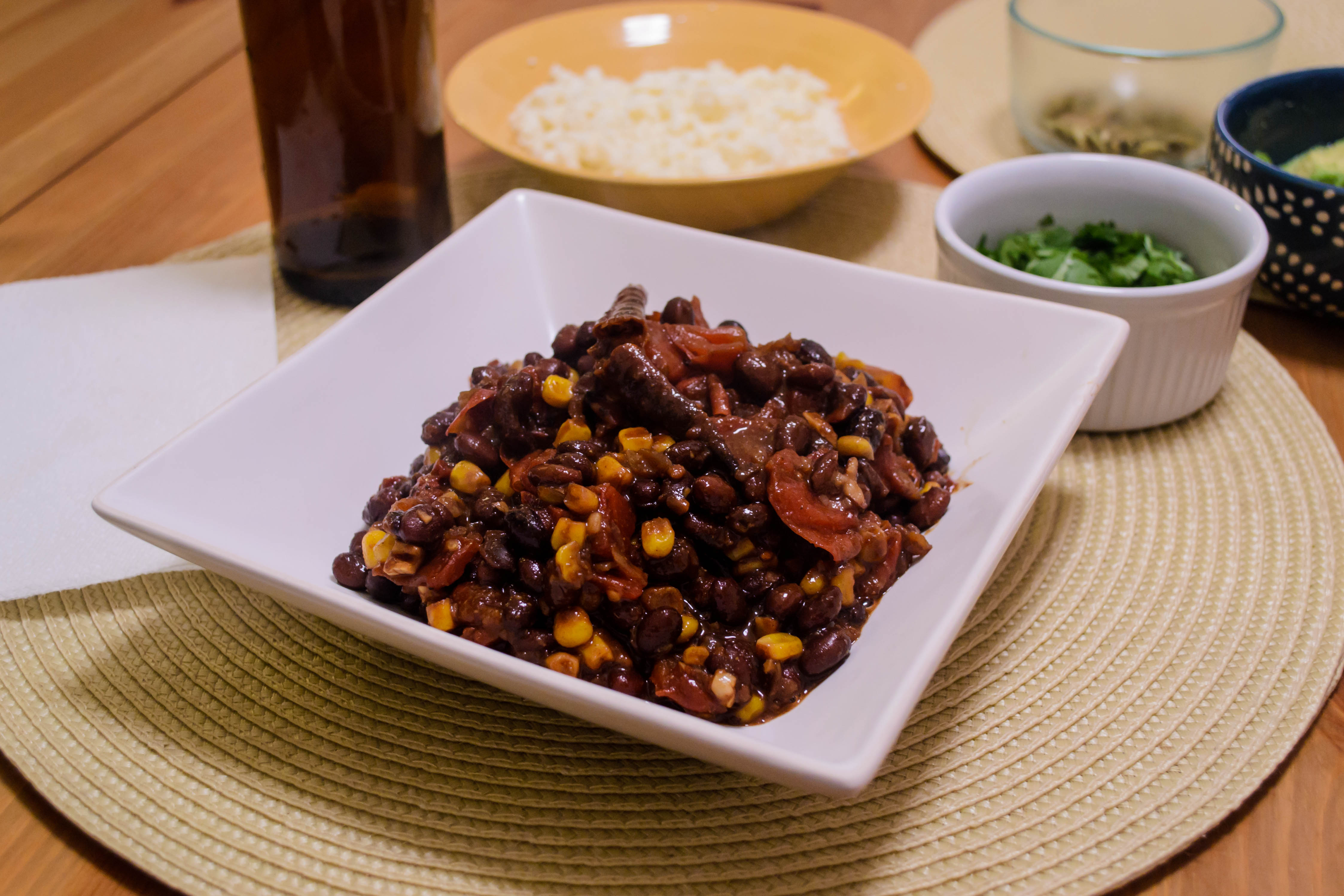
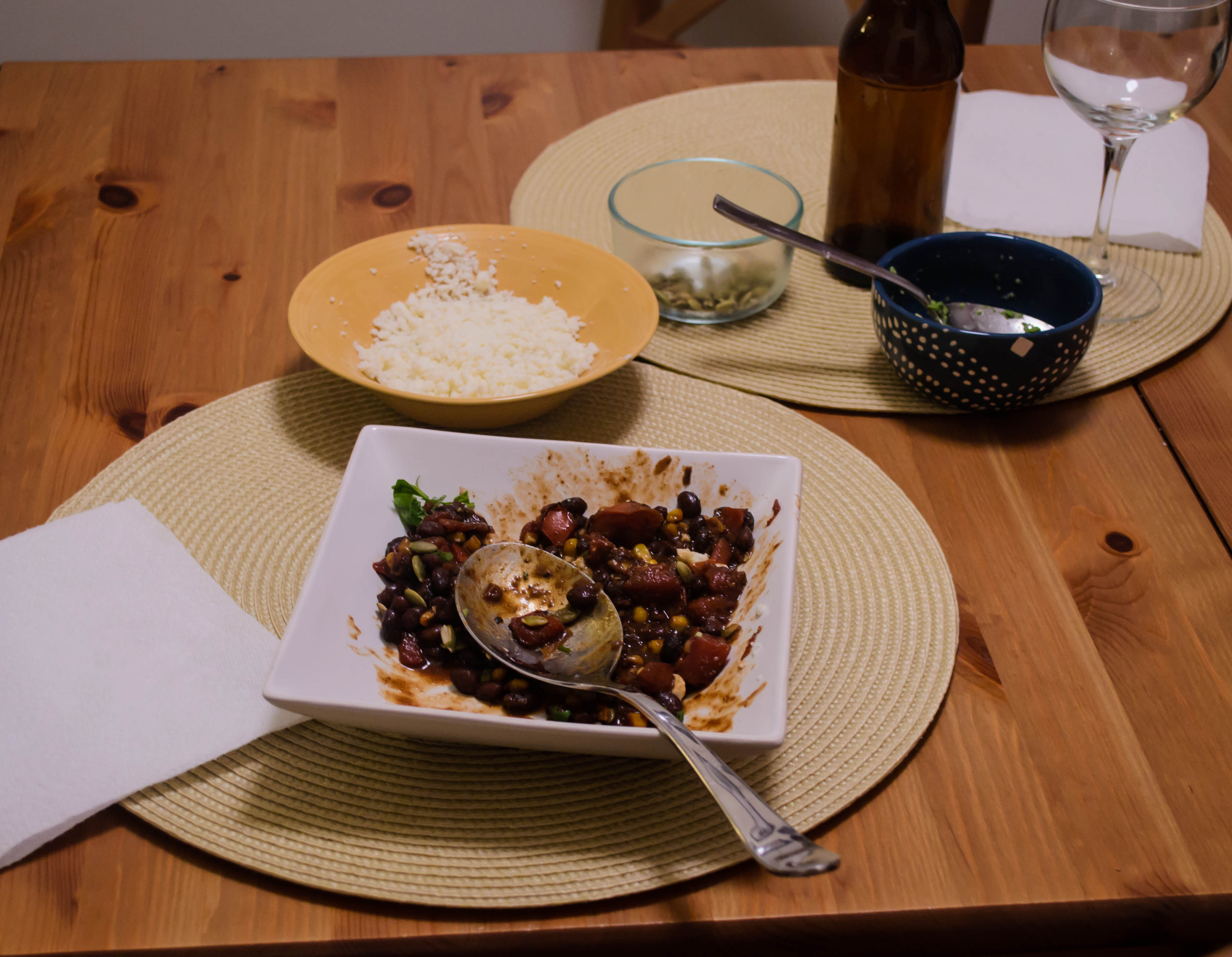
Beer Braised Beans

Food Blog March 2015-0444There is little glamour in a pot of beans. Beans are humble, simple food. They are inexpensive, they fill you up, and most often they serve as a neutral backdrop for flashier plate-mates: pork, beef, cheese… When it comes to aesthetics, things don’t get much more exciting. Photographing a pot of beans is not particularly rewarding. The overwhelming, well, brownness of the whole deal makes any tremendous infusion of flavors discernible in descriptors only. In short, I suppose, beans are not Pinterest food.

Food Blog March 2015-0435More and more, though, I’m appreciating beans – not as an excuse to shovel away great spoonfuls of bacon and brown sugar (though really, that sounds far from terrible), but for their savory value. Beans are a vehicle for flavor. They are, as a friend once remarked while I was preparing dinner, “Nature’s little sponges.” Aside from the fact, as I pointed out, that sponges are in fact Nature’s little sponges, this tends to be quite true. Beans learn by osmosis.

Food Blog March 2015-0436Typically I take advantage of this tendency to suck up flavors in Latin American directions: cumin, garlic, various chiles. A few months ago, though, needing another few minutes before dinner and not wanting the beans that had been simmering away on the stove for who-know-how-long to dry up, I cast about the kitchen and emptied a bottle of beer into the pot. I’m not going to say angels sang or the clouds lifted (because let’s be honest; this weekend’s welcome rain aside, this is Southern California. What clouds?), but the revelation was substantial in its own way. Beans already have an earthiness that separates them from the rest of the fruit and vegetable kingdom. Theirs is not the leafy greenness or plump juice of their compatriots, but a creamy, grounded neutrality. Brown. Earth. How odd that they grow on bushes and vines rather than beneath the surface, like potatoes.

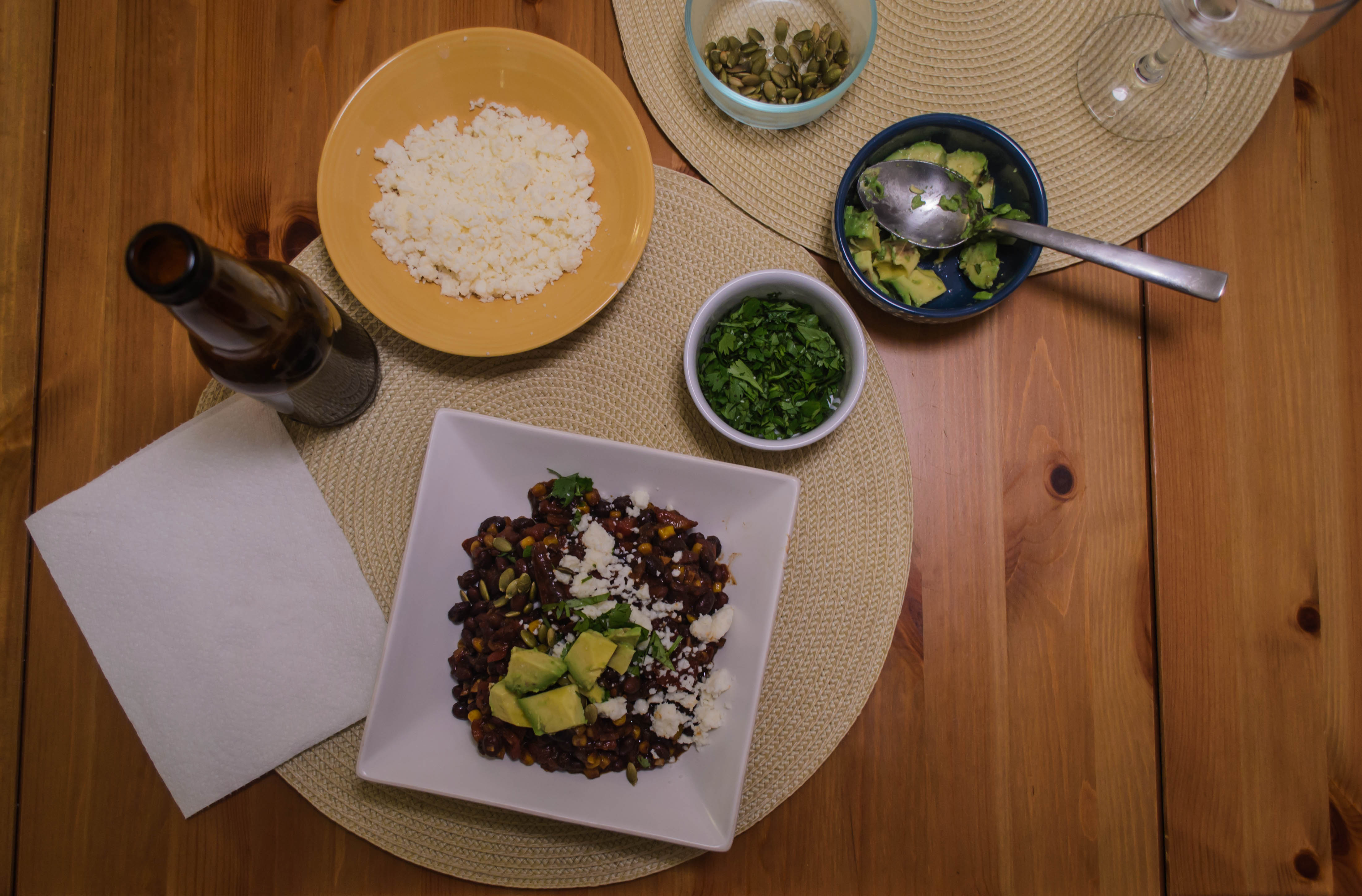
Food Blog March 2015-0440Beer, I found, enhances this earthiness perfectly, especially a dark beer like a porter or a stout. The bitterness of an ale or even a lager is tempered in a darker brew, giving way to toasted, bready flavors that mingle well with the earthy pleasantness of beans. Since this discovery, we’ve charged through a number of bean-and-beer concoctions, including a chile that also contained hunks of slow cooked bison stew meat and a barrage of spices – a triumph. But the one I want to come back to for you is the original, simple combination. Beer and beans. A few flavor enhancers by way of garlic, onion, some almost-burned corn kernels, and a scoop of fire-roasted tomatoes, and you’re looking at a side dish that I’d push away the mains for.

Food Blog March 2015-0439If you like a good garnish, I recommend the standards: crumbled queso fresco, cilantro, toasted pumpkin seeds, generous chunks of avocado, perhaps a dollop of sour cream or a few snippings of chives. But really, these beans don’t require much beyond a bowl, a spoon, and a belly in need of warming.
Food Blog March 2015-0442Food Blog March 2015-0445

Beer Braised Beans
Serves 2 as a main; 3-4 as a side dish
2 tablespoons olive oil
1 dried chile of your choice (I like ancho chiles for this)
½ cup diced red onion (about ½ a medium onion)
1 teaspoon ground cumin
1 teaspoon ground coriander
2 cloves garlic, minced
½ cup corn kernels (defrosted, if you’re using frozen corn)
14-16 ounce can of black beans
1 cup drained fire-roasted tomatoes, from a 14 ounce can
12 ounces of dark beer like a porter or a stout
salt to taste
garnishes of your choosing: crumbled queso fresco, avocado, cilantro, pumpkin seeds, etc.


  • Heat the olive oil over medium heat, then add the dried chile and the onions and sauté for 1-2 minutes. The chile may sputter a bit, and the onions will start to turn translucent.
  • Stir in the cumin and coriander and continue to cook for another 1-2 minutes, turning the heat down to medium-low if the onions threaten to burn.
  • Add the garlic and corn, turn the heat back up to medium if you previously lowered it, and sauté, stirring occasionally, until the corn picks up some roasty color; about 3-5 minutes.
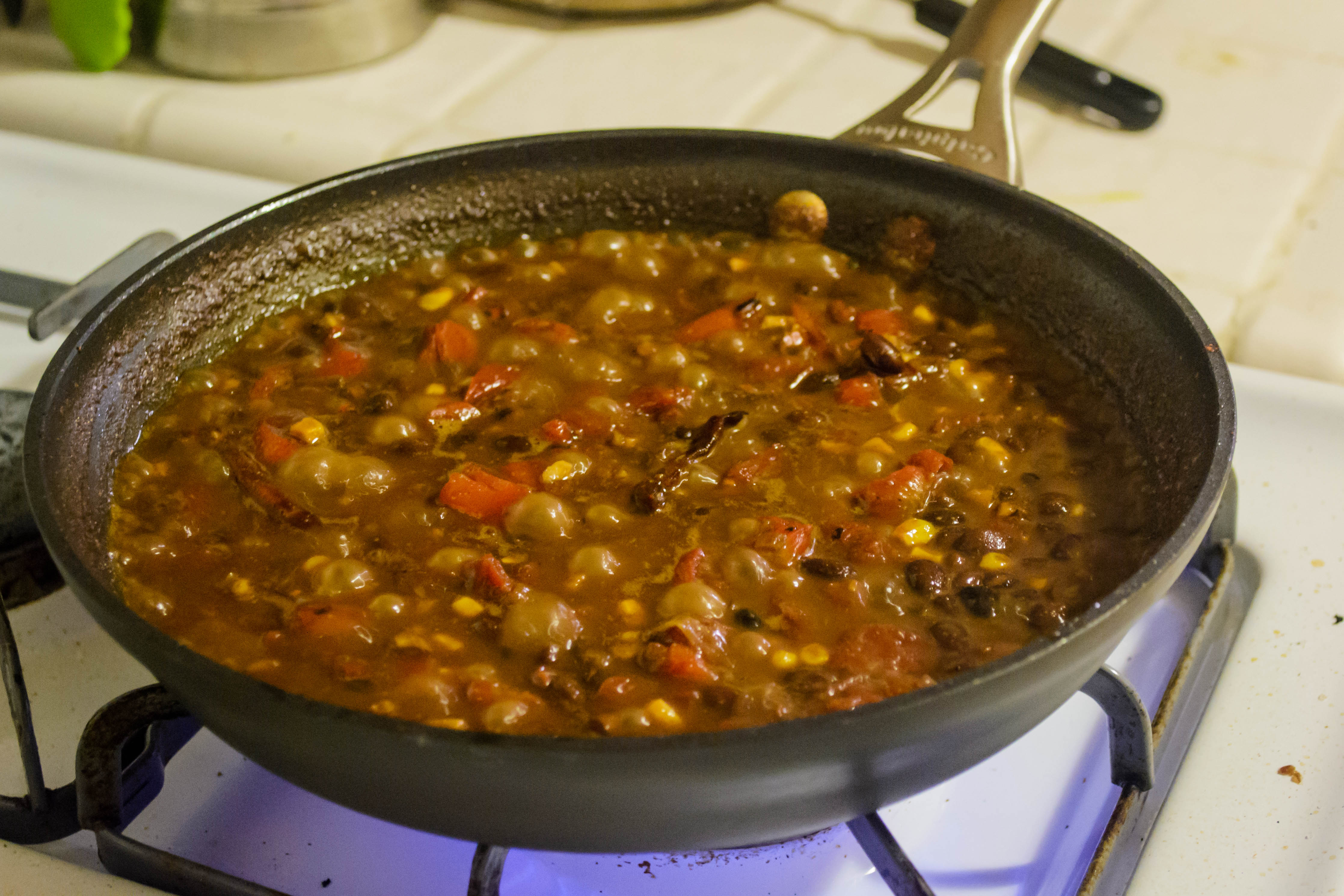
  • Now pour in the beans, canning liquid and all, along with the tomatoes and the beer. Turn the heat up to medium high, stir to ensure nothing is sticking to the bottom of the pan, and let it bubble away, stirring occasionally, until much of the liquid is absorbed. For me, they reached the consistency I wanted in 20 minutes – not totally dry, but not tremendously soupy either.
  • Taste for salt (canned beans can sometimes be quite salty, and reducing the liquid enhances the sodium content), pick out the dried chile, and serve hot with whatever garnishes you wish.

Olive Ciabatta for #TwelveLoaves February

Food Blog February 2015-0394The February assignment for Twelve Loaves left me stumped for a few weeks. Olives. What bread would I bake with olives? I couldn’t think of much that fit and sounded delicious. I mean, there was olive ciabatta of course, but apart from that… bagels? Pull-apart bread? Nothing sounded too inspiring except… oh. Well. I could make olive ciabatta. Sometimes the first ideas – the immediate ideas – are the best.

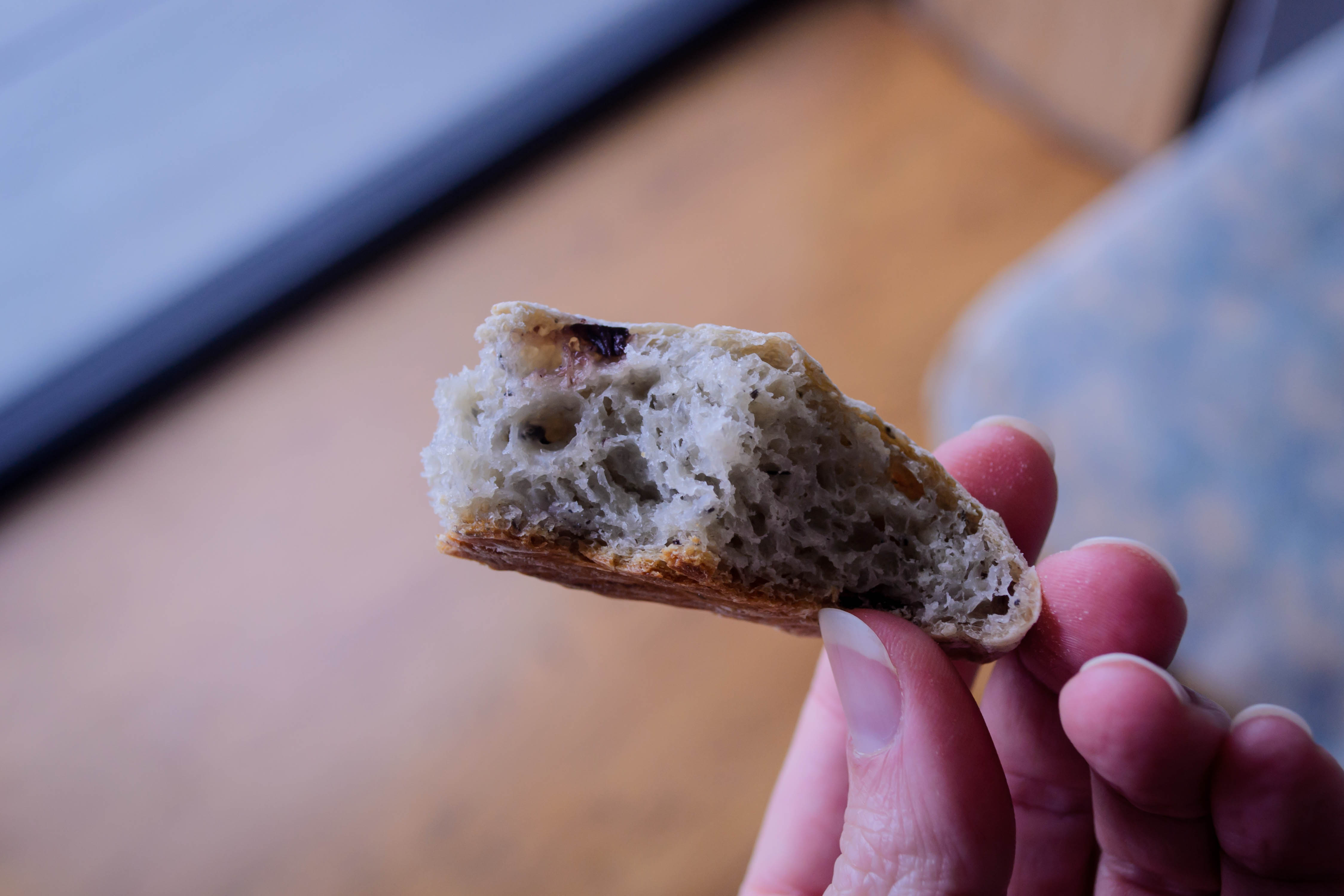
Food Blog February 2015-0375I tried making ciabatta once before, in the early days of my dough challenge. Though the rolls tasted fine, they were not the crunchy crusted, flour dusted, chewy, bubbly, homely smash of a loaf that makes a good ciabatta what it is.

Food Blog February 2015-0370Ciabatta is a reasonably recent Italian response to French baguette, and means “slipper,” which refers to the elongated, flattish shape – I imagine a well-loved pair of house slippers worn by an old man as he shuffles through his day. The lovely contrast of ciabatta loaves – the crisp exterior hiding a honeycomb of fat holes in a lovely chewy center – is achieved through several challenges: an overnight ferment of flour, water, and a touch of yeast called a biga (I kept saying it out loud. Biga. Bee-gah. Beeeeeegah), an extremely wet dough, and quite high oven heat.

Food Blog February 2015-0376For mine, I settled on the extremely clear directions from the kitchn. I’ve made only very minor adaptations, adding olives (as you might expect), and a glug of olive oil to pump up the olive flavor and add a touch of richness. A bit of fat in the loaf also prevents it from going stale quite so quickly, though you likely won’t need to worry about these loaves hanging around long.

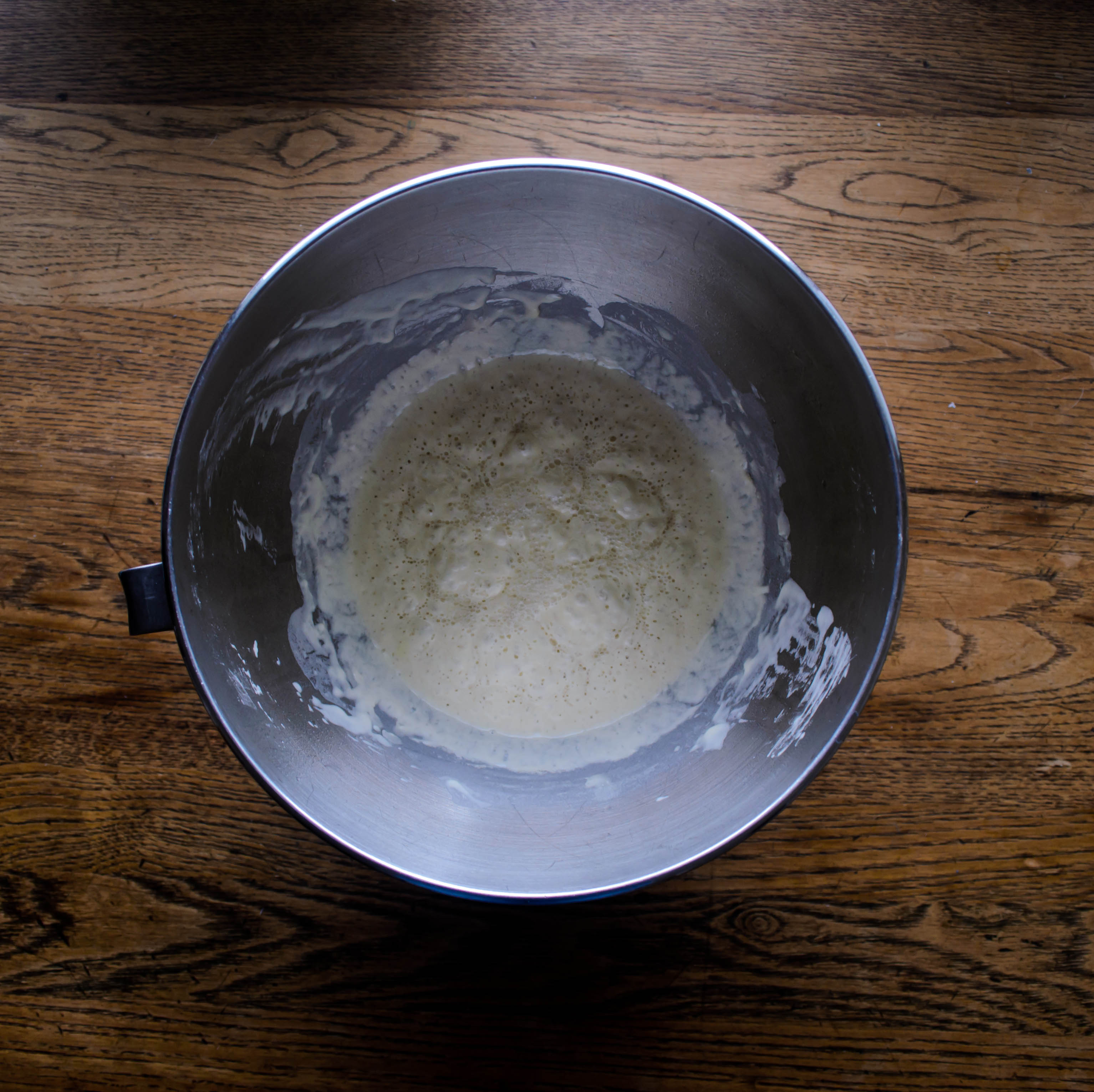
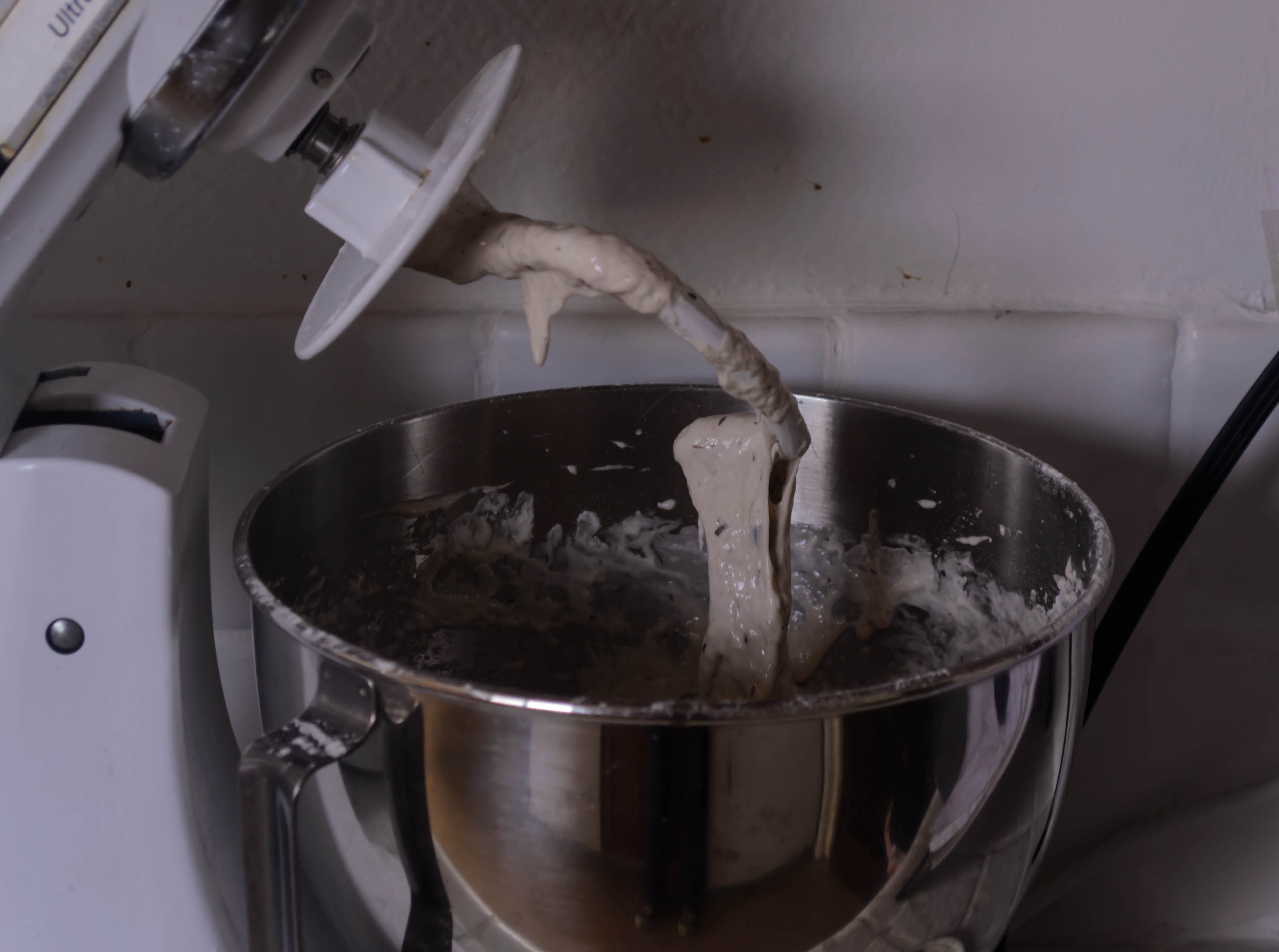
Food Blog February 2015-0378Food Blog February 2015-0379Apart from the biga, which transforms overnight from a strange, unappealing paste to a bubbling puddle that smells vaguely alcoholic and is quite clearly alive, this bread follows the standard process: knead, rise, shape, rise again, bake. Here’s the deal, though. Above I mentioned “extremely wet dough.” I mean it. I wouldn’t make this bread without a stand mixer. Though it collects together a bit around the dough hook during its long knead, it never forms a real ball, before or after the rise. When you dump it out onto a board, it sticks to everything. I mean everything. That whole dusting of flour that makes a ciabatta so recognizable? That’s not aesthetic. That’s necessary. “Well-floured board” has never been such a serious statement of setting.

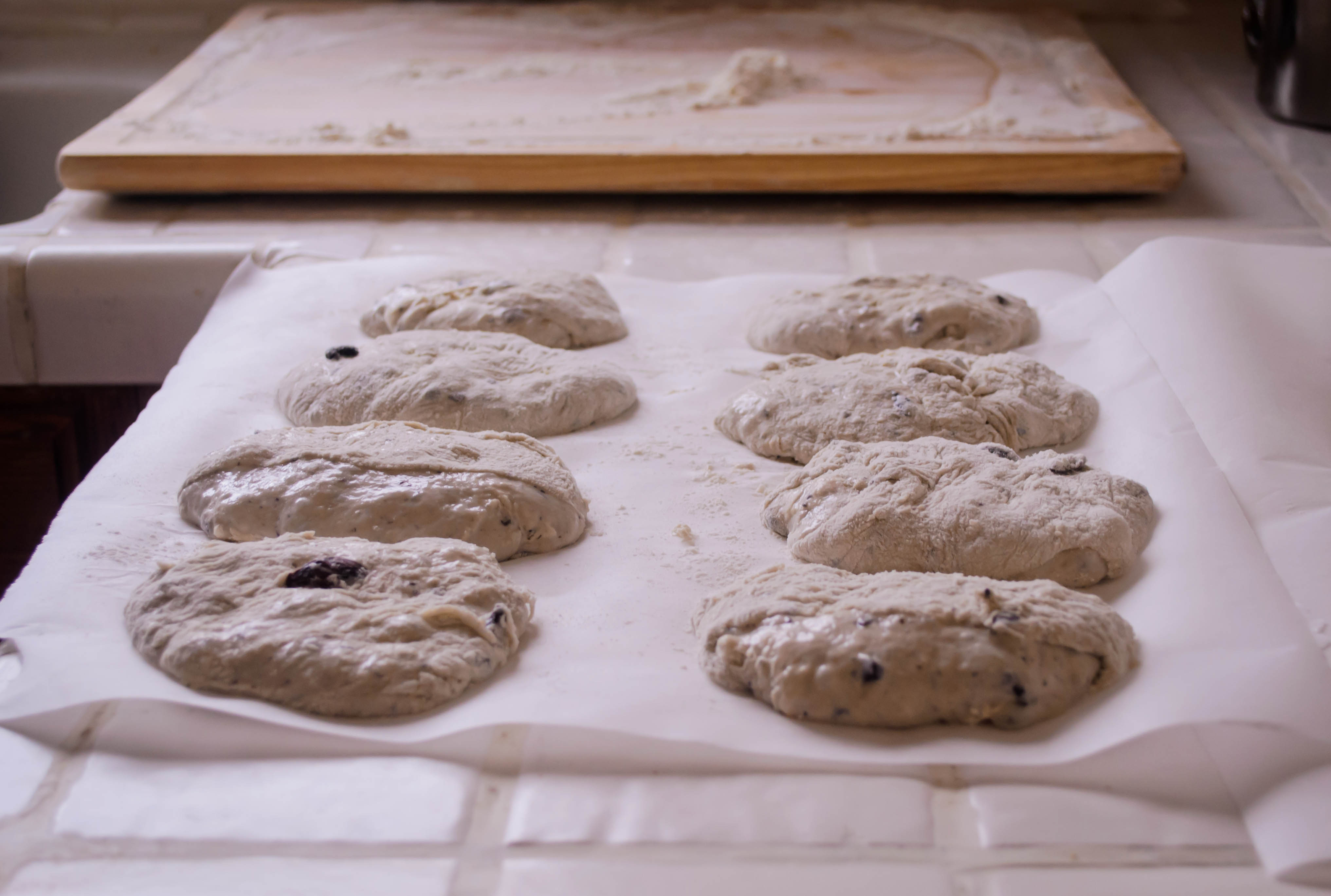
Food Blog February 2015-0381Fortunately, I’ve been making sourdough lately with a fairly wet dough, so the look of the olive-speckled, bubbly mass after three hours of expansion didn’t unnerve me too much. When it came time to shape the loaves (I opted for eight sandwich-sized rolls and one large loaf), I picked up the first one and just laughed. “Shaping” is a word you can use, but without a banneton or brotform of some sort, the dough just sort of sighs into the form it wants to be and stays there, a slightly contained puddle oozing its way threateningly toward the edges of the parchment paper you’ve so carefully flopped it onto. When I handled the rolls, in texture they reminded me bizarrely of – don’t laugh – a fresh oyster or an egg yolk sitting in my hand.

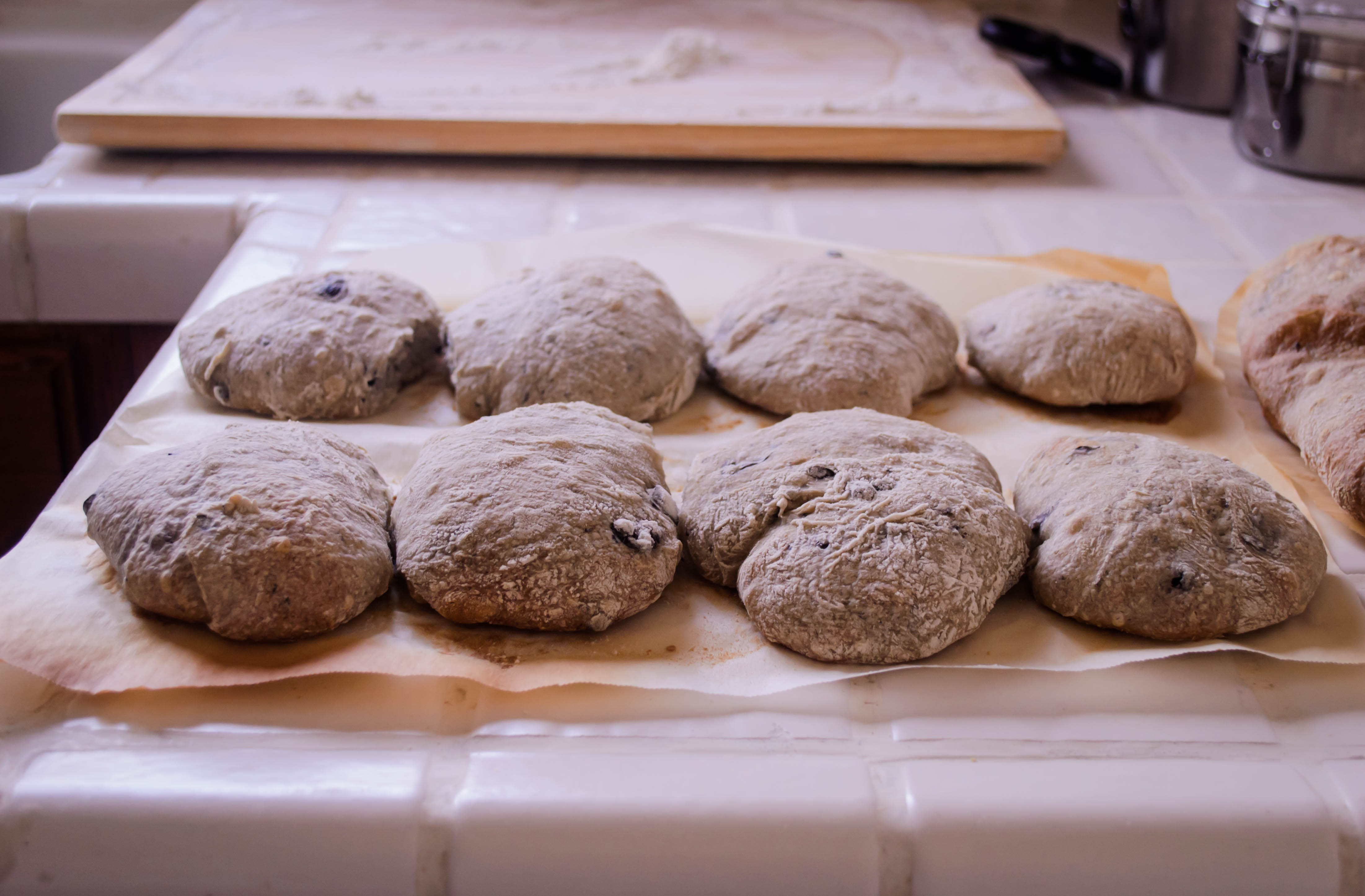
Food Blog February 2015-0383Despite the dicey textural proceedings, as bread so often and comfortingly does, it did what it was supposed to do in the oven. The loaves didn’t spring up all that high, but they did retain a network of lovely bubbles, and they did develop that moist, almost tacky texture that I, at least, require in a good ciabatta.

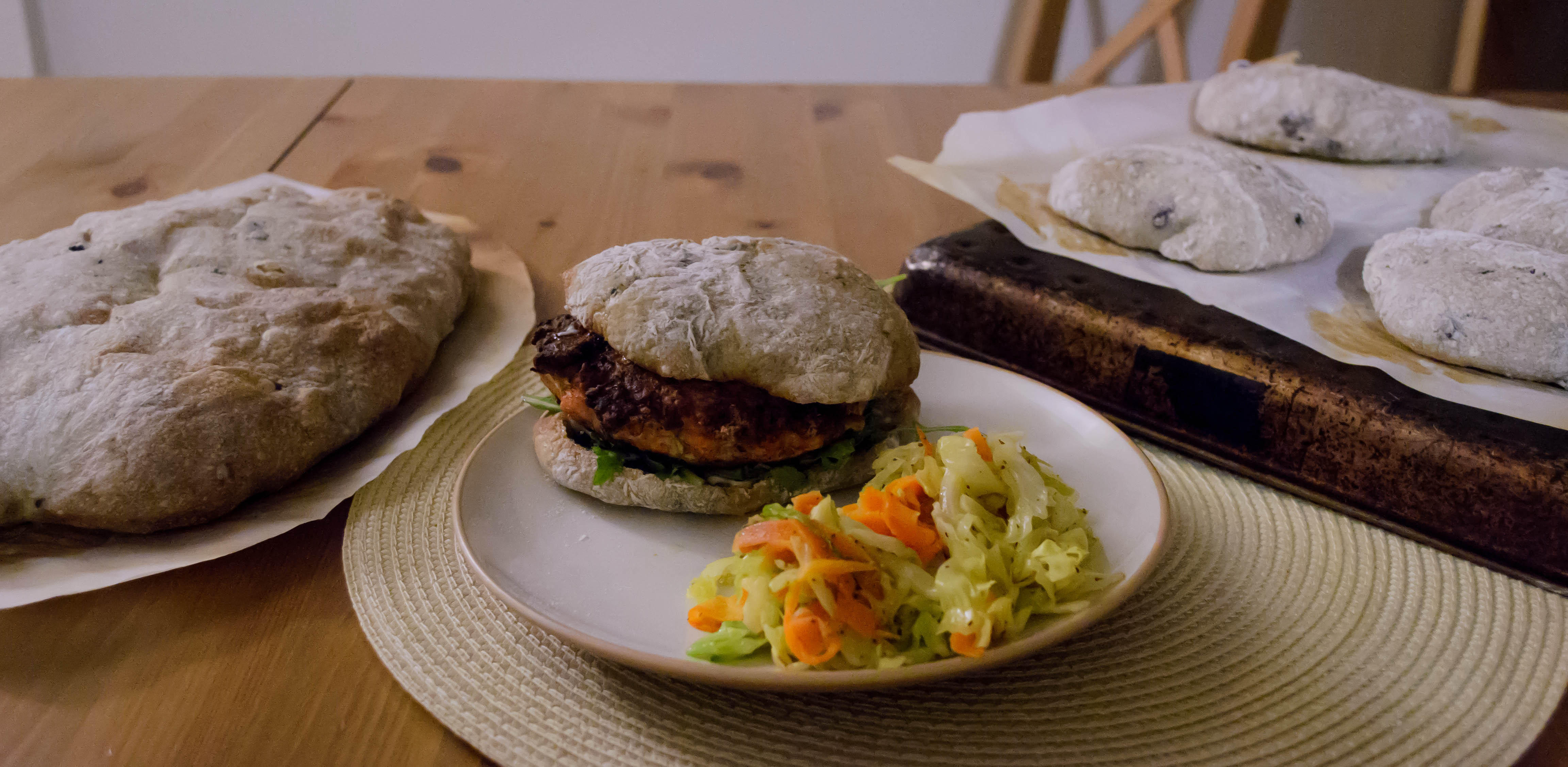
Food Blog February 2015-0387When I considered how to serve these, after I got past the urge to just tear into them and eat four or five (I stopped at one), I decided to go back to the first, unsuccessful attempt. In our previous, not-ciabatta meal, I’d used the rolls as vehicles for salmon burgers inspired by an old favorite restaurant in Eugene. Salmon burgers, then, it would have to be: a mixture of fresh and smoked salmon kneaded with egg and flour to help hold them together, parsley, a bit of garlic, and some salt and pepper. The olives in the bread were a nice addition, lending some light brininess to the burger appropriate to its marine origins.

Food Blog February 2015-0396I have to admit, though, as civilized as we were with those initial rolls, the remainder got packed into a Ziploc bag, stowed in the backseat of the car, and torn into just as they were when we needed a snack during this past weekend’s mini vacation. And that way – a day old, unheated, unadorned – they were just as good. Food Blog February 2015-0402

Olive ciabatta
Makes 2 large loaves, 16 sandwich-sized rolls, or 1 large loaf and 8 rolls
Adapted (barely) from the kitchn
For biga:
4 ounces (1/2 cup) room temperature water
½ teaspoon active dry yeast
5 ounces (about 1 fluffed cup) all-purpose flour
For dough:
17 ounces (just over 2 cups) water
1 teaspoon active dry yeast
Rested biga
20 ounces (about 4 fluffed cups) all-purpose flour
2 teaspoons kosher salt
1 tablespoon olive oil
1 cup drained, rinsed, and coarsely chopped kalamata olives


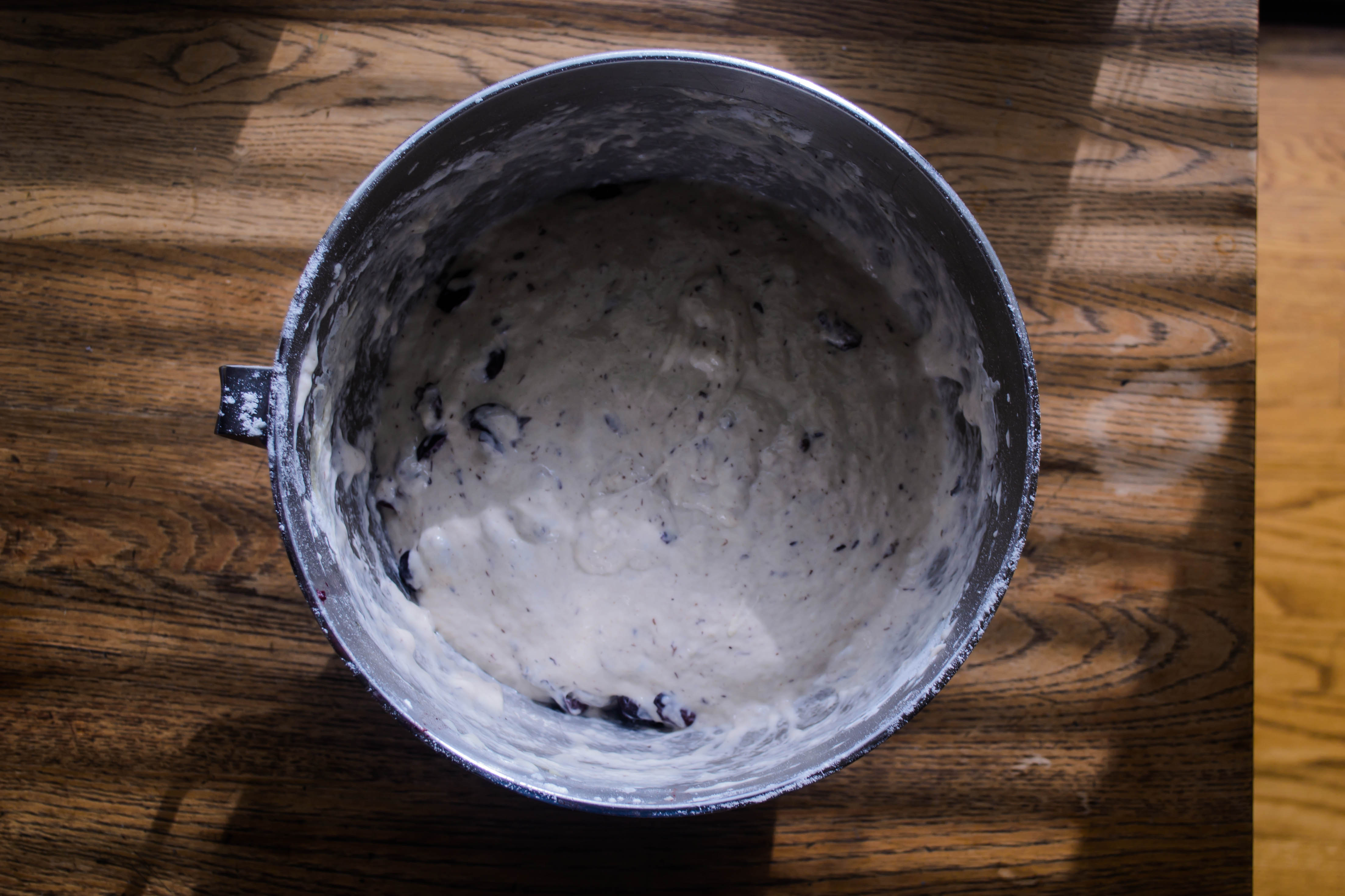
  • To make the biga, combine the ½ teaspoon of yeast and the 4 ounces of water in the bowl of your stand mixer. Stir and let sit to dissolve for 5-10 minutes. Add the flour (I highly recommend using weight measurements, as does the kitchn recipe) and stir by hand or with the paddle attachment for 1-2 minutes to start the gluten chains working. It will form a thick gluey goo. Cover with plastic wrap and let it sit at room temperature overnight.
  • The next day, the biga will look bubbly – rather like the top of a pancake when it’s ready to flip – and smell slightly fruity or alcoholic.
  • For the ciabatta, combine the 17 ounces of water and 1 teaspoon of yeast in a small bowl and stir to combine. I used my 2-cup glass measuring cup for this. Let sit for 5-10 minutes until the mixture is slightly bubbly and smells like bread. Then, dump the yeast and water into the rested biga and use a spoon or your hands to break it up a bit – this will feel disgusting but it’s necessary to ensure smooth integration.
  • Add the 20 ounces of flour, the salt, and the olive oil, and stir to form a thick, wet dough (though it’s more like a batter). Leave it to rest for 10-20 minutes to give the water time to hydrate the flour.
  • After 10-20 minutes, add the chopped olives to the dough/batter and knead on medium speed with the dough hook attachment for 15-18 minutes. On my stand mixer (brand KitchenAid), this was level 6. As the kitchn notes, keep an eye on your mixer, as it tends to walk its way across the counter at this speed.
  • The dough will remain very wet and fairly loose, sticking to the bowl, though the kitchn’s procedure says it will start to pull away from the sides of the bowl and begin slapping the sides around the 7 minute mark. Mine didn’t start this slapping pattern until I turned up the speed to medium-high for a minute or two. (If your machine seems to be heating up a lot and you are worried about it, pause halfway through the knead and let it cool down a bit – this won’t hurt the dough at all; it will simply collapse back into a wet batter while you wait.)
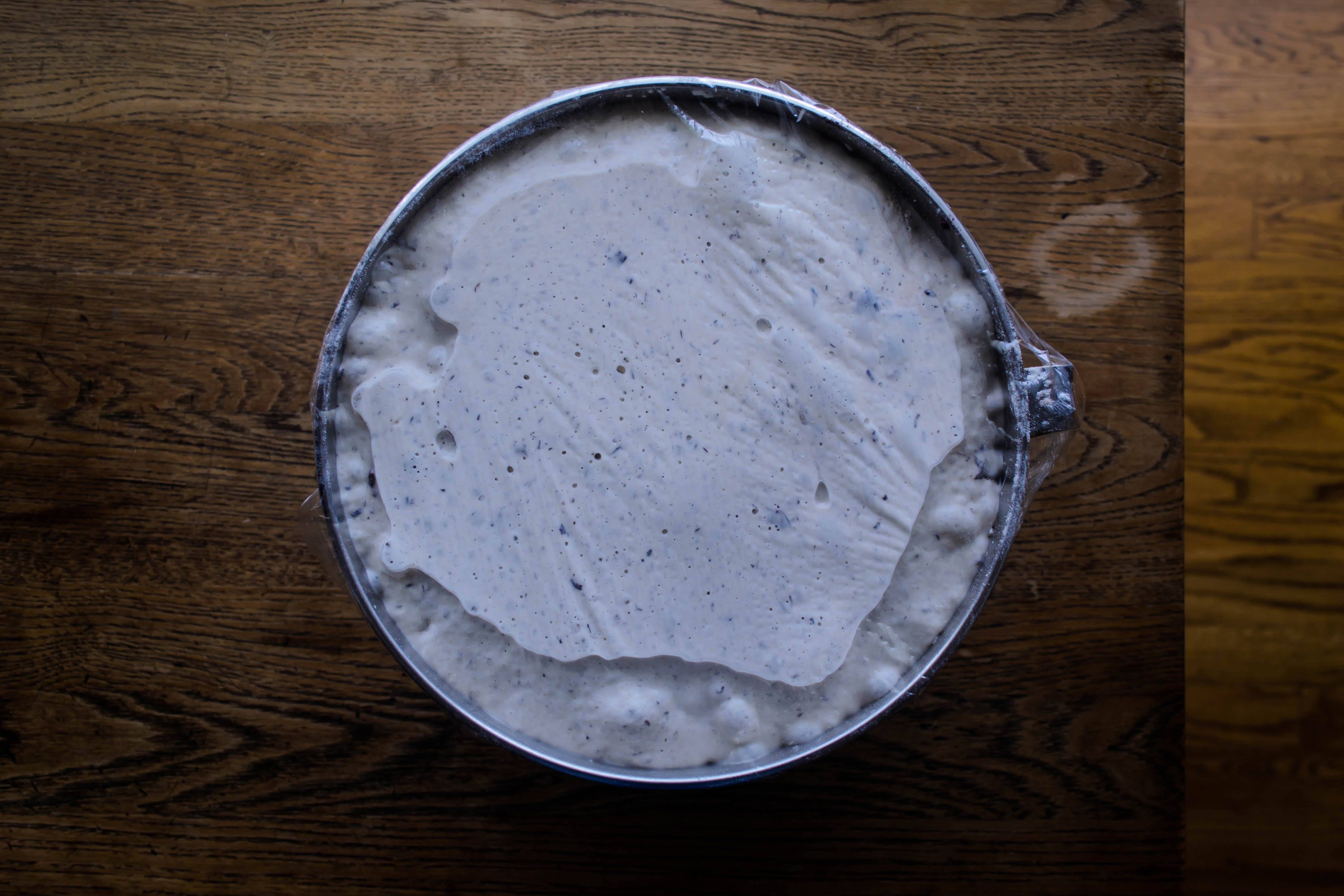
  • After 15-18 minutes, the dough will still turn into a loose puddle when you turn off the machine, but it should be smooth and shiny with bits of olives scattered through it. Cover it with a layer of plastic wrap and set it in a slightly warm place (70-75F) for 2-3 hours, until it triples in size.
  • Before we get into the messy part, preheat your oven to 475F and, if you have one, stow a baking stone inside. If you don’t, turn a cookie sheet upside down and place that on one of the racks instead. I used one baking stone and one inverted cookie sheet.
  • Now, here’s where the “well-floured surface” comes in. Scrape and pour the dough out of the bowl onto a very well-floured board, trying not to deflate it too much (we want those bubbles), then set two pieces of 9×13 inch parchment paper near your work surface. Sprinkle another layer of flour on the top surface of the dough. Use a pastry scraper or a pizza cutter, again dusted with flour, to cut the dough in half. If you are making rolls, cut each half into the desired number.
  • With floured hands, gently but quickly scoop the loaves or rolls one at a time from the board to the parchment paper. To achieve a dimpled, textured surface, press your fingers lightly into the dough. This will also flatten it into the expected “slipper” shape.
  • Let the loaves or rolls rise, uncovered, 30-40 minutes. They will puff a bit, but more out than up, and more big bubbles may develop.
  • When it’s time to bake, use the parchment sheets to slide the loaves right onto the baking stone or inverted baking sheet, parchment and all. Keeping them on the parchment ensures their bubbly structure won’t be disrupted by the relocation. Bake 20 minutes for rolls, 25 minutes for loaves, until golden brown, lightly crusty, and puffed. Remove from parchment to a wire rack to cool.

Roasted Cauliflower and Chick Pea Tacos

Food Blog February 2015-0342I’m sure it won’t surprise you to learn this, but I am one of those people who makes a meal plan. Every week, before we head to the grocery store, I write out a shopping list. I like to know what we’ll be eating most nights ahead of time, to be sure the pantry is adequately stocked, but also to prevent a lot of impulse buys or take-out emergencies (also I just love making lists. You probably aren’t surprised by that either). When I put the meal plan together, I usually ask N. for some input. Sometimes it’s because I need a little inspiration, sometimes it’s because I want to make sure he’s getting a meal or two he’s excited about, and sometimes, I’ll admit, it’s just because I want him to feel like he has some say about what happens in our kitchen.

Food Blog February 2015-0322This considerate move doesn’t always play out as helpfully as expected, however. Most weeks, without even looking at the list or at the meals I’ve proposed, he immediately says “tacos.” Nothing else gets this kind of instantaneous, definitive response. Tacos. Sometimes, when he says this, we’ve just had tacos. Sometimes, when I query him further, he doesn’t seem very enthusiastic about the suggestion he’s just made. Sometimes I’m just not in the mood for tacos (I mean, we JUST had them) and so I nod and smile and write down something else instead.

Food Blog February 2015-0324Finally, though, I got curious, and yesterday I asked him why he suggests tacos so frequently. Does he really like them that much? What is it about a taco that he finds so compelling? Turns out it’s not the food, exactly, but the name. Be warned, people. This is what happens when you fall for a words person. He really likes the sound of the word “taco.”  It is, he claims, an interesting sounding word. You can put emphasis on each of the syllables in turn, you can change the pronunciation of the vowel, you can draw out the length of each part of the word, all with different sounds and results. He then proceeded to say “taco” four or five times. It is, I must admit, a fun word to say. I’ll wait while you try it a few times…

Food Blog February 2015-0328As much fun as the word is, N. noted that he likes the dish as well, and it got me thinking about the constituent parts – what makes a taco a taco? As I see it, tacos break down into three major components: the shell, the “meat,” and the sauce. Of course you can – and often should – add cheese and lettuce and other garnishes, but I think you have to have at least these three parts. Once you have these critical components, you can take your tacos in a variety of directions.

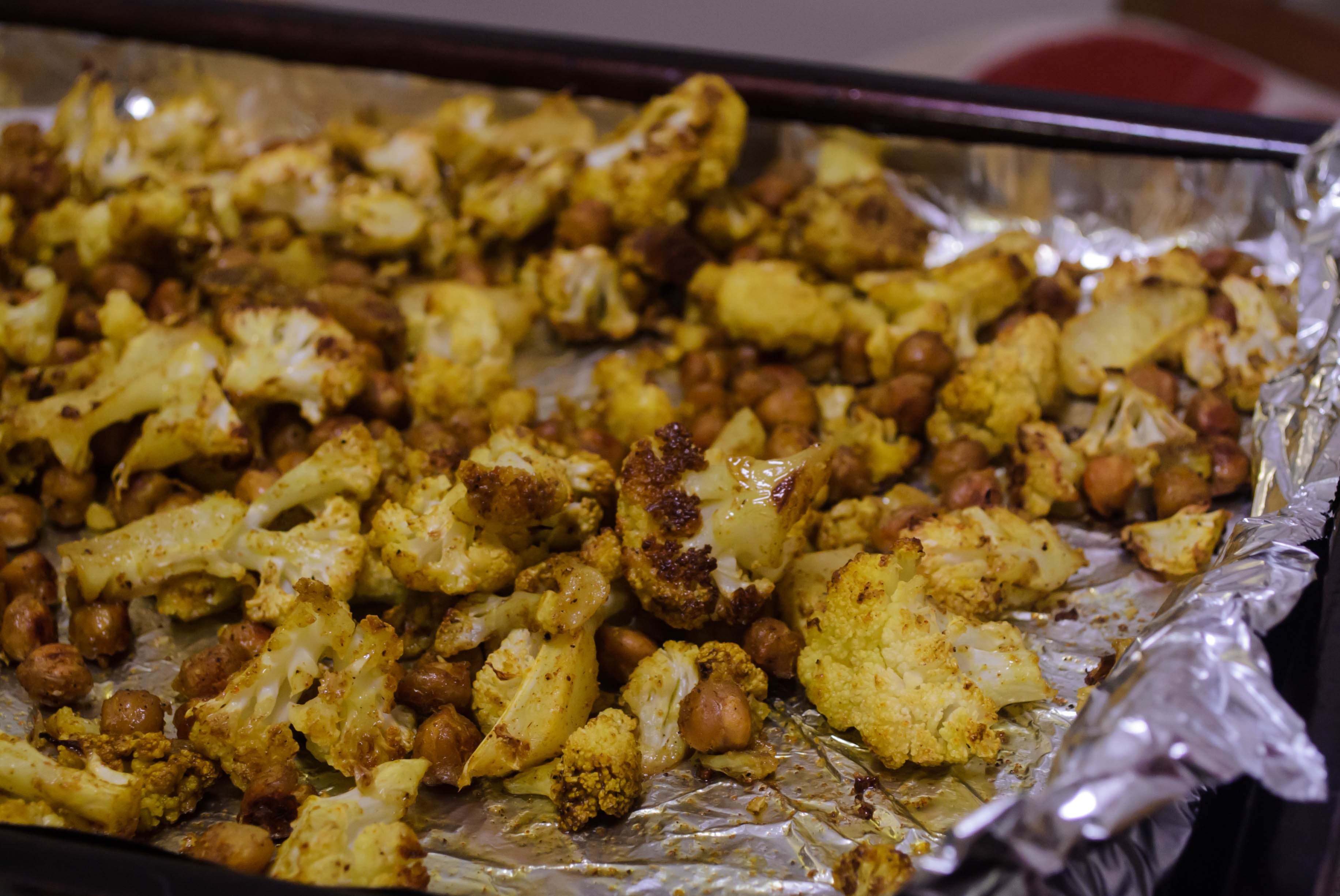
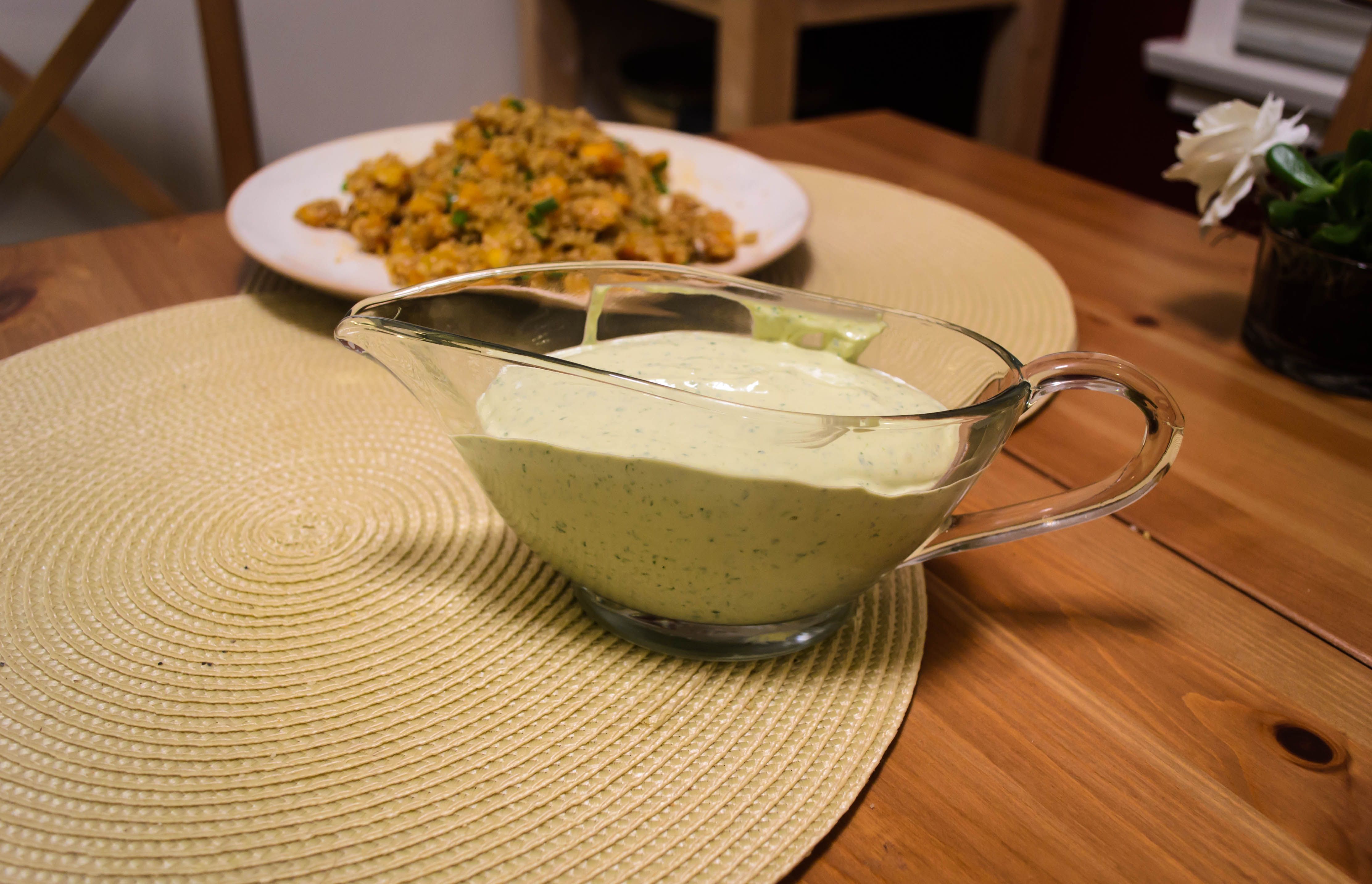
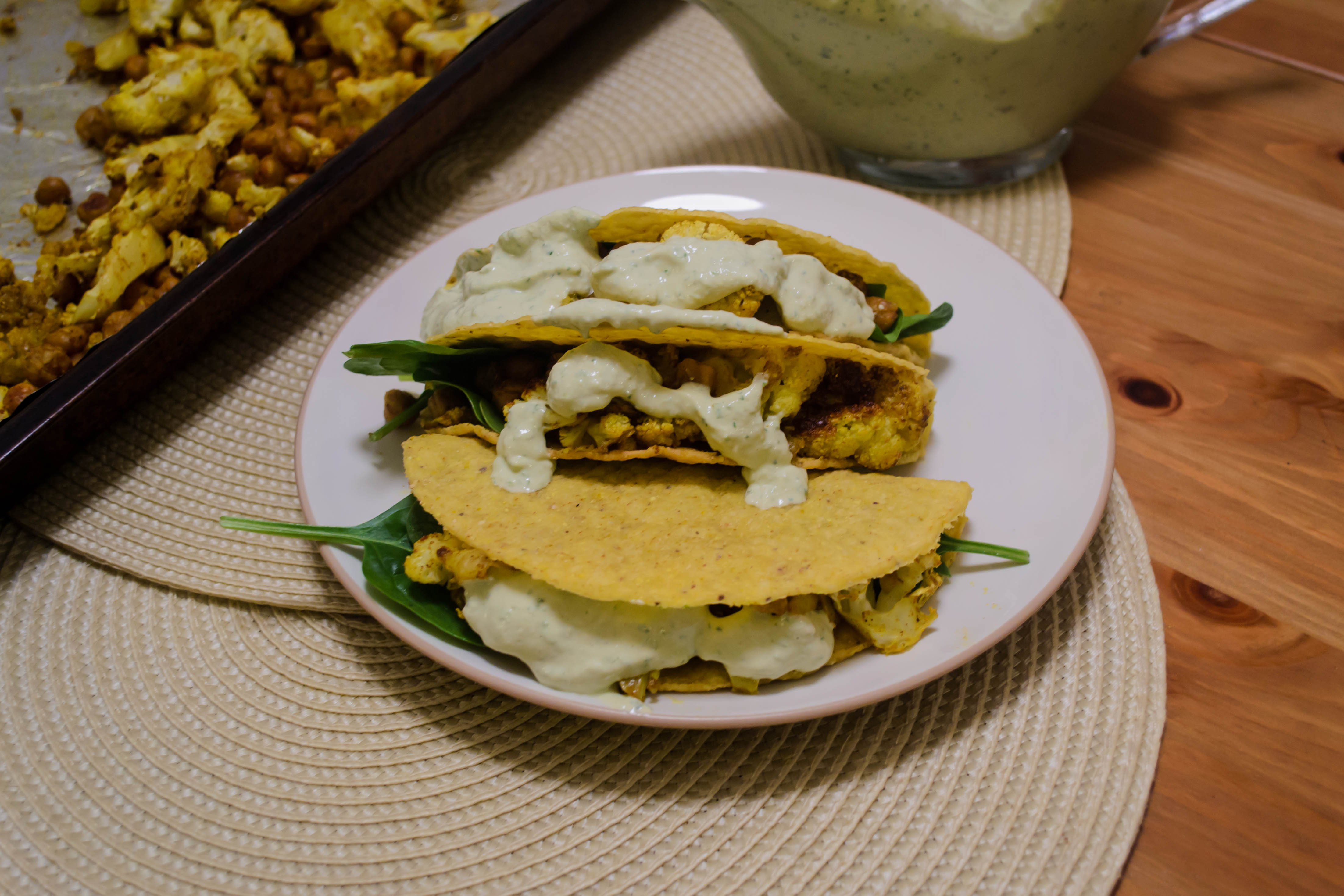
Food Blog February 2015-0335Perhaps because N. is so fond of them – whether it’s the word or the dish itself – I quickly tire of the standard ground-meat-with-cheese-and-things compilation, and look for other options. We’ve had grilled zucchini tacos with crumbled queso fresco and lime, dozens of incarnations of fish tacos (my favorite always involves a corn relish and plenty of smashed avocado), tofu tacos overloaded with pepperjack cheese, and I’m working on a potato taco inspired by an amazing version at – of all places – the Getty Museum cafeteria. This time around, though, I wanted something a little more outside the box (or should I say outside the shell? No, you’re right, I probably shouldn’t. Let’s pretend it didn’t happen). I’m not sure where the combination came from (if I’m honest, probably Pinterest), but I decided on a tumble of roasted cauliflower and chick peas, liberally spiced with a ras al hanout-esque blend and drizzled with a sauce of tahini and yogurt, tangy with lemon and flecked with parsley.

Food Blog February 2015-0332What resulted was not N.’s favorite taco ever (though I doubt it will stop him from requesting them), but I am finding, a day or two later, that I’m mildly obsessed with them, especially the sauce. It wasn’t fancy, but there was something quietly brilliant about how the yogurt and parsley lightened up the earthiness of the tahini. Roasted vegetables, though I will almost never say no to a bowl of them, can feel a little heavy. Blanketed with this sauce, they are bright and buoyant, and the creamy spread is just as fitting against the soft unctuousness of the cauliflower as it is against the toasted crunch of the chick peas.

Food Blog February 2015-0336This is one of those recipes where the list of spices looks daunting, and by all means, if your spice cabinet is not as ridiculous overflowing full as mine is, go easy on yourself and use a pre-mixed blend. I won’t judge. Ras al hanout is a North African combination of spices, one of those lovely warm mixtures incorporating options American dishes usually reserve for desserts. Really, though, any mixture of Mediterranean or Middle Eastern spices would be lovely here – choose your favorite and apply accordingly.

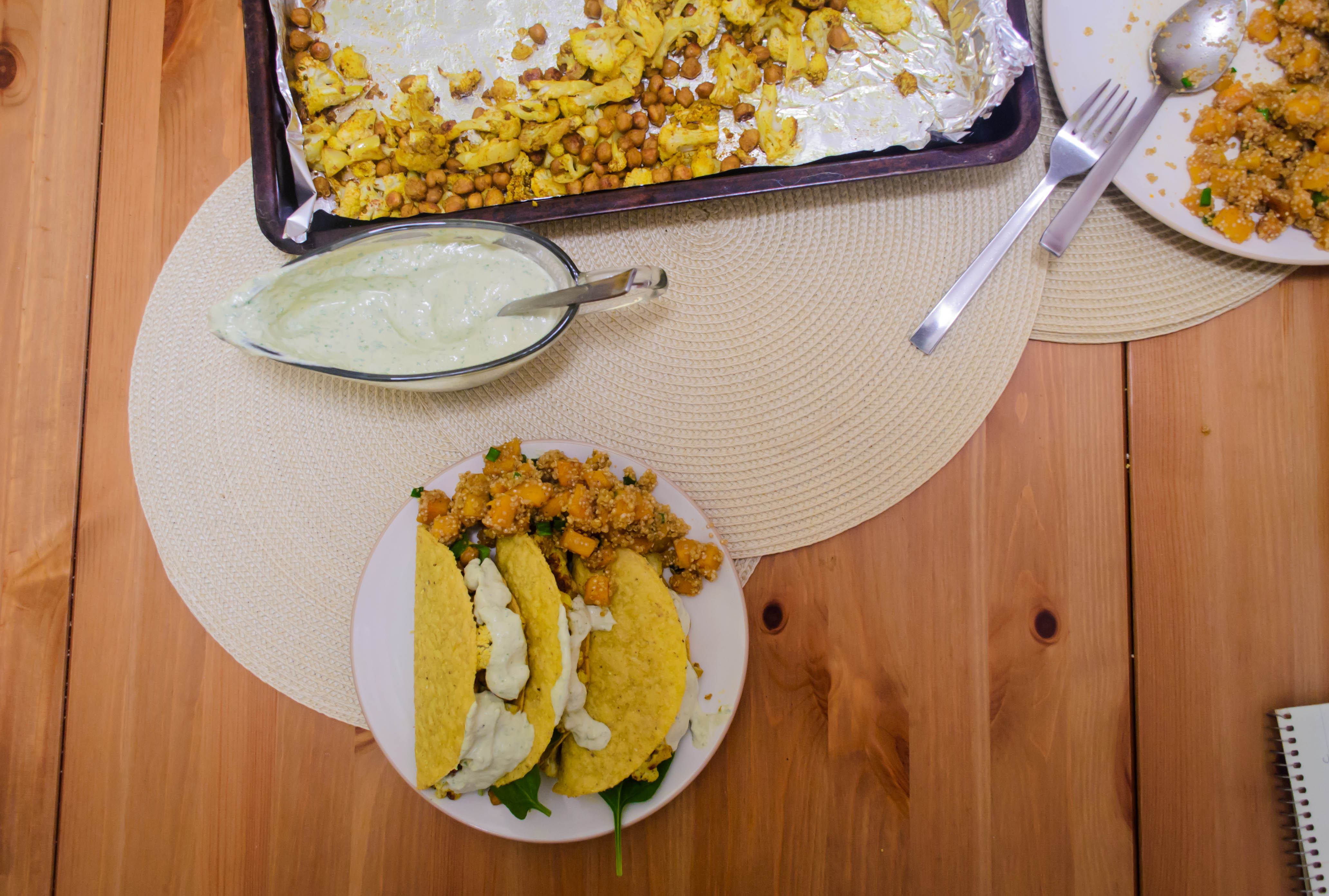
Food Blog February 2015-0338Once you’ve got the spices sorted, this dish is a multi-tasker’s dream. The cauliflower and chick peas need a good chunk of time in the oven at high heat, and while they are roasting you have plenty of time to whip up the sauce, warm the taco shells according to your favorite method, and even concoct a side dish (we ended up with sautéed cubes of butternut squash folded into a bit of cooked quinoa and a shower of green onions). By the time the filling finishes roasting, all you have left to do is scoop and serve, and if you’ve been reasonably efficient it has probably taken you just under an hour.Food Blog February 2015-0342*Note: you’ve probably noticed by now, and may be horrified by the omission, that these tacos don’t include a cheese component. With the yogurt and the deep earthy roasted flavors of the vegetables, I found I didn’t miss it. If you can’t do without, however, I suggest a few crumbles of feta to fill the void.


Roasted Cauliflower and Chick Pea Tacos
Makes 10-12 tacos

For the tacos:

½ teaspoon ground cardamom
½ teaspoon ground cumin
½ teaspoon ground coriander
½ teaspoon ground ginger
½ teaspoon ground turmeric
½ teaspoon freshly cracked black pepper
¼ teaspoon ground allspice
¼ teaspoon ground cloves
¼ teaspoon cayenne pepper
1 teaspoon coarse salt
6 tablespoons olive oil
1 head cauliflower, cut into bite-size florets
15 ounce can chick peas, drained and dried
1 cup loosely packed baby spinach leaves
taco shells
For the sauce:
½ cup tahini
½ cup plain greek yogurt
½ cup flat-leaf parsley
2-3 tablespoons lemon or lime juice, or a combination
1 teaspoon honey
½ cup water, to thin
salt and pepper, to taste


  • Line two baking trays with aluminum foil and place them in the oven. Preheat oven, trays and all, to 450F.
  • In a small bowl, combine all of the spices and the salt, stirring to be sure they are well-blended. Add the olive oil and stir or whisk to combine.
  • In a large bowl, toss the cauliflower with about ⅔ of the spiced olive oil mixture, then spread on one of the preheated baking trays in a single layer (if possible).
  • In the same bowl, toss the chick peas with the remaining olive oil and spice mixture, then spread onto the other baking tray.
  • Stow both baking trays in the oven and roast at 450F for 20 minutes. After 20 minutes, remove the tray of chick peas, shake them around a bit to deter sticking, and set aside. They should be toasty and crunchy. Shake and stir the tray of cauliflower pieces to promote even browning, then return just the cauliflower tray to the oven and roast for another 10-15 minutes, until both sides of most pieces are nicely browned.
  • While vegetables are roasting, combine the tahini, yogurt, parsley, honey, and lemon juice in a food processor and whir to create a thick paste. With the food processor running, dribble in the ½ cup of water slowly to transform the paste into a sauce. You may not need the entire ½ cup – thin to your desired consistency. Season to taste with salt and pepper, then set aside and prepare your chosen form of taco shells according to your preferences.
  • When the cauliflower is nicely browned and tender, toss it with the chick peas and stuff the mixture into taco shells with a few spinach leaves for freshness. Top with tahini yogurt sauce and serve immediately.

Carrot Ginger Soup with Coconut and Turmeric

I threw away my bathroom scale today. Before you applaud me, this isn’t some kind of new-year-new-me-self-acceptance resolution. No, it’s because unless we have had a 46 pound ghost living in our bathroom for the last month, the scale has stopped working. No amount of fiddling with the dial on the bottom has had any effect, aside from bulking up our imaginary squatter to 77 pounds.

Food Blog January 2015-0205Though I realize there are probably many videos, tutorials, and step-by-step Pinterest boards devoted to fixing this problem (how to evict your imaginary scale-ghost!), I decided it was easier to just throw it away. Then I went out and had chicken and waffles for lunch.

Food Blog January 2015-0210All that being said, it is the time of year when, if we’re invested in this sort of thing, we tend to pay a lot of attention to what our bodies look like and what we put into them. Usually that involves eating less and eating lighter, which is ironic and unfortunate, because so many places in the country this January are having such a harsh winter. We need comfort, we need warmth, we need rich food to sustain us through snow and low temperatures (well, perhaps not in Los Angeles).

Food Blog January 2015-0199The answer to both of these problems seems, to me, to be vegetable soup. I don’t mean a minestrone type concoction, with chunks of various veggies floating in broth, but a pureed soup, featuring a single vegetable star, with minimal back-up supporters and just a bit of spice to keep things interesting. After a recent episode of Top Chef on which one of the contestants made a deep, sunset inspired roasted carrot soup, I knew what my star would be.

Food Blog January 2015-0201Carrots work well with many flavors, but ginger is a particularly nice pairing; carrots are sweet and hearty, and ginger is a warm, spicy kick that keeps it bright. Rather than chicken stock, which I find can muddy flavors a bit, I opted for water as my liquid, with a generous splash of coconut milk to add some richness. Then, on a whim I’m pleased I followed, I sprinkled in a good teaspoon or two of turmeric, which bolstered both the orange glow of the carrots and their earthy flavor.

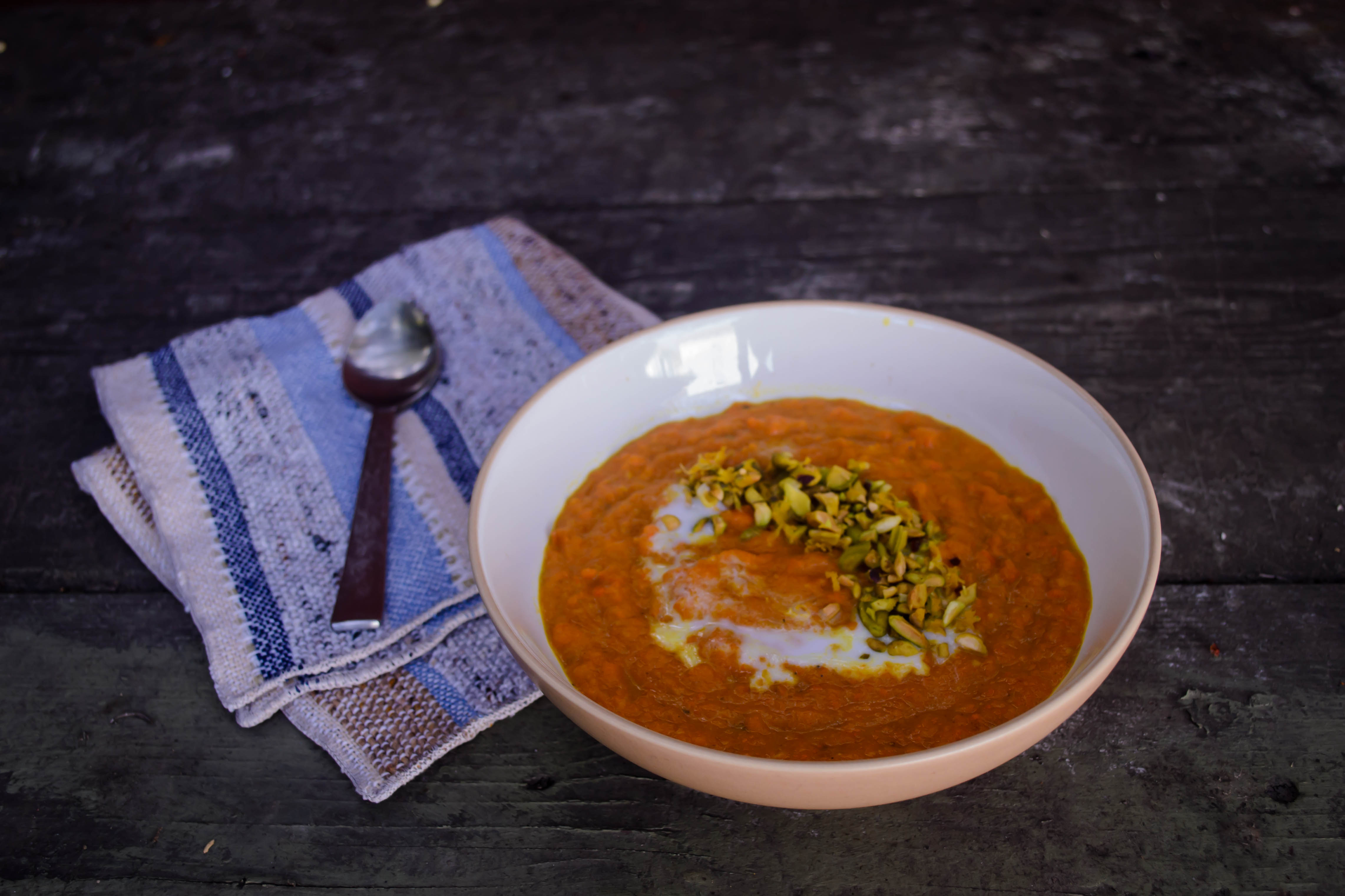
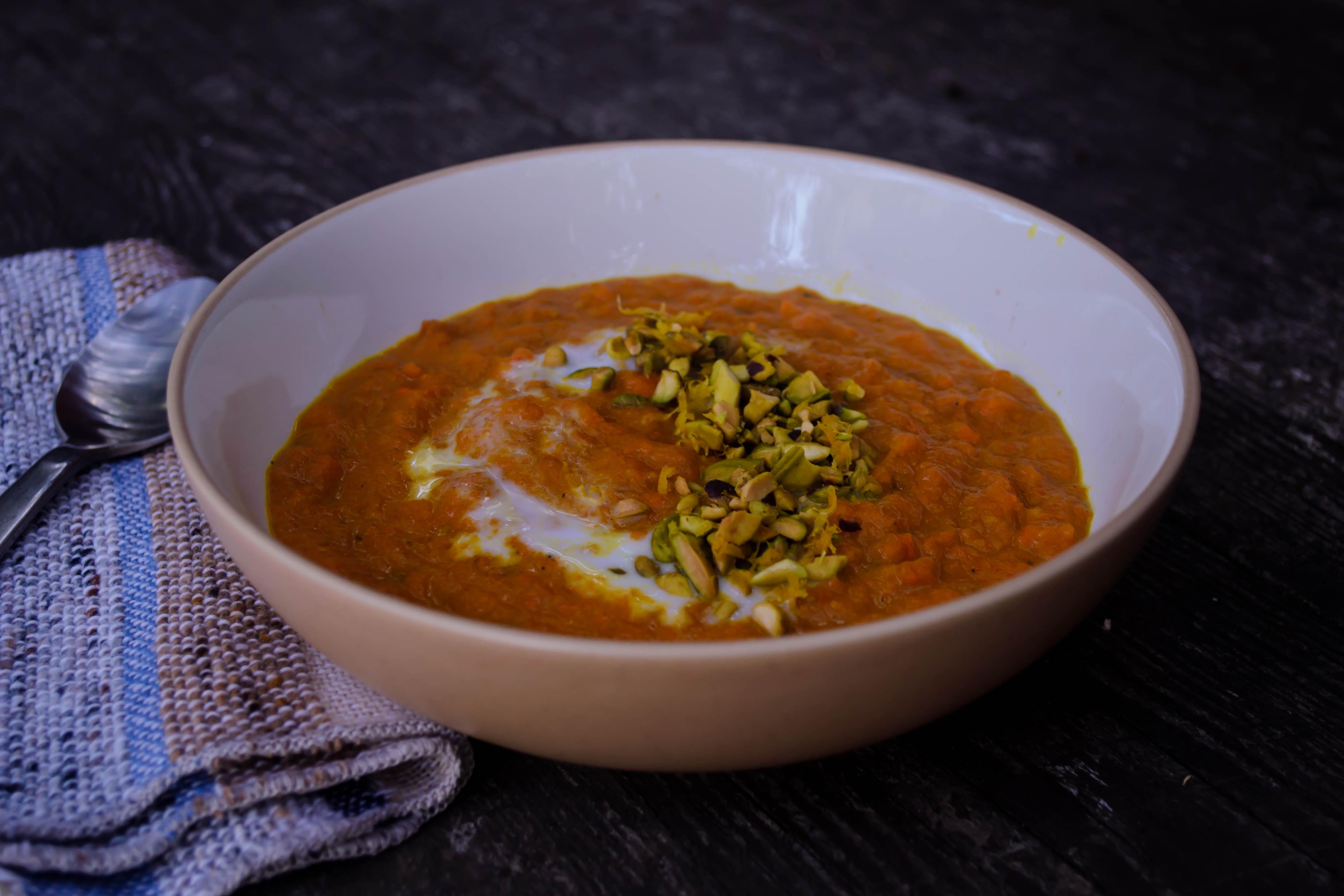
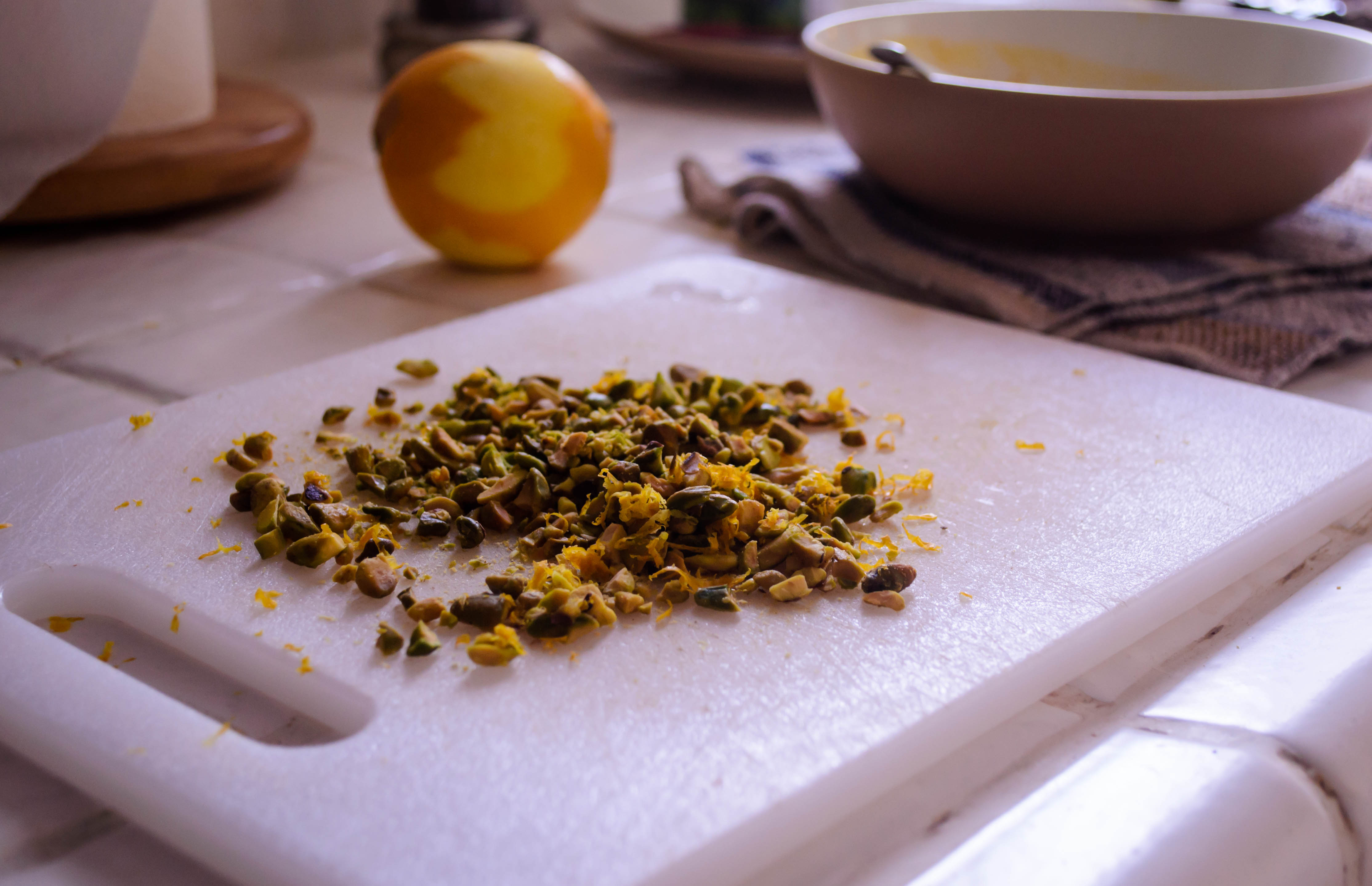
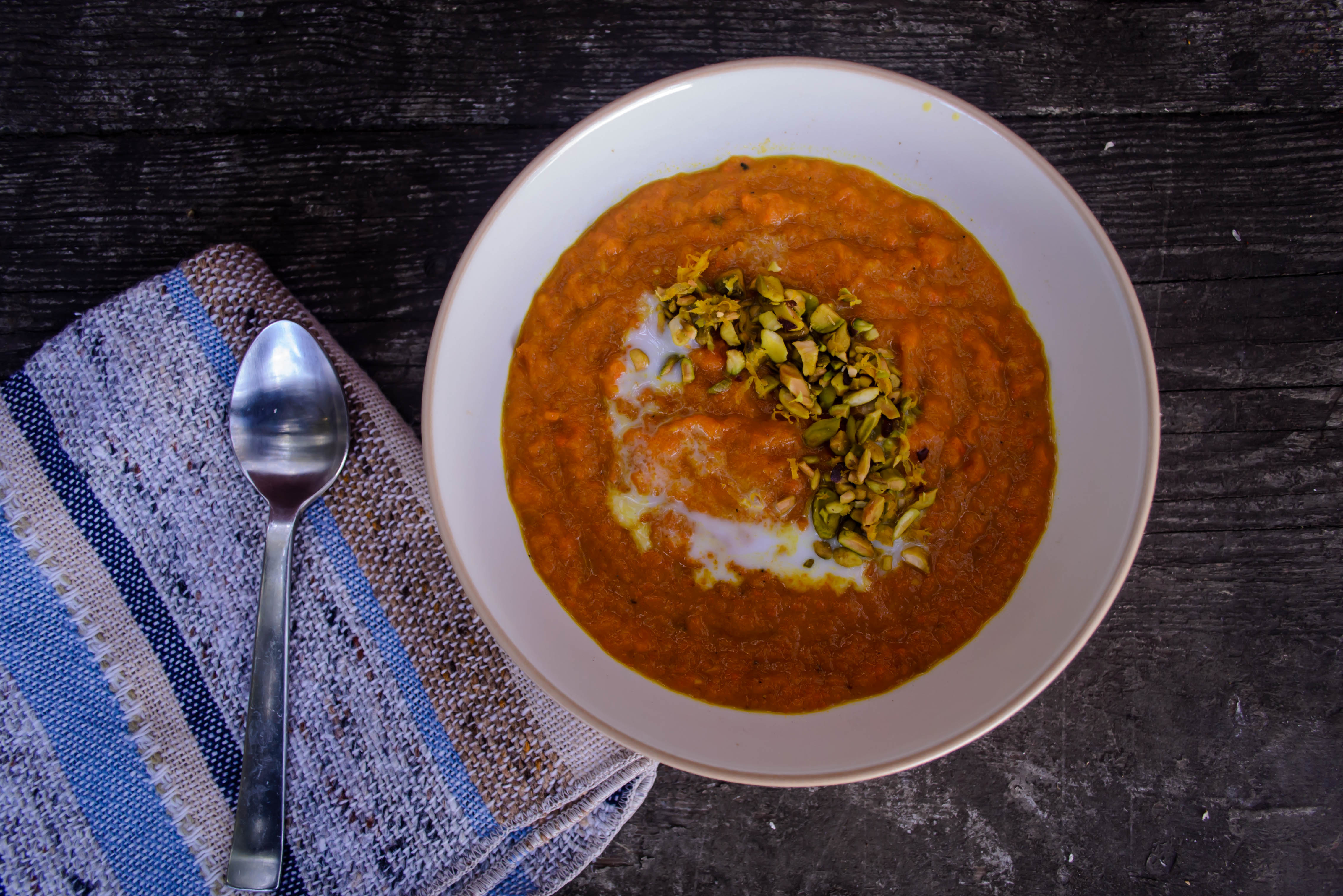
Food Blog January 2015-0213As I watched my pureed mixture burble in a pot, I started thinking about texture. I’d stopped short of pureeing the carrots to total velvet smoothness, but I still wanted something crunchy to break up the potential monotony of my soup. During the pumpkin madness of autumn, I experimented with some yet-to-be-perfected turmeric-spiced pumpkin bars that featured a pistachio and walnut crumble topping. Pistachios seemed like a good choice again here, and to play with the hint of citrus flavor they carry, as well as add a slight sourness the soup might benefit from, I tossed the nuts with lemon zest before sprinkling them over my vivid orange lunch.

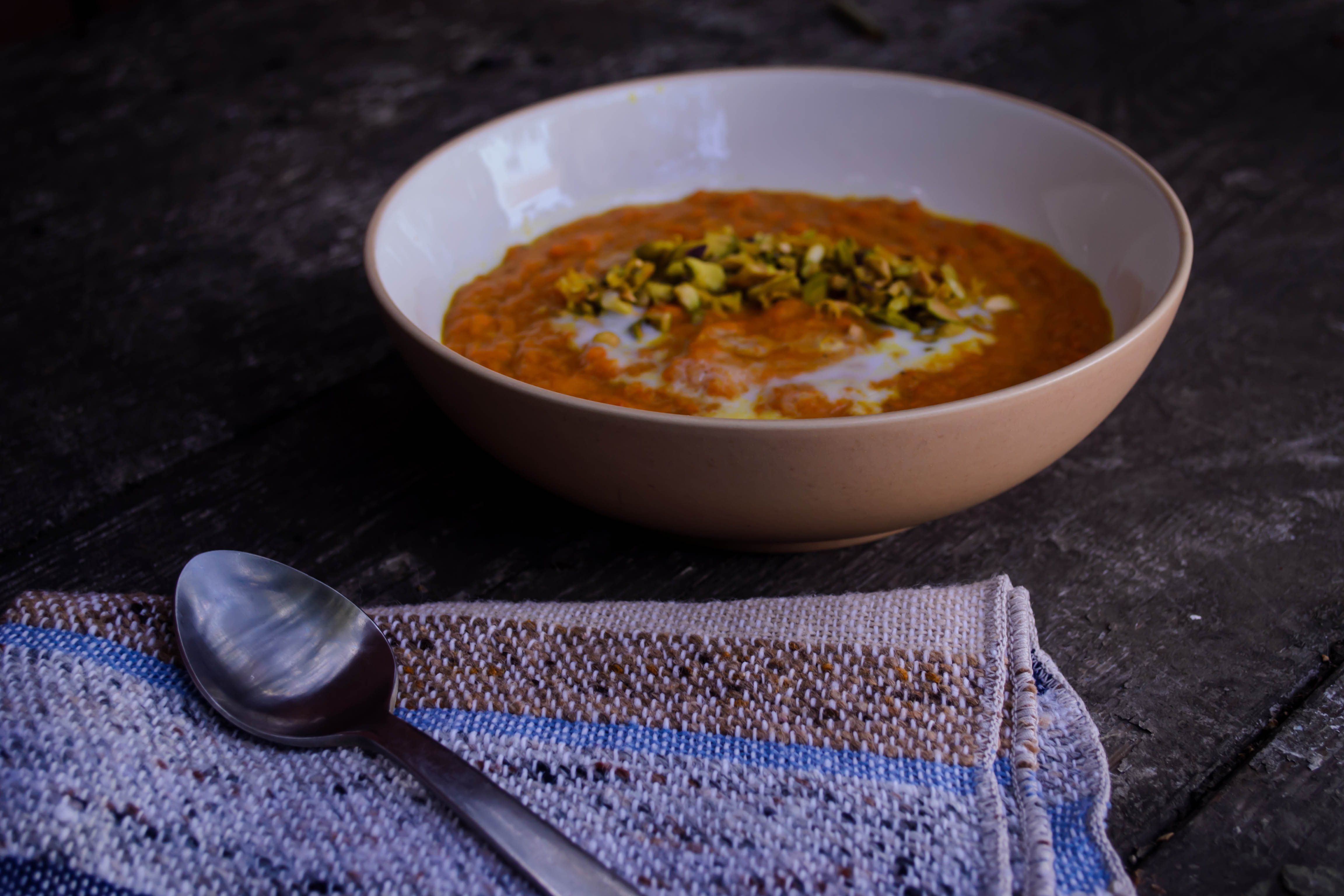
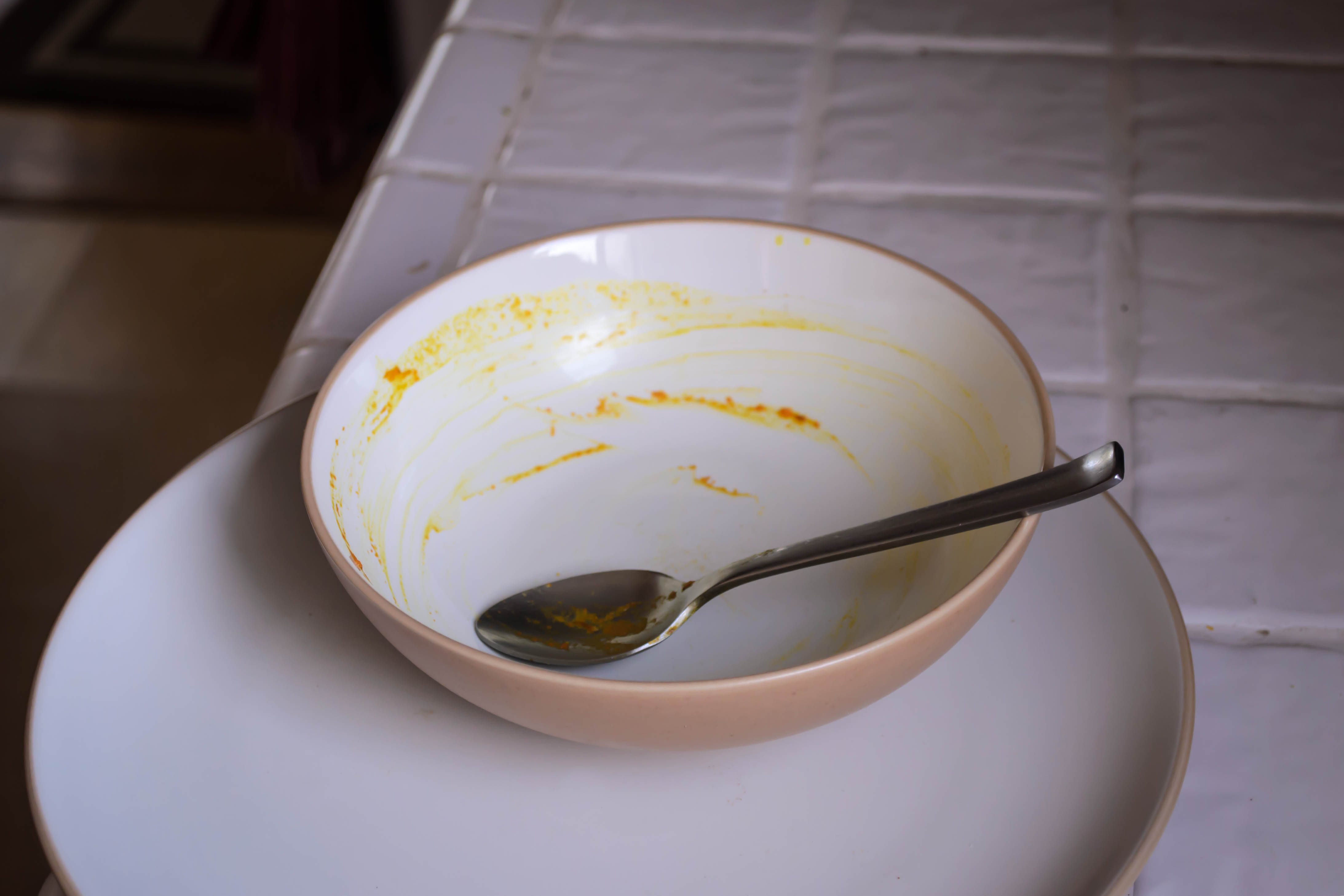
Food Blog January 2015-0209Despite our less-than-wintery weather, this was a comforting, warming bowl. Roasting the carrots brings out their sweetness and concentrates their flavor, but the spices keep it dancing between decadent richness and brightly refreshing. I used some leftover naan to mop up the edges of my bowl, but a crusty piece of baguette or hot pita would, as you might expect, be just as nice.

Food Blog January 2015-0214This is a thick soup – almost passable as a vegetable puree, and you can play with it as you please. Add more or less liquid, replace the pistachio and lemon topping with another toasted nut, or lime zest rather than lemon, or maybe even fried sage and crumbled gingersnaps, to play with the fresh ginger in the soup. My quantities here produce an assertively gingery mix – reduce to just a teaspoon or two for a milder spice.

Food Blog January 2015-0207

Carrot Ginger Soup with Coconut and Turmeric
Serves 2-3
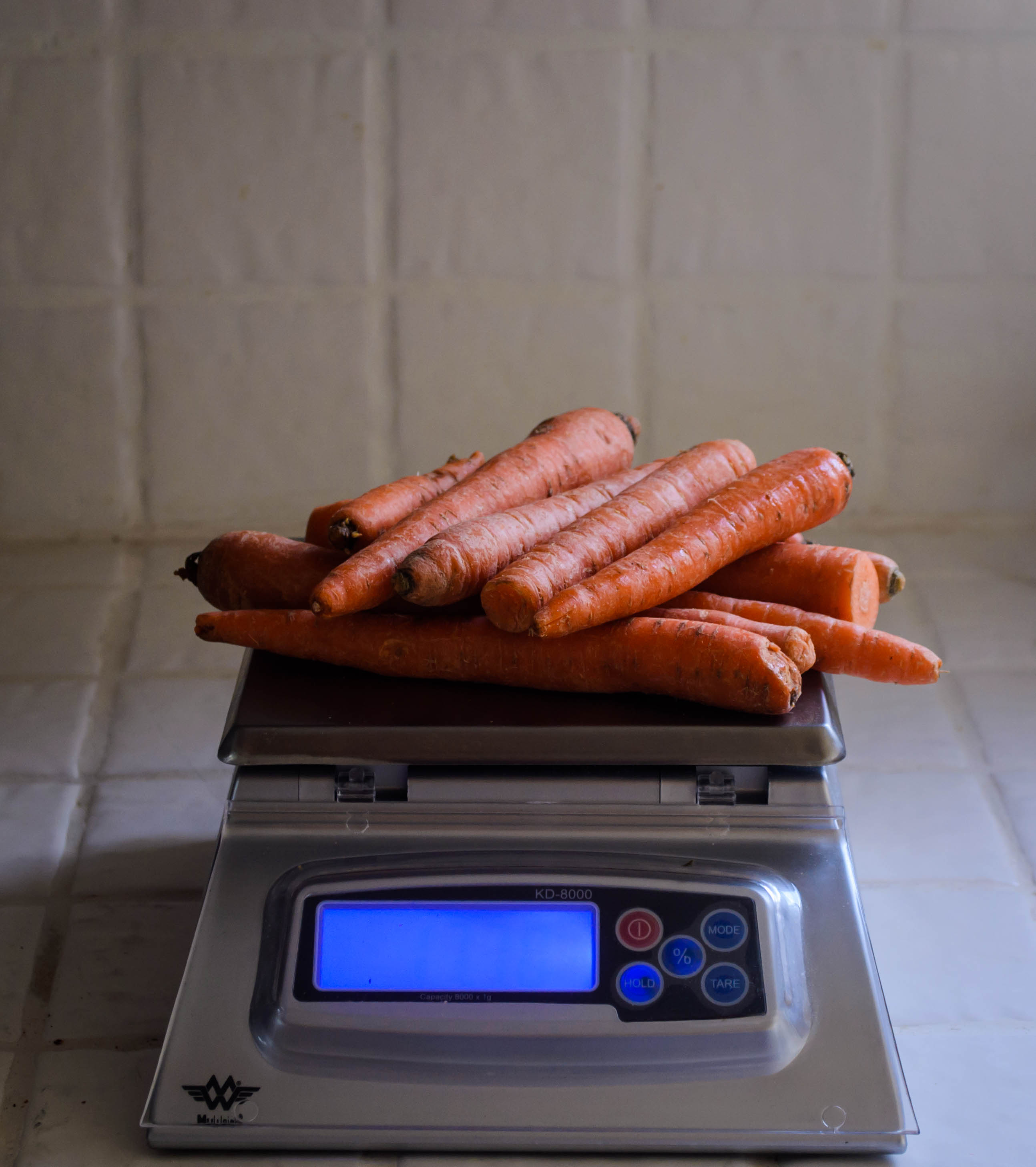
1 pound carrots, tips and tops removed, peeled if desired (I usually don’t – just scrub them off)
1 tablespoon olive oil
½ teaspoon salt
½ teaspoon pepper
1 tablespoon grated ginger (or less, to your taste)
2 teaspoons turmeric
1 cup light coconut milk
1 cup water
2 teaspoons sugar
additional salt and pepper to taste
¼ cup roughly chopped, toasted pistachios
2 teaspoons lemon zest


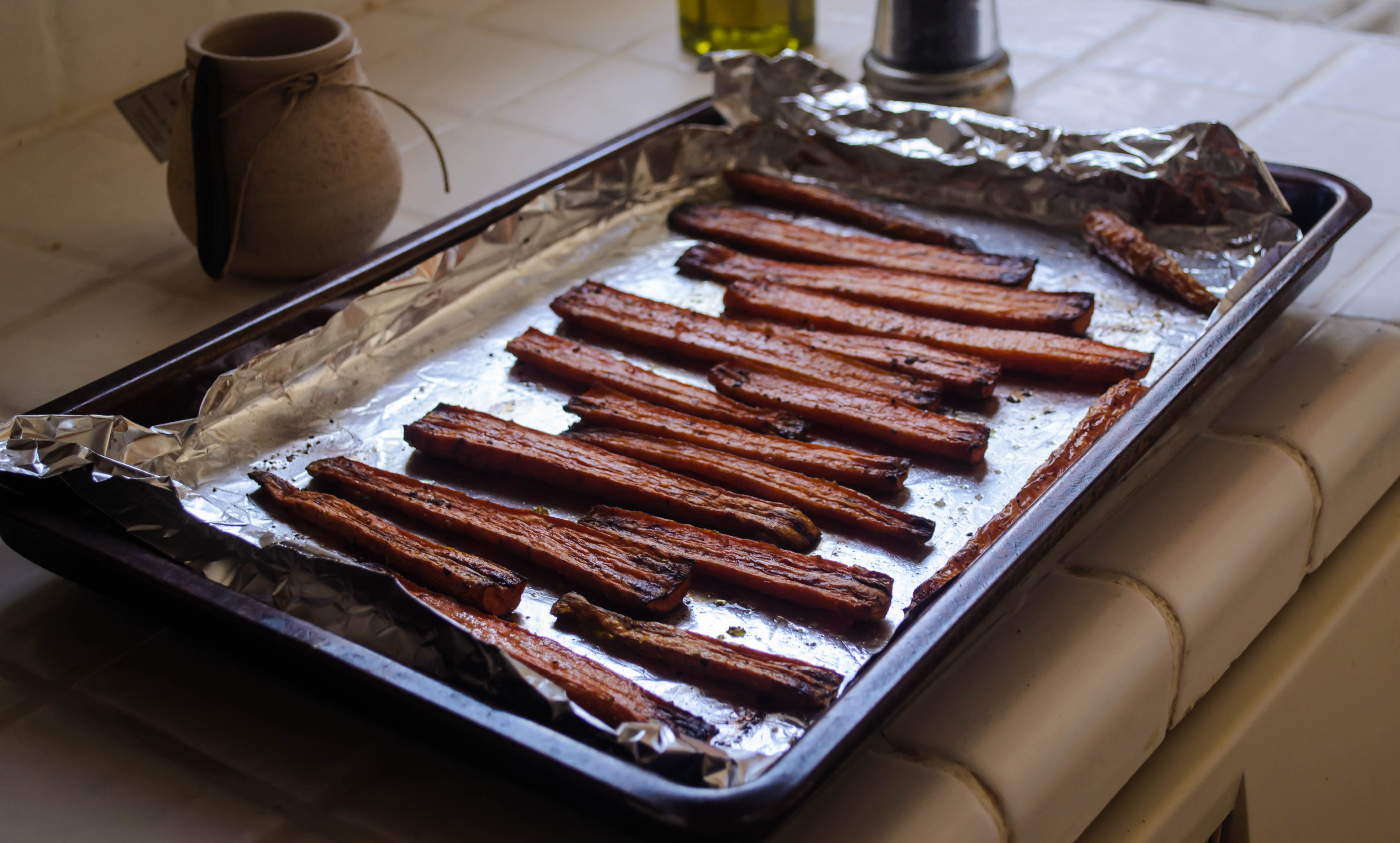
  • Preheat the oven to 425F while you prep your carrots. Remove their tops and tips, then split down the center for two long half cylinders. On an aluminum foil lined baking sheet, toss the carrot halves with the olive oil and the ½ teaspoon salt and ½ teaspoon pepper for a gleaming, even coat. Roast in the 425F oven for 40 minutes, until nicely browned and quite tender. Set aside to cool slightly.
  • For a standard blender: add the roasted carrots, coconut milk, water, grated ginger, and turmeric to a blender and blend until the mixture reaches your desired consistency. As noted above, I chose to leave mine with a little texture, but you can blend until completely smooth if desired. Pour the mixture into a medium pot.
  • For an immersion blender: add the roasted carrots, coconut milk, water, grated ginger, and turmeric to a medium pot with high sides (otherwise the soup spatters a bit during blending) and blend with an immersion blender until the mixture reaches your desired consistency. As noted above, I chose to leave mine with a little texture, but you can blend until completely smooth if desired.
  • For both methods: once the soup is your desired consistency in the medium pot, place it over medium-low heat until it is heated through. Be careful – because this mixture is thick, if it comes to a boil it will spit.
  • Season to taste with salt and pepper and serve topped with a scattering of chopped pistachios and lemon zest.

Roots Latkes

Most kids, upon reviewing what they ate during college, will talk about late night burrito runs. There will be a fair share of ramen noodle stock-up stories, and an assessment of the school’s dining facilities. For a student who has moved off campus, such a topic is likely to provoke a discussion of microwaveable meals. I had my share of those as well, I’ll readily admit, particularly during the month after a stunningly disorienting and unexpected breakup during which I subsisted mainly on Coca-Cola, boxed stuffing mix, Godiva ice cream, and carne asada burritos to-go from a restaurant next door to the grocery store where I was buying the rest of my supplies.

Food Blog November 2014-0694Thankfully, that month or so was an exception. For much of my off-campus college career, I lived with one other girl in a duplex her mom rented to us, and we fed each other. Sometimes it was easy stuff: pancakes, omelets, pasta with jarred red sauce, sometimes something a bit junkier like Oreo milkshakes. But we definitely introduced each other to our classics. One of mine was a modification of an old Ghirardelli oatmeal chocolate chip cookie recipe. One of hers was a simple, lovely little roasted vegetable dish her family just called “roots.” Roots consisted of, well, roots. Russet potatoes, sweet potatoes, carrots, parsnips, rutabagas, turnips, and sometimes beets got peeled, cubed, and tossed with salt, pepper, and olive oil. The first time she made it for us, K. said that she wasn’t sure how much olive oil to use, but that her mom said it should be just enough that the raw cubes of vegetables “glistened.” Then we loaded them into large glass casserole dishes and roasted them until they were done.

Food Blog November 2014-0681Roots comprised whole meals for us during those years. Sometimes there would be some kind of green side, but mostly we just sat down (never at the table, always on the couch) with big bowls of autumnal cubes, toasty and brown on the outside, starchy and pillowy soft on the inside, and inhaled them. It was reasonably good for us, it was filling, it was delicious, and best of all, it was cheap. The biggest disadvantage to the whole endeavor was getting a cashier at the grocery store who didn’t recognize “weird” vegetables like rutabagas and parsnips, and would take a long time looking up the codes to ring them up.

Food Blog November 2014-0682Over the years, I’ve made roots more times than I can count. They are a lovely comfort food dish: simple to make, hot and forgiving, and easily changed up depending on what vegetables and herb combinations you like the best. Over time, I’ve eliminated beets from the equation, and opted to add plenty of chopped rosemary to the requisite salt, pepper, and olive oil.

But recently, I got thinking about roots again and wondered what it would be like to turn these simple cubed, roasted vegetables into a latke. This would increase the ratio of crisp edges to soft interior, always a good thing, and cut down a bit on preparation as well as cooking time – you can just shred everything in a food processor before frying it up, rather than cubing by hand before waiting out the hour or more the original takes in the oven.

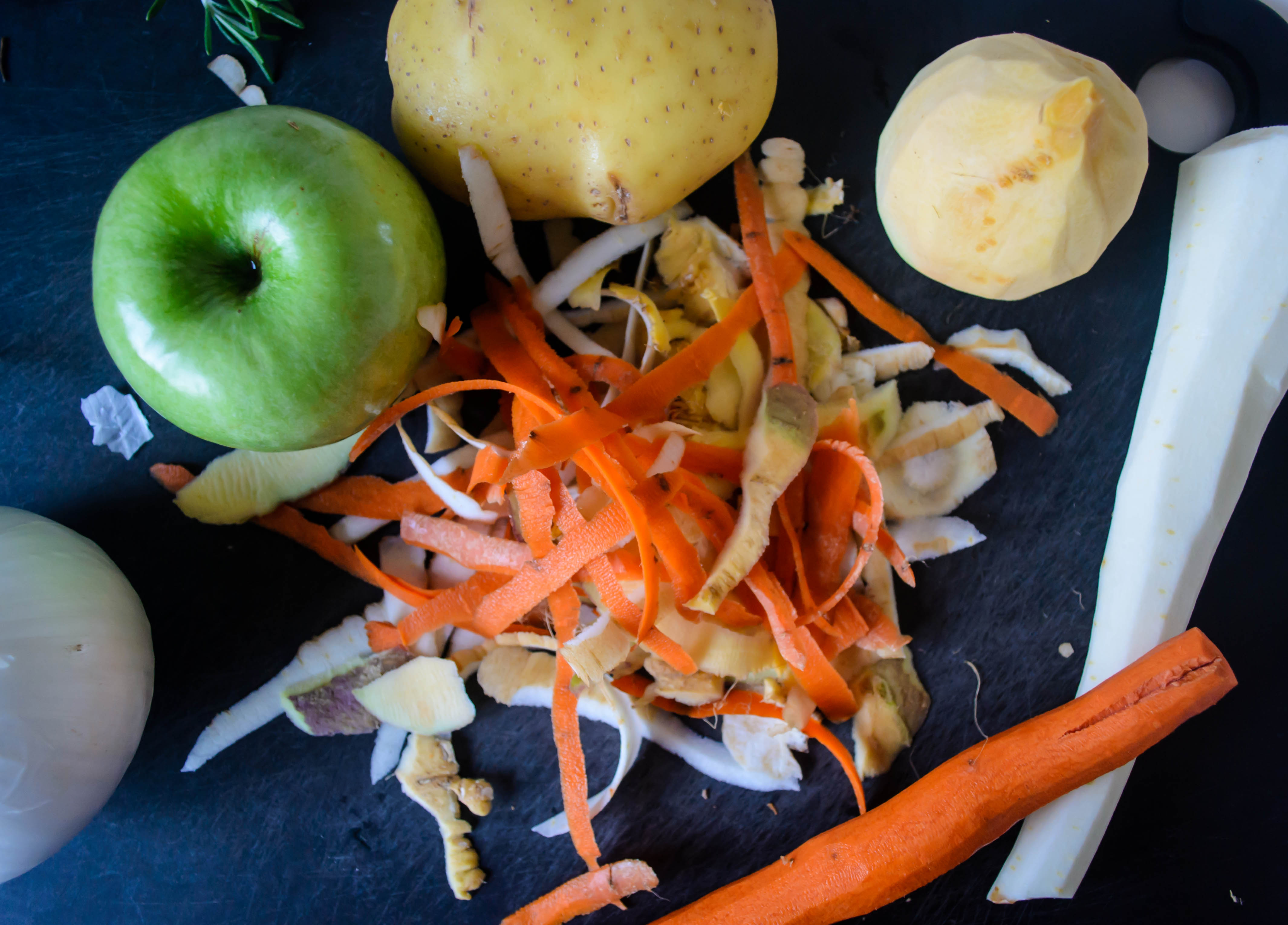
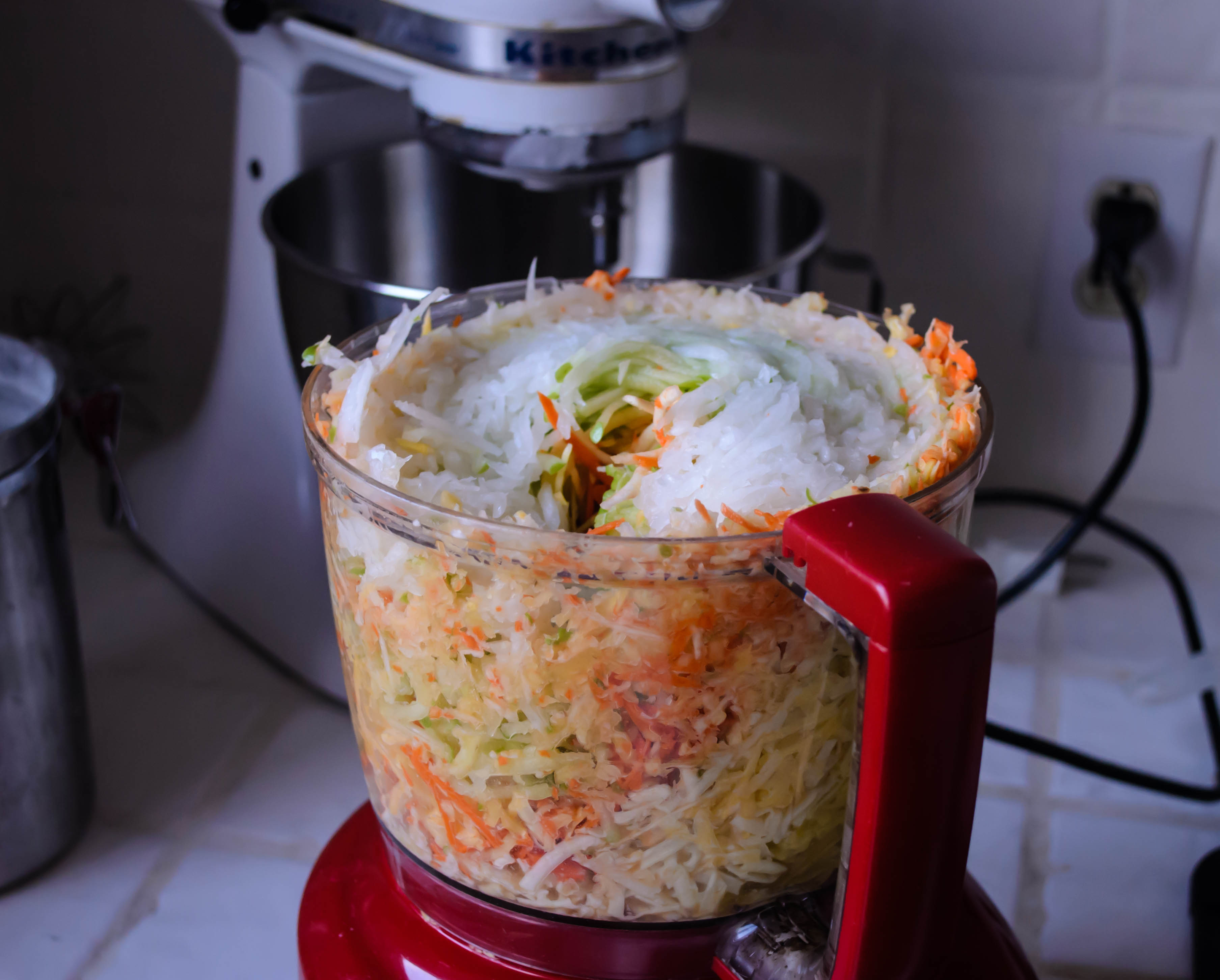
Food Blog November 2014-0687This was, as it turned out, exactly the right thing to do. I opted for potato, carrot, parsnip, and rutabaga as my key players. They whiz into a tangle of starchy threads. Half an onion joins the party – it’s part of a standard latke, and it’s a root vegetable too. As a nod to the common practice of serving latkes with applesauce, I added a tart green apple to the vegetable combination and was pleased with the sweet sharpness it contributed. And I preserved my own love of rosemary with a hefty tablespoon in the mix.

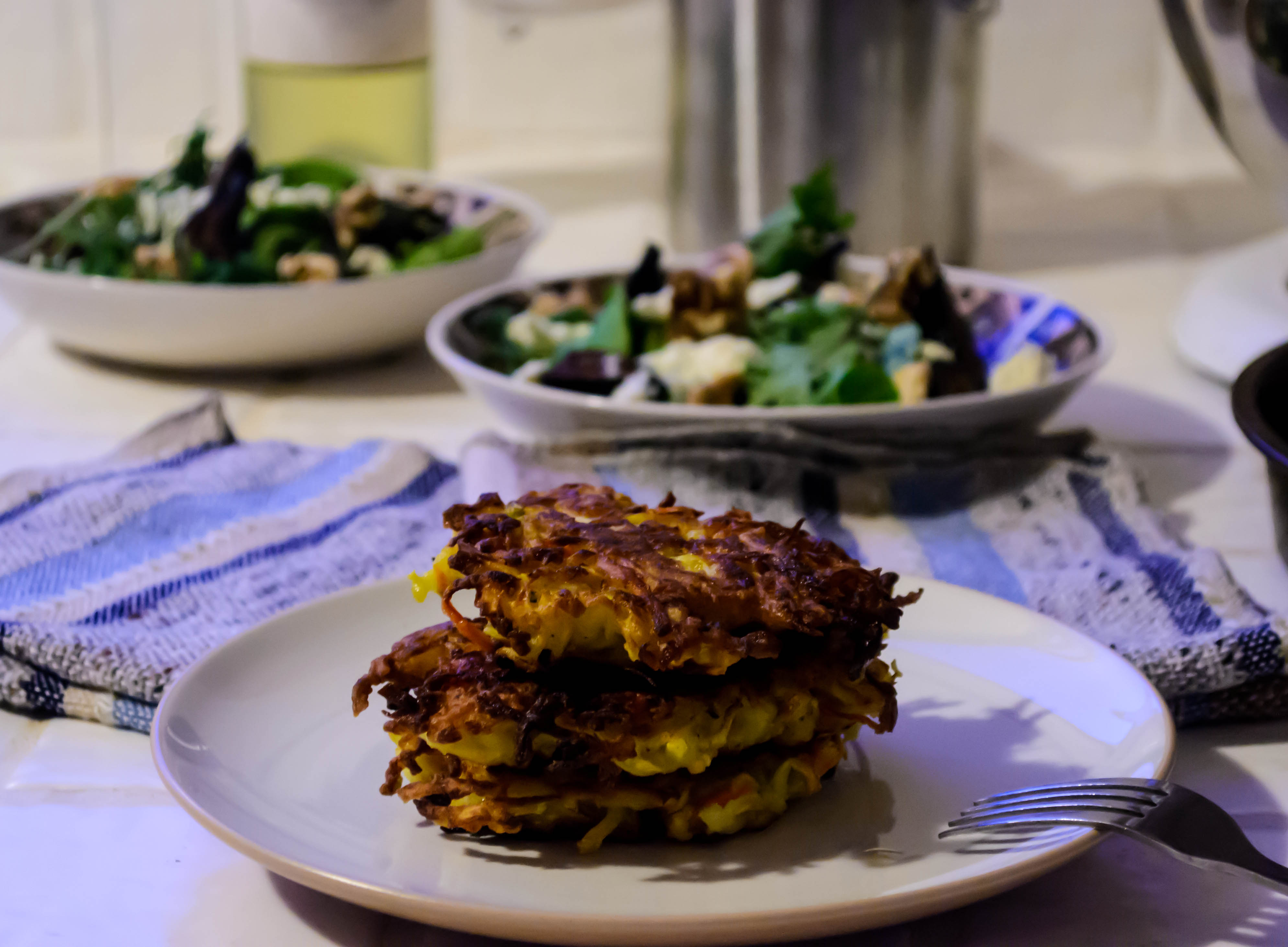
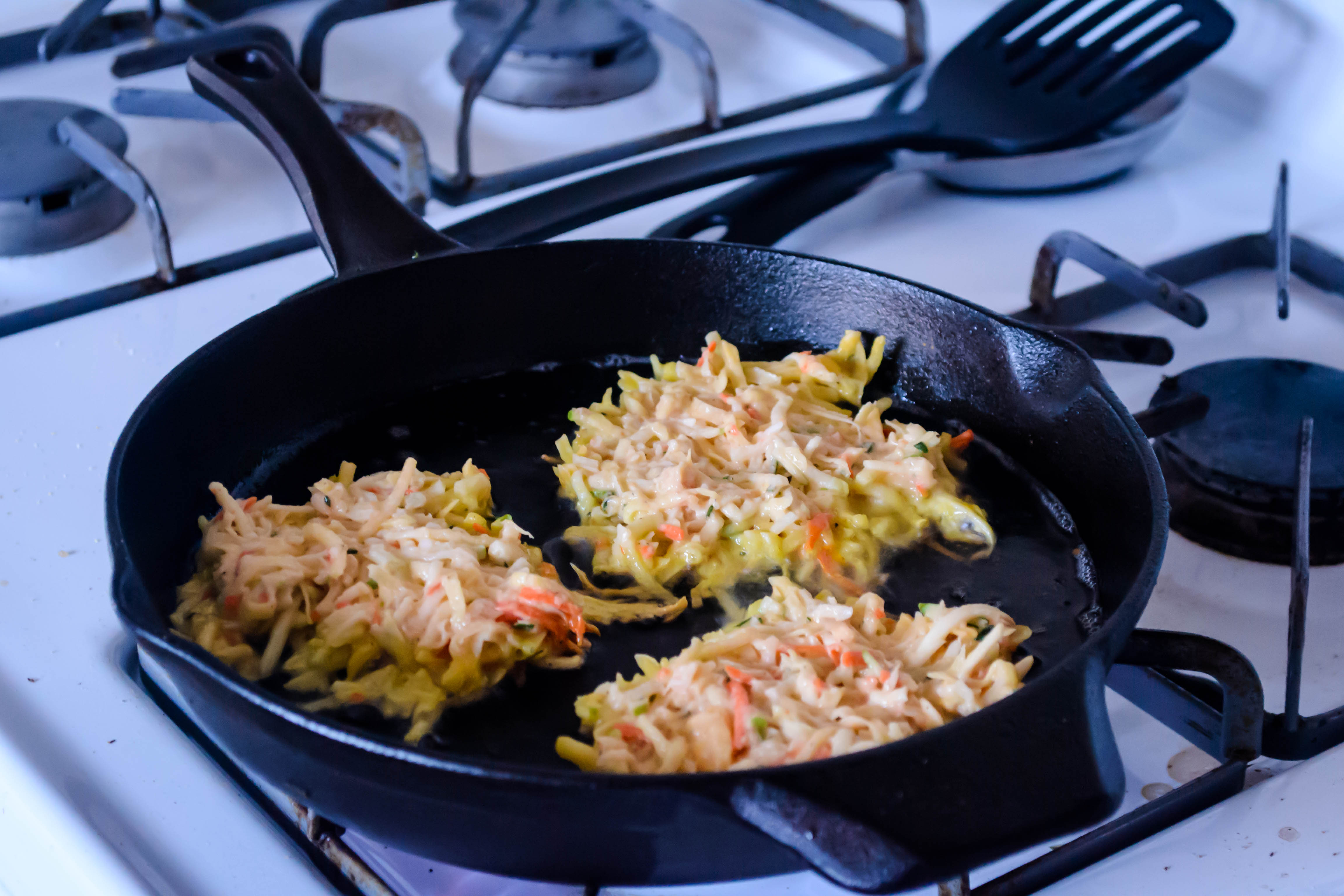
A few eggs, a toss with some flour, and salt and pepper to season, and you carefully drop-pour dollops of the sticky mixture into hot vegetable oil, preferably in a nicely seasoned cast iron pan. It sizzles, it browns, you flip it, and within ten minutes from your first addition of batter, you are passing out hot roots latkes to your delighted diners. Or, if you want to serve everything together, you can stow each batch in the oven on a rack in a baking tray to keep them warm and crisp.

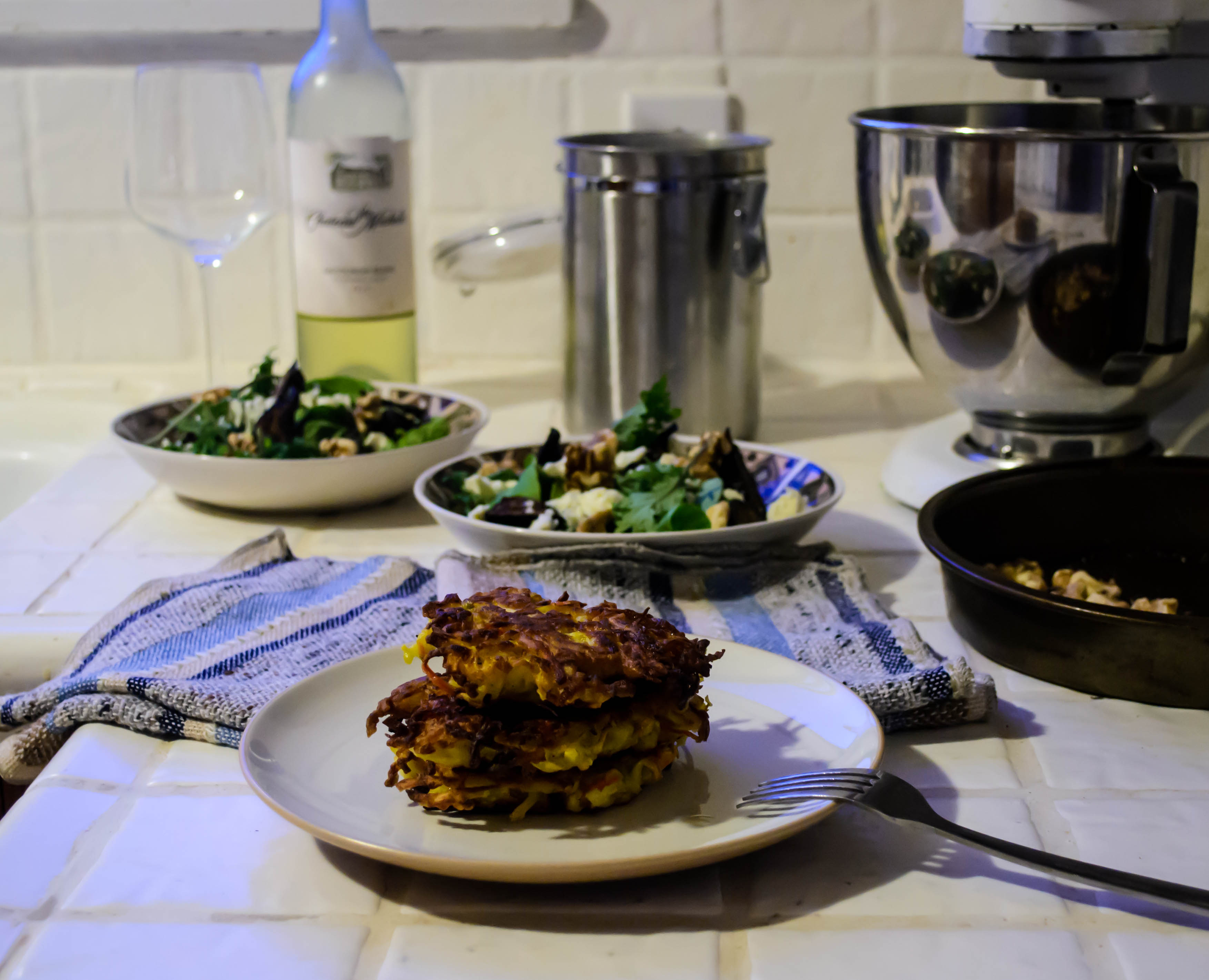
Food Blog November 2014-0690What you are left with is a reasonably quick, reasonably easy (both provided you have a food processor with a shredding disk) meal that doesn’t cost much but tastes exactly right for the approach of chillier weather. The flavors are more complex than your standard latke – there’s a mix of sweetness from the addition of the carrot and the apple. The parsnip and rutabaga have a spicy, earthy flavor that reminds me somehow of incense, a feeling pleasantly intensified by the rosemary.

Since I’d already captured the applesauce element by adding apple to the batter, I served these with a dollop of sour cream as a nod to another classic pairing.

Food Blog November 2014-0695

Roots latkes
Makes about a dozen  3-inch latkes
1 yukon gold potato
1 large carrot, peeled
1 large parsnip, peeled
1 medium rutabaga, peeled
1 large tart apple, cored
½ large white or yellow onion, ends and papery skin removed (either color is fine, so long as it’s not a sweet onion)
1 tablespoon minced rosemary
1-½ cups all-purpose flour
2 eggs, lightly beaten
1 teaspoon salt, or to taste
½ teaspoon pepper, or to taste
½-1 cup vegetable oil
Sour cream, for serving (optional)


  • Begin heating ½ cup of vegetable oil in a large cast iron skillet over medium heat – it will take a few minutes, but you are looking for it to just shimmer when swirled around the pan. If you plan to make the whole batch at once and need to keep them warm, preheat the oven to 300F and position a baking sheet with a wire rack on it inside the oven.
  • Fit a food processor with the shredding disk, or address the largest holes on a box grater with care for your knuckles. Cut the vegetables into the size needed to fit comfortably down the feeding chute of the food processor, and carefully feed the potato, carrot, parsnip, rutabaga, apple, and onion through the machine to create long, thin shreds of vegetable.
  • Dump the whole mess into a large bowl and mix them up a bit with your fingers to distribute evenly. You’ll be left with strands of vegetable confetti.
  • Add the rosemary and flour to the vegetable shreds and toss well with your fingers to combine. Then add the eggs and the salt and pepper, and mix well to combine. You could use a spoon or spatula for this, but I just use my fingers. They do a better job ensuring everything is evenly distributed.
  • When the oil is shimmering, plop ¼ – ⅓ cup dollops of the mixture into the oil. In my 10-inch skillet, I can fit three dollops of batter comfortably without touching – don’t crowd them. When they hit the oil, they should sizzle lightly. If the oil spits aggressively, it’s too hot. Turn the heat down or remove the pan from the heat for a minute to cool it down.
  • Sizzle the latkes for 4-5 minutes on the first side, until it is evenly golden-brown and crisp. Flip carefully (oil splatters) and cook for 2-3 minutes on the second side, until it too is brown and crisp. Move to the rack in the oven to keep warm, or directly to a plate for immediate consumption.
  • Repeat until batter is used up. If the oil level gets low or the latkes begin to brown unevenly, add additional vegetable oil to the skillet, giving it time to heat up before adding more batter.
  • Serve with sour cream, if desired, or applesauce, or just an anxious fork.

Bean and cheese stuffed poblanos and “stuck pot” red rice

Food Blog October 2014-0674I must have been this busy last year. I just don’t remember. When I get to work, I sit down at a desk on which the stacks of papers have been rearranged so many times they might as well be dancing. When I get home, I sit down at a table slowly succumbing to a pile of opened and unopened mail, notes and lesson plans, and yes, more papers. I am freest when standing, and when I am standing I am either stalking the classroom (a practice that, though necessary, regrettably and inevitably produces yet MORE papers), walking my sweet dog-daughter, or leaning over the stove to smell or to stir or to taste.
Food Blog October 2014-0645 Food Blog October 2014-0651 Food Blog October 2014-0652 It’s mid-October. It is at once much later in the year, and much earlier, than I’d hoped it would be. Recently my parents phoned to confirm a flight time for Thanksgiving; could N. or I pick them up from the airport if they arrived at x time? My brain flew ahead, thinking of food, thinking of games, thinking of the family closeness of the winter holidays and longing, longing, for that to be now, now, right-now-thank-you-very-much. But at the same time, there are so many things I wanted to accomplish, as always, that remain undone.

Food Blog October 2014-0648

Food Blog October 2014-0653All I can do is what I have. And what I have for you this week is, as promised, a pair of dishes that fit together so well I can’t, in retrospect, imagine presenting them here separately.
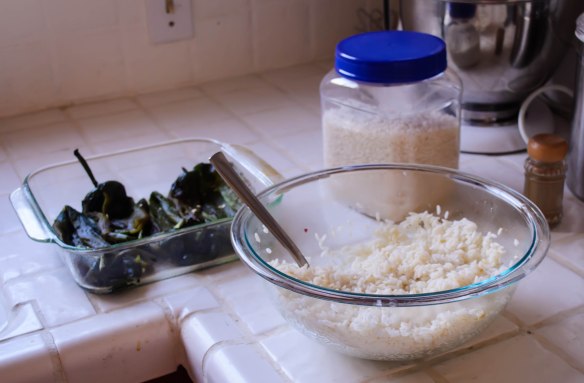
Food Blog October 2014-0655These dishes, a bean and cheese stuffed poblano and a take on the sort of rice you find shaped in a mound or a scoop on your enchilada plate at a certain type of Mexican restaurant, came into being for me during one of our dinners this past summer with our closest graduate school colleagues. Dinner was made by T., previously featured here as a salt expert, and she presented us a casserole dish approximately the temperature of hot magma, laden with fragrant peppers piled with beans and cheese. Beside them, she wedged a heavy dutch oven filled to the brim with “red rice,” a medley of tomato-laced long-grain rice shot through with aromatics and spice. It was one of those dinners where everyone ate without speaking.
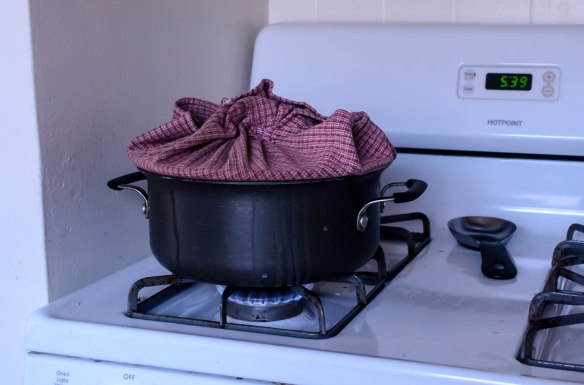
Food Blog October 2014-0657I had to have it again, and I knew it would take some tinkering. T.’s rice was fluffy and almost dry, whereas recipes I’d tried for this style of rice produced something wet and floppy – a Mexican risotto, if we’re trying for politeness – and that wasn’t my aim. I wanted something toastier, more like a pilaf. Inspiration and guidance came, as it so often does, from Deb at Smitten Kitchen, in a simple, hearty little feast she calls “Stuck Pot Rice and Lentils.” Inspired by Middle Eastern rice dishes that praise the tahdig, a crispy layer on the bottom of the pot, this rice gets parboiled vigorously, then mixed with other ingredients and cooked slowly, with very little additional liquid, until it adheres into a massive round cake you can, with some care and bravery, flip out onto a plate in a large, crunchy-topped wheel.

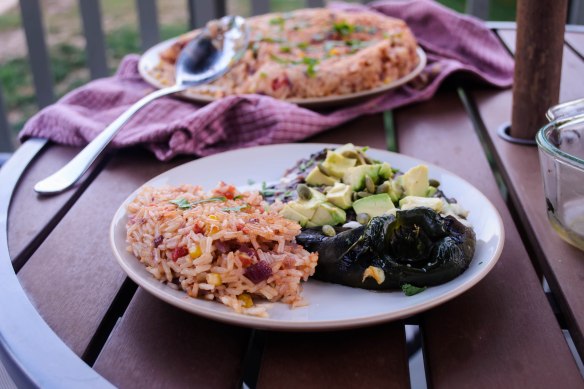
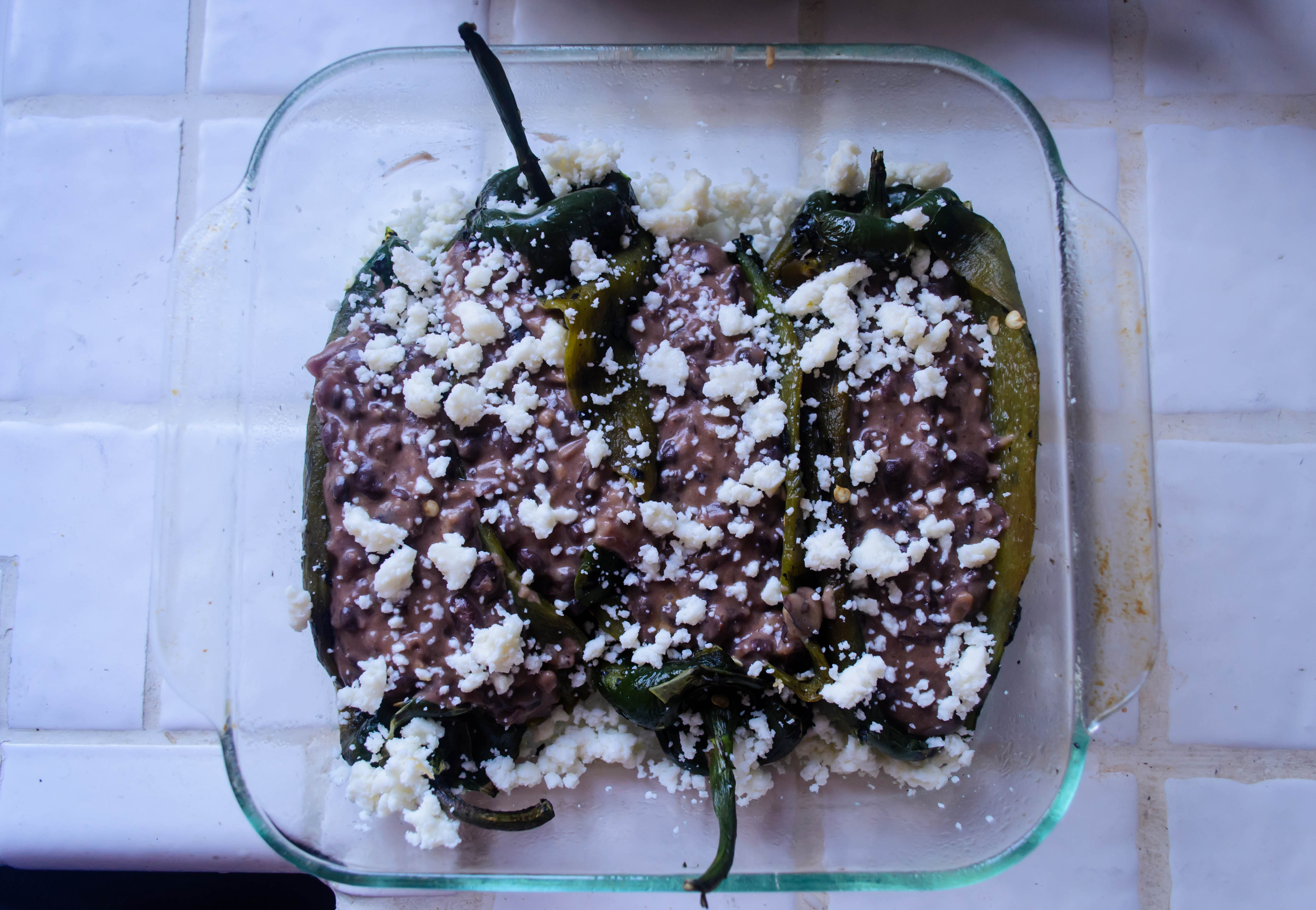
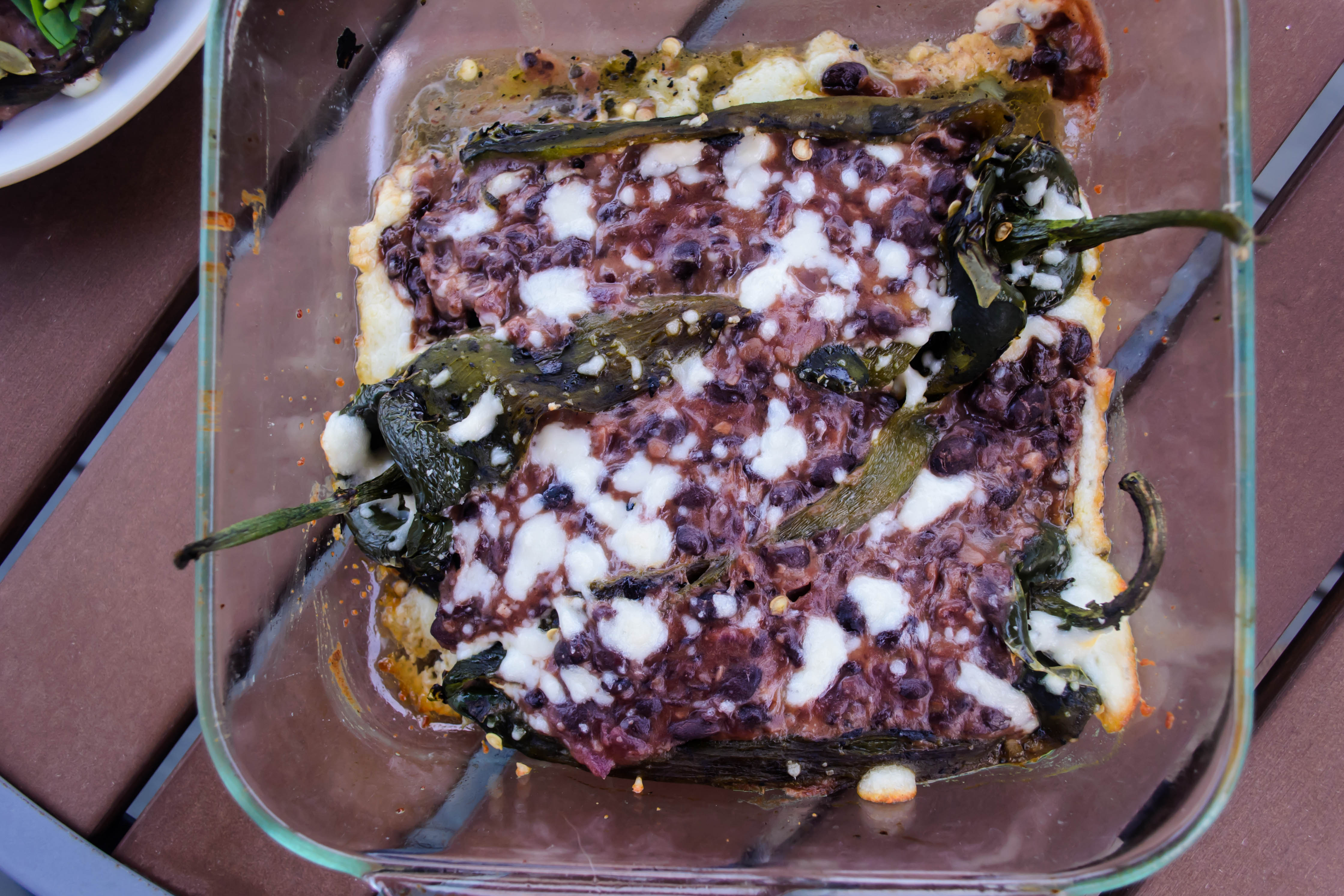
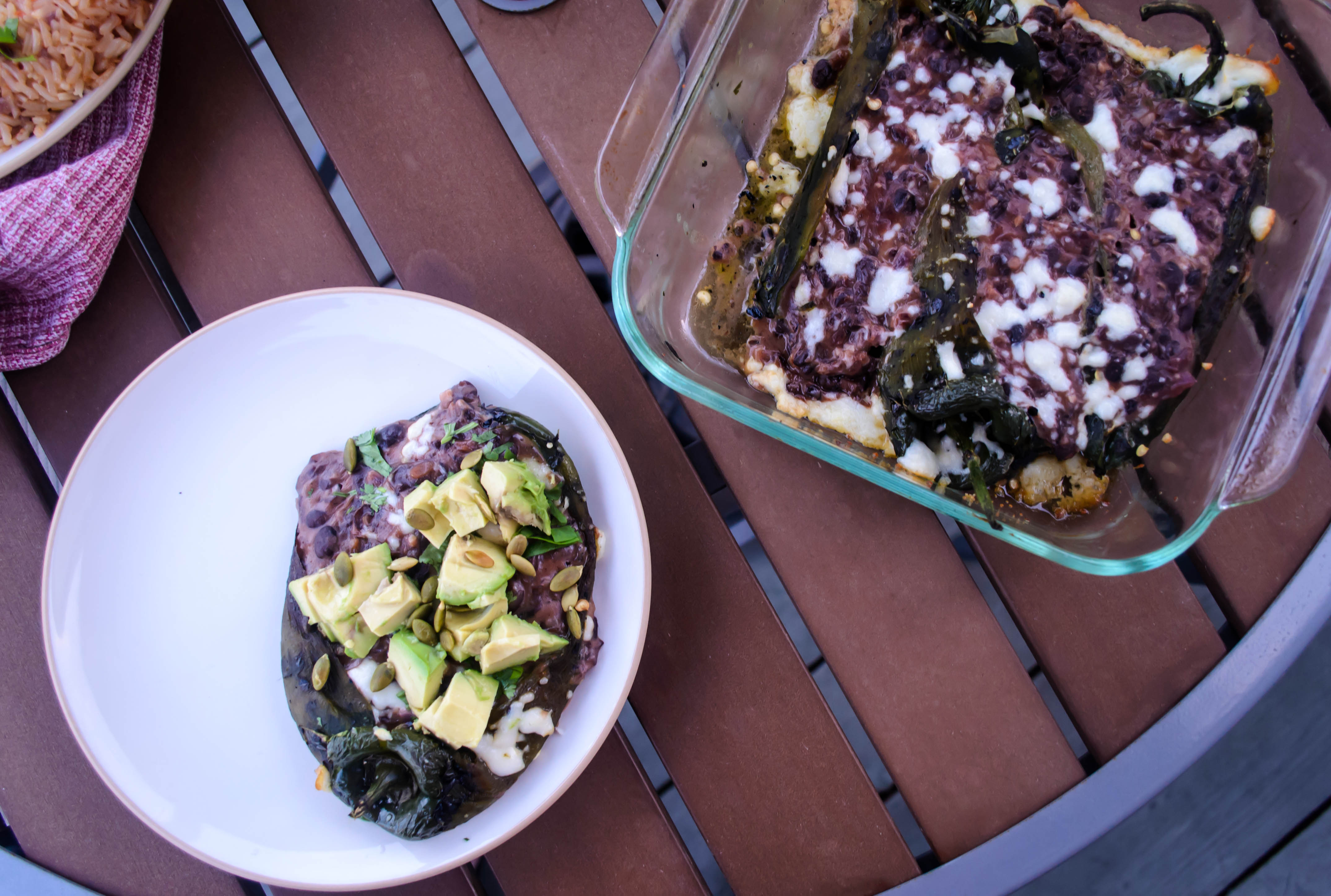
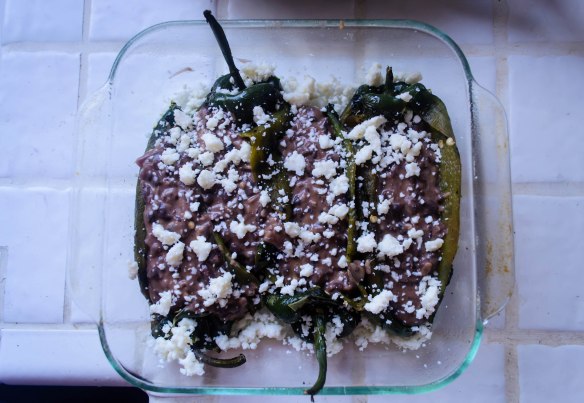
Food Blog October 2014-0673Food Blog October 2014-0679Are you hungry yet? There’s more. The peppers, which get roasted over a gas flame until their skins split and peel away and their flesh hangs like wet velvet (you could likely also do this in the oven at high heat or under the broiler, but I haven’t tried it – if you do and it works out, leave your procedure in the comments!), get delicately split and seeded, and then gently loaded with a mixture of smashed black beans and cheddar cheese before being baked for a half hour to bring everything together. Upon emergence from the oven, as if all this weren’t enough, they are subjected to a shower of crumbled queso fresco cheese, cubes of avocado, toasted pumpkin seeds and (if you’re the sort who appreciates this sort of thing) a sprinkling of cilantro and a squeeze of lime juice.
Food Blog October 2014-0660This is a play of heat. The pepper is a gamble – some poblanos (they may be labeled pasillas in your grocery store) are moderately spicy, while others are barely hot enough to tickle the back of the throat. The beans keep even the spicier peppers from overwhelming the palate, and if you are steaming, the cool avocados and a big forkful of the starchy rice relieve the sting. If you really want to tease your taste buds, you could add some diced jalapeño to the rice along with the other vegetables. I resisted, since the poblanos we used were aggressive enough.

Food Blog October 2014-0668This is, I must admit, not a quick weeknight dinner. The peppers must be addressed in several stages, the beans are seasoned and cooked separately, and the rice collectively takes the better part of an hour to complete. But it’s worth it, especially as temperatures cool. At this point in the season, I’d rather be warmed from within by a well-seasoned pepper than I would by the relentless sun (did you hear that, Southern California?!). It’s a warmth that almost, almost, chases away the busyness.
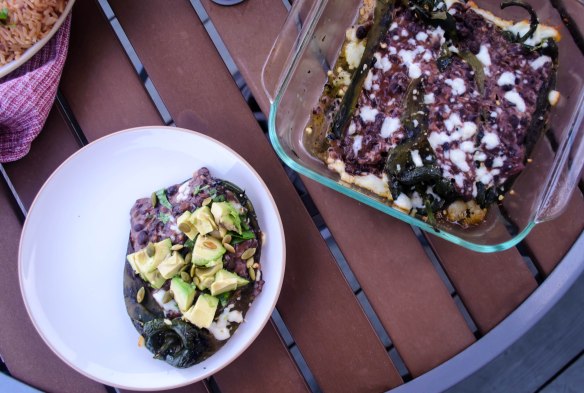
Food Blog October 2014-0667*** I’ve presented these recipes with the peppers first, since they require a bit more advanced planning. But I’ll inject spots in the procedure for each where you can switch between dishes to get both on the table at roughly the same time.
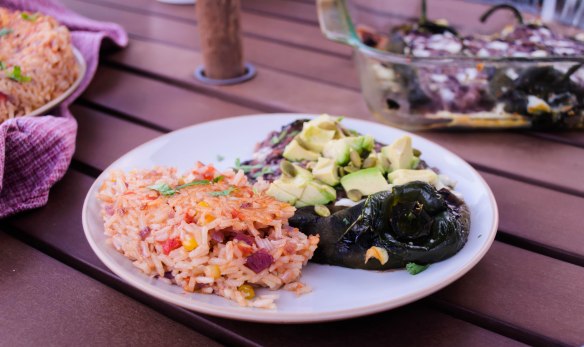
Food Blog October 2014-0676

Bean and Cheese Stuffed Poblanos
serves 6
6 large, shiny, firm-fleshed poblano peppers (they may be called “pasilla” peppers at your market)
2 cans (14 ounces each) black beans, one drained, one with liquid reserved
8 ounces cheddar cheese, as sharp as you like it
½ a red onion, diced
4 cloves garlic, finely minced
1 teaspoon cumin
(you may find you want salt for this, you may not. It will depend on your taste and how salty your black beans are. Taste first, add second)
¼ cup crumbled queso fresco
¼ cup toasted pumpkin seeds
1 whole avocado, cut into small chunks
2 tablespoons cilantro
squeeze of lime juice

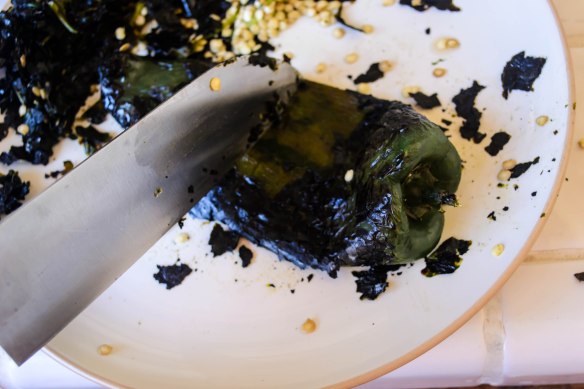
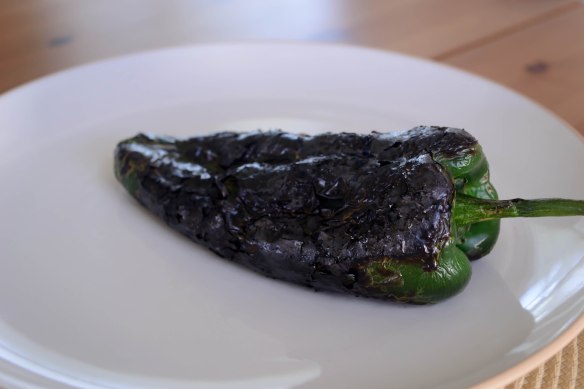
  • If you have a gas stove, turn the burners on to medium-high heat and set the whole poblanos over the flame, charring them on all sides. Turn as needed until the skins are uniformly black and crackly and the flesh feels soft; for me this took 10-15 minutes. As they finish roasting, pop them into a large bowl and cover tightly with plastic wrap. Leave them to steam (this helps the skins peel off) until they are just warm to the touch (I, um, forgot about mine while I did some other chores; they were quite certainly ready half an hour later…).
  • If you don’t have a gas stove, I suggest using your broiler. Since I haven’t tried this I can’t give indication of times, but put them close to the heat, watch them carefully and turn as needed.
  • When the peppers are cool, use your fingers, a paper towel, or the edge of a knife blade to scrape and peel the skins off. A few black specks here and there is okay, but the skins are a bit bitter, so the more you remove, the better.
  • (While you wait for the peppers to cool, you can turn your attention to prepping ingredients for the rice)
  • As you relieve each pepper of its skin, carefully cut a slit through just one side of the pepper and excavate the seeds and ribs inside. You want an empty, in-tact pouch, and this takes some delicacy. The flesh is quite tender at this point. Wedge the skinless, empty peppers into a greased 9×13 inch baking dish.
  • Saute the onions and garlic with a pinch of salt and pepper in 1 tablespoon of olive oil over medium heat until they are starting to shade gold, but are not burned. For me, this took 5-10 minutes with frequent agitating.
  • When the aromatics are toasty and golden, add the beans – one can that has been drained, one complete with the liquid. Add the cumin and stir to combine. Then, use a potato masher to smash about ¾ of the beans into a thick paste. A few whole or half stragglers are okay – they break up the texture nicely. Cook over medium heat until most of the liquid has evaporated: 15-20 minutes.
  • This is a good moment to preheat your oven to 350F.
  • (While the beans cook, you can shift your focus to the rice for a bit. Just don’t forget to give the beans an occasional stir to ensure they are not cementing themselves to the bottom of the pan.)
  • When the liquid in the beans has mostly disappeared, turn off the heat and add the 8 ounces of shredded cheddar cheese. Stir to combine.
  • To assemble, load up each empty pepper pouch with about ½ cup of the bean and cheese mixture. This takes a bit of finagling – get the mixture in there, but don’t tear up the peppers too much. Use the sides of the neighboring peppers to help everyone stand up straight and hold in their own filling.
  • If you wish, you may sprinkle on the ¼ cup queso fresco at this point. I found I preferred it as a post-baking addition, but it’s also nice baked on.
  • Bake in your preheated 350F oven for 25-30 minutes.
  • (While the peppers bake, carry on with your rice – if you are setting it over a low flame as you put the peppers in the oven, both will be ready at the same time)
  • When the peppers emerge from the oven, set them aside for 5 minutes. Then, serve, sprinkling as desired with queso fresco, avocado chunks, toasted pumpkin seeds, and cilantro. At the last possible moment, squeeze a bit of lime juice over the top.
Stuck-pot red rice
Serves 6-8
1-½ cups long grain white rice
¼ cup olive oil, divided
½ a large onion, diced (the other half of the one you used for the peppers is convenient)
4 cloves garlic, finely minced
part or all of 1 jalapeno, ribs and seeds removed, finely diced (optional)
½ cup fresh or defrosted frozen corn
juice of 1 lime
14.5 ounce can diced tomatoes, drained, juice reserved
Water as needed (see procedure)
2 teaspoons cumin
1 teaspoon coriander
1 teaspoon salt
fresh cilantro to serve, if desired
queso fresco to serve, if desired
  • Bring a large pot of salted water to a rolling boil. Add the rice all at once, clamp on the lid, and cook undisturbed for 5 minutes. Drain and set rice aside in a large bowl.
  • In the same large pot, heat 2 tablespoons of the olive oil over medium heat. When it is shimmering, add the onion, garlic, corn, and jalapeno, if using. Stir in a pinch of salt, then put the lid back on and cook 10-15 minutes, or until the vegetables are browning nicely. Be sure your corn is defrosted before adding, or it will take longer to cook off the water it emits.
  • While vegetables cook, drain the canned tomatoes, reserving their juice. Add enough water to the tomato juice to reach ⅓ cup, then add an additional 2 tablespoons.
  • When the vegetables are nicely browned, add them to the rice and mix well to distribute evenly. Add the canned tomatoes, the cumin and coriander, the salt, the lime juice, and the mixture of tomato juice and water as well, stirring to combine.
  • (The mixture can sit for a bit at this point if you need to go back and pay attention to your beans and peppers)
  • In the same pot you used to boil the rice and cook the vegetables, heat the remaining 2 tablespoons olive oil over medium heat until shimmering. Quickly and carefully, add all of the rice mixture and use a spatula to smooth it down into an even layer.
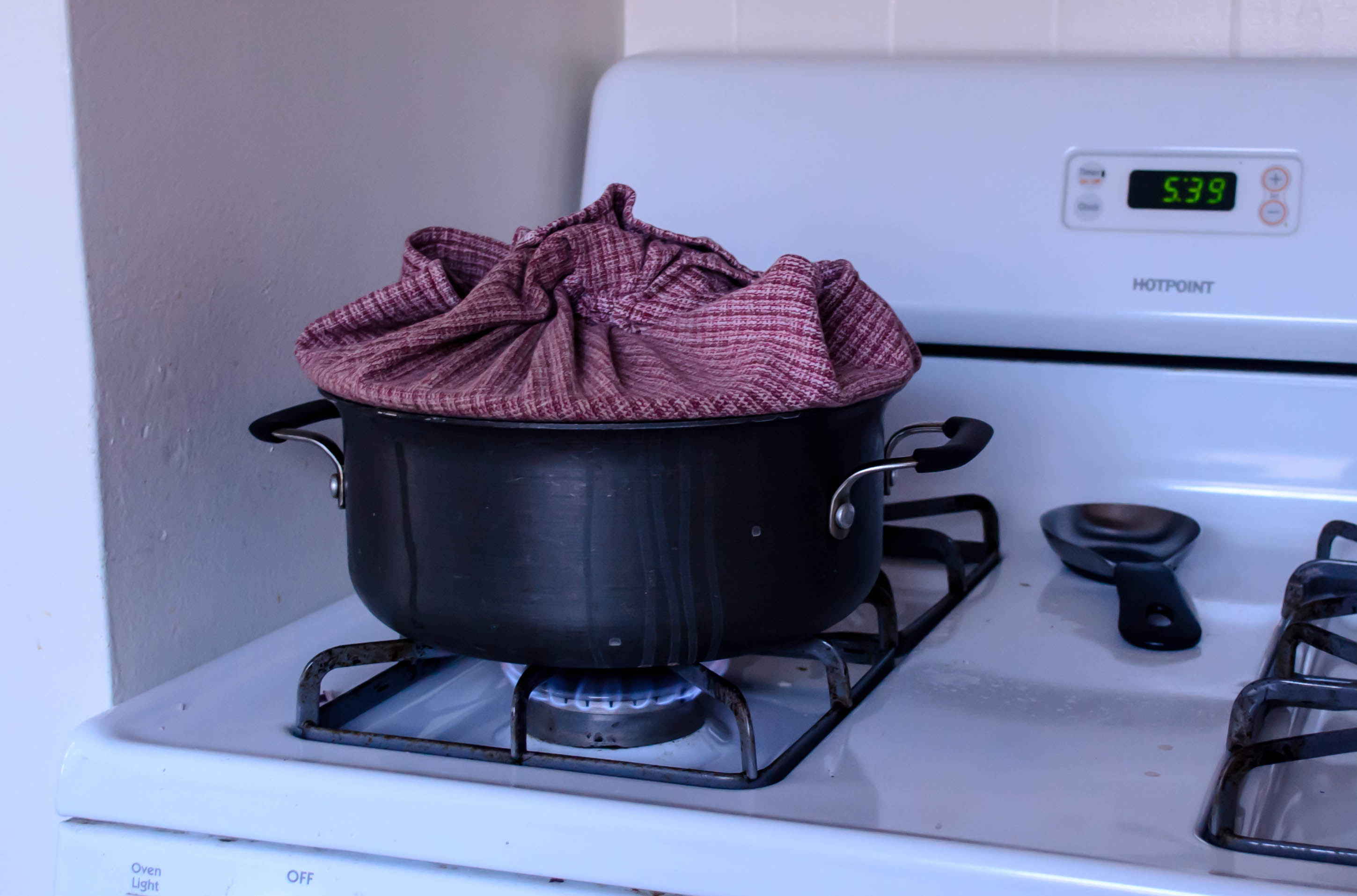
  • Now, being sure to keep edges away from the burner, place a clean kitchen towel over the open top of the pot, clamp on the lid, and securely wrap the edges of the towel around the handle of the pot lid. This creates a tighter seal and prevents extra water from dripping from the lid back onto the rice.
  • Once your towel and lid are securely situated, lower the heat to medium-low or low and cook, undisturbed, for 30 minutes. After about fifteen minutes you should start to smell a lovely toasty rice-y smell. If it smells closer to burning, turn the heat down a bit but don’t remove the pot from the heat. Check Deb’s post (linked above) for more on the procedure, if you like.
  • When 30 minutes has passed, turn the heat off and let the pot sit for 5 minutes to allow the rice to firm up. Then, using pot holders or a thick towel, carefully position a large plate or round platter over the top of the pot and, over a counter, invert the pot onto the plate and set it down. The rice should plop down onto the plate or platter; if you’re lucky, it will do so in a single round wheel.
  • Scatter it with cilantro and crumbled queso fresco, if desired, and serve.
  • If you don’t want all that fuss, just scoop the rice into a bowl, scatter on the optional garnishes, and be done with it.