Melinda’s Perfect Oven Poached Cold Salmon

A few weeks ago I attended a retirement luncheon for a now-former colleague (there are a lot of now-formers here lately, aren’t there?) at the home of one of her friends (and one of her now-former colleagues!). Our hostess made, among other perfect, not-too-heavy dishes for quite a warm day, a cold side of salmon so buttery and moist and perfectly cooked that a day or two later I had to email her to find out how she had done it.
Imagine my delight when, rather than a quick overview or an inexact “oh I just…” response, she sent me a page long, detailed explanation of both how she’d prepared the massive six pound piece of fish for that day, but how she does so when she’s only making a portion or two. Every step was well explained and justified, and she also told me where she gets her fish (a bit pricey for me at the moment, but maybe someday).
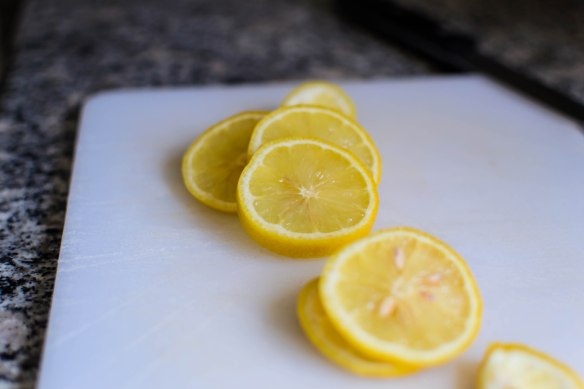
Because salmon is delicious cold, and because the actual cooking phase for this dish only takes about half an hour including the time spent preheating the oven, it’s a perfect dish for summer, when you don’t want to be cooking anyway (well, unless you’re me), and you can take care of the house-heating portion in the morning and stow the flaky, fatty main course in the fridge for the rest of the day.
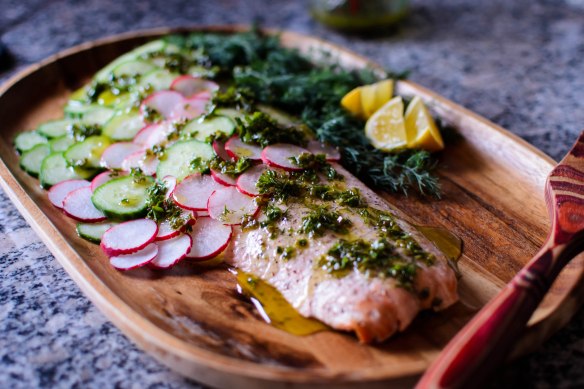
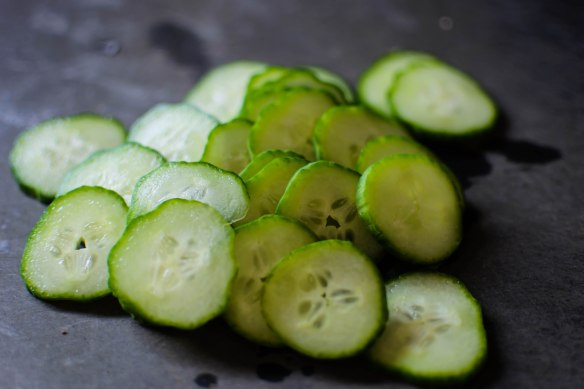
My hostess explained that she disguised a few cracks that formed during cooking with cucumber “scales,” and this struck me for two reasons: one, wouldn’t it be gorgeous to plate more of the filet with vegetable scales of different colors – green from cucumbers, florescent pink and white from radishes, maybe even yellow from baby golden beets – and serve a fish still enrobed in imitation of its original form? (Answer: yes, and a Google image search puts my meager shingling skills to shame.) Second, the idea of vegetables atop the fish made it seem only a step or two away from a salad. To complement the “scales” and disguise any possibility of dryness caused by potential overcooking, could you add a brisk, herby lemon vinaigrette right at the last minute, drizzling over fish and vegetables alike, and thus layer on one more fatty component to ensure moistness?
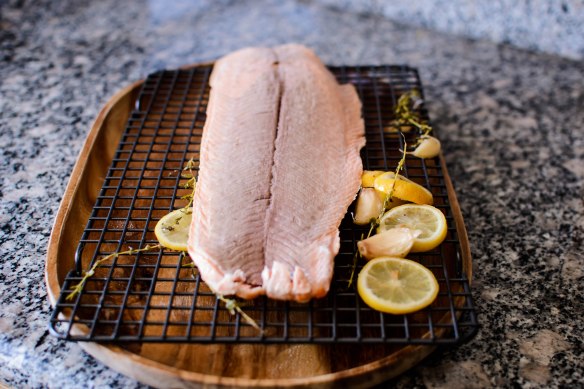
I decided to find out. Following my foolhardy practice of testing out new recipe ideas on guests, I determined to showcase M.’s fish – with a few of my adjustments – for some friends joining us for a weekend dinner.
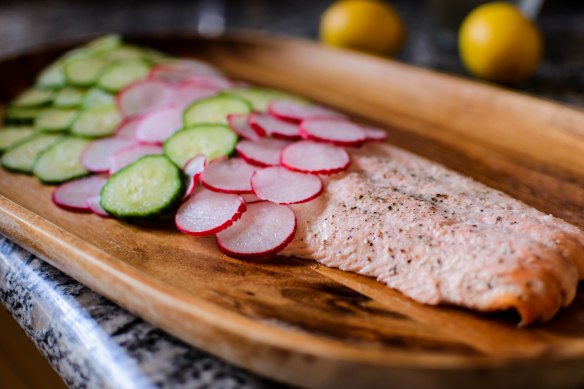
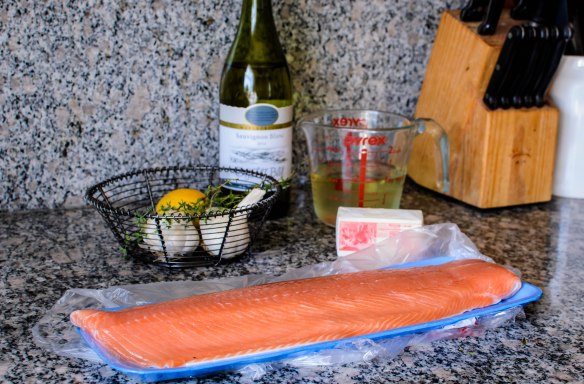
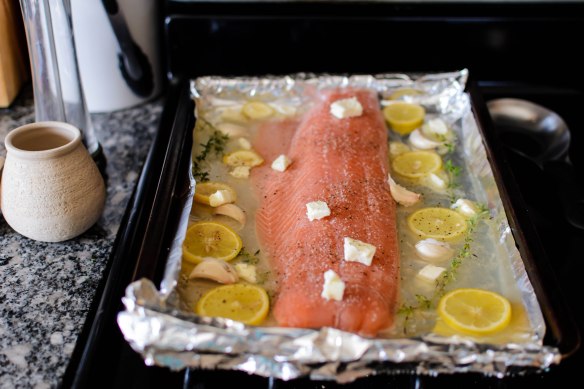
If you like salmon at all, you have to try this one. The pan, lined with aluminum foil for ease of fish manipulation and clean-up, preheats with the oven. Wine, garlic, lemon slices, thyme, and a few cubes of butter make the fragrant bath this cooks in, and though they lend subtle flavors, the star remains the salmon. The high heat of the oven does the job quickly, but the liquid bath means the method of cooking here is somewhere between steaming and poaching, which keeps the flesh of the fish tender and – not to overuse that word my former college roommate castigated as “too descriptive” – moist throughout. Slapping the fish straight onto the hot pan before adding the liquid and aromatics means the skin sticks to the hot surface, and when you remove the fish later you can peel the flabby skin right off along with its foil lining with little trouble.
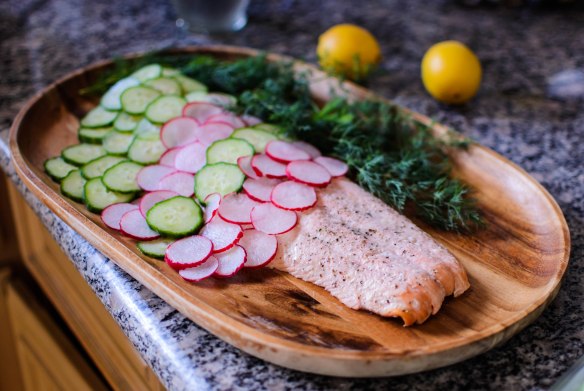
What you are left with under all that, once it has cooled and you’ve meticulously shingled on some bright, thin vegetable slices (or not – up to you!) and then drizzled the whole thing with a bright, herby lemon vinaigrette, is a filet that is just cooked through, so the fish doesn’t so much flake as it does sigh into tender, buttery layers. Cold, you can taste the richness of the fish but the whole thing still feels light, and if you’ve been wise enough to plan out the rest of your dinner with make-ahead options, you only have to leave your guests for five minutes while you sweep into the kitchen and emerge with a gleaming, laden platter they will exclaim over (and, if you’re anything like me, immediately try to recreate!)

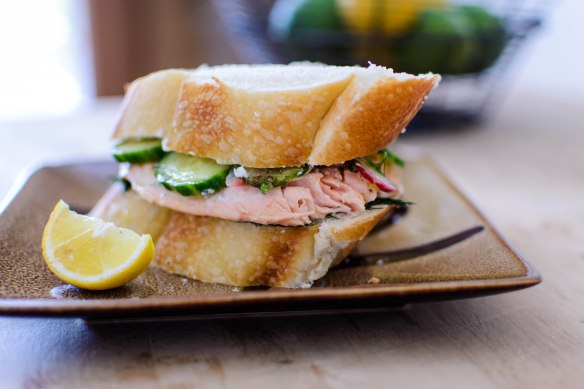
And if all that’s not enough for you, should there be any leftovers, stacked onto some soft, fresh slices of French bread that you’ve liberally spread with mayonnaise, or salted butter, or some whipped cream cheese, they produce a perfect lunch the next day that gives you enough strength to face the sink full of dishes that is the worthwhile consequence of every dinner party.
Melinda’s Perfect Oven Poached Cold Salmon
Serves 4-6
Prep and cooking time: about 30 minutes before, then another 15 after chilling, to decorate
Chilling time: 2-6 hours
For the salmon:
1½ pound filet of salmon, skin on
1 cup dry white wine
6 cloves garlic, lightly smashed
4 sprigs fresh thyme
1 small lemon, thinly sliced
2 tablespoons butter, cut into small chunks
½ teaspoon salt
¼ teaspoon pepper
For the “scales” and vinaigrette:
About ½ a cucumber, skin on, cut into very thin slices
2-3 radishes, cut into very thin slices
zest of 1 lemon
1 tablespoon minced chives
1 tablespoon minced dill
1 tablespoon minced parsley
2 tablespoons lemon juice
¼ cup olive oil
salt and pepper, to taste
additional dill, to serve (optional)
lemon wedges, to serve (optional)


  • Preheat the oven to 425F with a foil-lined cookie sheet inside. As soon as you turn on the oven, take the salmon and wine out of the refrigerator to warm up a bit for more even cooking.
  • When the oven is preheated, remove the pan and carefully place the fish skin-side down on the hot foil. Pour the wine over the fish, then scatter the garlic, lemon slices, thyme sprigs, and butter on and around the fish. Sprinkle salt and pepper onto the fish, then carefully slide the whole pan back into the oven.
  • Cook in the 425F oven for 12 minutes, or until the fish reaches and internal temperature of 120-125F. It will be pale pink with some white splotches, and look slightly fatty on top. Remove the whole pan carefully from the oven and set on a wire cooling rack. Immediately, using a large spoon, baste the salmon with the cooking liquid, then let the whole thing sit for 10 minutes.
  • After 10 minutes, baste again, then drain off the liquid. Lay a cooling rack top-side-down over the top of the salmon, then, holding both cooling rack and cookie sheet, carefully flip the whole cookie sheet over (it’s a good idea to do this over the sink). The salmon will now be top-side-down on the cooling rack. Remove the cookie sheet and peel back the foil a little at a time – the salmon skin should stick to the foil and come off cleanly (mine stuck in one place and necessitated a little cajoling).
  • When the skin and foil are removed, place your serving platter serving side down over the top of the salmon (so the bottom of the salmon is on the part of the plate that will be facing up). Carefully, holding both serving vessel and cooling rack, invert so the salmon and the serving plate are now right-side up. Remove cooling rack.
  • Cover the platter, salmon and all, with aluminum foil and refrigerate until cold.
  • 30-45 minutes before you intend to serve, remove the salmon from the refrigerator. We want it cold, but not chilly. While you wait for it to climb a few degrees in temperature, prep the cucumber and radish slices and make the vinaigrette: in a small measuring cup, combine the lemon zest, minced chives, dill, and parsley. Squeeze in the 2 tablespoons lemon juice, then whisk in the ¼ cup olive oil. Season to taste with salt and pepper and set aside until needed.
  • To decorate, shingle the sliced cucumbers and radishes over some or all of the fish in a pattern you like – you can see what I did above, and the internet has, as always, many gorgeous alternatives. If you wish, arrange some bushy dill sprigs in the corner of your platter and pile some lemon slices on them for diners to choose at their whim.
  • Just before serving, drizzle the fish and its vegetable “scales” with the lemon vinaigrette, using a whisk or a fork, if needed, to distribute the herbs evenly (they may come out in little clumps). Serve with a large fork or a wooden spatula.

Save

The Adele – limoncello spritzer

Hi friends. Remember me? I promise I haven’t forgotten about us. I’ve just been… busy.

A week or two ago N. and I were talking about explanations our students give for their absences, or for requesting extensions, or for missed work, and it led into a discussion of the difference between reasons and excuses (which dovetailed into me raging against one of the judges on the Food Network show Chopped for calling a contestant’s explanation that the plate she wanted to use had been taken by someone else an “excuse” he didn’t want to hear). We decided it was, in some senses, a matter of semantics, and that in many cases it was too bad that “excuse” has taken on such a negative connotation. In thinking about how I’ve effectively abandoned you here, I do have some reasons for my absence, but I’m now approaching the point where they are fast becoming excuses, in all the negative ways we usually think of the word. I moved. (True, but we unpacked the kitchen and the computer with my photo editing software almost two weeks ago.) It’s hot. (Yeah, but it wasn’t last weekend or the weekend before that.) I’m tired. (Not so tired that I can’t teach, and grade, and whip up dinner, but tired enough that staging ingredients and capturing the right angles feels like a pretty steep mountain to scale around 4:30 in the afternoon.)

In the end, it doesn’t matter, because what’s important is getting back to it and making an appearance, right? So here’s mine. In the steaming slick of the weekend, peeking around the ragged corners of my own laziness reluctance summer schedule, I figured I could manage a cocktail.

This drink is in honor of my now former neighbor, the “now former” part of which saddens me greatly. Before the move, we were in the habit of having monthly happy hours with one set of neighbors, taking turns hosting an evening of snacks and drinks and music and conversation. It was a lovely way to end the week, and a great excuse reason to resupply the cheese drawer. A former bartender, A. always impressed me with her imaginative cocktail ideas (and got me hooked on vodka tonics – how did it take me until my mid-thirties to discover this dangerously refreshing option every single bartender in the country knows how to make?). It was always a different drink, always something slightly unusual (amaretto and almond milk, anyone?), and she always had the ingredients for it chilled and waiting. For our final happy hour as neighbors, despite not having a great deal of time to plan (packing – you know how it goes), I wanted to have something special to offer her, and it turned out to be this, a drink she liked so much I decided to make it again, and again, and name it after her.

Apart from our neighbors, the other thing I’m going to miss about the house we no longer live in is the lemon tree in the backyard. It wasn’t a standard Eureka or Lisbon lemon (the varieties most common in the standard U.S. grocery store displays), but it wasn’t quite a Meyer lemon either – the skin and pith were sturdy and thick, and they grew to larger sizes than the grocery store offerings (and man were they full of seeds, a feature I’m currently taking advantage of by sprouting and growing a few of my own). The first winter we lived there, I used the tree’s bounty to make limoncello, a lovely bottle I forgot about in the back of a cupboard and allowed to steep much longer than suggested, producing something tooth-achingly sweet and far too strong to be sipped. Over the five years we lived in the house, I slowly worked on that one bottle, adding it to desserts and drinks when a boozy kick of lemon seemed right. As moving day approached, I had only a few shots left in the bottle. To enjoy the sunshine of those lemons as long as possible, the day before we left I stripped the tree of every ripe lemon I could reach (don’t worry, there were still plenty for the new tenants… assuming they have a ladder…). To my dismay, this recipe uses the very last of these.

This is no great revelation, I’m afraid (after I made you wait for it for a full page to finally find out what’s in it!), but it is a perfect, and perfectly easy, cocktail for the season. It uses the very last drops of my limoncello, the very last slices of the last lemon I brought from the old house, and a simple fizz of seltzer water to top it up. And as I sipped it this weekend in my hot, still backyard, still scattered with the detritus of the week’s airborne celebrations (fireworks leave a lot of garbage behind!), it remained a lovely way to close out the week: fresh, bright, not too sweet, just the right subtle tickle, as we plow full swing into summer.

The Adele
Makes one (but so easily multiplied)
These are my quantities of preference – you can, of course, adjust to your own tastes, making the drink stronger or weaker, more or less citrusy, as you prefer.
3-4 ice cubes
1 ounce limoncello
1-2 lemon slices or wedges
5-6 ounces seltzer water (don’t use club soda – it contains sodium)


  • Place the ice cubes in a red wine glass (with a big bowl and a tall stem)
  • Pour in the limoncello and add the lemon wedge or slice(s), squeezing to release juice if desired
  • Top up with seltzer water, stir gently, and enjoy.

Save

Ranch Biscuits

We are still awash in boxes (and the desktop computer that I use for photo editing is still sitting in a closet, so these are straight from the camera shots) in this new house that is our house (our house! That is ours! No more landlord! I’m just a little bit excited about this…), but it is starting to feel like home. This “like home” is a different kind of “like home” feeling, though – unlike any I’ve felt thus far in my adult life. Previously, “home” meant “a place I will live for a few years.” It meant “this space I occupy but will, at some point, move on from.” While there is certainly the possibility that at some point, some day, we will dislodge ourselves from this house, it won’t be for a while. This is a place to actually do all those “maybe someday” things we’ve put off: lining drawers. Acquiring “grown-up” bookshelves (read: shelves that actually cost more than $30 or so). Planning and planting a vegetable garden. Finally framing those diplomas. And as anxious and antsy as I am to have it “finished,” we don’t have to do those things immediately, because we’re going to live in this lovely, quirky little house for a long time.

None of that is a beautiful transition into these biscuits, though don’t they look nice against that backsplash? (I promise I’ll stop talking about the backsplash soon.) They’ve been hanging out at the back of my consciousness for a while now, poking at me, and now that it’s grilling season and all I want to do is sit out back with a very cold drink and watch N. manhandle well marinated beef on the grill, I thought these would make a nice accompaniment to anything barbecue related. The flavors of ranch dressing in a sky-high biscuit make sense. I mean, they already share buttermilk in common, and herbs like dill and chives are a lovely way of perking up your average biscuit and making it more interesting. The kick of garlic, of onion powder, and of a little dry mustard could do nothing but improve the whole situation.

Aided by my adaptation of Ruhlman’s folding and turning method for biscuits with well-puffed layers, these inflated gorgeously in the oven and found their way in multiples to our plates (the first set we tore through were still so warm it was hard to discern the individual flavors). We inhaled the batch in a day and a half, and while they were delicious – herby and kicky and tangy from the buttermilk – we realized while devouring our second helping that we weren’t sure precisely how closely their flavors mimicked ranch dressing, since it had been so long since either of us had tasted that childhood standby.

So here’s my thought for you, as the fourth of July, that ultimate of grill-based holidays, approaches: if you try these, as a side for your ribs or a mop for your baked beans or an ever-so-tolerant napkin for the drips of melted butter coursing from your corn (oh, or maybe even as a sandwich base for the leftovers, with a slick of mayonnaise on both split sides to add that final missing ranch-y ingredient), will you let me know, friends, if they remind you of ranch dressing?

Ranch Biscuits
Makes 9-10 3-inch biscuits
30-40 minutes
2 cups all-purpose flour
1 teaspoon sugar (I like turbinado, but any granulated sugar will do)
1 teaspoon salt
2 tablespoons baking powder
1 teaspoon onion powder
1 teaspoon dry mustard
¼ teaspoon paprika
¼ teaspoon ground black pepper
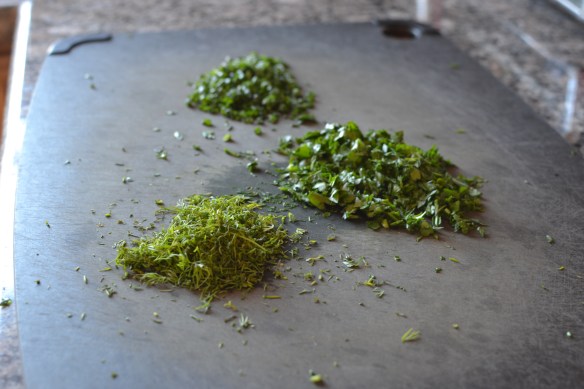
2 tablespoons finely chopped dill
2 tablespoons finely chopped chives
2 tablespoons finely chopped parsley
2 garlic cloves, finely minced
6 tablespoons cold butter, cut into chunks
6 ounces cold buttermilk (about ¾ cup)


  • Preheat your oven to 400F and line a baking sheet with parchment paper. In a medium bowl, whisk together the flour, sugar, salt, baking powder, onion powder, dry mustard, paprika, and black pepper. Add the finely chopped herbs and the garlic and whisk well to ensure even distribution (these wetter ingredients will want to clump together).
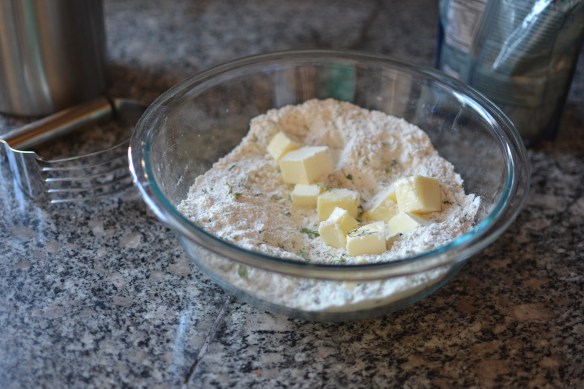
  • Plop in the cubes of cold butter and use a pastry cutter or your fingers to work the fat into the flour mixture. You are looking for butter bits the size of small peas. Pour in the buttermilk and use a fork or your fingers to mix it through the flour and butter mixture and bring the whole thing together into a shaggy, soft ball of dough (if it seems too dry and is not coming together, just set it aside for a minute or three – this will give the flour time to absorb the buttermilk a bit more).
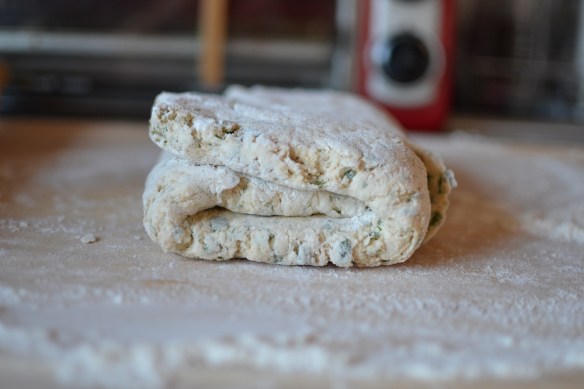
  • Turn the dough out onto a well floured board, sprinkle some more flour on top, and knead with your hands two or three times just to catch any loose bits. With a rolling pin or your hands, press or roll the dough into a rough rectangular shape about ½ an inch thick. Fold the dough into thirds, then roll out again. Repeat, again folding the dough into thirds and then rolling it out; this creates more flaky layers. If the dough sticks to your board, use the flat blade of a butter knife or a pastry scraper to help you lift it free.
  • After you’ve rolled and folded, rolled and folded (so you’ll have done a total of six folds), roll out once more, this time to a thickness of 1 inch, and use a 3-inch round cutter (or the lip of a glass) to punch out biscuits. Push the cutter straight down through the dough; don’t twist until you are all the way through to the board, or you’ll crush the flaky layers! Repeat, placing the biscuit rounds on your parchment lined baking sheet, until you can’t punch out any more rounds. Re-roll the dough scraps (no need to fold again unless you want to) and repeat – with a 3-inch cutter, you should be able to make 9-10 biscuits about 1 inch thick.
  • Arrange the biscuits, evenly spaced, on the parchment lined baking sheet and bake for 18-20 minutes, until they are well puffed and the tops are pale golden and slightly dry.
  • Let cool for just a minute or two, then wrap up in a basket or stack on a tray, and watch them disappear.

Rain check

Not a single solitary chance of a recipe post, I’m afraid. You know how moving is: everything takes longer and costs more than you were expecting, and of course it’s also the very last week of my semester, with all the bitter joy that entails.

What I am offering is a little sneak peak into – if you’ll pardon my Hamilton obsession leaking its way into my cooking space – the room where it happens. Snagged straight from my phone (no chance of a proper shot yet), this is the place! Look at that counter space! Look at that backsplash! Look at the light pouring in from that big window! (Look at that jalapeño cheddar cornbread just off-screen!) New organization scheme and cabinets-that-open-the-direction-I-wasn’t-expecting and glare management and wonky stove aside, I’m besotted, and I can’t wait to find out what emerges.

Once I’m a little more unpacked.

Save

Arugula Herb Soup

You know I don’t usually do this – usually I report on something delicious, sharing the recipe so you can make it too – but I owe you a soup for May, and there’s absolutely zero chance of a recipe next week, since the moving truck comes on Friday(!!!!), so here we go (and besides, the photos came out so nicely). This one was… weird. It wasn’t bad, but it also wasn’t remotely our favorite. If you’re into an herby, grassy taste, you should go for it.

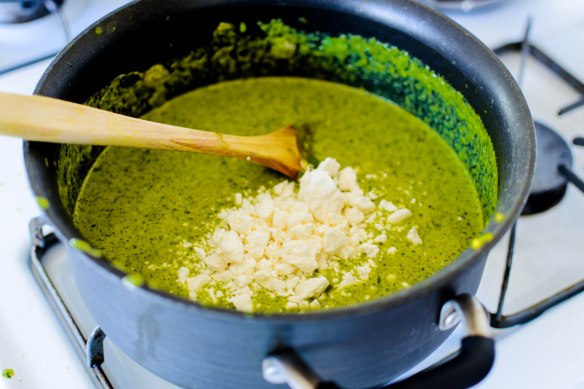
The base here is a soup recipe from Ottolenghi that blends spinach, parsley, cilantro, and mint with a base of onions and garlic and broth. I added arugula to mine as well as some mustard seeds, and ended up with a murky green concoction that, I have to admit, was reminiscent of high quality lawn clippings. N. called it “pesto soup,” and despite the absence of basil, I tended to agree – thickened up a bit and tossed with pasta, it would have been delightful.

Ever the glutton, I decided what this soup needed to add interest and richness was a poached egg, that darling of chefs everywhere (seriously, I think adding an egg is the culinary equivalent of “put a bird on it.”), and I was right. Broken into the soup, the yolk cut through some of the earthiness of the greens that got even better with the addition of a crunchy slice of garlic rubbed toast. So, in other words, the soup was improved by adding other things to the soup.

Perhaps it was the heavy dose of arugula, which contributed a peppery earthiness the soup didn’t need. Perhaps it was just upped quantities of the greens – I do have a tendency to go heavy on the flavoring agents and light on the liquid. Perhaps it was just a soup the likes of which we’ve never had before.

I’ll be spending next weekend arranging my new kitchen, so I’ll see you when I can. Be well!

Arugula Herb Soup with Poached Eggs
Adapted from Ottolenghi’s column in The Guardian
Serves 4-6 as a starter
3 tablespoons olive oil, divided
1 yellow or white onion, diced
2 garlic cloves, minced
1 teaspoon turmeric
1 teaspoon black mustard seeds
½ teaspoon nutmeg
½ cup chopped parsley, leaves and stems, + ⅛ cup for garnish
½ cup chopped cilantro, leaves and stems, + ¼ cup for garnish
¼ cup chopped mint leaves
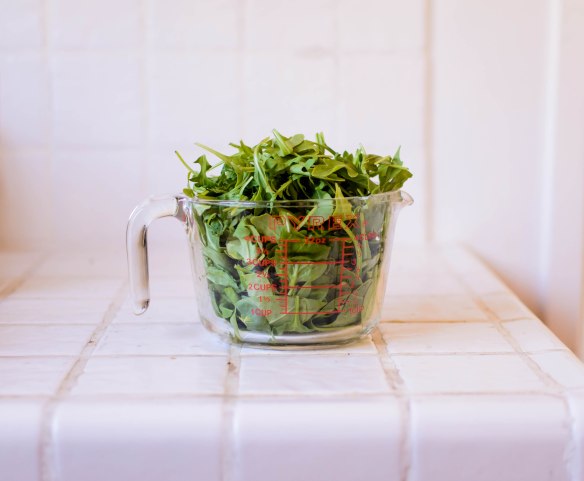
1 cup each baby spinach and baby arugula leaves, or 2 cups baby spinach (Ottolenghi gives his quantities in grams, and I admit I should have weighed mine, but the food scale is packed, so I estimated)
3 cups vegetable stock
salt and pepper to taste
5 ounces greek yogurt
1-2 ounces sour cream
squeeze of lemon juice to taste, if desired
3 ounces feta cheese, crumbled
Eggs – 1 per diner
Garlic toast, if desired, to accompany
  • Heat 2 tablespoons of the olive oil over medium low heat and sweat the onions and garlic until softened and translucent: 5-10 minutes. Stir in the turmeric, nutmeg, and mustard seeds, then raise the heat to medium and sauté 1-2 minutes. The mustard seeds may start to pop.
  • Add the parsley, cilantro, mint, spinach, arugula, if using, and vegetable stock. Stir together and bring to a simmer; cook for 10 minutes.
  • While the soup is simmering, poach the eggs: heat a pot of water to a bare simmer, then add about a tablespoon of vinegar. Stir the water ferociously just before adding eggs, creating a vortex. The spinning water and the vinegar will help the whites cling around the yolks when you break in the eggs. Break eggs directly into the water one at a time, or, if you’re nervous about that, break eggs into small bowls or ramekins, then tip one at a time into the water. Keep just below a simmer for 3-4 minutes, gently coaxing the eggs away from one another and from sticking to the bottom of the pot after 1-2 minutes. After 3-4 minutes, use a slotted spoon to remove each egg from the pot, and set them aside to rest in a bowl of warm water until you are ready to serve.
  • After the soup has simmered 10 minutes, season with salt and pepper to taste, then remove from heat and use a handheld or regular blender to blend until velvety smooth.
  • Return the soup to the heat and bring to just below a simmer. Whisk together the yogurt and sour cream in a small bowl, then add a ladle or two of hot soup to the dairy mixture and whisk in. Repeat 2-3 times – you are carefully raising the temperature of the dairy so when it is added to the soup it won’t curdle and split. Pour the diluted soup and yogurt mixture carefully into the rest of the soup and whisk through.
  • Stir in the remaining ⅛ cup parsley and ¼ cup cilantro, and crumble in the feta, reserving a small pile to garnish. Adjust seasoning to taste.
  • Ladle some soup into a bowl, sprinkle on the reserved feta, and top with one poached egg per diner. Drizzle over the remaining olive oil and serve with garlic toast.

Save