Beer Braised Cauliflower Tacos with Chimichurri

2016 Food Blog June-0973 The first heat wave of the summer has hit Southern California (actually, if I’m honest, it has hit most of the country. Stop cackling, Seattle), and as a result, the things I most want to consume are tacos, grilled anything, bright, herbaceous sauces with plenty of acid, and beer. Fortunately for everyone concerned, today’s recipe combines three of the four. Entirely decent odds.

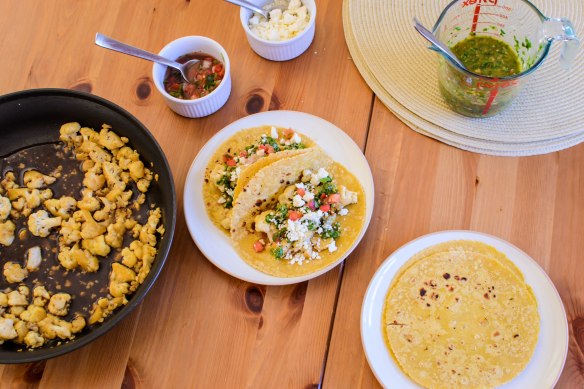
2016 Food Blog June-0946I had these tacos at a brewery restaurant in Venice, just on the other side of Highway 1. We’ve done cauliflower in tacos before, but that was a wintry dish. This one, with bright, sharp chimichurri sauce and briny crumbles of feta, is all summer.
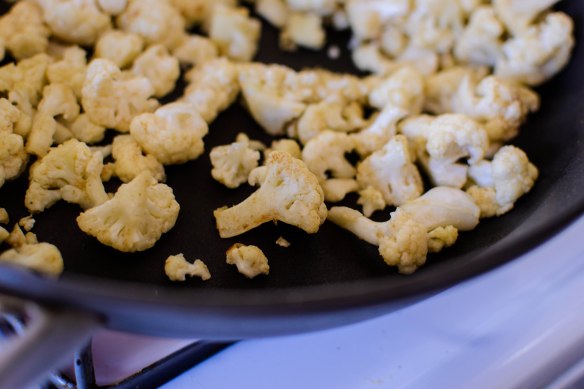
2016 Food Blog June-0964As many breweries do, this one tries to use their beers in their food as well as in pint glasses, which makes a lot of sense. A glug or two of dark beer into a cheese sauce is perfect, and braising everything from beef to cauliflower in a simmer of ale rather than red wine just fits the venue.

2016 Food Blog June-0972I suppose in this instance, braising isn’t quite accurate – a braise is a long, slow cook in liquid, and here the beer deglazes the pan and then simmers just until the cauliflower florets are tender – but the name sounds nice, doesn’t it? Anyway, the normally mild, sometimes musty vegetable picks up some color and char from a very hot skillet, then sucks in some of the nutty bitterness of whatever beer you pour, sputtering and steaming, into the pan with it. It’s not quite the same depth and richness as roasted cauliflower, but a lighter incarnation that is a bit less sweet.
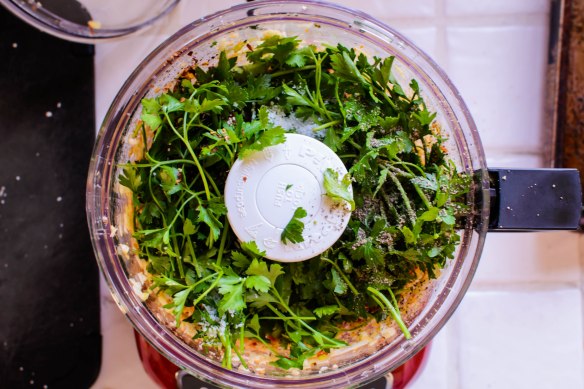
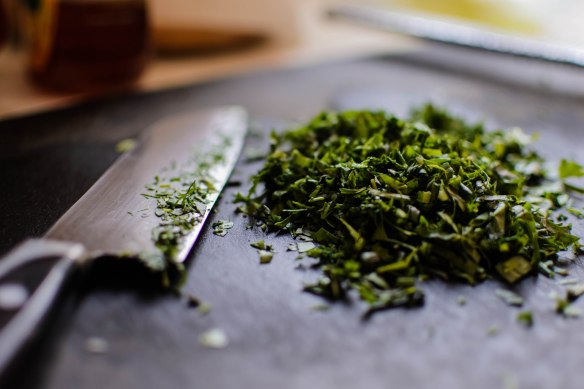
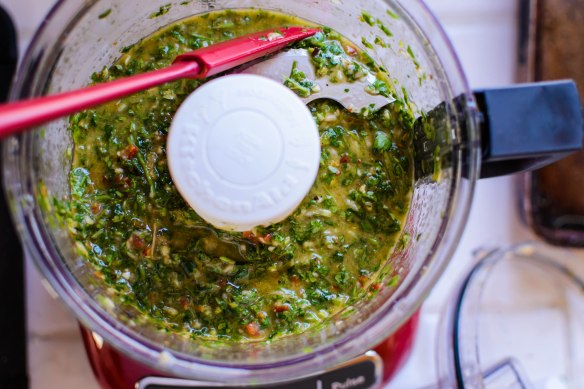
2016 Food Blog June-0958Once you pile the florets up into a nicely toasted tortilla, you spoon on some chimichurri sauce, a bright, Argentinian answer to pesto, possibly of Basque origin, that is traditionally used to both marinate and top grilled meat. It’s usually dominated by parsley, though sometimes cilantro and oregano make appearances, and gets its sharpness from raw garlic and a healthy dose of vinegar. Mine starts out traditional and then tempers the tang with red wine vinegar, rather than straight white, and sneaks in a bit of sundried tomato and green onion (though you could also use shallot) for a sauce that would make an equally good salad dressing, if you have some substantial greens laying around that need a kick. My version also uses much less oil than some, so feel free to glug in a bit more if you want a looser sauce.
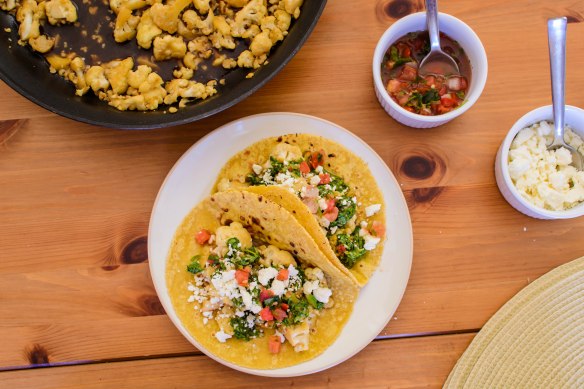
2016 Food Blog June-0963A few crumbles of feta on top of the veg, and you’re ready to serve. And if you’re really feeling the beer-y flavor, perhaps a side of these black beans. Hit it, summer.
2016 Food Blog June-0976

Beer Braised Cauliflower Tacos with Chimichurri
Makes 1 cup chimichurri, and enough cauliflower for 4-6 tacos
About 30 minutes
For chimichurri sauce:
3-5 garlic cloves, peeled
2 tablespoons shallot or the whites of green onions
1 tablespoon oil-packed sundried tomato, drained
¾ cup packed parsley, stems and all
2 tablespoons cilantro, stems and all
½ teaspoon salt
½ teaspoon black pepper
½ teaspoon red pepper flakes
5 tablespoons (¼ cup + 1 tablespoon) red wine vinegar
⅓ cup vegetable or olive oil
For cauliflower tacos:
1 large head cauliflower, cut into bite-size florets
1 teaspoon salt
1 teaspoon ground cumin
2-3 tablespoons olive oil
12 ounces dark beer
soft corn tortillas, lightly grilled or toasted over an open flame
crumbled feta cheese, to serve
pico de gallo, to serve (optional)
additional cilantro, to serve (optional)


  • To make the chimichurri, blitz the garlic, onion or shallot, and sundried tomato in a food processor until the ingredients are well broken up. This ensures no large chunks of garlic in the final product. Then, pack in the parsley, cilantro, salt, black and red pepper, and vinegar, and pulse the food processor 2 or 3 times at 1-second intervals. Finally, drizzle in the oil and pulse again, 2 or 3 times at 1-second intervals, until everything is well chopped, but not so long that a fully emulsified paste is created. We are looking for the mixture to retain some texture. Set aside until ready to serve.
  • In a large bowl, toss the cauliflower with the 1 teaspoon salt, the cumin, and the 2-3 tablespoons olive oil. Preheat a large skillet or a grill pan over medium-high to high heat and, when it is quite hot, tumble in the oiled, seasoned cauliflower. It will sizzle tremendously.
  • Char the cauliflower on all sides – you are looking for dark bronzed marks on the outside, but not to cook it through – this should take 3-4 minutes.
  • Deglaze with the beer by adding it all at once and stirring gently. Turn the heat down to medium-low and cook until the florets are tender but still have some texture; about 5 minutes.
  • To serve, use a slotted spoon to pile up about ¼ cup of florets in each tortilla. Spoon over a few teaspoons of chimichurri, then a few teaspoons of crumbled feta. Add pico de gallo and a few extra cilantro leaves if desired, and serve immediately.

The Rachel: lamb sausage and spinach pesto pizza

2016 Food Blog June-0945A few weeks ago, N. opened the fridge, snooped through the shelves, looked at me. “What’s for pizza? Wait. I mean, what’s for dinner?” Sometimes you don’t have to ask them what they’re craving.

2016 Food Blog June-0915Clearly, the following week I made pizza. We each have a favorite variety – though lately my favorite is becoming N’s favorite as well – and we’ve lent our names to them; whenever I write “The Chelsea” on the weekly meal plan, N. gets quite excited. This got me thinking about what toppings would constitute other members of my family. “The Dad” would certainly have red pepper flakes in some quantity, and my mom informed me on Sunday that hers would have plenty of vegetables.

2016 Food Blog June-0917But I decided to go first with my sister, and that meant lamb. I’m not sure whether it outweighs her affection for seafood, but lamb is certainly her red meat of choice. She stalks the meat counter to find it on sale; she buys the toughest cuts (often the cheapest) and grinds them up herself to make lamb burgers; she manufactures ways to integrate it into even traditionally vegetarian dishes. R’s pizza, then, would feature lamb sausage.

2016 Food Blog June-0918Once lamb sausage was on the menu, and some crumblings of feta had joined it in my imagination, I realized there was no way of avoiding a very Mediterranean flavor profile. Neither R. nor I are particularly interested in tomato-based sauces for pizza – “The Chelsea” has only a brush of garlic infused olive oil over its surface – so there would need to be an alternative. I gravitated toward pesto, and despite R’s declaration that she is “devoted to basil,” she’s also a rather non-traditional person in an interesting and glorious way. Given that, a pesto on her pizza couldn’t very well be the standard, and since this pizza was already leaning in such a Greek direction, I had to reach for the spinach, and added some parsley, some sundried tomatoes, some lemon zest, in addition to the standard garlic and pine nuts.

2016 Food Blog June-0925Considering other personality features, I decided to add some heat. R. is a spicy person: she’s quick, she’s feisty, she’s fun; she speaks her mind. Thinly sliced pepperoncini joined my collection of toppings, though some near-transparent wafers of jalapeno would also do the job.

2016 Food Blog June-0933When you construct “The Rachel,” you have some choices, and those choices depend on how much char you like on various ingredients. Obviously the pesto goes on first, in a generous layer. If you want your peppers and green onions to stay soft, they should be next, so they can hide out under the protective coating of mozzarella. If you prefer a bit of color on these greens, let them ride out the quarter hour in the oven right on top. I like to put the sausage underneath the mozzarella; since it’s already cooked, the cheese bubbling over it seems to prevent the meat from drying out.

2016 Food Blog June-0936Blistering hot from the oven, this was glorious. The lamb sausage I used was a merguez, which carries some heat of its own, so between that and the pepper slices the pizza was perfectly spicy. The spinach pesto is a solid base – not too aggressive in flavor on its own, just pleasant support for the well-spiced lamb and the briny feta. But interestingly (delightfully), the pizza came into its own as leftovers. When I unwrapped the remaining slices today in my office, door closed and light off as though I were getting away with something, the pizza had been out of the refrigerator long enough to come to room temperature, and though the cheese was no longer stretching into long strings and the crust had lost a bit of crispness, the flavors had come together so compellingly that I’d suggest doing one bit of advance planning: if you can, make the pesto a day in advance. Then, when you spread it thickly over the crust, it will already have had a day to slow dance in your refrigerator.

2016 Food Blog June-0943

The Rachel: lamb sausage and spinach pesto pizza
Makes one 12-14 inch pizza
16 ounces pizza dough of your choice
8 ounces lamb sausage (I used a nice, spicy merguez)
2 tablespoons pine nuts
3 cloves garlic
zest of one lemon
¼ cup oil-packed sundried tomatoes, drained
6 green onions
6 ounces baby spinach leaves
½ cup parsley leaves and stems
2 teaspoons lemon juice
1-3 tablespoons olive oil
salt and pepper to taste
8-12 ounces whole milk mozzarella cheese, grated
3 ounces crumbled feta cheese
3-4 pepperoncini or other pickled peppers
*Note: if possible, I recommend making your pesto a day ahead so the flavors have time to meld. Otherwise, proceed as below.


  • About 45 minutes before you are ready to cook the pizza, preheat your oven to 500F, or as high as it will go. If you are using a pizza stone (highly recommended), be sure to put it in the oven at this point to preheat as well. If your pizza dough is refrigerated or needs time to rise and relax, this is a good time to set it out as well.
  • Cook the lamb sausage in a medium skillet over medium heat. Use the flat edge of a wooden spatula to coerce the lamb into small pieces. Stir and flip frequently until cooked through and lightly browned, then set aside to cool.
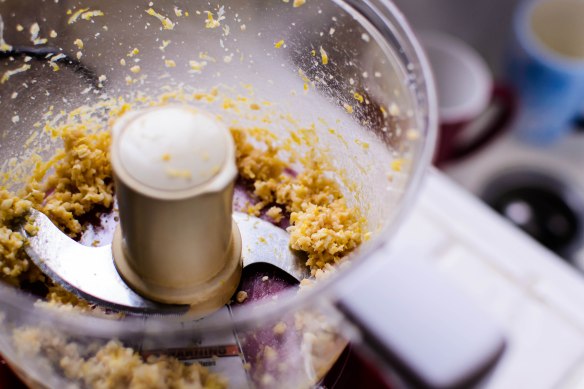
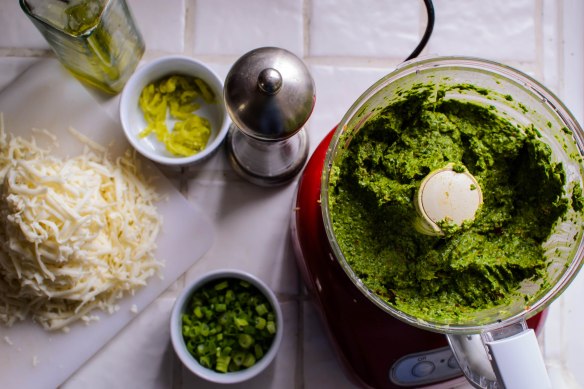
  • For the pesto, add the pine nuts and garlic to a food processor along with the sundried tomatoes, lemon zest, and the white and light green portions of the green onions, reserving the green stalks until later. Process for 4-5 seconds to break down the big chunks of vegetables. Pack in the spinach and parsley and process again, agitating the machine a bit to try and coax the leaves down into the blade. When it is simply not making any progress, add the lemon juice and 1 tablespoon of the olive oil with the machine running. If that’s not enough liquid, add the remaining tablespoons of olive oil one at a time, pausing between each. You are looking for a very thick, paste-like “sauce” – the less moisture we add to the top of the pizza, the better. If things still aren’t coming together after all 3 tablespoons of oil, add a splash of water, but try to keep this to an absolute minimum.
  • Once the pesto is a thick but spreadable texture, taste and season with salt and pepper accordingly. I suggest under-seasoning a bit with the salt, since the feta cheese is quite salty.
  • Slice the greens of the green onions and the pepperoncinis into thin slices.
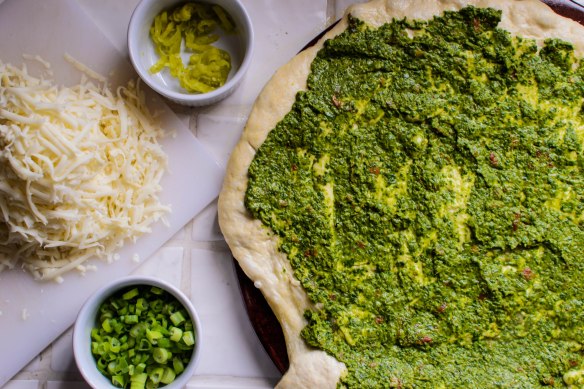
  • To assemble your pizza, stretch out the dough to your desired size (I put it carefully right onto the hot pizza stone), then spread generously with the spinach and parsley pesto. Add the remaining ingredients above or below the mozzarella cheese depending upon how browned you want them to get. I suggest lamb sausage underneath, to keep it moist, then the two types of cheese, then green onion and pepperoncini slices.
  • Carefully maneuver the loaded pizza back into the roaring hot oven, and bake for 15 minutes until the crust is crisp and the cheese is nicely studded with golden blisters. Remove from oven and let sit 4-5 minutes. Then sprinkle with additional parsley leaves if desired, slice, and serve.

Rain check

If all goes as planned, I’ll have a recipe for you tomorrow morning.

This is more a pizza-crust promise than a pie-crust promise, but I’ll leave you to knead your way through the details, and this teaser place-holder, while I try to carve out a few minutes for a post…

See you then!

2016 Food Blog June-0945

Grilled Zucchini and Corn Salad

2016 Food Blog June-0899As you can no doubt discern from the dead giveaway of two grilled corn dishes in three weeks, I’m itching for summer. Southern California has dipped into its customary “June gloom,” a period of several weeks that I adore, because the marine layer keeps my morning cool enough for a comfortable dog walk, for a bit of gardening, sometimes even for a (gasp) sweater while I sip a cup of tea. And this would, under normal circumstances, be a satisfying start to summer.

2016 Food Blog June-0877But for the first time in a few years, I’m teaching a summer course. It only lasts six weeks, and so far they are engaged and have made me think new things about some of the stories we’ve read – always a wonderful thing for an English professor. Yet still, upon arriving home this past Thursday afternoon, the end of my initial week with the class, I realized I had to go back on Monday, when all I wanted was grilled food and maybe a beer on the back porch, and certainly not to craft a lecture on Frankenstein.

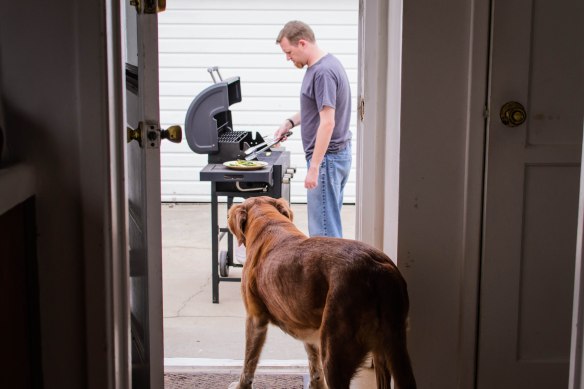
2016 Food Blog June-0884Since only two of these desires can be realized (Frankenstein must be attended to, whether I want to or not), I decided the grilled food should be as summery as possible. Some weeks ago I attempted a warm vegetable salad like this: corn and zucchini sautéed at high temperature and then doused with a sharp shower of lime, but the vegetables were disappointingly wilted. What they needed for the dish I’d envisioned was the grill.

2016 Food Blog June-08892016 Food Blog June-0890If you haven’t already investigated the trio that is corn, zucchini, and lime, I suggest you do so immediately. Zucchini is such a mild, grassy, vegetal taste, so a hit of acid wakes it up and makes it interesting again. It plays well with corn, which carries its own grassiness along with the starchy sweetness that we so prize. Both benefit tremendously from the savory char of a grill – that taste of fire we seem to cling to particularly as the weather warms outside. Michael Pollan has speculated that there’s something about the process of cooking – of submitting food to heat and to flame – that truly awakens our humanness. Grilling – that barely tamed version of fire as a cooking medium – is perfect for summer dishes, then, because it echoes the looser, easier, perhaps even more primal feel of the season. Besides, aside from, I don’t know, cheesecake or ice cream, I can think of few foods that don’t become better when cooked on an oiled grate over a bright flame.

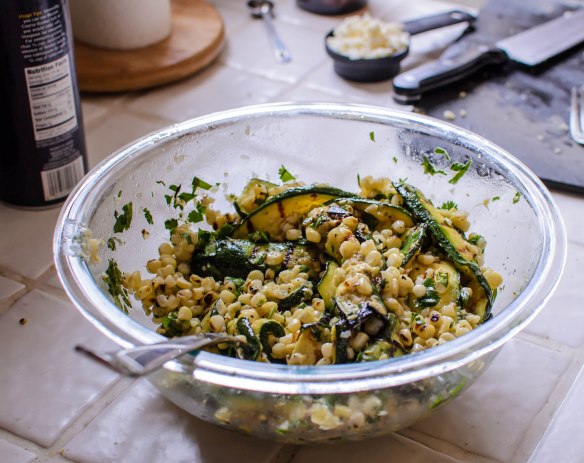
2016 Food Blog June-0887But in case you aren’t in love already with the summery ease and boost of flavor the grill imparts, dousing the still-warm veg in a dressing of lime, honey, and cilantro makes a sprightly side dish that needs only the crunch of toasted pumpkin seeds and the squeaky saltiness of crumbled cotija to complete it.

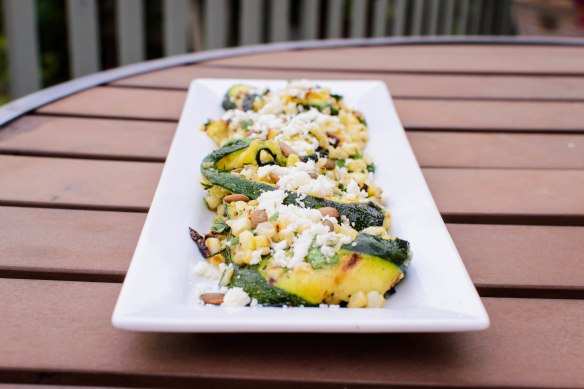
2016 Food Blog June-0892Because he’s nursing the same summer bug I am, N. wanted steak, so in addition to the vegetables he grilled a piece of sirloin flap.* As I played with presentation ideas, I realized the now-flexible planks of zucchini with their glorious char marks could be artfully arranged on a long platter, and the steak could be sliced thinly across the grain and draped over top, and I could have something that looked, well, like it came from somewhere a bit fancier than my backyard.

2016 Food Blog June-0903By the same token, though, the salad could simply be piled high on a plate, dusted with cheese and pumpkin seeds, and served alongside anything grilled, or perhaps spiced potatoes, or even wedged inside a tortilla as a quite respectable base for a vegetable taco.

2016 Food Blog June-0910* You should make this, too. I didn’t document it with any kind of precision, but I marinated the steak overnight in some dark beer, crushed garlic and coriander, and a bit of red pepper flake, then N grilled it for something like 3 minutes per side over the cooler side of the grill (ours has some hot spots), and rested it wrapped in aluminum foil for about five minutes to produce an incredibly tender, flavorful main course.


Grilled Zucchini and Corn Salad with Lime Vinaigrette
Serves 2-4 as a side dish
3 ears corn on the cob, husk and silk removed
4 medium zucchini, stem and flower ends removed
6 tablespoons olive oil, divided
1 teaspoon salt, divided
½ teaspoon pepper, divided
¼ cup pumpkin seeds
¼ cup lime juice from 1-2 limes
1 tablespoon honey
¼ cup chopped cilantro
¼ cup crumbled cotija cheese


  • Preheat a gas grill or a grill pan to high heat. While it warms, rub the corn with 2 tablespoons olive oil, ½ teaspoon salt, and ¼ teaspoon pepper. Grill the ears of corn over direct high heat for about 8 minutes, turning every minute or two, until the kernels are cooked and all sides are lightly charred. Remove and set aside until cool enough to handle.
  • While the corn cooks, prepare the zucchini: slice from stem to flower end into ¼ inch planks. In a large bowl, toss with remaining 4 tablespoons olive oil, ½ teaspoon salt, and ¼ teaspoon pepper. Lay out on grates or pan, being careful to keep them in a single layer, reserving any leftover oil in the bowl. Grill until cooked through and nicely marked, 2-3 minutes per side. Remove and set aside.
  • While vegetables are grilling, toast pumpkin seeds and mix dressing. Scatter pumpkin seeds in a small baking tray and cook in a 300F oven for 10-15 minutes. Seeds will take about 10 minutes if the oven is preheated, and more like 15 minutes if you forgot that whole preheating part. When they are browned and starting to crackle, take them out and set them aside.
  • To make the dressing, combine the lime juice, honey, and chopped cilantro in the bowl with the reserved olive oil from tossing the zucchini. Whisk well to combine.
  • When the corn is cool enough to handle, cut off the kernels by standing up the cob on your cutting board (you can use the stem to hold onto, if you’ve left it attached) and carefully cutting straight down the ear with a sharp knife, sawing the blade back and forth a bit to help loosen the kernels. When you get to the bottom of the ear, rotate the cob a half turn or so and cut again, repeating until you have removed all kernels. Some will be individual and some will come off in big chunks; that’s okay. The variety is nice.
  • Add the corn kernels and the grilled zucchini planks to the bowl with the dressing and toss to combine. To serve, either keep the vegetables in the bowl and offer the pumpkin seeds and cotija cheese for individual diners to add to their own portions, or arrange the vegetables on a square or long rectangular platter and sprinkle the seeds and cheese over the top.

Save

Apricot Goat Cheese Biscuits

2016 Food Blog May-0756One of my first big Sandra Lee-type triumphs in the kitchen was with biscuits. At the time, I was using Bisquick, and after a number of successful productions, I decided there was no reason I shouldn’t make the fluffy little drop biscuits more interesting by adding herbs, or green onions, or cheese, and then that my creations would probably be better with buttermilk rather than skim milk, and then at some point, with contributions from Mark Bittman and Michael Ruhlman, the Bisquick box disappeared altogether and the biscuits got fluffier, and higher, and packed densely with all kinds of interesting additions.

2016 Food Blog May-07262016 Food Blog May-0728There are probably enough biscuit recipes on this site – adding another seems superfluous. But they are so tasty, and so comforting, and so simple, and they accept additions that drive them into the realms of sweet or savory so well, that they keep popping up on my list of food ideas. This time, with half a bag of dried apricots in my pantry and a partial log of goat cheese in my fridge, there were no excuses for a special weekend breakfast.

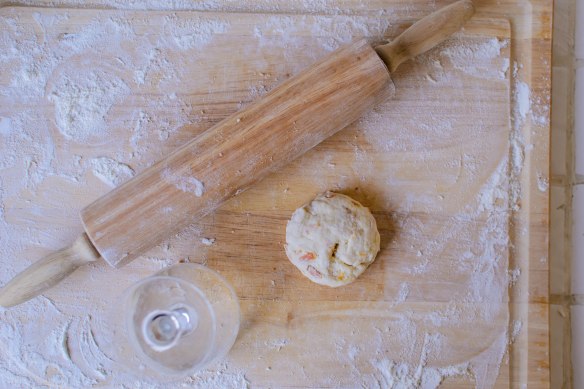
2016 Food Blog May-07332016 Food Blog May-07362016 Food Blog May-07382016 Food Blog May-0743Biscuits are a comforting baked item because they are easy. No yeast, so no long rise times or careful shaping or temperature concerns. No special flours or long ingredient list, and you don’t even have to have actual buttermilk to make buttermilk biscuits; you can just add a tablespoon of vinegar or lemon juice to regular milk, stir it up, and let it sit for two minutes, and you suddenly have perfectly serviceable “buttermilk” to work with. Mine are complicated just a tiny bit by a lazy-person’s adaptation of Michael Ruhlman’s method for lots of moist, fluffy layers, much like those beautifully sodden pillows from the can that you have to rap on the edge of the counter – you know what I mean – but this only entails a few extra folds and rolls of the dough before punching or cutting out your biscuit shapes.

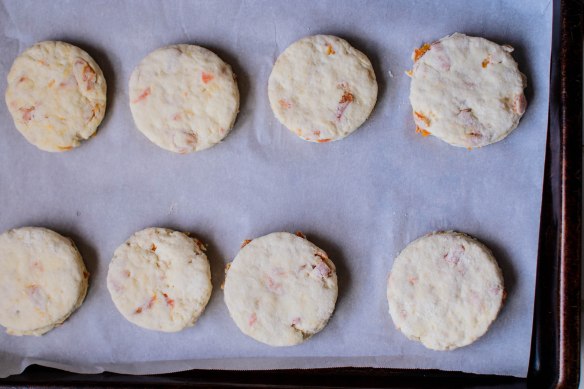
2016 Food Blog May-07482016 Food Blog May-07532016 Food Blog May-0750Most magical of all, biscuits survive freezing spectacularly. Once mixed and rolled and cut, you can stow them in the freezer overnight, which means hot, fresh, flaky biscuits for breakfast can be yours in just over twenty labor-free minutes – time easily used to start the coffee, or find your slippers, or get some Lou Reed going to groove breakfast to.
2016 Food Blog May-0761

Apricot and Goat Cheese Biscuits
Makes 10-12 biscuits (2-3 inch diameter)
2 cups all-purpose flour
1 teaspoon salt
1 tablespoon raw sugar (I use turbinado)
2 tablespoons baking powder
¾ cup chopped dried apricots (chop to your desired size – I like a mix of rough and fine)
6 tablespoons cold butter, cut into chunks
½ cup crumbled goat cheese
6 ounces cold buttermilk (or faux buttermilk: stir one tablespoon white vinegar or lemon juice into the milk and let it sit for 2 minutes before using)


  • Line a baking tray with parchment paper. If you are cooking the biscuits immediately, preheat the oven to 400F. If you are cooking the biscuits the next day, clear some space in your freezer.
  • In a medium bowl, whisk together the flour, salt, sugar, baking powder, and dried apricots until well combined. Tumble in the butter and the goat cheese and, with a pastry blender, a fork, or two knives (I’ve never mastered this method, though), work in the chunks until well distributed in small pebbly bits throughout the mixture.
  • Now, pour in the buttermilk and, using a fork, turn and mix and work until a clumpy, wet dough forms. Dump this out onto a well-floured board and, with lightly floured hands, work it into a ball.
  • Use your hands or a floured rolling pin to flatten the dough ball you’ve formed into a rectangle or oval about 1 inch thick. Then, fold up the flattened shape into thirds, turn it 90 degrees, and flatten again. Repeat this process of folding, turning, and flattening twice more. When the biscuits bake, they will rise high with lots of fluffy layers.
  • With your folded and flattened dough back at about 1 inch thick, punch out biscuit rounds by pushing a biscuit cutter or the lip of a glass straight down through the dough. Don’t twist! Twisting disrupts all the layers you’ve just made and the biscuits won’t rise as high or as evenly.

  • When you have punched out all the biscuits you can, gather the dough back together into a ball, knead gently once or twice, and then flatten out again and punch remaining biscuits. You should be able to get 10-12 out of this amount, depending on the diameter of your cutting tool.
  • Space your punched-out biscuits at least half an inch apart on your prepared baking sheet. If you are baking immediately, place the loaded tray into your preheated oven and bake for 12-14 minutes, until the biscuits are just golden on top. If you are waiting, shove the tray straight into your freezer. The next morning (or whenever you need freshly baked biscuits), remove the tray from the freezer, preheat the oven to 400F, and bake for 18-20 minutes. There’s no need to defrost first – the extra time in the oven will do the job.
  • Either way, serve steaming. We like ours with butter and honey.

Grilled Corn and Radish Herb Salad

2016 Food Blog May-0711When Corin Tucker, one of the vocalists of the musical group Sleater Kinney, released her first solo album after the band’s separation in 2006, she described in song how losing the band in some respects meant losing her vision of music and composition as well – she “stood frozen for so long,” and the silence felt like 1,000 years. To me, the song resonates with all kinds of creativity blocks. Every once in a while, when I think about writing here, I feel frozen – not just cold feet, but cold hands and stiff fingers and icicles in my brain – a sensation of writer’s block that extends to my enthusiasm for cooking itself. Broken off from my usual schedule, and with all but one stack of final papers graded and recorded and filed* in hopes students will return in the fall to pick up their work, you would think I would be panting for the kitchen and the refreshing feeling of absolutely zero comma splices or missing thesis statements to worry about.

2016 Food Blog May-06782016 Food Blog May-0679Instead I feel immobilized by a combination of exhaustion, puritan work ethic, and plain old laziness: if I’m not doing schoolwork, I should feel guilty, but I’m too tired to grade anything else. The kitchen, then, becomes a strange zone of misdirected productivity, and the couch and TV are just so friendly…

2016 Food Blog May-06892016 Food Blog May-0696But I should enjoy the sliver of summer I’m allotted (I’m teaching a session of summer school this year), so if I have to force myself, the gateway drug is corn on the cob. Corn speaks summer in ways few other vegetables do. Tomatoes, of course, but they typically show up a little later in the season, at least the massive spurting heirlooms I’m most interested in. Zucchini is a late summer crop – an overload that reminds you the last few weeks are approaching. Corn is sweet and juicy and plays so well with others. Raw, it has a kind of grassy starchiness, and of course the classic boiled or steamed cob works so well with butter and plenty of salt. For the past few years, though, my favorite way to eat corn is from the grill. Rubbed with olive oil, salt, and pepper and roasted all huskless, it blisters and crusts, and the sweetness we’ve bred into those kernels deepens into a toasty richness that reminds me vaguely of popcorn.

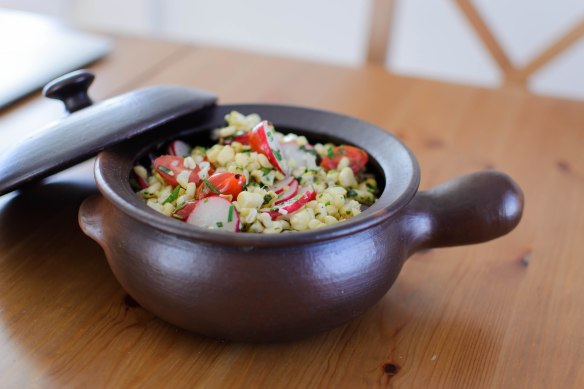
2016 Food Blog May-07012016 Food Blog May-0702For this dish, I was after a kind of warm salad, and thought the cold, peppery bite of radishes would work amazingly well with corn, especially doused with assertive lime vinaigrette. Both Food and Wine and Martha Stewart make a jalapeno dressing for this combination. I didn’t want spicy, but I did want to amp flavor, which I did with a bumper crop of added herbs: parsley, dill, chives, even some basil, to play with the flavors of the vegetables and contribute a different kind of sharpness to the dressing. For color and for fun, I added a handful of cherry tomatoes. You could also toss in some baby arugula or chunks of avocado.

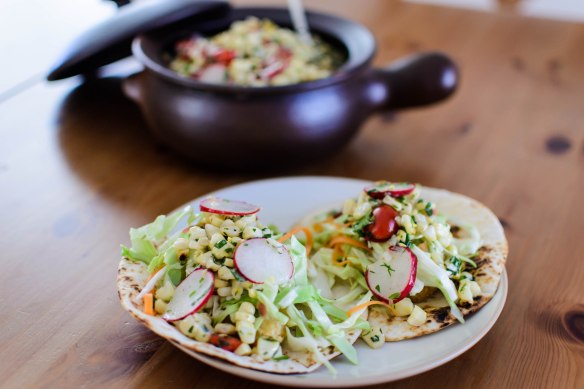
2016 Food Blog May-0704We ate this with fish tacos, but it would be equally good with grilled meat of any variety, really, as well as a nice, lighter side salad option at a picnic or barbecue. A crisp white wine, especially with a touch of effervescence, would pair well.

Bring on the summer, then. I’m ready to thaw.

2016 Food Blog May-0721* well, in a carefully shoved stack on the back corner of my desk

2016 Food Blog May-0720

Grilled Corn and Radish Herb Salad
Serves 4-6
4 ears corn on the cob
4 tablespoons olive oil, divided
salt and pepper, to taste
juice of 1-2 limes
1-2 teaspoons honey
½ cup mixed chopped soft-stemmed herbs, such as parsley, dill, basil, chives, or cilantro
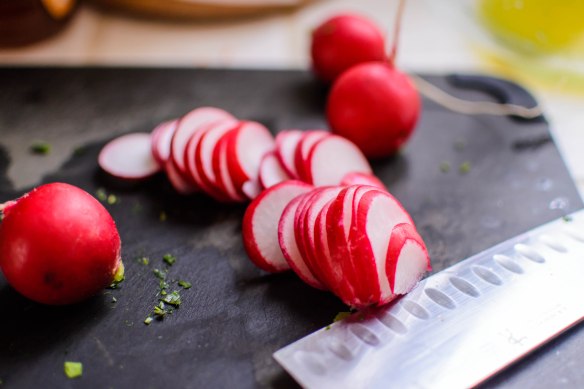
6-8 large red radishes, tops and tails removed, thinly sliced
4 ounces cherry tomatoes, halved
(1-2 ounces baby arugula, optional)
(1 avocado, cut in cubes, optional)


  • Preheat a gas grill or grill pan over medium high heat. While you wait, shuck the corn, removing the husk and as much silk as possible, but leave on the stem, as this will make for easier kernel removal. Rub the ears with 1 tablespoon of the olive oil and sprinkle liberally with salt and pepper. Place on the preheated grill and cook for about 8 minutes total, turning every two minutes or so, until the corn is fully cooked and has a healthy golden brown char.
  • Set the corn aside until it is cool enough to handle. Meanwhile, in a large bowl, whisk the lime juice with the honey and the remaining 3 tablespoons of olive oil. Add in the mixed chopped herbs and whisk well to incorporate.
  • When the corn has cooled enough that it won’t toast your fingers, cut off the kernels by standing up the cob on your cutting board (you can use the stem to hold onto, if you’ve left it attached) and carefully cutting straight down the ear with a sharp knife, sawing the blade back and forth a bit to help loosen the kernels. When you get to the bottom of the ear, rotate the cob a half turn or so and cut again, repeating until you have removed all kernels. Some will be individual and some will come off in big chunks; that’s okay. The variety is nice.
  • Add the corn, the sliced radishes, and the halved cherry tomatoes to the bowl with the dressing and herbs, and toss well to combine and distribute. The herbs will sometimes clump together; be sure to mix well so they – and the dressing – coat the other vegetables evenly. Taste for seasoning and add additional salt and pepper if desired.
  • If you are using arugula and/or avocado, add these as well and toss gently to avoid breaking up these delicate ingredients too much.
  • Serve warm or at room temperature with a grilled main.