 I’m not sure whether it’s a blessing or a curse that, as the semester picks up, this recipe happens to fill both of my current projects for the month of March: the Twelve Loaves assignment, and my own search term theme. It’s a blessing, in that it’s only one loaf that needs to be baked, which is certainly all I can handle in one weekend. It’s a curse, in that it means I have to come up with something else to make this month, since combining these two leaves an extra week out in the open.
 Still, though, it’s fortuitous in an utterly delicious way that these work together. The Twelve Loaves theme for the month is “Irish Breads,” and last year someone found my little site searching for “Irish bread with plums.” Aside from soda bread, the standard go-to Irish loaf, I knew nothing about Irish breads at all. Well, I suppose I knew about scones, but those are really British Isles in general to me, and not as specific to Ireland as I wanted to get.
 After a little research, I hit upon barmbrack, or barm braec. In Gaelic, “braec” means speckled, and so this lovely rich bread is threaded through with dried fruit. Usually the speckles are raisins and sultanas (or golden raisins, as we somewhat unimaginatively call them in the U.S.). This seemed, though, like a perfect place to add the requisite plums from the search. They would need to be dried, both because it’s not stone fruit season yet and because the moisture levels of fresh plums would make the bread too wet. Still, though, chopped prunes along with the traditional raisin component seemed promising. I love prunes, with their rich, concentrated flavor and their dense, almost meaty texture, but they don’t often find their way into baked goods, which I think is a shame.*
 Barmbrack can be made both as a yeasted loaf and as a simple round raised with baking soda. I decided on yeast, since sometimes I find soda breads a bit too dense for my taste. Since this was already going to be weighed down by the fruit, I wanted to give it a good bit of lift. In either case, it’s usually a holiday bread celebrating the harvest season, and there are sometimes small treasures like rings or coins baked into it as part of a fortune-telling game (I must admit I skipped this part).
 I surveyed a number of recipes, and finally combined two with features I liked. Interestingly, this bread is often made with tea: the dried fruits, and sometimes candied or fresh citrus zest, are soaked in strong black tea for a few hours, or even overnight, before being kneaded into the spiced, slightly enriched dough. I didn’t have any Irish Breakfast Tea, so I gritted my teeth and chose between Earl Grey and English Breakfast. In the end, I went with the Earl Grey. I realize the reference to British politics and aristocracy might ruffle some feathers, but at least it didn’t outright have the word “English” in the name. In any case, do forgive me, and use proper Irish tea for your loaf.
 Because there is a lot of moisture from the fruit in this loaf, you can expect a quite sticky dough. Don’t be afraid of it, though; just add some more flour to your board and knead away. You’ll be rewarded, after two rises and the better part of an hour in a hot oven, with a deeply browned loaf studded with a rubble of raisins and prune pieces, moist and richly chewy, but with a firm and almost crackly crust. Because it is baked in a round cake pan, it rises with a glorious even dome, and just around the edge where the loaf leaves the pan, there’s a curiously lovely pale golden stretch mark encircling the bread.
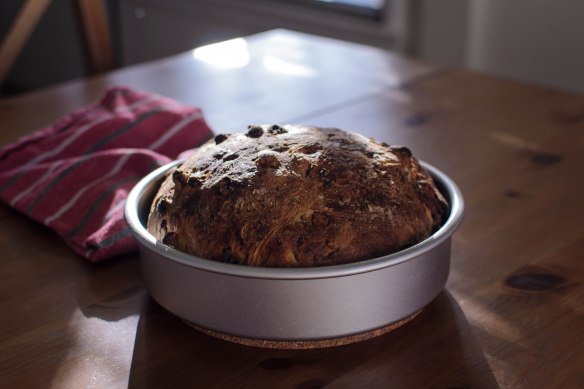 The Saveur recipe I borrowed from suggests, as the end of the baking time nears, brushing the top of the loaf with warm honey and then baking for an additional two minutes. I did not do this, in both an effort avoid too much sweetness and to maintain its lovely crusty exterior. If you should want to, though, they recommend ⅓ cup.
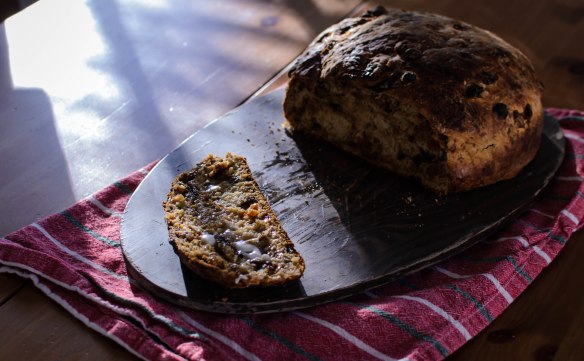
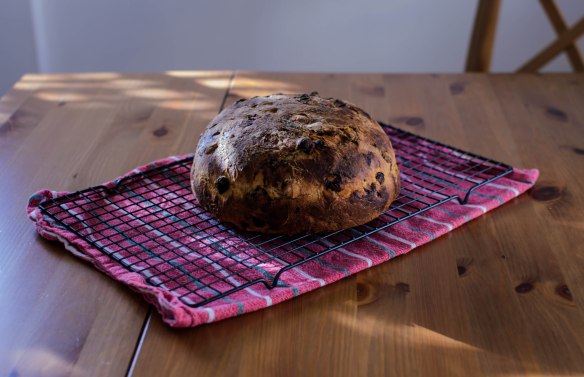 Despite wolfing down a thick slice the day I baked it, N. has since forgotten about this homely little loaf, and I haven’t bothered to remind him, because that means more for me. Even after a few days wrapped in aluminum foil, the interior remains moist and rich but not too dense, and the outside stays perfectly crusty – a rugged, deeply browned layer that I’ve tried all week to think of ways to describe. “Imagine if a brown paper bag were a crust,” I said to N. at one point, but we agreed that didn’t sound particularly delicious. “Perfectly crusty” remains the best thing I can come up with, and you’ll have to believe me that it’s part of what makes the loaf worth hoarding. Perfect still warm from the oven, great at room temperature, and glorious toasted, this is good plain but revelatory with a thick pat of salted butter and, obviously, a cup of tea.
 * if you aren’t a prune fan, you can stick with the traditional raisins and sultanas, or test out other dried fruit options: currants would be great here, and dried cranberries or dried cherries might also be good. Dried apricots also sound promising to me along with the sultanas, provided they were quite finely chopped. Perhaps a dollop of clotted cream or even mascarpone cheese over the top of the slice wouldn’t go amiss.
Prune and Sultana Barm Brack
Makes one 8-inch round loaf
About 5½ hours, including steeping and rising time, or overnight
2 cups strong black tea (I used 2 tea bags)
¾ cups chopped prunes (dried plums)
¾ cups sultanas (golden raisins)
2 tablespoons each orange and lemon zest, plain or candied
¼ cup whole milk, warm or at room temperature
2 teaspoons active dry yeast
2-2½ cups bread flour
1 teaspoon salt
¼ cup light brown sugar
½ teaspoon ground cinnamon
¼ teaspoon ground nutmeg
¼ teaspoon ground cloves
8 tablespoons softened unsalted butter, divided
1 egg
(optional: ⅓ cup honey, warmed, to brush over the loaf)
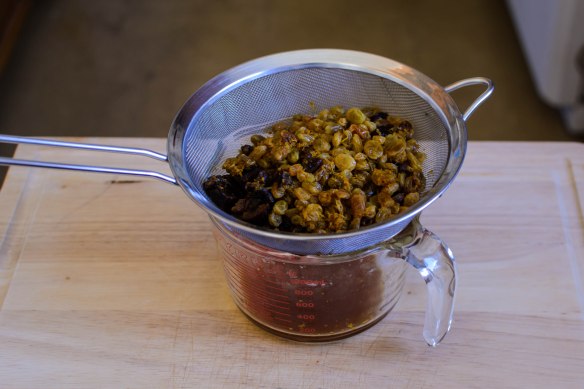
- In a medium glass bowl (I used my 4-cup measuring cup), pour 2 cups of boiling water over 2 teabags and let steep for 4-5 minutes. Add the chopped prunes, the raisins, and the mixed zest, and let soak for at least 2 hours, or as long as overnight. When you are ready to make the dough, drain the fruit and zest in a strainer, but reserve the soaking liquid.
- Meanwhile, sprinkle the 2 teaspoons active dry yeast and a pinch of sugar over the warmed milk and let sit for 5-10 minutes until the yeast fizzes and foams up. Mine raised quite a dome.
- While you wait for the yeast, combine 2 cups of flour, the salt, the brown sugar, the cinnamon, the nutmeg, and the cloves in the bowl of a stand mixer, or another large bowl.
- When the yeast is foamy, add the egg and mix briefly, then pour into the dry ingredients, add 6 tablespoons of the softened butter, and mix with the paddle attachment to bring together. Mine was a bit crumbly at this point.
- Switch to the dough hook and knead at medium speed for 5-7 minutes until you have a smooth but slightly sticky dough. If the dough seems too dry and is just not coming together, add a tablespoon or two of the reserved tea. If it gets too wet, add flour a tablespoon or two at a time until it is a workable consistency.
- When your dough is smooth and elastic but still a bit sticky, turn it out onto a well-floured board (I’m not kidding). In three or four additions, knead the drained fruit into the dough. I tried this in the mixer bowl with the dough hook, but it made a huge mess. By hand with flour and a dough scraper nearby is the best strategy.
- With the fruit incorporated, form the dough into a loose ball and deposit it into a large bowl you’ve buttered with 1 tablespoon of the remaining softened butter. I used the stand mixer bowl; you don’t even have to rinse it out in between. Cover the bowl tightly with plastic wrap and set aside to rise for 1-1½ hours, until nearly doubled.
- Punch down the risen dough by depressing your fist gently into the center; the dough will spring back only slightly. Turn it out onto a floured board and knead lightly 2 or 3 times, then shape it into a tight ball and position it in an 8-inch cake pan, which you’ve buttered with the last remaining 1 tablespoon of softened butter. Drape lightly with plastic wrap and let rise another 30-60 minutes. Mine was ready to go in 45 minutes.
- About 30 minutes before you are ready to bake, preheat your oven to 400F with a rack in the middle position. When the loaf fills the pan and is nicely domed, remove the plastic wrap and carefully place in the oven to bake for 35-45 minutes, until the bottom sounds hollow when thumped, or an instant-read thermometer measures 180-200F.
- If you wish, now is the time to remove from the oven, brush on the ⅓ cup warm honey, and return to the oven to bake an additional 2 minutes. I skipped this because I wanted the crust to stay, well, crusty.
- Let cool in the cake pan at least 10 minutes, then turn out onto a wire rack to cool an additional 20 minutes before cutting into unapologetically thick slices, slicking thickly with butter, and eating alongside a strong cup of tea.
#TwelveLoaves is a monthly bread baking party created by Lora from Cake Duchess and runs smoothly with the help of Heather of All Roads Lead to the Kitchen, and the rest of our fabulous bakers.
This month we are baking Irish Breads. For more bread recipes, visit the #TwelveLoaves Pinterest board, or check out last month’s inspiring selection of #TwelveLoaves RED Breads!
If you’d like to bake along with us this month, share your Irish Breads using hashtag #TwelveLoaves!
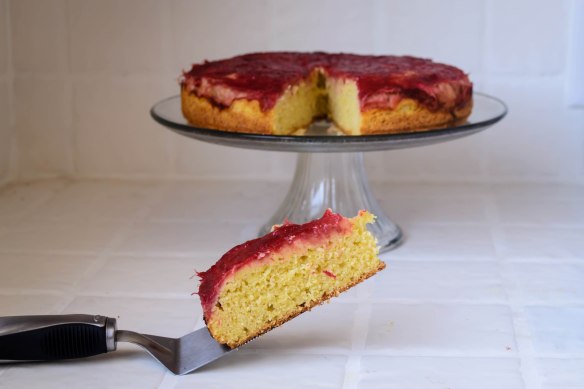
 Luckily the laptop is fine; I had the presence of mind to move it before I reached for my camera. And though the cake itself tastes great, there was a structural issue in addition to my own clumsiness that makes it not ready to share with you yet.







 "blackberry-eating in late September"