Project Cook: Fig Olive Stout Country Loaf

Well. I know it’s been a while, and I know Halloween is over, but here we are just one agonizing day away from a nation-altering election that promises to be either a trick or a treat. If you’re an American, I hope you’ve voted. It’s too late now to mail in your ballot, but you can still drop it off at an official collection station, and you can still go in person tomorrow.

This loaf, too, which I baked on Halloween, has elements of trick and treat. The inspiration came from a snack we had a few years ago at a local brewery: a fig and olive version of that perfect Trader Joe’s savory-sweet raincoat cracker, spread with brie, was perfect with our nearby Scholb Brewery’s then-on-tap Contemplation Porter. I dutifully recorded this as an idea for a loaf in my “blog ideas” file, and promptly forgot about it until a week or so ago, when I decided it was time to see what kind of crackly crust I could get baking in my dutch oven.

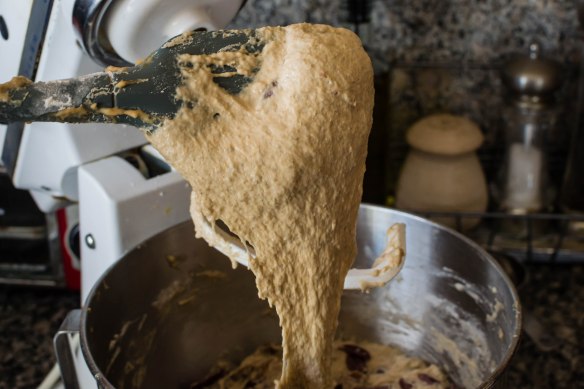
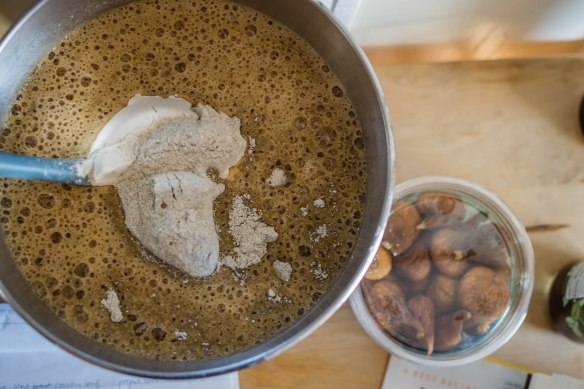
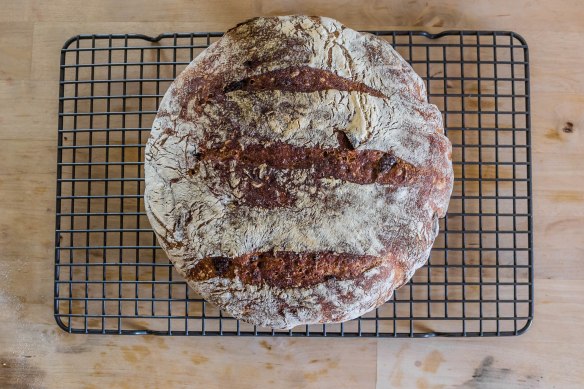
The treat is, of course, the sweet and savory combination, surprisingly good, of dried figs and briny kalamata olives. In a nod to its brewery muse, to help out the yeast and amp up the roasty flavors of the finished product I’ve used stout in the dough instead of water (but you could certainly sub water back in if you prefer). The final loaf is dense but still bouncy, with a lovely chewy interior and bursts of sweet and salt from the olives and figs. Baking in the dutch oven results in a wonderful crust – thin but still crisp, with none of the leathery heaviness a homemade boule can sometimes produce.
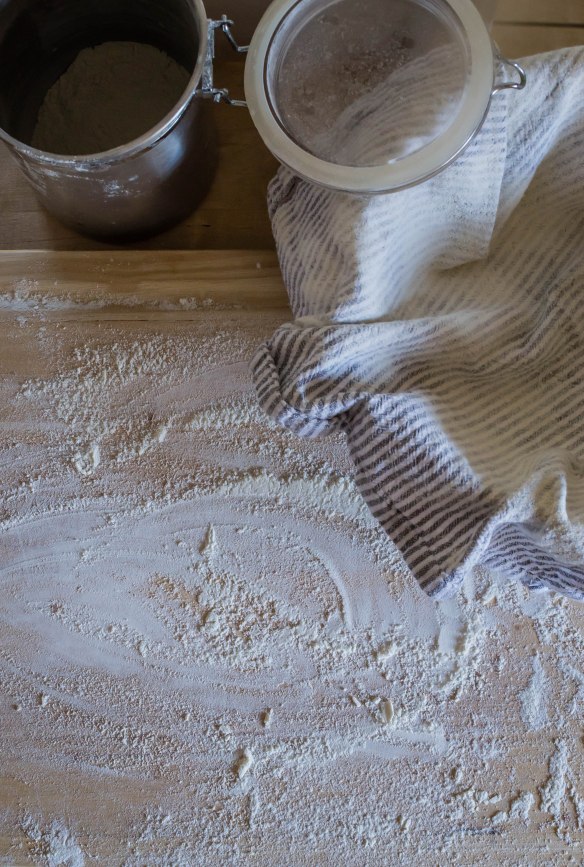
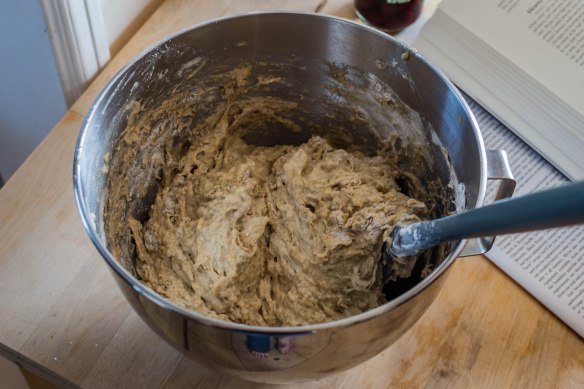
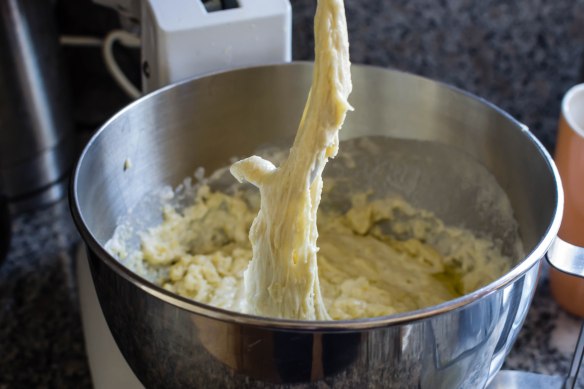
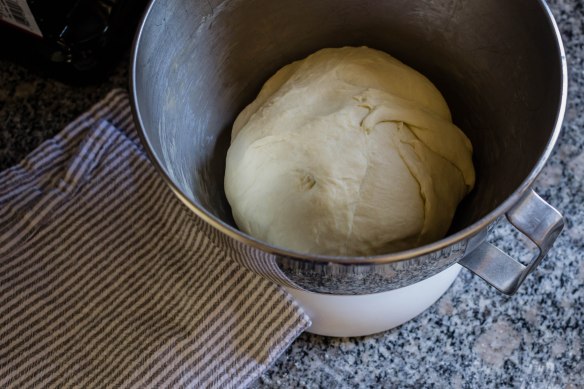
The trick came, at least for me, in the handling. I adapted this recipe from Baking Illustrated’s basic Country Loaf. It’s a wet dough from the outset, not one I’d want to attempt without my stand mixer – kneading by hand would be quite sticky. It starts with a biga or sponge for overnight rise (a biga, sponge, or poolish is a form of a leavening method that operates similarly to sourdough, except you offer a bit of yeast for the flour and water to start with and only allow it to work overnight so there’s no true sourness. Depending on how long it works and how active the yeast is, this can affect moisture levels). On top of that, I went and added more than a cup of fruit. This rendered the shaping and scoring all but impossible, yet I still somehow wound up with a nice boule, its crust flour-dusted like a good artisan loaf, such that you’d never know the first rise produced a worryingly floppy puddle of goo. You’ll notice there are no photographs of the folding and shaping procedure. That’s why.
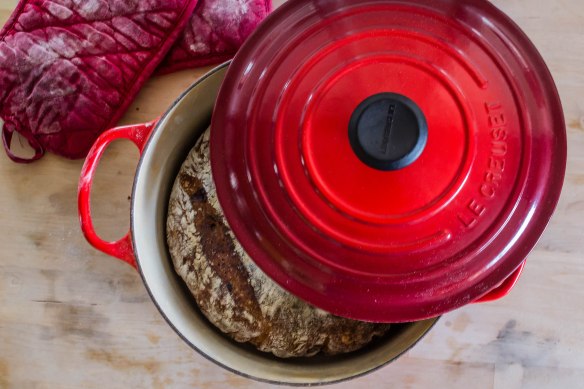
Lots of heaviness in this recipe – fruit aside, it also has a healthy dose of rye flour – means rising and baking take a good while, not to mention that whole starting the night before business. Baking Illustrated recommends a final internal temperature of a staggering 210F, and then you’ve got to twiddle your thumbs while it cools so the crumb structure inside can set up nicely. But accompanied by a pint of the same beer I used inside it, with a smear of triple cream brie on top, it was a late afternoon treat worth both the wait and the trickery.
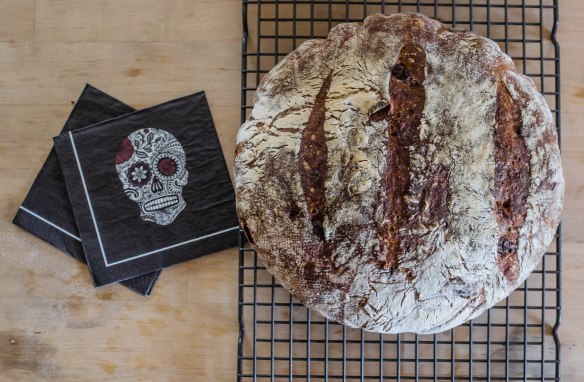
Fig Olive and Stout Country Loaf
Adapted from Baking Illustrated
This is a 2-day project: day 1 = about 20 minutes, plus overnight rise. Day 2 = about 6 hours, including rising times + 2 hours to cool
Makes one large, round loaf
Sponge/biga
½ teaspoon instant or active dry yeast
1 cup room temperature water
1 cup bread flour
1 cup whole wheat flour
Dough
3–3½ cups bread flour, plus plenty of bread flour or all-purpose flour for shaping
¾ cup rye flour
1⅓ cups room temperature stout or porter (or water)
2 tablespoons honey
2 teaspoons salt
½ cup quartered (if you’re feeling fussy) or coarsely chopped (if you’re not) kalamata olives, patted dry on a paper towel
¾ cup stemmed and sliced (again, if you want to fuss) or coarsely chopped (if you don’t) dried figs


  • The night before you bake the bread, stir together the biga/sponge ingredients in a large mixing bowl. I used the bowl of my stand mixer, since that’s where I made the dough. Cover with plastic wrap and leave overnight.
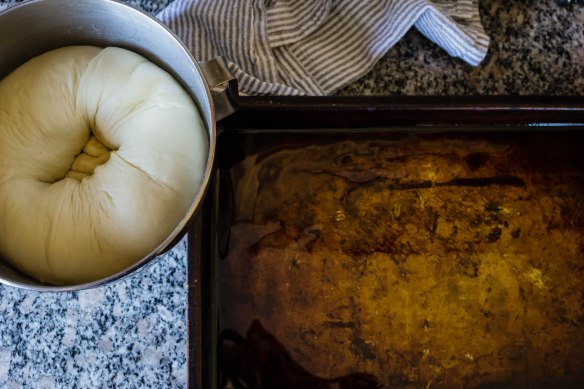
  • The next day, the biga should look bubbly and smell slightly fruity. Add 3 cups of the bread flour, all of the rye flour, the beer, and the honey, to the biga and stir it together with a rubber spatula. Switch to the dough hook of a stand mixer and knead on the lowest speed for 15 minutes, adding the salt, the olives, and the figs during the final 3 minutes. If the dough is extremely sloppy, add the remaining ½ cup bread flour 2 tablespoons at a time, until it reaches a consistency you feel more comfortable with. It should be smooth, but still fairly relaxed and sticky. Cover with plastic wrap and let rise until tripled, at least 2 hours.
  • To prepare for shaping, flour a surface extremely well. Line a baker’s brotform, a basket, or a colander with a heavily-floured square of muslin or linen (I used a linen napkin). Flour your hands too; this is going to be sticky.
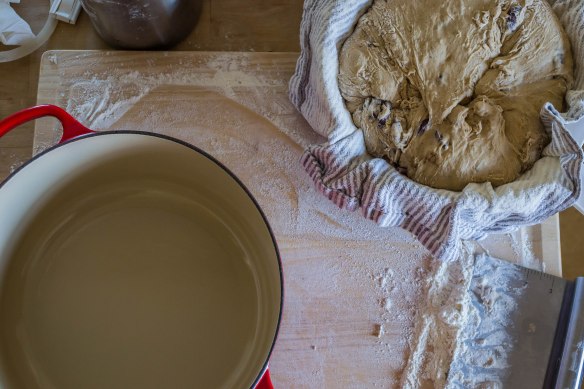
  • Turn out the dough onto the floured surface. If it’s anything like mine, it will puddle out somewhat distressingly. Be brave. Dust the top with flour, then lightly encourage it into a round by folding the edges of the dough into the middle from the top, right, bottom, and let, sequentially. Gather it loosely together. With the help of a bench scraper, if needed, transfer it quickly to your lined vessel, smooth-side down. Cover loosely with a large sheet of aluminum foil (we want the dough to be able to breathe a bit), and let it rise again until almost doubled in size, at least 45 minutes.
  • While the dough is rising, preheat the oven to 450F with a pizza stone or the bottom of a dutch oven on a rack in the middle position.
  • For baking on a pizza stone: place a small, empty baking pan on the bottom rack or the bottom of the oven, and prep 2 cups of water in an easy-to-pour container. Cover a pizza peel or the back of a large baking sheet with a large piece of parchment paper. Invert the risen dough onto the peel and remove the muslin or linen cloth carefully. Use a razor blade or very sharp knife to score the top of the dough. With scissors, trim the excess parchment until there is just an inch or so on all sides. Slide the dough, still on the parchment round, from the peel onto the preheated pizza stone, removing the peel with a quick backward jerk. Pour the 2 cups of water into the preheated pan at the bottom of the oven, being careful to avoid the steam, and close the oven door quickly. Bake until the internal temperature of the bread reaches 210F and the crust is very dark brown, 35-40 minutes.
  • For baking in a dutch oven: remove the preheated pot from the oven and set carefully on the stove. Place a large piece of parchment paper over the bottom of the dough in the colander. Hold the excess edges of the parchment and quickly, carefully invert so the round of dough drops directly into the dutch oven with the parchment underneath it. Don’t worry about the excess parchment edges. Use a razor blade or very sharp knife to score the top of the dough. Put the lid on and place the whole thing in the oven. Bake for 25 minutes with the lid on, then remove the lid and bake another 15-20 minutes, until the internal temperature of the bread reaches 210F and the crust is very dark brown.
  • For both methods: after the bread reaches an internal temperature of 210F, turn off the oven, open the door, and let the bread remain in the oven for 10 more minutes. Remove to a cooling rack and let it sit for at least two hours before slicing.
  • Serve with beer and creamy, spreadable cheese, or as desired.

Sourdough Soft Pretzels

I think it took me a little longer to fall into the sourdough-everything craze than it did some people, but that could be because I’ve been nurturing a little starter for some time now. Left with a bit of discard, though, from a (semi)weekly bake of my standard sourdough loaves, I decided to branch out from pancakes, and revisited the humble-but-stellar pretzel. Thus although I don’t have a clever or nostalgia-laced story to offer today, in an effort to get myself back into this blog-thing I supposedly have and considering that we mowed through the first batch of these in about twenty minutes and were already planning a second, they certainly seemed worth sharing!

I’m adapting two recipes here: one from King Arthur Baking Company (have you seen they’ve updated their name?!), and one from Smitten Kitchen, which she in turn adapted from Martha Stewart. The KAF (or, I guess, KABC?) recipe doesn’t include the traditional boiling step, moving their shaped dough straight into the oven after a single rise. I wanted the extra browning and chewy texture the baking soda boil offers (I have neither the materials nor the courage to use food grade lye… at least not yet…), so I used SK’s procedure for that part.

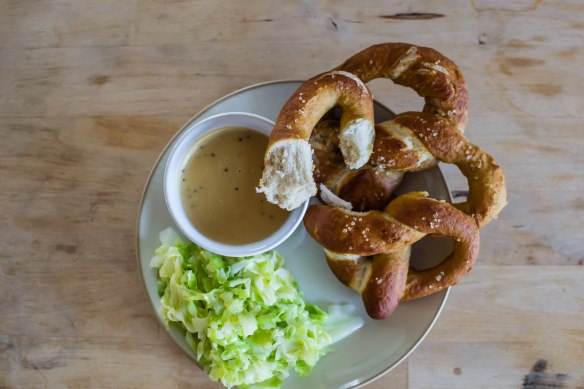
We had our half dozen chewy, slightly tangy results dunked in a beer cheese sauce – a simple, roux-thickened mix of stout, milk, mustard, and cheddar whisked into a smooth, thick cheese gravy,* and, in an attempt to be slightly virtuous, a side of sautéed cabbage.

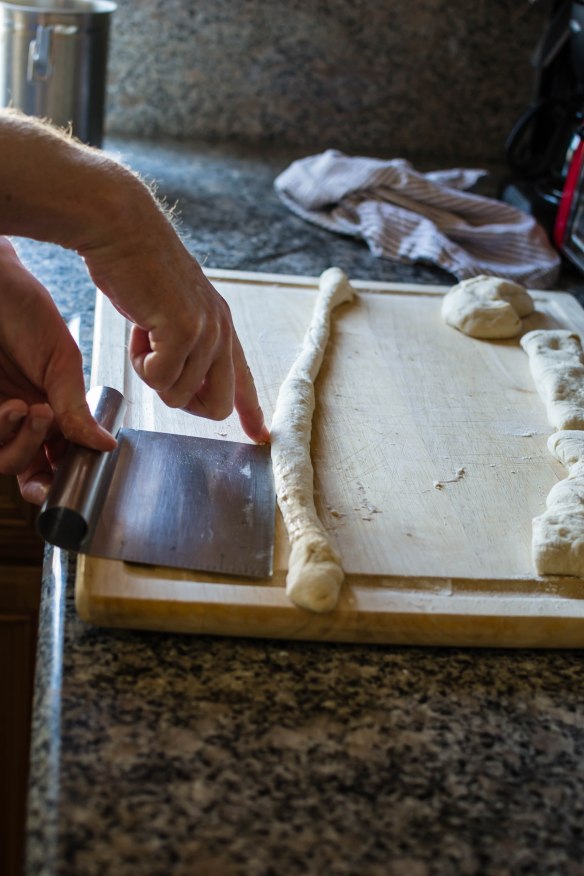
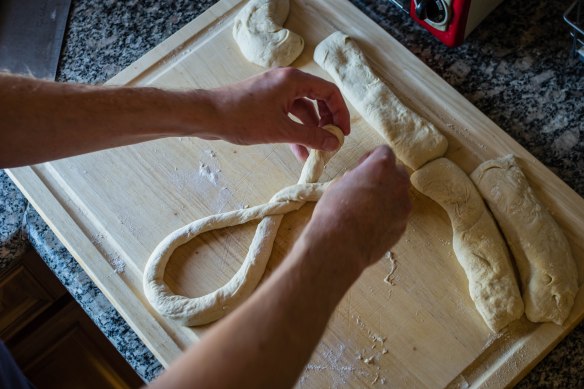
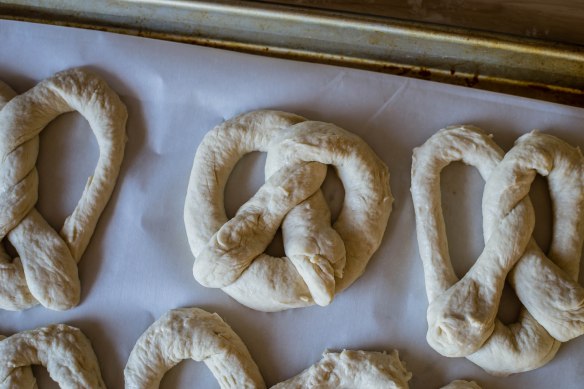
Enjoy the sequence of pretzel-shaping shots below, featuring N. as my arm-and-hand model (he was also very keen to perfect his technique, so even though I told him he only needed to shape one pretzel while I photographed, he did three of the half dozen we made that night before I pushed him aside – I wanted to play with dough ropes too!).

* cheese gravy sounds weird, I know. But this had more body than just a sauce; it clung thickly to the pretzels and could have made a great macaroni and cheese base. It didn’t have the right ingredients or flavors to be a queso (Tex-Mex) or a fondue (Swiss), so I’m going to embrace the weirdness. Cheese gravy it is.


Sourdough Soft Pretzels
Adapted from King Arthur Baking Company and Smitten Kitchen
Makes 12 (but easily halved; I’ve included quantities for both below)
2-3 hours (it will take longer to twist and boil 12 pretzels than it does for 6)


For 12:
¾ cup + 2 TB water
2 teaspoons active dry yeast
1 TB honey
1 cup sourdough starter, unfed / discard
3-3½ cups bread flour
¼ cup milk
1 TB butter
1½ teaspoons salt


For 6:
⅜ cup + 1 TB warm water
1 teaspoon active dry yeast
½ TB honey
½ cup sourdough starter, unfed / discard
1½-1¾ cups bread flour
2 TB milk
½ TB butter
¾ teaspoons salt


For the boil:
water to fill a 12-inch skillet
¼ cup baking soda
2 TB brown sugar


To bake:
Coarse salt or pretzel salt


  • Combine the yeast, warm water, and honey in a medium bowl (I used the bowl of my stand mixer). Let them sit for 5-10 minutes, until the mixture is bubbly and smells like bread. Add 1½ cups of the flour, and all of the sourdough starter, milk, butter, and salt.
  • Using the dough hook, knead into a smooth but slightly sticky dough; for me this took about 5 minutes on medium speed. If it really seems like it is too wet (too sticky), add the remaining ¼ cup of flour and knead at least 2 minutes longer.
  • Cover the dough and leave it to rest for 45 minutes, ideally in a warm place. It will only rise a little bit, so don’t be alarmed.
  • Line two baking sheets with parchment paper, then dump and pull your risen dough out onto a lightly floured board. Using a knife or a bench scraper, divide the dough into 12 even lumps (or 6 if you are making a half recipe).
  • Now the part that can seem intimidating: shaping the pretzels. Working with one piece of dough at a time, use your fingers and the palms of your hands to roll the lump or ball of dough into a long, even rope about 18 inches long. Above you can see N. measuring the one he’s working on. Note: too much flour on your board here is not a good thing. You don’t want the rope to stick (as you can see some of ours did), but you do need some friction or the dough will just slide around on the board instead of rolling and elongating.
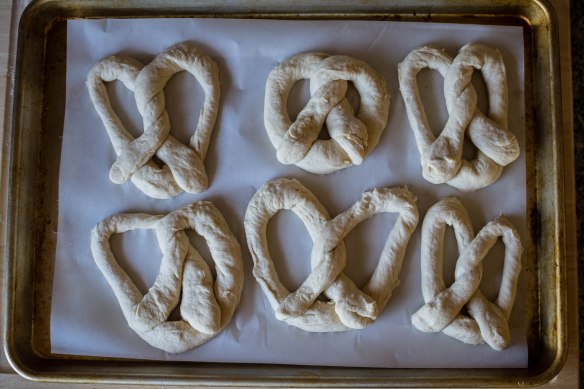
  • Drape the 18-inch rope into a U shape on your board. Holding each end between your thumb and forefinger, but leaving the bottom of the U on the board, gently cross the left side over the right side about 2 inches from each end. Repeat, again crossing the (new) left side over the (new) right side so you have two twists in your pretzel. Now, again holding one end in each thumb and forefinger, flip the ends down to the bottom of the U shape to form a pretzel. Pinch the points where they intersect with the U a little bit to keep them in place. Gently but quickly, relocate your shaped pretzel to one of the lined baking sheets. Repeat with the remaining dough.
  • When you have twisted all 12 (or all 6) pretzels into shape, stow them in the refrigerator for at least 30 minutes. This is a pretty soft dough, so plunging them right into the boil might result in disintegration.
  • While the pretzels chill, fill a 12-inch skillet about ¾ of the way with water and bring it to a boil. This is also a good time to preheat the oven to 350F, and to line an additional baking sheet with parchment paper.
  • After at least 30 minutes in the refrigerator, remove the tray(s) of pretzels and set them near the stovetop. Carefully, (carefully!), add the baking soda and brown sugar to the boiling water. There will be a lot of abrupt bubbling and fizzing! Stir gently to disperse and dissolve, then carefully add the pretzels 2 or 3 at a time. I find this should be done gently but with speed, to prevent the dough from stretching out of shape.
  • Let the pretzels boil in the bath for about 30 seconds, then use a strainer or spatula to flip. Boil another 30 seconds on the second side, then carefully, again using the strainer or spatula, remove the pretzels from the water and arrange them with space in between on the empty parchment lined baking sheet. Repeat with the remaining pretzels, letting the water come back to a boil between each batch. They won’t grow too much in the oven, but you don’t want to overcrowd them; I would suggest no more than 4 on each baking sheet unless they are very compact.
  • While the pretzels are still wet from the baking soda bath, sprinkle on some coarse salt or pretzel salt, then slide into the preheated oven and bake 25-30 minutes, until they are deeply golden and have a slightly crisp crust.
  • Remove from the oven and consume, with glee, as soon as they are cool enough to handle (or, if you’re me, a few minutes before that…).

Project Cook: Garden Focaccia

A garden path sentence is one in which the reader is misled, usually by a word or two that function(s) as a different part of speech than the reader expects, making the rest of the sentence seem incomplete or nonsensical when it is in fact grammatically correct. It takes its name from the idiom “to lead [someone] down the garden path”: essentially, to mislead or deceive them.

Here’s an example: “the old man the boat.” We initially see the phrase “the old man” and think that’s the subject of the sentence. Therefore, the ending “the boat” makes the sentence feel incomplete. But when we realize “man” is actually the verb and the subject is “the old,” suddenly it makes sense: this ship is being sailed by retirees.

Here’s another: “the horse raced past the barn fell.” Here, everything makes sense up until the last word if we’re reading the sentence with “the horse raced” as an active phrase. But it’s not, and it’s not the barn that fell either: the sense of the sentence only emerges if we understand what’s really being said is “the horse [that was] raced past the barn fell.”

Garden path sentences were introduced to me by one of my students a few years ago, and they blew my mind a little, but they shouldn’t have. Not only do I know full well as a student (and teacher) of words that sentences haven’t truly completed their meaning until their final punctuation mark is reached, but as a lover of food, I know that an expected direction, or perhaps being “led down the garden path” with an illusion or a twist, sometimes makes the dish that much more enjoyable.

It seems a bit cruel, perhaps, in a world in which the baking aisle of so many grocery stores has been ransacked, to show you a loaf of bread, but I was so taken with the images of decorated focaccias my Pinterest page was suddenly showing me, as taken as I was with the idea of garden path sentences, that here we are: a loaf literally studded with deceptive visuals, turning carefully placed herbs and vegetables into an edible flower garden.

I started with Anne Burrell’s recipe, making only the smallest of adjustments: she uses AP flour; I went with bread flour, reduced the olive oil a touch, and subbed in honey for the sugar used to start up the yeast. As for process, I added a step I’ve always done with my mom’s challah, letting the mixture – more batter than dough at that point – rest for 15-20 minutes after adding about half the flour. I think this gives a truer sense of how much flour is really needed, since the initial addition has a chance to start hydrating. It’s not 100% necessary, but I notice it means I wind up using a bit less flour overall, and that’s not a bad thing these days.

The real magic here – where we verge into complexity and deception – is during the rising: while the first rise is standard, letting the dough swell and double in a bowl, the second requires more unusual methods. You spread the risen dough out on an oil-drenched baking sheet (be sure yours has sides!), coaxing it with your fingers to spread reluctantly all the way into the corners. You press and stab your fingers all the way – all the way! – through the dough, making dozens of small holes straight down to the baking sheet below, to create that characteristic bubbled texture of a focaccia, before allowing it to rise again.

Halfway through this second rise comes the fun part – or the fiddly part, depending on who you are. Assorted herbs, thinly sliced vegetables and citrus zest, get pressed gently but firmly into the partially risen dough to form whatever patterns you desire. I used chives, parsley, and dill for “stems” and leaves, and then slender segments of olives and cherry tomatoes for “flowers,” and some curls of lemon zest for extra flair. I tried to roll a few tomato roses, but for me at least, cherry tomato skins provided not quite enough material to work with.

The finished loaf is quite the spectacle – the brightness of your “garden” fades a bit in the baking (there’s a metaphor here for spring into summer, perhaps), but the bake isn’t quite long enough for the delicate herb stems and leaves to burn – instead they crisp and frizz as residual oil soaks into the bread. You have to saw carefully with a bread knife to keep everything in place as you carve off big slices perfect with a salad, or a bowl of soup, or the base of a sandwich, or just straight out of hand. There’s a joke here about a garden variety of options, but I’ll leave you only with this: as he baked the bread disappeared.

It must have been delicious.

Project Cook: Garden focaccia
Adapted from Anne Burrell
Makes 1 large 9×13 inch loaf
1¾ cups warm water
2 teaspoons yeast
1 TB honey
4 ½ – 5 cups bread flour
½ + ⅓ cup olive oil
1 TB kosher salt + more for sprinkling
Assortment of herbs, vegetables, and/or edible flowers to decorate
  • Mix yeast, water, and honey in the bowl of a stand mixer and let sit 10-15 min, until the yeast is foamy and puffed. Add 3 cups of the bread flour and ½ cup of the olive oil, beat on slow speed with the paddle attachment just until the mixture comes together, then loosely drape with a clean kitchen towel and let sit 15-20 min. This allows the flour to begin hydrating and the yeast to start working.
  • Add 1 cup more flour and 1TB salt, then knead at medium speed with the dough hook 5-7 min until smooth and elastic. Sprinkle in remaining flour ¼ cup at a time if dough seems very sticky while kneading. I ended up using the full 5 cups of flour.
  • Cover with a clean kitchen towel or plastic wrap and let rise until doubled, about 1 hour in a warm spot. “Punch down” the risen dough by gently depressing your fist into the middle.
  • Pour the remaining ⅓ cup olive oil onto a 9×13 inch cookie sheet with sides and tilt the sheet back and forth until the bottom and sides are well oiled. Flop the risen, punched down dough onto the oiled sheet, then use your fingertips to coax it toward the sides. As you stretch the dough, create focaccia’s characteristic dimples by pressing and stabbing all the way through the dough all over its surface. You have to create actual holes, not just depressions, to retain the texture. Some of the olive oil from the baking sheet will lap up over the surface of the dough – that’s okay.
  • Cover the dough with your towel again and let it rise for another hour.
  • 30 minutes into the second rise, preheat the oven to 425F and add your decorations to the loaf: press in herbs, vegetables, and/or flowers in a pleasing pattern. Finish the rise, sprinkle on some kosher or coarse salt, then bake in the preheated 425F oven for 25-30 minutes until bronzed and crusty. Mine was quite well browned after 25 minutes.
  • Remove to a wire rack to cool before slicing carefully and devouring.

Dalgona Experimentation

I hope you are well and finding ways to keep yourself and your loved ones – perhaps not joyful or fulfilled – but safe and satisfied – during this strange time. I have not yet – and the “yet” is important – succumbed to the siren call of quaran-baking, but I have, thanks to a friend and former colleague, been introduced to the fluffy, caffeine-laced clouds that are Dalgona coffee. Basically equal parts instant coffee, sugar, and hot water, whipped together until they froth and then fluff into a mound of something like meringue, this confection is then scooped over very cold milk, and your tongue gets a play of temperatures and textures, not to mention an intense hit of sugar and caffeine.

I tried the original first, and, as I mentioned previously, I’m a fan. But immediately I had questions: why settle for instant coffee? Why not a strong brew of something high quality? Why water, when you could get extra creaminess from scalded milk? What about adding cocoa powder or vanilla or almond extract? Where would chai spices fit in? To what other application could this be put, aside from a float atop a glass of milk (or, as my siblings have discovered, iced irish cream liqueur)? With raw materials at hand and plenty of time, this would require experimentation.

My first thought was how this could work as cake frosting or filling. To get everything in there together, I would replace the water with hot milk, and following a suggestion I saw here, I would use twice as much milk “for a creamy texture.” What I can tell you today is that if you use 2 parts very hot milk to one part each instant coffee and sugar, it takes a very long time to whip up. It might become marshmallow-y clouds eventually, but I wasn’t quite patient enough for that.

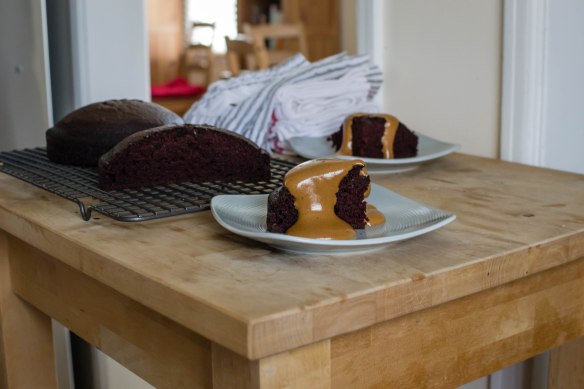
The lightly thickened, foamy concoction I ended up with wasn’t nearly thick enough to serve as a filling or a frosting for anything – it just wasn’t spreadable. But it was certainly capable of draping itself thickly over a slice of still warm chocolate cake. And when shaken up thoroughly the next morning and stirred into to a glass of milk with a little bit of chocolate syrup, it was an intense – and intensely satisfying – replacement for an iced mocha.

Contrarian Chewy Not-Chocolate-Chip Cookies

As I’ve noted here before, I can be a bit contrarian about food. I like my risotto with anything but rice, somehow I always find myself frying food in the most disgusting heat of summer, and I’m that person who, instead of making something practiced and reliable for a dinner party, always somehow ends up trying something untested.

But perhaps my most blasphemous contrarian food tendency is this: sometimes I don’t want chocolate chips in chocolate chip cookies. I love the cookie part – the depth of the brown sugar, the butter, the just-crisp edges – and then that chocolate gets in the way. Don’t get me wrong: I do like chocolate. I’m not a total monster. But in a cookie, especially after it cools and the chunks or chips or boulders of chocolate solidify again, I could do without. I sometimes find myself looking forward to the cookie that comes from the very last scrapings of batter from the bowl, since it probably won’t have much chocolate in it.

Last month N. ran a half marathon and I, following what is becoming a tradition, decided to have cookies waiting for him when he came home. Not so contrarian as me, N. loves a good chocolate chip cookie (and a mediocre chocolate chip cookie too – in fact, let’s be honest: he’ll take just about any chocolate chip cookie). Inspired by a recent trip to Le Grande Orange Café in Pasadena, I decided I wanted to do a batch of thin, crisp-but-chewy cookies with a sprinkling of salt on top. Good for helping my runner rehydrate a little. I started with a Bon Appetit recipe, but played a little: almond meal replaced some of the flour, I was out of chocolate chips, so I chopped up some dark chocolate covered pretzels and, just for fun, couldn’t resist a little instant espresso powder to the dough as well. A little buzz of extra caffeine wouldn’t hurt N. as he unwound from a thirteen mile morning.

We both loved the cookies. But again, I found myself thinking how good they would be if they just… didn’t have chocolate in them. So I did another batch here, retaining the almond meal, but eliminating all hints of chocolate. These are designed to be crisp at the edges and chewy at the middle, and several elements of the recipe contribute to that: the almond meal is always going to add some pleasant texture, as is brown sugar. The powdered sugar allows for a denser final result, which contributes to chew in that not as much air is trapped in the dough. And using egg yolks instead of just whole eggs seems to help too, though opinions seem divided on this.

My contrarian cookies were simple. As I was mixing them up, I found myself thinking, “could I add anything? What about dried cherries? What about lemon zest? Could I put in some cardamom or cinnamon, or maybe chopped nuts?” And of course the answer is yes. I could. You could too. Toss in a teaspoon or so of some warm spice. Toast and chop and fold in about a cup of nuts or dried fruit. If you’re feeling particularly contrary with me, you could even reverse hack all the way into putting the chocolate back in; you’ll want about 8 ounces.

But when I chewed my way through the first, and then the second, of these simple, too-spread-out, just bendable,* still warm offerings, I wanted none of that. The texture was right: crisp around the edge, a chew similar to a good snickerdoodle in the middle, and the occasional delightful crunch from the sea salt. And nothing, nothing at all, disrupting that deep, lovely, buttery brown sugar taste.


* because these cookies spread so much while they bake, and because they are so soft when they first come out of the oven, I’d wager you could successfully cool them over the back of a muffin tin or ramekin for little cookie bowls to fill with ice cream or custard or fruit, or maybe even a deep, rich mousse to get the chocolate back in there…


Contrarian Chewy Not Chocolate Chip Cookies
Adapted from Bon Appétit
Makes about 18 cookies
½ cup (1 stick, or 4 ounces) room temperature unsalted butter
¾ cup brown sugar
½ cup granulated sugar
¼ cup powdered sugar
2 large egg yolks
1 large egg
1½ tsp vanilla
1 cup all purpose flour
½ cup almond meal
1 tsp baking powder
¼ tsp baking soda
½ tsp kosher salt + more for sprinkling


  • Preheat the oven to 375F and line two cookie sheets with parchment paper or nonstick spray
  • In a large bowl or the bowl of a stand mixer, beat the butter with the paddle attachment or with an electric mixer until it is soft and the big pieces have broken down. Add all three varieties of sugar and continue mixing until light and fluffy, about 3 minutes. Scrape down the sides of the bowl. Add the egg yolks, the whole egg, and the vanilla. Beat again, stopping once or twice to scrape down the sides of the bowl, until the whole mixture is pale and fluffy, about 4 minutes. This seems like a long time, but it does make a difference. It will look like buttercream frosting when it’s ready, and really, it basically is.
  • If you want to, whisk the dry ingredients (flour, almond meal, baking powder, baking soda, salt) together in a smaller bowl, then slowly add to the wet mix in three additions, mixing just to blend in between. If you don’t want to bother with the whisking, just add in stages: ½ cup flour, mix to blend, ½ cup almond meal, mix to blend, then remaining ½ cup flour with leavening and salt, mix just to blend.
  • Spoon tablespoonfuls of dough onto your prepared cookie sheets, spacing them at least 1 inch apart. They will spread. I wouldn’t do more than about 6 dough blobs on each sheet. Sprinkle the tops sparingly with kosher salt or flaky sea salt.
  • Bake in the preheated 375F oven, rotating the sheets halfway through, until golden around the edges, 12-13 minutes. The middles will seem very soft, but will firm as they cool. Let sit on baking sheets 3-5 minutes before transferring to wire racks to cool completely (unless you want to mold them – see * above).

On Unfrosted Cake

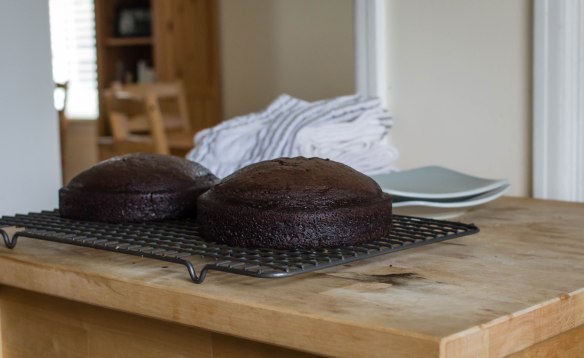
Growing up, we had one cake. This one. I mean, of course we ate other cakes: coffee cake was a breakfast time treat, and Mom made other recipes (plus there was that one boxed coconut cake from Sara Lee that came out of the freezer every so often), but this simple chocolate cake, a variant of the Depression era wacky cake or crazy cake, was the standby for celebrations. And though the original recipe called for a thick, sweet buttercream, we always frosted it with lightly sweetened whipped cream instead, artfully (or sometimes something less than artfully) swirled on with a knife or a rubber spatula or, if someone was feeling really fancy, an offset metal spatula that got just so close to the bakery-smooth finish I, at least, was always after.

So as you might expect, as I “leveled up” in the kitchen I tried some fancier finishes (though for THE cake I always went back to the whipped cream). I found the perfect cream cheese frosting recipe. I flirted with buttercreams of various kinds, and with varying success.

Lately, though, I’ve been appreciating the simple pleasure of unfrosted cakes. I don’t know if this is a result of binge-watching so much Great British Baking Show, on which the Victoria sandwiches are simply dusted with sugar, but there is something satisfying about plonking down a cake that you haven’t spent time fussing over.

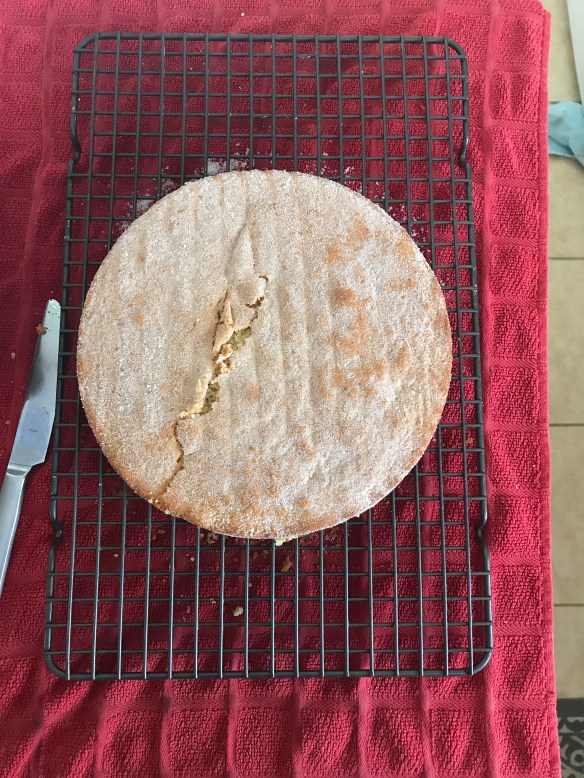
I’ve made three unfrosted cakes of note recently. The first is an almond cake recipe from King Arthur Flour. I did this almost exactly as the site required, subbing in some almond meal for some of the almond flour, a move that I think was a good one, and now has me looking for places to add almond meal for flavor and texture (stay tuned on this for cookies…). The recipe also taught me an interesting twist on pan preparation, requiring a dusting of sugar instead of flour atop the butter or non-stick spray layer. This results in a lovely, crunchy sugar coating on the bottom and sides of the cake (though the bottom usually ends up not noticeable) and, if you have the presence of mind to add it 15 minutes or so before the baking time ends, on the top as well.

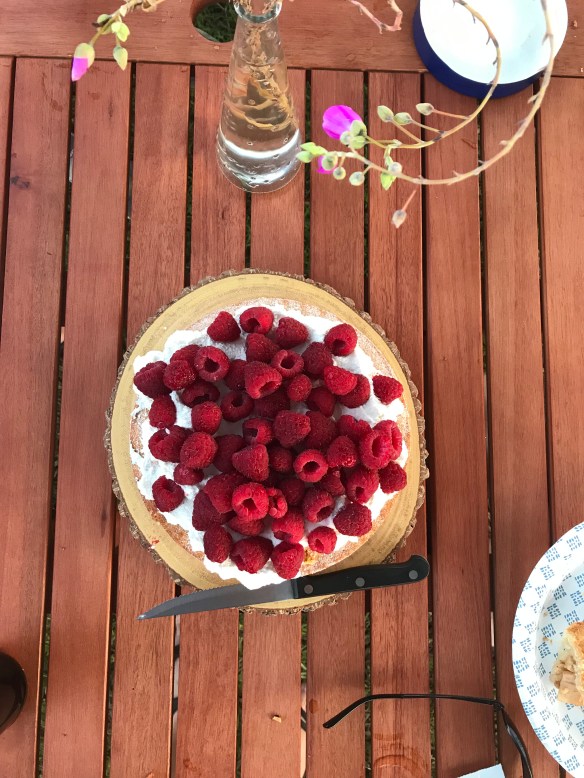
The second unfrosted cake I’ve made recently was a recipe from Tara Jensen’s cookbook/journal/mini-memoir A Baker’s Year. She calls it “groomsman cake,” celebrating the man she met at a friend’s wedding who entered her life with curiosity and bourbon. I may have overbaked mine a tad, since the resulting bundt was a bit less tender than I was expecting, but it was nothing a tumble of raspberries and a heaping scoop of whipped cream – my current favorite combination for cakes without frosting – couldn’t amend.

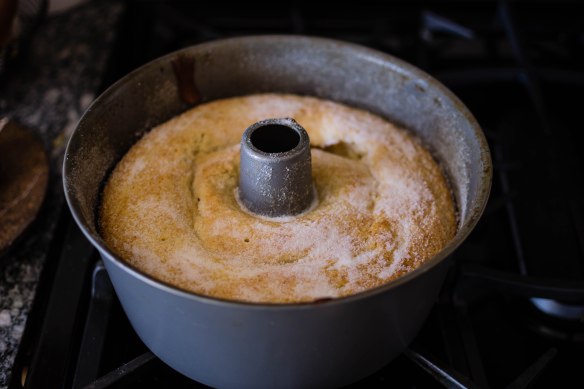
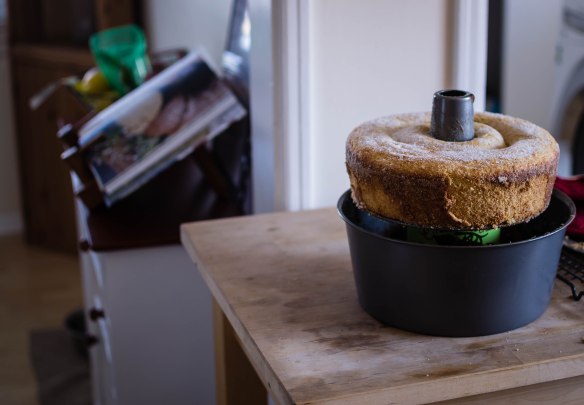
Finally, in a major blast from the past, I made a rum cake from deep in my mom’s recipe archives for a viewing party last weekend. “Why rum cake?” Mom asked, and the answer was more about linguistic cleverness than anything else: because if you make the cake using Bacardi, then you can call it “lightly thematic” because the brand name so resembles that of a certain former Starfleet captain now back on screen and invested in returning to the galaxy out there… This was not only nostalgic in the sense that I pulled it forward into the 21st century (or 24th?), but in its composition: boxed yellow cake mix. Instant vanilla pudding. A boiled sugar glaze. For the second time in recent cakery, a bundt pan. And Rum Cake? This cake means it. A full cup of dark rum, half baked into the tender sponge itself (which emerges a shocking dandelion yellow topped with toasty chopped pecans), and the other half stirred into that boiled glaze and drizzled slowly over the cake until it has all absorbed. When show-and-cake-time arrived, I pulled off the layer of aluminum foil I’d dressed the cake in for travel and was caught off guard by the heady fumes that rushed out. Fortunately we had a full hour of show to enjoy before anyone drove home.

Despite that leftovers of this cake need to be enjoyed more in the 3:30pm hour than in the 10:30 snack slot (and despite my snobby concerns about its less-than-from-scratch ingredient list), it is delicious. Tender. Moist (how could it not be?). Beautiful flavors, and the aggressiveness of the rum somehow mellowed overnight, though the kick lingers. And that makes it even better as a party option: you can – you should – make it the afternoon before, giving you less to fret about on the day of whatever gathering it’s invited to.

Of course, an unfrosted cake requires less dressy fuss in terms of presentation, too. No fancy cake pedestals necessary. A large plate, a simple platter, even a wooden cutting board will do, especially if you can add a stack of plates, forks, and a knife to it, so the moment you bring the cake to the table is the only one needed to get everyone eating.

Tell me. Are you a frosted or unfrosted fan? What’s your current favorite flavor combination, or serving vessel, or cake variety, that makes the buttercream and the fondant and the cream cheese feel unneeded? Leave a comment here and let’s talk cake!