Milestones. And Cake. And Salad.

This September has been a big one for me.  New home (okay, so we technically moved in July), new job (okay, so school started in August), and new decade!  I’ve finally hit my 30s, and I like what I see so far (though admittedly I’ve only been stationed in this new world for two weeks).

Given my fanciful proclivities for putting food in my mouth, then, N. knows that my birthday must involve a restaurant in some form.  Since we are only just beginning to explore our new culinary surroundings, this was a perfect opportunity to embark on our adventures.  I started with Culver City which, delightfully, has a whole webpage devoted to its downtown restaurants, including (in most cases) links to each restaurant’s website.  This was almost too much.  I spent the better part of an evening cruising through online menus, imagining what kind of mood I might be in on the big day and what I might want to order and what, if the restaurant I ultimately chose should happen to be out of my top choice, I would order instead.

Based on menus and Yelp reviews, I decided on Fords Filling Station (FFS), whose upscale comfort food and wide range of offerings sounded promising.  I tend to like mid-range restaurants: not too fancy, where a prix fixe menu or outstandingly high prices make me feel like a grubby graduate student out of place (I know, I’m not anymore.  But it’s a hard habit to break in this new world of adulthood and employment), but not too casual either, where the food is sub-par or inconsistent and the wait staff makes no pretense of caring about our presence.  A gastropub – a self-proclaimed innovative collection of food, decor, and atmosphere – seemed like the right fit.

FFS is a fun spot.  It’s centrally located downtown, and the dining room is a big open space with a bar to one side, traditional tables, and long narrow two-tops where the couple sits on a bench next to one another looking out at the other diners, rather than across from each other.  N. and I were seated at one of these bench seats, and it was fun to sit side by side for a change in a restaurant setting.  Brick walls, big barrels, and warm colors make it inviting and, I thought, pretty unpretentious.

Our server, who was the perfect balance of informative and attentive, sold me on one of the night’s cocktail specials: citrus vodka, house made lemonade, and a little float of chambord.  It was nice – punchy and bright and sweet-tart, but oddly similar to a Rennie’s Lemonade from our erstwhile happy hour hangout in Eugene, and therefore it felt drastically overpriced at $12. 

We opted to share entrees so we could order a few things, and got a Cuban flatbread with smoked pork pieces, cilantro, mozzarella, and some kicky little red chilis; grilled asparagus blanketed in shaved parmesan,; and a flattened half chicken with amazing garlic mashed potatoes and succotash.

N. was most attracted to the chicken (as is often the case when we dine out), and here he was clearly right to be.  Flattened, the bones were gone, the meat was compressed, flavorful, and intensely juicy, and the skin was crunchy and buttery and tender and perfectly unctuous.  Because he is fonder of white meat, it was also a perfect dish for us to share, because N. left me the thigh, with its dark, meatiness pleasantly encased in a crisp layer of fatty crunch.  Beside the chicken, the mashed potatoes swam in a sauce of garlic confit, which was rich and intense: the best gravy I’ve had in a long time.

The flatbread, which would have been just delightful on its own, paled a bit in comparison to this chicken.  The crust was cracker-like in texture, and the pork pieces paired nicely with the pepper and cilantro, but together the dish was a little bit dry.  It needed – perhaps – some herb oil drizzled over the top, or maybe 45 seconds less in the oven.  Tasty, but not the star of the show by any means.
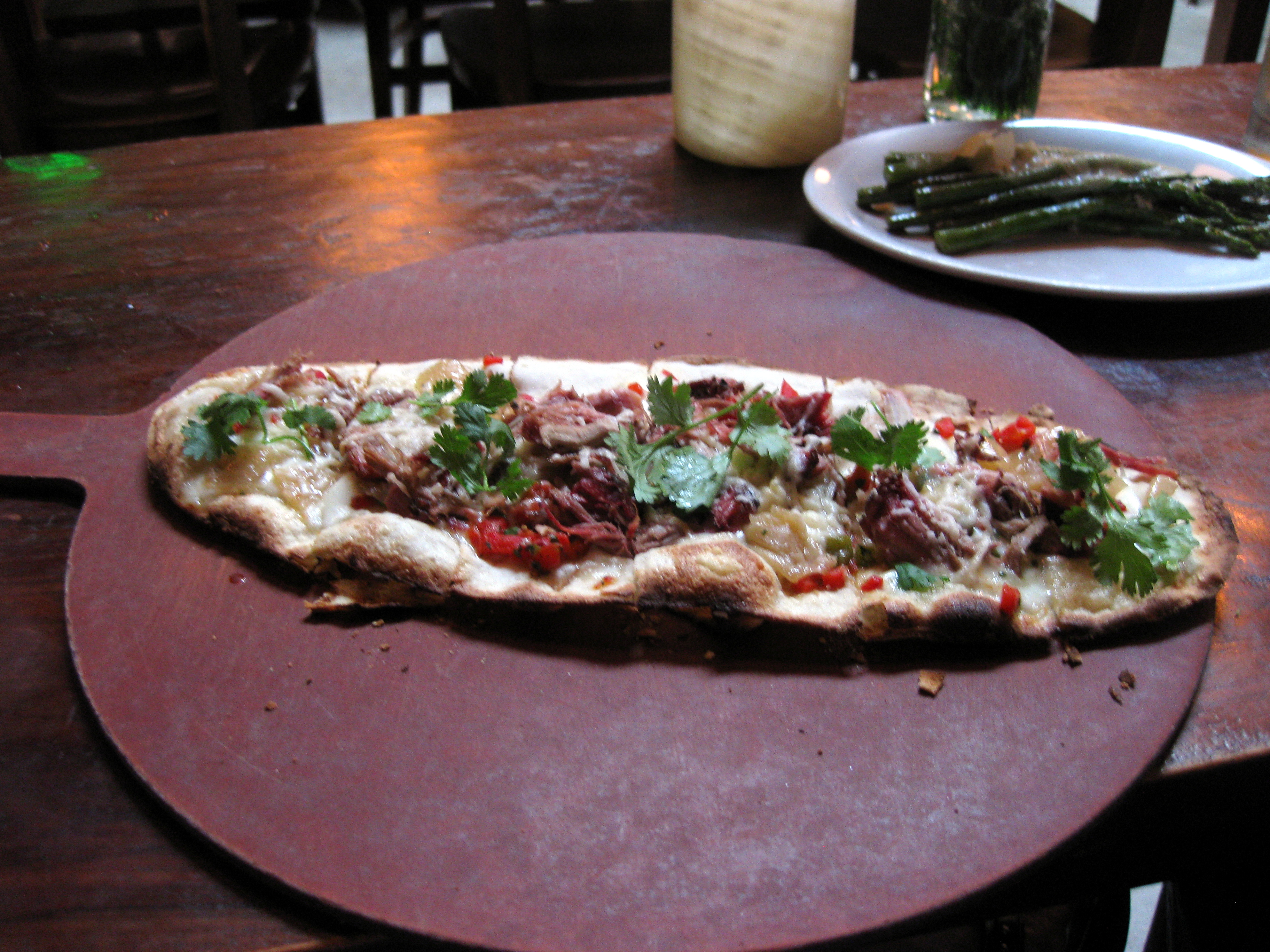
The asparagus was excellent: nicely flavorful and light, well cooked and, aside from the piece I dropped on myself (grace embodied, truly), a nice vegetal accompaniment to our meal.

Since I didn’t get any dessert that night (I was full but not overstuffed, and didn’t want to tempt myself by even glancing at a dessert menu), I was still longing for birthday cake a few days later.  Fortunately for me A., who blogs from the other side of the world at Over and Under, had told me about Porto’s – a Cuban bakery in Burbank that turns out to be right on my route to and from work.  I had to drive up to the school for a Friday meeting, and as I headed toward the freeway to come home, I decided to stop in and treat myself.

Inspired by the flatbread we’d shared at FFS, and because I thought it would be a good benchmark for a Cuban bakery, I got the Cubano.  Then, because it was still my birthweek (I’m big on extending the celebration as long as seems rationally possible), I picked out two tiny cakes to share with N.: flourless chocolate, and tres leches.

The sandwich was good.  Ham and pork packed tightly onto a fresh bakery roll with cheese, sharp mustard, and a pickle.  A simple sandwich, but a delicious one.

My dessert selections, though, were fantastic.  The tres leches was rich and light at once, not overly sweet but dripping with cream, like a well soaked angelfood cake topped with toasted marshmallow cream.  The flourless chocolate selection was less cake than a giant chocolate truffle: impossibly rich solidified ganache inside a thin shell of cake-like crumb.  N. was only able to eat two or three bites before declaring it too rich for his tummy.  I had no such trouble, but did talk myself into enjoying only half at that sitting, and saving the other half for another night when chocolate felt mandatory.

Indulgent?  Certainly.  But (at least in the case of the desserts) at $2-3 each, a reasonable indulgence.  Still, when one is a responsible adult (as I suppose some might now imagine me), one must temper such indulgences.  In this case, that means salad.

80. Trim and coarsely chop chard (rainbow makes for a gorgeous salad) and combine with white beans and chopped scallions. Dressing is minced ginger, a suspicion of garlic, olive oil and cider vinegar. 

I collected:

½ huge bunch red chard, thick stems removed

1 15 oz. can white kidney beans

5 green onions, finely sliced

1/2 inch knob of ginger

2 garlic cloves

1/4 tsp coarse salt

1/4 cup each cider vinegar and olive oil

1 TB honey

I tossed together the chard, beans, and green onions and set them aside in a big salad bowl.  To make sure the ginger and garlic were fine enough, I minced them by hand, then sprinkled them with coarse salt and dragged the flat of my knife across them until they turned into a thick, aromatic paste.  I scraped the paste into a glass measuring cup and whisked it up with cider vinegar and olive oil.  A taste of this was a cheek puckering revelation, so I added a healthy squeeze of honey to make it less astringent.

Aside from spinach, raw bitter greens are not always N.’s cup of tea.  Because I feared this might be the case with this combination, I decided to treat this more like a slaw than a salad.  I combined the main ingredients early and doused them in dressing a good fifteen minutes before dinnertime.  This would, I hoped, give the acidic dressing time to wilt the chard a bit, much like the vinegar in coleslaw dressing does for the cabbage.
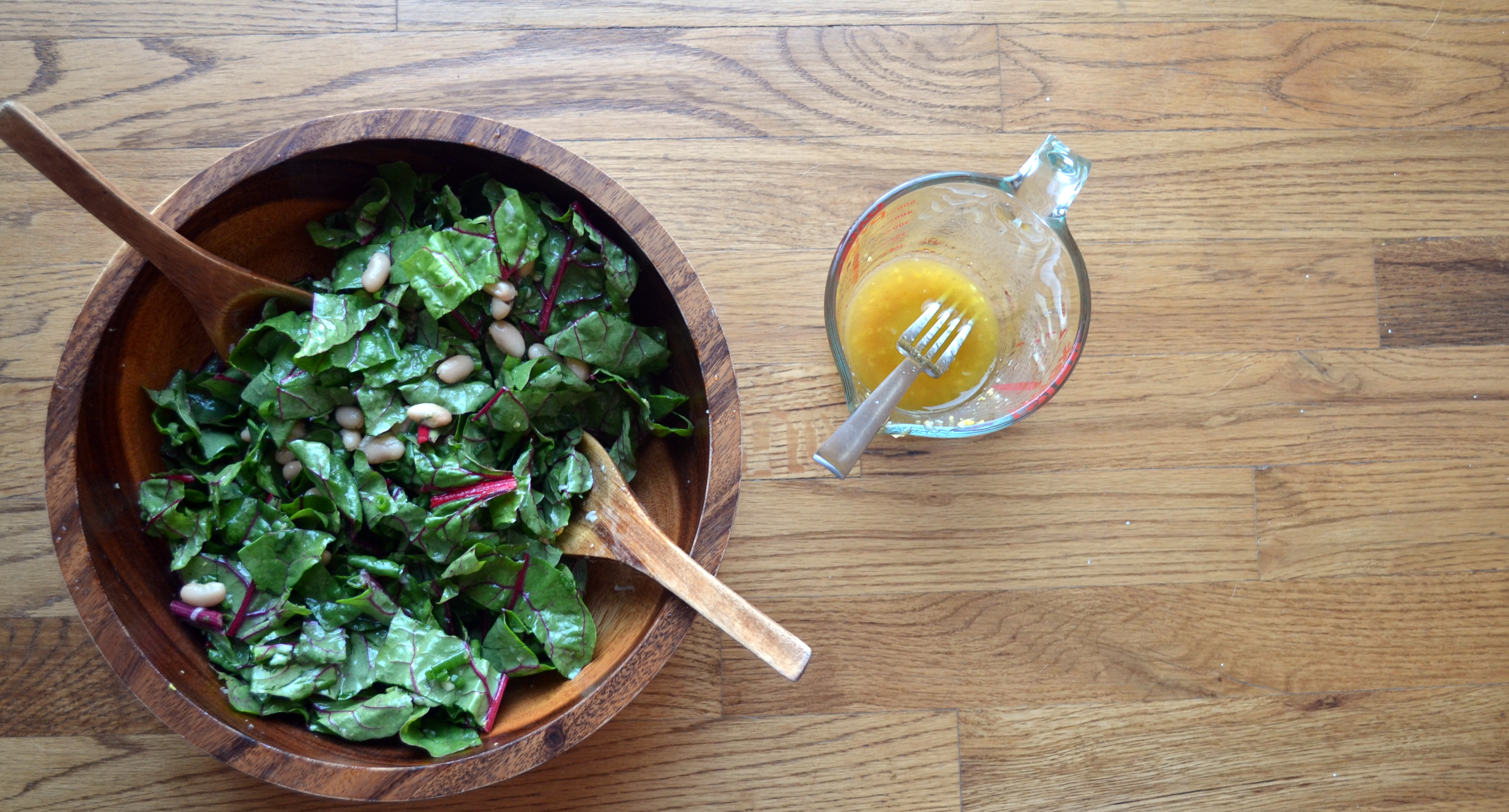
It worked well.  By the time we ate (grilled chicken breasts sauced with equal parts whole grain mustard and apricot jam), the chard had lost just a bit of its aggressive bite but its freshness was not compromised.  The beans, sometimes bland customers, had soaked up a bit of flavor from the tangy bright dressing, and so while they were a steady, creamy counterpoint to the earthy-fresh chard, they weren’t at all boring.  We were both surprised by how well we liked this simple little salad.
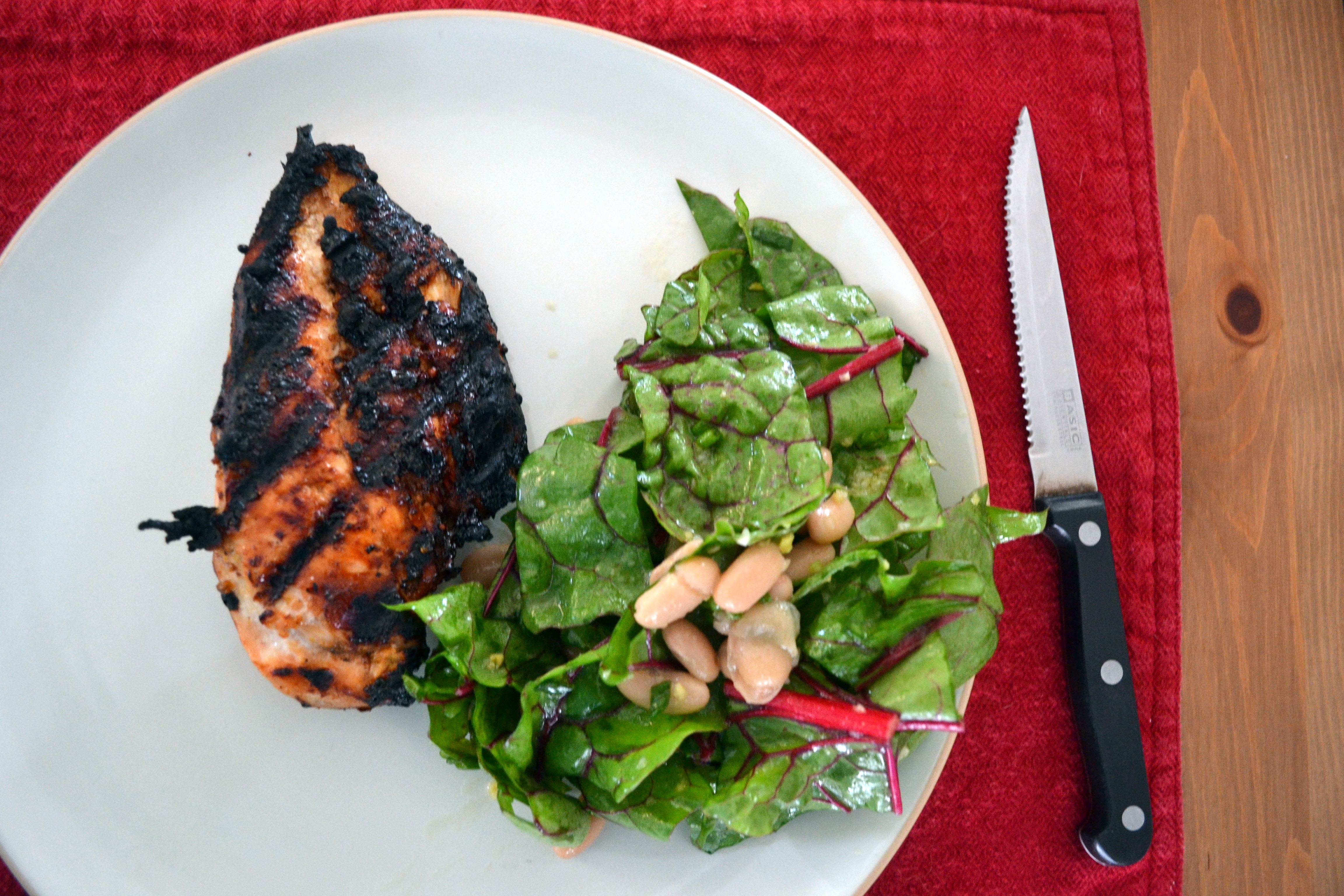
Success, then, and balance: excitement and indulgence followed and tempered by stability.  If this is what the 30s are like, I’m ready.  Bring it on.  I’ll just be 30 forever.
Food from Fiction Potluck

So what does one do, you might ask, as a newly minted Doctor of Literature, unfettered from the everyday proletariat academic concerns?  Well, one grades, and one line edits, and one revises frantically, and frankly, one feels completely different and not different at all.  The school year isn’t over, even though (as of Tuesday, when I upload my “completed” dissertation to our Graduate School’s website) my degree is.  So my daily duties no longer include anxious preparing for the big day, but they still include student emails and lesson planning and reading.

But because they don’t include anxious preparation and last minute rethinking and nail biting about what the committee will think, these days can also include celebrations.  Last night was one such celebration: a party I’ve wanted to have for several years now.  The style: potluck.  The theme: “Food in Fiction.”  Interpretation: bring a dish inspired by or mentioned in a book.  That’s it.  There are so many vivid options in novel, drama and film, and our guests had only to choose one and recreate it in the material, taste-bud-bearing world.

We had tremendous fun, in brainstorming, in cooking, and in sharing the variety of dishes from books we love.  As I mentioned to one friend who thanked N. and I for the great party on his way out the door, this is a party we had to have before parting ways as many of us graduate this June, because only in this company could we feel so self-congratulatory and so excited about immersing ourselves in something so nerdy.

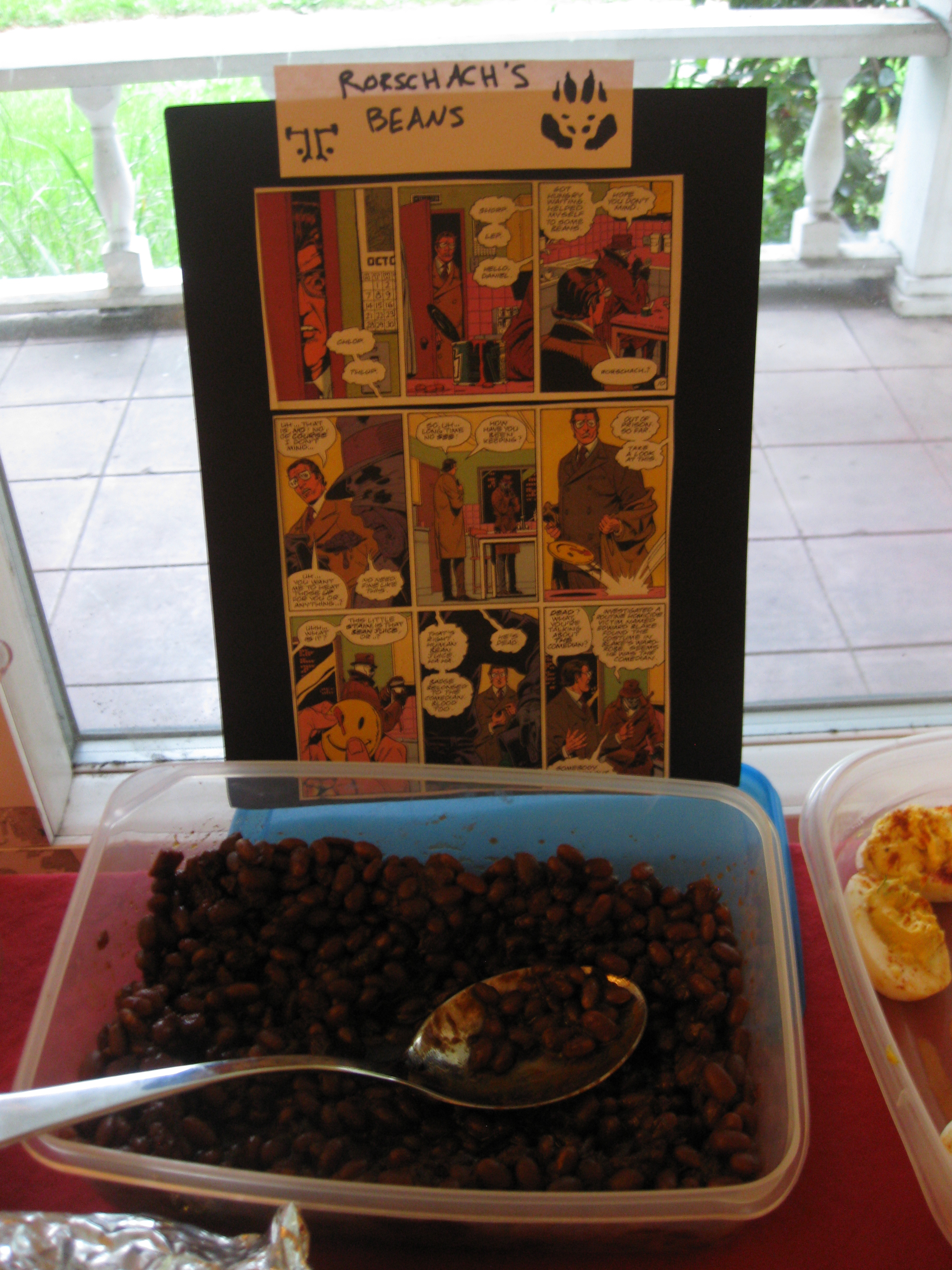
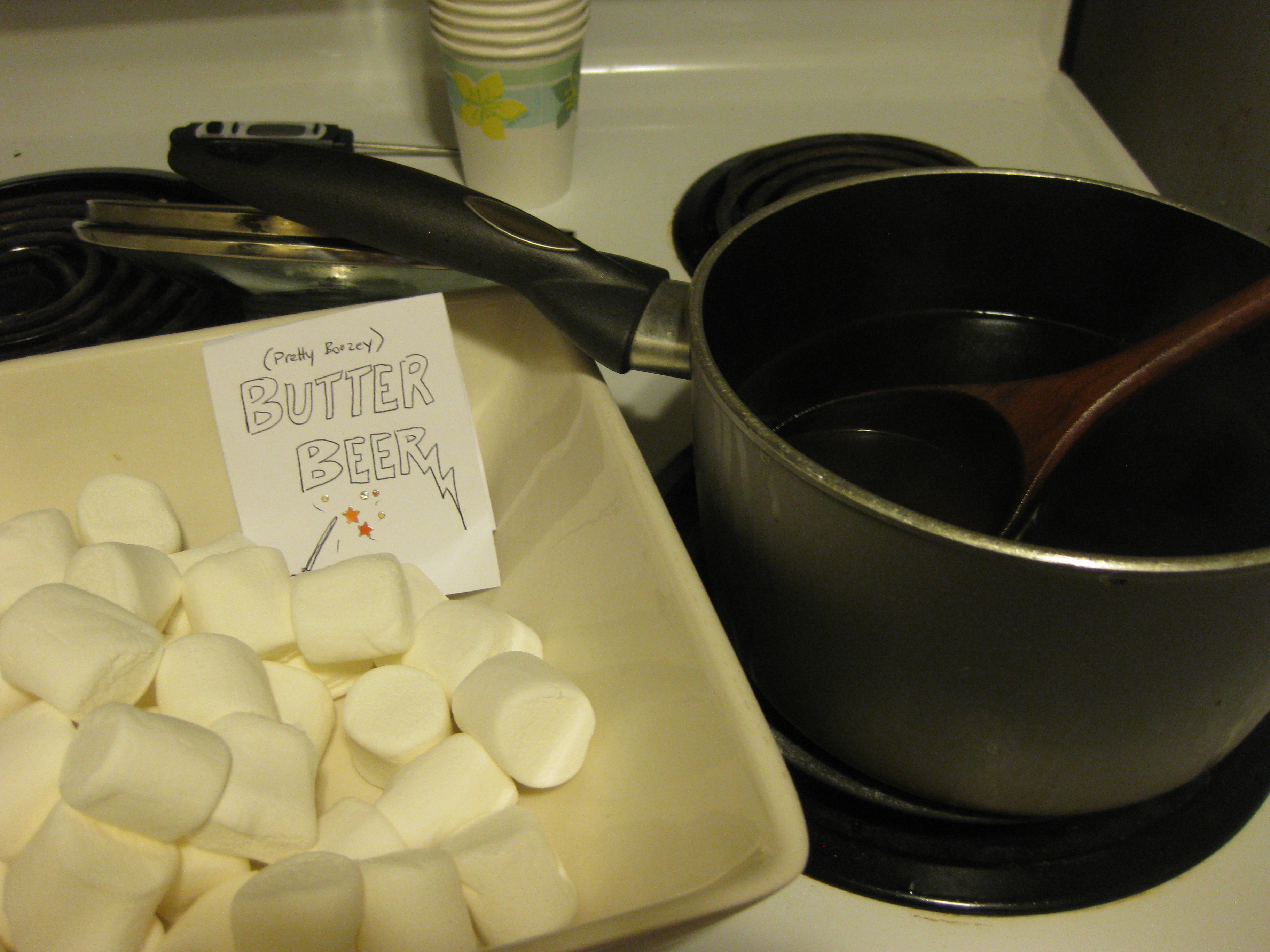
Here are a few of the dishes we enjoyed.  I suggested to folks that they provide the description of the food in question from its source text so guests would know what they were eating and which world it was taking them to.  We had Victorian sandwiches and High Modernism Stew nestling next to a magical realist chutney and a warm wassail of fantasy.  What wandering, all in one house…

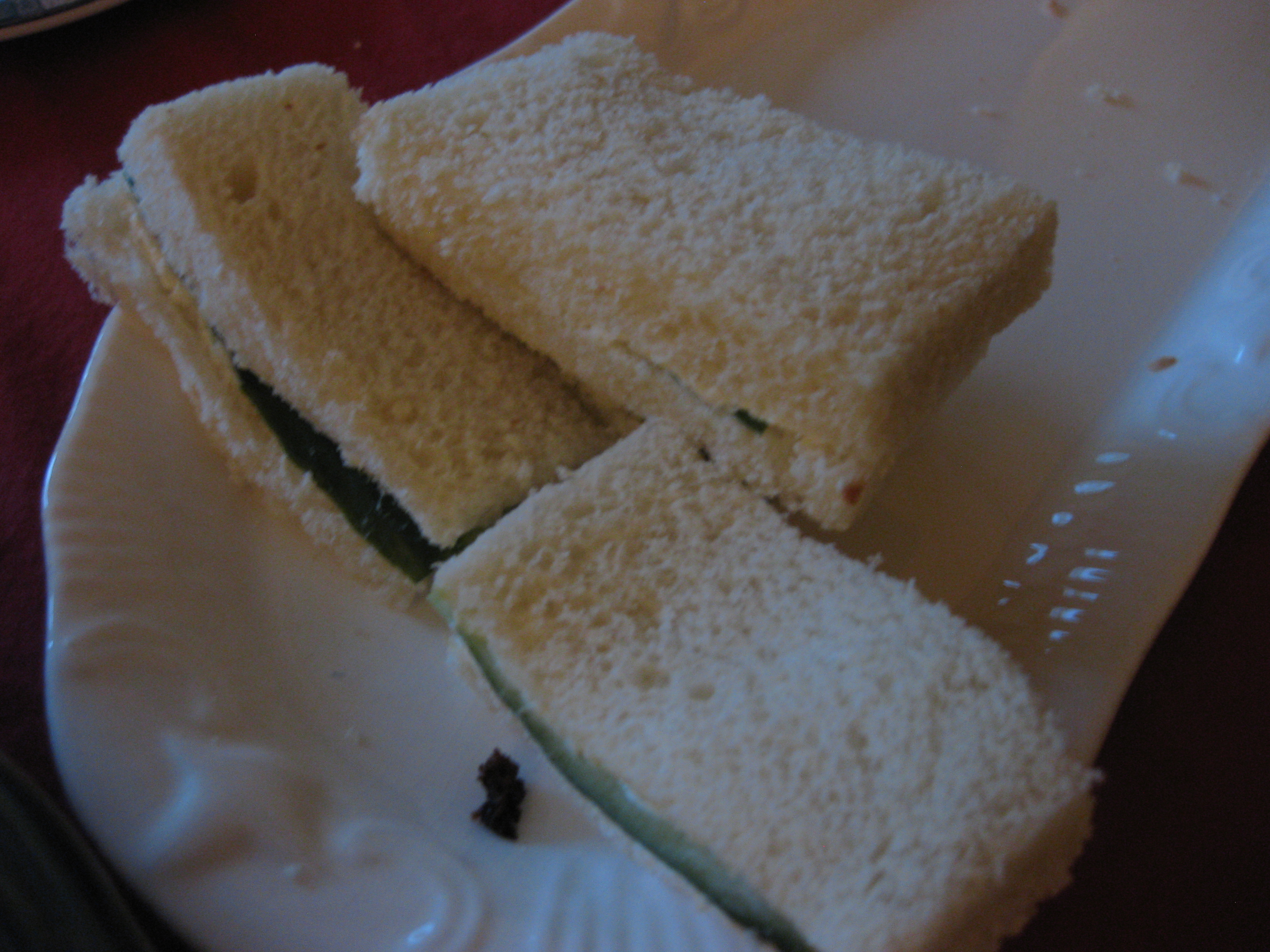
Cucumber sandwiches from Oscar Wilde’s “The Importance of Being Earnest.”

Rorschach’s beans from the graphic novel “Watchmen.”

Boeuf en daube from Virginia Woolf’s To the Lighthouse.

A trio of deviled eggs to breathe life into Hemingway’s thoughts on being hard boiled in The Sun Also Rises.

A wonderfully smoky molasses cake inspired by the molasses-drenched dinner scene in Harper Lee’s To Kill A Mockingbird.

Well spiked butterbeer (you drop in a few marshmallows which, as they melt, mimic the foamy head on the beer) from J. K. Rowling’s Harry Potter series.

Not pictured: (more!) deviled eggs, from Toni Morrison’s Song of Solomon, sautéed marinated mushrooms inspired by Lewis Carroll’s Alice in Wonderland, raspberry cordial from L. M. Montgomery’s Anne of Green Gables, and a few sourceless delights: meatballs (Cloudy with a chance of, perhaps?), and a bread, cheese, and hard salami platter.  These were justified by their authors with the claims that “surely there must be moments of literary eating that include these items,” which I was quite willing, given their deliciousness, to accept.  And of course, wine.  If we were picky, we could call this an homage to Hemingway, whose characters “get tight” with abandon, or to Carroll’s Alice, who does imbibe from the mysterious bottle demanding she “drink me.”

I made two offerings: a take on the “green as grasshoppers” chutney so adored by Saleem in Salman Rushdie’s Midnight’s Children, and a pork pie stuffed with hard boiled eggs from Roald Dahl’s Danny the Champion of the World.  Both turned out extremely well, but I want to talk about the pie first.

Danny the Champion of the World is the story of a boy and his father.  Without giving too much away, I will only say that Danny’s father suffers an injury almost halfway into the book, and when Doc Spencer, the family physician, brings him home from the hospital to the gypsy caravan in which he and Danny live, Doc also brings Danny a package from his wife:

“Very carefully, I now began to unwrap the waxed paper from around the doctor’s present, and when I had finished, I saw before me the most enormous and beautiful pie in the world.  It was covered all over, top, sides, and bottom, with rich golden pastry.  I took a knife from beside the sink and cut out a wedge.  I started to eat it in my fingers, standing up.  It was a cold meat pie.  The meat was pink and tender with no fat or gristle in it, and there were hard-boiled eggs buried like treasures in several different places.  The taste was absolutely fabulous.  When I had finished the first slice, I cut another and ate that, too.  God bless Doctor Spencer, I thought.  And God bless Mrs. Spencer as well” (Dahl 85-86).

Since my first trip through Danny, I salivated over this savory pie Danny enjoys.  And this party was the perfect excuse to attempt my own.

I found a perfect (and much prettier) base recipe for my pie in the archives of the blog Married… With Dinner.  Though I followed their basic instructions, I made a few amendments for ease and expense.  The key points are as follows:

Use a springform pan.  That way the pie is tall and regal and can sit magically outside a pie plate all on its own.

Roll the bottom crust out large enough to come almost all the way up the sides of the springform (I used storebought crust and it work out just fine), so you can connect top and bottom more easily.

I squashed together a mixture of ground pork, pork sausage, finely chopped ham from a ham slice, salt, cayenne pepper, ground cloves, and black pepper.  I pressed a thin layer of the meat mixture onto the bottom of the pie crust, then laid six hard boiled eggs in a circle through the middle of the pie (regrettably, with ham-covered hands, I did not get a photo of this).  Then I lightly packed the rest of the meat mixture around and over the eggs and sank a bay leaf deep into the very center of the pie.

A traditional English pork pie has warm pork stock poured into a hole in the crust just after baking, which turns into a thick jelly as the pie cools.  This did not sound particularly delicious to me, though I did like the idea of a rich layer of something atop my pork.  I decided on cheese.  I grated about a cup of sharp cheddar and sprinkled it lightly on top of the meat before draping the top pie crust over it.  I cut a little hole in the center of the crust and sliced some steam vents for additional release before baking.

It’s a long baking process (almost two hours), but you are dealing with raw pork, so the cooking time needs to be sufficient.  When the pie is almost done, Married… With Dinner recommends you carefully release the spring on the pan and brush an egg wash all over the top and sides of the pie.  Fifteen minutes more in the oven and this results in a beautiful, shiny golden glaze all over the pie.  It also, in case you are lazy like me and didn’t brush an egg wash over the top edge of the bottom crust to help the lid adhere, creates an after-the-fact glue to hold base and lid together.

I let my pie cool on the counter for an hour or so, then tented it with aluminum foil and stowed it in the fridge until the party started.  It did, after all, have to be a cold meat pie.

It was fabulous.  The meat was nicely spiced and the ham bits shredded in added some smoky, salty variety.  The hard boiled eggs were, indeed, delightful treasures to find, though I admit to over-boiling them slightly so their yolks were not as bright as they could have been.  Still, this is hardly a complaint.  It was like a meatloaf wrapped in flaky, buttery crust, and the cheese was a nice additional flavor and richness.  I suspect this could have been just as good warm as it was cold, but the pie might not have held together quite as nicely.

My second offering was a cilantro coconut chutney.  Saleem, as Midnight’s Children comes to a close, receives a meal from a blind waitress.  He lists:

“On the thali of victory: samosas, pakoras, rice, dal, puris; and green chutney.  Yes, a little aluminum bowl of chutney, green, my God, green as grasshoppers… and before long a puri was in my hand; and chutney was on the puri; and then I had tasted it, and almost imitated the fainting act of Picture Singh, because it had carried me back to a day when I emerged nine-fingered from a hospital and went into exile at the home of Hanif Aziz, and was given the best chutney in the world… the taste of the chutney was more than just an echo of that long-ago taste – it was the old taste itself, the very same, with the power of bringing back the past as if it had never been away…” (Rushdie 525).

I found a recipe for a coriander chutney replete with tart lemon juice, lip puckering spice from serrano chiles, and bright, bright green cilantro, tempered by shredded coconut.  The recipe called for unsweetened coconut but I, in my haste, having only sweetened, forgot to rinse it to get some of the sugar off before dropping it into my food processor.  As a result, my chutney was lightly sweetened, but no one seemed to mind that, especially when it was spread onto the pakoras I made.

I searched around online and made a master recipe from a combination of ideas for these pakoras.  Mine included:

4 cloves garlic, smashed and finely minced

2 tsp. each:

Garam masala

Turmeric

Chili powder

Salt

2 cups Bob’s Red Mill gluten-free all-purpose flour (pakoras are made with garbanzo bean flour, and though the Bob’s Red Mill mix is a blend including potato starch, it is composed mostly of garbanzo and fava bean flours, so since I had it, I decided a little break from tradition would be okay.  This is literature, after all.  It’s all interpretation anyway!)

1 ½ cups water

½ head cauliflower, diced

¾ large onion, diced

1 small sweet potato, diced

1 quart vegetable oil

Heat the vegetable oil to 375F in a large, sturdy pot.  I used my dutch oven.

While the oil heats, whisk together the dry ingredients and garlic until well combined, then slowly whisk in the water to form a thick, smooth batter.

Add the diced vegetables and stir to combine.

Drop spoonfuls of the batter (ever so carefully!  Watch out for splashes!) into the hot oil and fry for 5-6 minutes, or until the batter is deeply golden and the vegetables inside have magically cooked.

I got to taste one of these.  It was crunchy and starchy and slightly spicy and wholesome and delicious.  It was vegan.  It was gluten-free.  Topped with the chutney it was fresh and springy and spicy and then gone.  By the time I went back to have another, the giant platter I’d made was empty, and only a spoonful or two of chutney remained.  Pride overwhelms disappointment, in moments like these.  My little experiment was so successful it prohibited me from tasting further.  So I had another deviled egg instead.

Full and happy, we fell into bed at midnight with a sinkful of dishes and a fridge-full of leftovers to look forward to.  It’s like reopening a book to your favorite chapter: whose world will I lunch from, dine from, be returned to today?

The Buttercream Problem 2: What Problem?

Thanks for the support and thoughts on my previous buttercream post.  I appreciate knowing you are out there, lurkers and likers!

The title of this post might be a bit of a lie, because can you really call something “Problem, part 2” if it isn’t too much of a problem anymore?  Maybe “The Buttercream Project” would be more accurate.

Anyway, I owe this amelioration of gloop, sludge, and anxiety in part to my own intuition, but in larger part to Leah at “So, How’s it Taste?” and her recipe for Cinn-Chili Chocolate Cupcakes with Cinnamon Buttercream.  With a chapter draft submitted and a guiltlessly girly shopping trip/reward for my efforts over, I wanted to bake a little something for my officemates AND do a buttercream practice.

Here’s what I learned:

It’s important to sift the powdered sugar.  Otherwise you end up with little clumpy bits that don’t incorporate completely (which happened at New Year’s on the blue poo cake).

It’s important that the butter be fully softened, and that you whip it up well before adding any of the sugar, lest it not incorporate fully (which happened at New Year’s on the blue poo cake).

A couple of tablespoons of whole milk help smooth things out.

I probably should use champagne extract or flavoring, not champagne itself, because so little liquid is needed to keep this pipe-able and smooth (but not turning into blue poo.  I’m just saying…).

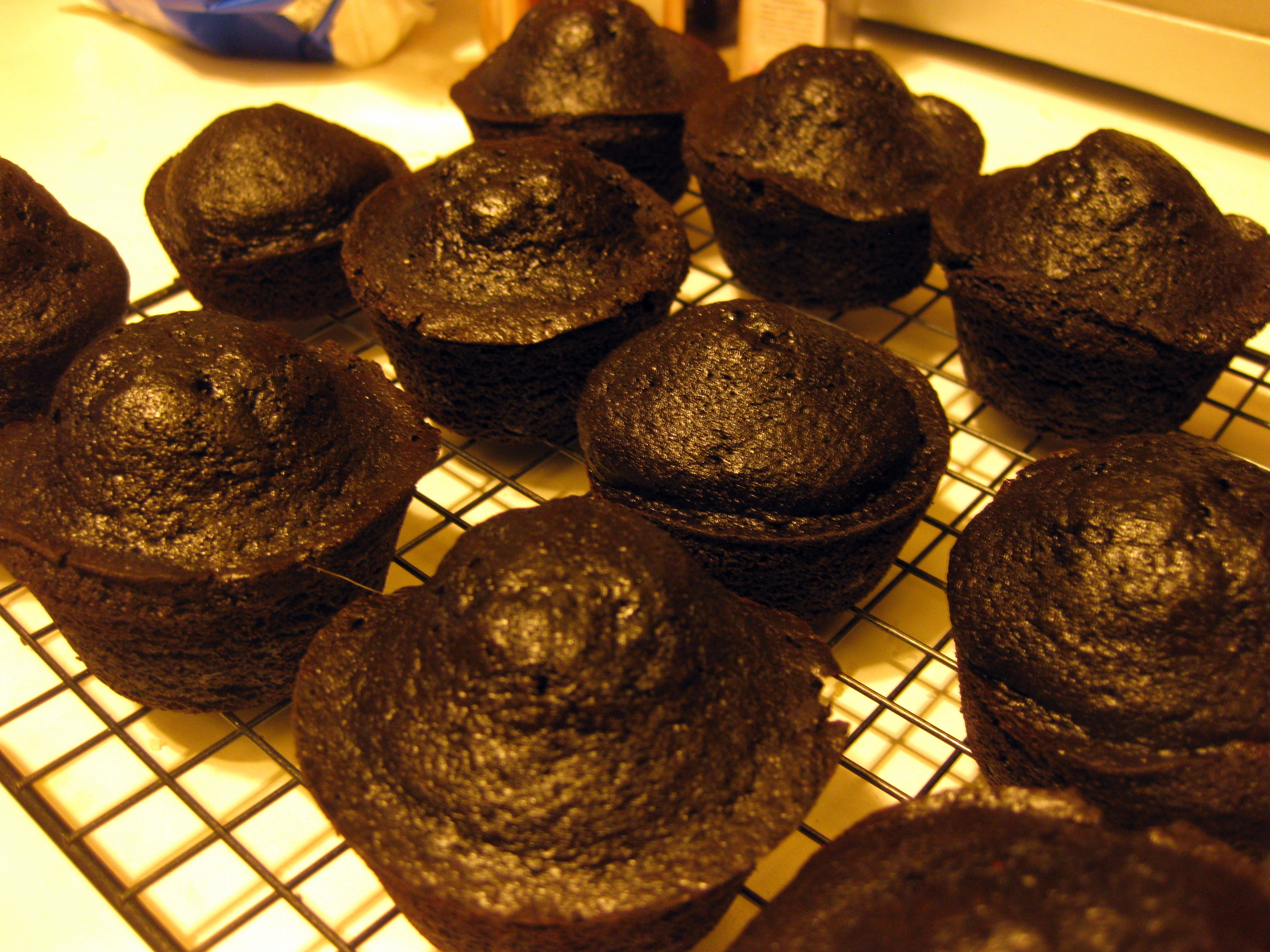
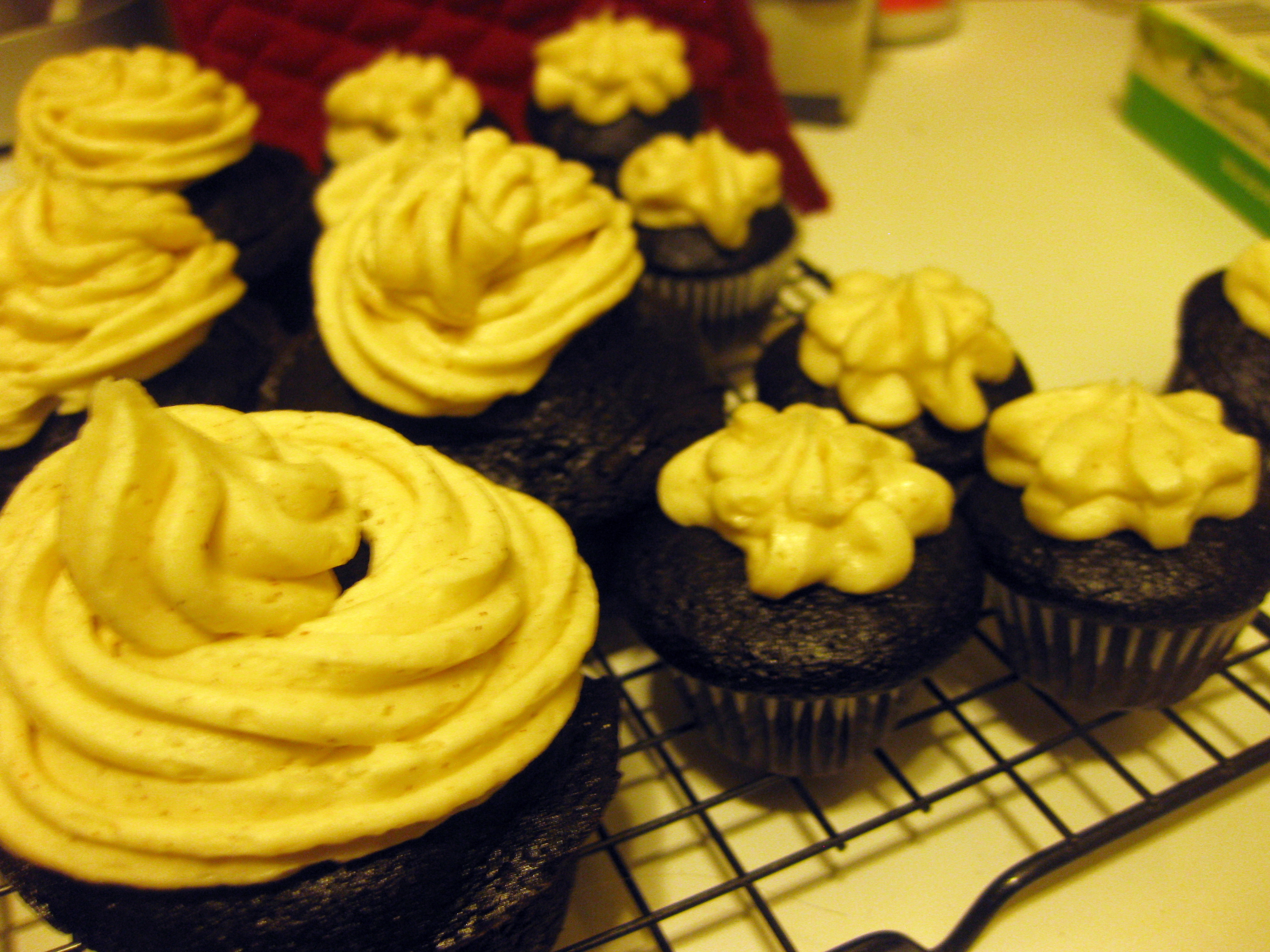
So the frosting whipped up really nicely – smooth and buttery and even – but the cupcakes were no slouch either. The combo of chocolate, cinnamon, and cayenne is, I’ve decided, one that should be present in everything from cupcakes to hot cocoa to coffee to a spread for sourdough toast. It was warm and toasty and dark and rich and left just a little lingering heat in the back of your throat after the last swallow of cupcake. The cakes were really, really dark – almost black – because I used Hershey’s “Special Dark” cocoa powder instead of just the regular stuff. They had a nice moist crumb and weren’t overwhelmingly sweet.

The buttercream was delicious too. It was pretty sweet, though that’s difficult to combat, I think, but the heat of the cayenne and the warmth of the cinnamon in the frosting cut the sugar. Also, after a night in the fridge the frosting seemed less aggressively sweet – giving the butter and sugar time to hang out together might have done something the mellow the cloying flavor buttercream can have. I used less cayenne in the frosting than Leah’s recipe specifies, though I did add the barest sprinkle over the top when the cupcakes were all frosted.

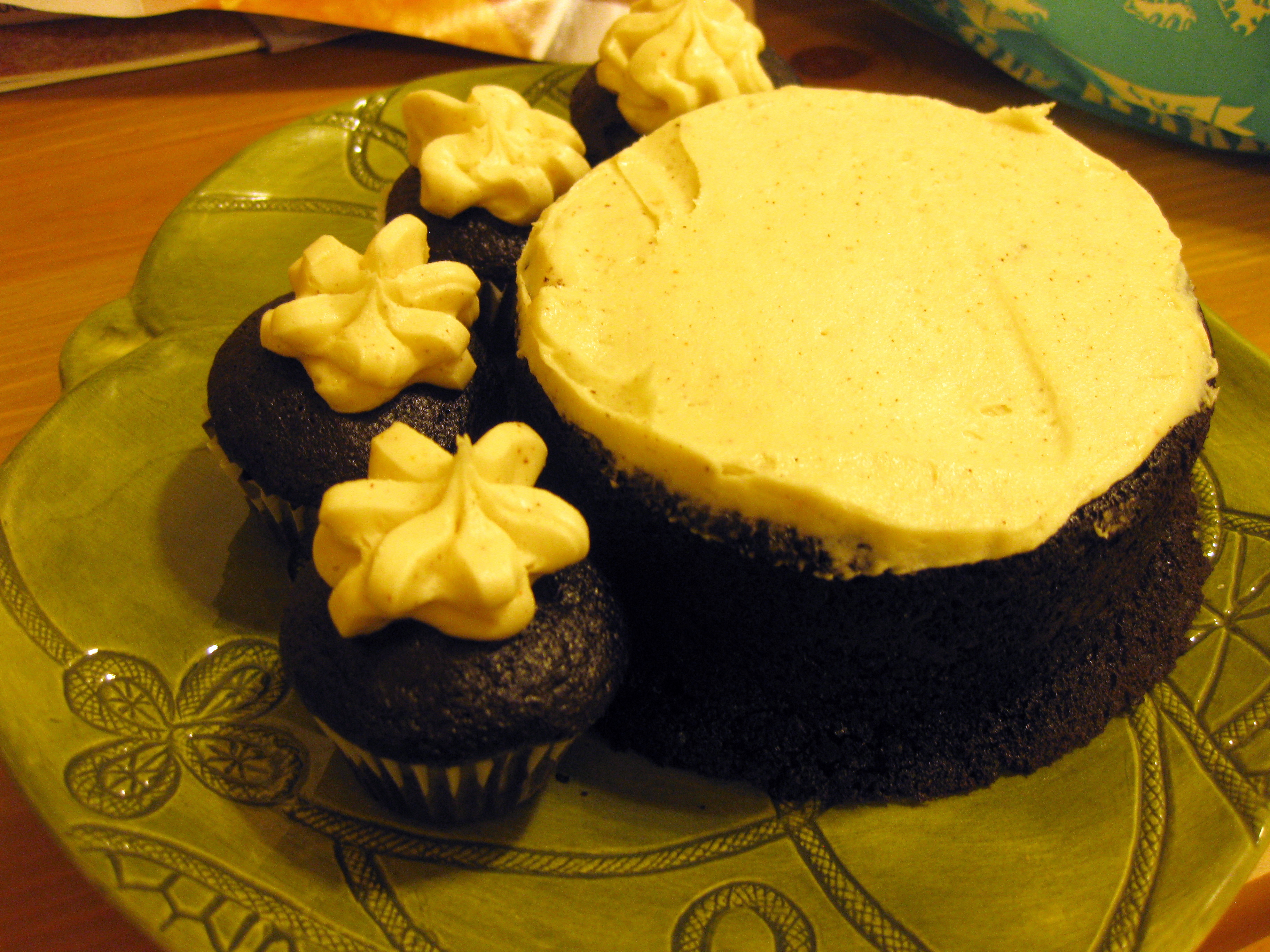
Here’s what I learned about the process of frosting: cupcakes are easy, and a properly made buttercream spreads with surprising smoothness over a flat surface (I made one tiny “cake” for the bride and groom as a taster and smoothed icing across the top). With an offset spatula or a metal scraper at my disposal, I bet I can get the thing even and gorgeous.

Here’s what I learned from the bride: she LOVES the idea of doing cupcakes and mini cupcakes as additions to the cake, and we’ve decided to use an asymmetrical cake stand  for the actual cakes. This means I don’t have to stack anything, just make three separate, differently sized cakes, and a Subaru-load of cupcakes.

So here’s the plan: the cakes will get frosted with buttercream and decorated in some as-yet-to-be-determined way. The cupcakes will get frosted with a star tip much like I’ve done here, and possibly drizzled with blue crystal sprinkles. As for the mini cupcakes, I found a tutorial for making pansy-like flowers out of buttercream on minis, and the next time I do a trial run I’m going to give this a try to see if it’s something me and my meager piping skills can pull off.

Next month: I’ll make the champagne batter the cake will actually be made of and bake it in cupcake form so I can start to get times down. It wouldn’t do to have dry cupcakes. Then I’ll try out this flower pattern on the minis and see how it turns out. With luck, it will go as well as this month’s new buttercream recipe did!

Stay tuned… I added a “wedding” tag, and all the buttercream and cake-related posts will end up in that category for easier access.

Kale and coconut

Kale is a recent love for me, at least relatively speaking.  I had seen the curly leaves used as edging – a kind of metaphorical hedge between dishes in fancy hotel breakfast buffets or salad bars; a hefty big brother to curls of parsley left quasi-artistically on the side of a plate – but I had never eaten it.  Sometimes it didn’t even look edible, but more like a plastic plant trapped somewhere in the realm of land kelp.

Last year I began experimenting with kale, mostly thanks to bloggers like Shauna at Gluten-Free Girl and Elana at Elana’s Pantry.  N. and I have chomped our way through kale in lasagna, pesto, braised with soy sauce and mushrooms, and of course coated in olive oil, sprinkled with salt and paprika and roasted into chips.  Its robust, almost waxen toughness seemed to require aggressive cooking techniques.  I never believed the recipes I read suggesting raw consumption could be tasty.  And yet Bittman advocated for this as well!

“74. Trim and chop kale; salt and squeeze and knead until wilted and reduced in volume, about 5 minutes.  Rinse, dry and toss with olive oil, lemon juice, chopped dried apples and toasted pine nuts.”

With my yen for freshness and greenery escalating, I decided it was worth a try.  The cast of characters consisted of:

1 large bunch Italian or lacinato kale

1 tsp. salt, plus more to taste, if desired

2 TB olive oil, or to coat

Juice of half a lemon

½ chopped dried apples

¼ cup toasted pine nuts

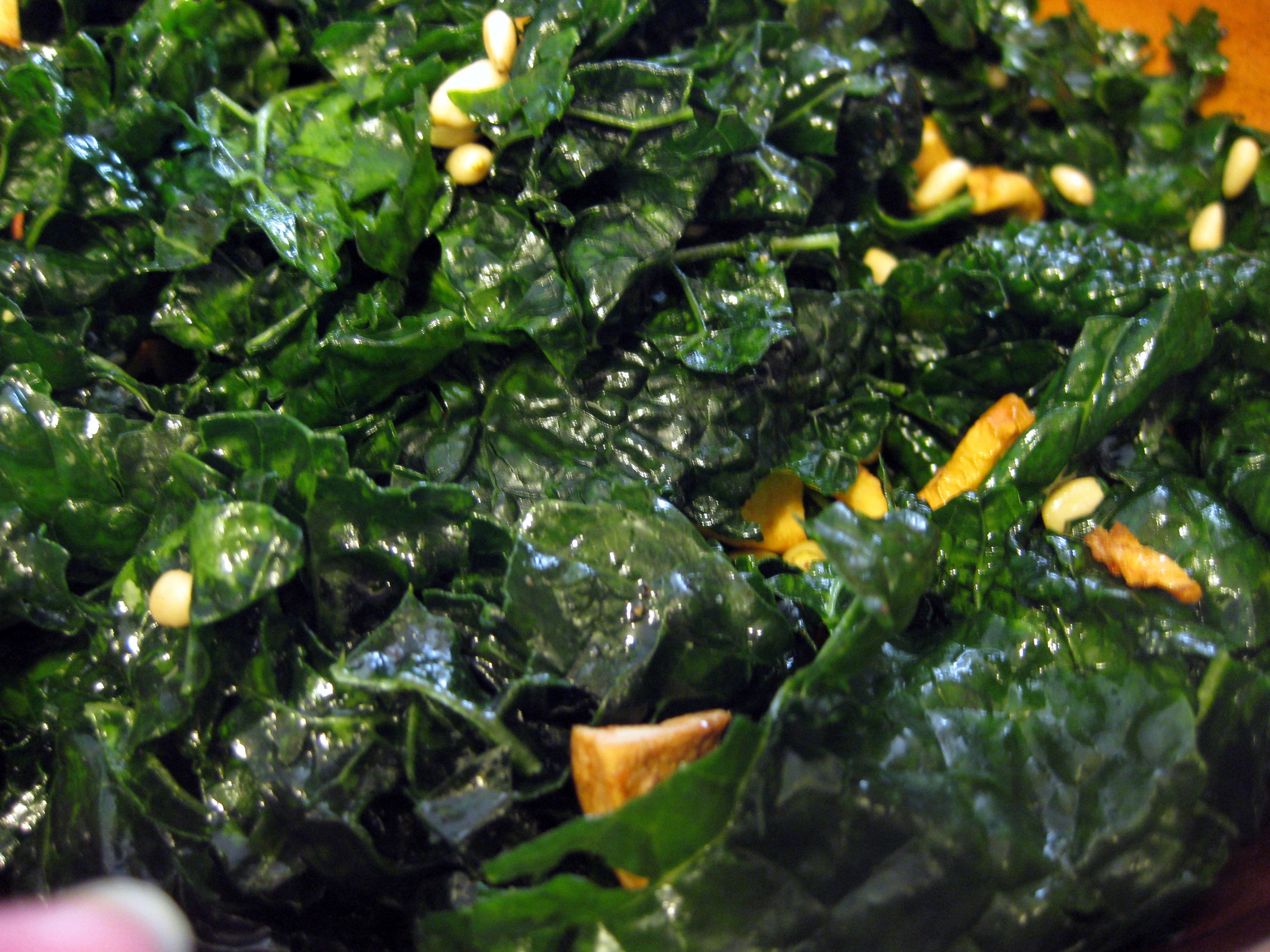
Doubtful, I tore the beautiful emerald lobed leaves from the tough central stalks, then roughly chopped the huge pile of leafy scraps into smaller pieces.  I sprinkled salt over my heap of salad and began to knead.  To my utter amazement, in under a minute the leaves had started to change in texture and consistency.  They became more like spinach, then more like cooked greens, and I decided to knead only for two or three minutes, fearing from the drastic reduction in volume already that I would end up with less than two servings.  When I stopped kneading, I flopped the wilted clumps into a salad spinner to rinse, de-salt, and spin dry.

I tossed the kale with olive oil and lemon juice in a large salad bowl, then added the pine nuts and apples.  A quick taste led me to add a miniscule sprinkle of salt, and then it was ready to serve!

We enjoyed the salad with chicken apple sausages – I wanted to capture the special flavor of the apples and highlight their sweetness against the tart lemon and bitter kale.  It was a very successful salad, and would be particularly good at the height of summer when you cannot bear to encounter the heat cooking requires.  Just pre-toast the pine nuts on a cooler occasion and this salad flies together.

The contrast of flavors is lovely.  It manages to hit all four of the major taste bud groups: the kale is bitter, the hint of salt gives it nice salinity, the apples are sweet, and the lemon is tartly sour.  Similarly, it satisfies a variety of textures: the kale is tender but still has some body for your tongue to play with, while the apples are chewy and the pine nuts provide a satisfying crunch.

Using kale as a salad base provides so many possibilities.  I already know I’d like to try toasting the apple rings to try and achieve a more chip-like texture and add extra crispness: apple croutons, if you will.  A more savory salad might entail replacing the apples with a good grating of sharp cheddar or Parmesan cheese.  Hard boiled eggs, walnuts, and maybe a scattering of bacon would make a more substantial salad.  The options are endless.

But the title of this post isn’t about endless kale.  It also mentions coconut, so I’d better move along.

With half a bag of sweetened, flaked coconut in my pantry and a small bevy of beauties descending on my house for a ladies’ TV night, I decided to over-achieve this week and make another Bittman selection to share with my friends.

“100. Spiced Macaroons: Mix 3 cups shredded unsweetened coconut, 1 cup sugar, ½ teaspoon ground cardamom and a pinch of salt in a bowl.  Stir in 3 lightly beaten egg whites and a teaspoon almond extract.  Drop in small spoonfuls on baking sheet and bake at 350 degrees for about 15 minutes, or until golden on the edges.”

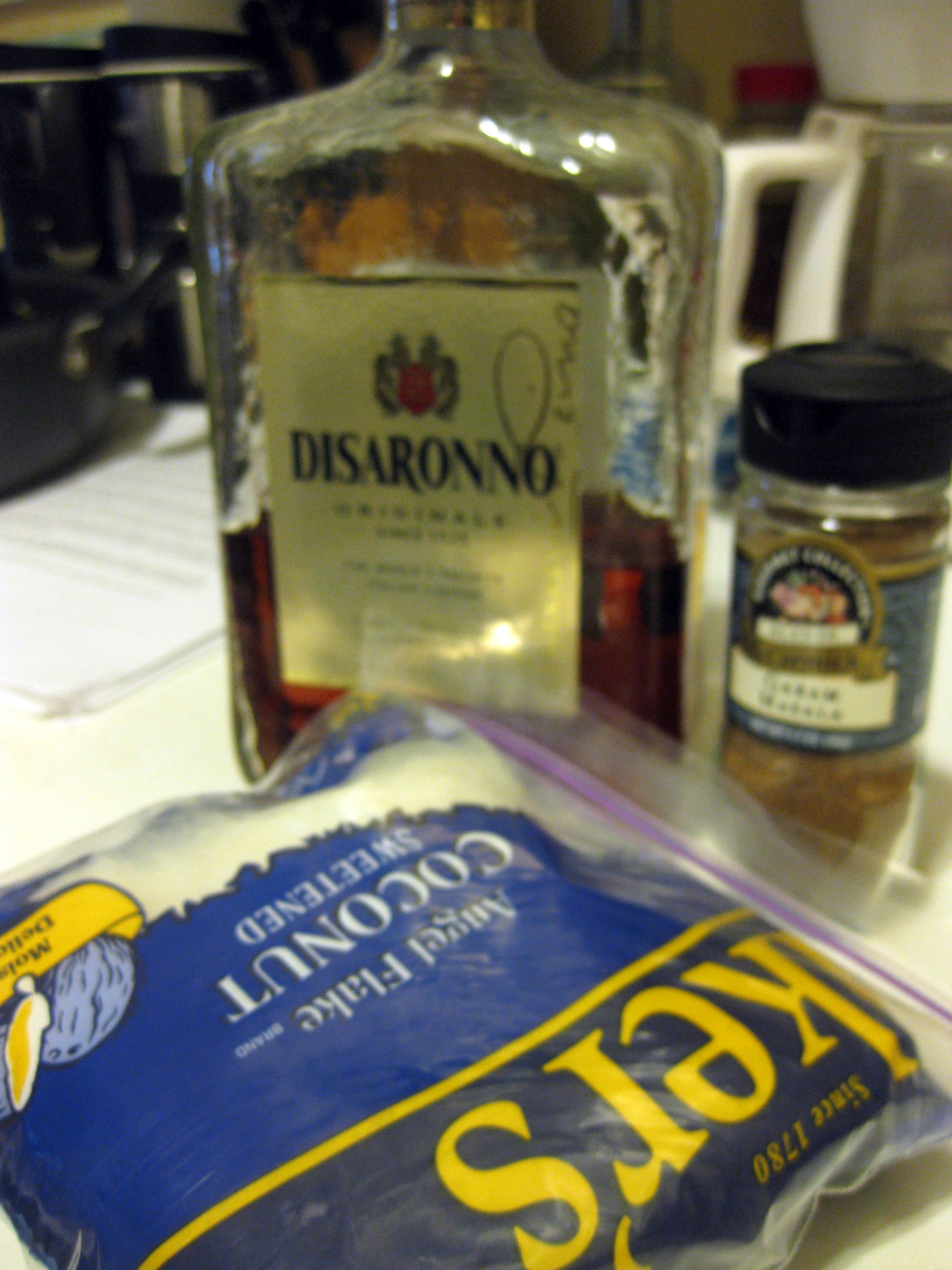
I must admit from the outset that my process was a considerable adaptation, spurred by a shortage or downright lack of both ingredients and time to obtain more.  I used the following:

2 cups sweetened shredded coconut

¼ tsp garam masala

Pinch of salt

2 lightly beaten egg whites

1 tsp amaretto liqueur

From there, I followed Bittman’s directions exactly.  At the point the house began to smell like a vacation, I pulled the cookies from the oven and, unable to resist, stuffed one that collapsed from its fragile form into my mouth.  Oh heaven.  It was incredible.  The coconut was still chewy, and I’m pretty good with words, but the mixture of spice and salt did something I can’t describe.  Cooks are always saying salt enhances the other flavors of the dish, and that’s what happened here.  The coconut and egg whites suggested lightness and airy tropical sweetness, while the garam masala was incense and thick dark spice, but just the barest touch: a perfumed, candle-lit temple down the road from an endless white sand beach.  Fanciful, you say?  What can I tell you… coconut is one of my favorite flavors, and when it is elevated to such heights a certain mystical religiosity is perfectly appropriate.

The cookies were quite tender, and some declined to hold together at all.  This made them easier to eat, in a way, because they were already breaking themselves for us – all but insisting upon their own sacrifice – but the next time I attempt them I want them to hold together better.  I may cook them a little longer, or perhaps beat the egg whites more vigorously.  You wouldn’t want stiff, or even soft, peaks, but perhaps an approach to peaks would help the coconut cling together.  Nevertheless, three girls in the space of an hour decimated a plate of macaroons, leaving behind only three stragglers who were so lonely that I found them a happier home the following afternoon as a reward to myself for accomplishing some much-needed reading.  I must say, the lift from an analysis of 14th century poetic aesthetics into all-but-mystical flavor vacation is about the best an afternoon snack can do. 

Salty sweet

Week 4 of my project (hear that, everyone?  That means January is over and I’ve stuck with my resolution!), and we’ve had our first gathering of ingredients that resulted in a not-amazing dish.  I’m going to share it anyway, though, in the spirit of the project, because I have some ideas for amendment.

“33. Cook Israeli couscous in stock or water.  With a fork, stir in chopped, pitted Kalamata or other olives, chopped green onions and diced, poached or roasted sweet potatoes.  Dress with a vinaigrette.”

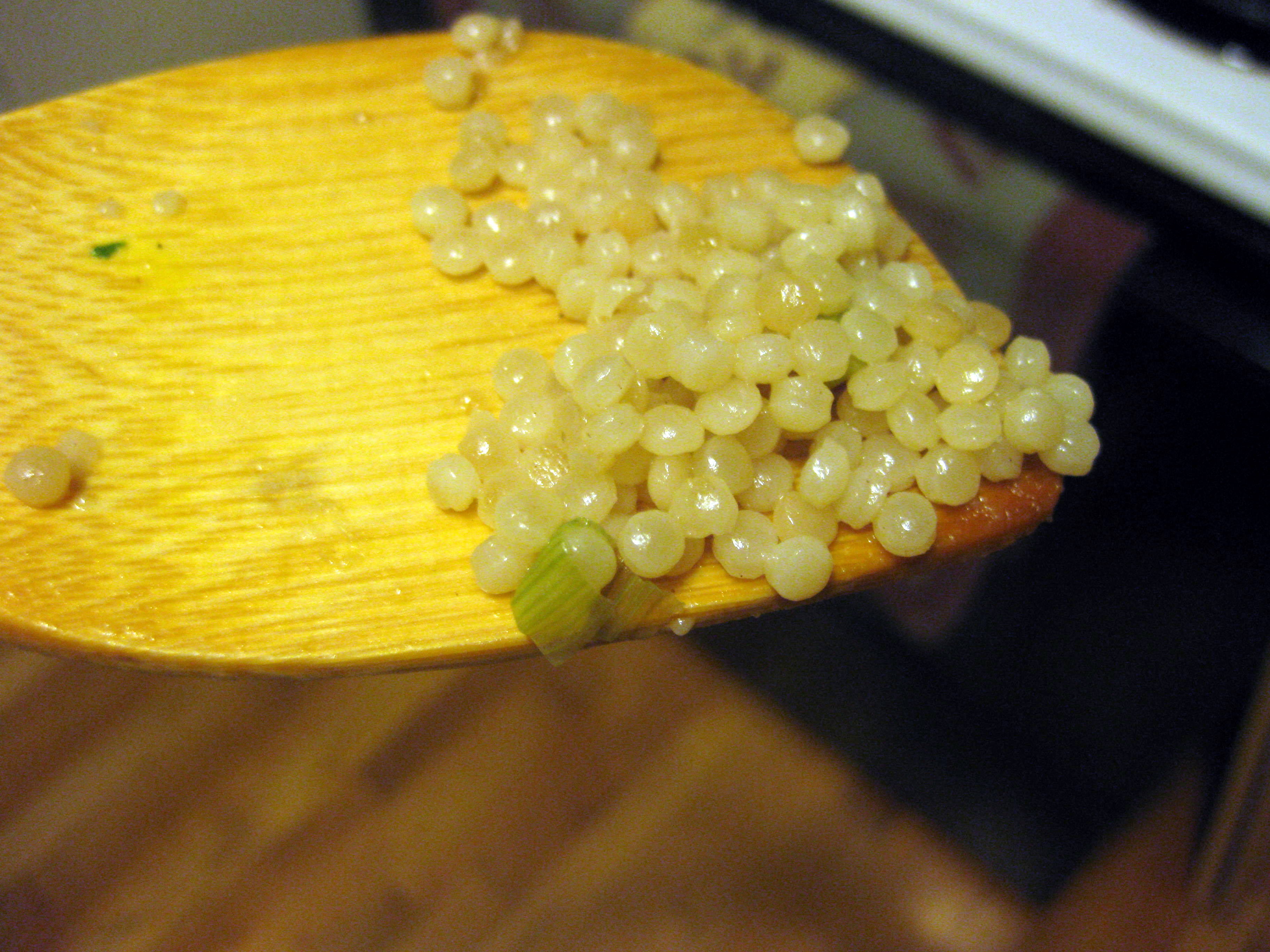
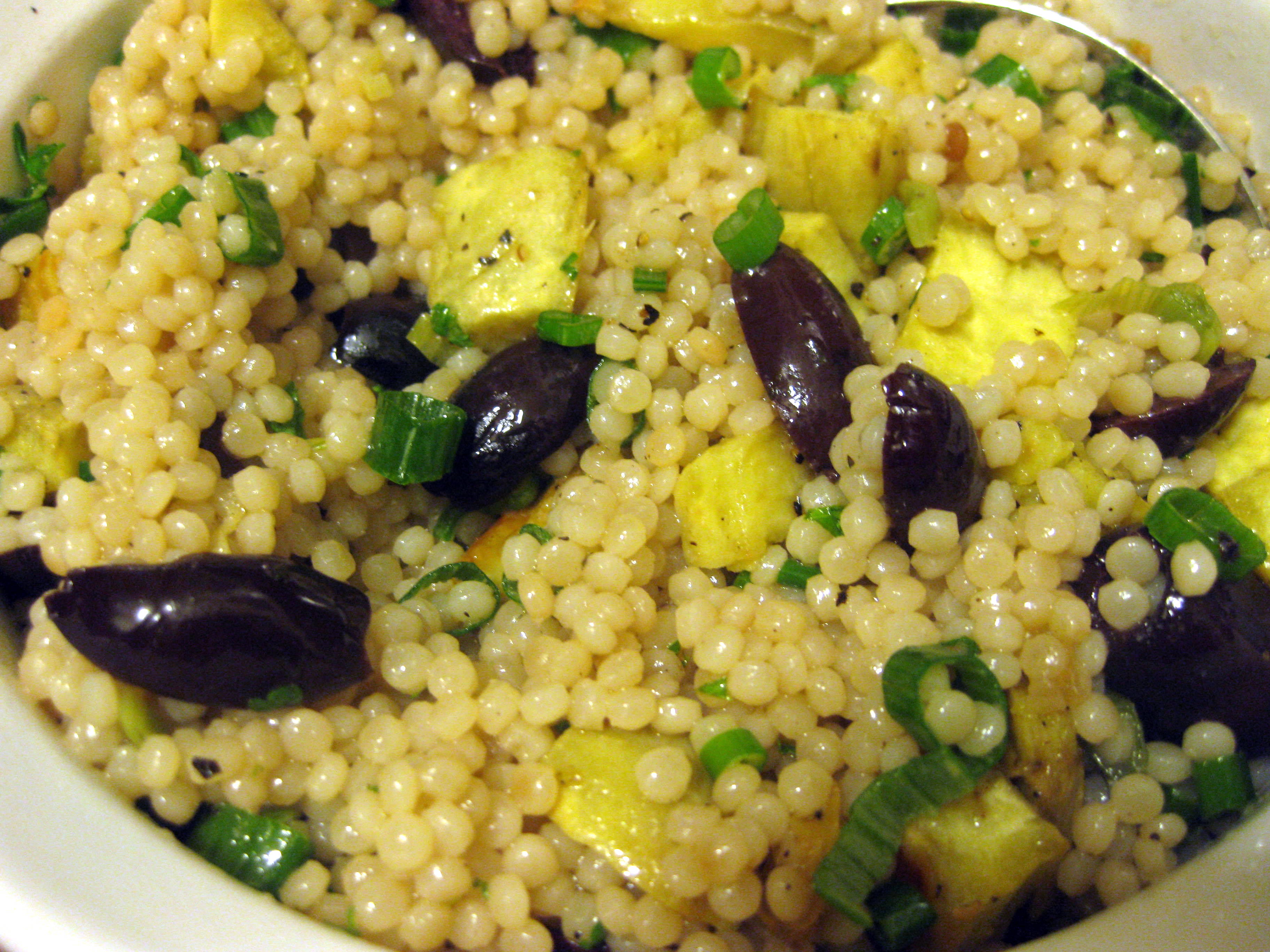
Dutifully, I found and purchased Israeli couscous and cooked it in chicken stock.  I roasted cubes of an enormous sweet potato because I thought the flavor would be more intense and therefore more exciting than just poaching it.  I halved my olives instead of chopping them finely because I was feeling a bit lazy, and I stirred together a vinaigrette of red wine vinegar, a squeeze of dijon mustard, a dribble of honey, and olive oil.  I dressed the couscous while it was still hot, as I’ve learned from experience with pasta salads that this helps the flavor of the dressing permeate the pasta.

And then we tasted.  The couscous was chewy and intriguing, like savory little balls of tapioca.  The green onions were crunchy and fresh, the olives were briny and salty and rich, and the sweet potato was… sweet.

I’m a fan of salty-sweet.  I like chocolate covered pretzels, I love salted caramels, I think craisins are a perfect accompaniment to roasted nuts, but this combination just didn’t thrill me.  Maybe we just had a too-sweet-sweet-potato, or maybe the olives should have been in smaller pieces to lessen their impact, or maybe I wasn’t in the mood for the reminiscences of Thanksgiving, but I think it just wasn’t the perfect collocation of ingredients for our usually investigative little taste-buds.  What I was wanting, I realized halfway through dinner, was acidity – more than the mildly tart vinaigrette I made was offering.  I wanted lemon zest, or capers, or even the glorious salt-packed earthy richness of anchovies.  And then I realized I wanted the dish to be Shauna and Danny’s Pasta with Lemon, Anchovies, and Olives.  And now that’s all I can think of.

So my recommendation for this collection of ingredients is to make one substitution.  Cook up the couscous.  It is filling without being overbearing, and the green onions and vinaigrette lighten it up.  Chop up the olives and fold them in, unapologetic.  They are delicious and they know it.  But leave out the sweet potato.  Replace it with something more savory, like sundried tomatoes or capers or shards of prosciutto.  And then add a squeeze of lemon juice and a few teaspoons of zest.  It will change the tenor of the dish.  It won’t marry nicely with roasted turkey and cranberries and mashed potatoes and green bean casserole anymore.  It won’t be out of place as a fresh take on pasta salad in the summer.  It wouldn’t complain, if you paired it with grilled chicken, or sausages, or Mediterranean-spiced kebabs.  But it will, I think, be good.