Creme Anglaise

Food blog June 2014-3984Everyone starts off in the kitchen somewhere, whether it’s spreading peanut butter thickly onto a piece of barely toasted bread, or stirring spaghetti tentatively with a long-handled wooden spoon and watching it relax into the water, or even scrambling eggs because the planned entrée for that night looks “weird.” In my case, I started with dessert. Cookies and cakes were the first things I “helped” make, which probably explains why I’ve developed such a sweet tooth over the years. Mom would let me stir batter, pour pre-measured cups of sugar, taste a beater. She was there while I jammed my thumbs into an egg trying to crack it, while I spilled powdery fluffs of flour onto the counter and sometimes the floor. She was there, though not watching, when I had my first lesson in ingredient deception: my first taste of cinnamon. A few brown grains on the counter, a small, damp index fingertip, and the sourest face dipping away from the countertop. Vanilla extract was the same way. Each time, I’m sure Mom turned and saw, and probably tried not to laugh, as I learned that in dessert as in so many things, a dose of sugar makes things better.

Food blog June 2014-3981It seemed only fitting, then, when I embarked on the dessert selection of my sauce project, that Mom should be there. Together, in my bright, narrow kitchen, we talked and laughed and spilled and fumbled our way through crème anglaise.

Food blog June 2014-3959Crème anglaise is essentially an all-purpose dessert sauce, and provides a base for so many lovely simple sweets. Egg yolks, cream, sugar, and some vanilla for flavor, cooked gently but whisked fervently, and you have a beautiful, rich sauce that lovingly coats the back of a spoon. Cooled, run through an ice cream machine, and shoved impatiently into a freezer, you’d have vanilla ice cream. A few more yolks and a long, slow bake in the oven, and you’d have crème brulee. Some cornstarch to thicken during the cooking process? Pastry cream. But left liquid and chilled, it makes a beautiful summer treat poured in decadent quantities over a bowl of glistening berries. And if you want to build the whole thing atop a slice of cake, well who am I to stop you? Since Mom and I are both grown-ups now, we added a whisper of bourbon to our creation, for a floral warmth and slightly more complex flavor.
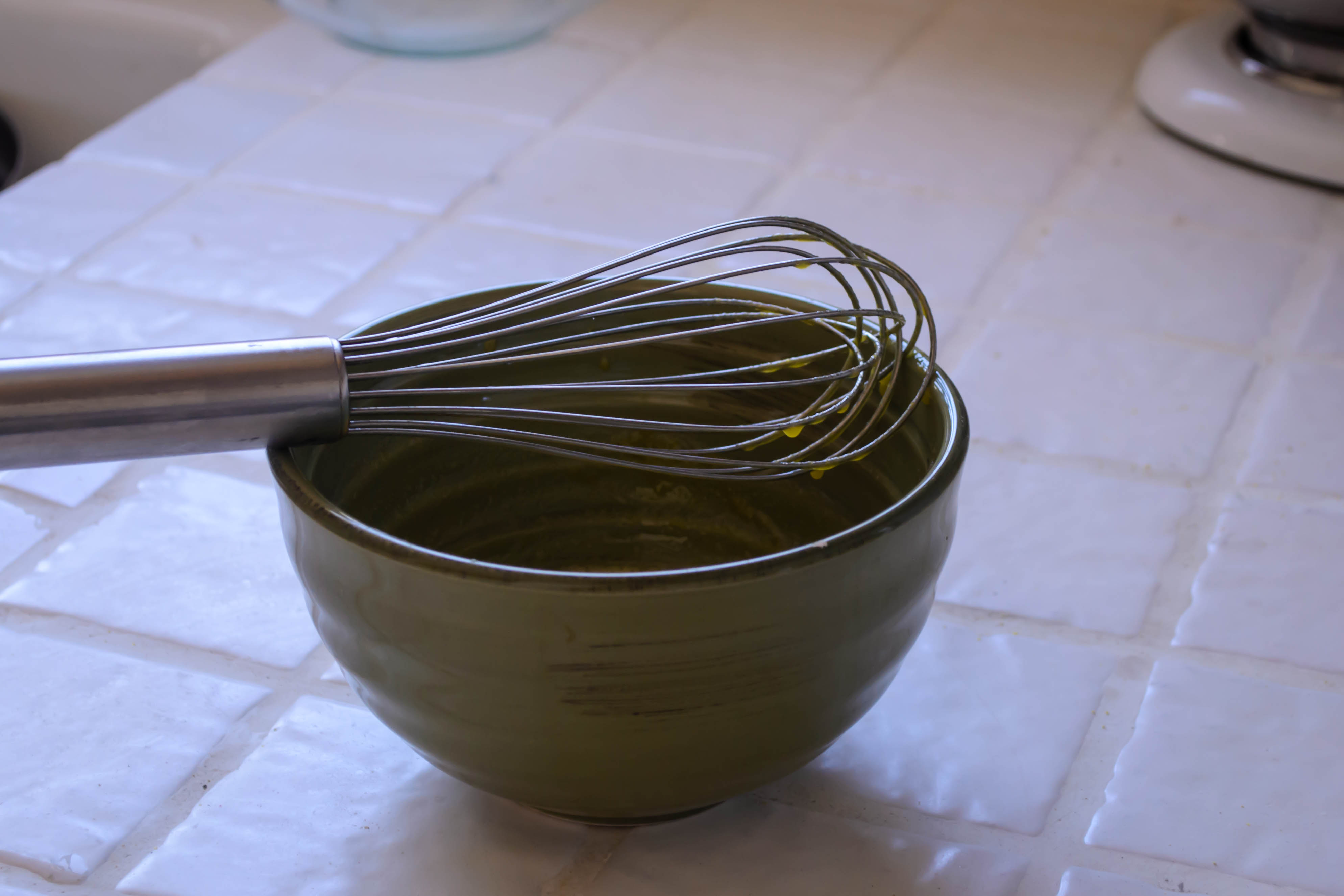
Food blog June 2014-3969I think the hardest thing about crème anglaise is waiting for it to cool so you can eat it. But the second hardest thing, which is not much of a challenge at all, is separating the eggs. This isn’t as dicey a prospect as separating the whites for a meringue or angel food cake, because a bit of white slopped in with the yolks does no damage at all. It’s just that we are after the glossy, dense fat of the yolk here, and so the light liquidy quality of the whites is better saved for something else.
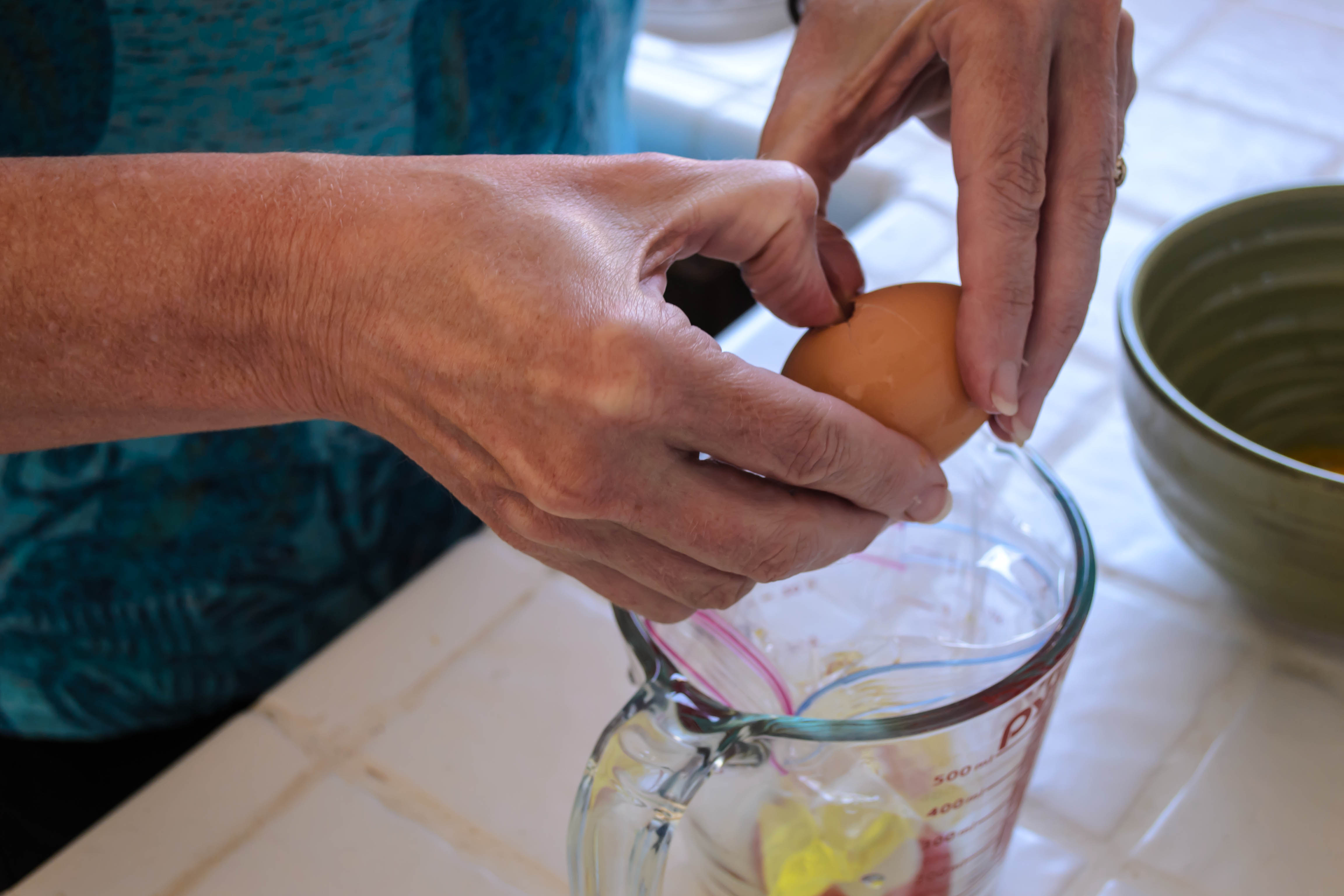
Food blog June 2014-3964Food blog June 2014-3965Food blog June 2014-3966I prefer to separate my eggs by plopping the yolk back and forth between the halves of shell, letting the white drip down directly into the open mouth of a zip-top freezer bag. Once most of the white has detangled itself, I add the yolk to my work bowl and move on. You can also crack the egg directly into your hand and let the white ooze down through your fingers, while the yolk stays plump and golden in your palm, but the shell method works better for me. When all the whites are contained in the baggie, I write the number and the date on the outside and freeze it for later use.
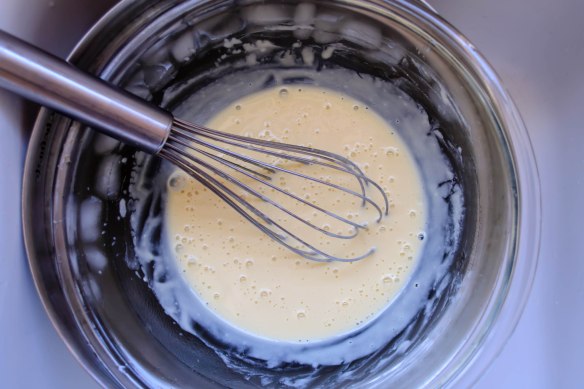
Food blog June 2014-3973Food blog June 2014-3970Eggs managed, it’s a simple prospect of whisking in some sugar with the yolks, heating milk and cream together, adding the warm dairy to the thick, sweetened yolks, and cooking the whole thing to a thickness like, well, melted ice cream, since that’s basically what it is. Incorporate flavorings, strain the mixture to ensure a nicely textured final product, and chill until ready to use.

Food blog June 2014-3980With berry season upon us, I see no better motivation to make this sauce. Maybe for your mom. She’ll probably love it.

Food blog June 2014-3986

Food blog June 2014-3987Crème Anglaise
Barely adapted from Michael Ruhlman’s Ratio
Makes about 1 ½ cups sauce
½ cup heavy whipping cream
½ cup milk
3 egg yolks (save the whites for another treat)
3 tablespoons granulated sugar
1 teaspoon vanilla
1-2 teaspoons bourbon (optional)


  • First, prepare an ice bath by filling a large mixing bowl with water and ice cubes. Set another bowl inside, so it rests in the bath but is in no danger of getting water inside.
  • In a small pot, warm the milk and cream together to a bare simmer.
  • While the dairy warms, whisk the egg yolks and sugar together in a medium bowl until quite thick. You want the sugar to be well incorporated to make the integration with the liquid easier.
  • When the milk and cream are just simmering, slowly – and I mean slowly! – pour them into the yolk and sugar mixture, whisking the whole time. If you pour slowly and whisk assiduously, you will end up with a smooth, thick mixture. If you don’t, you will end up with scrambled egg yolks.
  • Pour your smooth sauce back into the pot and cook over medium heat, whisking constantly, for 2-5 minutes, until the sauce is thick that when you dip in the back of a spoon and draw a line through the coat of sauce with your finger, the line remains clean.
  • Add the vanilla and bourbon, stir, and remove from heat.
  • Pour the sauce from the pot through a strainer and into the bowl you’ve rested in the ice bath. Whisk or stir as it cools to room temperature, then liberate from the ice bath and refrigerate until cold. Serve however you wish. I recommend a mixture of fresh berries, with or without a slice of moist cake, but a plain old spoon and no interruptions would be just fine too.

Coffee ice cream (and an unexpected love story)

Ah, expectations. They can be weasel-y little twerps, don’t you think? We organize our lives around them, constructing hope-castles, forts stabilized by plans that don’t pan out, two-story shambles resulting from too many taken-for-granted ideals. Expectations bolster us. And then they dissolve into crumbs, or explode, or sink, or flop around in directions we weren’t expecting.

Food Blog February 2014-3214In college, I had sky-straddling expectations. I expected to figure this life thing out in the first year or two. I would be at the top of my major. I would make decade-spanning friendships. I would collect acclaim, graduate with honors, make my parents proud, especially my dad. I expected to land a perfect career, garner financial success, all while also a perfect wife, mother, homemaker, lover, even though I didn’t know what that entailed yet. I expected to write a novel or two along the way.

Food Blog February 2014-3187I didn’t expect to fall in love with an older version of our language and want to study its literature forever, setting me up for a career path typically paved with loans and let-downs. I didn’t expect to struggle with roommates or friendships or classes. I didn’t expect to have my heart torn by the gentle trampling of a pair of shining sneakers, in snap-up track pants, driven by reasons that probably involved a raucous house full of boys, boredom, and possibly a brunette with glasses.

Food Blog February 2014-3186But after that, I tried to give up on expectations. I would stop thinking “everything would work out.” I would stop expecting him to realize he’d made a mistake. I would stop, oh please, I would stop, writing terrible mopey songs about this person who wasn’t even the same person anymore. I would just live. I would just try to be me. I wouldn’t ask someone else to repair the torn bits for me, because that would be expecting too much. And since I’ve never been much of a seamstress, my repairs were clumsy. I was patched, the stitches were irregular, and I felt worn and fragile but maybe whole, and maybe a little bit strong.

Food Blog February 2014-3178And then I met N. And because I was done with expectations, I didn’t expect anything at all. Not even a friendship. It would be a, well, a something. It might be fun, it might be sweet, but it would end. We were seniors. We were going somewhere. We didn’t know where yet, because we weren’t expecting anything, but we were sure of little, then. We spent phone calls trying to scare each other away by explaining our neuroses, and our cynicism, and what we considered our more unlovable attributes. I hate phone calls, but ours would last hours.

Food Blog February 2014-3179I’m not going to say, at this point, that because N. was worn and patched and had sewed his heart back together in an irregular shape too that these two odd shapes fit perfectly together and made one another complete – my ventricle, his aorta – because I don’t believe in that. We were both whole people before, and we are both whole people now. I’m not a half, and I wouldn’t want N. to be either. But because he was patched up too, and some of my stitches were snagged like his, he was better able to understand me. We weren’t what we expected. The thing about patches is, they hide but don’t erase the worn spot. Every stitch, meant to repair, could also re-harm. But when you are patched and stitched up, and you still feel raw from that needle of hope and trying and blistering independence loneliness solitude you weren’t sure you wanted, you know how to see that in someone else, and you know how gently you have to reach out. Or how hard. We weren’t what we expected, no. But ten years into a relationship, and seven years into a marriage, he defies and surmounts and explodes any expectations I could have had. And I wouldn’t have it any other way.

Food Blog February 2014-3182This, oddly enough, brings me around to Valentine’s Day, and to ice cream. This is, you may notice, a bit heavy, a bit confessional, for me. I wasn’t expecting to tell you all this. But we’re approaching that holiday that is supposed to be about love, and I’ve always felt a little torn and patchy about it (the day, not the love), so here we are.

Food Blog February 2014-3213I had big plans for our Valentine’s Day celebration. I’m not talking about me and N. He’s always hated Valentine’s Day, probably thanks to that whole expectations thing. I’m talking about us. You and me. We were going to have soufflé. And not just any soufflé; chocolate soufflé. I wanted to teach you a quick, easy, all-but-fool-proof version of the dessert, one that I’ve now made for several big-deal-must-impress events with zero problems, so you could defy someone’s expectations this Valentine’s Day. Maybe even yours!

Food Blog February 2014-3215I had never thought about serving soufflés with ice cream. A lovely sweet drizzle, yes. A liqueur infused caramel or cream, completely. But when I saw Lindsay’s chestnut soufflé with matching ice cream a few weeks ago, and when I watched a recorded episode of Nigella Lawson making a coffee ice cream that required no eggs and no churning, I knew this would be our Valentine’s Day pairing: deep, dark, rich chocolate soufflé, and an ice cream so easy, so deep, silky as satin lingerie and toasty with espresso (because hey, you might need that shot of caffeine on the evening of Valentine’s Day!), it would be perfect. I would be perfect. I even half-bragged in a comment on Lindsay’s post about how easy soufflé-making is, once you get the hang of it.

Food Blog February 2014-3216And so, expectations. Because I don’t know what happened – maybe my eggs were too small (they were of the homegrown variety, given to N. by a student), maybe I didn’t whip the whites enough, maybe I scrambled the yolks a little or the chocolate seized or the oven was too hot – but my soufflés were a disaster. They rose only a few reluctant centimeters. They were dark and rich, but dense, thick, almost crumbly where they should have been flat-topped trembling pillows.

I despaired. But then I remembered me, and my patchwork, and that I had this ice cream that was so so creamy, and so thick, and so tasty and light and dangerously easy, that in fact the soufflé was hardly necessary. It may even have muddied things. And so, I put expectations aside again, the better to embrace what I had.

Food Blog February 2014-3217Nigella’s ice cream does not start with a custard. It combines unlikely and few ingredients: sweetened condensed milk, double cream (a British institution we would do well to adopt), espresso powder, and a few tablespoons of coffee liqueur. I made a few changes, inspired by my own insufficiencies and a suggestion from a commenter on the original recipe. For a slightly lighter result, I replaced some of the double cream with whipping cream. For want of coffee liqueur, I replaced it with Irish cream. The liqueur serves two purposes. First, it deepens and enhances the flavor of the ice cream. Second, it offers a textural benefit: since alcohol doesn’t freeze (or at least it freezes at lower temperatures than water), the ice cream maintains a soft, scoopable consistency indefinitely (not that you’ll have long to find out – I suspect you’ll eat all of it before conclusive data can be gathered).

And so, I send you into the week of that dubious, expectation-laden lovers’ holiday with this: I hope you are happy, and that your version of love, whether it is patched and fragile, or hearty and unblemished, is at least in part directed back toward you. Because no matter what your expectations have told you, you are lovely and perfection is overrated. And I think ice cream is a perfectly suitable Valentine to send yourself. I recommend this one.

 Food Blog February 2014-3219

No-churn, no-egg Coffee Ice Cream
Adapted from Nigella Lawson
Makes a generous 1 pint
 
2/3 cups sweetened condensed milk
1 cup heavy whipping cream
6 ounce jar double cream (I found mine at Whole Foods)
2 tablespoons Irish cream or coffee liqueur
2 tablespoons instant espresso powder


  • Dump all ingredients as unceremoniously as you like into the bowl of a stand mixer. You could do this in a regular mixing bowl with a hand-held mixer too.
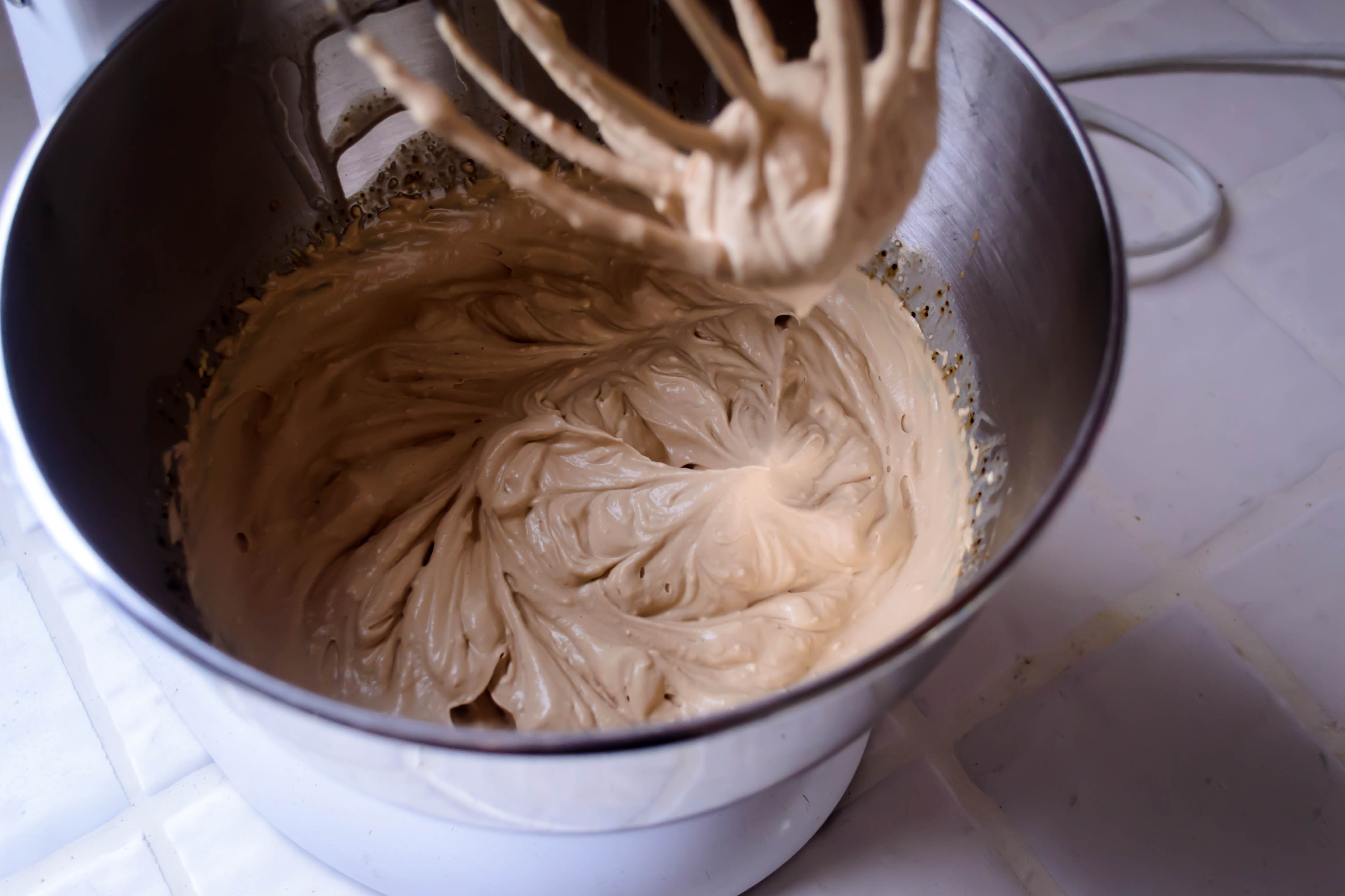
  • Using the whisk attachment (or regular beaters), whip on medium speed until soft peaks form. For me, this took only 3-4 minutes. It may take more or less time for you depending on the speed of your mixer.
  • Using a rubber spatula, scrape the fluffy, coffee-scented clouds into a freezer friendly container – I used a clean empty Greek yogurt tub – and freeze for at least 6 hours to let the mixture harden up.
  • Serve atop a soufflé, or with whipped cream, or in a cappuccino, or with fudge sauce, or just with you and a spoon and a spot against the refrigerator door.

Savory Greek “cheesecake” dip

Food Blog December 2013-2977Ricotta cheese and I have a strange (strained?) relationship. I want to love it. Dishes in which it features – lasagna, calzone, a certain breed of cheesecake – sound to me decadent and worthy. But when I do eat it, I feel torn. It’s a texture thing, isn’t it? It has this graininess – a kind of luscious roughness that doesn’t feel quite right. I want it to make up its mind. Either be feta, all craggy and crumbling and tang, or be mascarpone, relentlessly silken. But ricotta is neither. It resists singularity. It hovers in the middle there, taunting me with its bothness.

Food Blog December 2013-2967Just before our annual in-laws holiday shuffle, I needed to use up some of our perishables, and there was half a container of ricotta, lonely and renounced in the back corner of the fridge. With lemons coming in on my backyard tree, I suddenly thought of a feta dip flavored with lemon zest and oregano and garlic that I’ve made dozens of times, and wondered how it would fare with this creamy cousin as its star player. I’d also been itching to try baked ricotta, after hearing that it transforms in the oven into something airy and rich. With a block of cream cheese also wailing its abandonment and crackers to use up before the trip at the end of the week, hey presto, my lunch menu was suddenly all about a savory Greek inspired dip.

Food Blog December 2013-2972Unlike a standard baked ricotta, I didn’t add any eggs here. This omission, plus the addition of cream cheese, kept the dip quite thin – not the quasi-souffle texture you might be expecting. Were I to make this again, I might add an egg or two just to puff it up a bit more. If you try it that way, let me know how it turns out.

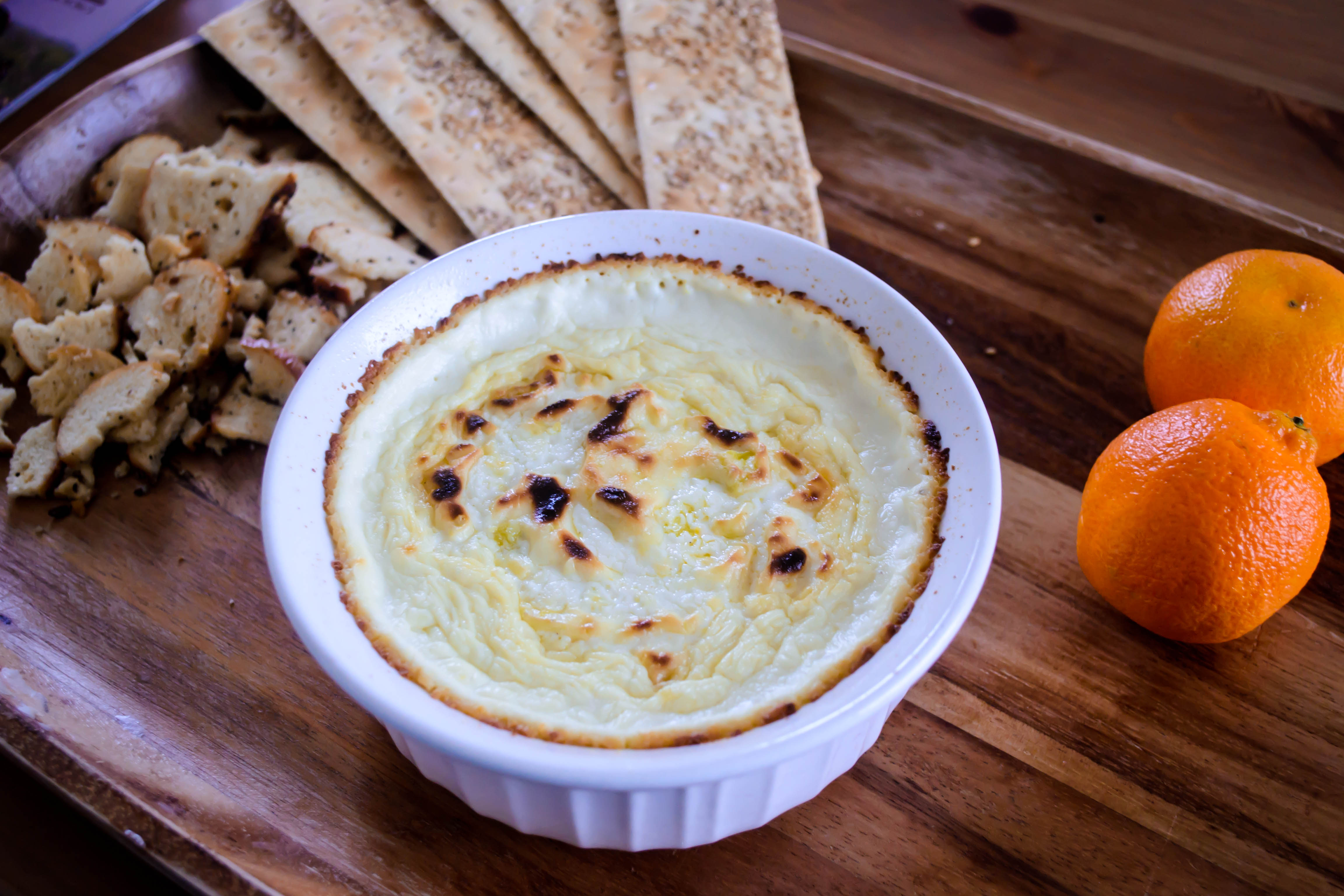
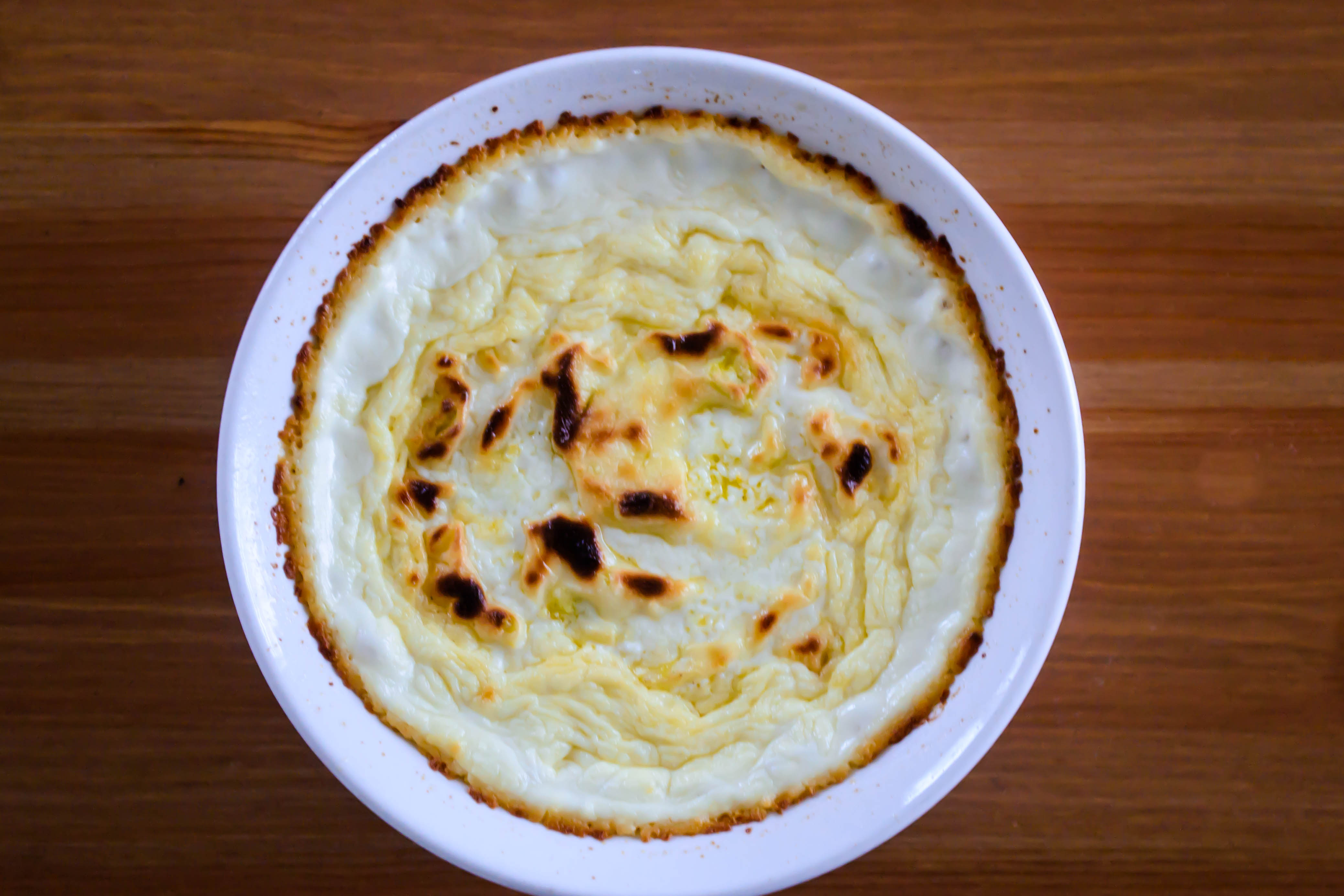
Food Blog December 2013-2973Thanks to these changes, what you’re getting here is essentially melted creaminess that, at least when it’s hot, won’t even need spreading, covered by a layer of golden-brown bubbles that are easily pierced with the persistent corner of a cracker. It’s soft, it’s hot, it’s herby and spicy and perversely fresh, thanks to the lemon zest, and while I had it with crackers, it could be easily compelled to drape itself over sticks of fresh vegetables or bread. Pita chips, too, would be particularly nice. I’d be clever and current and say it would make a superb addition to a Superbowl game day spread, but I’ve narrowly missed that opportunity which, for me, seems somehow fitting. Instead, bake yourself a batch of this to fend off the post-holiday cold of the next month or two, when winter always seems the longest. Food Blog December 2013-2975

Savory Greek “cheesecake”dip
Makes a generous 1 cup
4 ounces ricotta cheese, at room temperature
4 ounces cream cheese, at room temperature
2 cloves garlic, finely minced
Zest of one lemon
¼ teaspoon dried oregano, or ½ teaspoon fresh, finely chopped
3 pepperoncinis, finely minced
Salt to taste (start with ¼ teaspoon)


  • Preheat the oven to 400F and spray or oil a 16 ounce (2 cup) oven-safe dish. I used the smallest soldier in my Corningware collection.
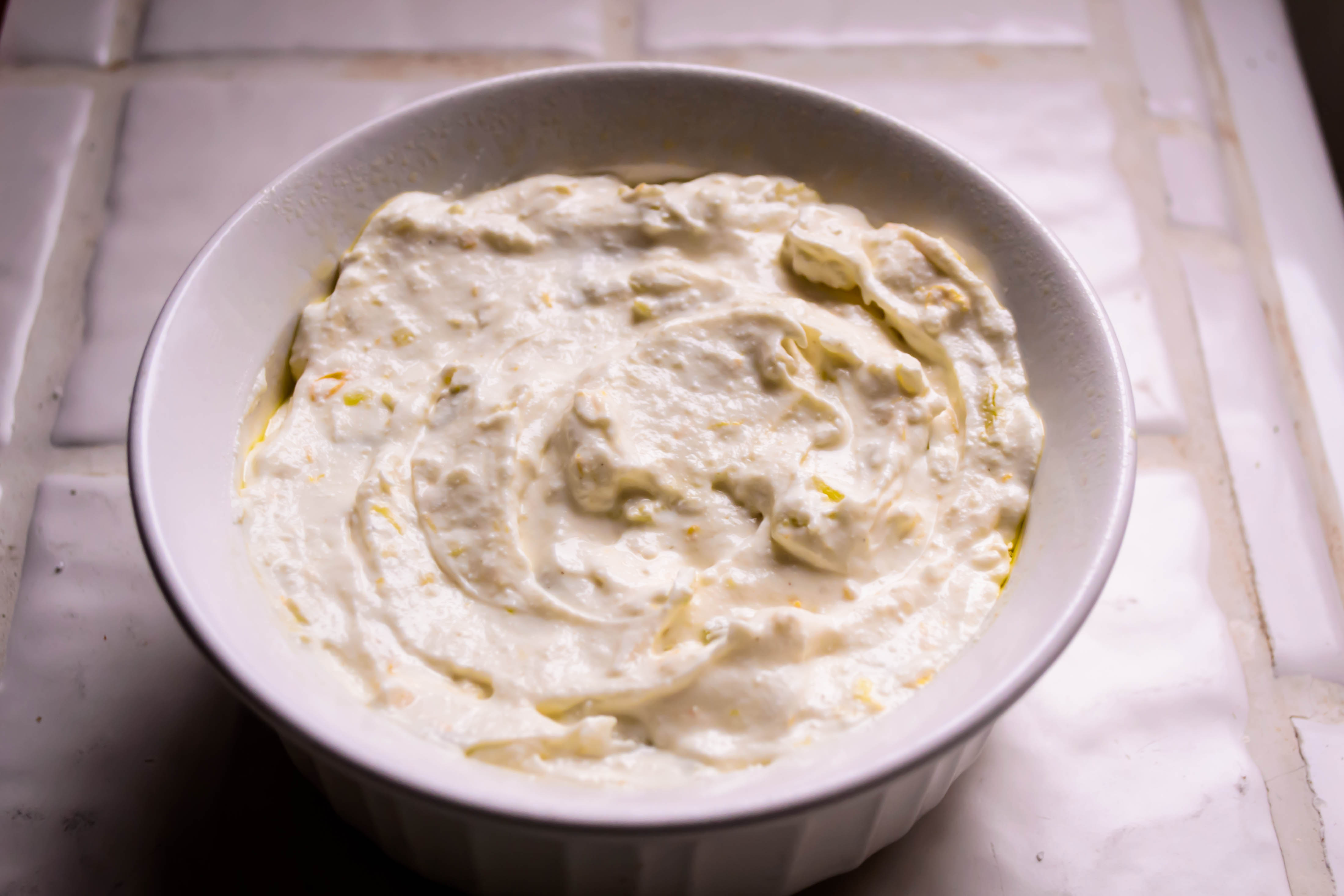
  • In a small bowl, mix the cheeses thoroughly until they are quite smooth. Lumps are the enemy here, as they signal incomplete incorporation.
  • Add the remaining ingredients, mixing well to combine evenly. Taste for salt and add more if needed.
  • Using a rubber spatula, scrape into your prepared dish, smoothly the top a bit for even browning.
  • Bake for 25-30 minutes, or until the top is burbling and oil is sizzling around the edges.
  • If you want more browning, carefully place it under the broiler for a few minutes to let some of the bubbles turn deeply golden and barely crusty.
  • Remove from the oven and let sit for 5 minutes or so, just until it is cool enough to eat without scorching your throat. Serve with chips, thin slices of toast, crackers, or a crudités platter.

Project Sauce: Bechamel

I think it’s a good idea to start with the basics. I don’t rush my students straight into composing multi-source research papers; starting a new project here seemed to hold to the same strictures. I’m not racing right into hollandaise. I’m not drenching your January palates with demi-glace, homemade mayonnaise, or even beurre blanc (though these are coming, have no fear). No, we’re going to start with something foundational, and at least for me, something familiar: bechamel.

Food Blog January 2014-3092Here’s the thing, though. As I’ve dipped my toe tentatively into the field of culinary history (side note: one of my new secret pretend-careers is culinary historian – fascinating!), what stands out more and more brightly to me is how rarely familiar actually is. Bechamel is an excellent example. It’s a white sauce. It’s one of the classic mother sauces. It forms a base for numerous other sauces: the luscious cheddar and beer laced concoction you drape over toast to make Welsh rarebit. The silky, creamy mess redolent of parmesan that becomes alfredo. Even the simple melting glory you toss with elbow noodles to make macaroni and cheese (can you tell we’ll be delving into cheese sauces?!). But its history is not without contradictions. Even the Medici family figure into it! According to some Catherine de Medici brought a retinue of Italian chefs with her into France when she married Henri, Duke of Orleans, and bechamel sauce flowed straight from their kitchens out into the rest of France. There are stories that it was invented by (though more likely named for) a steward called the Marquis Louise de Bechameil. The tradition of reducing cream sauces probably began in 18th century France, but the “mother sauces,” of which bechamel is one, were created in the 17th century. And boiling or simmering food items in milk, as some bechamels do, goes back to medieval cuisine.

Food Blog January 2014-3086National and temporal origins aside, there are even disputes about what goes into it. I’ve always made a bechamel sauce from three main ingredients: butter, flour, and milk. But there are thoughts about what kind of dairy should be used, and which flavoring agents are permissible, and some traditional recipes even call for sticking an onion with cloves and letting this flavor the milk as it heats.

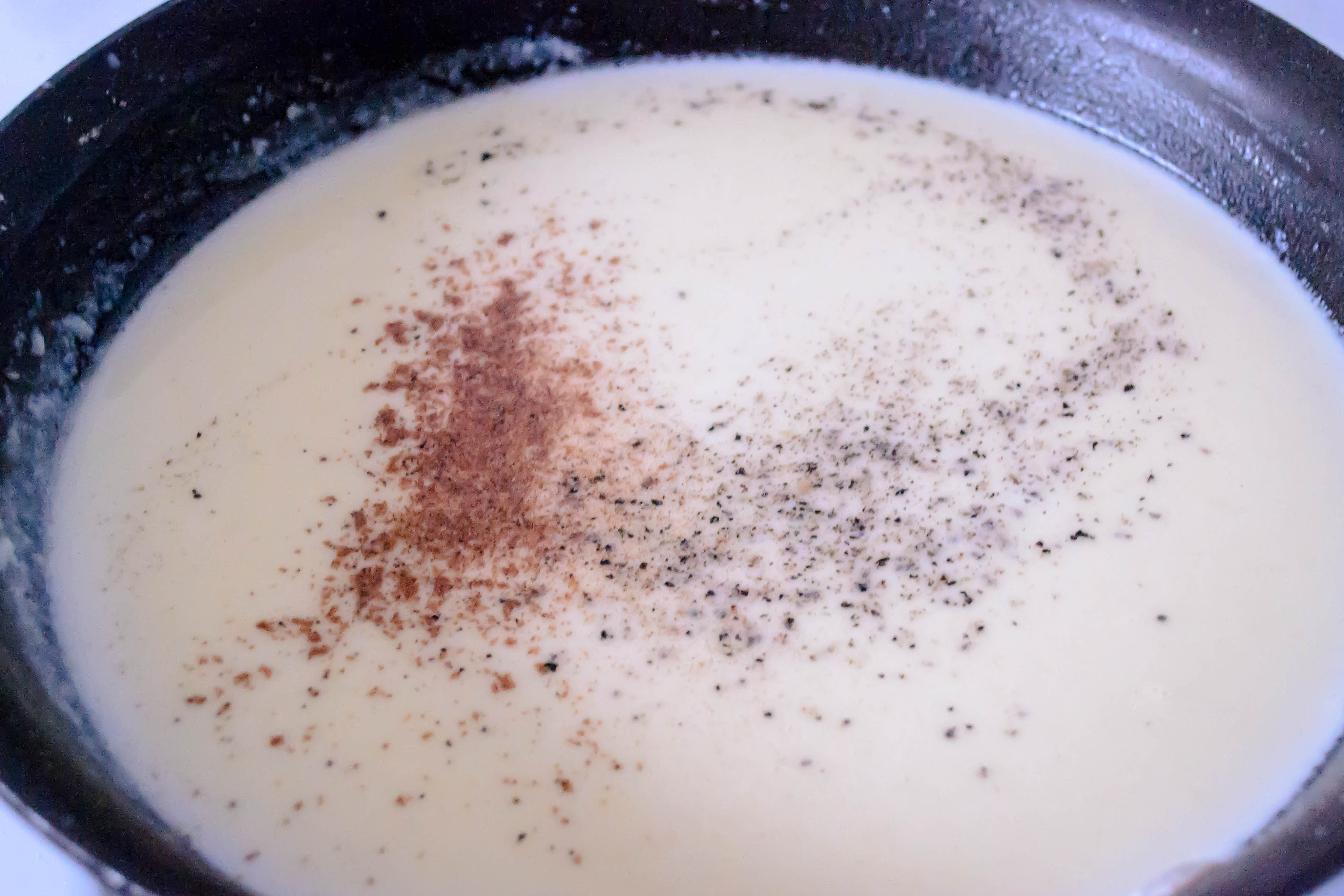
Food Blog January 2014-3090Lest we get confused right out of the gate, however, I’m going to stick with what feels familiar and comfortable. Butter, flour, milk. A pinch of salt. A grind or two of pepper. French traditionalists would have me use white pepper, since it won’t disrupt the homogenous ivory color of the sauce, but I like seeing those little specks of flavor. Not to mention, I didn’t have any white pepper in my kitchen. A sauce made of butter, flour, and milk can only taste like so much, so I’ve also adopted the Italian addition of some nutmeg, freshly ground, to amp up the flavor. Now we have a lightly speckled pool of creaminess, like the slight freckles on a fresh egg.

Food Blog January 2014-3087Here’s how a bechamel works: you melt butter, add an equal portion of flour, and cook for a minute or two to allow the flour to dissolve and distribute. This combination – equal parts butter and flour – is called a roux, and it is the classic thickening agent. Everything from gumbo to cream gravy is thickened with roux.

Food Blog January 2014-3088To transform the roux into a sauce, then, you have to add liquid. For bechamel, that’s milk. So we add a quantity of milk, preferably warm, a little at a time, whisking and whisking until a velvet smooth sauce forms. The quantity of milk added depends on the desired thickness of the final end product. Being sure the milk is warm, and adding it slowly, guards against lumps. This sauce is about luscious smoothness and creamy thickness. Lumps won’t do.

Food Blog January 2014-3117The magic of bechamel is that you won’t know how thick it is going to be until it starts to simmer. It takes a bit of time for the flour granules to hydrate, and only once they are fully incorporated and warm enough to bubble will the true viscosity of the sauce reveal itself. The one we are going to produce here gets just a touch thicker than a pool of melted ice cream. It’s easily pourable, but it will also coat the back of a spoon, clinging in a smooth layer until you, say, run a finger through it to have a taste.

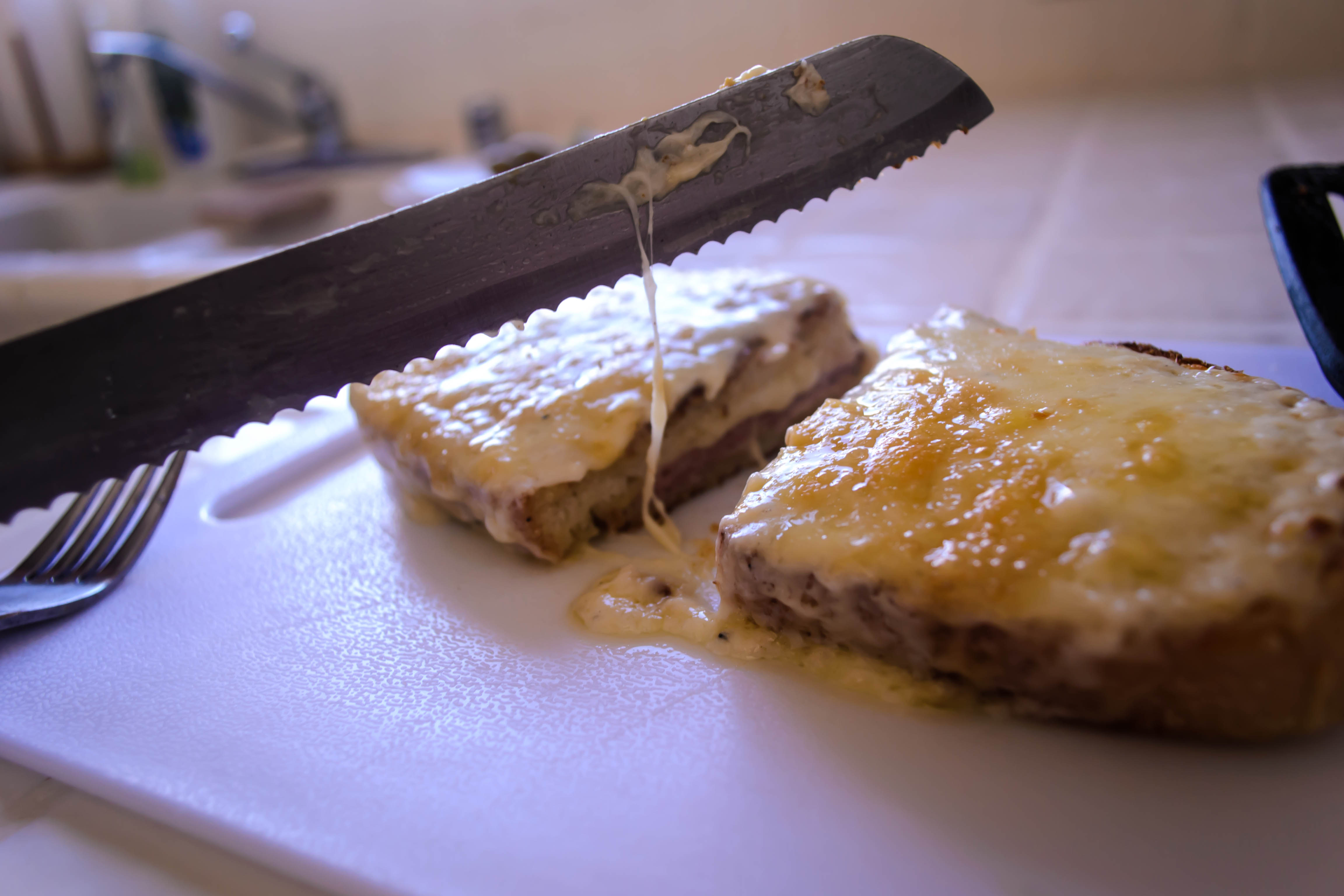
Food Blog January 2014-3119You can do a lot with a bechamel. As I noted earlier, it is the foundational component of a good cheese sauce. It’s also the classic white sauce component in a traditional lasagna. It can be draped over steamed vegetables, or make the base for a chowder or other cream soup, or even rest gently over a pounded, breaded, pan-fried chicken cutlet. But since I am working with classic and simple here, I wanted to go with a dish that really lets you experience the creamy loveliness of a bechamel: croque monsieur.

Food Blog January 2014-3122Now you’re raising your eyebrows. I know; croque monsieur is essentially a grilled ham and cheese sandwich. Ham and swiss, to be specific. It’s a name taken from the French verb croquer, which means “to crunch” or “to munch.” Thus the sandwich is, if I dare, a Mister Crunch. N. loved this. He’s been calling the sauce in question a “bleckmel” to make me laugh; he knows full well how to pronounce it (he did take French, after all), and he was so delighted by the literal translation of our dinner that he started to call it a “Crunchy Human” sandwich, eliminating the gendered title: a sandwich for everyone! (I should note, however, that there is a “female” version of this sandwich: a croque madame is the same grilled ham and swiss, with the addition of a gently fried egg on top.)

Food Blog January 2014-3127So let’s do this. A perfectly crunchy sandwich, laden with melting swiss and a thin layer of smoky, salty ham, topped with spoonfuls of perfectly creamy bechamel, sprinkled with more cheese, and broiled until golden bubbles swell on the surface. It’s a fork-and-knife sandwich, and it’s far from a light lunch, but it is, I think, a good way to start.

Food Blog January 2014-3130

Bechamel
Makes approximately 1 ½ cups
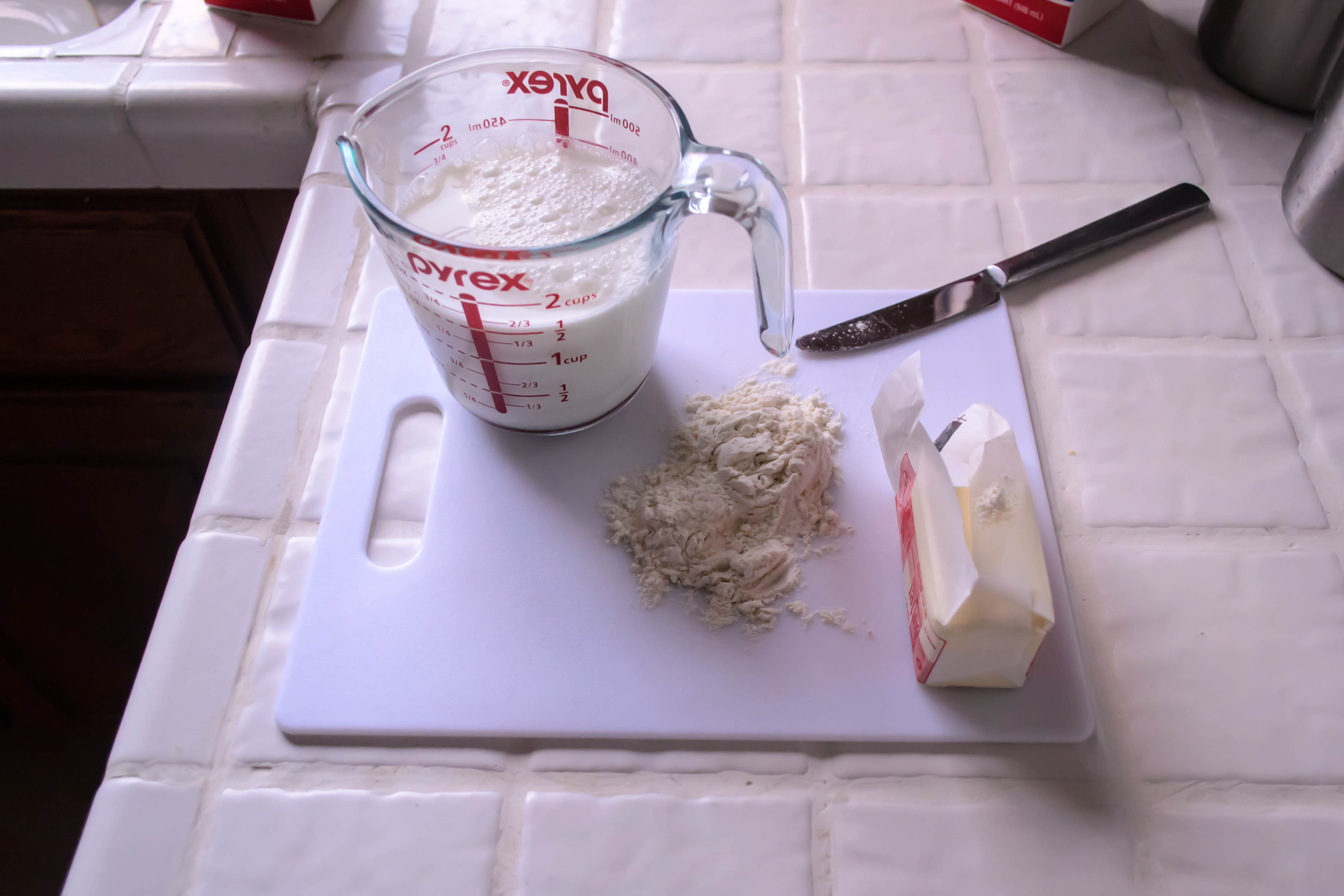
2 tablespoons unsalted butter
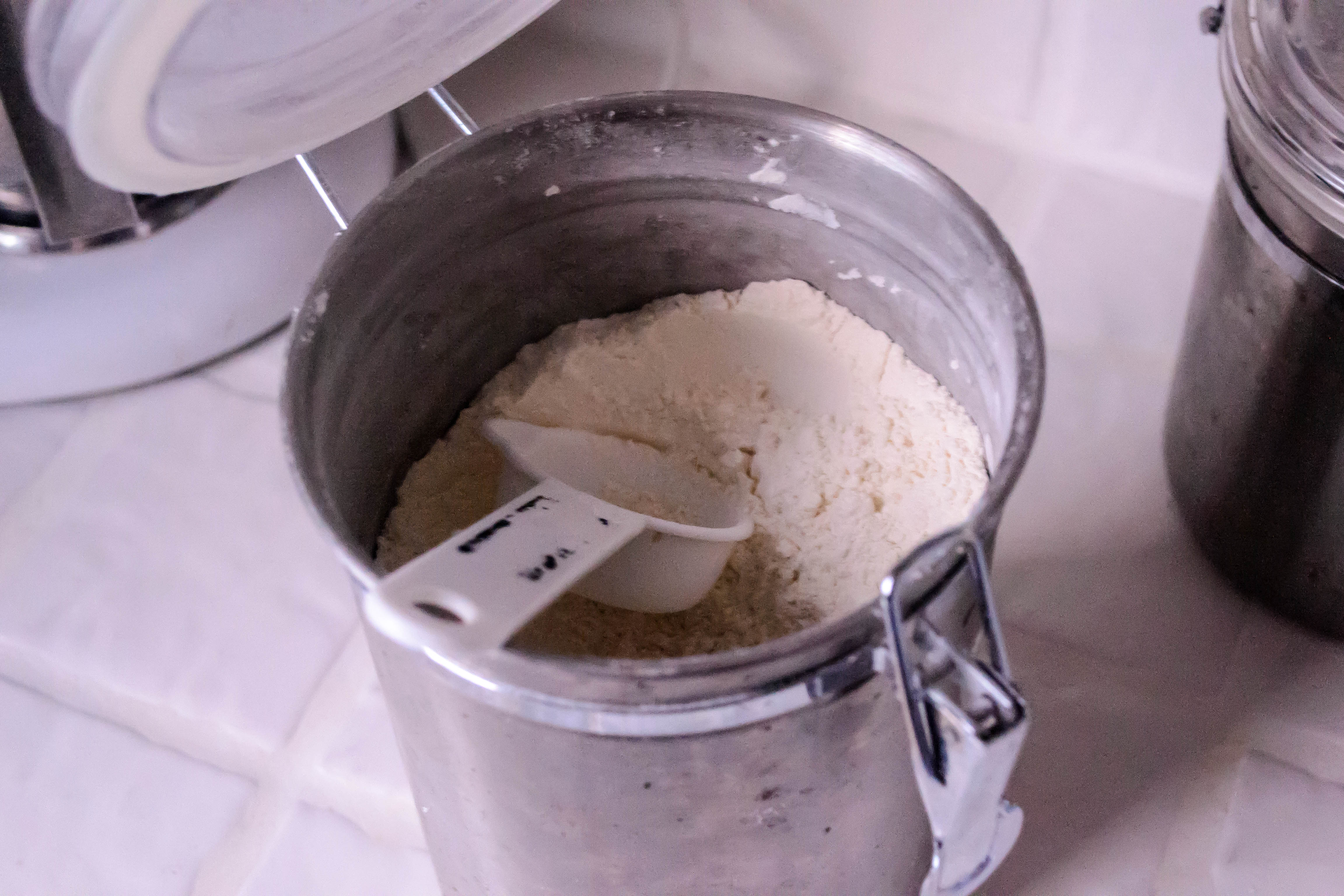
2 tablespoons all purpose flour
1 ½ cups whole milk, warmed slightly in a saucepan or in the microwave
a pinch each salt, pepper (white is traditional, but I used black), and nutmeg (freshly ground is preferable)
  • In a medium pan, melt the butter over medium to medium-low heat.
  • Add the flour, sprinkling it in around the pan rather than dumping it all in one spot; this will help it incorporate easily and quickly. Stir it around with a whisk, letting it mix with the butter to form golden clumps, which will slowly collapse into a pale yellow, lightly bubbling mass. This will take 1-2 minutes.
  • Once the flour and butter have cooked together for 1-2 minutes, begin adding the milk. Pour in only about ¼ cup at a time, whisking constantly during and after each addition. The butter and flour mixture will get quite thick and pasty with the first few additions of milk. That’s fine – just keep whisking, fully incorporating before each additional pour of liquid.
  • After a few additions, the mixture will begin to resemble a sauce, thinning out and liquifying. Keep whisking. Inattendance will result in unincorporated hunks of flour, and thus a lumpy sauce.
  • Once you have added all of the milk, you won’t have to whisk as vigorously. Just keep turning your whisk through the sauce in lazy figure eights, dreaming about your weekend or the tropics or the lecture you are planning on Anglo-Saxon England (that might be just me), as it heats through.
  • When your sauce is slightly thickened, approaching the texture of melted ice cream, add the salt, pepper, and nutmeg. You want just a nice little sprinkle of each, to add subtle flavor.
  • Continue your lazy whisking until the sauce barely begins to bubble. It will be just a touch thicker than melted ice cream now – something like a thick royal icing or even a powdered sugar glaze.
  • Lower or turn off the heat until you are ready to apply the sauce.
  • Bechamel behaves best when warm. As it cools, it clumps and forms a skin like you’d find on a pudding. It can be stored in the refrigerator, covered tightly, and reheated in a pan if needed, but will be best on the day it is made.
Croque Monsieur
Quantities are per sandwich. Make as many as you wish!
1 teaspoon dijon mustard
2 slices of bread (a french loaf would be traditional; I used sourdough, because I’m not)
2-3 thin slices of good ham
½ cup grated swiss cheese, divided (I like Gruyere. Emmantaler would also be lovely)
1 tablespoon unsalted butter
2 tablespoons grated parmesan cheese
2-3 tablespoons bechamel sauce
  • Spread the inside of each slice of bread with dijon mustard. You might want more than a teaspoon, but I tend to prefer my sandwiches light on the mustard.
  • On top of the mustard, mound all but 2 tablespoons of the grated swiss cheese, then spread it carefully and gently over the bread to form an even layer.
  • Add the slices of ham on top of the cheese, folding or manipulating their shape where necessary so they aren’t hanging over the sides. Top with the remaining piece of bread.
  • Spread the outsides of both pieces of bread with the butter. I like to do this by placing the sandwich in the cold skillet I’ll be toasting it in. That way, when I flip the sandwich over to butter the other side, I won’t make a mess or lose any of the butter – it will just be resting against the cooking surface.
  • With the sandwich in the skillet, heat it over medium heat. Don’t go any hotter than this! You’ll be tempted to crank the heat up. But it takes a while for the cheese to melt, and we don’t want the bread to burn in the meantime. Slow and steady.
  • Toast the sandwich until the bread is golden and crisp, and the cheese inside is well melted: 4-5 minutes per side over medium or even medium-low heat. Meanwhile, preheat your broiler.
  • When the sandwich is nicely toasted, turn off the stove. Spoon 2-3 tablespoons of warm bechamel over the top slice of bread. Use the back of the spoon to spread it out – you want an even layer, completely covering the slice. Corners and edges poking out will get too dark under the intense heat of the broiler.
  • Once you have an even layer of bechamel, sprinkle the remaining swiss cheese and all of the grated parmesan right over the top, again trying to create an even, complete layer.
  • Carefully place the skillet into your broiler (if you have handles on the skillet made of anything but metal, be sure to wrap them in aluminum foil first) and broil for 3-5 minutes, until the sauce and cheese on top melt, bubble, and attain a slightly crunchy bronzed layer on top.
  • Remove from the broiler (be careful – the handle of your skillet is now incredibly hot. Don’t ask me how I know this), plate, and serve bubbling hot! You can cut the sandwich in half if you like, but since you are probably going to be eating it with a fork and knife, pre-slicing might not be necessary.

Honesty and Irish Soda Bread

Food Blog March 2013-0878
It seems like admission and honesty are the motifs of the moment in many of the blogs I read.  A few weeks ago Joy the Baker created a beautiful list of things to remember while blogging – things like despairing over the cuteness of other people’s pages isn’t worth it.  Things like not stressing over ratings, and remembering that the internet is always changing, which means it’s okay to not be involved in every single new trend.  She has just ended a week on that most humble and most basic of vehicles for deliciousness: toast.  Simple.  Honest.  Real.  (Also, can you tell I’m kind of crushing on Joy the Baker right now?  This is about honesty, after all…).  Shauna on Gluten-free Girl and the Chef has been writing for herself lately, not for ratings or comments or trends.  In fact, she has closed comments on her blog; she’s writing in the undisturbed beauty of what is important to her, not what is important to others making demands on her.  Just Monday, Irvin at Eat the Love published a beautiful, real, excruciatingly honest piece he’d been sitting on for over a year about jealousy and perfection and measuring up in the blogging world.  (Lately I’m crushing on Irvin too; he just seems so nice!  And sometimes he responds to my tweets!  Squee…).
Food Blog March 2013-0854These are courageous posts.  It’s hard to be real here in this virtual world.  It’s hard to admit to imperfection or doubt or dissatisfaction or envy.  These are ugly ideas.  Yet we have them, and our impulse is to hide them behind the veneer of beautifully crafted pages, or photos with the white balance adjusted, and cropped just right to edit out the dish soap we forgot to move, or fluffy, romantic sentences with words like “mouth-feel” or “buttery crumb” or “silky texture.”
Food Blog March 2013-0858
And I do it too.  Despite my assertion that you are going to see imperfect products or read about unsuccessful attempts, of course I want every item I post about here to be beautiful and balanced and insurmountably delicious.  Of course I don’t want to admit to the doubts and worries and sneaky hate spirals that sometimes result from something as simple as turning away from grading papers to bake a loaf of bread and then half an hour later I’m trembling before a monster of despair that maybe by cooking instead of researching I’m throwing away all that work I did on my PhD because my dissertation might never become a book.  That by insisting on making dinner every night and posting every week, I’m sabotaging my own search for a better job and therefore I’m never going to “make it” in the adult world.  That I’m wasting my time as a blogger because I don’t have – and will likely never have – the same kind of following as Deb or Ree.  That there are a billion food blogs out there and I’m just adding to the clamor without bringing anything original or special or any of the things I hoped to be when I started writing.
Food Blog March 2013-0861

But I don’t want to tell you all that.  Despite my doubts, I, too, want to be a “good blogger,” a “popular blogger” with a following and cooing comments over the little messes I arrange just right so they look like masterpieces on screen, so I try to do the things that will make this happen.  I want to be an authority.  I want to spring to people’s minds when they think of food sites they like.  I want to talk about food and I want to be real, but I still want to find that magical, imaginary combination of words and photos and style and design that pulls people here in droves.  Those days where my little stats bar doesn’t even tick from zero to one are too real.  I never tell you that.
Food Blog March 2013-0862But I think this desperate, ugly, gasping kind of honesty can be a good thing, even if it only emerges now and then.  It’s a sign of strength and a sign of independence.  It forces you – it forces me – to reassess, to remember that I am doing what makes me happy for the reasons it makes me happy.  And maybe that is part of what Spring is about: cleaning out your assumptions.  Stripping down the need for perfection and presenting a more naked, more truthful, more real version of yourself to your audience.  Even if that version is a little ugly.
Let’s call it mental Spring cleaning.

Food Blog March 2013-0851

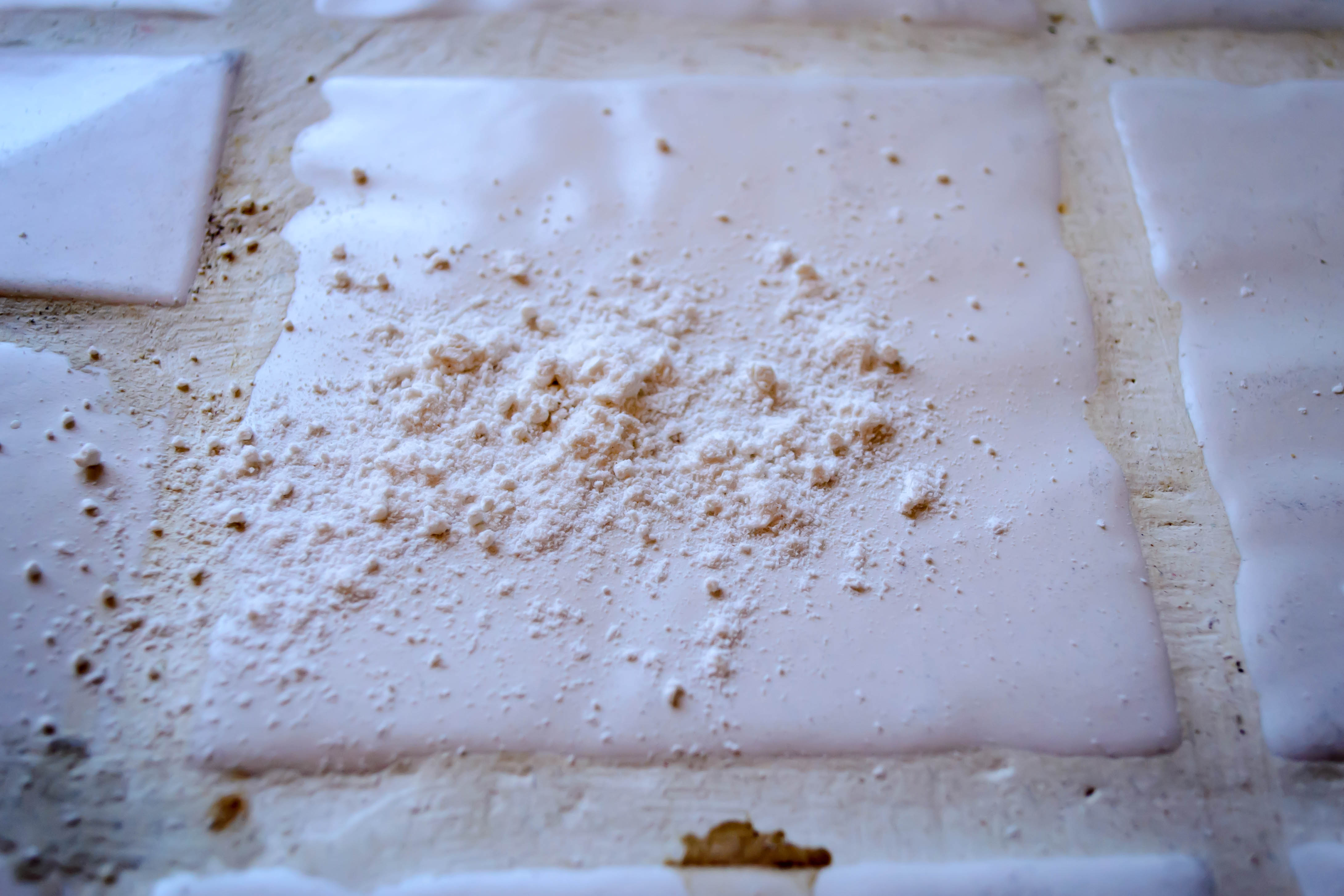
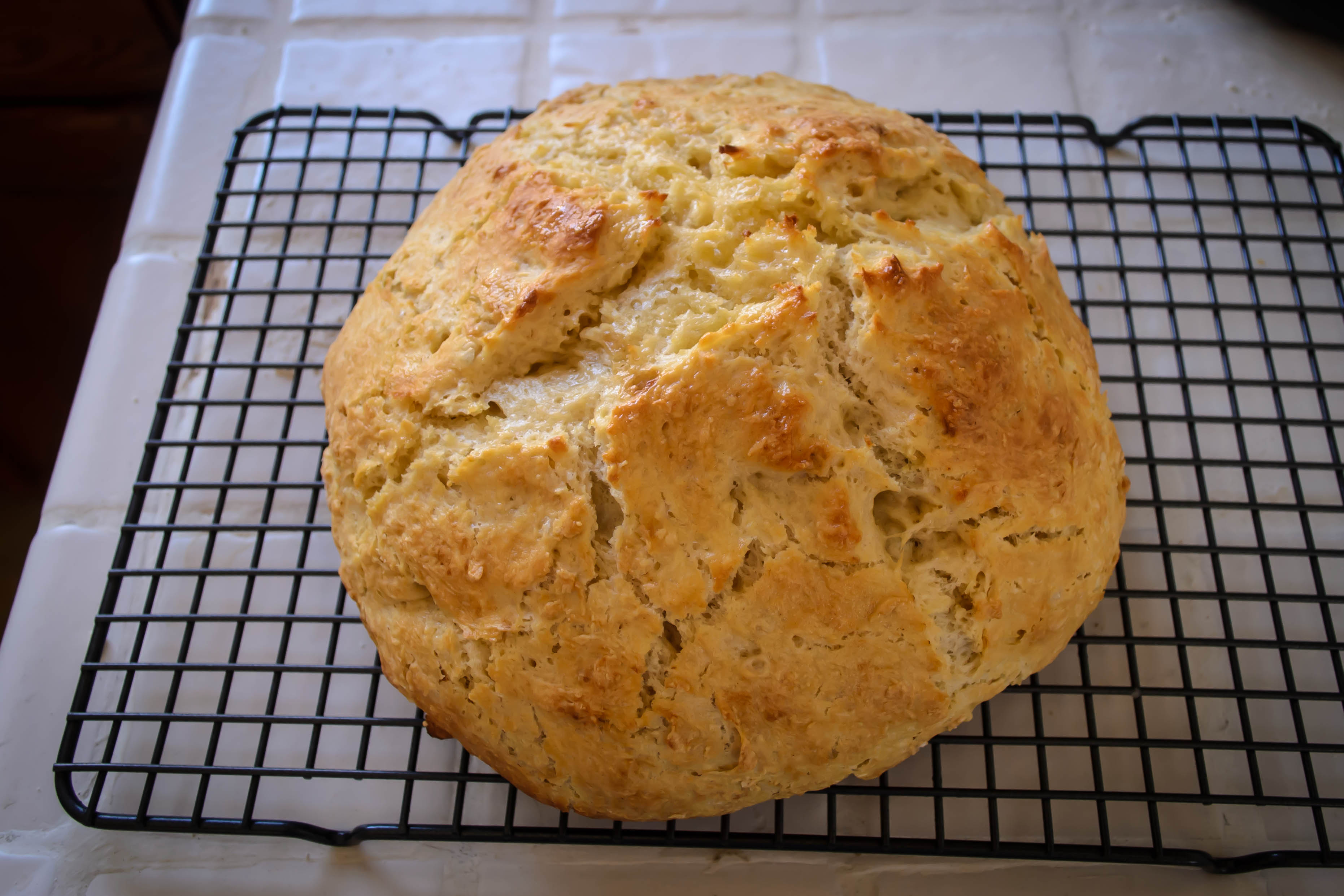
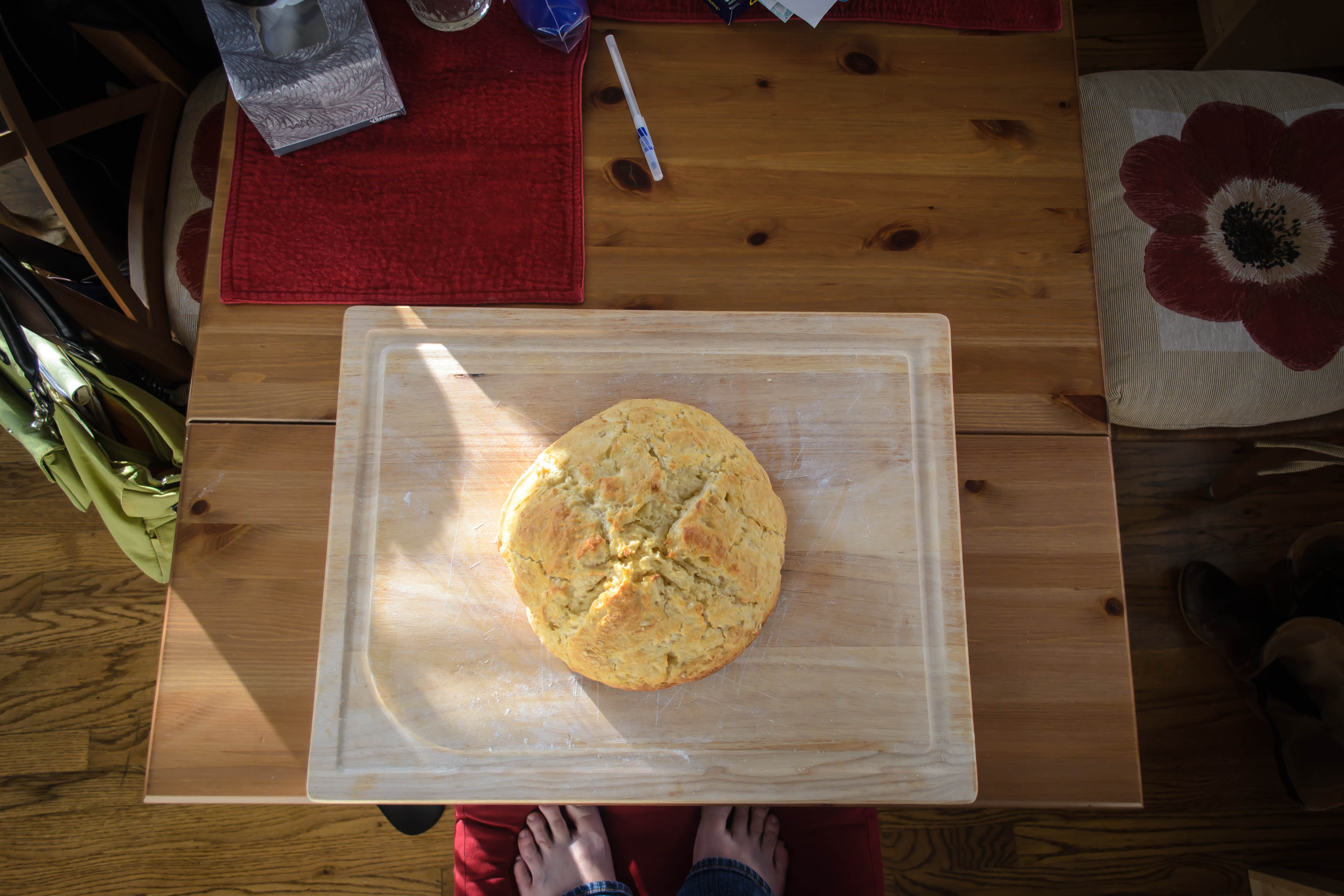
This week I made Irish Soda Bread.  Simple, rustic, honest.  Lumpy.  Rough.  Uneven.  No yeast, no eggs, no herbs or dried fruit or fancy techniques or browned butter or sifting.  I didn’t even wipe down the counters first to make you think my kitchen is always spotless.  I shuffled through a few recipes and found suggested combinations like golden raisin and rosemary, or candied orange peel and bittersweet chocolate.  Those didn’t feel truthful.  They were too dressed up – too showy.  So I turned to the most basic, most honest cookbook I have: Baking Illustrated.  BI is willing not only to present you with a recipe, but to explain why they made the choices they made, and what happened when they tried things in other ways.  They talk about the cakes that came out gummy or runny.  They talk about overly eggy batters and dry loaves and dense biscuits.  They show you what a less-than-perfect product looks like.  And then they tell you how to fix it.  This was the kind of Springtime honesty I needed.

Food Blog March 2013-0866

I changed very little from the original recipe, only using brown sugar in place of white granulated sugar for a deeper flavor, and taking up the suggestion to bake the loaf in a deep covered pot to enhance the texture of the crust.  Since I’ve been doing that with success in my yeast experiments, it seemed worth trying out here too, and I have to recommend it highly.  Our loaf was surprisingly tender – almost like a giant scone – and the crust was springy and buttery – it felt like it must be loaded with eggs even though there are none in the recipe.  I like the flavor the baking soda provides, which is a different kind of tangy breadiness than yeast.  After weeks of churning out loaves that require hours and hours and multiple rise times, it was nice to have a quick-bread that rose just enough on baking time alone, and left behind concerns like proofing and kneading and windowpanes and tucking and shaping.  Honestly.
 Food Blog March 2013-0868
Irish Soda Bread
adapted from Baking Illustrated
3 cups all-purpose flour (BI recommends one with a relatively low protein content, like Gold Medal or Pillsbury) plus a scattering for your work surface
1 cup cake flour (even lower protein, which makes for a more tender end product)
2 TB brown sugar
1½ tsp baking soda
1½ tsp cream of tartar
1 tsp salt
2 TB softened butter
1½ cups buttermilk
3 additional TB butter, divided
Food Blog March 2013-0872

Here’s the final product, when I edit and trim.

Food Blog March 2013-0873

But since we’re being honest here, this is the set-up; I just push all that other stuff aside and crop it out…

Preheat your oven to 400F.  BI says to position a rack in the upper middle portion of your oven, but I left mine near the bottom and things turned out fine.
Whisk the dry ingredients together in a large bowl.
Cut in the softened butter with a fork, your fingers, or a pastry blender until it is distributed in small crumbly bits.  The mixture, BI says, should resemble coarse crumbs.
Add the buttermilk and combine with a fork just until the mixture begins to come together – the coarse crumbs should clump into slightly wet crags.
Turn out onto a floured board and knead slightly – 12 to 14 turns – just till the dough becomes “cohesive and bumpy” (43).  You don’t want to overknead this bread because it will become tough.  The intent here is not to stimulate gluten production, as it would be in a yeast dough.  We just want a homogenous mass that stays together.
Pat the dough into a 6 inch round (about 2 inches high) and score an X in the center with a sharp knife; use 2 TB of the additional butter to grease the bottom and sides of a dutch oven or similar covered pot.  Place the loaf carefully inside, cover, and bake with the lid on for 30 minutes.  Then remove the lid and continue baking for an additional 10 minutes, or until the internal temperature is 180F.
Melt the final TB of butter.  As soon as you remove the loaf from the oven, brush the top with the melted butter to keep the crust soft and tender.
Wait about half an hour before you attack it – this bread is delicate and it needs the extra structural support gained by cooling.  Earlier slicing will result in squashing and crumbling, and as honest as that is, we’d rather have nice slices or, as N. and I prefer, thick wedges for dunking.

Food Blog March 2013-0875Food Blog March 2013-0877

Uncommon Brown Sugar and Cheddar Biscuits

When it rains in Los Angeles, the whole atmosphere of the city changes.  The earth sighs acceptance and glee, and the ordinary dustiness of every other person’s front yard glimmers with emerald slickness: life!  Reprieve from the desert we pretend we haven’t built over!  The roads become jagged, glistering, tar and oil stained slip’n’slides on which people drive either too slowly – avoiding disaster through excess caution – or too quickly – rushing to get off the highways as soon as possible.  The sky is unused to gray billows here, or at least it seems that way.

Food Blog January 2013-0518

But for me, the end of this week felt like home.  It was a strange mix of homesickness and invigoration.  I am accustomed to working in this climate.  It feels natural.  Habitual.  My fingers and my brain and my skin – they fit into this overcast world.

Seeking the comfort of familiarity, I decided to leave yeast alone for this week and fall back on something I know: biscuits.  Butter.  Flour.  Buttermilk.  Salt.  Baking powder.  The blessed fundamentals.  But I know the fundamentals.  I wanted more.

Food Blog January 2013-0514

In Ratio, Ruhlman calls these Chicago biscuits because their ratio 3-1-2 is Chicago’s area code.  3 parts flour, 1 part fat, 2 parts liquid.  I’m calling them Uncommon because their pairing – brown sugar and extra sharp cheddar cheese – might not be anyone’s first inclination.  It made sense to me, though, if you reinsert the missing link of apple pie in the middle.  Cheese and apples are perfect.  Brown sugar and apples are perfect.  What would happen if you took the apples out of the equation and left the savory richness of cheese chewing against the molasses-deep hum of brown sugar?  They are also Uncommon because they take a little extra time (almost 3 hours from start to finish) and produce a slightly different product than your ordinary dinner biscuit.

Adapted, obviously, from Ruhlman’s Ratio 312 Biscuits.


Uncommon Brown Sugar Cheddar BiscuitsFood Blog January 2013-0491

scant 2 cups flour (9 oz)

1 tsp salt

2 tsp baking powder

2 TB brown sugar

6 TB butter (3 oz)

½ cup ¼-inch chunks of cheddar cheese, the sharper the better

¾ cups buttermilk (6 oz)

In a medium bowl, whisk together the flour, salt, baking powder, and brown sugar.

Using a pastry blender or your fingers, cut in the butter until it is incorporated throughout in chunks the size of small peas.

Add the cheddar cheese and buttermilk and mix to combine into a rough, sticky dough.  I find using a fork works well for this step.

Food Blog January 2013-0501

Here’s where things change up a bit.  Instead of rolling this out and cutting rounds, stretch a piece of plastic wrap across your counter and dump the dough onto it.  Using the plastic wrap, form the dough into a rectangle of approximately 4×6 inches.  Mine was bigger because I am impatient.  This didn’t seem to have dire consequences.  Once the dough is shaped, wrap it in the plastic wrap and refrigerate for at least 1 hour.

Food Blog January 2013-0502

After an hour, the butter has firmed up again and the dough has relaxed.  Pull it out and free it from the plastic, plopping it carefully onto a well floured board.  It’s a very sticky dough, so flour your rolling pin and the top of the dough itself well to avoid irritation.  Roll the dough out until it is three times its original size, maintaining the rectangular shape.  Fold it into thirds, press down well, and then roll it out again.  Fold it into thirds for a second time.  I did mine in the opposite direction of the first fold, which was probably wrong, but again, produced no discernible taste consequences.  Press down firmly, wrap up the dough in plastic wrap again, and put it back into the fridge for another hour.

Food Blog January 2013-0506

While it chills, here’s what’s happening with all this bother: you are creating something akin to one of those biscuits that comes out of the tube.  You know, the cardboard tube you anxiously peel the wrapper from to reveal a twisting seam, then judiciously smack on the edge of the counter until it pops and dough appears in great bulges?  Those biscuits are composed of dozens of flaky layers, and that’s what you are doing by folding and rolling and folding and rolling.  You are, Ruhlman notes, following a similar procedure to that used for making puff pastry, except in our case the butter is irregularly placed, which results in craggy puffs, whereas puff pastry requires a smooth, even layer of butter in between each floury fold to reach its incredible signature height.

With another hour gone, liberate the dough from fridge and plastic, return it to your well floured board, and repeat the procedure: roll out, fold in thirds, roll out, fold in thirds again.  At this point, you should also preheat the oven to 400F.

Food Blog January 2013-0509

You’ve now folded your dough a total of four times, which means you’ve made twelve layers.  Now, roll it out to ½ inch thick and cut it into 6 pieces.  You could do rounds with a biscuit cutter, but it seems easier and less wasteful to just trim up the edges (which you could roll into a homely little extra biscuit to taste on the sly) and then cut into squares.

Food Blog January 2013-0511

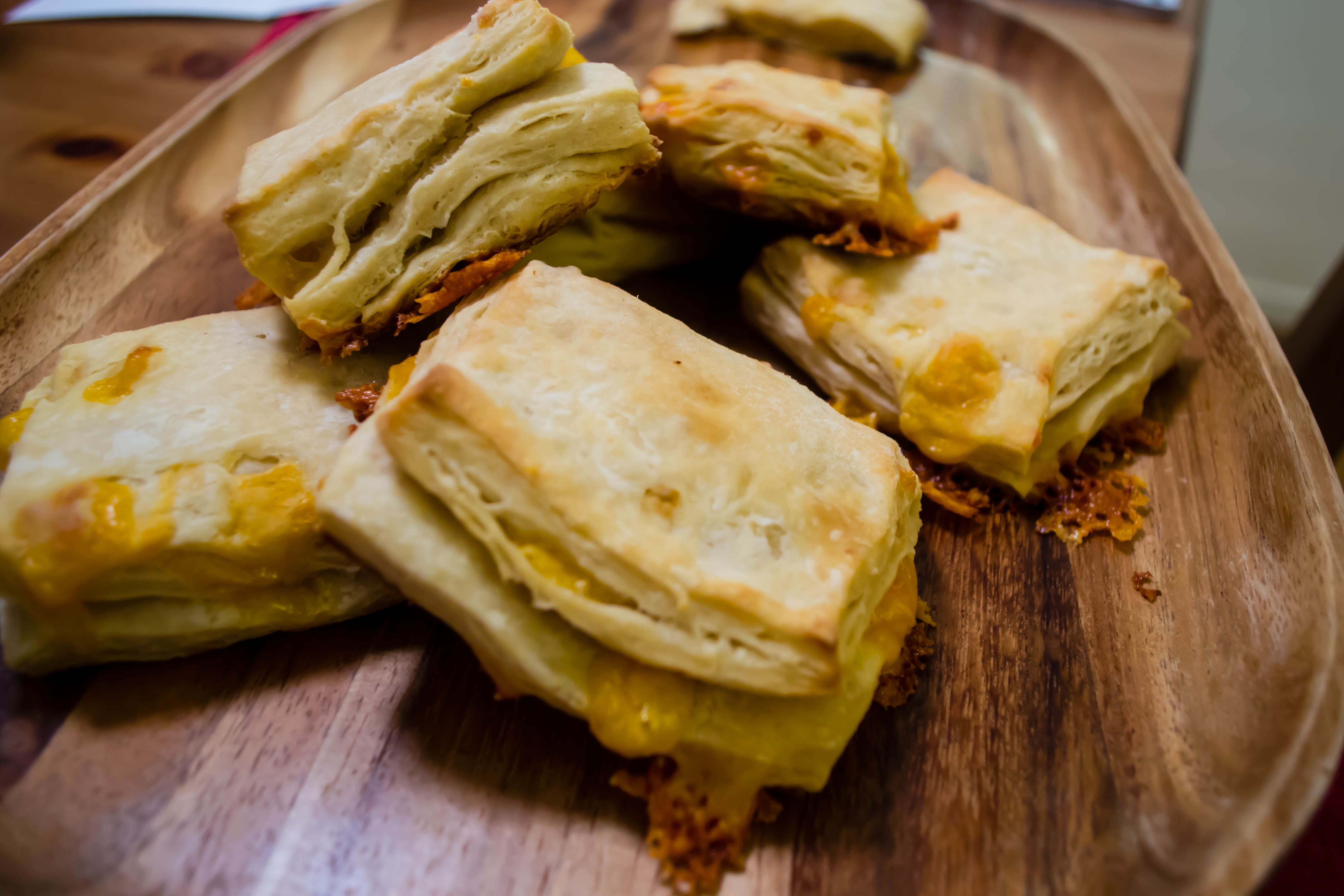
Pop these onto a greased baking sheet and into the oven for 20-25 minutes.  They will emerge lightly golden on top, with cheese oozing out from between the layers to form crispy lacy edges against the cookie sheet.

Food Blog January 2013-0517

We ate these as an accompaniment to a honey mustard roasted acorn squash and chicken apple sausages.  I know, I had to get the apple back in there somehow.  My assessment?  They were delightful.  The exterior was flaky and crisp, and I was impressed by how the layers really did make a difference in the texture of the biscuit: they were moist and chewy and distinct.  The cheese wasn’t as noticeable as I’d thought it would be, though the crispy edge bits were lovely – much like the lacy brulée that adorns the outside edges of a good cheese bagel.  At first I thought I couldn’t taste the brown sugar at all, but as I took my third and fourth bite, gasping around the steam, I realized that the complex lingering warmth at the end of each bite was probably the effect of the brown sugar.  It carried the depth and richness of a caramel without being sweet.

Food Blog January 2013-0516

So the verdict is: if you need biscuits to go with a weekday meal, these are probably not the ones for you.  It’s asking a bit much to devote three hours to six biscuits, when you could just roll, cut, and bake the same ingredients straight from the mixing bowl.  But if you are planning for something special, or if you were thinking of baking bread anyway and are willing to replace rise time with refrigeration time, try these instead.  The layers are really remarkable, they stay warm for some time, they are all kinds of tasty, and they would reheat – I suspect – very well in a toaster oven, though they are best on the day they are made.  But you probably won’t have any left over, so that’s an issue barely worth discussing.

Food Blog January 2013-0522

I hope you are warm and well, wherever you are.