The Rachel: lamb sausage and spinach pesto pizza

2016 Food Blog June-0945A few weeks ago, N. opened the fridge, snooped through the shelves, looked at me. “What’s for pizza? Wait. I mean, what’s for dinner?” Sometimes you don’t have to ask them what they’re craving.

2016 Food Blog June-0915Clearly, the following week I made pizza. We each have a favorite variety – though lately my favorite is becoming N’s favorite as well – and we’ve lent our names to them; whenever I write “The Chelsea” on the weekly meal plan, N. gets quite excited. This got me thinking about what toppings would constitute other members of my family. “The Dad” would certainly have red pepper flakes in some quantity, and my mom informed me on Sunday that hers would have plenty of vegetables.
2016 Food Blog June-0917But I decided to go first with my sister, and that meant lamb. I’m not sure whether it outweighs her affection for seafood, but lamb is certainly her red meat of choice. She stalks the meat counter to find it on sale; she buys the toughest cuts (often the cheapest) and grinds them up herself to make lamb burgers; she manufactures ways to integrate it into even traditionally vegetarian dishes. R’s pizza, then, would feature lamb sausage.
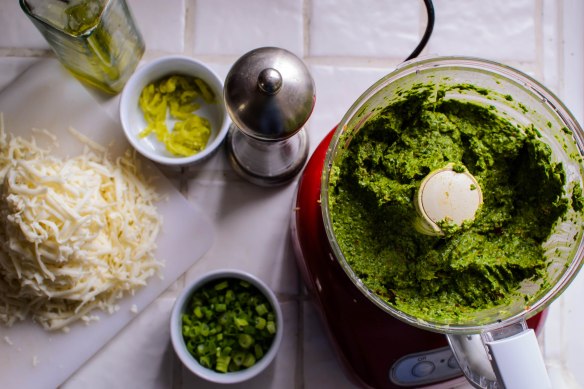
2016 Food Blog June-0918Once lamb sausage was on the menu, and some crumblings of feta had joined it in my imagination, I realized there was no way of avoiding a very Mediterranean flavor profile. Neither R. nor I are particularly interested in tomato-based sauces for pizza – “The Chelsea” has only a brush of garlic infused olive oil over its surface – so there would need to be an alternative. I gravitated toward pesto, and despite R’s declaration that she is “devoted to basil,” she’s also a rather non-traditional person in an interesting and glorious way. Given that, a pesto on her pizza couldn’t very well be the standard, and since this pizza was already leaning in such a Greek direction, I had to reach for the spinach, and added some parsley, some sundried tomatoes, some lemon zest, in addition to the standard garlic and pine nuts.
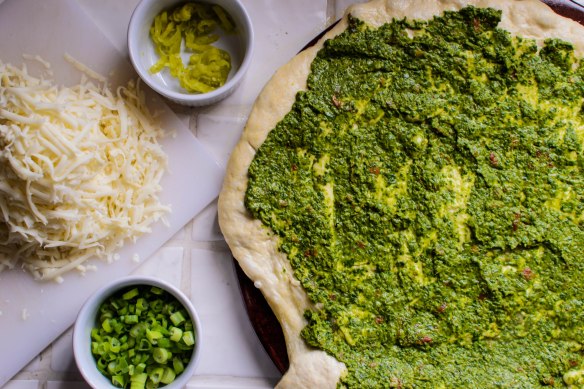
2016 Food Blog June-0925Considering other personality features, I decided to add some heat. R. is a spicy person: she’s quick, she’s feisty, she’s fun; she speaks her mind. Thinly sliced pepperoncini joined my collection of toppings, though some near-transparent wafers of jalapeno would also do the job.

2016 Food Blog June-0933When you construct “The Rachel,” you have some choices, and those choices depend on how much char you like on various ingredients. Obviously the pesto goes on first, in a generous layer. If you want your peppers and green onions to stay soft, they should be next, so they can hide out under the protective coating of mozzarella. If you prefer a bit of color on these greens, let them ride out the quarter hour in the oven right on top. I like to put the sausage underneath the mozzarella; since it’s already cooked, the cheese bubbling over it seems to prevent the meat from drying out.

2016 Food Blog June-0936Blistering hot from the oven, this was glorious. The lamb sausage I used was a merguez, which carries some heat of its own, so between that and the pepper slices the pizza was perfectly spicy. The spinach pesto is a solid base – not too aggressive in flavor on its own, just pleasant support for the well-spiced lamb and the briny feta. But interestingly (delightfully), the pizza came into its own as leftovers. When I unwrapped the remaining slices today in my office, door closed and light off as though I were getting away with something, the pizza had been out of the refrigerator long enough to come to room temperature, and though the cheese was no longer stretching into long strings and the crust had lost a bit of crispness, the flavors had come together so compellingly that I’d suggest doing one bit of advance planning: if you can, make the pesto a day in advance. Then, when you spread it thickly over the crust, it will already have had a day to slow dance in your refrigerator.

2016 Food Blog June-0943

The Rachel: lamb sausage and spinach pesto pizza
Makes one 12-14 inch pizza
16 ounces pizza dough of your choice
8 ounces lamb sausage (I used a nice, spicy merguez)
2 tablespoons pine nuts
3 cloves garlic
zest of one lemon
¼ cup oil-packed sundried tomatoes, drained
6 green onions
6 ounces baby spinach leaves
½ cup parsley leaves and stems
2 teaspoons lemon juice
1-3 tablespoons olive oil
salt and pepper to taste
8-12 ounces whole milk mozzarella cheese, grated
3 ounces crumbled feta cheese
3-4 pepperoncini or other pickled peppers
*Note: if possible, I recommend making your pesto a day ahead so the flavors have time to meld. Otherwise, proceed as below.


  • About 45 minutes before you are ready to cook the pizza, preheat your oven to 500F, or as high as it will go. If you are using a pizza stone (highly recommended), be sure to put it in the oven at this point to preheat as well. If your pizza dough is refrigerated or needs time to rise and relax, this is a good time to set it out as well.
  • Cook the lamb sausage in a medium skillet over medium heat. Use the flat edge of a wooden spatula to coerce the lamb into small pieces. Stir and flip frequently until cooked through and lightly browned, then set aside to cool.
  • For the pesto, add the pine nuts and garlic to a food processor along with the sundried tomatoes, lemon zest, and the white and light green portions of the green onions, reserving the green stalks until later. Process for 4-5 seconds to break down the big chunks of vegetables. Pack in the spinach and parsley and process again, agitating the machine a bit to try and coax the leaves down into the blade. When it is simply not making any progress, add the lemon juice and 1 tablespoon of the olive oil with the machine running. If that’s not enough liquid, add the remaining tablespoons of olive oil one at a time, pausing between each. You are looking for a very thick, paste-like “sauce” – the less moisture we add to the top of the pizza, the better. If things still aren’t coming together after all 3 tablespoons of oil, add a splash of water, but try to keep this to an absolute minimum.
  • Once the pesto is a thick but spreadable texture, taste and season with salt and pepper accordingly. I suggest under-seasoning a bit with the salt, since the feta cheese is quite salty.
  • Slice the greens of the green onions and the pepperoncinis into thin slices.
  • To assemble your pizza, stretch out the dough to your desired size (I put it carefully right onto the hot pizza stone), then spread generously with the spinach and parsley pesto. Add the remaining ingredients above or below the mozzarella cheese depending upon how browned you want them to get. I suggest lamb sausage underneath, to keep it moist, then the two types of cheese, then green onion and pepperoncini slices.
  • Carefully maneuver the loaded pizza back into the roaring hot oven, and bake for 15 minutes until the crust is crisp and the cheese is nicely studded with golden blisters. Remove from oven and let sit 4-5 minutes. Then sprinkle with additional parsley leaves if desired, slice, and serve.
Grilled Corn and Radish Herb Salad

2016 Food Blog May-0711When Corin Tucker, one of the vocalists of the musical group Sleater Kinney, released her first solo album after the band’s separation in 2006, she described in song how losing the band in some respects meant losing her vision of music and composition as well – she “stood frozen for so long,” and the silence felt like 1,000 years. To me, the song resonates with all kinds of creativity blocks. Every once in a while, when I think about writing here, I feel frozen – not just cold feet, but cold hands and stiff fingers and icicles in my brain – a sensation of writer’s block that extends to my enthusiasm for cooking itself. Broken off from my usual schedule, and with all but one stack of final papers graded and recorded and filed* in hopes students will return in the fall to pick up their work, you would think I would be panting for the kitchen and the refreshing feeling of absolutely zero comma splices or missing thesis statements to worry about.

2016 Food Blog May-06782016 Food Blog May-0679Instead I feel immobilized by a combination of exhaustion, puritan work ethic, and plain old laziness: if I’m not doing schoolwork, I should feel guilty, but I’m too tired to grade anything else. The kitchen, then, becomes a strange zone of misdirected productivity, and the couch and TV are just so friendly…
2016 Food Blog May-06892016 Food Blog May-0696But I should enjoy the sliver of summer I’m allotted (I’m teaching a session of summer school this year), so if I have to force myself, the gateway drug is corn on the cob. Corn speaks summer in ways few other vegetables do. Tomatoes, of course, but they typically show up a little later in the season, at least the massive spurting heirlooms I’m most interested in. Zucchini is a late summer crop – an overload that reminds you the last few weeks are approaching. Corn is sweet and juicy and plays so well with others. Raw, it has a kind of grassy starchiness, and of course the classic boiled or steamed cob works so well with butter and plenty of salt. For the past few years, though, my favorite way to eat corn is from the grill. Rubbed with olive oil, salt, and pepper and roasted all huskless, it blisters and crusts, and the sweetness we’ve bred into those kernels deepens into a toasty richness that reminds me vaguely of popcorn.

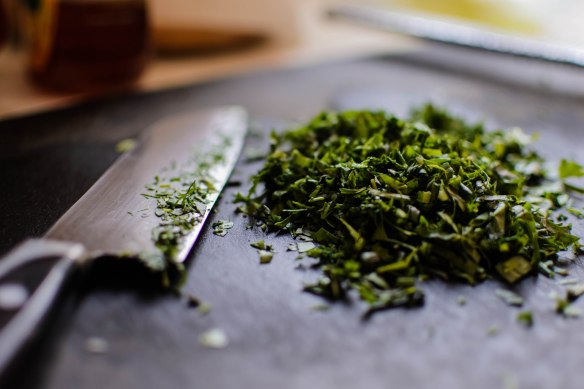
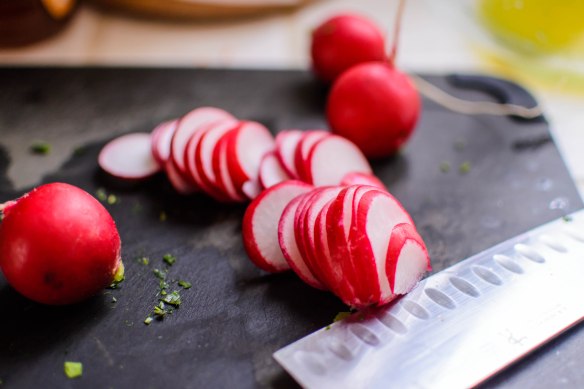
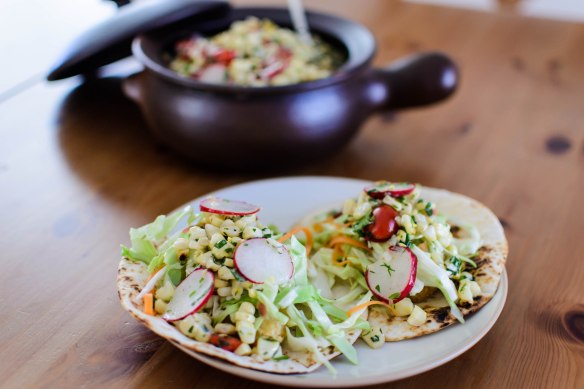
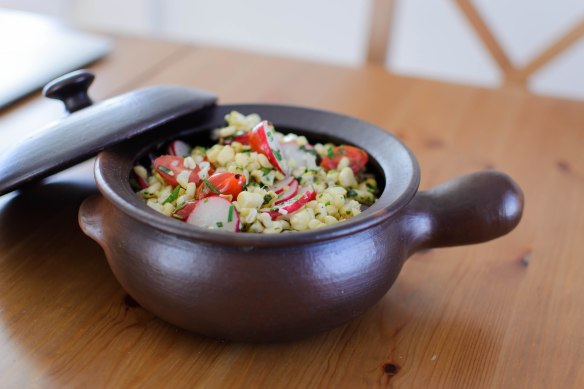
2016 Food Blog May-07012016 Food Blog May-0702For this dish, I was after a kind of warm salad, and thought the cold, peppery bite of radishes would work amazingly well with corn, especially doused with assertive lime vinaigrette. Both Food and Wine and Martha Stewart make a jalapeno dressing for this combination. I didn’t want spicy, but I did want to amp flavor, which I did with a bumper crop of added herbs: parsley, dill, chives, even some basil, to play with the flavors of the vegetables and contribute a different kind of sharpness to the dressing. For color and for fun, I added a handful of cherry tomatoes. You could also toss in some baby arugula or chunks of avocado.

2016 Food Blog May-0704We ate this with fish tacos, but it would be equally good with grilled meat of any variety, really, as well as a nice, lighter side salad option at a picnic or barbecue. A crisp white wine, especially with a touch of effervescence, would pair well.

Bring on the summer, then. I’m ready to thaw.

2016 Food Blog May-0721* well, in a carefully shoved stack on the back corner of my desk

2016 Food Blog May-0720

Grilled Corn and Radish Herb Salad
Serves 4-6
4 ears corn on the cob
4 tablespoons olive oil, divided
salt and pepper, to taste
juice of 1-2 limes
1-2 teaspoons honey
½ cup mixed chopped soft-stemmed herbs, such as parsley, dill, basil, chives, or cilantro
6-8 large red radishes, tops and tails removed, thinly sliced
4 ounces cherry tomatoes, halved
(1-2 ounces baby arugula, optional)
(1 avocado, cut in cubes, optional)


  • Preheat a gas grill or grill pan over medium high heat. While you wait, shuck the corn, removing the husk and as much silk as possible, but leave on the stem, as this will make for easier kernel removal. Rub the ears with 1 tablespoon of the olive oil and sprinkle liberally with salt and pepper. Place on the preheated grill and cook for about 8 minutes total, turning every two minutes or so, until the corn is fully cooked and has a healthy golden brown char.
  • Set the corn aside until it is cool enough to handle. Meanwhile, in a large bowl, whisk the lime juice with the honey and the remaining 3 tablespoons of olive oil. Add in the mixed chopped herbs and whisk well to incorporate.
  • When the corn has cooled enough that it won’t toast your fingers, cut off the kernels by standing up the cob on your cutting board (you can use the stem to hold onto, if you’ve left it attached) and carefully cutting straight down the ear with a sharp knife, sawing the blade back and forth a bit to help loosen the kernels. When you get to the bottom of the ear, rotate the cob a half turn or so and cut again, repeating until you have removed all kernels. Some will be individual and some will come off in big chunks; that’s okay. The variety is nice.
  • Add the corn, the sliced radishes, and the halved cherry tomatoes to the bowl with the dressing and herbs, and toss well to combine and distribute. The herbs will sometimes clump together; be sure to mix well so they – and the dressing – coat the other vegetables evenly. Taste for seasoning and add additional salt and pepper if desired.
  • If you are using arugula and/or avocado, add these as well and toss gently to avoid breaking up these delicate ingredients too much.
  • Serve warm or at room temperature with a grilled main.

“Parsley Pie”

2016 Food Blog February-0492Whereas last month’s blog experiment entry left me stumped for a while, not only do I know which post led this searcher to my blog; the dish I wanted to create coalesced pretty quickly in my mind. The search term “parsley pie,” with its bright green focus, seemed appropriately spring-y for this first warm week in Southern California. Though I had my own ideas already, I did a quick image search to see what other sorts of “parsley pies” turned up, and the answer is: not many. Most of what I saw were meat pies, with the addition of parsley to lighten up the filling or, in one case, add fiber. Some of these concoctions were the classic British pork pie, with high, golden sides and, sometimes, a hard boiled egg or two cunningly tucked into the filling, while some were shepherds pies, with parsley added to the ground lamb or to the mashed potato topping.

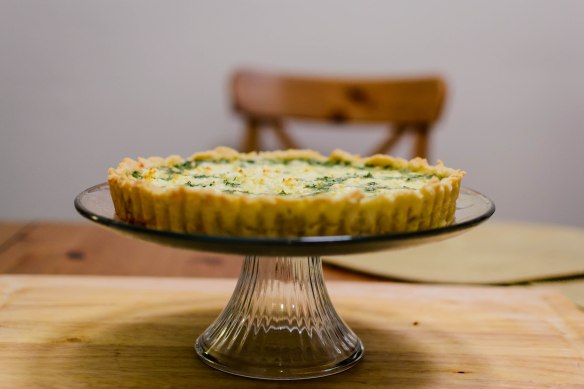
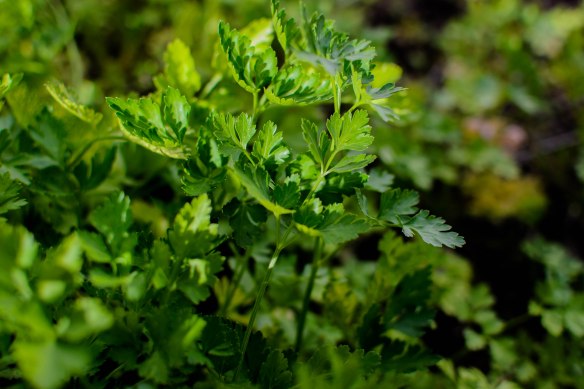
2016 Food Blog February-04372016 Food Blog February-04572016 Food Blog February-0458What I’d envisioned, quite contrary to these heavy options, was a pie where parsley dominated: something like a quiche Lorraine would be a neutral base, and allow for greater visibility for the heaping mounds of the freshly chopped herb in question. I suppose if I’m being absolutely honest I should call this a parsley quiche, but it does have a proper crust and a filling, and since that ultimate internet authority Wikipedia (hah!) classifies quiche as a “savoury pie,” I’m going to cross my fingers behind my back and declare that this counts.

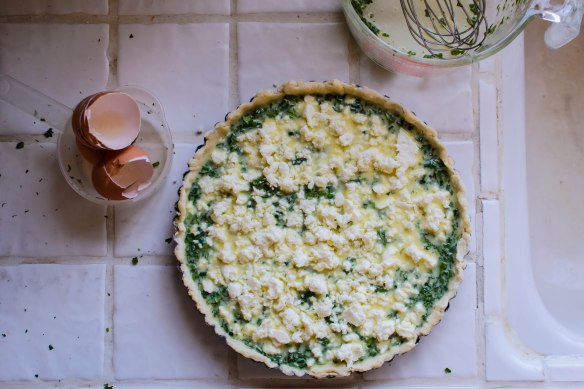
2016 Food Blog February-04632016 Food Blog February-04732016 Food Blog February-0476Because there are no bulky chunks in the filling to hold it up, this must of necessity be a shallow pie. Thus it was a perfect opportunity to use the tart pan I bought myself for Christmas (though a pie pan would work fine). Along with eggs, milk, and of course the eponymous parsley, I whisked in a combination of other herbs: basil, cilantro, dill, and a few chives, to add some variety to the flavor. And because I can’t help myself, I topped the green freckled custard with crumbles of feta cheese, which admittedly adds a pleasant brininess that the pie would suffer without.

2016 Food Blog February-0500A few thoughts: if you’re going to make this, you have to like parsley. This seems a distressingly obvious revelation, but I mean it – this really, really tastes like parsley. If it’s too herbaceous for you, or you’re looking for a bit more to sink your teeth into, crumbled, crisp prosciutto, or lumps of crab, or slick slices of smoked salmon, would bulk it up nicely. Alternatively, a side salad with a thick wedge would make a perfect spring lunch. As for construction, if you use a tart pan you really have to be sure your crust forms an unbroken layer around the bottom edge of the pie. Cracks or very thin areas can lead to egg leakage in the oven. Don’t ask me how I know this.

2016 Food Blog February-0503

“Parsley Pie”
Makes a 9-inch pie
About 2 hours, including crust resting time
For crust:
6 ounces all-purpose flour (about 1¼ cups)
½ teaspoon salt
4 ounces unsalted butter (1 stick or 8 tablespoons)
2-4 ounces cold buttermilk (water would be fine too)
For filling:
4 large eggs
1 cup whole milk
1 cup chopped parsley
1 cup chopped mixed soft green herbs (such as basil, chives, tarragon, cilantro, dill, etc)
½ teaspoon salt
¼ teaspoon pepper (I used black, but white pepper would work too)
4 ounces crumbled feta cheese


  • To make the crust, combine the flour and ½ teaspoon salt in a food processor. Cut the stick of butter into 12-16 slices, then add these to the processor as well and pulse at 1 second intervals until the butter is mostly broken up into blueberry or cherry-sized chunks. With the processor running, dribble in the buttermilk just until the mixture starts to come together into a dry ball. You may not need all of the buttermilk. Turn the mixture out onto a large piece of plastic wrap and use the plastic wrap to help you quickly and decisively form the mixture into a flat disc about 6 inches in diameter. Wrap it up and stow it in the fridge for at least half an hour. Not only does this chill the butter, making for a flakier end result, but it allows the buttermilk to hydrate the flour.
  • While you wait for the dough to chill, preheat the oven to 350F with a rack in the middle position, oil or butter a 9-inch tart pan or pie plate, and prep the filling ingredients. Whisk the eggs with the cup of milk and add in the chopped herbs, the ½ teaspoon of salt, and the ¼ teaspoon of pepper. Note: 1 cup chopped parsley means you chop before you measure, so you do need a rather large bouquet of herbs to meet the required amount.
  • You can whisk the feta in with the herb and egg mixture, or you can crumble it over the top of the custard when it’s poured into the crust. Or, of you prefer, you can do a little of both, mixing some in and saving some to sprinkle on top. You do you.
  • After at least half an hour in the fridge, remove the dough disc and unwrap it onto a floured board. Now, this is crucial: let it sit about ten minutes to warm up just a tad before you try to roll it out. When it has had a chance to shake the chill off, sprinkle its surface with a little flour and, with a floured rolling pin, roll it out into a circle about 11 inches in diameter. I like to start in the middle of the disc and push away from me first, then bring the rolling pin back all the way towards me. Then I turn the disc of dough 90 degrees and repeat, flipping it over if needed, until I have a rough circle.
  • Use the rolling pin to help you transport the circle of dough into the prepared pan. Drape the dough gently down into the edges and, if you are using a tart pan, be sure to press it lightly into the grooves on the side of the pan, and carefully patch any thin areas or cracks along the bottom. For extra insurance, place the tart pan on a cookie sheet – this makes for easier transport to and from the oven and, if you do suffer some leakage, keeps the mess contained, not on your oven floor.
  • Whisk up your filling mixture again to ensure even distribution, then gently pour it into the crust. Sprinkle some or all of the crumbled feta over the top, if desired, and carefully transport to the oven.
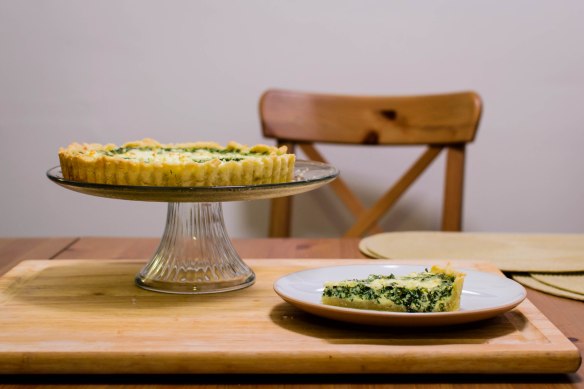
  • Bake 45-60 minutes until the crust is pale gold and the filling is set and has puffed slightly in the center. Remove to a wire rack and let cool at least fifteen minutes before you carefully remove the tart pan (if using) and center the pie on a serving platter. I used a cake stand because I like to be fancy for you. Serve warm or at room temperature.

Tomato Basil Loaf

2016 Food Blog February-0424N. and I first discovered Panera when we were living in Eugene. This seems a bit counterintuitive, since Eugene doesn’t have any Paneras. But on a visit or two with my parents, and N.’s parents, it became an easy place to pick up lunch, or a dinner for a sunset hike, and I was quickly sold on their vegetarian sandwich, not just because it came layered with pickled red peppers and fresh greens and spicy spread and crumbled feta, but because the bread it used – a fluffy tomato and basil flavored loaf with an intriguing, slightly sweet streusel across the top crust – was addicting. When we could, N. and I started buying a whole loaf of the bread on our last day in California, to take home to Eugene with us.

2016 Food Blog February-0378Now that we are in Los Angeles, there are Paneras everywhere (in fact, I just checked: there are at least five within a 5 mile radius of our house). Despite that proximity, though, we don’t go there very often. There are several reasons for this, but mostly, if I’m going to spend my money on restaurant fare, I’m going to explore what Los Angeles has to offer rather than a national chain. Regardless, the tomato basil bread, with that intriguing streusel, remains a favorite of mine, and when “red” was declared as February’s Twelve Loaves theme, I decided this was the right time to try a little re-creation attempt.

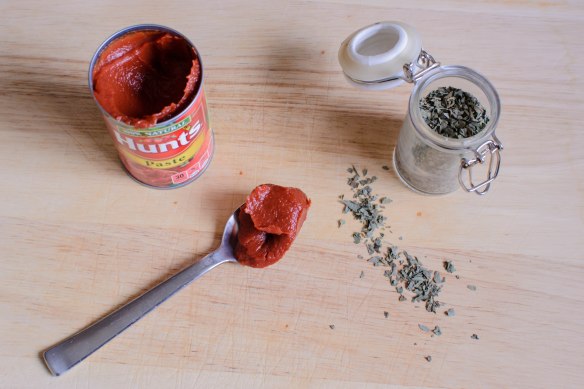
2016 Food Blog February-0370My bread combines lush, densely flavored scarlet tomato paste with a generous dusting of dried basil. The loaf itself is moistened and sweetened with buttermilk and molasses, and though it does bake up more orange than red, it makes perfect sandwich slices for cucumber and mozzarella, or pesto chicken, or just well-buttered toast.

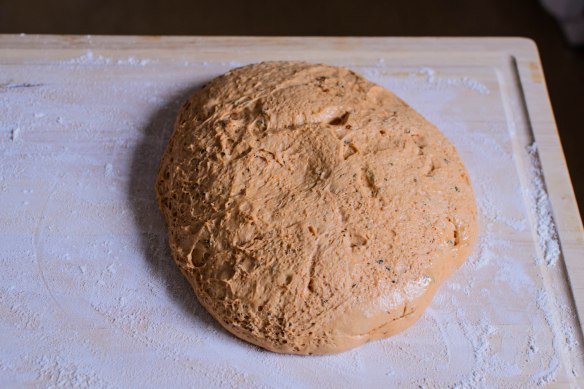
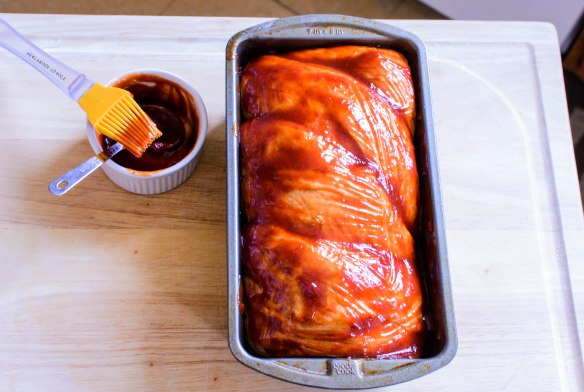
2016 Food Blog February-0375The challenge here was the streusel. There are a number of “copycat” recipes out there for Panera’s loaf, but few of them make any attempt at the dark, sweet, sticky crumble adorning the top crust. I finally found a suggestion for a glaze made from tomato paste and brown sugar, thinned with a little water, and brushed over the top of the loaf. Since my first attempt was a little heavy on the tomato paste in the dough itself, reserving some for the top seemed like a smart adjustment. It did look a bit distressingly like a meatloaf with the traditional ketchup coating when I first applied the glaze, but the flavor of the finished product was strikingly similar to my inspiration.

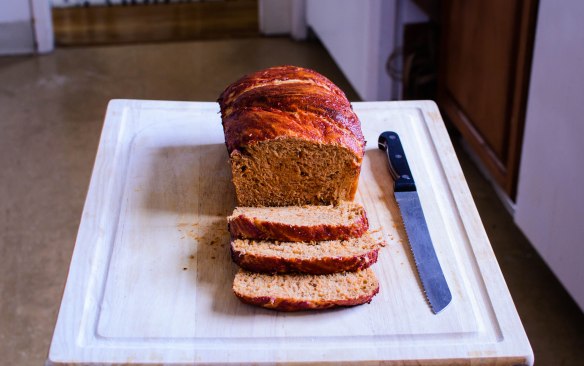
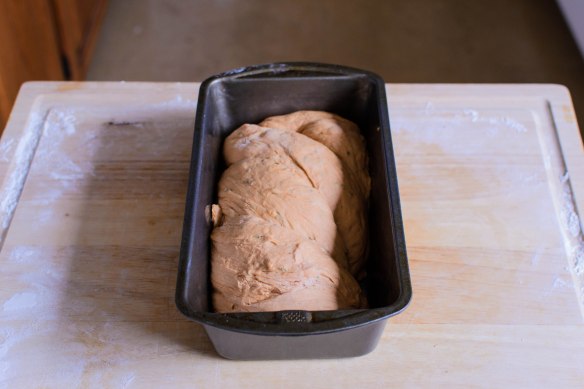
2016 Food Blog February-03832016 Food Blog February-03892016 Food Blog February-0394Panera’s loaf is scored straight down the center so that the top crust puffs and pulls away from itself in two fat rounds, leaving the top of a slice looking almost heart shaped. I decided I wanted to try something new, so I went for a twist instead, separating my dough into two sluggish, sticky logs and wrapping them around each other before depositing into a loaf pan.

2016 Food Blog February-04042016 Food Blog February-0406A second rise, a glaze, and a quick 40 minutes in the oven, and I was rewarded with a loaf that, despite not being truly red, may be as close to the original as I’ll ever get. The interior is tender and chewy and springy, and the glaze hardened into gleaming sticky shellac (though it loses its crustiness as it sits). The tomato and basil flavor are both easily discernible, and the combination of tomato paste and brown sugar burnishing the top crust is just the right toasty sweetness, since despite the molasses, the bread itself is fairly savory.

2016 Food Blog February-0416Because the dough is pretty sticky, the loaf is moist and tender, which also means it’s a bit delicate. Take care when slicing into it, and be sure to give it at least half an hour to cool before attempting a slice at all. Conveniently, we found we liked the flavor better once the bread had cooled completely. As noted above, the glaze resorts to stickiness after a few hours, but it is still quite tasty, and will “crisp” up again just slightly after a trip through the toaster. Slicked with salted butter, it makes a perfect accompaniment to lesson-planning on a blustery afternoon.

2016 Food Blog February-0430

Tomato Basil Loaf
Makes 1 large sandwich loaf
4-4½ hours, including rising and baking time
1 cup cold buttermilk
⅓ cup boiling water + more to thin the glaze
3 tablespoons molasses
2 teaspoons active dry yeast
3 ¾ cups bread flour (you may not use all of it) + additional flour to dust the board
2 teaspoons salt
1 tablespoon dried basil
½ cup tomato paste, divided
3 tablespoons brown sugar


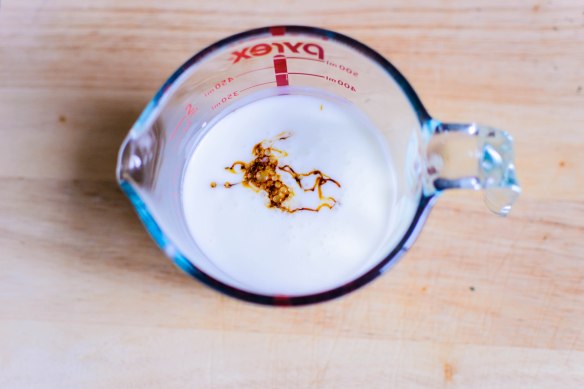
  • In a 2-cup glass measuring cup, combine the cold buttermilk and the boiling water. This creates a yeast-friendly temperature without having to wait for the buttermilk to warm up. Stir in the molasses and the yeast, and let sit for 5-10 minutes until the surface of the mixture foams up and it smells bready.
  • While the yeast is working, combine 3 cups of the flour with the salt and basil in a large bowl. I use the bowl of my stand mixer. After the yeast has had a chance to wake up and is foamy, add the liquid slowly to the flour mixture and mix on low with the paddle attachment (or with a wooden spoon) to combine. Scrape in the tomato paste and again, mix just to combine.
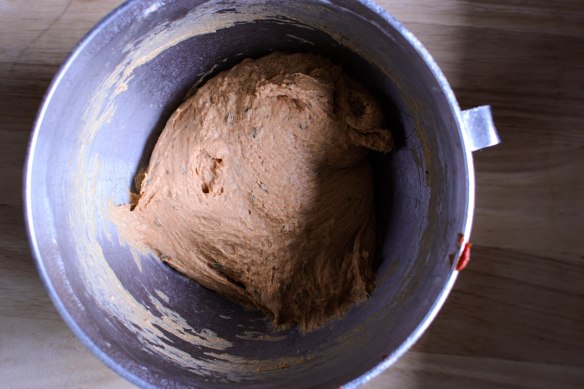
  • Now, if you are using a stand mixer, switch to the dough hook. If you are not using a stand mixer, turn out onto a well-floured board. Knead at medium speed for 5-7 minutes, adding in more flour if needed ¼ cup at a time, until the dough pulls away from the sides of the bowl and takes on the consistency of soft, sticky play-dough.
  • Oil the inside of your work bowl (I use a non-stick spray), turn the ball of dough over inside a few times to coat it evenly, and then cover the bowl tightly with plastic wrap and stow in a slightly warm spot for 1½-2 hours, until almost doubled.
  • Once the dough has risen adequately, punch it down by gently depressing your fist into the center to release the air, then let rest about ten minutes to get its breath back. Meanwhile, spray or butter a standard loaf pan.
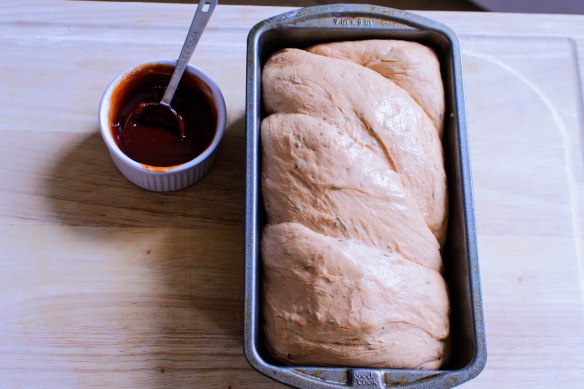
  • Turn the dough out onto a lightly floured board and divide it into two equal portions. Roll each half out into a pudgy log about 9 inches long. Pinch one end of each log together tightly to connect, then create a twist by lifting the left strand over the right, then repeating (because now what was the right strand will be the left one) until you come to the other end of each log. Pinch these remaining ends together tightly, then tuck underneath the twist you’ve created and gently place it in the prepared loaf pan. Cover lightly with plastic wrap and set aside to rise again for 45-60 minutes.
  • About 30 minutes before you put the dough into the oven, preheat to 350F, and make the glaze by combining the remaining 2 tablespoons of tomato paste, 3 tablespoons of brown sugar, and 1-2 tablespoons of hot water to thin to a barely pourable glaze. When ready to bake, remove the plastic wrap, brush the glaze over the top of the loaf in a thin layer, and gently slide it into the preheated oven. Bake 35-40 minutes, or until the interior tests 180-200F on an instant read thermometer.
  • Cool at least 10 minutes in the loaf pan, then turn out onto a wire rack and cool at least 20 minutes more before slicing and eating. We found the flavor was better once the bread had completely cooled.


#TwelveLoaves is a monthly bread baking party created by Lora from Cake Duchess and run with the help of Heather of All Roads Lead to the Kitchen, which runs smoothly with the help of our bakers.

This month we’ll be baking breads with a RED theme in honor of National Heart Month, Valentine’s Day, and the Oscars (red carpet) – any red ingredient goes! For more bread recipes, visit the #TwelveLoaves Pinterest board, or check out last month’s mouthwatering selection of #TwelveLoaves enter last month’s breads featuring a “new to you” type of flour!

If you’d like to bake along with us this month, share your “RED” themed bread using hashtag #TwelveLoaves!

Classic Spaghetti and Meatballs

2015 Food Blog December-0665When I told my parents that my blog project for 2015 was meatballs, my dad immediately said “I know how you should start your first entry.” He recommended the children’s retelling of the old folk song “On Top of Old Smokey” which, rather than a lament about lost love, relates a warning tale about losing your meatball (all covered with cheese) as the result of a poorly timed sneeze. After rolling off the table and onto the floor, the poor meatball rolls out the door, into the garden, and collapses to mush under some shrubbery. Fear not, however! In the springtime, it grows into a tree, presumably studded with fresh, hot, cheesy meatballs.

2015 Food Blog December-0653Since my first entry was a.) already written and b.) decidedly middle eastern, Dad’s song suggestion didn’t seem to fit. It did make me reconsider, though, my initial proclamation against the classic meatballs usually crowning the spaghetti-and– combination. My objections were memories of uninspiring flavor and texture – the classic meatballs can be mealy and soft inside, and they are so drowned in red sauce their own flavors are rendered unapparent.

2015 Food Blog December-0646The decision to make the classic, then, required three challenges: the meatballs themselves had to be light, springy, tender, and flavorful – all of the techniques I’d been honing throughout the year would be put into application here – the pasta had to be perfectly cooked, and there would need to be sauce. The meatballs, as the feature, needed to have the right texture – I decided on milk-soaked breadcrumbs for tenderness, but not too many. Many classic Italian-American meatballs combine multiple types of meat – I chose pork and beef for a strong pairing of fat and flavor. Some meatballs also use ground veal, but I have ethical concerns about veal and so I choose not to purchase it. The pork, with its fattiness, and the beef with its lean flavor, would be perfect. Using pork as well as beef eliminated the need for an egg as a binder. Raw ground pork clings to itself and everything around it, so these meatballs hold together with no trouble.

2015 Food Blog December-0657Flavorings are, I think, the most important part of a meatball. Rather than a bland ball of, well, meat, I wanted these to be interesting in their own right. Parsley was a definite, and I decided I wanted some basil as well. Finely grated onion and garlic sweated down in a bit of olive oil would add flavor as well as moisture, to keep the meatballs from getting dry. Finally, there needed to be parmesan cheese. Ina Garten’s Italian Wedding Soup features baked chicken meatballs oozing with cheese, and the salty gooiness is so appealing; I knew I wanted to imitate it with mine.

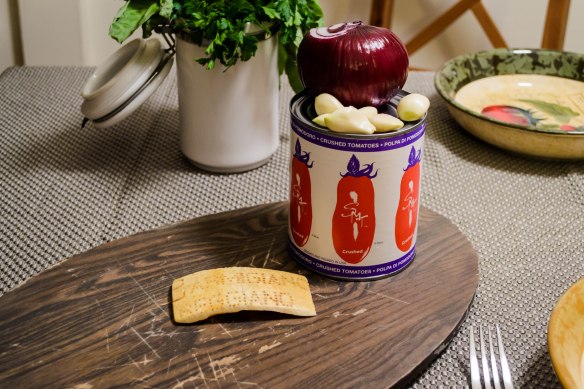
2015 Food Blog December-06582015 Food Blog December-0659Meatballs managed, there was then the sauce to contend with. Tomato sauce and I have a long, fraught history. I never much cared for the sort that dripped out of jars, and during my teenage years it flat out upset my stomach. The idea of meatballs burbling away in that acidic, over-processed stuff was beyond unappealing. But I’ve started making my own tomato sauces in the last few years, and I’ve found that rather than tomato paste and sugar, garlic and red wine seem to be the key flavoring components for a satisfying pasta topper. For this one, I started with Smitten Kitchen’s incarnation of a three ingredient tomato sauce, but couldn’t deal with the probably stellar simplicity of it, and succumbed to adding red wine, garlic, basil, red pepper flakes, and – my ultimate pasta sauce weapon – a parmesan cheese rind (I keep them in the freezer when there’s no more cheese to grate from them) to the original trio of canned tomatoes, an onion, and butter.

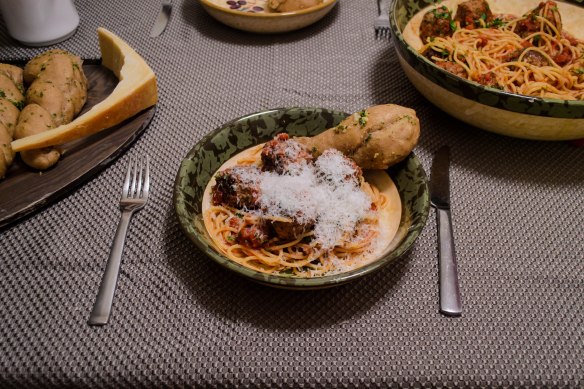
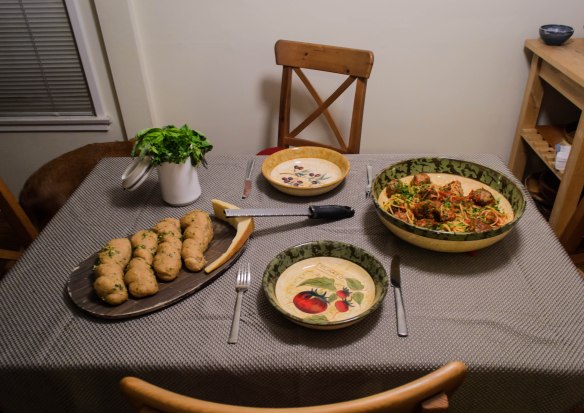
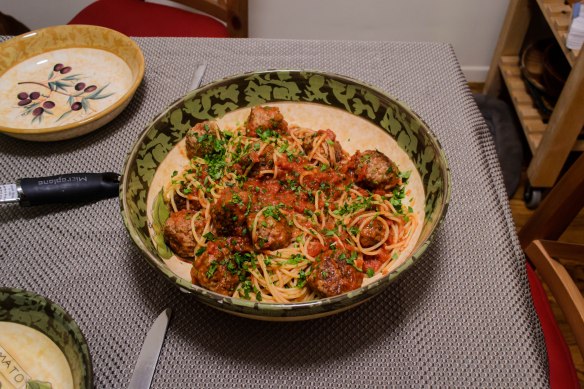
2015 Food Blog December-06622015 Food Blog December-0663While it would be sacrilege to call this anything like the “best spaghetti and meatballs” (in today’s world, that title is probably copyrighted anyway), it was a very satisfying way to conclude the project.* The meatballs were flavorful and tender and held together well. The sauce was deeply savory but still fresh and light and strongly tomato-y. Crowned with some fresh herbs and a fluffy shower of grated parmesan, it was worth holding onto, and certainly nothing to sneeze at.

2015 Food Blog December-0668*Though I’ll be back next week with a few end-of-year reflections on the project in its entirety.

Classic Spaghetti and Meatballs
About 90 minutes
Serves 4-6
For meatballs:
scant 1½ cups fresh bread crumbs (1-2 slices)
1 cup milk, cream, or half and half
¼ cup olive oil, divided
⅓ cup grated onion (about ½ a large onion)
2 large or 3 small garlic cloves
½ pound ground beef
½ pound ground pork
2 tablespoons chopped fresh parsley
2 tablespoons chopped fresh basil
⅛ teaspoon pepper
½-¾ teaspoon salt
⅓ cup grated parmesan
For sauce:
½ cup dry red wine
28 ounces crushed tomatoes (I like the San Marzano brand)
3 tablespoons butter
½ a large, peeled onion
6 whole, peeled garlic cloves
3-4 inch hunk of parmesan rind, if you have one
2 stalks basil
salt and pepper to taste
1 pound hot cooked spaghetti
¼ cup chopped parsley
extra parmesan cheese, to serve


  • Use a food processor to make your bread crumbs, then add them to the milk in a two-cup glass measuring cup, and let them soak for 10-15 minutes.
  • Use the same food processor (you don’t even have to rinse it out) to process the onion and garlic – toss in the onion in a few pieces, and the whole garlic cloves, and pulse until almost paste – only very small, grated-looking bits will remain.
  • Heat 1 tablespoon of the olive oil in a large skillet over medium-low heat. Scrape in the onions and garlic, sprinkle very lightly with salt and pepper, and sweat until tender and translucent; 5-8 minutes. Turn off the heat and move to a glass bowl to cool slightly.
  • While the onions and garlic are cooking, use the food processor again to chop the herbs and the parmesan cheese. Drain the bread crumbs by squeezing them lightly with your hand, then add the crumbs, the herbs, and the cheese to your cooling onion and garlic mixture. Toss together lightly.
  • When the bread and aromatics mixture is room temperature or only barely warm, add the ground beef, the pork, and the salt and pepper. Use your fingertips to combine – you want to evenly distribute the ingredients, but not overmix. Keep it as light as possible.
  • In the same large skillet you used for the onions and garlic, heat the remaining 3 tablespoons of olive oil over medium heat. Fry about 1 teaspoon of the meat mixture until cooked through, then taste for seasoning, and adjust in the remaining mixture if needed.
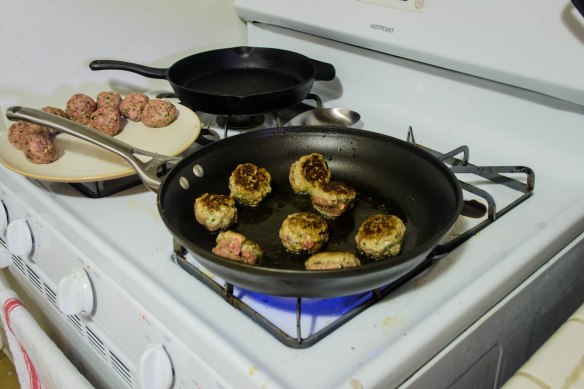
  • Roll the remaining meatball mixture into 16 equal sized meatballs (they will be about 3 tablespoons each) . Carefully place them into the skillet, not touching one another (you will probably need to do this in two batches), and sear, undisturbed, for about 2 minutes. When this first side is golden brown, flip over and fry for another 2 minutes, again until golden brown. When browned nicely on all sides, remove to a clean plate and repeat with the remaining meatballs.
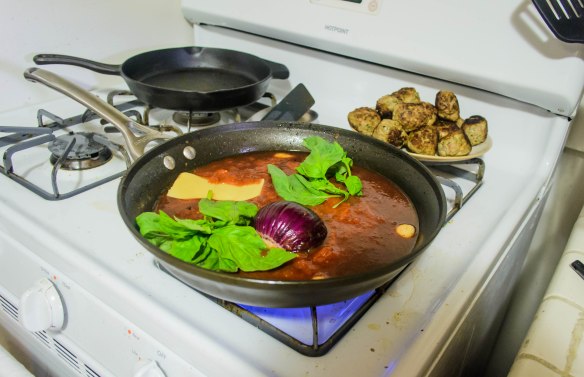
  • When all meatballs are browned and removed from the pan, add the wine all at once and use a wooden spoon or spatula to scrape around and remove the browned bits from the bottom into the wine, where they will act as flavoring agents. Add in the canned tomatoes, the onion half, the garlic cloves, the parmesan rind, if using, and the stalks of basil. Stir to combine. As soon as the sauce starts to bubble, turn the heat down to medium low and simmer for 10 minutes.
  • This is a good time to start a pot of salted water for your spaghetti.
  • After the sauce has simmered 10 minutes, taste it and add salt and pepper as needed, but go easy on the salt – the parmesan rind will release some salinity, and the meatballs themselves will as well. Nestle in the meatballs and simmer another 10 minutes, then flip over each meatball and simmer a final 10 minutes, for a total of 30 minutes.
  • Discard the onion, garlic, basil, and parmesan rind, then drain the cooked spaghetti and add it into the sauce. Use tongs to gently work it through the sauce, coating it completely.
  • Serve directly onto warm plates, or carefully slither into a serving bowl. Sprinkle with herbs and fluffy grated parmesan cheese. I recommend a side of garlic bread, and maybe a green salad.

Thyme and Black Pepper Crackers

2015 Blog September-0498Over the past few years, N. and I have made it our business to conclude the week with a happy hour – we load some cheeses and crackers on a plate, sometimes some sliced cured meat, sometimes a few dried figs – and pour something cold and alcoholic into a frosty glass. Through this process, I’ve learned that N. loves black pepper. We bought a wedge of cheese crusted in black pepper once as an experiment, and I think since then it has been on every shopping list, every week, for about the last two years. More recently, we started picking up variety packs of crackers – the crushed wheat rounds, the chalky water crackers, the rectangles spiked with vegetable bits – and in one variety-pack, a black pepper water cracker. This sleeve always, always disappears first. N. doubles up on the pepper – peppered cheese on peppered cracker. And should there be peppered salami? The kid is in paradise.

2015 Blog September-04712015 Blog September-0475Because we always run out of the black pepper cracker first, I knew when I saw this month’s Twelve Loaves theme of crackers, crisps, or flatbreads that I wanted to recreate them. I poked around and considered, decided to add some fresh thyme for a little more interest, and ended up with these. At first I called them water crackers, but decided to amend for the sake of accuracy. A real water cracker, traditionally speaking, contains only flour and water (and sometimes some salt or leavening agent). No fat. Yet fat is what, so often, imparts flavor. Here, a few glugs of oil result in a cracker that crackles in thin, flaked layers, almost like a very crisp pastry crust.

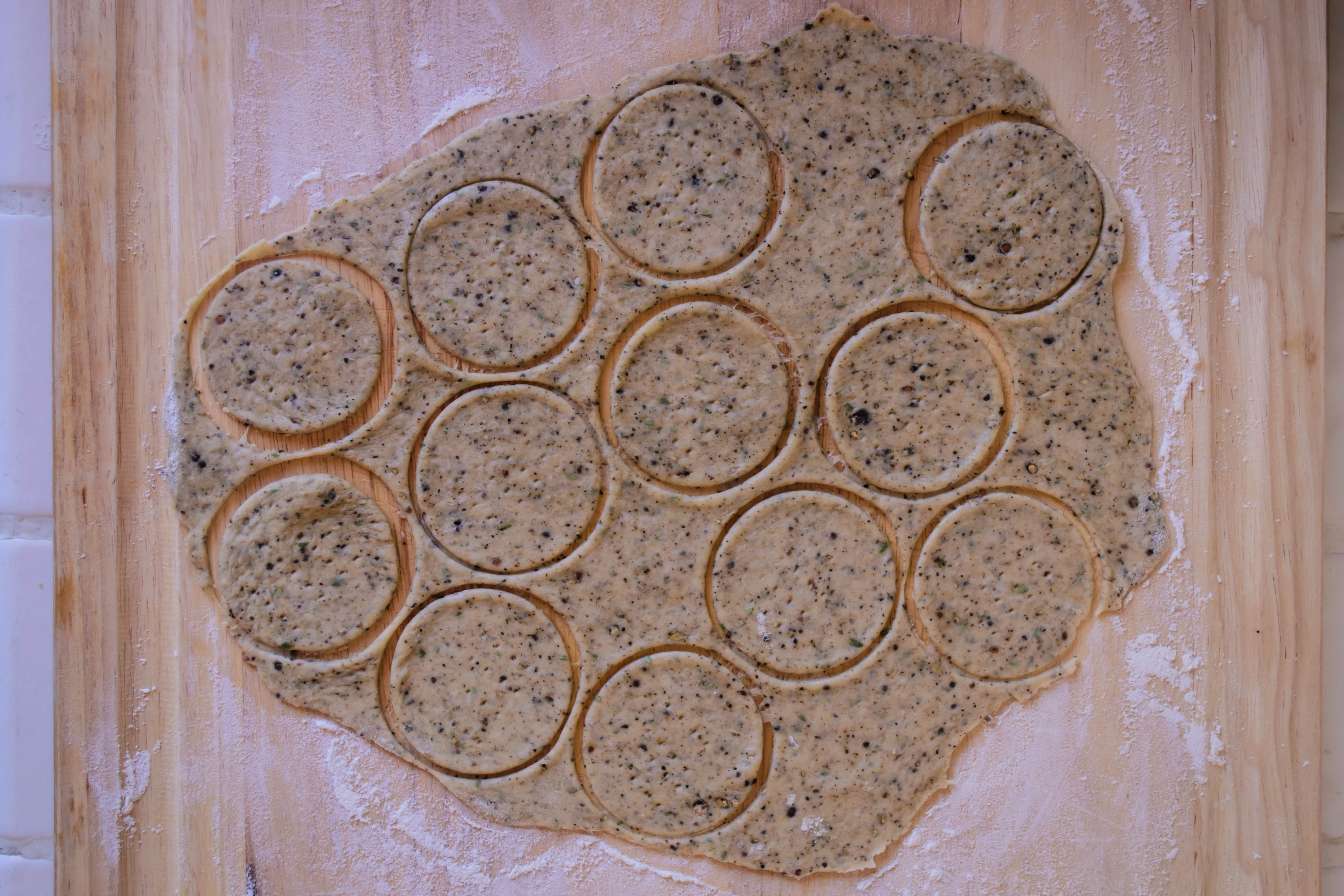
2015 Blog September-04762015 Blog September-04782015 Blog September-04792015 Blog September-0482A few notes: first, these are not for the weak-of-tongue. The black pepper flavor is quite aggressive, and though a smear of creamy cheese will certainly cool things down, it can’t disguise the sharp spice of the bits of cracked pepper. Second, as with most crackers, the greatest trick here is getting them thin enough. I’ve recommended ⅛ inch at the thickest, but even thinner than that is better. They swell up only slightly as they bake, and a thick cracker is, alas, a decidedly not-crisp cracker. Those that I didn’t get quite thin enough tasted stale already barely cooled from the oven, simply because they didn’t snap and crumble adequately between the teeth. For us, the thinnest, most golden specimens stayed crisp and fresh tasting for a mere two days afterward, even stored in a firmly flattened zip-top bag. That means, unless you have a pepper fiend around your house, you are best served by making these for a gathering (the spice suggests a Halloween party might be a good venue), or throwing together a half recipe, or maybe even freezing half the dough until you need another batch. I haven’t tried that with this particular cracker, but I have done so with great success with Joy the Baker’s Sharp Cheddar Cheese Crackers, so I have every confidence these will be equally suited for the deep freeze.

2015 Blog September-0488Serving recommendations: topped with any sort of cheese, of course. But they would be equally good with cured meat of some sort, or a scoop of egg salad, or maybe even some hummus. While they were hot, I found myself compulsively snatching one and then another from the cooling rack, suggesting they are even acceptable bare. I do think, though, that a glass of something sparkling to wash them down is not to be discounted.

2015 Blog September-0497

Thyme and Black Pepper Crackers
Adapted from Chowhound
Makes 4-5 dozen 2½ inch crackers
Time needed: about an hour
2 cups all-purpose flour
1 teaspoon baking powder
½ teaspoon salt
1 tablespoon black peppercorns
1 tablespoon fresh thyme leaves
⅔ cup warm water
⅓ cup olive oil


  • Preheat the oven to 400F and line two cookie sheets with parchment paper.
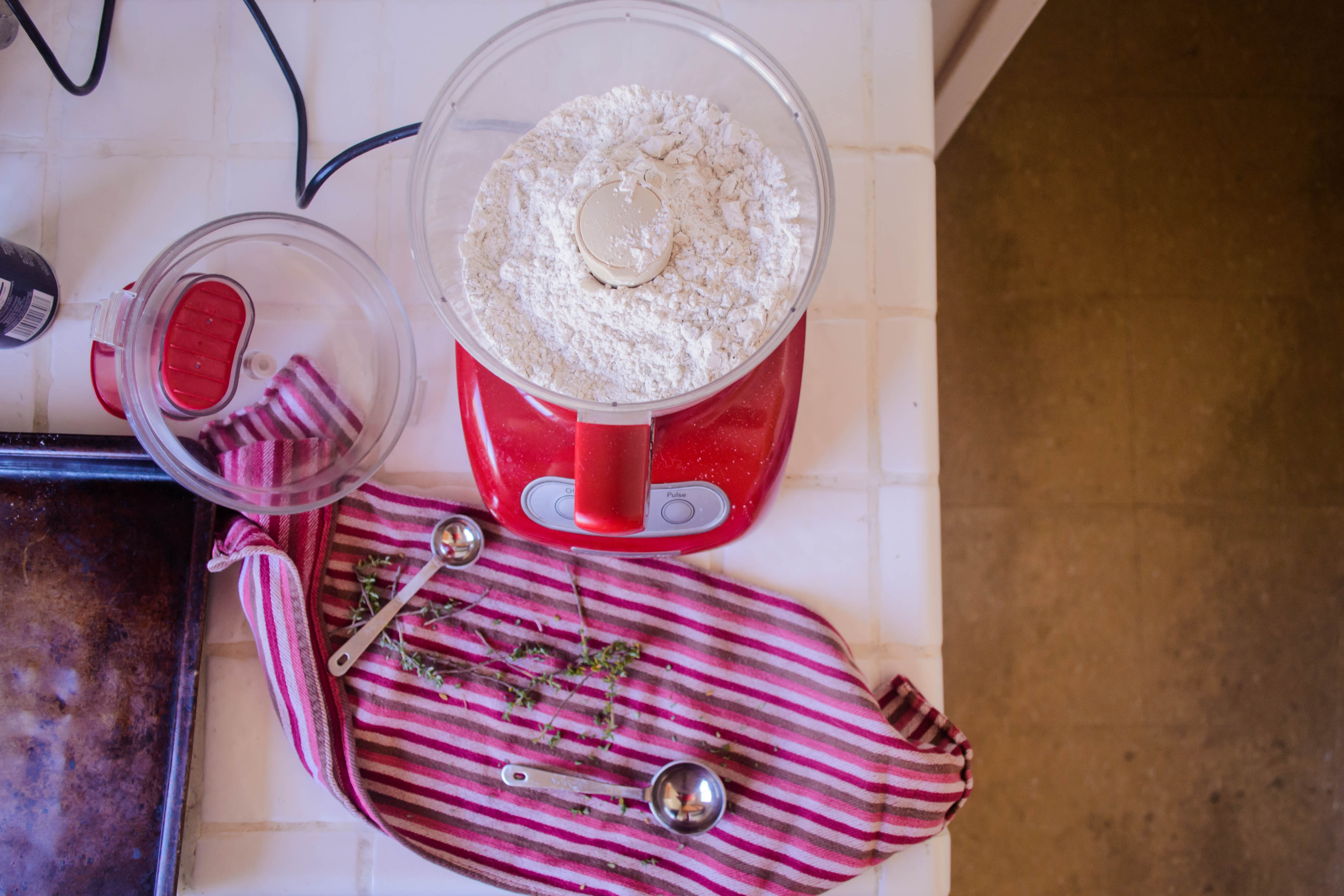
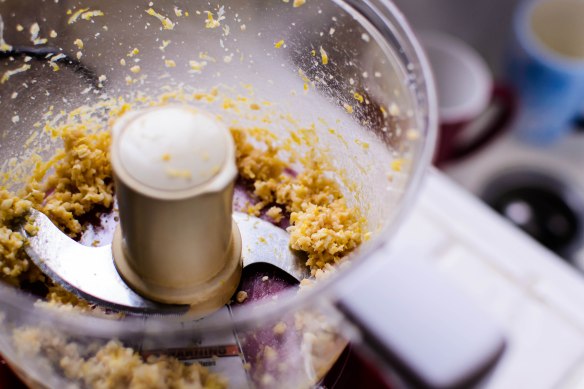
  • In a food processor, pulse the flour, baking powder, salt, and thyme until combined. Use a spice grinder or similar small bladed tool to crush up the peppercorns until some are coarsely chopped and some are a fine powder. Add this pebbly pepper dust into the food processor and run until the pepper is evenly distributed through the flour mixture.
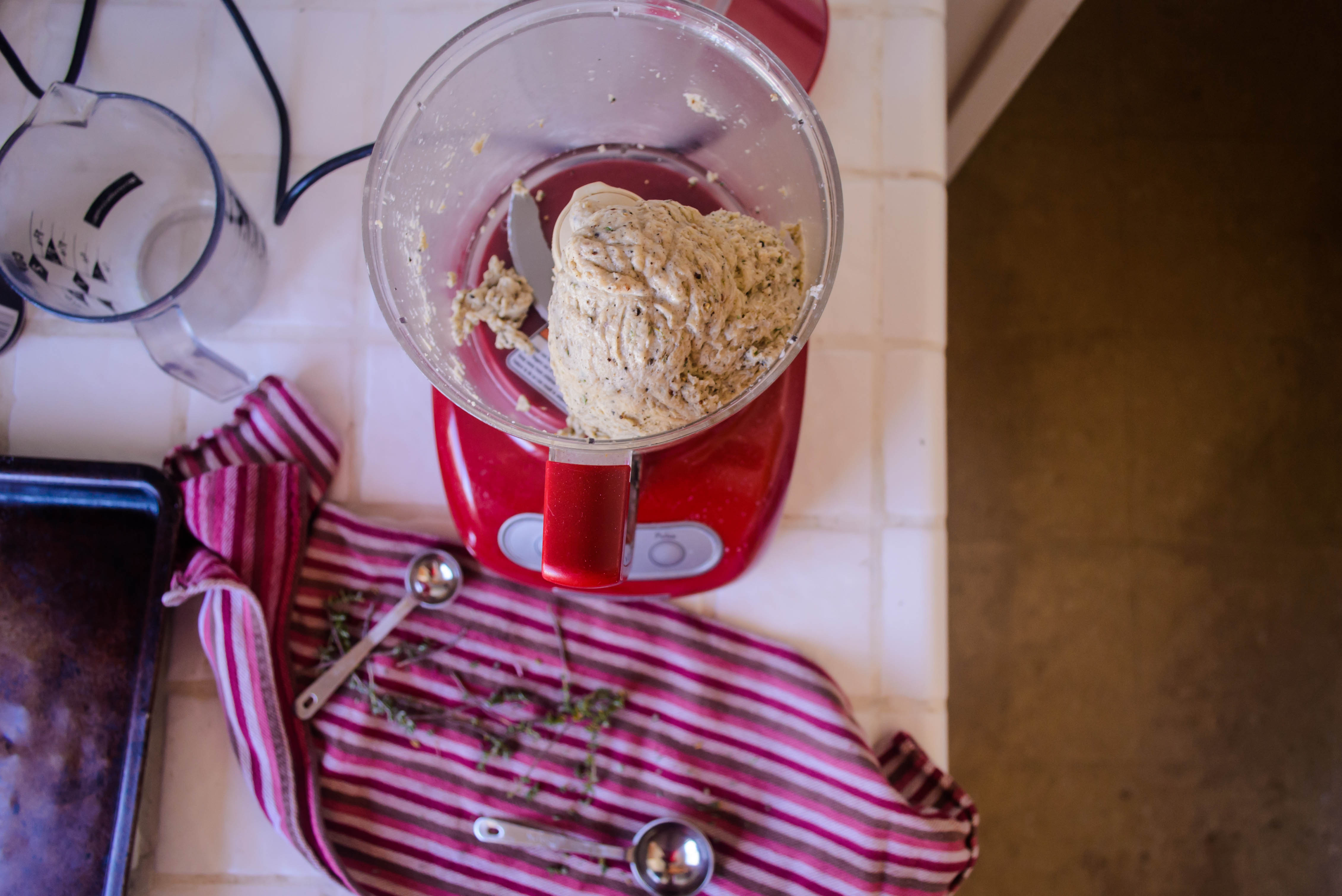
  • Measure out the warm water and the oil into the same vessel. With the food processor still on, drizzle in the water and oil and let the machine run until the ingredients form a smooth, slightly sticky dough. First small hunks will clump together, then quite suddenly a mass will form and run in circles around the belly of the processor.
  • Lightly flour a board and a rolling pin, and turn out half the dough. Sprinkle a little flour atop the dough as well. Roll out until very thin – at maximum ⅛ inch, but 1/16 inch is better for crisp crackers. Be sure to get the edges as thin as the middle. If you fear the dough is getting sticky, flip it over and turn it 180 degrees, then sprinkle with a little flour and roll again.
  • Cut the thin, even layer of dough into shapes of your choosing. We like rounds, and I used a glass with a diameter of 2½ inches. Prick rounds with a fork three or four times, then transport dough rounds to the prepared cookie sheets. Place them in a single layer, but they can sit very close together because they will not spread out. I easily fit 2 dozen on a single cookie sheet. Repeat for the remaining half of the dough.
  • Bake 12-14 minutes, until golden on top and quite dry. Cool completely before topping with cheese, salami, hummus, or whatever’s your favorite.
  • These can be stored in an airtight container or zip-top bag for a few days, but because they are freshly made and contain no preservatives, they will get stale faster than the average boxed cracker.


#TwelveLoaves is a monthly bread baking party created by Lora from Cake Duchess and runs smoothly with the help of Heather of All Roads Lead to the Kitchen, and the rest of our fabulous bakers.

Our host this month is Camilla from Culinary Aventures with Camilla, and our theme is Crackers, Crisps, and Flatbreads. For more bread recipes, visit the #TwelveLoaves Pinterest board, or check out last month’s mouthwatering selection of #TwelveLoaves enter last month’s #TwelveLoaves Seeded Breads!

If you’d like to bake along with us this month, share your Crackers, Crisps, and Flatbreads using hashtag #TwelveLoaves!