“Rumpled Donuts”

2016 Food Blog January-0343Some of the blog search terms I’ll be using for this year’s project are straightforward, and some made proto-recipes fly immediately into my head. This one did not. Part of the reason I chose to do it first was simply because I wasn’t sure what “rumpled donuts” should be, and wanted to figure it out before I was too deep into the spring semester.

2016 Food Blog January-0316Though I can think of what many “rumpled” baked goods might look like – particularly rumpled pancakes, which might be crepes, or maybe that lovely giant Dutch baby or German pancake that rises up past the edges in the pan – I couldn’t fathom what a rumpled donut might be. If you’re still out there, searcher, what were you after? When I think “rumpled,” I think unmade bed sheets. It’s uneven. It’s piled and layered, and that meant my dough, whatever I opted for, would also have to be uneven. Clearly this is a problem for regular dough – in almost all baked goods you want your dough or batter to be rolled or spread or patted out to the same thickness all the way across, for even cooking. It would need, then, to be a non-traditional dough.
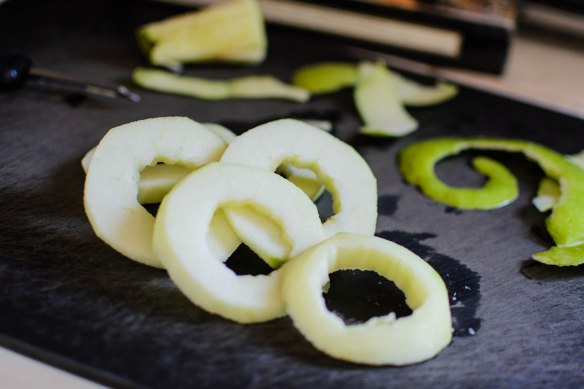
2016 Food Blog January-0319I’m not sure what eventually led me to phyllo. Certainly I thought of my favorite donut, the perfectly delicious but sometimes overlooked apple fritter, and somewhere in the contemplation of apple and cinnamon and unmade beds, I thought of a crumpled layer of phyllo dough, and I knew exactly what I would do. Phyllo would get twisted and wrapped around a ring of apple, then fried until crisp and dredged in a healthy layer of cinnamon sugar. Bingo. Rumpled donut. The apple slices would have to be cooked for a while first, though, since the phyllo would fry so quickly.
2016 Food Blog January-0312Next to making caramel, frying is the cooking project that puts me most on edge. The oil takes a long time to come up to temperature, it seems like so much, and there’s always the fear that, well, you have a vat of boiling oil on your stove right next to your hands, and arms, and legs, and all those body parts you’d prefer remained un-fried. In this case, there was also the complication of working with phyllo, which needs to be treated quickly and delicately to avoid tearing or drying out. For that reason, even after deciding exactly what I would do, I put off making these for three weeks. Surely, I thought, they would be more trouble than the end product was worth.

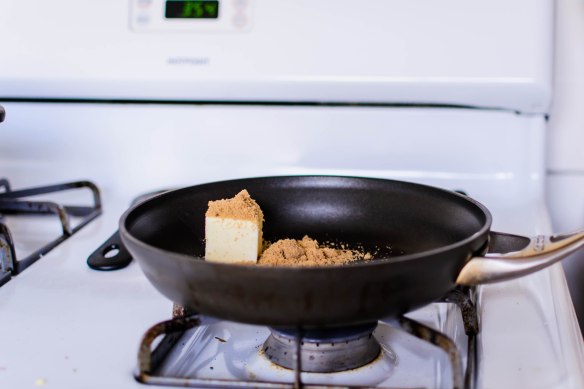
2016 Food Blog January-0330Untrue. I’m not in a rush to make them again, but for a pure experiment they were amazing. The apple rings are meltingly tender after a sauté in butter and brown sugar spiked with a cinnamon stick. The loose buttery caramel they leave behind is the perfect slick to brush between phyllo layers to help them cook through and to sweeten the tasteless, papery dough. Once fried, which only takes about a minute on each side, the phyllo is impossibly crisp, not particularly greasy, and deeply golden. It’s like a croissant and an apple fritter had a beautiful affair. I made six of these, since that’s how many rings I divided my apple into, and since each one consisted only of one slice of apple and one sheet of phyllo, N. and I felt no compunction whatsoever about eating three each over the course of the afternoon and evening.
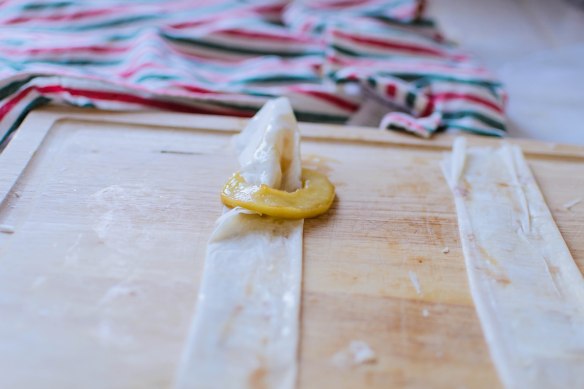
2016 Food Blog January-03392016 Food Blog January-0337Here’s the thing, though. Most of the recipes I post here, I want you to cook. I try to make them precise, and organized, and exact, so you can replicate them successfully, with your own touches, if you wish. This one is different. Unless you’re really into what you’re seeing here, don’t make these. They were outstandingly delicious, yes, but they were also a giant pain to execute. The apples tore, the phyllo tore, there was sugar everywhere, and as you’ll see below, the process of folding and twisting and wrapping is tricky to describe and to do (and impossible to take pictures of – I gave up). What I’d advise instead, and what I will likely do when a craving for fried phyllo arises, is to forget about the donut ring shape. Just make packets – twist or roll or wrap up a sautéed slice or plank of apple in phyllo layers and drop it into the oil that way. It will still produce sweet, tender apples in flaky, crispy layers of dough that shatter everywhere upon impact, but you’ll save yourself a lot of irritation in the construction phase. And if apples aren’t your jam, I’d imagine you could use almost anything: a smear of pesto, a dollop of nutella, a slice of brie spread with fig or apricot preserves and wrapped in prosciutto inside that papery crispy envelope.
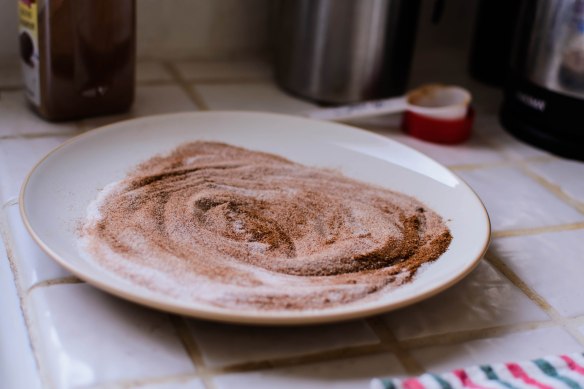
2016 Food Blog January-0309Just in case, though, what follows is my procedure, as clearly as I can describe it, for my attempt to invent the “rumpled donut.” Enjoy!

2016 Food Blog January-0344

Rumpled Donuts
Makes 6
45-60 minutes, roughly, depending on how many donuts you fry at a time
1 large green apple
4-5 tablespoons of butter
2 tablespoons brown sugar
1 cinnamon stick
pinch of salt
6 sheets phyllo dough (or however many apple rings you end up with)
1-2 quarts vegetable oil
½ cup granulated sugar
2 tablespoons cinnamon


  • Begin to heat the oil to 350F in a deep pot. I use one with straight sides, but a wok would probably also work nicely. Oil should be at least three inches deep.
  • While the oil heats, prep your ingredients. Skin the apple and core it, leaving a hole down the center at least 1 ½ inches in diameter. Cut the cored apple into ¼ inch thick rings – for me, this made 6 even slices.
  • Melt 4 tablespoons of the butter in a skillet over medium heat. Add the brown sugar, the cinnamon stick, and the pinch of salt and stir or whisk together the sugar is fully dissolved into the butter. Add the apples in a single layer and sauté until tender, about 2 minutes per side. When apple slices are tender but not mushy, turn off the heat, remove apple slices from the pan, and set them aside to cool until room temperature, or just barely warm.
  • While the apples are cooling, combine the granulated sugar and cinnamon in a small dish, and prepare a work station for the phyllo dough. You will need a large board and two slightly damp kitchen towels. Lay one towel down on a countertop, place the 6 sheets of phyllo on it, then cover the phyllo with the other towel. Phyllo dries out fast, and when it dries it becomes brittle and even more difficult to work with. Set out a wire rack with paper towels, or a cookie sheet, or a large plate underneath – this is where you will set your finished rumpled donuts.
  • Carefully separate one sheet of phyllo from its companions and spread it out on the large board. Cut it in half width-wise so you end up with two fatter rectangles (as opposed to two thinner ones, as you would if you cut it lengthwise). Use the leftover butter and sugar mixture in your pan to brush lightly over each rectangle (if this has solidified and seems unbrushable, add the additional tablespoon of butter, put it over low heat, and stir or whisk together until melted and spreadable again). Fold each phyllo rectangle in half lengthwise for two longer, thinner strips. Repeat, brushing and folding again, for each piece so you have two thin strips of phyllo.
  • Now comes the pesky part. Take one of your apple rings and carefully insert one of the phyllo strips through the hole in the center. Pull the apple through about ¼ of the length of the phyllo, and wrap that ¼ back around the apple ring. Draw the remaining phyllo strip around the apple ring and back through the hole. This is easiest if you draw the end of the phyllo through as though you were threading a needle, rather than pushing from the middle of the phyllo strip, which can encourage tearing. Continue to draw the phyllo through and carefully wrap it around the apple ring in a spiral, and repeat with the second strip. You will need both to form a full spiral of dough around the apple, completely encircling it. Tuck the ends of phyllo into the central hole of the apple to secure.
  • Repeat with the remaining apple rings and sheets of phyllo.
  • When you have wrapped your apples and your oil has reached a temperature somewhere in the window of 350-365F, you are ready to fry. Use a skimmer or a kitchen spider to carefully lower the “donuts” into the oil one at a time. If your pot is wide, you can fry more than one at once. I just did one at a time.
  • Fry the “donuts” until deeply golden, then flip and repeat. For me, this took about 1 minute per side. Carefully remove with the skimmer and let it drain over the pot of oil for a few seconds, then sprinkle liberally with the cinnamon sugar mixture (be sure to get both sides!), and set gently on the wire rack to cool for at least 5-10 minutes. This will ensure that all surfaces stay crispy. Keep an eye on your oil temperature, ensuring that it remains in the 350-365F range.
  • Repeat with remaining donuts, and eat as soon as they are cool enough to handle, with plenty of napkins at the ready. We did not save any, so I don’t know how they store, but my guess is the phyllo will not retain its perfect crunch overnight.
Rain Check + Roasted Carrots

Most of the way through a long weekend during which I did nothing, which was not enough, and therefore the weight of the semester starting tomorrow built up castles and piles and walls of things to do, that I just couldn’t start since I’d already put them off too long, I found myself feeling a bit unready, and a bit homesick, and a bit cranky about it all. The moment I decided I could take this week off from recipe writing and photo editing and blog posting, it all suddenly seemed more doable.

So I did.

Except, it’s worth popping in to say, that if you find yourself in possession of a bundle of slim, whiskered, rainbow colored carrots, and you toss those in a concoction of roughly equal parts mango chutney (or apricot jam), dijon mustard, and olive oil, and you spread them out on a cookie sheet and sprinkle them with salt, you can roast them at 400F until they are caramelized on the outside and just tender on the inside (anywhere from 15 minutes for very thin spears to 45 minutes for fat ones), and you can challenge yourself to see how many fit on your fork tines at once, and you can fight over the last almost-charred morsel, and your evening suddenly has a lovely chance of being bright.

Apple Cranberry Hand Pies

2016 Food Blog January-0251When my sister was a kid, she somehow acquired a cooking toy the internet tells me was called “McDonald’s Happy Meal Magic: Pie Maker.” Released in 1993 (feeling old yet?), it allowed the user – with parental guidance, to be sure – to create a small pocket snack that, at least in inspiration, vaguely approximated the fast food giant’s classic dessert. The “pies” this toy made can’t have been very good; from what I recall, they consisted of a piece of store-bought bread, crusts removed, that you rolled out thin and topped with a small hill of fruit filling (I remember applesauce; my sister recalls jam). You then folded the bread over the filling, placed it in a little box-like contraption and, upon forceful application of the lid, squashed and crimped it into submission. You could then sprinkle on some cinnamon sugar, and eat it immediately.

2016 Food Blog January-02192016 Food Blog January-0221The problem with this, aside from the fact that it doesn’t sound very appetizing anymore, was that after going to all the trouble of removing crusts, rolling out, squashing and crimping, my mom would only let us eat one or two at a time. And I can’t imagine they would keep well.

2016 Food Blog January-0222Regardless of practicality or flavor, though, I remember this being a lot of fun. There was a satisfaction to assembly-line production of “dessert” items that, though not as prolific as Lucy and Ethel’s experience, meant we had the ability (if not the permission) to create high volumes of sweets.

2016 Food Blog January-0224This was my introduction, though I didn’t realize it, to hand pies. A sweet rejoinder to pasties, flaky dough encases a fruity filling in a single serving that, true to its name, can be picked up (once it has cooled enough, of course) and eaten straight out of hand. It can also, of course, be topped with a scoop of ice cream, or drizzled with caramel, or a dozen other plate-and-fork applications, but the glory of being able to lift one straight off of a baking sheet and walk away utensil-free is worth noting.

2016 Food Blog January-0225A mid-winter pie should be sweet, yes, but it should also be tart and bright to wake up your sluggish, post-holiday self. I decided on apple and cranberry. I always buy a few extra bags of cranberries when they are on sale in November and December, and stow them in the freezer in case I get early spring cravings for cranberry sauce.

2016 Food Blog January-0233The dough for hand pies needs to be easy to manipulate, since you’ll be rolling and cutting and folding and crimping, so I went with the cream cheese dough I’ve been dabbling with lately – it is a moist dough, so it doesn’t tear as easily as some, and the cream cheese as well as butter keeps it fairly tender even when you work it a bit.

2016 Food Blog January-0237The filling is lightly adapted from Joy the Baker’s Apple Cranberry Crumble pie.  In addition to the classic procedure – toss the apples with sugar, cinnamon, lemon juice – Joy includes two extra steps: let the apples macerate for thirty minutes or so, to create a puddle of sweet, spiced juices. Rather than just dump this into a pie shell, in a stroke of genius, you bubble the juices down with some butter to create a thick, syrupy caramel, which you promptly stir back into the fruit before filling your crust. You end up with a slightly less wet filling, which is a fine thing on the mess front, and a deeper, more developed flavor. I took the liberty, and I think Joy would approve, of adding a few tablespoons of bourbon to my juice mixture before I boiled it down into a syrup.

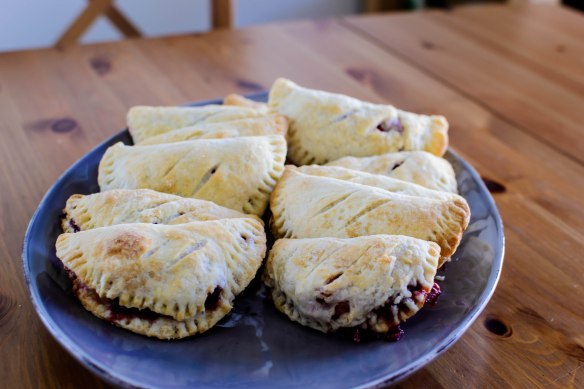
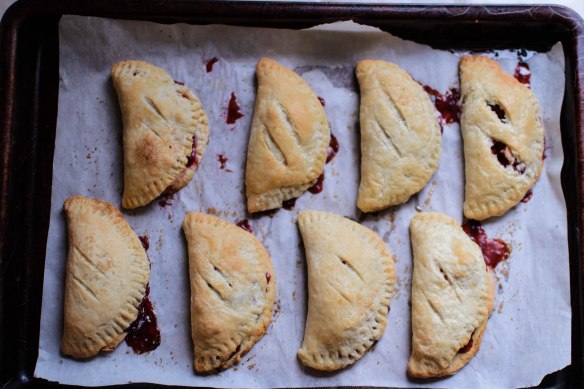
2016 Food Blog January-0242These are lovely little pockets of sweet tartness. In the time it takes the crust to go pale gold and fluff up into pockets of flakiness, the small chunks of apples and coarsely chopped cranberries swimming in syrupy cinnamon caramel have time to cook through, but not turn to mush. Your only enemies here are time and heat – as with all butter-based pie crusts, if the butter in the dough warms up too much before it goes in the oven, the crust will not puff and flake, as the butter will melt right out of the dough before it has a chance to create layers of pastry. But you can surmount this by carefully moving back and forth between prep with the crust and the filling, making use of your fridge in between, and still put forth a dessert in about two hours. I brought one to N. to sample, and he returned ten minutes later with an empty plate and said “that was really, really good. Now I just want four more.” I didn’t tell him I’d already eaten two and was contemplating another.

2016 Food Blog January-0259I call that a win.

2016 Food Blog January-0275These will keep wrapped in aluminum foil for 2-3 days before the pastry starts to get a bit soggy. Good news, though: they reheat perfectly in a 300F toaster oven.

2016 Food Blog January-0250

Apple Cranberry hand pies
Makes 16 5-inch pies
Time: about 2 hours
For Crust:
2 ½ cups all-purpose flour
2 tablespoons granulated sugar
1 teaspoon salt
8 ounces cold full fat cream cheese
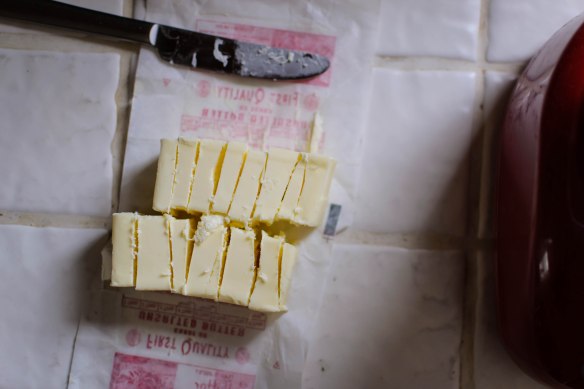
8 ounces cold unsalted butter (2 sticks), cut into thin slices
3-4 tablespoons very cold water
For Filling:
3 large granny smith or other tart apples, peeled, cored, and cut into ¼-½ inch chunks
1 tablespoon lemon juice
¼ cup packed brown sugar
¼ cup granulated sugar
2 teaspoons cinnamon
¼ teaspoon salt
2 tablespoons butter
2 tablespoons bourbon (optional)
1 tablespoon cornstarch
For assembly:
Flour, for dusting
Coarse sugar, to sprinkle


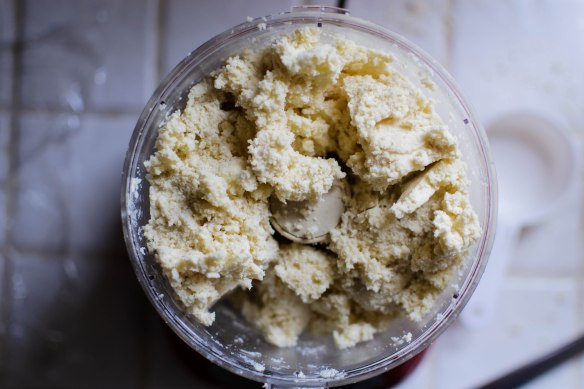
  • To make the crust, pulse the flour, salt, and sugar in the belly of a food processor until evenly distributed (consider doing this in halves – my food processor could barely handle the whole quantity). Add the cream cheese and let the mixer run until the mixture is homogeneous – it will be the texture of barely moistened sand and stay together only a moment when pressed between thumb and fingertip, as in the photo above.
  • Dump in the slices of butter and pulse in 1 second intervals until most of the butter is broken up and, when tested, the mixture stays together when pressed between thumb and fingertip.
  • Drizzle in 3 tablespoons of the cold water and pulse again briefly once or twice. We are looking for the mixture to just start to come together into a rumbling ball in the belly of the machine. If the mixture seems too dry, add the last tablespoon of water and pulse again briefly to bring together.
  • Stretch out a piece of plastic wrap on your countertop and dump the contents of the food processor onto it. Remove the blade and use the plastic wrap to help you shape the dough into a disc about 6 inches in diameter. Try to handle it as little as possible to keep it tender. Wrap it up and stow it in the fridge for at least an hour.
  • While the crust chills, make the filling. Combine the apple chunks, lemon juice, brown sugar, granulated sugar, cinnamon, and ¼ teaspoon salt in a large bowl. Toss with a spatula or your fingers to evenly distribute the spicy, sugary coating. Gently maneuver the apples and their sugar and spice mixture into a fine mesh sieve and position this over the large bowl you were using, then set aside for at least 30 minutes (Joy says up to three hours, though I didn’t leave mine this long). The objective here is to catch the drippings.
  • While the apples drip, preheat the oven to 400F and line two baking sheets with parchment paper. Remove the pie crust disc from the fridge. Lightly flour a large board and a rolling pin, then unwrap the disc, divide it in half, and set half on the floured board. Pop the other half back into the fridge until you are ready for it. Using firm and deliberate strokes, roll out the first half of the dough into a rough circle about ¼ inch thick. Every few rolls, shift the dough circle around, flipping it and adjusting it on the board – this will minimize sticking. You can also add more flour if needed.
  • With an even ¼ inch layer of dough, use a floured cutter or lip of a glass to cut the dough into circles. I went with 5 inches in diameter. To avoid extra stickiness or tearing the dough, press straight down without twisting. Once you have cut all the way through the dough, then you can twist the cutter a bit to loosen the round from the board.
  • Once you have made all the circles you can, gather together your scraps and re-roll them – you want to do this as quickly as you can to prevent the butter from softening too much. Roll out and cut again, then repeat with the other half of the dough. Position your dough circles on the prepared baking sheets (it’s okay if they overlap – they won’t stick), and put them into the fridge to chill out again.
  • Now turn back to the filling. When you have at least ½ cup of liquid from the apples, pour it into a small saucepan along with the 2 tablespoons butter and the bourbon, if using, and cook over medium-low heat until it becomes thick and syrupy, and only about ⅓ cup remains.
  • While the apple drippings cook down, plop the apples back into the original large bowl. Using the same food processor you used for the crust (you can wash it out if you want – I usually just scrape out any big lingering bits), pulse up the cranberries until they are coarsely chopped. You can do this by hand if you want, but it is fairly messy.
  • Add the cranberry pieces to the apple chunks in the large bowl, and toss them with the cornstarch until the cornstarch is no longer visible.
  • When the apple drippings are reduced to a thick, syrupy caramel, pour it back over the fruit and toss gently to combine.
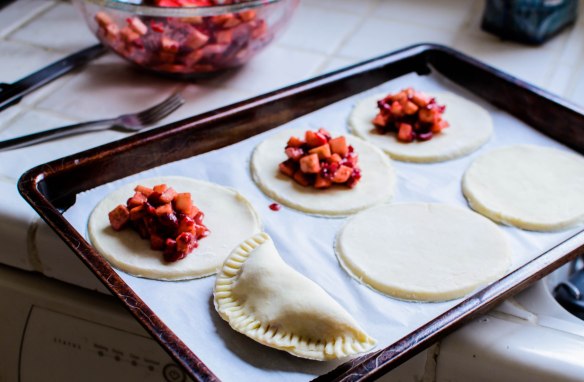
  • Now, pull the prepared dough rounds out of the fridge (I’d do one baking sheet at a time), and add 1½-2 tablespoons filling to each 5-inch round of dough. You will be tempted to add more. Don’t do it! 1½, or a scant 2, tablespoons is all that can safely fit. If your rounds are smaller, you will, of course, need less filling. When all rounds are filled, you’ll likely have a tablespoon or 2 of filling left over.
  • As you place each tiny pile of filling in the middle of the dough round, fold it in half and press the edges together with your forefinger and thumb. To seal each little half-moon package, set it down on the floured board or on your baking sheet and press down on the edges all the way around with the back of the tines of a fork.
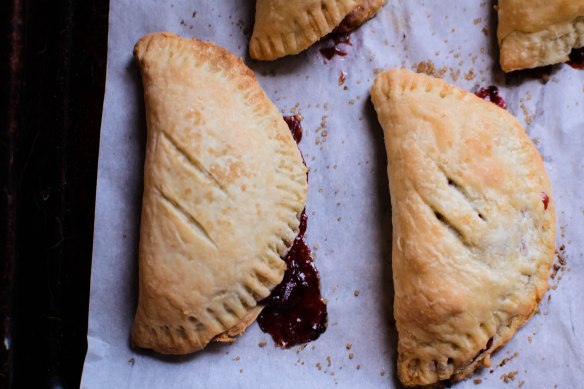
  • Settle each crescent evenly spaced on your baking sheet – you should be able to fit 8 per sheet without them touching each other. Slash the top of each one lightly with a knife to give an escape valve for steam, and if desired, sprinkle on a pinch or two of coarse sugar before levering them into the oven.
  • Bake at 400F for 25-30 minutes, until the crusts are puffed and golden brown, and possibly a bit of gooey syrup escapes from the less-carefully-crimped edges.
  • Cool for at least 10 minutes before digging in. They are perfect on their own, but I suspect a scoop of vanilla ice cream wouldn’t hurt matters…

2015 in Review, 2016 Project Announced!

I realize I’ve been quite remiss in posting, but friends, after two weeks of traveling, holidays, and a persistent head cold, it felt SO GOOD to just watch a Monday go by without worrying about recipe development or photo editing. It feels extravagant and lush to spend a day at leisure without any guilt (this is a problem I often have), and so I’ve allowed myself a bit of that these past few days.

It’s time to come back to reality, but I’m letting myself edge back into the pool slowly, lightly. Today, I want to offer you two things. First, a bit of a photo review – some of my favorite shots from last year, and why they rank so highly – and second, the project I’ve decided on for 2016.

Let’s start with the photos.

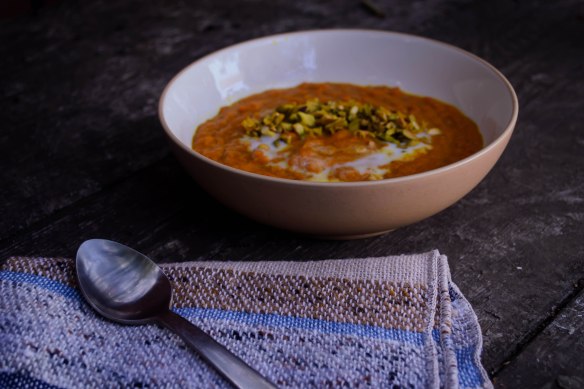
Food Blog January 2015-0209The one is all about color contrast. I love the deep rusty sunset color of the carrot soup, with the bright drizzle of coconut milk resting on top. The dark color of the table sets off the whole thing, and I like the homey weave of the napkin in front, with the bowl set back and out of focus, almost as an afterthought. I’m shooting in late morning on an unfinished table in the back corner of my backyard, shaded by several trees, that I’d hastily wiped off just before this shoot.

Food Blog March 2015-0464I’m crazy about the look of the mushrooms here. It was a quick picture without much planning, but there was something about their uneven roundness and the way they tumbled and clustered across my cutting board that appealed deeply to me.

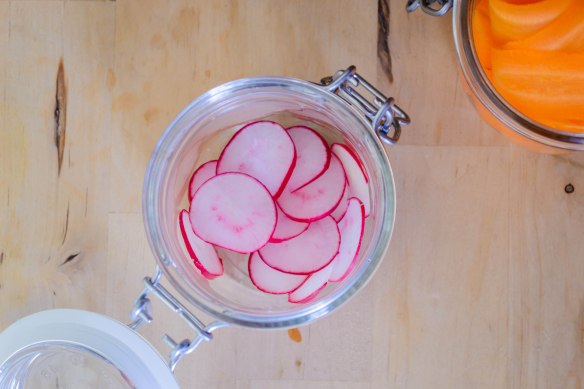
Food Blog April 2015-0551Here it’s all about brightness and sharpness. The edges of the radish – bright pink into tinted white – are just as sharp as the peppery radish itself. The slices are so thin they are almost transparent, and I dig the overhead perspective with the pale, unfinished table surface underneath.

Food blog June 2015-0910This is my desktop background on my computer at work – partly because the reminder of the existence of chocolate during a tough day is a pick-me-up in itself, and partly because I love the depth of field. I had just started seriously experimenting with aperture mode on my camera when I took this, and I was so happy that the focus came out exactly where I’d wanted it to, right at the closest point of the bar of chocolate, and fading out of focus as the bar extended, which I think makes it look far bigger than it actually is.

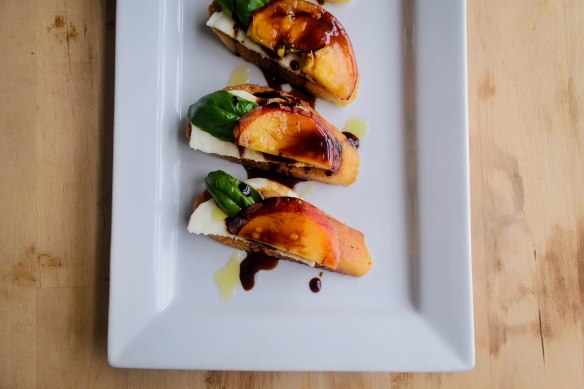
Food blog June 2015-0973Again, I love the color contrast here, but also the textures you can see – the uneven grain of the wood beneath the stark white ceramic plate, the random drizzles of dark balsamic and pale olive oil, and the bright basil leaf drowning underneath the warm peach slices. It was exactly the photograph I wanted to capture, and those always delight me.

Food blog June 2015-1062I find salads one of the hardest types of food to photograph attractively, so I was thrilled by how well this came out. There was a lot of careful placement work for this image, adjusting the leaves and the vegetable slices to ensure a varied stack rather than a homogeneous pile. I also resisted dressing the salad until the last possible moment, as a dressed salad begins to wilt instantly, and crisper leaves seem to make for a better photo.

Food blog July 2015-1114Crackly cheese puddles. What else can I say?

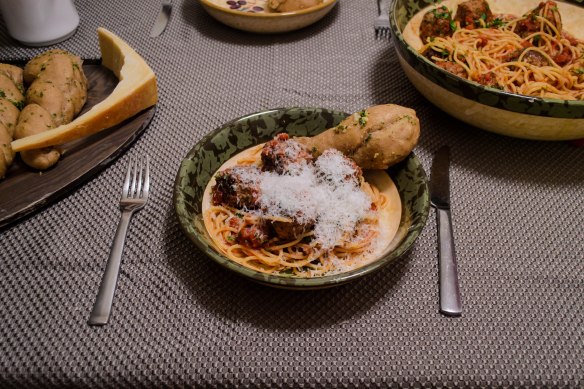
Food blog July 2015-1180I love that you can see the architecture here – even though the perspective is straight overhead, you can tell how high the pasta is twirled, and how the meatball is resting precisely on the summit.

2015 Blog August-0307The blistered skin, curling back from where it has snapped from the pan’s heat, made such a nice play of different shiny surfaces here, and because I am outside (the kitchen was losing light, so I went for the neutral background of our paved back patio area), there’s a blueness to the light of the photo that I really like with the plums. It was a dessert with a play of temperatures – warm fruit with an ice-cold pastry cream – so the coolness of the photo and my memory of the very hot day on which it was taken heighten my appreciation for both the dessert and the image of it.

2015 Blog September-0367This one might be my favorite. I love the play of different sizes and colors here, and the fact that there are no defined borders. The seeds are tumbled together in a large cookie sheet, but my shot is tight enough that you can’t see any of the sides, and I think that makes for a better final picture.

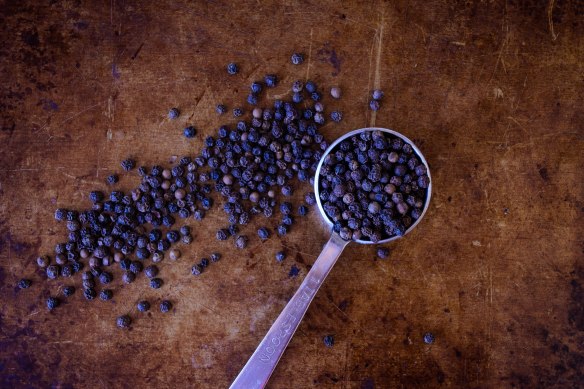
2015 Blog September-0471The mottled, uneven look of the ancient, battered cookie sheet here makes a nice contrast to the sharp, new metal of the measuring spoon and the dark, wrinkled peppercorns. The detail here thrills me – I love photos that remind me how sharp and powerful my camera is – it is lovely to be able to see so sharply the pocks and pits in the peppercorns.

There you have it: my favorite photos from 2015. It was hard to choose, and as you can see, hard to narrow them down.

Since we’re now into the first week of 2016, I’m excited to share with you this year’s project. One of the features WordPress allows me with this blog is to check a statistics page, and in addition to page hits and number of views, it often shows me search terms – what words or phrases people have used to find the blog. Sometimes these are easy to figure out – “apple oatmeal bread” is a pretty common one that leads people to this quickbread I made for a Twelve Loaves challenge – but sometimes they are odd or hilarious, and sometimes they are inspiring – I’m driven to imagine what such a dish would be like. What ingredients would I use? What would tie it together? How would I assemble it? So that’s the project for 2016. Once a month, I will create a dish inspired by search terms someone has used to find this blog. It will, I think, stretch my imagination, and that requirement of originality without a real plan will be an entertaining challenge.

Project Meatball: Reflections

As I did last year, I want to conclude my study in meatballs with a few reflections. Having now conducted twelve experiments, I have a few definite thoughts to offer, if you’re thinking of increasing your own meatball intake.

1.) Meatballs are not as photogenic as a food blogger might like. I mean, the finished dish, with its starchy base and the browned and simmered balls and their garnish artfully arranged look nice enough. The process of making them, though, is decidedly less so. Think about it. Chopped and sautéed aromatics, sopping breadcrumbs, and a bowl of raw ground meat. Not particularly aesthetically pleasing. As I went through each recipe, I found myself struggling a bit to achieve attractive shots. This was, in part, due to the ragged look of the raw ingredients themselves, but also the overlap in staging possibilities: you take the bowl of raw meat, you roll it into balls, you brown and then simmer the balls. You can only take pictures of each step so many times before it begins to feel repetitive.

2.) Meat is expensive. For financial, ethical, and digestive reasons, N. and I tend to limit our intake of meat, especially red meat, and when we do buy it, we try to buy responsibly and humanely farmed product. This, of course, means a certain type of grocery store or butcher shop, and when you add one or two different types of ground meat to your list a couple times a month, your grocery bill gets noticeably higher.

3.) It’s SO MUCH MEAT! As a side effect of our choice to limit our meat consumption, N. and I have become much less accustomed to, well, how bodies process meat. While we really liked most of these meatball dinners, we definitely noticed how much more meat we were eating, and how our stomachs, among other parts, responded. It’s not an official resolution, but I think we’ll be laying off the meat for a little while next year (though the cheeseburgers my dad made us a few nights ago were everything good about beef).

4.) Despite these critiques, meatballs are delicious, and really quite easy. They follow a definite pattern: prep some aromatics, whether that means chopping some herbs, sautéing aromatics, or both; whizzing up and soaking breadcrumbs or beating egg; massage the seasonings and moistening elements in with the meat; roll, brown, remove, bring the sauce component to a simmer, and plop the meatballs back in to simmer until cooked through. In all honesty, and to no real surprise, the trickiest thing about the whole process is having all three components – meat, sauce, and starch or accompanying side – ready at the same time.

Next week I want to show you a few of my favorite images from the past year, and I’ll be back with a new recipe for you in January!

Classic Spaghetti and Meatballs

2015 Food Blog December-0665When I told my parents that my blog project for 2015 was meatballs, my dad immediately said “I know how you should start your first entry.” He recommended the children’s retelling of the old folk song “On Top of Old Smokey” which, rather than a lament about lost love, relates a warning tale about losing your meatball (all covered with cheese) as the result of a poorly timed sneeze. After rolling off the table and onto the floor, the poor meatball rolls out the door, into the garden, and collapses to mush under some shrubbery. Fear not, however! In the springtime, it grows into a tree, presumably studded with fresh, hot, cheesy meatballs.

2015 Food Blog December-0653Since my first entry was a.) already written and b.) decidedly middle eastern, Dad’s song suggestion didn’t seem to fit. It did make me reconsider, though, my initial proclamation against the classic meatballs usually crowning the spaghetti-and– combination. My objections were memories of uninspiring flavor and texture – the classic meatballs can be mealy and soft inside, and they are so drowned in red sauce their own flavors are rendered unapparent.

2015 Food Blog December-0646The decision to make the classic, then, required three challenges: the meatballs themselves had to be light, springy, tender, and flavorful – all of the techniques I’d been honing throughout the year would be put into application here – the pasta had to be perfectly cooked, and there would need to be sauce. The meatballs, as the feature, needed to have the right texture – I decided on milk-soaked breadcrumbs for tenderness, but not too many. Many classic Italian-American meatballs combine multiple types of meat – I chose pork and beef for a strong pairing of fat and flavor. Some meatballs also use ground veal, but I have ethical concerns about veal and so I choose not to purchase it. The pork, with its fattiness, and the beef with its lean flavor, would be perfect. Using pork as well as beef eliminated the need for an egg as a binder. Raw ground pork clings to itself and everything around it, so these meatballs hold together with no trouble.

2015 Food Blog December-0657Flavorings are, I think, the most important part of a meatball. Rather than a bland ball of, well, meat, I wanted these to be interesting in their own right. Parsley was a definite, and I decided I wanted some basil as well. Finely grated onion and garlic sweated down in a bit of olive oil would add flavor as well as moisture, to keep the meatballs from getting dry. Finally, there needed to be parmesan cheese. Ina Garten’s Italian Wedding Soup features baked chicken meatballs oozing with cheese, and the salty gooiness is so appealing; I knew I wanted to imitate it with mine.

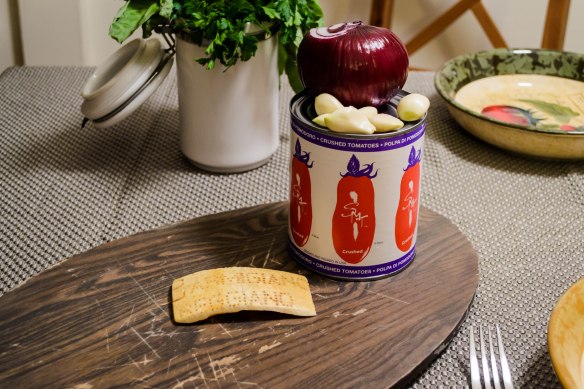
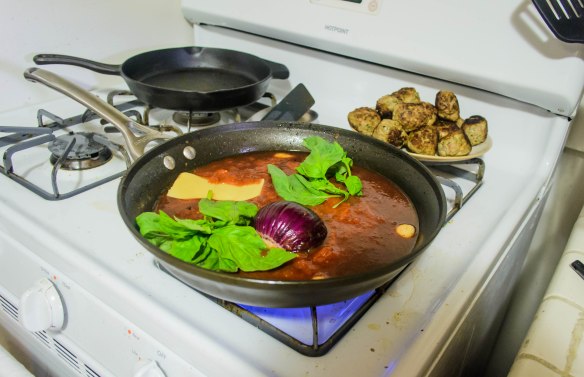
2015 Food Blog December-06582015 Food Blog December-0659Meatballs managed, there was then the sauce to contend with. Tomato sauce and I have a long, fraught history. I never much cared for the sort that dripped out of jars, and during my teenage years it flat out upset my stomach. The idea of meatballs burbling away in that acidic, over-processed stuff was beyond unappealing. But I’ve started making my own tomato sauces in the last few years, and I’ve found that rather than tomato paste and sugar, garlic and red wine seem to be the key flavoring components for a satisfying pasta topper. For this one, I started with Smitten Kitchen’s incarnation of a three ingredient tomato sauce, but couldn’t deal with the probably stellar simplicity of it, and succumbed to adding red wine, garlic, basil, red pepper flakes, and – my ultimate pasta sauce weapon – a parmesan cheese rind (I keep them in the freezer when there’s no more cheese to grate from them) to the original trio of canned tomatoes, an onion, and butter.

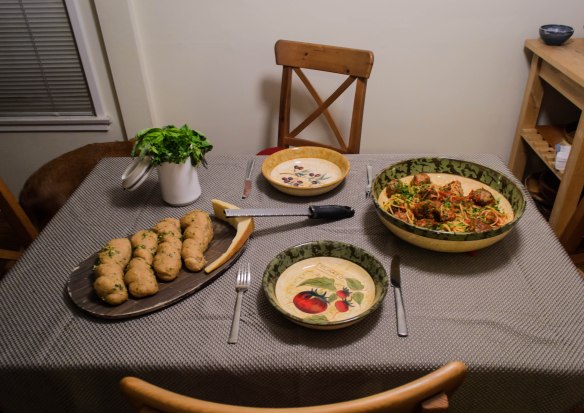
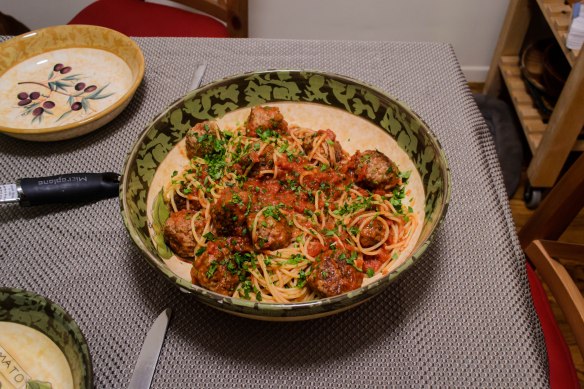
2015 Food Blog December-06622015 Food Blog December-0663While it would be sacrilege to call this anything like the “best spaghetti and meatballs” (in today’s world, that title is probably copyrighted anyway), it was a very satisfying way to conclude the project.* The meatballs were flavorful and tender and held together well. The sauce was deeply savory but still fresh and light and strongly tomato-y. Crowned with some fresh herbs and a fluffy shower of grated parmesan, it was worth holding onto, and certainly nothing to sneeze at.

2015 Food Blog December-0668*Though I’ll be back next week with a few end-of-year reflections on the project in its entirety.

Classic Spaghetti and Meatballs
About 90 minutes
Serves 4-6
For meatballs:
scant 1½ cups fresh bread crumbs (1-2 slices)
1 cup milk, cream, or half and half
¼ cup olive oil, divided
⅓ cup grated onion (about ½ a large onion)
2 large or 3 small garlic cloves
½ pound ground beef
½ pound ground pork
2 tablespoons chopped fresh parsley
2 tablespoons chopped fresh basil
⅛ teaspoon pepper
½-¾ teaspoon salt
⅓ cup grated parmesan
For sauce:
½ cup dry red wine
28 ounces crushed tomatoes (I like the San Marzano brand)
3 tablespoons butter
½ a large, peeled onion
6 whole, peeled garlic cloves
3-4 inch hunk of parmesan rind, if you have one
2 stalks basil
salt and pepper to taste
1 pound hot cooked spaghetti
¼ cup chopped parsley
extra parmesan cheese, to serve


  • Use a food processor to make your bread crumbs, then add them to the milk in a two-cup glass measuring cup, and let them soak for 10-15 minutes.
  • Use the same food processor (you don’t even have to rinse it out) to process the onion and garlic – toss in the onion in a few pieces, and the whole garlic cloves, and pulse until almost paste – only very small, grated-looking bits will remain.
  • Heat 1 tablespoon of the olive oil in a large skillet over medium-low heat. Scrape in the onions and garlic, sprinkle very lightly with salt and pepper, and sweat until tender and translucent; 5-8 minutes. Turn off the heat and move to a glass bowl to cool slightly.
  • While the onions and garlic are cooking, use the food processor again to chop the herbs and the parmesan cheese. Drain the bread crumbs by squeezing them lightly with your hand, then add the crumbs, the herbs, and the cheese to your cooling onion and garlic mixture. Toss together lightly.
  • When the bread and aromatics mixture is room temperature or only barely warm, add the ground beef, the pork, and the salt and pepper. Use your fingertips to combine – you want to evenly distribute the ingredients, but not overmix. Keep it as light as possible.
  • In the same large skillet you used for the onions and garlic, heat the remaining 3 tablespoons of olive oil over medium heat. Fry about 1 teaspoon of the meat mixture until cooked through, then taste for seasoning, and adjust in the remaining mixture if needed.
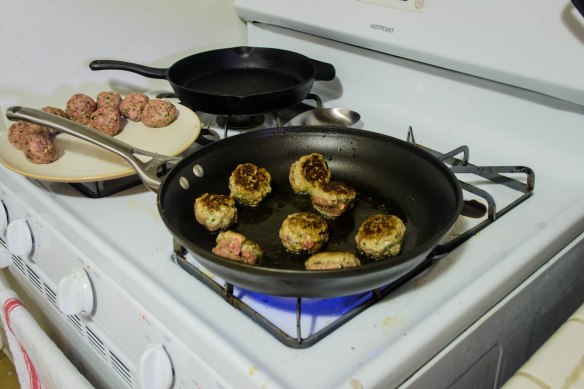
  • Roll the remaining meatball mixture into 16 equal sized meatballs (they will be about 3 tablespoons each) . Carefully place them into the skillet, not touching one another (you will probably need to do this in two batches), and sear, undisturbed, for about 2 minutes. When this first side is golden brown, flip over and fry for another 2 minutes, again until golden brown. When browned nicely on all sides, remove to a clean plate and repeat with the remaining meatballs.
  • When all meatballs are browned and removed from the pan, add the wine all at once and use a wooden spoon or spatula to scrape around and remove the browned bits from the bottom into the wine, where they will act as flavoring agents. Add in the canned tomatoes, the onion half, the garlic cloves, the parmesan rind, if using, and the stalks of basil. Stir to combine. As soon as the sauce starts to bubble, turn the heat down to medium low and simmer for 10 minutes.
  • This is a good time to start a pot of salted water for your spaghetti.
  • After the sauce has simmered 10 minutes, taste it and add salt and pepper as needed, but go easy on the salt – the parmesan rind will release some salinity, and the meatballs themselves will as well. Nestle in the meatballs and simmer another 10 minutes, then flip over each meatball and simmer a final 10 minutes, for a total of 30 minutes.
  • Discard the onion, garlic, basil, and parmesan rind, then drain the cooked spaghetti and add it into the sauce. Use tongs to gently work it through the sauce, coating it completely.
  • Serve directly onto warm plates, or carefully slither into a serving bowl. Sprinkle with herbs and fluffy grated parmesan cheese. I recommend a side of garlic bread, and maybe a green salad.