Sweet Potato Apple Oatmeal Bread

I seem to be increasingly fond of dishes with long titles. There’s nothing particularly extravagant about this quickbread (though I must admit, the prep work involved makes it not all that quick), but the title is lengthy because it does have a lot going on.  Harvest color from a baked, mashed sweet potato, juicy chunks of apple, a hearty, wholesome boost from the oats, plus a hefty dose of brown butter, buttermilk, cinnamon, and a streusel topping crammed with walnuts and dried apple rings. But I didn’t want to overload you, so sweet potato apple oatmeal bread it is.
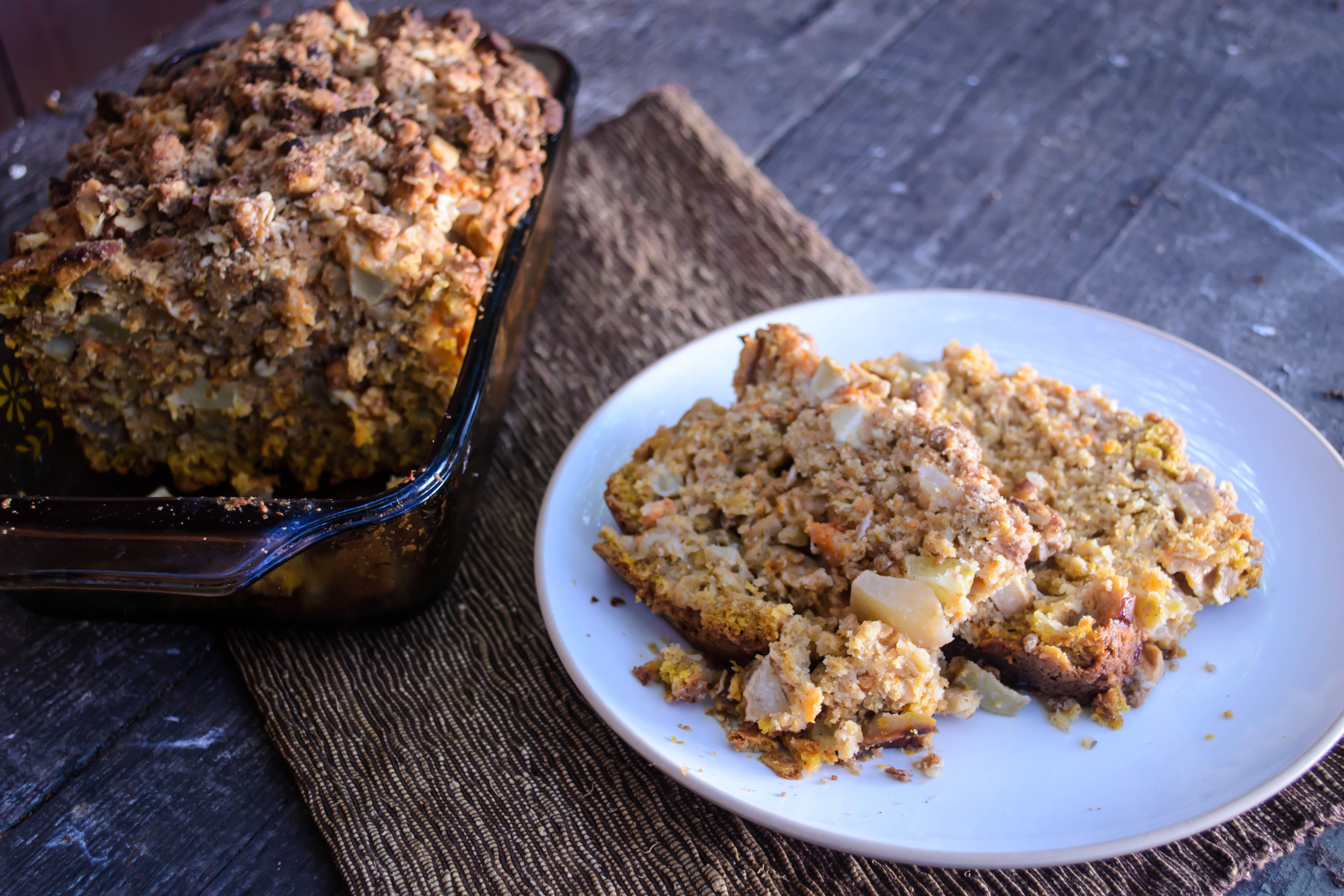
Food Blog October 2013-2708This bread turned out to be a lovely little response to October’s Twelve Loaves theme: root vegetables. Upon first reading this mandate, I was a little concerned. I’ve already done loaded potato biscuits. Carrot cake is, eponymously, not bread. Beets and rutabegas and parsnips and all those other decidedly savory tubers I’d welcome in a roasting pan or in a latke just don’t seem like a good fit in bread, yeasted or otherwise.

Food Blog October 2013-2701Los Angeles has recently decided that, since it’s almost the middle of October now, Fall might be okay. It might be acceptable to hover below 80 degrees during the day,* and nights could, possibly, occasionally, fall to the chilly (hah!) mid-50s. This has put me in mind of all the harvest flavors I love which, predictably, takes me to Thanksgiving. Once there, it’s only a tiny hop to the humble sweet potato.

Food Blog October 2013-2687Sweet potatoes are true root vegetables. Unlike taro or ginger, which are technically modified stems, or even the grand old potato itself, which is a tuber but not a “true” root (I know, I was shocked too!), sweet potatoes are the root of the plant.

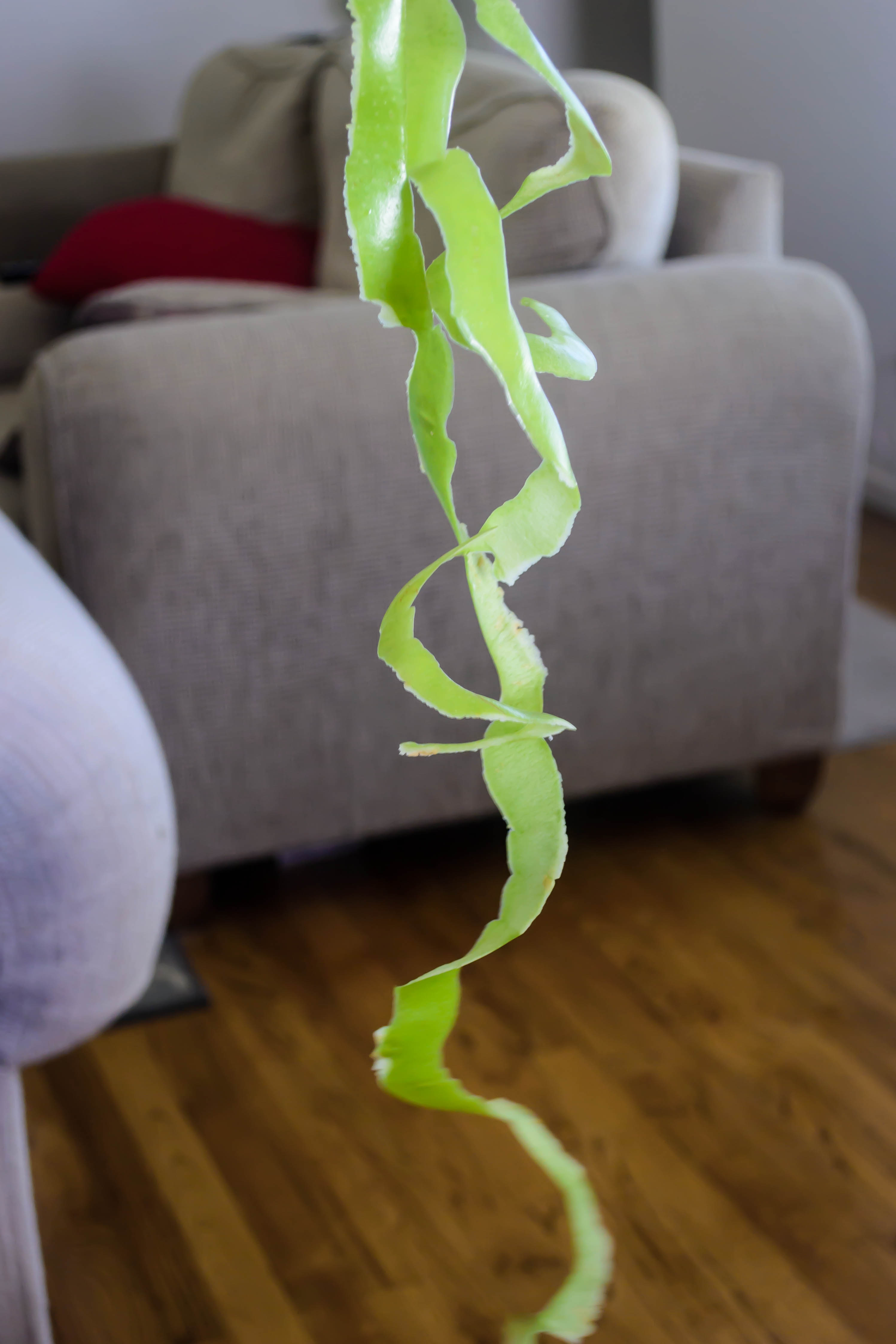
Food Blog October 2013-2680Food Blog October 2013-2685Food Blog October 2013-2682Thankfully, they are also delicious. I love their mellow, starchy sweetness in savory and sweet applications, but I’d never tried incorporating them into bread before. I knew almost immediately I wanted a quickbread rather than a yeasted loaf, and from there it only remained to pair a few flavors. Apples seemed like a nice match for sweet potato: big, fresh Honeycrisps have been showing up at our Farmers’ Market lately, and their juicy tartness would be a good foil for the dependable mellow of my main player. Oatmeal would bulk up the bread a little, giving it strength to support the onslaught of apple and sweet potato I had in mind. I found an oatmeal quickbread recipe that sounded promising on Flour Child, but things really cemented when I read Irvin’s post on Spiced Brown Butter Apple Walnut bread on his blog Eat the Love.

Food Blog October 2013-2688So, sweet potato, baked rather than steamed or boiled to cut down on moisture, an excessive mound of apples, left in sizable chunks that, when you start to mix them in will seem like far too many, rolled oats to bake into a breakfast-worthy slice, and the usual players – brown sugar and cinnamon and just enough salt – get topped off by a streusel you will want to eat not just on this bread, but on everything.  Walnut pieces, more oats, cinnamon for flavor and flour for texture, enough butter to hold things together, and the crowning touch: roughly chopped dried apples that, when baked, dehydrate even more into crispy, gloriously tart-sweet candy. I’m already imagining it on oatmeal, or pancakes, or baked on its own into a take on granola.

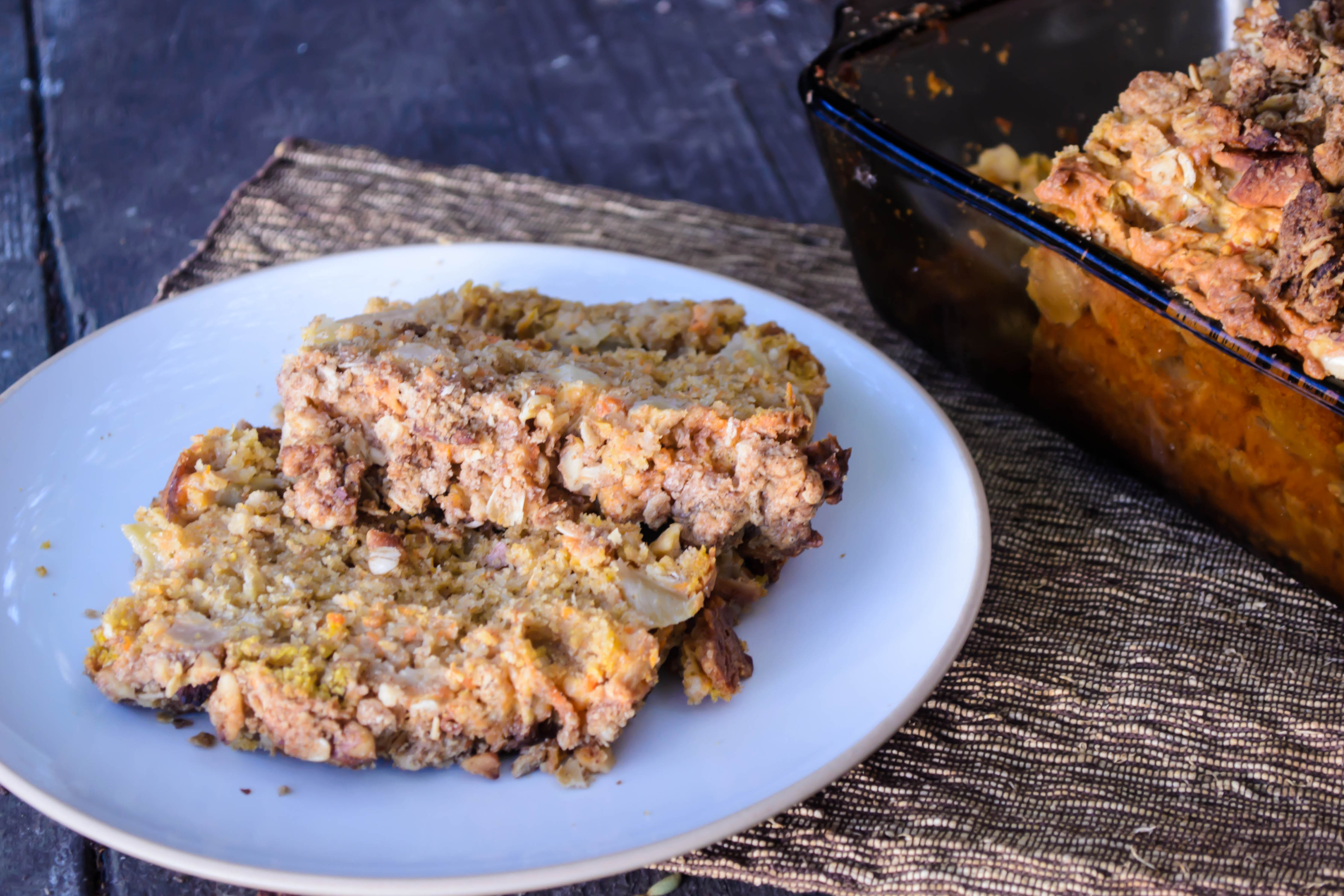
Food Blog October 2013-2699This is a moist loaf, and hearty, but not particularly dense. It can’t quite support its own weight, which means slices collapse easily on themselves because they are groaning under the quantity and size of the apples. It is also not terrifically sweet. I was aiming for a breakfast or a mid-morning snack kind of loaf. If you want something more dessert-like, or if you just have a determined sweet-tooth, try increasing the quantity of brown sugar by a few tablespoons.


* This morning’s meteorological news, however, may have made a liar out of me.
Food Blog October 2013-2707

Sweet potato apple oatmeal bread
Adapted from Flour Child and Eat the Love
makes one large loaf
For bread:
1 ½ cups flour
1 cup old-fashioned rolled oats
1 teaspoon baking powder
½ teaspoon baking soda
½ teaspoon salt
1 teaspoon cinnamon
½ cup butter (8 tablespoons or 1 stick)
½ cup buttermilk
2 large eggs
½ cup brown sugar
1 cup baked, mashed sweet potato (from one medium)
2 apples, peeled, cored, and cut into generous ½ inch pieces (I used Granny Smiths)
For streusel:
2 tablespoons oats
2 tablespoons flour
2 tablespoons brown sugar
½ teaspoon cinnamon
¼ cup roughly chopped walnuts
¼ cup roughly chopped dried apple rings
2 tablespoons softened or melted butter


  • If you have not already baked your sweet potato, preheat your oven to 400F, pierce the flesh of the sweet potato a few times with a knife or the tines of a fork, and bake until the potato is evenly soft – anywhere from 35-60 minutes, depending on the size of the root.  When done, remove from the oven and cool completely before halving lengthwise and mashing the flesh. Discard the skin (or just eat it – it’s sweet and soft and good for you!).
  • Turn the oven down to 350F (or, if you haven’t just baked a sweet potato, preheat it to 350F) and butter, grease, or spray a loaf pan.  Set aside.
  • Begin by browning the butter. Melt your ½ cup of butter in a small pot over medium-low heat. As it melts, it will foam and sizzle a bit and some scummy stuff will appear on the surface. That’s okay. Water is evaporating and leaving us with a more concentrated product. After a while, little brown bits will begin to form on the bottom. This is what we want, but watch carefully – it takes a matter of seconds for butter to go from perfectly brown to burned. When the brown bits are nice and toasty, turn off the heat and set aside to cool.
  • While the butter cools, it’s a good time to make your streusel so you’re prepared later. In a small bowl, combine all streusel ingredients except the butter and whisk lightly together with a fork. Add butter and toss with the fork again or with your fingers until the mixture begins to stick together in clumps. Set aside.
  • Now, back to the bread. In a medium bowl, combine the flour, oats, baking powder, baking soda, salt, and cinnamon. I like to use a whisk for this – it aerates the flour and evenly disperses the leavening agents.
  • In a large bowl (or the bowl of your standing mixer), combine the buttermilk, eggs, brown sugar, and mashed sweet potato. Add the brown butter and beat until a soupy, homogenous mixture is formed.
  • Add the dry ingredients to this wet mixture in two batches, beating just enough to combine after each. Once the flour mixture is incorporated and you have a thick, stiff batter, fold in the apples using a stiff spatula. It will seem like there are too many for the quantity of batter, but don’t worry. It will all work out.
  • Scrape the batter, which might seem more like just battered apple cubes, into the loaf pan.  Tap it once or twice on the counter to release air bubbles and help it settle a bit.
  • Pack on the streusel.
  • Bake in a preheated 350F oven for 1 hour and 30 minutes, or until the topping is deeply bronzed and a toothpick or knife inserted in the center of the bread comes out with just a few moist crumbs. Since the size and juiciness of your apple chunks may vary, check for doneness the first time after an hour, so you can gauge how much more time you might need.
  • If your bread is not done yet but outlier edges of dried apple or walnut threaten to burn, treat this like you’d treat a pie crust: tent the offending areas loosely with aluminum foil to keep them from getting too dark.
  • Cool completely before attempting to slice or remove from loaf pan.  Trust me.

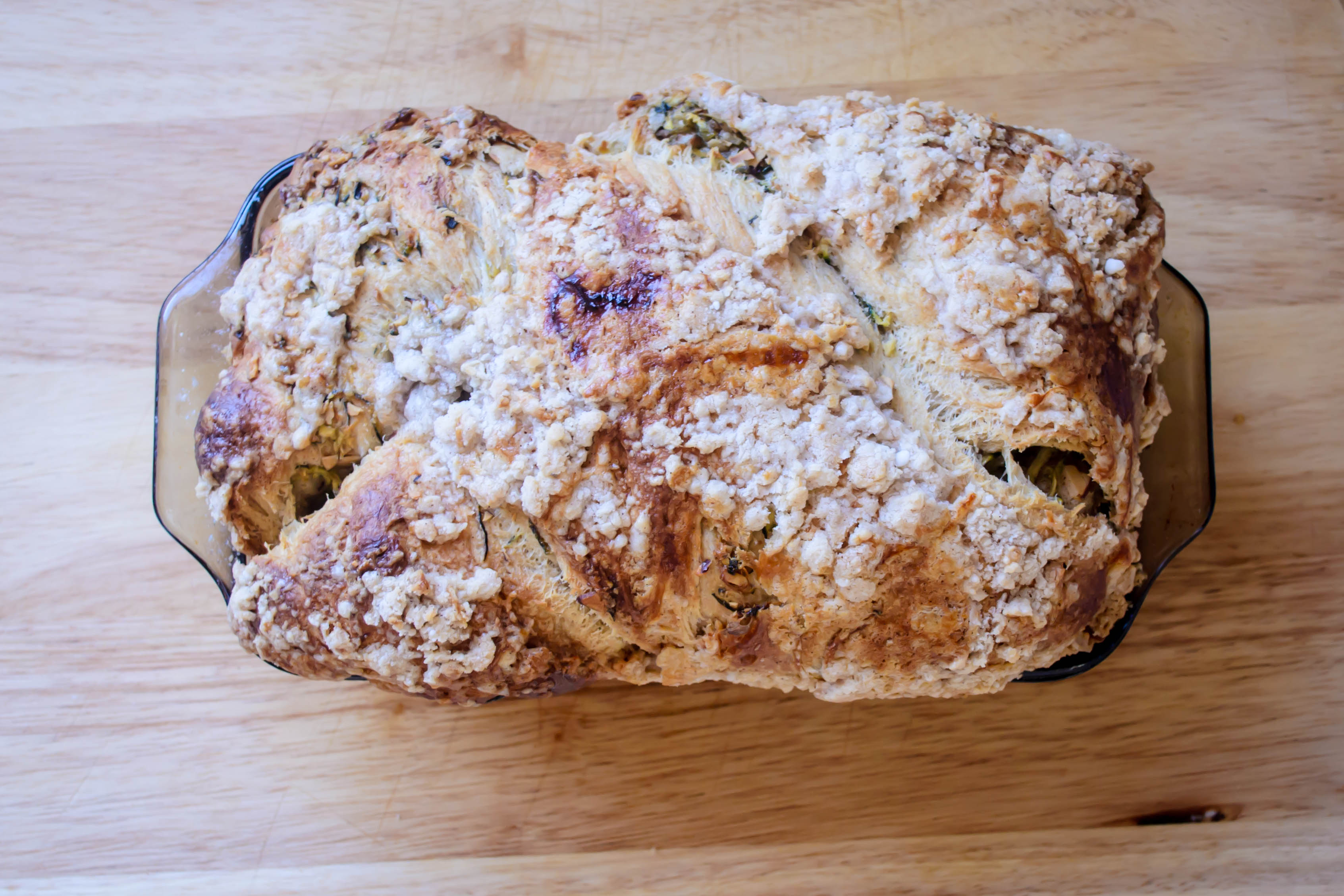
Zucchini Almond Babka

This is the time of year when people who frequent food blogs are probably looking for one of two things: simple, delicious dishes to use up lots of late summer produce, or inspiration for encroaching harvest, autumn-centered meal plans.

Food Blog September 2013-2597Sorry to disappoint.

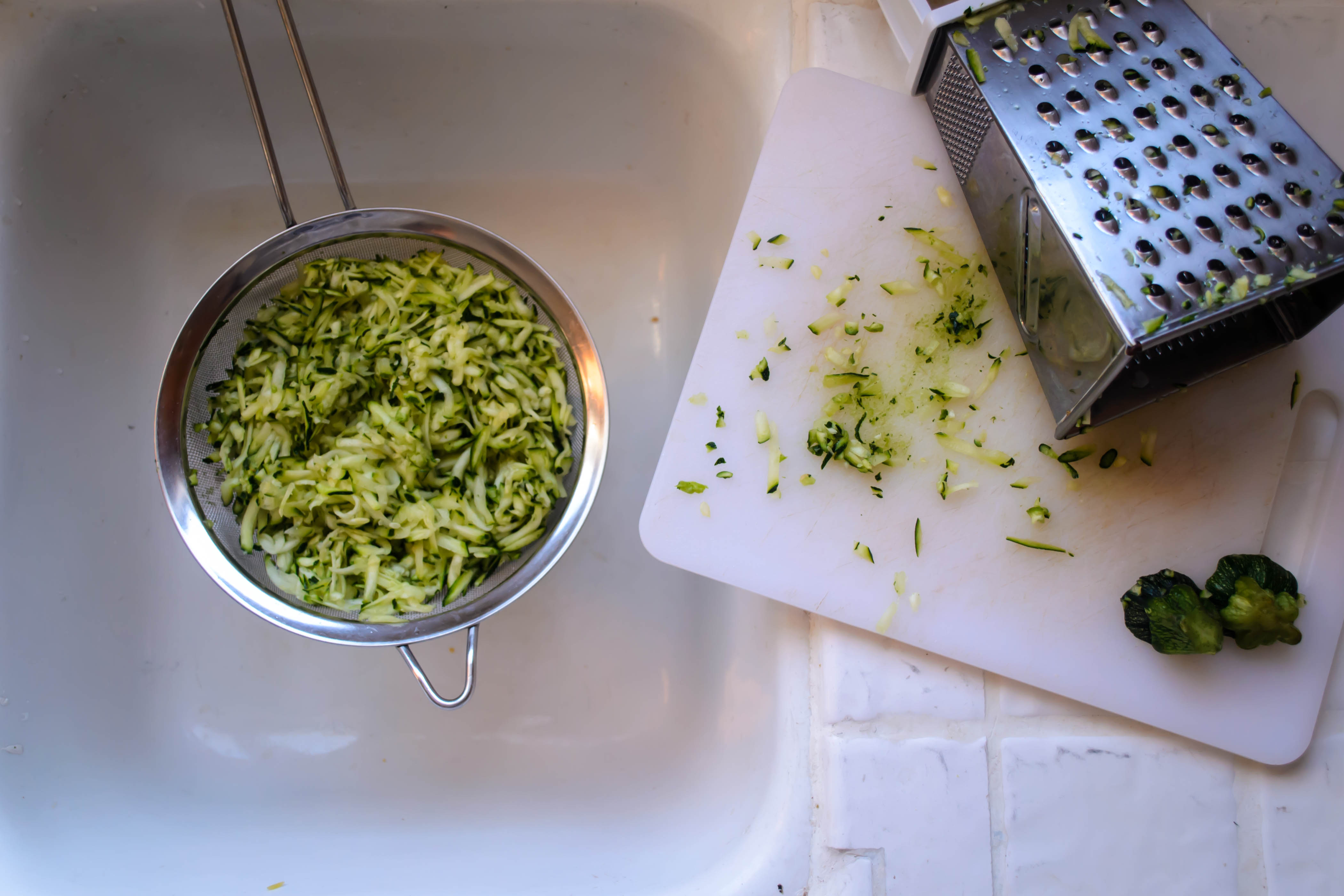
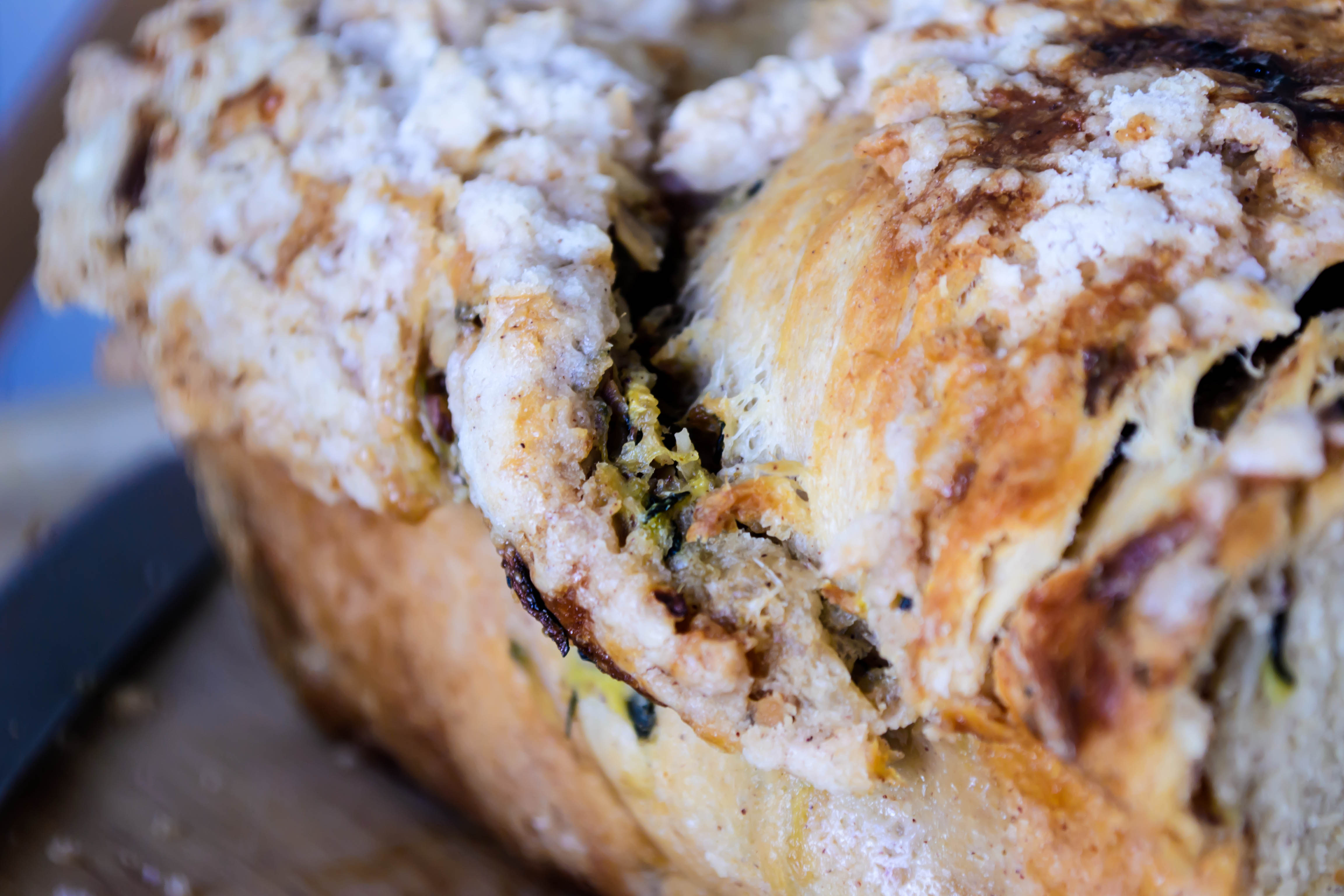
Food Blog September 2013-2578Yes, this week’s recipe uses a good pile of zucchini, shredded into a mass of green and white ribbons, and yes, it combines the warm, welcome flavors of cinnamon, nutmeg, and brown sugar that you might expect from a really good zucchini bread. But it takes those flavors and, peevishly, wraps them up in one of the more involved sorts of bread out there.

Food Blog September 2013-2585Babka is a sweet bread, raised with yeast and stuffed with butter and eggs. Most frequently, it is filled with chunks of chocolate until it is gasping under the weight, then rolled up, twisted, folded, twisted again, piled with streusel, and then baked until it is golden and crusty and melty and decadent. It tends to be a holiday treat which, considering the quantities of butter and time that go into producing a loaf, makes good sense. Though the bread itself is most likely of Eastern European origin, it probably didn’t intersect with chocolate until the mid 20th century at the hands of some, I must say, entirely sensible and clever American Jews. I mean, bread and chocolate all in one? Yes, please!

Food Blog September 2013-2586I wanted to make a lighter version (hah). I’ve been making zucchini bread for years, and I have a recipe I like, but with this year’s focus on dough, I needed something a bit more complex. I don’t remember exactly where the idea came from, but the idea of sweet, slightly vegetal zucchini flavored with the warm spices of zucchini bread and rolled up in a sweet, doughy loaf was something I had to taste. When the recipes for zucchini babka that I found used the zucchini threads in the dough itself, rather than rolling them up in the middle, I got determined.

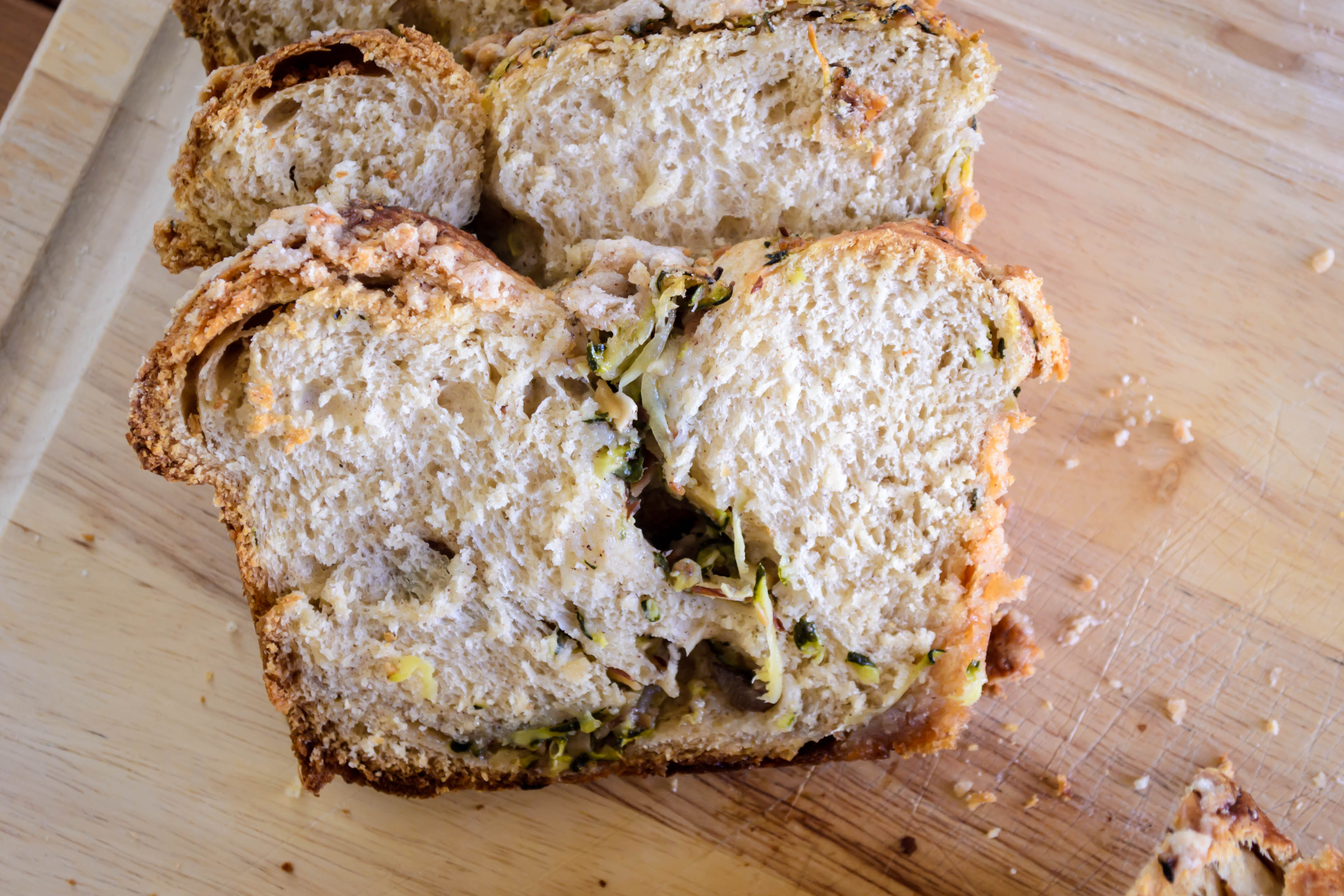
Food Blog September 2013-2589The biggest problem here, of course, is how watery zucchini is. My great fear was that this would produce a loaf that was overcooked on the outside but still underdone in the center, as the great leaking mass of zucchini kept things too wet to bake properly. This fear was, thankfully, unfounded. A lengthy draining session followed by a firm squeezing made the zucchini, while still quite moist, apparently dry enough to use as a filling. Paired with well toasted almonds, brown sugar, and butter, it baked into a curious, almost custard-like texture. The stubby ribbons of zucchini were still in evidence, but the edges of dough around them mellowed into beautiful creaminess, like a little central vein of bread pudding.

Food Blog September 2013-2596Is this easy? Not especially. But it will use up some of your fall harvest, and it will impress whoever it is you most want to impress at this moment. Even, perhaps most importantly, you!

Food Blog September 2013-2599Food Blog September 2013-2610

Zucchini Almond Babka
Adapted from Martha Stewart
Makes one large loaf
For bread:
½ cup milk
1 ½ teaspoons yeast
¼ cup granulated sugar
1 large egg
1 egg yolk
1 teaspoon vanilla
2 cups flour
2 teaspoons cinnamon, divided
¼ tsp nutmeg
½ teaspoon salt
10 tablespoons butter (1 stick + 2 tablespoons), divided
2 medium zucchini, grated, drained, and squeezed
½ cup brown sugar
½ cup finely chopped toasted almonds
1 egg white (use the one you separated from the yolk above)
1 tablespoon milk
For streusel topping:
½ cup powdered sugar
1/3 cup flour
4 tablespoons butter
½ teaspoon cinnamon


  • First, prep your zucchini: grate it with the large holes on a box grater and set it in a colander, preferably lined with cheesecloth or a paper towel, so it can drain while you mix up the dough.
  • Heat milk in a small bowl until just warm to the touch. Sprinkle yeast over milk and let it stand until it is foamy and smells like bread; about 5 minutes.
  • In a bowl, whisk together the granulated sugar, the egg, the egg yolk, and the vanilla. Add egg mixture to the yeast and milk, whisk to combine.
  • In the bowl of an electric mixer fitted with the paddle attachment, combine the flour, 1 teaspoon of cinnamon, nutmeg, and salt. Add the egg mixture, and beat on low speed until the flour is mostly incorporated and forms a shaggy, craggy mass. This should take about 30 seconds.
  • Switch from the paddle attachment to the dough hook. Add 6 tablespoons of butter one at a time in 1-inch chunks, beating until incorporated after each addition. The dough will come together briefly, then fall apart into wet bits, and then come together again into a smooth, elastic, rich dough. This should take about 10 minutes.
  • Turn the dough out onto a lightly floured surface and knead a few times until it is smooth. It will feel moist and elastic against the heels of your hands.
  • Butter or oil your mixing bowl and place the ball of dough back into it, turning the dough to coat it with fat on all sides. Cover the bowl with plastic wrap and set it aside to rise for about 1 hour. During this time, it should double in bulk.
  • When your dough is almost done rising, squeeze your drained zucchini to eliminate as much water as possible, then combine the zucchini, brown sugar, remaining 1 teaspoon of cinnamon, and 4 tablespoons of butter in a small bowl. Stir or smoosh these together, then set the mixture back into a colander to drain again.
  • Butter or oil a 9×5 inch loaf pan and line it with parchment paper if desired. Beat the remaining egg white with milk and set it aside.
  • Gently punch down the dough by pressing your fist into the center. It will depress as the air releases. Set it on a generously floured surface and let it rest for 5 minutes.
  • Once dough has rested, roll it out into a 16-inch square; it should be about 1/8 inch thick.
  • Brush edges of the dough with the egg wash. Distribute all but about 2 tablespoons of the zucchini mixture evenly over the dough, leaving a ¼ inch border.
  • Roll the dough up tightly like a jelly roll, enclosing the zucchini mixture inside. Pinch ends together to seal. Twist 5 or 6 times.
  • Brush the top of the roll with egg wash, then carefully crumble the remaining 2 tablespoons of zucchini mixture over the left half of the roll, being careful not to let it slide off. Fold the right half of the roll over onto the coated left half. Fold ends under, and pinch to seal. Twist the roll 2 turns, and fit it into the prepared pan. This may make a bit of a mess, but be bold. It will all work out.
  • Heat your oven to 350F and prepare your streusel by combining the powdered sugar, flour, butter and cinnamon together in a small bowl. Two forks work well for this, but your fingers work better.
  • Brush the top of the loaf with egg wash, then crumble the streusel topping over it. You may have some extra, but don’t be afraid to load it up.
  • Loosely cover the loaf with plastic wrap and let it stand in a warm place for 20-30 minutes while the oven heats up and the loaf swells again.
  • Bake the loaf, rotating it halfway through if possible, until it is golden on top. This will take about 55 minutes. Lower the oven temperature to 325F and continue baking until the loaf is deep golden, 15 to 20 minutes more.
  • Remove from oven, transfer to wire rack until completely cool before you attempt to remove it from the pan and cut it into thick slices to serve. Beware: removing it from the pan and slicing too early will result in a failure in structural integrity! Be sure to let it cool.


Goat Cheese Tomato Pie

All over the food blog world, folks are declaring that fall is here.  It’s the season for pumpkins and root vegetables and casseroles and braised meats.  Except that I live in Los Angeles, where it has been close to or over 90 degrees Fahrenheit for the past week and a half.  Where was this in June, Los Angeles?  Where was it in July (when we were further north and would have missed it!)?  Why now, now that school has started and I have to wear professional clothes all week and can’t be here to keep the windows open all morning, do we finally get the month or so of scorching temperatures when everyone else has packed up their popsicle molds weeks ago?

Food Blog August 2013-2488Well I’m not convinced that it’s fall.  I’m calling it late summer.  And this is convenient, because the heirloom tomato bushes that have grown into a vast jungle in my backyard are still heavy with fruit.  The Farmers’ Market we frequent is still bursting with bright bell peppers and corn and stone fruits, and hasn’t yet been taken over by cruciferous vegetables or potatoes.

Food Blog August 2013-2468A few weeks ago, stunned by the number of gleaming tomatoes we’d managed to produce, in shades of deep crimson and flame yellow, I did what anyone trying to find inspiration would do.  I asked Facebook.  And my friend M. responded with an idea I’d never considered: tomato pie.

Food Blog August 2013-2474Food Blog August 2013-2479Since tomatoes are a fruit, I suppose it shouldn’t seem so strange to put them in a pie.  (Isn’t pizza, in fact, the ultimate incarnation of a tomato pie?)  But I quickly determined that mine would be savory rather than sweet, and from there things fell together with little effort.  Creamy, tangy goat cheese pairs so well with the acidic sweetness of tomatoes, and a handful of fresh herbs from the garden add a grassy complexity to the dish.

Food Blog August 2013-2480Making a pie, of course, entails making a pie crust, and this remains one of my greatest nemeses in the cooking world (it’s all about the butter, I’m sure of it.  The size and the temperature are almost impossible for me to get right, and given this and all the trouble I had with buttercream frosting I’m almost convinced I should just have gotten it out in the open from the beginning and renamed this blog Butter Problems).  But I considered a few techniques I’d read about recently in Shirley O. Corriher’s genius book Bakewise, which takes a scientific approach to baking, not only providing stellar sounding recipes, but explaining carefully what each ingredient does for the final product, and offering options that will result in a subtly or staggeringly different end product.  In her section on pie crust, Corriher explains that crust texture is a near catch-22 between flakiness and tenderness.  Flakiness comes from leaving the butter in sizable chunks, so that during the baking process the crust puffs into layers before the butter has had a chance to melt fully.  Tenderness, though, comes from being sure the flour has been fully hydrated, which can only happen with full incorporation of the liquid element.  Yet overworking the dough makes it tough, and the flakiness quotient disintegrates as you break the butter into smaller and smaller bits.  See why I don’t like making pie crust?

Food Blog August 2013-2462Food Blog August 2013-2466But this crust was magic.  I decided that if what we really wanted was flakes and tenderness, and if fat helps along hydration and acidity contributes to a tender final product, then the little container of buttermilk that had been sitting quietly at the back of my refrigerator for weeks was the consummate answer.  And it was.  The crust came together quickly, rolled out like a dream, and was stable enough that I was actually able to give it some decorative edging before I packed it full of goat cheese and thick slices of tomato and shoved it into the oven.

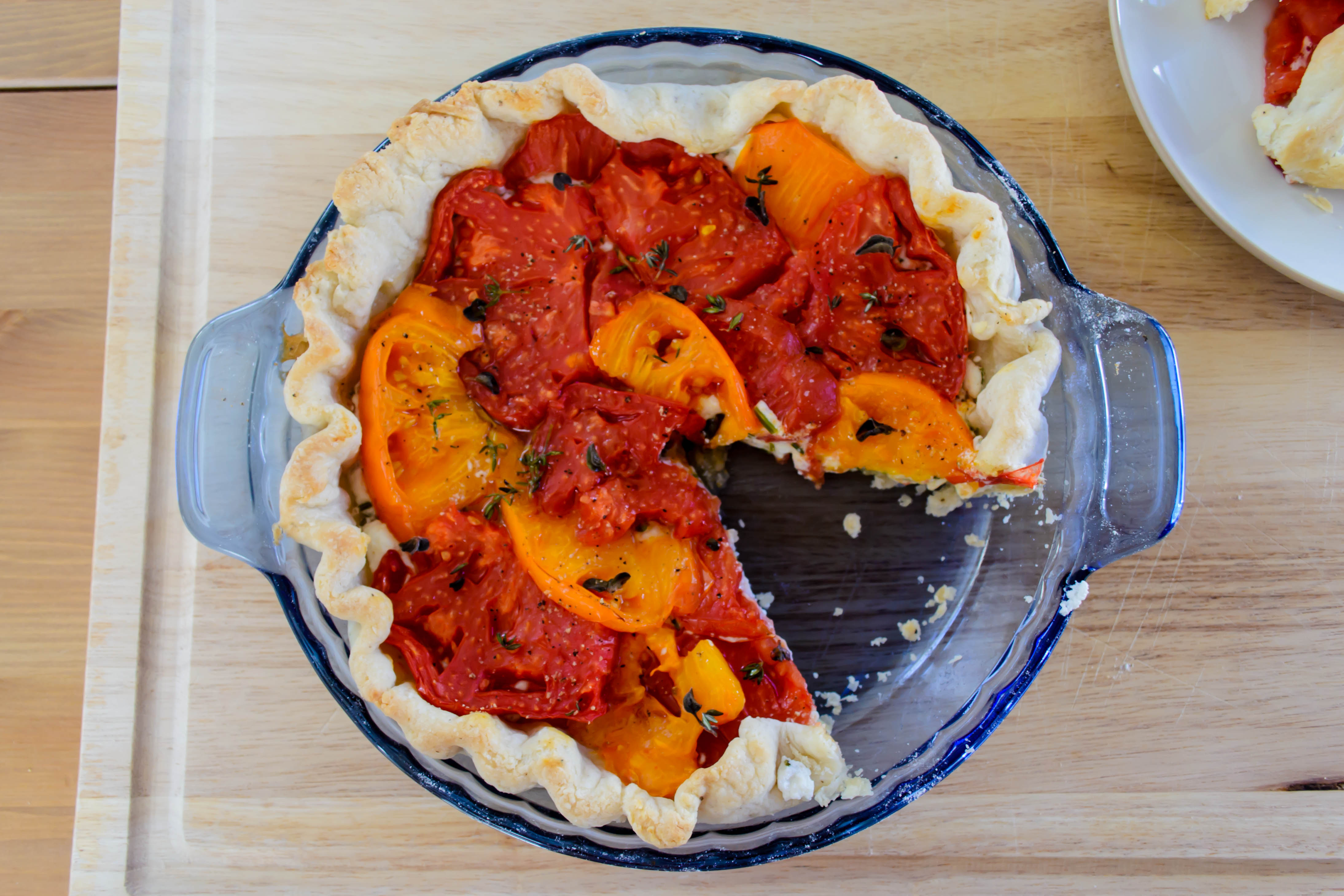
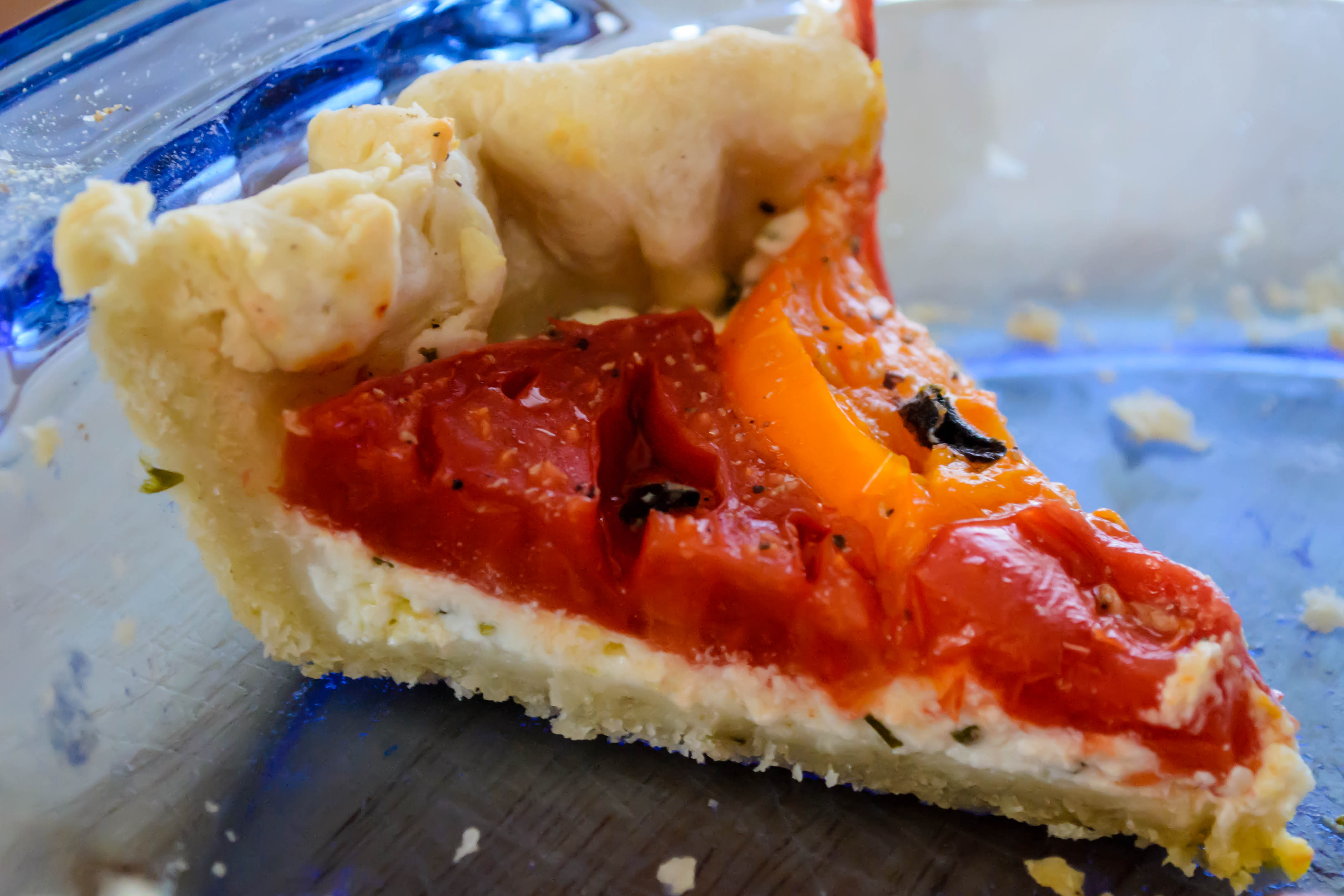
Food Blog August 2013-2482Food Blog August 2013-2483Food Blog August 2013-2485Food Blog August 2013-2491Food Blog August 2013-2495We weren’t exactly sure what to expect of this dish (in fact, when I said “tomato pie” to N., he made a very interesting face), but after we’d both gone back for a second slice, and then a sliver of a third, we decided that we must like it.  It’s a really nice balance of flavors, with the sweet sharpness of tomatoes mellowed into something almost meaty, but still light in spite of the layer of tangy cheese.  The perfect late summer supper.  But it would also, I think, be a great brunch option, or a light lunch with a fresh salad, or, cut into very thin slices, a beautiful canapé for a bridal or baby shower.

Food Blog August 2013-2499Goat cheese tomato pie
makes one 9-10 inch pie
For the crust:
6 oz. flour (or a fluffy 1 ½ cups)
1 tsp sea salt
¼ tsp ground black pepper
1 stick butter, very cold, cut into 8 pieces (if you are going to use your food processor to make the crust, the butter can be frozen)
3-5 TB buttermilk, very cold (I put mine in a little glass in the freezer for 5-10 minutes before I start making the crust)
For the filling:
8 oz. goat cheese, at room temperature
1 TB milk
1 clove garlic, finely minced, or ¼ tsp garlic powder
2 TB chopped chives
1-2 tsp chopped mixed herbs (I used thyme and oregano)
2-3 large heirloom tomatoes, cut into ½ inch thick slices (this quantity is inexact, since heirloom tomatoes differ in size.  You are looking for enough slices to create a slightly overlapped single layer over the goat cheese filling)
Salt and pepper to taste
Drizzle of olive oil


  • To make the crust, combine the flour, salt, and pepper in a bowl.
  • If you are using a food processor, dump in the chunks of butter and pulse on three-second intervals until the butter has been broken up a bit and some pieces are the size of walnut halves, while some are more like peas.  If you are using a mixing bowl, cut in the butter with a pastry blender, two knives, or your fingers.
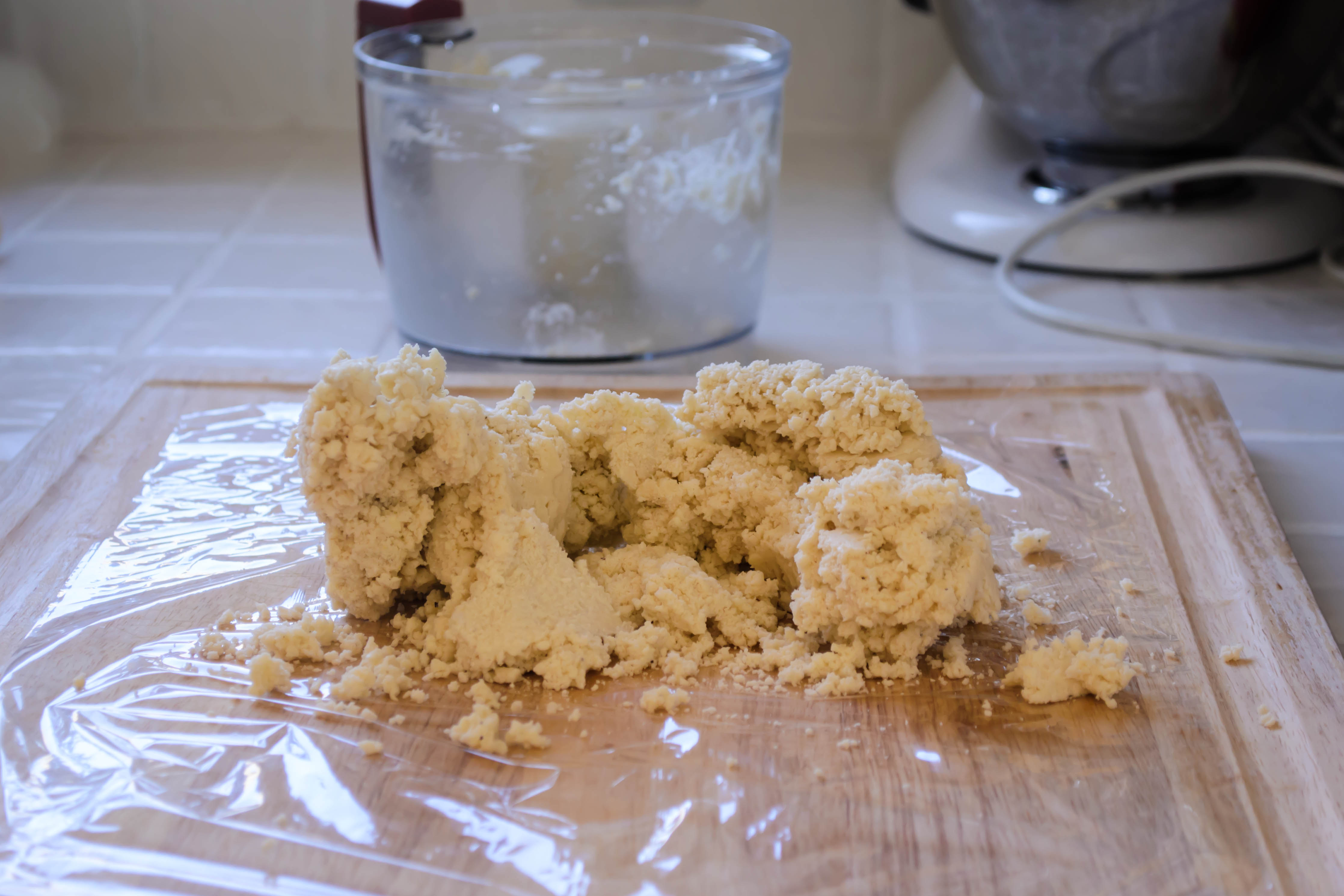
  • Dribble in 3 TB of the buttermilk and pulse again on three-second intervals (or use a fork or your fingers to combine).  If the dough begins to clump together like wet sand or crumbly cake, you are done!  If it is too dry to come together, add another TB of buttermilk and pulse again.
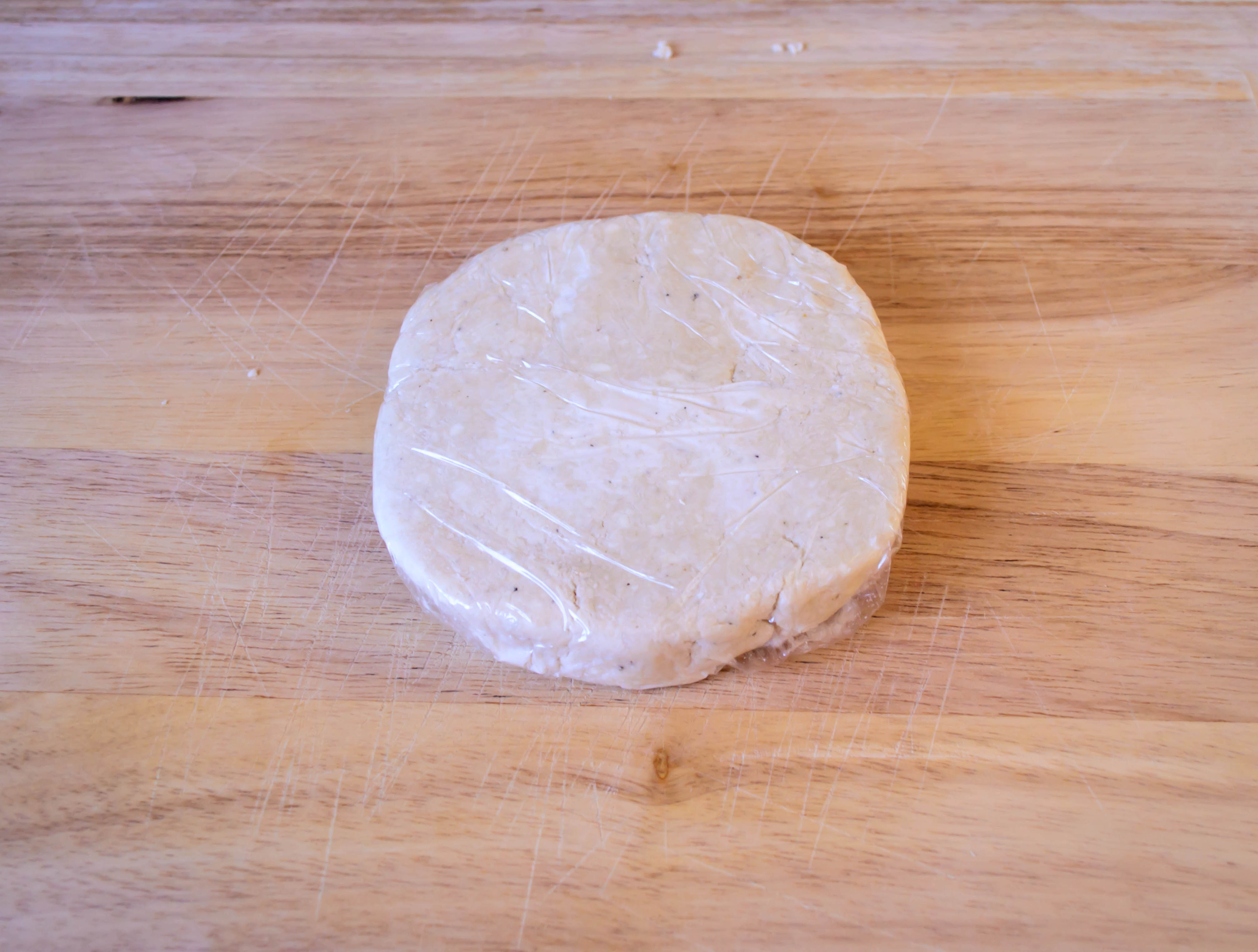
  • Dump out your crumbles of just-tacky dough onto a big piece of plastic wrap.  Using the plastic wrap to help you, press and squash and manipulate the dough into a disc of about 1 inch thick.  Wrap it up and stow it in the fridge for 30-45 minutes.
  • While the dough chills, prep the filling ingredients.
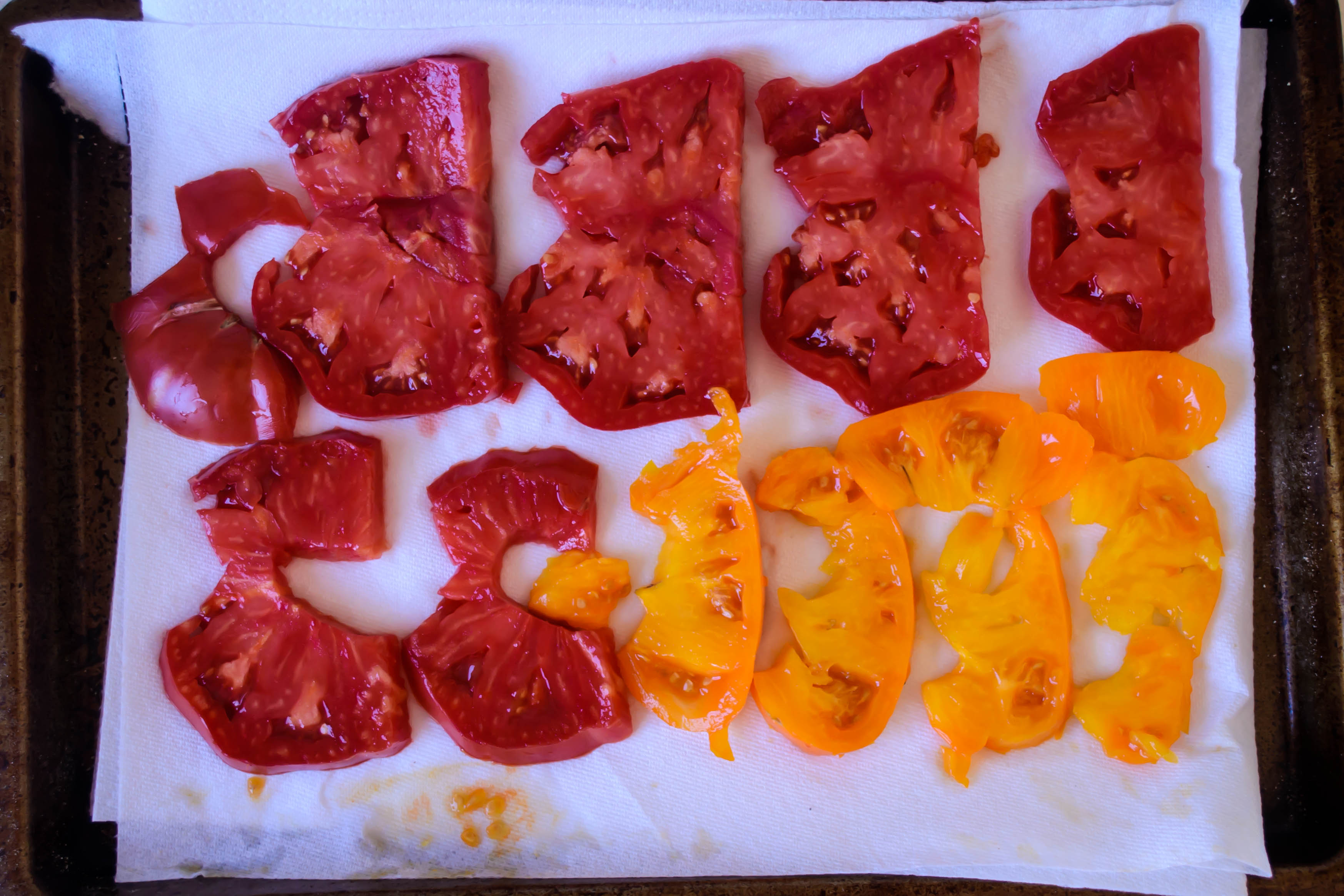
  • Place the sliced tomatoes on a double layer of paper towels lining a cookie sheet.  This will allow them to drain a bit, so they won’t expel quite as much juice in the oven.  Let them sit for at least 15 minutes.
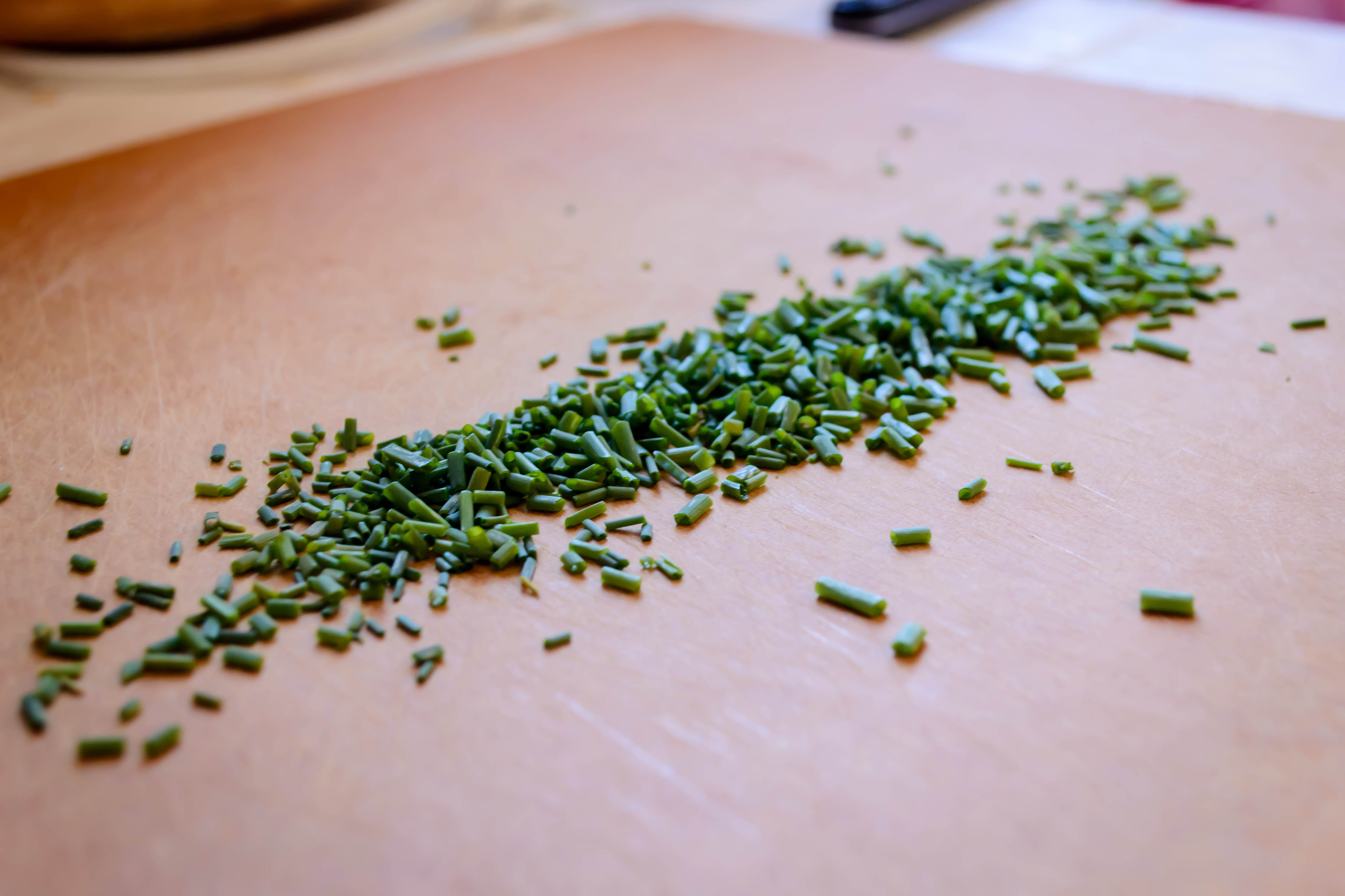
  • Once the goat cheese is at room temperature, combine it with the milk and the chives in a small bowl.  This miniscule quantity of milk thins the goat cheese out just enough to make it spreadable.  The chives are, of course, all about flavor.
  • Preheat the oven to 400F and transport your disc of dough from the fridge to a well-floured board.  Unwrap it and let it warm up just a touch – no more than five minutes or so.
  • With a rolling pin, push from the middle of the dough circle out away from you – toward what we might term the top edge.  Then, return to the middle and push back toward you.  You will now have a strange, elongated oval.  Rotate the disc about a quarter of a turn and repeat, so you’re slowly returning the dough to a circular shape.  If you get some cracks, don’t worry about it – you can either press the dough back together manually, or it will miraculously repair itself as you roll.  If things get sticky, sprinkle on some additional flour.
  • When your dough is rolled out into a basic circle with a diameter 1-2 inches bigger than your pie dish, it’s time to transport it once again.  Roll it up loosely around your rolling pin, then unroll it into the pie dish, draping it gently into the crease where the bottom of the pan becomes sides.  You should have some excess dough around the top.  That’s good.  In small sections, fold it in on itself so it is even with the top edge of the pie dish, creating a thicker edge.  If you wish, make this edge decorative by pressing it in at intervals with your thumb or the tines of a fork.
  • With a spatula, spread the goat cheese mixture in an even layer across the bottom of the crust.  Be careful not to press too hard, as you’ll squash the crust down.
  • Next, layer the tomatoes as attractively as you can manage (for me, this was not very much) over the cheese.  You can overlap them slightly, but the point here is to completely cover the cheese in something as close to a single layer as possible.  This will allow them to receive heat evenly – we don’t want some of them roasty and others stewed.
  • Sprinkle the tomato slices with your 1-2 tsp of mixed herbs, salt and pepper to taste, and a good glug of olive oil for gloss.
  • Bake at 400F for about 30 minutes, until the crust is cooked through and becomes golden, and the tomatoes begin to crumple.
  • Remove from oven and let cool for 10-15 minutes before slicing, to regain some structural integrity.  Tomato juice will gush about when you cut into it; there’s just no avoiding it.  But it will be that utterly delicious kind of gushing that you end up feeling pretty pleased about.  Serve warm or at room temperature.

Jalapeño Cheese Bagels

August 2013-2541Seeing as it’s now been more than half a year since I started this dough resolution, I think it’s high time for a check-in.  When I began this project, I was afraid of pie crust.  I found baking bread an intimidating procedure: proofing yeast was a touchy business; sticky dough made me wring my hands in despair.  My first few loaves came out with black bottoms, and I didn’t have a real sense of the difference between bread flour and all-purpose.

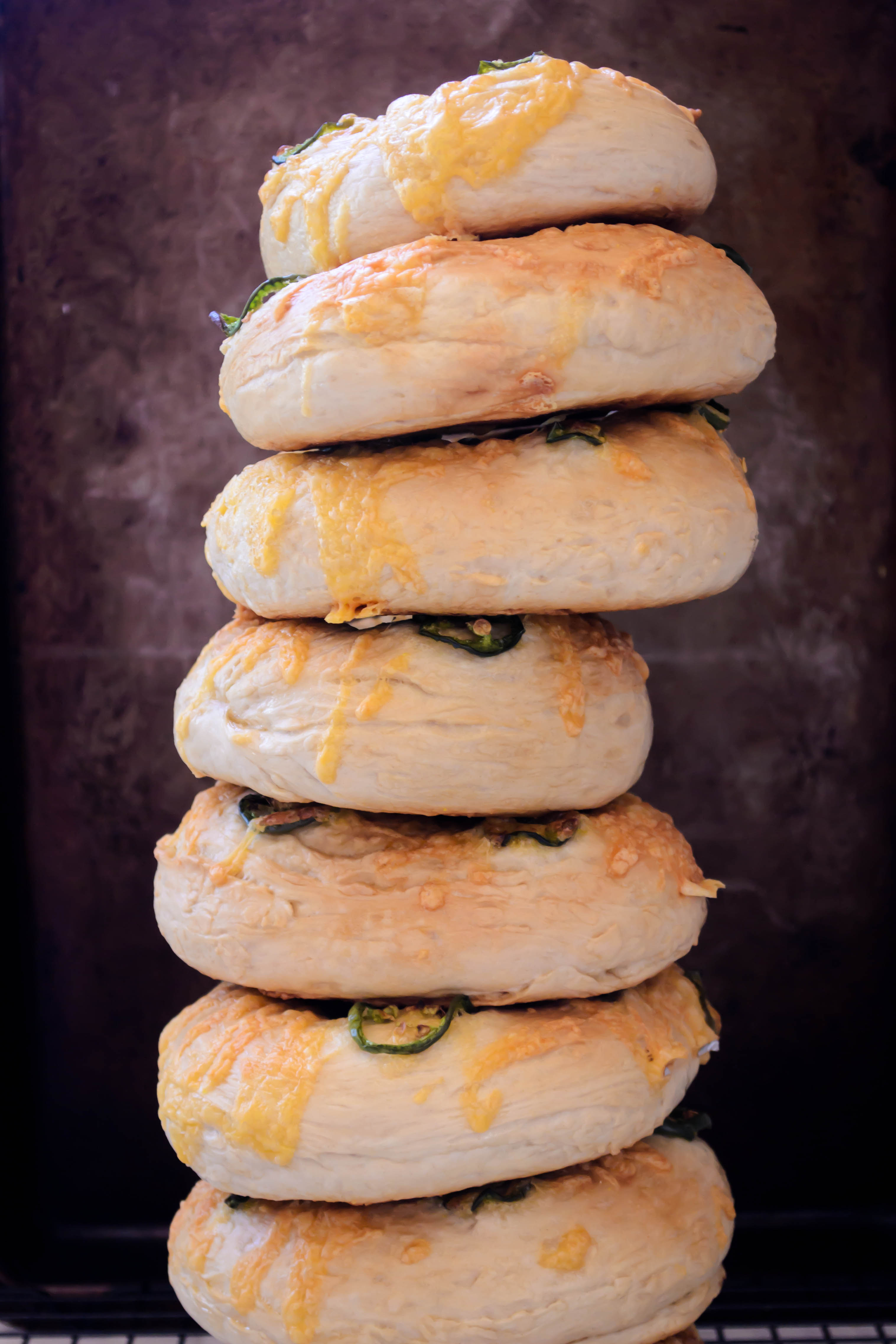
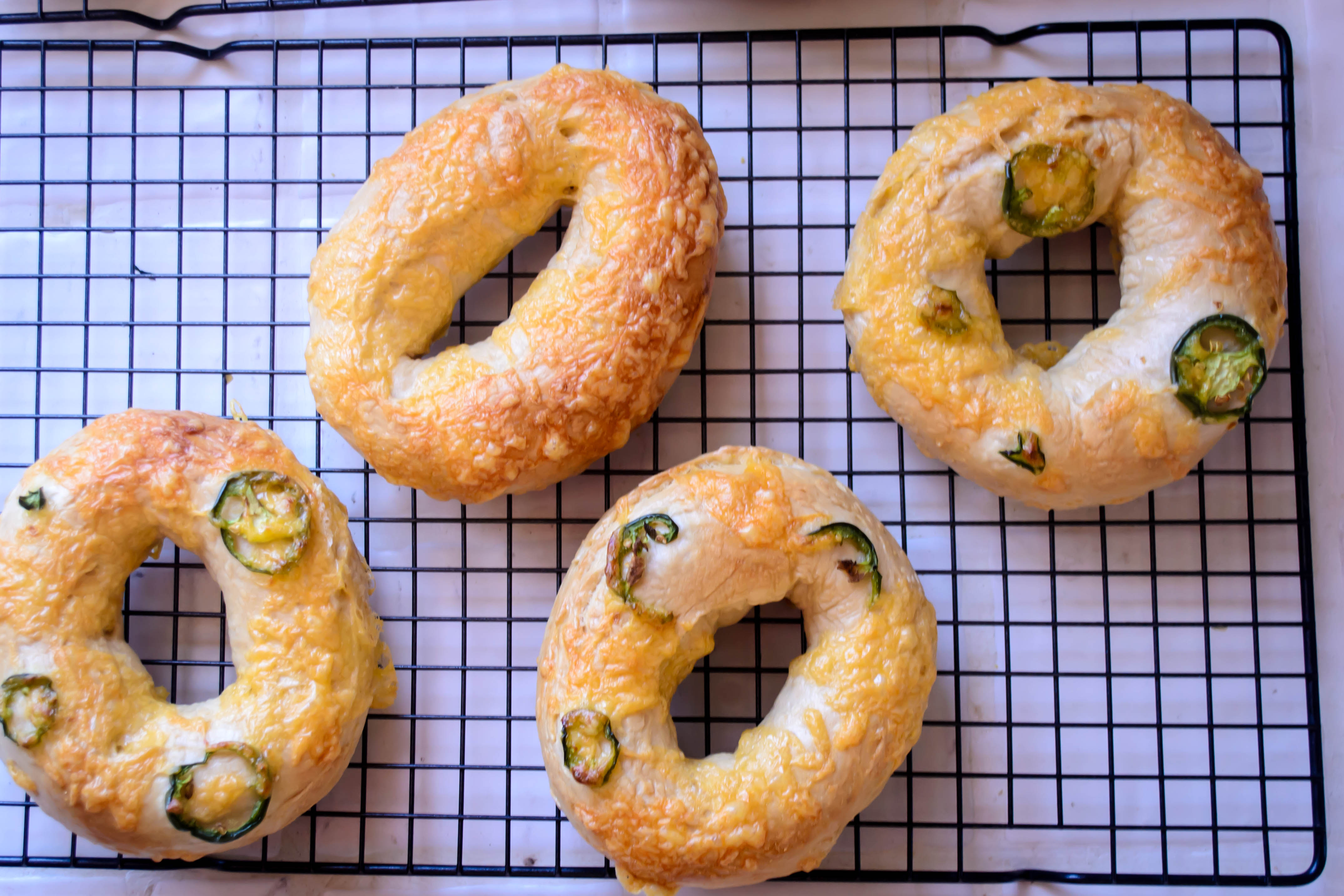
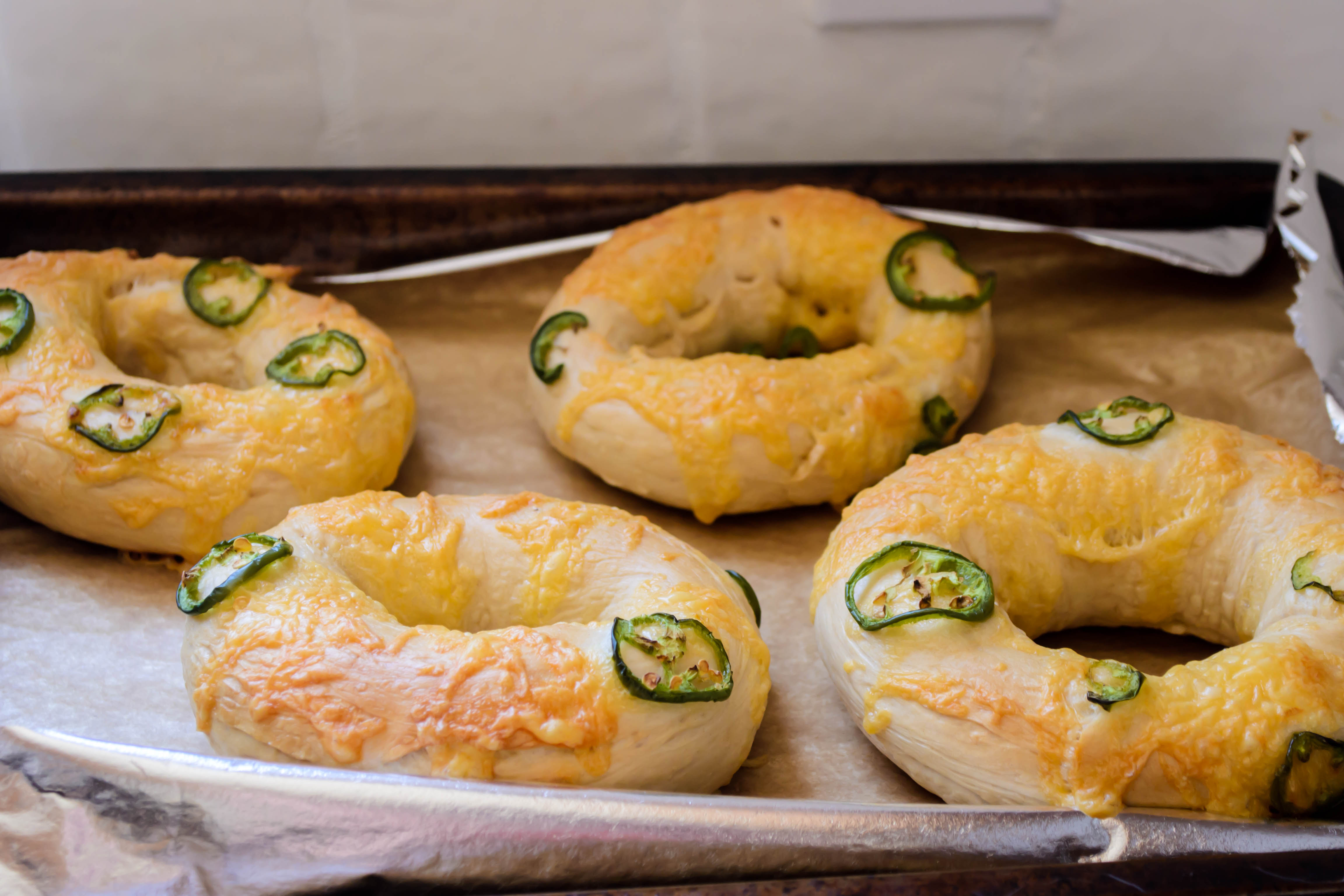
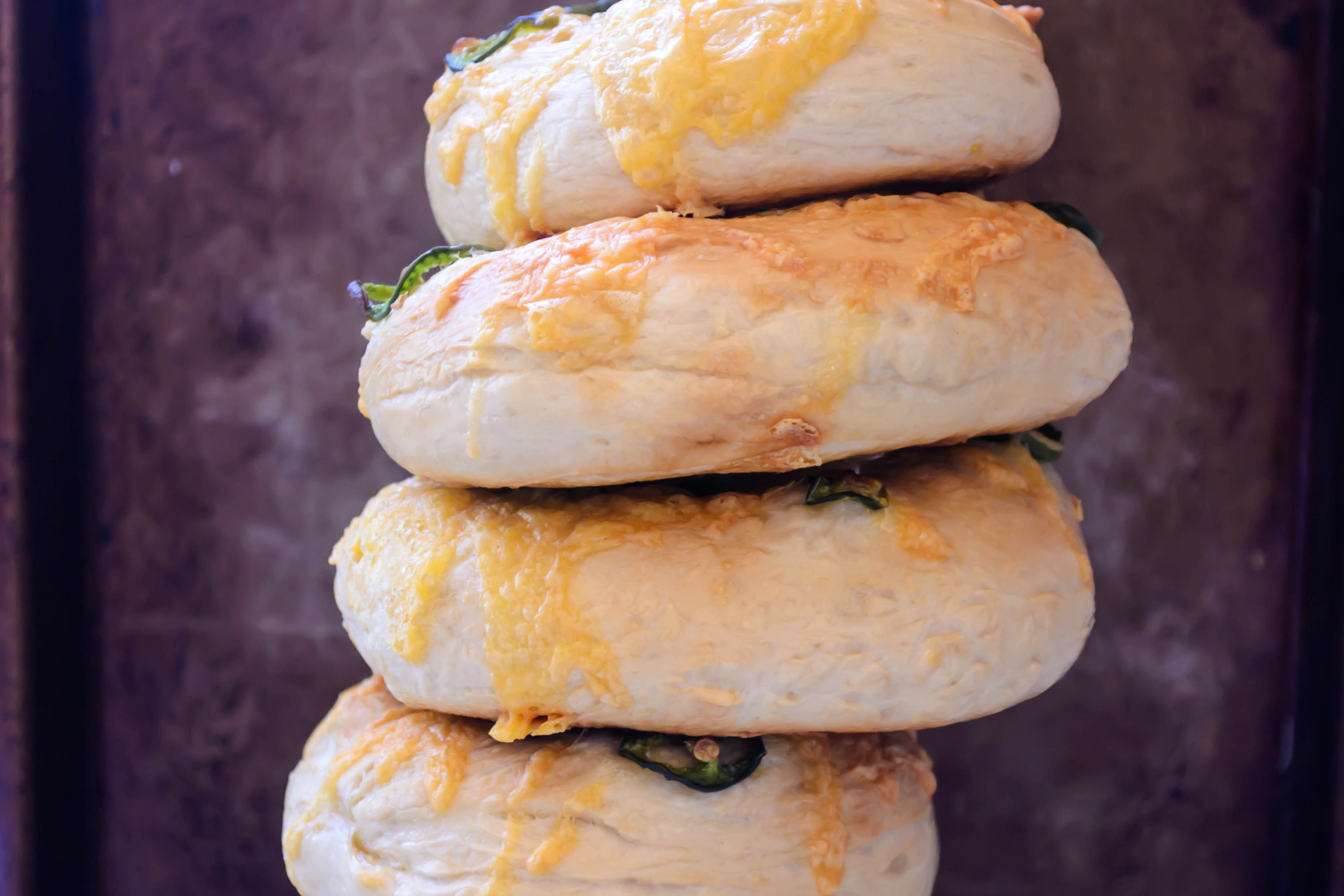
August 2013-2537Fast forward.  This past weekend, I made bagels.  Real, crisp crusted, chewy, bagel-y bagels, studded with jalapeño slices and dripping with sharp cheddar cheese.  I’d been thinking of making them anyway, but when this month’s Twelve Loaves challenge came along with a demand for savory breads, it sealed the deal.  I know, I’ve used this flavor combination before.  In fact, I used it for another Twelve Loaves challenge.  You could say I’m rather fond of it.  Maybe I need a bit of an intervention.  But… jalapeño and cheese!  How can you resist?  See, the cheese transforms into a delicate crackling lace encasing the top of the bagel, and the pepper slices roast and shrivel in the oven’s high heat, and the whole thing becomes just so savory and interesting, that I want to put it on everything.

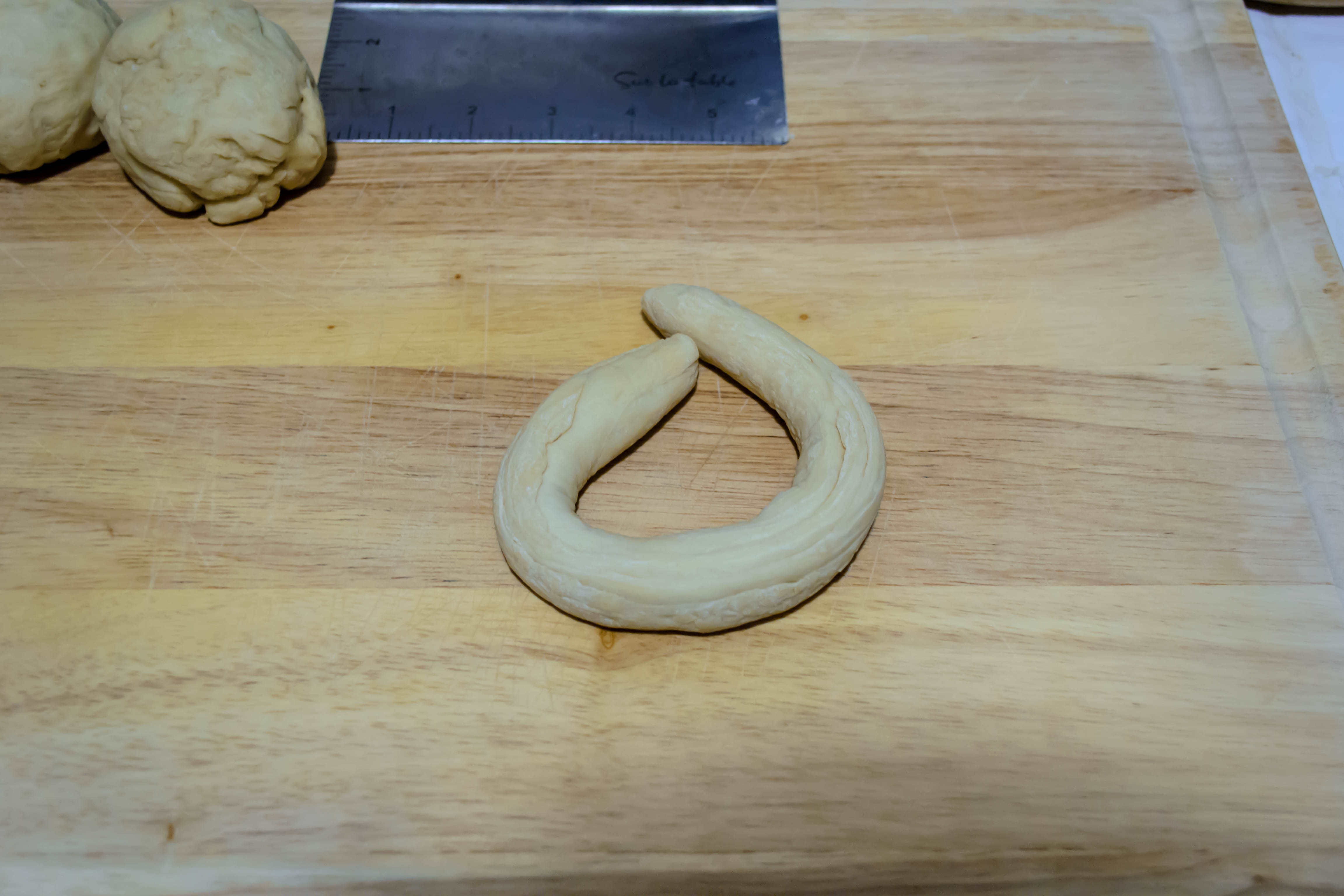
August 2013-2534Bagels are an odd-ball bread.  The additional protein of plain old bread flour is not enough for them – they require the even heavier duty high gluten flour, and sweetener in the form of barley malt syrup, both products I’d never heard of (see note on ingredients below).  After a lengthy turn with a dough hook that I thought would break my stand mixer (the heaving strain of the machine was almost too much to take), the stiff, dense dough gets portioned out, rolled into wormy logs, curled and pressed and sealed into rings, and then refrigerated overnight to allow for a long, slow rise that enhances the flavor and texture of the finished product.  Upon retrieval from the chill-chest, the rings are plunged into a vat of boiling water before being sprinkled with toppings and levered into a hot, hot oven to bake up shiny and crisp and chewy.

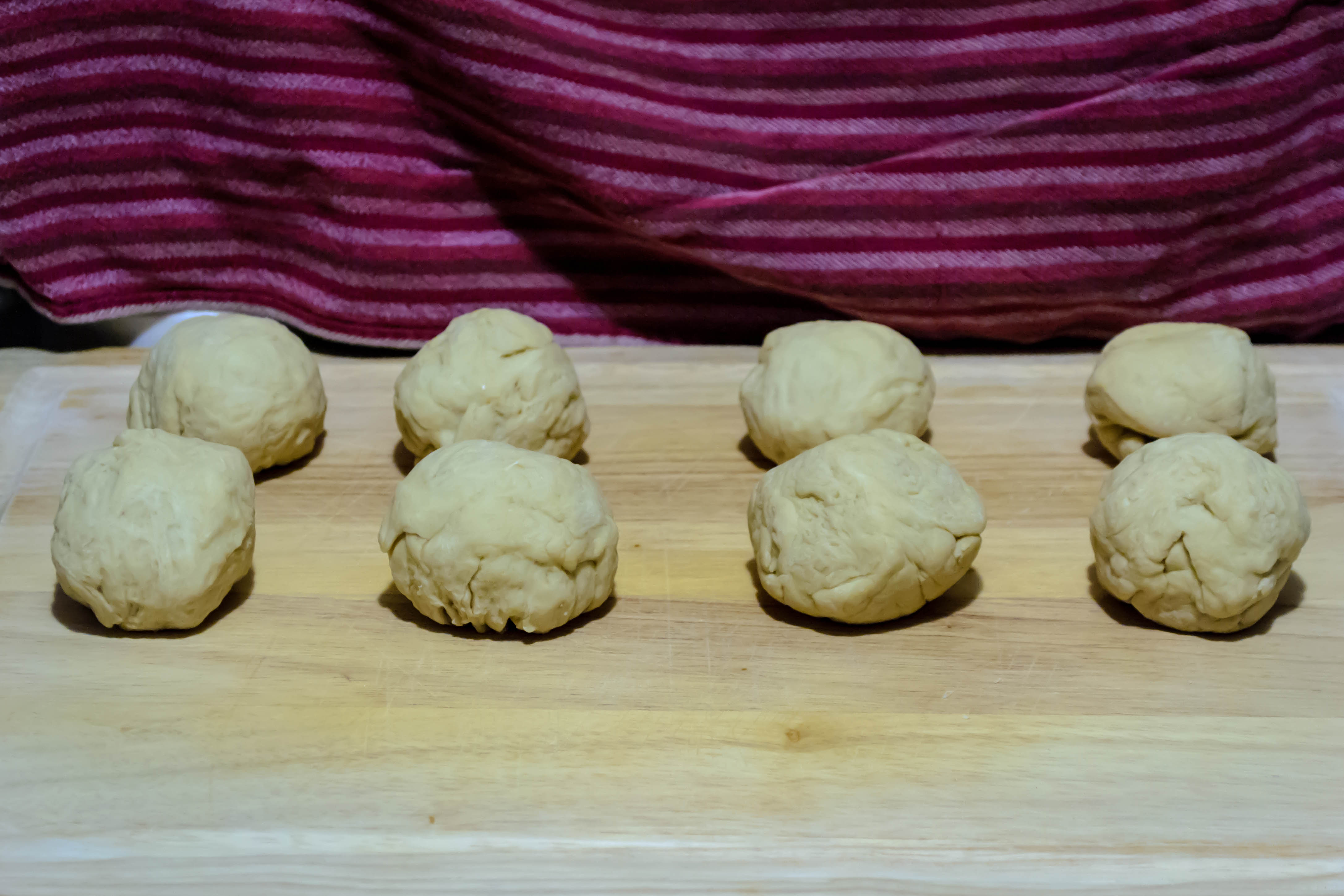
(Obligatory apology for the weird lighting in the pre-topped, pre-baked photos.  That’s what happens when you bake at night…)

August 2013-2516 August 2013-2518 August 2013-2519 August 2013-2520 August 2013-2521 August 2013-2522 August 2013-2523These are not the easiest baked good I’ve tried.  They involve odd ingredients, special equipment (I can’t imagine kneading this dough by hand.  Baking Illustrated, my guide for this recipe, says you shouldn’t even try), and considerable time.  They require not one, but two methods of cooking, and they make a lot of dishes for a willing but sometimes reluctant dishwasher sous chef helper to wash up.

August 2013-2524 August 2013-2525Yet I think, if you are up for the challenge, that you should take it on.  Watching them transform from a scrappy, tough dough into firm rings, and then seeing the crust take on that glossy shine and texture surrounding a chewy, densely-spongy interior, is not far short of amazing.  Several times during the process, astounded by how bagel-like they actually were, I said to N., “I can’t believe I’m making bagels!  Actual real bagels!”  The finished product is a far cry from the soft, fluffy offerings you’d find on a grocery store shelf.  The extra labor and the strain they put on my stand mixer (seriously, guys, you should have heard the motor.  I thought it was going to die on me right there) make these only a truly special occasion project, but one that was certainly worth doing.

August 2013-2528 August 2013-2530Note on ingredients: I couldn’t find high gluten flour, but Baking Illustrated told me it could be readily ordered from King Arthur flour, if you have that kind of time, and the sweet, helpful woman who swept in to help me navigate the rows of flour in our Whole Foods market said it was sometimes at “crunchy granola” sorts of markets.  I used, at her recommendation, a combination of bread flour and a few tablespoons of vital wheat gluten instead.

Barley malt syrup is a sweetener made from sprouted barley with an intriguing, earthy taste, less saccharine than white sugar or honey, not nearly as intense as molasses.  I found it at my Whole Foods, but again, if you can’t find it, you might try a natural foods store or the internet.

August 2013-2542Jalapeño Cheese Bagels
Adapted from Baking Illustrated
Makes 8 bagels
4 cups high-gluten flour OR 3 ¾ cups bread flour and ¼ cup vital wheat gluten (22 oz)
2 tsp salt
1 TB barley malt syrup
1 ½ tsp yeast (I used active dry yeast; you could also use instant)
1 ¼ cups water (at 80 degrees – it should feel just barely cool to the touch)
3 TB cornmeal, for dusting the baking sheet
1 cup shredded extra sharp cheddar cheese
1 green jalapeño, sliced wafer thin


Day 1:

  • If you are using active dry yeast, sprinkle it over the water and leave it to burble for a few minutes while you collect the rest of your ingredients.
  • Combine the flour, salt, and barley malt syrup in the bowl of your stand mixer with the paddle attachment.  Add the yeast and water (if you are using instant yeast, skip the proofing step and measure it straight into the bowl) and mix on the lowest setting with the paddle attachment for about 4 minutes, until the dough is in dry tangles.  Baking Illustrated says until it “looks scrappy, like shreds just beginning to come together,” which is a perfect description (124).
  • Exchange the paddle attachment for the dough hook, and continue to knead on medium-low speed until the dough comes together into a stiff but slightly elastic ball, about 8 to 10 minutes more.
  • Turn the ball of dough onto a work surface.  It won’t be very sticky, so you probably won’t need to flour your board at all.  Divide the dough into 8 even portions, roll each one into a smooth ball and cover them all with a towel or plastic wrap for 5 minutes.
  • Once the dough balls have rested, form each one into an 11 inch rope of even thickness by firmly rolling from the bottom joints of your fingers down to the heel of your hands.  I found I had the best luck angling my hands slightly away from each other and pushing down and forward, which helped lengthen both sides of the rope simultaneously.
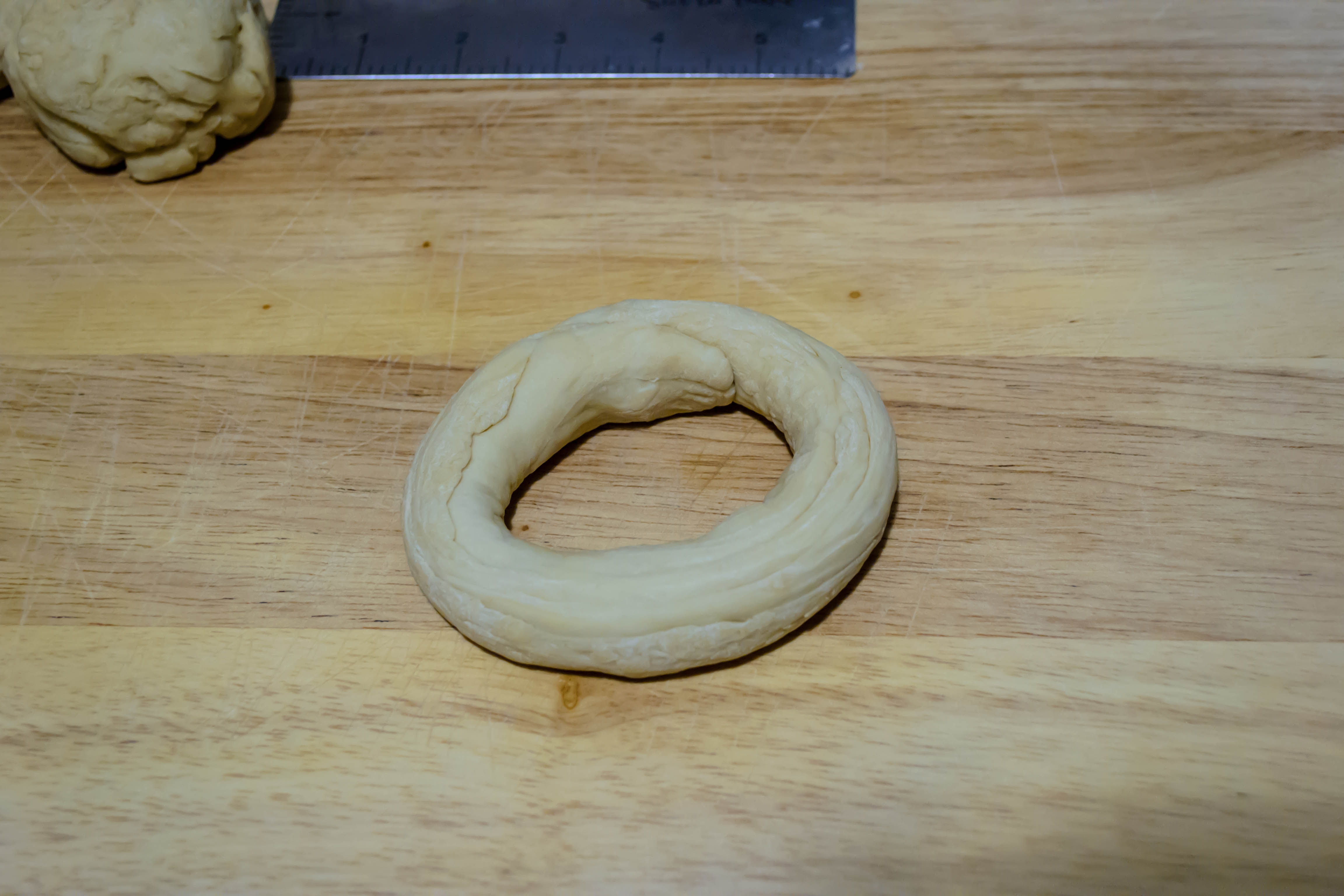
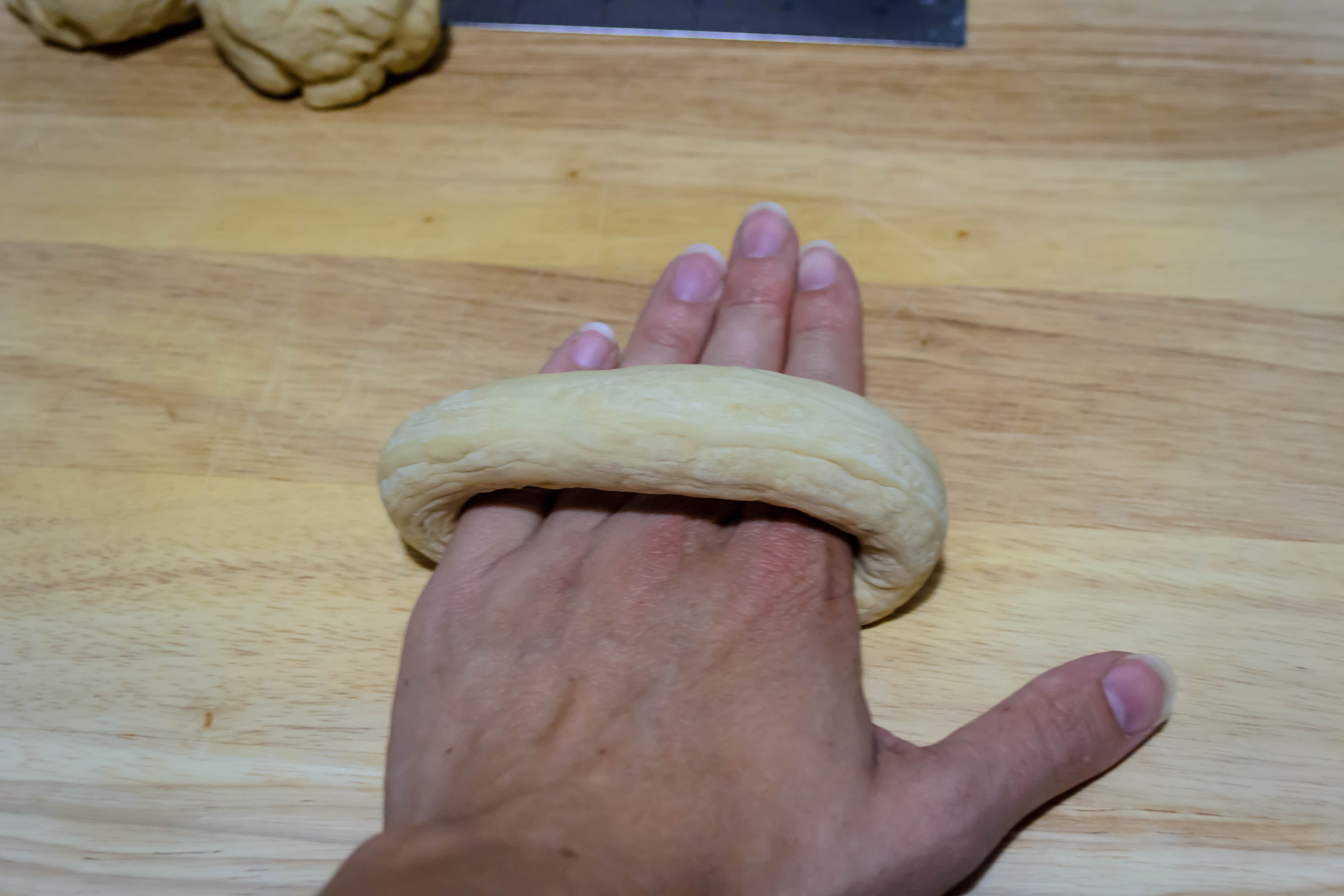
  • Shape each 11 inch rope into a circle, allowing for a 1-2 inch overlap.  Dampen the dough surface where it will overlap, and press together, squeezing and pinching tightly to seal the edges.  To secure the seal, put your fingers through the dough ring, resting it at the base joint where your fingers meet your palm, and roll the dough circle over the board a few times with the overlapped portion against your palm.
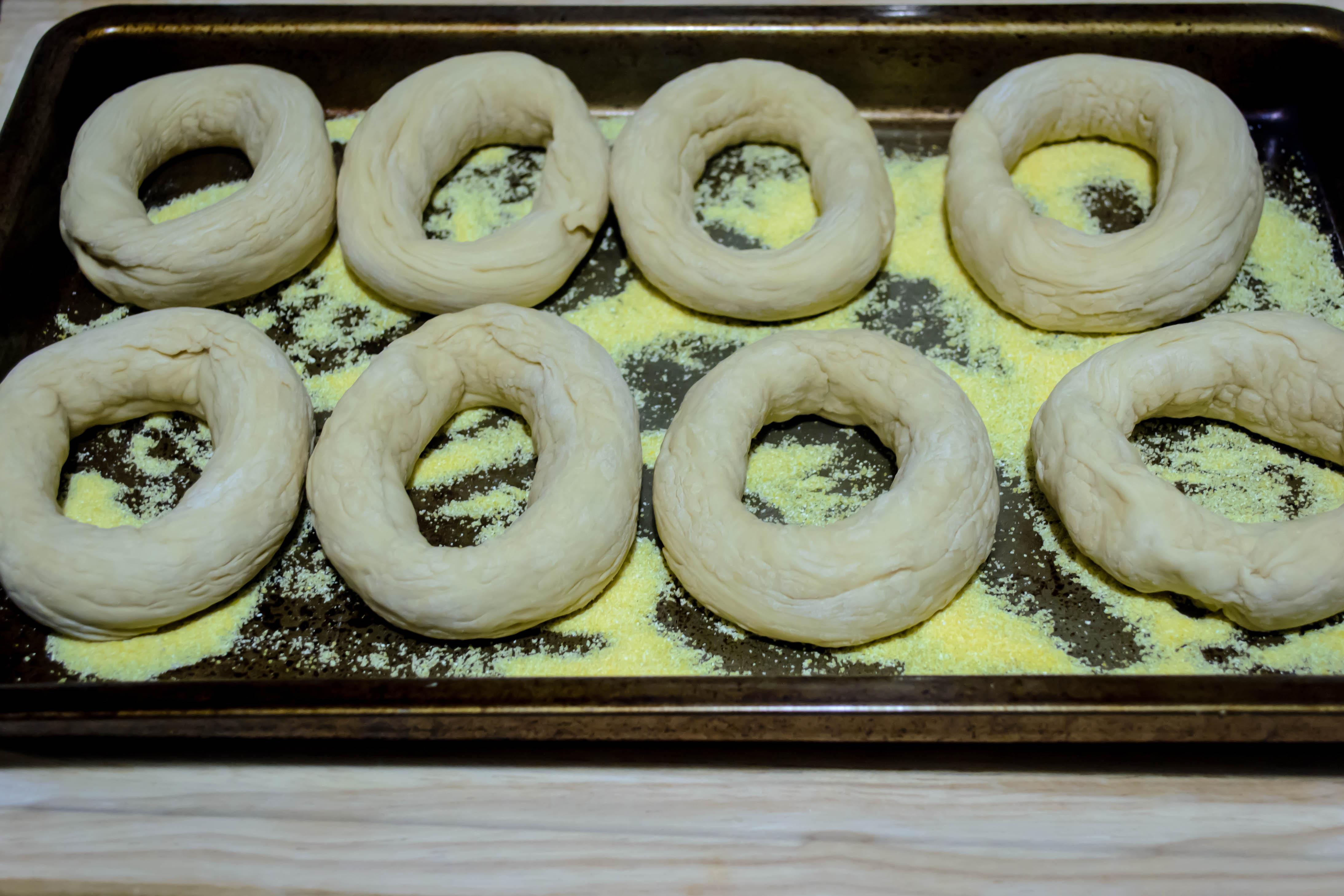
  • Dust a baking sheet with the cornmeal, evenly space the dough rings on it, and cover securely with plastic wrap.  Refrigerate for 12-18 hours.


Day 2:

  • 20-30 minutes before baking, remove the baking sheet from the refrigerator to let the dough rings warm up just a bit and get the yeast ready for quick action.  With the rack in the middle position, preheat your oven to 450F.  Pour water into a large stockpot or a wok to a depth of about 3 inches and bring it to a boil.
  • With the water boiling, drop the dough rings 4 at a time into the water; stir and submerge them with tongs, a slotted spoon, or a little skimmer for about 30 seconds.  They will puff very slightly as the yeast expands and then is extinguished by the heat.
  • Remove the dough rings from the boiling water and drain them on a wire rack, bottom-side down.
  • While the rings are still wet, sprinkle them with the cheese and stud them with jalapeño slices, then transfer each to a cookie sheet lined with parchment paper.
  • Bake 14 minutes, or until they are crisp and golden, and the cheese has transformed from drippy and melted to lacy and crunchy, and the jalapeños are just toasty and shriveled.  Transfer to a wire rack to cool before serving.

Espresso Molasses Spice Cookies

As Molly said a few weeks ago, sometimes recipes are so good they need no long-winded, story-laced introduction.  These cookies are like that.  You should just go and make them right now.  But for the sake of propriety, or normalcy, or expectations, I’ll just explain how these – perhaps the best cookies I’ve ever made – certainly the best cookies I’ve tinkered with my own recipe for – came about.

Food Blog July 2013-1915Perhaps months ago, a friend mentioned molasses spice cookies on Facebook (incidentally, and perhaps obnoxiously, have you acquainted yourself with the blackberry eating Facebook page?  Come on by, if you’d like), and suddenly I had to have them.  So I poked around, checking one recipe and another, and finally, as I often do, turned to Smitten Kitchen to see what Deb’s take on the issue looked like.

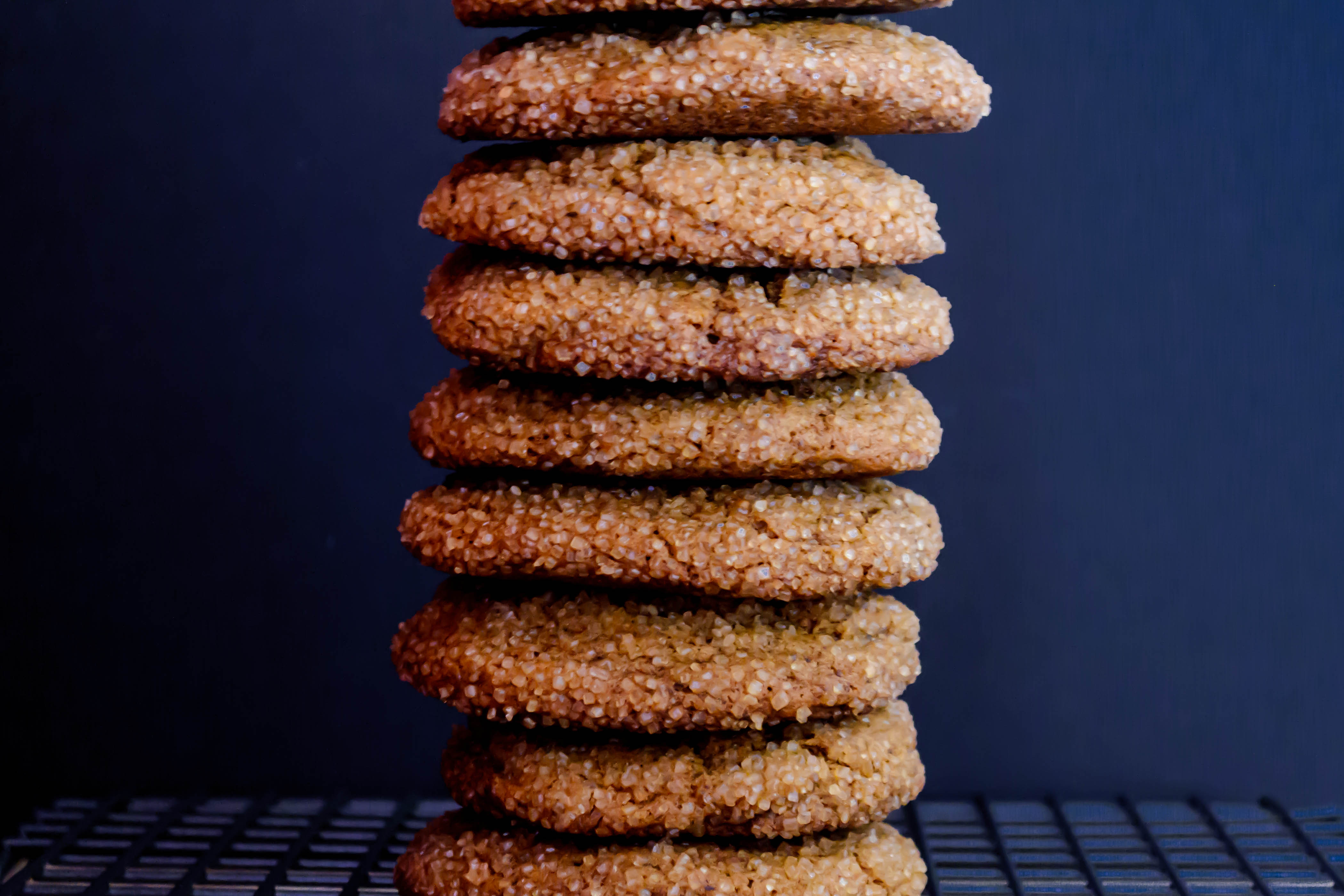
Food Blog July 2013-1890I mixed up a batch of Deb’s recipe, subbing out white sugar for all brown, adding some espresso powder for a bit of kick and rolling the cookies in coarse, crunchy turbinado sugar rather than standard granulated.  And then in between bouts of shoving them into our faces, I sent a stack to a few friends, who proclaimed them some of the best cookies they’d eaten.

Food Blog July 2013-1891For normal people, I’d wager this assessment of “best ever” would be enough to declare the recipe finished.  But I’ve never been entirely normal.  Yes, these cookies were good.  They were soft and spicy and warm, and the crunchy sugar on the outside was a perfect contrast.  They crinkled into little cracks on top and would have made ideal “bread” for a sandwich of ginger ice cream.  But I wasn’t done.  I upped the quantity of espresso powder so you could really taste a hint of it against the molasses.  I added orange zest for perfumed freshness and black pepper for an additional and different kind of zing.

Food Blog July 2013-1894And then I thought about texture.  For years, my dad has been searching for the perfect chewy chocolate chip cookie (more on this achievement in the future, I suspect…), and remains unsatisfied with recipes that churn out cakey or fluffy domes of dough.  The first batch of these molasses wunderkind were like that – lovely spice and flavor, but a bit on the soft side for me.  Some of this softness was my choice of sweetener; using all brown sugar is always going to leave you with a softer product than white sugar.  So will honey.  Both are hydrophilic, which simply means they attract moisture and thus stay flexible and soft, even after a few days (case in point: my friends who received theirs via post had no complaints about stale cookies!).  But some of this textural challenge is also related to flour.

Food Blog July 2013-1895Let’s talk about flour for a moment, if you’ll permit me.  “All-purpose flour” is one of the most misleading claims in the baking universe.  Flour – at least wheat flour – does what it does thanks to gluten, which are the little strands of protein that form snaky, chewy chains that result in the stretchy but still pillowy texture of bread.  The higher protein content your flour has, the more gluten it has and the more developed those chains will be.  The issue is, all-purpose flour is going to have a different protein content depending on the company whose flour you buy, the particular type of wheat used, and, to some extent, the year’s harvest itself.  So if you’ve ever made a batch of cookies that turned out perfectly the first time and then somehow, subtly different in texture the next time, you might have used a different batch of flour with a higher or lower protein content.
Food Blog July 2013-1896So how does this relate to the chewiness I was after?  Here, as should surprise no one (at least no one who knows me), I turned to Alton Brown.  If higher protein flour results in chewier cookies, why not sub in the flour made specifically for gluten development?  Bread flour.  And that was it.  Replacing just a ¼ cup of the all-purpose flour from the original recipe with bread flour produced a cookie that still crackled on top and felt appealing between our teeth, but held up with a bit more resistance, demanding an extra chew or two.  The perfect chewy cookie.  We planned to bring a batch of these to my family when we went to visit them last week, but as we each took yet another from the bag mid-drive, we realized there were only three left from the whole endeavor – enough for my family to each taste just one.

Food Blog July 2013-1905
Espresso Molasses Spice Cookies
adapted from Smitten Kitchen, who got them from the Cooks Illustrated Best Recipe Cookbook
makes 18-20 large cookies
2 cups all-purpose flour
¼ cup bread flour (this makes the cookies a bit chewier.  If you don’t care or you don’t have bread flour, use 2 ¼ cups all-purpose.  The cookies will be a touch softer, but still amazing)
2 tsp baking soda
½ tsp salt
1 ½ tsp cinnamon
1 tsp ginger
¾ tsp cloves
1 TB instant espresso powder
¼ tsp black pepper
12 TB room temperature butter (1 ½ sticks)
2 tsp orange zest
1 cup brown sugar, packed (I used golden brown; I’m sure dark would be delicious as well)
1 egg
1 tsp vanilla
1/3 cup unsulphured molasses
1/3 turbinado or other coarse sugar, for rolling
  • Position your oven racks in the top third of the oven, preheat to 375F, and line two baking sheets with parchment paper.
  • In a medium bowl, whisk flours, baking soda, salt, and spices through the black pepper.  This will leave you with a beautifully flecked mixture.
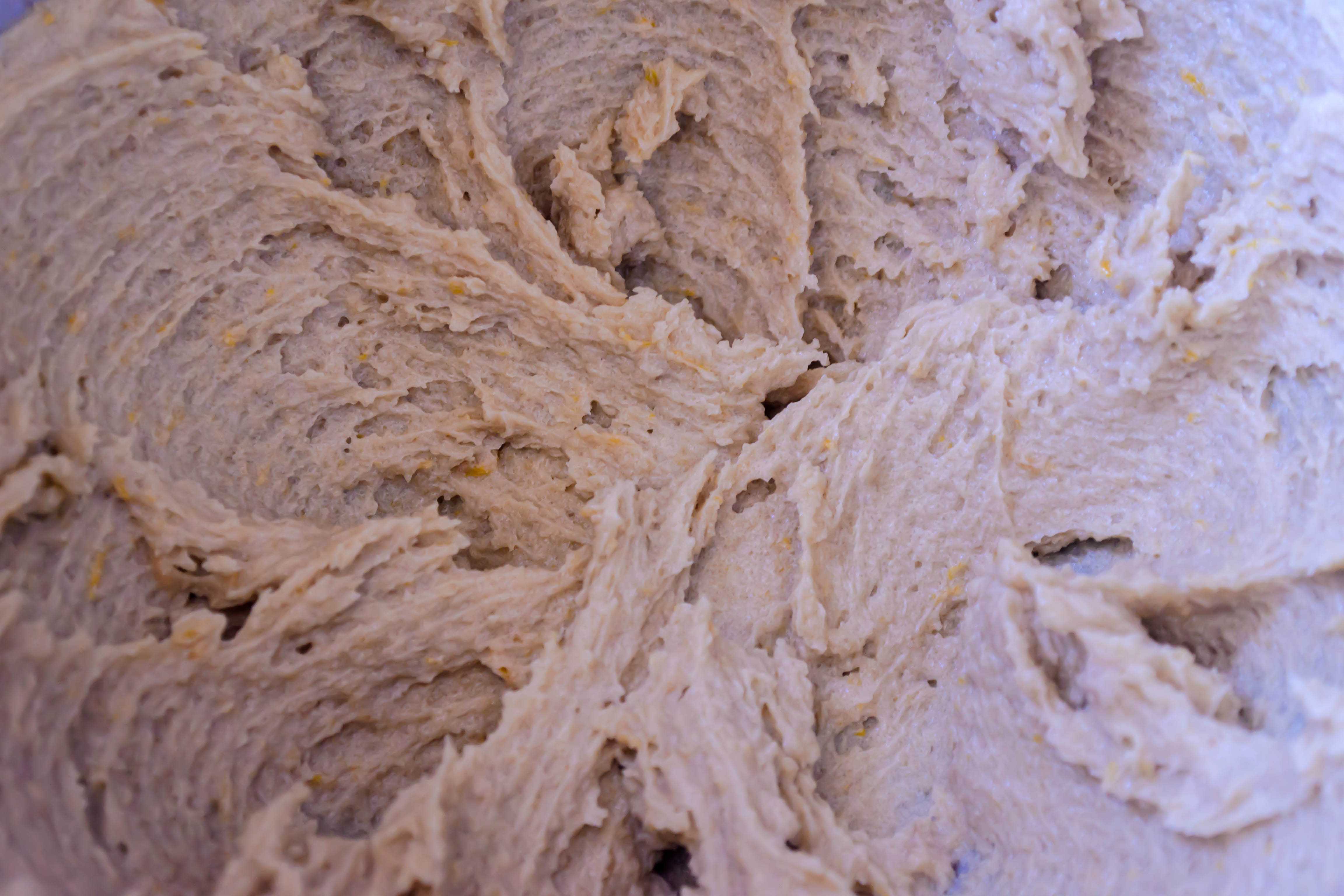
  • In a large bowl (I used the bowl of my stand mixer), cream the butter with the orange zest and the brown sugar for about 2 minutes, or until light and fluffy.  Scrape down the sides of the bowl.
  • Slosh in the vanilla, the egg, and the molasses, and mix well.  Scrape down the sides of the bowl again so everyone is included.
  • Add the dry ingredients to the creamed mixture and beat until all signs of flour are evenly mixed into a thick,sludgy dough.  Again, scrape down the sides of the bowl to ensure full incorporation.
  • Pour the 1/3 cup coarse sugar onto a plate or a shallow bowl.
  • Scoop 2 TB (1/8 cup) portions of cookie dough, roll them in your hands briefly to make a ball, and coat the ball in the coarse sugar on all sides by pushing it lightly around the plate or shallow bowl.
  • When each ball of dough is coated in coarse sugar, set it on your prepared cookie sheets.  Cookies should be spaced an inch or two apart; I wouldn’t do more than 6 per sheet, as they are large and do spread a bit.
  • Bake each sheet 11-13 minutes, or until cookies are puffed and set at the edges.  The middles will still be soft, but don’t despair.  They will continue to cook as they cool.
  • Cool cookies on their sheet for 2-3 minutes, then remove to a wire rack to cool completely before consuming, if possible.
  • You’ll hardly need to know this, I suspect, once you put one in your mouth, but enclosed in a zip-top bag these will stay fresh for up to a week.

Plum Upside Down Irish Soda Bread Cake #TwelveLoaves

Food Blog July 2013-1940As you can perhaps intuit from the title of this post, this month’s Twelve Loaves challenge was just that for me: a challenge.  Called upon to incorporate stone fruit into a bread item, my mind went in a thousand directions at once and came up blank.  For me, stone fruits belong in pies and cakes.  The idea of combining cherries, or peaches, or apricots, or nectarines with the slow, yeasted rising of a bread was an odd one (although now that I’ve considered it, chocolate and cherry bread sounds fantastic.  Inspiration, if anyone still needs an idea for this month?).  So I struggled.  I wrote down ideas that sounded like madness:

Caramelized apricot yeasted mini loaves, baked in muffin tins  too weird.

Plum cobbler  not really a bread.

Peach upside down cake  not a bread at all!

Irish soda bread with… stone fruit… somehow…

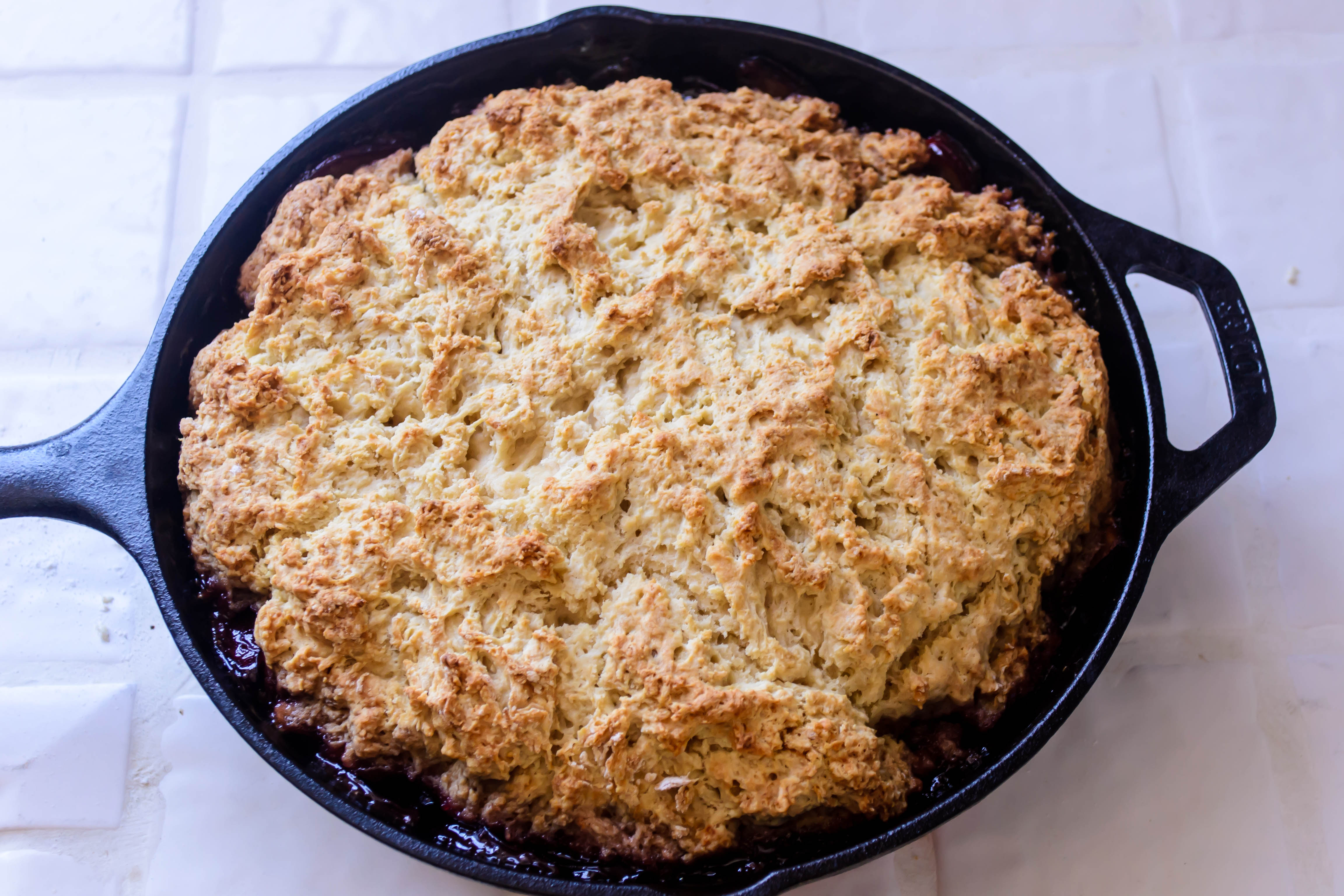
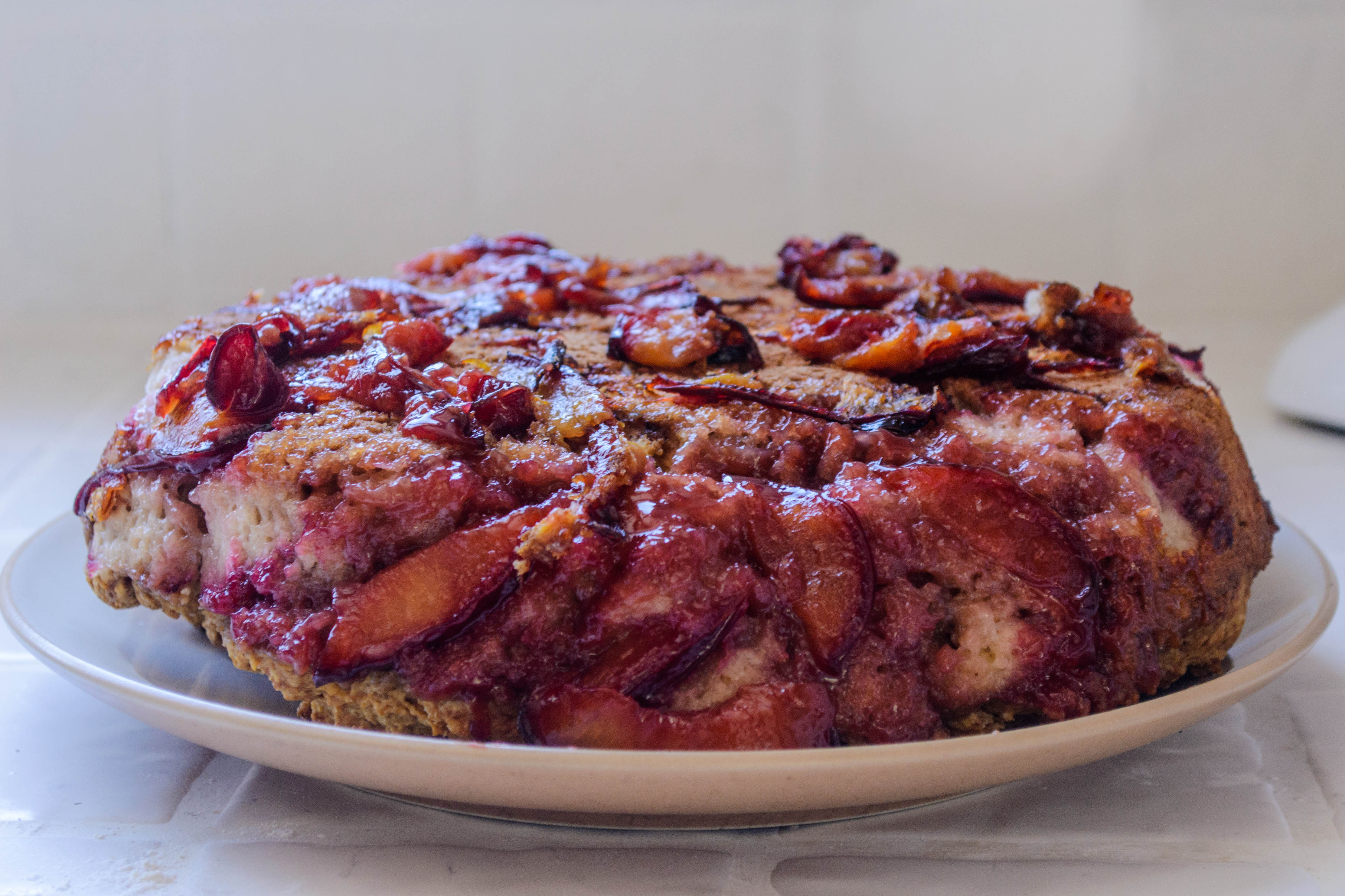
And that was where I landed, nibbling at the edges of this idea.  It would be, I decided, a skillet bread: fruit caramelized in the bottom of a cast iron skillet, soda bread dough mounded atop it and then baked and flipped, like the weirdest version of a pineapple upside down cake bread you’ve ever heard of.

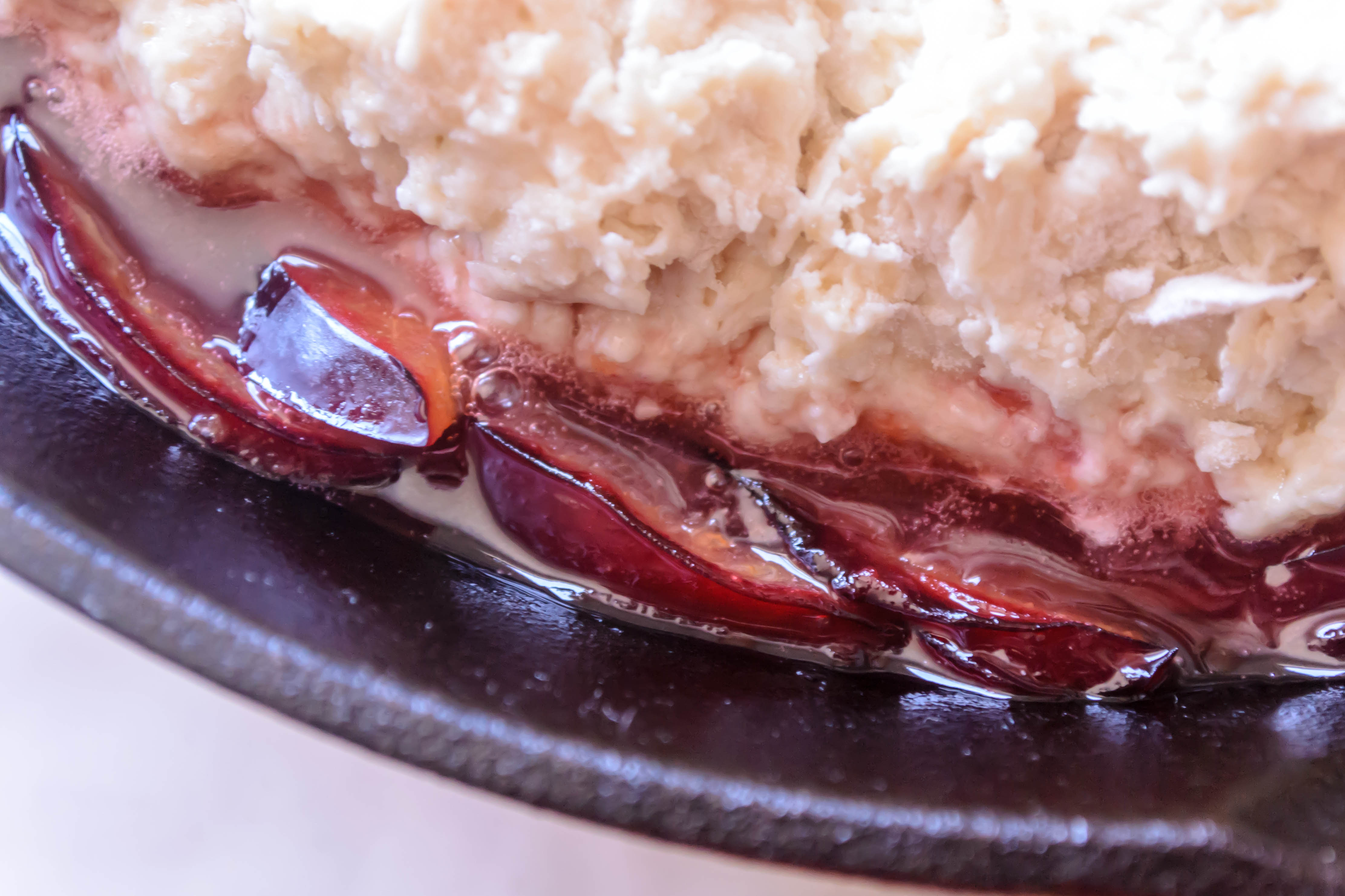
Food Blog July 2013-1919Once this weirdness was determined, I settled immediately on plums as my fruit choice.  I always forget how much I love plums as a cooked component.  None of the insistent fuzziness of peaches to deal with, but bursting with juice, brightly veined, and hiding just the right hit of tartness in that secret microscopically thin layer between skin and flesh.  I love that part.

Food Blog July 2013-1923Food Blog July 2013-1926Food Blog July 2013-1929I envisioned bubbling slices of that sweet tartness in a slick of butter and brown sugar, mounding on heaps of gussied up Irish soda bread dough and baking the whole thing into a puffed, flippable cake/bread to have for breakfast, afternoon “tea” (N. and I rarely drink hot tea in the 3pm hour, but love the idea of stopping for a bit of a snack), or maybe even wedges wrapped up in wax paper to take on the road as we head into vacation.

Food Blog July 2013-1931Food Blog July 2013-1932What I got was a stunner-in-progress.  I’m going to give you the recipe for exactly what I made, but I know this is not the final iteration of this dish for me.  The plums were perfect: juicy, melting into the caramel and the bottom of the bread, sticky and jammy and reminiscent of a triumphant batch of plum butter my mom made one summer with pounds and pound of plums delivered to our door in a brown paper bag straight from a neighbor’s tree.  The bread itself was good: solid Irish soda bread, a little richer and a little sweeter from the addition of brown sugar, extra butter, and an egg, perfect for the breakfasts and snacks I envisioned, and better the second day than the first.  But as I dug in, I found myself wanting the bread part to be more like cake: more egg, less flour, a hint of vanilla or nutmeg or maybe cardamom.  The plums were so good, so gloriously gooey and tooth-sticking-ly caramelized, that they deserve a proper dessert – something you can watch a scoop of ice cream melt over.
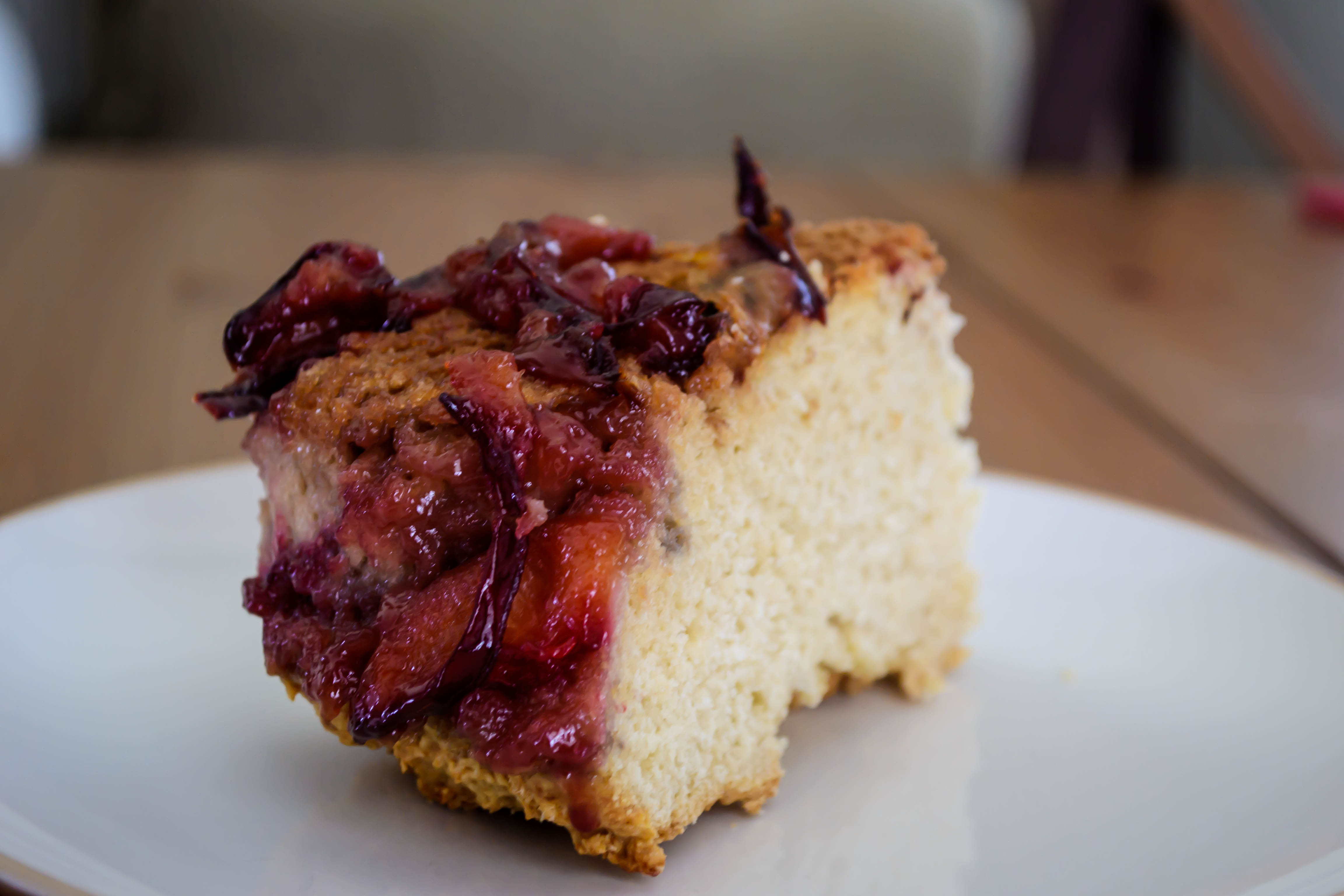
Food Blog July 2013-1938Make this.  It’s solid and scrumptious: the perfectly not-too-sweet energy boosting slice.  But consider yourself warned: this won’t be the last time you see upside down plum something here…

Food Blog July 2013-1945

Plum Upside Down Irish Soda Bread Cake
Serves 8-10
2-3 plums, thinly sliced
2 TB butter
¼ cup brown sugar
2 cups all-purpose flour
2 cups cake flour (this adds some lightness – if you don’t have cake flour, you can use all AP flour instead with slightly denser results)
¼ cup brown sugar (again)
1 ½ tsp baking soda
1 tsp salt
¼ cup melted butter
1 ½ cups buttermilk
1 egg


  • Preheat the oven to 400F.
  • In a cast iron skillet (or other oven-safe skillet), melt the 2 TB butter and toss in the first ¼ cup brown sugar.  Stir around until butter and sugar melt together into a sticky, bubbly mass.
  • Pull the skillet off the heat and add the plums in an even, single layer right on top of the caramel you’ve created.  You can place them in concentric rings if you want, for aesthetics, but so long as you have a complete single layer, you’re in good shape.  Set the skillet aside.
  • In a medium bowl, whisk the flours, the remaining ¼ cup brown sugar, the baking soda, and the salt until well blended.
  • In a small bowl or a 2-cup glass measuring cup (I like it easy), combine the melted butter, buttermilk, and egg.  Beat thoroughly with a fork.  Some of the melted butter will solidify again when the colder buttermilk hits it, but that’s okay.  It will all work out.
  • Pour the liquid mixture into your whisked dry ingredients.  You can make a well in the center first if you want, but the important thing is just to get them in there.  Combine with a fork, as you would with the liquid in biscuits, just until everything is incorporated into a rough, lumpy heap of dough.
  • Plop the dough onto the layer of plums and use a spatula or your hands to press it down a bit into an even layer that covers the fruit below.
  • Bake in a 400F oven for 30-40 minutes, until the bread is puffed, golden, and reaches an internal temperature of about 180F.
  • When the bread is done, let it cool for 5-10 minutes.  You can use this time to gather your courage, because the step that comes next is a little bit scary.
  • Place a large plate over the top of your cast iron skillet.  Being very careful, and using pot holders because that sucker is still smokin’ hot, invert the plate-skillet contraption so that the skillet is resting on the plate, bottom side up.  What we’re after is for the bread to give up its hold on the skillet and drop gently onto the plate with the plum layer on top.  This may take another 5-10 minutes.
  • Once the loaf has unstuck itself from the skillet and landed on the plate, remove the skillet and scrape out any remaining plum slices to add to the top of the cake itself.
  • Serve warm, room temperature, or cold, but I think this bread tastes better on day two, when the flavors have had time to meld and deepen a bit.