The Buttercream Project, part 6

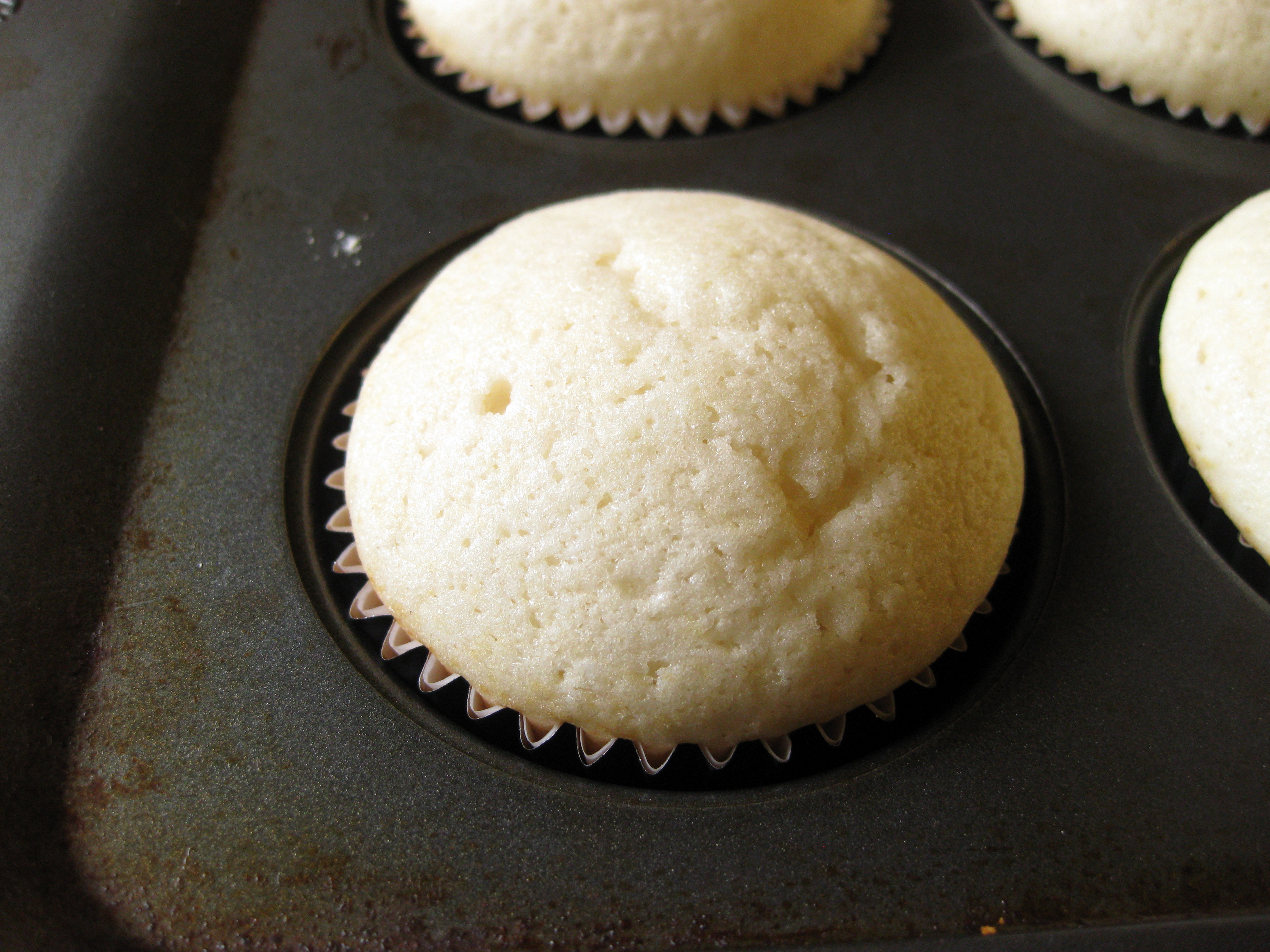
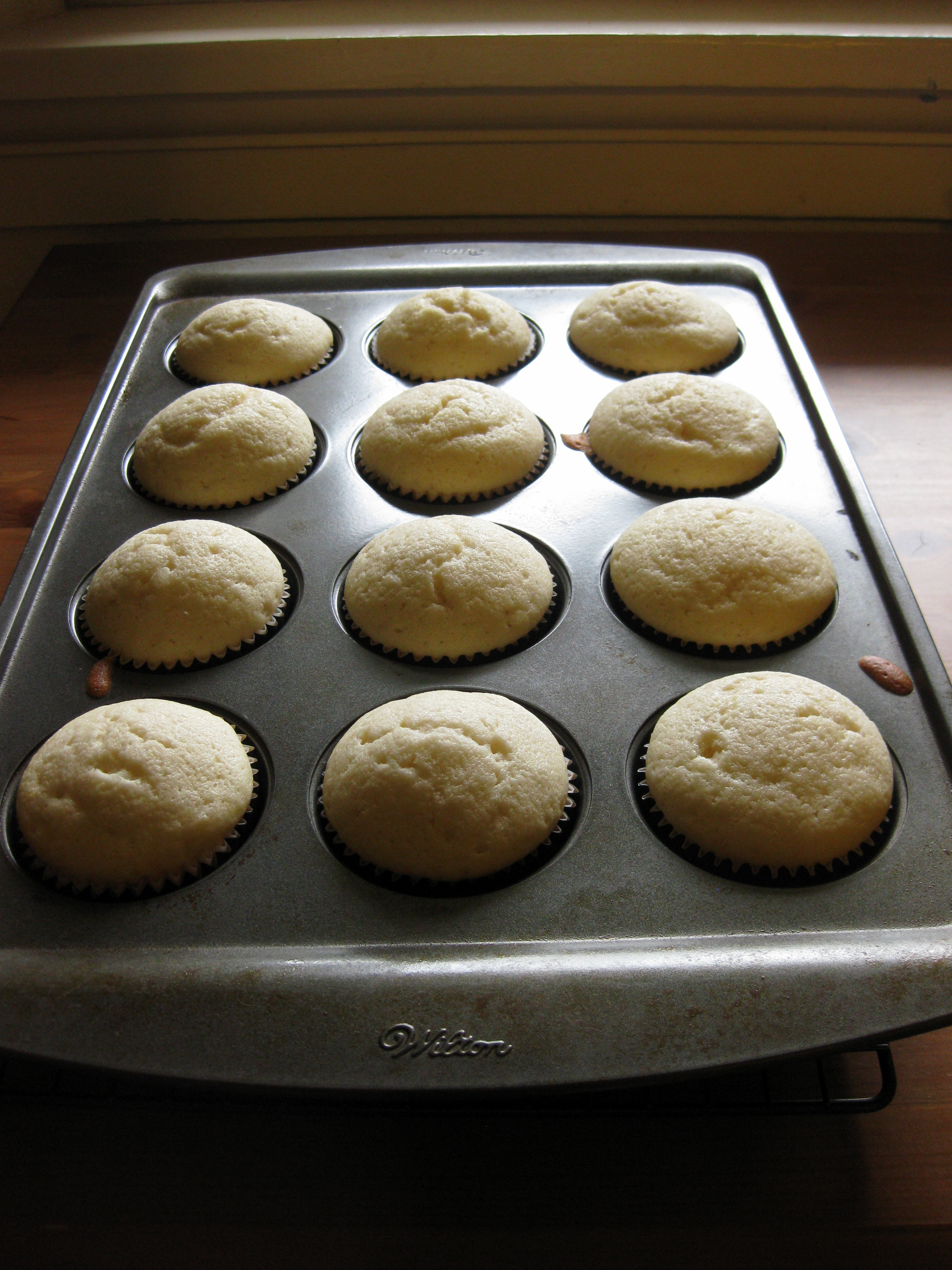
Buttercream and I are getting more comfortable with each other (and we’d better be, since the wedding is in one week.  One week!).  To prove this to myself, and because my family was clamoring for a taste of the cake I’ve been practicing for so long, I made a batch of wedding cupcakes while visiting my parents a few weeks ago.  My mom acted as sous chef, and we produced a batch together that will, thanks to time slipping away from me, serve as my final practice before I execute the real thing at the end of this coming week.

This practice run was an exercise in slight changes.  Not only did I not have cake flour to work with, or as many raspberries as I wanted for the filling, or enough champagne to add to the fruit compote, I was also working with a new oven, new tools (my mom has an electric mixer, but not a KitchenAid stand mixer, which is what I use at home), and a new friend: I’ve upgraded cameras.  I’m now (mostly) shooting with a Nikon D3100, a fantastic graduation gift courtesy of my folks.  It’s amazing.  I love it.  But I digress…

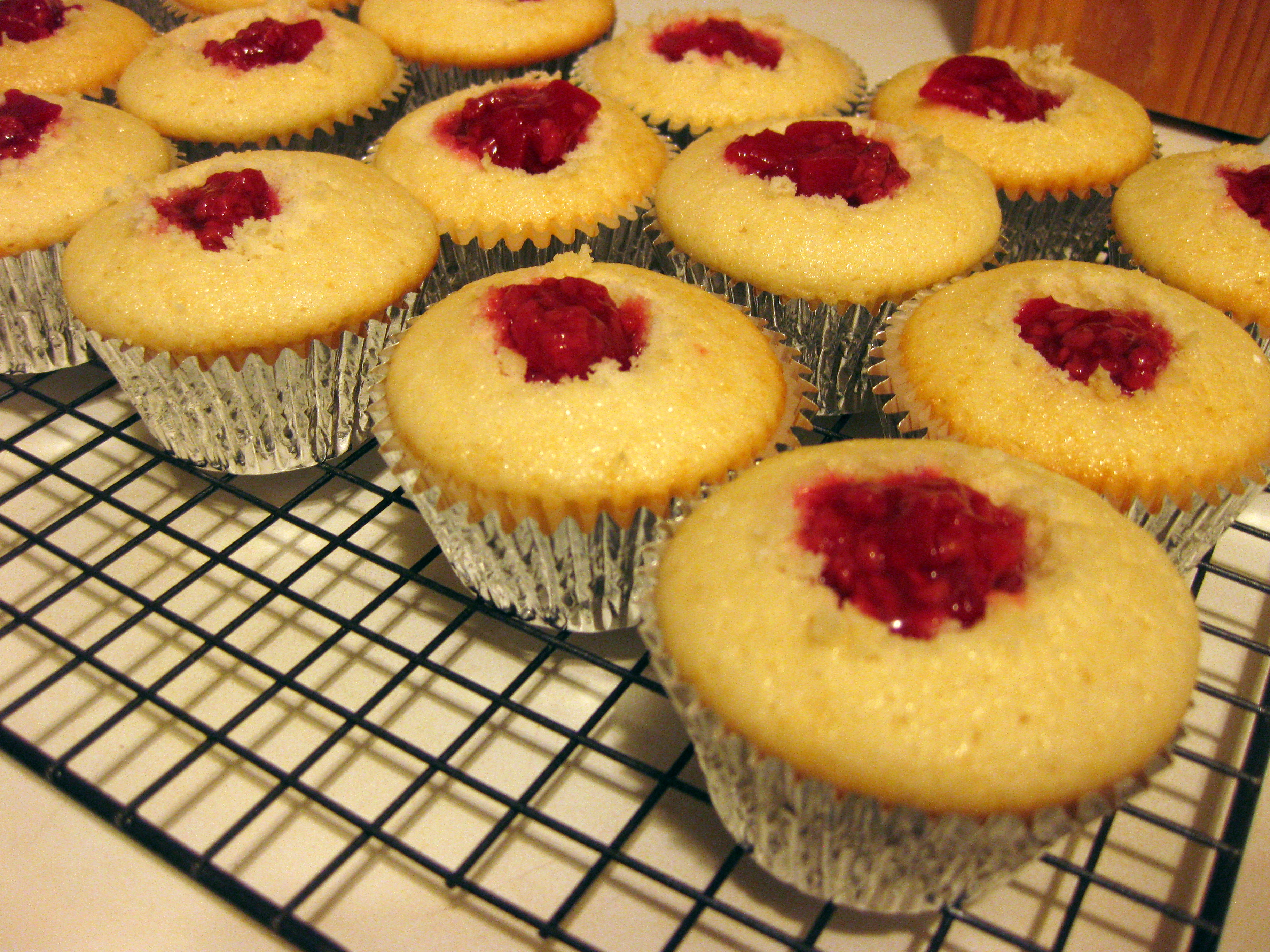
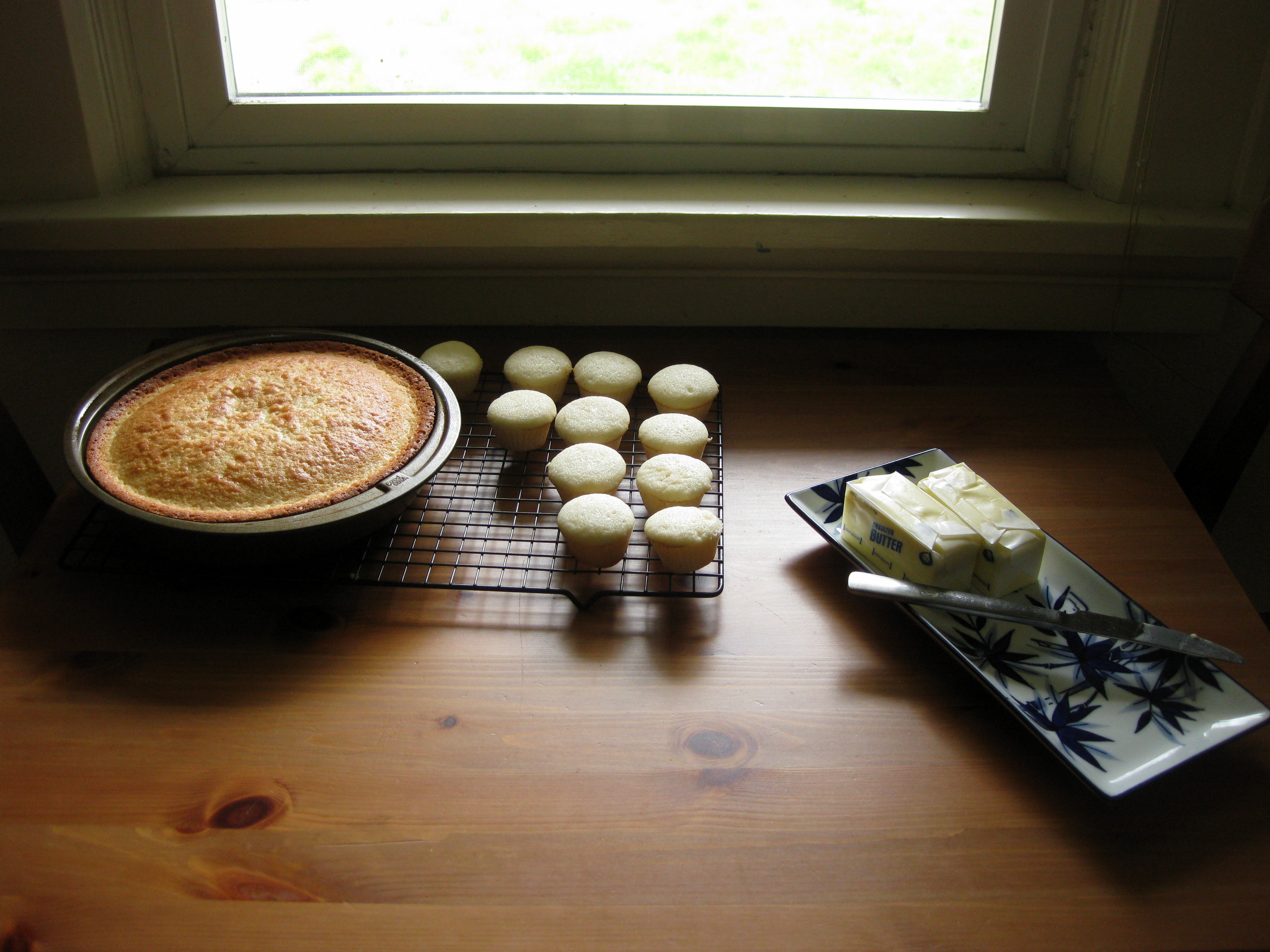
With regular instead of cake flour, the baking time needed to be increased by a minute or two (science-types: why might this be?  Does it take longer for regular flour to absorb liquids than cake flour?), and in my impatience, a few of the cupcakes fell in the middle and remained a bit gummy.  Initially this upset me, but the wonderful thing about filling is that you hollow out the center of the cupcake, which eliminated any underbaked batter completely.

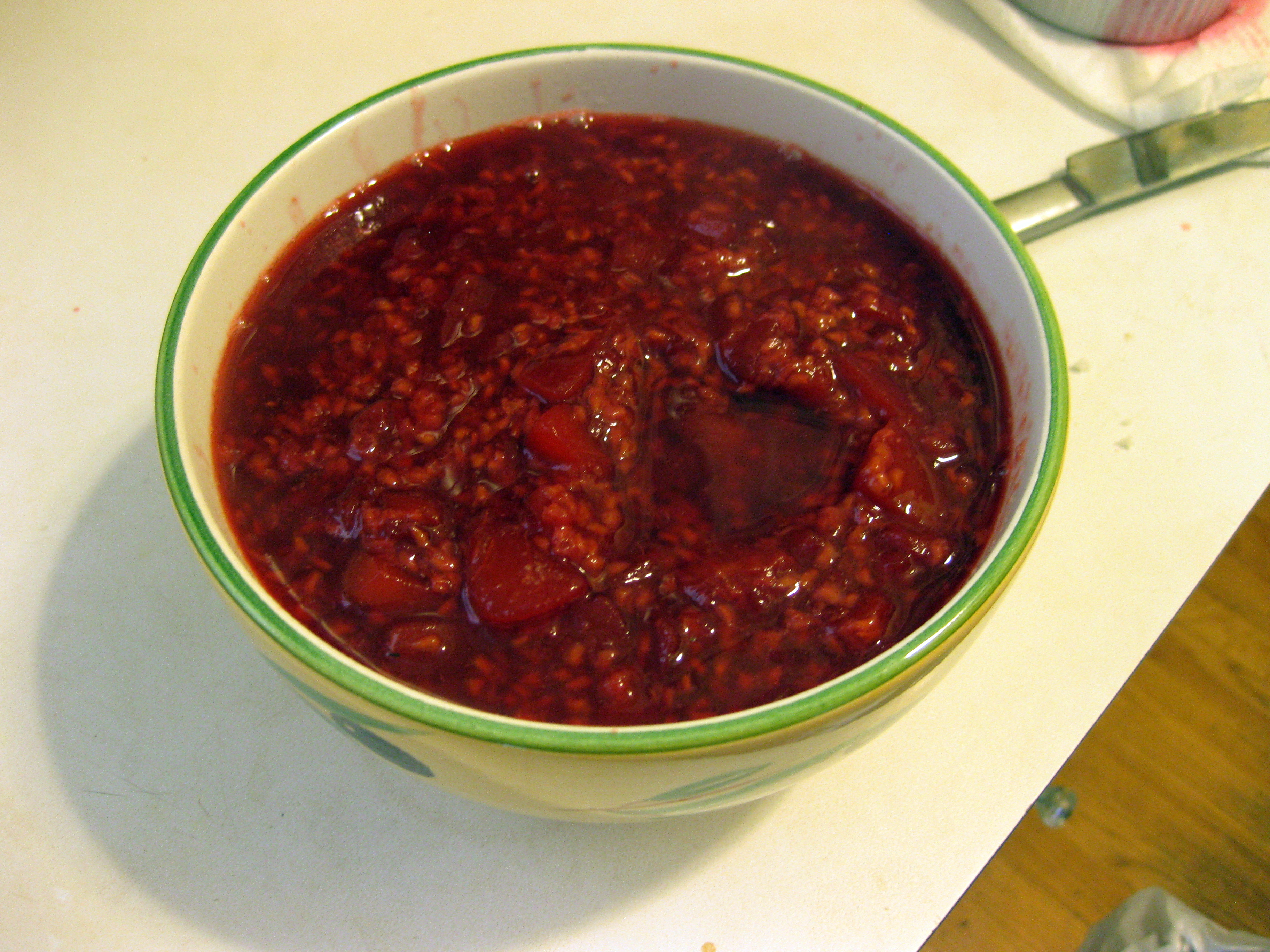
My mom dipped apricots in a boiling bath so she could slip them easily out of their skins, and she chopped them up in a medium dice to add to the mush of raspberries we had available, water, a small drift of sugar, and a generous splash of dry white wine.  We cooked this down for at least half an hour, then poured off some of the remaining liquid and cooked it a bit more. What was left was the consistency of loose jam, and pleasantly melon-colored.  To be honest, though the combination was nice and the filling tasted fine with the cupcakes, I think it could have benefited from less cooking time and less sugar.

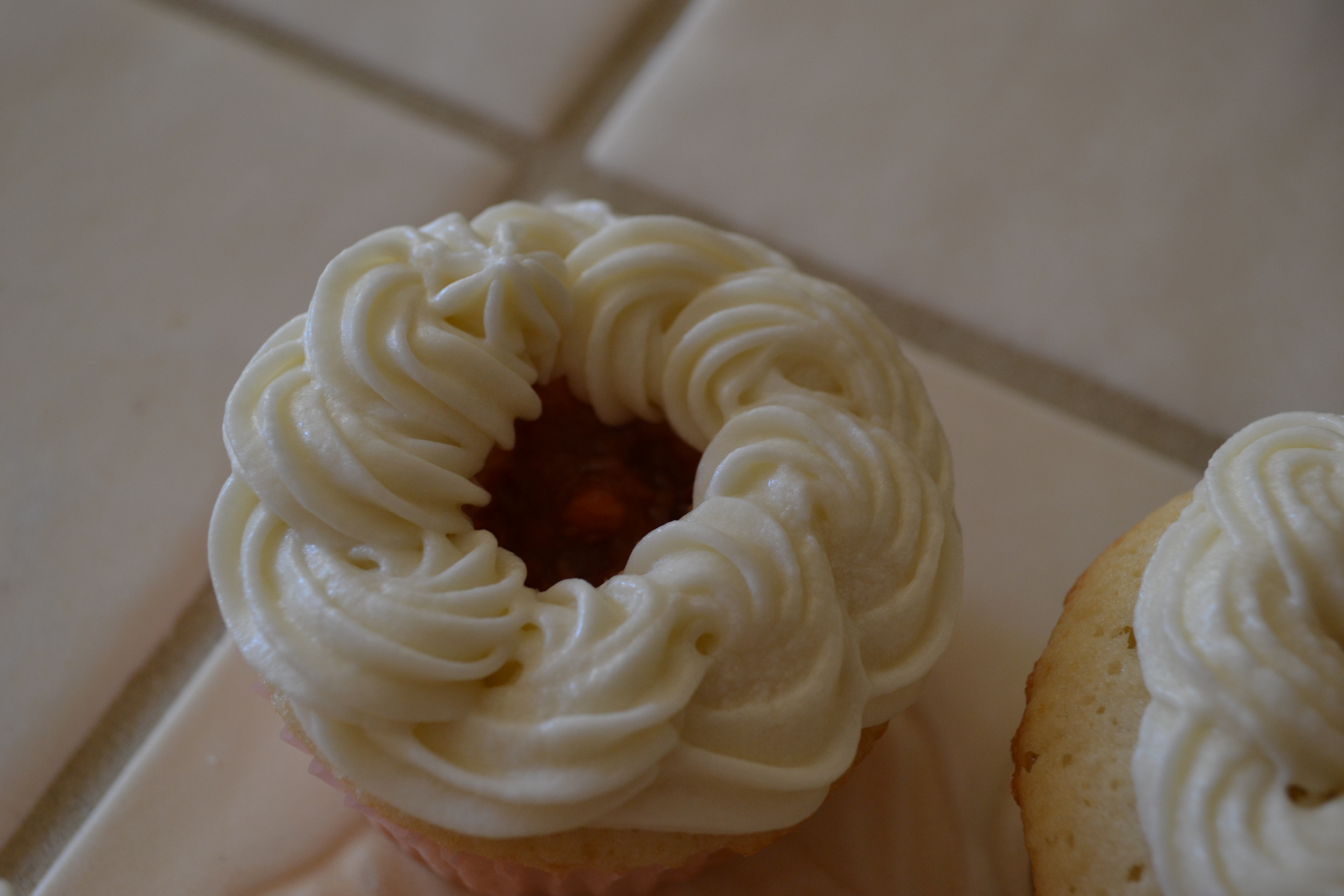
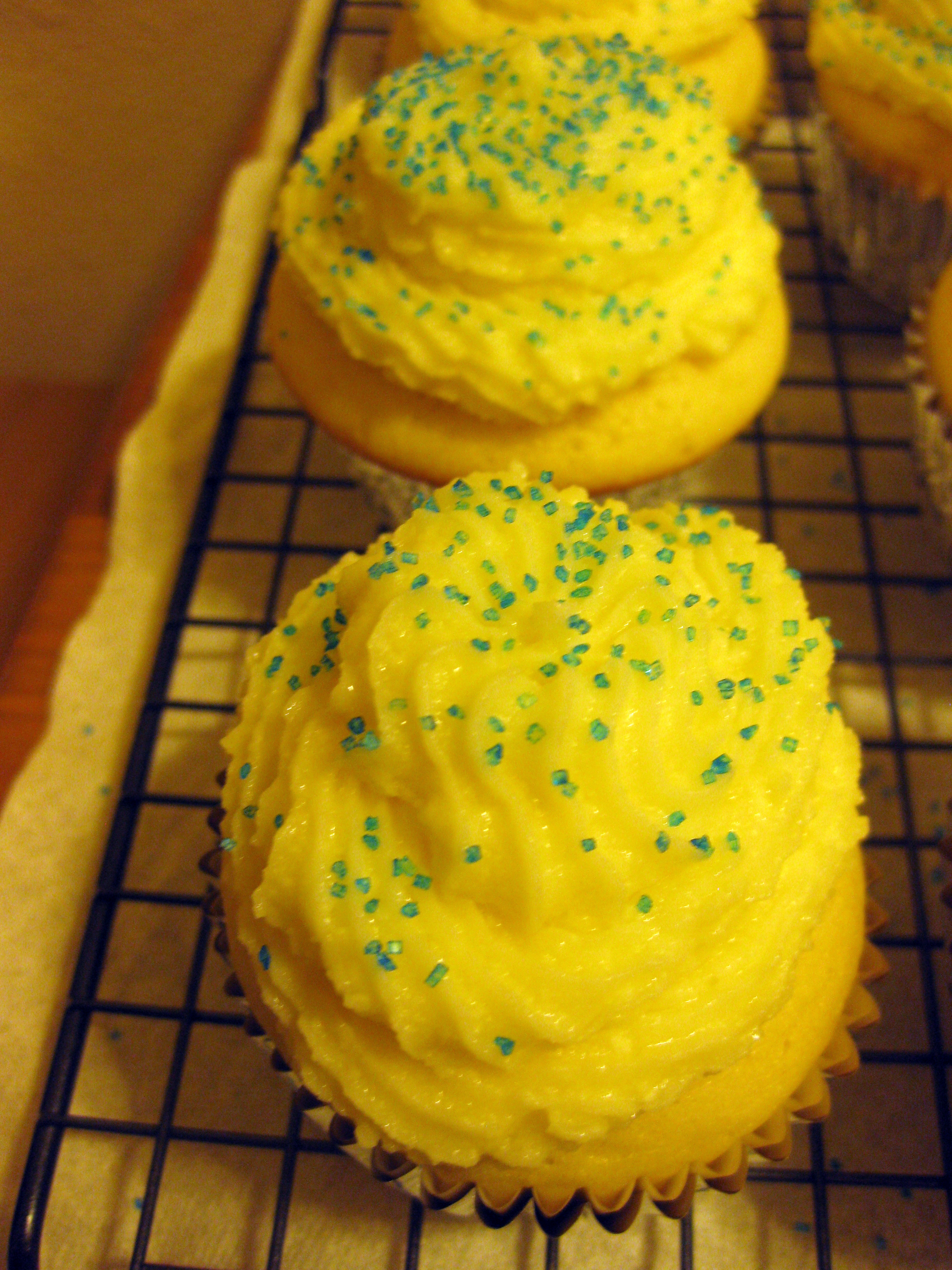
Baked, cooled, hollowed and filled, the cupcakes just needed their final element: perhaps the tastiest nemesis anyone has ever had.  I only let the butter and mascarpone cheese soften for half an hour or so.  In my mom’s summer kitchen, it was in the low 70s and the butter had a slight give at the press of a finger, but was not as achingly soft as it would be for chocolate chip cookies.  This seemed to be the right move.  It whipped together with the cheese easily and well – no large clumps of butter, no separation of fat from liquid.  I added powdered sugar a half cup at a time, as I’ve been doing, this time through my mom’s sifter, an ancient, squeaky-creaky crank-powered tube of tin.  Only one tablespoon of milk trickled in, and then I had a stroke of genius.  The problem with this frosting – the problem I’ve been searching in vain for ways to combat without compromising the texture – is that it’s too sweet.  Sitting in a wicker basket on the counter next to me was a large, juicy lime.  What would happen if we whipped a little lime juice into the frosting?

Revelation.  The good kind.  Just a tablespoon of lime juice and the frosting already tasted less sweet.  Another tablespoon and it was markedly less saccharine, but still no citrus flavor overwhelmed it, and it piped on beautifully in both swirls and curlie-cues.  This is an experiment to be repeated.  In a week.  One week.

Food from Fiction Potluck

So what does one do, you might ask, as a newly minted Doctor of Literature, unfettered from the everyday proletariat academic concerns?  Well, one grades, and one line edits, and one revises frantically, and frankly, one feels completely different and not different at all.  The school year isn’t over, even though (as of Tuesday, when I upload my “completed” dissertation to our Graduate School’s website) my degree is.  So my daily duties no longer include anxious preparing for the big day, but they still include student emails and lesson planning and reading.

But because they don’t include anxious preparation and last minute rethinking and nail biting about what the committee will think, these days can also include celebrations.  Last night was one such celebration: a party I’ve wanted to have for several years now.  The style: potluck.  The theme: “Food in Fiction.”  Interpretation: bring a dish inspired by or mentioned in a book.  That’s it.  There are so many vivid options in novel, drama and film, and our guests had only to choose one and recreate it in the material, taste-bud-bearing world.

We had tremendous fun, in brainstorming, in cooking, and in sharing the variety of dishes from books we love.  As I mentioned to one friend who thanked N. and I for the great party on his way out the door, this is a party we had to have before parting ways as many of us graduate this June, because only in this company could we feel so self-congratulatory and so excited about immersing ourselves in something so nerdy.

Here are a few of the dishes we enjoyed.  I suggested to folks that they provide the description of the food in question from its source text so guests would know what they were eating and which world it was taking them to.  We had Victorian sandwiches and High Modernism Stew nestling next to a magical realist chutney and a warm wassail of fantasy.  What wandering, all in one house…

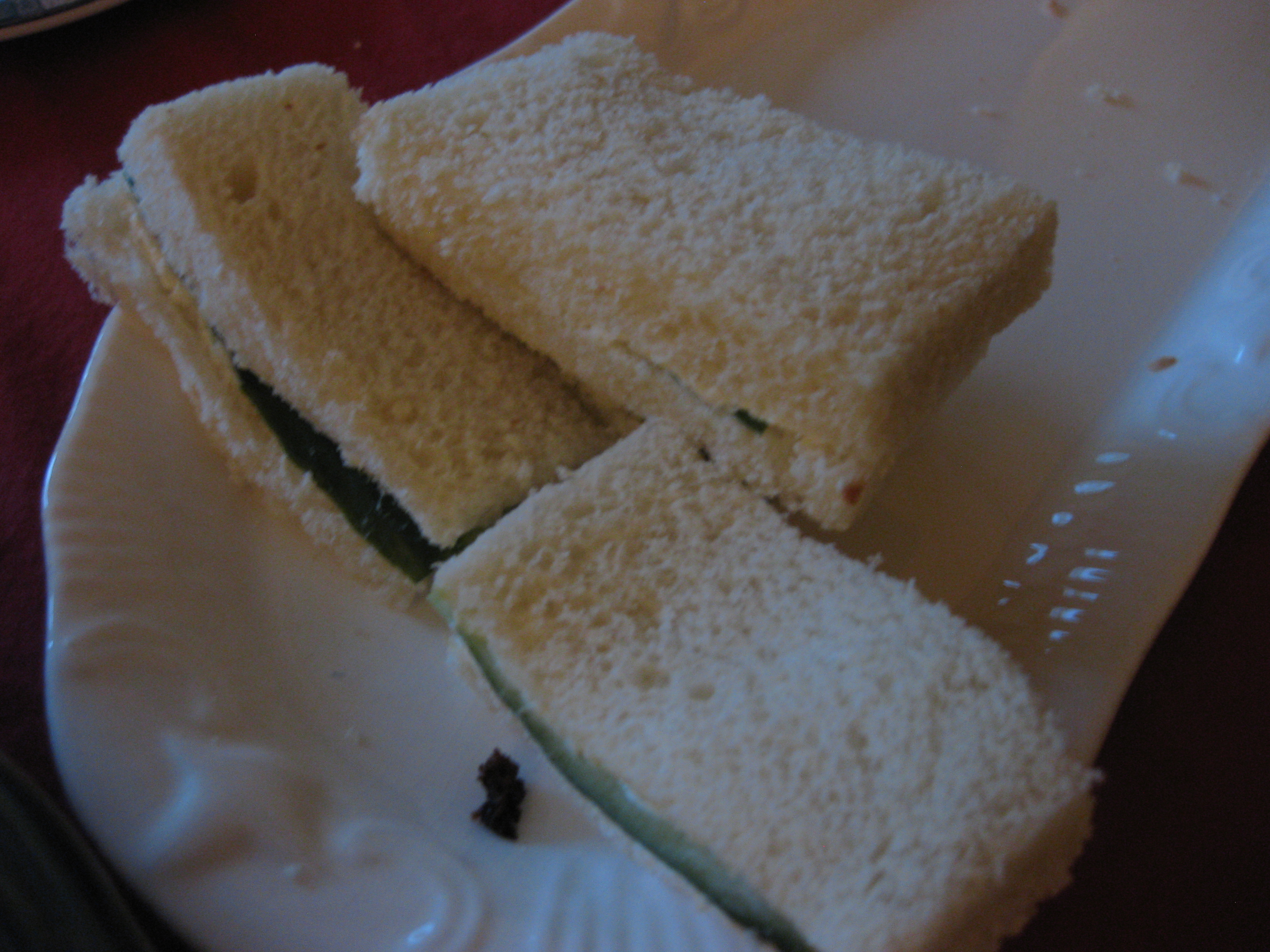
Cucumber sandwiches from Oscar Wilde’s “The Importance of Being Earnest.”

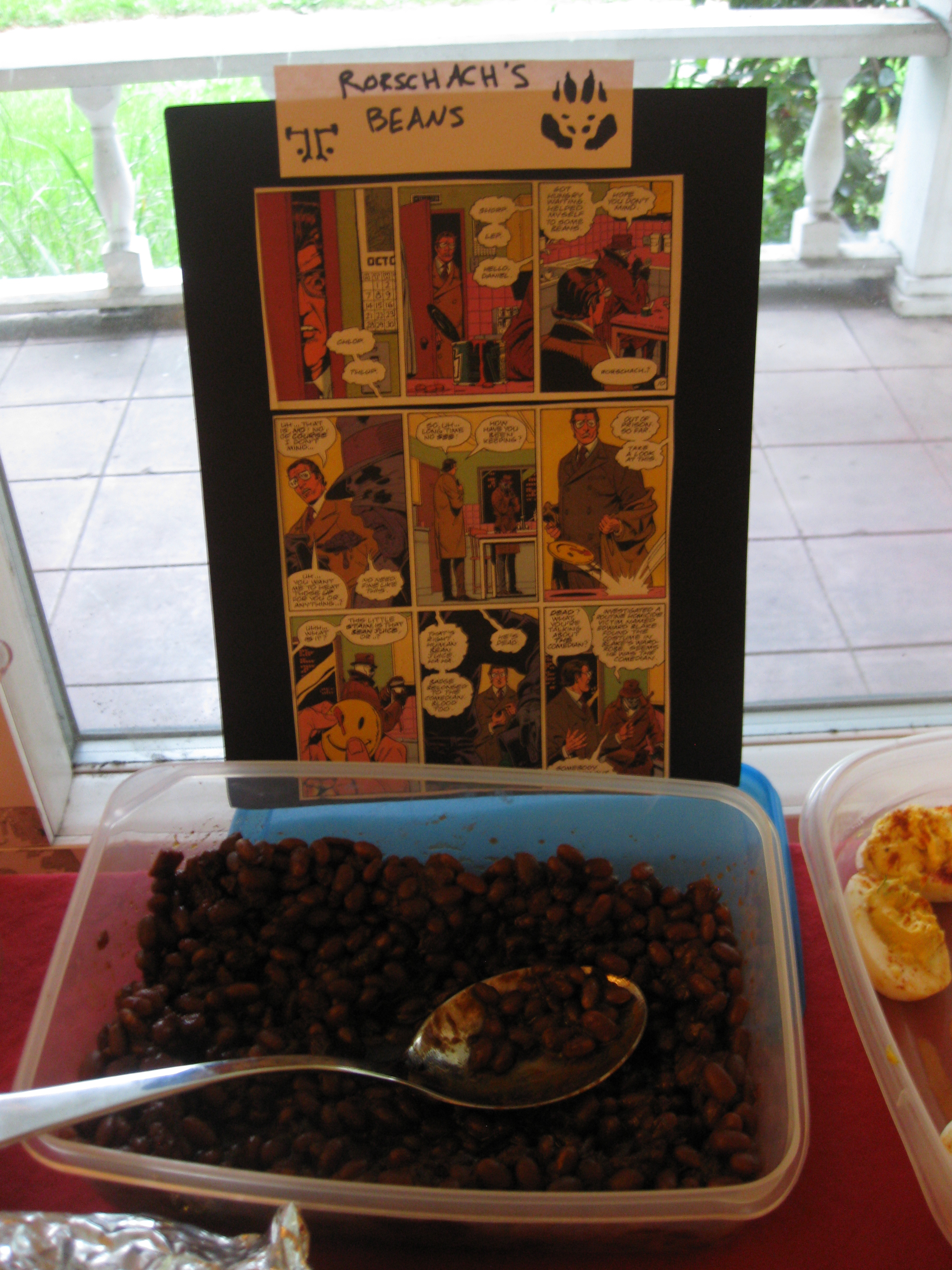
Rorschach’s beans from the graphic novel “Watchmen.”

Boeuf en daube from Virginia Woolf’s To the Lighthouse.
A trio of deviled eggs to breathe life into Hemingway’s thoughts on being hard boiled in The Sun Also Rises.

A wonderfully smoky molasses cake inspired by the molasses-drenched dinner scene in Harper Lee’s To Kill A Mockingbird.

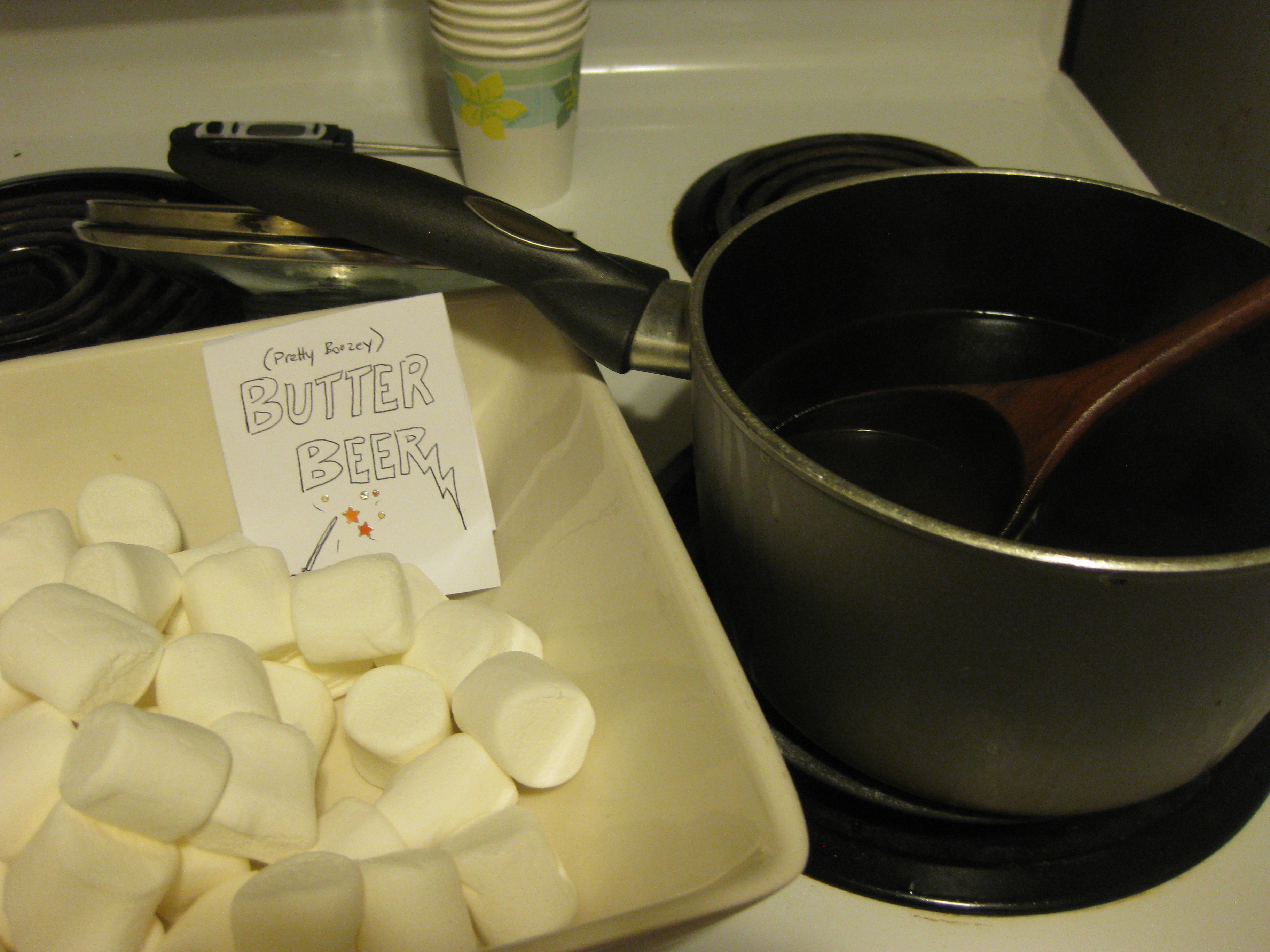
Well spiked butterbeer (you drop in a few marshmallows which, as they melt, mimic the foamy head on the beer) from J. K. Rowling’s Harry Potter series.
Not pictured: (more!) deviled eggs, from Toni Morrison’s Song of Solomon, sautéed marinated mushrooms inspired by Lewis Carroll’s Alice in Wonderland, raspberry cordial from L. M. Montgomery’s Anne of Green Gables, and a few sourceless delights: meatballs (Cloudy with a chance of, perhaps?), and a bread, cheese, and hard salami platter.  These were justified by their authors with the claims that “surely there must be moments of literary eating that include these items,” which I was quite willing, given their deliciousness, to accept.  And of course, wine.  If we were picky, we could call this an homage to Hemingway, whose characters “get tight” with abandon, or to Carroll’s Alice, who does imbibe from the mysterious bottle demanding she “drink me.”

I made two offerings: a take on the “green as grasshoppers” chutney so adored by Saleem in Salman Rushdie’s Midnight’s Children, and a pork pie stuffed with hard boiled eggs from Roald Dahl’s Danny the Champion of the World.  Both turned out extremely well, but I want to talk about the pie first.

Danny the Champion of the World is the story of a boy and his father.  Without giving too much away, I will only say that Danny’s father suffers an injury almost halfway into the book, and when Doc Spencer, the family physician, brings him home from the hospital to the gypsy caravan in which he and Danny live, Doc also brings Danny a package from his wife:

“Very carefully, I now began to unwrap the waxed paper from around the doctor’s present, and when I had finished, I saw before me the most enormous and beautiful pie in the world.  It was covered all over, top, sides, and bottom, with rich golden pastry.  I took a knife from beside the sink and cut out a wedge.  I started to eat it in my fingers, standing up.  It was a cold meat pie.  The meat was pink and tender with no fat or gristle in it, and there were hard-boiled eggs buried like treasures in several different places.  The taste was absolutely fabulous.  When I had finished the first slice, I cut another and ate that, too.  God bless Doctor Spencer, I thought.  And God bless Mrs. Spencer as well” (Dahl 85-86).

Since my first trip through Danny, I salivated over this savory pie Danny enjoys.  And this party was the perfect excuse to attempt my own.

I found a perfect (and much prettier) base recipe for my pie in the archives of the blog Married… With Dinner.  Though I followed their basic instructions, I made a few amendments for ease and expense.  The key points are as follows:

Use a springform pan.  That way the pie is tall and regal and can sit magically outside a pie plate all on its own.

Roll the bottom crust out large enough to come almost all the way up the sides of the springform (I used storebought crust and it work out just fine), so you can connect top and bottom more easily.

I squashed together a mixture of ground pork, pork sausage, finely chopped ham from a ham slice, salt, cayenne pepper, ground cloves, and black pepper.  I pressed a thin layer of the meat mixture onto the bottom of the pie crust, then laid six hard boiled eggs in a circle through the middle of the pie (regrettably, with ham-covered hands, I did not get a photo of this).  Then I lightly packed the rest of the meat mixture around and over the eggs and sank a bay leaf deep into the very center of the pie.

A traditional English pork pie has warm pork stock poured into a hole in the crust just after baking, which turns into a thick jelly as the pie cools.  This did not sound particularly delicious to me, though I did like the idea of a rich layer of something atop my pork.  I decided on cheese.  I grated about a cup of sharp cheddar and sprinkled it lightly on top of the meat before draping the top pie crust over it.  I cut a little hole in the center of the crust and sliced some steam vents for additional release before baking.

It’s a long baking process (almost two hours), but you are dealing with raw pork, so the cooking time needs to be sufficient.  When the pie is almost done, Married… With Dinner recommends you carefully release the spring on the pan and brush an egg wash all over the top and sides of the pie.  Fifteen minutes more in the oven and this results in a beautiful, shiny golden glaze all over the pie.  It also, in case you are lazy like me and didn’t brush an egg wash over the top edge of the bottom crust to help the lid adhere, creates an after-the-fact glue to hold base and lid together.

I let my pie cool on the counter for an hour or so, then tented it with aluminum foil and stowed it in the fridge until the party started.  It did, after all, have to be a cold meat pie.

It was fabulous.  The meat was nicely spiced and the ham bits shredded in added some smoky, salty variety.  The hard boiled eggs were, indeed, delightful treasures to find, though I admit to over-boiling them slightly so their yolks were not as bright as they could have been.  Still, this is hardly a complaint.  It was like a meatloaf wrapped in flaky, buttery crust, and the cheese was a nice additional flavor and richness.  I suspect this could have been just as good warm as it was cold, but the pie might not have held together quite as nicely.

My second offering was a cilantro coconut chutney.  Saleem, as Midnight’s Children comes to a close, receives a meal from a blind waitress.  He lists:

“On the thali of victory: samosas, pakoras, rice, dal, puris; and green chutney.  Yes, a little aluminum bowl of chutney, green, my God, green as grasshoppers… and before long a puri was in my hand; and chutney was on the puri; and then I had tasted it, and almost imitated the fainting act of Picture Singh, because it had carried me back to a day when I emerged nine-fingered from a hospital and went into exile at the home of Hanif Aziz, and was given the best chutney in the world… the taste of the chutney was more than just an echo of that long-ago taste – it was the old taste itself, the very same, with the power of bringing back the past as if it had never been away…” (Rushdie 525).

I found a recipe for a coriander chutney replete with tart lemon juice, lip puckering spice from serrano chiles, and bright, bright green cilantro, tempered by shredded coconut.  The recipe called for unsweetened coconut but I, in my haste, having only sweetened, forgot to rinse it to get some of the sugar off before dropping it into my food processor.  As a result, my chutney was lightly sweetened, but no one seemed to mind that, especially when it was spread onto the pakoras I made.
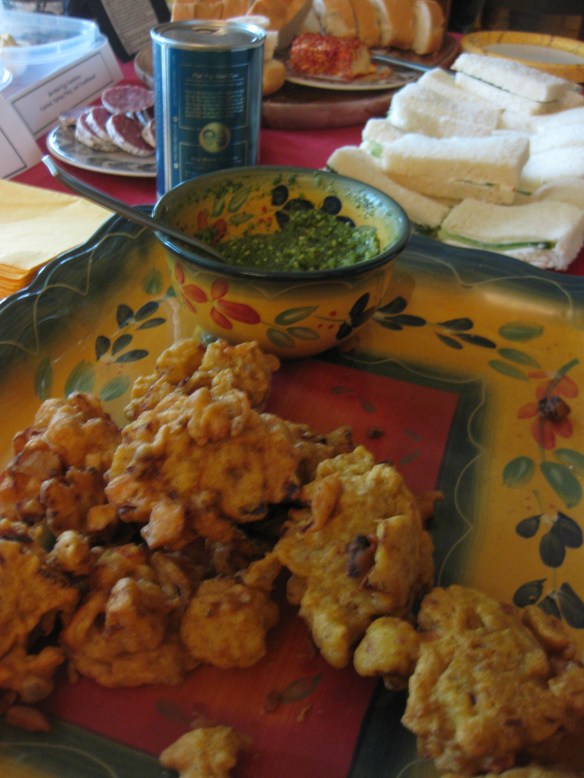
I searched around online and made a master recipe from a combination of ideas for these pakoras.  Mine included:

4 cloves garlic, smashed and finely minced

2 tsp. each:

Garam masala

Turmeric

Chili powder

Salt

2 cups Bob’s Red Mill gluten-free all-purpose flour (pakoras are made with garbanzo bean flour, and though the Bob’s Red Mill mix is a blend including potato starch, it is composed mostly of garbanzo and fava bean flours, so since I had it, I decided a little break from tradition would be okay.  This is literature, after all.  It’s all interpretation anyway!)

1 ½ cups water

½ head cauliflower, diced

¾ large onion, diced

1 small sweet potato, diced

1 quart vegetable oil

Heat the vegetable oil to 375F in a large, sturdy pot.  I used my dutch oven.

While the oil heats, whisk together the dry ingredients and garlic until well combined, then slowly whisk in the water to form a thick, smooth batter.

Add the diced vegetables and stir to combine.

Drop spoonfuls of the batter (ever so carefully!  Watch out for splashes!) into the hot oil and fry for 5-6 minutes, or until the batter is deeply golden and the vegetables inside have magically cooked.

I got to taste one of these.  It was crunchy and starchy and slightly spicy and wholesome and delicious.  It was vegan.  It was gluten-free.  Topped with the chutney it was fresh and springy and spicy and then gone.  By the time I went back to have another, the giant platter I’d made was empty, and only a spoonful or two of chutney remained.  Pride overwhelms disappointment, in moments like these.  My little experiment was so successful it prohibited me from tasting further.  So I had another deviled egg instead.

Full and happy, we fell into bed at midnight with a sinkful of dishes and a fridge-full of leftovers to look forward to.  It’s like reopening a book to your favorite chapter: whose world will I lunch from, dine from, be returned to today?
The Buttercream Project part 5

It’s funny, the things we feel we have to do to catch up with life.  Thursday was a big day: I successfully defended my dissertation, the last step on the way toward becoming a PhD in English literature.  So I guess I’m a doctor now, of a sort.  And now that the defense is over, and summer is (supposedly) on its way, I’m trying to find footing in the landslide of other responsibilities I’ve let slide: getting back in touch with friends, grading student work, cleaning up an office I’ll have to vacate in a month or so, and remembering (much to my dismay) an unwritten conference paper I have to present at the end of July.  And yet, rather than doing any of those things, the most important obligation I feel I must fulfill is this one: sharing how my most recent efforts on the cupcake front – now almost a month old – came out. 

The answer is spectacular.  I think, barring any further requests or complaints from the bride and groom, I have hit on THE mixture we’ll be using for the wedding.  And of course, as always, I’ve learned some things too.

Last time I made a floaty, creamy filling that coated the tongue and whispered with sweetness.  This time, I wanted something tart – almost aggressive – to to cut through the sometimes overwhelming clouds of frosting.  I combined 1 bag each frozen raspberries and frozen peach chunks, 1-2 cups champagne, and about ¼ cup of sugar in a small pot, and simmered them together for 20-30 minutes.  I was hoping for a thickened, jam-like compote, but I think there was too much champagne for that, and the mixture stayed fairly loose.  The flavor was great, though – with such a small quantity of sugar, the tartness of the fruit and champagne made the mixture bright and assertive.

When the cupcakes were baked, and both they and this ruby mixture were completely cool, I cut the middles out of the full sized cupcakes and deposited a teaspoon or two of filling into each.  To my relief, despite being thin, the juice of the filling did not bleed through and stain the exterior of the cakes.  Bright red splotches on otherwise pristine ivory-white wedding cupcakes would be disastrous.

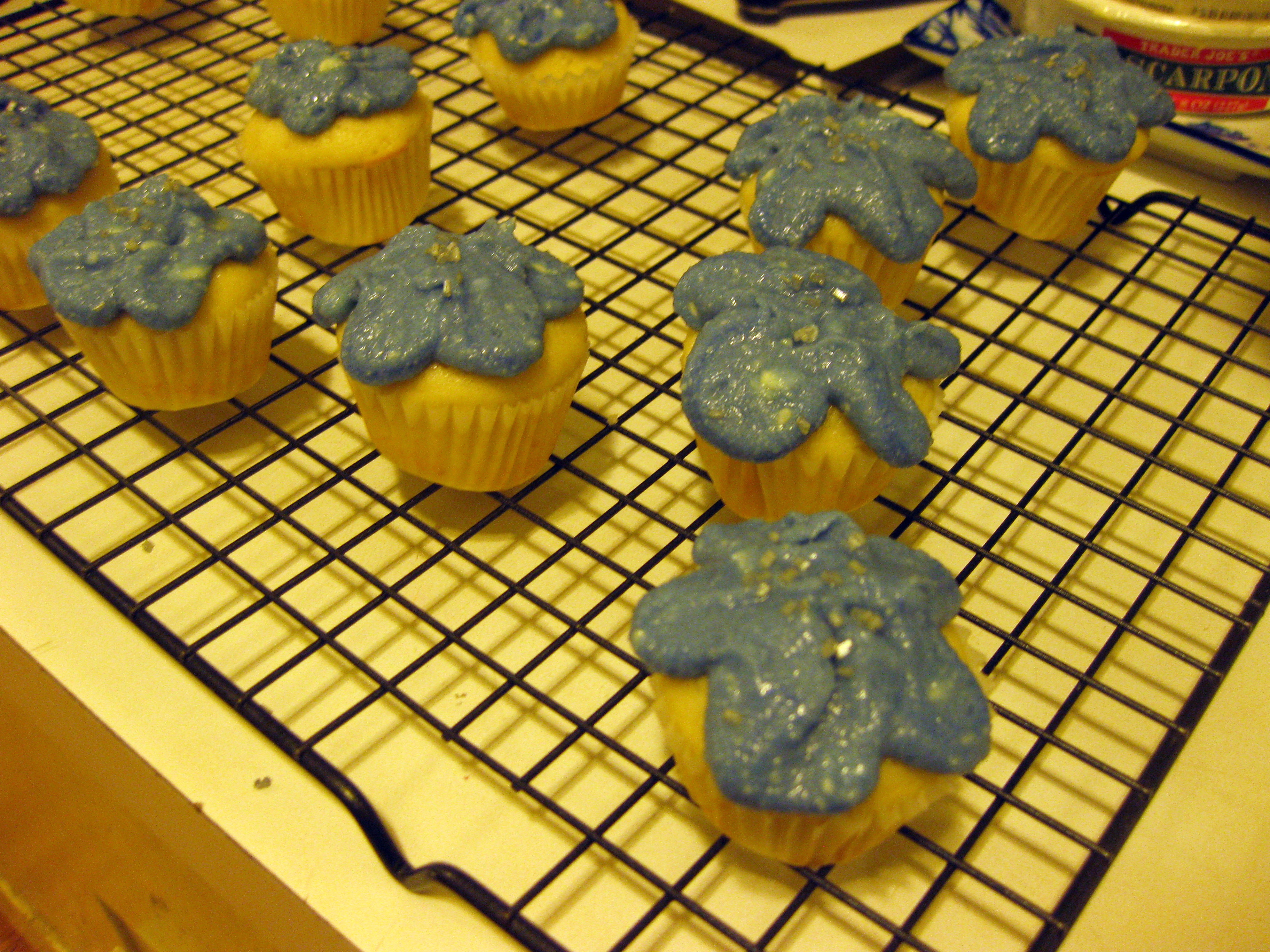
When I mixed up the frosting this time, my butter and mascarpone cheese were not as terrifically soft as they were in my last attempt.  Therefore, they creamed together without the fearful separation I wrote about previously.  The edges and ripples of the swirls were still not as rigid and fluted as they are on bakery cakes, but they were still okay.  And when I went to frost the mini cupcakes, I finally figured out what was going on.

I ran low on frosting as I approached the minis, and because I was now out of mascarpone cheese I plopped a half-softened half-stick of butter into my mixer and let it rip.  Immediately, even though I hadn’t upped the ratio of sugar in the mix, this frosting was different.  The flowers, which I’ll say more about in a minute, actually had fluted edges, and the frosting required more pressure to liberate from my piping bag.  Mascarpone cheese, even when it’s cold, is already softer than butter.  It is never going to result in the same consistency as pure buttercream because it is such a soft cheese.  So while it is fine for simple swirls or covering a cake, it is not great for detail work that requires sharp edges or fine points.

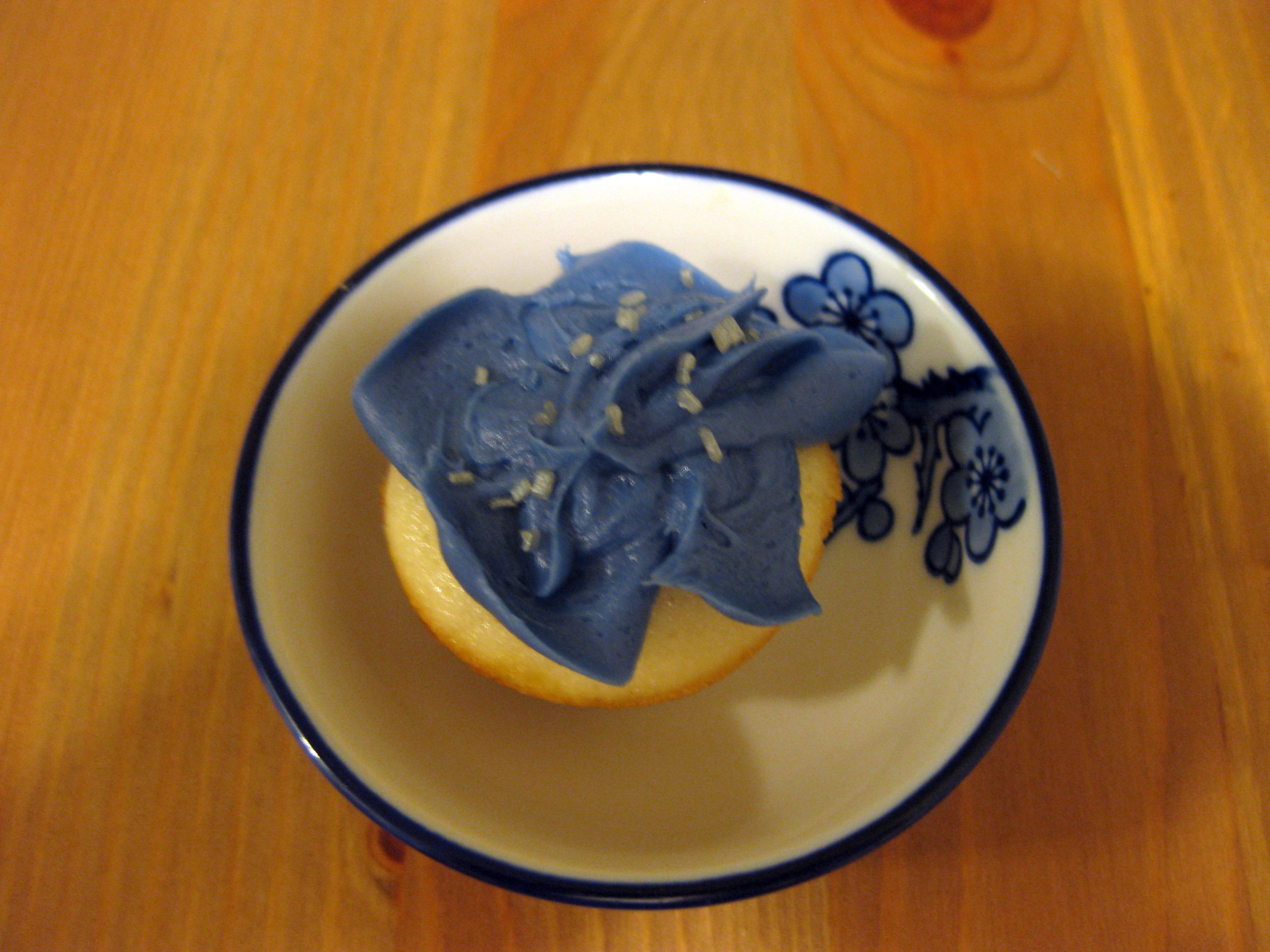
As you can see, these are the best flowers I’ve made so far, thanks mostly to the higher ratio of butter to mascarpone in the frosting.  I still wondered why mine did not seem to ripple out of the petal tip I was using the same way they do in the instructional video I’m using, until I remembered – what an epiphany – that I’m left handed.  If you turn a cupcake to the left while you hold the piping bag in your right hand, you probably need to turn the cupcake to the right if you’re going to hold the piping bag in your left hand.  I realized this minutes too late to apply it this time around, but now I know.  That way the icing will emerge from the piping bag in the same pattern as it would for a right handed person. 

Survey said these were the best version I’d attempted yet by leaps and bounds.  The filling was perfect because it provided the right counterpoint to the achingly sweet frosting and the delicately sugary cake.  The flowers looked like flowers, and the blue sugar I found for the full size cupcakes is a deep enough blue to look sophisticated and adult (previous, lighter versions would bit better on sweets for a baby shower than on wedding cupcakes).

Next month, the challenge is piping.  I’ve purchased some beautiful ivory and gray cupcake wrappers that we’ll be using for the wedding, and I’d like to be able to imitate – if not copy – the leafy designs on them as the piped décor on one of the full sized cakes.  This will give me at least one more trial run with buttercream before the big day, and allow me to prove my theory about the mini cupcake flowers.  It will also, assuming Oregon’s weather gets its act together and remembers it’s Memorial Day weekend, give me a chance to see how the frosting behaves in warmer temperatures.

Fingers metaphorically crossed (it’s too hard to type otherwise)!

The Buttercream Project part 4

Time has come and gone and I am now not only a Bittman truant, but two buttercream posts behind. I’ve got to catch up. But I have an excuse. It looks like this:

Yes, the dissertation is complete. Well, it’s complete in the sense that I’ve distributed it to my committee. Three weeks from now – three weeks from yesterday, actually – I will defend it. But in the meantime, cupcakes!

What I learned this round, which I baked about a month ago:

Cake flour makes the most delicate, light, bakery-style cake. It’s worth the extra cost.

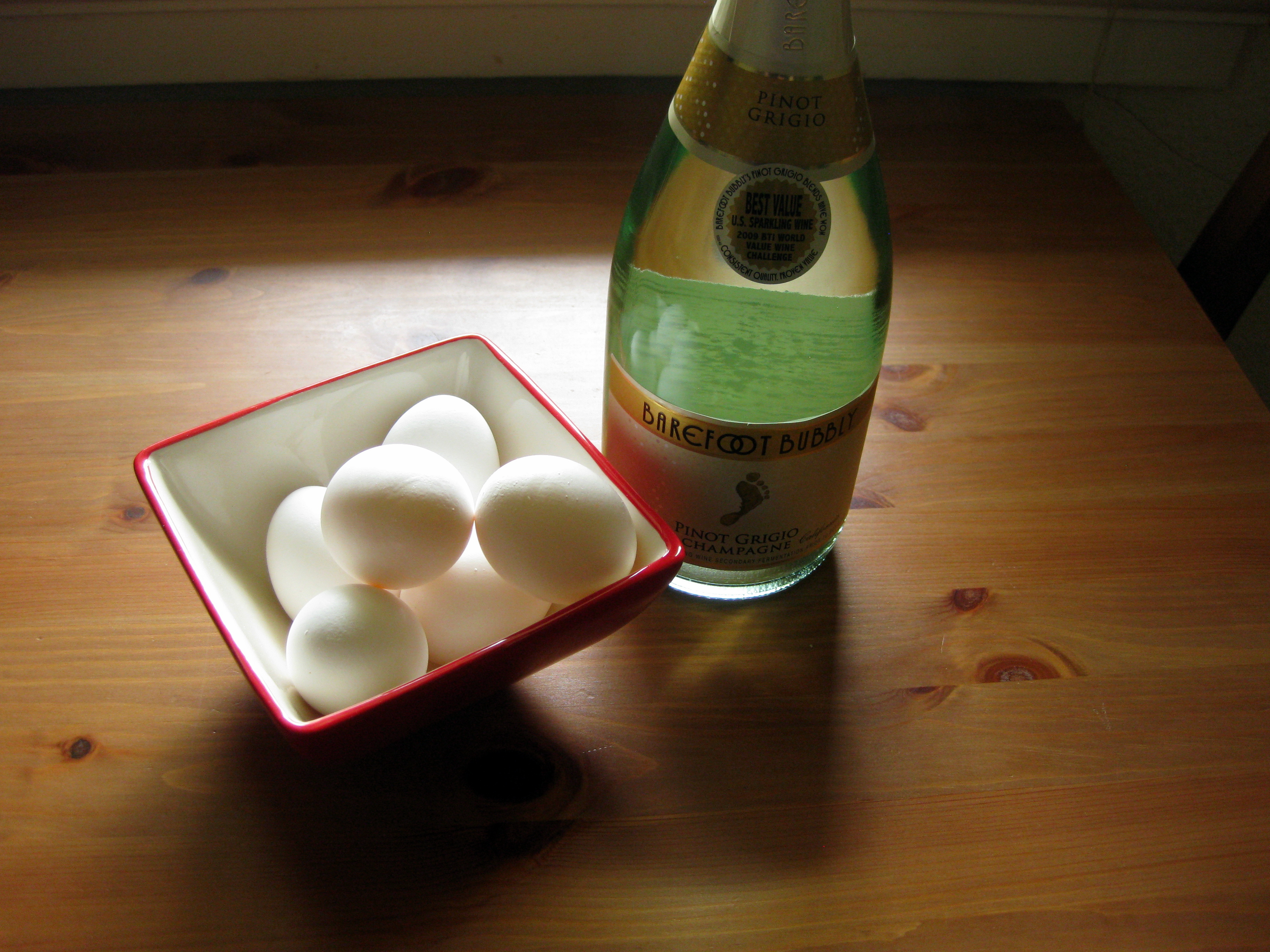
Barefoot’s Pinot Grigio sparkling wine is a good choice for cake; it has a crisp brightness and is strong enough to stand out as a distinct flavor once the cake is cooked.

Buttercream sometimes looks like it’s going to fail, but then you just continue to whip it and it comes together.

This round, I did champagne cake with a mascarpone and apricot jam filling, and mascarpone buttercream. I wanted to try a full sized cake so I could practice getting the frosting nice and smooth.

My assessments: the cake was perfect. It smelled good, it tasted good, it had a moist crumb with a slight squish between the teeth – excellent eating. Cornelli lace all over the top is really quite pretty, but not too twee or too formal.


The filling was… okay. Tasty, but not perfect. I think the jam with the mascarpone added too much richness to an already rich product. Perversely, I think this particular filling would be better with a chocolate cake. It would be a contrast in both color and flavor that simply wasn’t present here. J. and H. liked it, and of course their vote is most important, but I wasn’t satisfied yet.

The buttercream, my nemesis, was almost a disaster. I made a big batch of frosting, because I wanted to frost the full cake and practice making flowers on the mini cupcakes. I bought myself a petal tip from Michael’s and was itching to try it out. This time, it would have to be perfect.

Here’s the thing, though. When you double the amount of fat in a frosting, you also have to double the amount of sugar! As I whipped together a cup of butter and a cup of mascarpone cheese, and as I added cup after cup of powdered sugar, things were not coming together. No, in fact things were starting to separate. A pool of liquid formed as the clumps of butter and cheese turned into strange creamy granules instead of an even mass. I started to fret. I got a little scared.  This was NOT how this round was supposed to go.

And then, logic and revelation triumphed over fear. Maybe the fat was too warm. Yes, it was melting in protest. I stowed it in the fridge for twenty minutes or so.

When I pulled it out, it was better, but still disappointingly far from smooth. And then I remembered: if you have to use 3-4 cups of sugar for 1 cup of butter, you’ll probably have to use 6-8 cups of sugar for 2 cups of fat. And I’m trying to get a PhD…

As I added more sugar, things got a little better. As I added more sugar, it started to smooth out. And then after my final addition, I let the mixer rip for a good minute or two, and magic happened. The frosting smoothed and softened and became this delicious creamy cloud. My lungs heaved relief. The moral of this, apparently, is: if your buttercream isn’t perfect, add more sugar and beat it longer. Whip the resistance right out of it.

Despite the improved texture and the excellent flavor, my frosting attempts were still imperfect. The swirls I put on the full size cupcakes threatened to topple over the delicately curved hills onto which I optimistically piped them. They still looked nice, but the edges and ripples weren’t sharp, and I shoved them into the refrigerator before they had time to break down any further.

The mini cupcake flowers were another fresh learning experience. I tried. Oh I tried. I watched the video twice and followed it exactly, and again, the petals were thick and dull. They looked more flower-like than my previous attempt, but they weren’t the beautiful fluted edges Alice achieves with such ease. Nevertheless, for me, improvement is improvement. Progress counts. This was the best so far, and just needed some minor (I hoped) adjustments to make it wedding-worthy.

It’s a good metaphor for my own progress, really. Even the best work can stand improvement. Let’s hope my revisions, as I note them, are as minor as tweaking a frosting method. Flute the edges. Visit the thesaurus. Adjust a sentence or two. Or five. Add powdered sugar. Enjoy.  Aren’t these things, at their heart, not so different? Let’s hope so.

Spiking your stuffing

The one part of Thanksgiving dinner I refuse to make from scratch is the stuffing.  I don’t know why, but no stuffing has ever lived up to the Stove-top brand blend my mom puts together: one box of turkey stuffing, one box of cornbread stuffing, mixed up and tossed together and then, rather than just stirred into boiling water, baked in a casserole dish for twenty minutes or so right before serving, so the top is crusty and crunchy.  This is easy to do, since it takes my dad at least twenty minutes to get the turkey carved.  This is smart to do because it makes a texture contrast and provides a gravy sponge.  Other stuffing mixes I’ve tasted, and the homemade one I attempted this past year for A., who doesn’t like celery (have you ever tried to find a stuffing mix without celery?  Impossible!), just haven’t measured up.

And then, Bittman.

“26. Chop corn bread into cubes. Sauté cherry tomatoes, scallions and corn kernels in butter or oil. Deglaze the pan with beer, then empty the pan over the corn bread. Bake in an oiled dish or use as stuffing.”

You guys, this was amazing.  And given how you now know I feel about stuffing, that’s saying something.  Amazing.  Here’s what I used:

6 cups (roughly) corn bread cubes, toasted (use your favorite recipe)

4 TB butter

6-8 beefy green onions

1 pint red cherry tomatoes, rinsed and dried

1 cup corn, fresh or frozen (if frozen, defrost it first)

Salt and pepper

12 oz. beer (I used Drifter)

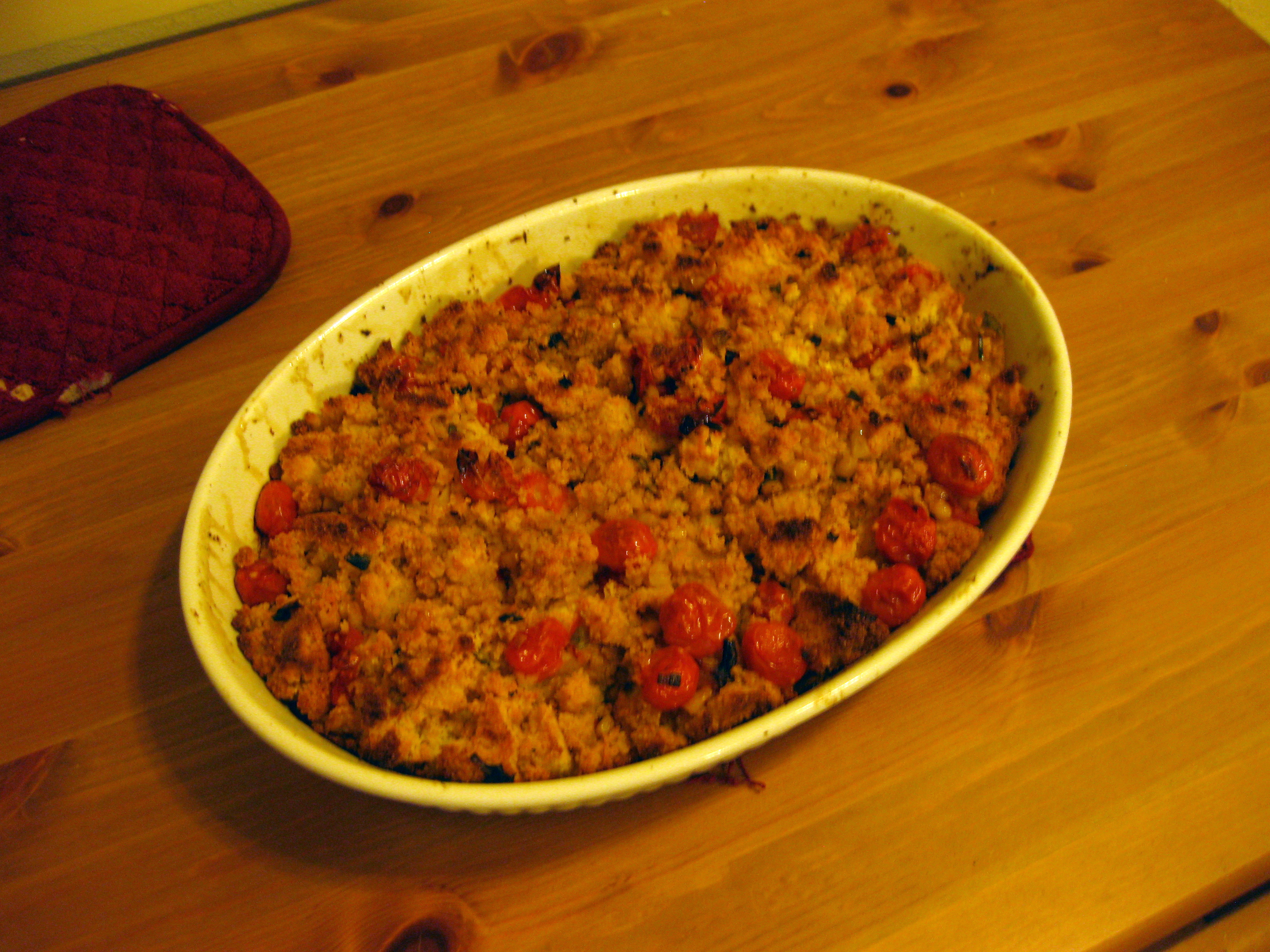
I made a pan of cornbread from my favorite recipe in a larger pan than usual; I thought this would result in a slightly drier bread, so it wouldn’t become mushy when the liquid was poured over it.  The cornbread was still pretty moist and springy, though, so after it had cooled for a while I cubed it, scuffed it around in the pan a bit to separate the clinging pieces, and tossed it back in the oven at 400F for fifteen minutes or so to get some toasty edges and dark golden spots on it, then set it aside to cool completely.  This worked beautifully and I’d recommend it, especially if your cornbread is moist and cakey.

While the oven was occupied by an herb-stuffed chicken (again, I know.  I can’t help it), I melted the butter in a skillet over medium heat and sliced the green onions, using the white and green portions.  I tossed these little rings into the sizzling butter along with the corn, and agitated them gently.  When the onions were soft and the corn just beginning to caramelize, I added the cherry tomatoes and seasoned the whole skillet with salt and pepper and, on a whim, a few shakes of garlic powder.

I turned the heat up to medium high for just a few minutes until the cherry tomatoes started to burst through their skins, spilling pulp into the mix, and the corn had browned delightfully, leaving the kitchen smelling like summer.

I then switched off the heat and poured in a full bottle of beer, nutty, yeasty, and brown (Drifter is a pale ale, so it has some body and depth – I wouldn’t go any lighter than pale ale, and might in fact prefer something darker: a brown ale like Newcastle, or even a porter if it’s not too strong).  The aroma changed from summer to fall harvest in an instant as the beer fizzed over the vegetables.

After scraping the bottom of the skillet gently with a spatula to remove any persistent browned bits, I poured the whole steaming bubbling mass over my pan of cornbread cubes and tossed gently to distribute the liquid evenly.  Then I stowed the pan in the oven: 350F for 25-30 minutes until the top is deeply golden and just crunchy.

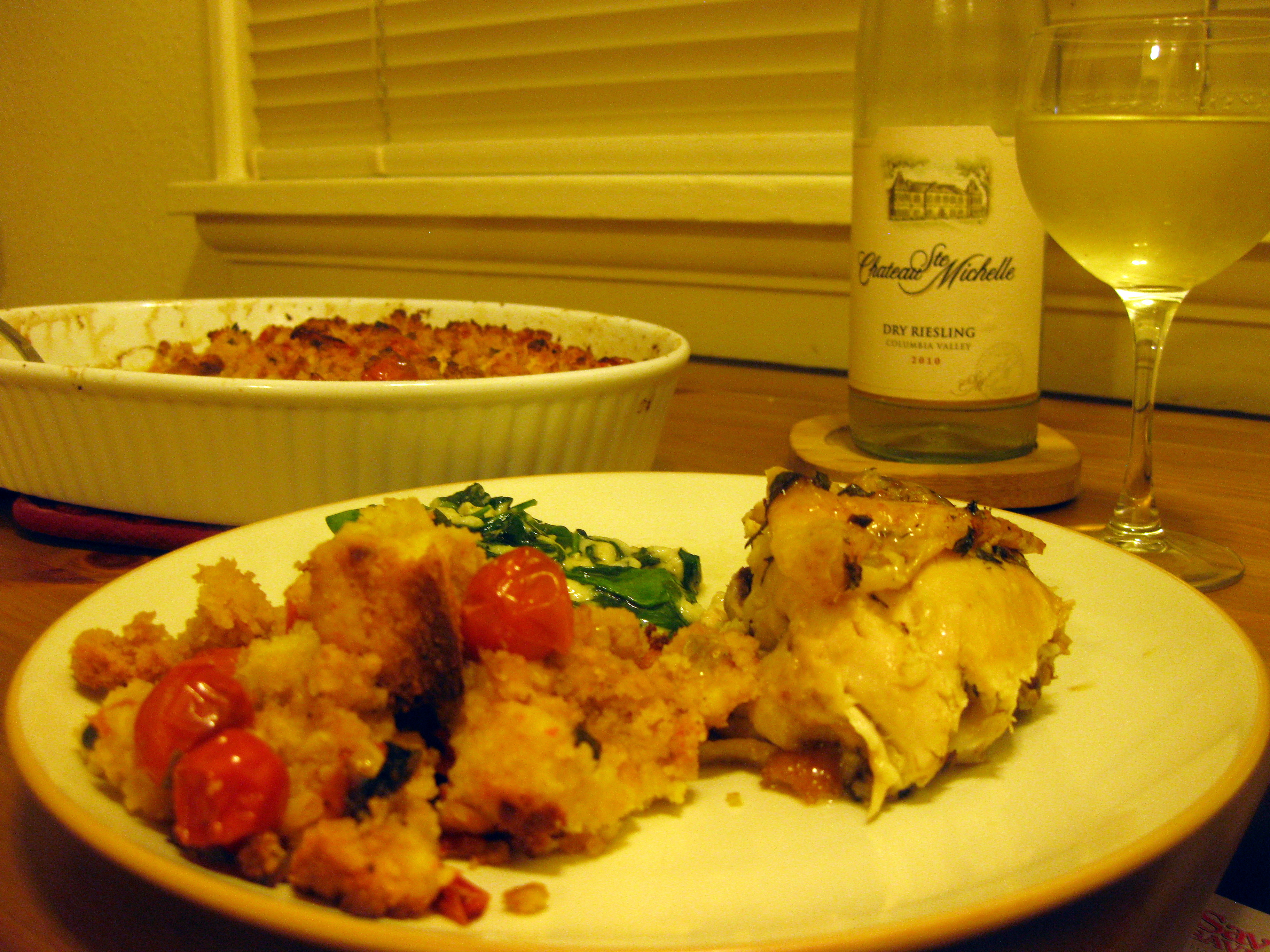
We ate this with roasted chicken and creamed spinach.  Vegetarians shield your eyes, but the chicken just collapsed so beautifully across my carving board that I felt I had to show you:

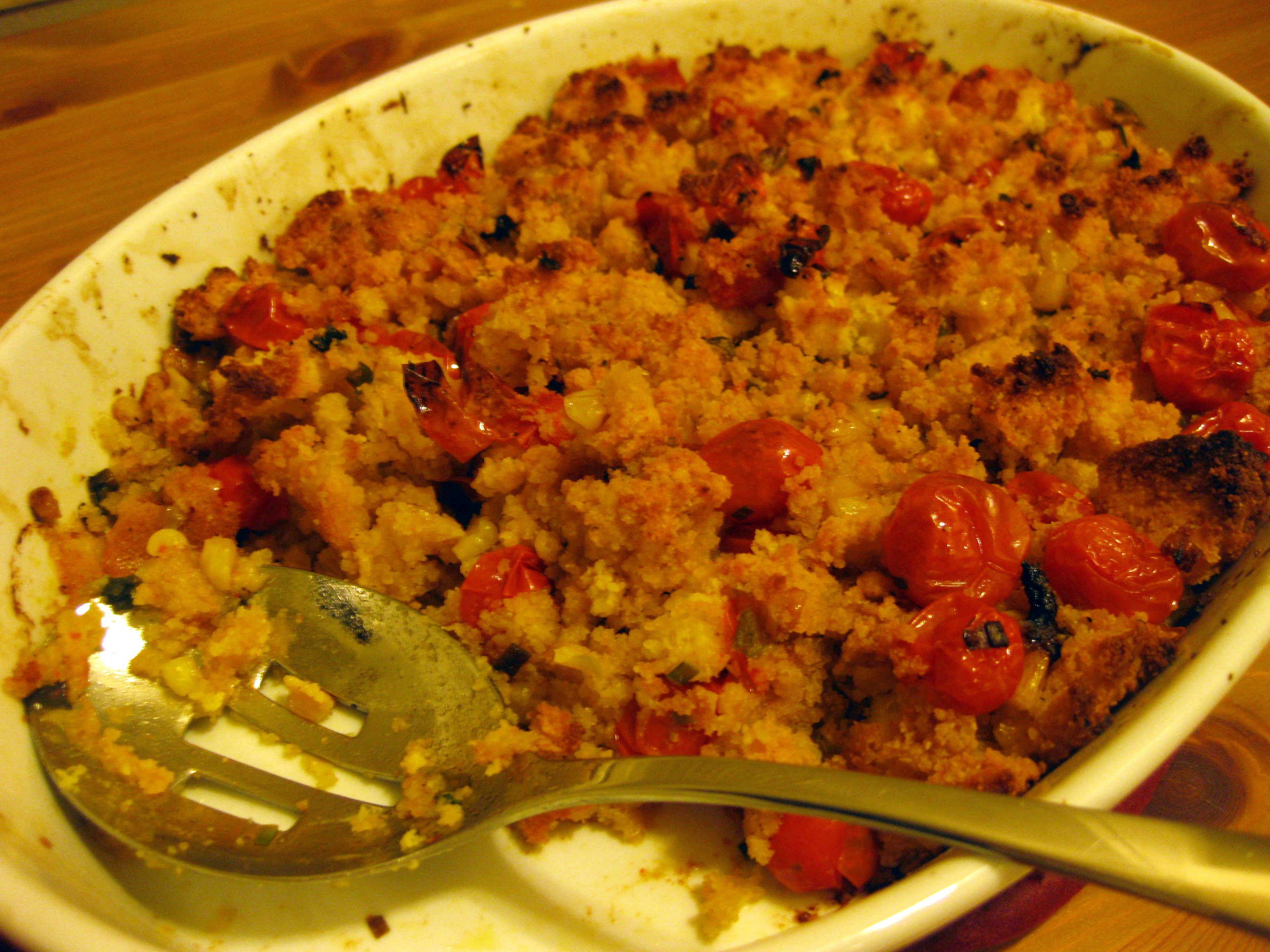
But the stuffing!  The stuffing was incredible.  The cornbread soaked up the beer, and the sweetness of the bread plus the sourness of the ale created this yeasty glory I couldn’t stop eating.  And I don’t like beer.  It was just such a perfect liquid for this dish, contributing just the right amount of malty bitterness.  The tomatoes got richer and sweeter in the oven, as did the corn kernels, and they partnered with the green onions to make such a good accompaniment to the cornbread that I’m almost tempted to add them into the batter in my next pan.  Or maybe into a compound butter to spread on top.  That would be better, texture-wise.  Green onions, cherry tomatoes, and corn: three musketeers. 

This stuffing was gone in two days.  With only two of us eating.  It was that good.  If you’re in the Northwest, where Spring is shunning us, make this now while you still need your oven to keep warm.  Accompanying some baked sweet potatoes and leafy greens, this becomes a vegetarian meal.  If you use oil instead of butter and have a good egg replacement, it could be vegan.  If your cornbread is free of wheat flour and you use gluten-free beer, it could be gluten-free as well.  However you make it, make it.  This one is too good not to try.

The Buttercream Project 3

My favorite weekends always turn out to be the ones that revolve around cooking.  You know the ones I mean.  You have a dinner party, or a potluck, or an afternoon on the porch surrounded by cookbooks, or you watch a marathon of FoodNetwork shows while almost absent-mindedly spooning one of your favorite indulgences into your mouth…

I wouldn’t know what that’s like…

Seriously, though, I am suddenly having one of those weekends.  Our friend Sh. is sharing a pulled pork dinner with us tonight, so by 9am (which felt like 8am, cursed Daylight Savings…) I was standing at the kitchen counter, pouring ginger ale and Jack Daniels whiskey atop 4 pounds of pork butt in my slow cooker, and deciding whether it needed anything besides salt and pepper to round out the flavors (I decided on a big chunk of fresh ginger and a few shakes of Worcestershire sauce).  Now, I’m sitting in the kitchen babysitting a pot of polenta, which I’ll cook, spread, and chill today to be cut into squares, pan-fried, and eaten later this week, and keeping a wandering eye on some cornbread, which we’ll have tonight with the pulled pork.

And yet this post isn’t about any of those things.  Whether you believe it or not after that extended tangential introduction, this post is about buttercream.  Again. 

I’ve completed my third buttercream experiment, and I must report mixed success.  I decided this time I’d better try out the cake recipe I’ll be using for the wedding in cupcake form so I could start nailing down baking times.  On a whim, I picked up some cake flour, which I’ve never used before.  This was for texture: often my cupcakes, if they are not chocolate, end up with a suspiciously muffin-like consistency, and I didn’t want that for these babies.  I also picked up some mascarpone cheese to continue the experiment in de-sweetening the frosting.

The baking process involved a lot of checking the cupcakes with a trembling toothpick, hoping for the barest of moist crumbs, not a completely clean tester.  I have found the completely clean tester is a recipe for overcooked baked goods, especially when it’s something very tender and delicate like cupcakes, because the cake continues to cook for a while as it sits in its tin on the cooling rack.  Tough cupcakes would not do.  Fortunately for me, they cooked up the color of pale cream and sported perfectly slight, perfectly shaped domes. They were pillowy tender.  They smelled good too – sweet and soft with the barest hint of floral fruitiness from the sparkling wine I used.

As they cooled, I started the buttercream process.  I wasn’t nervous at all this time – hadn’t my previous attempt come out smooth and creamy and lusciously perfect?  This time, I was golden.

This time, unfortunately, my kitchen was about 59 degrees Fahrenheit and, despite having left the butter out for hours and hours, it wasn’t the same squashy softness it had been last time.  The mascarpone cheese I decided to use was fresh from the fridge, since it was already soft enough that it didn’t occur to me having it at room temperature would make a difference.

It does.

Here’s what happened.  I whipped together a cup of butter and a cup of mascarpone cheese.  I sifted in about 3 cups of powdered sugar, a slight sprinkle of salt, and then trickled in a couple tablespoons of whole milk and a splash of vanilla (I can’t find champagne extract anywhere besides Amazon.com, where it costs upwards of $12 for a teensy bottle.  Needless to say I haven’t bitten that bullet).

Immediately I knew this wasn’t going to be perfect.  Already I could see tiny little clumps of butter, rechilled by the cold cheese, and tiny lumps of sugar, courtesy of a hasty and careless sifting session.  I pressed on regardless, deciding in the moment that this experiment was about taste, not texture.  Let’s get the taste right first, I told myself, to avoid the tumble into hysterical depression the blue poo cake had wrought.

So I loaded up a piping bag with my new fancy-pants metal star tip and went to work on the full sized cupcakes.  In the process I got enough frosting on my fingers to be able to taste, and I have to say I was incredibly pleased.  The mascarpone cheese added another layer of velvet and creaminess, and because it is not sweet to begin with, there wasn’t as much overwhelming saccharine powdered sugar taste to the finished product.  The touch of salt probably helped with that too.  It was just incredibly rich and moist and lovely.

The texture, on the other hand, sucked.  Well, that’s not fair.  It wasn’t ideal.  It was slightly grainy, and the star tip’s sharp edges combined with my not-exactly-quite-as-smooth-as-I’d-wanted icing produced rough crumples on my swirls of frosting rather than delicate demure rosettes.

Hasty, thoughtless, and stubborn, I pressed on to my next experiment.  I’d found this the previous month: a video tutorial about making beautiful blue flowers on mini cupcakes, and I wanted to surprise my bride by testing these out.  I considered, as I dripped blue food coloring into the remaining buttercream, rewatching the video.  And then I talked myself out of it.  I’d watched it twice, I remembered basically what she’d said to do, and she made it look abysmally simple.  I’m marginally artistic.  How hard could it be? 

For starters, the frosting was now looking a little wet.  Terrified of a repeat blue poo scenario, I added more powdered sugar.  But now I was in a hurry, because I had girlfriends coming over for a TV night and I wanted to serve them beautiful, frosted cupcakes (notice I didn’t say beautifully frosted cupcakes.  I was trying to be realistic).  So I didn’t sift the sugar.

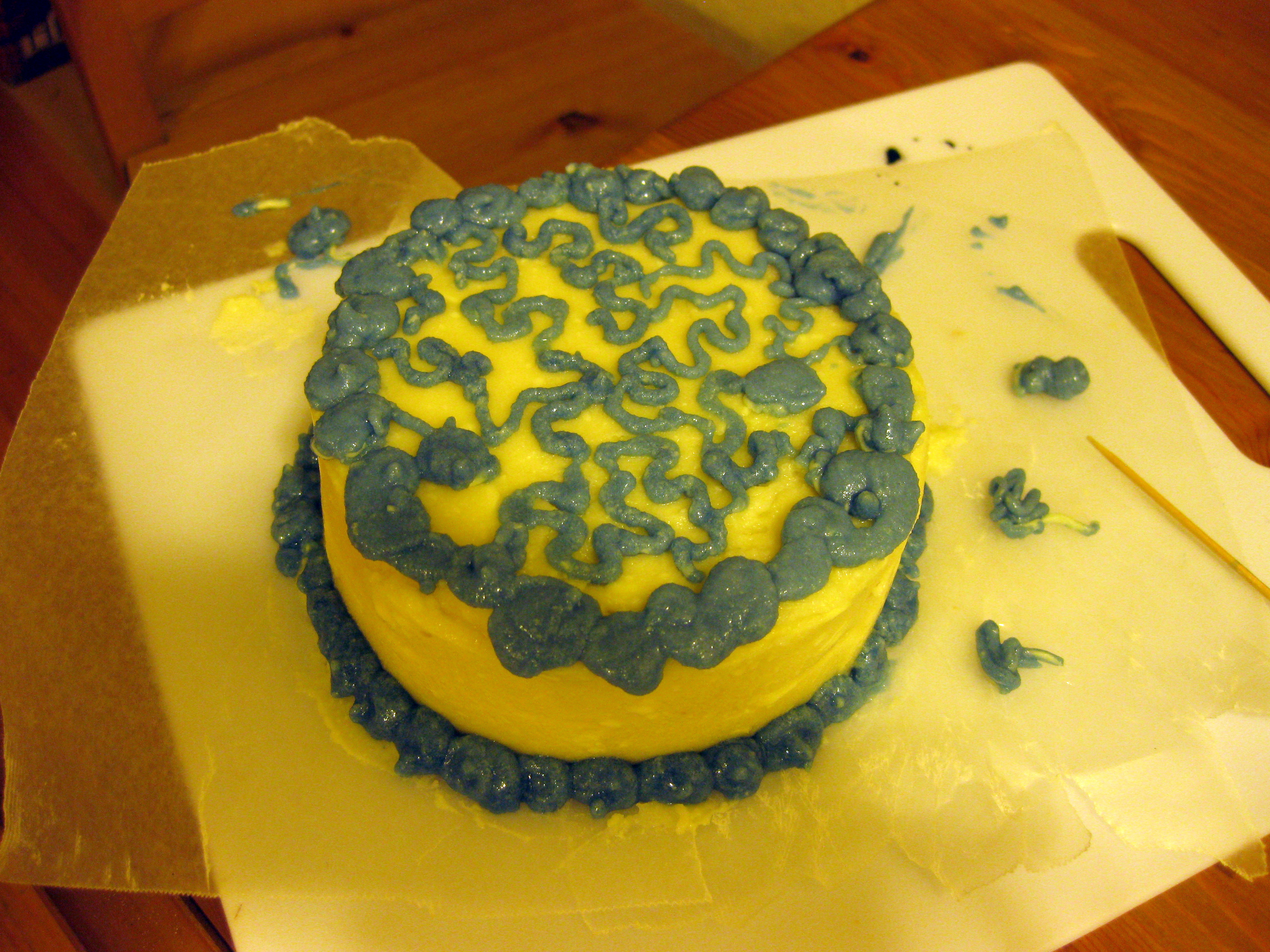
This, as you might expect, resulted in more lumps.  But I was not to be discouraged.  I slapped some icing into a bag with a tip that looked similar to the one in the video tutorial, and started trying to make flower petals.  I made circular blobs.  There were no delicate curling edges, no gentle petal shapes, and the lumps of powdered sugar I’d stubbornly ignored made the frosting emerge from the piping tip unevenly.  I ended up with deformed starfish in a lovely cornflower-esque shade on the mini cupcakes, and a spotty lace pattern surrounded by blue blobs on the tiny taster cake I’d made for the bride and groom.  (It was supposed to be cornelli lace, but when hunks of cold butter in your frosting burst out through the piping tip, all bets are off.)  I did, however, glean a valuable tip for frosting a cake from the Barefoot Contessa: once you have your layer covered, dip your frosting spatula in very hot water and run it gently over the sides and top surface of the cake.  The hot water lightly melts the very outer molecules of butter and sugar and solders them together while smoothing them out, resulting in a perfectly level layer of frosting.  I tried this out to great success.

But back to the cupcakes.  Undaunted by their aesthetically challenged appearance, I sprinkled them with silver-gray sprinkles and presented them proudly to my friends, who pronounced them praiseworthy masterpieces.  I privately thought them too kind, but it is gratifying to have good friends who support your stubborn goofy screw-ups and prevent you from being too hard on yourself.

It was only the next day that I rewatched the tutorial video and saw that not only was a using the wrong tip to pipe these petals, but I was holding it the wrong way.  This gave me hope.  Next time, next time when butter and mascarpone are at the same temperature, when it’s warmer in the kitchen, when a fresh bag of powdered sugar and careful sifting result in a perfectly velvet texture, and when I acquire a rose petal icing tip, I will be on my way.  The flowers won’t be perfect, but they will actually resemble flowers.  Next time. 

I keep ending these posts by talking about what I will do next time.  Upon reflection, it seems dangerous to be counting always on next time in this project.  There will come a time when “next time” no longer works, and on that day in July I’d better get everything right.  What if the butter is too soft?  What if I over whip it?  What if there are lumps?

Fortunately I still have a few next times to lean on.