Finish line

The problem with cramming for final exams – as many of my students were doing only a few weeks ago – is that you end up trying to process too much information, and just as quickly as you learn new things, the old things you thought you knew start sliding away. That’s the glory and the power of writing. Once it’s on the page, it’s solid. No matter how many holiday dinners you eat (I’m onto my third or fourth at this point), those words will still tell you exactly what you did and (sometimes) how you felt about it.

I feel like I’m cramming for my final. Last week, before the holiday, before the family time, before the outpouring of memories and laughter and swallowed tears of all kinds and barking and yelling and joy, I made three Bittmans in a desperate bid to stay on top of the project.

42. Brussels Sprout Sliders: Trim and halve large brussels sprouts, toss with olive oil and roast at 400 degrees until tender but not mushy. Using the brussels sprout halves as you would hamburger buns, sandwich them around a piece of crispy bacon or ham, maybe a little caramelized onion, and a dab of whole grain mustard. Keep everything in place with toothpicks.”

I always intended to make this one for a Halloween party. It seemed fitting: for some, brussels sprouts are a frightening, disdained vegetable. But this new perspective on them makes them fun and perhaps even appetizing to those disbelievers who see them only as a bitter waterlogged grenade of disappointment. But I never did. So they became an appetizer for two:

6 brussels sprouts, trimmed and halved

2 strips bacon, cut into eight even pieces (you’ll use six for the brussels. Eat the other two, or share with a tall, handsome somebody who shows up in the kitchen when the smell becomes too enticing to ignore)

dab (maybe 1 tsp total?) whole grain mustard

Preheat the oven to 400F.

Line a small baking dish (I used a 9” cake pan) with aluminum foil and drizzle the foil with olive oil. Brush or rub the olive oil into an even layer so every millimeter of foil is covered.

Set the sprouts, cut side down, on the oiled foil, spacing them evenly so none are touching. This will ensure even roasting rather than steaming.

Food%2520Blog%25202011-2013-0204

Roast for 15 minutes, until the cut edges are browned and just crisp. Using tongs, flip over each sprout so they teeter on their curved sides. Roast for another 15 minutes.

While sprouts are roasting, cook the bacon. Mine was already cooked – saved from another porky occasion – so during the last five minutes of sprout roasting I added the bacon pieces to the pan to heat them up a little.

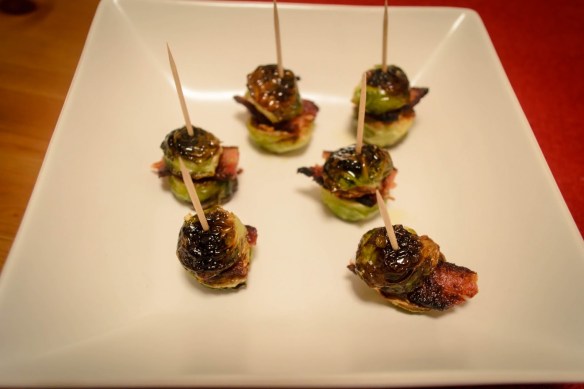
When the sprouts are browned and lightly tender, set them aside until they are cool enough to handle. As soon as you can bear to touch them, add a tiny spread of mustard across one cut edge, seat the bacon atop it, and place another sprout half on top to complete the sandwich. Drive a toothpick through the whole thing and serve as an hors d’oeuvre.
Food%2520Blog%25202011-2013-0205

We gobbled these down like we hadn’t eaten in weeks. They were delightful and I highly recommend them as a party item: crisp bacon, zesty mustard, and the nutty crunchy slight bitterness of roasted brussels sprouts, all collected together in one perfect bite. Perhaps a New Year’s Eve treat to help the hours pass.

Food%2520Blog%25202011-2013-0210


Soup and bread seemed like a good meal to follow our sprouts.

82. Cornmeal Flatbread with Onion and Sage: Mix 1 cup cornmeal with 1 teaspoon salt; slowly whisk in 1½ cups water. Cover and let sit for an hour (or up to 12 hours in the refrigerator). Put ¼ cup olive oil in a 12-inch ovenproof skillet along with a thinly sliced red onion; stir. Heat the skillet in a 400-degree oven for a few minutes, then stir and pour in the batter. Bake at 375 degrees until the flatbread is crisp at the edges and releases easily from the pan, about 45 minutes.”

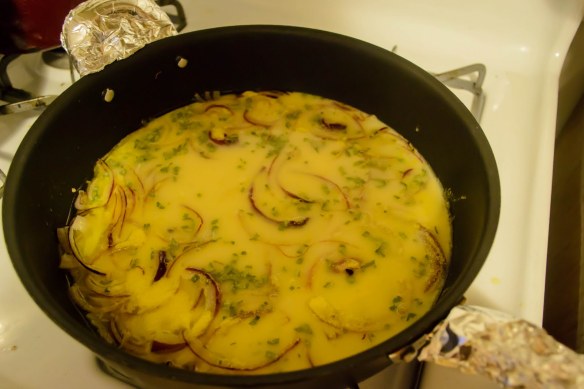
I followed these directions fairly exactly, with the exception that I used only half an onion. The olive oil and onion went into the oven for five minutes at 400F, at which point the onion slices were sizzling and the oil was shimmering beautifully.

Bittman neglects to note where and when to add the sage, so I stirred a tablespoon of finely chopped fresh sage into the batter just before adding it to the skillet.
Food%2520Blog%25202011-2013-0203

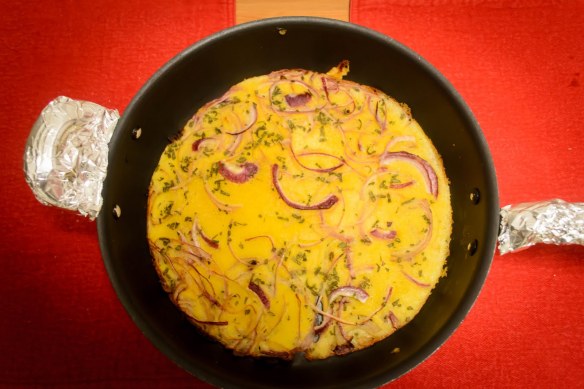
This concoction baked for 45 minutes, until it was set, the onions were crisp-tender, and the whole thing loosened easily from the skillet and slid almost gracefully onto a serving tray.
Food%2520Blog%25202011-2013-0212

We cut large wedges and tasted. It was unlike any other bread I’ve come across – more like baked squares of polenta than anything else, which made sense when I stopped and thought about it. Were I renaming this dish, I think I would call it Polenta Pizza. It was well oiled and spongy in texture, squishing pleasingly between our teeth and driving us back for additional tastes. N. wasn’t sure he liked it at first, but then he went back for a second slice and then a third. When I ribbed him about this, he said he was still deciding what he really thought, and needed more samples to truly make up his mind.

Food%2520Blog%25202011-2013-0214

This odd little bread course could easily be dunked in saucers of warmed marinara sauce, or sprinkled with mozzarella or parmesan for a pleasing salty bite. Though the onions and sage were good, you could probably saute almost anything in that skillet before adding the batter: sausage, peppers, mushrooms… anything you’d put on a pizza.

A decadent appetizer and a well-oiled pizza/bread need a sober, sensible kind of soup to balance them out.

19. Saute chopped onions, garlic, celery and carrots in olive oil, then add chopped tomatoes (boxed are fine) with their juice, lentils and stock or water to cover. When everything is soft, add a squeeze of lemon juice or a splash of red wine vinegar. Garnish with parsley.”

Since we were leaving town the next day, I didn’t want huge quantities. (This still made enough for four, but I froze the leftovers so nothing was lost)

½ red onion (left from the flatbread, so convenient), diced

4-6 small cloves garlic, minced

1/3 cup each celery and carrots, sliced

¾ cup lentils

13.5 oz can petite diced tomatoes

2½ cups chicken broth (or vegetable broth, or water)

1 TB lemon juice

2 TB fresh, finely chopped parsley

salt and pepper to taste

I heated 2 TB olive oil over medium heat, then tossed in the onions to sweat for a minute or two before adding the garlic and the other vegetables. When the onions were translucent and tender, I added the tomatoes, lentils, and broth and turned the heat up to medium high until the whole pot came to a boil.

Once boiling, I gave it a healthy stir and then turned the heat down so the soup would just simmer, letting the lentils soften gently and the vegetables tenderize.

Simmer for at least 35 minutes, then taste the lentils to see if they are tender enough for your taste. We like them soft but not mushy, with minimal resistance but still able to hold their shape.

Just before serving, squeeze in the lemon juice, stir gently, and dip into serving bowls. Scatter the surface with a grassy sprinkle of parsley.

Food%2520Blog%25202011-2013-0215

We liked this, though it wasn’t the best lentil soup I’ve ever had. The flavors were enticing and the lemon juice made it a bright, rather than heavy, soup. The problem with it was that I like my lentil soup more like a stew or a chili. The brightness of the lemon made the shower of shredded pepperjack cheese I was considering adding seem extraneous and out of place, and I tend to get crotchety when denied cheese. But alongside the flatbread and the richness of the brussels sprouts, it was hearty but didn’t weigh us down.

2012 is fading like the last sheen of daylight across the hills in winter. 2013 charges toward us, all mystery and sharp promise. I thought about cheating and saying I was done; these three dishes are the final three, I made it, all boxes are checked, all questions answered, funtoosh, kaput (extra points if you can name my source!), but I just can’t. I’m too close. This final exam is too important. This resolution needs to be one I keep. I have two dishes left. I have two days, one of which will be spent driving from the Sierra Nevada foothills where N.’s parents live back to Los Angeles and my little house. I hope I’m going to make it. The finish line is in sight. Now I just have to stagger across it.
Cold Comfort

Tragedy, when it strikes, whether it be national and sweeping or personal and held tight against you – and I have experienced both this week – plunges you into strangeness.  There is shock, there is disbelief, there are weighty moments of contemplation, there is knowledge of helplessness.  There is the feeling of being alone.

When I feel the chill and the incomprehensible wounding of tragedy, I want my belly full of warmth and familiarity and comfort.  And while it may seem trivial or even juvenile to want to write about food in the aftermath of gut-twisting pain, I think there is an important connection to be made.  As Shauna said shortly after Hurricane Sandy, one of the ways food is important is that it brings us together.  Her post moved me deeply, and made me feel that it’s not trivial or disrespectful to feel the need to talk about humble little food in the aftermath of disaster.  The loneliness and helplessness of pain can be beaten back by community.  When we come together, we are able to offer one another comfort, even if it is slight, and the metaphorical warmth of our togetherness can often eclipse physical heat.  Food bridges that gap.  It offers a physical warming, yes, in that it nurtures us and fills us and helps us carry on as individuals.  But it also links us – we eat together, we break bread, and in eating together we share ourselves with each other in meaningful ways, even if we didn’t realize that sharing took place.  It binds us in communities, however small, and having fellows in a bad situation, whether they are fellow mourners or whether they are comforters and supporters, gives us the opportunity for light and warmth, if we are able to feel that connection.

So when I talk about food today, I want to talk about food that warms us.  I want the fullness of soup and the richness of dessert.  I want the clinking of spoons and the sprinkling of spice that stabilizes and relaxes and envelopes us.  I want us to be able to feel the warmth of love which, to me, is most easily expressed through a transfer of food: if I feed you, it’s a good bet I care about you.  It’s a small thing, and you may think it’s a silly thing or an unimportant thing, but it is perhaps the only thing I can do in this moment to reach across the feeling-less blips of the net-scape and offer you warmth.  But I mean it.  Take this warmth.

“95. Indian Pudding: Combine 3 cups of milk and 1/3 cup of cornmeal in a saucepan over medium heat. Bring to a simmer; stir in 1/3 cup of molasses, 1 tablespoon sugar, ¼ teaspoon salt, 1 teaspoon ginger and ½ teaspoon cinnamon and simmer, stirring occasionally, until thick. Add 1 tablespoon of butter and stir until melted. Pour pudding into buttered baking dish and bake at 300 degrees for about 2 hours, uncovered, until golden brown and set in the middle. Serve with ice cream or whipped cream.

Food Blog 2011-2013-0169

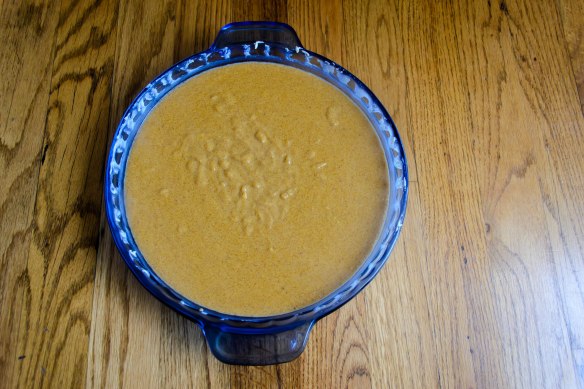
Stirred sternly, this mixture took on the texture and the color of pumpkin pie filling.  It began to spit and burble like a pot of grits (which, in a somewhat removed way, it was), and I decided it had done its time.  Into the oven with it.

I think I overbaked this.  Just the barest firmness across the top, like a good cheesecake, is what is needed.  Mine was stiffly set.  I also think I chose the wrong cooking vessel.  I used a glass pie dish.  Serviceable, sturdy, but too wide.  The pudding came out an odd inch or so thick.  A deep mass of wobbly richness would have been preferable.

Food Blog 2011-2013-0172

Despite these fallbacks, it was still very, very good.  Perhaps it was the color and the texture, but it really did remind me of crustless pumpkin pie.  The cornmeal and milk became a custard, and the rich deepness of molasses and autumnal spices left me wanting to douse this with a healthy dollop of Reddi-whip.  I settled for vanilla ice cream instead.

Food Blog 2011-2013-0174

“18. Hot and Sour Vegetable Soup: Sauté chopped onions and garlic in vegetable oil until soft. Add chopped or shredded carrots, cabbage, and daikon or turnip, frozen corn, chopped boxed tomatoes with their juice and stock to cover; bring to a boil. Simmer for 15 minutes, then finish with about a tablespoon of rice wine vinegar per 2 cups of soup and loads of black pepper.”

Soup warms the belly like very little else.  This one, with the copious quantities of black pepper and the inevitable sour burn of the rice vinegar, promised a cauldron of comfort.  Quantities listed here make enough for two large bowls – quite enough for a deep December lunch.

2 TB vegetable oilFood Blog 2011-2013-0179

¼ large onion, diced

4 cloves garlic, minced

1 carrot

½ medium turnip

8 napa cabbage leaves

½ cup frozen corn kernels

14.5 oz can of petite diced tomatoes

2-3 cups chicken or vegetable broth

2 TB rice vinegar

½ tsp salt

½ pepper to start – add more to your liking

Heat the vegetable oil over medium heat and sauté the onion and garlic for a few minutes, until the onions just begin to pick up color.

Meanwhile (or beforehand, if you are not speedy with your vegetable prep), peel the carrot and turnip.  Once you have disposed of the scraps, continue to peel the carrot into thin strips with your vegetable peeler.  Cut the pile of ribbons in half or in quarters to create bite-sized pieces.

Cut the turnip in half from root to tip, then crosswise into thin slices.  Julienne each thin slice so you have slim matchstick pieces.

Stack the napa cabbage leaves, then roll into a thick cigar and slice as thinly as possible.

Add the vegetables to the onion and garlic.

Add the corn kernels and the broth and simmer the whole pot for 15-20 minutes, or until all vegetables are tender and everything is warmed through.

Add the rice vinegar, salt, and pepper, stir gently, and serve.

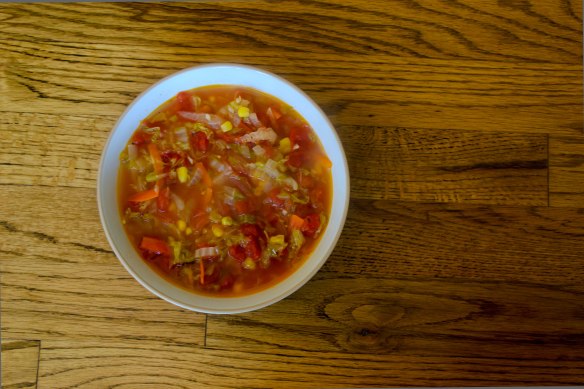
I loved everything about this soup except the tomatoes.  They weren’t a bad addition, there were just too many of them.  Were I making this again, I might decrease the quantity, or just drain the can and add only the liquid for the color and acidity.  The strings of carrot and turnip kept a minimal bite, and the combination of vinegar and pepper was near perfect.  The puckering sourness played against and contributed to the bland crunch of the vegetables, and alongside a hastily prepared hunk of garlic toast, this was a satisfying lunch on a chill day: it was heat, and comfort, where both were needed.

Food Blog 2011-2013-0178

Be well, all.

Chatterbox

I’ve just begun rereading Neil Gaiman and Terry Pratchett’s genius collaboration Good Omens for perhaps the sixth or seventh time.  One of the characters introduced early in the novel is a Satanic nun named Sister Mary Loquacious from the Chattering Order of St. Beryl.  In looking back through some recent posts, I’ve noticed myself falling a bit on the loquacious side, with posts extending perhaps a bit longer than you’d like for a casual evening read.  So today, with three Bittmans to report on, I’m going to try to keep this brief.

54. Cook onion, curry powder and chopped ginger in oil until onion is soft; meanwhile, steam cauliflower florets until nearly tender. Add cauliflower to onion mixture, along with raisins; cover and cook until the cauliflower softens.

Two of my most hated food items as a child were cauliflower and curry.  Cauliflower was drab and slightly bitter – worthless unless smothered in sharp cheese sauce, and even then a bit suspect.  Curry powder was musty and unpleasant, and the two of them together sound like one of my youthful nightmares.  I kept this selection on the list because N. loves the flavor of curry.  But I knew that I would have to doctor up Bittman’s procedure to give this dish even a fighting chance.

1 head cauliflower

1 tsp curry powder, divided

½ tsp salt

½ tsp black pepper

generous glugs of olive oil (quantity will depend upon the size of your cauliflower)

¼ of a red onion

¼ cup golden raisins

2 TB fresh ginger, grated (this is easiest to do while it is mostly frozen; you keep your ginger in the freezer, don’t you?)

Brush a layer of olive oil on each of two cookie sheets and preheat the oven to 400F.

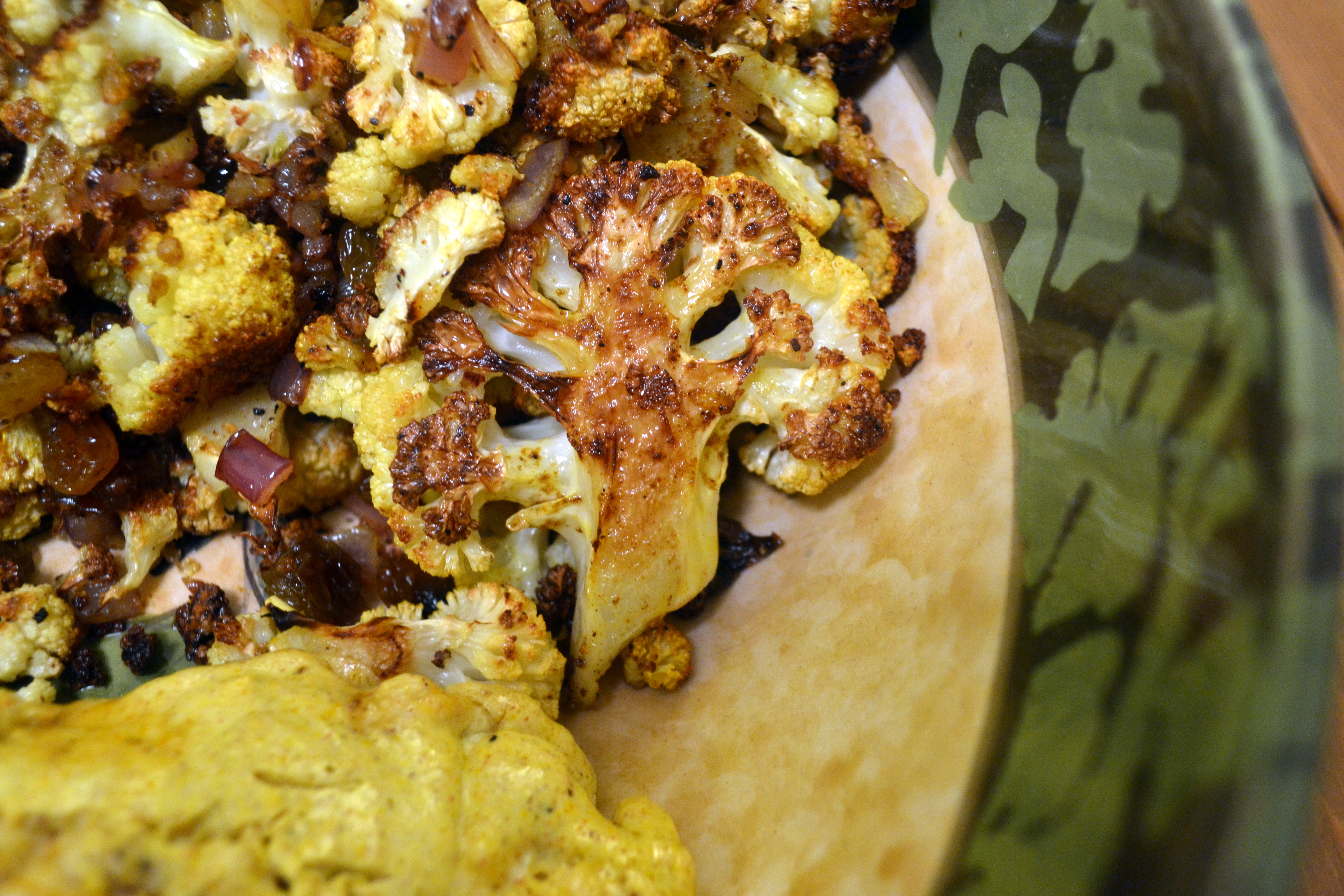
Core the cauliflower and slice it across into flat steaks of about ½ inch thick.  Some will collapse into florets.  That’s okay, but ideally you want nice long, horizontal pieces of cauliflower.  They look like flattened sprigs of Queen Anne’s Lace.  Toss the cauliflower with ½ tsp of the curry, salt, pepper, and more olive oil, then place on the tray in a single layer.  Don’t crowd them too much – the more space they have, the better they will brown.  Roast for 40 minutes, pausing at the 20 minute mark to flip each piece.

While the cauliflower roasts and caramelizes and browns, sauté the red onion in a little more olive oil.  When it begins to brown, toss in the raisins, the ginger, and the other ½ tsp of curry powder.  Cook together for another 2-3 minutes until the raisins plump and the curry aroma mellows a bit.

When the cauliflower is just tender and darkly golden, take it out of the oven and toss it with the onion and raisin mixture.

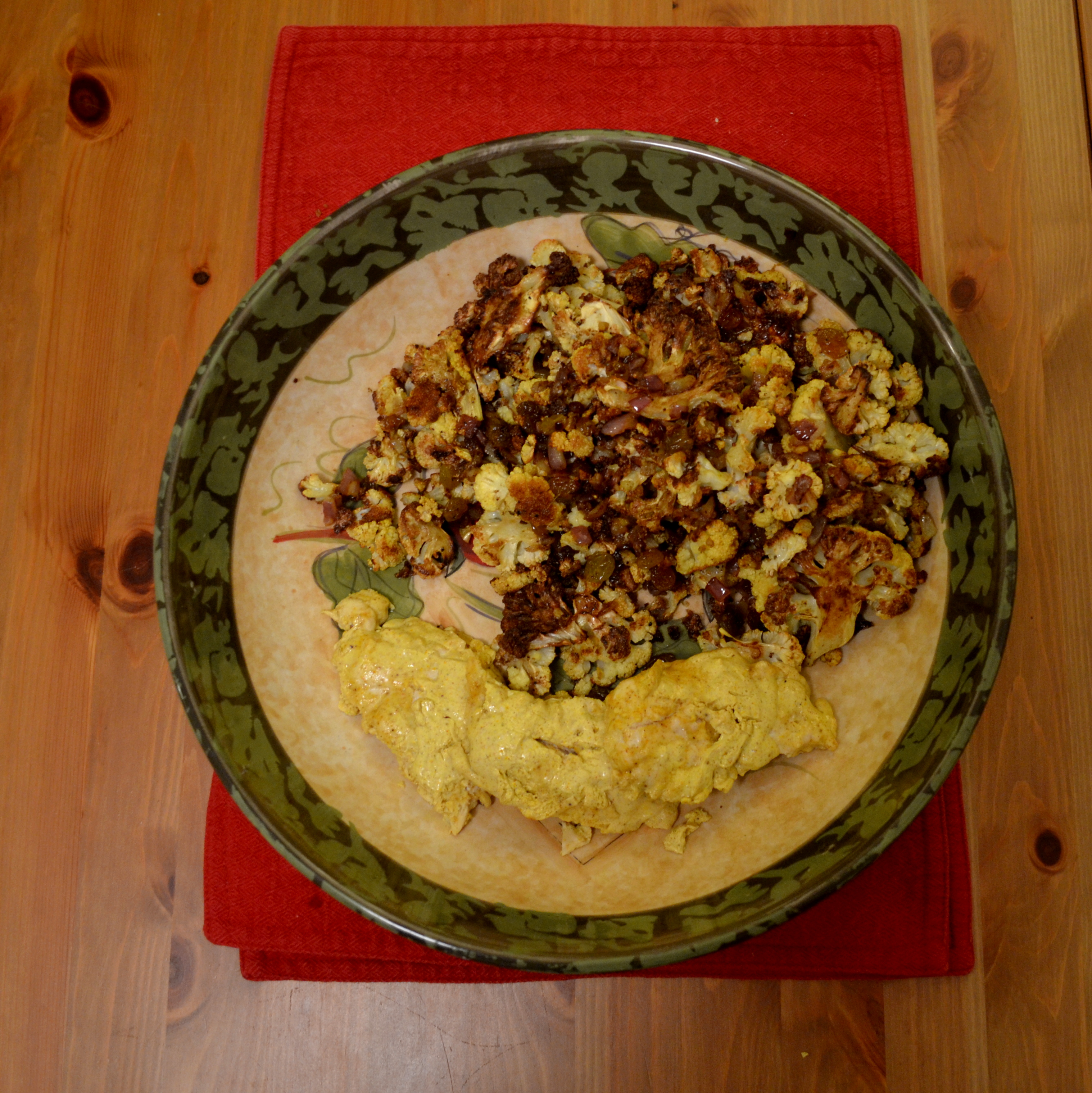
We had ours alongside some roasted chicken breasts I’d marinated in yogurt and garam masala.  It was delightful – if you favor a strong curry flavor, add more to both the cauliflower and the onions.  I was happy to have just a mild hint of earthy spiciness, and the unexpected sweetness of the raisins cut even this dankness in a very pleasant way.

16. Sauté equal amounts chopped, peeled apples and onions in butter until soft. Add stock or water to cover, then simmer for 10 minutes. Cool and puree. Serve sprinkled with Stilton or other blue cheese.

We weren’t sure about this one.  Nevertheless, we bravely decided to make just a small portion and see what happened.  These quantities will serve two.

1 medium apple, peeled and cored

1 medium onion

salt and pepper to taste

2 TB butter

1 ½ cups chicken stock

blue cheese

Melt the butter in a small pot over medium heat.  When it foams, it’s ready.

Meanwhile, dice the apple and onion into small chunks.  You want equal sized piles – we probably ended up with just over a cup of each.  Add them to the pot and cook over medium, stirring occasionally, for 10-15 minutes.  You want softening and tenderizing, not aggressive browning.

When the apples are tender and the onions soft and translucent, add the broth and seasoning (though we didn’t make any additions, some thyme or sage might be very nice here – try 1 tsp of finely minced fresh herbs) and simmer for 10 minutes.

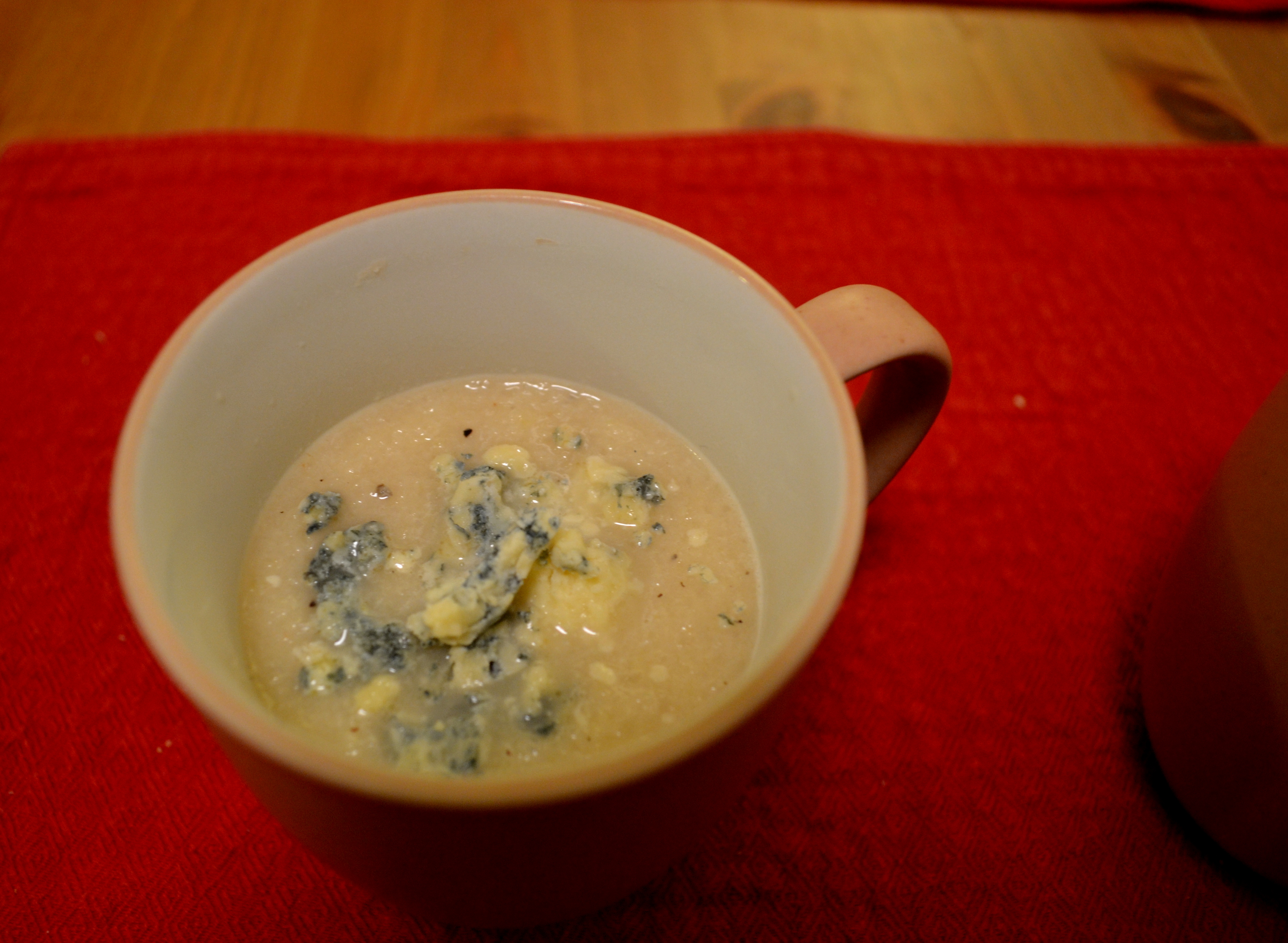
Remove from heat and cool slightly, then puree and serve with 1-2 TB blue or gorgonzola cheese sprinkled on top.  We had a nice blue stilton.

It wasn’t that we didn’t like this, it was that it seemed odd as a soup.  It was slightly reminiscent of a butternut squash soup, but the apples were slightly sweeter than a squash, and the combination of their sweetness with the sharpness of the onion made this seem like an applesauce with too many ingredients.  Left chunkier, this might be nice draped over a roasted pork tenderloin – a meat that goes nicely with both sweet and sharper, savory flavors.  It might also be a good base for a butternut squash soup – the one additional player in this game could be the additional complexity it might have needed.


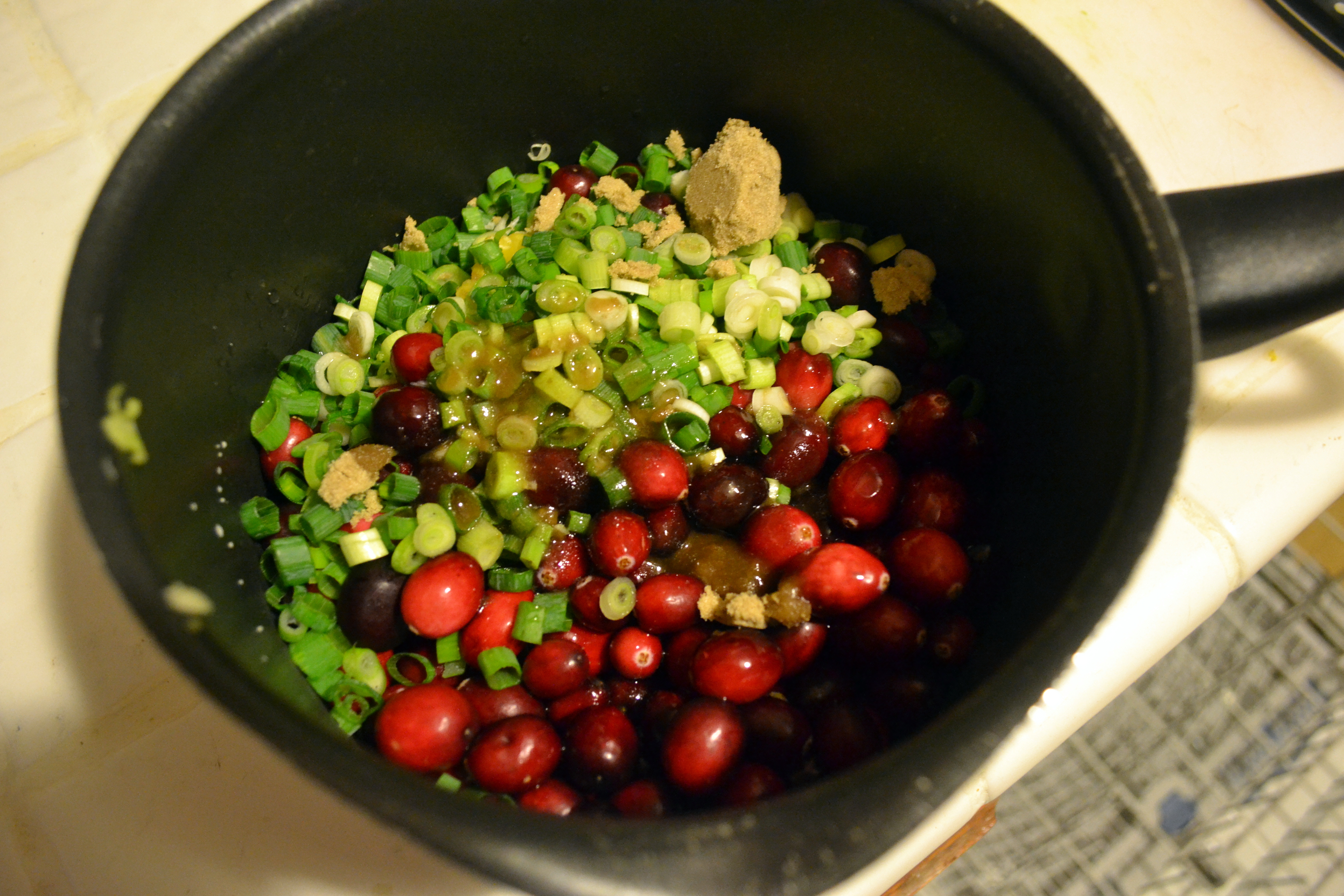
6. Cranberry-Corn Sauce: Cook a bag of fresh cranberries with about a cup of corn kernels, some chopped scallions, ¼ cup brown sugar (or to taste) and a splash of water, just until thick.

Our third Bittman this week was part of a pre-Thanksgiving Thanksgiving dinner.  When you grow up with a set collection of dishes that come to equate to this holiday, it can be hard to make a change.  When N. started having Thanksgiving dinner with my family, he missed his mashed potatoes and green bean casserole.  So I try, in the weeks that surround the holiday, to make up for these omissions. I make several smaller dinners featuring the dishes that don’t quite fit onto our holiday menu.  This seemed like the perfect side – not traditional enough for our Thanksgiving table, but satisfying in the mean time.

1 bag cranberries

1 cup fresh or frozen corn

3 green onions, thinly sliced

¼ cup brown sugar

¼ cup water

I tossed the cranberries, corn, water, and brown sugar together in a saucepan and set them over medium heat.  I added the green onions at this point too, but were I making this again I would add them later – the 15-20 minute simmering time resulted in a slightly adulterated color, and the fresh greenness would be so much nicer.  I advise adding them during the last five minutes of cooking time.

I let this simmer for about 20 minutes, until most of the cranberries had popped and the whole pot was a sticky, almost syrupy texture.  I let them cool off the heat with the pot uncovered for a few minutes, both because I like the flavor of cranberry sauce better the cooler it is, and because I wanted to let it gel up a bit further.

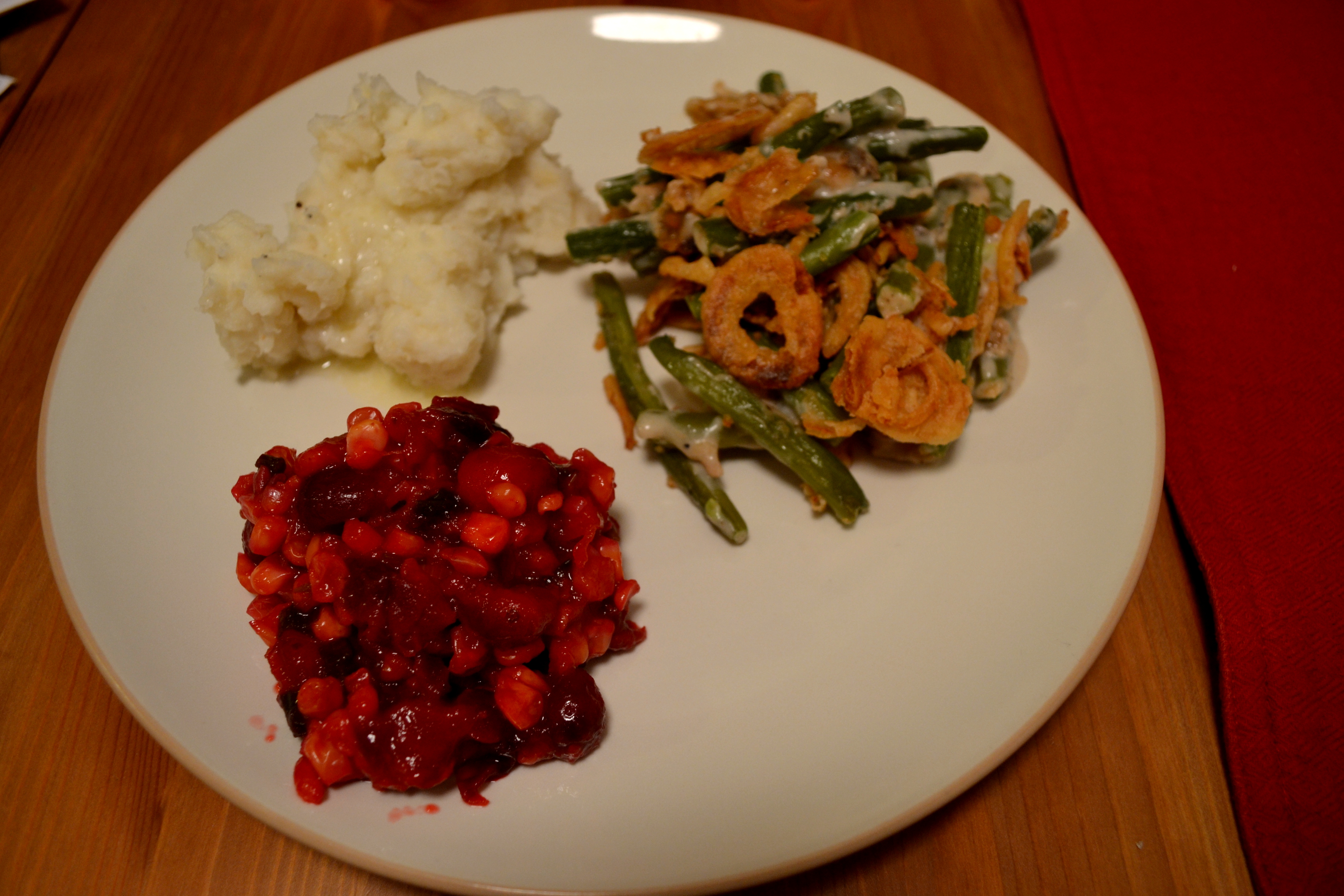
These weren’t as sweet as your typical cranberry sauce.  At least, they were not as sugary sweet.  The corn added a beautiful vegetal sweetness that seemed at once the perfect fit and a strange accompaniment.  We talked through this dish as we ate it, appreciating the maple overtones of the brown sugar and the tender crunch of the sweet corn, but thrown off slightly by the same qualities.  What we finally decided, as we sampled second helpings, was that they were a delicious side dish, but they didn’t feel like Thanksgiving.  Since the rest of the meal (garlic mashed potatoes and the old standard green bean casserole, slathered with cream of mushroom soup and the salty, salty crunch of french fried onions) was so traditional, having this difference, even in its subtlety, felt wrong.  If you’re a stickler for tradition, this cranberry dish would have a better chance as a chutney for grilled pork or maybe even lamb.

Next week is the big feast.  Oddly (odd because the entire Bittman list was conceived for this single day), I had some trouble figuring out where to fit his ideas in.  I’ve come up with a pair of selections to try out, and I will report back.  In the mean time, what dishes will grace your menu on Thursday?

Vacation fried

Nothing says vacation like fried food.  Of course, for me, nothing says vacation like fried-food-I-didn’t-have-to-fry-myself-that-comes-in-achingly-bad-for-the-environment-but-when-I’m-on-vacation-I-might-not-care-styrofoam-containers. So at the Farmers’ Market near my parents’ home in California’s East Bay Area, I fought with my compunction about collecting a lunch made at an event celebrating freshness and organics and the products of the earth in a container that will last longer than my own body will. Compunction lost.

Because inside that container were two items: a chicken tamale and a spinach and cheese empanada.  I bought them from a stand advertising Panamanian food – the boy and the man in charge webbed within unexplained netting. The tamale was largely unremarkable; steamed in a banana leaf instead of a corn husk, filled generously with a mixture of moist, shredded chicken and kick-less tomato based sauce, I ate it with enjoyment but not gusto. The empanada was a different story.

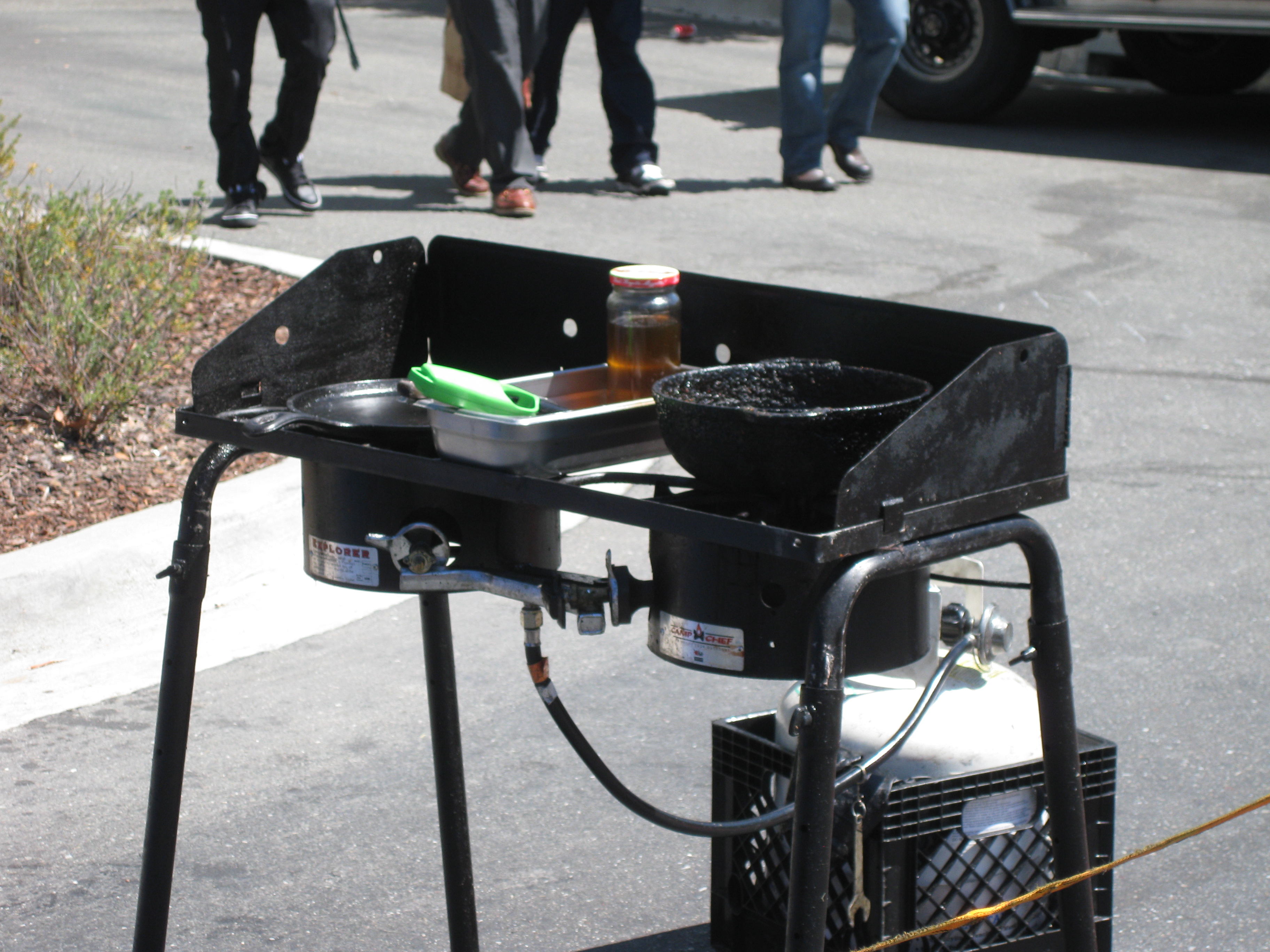
When my mom and I approached this stand, it was barely 11am. While the tamales had been pre-steamed and just needed to be heated up to be ready to eat, the empanadas did not yet exist in finished form. As I ordered, the older man doing the cooking ambled toward a small outdoor fryer consisting of a coal-black bowl full of questionable oil and turned on the gas.

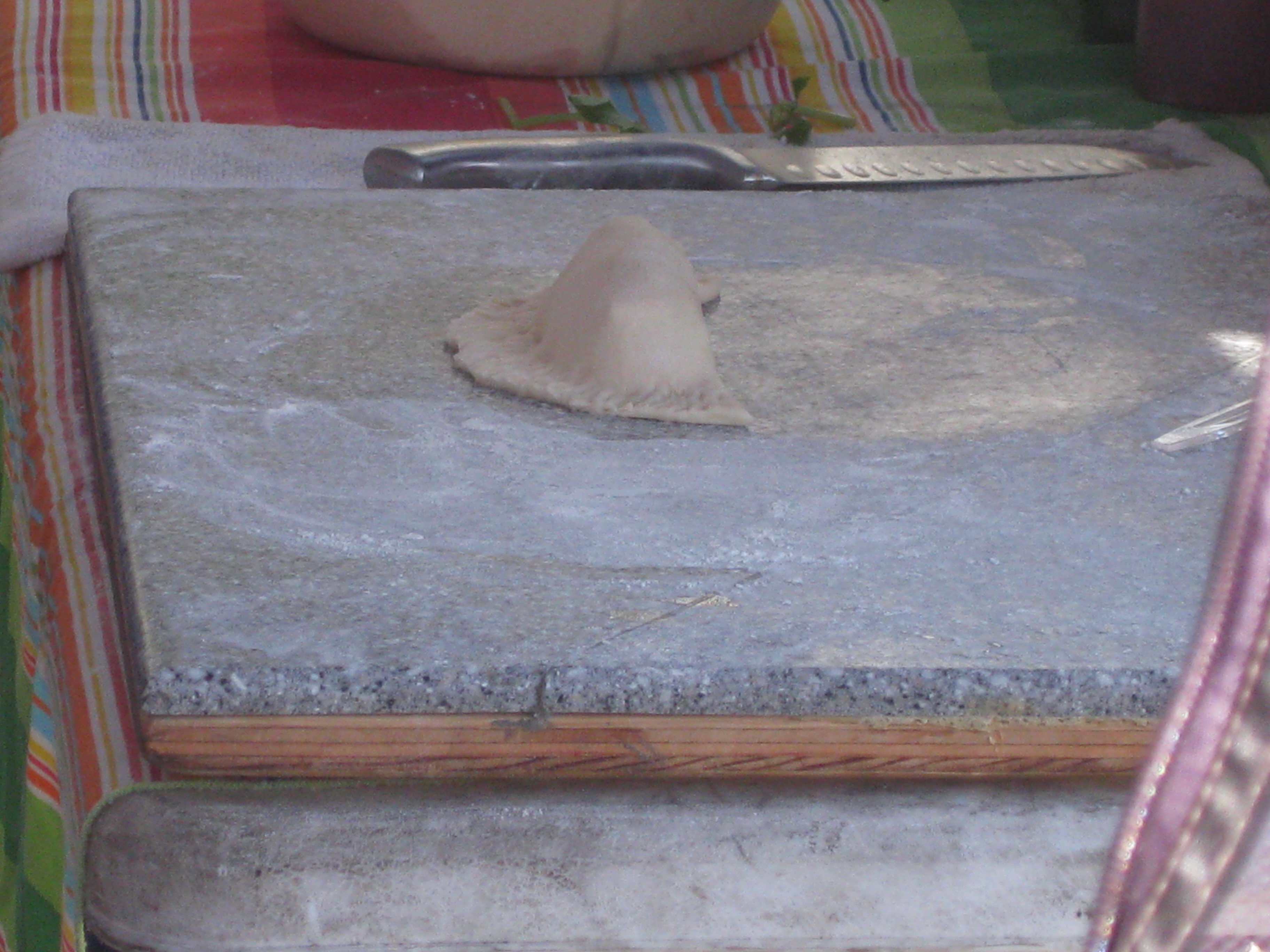
He ambled back to the netted tent and pulled a ball of smooth, elastic dough from under plasticwrap and, easily and lovingly, rolled it into a six or seven inch circle with almost no extra flour (if you’ve read about my troubles with dough, you understand why this amazed and alarmed me). He layered on some spinach and a big chunk of cheese, dribbled egg wash, then casually folded the dough, pressing the edges first with floured fingers and then with the tines of a fork, leaving even indentations all around the outside to seal in the goodness.

As he carried my lunch over to the warming oil, he told us there were two ways to make an empanada: baked or fried. Then he added, “but really, there’s only one way,” and we agreed that fried is always better. Tipping the little pastry into its bath and carefully manipulating its floating orientation with his fingers, he said he likes to fry his empanadas in oil rather than lard, because lard makes the exterior too dark too fast.

My mom was surprised by the time and low temperature this fry required. The oil did not sizzle and leap furiously, but simmered warmly around the edges of the pastry. This was necessary, we were told, because time was needed to thoroughly heat the filling and cook the dough all the way through. The empanada, with help from our new friend’s careful, gloved prods, swam its way around the oil bath into a state of deep golden crispness before extraction and enclosure within baneful Styrofoam.

Too many minutes later, we were home and I was investigating my purchase more personally. The dough, fried so carefully and attentively, parted with a raspy flaky tear between my teeth, quickly revealing moist, almost dense chewiness. The cheese had cooled only slightly and now maintained all the delightful elasticity of a taffy-pull. But it was the pastry I couldn’t get enough of. Because it was stuffed, the central, puffed area containing the spinach and cheese was a slightly different texture than the crisp pressed edges – softer, chewier. The edges, almost completely crisp, still had a slight interior tenderness to squash pleasingly between eager teeth. The closest comparison I can imagine, though I’ve never eaten it, would be fried pie dough.


I dispatched the whole thing in a time embarrassingly less than five minutes. I tried to savor, I really did. But isn’t that just like vacation? No matter what you do, it’s gone too quickly…

Spiking your stuffing

The one part of Thanksgiving dinner I refuse to make from scratch is the stuffing.  I don’t know why, but no stuffing has ever lived up to the Stove-top brand blend my mom puts together: one box of turkey stuffing, one box of cornbread stuffing, mixed up and tossed together and then, rather than just stirred into boiling water, baked in a casserole dish for twenty minutes or so right before serving, so the top is crusty and crunchy.  This is easy to do, since it takes my dad at least twenty minutes to get the turkey carved.  This is smart to do because it makes a texture contrast and provides a gravy sponge.  Other stuffing mixes I’ve tasted, and the homemade one I attempted this past year for A., who doesn’t like celery (have you ever tried to find a stuffing mix without celery?  Impossible!), just haven’t measured up.

And then, Bittman.

“26. Chop corn bread into cubes. Sauté cherry tomatoes, scallions and corn kernels in butter or oil. Deglaze the pan with beer, then empty the pan over the corn bread. Bake in an oiled dish or use as stuffing.”

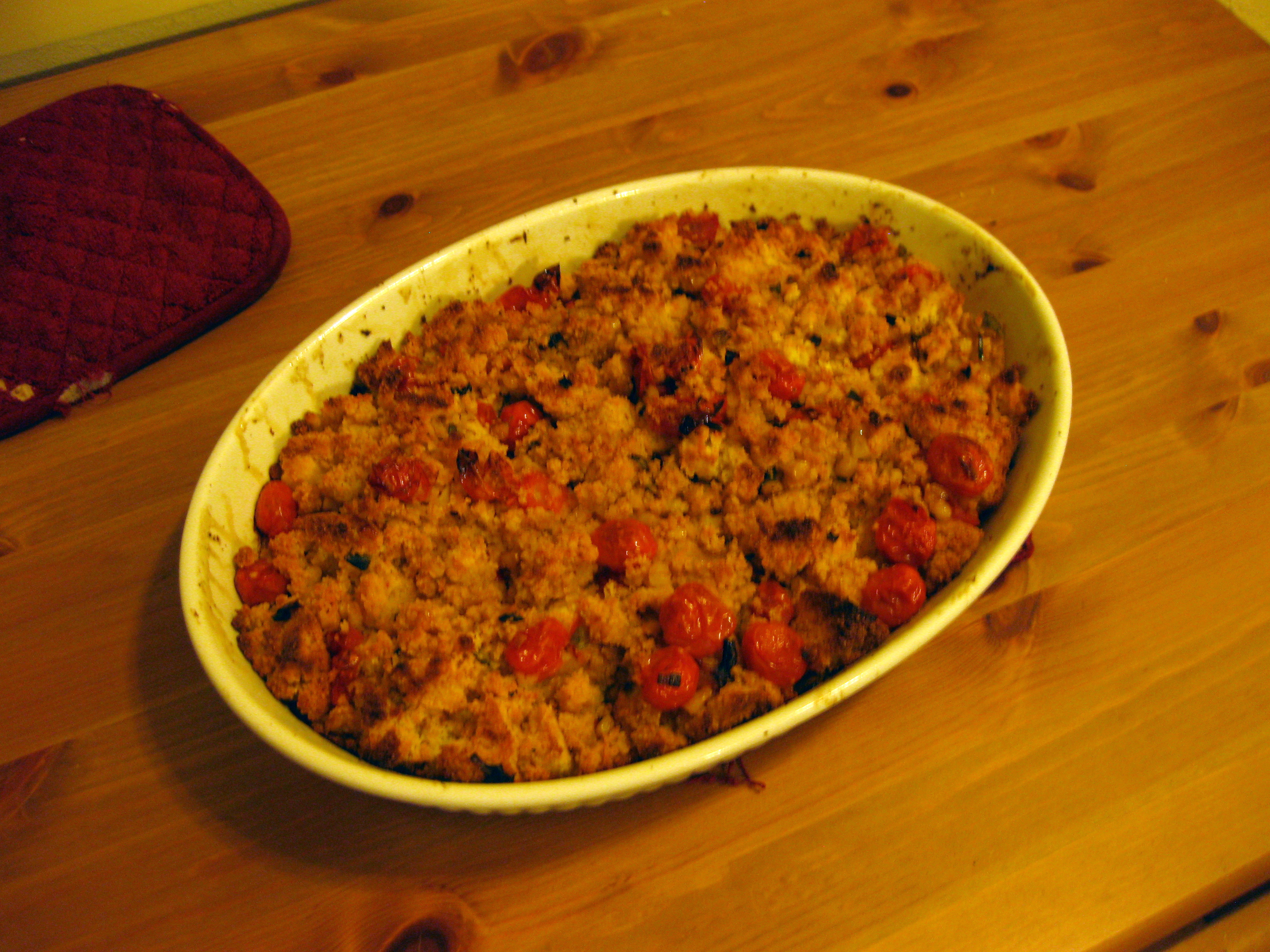
You guys, this was amazing.  And given how you now know I feel about stuffing, that’s saying something.  Amazing.  Here’s what I used:

6 cups (roughly) corn bread cubes, toasted (use your favorite recipe)

4 TB butter

6-8 beefy green onions

1 pint red cherry tomatoes, rinsed and dried

1 cup corn, fresh or frozen (if frozen, defrost it first)

Salt and pepper

12 oz. beer (I used Drifter)

I made a pan of cornbread from my favorite recipe in a larger pan than usual; I thought this would result in a slightly drier bread, so it wouldn’t become mushy when the liquid was poured over it.  The cornbread was still pretty moist and springy, though, so after it had cooled for a while I cubed it, scuffed it around in the pan a bit to separate the clinging pieces, and tossed it back in the oven at 400F for fifteen minutes or so to get some toasty edges and dark golden spots on it, then set it aside to cool completely.  This worked beautifully and I’d recommend it, especially if your cornbread is moist and cakey.

While the oven was occupied by an herb-stuffed chicken (again, I know.  I can’t help it), I melted the butter in a skillet over medium heat and sliced the green onions, using the white and green portions.  I tossed these little rings into the sizzling butter along with the corn, and agitated them gently.  When the onions were soft and the corn just beginning to caramelize, I added the cherry tomatoes and seasoned the whole skillet with salt and pepper and, on a whim, a few shakes of garlic powder.

I turned the heat up to medium high for just a few minutes until the cherry tomatoes started to burst through their skins, spilling pulp into the mix, and the corn had browned delightfully, leaving the kitchen smelling like summer.

I then switched off the heat and poured in a full bottle of beer, nutty, yeasty, and brown (Drifter is a pale ale, so it has some body and depth – I wouldn’t go any lighter than pale ale, and might in fact prefer something darker: a brown ale like Newcastle, or even a porter if it’s not too strong).  The aroma changed from summer to fall harvest in an instant as the beer fizzed over the vegetables.

After scraping the bottom of the skillet gently with a spatula to remove any persistent browned bits, I poured the whole steaming bubbling mass over my pan of cornbread cubes and tossed gently to distribute the liquid evenly.  Then I stowed the pan in the oven: 350F for 25-30 minutes until the top is deeply golden and just crunchy.

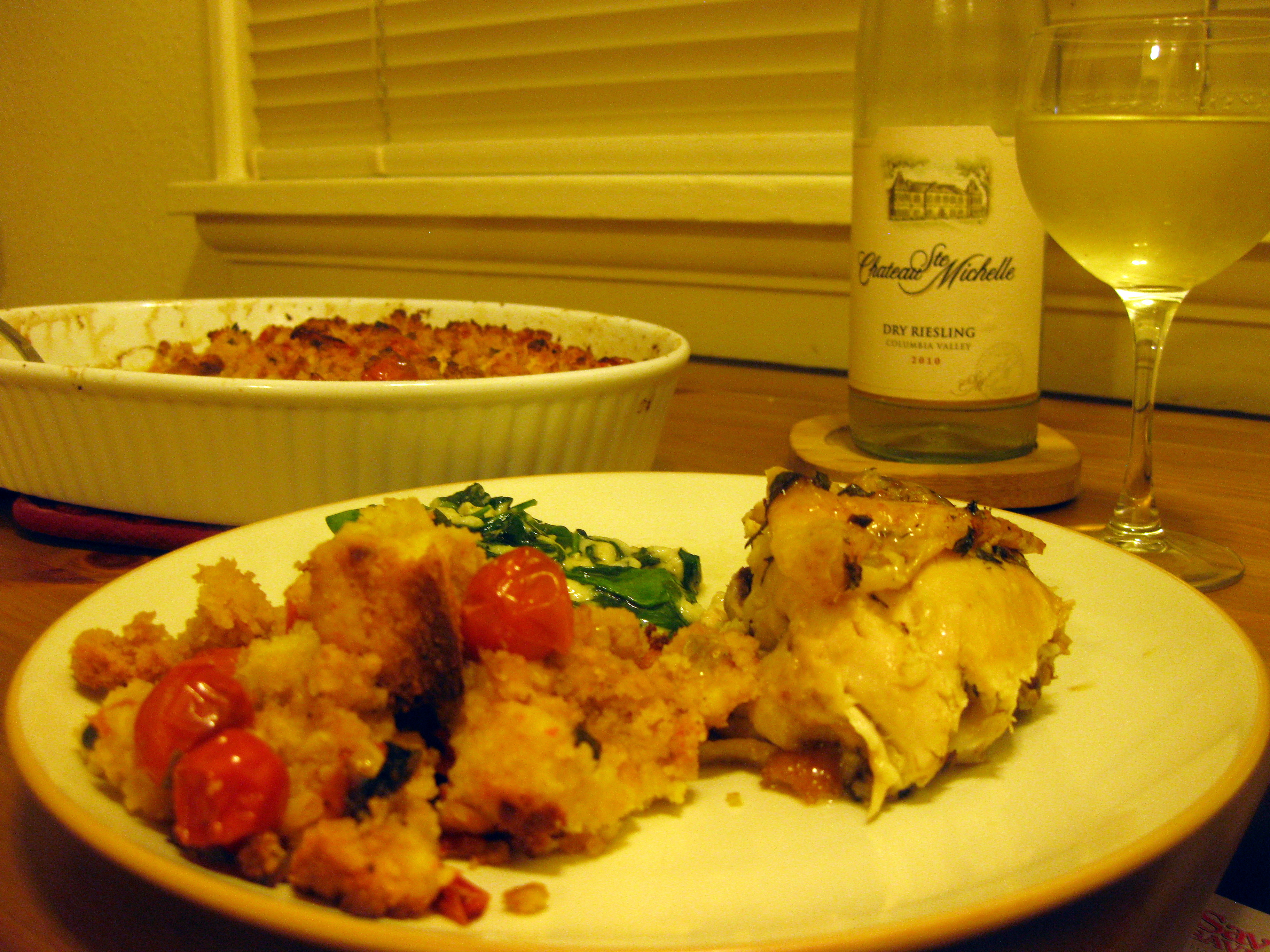
We ate this with roasted chicken and creamed spinach.  Vegetarians shield your eyes, but the chicken just collapsed so beautifully across my carving board that I felt I had to show you:

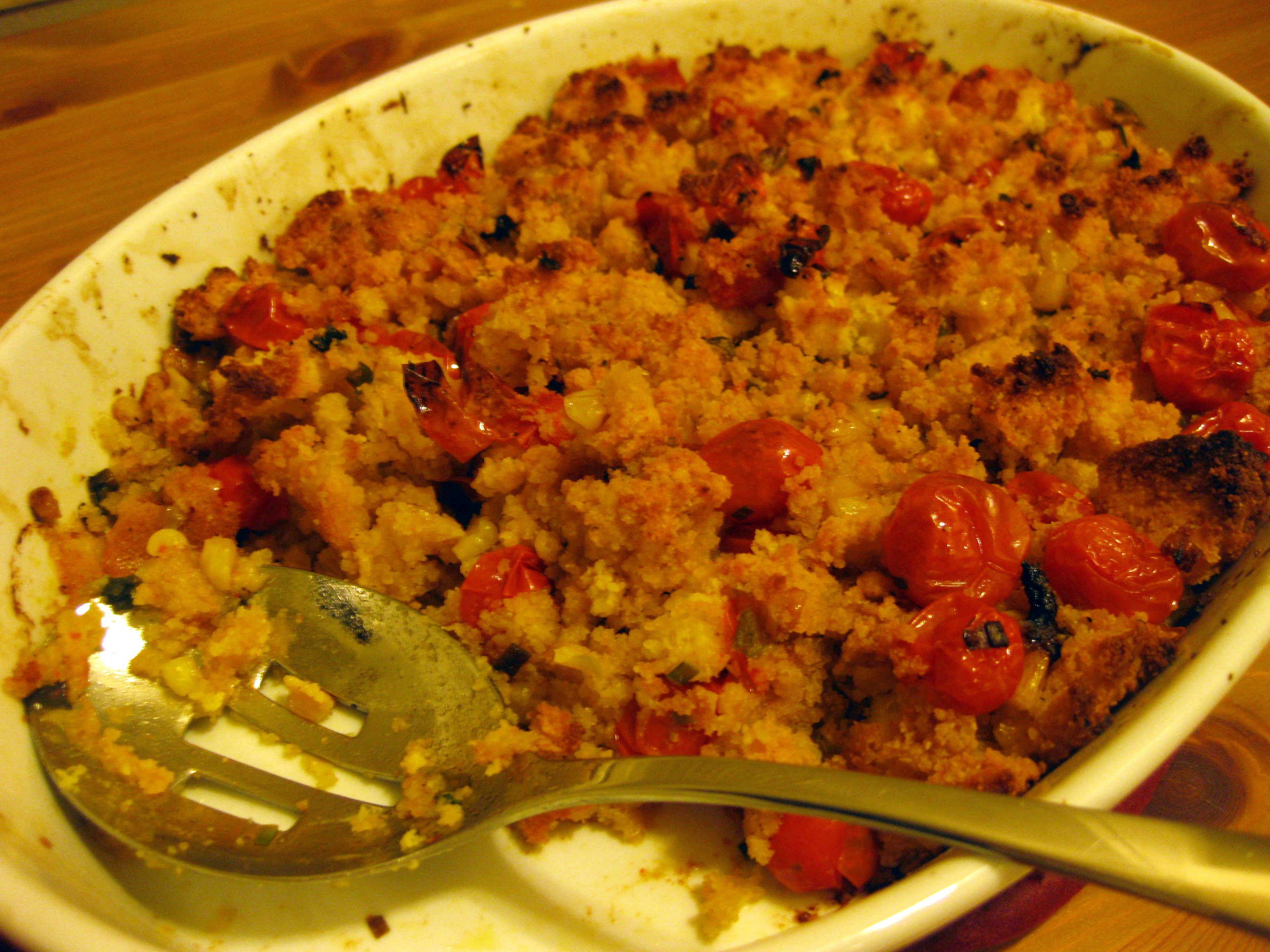
But the stuffing!  The stuffing was incredible.  The cornbread soaked up the beer, and the sweetness of the bread plus the sourness of the ale created this yeasty glory I couldn’t stop eating.  And I don’t like beer.  It was just such a perfect liquid for this dish, contributing just the right amount of malty bitterness.  The tomatoes got richer and sweeter in the oven, as did the corn kernels, and they partnered with the green onions to make such a good accompaniment to the cornbread that I’m almost tempted to add them into the batter in my next pan.  Or maybe into a compound butter to spread on top.  That would be better, texture-wise.  Green onions, cherry tomatoes, and corn: three musketeers. 

This stuffing was gone in two days.  With only two of us eating.  It was that good.  If you’re in the Northwest, where Spring is shunning us, make this now while you still need your oven to keep warm.  Accompanying some baked sweet potatoes and leafy greens, this becomes a vegetarian meal.  If you use oil instead of butter and have a good egg replacement, it could be vegan.  If your cornbread is free of wheat flour and you use gluten-free beer, it could be gluten-free as well.  However you make it, make it.  This one is too good not to try.

First fire

Don’t look back.  Don’t stop and talk to your loved ones.  Do not pass GO or collect $200.  Just grab your beer bottle, your children, your spouse, whoever, and run to your grill.  You must make and eat this, now: Honey-lime Chicken Fajitas with Grilled Fresh Corn and Avocado-Orange Salad.

At my request, N. just lugged our baby gas grill out for its first showing of the season.  It just needed to be dusted off, scraped down, and switched on.  And then we cover it with unreasonably delectable things like these fajitas from the June 2008 issue of Cuisine at Home (the recipe for the chicken can be found here).  With my numerous food magazine subscriptions expired, and me on a graduate student budget, I’ve started going back through old issues by month and, rather than cooking whatever I want willy-nilly, only permitting myself to use recipes from the month we’re in.  Thus this month I have four issues of various titles from June to choose from.  I didn’t need to look further than June 2008, though.

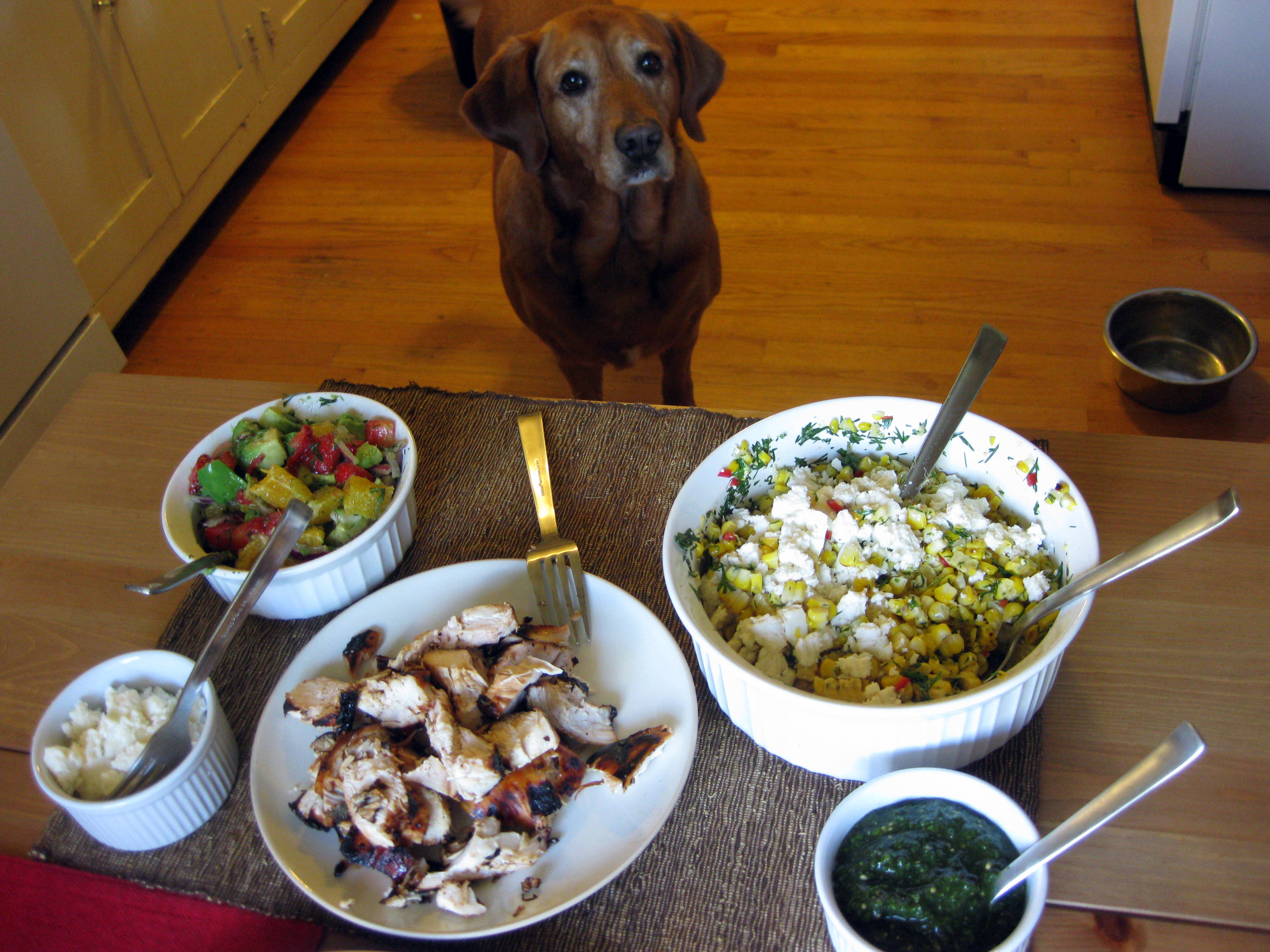
N. did an excellent job grilling the chicken breasts, which got crunchy caramelized exteriors from the honey in the marinade.  While he was busy, I was able to compose our two sides.

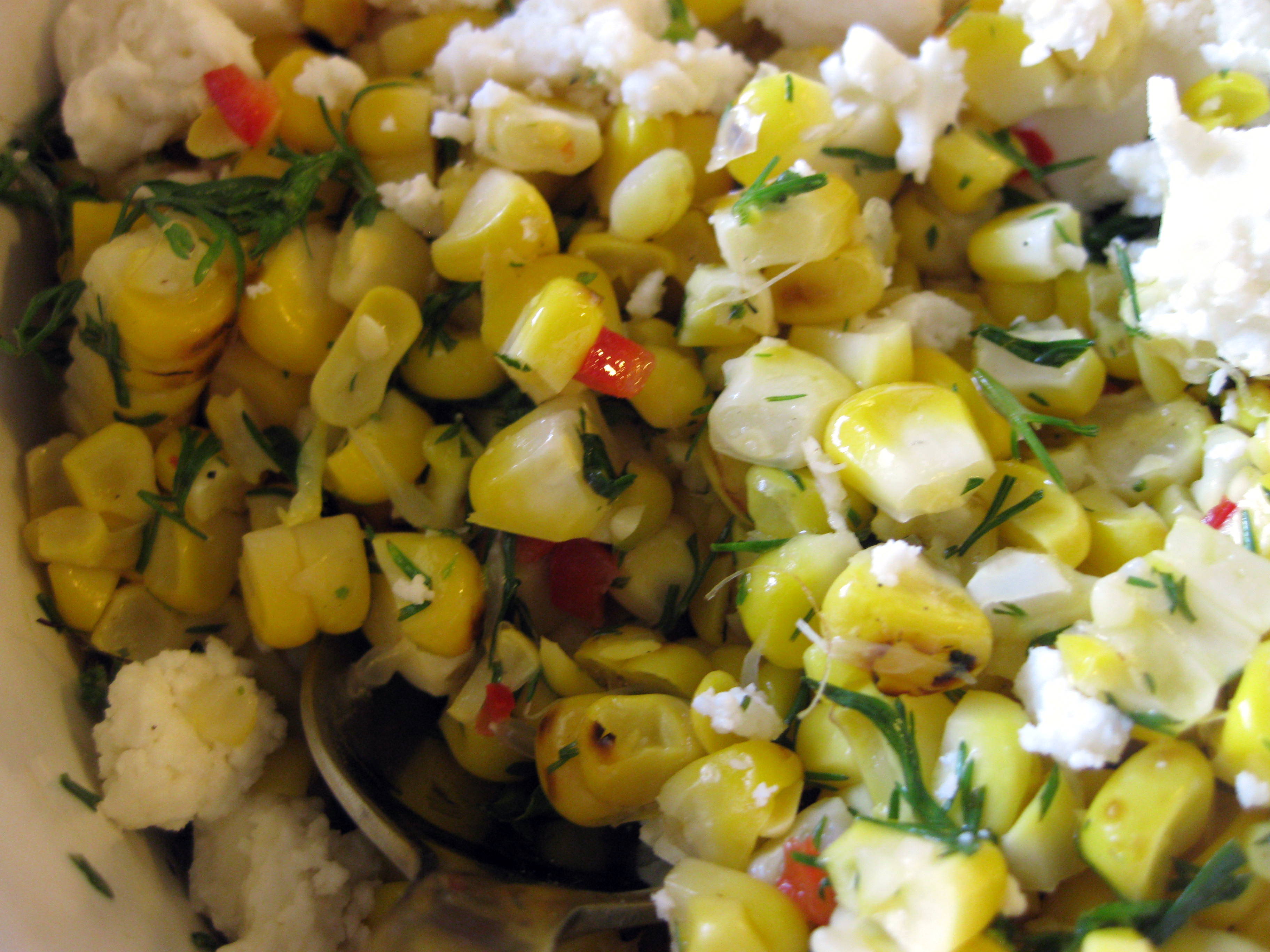
Love it or hate it, the cilantro in this grilled corn mixture added bright, grassy freshness and went with the sweetness of the corn extremely well.  Surprisingly, the queso fresco I crumbled over the top went along well too, probably because the salad was all freshness and crisp juiciness, and benefited from some creamy curds of cheese.

Because we had a sudden profusion (read: six) of tart garnet strawberries weighing down their respective stems in the backyard, I made a fruity addition to the Avocado-Orange salad Cuisine at Home offered.  Eliminating the garlic from the recipe and using the orange’s dripping liqueur instead of lime juice (one of my limes was most reluctant to give up anything), I mixed the roughly chopped strawberries in with an avocado, an orange, a few pinches of cilantro, and some salt and pepper.  Then I tried not to eat everything in the bowls while I waited for N. to bring the chicken in.

Fingers burning, we sliced it, then loaded up warm flour tortillas with thick moist slices of chicken, crumbles of queso fresco, sweet juicy pops of corn, and some green salsa (not homemade, but what can you do?).  I substituted a spoonful of Avocado-Orange salad for the salsa on my second fajita, and was equally overwhelmed.  So fresh.  So fragrant.  Such a pleasing, intriguing combination of flavors.

So quickly gone.