Dancing in the Kitchen with Gluten-Free Girl and the Chef

Shauna and Danny Ahern are my friends.  I don’t know them, we’ve never met, and though I read Shauna’s blog Gluten-Free Girl with a dedication that trips along the border between religious devotion and obsessive-compulsive disorder, I doubt she has ever glanced at mine.  I have drooled over the food (and made some of it!), I have laughed at her triumphs, I have felt my biological clock chime when she speaks of her daughter.  In late July, I sat on my sofa with tears streaming down my face, choking for breath as I read the beautiful story of her wedding.  As a writer myself, I admire her style, her skill with words, and her ability to talk lovingly, richly, thoughtfully about food, about family, about opportunity and love.  I feel like I know these people.  I wish I really did.

A few weeks ago, Shauna announced that along with the forthcoming publication of the cookbook/love story she and Danny “the Chef” wrote together (Gluten-Free Girl and the Chef: A Love Story with 100 Tempting Recipes, listed on Amazon at http://www.amazon.com/Gluten-Free-Girl-Shauna-James-Ahern/dp/0470419717), they were willing to share three preview recipes with interested parties.  I was, of course, one of these, and in a flurried email exchange, I suddenly had three brilliant recipes, replete with stories, to dance to in my little kitchen.

I ended up only making two of the three, mostly because N. doesn’t like shrimp, so a plate of seared prawns in almond garlic sauce did not sound appealing to him.  But if everything in the cookbook is as stellar in flavor and straightforward in instructions as the two recipes I did conquer over as many days, everyone should own a copy of this book, whether you eat gluten-free or not.

Friday night N. and I went to a last-hurrah-of-summer-bbq at the home of J., my birthday twin, and his partner HP.  Troubled by the notion of bringing the chocolate cake again (I’ve made it several times this summer already), I cast about mentally for another idea, and there was the pdf recipe for GFG’s chocolate peanut butter brownies.  My mouth started to moisten.  Chocolate, butter, sugar, peanut butter, and my first experimentation with xantham gum?  Yes, thank you, I think I will!

As brownies go, it was a fairly standard procedure of careful melting, mixing, swirling, baking, but oh the delight of tasting!  In the short section about the recipe preceding the ingredient list, the words “Reese’s Peanut Butter Cup” appear.  They aren’t kidding.  With the peanut butter swirled gently into the deep chocolate batter (and there is no other word for the color than that: chocolate) and my fingers cautiously tasting stray blobs of batter, I wanted to stop and eat the batter.  Half of it would bake up just as nicely as the whole pan, right?

I resisted, and slipped the dish into the oven, relinquishing it from sight for half an hour.  Still tasting the batter, I could detect a slight grainy texture that I attributed to the alternative flours used (my previous experimentations with gluten-free flours have not always been great, but they have always been grainy), so I was a little worried about that.  But after the pan cooked, cooled, and came to the party with me, my concern lifted.  I wouldn’t have had to tell anyone these brownies were gluten-free.  I wanted to, because I must admit I wanted to brag a bit about participating in this project (and get the word out there!), but there was no explaining to do.
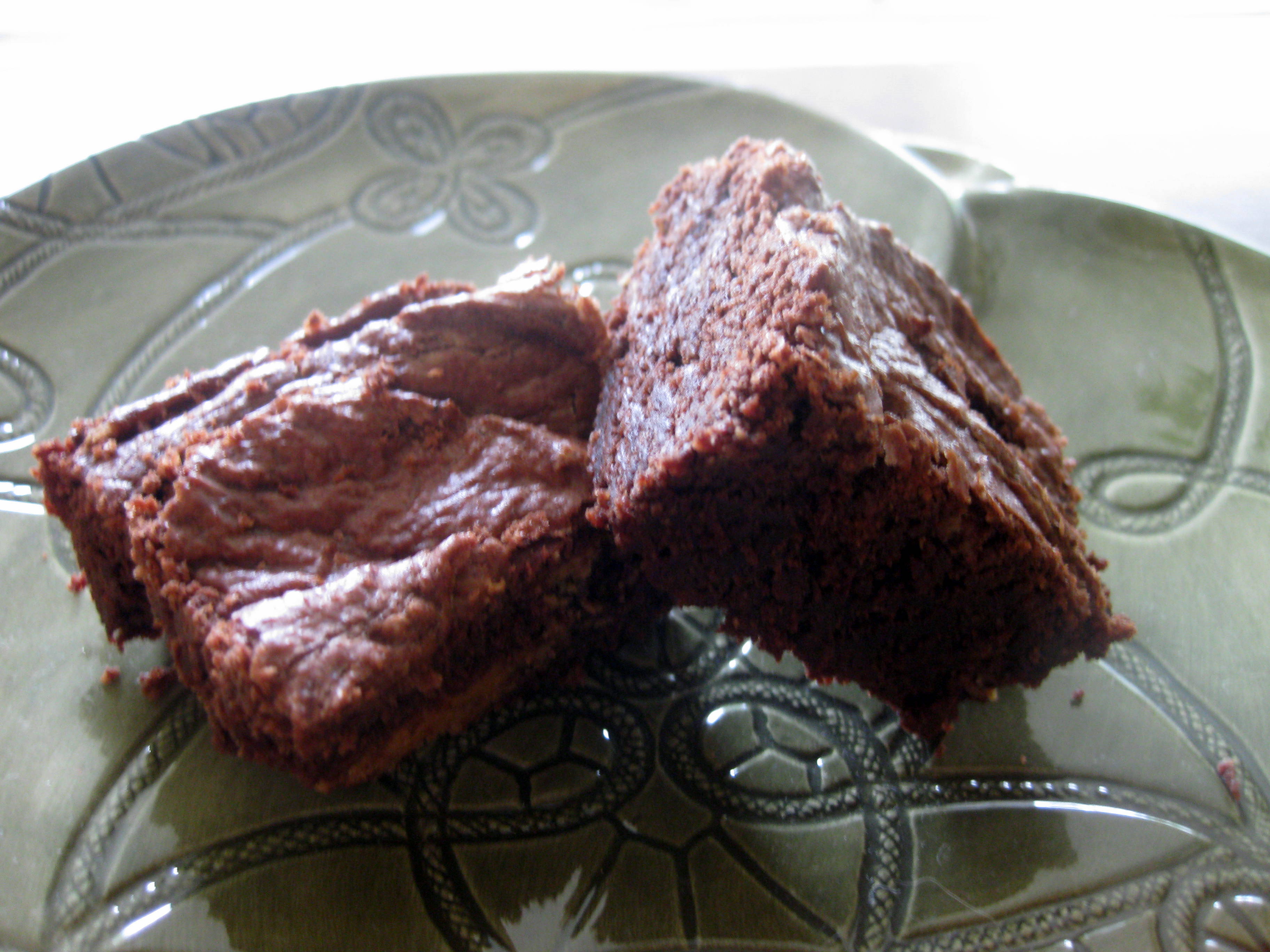
Oh Shauna.  Oh Danny.  The taste!  The crumb was rich and moist, the pockets of peanut butter were sticky bombs of candy-like delight.  I couldn’t even get a photo in before the hordes descended on the pan.  Seven people decimated ¾ of the pan in ten minutes.  Almost everyone went back for seconds.  Ever thoughtful of my not-so-narrow waistline (and hips, and thighs, and butt), I generally try to leave leftovers at other people’s houses when I choose dessert as my contribution to a meal.  Not this time.  The remaining brownies came with me, clasped tightly on my lap as we drove home in the rain.

Saturday, I ventured out into the weather again to pick up a few last ingredients for my second dance with Gluten-Free Girl and the Chef; it’s hard to make a pasta dish containing lemons, olives, anchovies and pine nuts when you don’t have lemons or pine nuts in your kitchen.  I grumped to myself as I walked to the store and back.  Why did I need this stuff?  I knew I shouldn’t, but it would just be easier to substitute ingredients.  The brownies had been good (liar, understatement of the century!), but this was just pasta.  I could post about the brownies and leave it at that…

I was so wrong.  With water for brown rice pasta considering coming to a boil, I prepped ingredients and tried to imagine what this was going to taste like.  N. had already been frightened by the idea of anchovies, and I knew he was envisioning a cheap pizza draped with little fishy bodies.  I told him that Shauna and Danny said not to be afraid.  He said “hmph,” which meant he was unconvinced.  He doesn’t know Shauna and Danny like I do.

With the toasty, nutty perfume of not-quite-burned pine nuts still lingering in the kitchen, I sautéed a collection of vegetables in my biggest skillet, hurriedly chopping and slicing in between stirring sessions.  I’m always too anxious to cook to bother readying all my mise en place before scraping a boardful of ingredients into the pan.  At the point that the roughly chopped mix of olives I’d kept stowed in the back of my fridge and the finely chopped little fillets of anchovy hit the pan, I felt my knees buckle.  The smell was incredible.  When I added capers and lemon juice, I had a Proustian epiphany of Corsica, of Greece, of Spain.  Except I’ve never been to Spain.  Or Corsica.  Or anywhere in Greece.  It was just a strong enough, rich enough, delicious enough smell that it lifted me from the stained hardwood floor of my kitchen and transported me onto some magical different plane of Mediterranean glory.

Carefully twirling the pasta through sauce, I had to be careful not to drool on it.  These flavors: is this umami?  It was almost more than I could manage to mix in pine nuts, lemon zest, a clumsy chiffonade of basil – I just wanted to eat it straight out of the skillet.

We sat down to eat.  I tried to do one of those perfect forkfuls where you get a tiny sample of everything.  I tried to think objectively about what I was about to experience, about what vocabulary I would use to describe it, about how I could speak like a food critic about it.  I don’t know how.  Here are my words, all I can manage: earthy.  Warm.  Salty-bright-tangy-acidic-perfect.  Briny.  Tart.  Meltingly rich.  Flavor bomb.  Somewhat reminiscent of chicken piccata, but deeper, richer, earthier, nuttier.
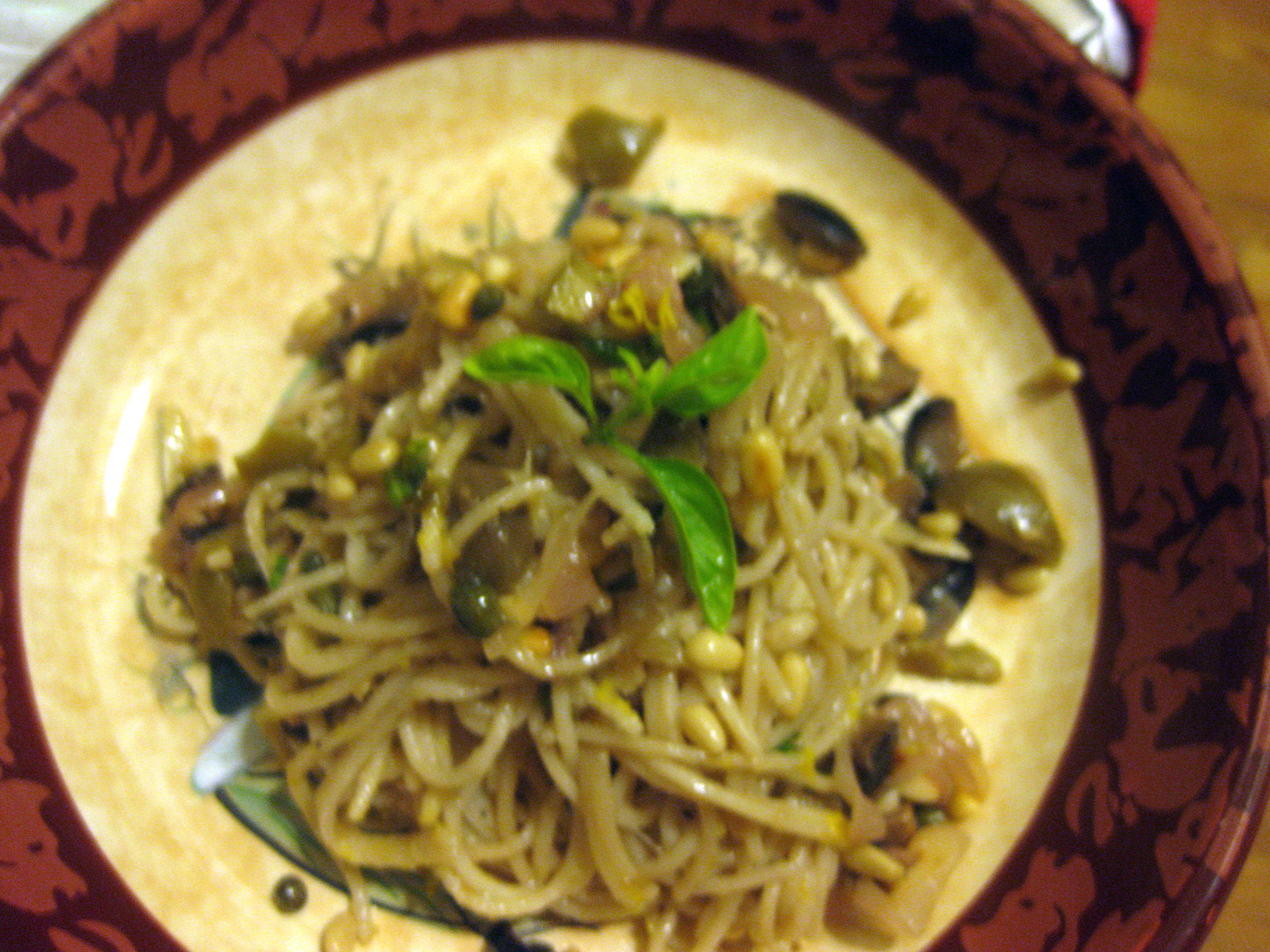
And N.?  He scraped his plate.  I asked him what he thought so I could make a report.  “It was excellent.”  As I’ve written before, N. is generally restrained in his verbal praise of food.  And this was “excellent.”

I’ve never bought anchovies before.  I might never allow them out of my pantry again.  This recipe, whether we use gluten-free pasta or not, will fast become one of my staples.  For me, it’s too distinctive to have all the time.  It’s too special.  But for those nights when I need something powerful to wake my taste buds, when I need something that makes my mouth feel alive, this is it.  This was like eating a tango.

Go to a bookstore.  Order Gluten-Free Girl and the Chef: A Love Story with 100 Tempting Recipes.  Rejoice in the story and in the recipes and in the wonderful opportunity to eat really, really good food.  Dance in your kitchen.  And then tell me about it.  And tell Shauna.  I know she’d want to know.

Post-partum parcels of joy

After passing my exam a couple weeks ago, I went and spoke with my adviser to find out what I should be doing to keep on track.  She told me to rest.  Rest!  Actual, warranted permission to lie around, to catch up on terrible reality television series, to take naps and sleep in, uninterrupted by guilt about conferences, articles or (gulp) the dissertation!
Of course this didn’t last long.  Like any kid after the first few weeks of summer vacation, I got bored.  So I turned to the kitchen, as usual, to vent my new creative focus.  I spent my weekend on a few special projects.  As I’ve mentioned before, it has become something of a hobby of mine to “collect” menu descriptions from restaurants and try to recreate them.  On this occasion, I didn’t even have to do that much guesswork.
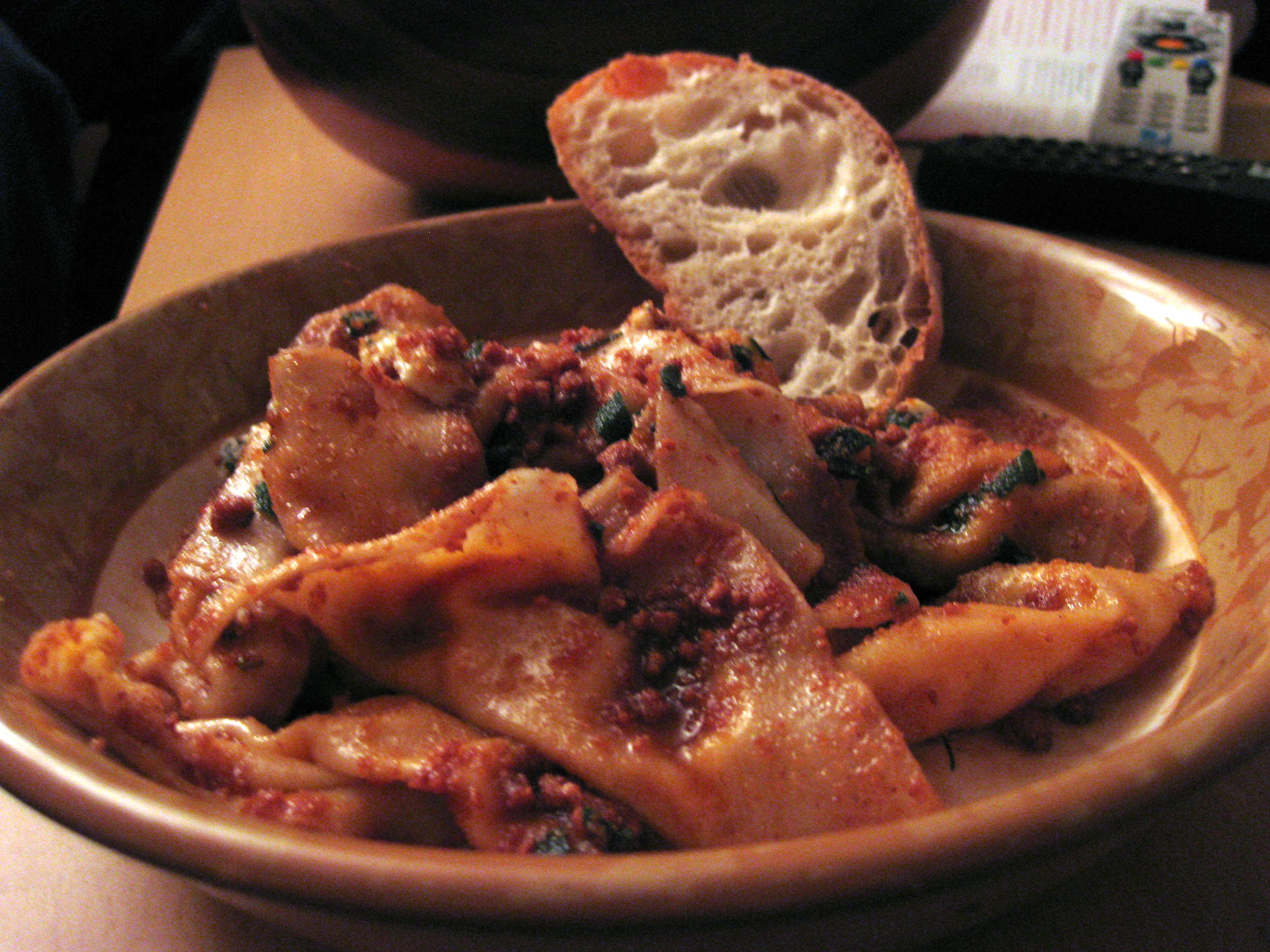
Pasta Piatti in Ashland is a favorite of mine, and I’ve mentioned it before.  When N. and I had dinner there in celebration of our second wedding anniversary this past summer, I had their butternut squash ravioli in a brown butter sauce with sage, crumbled biscotti cookies, and “Oregonzola” cheese from Rogue Creamery.  It looked like this:

Gloriously, the restaurant posts recipes for some of their dishes on their website, and the filling for their extravagantly delicious squash ravioli is one of them.  Make this at home?  Yes, please.

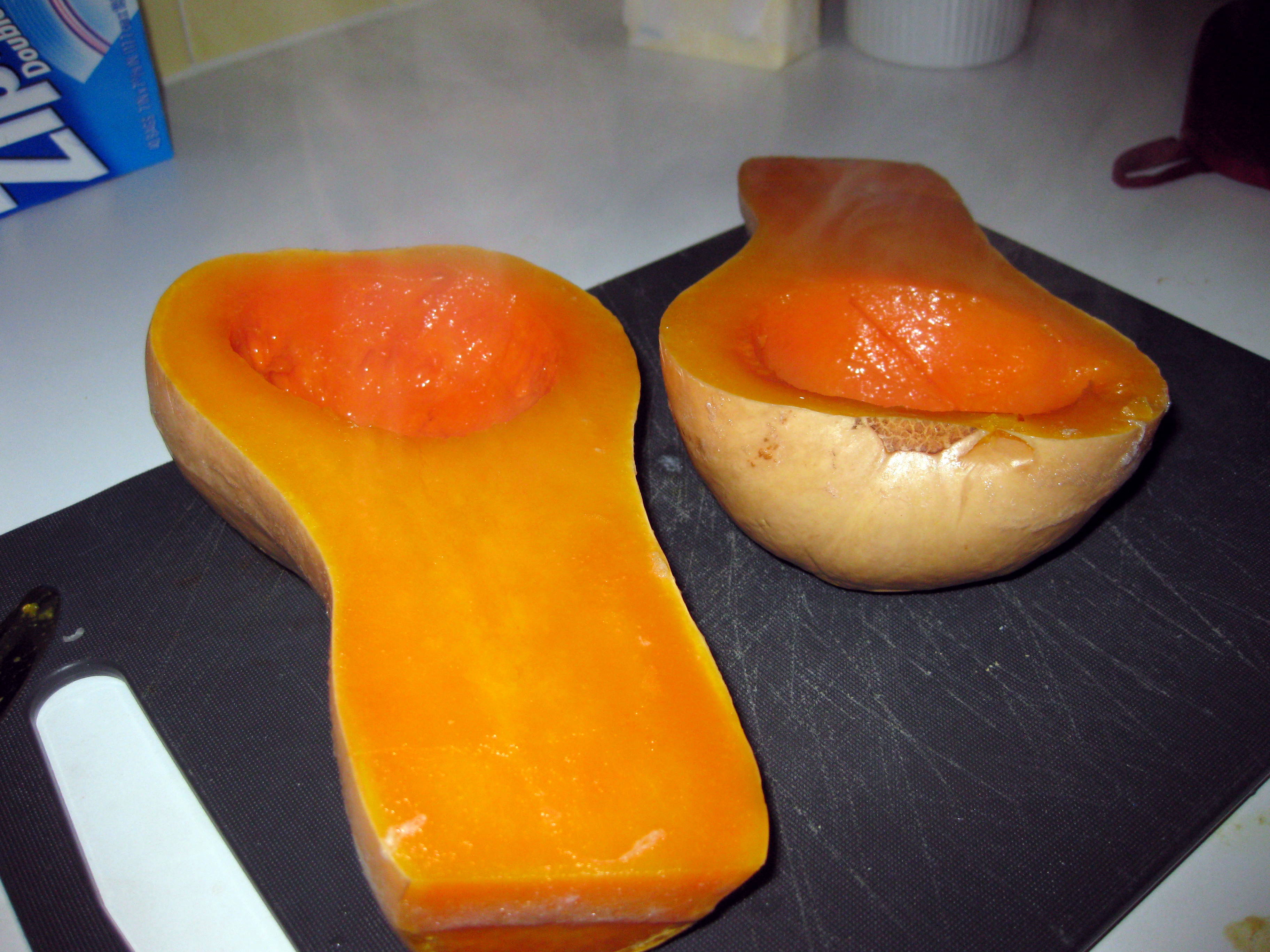
It’s a process, but I think it’s worth it.  See the recipe for detailed directions, but note that there are a few inconsistencies (i.e. do you food process the onion along with the squash and garlic, or just fold it in?).  It took about an hour for the squash to cook and the garlic to soften and fill the house with its sweet buttery aroma.  I processed together the squash, garlic, sauteed onion (though I used shallot), and egg yolks, but folded in the cheeses so they wouldn’t melt or gum up the blades of my food processor.
When the filling is cooled, you can address containment.  Though you could certainly make your own fresh pasta, or maybe even stuff large shells or manicotti, I addressed a package of square wonton wrappers.

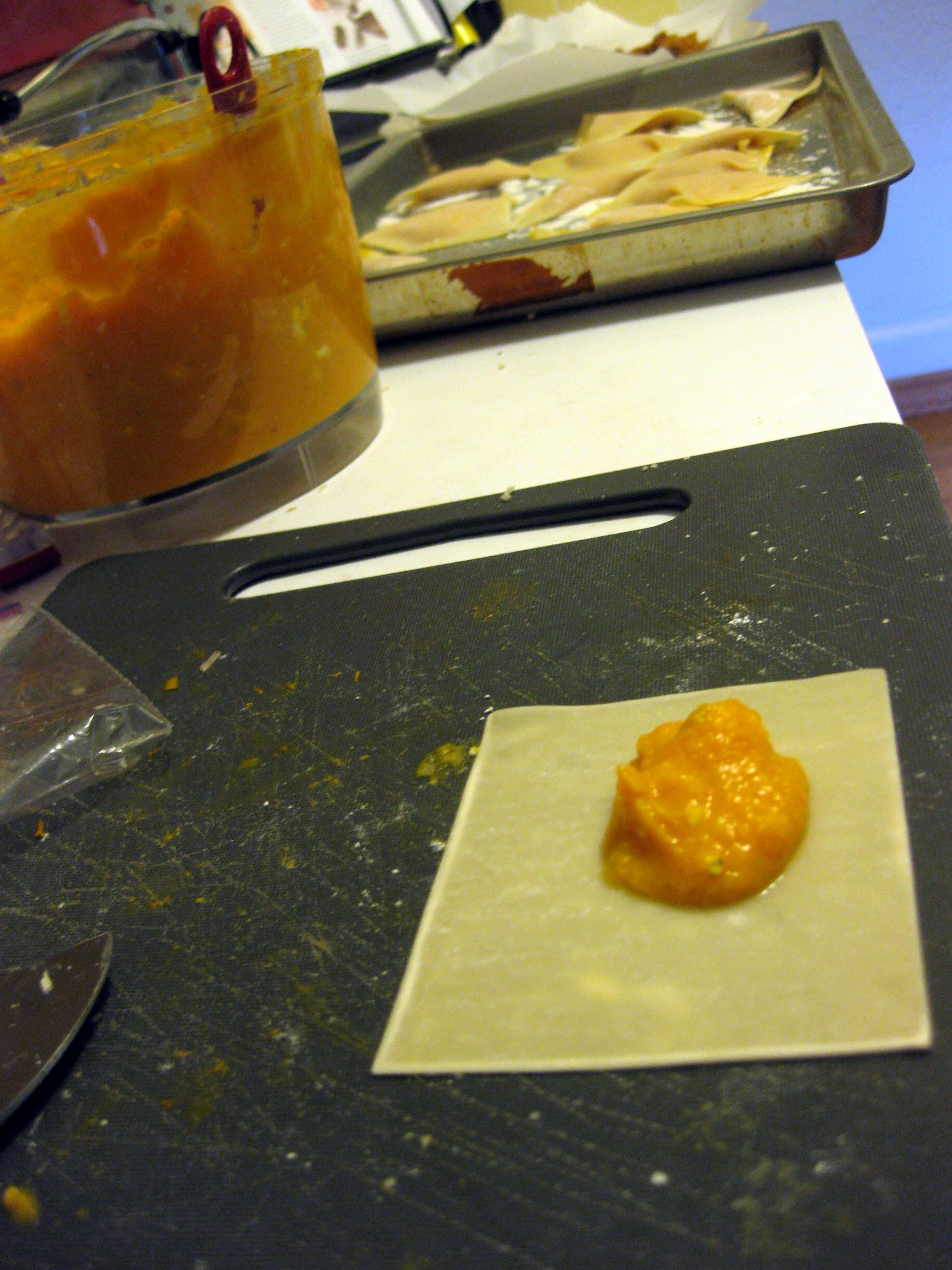
Made from wheat flour and fairly flexible, wonton wrappers are a good, easy substitute for fresh pasta.  I loaded up each square with about ½ a tablespoon of filling, wet the edges, and folded them into semi-clean, somewhat isosceles triangles.  How that word survived in the memory banks astounds me.  Geometry was a long time ago.  After spreading the little packages on a well floured cookie sheet, I stowed them in the refrigerator for an hour or so to let the seal set while I got everything else ready.  With water heating on the back burner to boil my squash-stuffed parcels, I readied the rest of the arsenal:

½ cup (1 stick) unsalted butter
2 TB fresh sage, minced or in chiffonade
½ – 1 cup graham cracker crust crumble (recipe follows)
2 oz. Oregonzola cheese, crumbled (or any gorgonzola or mild blue cheese)
salt and pepper to taste

1.  During a downtime in the cooking process (either while the butternut squash and garlic are roasting or as the ravioli are cooling down in the refrigerator), mix together about a cup of graham cracker crust with 2 TB brown sugar and 2 TB melted butter.  Spread the mixture on a parchment paper lined cookie sheet and bake at 325 or 350 until deep golden brown and crumbly.  Crumble up and cool.  Pasta Piatti uses crumbled almond biscotti.  I just used what I had in my pantry and it worked out very well.
2.  While you wait for the water to boil for the raviolis, melt the butter in a large pan over medium heat.  When foam subsides, the butter will begin to turn a deep gold and then brown.  As it moves from gold to brown, toss in the sage and allow it to fry until almost crisp; crunchy little shards of herbage.  You may at this point have to turn down the heat so the butter will not burn while the ravioli cook.
3.  The ravioli will only need 3-4 minutes to cook in rapidly simmering, salted water.  I let the water cool from a rolling boil before dropping them in a few at a time because I wasn’t sure how well sealed they were, and I wanted to forestall explosions or leaking.  I was mostly successful.  When they float to the top of the pot, scoop them out with a strainer or a slotted spoon and deposit them carefully into the butter sauce, draining off as much water as possible before adding them to the skillet.
4.  When all raviolis have joined the dark golden buttery bath, fold them gently into the sauce and add the cookie and cheese crumbles.  Mix again gently and serve with bread and salad.

We had a ciabatta loaf from Trader Joe’s and a salad of romaine, arugula, thinly sliced Granny Smith apple, pomegranate seeds, and walnut halves as a side.  I made a quick dressing from finely diced shallot and sage, with honey, white wine vinegar, and mayonnaise.  Thanks to an impromptu Trader Joe’s trip for the gorgonzola cheese, the pomegranate seeds and the ciabatta, I was able to pair dinner with a TJ’s special: Green Fin white table wine.  This is made from organic grapes, which supposedly eliminate some of the problems caused by tannins (headache, bad hangover), but also tastes delicious.  It’s a bit on the sweet side, which seems good for this meal; the sweetness of the butternut squash and the cookie crumbs in the sauce offers the peril of bitterness to an ordinarily lovely white wine.

But let’s get on to the important bit: the ravioli.  The filling is soft and luscious, since it has been blended, and the wonton wrappers are so delicate after their boiling bath that they almost dissolve on your tongue.  With a whole head of roasted garlic in the mix, you might expect a stronger garlic flavor, but because it is roasted it just melts into the background as a sweet, mellow support for the squash.  Sage and squash are a natural pairing, and the herb adds a little freshness to the nutty, almost caramel notes of the brown butter.  These flavors all blend so well, but the real glory of the dish in my mind is in the contrasting crumbles.  The cookies and the cheese are such opposites in flavor and in texture; the cookies are crisp and sweet-crunchy, even after a dunk in butter, while the cheese maintains its structural integrity for a while as the dish cools on your plate (ahem, it would, if the dish had long enough to cool on your plate before you devoured every last bit) and provides a creamy, slightly chewy counterpoint.  Since gorgonzola is not terribly sweet and, in fact, has its own definitive funk to it in flavor and in aroma, it coats your palate a bit, protecting it from the potentially overwhelming sweetness of the squash, the butter, the cookies.
This is a beautiful dinner.  It would also make a rich, out-of-the-ordinary dessert, and an unconventional but satisfying breakfast.  But we didn’t leave enough for all that…

The Week of Magical Eating days 3 and 4: Soup and Salad

Since sharing lunch with my friend S. a few weeks ago, I have developed a minor obsession with Caesar Salad.  The crispest romaine, whether to add the Parmesan by shreds, crumbles, grates or curls, the perfectly textured crouton: crisp and golden on the outside, with the barest hint of residual chewiness deep within.  But mostly, the object of mystery and allure is the dressing.  It’s tangy but creamy and rich but still light, and pulls the flavors of the salad together to make it a phenomenon.  I decided to make it.  In the gloom of winter, I don’t have the opportunities I’d like to find farm-fresh eggs, and locally grown egg yolk is all I would feel comfortable using without cooking it.  Besides, N. gets worried about raw foods sometimes, and he doesn’t care for the idea of fish in dressing, so egg and anchovy were out.  I poked around online and found some vegan Caesar salad dressings with interesting suggestions, including the addition of brewer’s yeast and tamari to add the salty richness of anchovy.  I collected ideas and then, as usually happens, ended up making my own.

Mayonnaise, lemon juice, brown mustard, tamari, pepper, and garlic went into the mixing vessel that came with my immersion blender.  I pulsed these ingredients together a few times until the garlic was chopped and things were looking paste-like, and then streamed in some olive oil with the blender running until it reached a more dressing-y consistency.  It’s a work in progress, and I didn’t take note of amounts, but it began to capture that lofty Caesar flavor as I added additional spoonfuls of mayo here and lemon there… a bit too much mustard in the first squeeze.  Over-enthusiasm, you know. Tossed with fresh greens, lemon wedges, and sourdough croutons from half a baguette, it was almost right.  Almost there, but close enough for a weeknight.

The next night, inspired by a recipe request I couldn’t fulfill from D., I scoured the ‘nets for a suitable looking black bean soup.  Our salad accompanied a slow cooked chicken with 40 cloves of garlic, and I saved the garlic-infused broth our chicken expelled in the crock pot, so I had a wonderful flavorful stock to use for soup.

After sliding a pan of batter in and a loaf of cornbread out of the oven half an hour later, I commenced to create Dave Lieberman’s black bean soup, found here:  http://www.foodnetwork.com/recipes/dave-lieberman/black-bean-soup-recipe/index.html

I made a few changes to his recipe, for one reason or another, which I’ll share because I thought the result turned out well.

I cooked my bacon until crispy before draining out some of the fat (which ended up mixed with dogfood; Lucy was ecstatic!) and adding only 1 ½ onions.  Instead of Dave’s can of chicken broth, I used the leftovers from our chicken, which were about 1 ½ cups, and about a third of a bottle of New Belgium 1554 for a little extra flavor and fizz (then I handed the remainder of the bottle to N.  Beer and bacon = happy little family!).  I eliminated the ketchup and forgot the lime juice, and added my cilantro right at the end rather than letting it cook.  I decided I wanted a fresher green flavor, so it would serve as a garnish.

Then we went a little crazy with toppings.  I crumbled up some queso fresco, which I am having a deep affair of intrigue with, and used up my single-serving ramekins providing serving dishes for cheese, sour cream, green onion tops, more cilantro, and lime wedges.  The photo below isn’t the most aesthetically pleasing composition, but it was belly-warming and hearty, and tasted marvelous.  We usually have trouble finishing up leftovers from soup, but it has been only four or five days since I made this, and the remains are already gone.  That should tell you something.

The Week of Magical Eating Day Two: Belated Valentine

Belated Valentine, from my kitchen to you:

I am a big believer in comfort food.  For me, mashed potatoes are a comfort food that are impossible to get tired of.  They can be made in so many ways: with butter, with olive oil, with sour cream, whipped, blended, smashed, gravy-ed.  Two things seem to remain true about them.  1.) there are never enough, and 2.) they get cold too fast.  How to combat this?  It helps that I am only cooking for two, but had my first lessons, triumphs, and failures in a kitchen that fed four nightly.  I haven’t yet mastered the downsizing process, but in cases like mashed potatoes, N. and I actually benefit from my over exuberance.

The key element to mashed potatoes, I think, is including enough fat.  Otherwise all you end up with is crumbly boiled potato.  I take my fat options extremely seriously, and in considering all the creamy options, I decided to play with ricotta cheese during this round.  Not only would this add a cheesy dimension, which is almost never a bad thing, but would contribute a velvety texture and give the potatoes a way of clinging together as they crumbled under the force of my masher.

I dropped a bag of baby Yukon golds into a pot of half salted water, half leftover chicken broth that didn’t get stirred into the risotto from the previous night’s adventure.  Then, in a moment of sudden, startling inspiration, I cracked three whole, unpeeled garlic cloves off the bulb and tossed them in too.  Considering the plans for the following night, these paper-wrapped, pungent little cloves could tie the whole week together.

While the potatoes boiled, I considered their final destination.  Ricotta cheese is nice, but it certainly could be improved upon.  I chopped up a good handful of dill and Italian parsley, and on sudden urge, grated a handful of parmesan cheese too.

I like my mashed potatoes chunky, and I know that most of a potato’s nutrients are found in its skin, so I like to make mashed potatoes with new or fingerling potatoes, or with red-skinned potatoes, which all have thin skins with unobjectionable flavors.  This adds to the nutritious value of the final result, and it saves me time because I don’t have to peel a bunch of potatoes in preparation.  Additionally, the skins add a nice textural element as they yield their hold on the starchy interior and shred through the pot upon mashing.

After draining and peeling the garlic cloves, I added and gently mashed together the following with the softened soldiers:

  • 4 TB butter
  • ½ cup milk
  • 8 oz. part-skim ricotta cheese
  • ¼ – ½ cup grated parmesan cheese
  • ¼ cup roughly chopped fresh parsley
  • 2-3 TB chopped fresh dill
  • Sea salt and black pepper

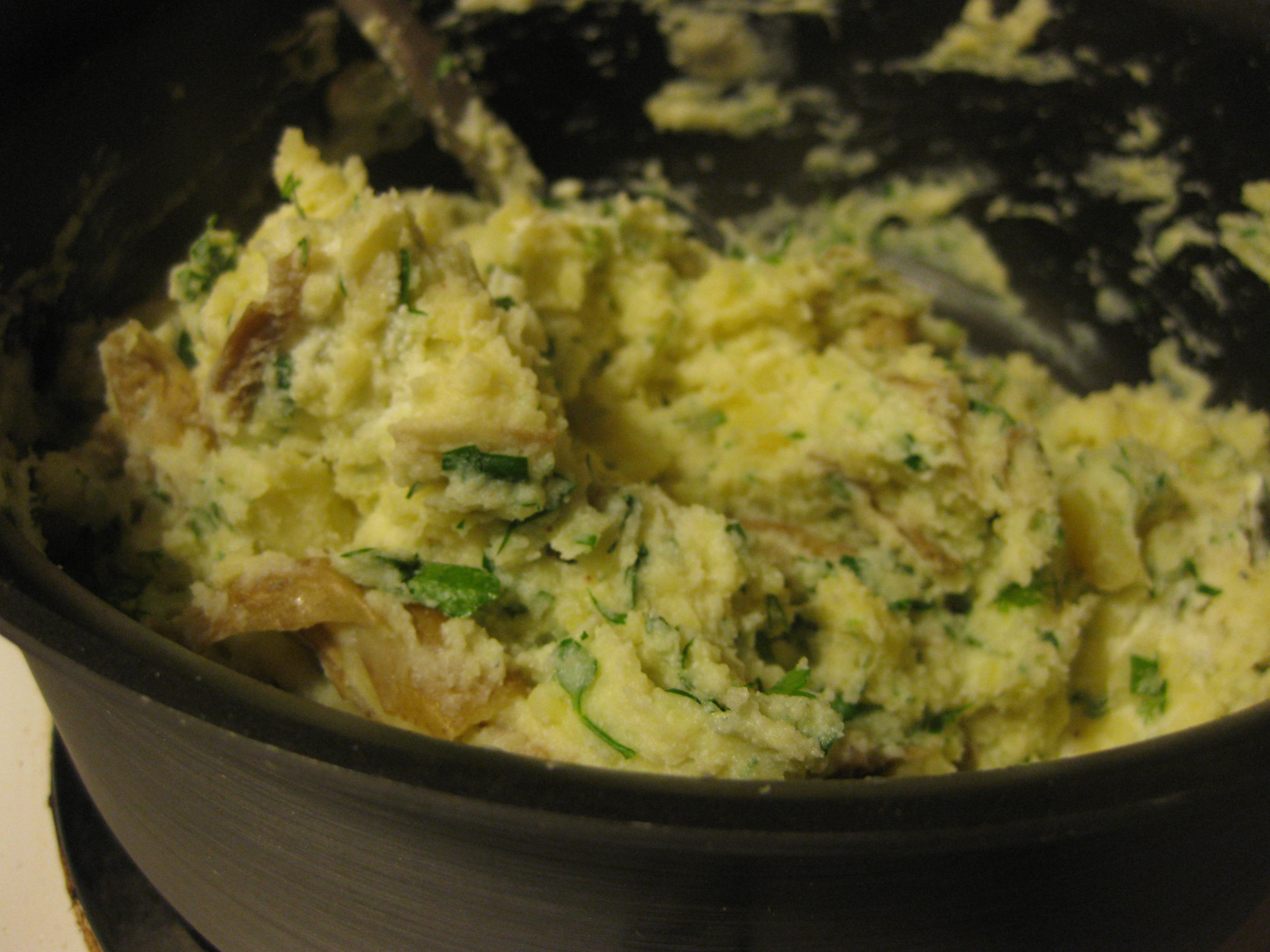
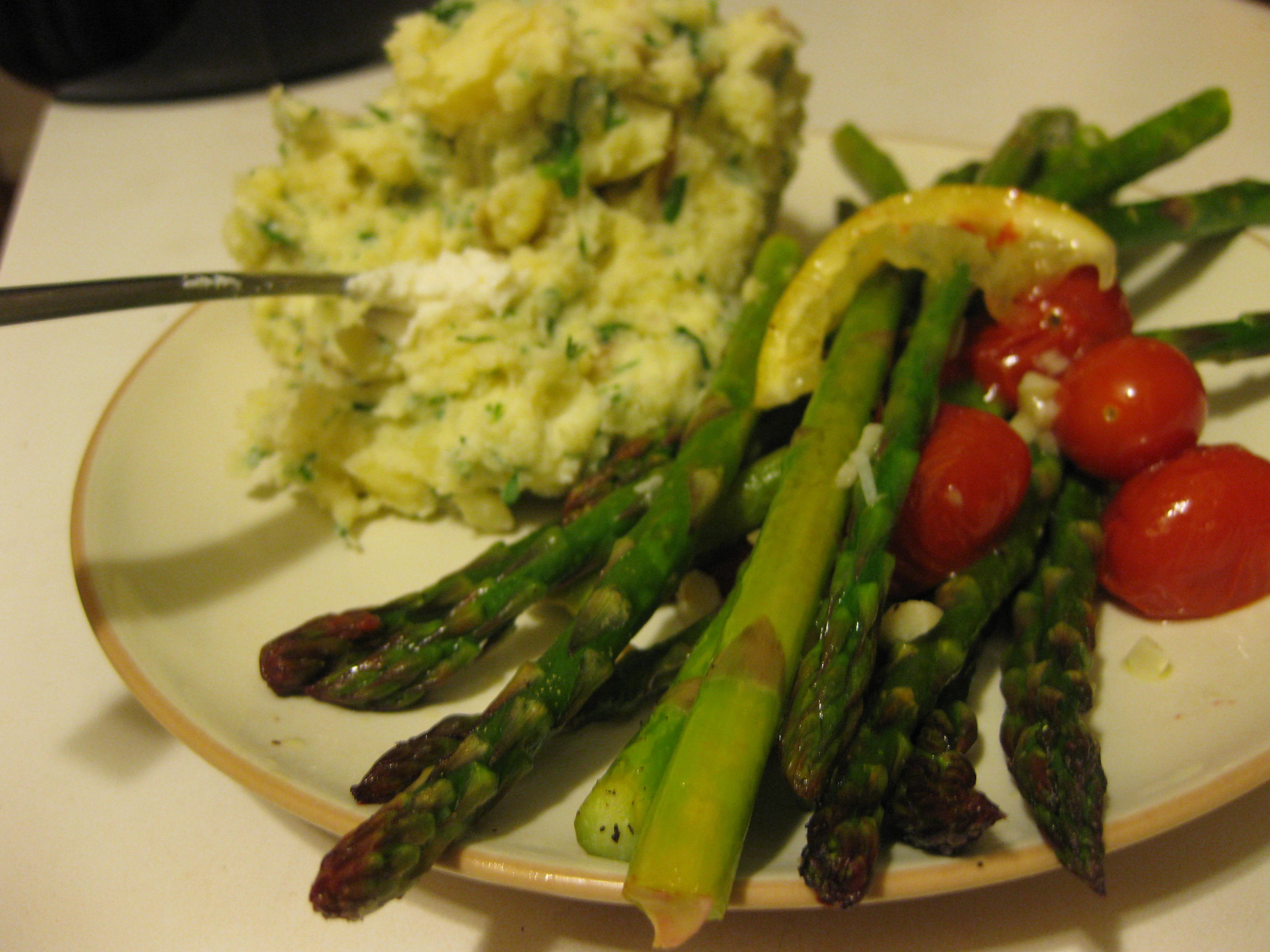
Using a plastic masher is invaluable because you can do your mixing and mashing right in the pot, which ensures that the potatoes stay hot longer.  We mounded ours up on warm plates and ate them alongside roasted asparagus.  The ricotta was a great addition; it was not super cheesy, but recognizably creamy and smooth.  It definitely added richness and tamed the starchiness of the potatoes.  The combination of herbs was a success.  With the additional richness of the cheese, having bright pops of green both visually and orally made the dish feel, not exactly healthy, but not overbearing.  Besides, with a side of asparagus and burst cherry tomatoes, we weren’t being all that bad…

Dinner for one

At the beginning of October, N. went to a literary conference in Spearfish, South Dakota.  That’s right, Spearfish.  For almost a week.  Now, I don’t even like eating dinner alone, much less rattling around the empty (all-but-dog) house in the evening and settling into bed by myself (again, aside from the dog who spent each night usurping more of my blankets).  You hear the creaking and settling of an old house much more clearly when something is out of the ordinary.

To assuage my loneliness, of course, I turned to food.  There are several items in this wonderful culinary world that N. doesn’t like.  One of them is shrimp.  I know, I must be crazy for having married him with such a deficiency (another of his dislikes is coconut.  Crazy!), but otherwise he’s pretty perfect.  So in his absence, I ate shrimp.  A recent issue of Cooking Light had a wonderful looking shrimp pasta recipe that I wanted to try out, and with the crustacean hater a full time zone away, this was my opportunity.

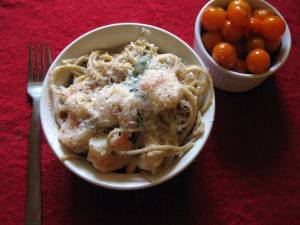
Shrimp, pine nuts, a little white wine, basil, and some nutmeg and pepper spiced cream made the sauce, and I tossed spaghetti into it and folded the creamy sauce around the long strands of pasta before adding a generous grating of Parmesan cheese.  Though this sounded like an excellent meal all on its own, I have been making an effort lately to be sure I include some kind of vegetable (or fruit) material in my meals, and a few julienned leaves of basil wasn’t going to cut it on this one.

I turned to tomatoes.  Our sungold cherry tomato plant, with which I’ve been having a serious love affair all summer, provided me with several generous handfuls of tiny, deep orangey-gold spheres of sweet juicy flavor explosions.  I drizzled a little olive oil over them in a small skillet and agitated them in the pan until they started to burst their skins.  Then I added salt, pepper, and two big glugs of balsamic vinegar and let it heat through until barely simmering.  Then I couldn’t stand it anymore, and ate a huge helping of tomatoes and pasta.

It was delicious.  The sauce for the pasta was creamy and luscious, punctuated by bursts of freshness from the basil, and deep, complex buttery nuttiness from the pine nuts and nutmeg.  The tomatoes, meanwhile, were tart and sweet – almost sweet enough to be dessert.  When I went back for a second helping (what can I say, I was all by myself with no one to help me enjoy the feast!), an amazing thing had happened.  Though I had turned off the stove (safety first!), I had left the pan containing the tomatoes on the cooling burner, and there was enough residual heat to begin to reduce the balsamic vinegar.  What remained was a slowly thickening syrup of balsamic and sweet cherry tomato juice, sticky and oozing among the deflating tomatoes.  I couldn’t stand it, I gobbled up the remaining spoonfuls and left the rest of the pasta for another day.

At my house, dinner for one looked like this:

IMG_1796

Roast Chicken, part II

With the falling temperatures and rising rains of autumn comes another unfortunate event.  Well, it’s unfortunate in the sense that it interrupts me from my otherwise regularly schedule internet time.  So that means it’s unfortunate for the regular updating of this blog, because I stop posting.

School.

We’re in the middle of the third week now, and this is the first time I’ve really had the chance to sit down and get back to the story.  It’s all being sitting on the back burner up until now.  Which is oddly appropriate, given our current topic.

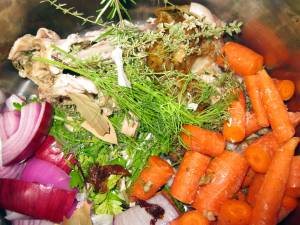
You’ll remember that when last we met, my first roast chicken had been liberated of meat.  The carcass itself I lowered into my gigantic gleaming aluminum pasta pot.  I added roughly chopped red onion chunks and quartered carrots.  Then I tossed in a liberal mix of herbs: thyme, sage, parsley, rosemary, dill, two or three bay leaves, and a small cupped handful of black peppercorns.  I finished by cracking a head of garlic and strewing several cloves, paper wrapped still, around the carcass.  I added probably twelve cups of water, and lidded the whole pot up to simmer for two and a half hours.

IMG_1770

When I strained out the bones and wasted vegetables, I was able to pour ten cups of rich, buttery-colored stock into my largest Tupperware.  At Ina Garten’s helpful suggestion courtesy of the Food Network website, I stowed the container in the fridge overnight, and was rewarded the next morning by a thick layer of fat across the top of the broth, which I scooped off before portioning out the golden liquid into smaller amounts in freezable containers.  Though I will not use it for everyday applications that only call for a cup or half a cup of broth, now I will have homemade chicken broth for clear soups and risottos.  You can bet that if this roast chicken obsession continues, I will need to start saving every lidded container that goes through my kitchen.  Scrubbed and labeled, yogurt and cottage cheese containers alike will be homes to ice-crystalled, rock hard pints of lovingly simmered stock.  C’mon, winter cold, I dare you to take on my broth base.